1989 Roosevelt Dime Coin Value: How Much Is It Worth?
Most 1989 Roosevelt dimes you find in pocket change are worth face value — ten cents. In mint-state condition, a guide estimate from USA Coin Book places an MS65 example at about $2.79.
The S clad proof carries a PR65 guide value of roughly $3.62. Higher grades, authenticated errors and coins with strong strike details can command more, so it pays to look closely before spending one.
Fast Way to Identify Your 1989 Roosevelt Dime
Want a quick read on your 1989 dime? Upload clear photos of the front and back, and our identifier will give you a preliminary idea of which version you have.
Good lighting and a steady shot help — try to capture the mintmark area near the date and the torch detail on the reverse.
1989 Roosevelt Dime Value
Upload both sides of your 1989 Roosevelt Dime.
Front Obverse
Upload photo
Back Reverse
Upload photo
Which 1989 Roosevelt Dime Versions Are Worth Money?
- 1989-P or 1989-D business strikes in high mint state with clear, fully separated torch bands.
- 1989-S clad proofs with deep mirror fields and strong cameo contrast on devices.
- Missing Obverse Clad Layer on a 1989-P — one ANACS MS63 sold for $92 in August 2004.
- Off-Center Strike on a 1989-D — roughly 50% displacement with a readable date adds significant collector interest.
Step 1: Identify Your 1989 Roosevelt Dime Mint Mark and Version
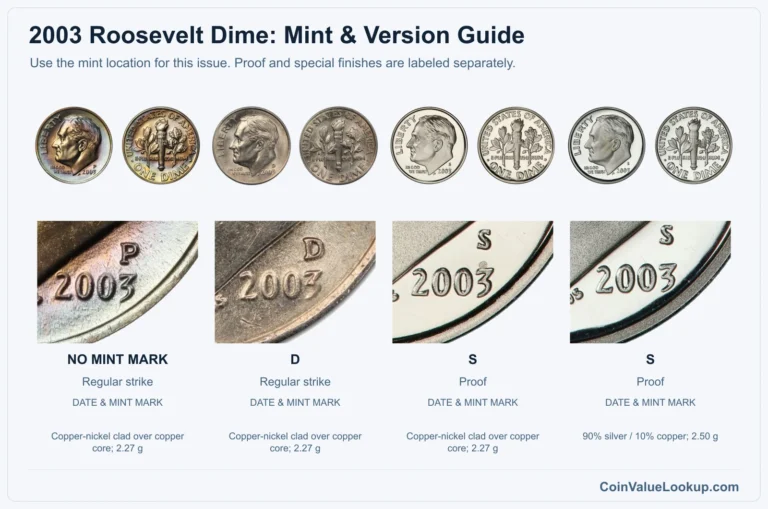
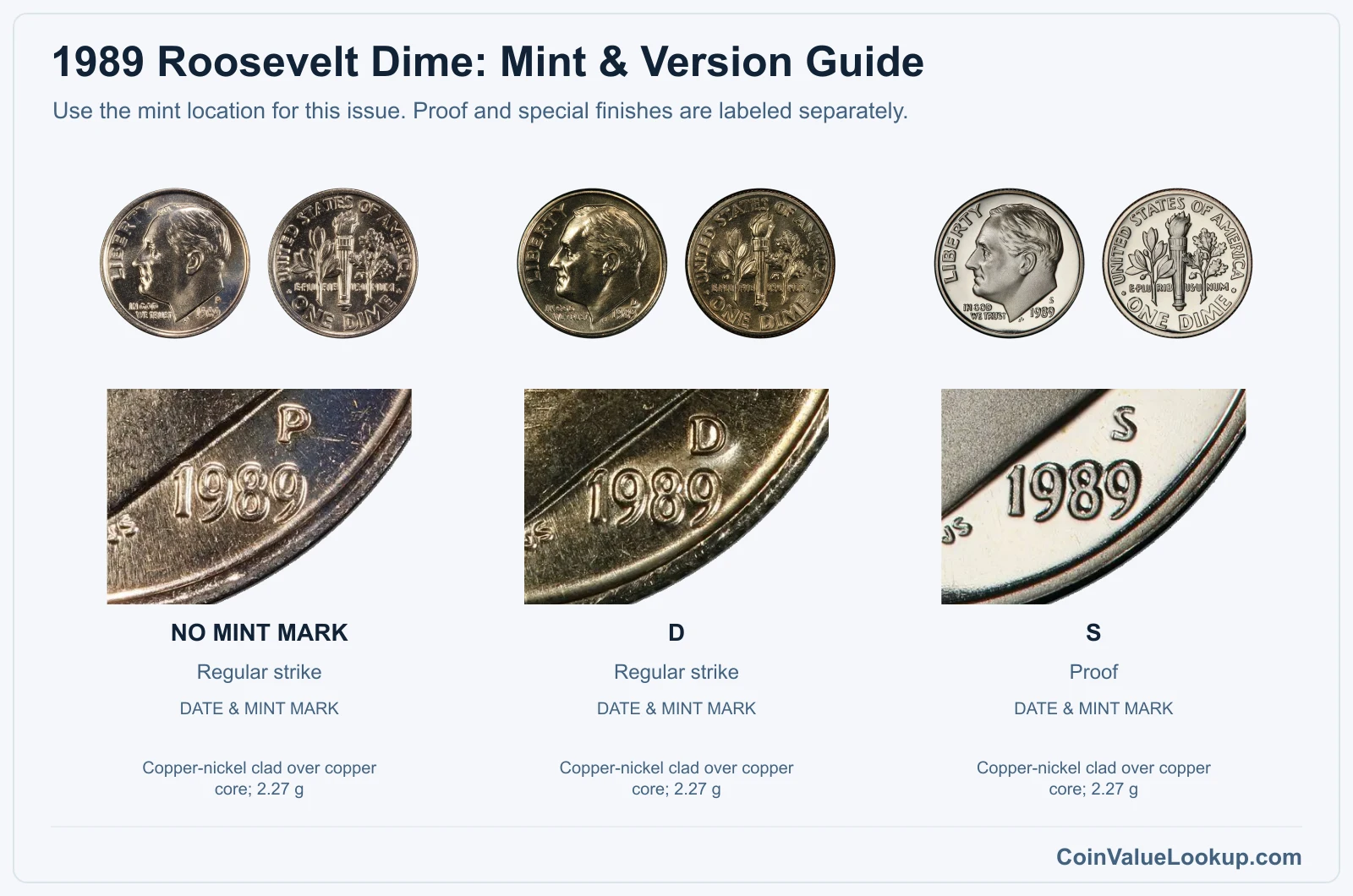
Start with the basics: confirm a 1989 date, Roosevelt's portrait on the obverse, and the torch-with-branches reverse. The mintmark sits on the obverse near the lower-left date area — look for a P (Philadelphia), D (Denver) or S (San Francisco).
All three versions use copper-nickel clad over a copper core, weighing 2.27 grams at roughly 17.9 mm in diameter. There is no regular silver proof for this date; silver S proofs did not begin until 1992.
If you tilt the coin and check the edge, you should see a copper-colored stripe sandwiched between the silvery outer layers. That stripe confirms the normal clad composition.
A coin that looks odd — wrong weight, unusual edge color, or missing clad layer — may need professional authentication rather than guesswork.
Coin Value Lookup is a good starting point when you want to compare guides for other Roosevelt dime dates and denominations. You can search by year and series to find the right reference quickly.
Step 2: Check Your 1989 Roosevelt Dime Grade
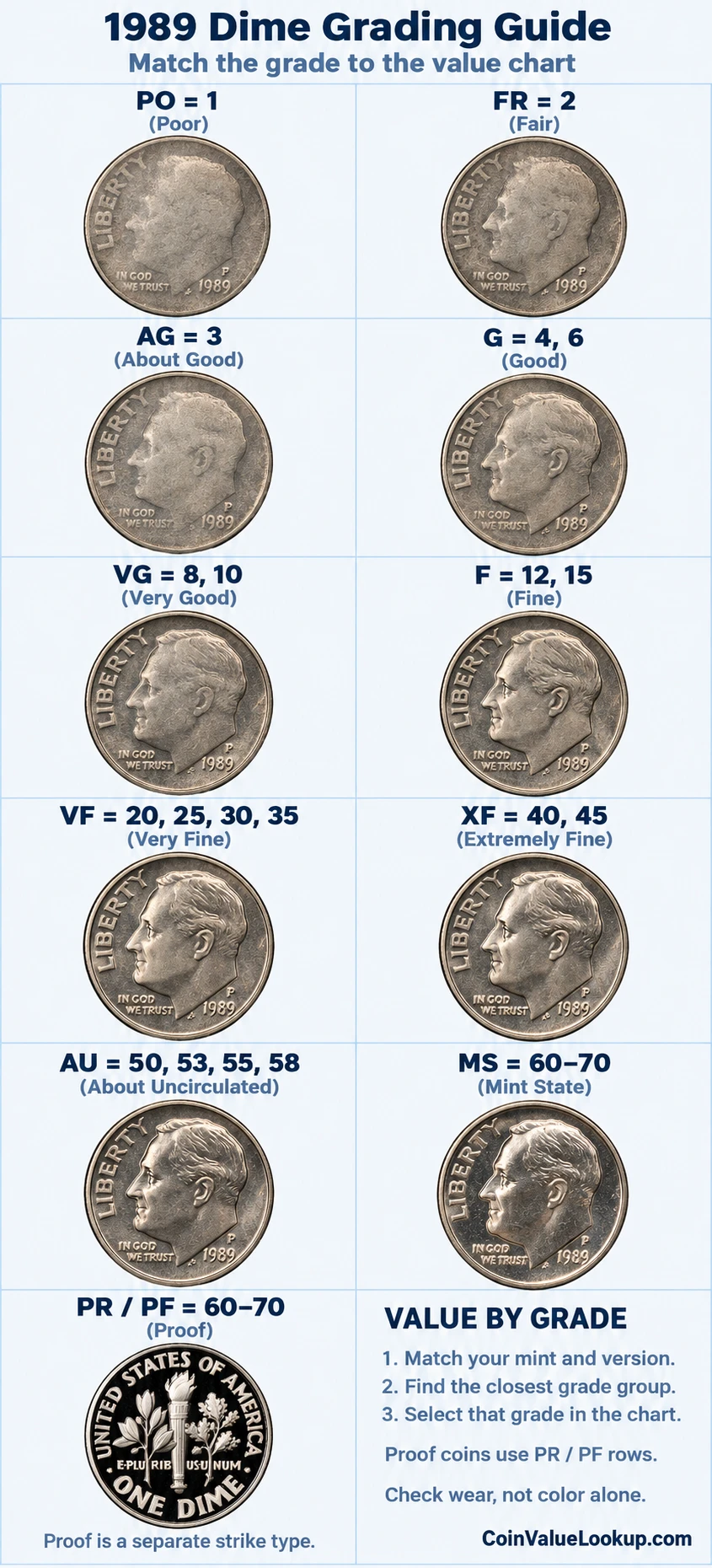
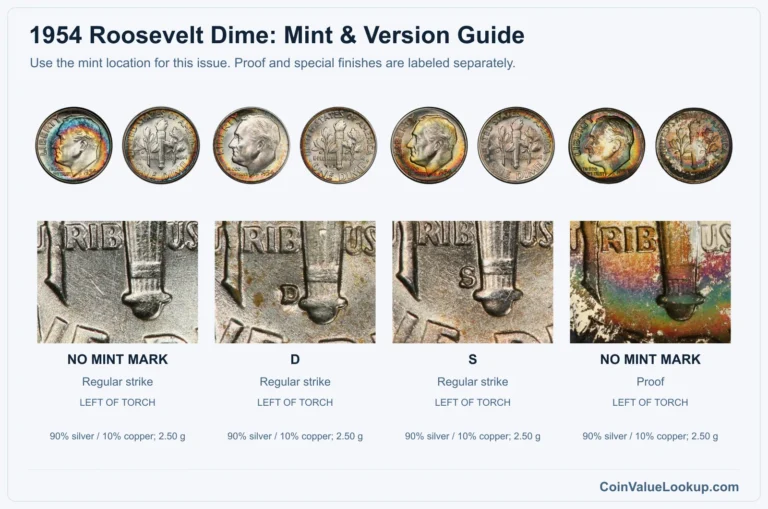
Focus on Roosevelt's cheek, jawline and the hair just above the ear — those are the first spots to show friction. On the reverse, the torch lines and the leaf veins lose definition early.
A coin with full original luster across every surface and no contact marks is heading toward gem territory.
Do not confuse a weakly struck coin with a worn one. A weak strike may leave the horizontal torch bands soft even on an uncirculated piece, while wear from circulation removes luster entirely.
Cleaning, scratches and corrosion all reduce eye appeal regardless of how much metal remains.
For proof coins, look at the fields for hairlines and haze. Cameo or deep-cameo contrast — frosted devices against mirror fields — is a separate designation from the numeric grade.
Full Bands, per PCGS, requires both horizontal band pairs on the torch to show clear separation; it describes strike quality, not an error. Use the comparison image to calibrate your eye against known grade examples.
Step 3: Check 1989 Roosevelt Dime Value by Mint and Version
1989 Roosevelt Dime — P Business Strike
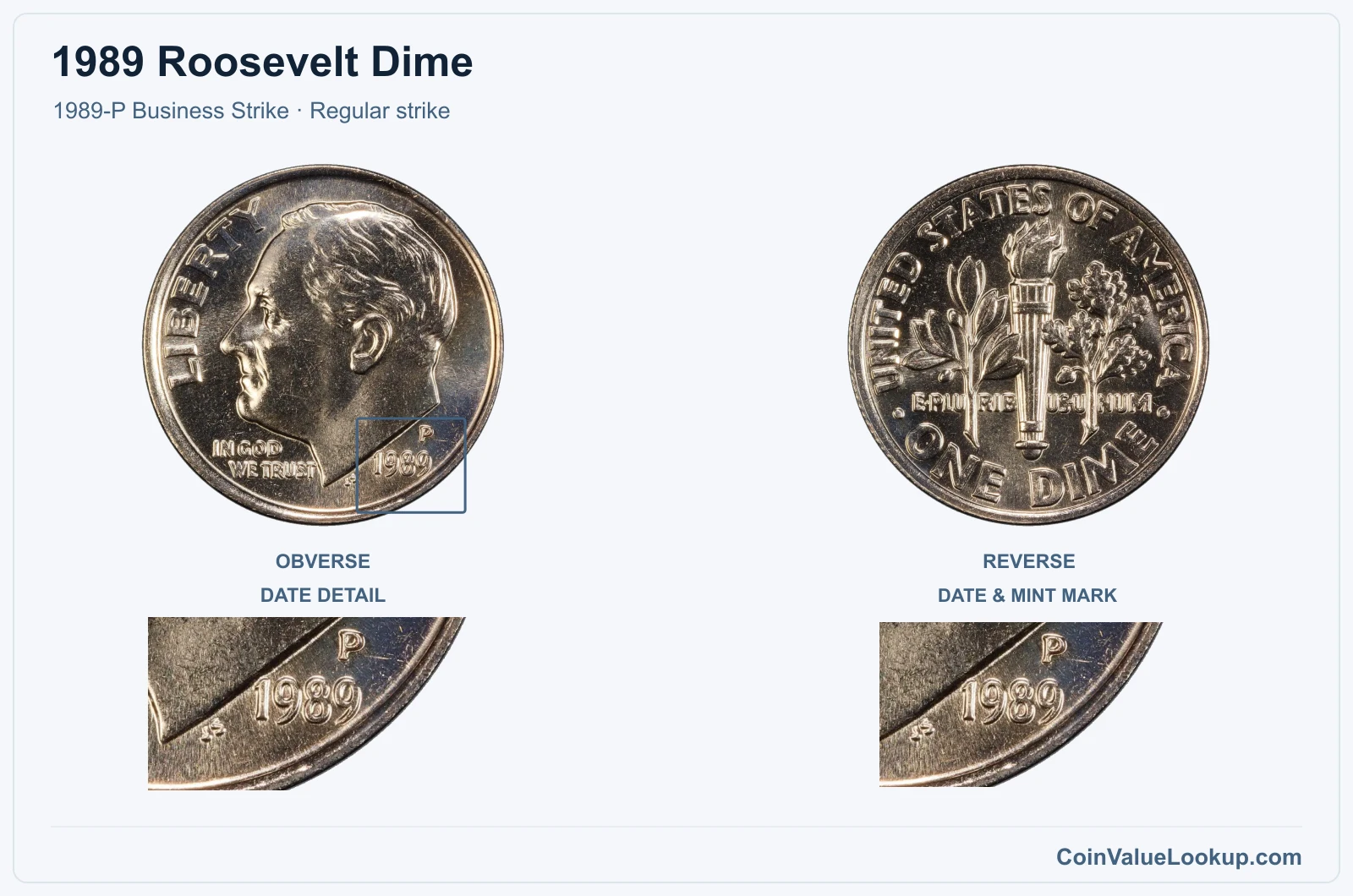
The 1989-P was struck at Philadelphia and carries a small P mintmark on the obverse near the date. It is standard copper-nickel clad over a copper core, weighing 2.27 grams.
In circulated grades these trade at face value. A USA Coin Book guide estimate puts an MS65 at $2.79.
Look for coins with sharp horizontal torch bands on the reverse; that Full Bands designation can make a difference at higher grades. Checking luster under a light helps separate a gem from a merely average uncirculated coin.
Range Grade
Price Auction Records Appraisal PO PO 1
—
Coin Identifier FR FR 2
—
Coin Identifier AG AG 3
—
Coin Identifier G G 4
—
Coin Identifier
G 6
—
Coin Identifier VG VG 8
—
Coin Identifier
VG 10
—
Coin Identifier F F 12
—
Coin Identifier
F 15
—
Coin Identifier VF VF 20
—
Coin Identifier
VF 25
—
Coin Identifier
VF 30
—
Coin Identifier
VF 35
—
Coin Identifier XF XF 40
—
Coin Identifier
XF 45
—
Coin Identifier AU AU 50
—
Coin Identifier
AU 53
—
Coin Identifier
AU 55
—
Coin Identifier
AU 58
—
Coin Identifier MS MS 60
—
Coin Identifier
MS 61
—
Coin Identifier
MS 62
—
Coin Identifier
MS 63
—
Coin Identifier
MS 64
Coin Identifier
MS 65
Coin Identifier
MS 66
Coin Identifier
MS 67
Coin Identifier
MS 68
Coin Identifier
MS 69
—
—
—
MS 70
—
—
—
1989 Roosevelt Dime — D Business Strike
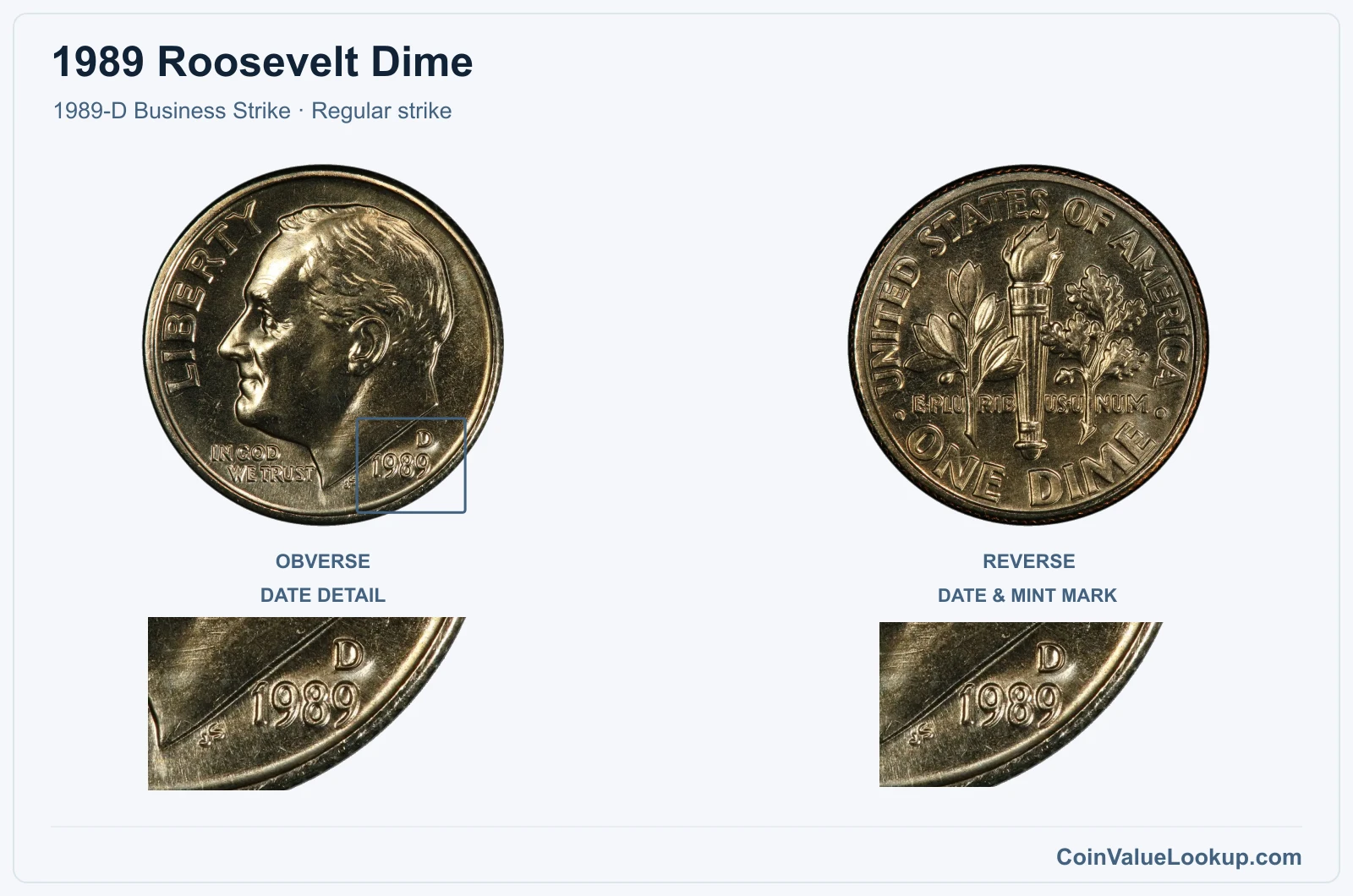
Denver's 1989-D dime is the same composition and weight as the P issue, distinguished by its D mintmark. The USA Coin Book guide also lists MS65 at $2.79.
Huge mintages for both facilities mean circulated examples are common — you need strong luster, clean surfaces and fully separated torch bands to push into collectible territory. Look at the edge for the expected copper stripe to confirm the normal clad makeup.
Range Grade
Price Auction Records Appraisal PO PO 1
—
Coin Identifier FR FR 2
—
Coin Identifier AG AG 3
—
Coin Identifier G G 4
—
Coin Identifier
G 6
—
Coin Identifier VG VG 8
—
Coin Identifier
VG 10
—
Coin Identifier F F 12
—
Coin Identifier
F 15
—
Coin Identifier VF VF 20
—
Coin Identifier
VF 25
—
Coin Identifier
VF 30
—
Coin Identifier
VF 35
—
Coin Identifier XF XF 40
—
Coin Identifier
XF 45
—
Coin Identifier AU AU 50
—
Coin Identifier
AU 53
—
Coin Identifier
AU 55
—
Coin Identifier
AU 58
—
Coin Identifier MS MS 60
—
Coin Identifier
MS 61
—
Coin Identifier
MS 62
—
Coin Identifier
MS 63
Coin Identifier
MS 64
—
Coin Identifier
MS 65
—
Coin Identifier
MS 66
Coin Identifier
MS 67
Coin Identifier
MS 68
Coin Identifier
MS 69
—
—
—
MS 70
—
—
—
1989 Roosevelt Dime — S Clad Proof
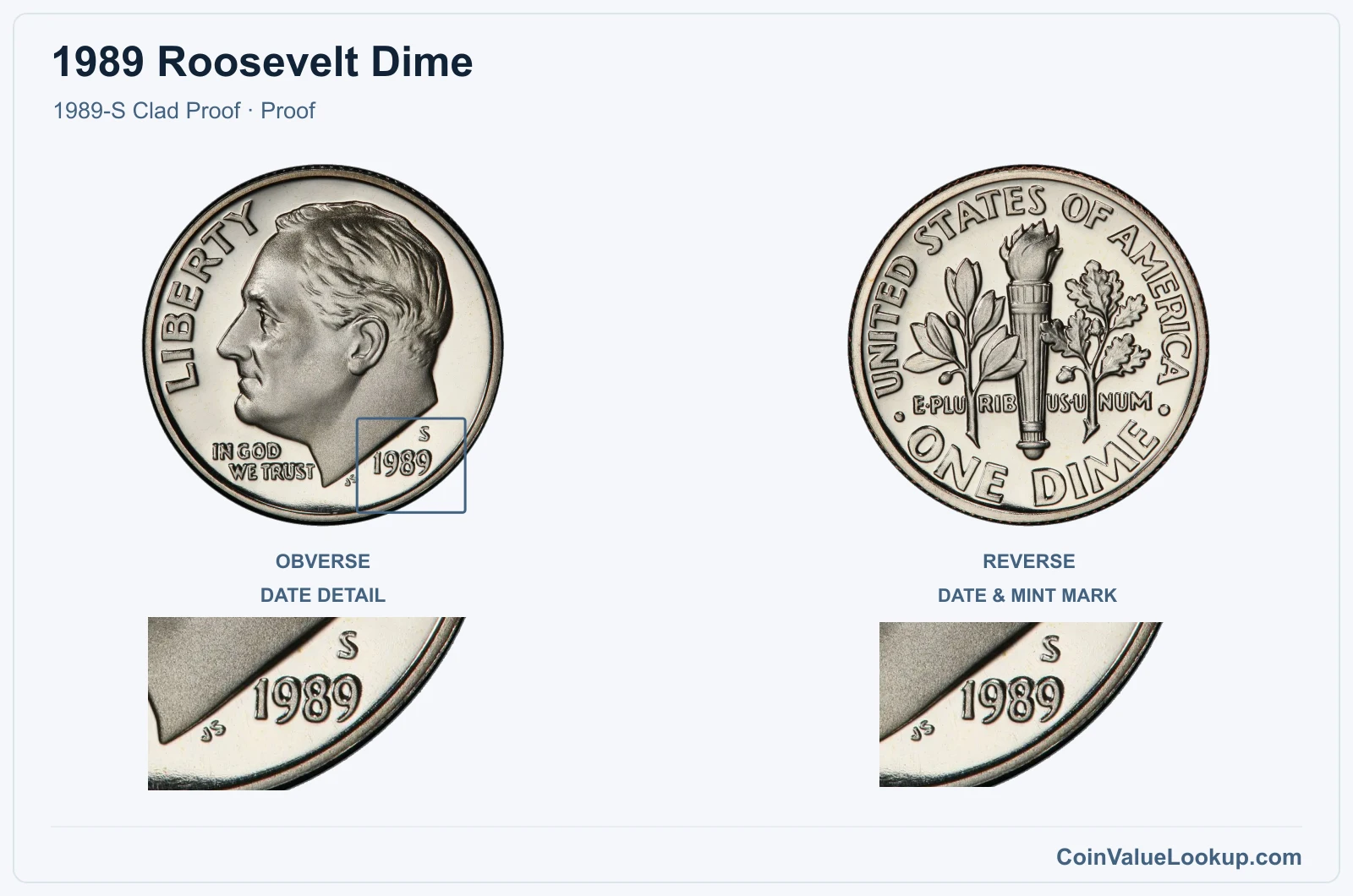
San Francisco produced the 1989-S clad proof for collectors, sold in proof sets. Same copper-nickel clad composition, same 2.27-gram weight, but struck with polished dies and specially prepared planchets for mirror-like fields.
A USA Coin Book guide estimate places PR65 at $3.62. Coins with frosted devices contrasting against deep reflective fields earn cameo or deep-cameo designations, which collectors prefer.
Hairlines from handling are the biggest grade killer on proofs, so check the open fields carefully under angled light. No silver proof exists for 1989 — that option started in 1992.
Range Grade
Price Auction Records Appraisal PR PR 1
—
Coin Identifier
PR 2
—
Coin Identifier
PR 3
—
Coin Identifier
PR 4
—
Coin Identifier
PR 6
—
Coin Identifier
PR 8
—
Coin Identifier
PR 10
—
Coin Identifier
PR 12
—
Coin Identifier
PR 15
—
Coin Identifier
PR 20
—
Coin Identifier
PR 25
—
Coin Identifier
PR 30
—
Coin Identifier
PR 35
—
Coin Identifier
PR 40
—
Coin Identifier
PR 45
—
Coin Identifier
PR 50
—
Coin Identifier
PR 53
—
Coin Identifier
PR 55
—
Coin Identifier
PR 58
—
Coin Identifier
PR 60
—
Coin Identifier
PR 61
—
Coin Identifier
PR 62
—
Coin Identifier
PR 63
—
Coin Identifier
PR 64
—
Coin Identifier
PR 65
—
Coin Identifier
PR 66
—
Coin Identifier
PR 67
—
Coin Identifier
PR 68
Coin Identifier
PR 69
Coin Identifier
PR 70
Coin Identifier
1989 Roosevelt Dime Error List
1. 1989 Roosevelt Dime — Missing Obverse Clad Layer
A 1989-P dime missing its obverse clad layer exposes the copper core on the face of the coin, giving it a distinctly reddish or orange appearance on that side while the reverse remains its normal silvery tone. The blank was thinner than usual, so you may notice some border weakness around the rim.
Check the edge — it should show an asymmetric layer structure since one outer skin is absent.
One ANACS-graded MS63 specimen sold through Heritage Auctions in August 2004 for $92. That particular coin also had a small scratch below the date, which was noted in its description.
Be cautious with lookalikes: acid-treated or chemically stripped dimes can mimic the copper look, and heavy toning sometimes fools the eye. A genuine missing clad layer affects thickness and weight, which helps distinguish it from surface damage.
2. 1989 Roosevelt Dime — Off-Center Strike
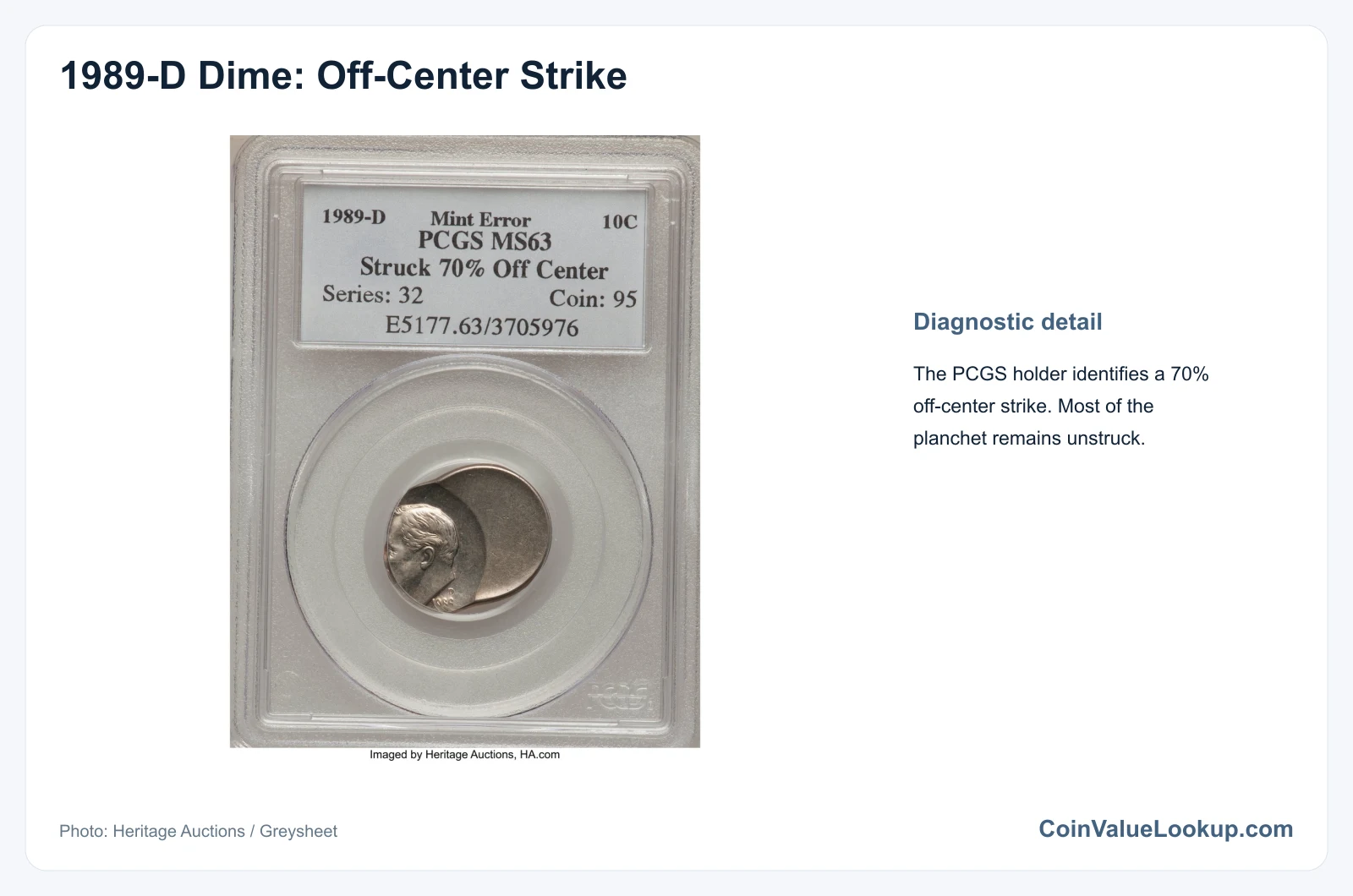
A 1989-D off-center strike listed through Heritage Auctions shows roughly 50 percent displacement toward the 1 o'clock position, leaving a dramatic unstruck crescent on part of the planchet. The date and D mintmark remain readable, which matters — an off-center coin without an identifiable date loses much of its appeal.
No individual price was adopted for this piece because it appeared in a multi-coin lot paired with a 1986-D dime. Value for off-center errors depends heavily on the percentage of displacement, whether the date is visible, and the coin's overall condition.
A one-sided die misalignment or a coin that was cut after striking can resemble an off-center error, so authentication by a recognized grading service is the safest route before assuming a premium.
3. 1989 Roosevelt Dime — Clipped Planchet
Clipped planchet errors occur when the blank is punched from strip metal that overlaps a previously punched hole or the edge of the strip, leaving a missing curved, straight or ragged section. On a 1989 dime, look for a portion of the rim and adjacent design that simply is not there.
A useful confirmation is the Blakesley effect: weakness on the rim directly opposite the clip, caused by incomplete metal flow during striking. Compare the edge texture at the clip to the rest of the coin — a genuine clip shows the coin's natural metal grain, while a filed notch or deliberate cut leaves tool marks.
Corrosion can also eat away edges unevenly. No specific price range is adopted here; value depends on the clip's size, visibility and the coin's condition, so individual assessment matters.
4. 1989 Roosevelt Dime — Repunched Mintmark
A repunched mintmark on a 1989 dime shows traces of a second or shifted impression near the primary mintmark. You might see a faint shadow, a notch or a partial letter overlapping the main punch.
Magnification at 10x or higher helps — compare your coin's mintmark to a known normal example at the same magnification to spot differences.
This is not the same as machine doubling, which leaves flat, shelf-like outlines rather than the rounded remnant of a separate punch. Die chips or corrosion near the mintmark can also mimic the look.
No specific price range is adopted for this category; the premium depends on the clarity of the remnant, the coin's grade and overall eye appeal. Authentication through a grading service is the surest way to confirm it.
5. 1989 Roosevelt Dime — Die Crack / Die Chip
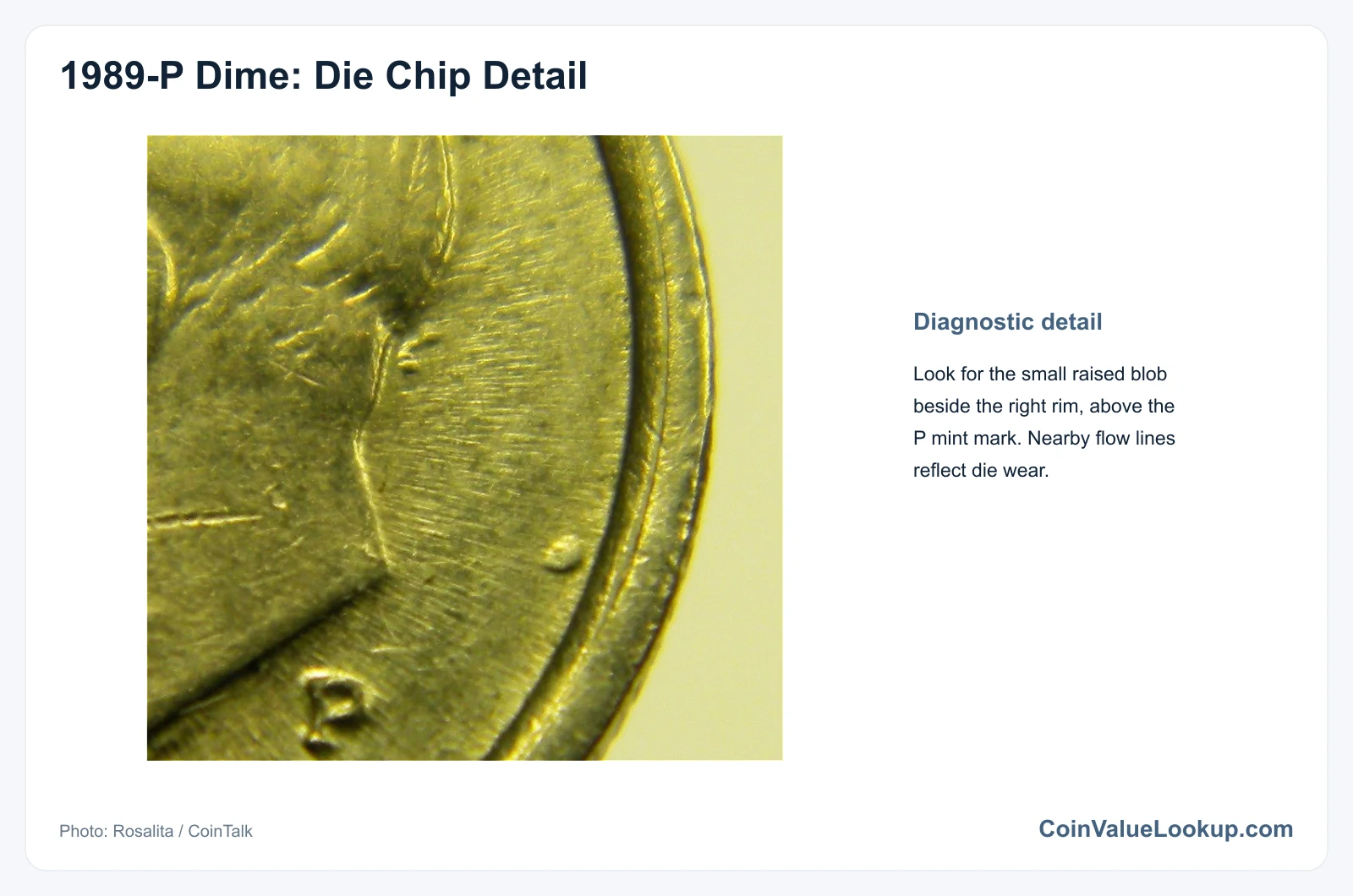
Die cracks and die chips appear as raised lines or small raised blobs on the coin's surface, transferred from a deteriorating die. On a 1989 dime, look for thin raised ridges running across the design or a small lump of extra metal — often near letters, the rim or high-relief areas.
A crack that connects to the rim and raises a significant chunk of metal is called a cud, which is a different animal from a small interior chip.
Do not confuse these with incuse scratches, which are pressed into the surface rather than raised above it. Foreign material stuck to the coin or corrosion buildup can also look like a die chip at first glance.
No specific price range is adopted for this category; value depends on size, location and the coin's overall condition. Photograph the full coin and the feature close-up if you want a meaningful opinion.