2004 Roosevelt Dime Coin Value: How Much Is It Worth?
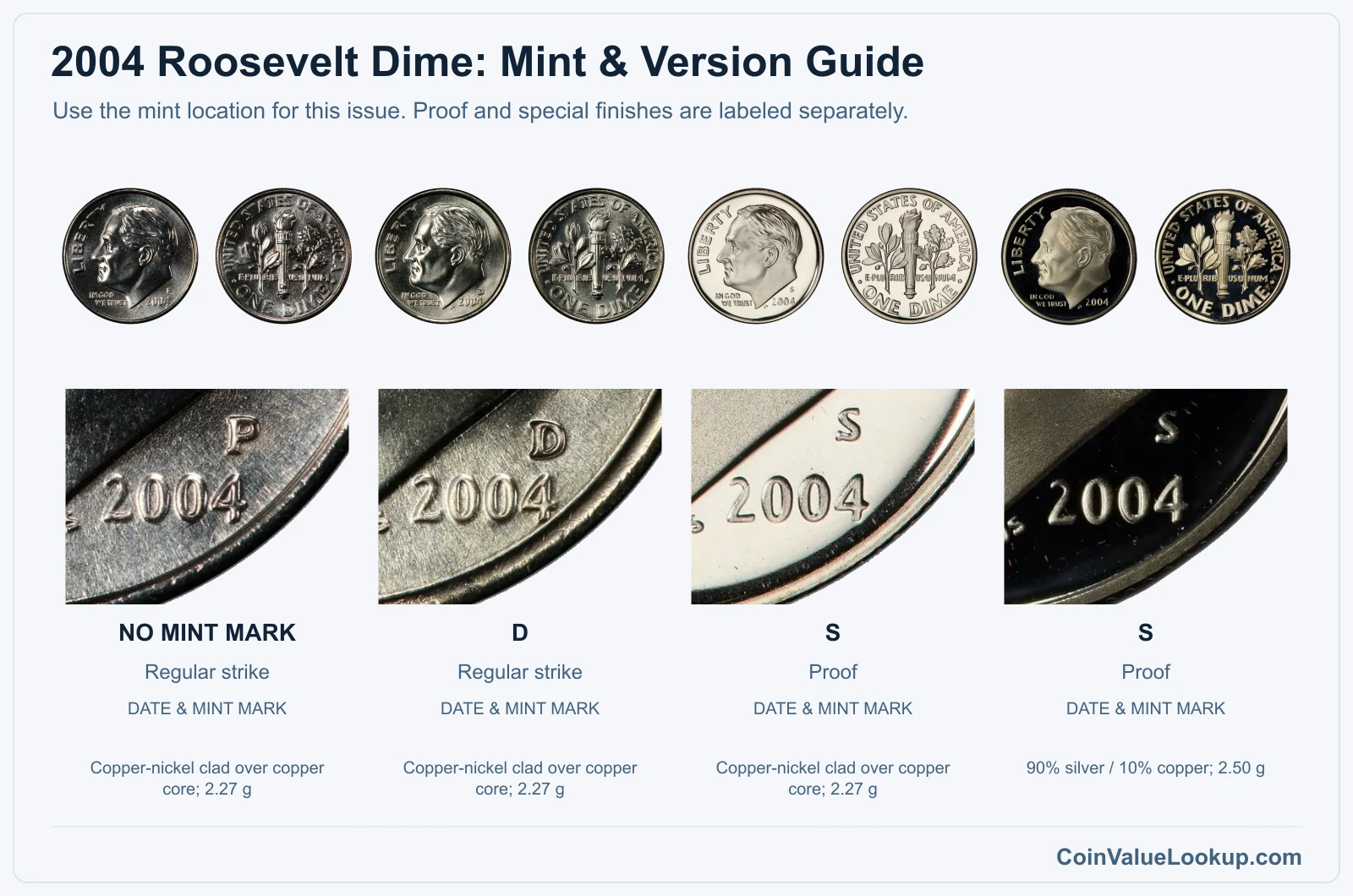
Most 2004 Roosevelt dimes you pull from a jar are worth face value — ten cents, no more. A USA Coin Book guide lists the P and D business strikes at about $2.50 in MS65 condition, the S clad proof at $3.62 in PR65, and the S silver proof at $9.65 in PR65.
Finish, condition, and authenticated errors shift those numbers, so it pays to know what you are holding.
Fast Way to Identify Your 2004 Roosevelt Dime
The quickest way to start is to snap clear photos of both sides of your coin and upload them here. Our identifier can give you a preliminary read on which version you have — Philadelphia, Denver, or San Francisco — and whether the finish looks like a business strike or proof.
It is not a substitute for professional certification, but it points you in the right direction.
2004 Roosevelt Dime Value
Upload both sides of your 2004 Roosevelt Dime.
Front Obverse
Upload photo
Back Reverse
Upload photo
Which 2004 Roosevelt Dime Versions Are Worth Money?
- Uncirculated 2004-P or 2004-D dimes with sharp, fully separated torch bands — strike quality matters for this series.
- 2004-S silver proof dime, confirmed by weight (2.50 g) and edge; the guide lists PR65 at $9.65, above the clad proof.
- 2004-S clad proof in original condition; even common proofs deserve a separate value comparison from circulated coins.
- Improperly Annealed Planchet on a 2004-D strike — a documented example sold for $38 at auction in 2015.
Step 1: Identify Your 2004 Roosevelt Dime Mint Mark and Version
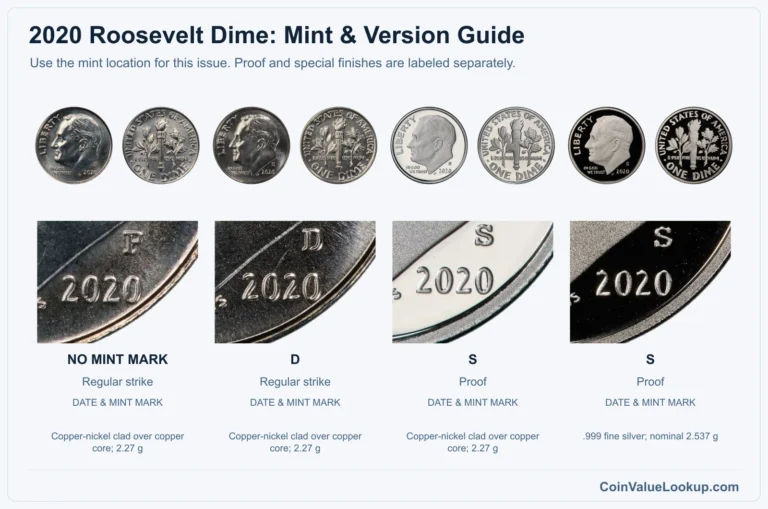
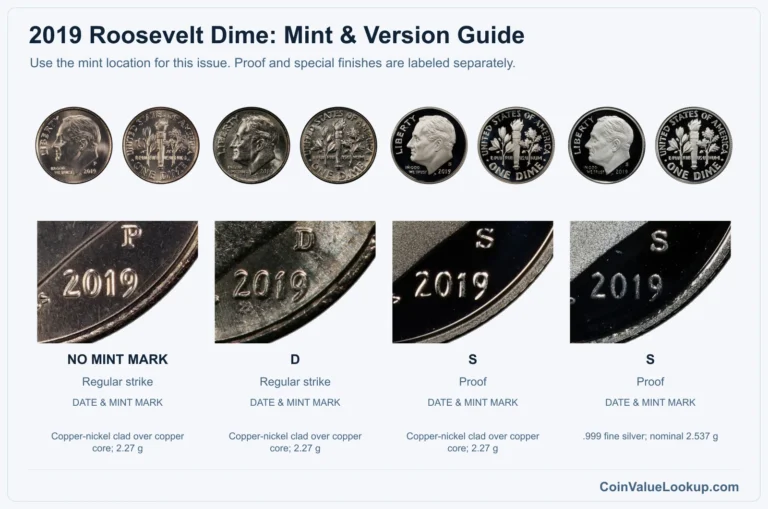
First, confirm the date reads 2004 and that you see Roosevelt's portrait on the obverse with the torch-and-branches reverse. Then check the mintmark just above the date: P for Philadelphia, D for Denver, or S for San Francisco.
P and D coins are copper-nickel clad business strikes. S-mint dimes come in two versions — clad proof and silver proof — that share the same design and mintmark.
Telling S proofs apart takes more than a glance. A normal clad dime weighs 2.27 grams; the 90% silver proof weighs 2.50 grams.
Use a precision scale. The silver proof's edge appears solid rather than showing the layered sandwich visible on clad coins.
Color alone is not reliable. Toning, cleaning, and environmental exposure all change how a surface looks.
Rely on edge appearance, weight, and original packaging when possible. Diameter for both is about 17.9 mm.
Step 2: Check Your 2004 Roosevelt Dime Grade
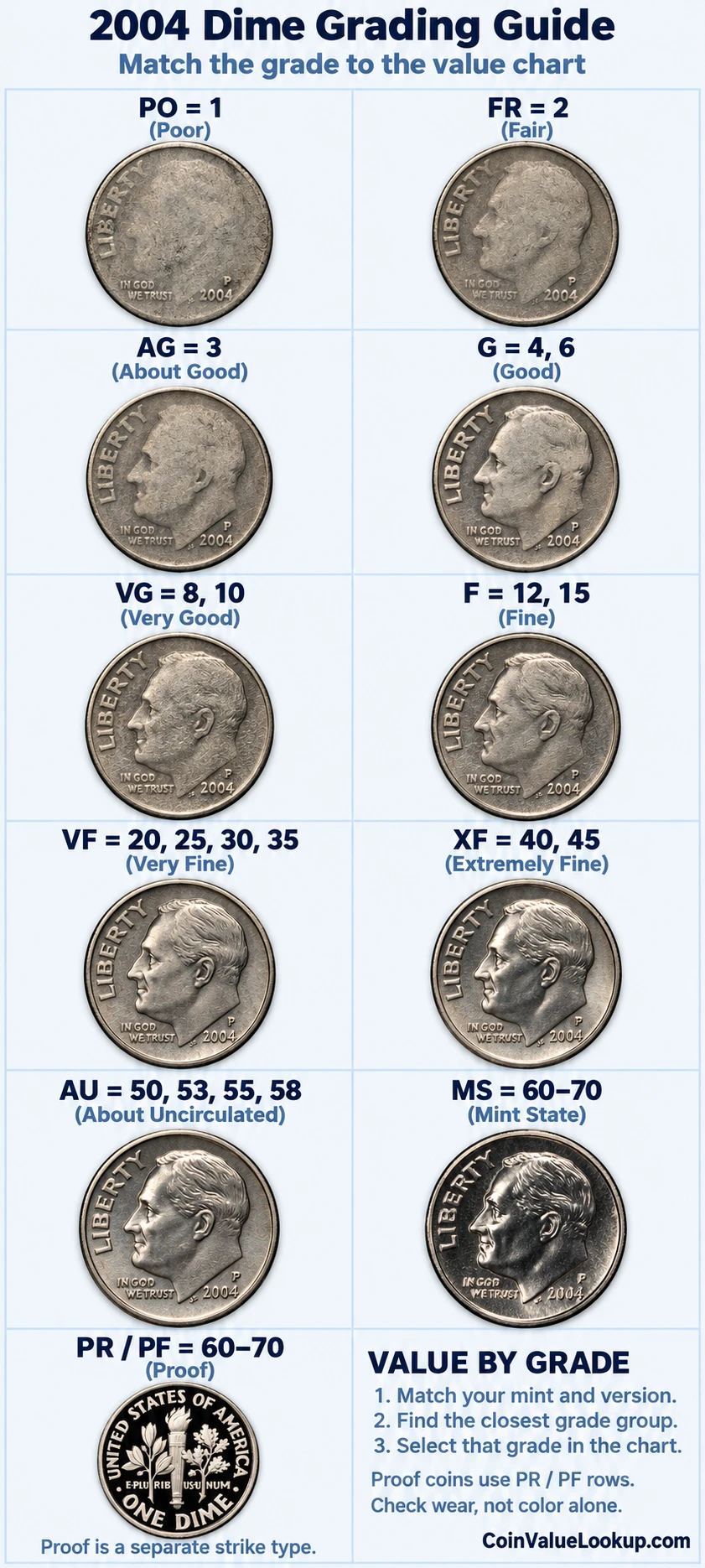
Start at the high points: Roosevelt's cheekbone, jawline, and the hair above his ear. On the reverse, examine the torch bands and leaf details.
Wear shows as flattened or dull areas where the original mint luster has been rubbed away.
Do not confuse a weak strike with actual wear. Some coins left the press without fully defined torch bands.
Full Bands is a strike designation recognizing sharp horizontal separation across both torch band pairs — it is not an error or a different alloy.
Compare your coin against the grading image provided. Look for unbroken luster across flat fields.
Bag marks and contact marks are normal on business strikes but reduce the grade.
Proofs have their own scale. A proof's mirror-like field and frosted devices should be free of haze and hairlines.
Cleaned or damaged coins of any finish need honest condition descriptions — they grade lower, sometimes sharply.
Step 3: Check 2004 Roosevelt Dime Value by Mint and Version
2004 Roosevelt Dime — P Business Strike
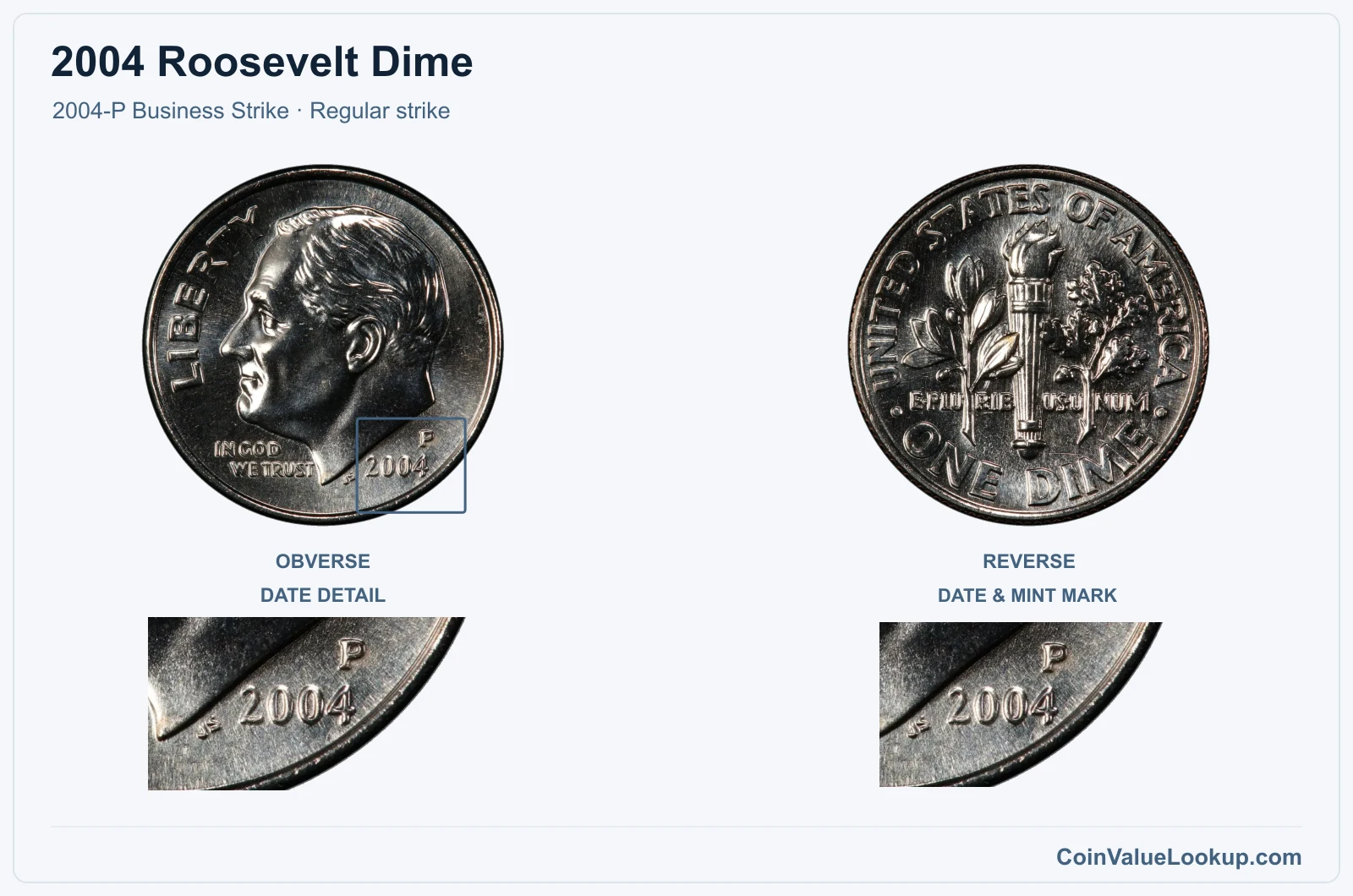
The 2004-P dime was struck at Philadelphia on standard copper-nickel clad planchets weighing 2.27 grams. Look for the small P mintmark above the date on the obverse.
In circulated condition these trade at face value.
A USA Coin Book guide places the MS65 value at roughly $2.50. Coins with sharply struck, fully separated horizontal torch bands can command attention from registry-set collectors, so inspect the reverse carefully before tossing one back in the jar.
Range Grade
Price Auction Records Appraisal PO PO 1
—
Coin Identifier FR FR 2
—
Coin Identifier AG AG 3
—
Coin Identifier G G 4
—
Coin Identifier
G 6
—
Coin Identifier VG VG 8
—
Coin Identifier
VG 10
—
Coin Identifier F F 12
—
Coin Identifier
F 15
—
Coin Identifier VF VF 20
—
Coin Identifier
VF 25
—
Coin Identifier
VF 30
—
Coin Identifier
VF 35
—
Coin Identifier XF XF 40
—
Coin Identifier
XF 45
—
Coin Identifier AU AU 50
—
Coin Identifier
AU 53
—
Coin Identifier
AU 55
—
Coin Identifier
AU 58
—
Coin Identifier MS MS 60
—
Coin Identifier
MS 61
—
Coin Identifier
MS 62
—
Coin Identifier
MS 63
—
Coin Identifier
MS 64
—
Coin Identifier
MS 65
—
Coin Identifier
MS 66
—
Coin Identifier
MS 67
—
Coin Identifier
MS 68
—
Coin Identifier
MS 69
—
Coin Identifier
MS 70
—
—
—
2004 Roosevelt Dime — D Business Strike
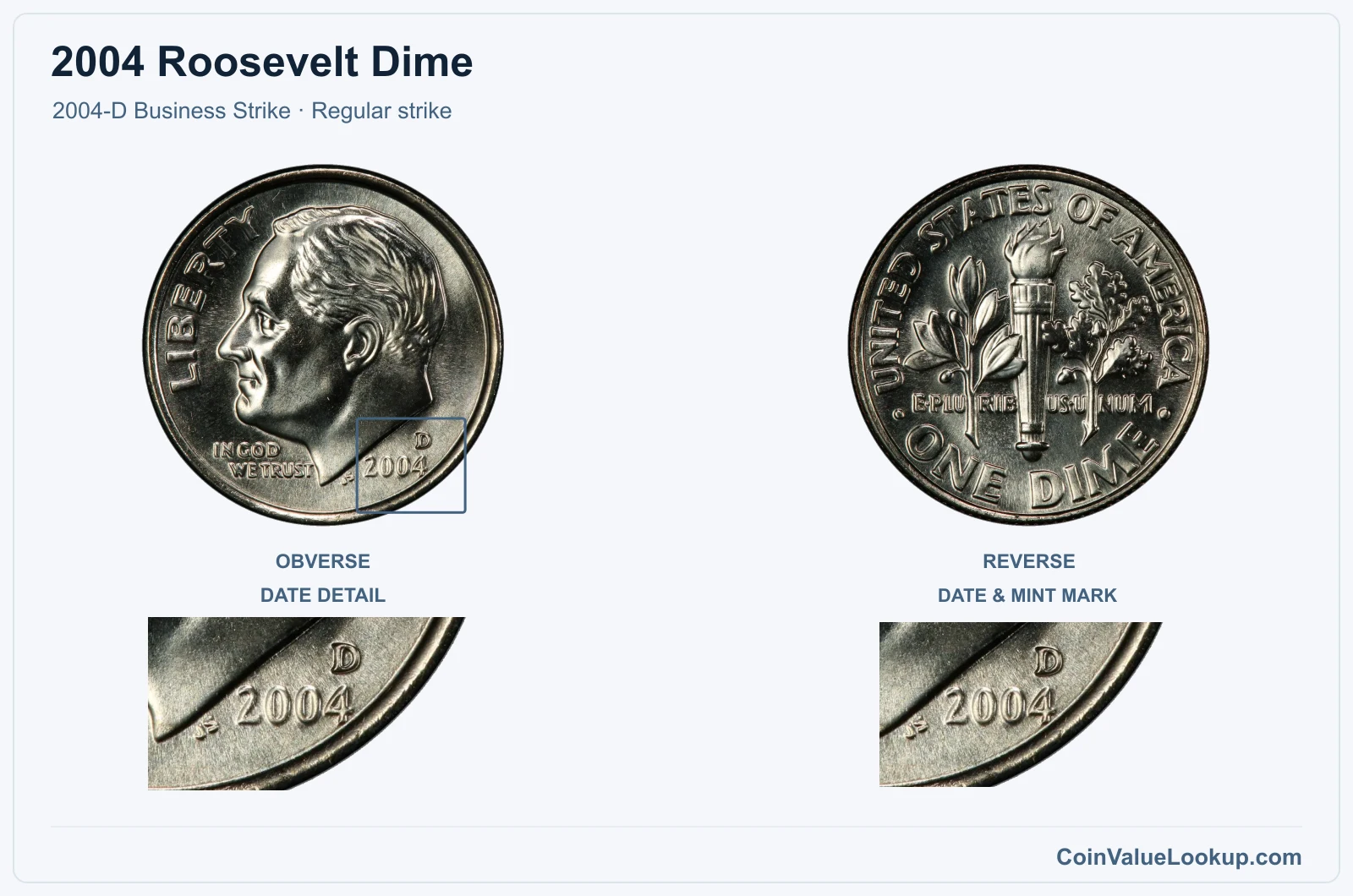
Denver's 2004-D dime uses the same copper-nickel clad composition and 2.27-gram weight as its Philadelphia counterpart. The D mintmark sits in the same spot above the date.
Guide value at MS65 is about $2.50 according to USA Coin Book. Like the P mint, watch for Full Bands examples — those clean horizontal separations on the torch are a strike characteristic, not a rarity per se, but they affect how the coin is graded and valued at upper mint-state levels.
Coin Value Lookup is a good starting point if you want to compare this dime against other years or denominations. You can look up guides organized by series and date.
Range Grade
Price Auction Records Appraisal PO PO 1
—
Coin Identifier FR FR 2
—
Coin Identifier AG AG 3
—
Coin Identifier G G 4
—
Coin Identifier
G 6
—
Coin Identifier VG VG 8
—
Coin Identifier
VG 10
—
Coin Identifier F F 12
—
Coin Identifier
F 15
—
Coin Identifier VF VF 20
—
Coin Identifier
VF 25
—
Coin Identifier
VF 30
—
Coin Identifier
VF 35
—
Coin Identifier XF XF 40
—
Coin Identifier
XF 45
—
Coin Identifier AU AU 50
—
Coin Identifier
AU 53
—
Coin Identifier
AU 55
—
Coin Identifier
AU 58
Coin Identifier MS MS 60
—
Coin Identifier
MS 61
—
Coin Identifier
MS 62
—
Coin Identifier
MS 63
—
Coin Identifier
MS 64
—
Coin Identifier
MS 65
—
Coin Identifier
MS 66
—
Coin Identifier
MS 67
Coin Identifier
MS 68
—
Coin Identifier
MS 69
—
—
—
MS 70
—
—
—
2004 Roosevelt Dime — S Clad Proof
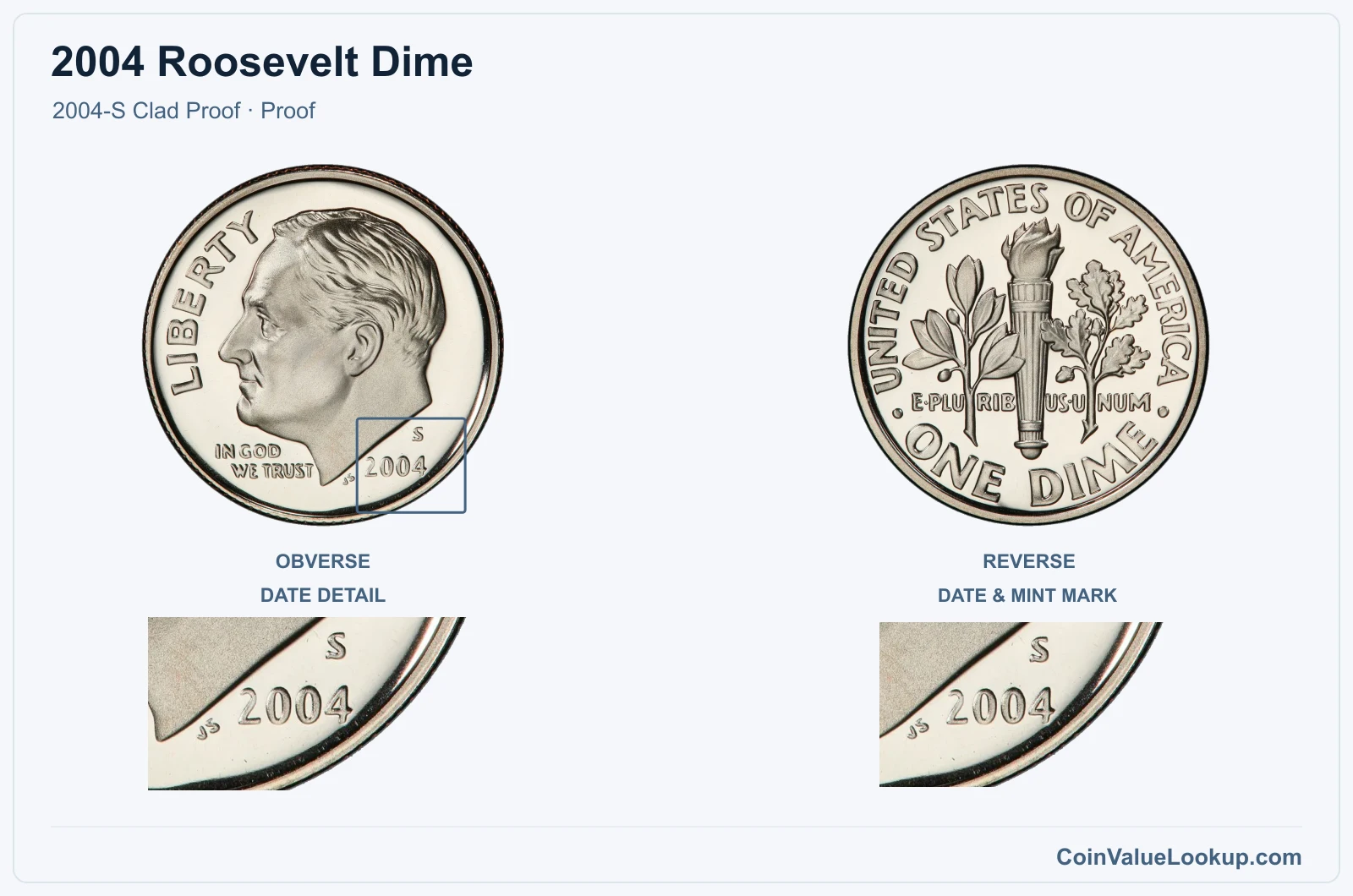
San Francisco struck clad proof dimes in 2004 with the same copper-nickel clad composition as circulation strikes, at 2.27 grams. These came in standard proof sets with mirror fields and frosted devices.
The USA Coin Book guide lists PR65 at $3.62. Because both S-mint proofs share the same mintmark and design, you need the edge and weight to confirm clad versus silver.
The clad proof shows the familiar layered sandwich on its edge. Original government packaging is the easiest confirmation if you still have it.
Range Grade
Price Auction Records Appraisal PR PR 1
—
Coin Identifier
PR 2
—
Coin Identifier
PR 3
—
Coin Identifier
PR 4
—
Coin Identifier
PR 6
—
Coin Identifier
PR 8
—
Coin Identifier
PR 10
—
Coin Identifier
PR 12
—
Coin Identifier
PR 15
—
Coin Identifier
PR 20
—
Coin Identifier
PR 25
—
Coin Identifier
PR 30
—
Coin Identifier
PR 35
—
Coin Identifier
PR 40
—
Coin Identifier
PR 45
—
Coin Identifier
PR 50
—
Coin Identifier
PR 53
—
Coin Identifier
PR 55
—
Coin Identifier
PR 58
—
Coin Identifier
PR 60
—
Coin Identifier
PR 61
—
Coin Identifier
PR 62
—
Coin Identifier
PR 63
—
Coin Identifier
PR 64
—
Coin Identifier
PR 65
—
Coin Identifier
PR 66
—
Coin Identifier
PR 67
—
Coin Identifier
PR 68
—
Coin Identifier
PR 69
Coin Identifier
PR 70
Coin Identifier
2004 Roosevelt Dime — S Silver Proof
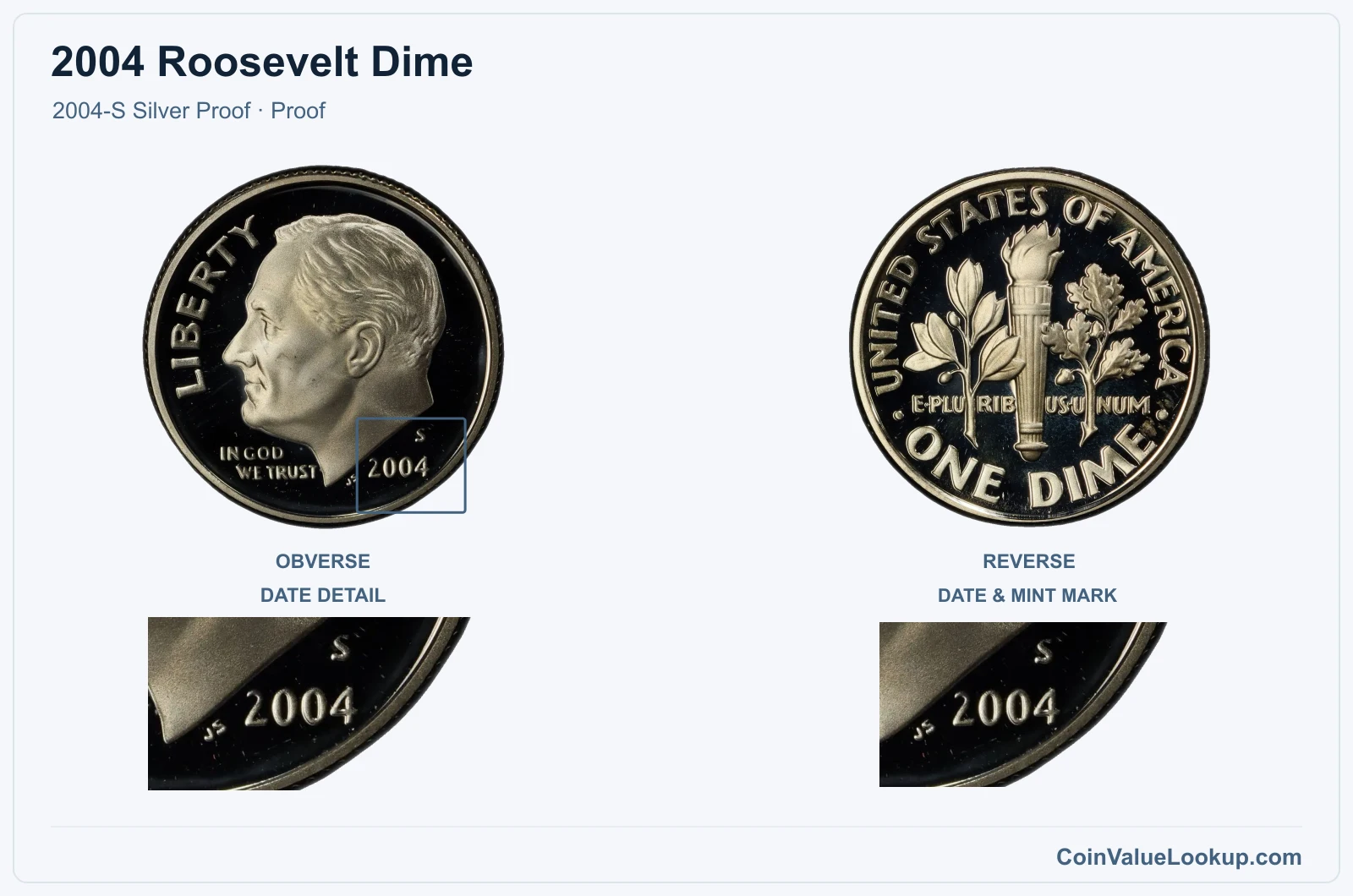
The 2004-S silver proof dime is 90% silver and 10% copper, weighing 2.50 grams — noticeably heavier than the 2.27-gram clad version. The silver proof set program was reintroduced in 1992, and this coin was part of that continuing series.
At PR65, USA Coin Book lists this version at $9.65, making it the highest guide value among the four 2004 dime versions at that grade level. Confirming the silver content is essential: weigh the coin on a scale accurate to at least 0.1 grams and examine the edge for a uniform silver-gray appearance rather than a copper-nickel sandwich line.
Range Grade
Price Auction Records Appraisal PR PR 1
—
Coin Identifier
PR 2
—
Coin Identifier
PR 3
—
Coin Identifier
PR 4
—
Coin Identifier
PR 6
—
Coin Identifier
PR 8
—
Coin Identifier
PR 10
—
Coin Identifier
PR 12
—
Coin Identifier
PR 15
—
Coin Identifier
PR 20
—
Coin Identifier
PR 25
—
Coin Identifier
PR 30
—
Coin Identifier
PR 35
—
Coin Identifier
PR 40
—
Coin Identifier
PR 45
—
Coin Identifier
PR 50
—
Coin Identifier
PR 53
—
Coin Identifier
PR 55
—
Coin Identifier
PR 58
—
Coin Identifier
PR 60
—
Coin Identifier
PR 61
—
Coin Identifier
PR 62
—
Coin Identifier
PR 63
—
Coin Identifier
PR 64
—
Coin Identifier
PR 65
—
Coin Identifier
PR 66
—
Coin Identifier
PR 67
—
Coin Identifier
PR 68
—
Coin Identifier
PR 69
Coin Identifier
PR 70
Coin Identifier
2004 Roosevelt Dime Error List
1. 2004 Roosevelt Dime — Improperly Annealed Planchet
An improperly annealed planchet occurs when the metal blank receives incorrect heat treatment before striking. The documented example for this error is a 2004-D business strike, graded NGC MS65, that sold through Heritage Auctions (lot 25236, auction 131546) for $38 in November 2015.
The visible clue is abnormal surface color that looks different from ordinary toning or wear. However, color is only a screening hint — environmental discoloration, deliberate heating, or chemical exposure can mimic the appearance.
Professional attribution is important here because the difference between a genuine mint process error and post-mint damage is not always obvious in hand.
If your 2004-D dime has an unusual overall tone that does not match normal copper-nickel clad color, it is worth a closer look, but do not assume a premium without third-party confirmation.
2. 2004 Roosevelt Dime — Off-Center Strike
An off-center strike happens when the planchet is not properly seated between the dies at the moment of impact. The result is a displaced design with an unstruck crescent of blank metal along one edge.
The date should remain visible for the coin to be identifiable and collectible.
This error category has been reported for 2004 dimes. The degree of misalignment — typically described as a percentage — along with the coin's overall condition and whether the date is readable all affect value.
No specific price is adopted here.
Watch for lookalikes: a curved clip, a one-sided die misalignment, or post-mint flattening from a vise can create misleading shapes. A true off-center strike shifts the entire design uniformly in one direction.
3. 2004 Roosevelt Dime — Broadstrike
A broadstruck dime was struck without the normal retaining collar that shapes the coin's edge and enforces its diameter. The metal spreads outward, producing a coin that is wider than standard with a smooth or irregular rim instead of the usual reeded edge.
This category has been listed for 2004 dimes. Value depends on condition, how pronounced the spread is, and whether the full design is present.
No specific price is adopted for this error.
Do not confuse a broadstrike with an off-center strike where the design is shifted to one side, or with a coin that was simply flattened after leaving the mint. A genuine broadstrike retains a centered design but lacks the normal collar-imposed edge profile.
4. 2004 Roosevelt Dime — Die Crack / Die Chip
Die cracks and die chips appear as raised lines or small raised blobs on the coin's surface. They form when the steel die develops fractures from repeated use.
A crack that reaches the rim is sometimes called a cud, producing a larger raised blob of featureless metal at the edge.
Large die cracks have been reported on 2004 dimes. The size, location, and visual impact all influence collector interest.
No specific price is adopted here.
Look carefully: raised features are the key. Incuse scratches, surface corrosion, or stuck foreign material sit below or on the surface rather than standing above it.
A genuine die crack follows a consistent raised path and will appear in the same position on other coins struck from that same die.
5. 2004 Roosevelt Dime — Clipped Planchet
A clipped planchet error occurs when the blank is incompletely punched from the metal strip, leaving a missing curved, straight, or ragged section. Genuine clips often show a characteristic weakness in the design on the opposite side of the coin, called the Blakesley effect, where metal flow was disrupted.
Clipped planchets have been listed for 2004 dimes. Value depends on the size and type of clip, whether the date is intact, and overall condition.
No specific price is adopted.
Check the edge texture at the clip boundary — it should show original metal flow, not file marks or a sharp cut. Post-mint damage from tools, impacts, or corrosion can create similar-looking notches but will lack the complementary weakness on the opposite side.
6. 2004 Roosevelt Dime — Missing Clad Layer
A missing clad layer error means one of the outer copper-nickel layers was absent before the coin was struck. The affected side may show a different color where the underlying metal is exposed, and the coin will weigh less than the normal 2.27 grams.
This category has been listed for 2004 dimes. The coin's weight compared to normal, the visual difference between sides, and the edge profile are all diagnostic.
No specific price is adopted for this error.
Toning, deliberate plating, corrosion, and post-mint surface removal can all make one side of a dime look unusual. Weigh the coin — a genuine missing clad layer produces a measurable weight deficit.
If the weight is normal and only the color seems off, environmental damage is a far more likely explanation.