2006 Roosevelt Dime Coin Value: How Much Is It Worth?
A worn 2006 Roosevelt dime from your pocket is worth face value — ten cents. In mint state, things pick up a little: a USA Coin Book guide estimate puts an MS65 Philadelphia or Denver business strike at $2.50.
The S clad proof sits around $3.08 at PR65, and the S silver proof reaches about $9.65 at the same grade. Finish, condition, and authenticated errors can push certain examples well beyond those guide figures, so it pays to know what you have.
Fast Way to Identify Your 2006 Roosevelt Dime
The quickest way to start is to upload clear photos of the front and back of your 2006 dime. That lets us run a preliminary identification of the mintmark, finish type, and overall condition.
Snap both sides in good light against a plain background. This is not a substitute for professional authentication or grading, but it gives you a useful starting point before you decide on next steps.
2006 Roosevelt Dime Value
Upload both sides of your 2006 Roosevelt Dime.
Front Obverse
Upload photo
Back Reverse
Upload photo
Which 2006 Roosevelt Dime Versions Are Worth Money?
- Uncirculated P or D business strikes with sharp, fully separated torch bands — the Full Bands strike designation can add a premium at higher grades.
- S silver proof confirmed by weight (2.50 g) and composition, not just mintmark — the silver version carries a higher guide estimate than its clad proof counterpart at the same grade.
- P and D Satin Finish coins from 2006 Uncirculated Coin Sets, which are separate special strikes with their own collector market.
- Double Clipped Planchet errors on authenticated examples — match the documented feature before assuming a premium.
- Missing Reverse Clad Layer errors on authenticated examples — verify the copper exposure is genuine, not caused by chemical damage.
Step 1: Identify Your 2006 Roosevelt Dime Mint Mark and Version
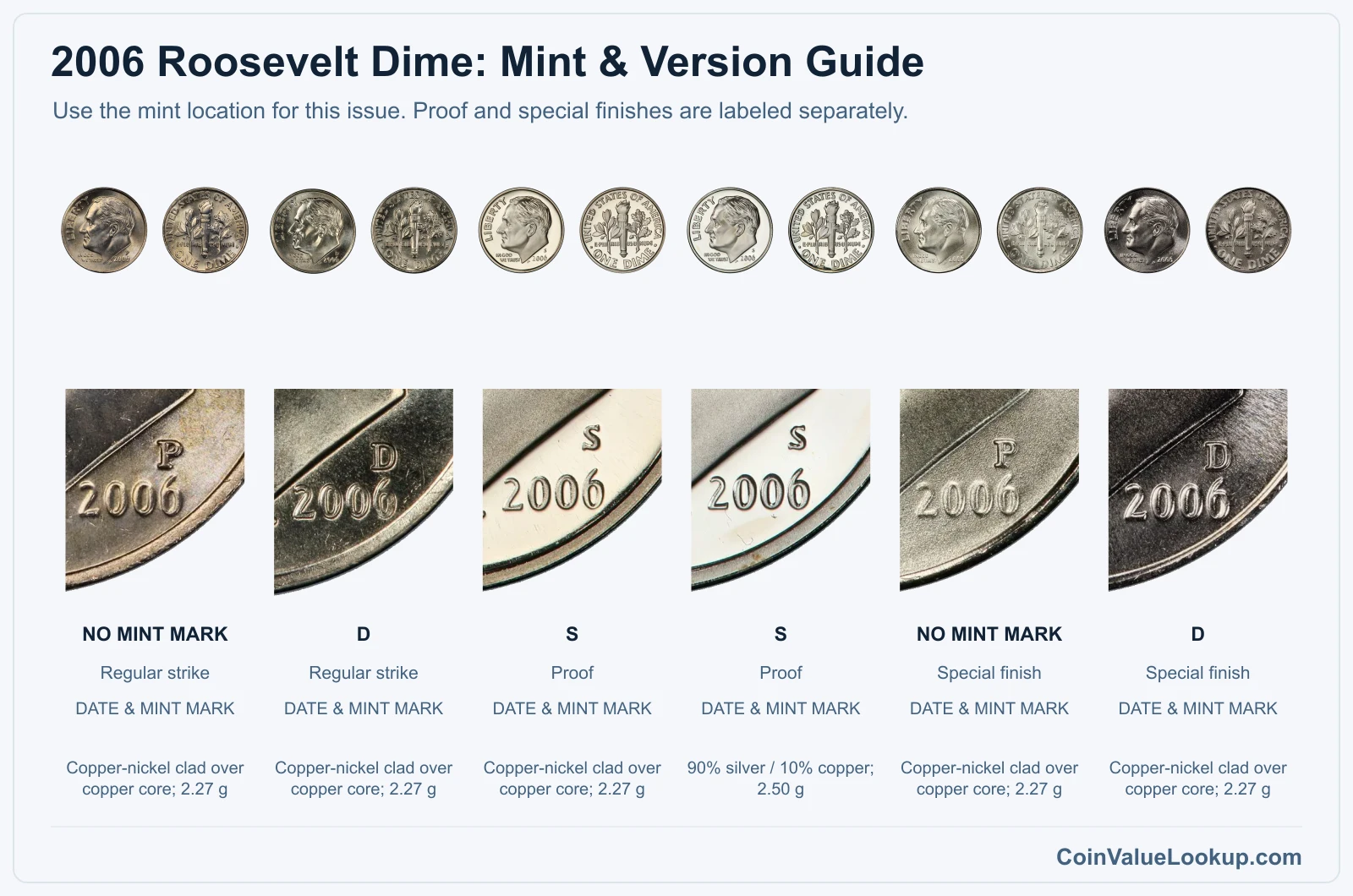
First, confirm the date reads 2006 and the design shows Roosevelt's portrait on the obverse with a torch flanked by branches on the reverse. Then find the mintmark — it sits on the obverse near the date.
P and D marks indicate circulation strikes. An S mark means a proof, but here is the tricky part: there are two S-mint versions, clad and silver, and they look nearly identical from the front.
Normal clad dimes weigh about 2.27 grams. The 90% silver proof weighs 2.50 grams.
A decent scale is your best friend here — color alone will not reliably separate them.
There are also Satin Finish versions from 2006 Uncirculated Coin Sets, struck at Philadelphia and Denver. These carry P or D mintmarks just like business strikes, so packaging and surface texture matter when telling them apart.
Check the edge, weigh the coin, and note the original packaging if you still have it.
Step 2: Check Your 2006 Roosevelt Dime Grade
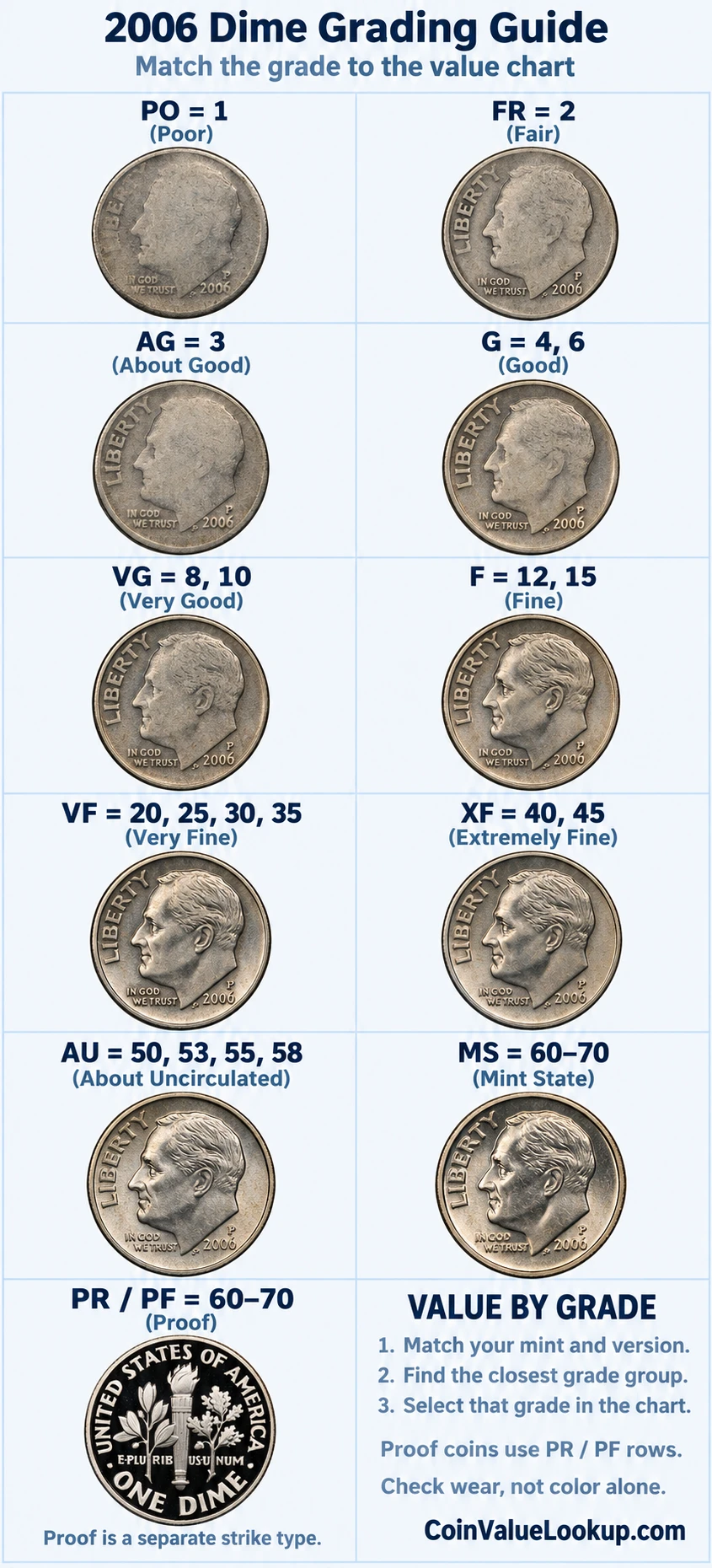
Start by examining Roosevelt's cheek and jawline — those are the first areas to lose detail as wear progresses. On the reverse, the horizontal torch bands and leaf tips tell a similar story.
Original luster matters more than raw shininess. A cleaned coin can look bright but still grade poorly because the natural mint finish has been stripped away.
Do not confuse a weak strike with actual wear. Full Bands is a strike designation recognized by PCGS: both horizontal torch band pairs need clear separation.
That is about how the coin was made, not how long it circulated.
Proof and Satin Finish coins have their own grading scales and comparisons, so do not judge them against a circulation strike. Use the comparison image for your specific version to see how different grades look side by side.
Damaged or cleaned coins will need condition qualifications that affect value regardless of remaining detail.
Step 3: Check 2006 Roosevelt Dime Value by Mint and Version
2006 Roosevelt Dime — P Business Strike
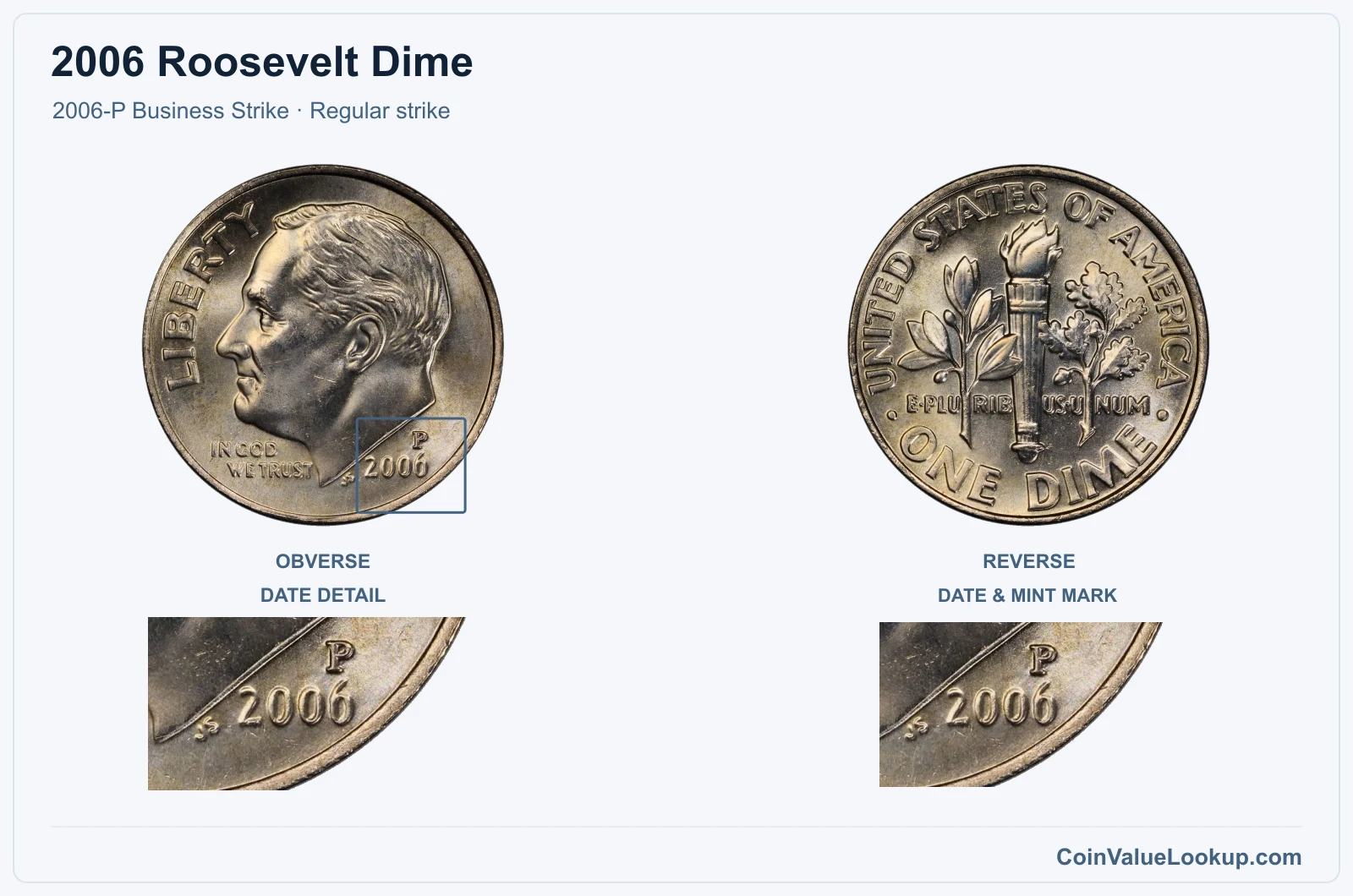
The 2006-P business strike is a copper-nickel clad dime weighing 2.27 grams, struck at Philadelphia with a P mintmark on the obverse. Millions were produced for everyday commerce, so circulated examples are worth face value.
At MS65, a USA Coin Book guide estimate is about $2.50. Coins grading higher, especially those with fully separated torch bands, can command more from specialists.
Look for unbroken luster across both sides and no contact marks on Roosevelt's cheek.
Range Grade
Price Auction Records Appraisal PO PO 1
—
Coin Identifier FR FR 2
—
Coin Identifier AG AG 3
—
Coin Identifier G G 4
—
Coin Identifier
G 6
—
Coin Identifier VG VG 8
—
Coin Identifier
VG 10
—
Coin Identifier F F 12
—
Coin Identifier
F 15
—
Coin Identifier VF VF 20
—
Coin Identifier
VF 25
—
Coin Identifier
VF 30
—
Coin Identifier
VF 35
—
Coin Identifier XF XF 40
—
Coin Identifier
XF 45
—
Coin Identifier AU AU 50
—
Coin Identifier
AU 53
—
Coin Identifier
AU 55
—
Coin Identifier
AU 58
—
Coin Identifier MS MS 60
—
Coin Identifier
MS 61
—
Coin Identifier
MS 62
—
Coin Identifier
MS 63
—
Coin Identifier
MS 64
—
Coin Identifier
MS 65
—
Coin Identifier
MS 66
—
Coin Identifier
MS 67
—
Coin Identifier
MS 68
—
—
—
MS 69
—
—
—
MS 70
—
—
—
2006 Roosevelt Dime — D Business Strike
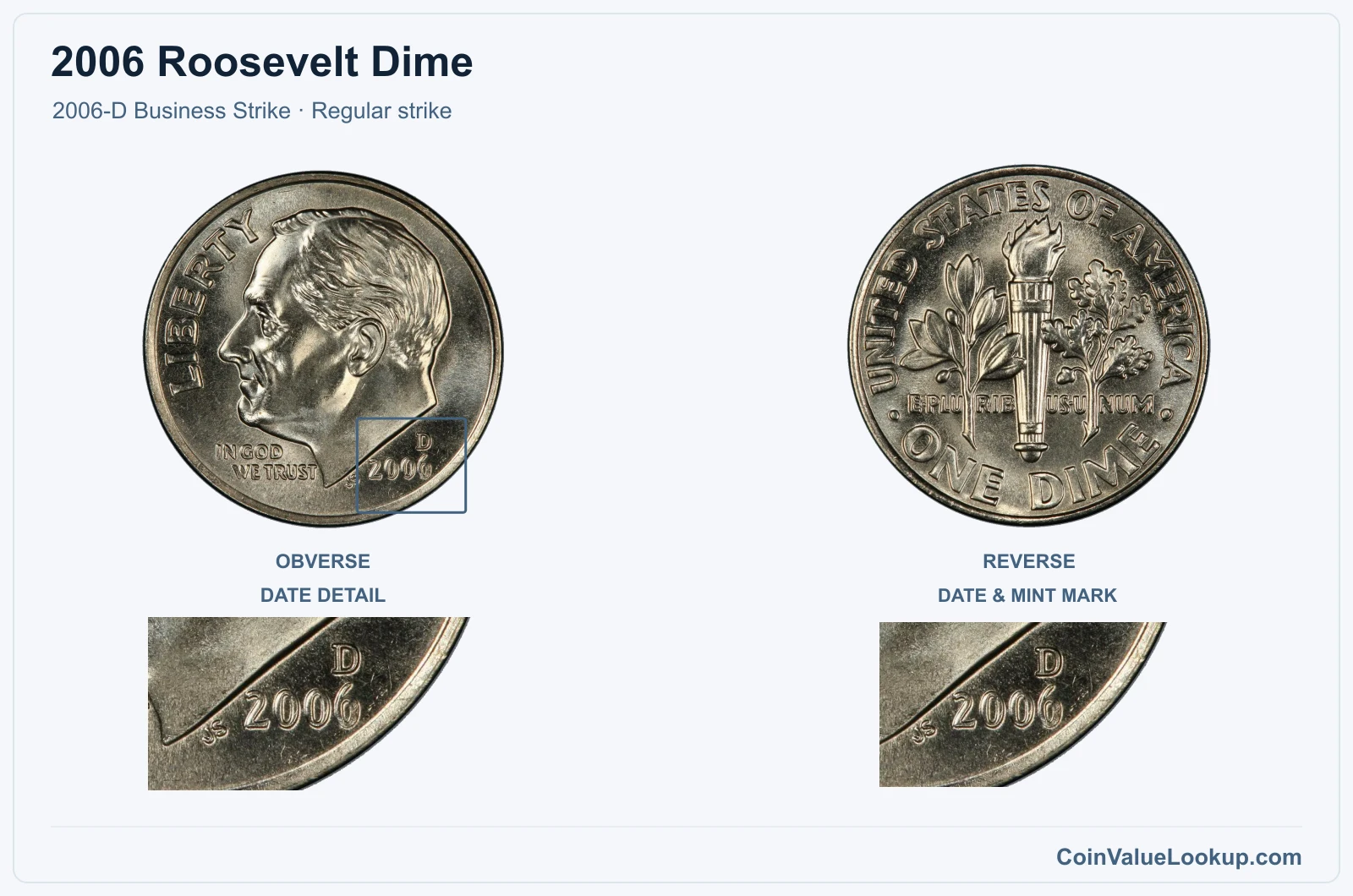
Denver's 2006-D dime shares the same copper-nickel clad composition and 2.27-gram weight as the Philadelphia issue. The D mintmark appears on the obverse near the date.
A guide estimate from USA Coin Book places this version at roughly $2.50 in MS65. As with the P mint, the real action is in higher grades with strong torch band separation.
Check the edge for even, undamaged clad layers and the surfaces for original mint luster.
Range Grade
Price Auction Records Appraisal PO PO 1
—
Coin Identifier FR FR 2
—
Coin Identifier AG AG 3
—
Coin Identifier G G 4
—
Coin Identifier
G 6
—
Coin Identifier VG VG 8
—
Coin Identifier
VG 10
—
Coin Identifier F F 12
—
Coin Identifier
F 15
—
Coin Identifier VF VF 20
—
Coin Identifier
VF 25
—
Coin Identifier
VF 30
—
Coin Identifier
VF 35
—
Coin Identifier XF XF 40
—
Coin Identifier
XF 45
—
Coin Identifier AU AU 50
—
Coin Identifier
AU 53
—
Coin Identifier
AU 55
—
Coin Identifier
AU 58
—
Coin Identifier MS MS 60
—
Coin Identifier
MS 61
—
Coin Identifier
MS 62
—
Coin Identifier
MS 63
—
Coin Identifier
MS 64
—
Coin Identifier
MS 65
—
Coin Identifier
MS 66
—
Coin Identifier
MS 67
Coin Identifier
MS 68
—
—
—
MS 69
—
—
—
MS 70
—
—
—
2006 Roosevelt Dime — S Clad Proof
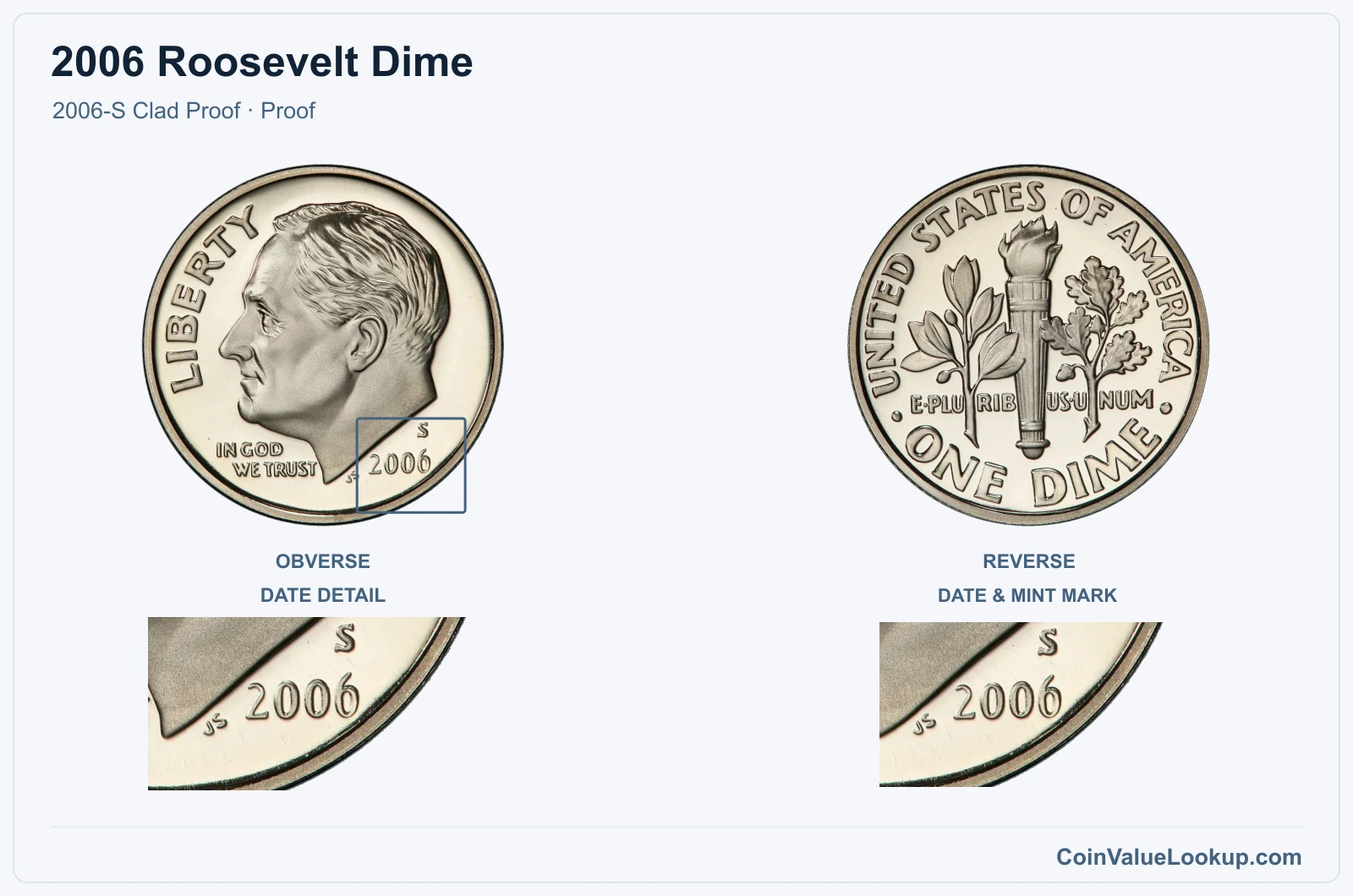
The 2006-S clad proof was struck at San Francisco on the same copper-nickel clad planchet used for business strikes. It has sharp, mirrored fields and frosted devices — the hallmarks of proof manufacturing.
A USA Coin Book guide estimate puts this one at $3.08 in PR65. The S mintmark alone does not tell you whether you have the clad or silver version, since both carry it.
Weigh the coin: 2.27 grams means clad. Original government packaging is another solid confirmation.
Coin Value Lookup is a good place to compare guide values for different Roosevelt Dime years if you are working through a collection. It can save you time when you need a quick reference across multiple dates.
Range Grade
Price Auction Records Appraisal PR PR 1
—
Coin Identifier
PR 2
—
Coin Identifier
PR 3
—
Coin Identifier
PR 4
—
Coin Identifier
PR 6
—
Coin Identifier
PR 8
—
Coin Identifier
PR 10
—
Coin Identifier
PR 12
—
Coin Identifier
PR 15
—
Coin Identifier
PR 20
—
Coin Identifier
PR 25
—
Coin Identifier
PR 30
—
Coin Identifier
PR 35
—
Coin Identifier
PR 40
—
Coin Identifier
PR 45
—
Coin Identifier
PR 50
—
Coin Identifier
PR 53
—
Coin Identifier
PR 55
—
Coin Identifier
PR 58
—
Coin Identifier
PR 60
—
Coin Identifier
PR 61
—
Coin Identifier
PR 62
—
Coin Identifier
PR 63
—
Coin Identifier
PR 64
—
Coin Identifier
PR 65
—
Coin Identifier
PR 66
—
Coin Identifier
PR 67
—
Coin Identifier
PR 68
—
Coin Identifier
PR 69
Coin Identifier
PR 70
Coin Identifier
2006 Roosevelt Dime — S Silver Proof
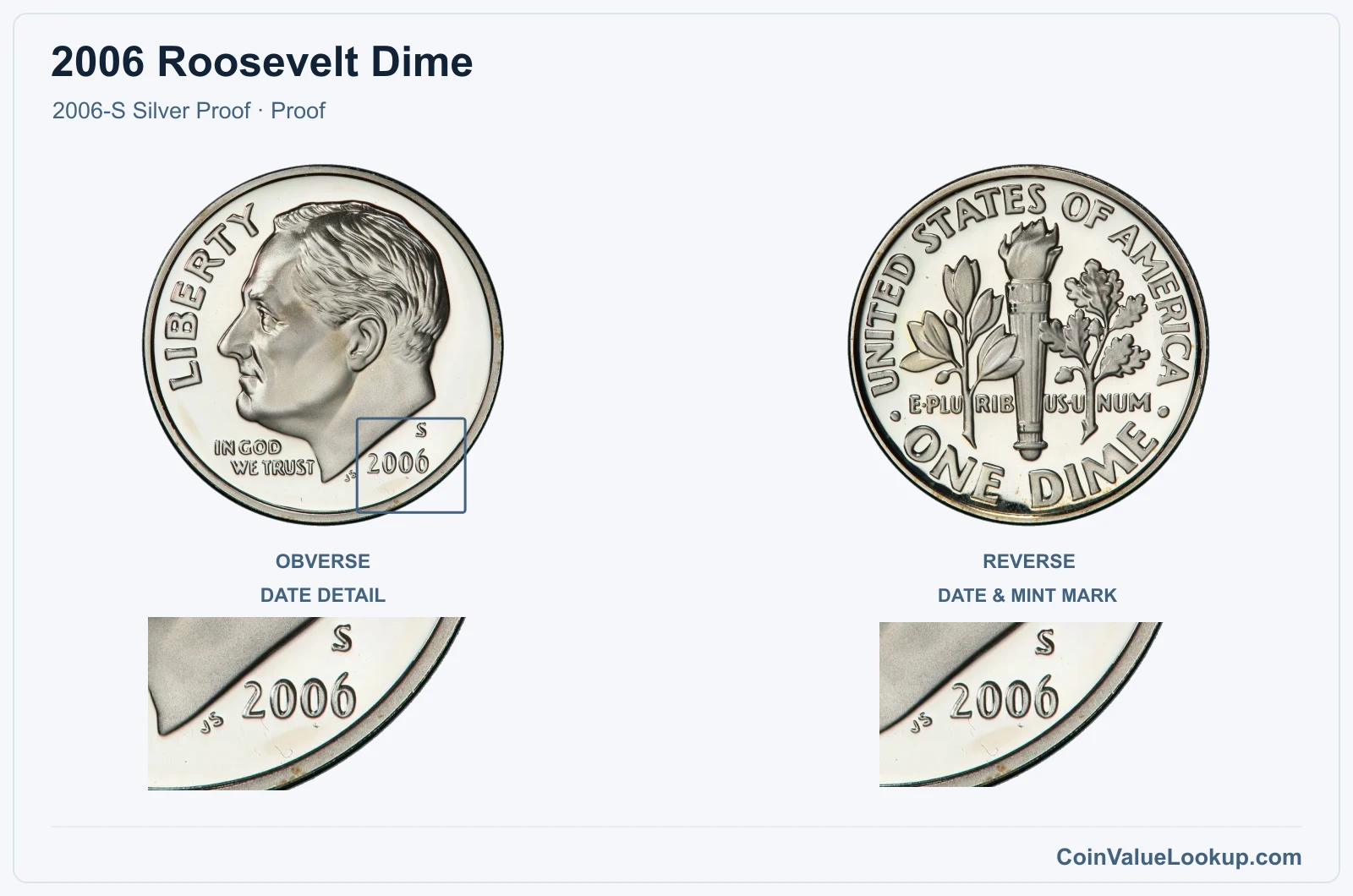
This is the 90% silver proof version, struck at San Francisco and weighing 2.50 grams — noticeably heavier than the 2.27-gram clad proof. The silver proof set was reintroduced by the United States Mint in 1992, and the 2006 issue continues that line.
USA Coin Book estimates a PR65 at about $9.65, making it the highest guide-value regular version for this year at that grade. The edge may show a slightly different tone than clad, but a scale is more reliable than your eyes.
Keep original Mint packaging when possible — it is the easiest way to confirm what you have.
Range Grade
Price Auction Records Appraisal PR PR 1
—
Coin Identifier
PR 2
—
Coin Identifier
PR 3
—
Coin Identifier
PR 4
—
Coin Identifier
PR 6
—
Coin Identifier
PR 8
—
Coin Identifier
PR 10
—
Coin Identifier
PR 12
—
Coin Identifier
PR 15
—
Coin Identifier
PR 20
—
Coin Identifier
PR 25
—
Coin Identifier
PR 30
—
Coin Identifier
PR 35
—
Coin Identifier
PR 40
—
Coin Identifier
PR 45
—
Coin Identifier
PR 50
—
Coin Identifier
PR 53
—
Coin Identifier
PR 55
—
Coin Identifier
PR 58
—
Coin Identifier
PR 60
—
Coin Identifier
PR 61
—
Coin Identifier
PR 62
—
Coin Identifier
PR 63
—
Coin Identifier
PR 64
—
Coin Identifier
PR 65
—
Coin Identifier
PR 66
—
Coin Identifier
PR 67
—
Coin Identifier
PR 68
—
Coin Identifier
PR 69
Coin Identifier
PR 70
Coin Identifier
2006 Roosevelt Dime — P Satin Finish
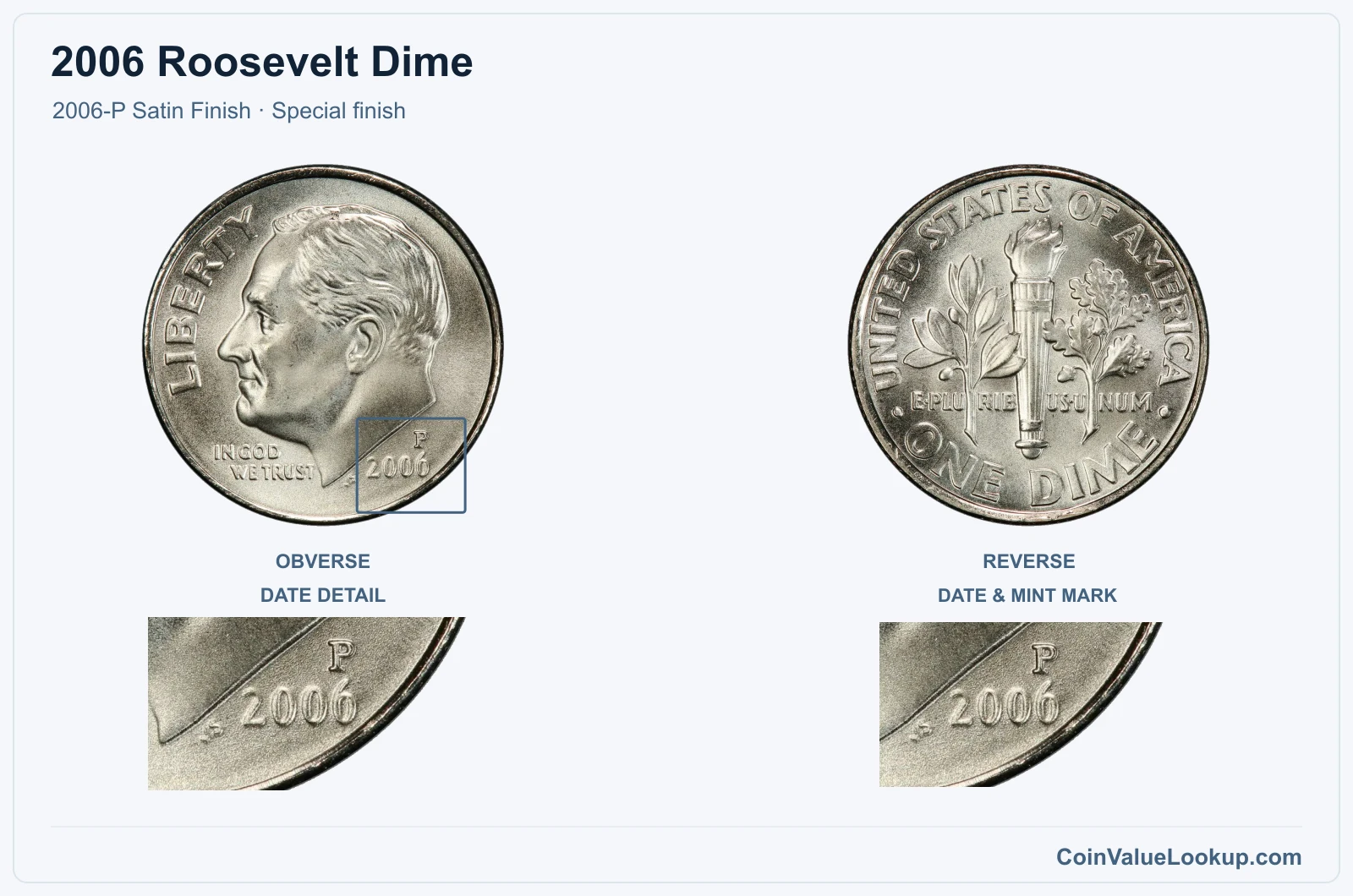
The 2006-P Satin Finish dime came exclusively in that year's Uncirculated Coin Set from the United States Mint. It is a copper-nickel clad coin with a P mintmark, but its surfaces have a distinctive soft, even luster that differs from a normal business strike's cartwheel shine.
PCGS recognizes these 2005–2010 Satin Finish issues as separate special strikes, not proofs and not errors. Without the original Mint Set packaging, distinguishing one from a well-preserved business strike takes practice.
Value depends on authenticated identity and condition; no specific guide price is adopted here.
Range Grade
Price Auction Records Appraisal SP SP 1
—
Coin Identifier
SP 2
—
Coin Identifier
SP 3
—
Coin Identifier
SP 4
—
Coin Identifier
SP 6
—
Coin Identifier
SP 8
—
Coin Identifier
SP 10
—
Coin Identifier
SP 12
—
Coin Identifier
SP 15
—
Coin Identifier
SP 20
—
Coin Identifier
SP 25
—
Coin Identifier
SP 30
—
Coin Identifier
SP 35
—
Coin Identifier
SP 40
—
Coin Identifier
SP 45
—
Coin Identifier
SP 50
—
Coin Identifier
SP 53
—
Coin Identifier
SP 55
—
Coin Identifier
SP 58
—
Coin Identifier
SP 60
—
Coin Identifier
SP 61
—
Coin Identifier
SP 62
—
Coin Identifier
SP 63
—
Coin Identifier
SP 64
—
Coin Identifier
SP 65
—
Coin Identifier
SP 66
—
Coin Identifier
SP 67
Coin Identifier
SP 68
Coin Identifier
SP 69
—
Coin Identifier
SP 70
—
—
—
2006 Roosevelt Dime — D Satin Finish
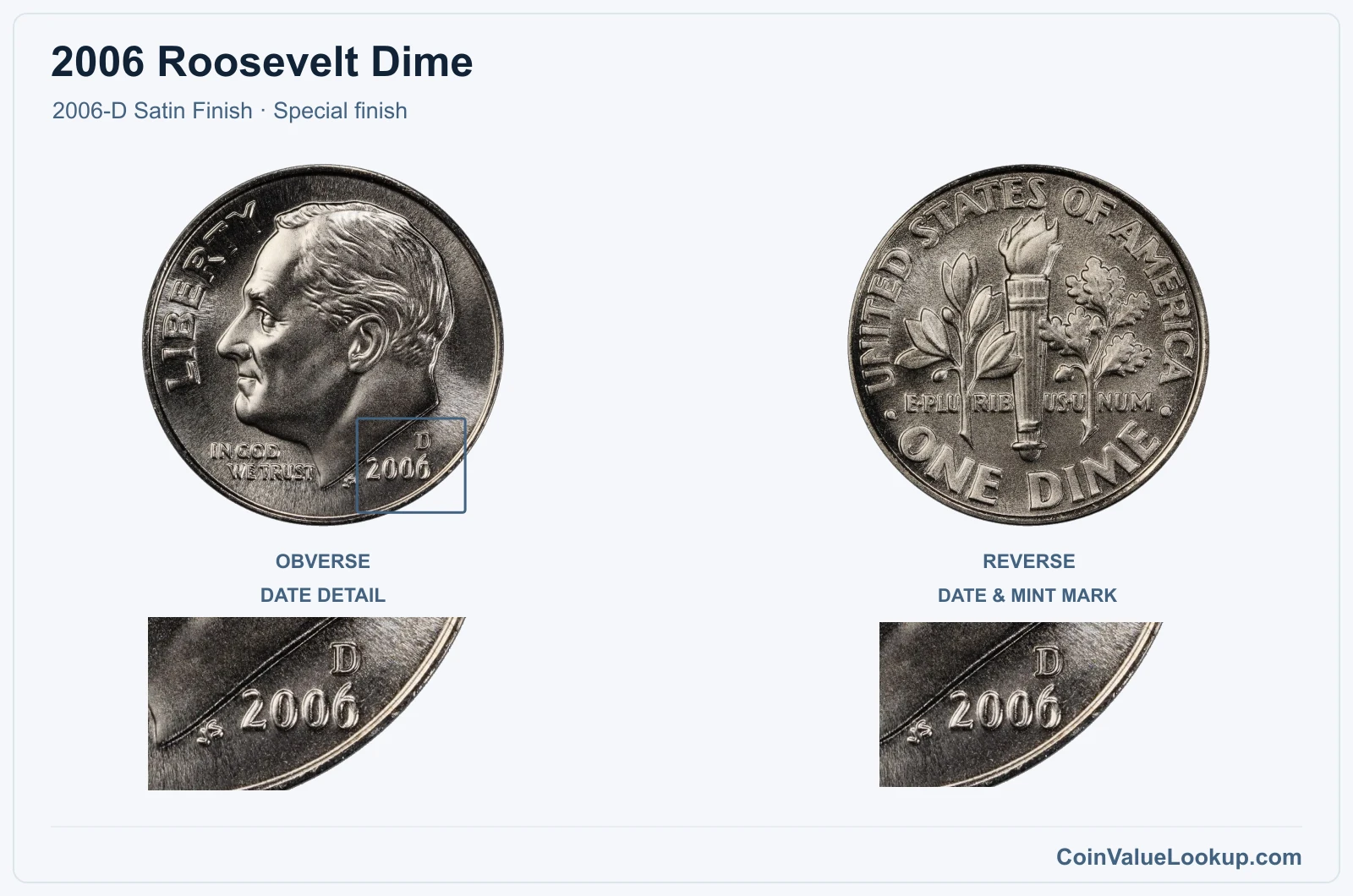
Denver's counterpart in the 2006 Uncirculated Coin Set, the D Satin Finish dime shares the same clad composition and special surface as the P version. The D mintmark is your starting point, but packaging and surface character do the real work of separating it from a regular D business strike.
Like the P Satin, PCGS catalogs this as a distinct special strike produced from 2005 through 2010. No specific guide price is adopted here, so value comes down to authenticated identity and condition at the time of sale.
Range Grade
Price Auction Records Appraisal SP SP 1
—
Coin Identifier
SP 2
—
Coin Identifier
SP 3
—
Coin Identifier
SP 4
—
Coin Identifier
SP 6
—
Coin Identifier
SP 8
—
Coin Identifier
SP 10
—
Coin Identifier
SP 12
—
Coin Identifier
SP 15
—
Coin Identifier
SP 20
—
Coin Identifier
SP 25
—
Coin Identifier
SP 30
—
Coin Identifier
SP 35
—
Coin Identifier
SP 40
—
Coin Identifier
SP 45
—
Coin Identifier
SP 50
—
Coin Identifier
SP 53
—
Coin Identifier
SP 55
—
Coin Identifier
SP 58
—
Coin Identifier
SP 60
—
Coin Identifier
SP 61
—
Coin Identifier
SP 62
—
Coin Identifier
SP 63
—
Coin Identifier
SP 64
—
Coin Identifier
SP 65
—
Coin Identifier
SP 66
—
Coin Identifier
SP 67
—
Coin Identifier
SP 68
Coin Identifier
SP 69
Coin Identifier
SP 70
—
—
—
2006 Roosevelt Dime Error List
1. 2006 Roosevelt Dime — Double Clipped Planchet
A double clipped planchet means the blank was punched from the metal strip in an area where two previous punches already removed material, leaving two curved bite marks. On a documented 2006-P example graded ANACS AU58, the coin weighs 2.13 grams — well below the normal 2.27 grams — and the date and P mintmark remain readable.
Look for two natural, curved clip boundaries with characteristic Blakesley effects (flat weak areas opposite each clip). A coin that was cut or damaged after leaving the Mint will usually show sharp, unnatural edges and no corresponding weakness on the opposite side.
No specific price range is adopted; value depends on authenticated identity, the size and visibility of both clips, and overall condition.
2. 2006 Roosevelt Dime — Missing Reverse Clad Layer
On a missing reverse clad layer error, the copper core is exposed on the reverse while the obverse retains its normal appearance. A documented 2006-P example was graded PCGS MS64 with the reverse clad layer absent, giving that side a distinctly copper-colored look that contrasts sharply with the silvery obverse.
Check the edge: you should see an asymmetric layer structure where one side's outer metal is simply gone. This is not the same as toning, acid damage, or stripped plating — those affect both sides unevenly and leave surface irregularities.
Genuine missing clad errors occur at the Mint before striking. No specific price is adopted here; value depends on authentication, grade, and the completeness of the missing layer.
3. 2006 Roosevelt Dime — Off-Center Strike
An off-center strike happens when the planchet is not properly seated in the collar before the dies come together. The result is a displaced design with an unstruck crescent of blank metal along one edge.
On a 2006 dime, reported examples fall in the 5% to 10% off-center range.
The date needs to remain visible for the coin to be attributable — and collectible. A small off-center percentage can be subtle, so compare the rim width on all sides.
Do not confuse a clipped planchet, a one-sided die misalignment, or post-mint flattening with a genuine off-center error. Value varies with condition, the percentage of displacement, and whether the full date is readable.
No specific price range is adopted.
4. 2006 Roosevelt Dime — Broadstrike
A broadstrike occurs when a coin is struck without the retaining collar that normally forms the rim and controls the coin's diameter. The metal spreads outward freely, producing a coin that is wider than normal and lacks a defined rim, though the full design is usually present on both sides.
On a 2006 dime, look for an expanded diameter and flat or missing rim all the way around. The design should still be centered, which helps distinguish a broadstrike from an off-center error.
Post-mint flattening can mimic the spread but typically shows uneven distortion and no genuine strike characteristics. Value depends on condition, the degree of spread, and authentication.
No specific price range is adopted.
5. 2006 Roosevelt Dime — Die Crack / Die Chip
Die cracks and die chips are raised features caused by damage to the die itself. A crack shows up as a thin raised line running across the coin's surface, while a chip appears as a small raised blob — essentially a chunk of the die face that broke away, leaving a void that fills with metal during striking.
On a 2006 dime, reported examples are small die cracks. Look for raised lines or bumps that sit above the coin's normal surface, not scratched into it.
Incuse scratches, corrosion spots, or foreign material stuck to the surface are common lookalikes. A crack that reaches the rim is sometimes called a cud, but that is a different category.
Value depends on the size, location, and visual impact of the crack, plus the coin's overall condition. No specific price range is adopted.