1802 Draped Bust Dollar Coin Value: How Much Is It Worth?
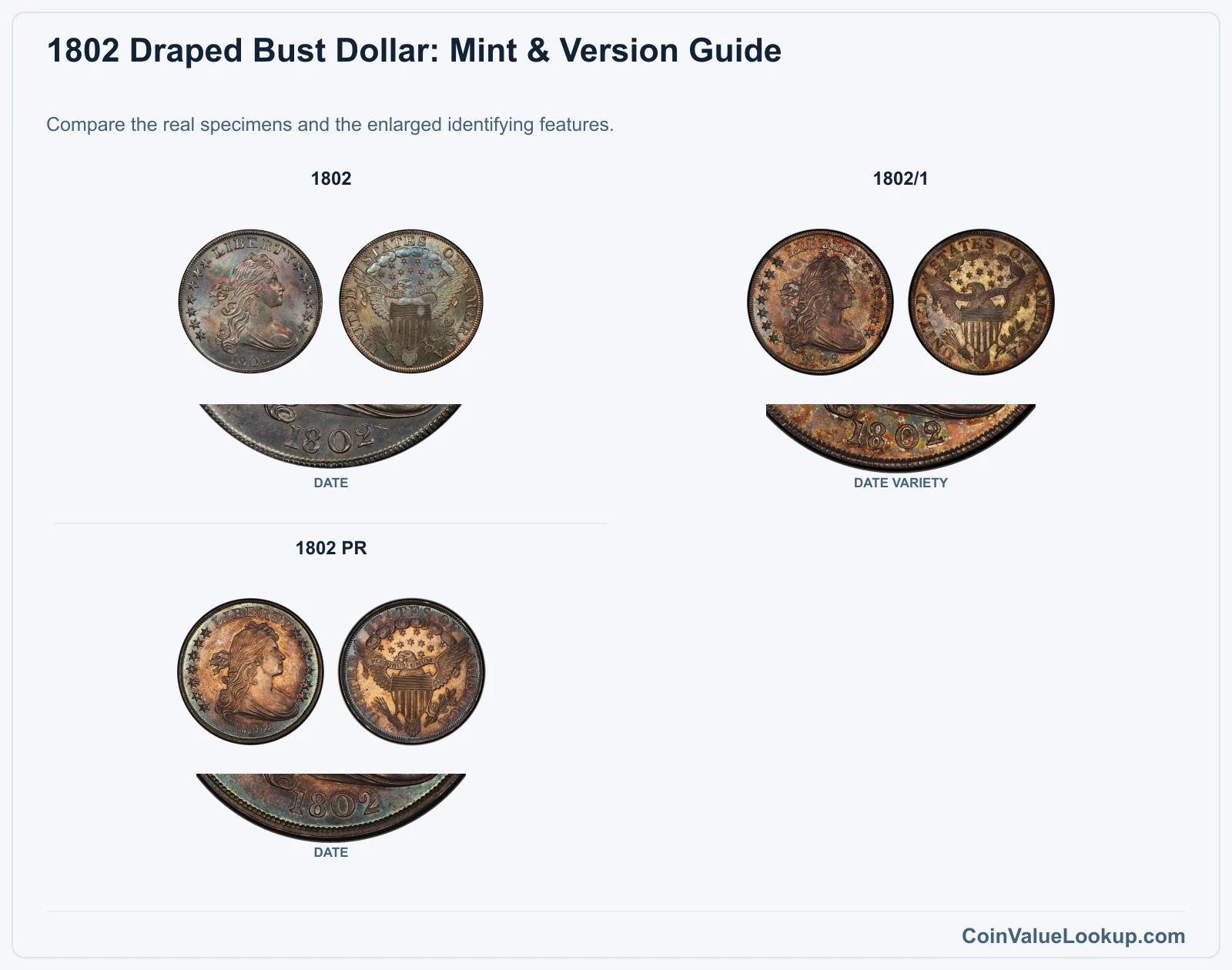
The 1802 Draped Bust Dollar is one of the early federal silver dollars that collectors chase with serious intent. Values depend heavily on which branch you hold: the standard 1802, the 1802/1 overdate, or the extremely rare proof restrike.
A USA Coin Book guide estimate places one proof restrike grade at $1,217,520.00, but that is a single grade-specific estimate, not a guaranteed offer. Most circulated examples require individual assessment based on authenticated identity and condition.
Confirm your coin's exact version before drawing any conclusions about its worth.
Fast Way to Identify Your 1802 Draped Bust Dollar
The quickest way to start figuring out what you have is to upload clear photos of both the front and back of your coin. Our identifier can provide a preliminary identification of the year, design type, and mint.
That first step helps you narrow down whether you're looking at a standard 1802, an overdate, or something else entirely. Good lighting and a steady hand go a long way.
1802 Draped Bust Dollar Value
Upload both sides of your 1802 Draped Bust Dollar.
Front Obverse
Upload photo
Back Reverse
Upload photo
Which 1802 Draped Bust Dollar Versions Are Worth Money?
- The 1802/1 overdate is a distinct die variety where remnants of an earlier date digit are visible beneath the final numeral, making it a separate collectible branch.
- The 1802 proof restrike is exceptionally rare; a USA Coin Book guide estimate lists the PR65 grade at $1,217,520.00, reflecting how few are known to exist.
Step 1: Identify Your 1802 Draped Bust Dollar Mint Mark and Version
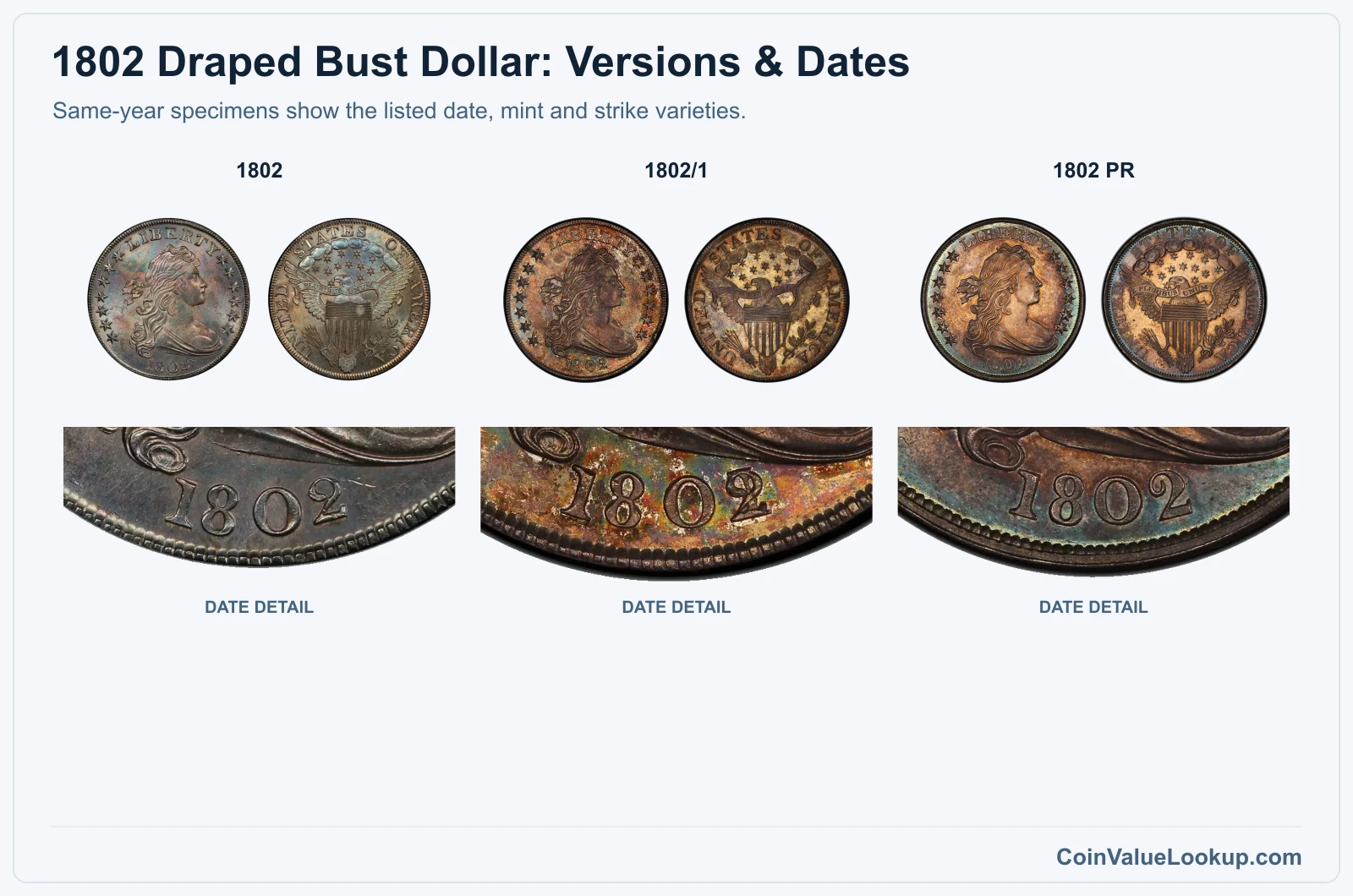
Every 1802 Draped Bust Dollar was struck at the Philadelphia Mint, so there is no mintmark to hunt for. The coin is a silver-copper alloy at the early federal dollar standard, nominally 26.96 grams.
The obverse shows Liberty with draped fabric at the bust, surrounded by stars. The reverse features a Heraldic Eagle with a shield on its breast, arrows and olive branch in its talons, and a constellation of stars above.
To distinguish the main branches, focus on the date. The standard 1802 has a cleanly punched date.
The 1802/1 overdate shows traces of an underlying "1" beneath the final "2" in the date. This is a die variety, not damage, and it requires careful inspection, ideally under magnification.
The proof restrike is an entirely different animal. A proof is a manufacturing finish involving specially prepared dies and planchets, not just a shiny coin.
The date on a restrike does not necessarily mean it was struck in 1802; pedigree and attribution by a professional service control that identification. If you suspect you have a proof, professional authentication is essential.
Coin Value Lookup is a useful starting point if you want to look up guides for other early dollar types or any U.S. coin series. It can help you compare your coin against the right reference before seeking professional evaluation.
Step 2: Check Your 1802 Draped Bust Dollar Grade
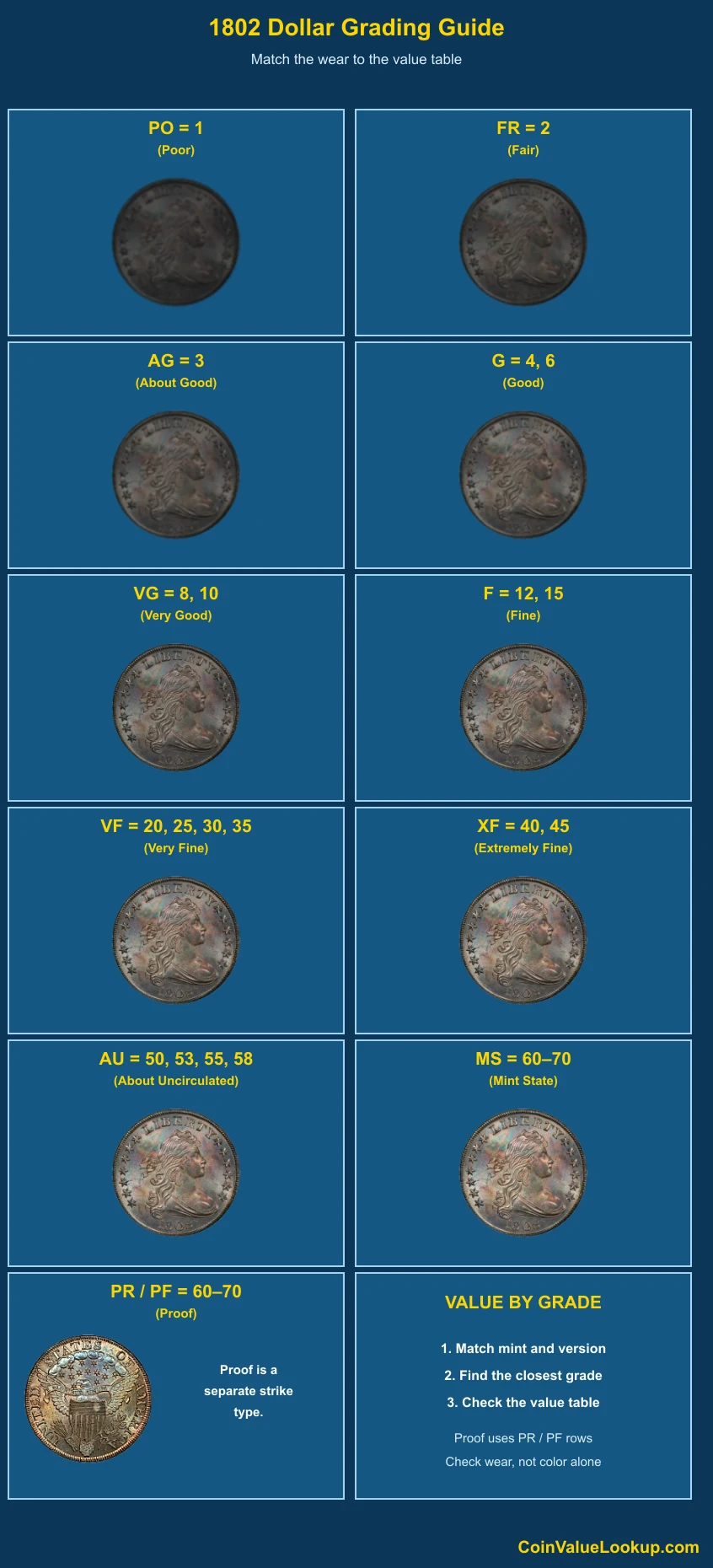
When grading a Draped Bust Dollar, start with the hair above Liberty's forehead and around her ear. On a well-circulated coin, this area flattens first.
The drapery lines across Liberty's bust also lose definition as the coin wears.
On the reverse, check the eagle's breast feathers and the tips of its wings. A coin with clear separation in those feathers has retained more detail than one where the breast is a smooth lump.
Strike weakness is common on early dollars, so don't confuse a soft strike for wear. A weakly struck coin may still show luster in protected areas, while a worn coin loses luster uniformly.
Compare your coin against the same-type grading image to see the difference between circulated, About Uncirculated, and Mint State examples side by side.
Original surfaces matter. Cleaning, polishing, or artificial toning reduces a coin's desirability and can result in a details grade rather than a straight numeric grade.
Look for hairline scratches under light, which are a telltale sign of past cleaning.
Step 3: Check 1802 Draped Bust Dollar Value by Mint and Version
1802 Draped Bust Dollar
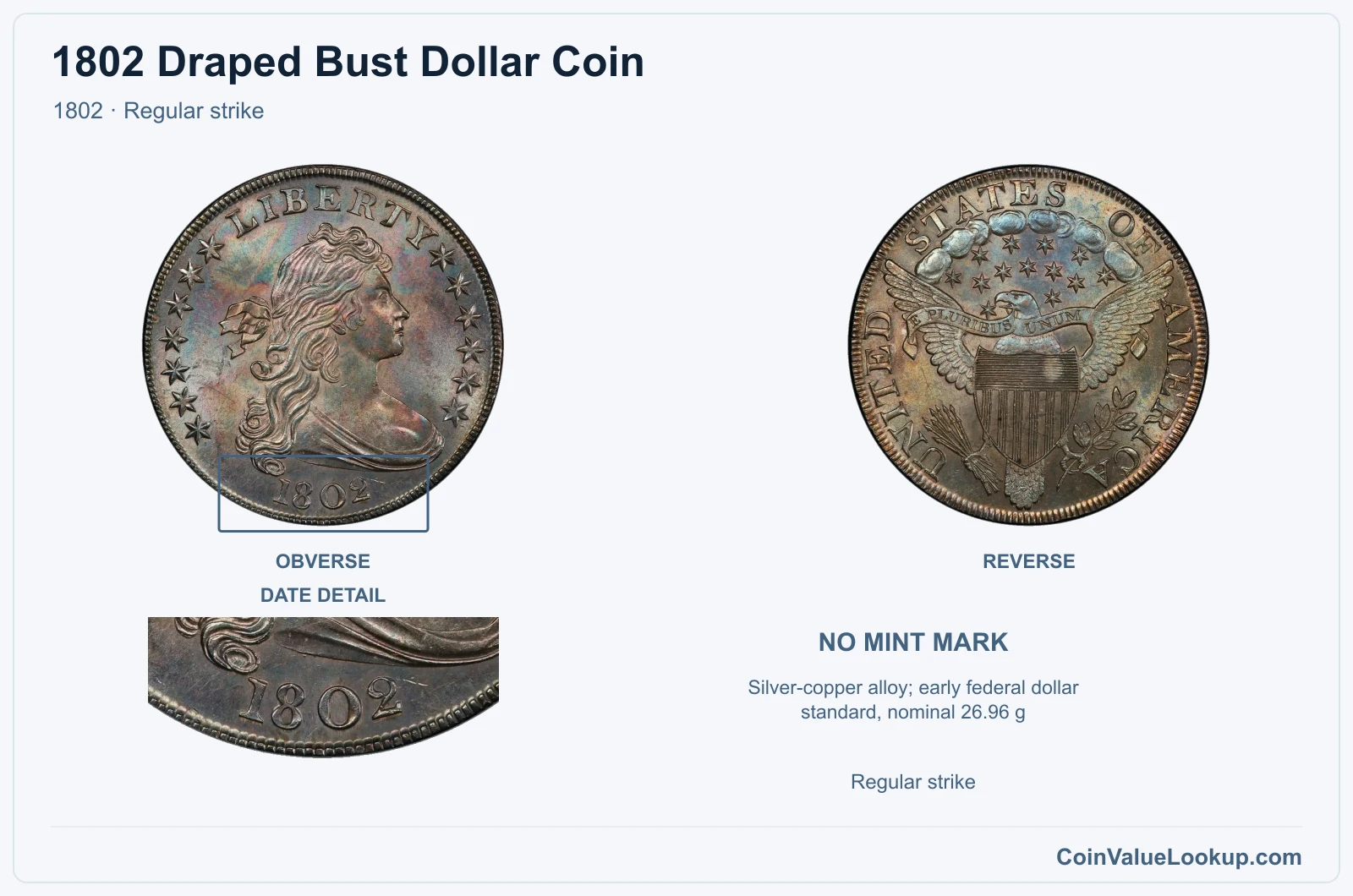
The standard 1802 Draped Bust Dollar features the Heraldic Eagle reverse and was struck for circulation at Philadelphia. No mintmark appears on the coin.
The silver-copper alloy follows the early federal dollar standard at a nominal 26.96 grams.
Look for a cleanly punched "1802" date with no traces of another digit underneath. No supported numeric price range is available for this version across grades, so value comes down to individual assessment by authenticated identity, condition, and whether the coin retains original surfaces.
Cleaning or polishing reduces comparability against published references.
Range Grade
Price Auction Records Appraisal PO PO 1
—
Coin Identifier FR FR 2
—
Coin Identifier AG AG 3
—
Coin Identifier G G 4
Coin Identifier
G 6
—
Coin Identifier VG VG 8
Coin Identifier
VG 10
Coin Identifier F F 12
Coin Identifier
F 15
Coin Identifier VF VF 20
Coin Identifier
VF 25
Coin Identifier
VF 30
Coin Identifier
VF 35
Coin Identifier XF XF 40
Coin Identifier
XF 45
Coin Identifier AU AU 50
Coin Identifier
AU 53
Coin Identifier
AU 55
Coin Identifier
AU 58
Coin Identifier MS MS 60
—
Coin Identifier
MS 61
—
Coin Identifier
MS 62
Coin Identifier
MS 63
Coin Identifier
MS 64
—
Coin Identifier
MS 65
Coin Identifier
MS 66
—
—
—
MS 67
—
—
—
MS 68
—
—
—
MS 69
—
—
—
MS 70
—
—
—
1802 Draped Bust Dollar — /1
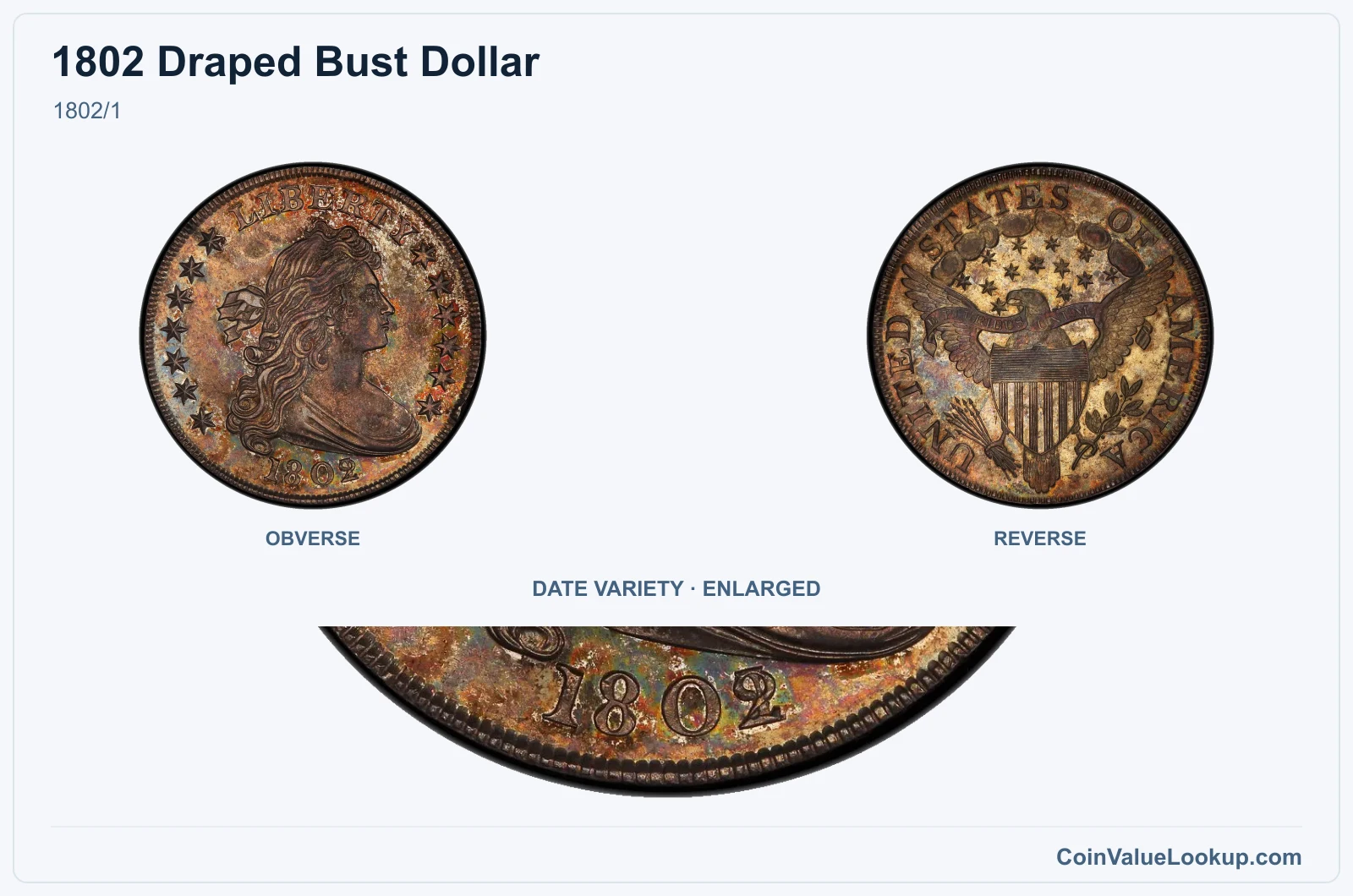
The 1802/1 overdate is one of the more sought-after die varieties in the Draped Bust Dollar series. Under magnification, you can see the outline of an underlying "1" beneath the final "2" in the date.
The Mint reused a die originally punched with an 1801 date, re-engraving it for 1802 production. Same Philadelphia mint, same silver-copper alloy, same Heraldic Eagle reverse.
This is a business strike coin, so expect it to show wear consistent with circulation. No supported numeric price range has been adopted for this version, meaning each coin needs individual evaluation based on its authenticated identity, the clarity of the overdate feature, and overall condition.
Coins with a bold, easily visible overdate tend to attract stronger collector interest than those where the remnant digit is faint.
Range Grade
Price Auction Records Appraisal PO PO 1
—
Coin Identifier FR FR 2
—
Coin Identifier AG AG 3
—
Coin Identifier G G 4
Coin Identifier
G 6
Coin Identifier VG VG 8
Coin Identifier
VG 10
Coin Identifier F F 12
Coin Identifier
F 15
Coin Identifier VF VF 20
Coin Identifier
VF 25
Coin Identifier
VF 30
Coin Identifier
VF 35
Coin Identifier XF XF 40
Coin Identifier
XF 45
Coin Identifier AU AU 50
Coin Identifier
AU 53
Coin Identifier
AU 55
Coin Identifier
AU 58
Coin Identifier MS MS 60
—
Coin Identifier
MS 61
—
Coin Identifier
MS 62
—
Coin Identifier
MS 63
—
Coin Identifier
MS 64
—
Coin Identifier
MS 65
—
—
—
MS 66
—
—
—
MS 67
—
—
—
MS 68
—
—
—
MS 69
—
—
—
MS 70
—
—
—
1802 Draped Bust Dollar — PR
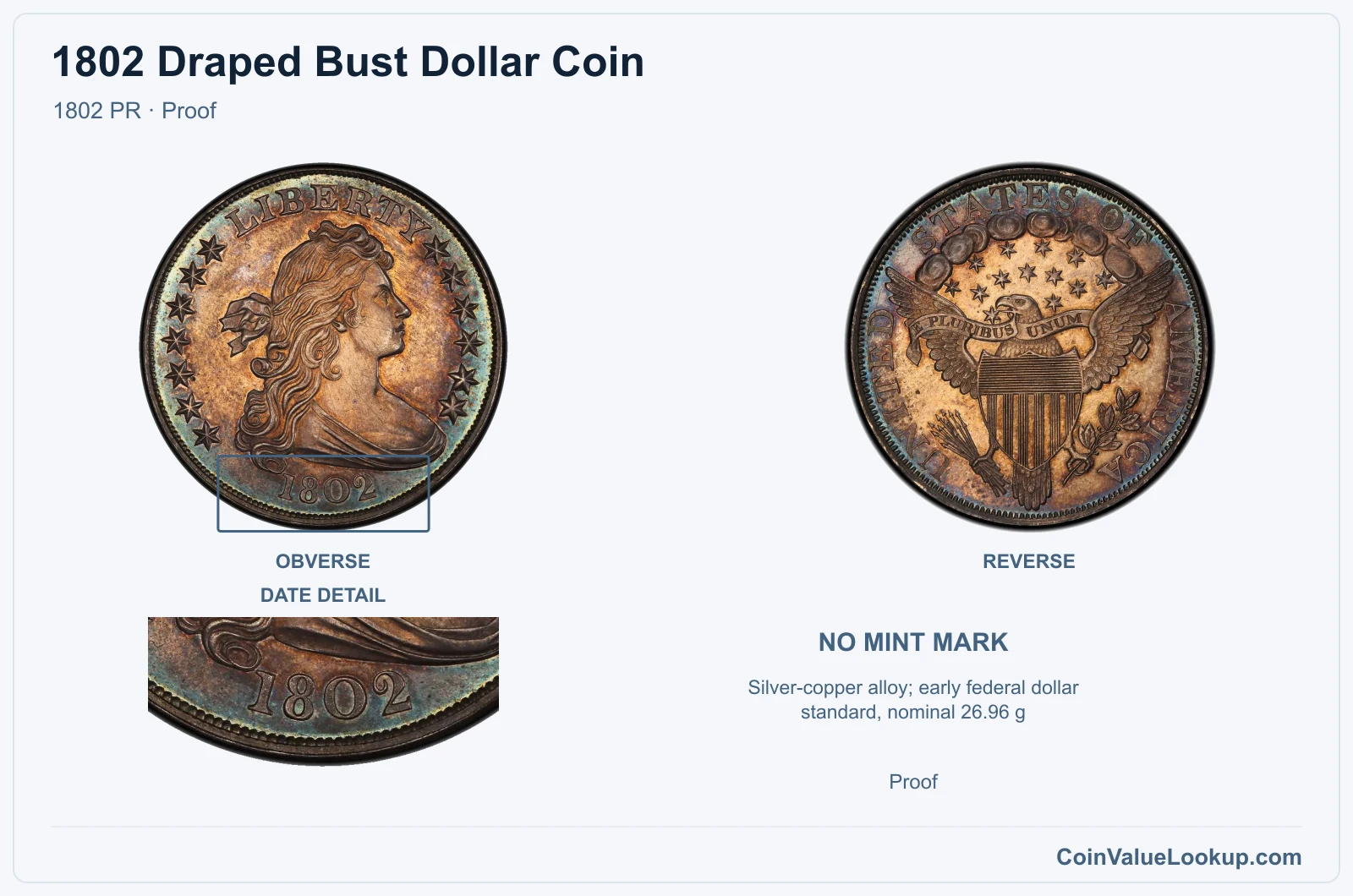
The 1802 proof restrike is among the rarest branches of the entire Draped Bust Dollar series. A proof is a specific manufacturing finish involving polished dies and carefully fed planchets.
It is not simply a high-grade business strike that happens to look shiny.
The date on the coin reads 1802, but restrike attribution means the coin may not have actually been produced in that year. Pedigree history and professional attribution by a major grading service are what confirm this branch.
Do not assume a coin is a proof restrike based on appearance alone.
A USA Coin Book guide estimate places the PR65 grade at $1,217,520.00. That is a single-grade guide figure, not a guaranteed offer or a market range across all proof grades.
The coin's table identity is listed as "1802 P Proof Restrike." If you believe you have one of these, professional authentication is not optional, it is the entire ballgame.
Range Grade
Price Auction Records Appraisal PR PR 1
—
Coin Identifier
PR 2
—
Coin Identifier
PR 3
—
Coin Identifier
PR 4
—
Coin Identifier
PR 6
—
Coin Identifier
PR 8
—
Coin Identifier
PR 10
—
Coin Identifier
PR 12
—
Coin Identifier
PR 15
—
Coin Identifier
PR 20
—
Coin Identifier
PR 25
—
Coin Identifier
PR 30
—
Coin Identifier
PR 35
—
Coin Identifier
PR 40
—
Coin Identifier
PR 45
—
Coin Identifier
PR 50
—
Coin Identifier
PR 53
—
Coin Identifier
PR 55
—
Coin Identifier
PR 58
—
Coin Identifier
PR 60
—
Coin Identifier
PR 61
—
Coin Identifier
PR 62
—
Coin Identifier
PR 63
—
Coin Identifier
PR 64
Coin Identifier
PR 65
—
Coin Identifier
PR 66
—
—
—
PR 67
—
—
—
PR 68
—
—
—
PR 69
—
—
—
PR 70
—
—
—
1802 Draped Bust Dollar Error List
1. 1802 Draped Bust Dollar — Overdate
The 1802/1 overdate is a recognized die variety for the 1802 Draped Bust Dollar in regular strike form, reported by PCGS CoinFacts. It was created when the Mint repunched the date over an existing "1801" die, leaving traces of the original final digit beneath the new "2."
To identify it, look closely at the last numeral of the date. You should see the curved top or vertical stroke of a "1" peeking out from under the "2." The remnant is most visible at the top and base of the numeral.
Magnification helps considerably.
Don't confuse this with ordinary damage to the date area or basic machine doubling, which creates a shelf-like shadow around all numerals rather than the distinct outline of a different digit. An overdate shows a specific, identifiable earlier numeral, not just fuzzy doubling.
No numerical price range has been adopted for this variety. Value depends on condition, the visibility of the overdate, and professional authentication of the die variety.