1866 Liberty Seated Dollar Coin Value: How Much Is It Worth?
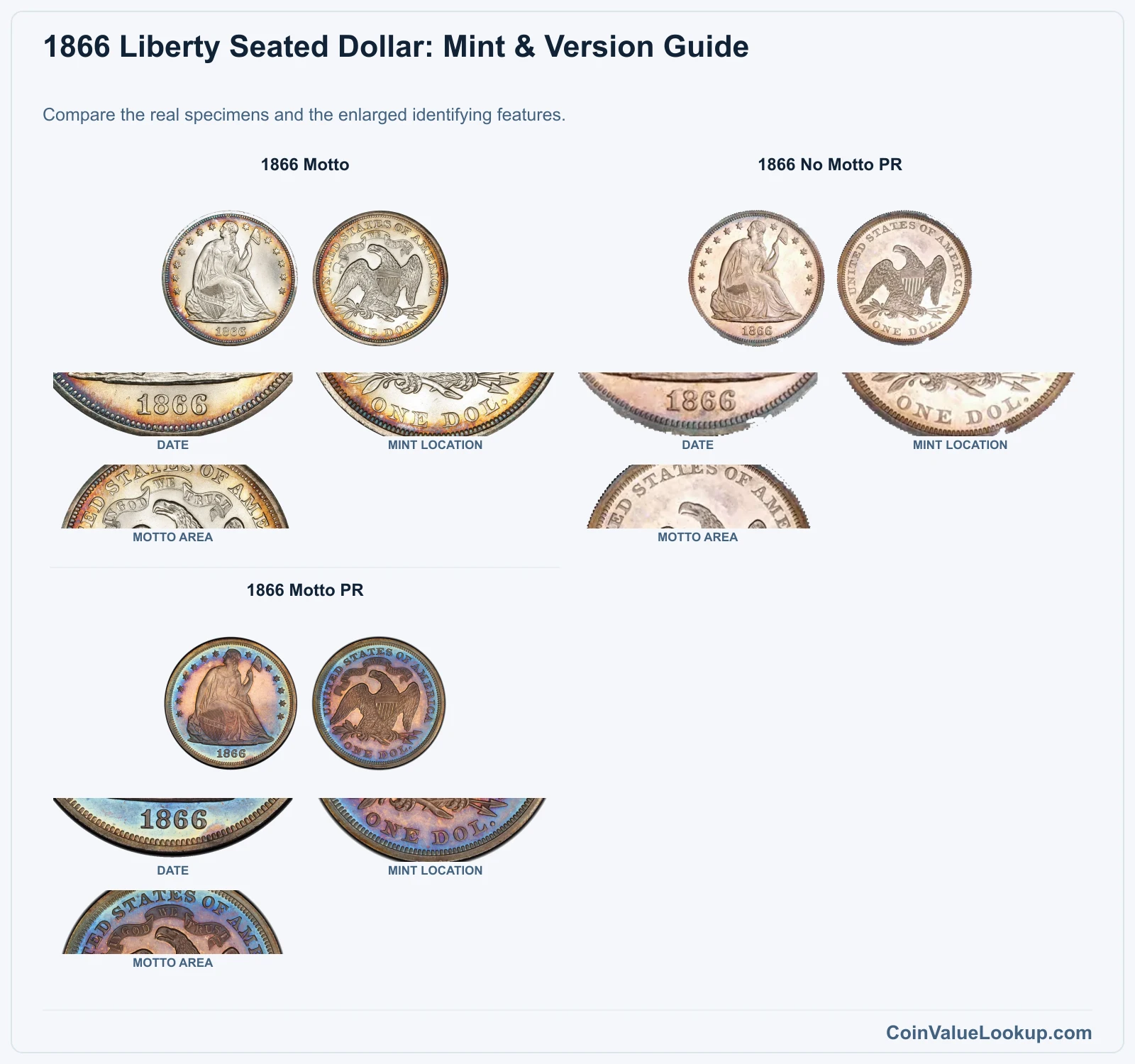
The 1866 Liberty Seated Dollar is a coin that demands careful identification before you assign any value. Guide estimates for specific proof versions in PR63 condition reach approximately $1,839,632.00, though that figure applies only to authenticated examples in that exact grade and finish.
Your coin's worth depends entirely on which branch it belongs to — business strike with motto, no-motto proof, or motto proof — and its actual condition. Sorting out those distinctions is the first step.
Fast Way to Identify Your 1866 Liberty Seated Dollar
The quickest way to start figuring out what you have is to snap clear photos of both the front and back of your coin and upload them here. This gives you a preliminary identification based on the design details, mintmark location (or lack of one), and visible wear.
It is not a substitute for professional authentication or grading, but it puts you on the right track.
1866 Liberty Seated Dollar Value
Upload both sides of your 1866 Liberty Seated Dollar.
Front Obverse
Upload photo
Back Reverse
Upload photo
Which 1866 Liberty Seated Dollar Versions Are Worth Money?
- The 1866 No Motto Proof is a rare proof-finish variety featuring the earlier no-motto reverse design on an 1866-dated coin, with a guide estimate of $1,839,632.00 in PR63.
- The 1866 Motto Proof carries the with-motto reverse in proof finish, also estimated at $1,839,632.00 in PR63 — confirming both proof branches command serious premiums.
- The 1866 Motto business strike is the regular-issue coin; no supported numeric price range is currently adopted, so value depends on individual authenticated condition.
- Before paying any premium, verify mint, design variety and finish through a reputable grading service — unverified claims of proof status or rare variety are common.
Step 1: Identify Your 1866 Liberty Seated Dollar Mint Mark and Version
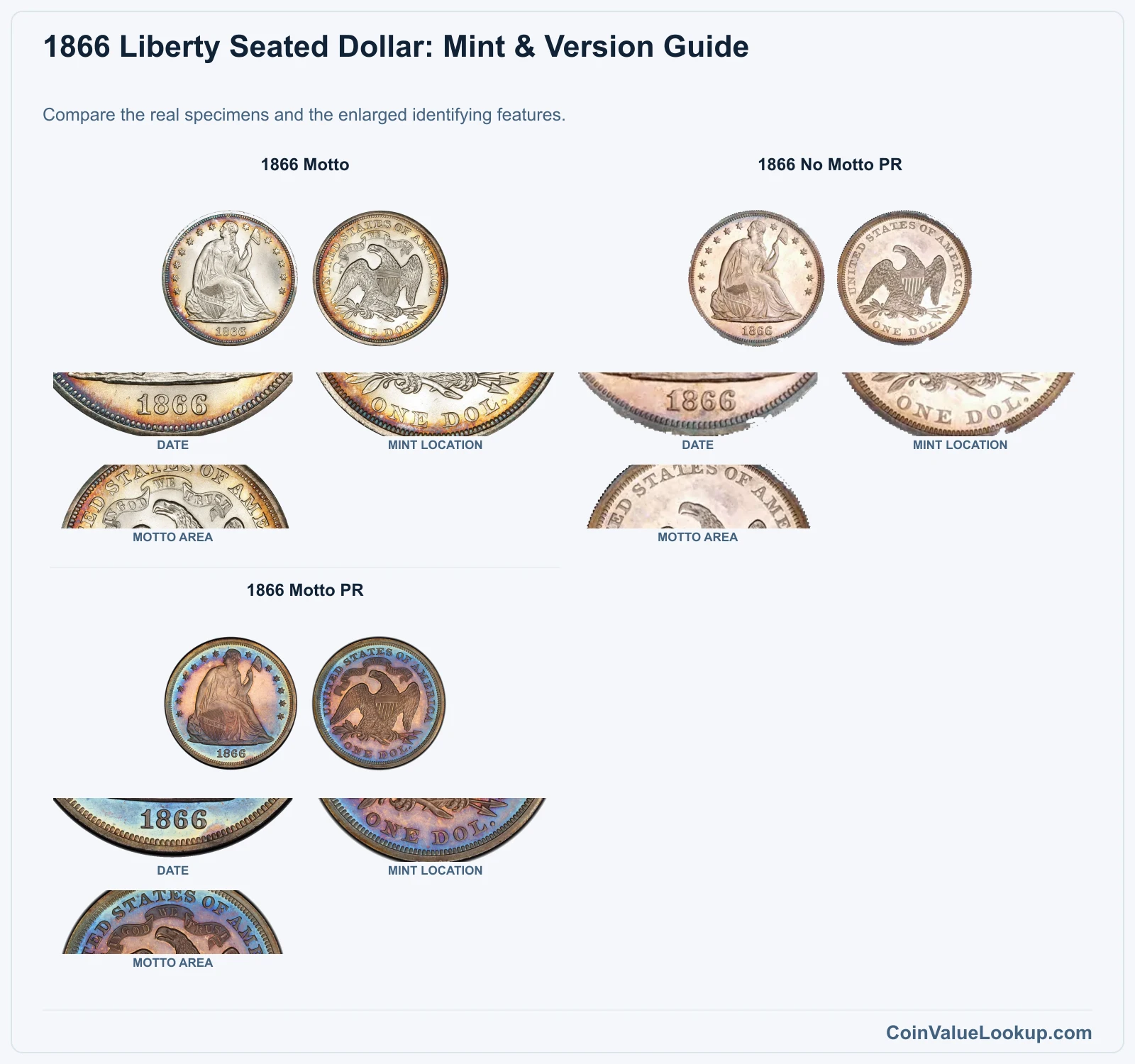
All 1866 Liberty Seated Dollars were struck at Philadelphia, so there is no mintmark to look for. On branch-mint issues of this series you would check the reverse below the eagle and above ONE DOL., but for 1866 that spot should be clean.
The coin is 90% silver and 10% copper, with a nominal weight of 26.73 grams. If yours feels light or the wrong color, it may be a counterfeit or a cleaned/plated piece.
Three distinct versions exist for this year. The business-strike 1866 carries the motto IN GOD WE TRUST on the reverse banner above the eagle.
Then there are two proof versions: a no-motto proof and a motto proof. That motto distinction is critical.
The no-motto reverse is the earlier design without the banner text, and its appearance on an 1866-dated proof is what makes identification so important.
Look at the reverse banner carefully under magnification. If you see IN GOD WE TRUST in that ribbon, it is the motto type.
A blank banner (or no banner at all) indicates the no-motto variety. Proof coins will show mirrored fields and sharp, squared-off rims — a proof is a specific manufacturing process, not just a shiny coin that looks nice.
Step 2: Check Your 1866 Liberty Seated Dollar Grade
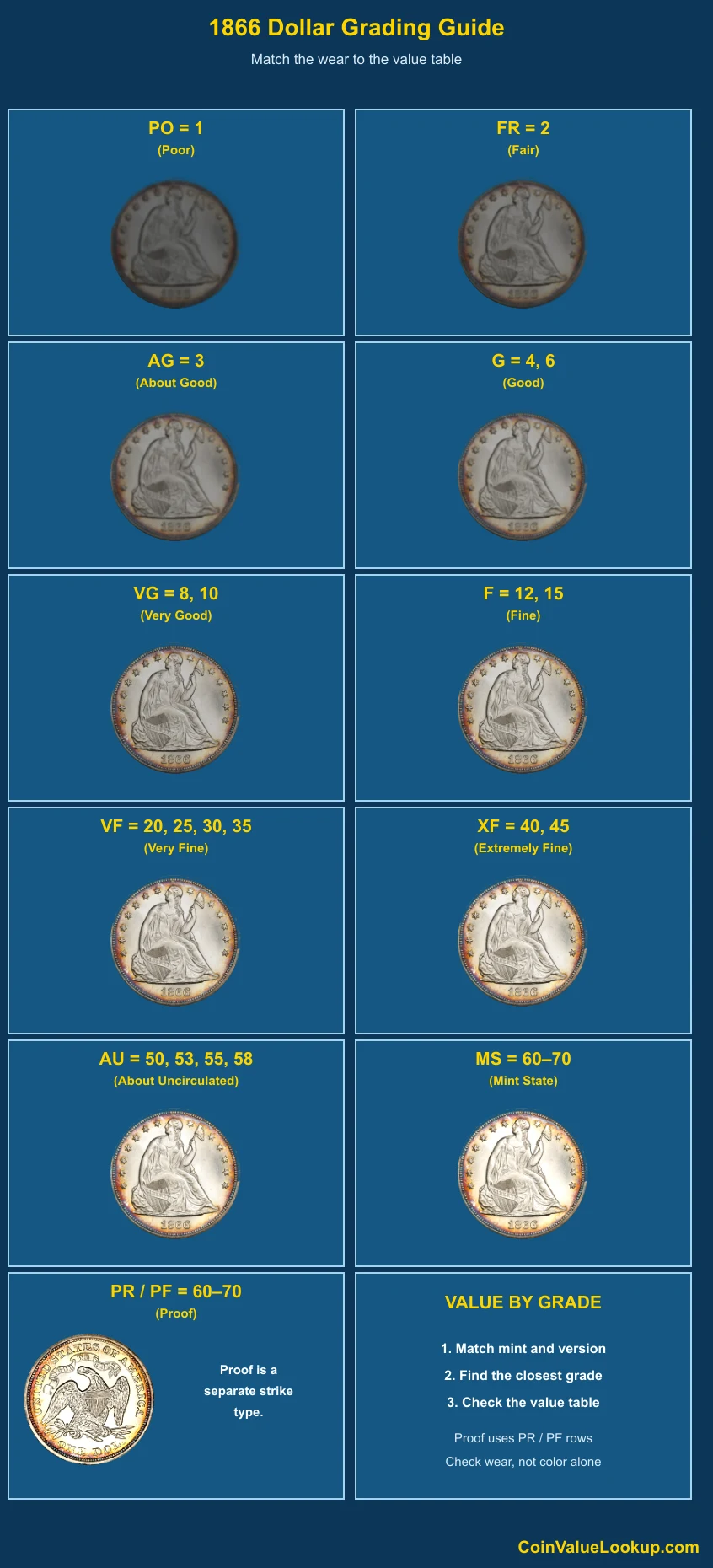
Start with Liberty's head on the obverse. The hair detail around the ear and forehead wears first in circulation.
Next check the breast area and the knee — both lose definition quickly on lower-grade pieces. The shield on Liberty's arm should show horizontal and vertical lines; if they are mushed together, you are looking at heavy wear.
On the reverse, the eagle's breast feathers and wing tips tell the story. A coin with full breast-feather separation and sharp talon detail is in much better shape than one where the eagle looks like a blob.
Do not grade from the head alone. Weak strikes on the head are common for this series, and a softly struck but unworn coin is not the same as a worn one.
Compare your coin to the grading image showing circulated, AU, and Mint State examples side by side.
Proof coins get evaluated differently — look for hairlines from cleaning, haze, or spotted toning rather than circulation wear. Original surfaces matter enormously.
A cleaned proof or a business strike with polishing loses much of its collector appeal and comparability to price-guide figures.
Step 3: Check 1866 Liberty Seated Dollar Value by Mint and Version
1866 Liberty Seated Dollar — Motto
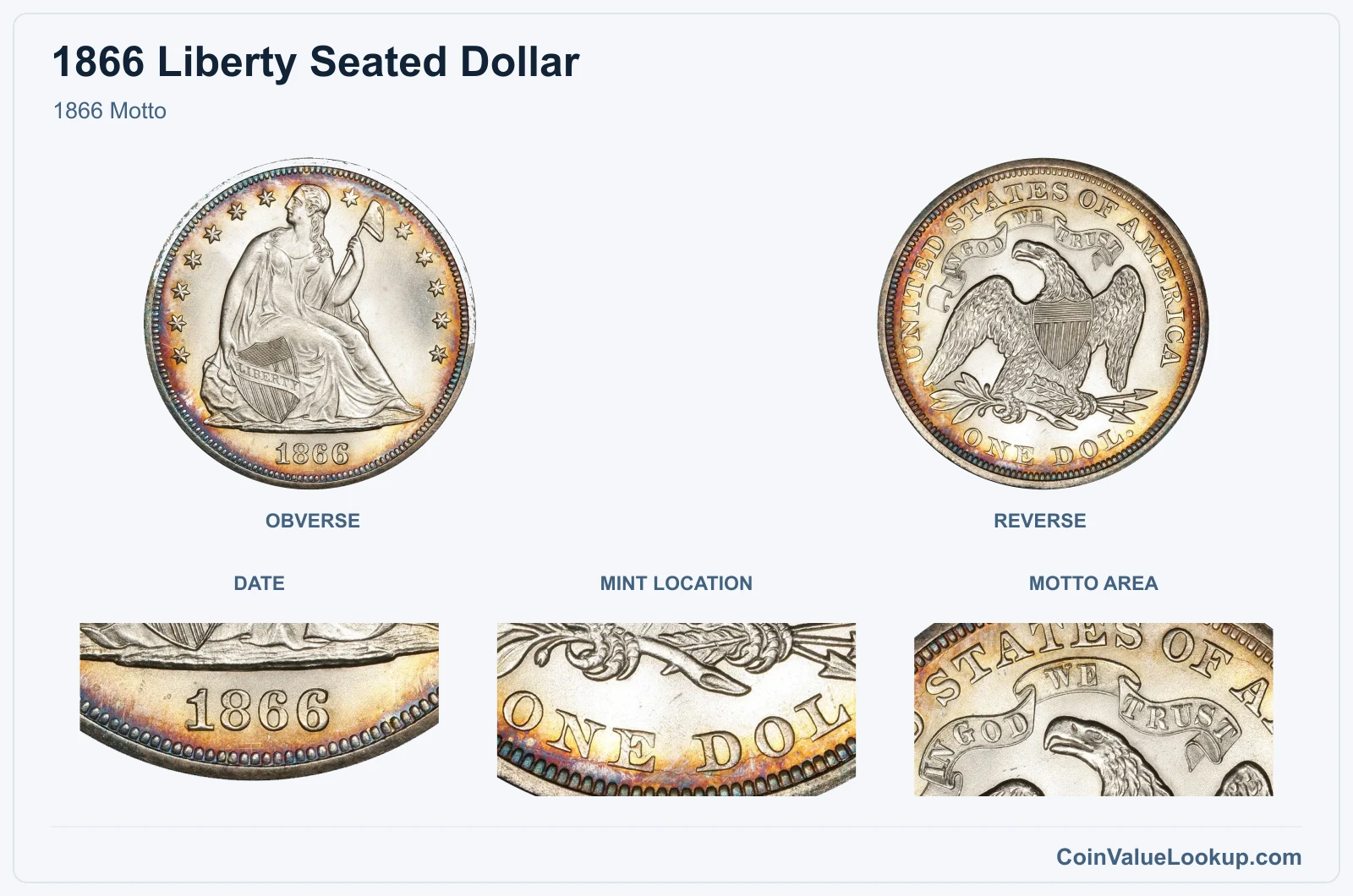
The 1866 Motto is the standard business-strike dollar for this year, produced at Philadelphia with no mintmark. Its reverse carries the IN GOD WE TRUST banner above the eagle — that banner is your key identifier.
The coin weighs 26.73 grams in 90% silver.
No supported numeric price range is currently adopted for this version, so its value comes down to individual assessment: authenticated identity, actual grade, and whether the surfaces are original or have been cleaned or damaged. A raw, ungraded example needs professional evaluation before you can compare it meaningfully to any published price.
Range Grade
Price Auction Records Appraisal PO PO 1
—
Coin Identifier FR FR 2
—
Coin Identifier AG AG 3
—
Coin Identifier G G 4
Coin Identifier
G 6
Coin Identifier VG VG 8
Coin Identifier
VG 10
—
Coin Identifier F F 12
Coin Identifier
F 15
Coin Identifier VF VF 20
—
Coin Identifier
VF 25
Coin Identifier
VF 30
Coin Identifier
VF 35
Coin Identifier XF XF 40
Coin Identifier
XF 45
Coin Identifier AU AU 50
Coin Identifier
AU 53
Coin Identifier
AU 55
Coin Identifier
AU 58
Coin Identifier MS MS 60
Coin Identifier
MS 61
Coin Identifier
MS 62
Coin Identifier
MS 63
Coin Identifier
MS 64
Coin Identifier
MS 65
Coin Identifier
MS 66
Coin Identifier
MS 67
Coin Identifier
MS 68
—
—
—
MS 69
—
—
—
MS 70
—
—
—
1866 Liberty Seated Dollar — No Motto PR
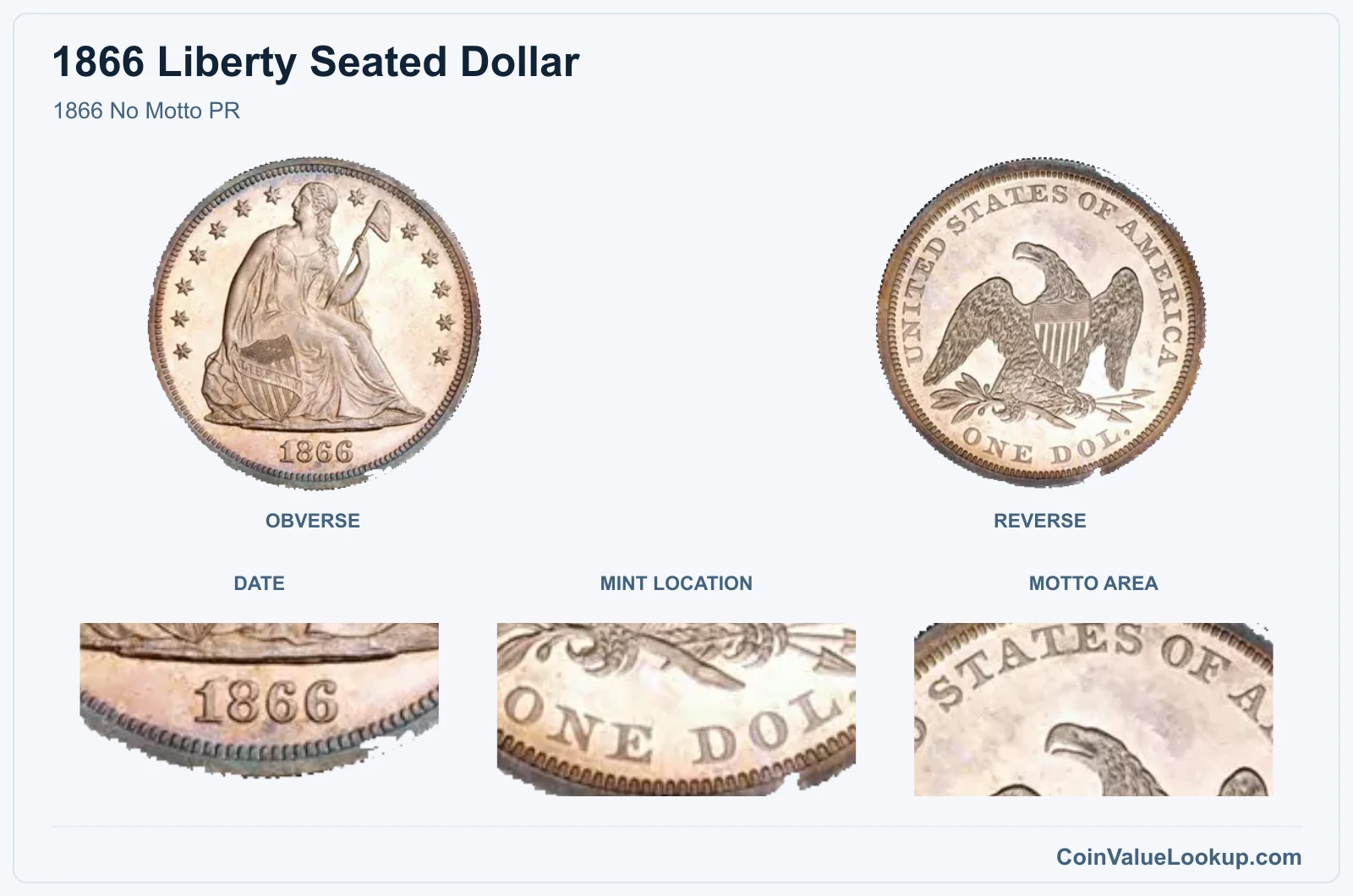
The 1866 No Motto Proof is the variety that raises eyebrows. This is a proof-finish coin — mirrored fields, sharp rims, squared-off details — but it carries the older no-motto reverse design without IN GOD WE TRUST on the banner.
That combination on an 1866-dated dollar is extremely scarce.
A guide estimate from USA Coin Book places PR63 examples at approximately $1,839,632.00. That is a guide figure, not a guaranteed offer, and it applies strictly to authenticated, properly graded proof coins in that condition.
A proof is not simply a high-grade or shiny coin; it is a distinct manufacturing process. If you suspect you have one, professional authentication is essential before drawing any value conclusions.
Coin Value Lookup is a good starting point if you want to look up guides for other Liberty Seated Dollar dates and compare what different years and varieties are worth.
Range Grade
Price Auction Records Appraisal PR PR 1
—
Coin Identifier
PR 2
—
Coin Identifier
PR 3
—
Coin Identifier
PR 4
—
Coin Identifier
PR 6
—
Coin Identifier
PR 8
—
Coin Identifier
PR 10
—
Coin Identifier
PR 12
—
Coin Identifier
PR 15
—
Coin Identifier
PR 20
—
Coin Identifier
PR 25
—
Coin Identifier
PR 30
—
Coin Identifier
PR 35
—
Coin Identifier
PR 40
—
Coin Identifier
PR 45
—
Coin Identifier
PR 50
—
Coin Identifier
PR 53
—
Coin Identifier
PR 55
—
Coin Identifier
PR 58
—
Coin Identifier
PR 60
—
Coin Identifier
PR 61
—
Coin Identifier
PR 62
—
Coin Identifier
PR 63
Coin Identifier
PR 64
—
Coin Identifier
PR 65
—
Coin Identifier
PR 66
—
—
—
PR 67
—
—
—
PR 68
—
—
—
PR 69
—
—
—
PR 70
—
—
—
1866 Liberty Seated Dollar — Motto PR
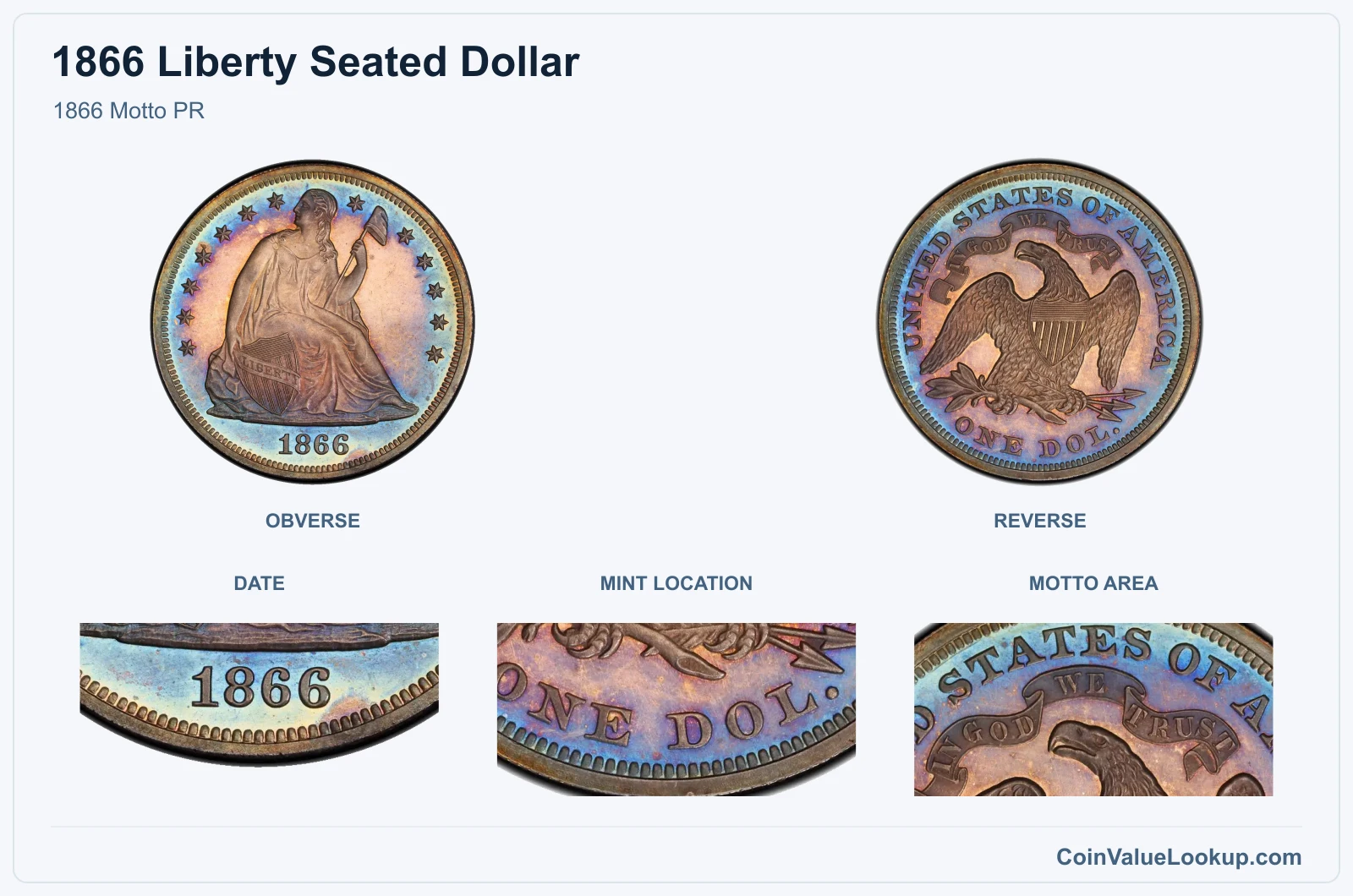
The 1866 Motto Proof pairs the with-motto reverse — IN GOD WE TRUST on the banner — with a proof manufacturing finish. Like the no-motto proof, it was struck at Philadelphia with no mintmark, weighs 26.73 grams, and is composed of 90% silver.
USA Coin Book estimates PR63 examples at approximately $1,839,632.00. Same caution applies: this is a guide estimate for a specific grade, not a blanket offer.
Proof coins show mirror-like fields and precisely struck details that differ from even the finest business strikes. Original surfaces free of cleaning hairlines or environmental damage are what separate a coin that matches this estimate from one that falls well short.
Get it authenticated before you get attached to any number.
Range Grade
Price Auction Records Appraisal PR PR 1
—
Coin Identifier
PR 2
—
Coin Identifier
PR 3
—
Coin Identifier
PR 4
—
Coin Identifier
PR 6
—
Coin Identifier
PR 8
—
Coin Identifier
PR 10
—
Coin Identifier
PR 12
—
Coin Identifier
PR 15
—
Coin Identifier
PR 20
—
Coin Identifier
PR 25
—
Coin Identifier
PR 30
—
Coin Identifier
PR 35
—
Coin Identifier
PR 40
—
Coin Identifier
PR 45
—
Coin Identifier
PR 50
—
Coin Identifier
PR 53
—
Coin Identifier
PR 55
Coin Identifier
PR 58
Coin Identifier
PR 60
Coin Identifier
PR 61
Coin Identifier
PR 62
Coin Identifier
PR 63
Coin Identifier
PR 64
Coin Identifier
PR 65
Coin Identifier
PR 66
Coin Identifier
PR 67
Coin Identifier
PR 68
—
Coin Identifier
PR 69
—
—
—
PR 70
—
—
—
1866 Liberty Seated Dollar Error List
1. 1866 Liberty Seated Dollar — Doubled Die Reverse
A Doubled Die Reverse has been reported for the 1866 Liberty Seated Dollar. This type of error shows doubling in the reverse design elements — lettering, the eagle's features, or the motto banner — caused by a misaligned hub impression during die production.
To check for it, compare your coin's reverse legends and design contours against a known normal example under magnification. Look for a consistent secondary image slightly offset from the primary design.
The doubling should appear uniform across affected elements.
Don't confuse this with machine doubling, which produces flat, shelf-like displacement rather than a rounded secondary image. Reflections from proof surfaces or random post-strike damage can also mimic doubling to the untrained eye.
No specific price range is adopted for this error, because value depends on the severity of the doubling, overall coin condition, and professional confirmation. This reported listing is not independent authentication of any individual coin.
2. 1866 Liberty Seated Dollar — Repunched Date
A Repunched Date variety has been reported for the 1866 Liberty Seated Dollar. This occurred when the date numerals were punched into the working die more than once, with slight misalignment between punches.
The result is visible remnants of an earlier date position next to or beneath the final digits.
Look at the 1866 date under magnification. You may see traces of a prior impression — a ghost of a numeral slightly north, south, east, or west of where the final digit sits.
This is different from doubled die errors, which affect the entire design from a hub misalignment rather than individual hand-punched numerals.
Be careful not to mistake a damaged date or machine doubling for a genuine repunched date. Damage tends to be irregular and unrelated to the die-making process.
No numerical price range is adopted for this variety; value depends on clarity of the repunching, the coin's condition, and professional verification.