1876 Trade Dollar Coin Value: How Much Is It Worth?
The 1876 Trade Dollar is a hefty silver coin struck for international commerce, and guide estimates for the various versions range from about $232 in well-worn condition up to $34,473 for a top-grade Carson City example. That is a wide spread, so identifying your exact mint, type combination and condition matters a lot before you assign a value.
Three mints produced these coins — Philadelphia, Carson City and San Francisco — and each has its own pricing track. Proof strikes from Philadelphia also exist.
Before you get excited about big numbers, take a careful look at your coin's mintmark, obverse/reverse type pairing and overall condition.
Fast Way to Identify Your 1876 Trade Dollar
The quickest way to start figuring out what you have is to upload clear photos of both sides of your coin. A well-lit front and back image lets us provide a preliminary identification of your mint, type combination and approximate condition.
That is not a substitute for professional authentication, but it gets you pointed in the right direction fast.
1876 Trade Dollar Value
Upload both sides of your 1876 Trade Dollar.
Front Obverse
Upload photo
Back Reverse
Upload photo
Which 1876 Trade Dollar Versions Are Worth Money?
- 1876-CC coins carry the highest guide estimates, reaching $34,473 at MS63 — the Carson City mint produced fewer Trade Dollars, making survivors scarce in upper grades.
- 1876-S Type-I/II and Type-II/II versions guide higher than the Type I/I San Francisco coins at MS63, so confirming your exact type pairing matters.
- 1876 Proof strikes require individual assessment by authenticated identity and condition, making professional evaluation important.
- A 1876-CC Doubled Die Reverse has been reported and may carry additional collector interest beyond the standard Carson City pricing.
- 1876-S Repunched Date varieties exist and are worth checking for remnants of an earlier date position next to the final numerals.
Step 1: Identify Your 1876 Trade Dollar Mint Mark and Version
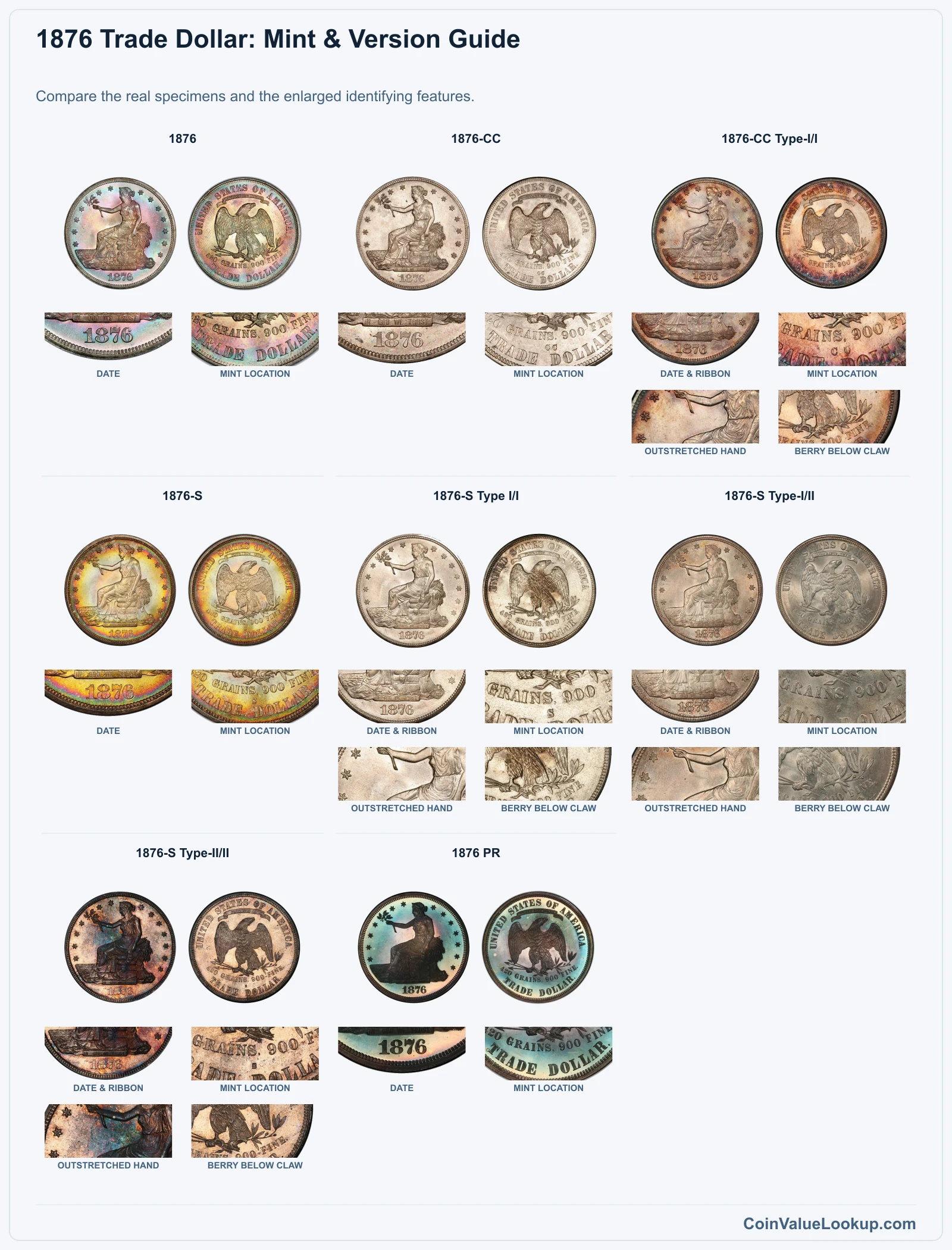
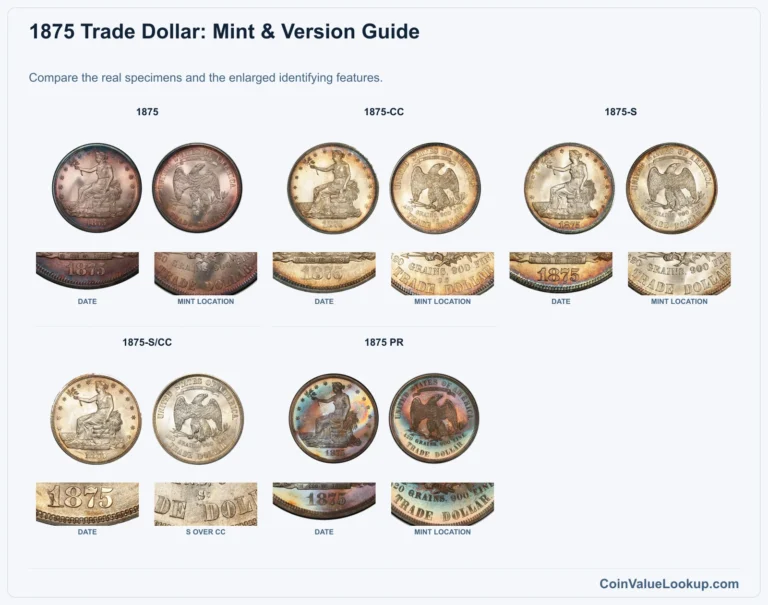
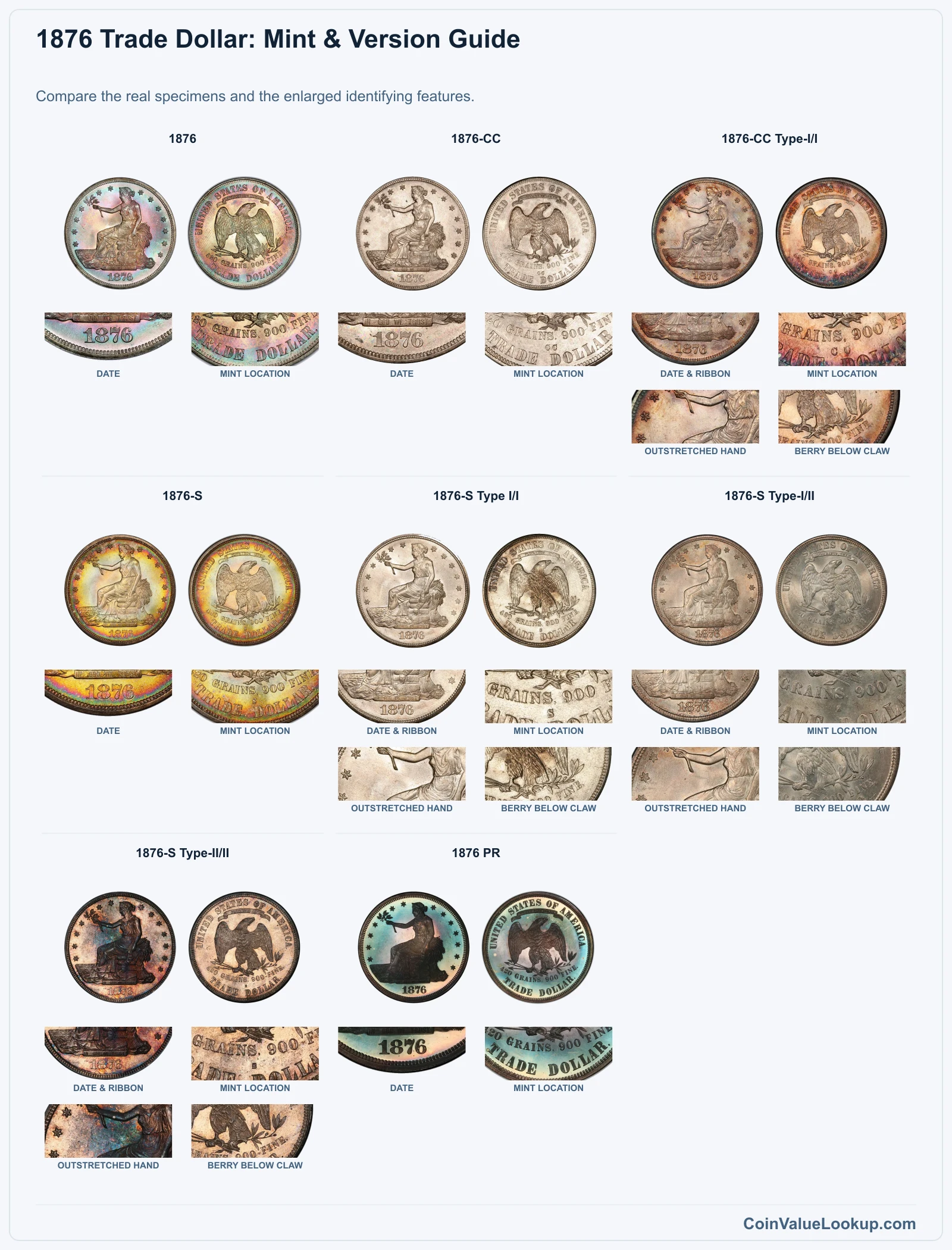
Flip your coin to the reverse and look below the eagle, near the base. A tiny "CC" means Carson City, an "S" means San Francisco, and no mark at all means Philadelphia.
These letters are small, so use a magnifier if needed.
The coin is 90% silver and 10% copper, weighing 27.22 grams with a reeded edge. The obverse shows Seated Liberty facing left; the reverse features an eagle with the inscription 420 GRAINS / 900 FINE.
Beyond the mintmark, you need to determine the obverse and reverse type combination. Trade Dollars have Type I and Type II obverse and reverse designs that differ in details like the ribbon, hand positioning and eagle arrow arrangement.
Compare your coin carefully against attributed images for those small but important distinctions.
Chopmarks — small stamps or punches on the surface — are merchant verification marks applied in Asia during circulation. They are not mint errors.
They affect value differently depending on the collector, but they should not be confused with die varieties or striking anomalies.
Step 2: Check Your 1876 Trade Dollar Grade
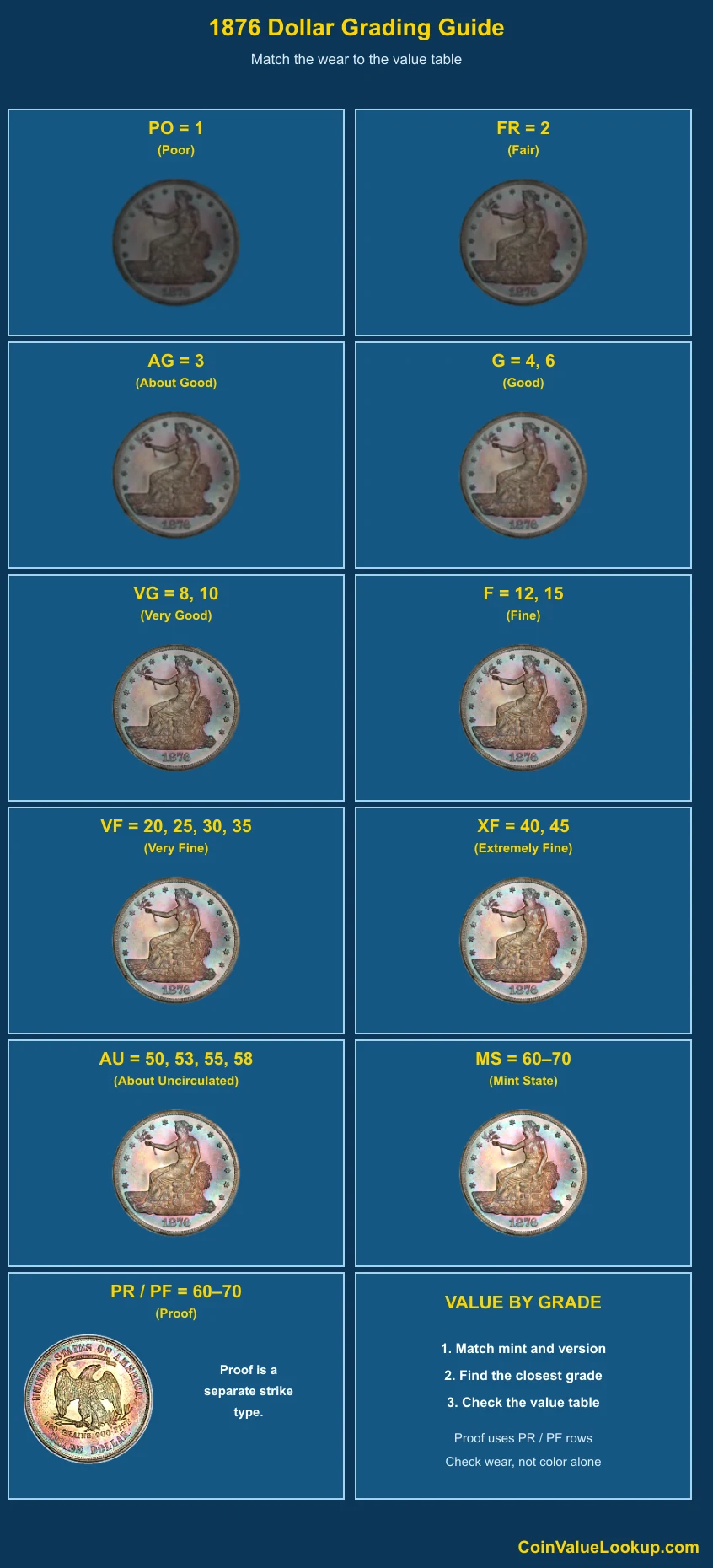
Start with Liberty's head, shoulder and knee on the obverse, then check the eagle's breast feathers and upper wing tips on the reverse. These are the first areas to lose detail as the coin wears.
A coin grading around Good-4 will show Liberty as a flat outline with very little interior detail. Move up to About Uncirculated and you will see nearly complete design elements with just slight friction on the highest points.
Mint State coins retain full original luster and sharp detail across every element. Use the comparison image to see the progression from circulated through AU and into Mint State side by side.
Grading is separate from surface problems. Cleaning, polishing, scratches and environmental damage all reduce a coin's desirability regardless of how much design detail remains.
A cleaned Trade Dollar with full detail is not the same as an original-surface example at the same wear level.
Step 3: Check 1876 Trade Dollar Value by Mint and Version
1876 Trade Dollar
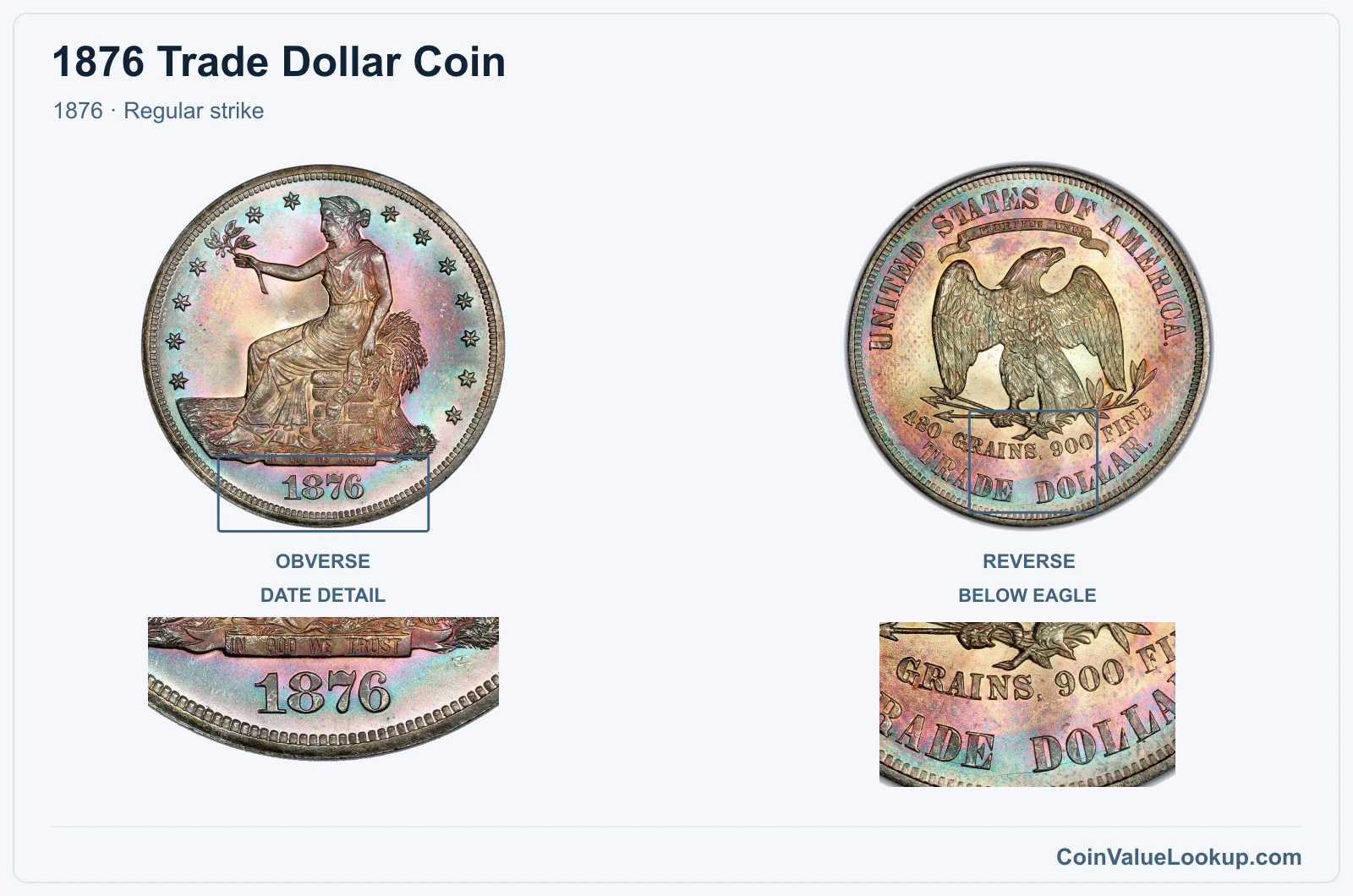
The 1876 Philadelphia Trade Dollar carries no mintmark. In well-circulated condition at G4, guide estimates sit around $232, climbing to roughly $1,854 at MS63.
These are guide estimates from USA Coin Book, not guaranteed sale prices.
Before comparing values, confirm the Type I obverse and Type I reverse combination by examining the ribbon, hand and arrow details against reference images. Original surfaces matter — a cleaned or polished coin does not compare evenly to one with natural toning and luster intact.
Range Grade
Price Auction Records Appraisal PO PO 1
—
Coin Identifier FR FR 2
—
Coin Identifier AG AG 3
—
Coin Identifier G G 4
—
Coin Identifier
G 6
—
Coin Identifier VG VG 8
Coin Identifier
VG 10
—
Coin Identifier F F 12
Coin Identifier
F 15
—
Coin Identifier VF VF 20
Coin Identifier
VF 25
Coin Identifier
VF 30
Coin Identifier
VF 35
Coin Identifier XF XF 40
Coin Identifier
XF 45
Coin Identifier AU AU 50
Coin Identifier
AU 53
Coin Identifier
AU 55
Coin Identifier
AU 58
Coin Identifier MS MS 60
Coin Identifier
MS 61
Coin Identifier
MS 62
Coin Identifier
MS 63
Coin Identifier
MS 64
Coin Identifier
MS 65
Coin Identifier
MS 66
Coin Identifier
MS 67
—
Coin Identifier
MS 68
—
—
—
MS 69
—
—
—
MS 70
—
—
—
1876 Trade Dollar — CC
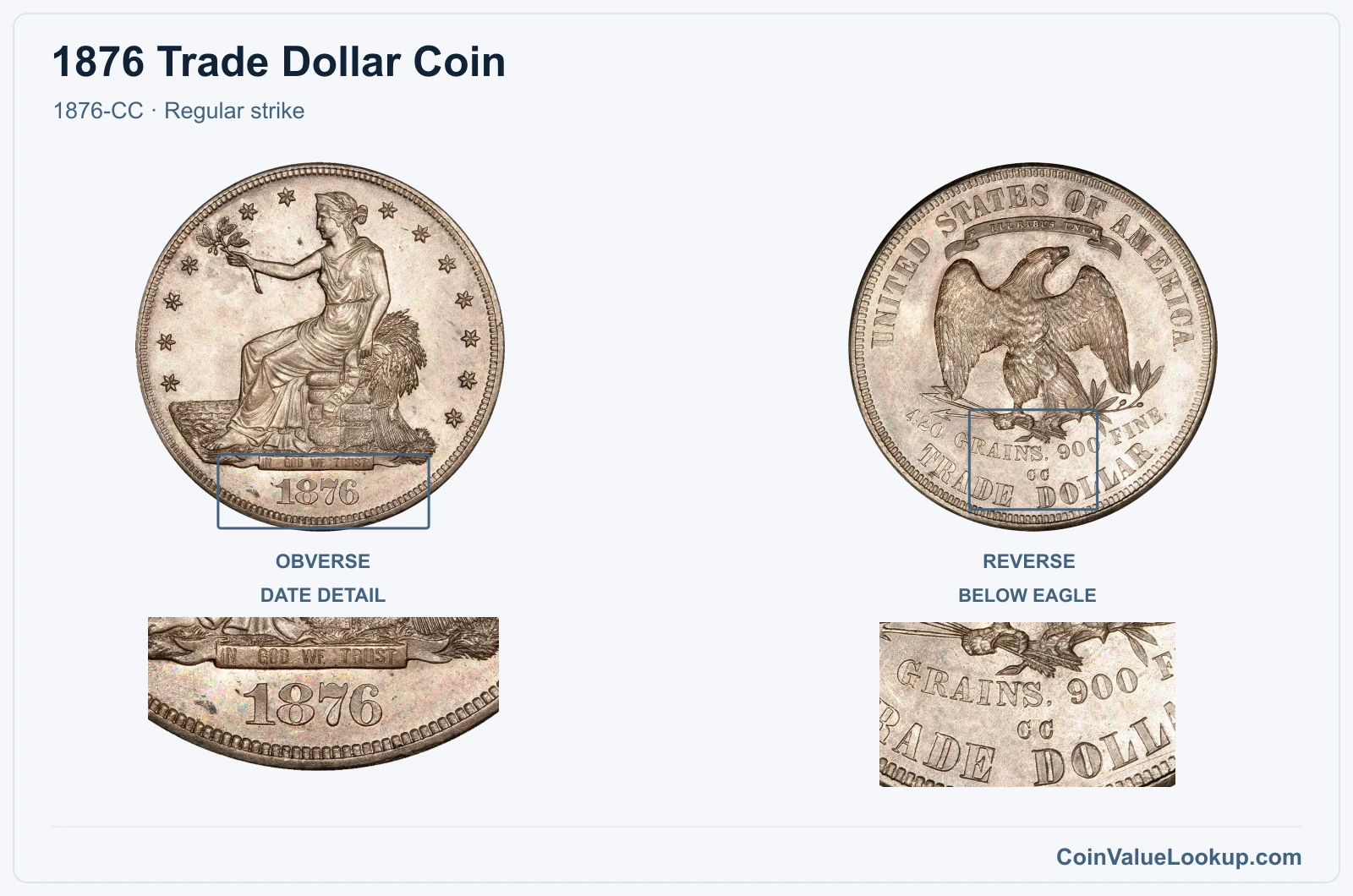
The 1876-CC Trade Dollar was struck at the Carson City Mint, identified by the small "CC" below the eagle on the reverse. Guide estimates range from $705 at G4 to $34,473 at MS63, reflecting the relative scarcity of Carson City production.
This version is cataloged as a Doubled Die Reverse type with a Type I/I combination. That elevated MS63 figure is not what every Carson City piece is worth — grade and originality drive the number hard.
A chopmarked or cleaned example in lower grades will trade for far less than those headline numbers suggest.
Coin Value Lookup is a useful starting point if you want to look up other Trade Dollar years or denominations while researching your coin. It offers guides organized by series so you can compare across dates quickly.
Range Grade
Price Auction Records Appraisal PO PO 1
—
Coin Identifier FR FR 2
—
Coin Identifier AG AG 3
—
Coin Identifier G G 4
—
Coin Identifier
G 6
—
Coin Identifier VG VG 8
—
Coin Identifier
VG 10
—
Coin Identifier F F 12
Coin Identifier
F 15
Coin Identifier VF VF 20
Coin Identifier
VF 25
—
Coin Identifier
VF 30
Coin Identifier
VF 35
Coin Identifier XF XF 40
Coin Identifier
XF 45
Coin Identifier AU AU 50
Coin Identifier
AU 53
Coin Identifier
AU 55
Coin Identifier
AU 58
Coin Identifier MS MS 60
Coin Identifier
MS 61
Coin Identifier
MS 62
Coin Identifier
MS 63
Coin Identifier
MS 64
Coin Identifier
MS 65
—
Coin Identifier
MS 66
—
—
—
MS 67
—
—
—
MS 68
—
—
—
MS 69
—
—
—
MS 70
—
—
—
1876 Trade Dollar — CC Type-I/I
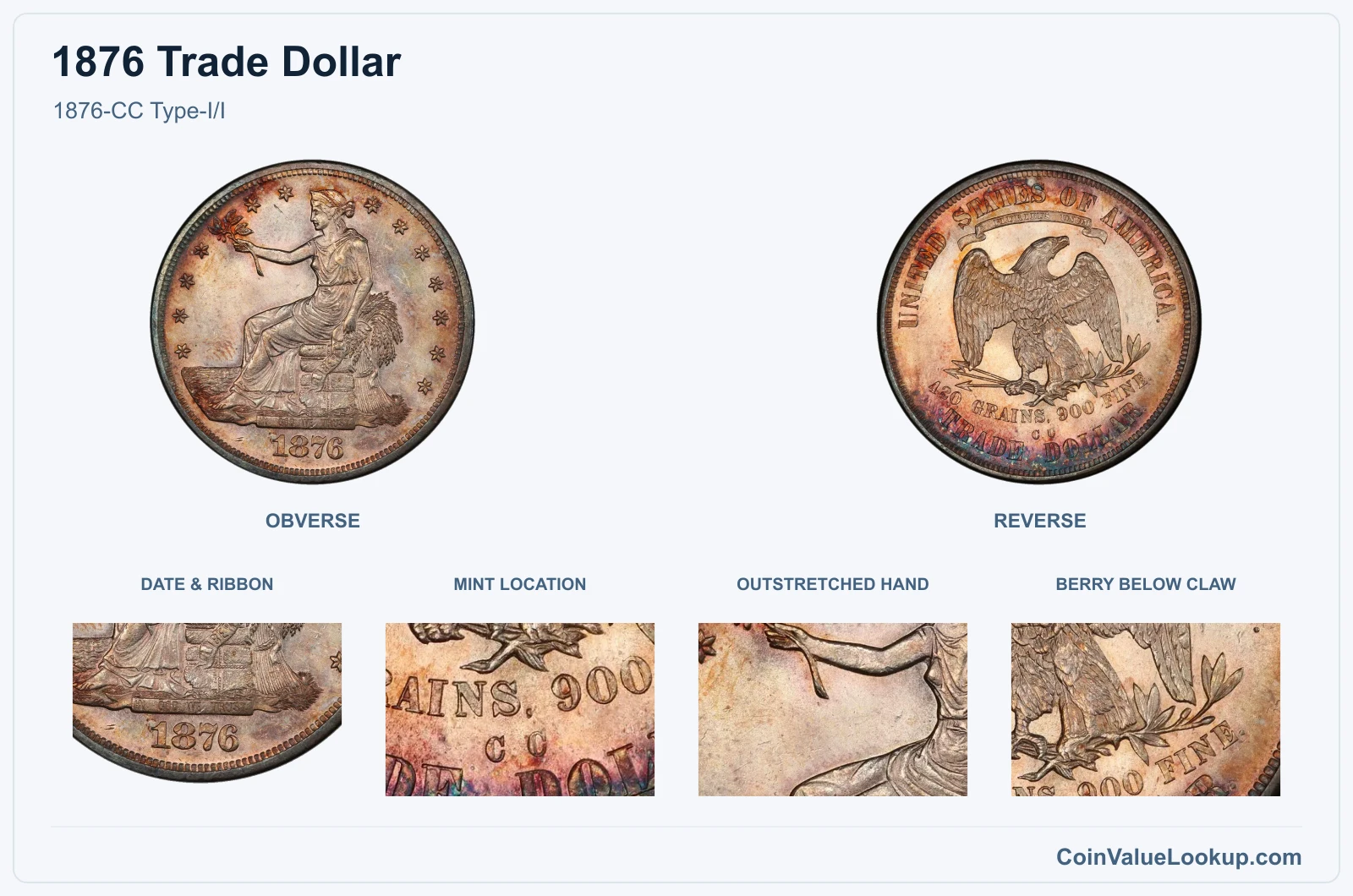
The 1876-CC Type-I/I is the attributed obverse and reverse type pairing for the Carson City Trade Dollar this year. You need to verify both the "CC" mintmark and the Type I/I design details — ribbon arrangement, hand position and eagle arrow configuration — against reference images.
Guide estimates match the general 1876-CC listing: $705 at G4 and $34,473 at MS63. Those high-end numbers apply to original-surface, accurately attributed coins in certified holders.
A raw coin claiming to be MS63 without third-party grading deserves skepticism. Condition and authenticity verification are everything with Carson City dollars.
Range Grade
Price Auction Records Appraisal PO PO 1
—
Coin Identifier FR FR 2
—
Coin Identifier AG AG 3
—
Coin Identifier G G 4
—
Coin Identifier
G 6
—
Coin Identifier VG VG 8
—
Coin Identifier
VG 10
—
Coin Identifier F F 12
—
Coin Identifier
F 15
—
Coin Identifier VF VF 20
—
Coin Identifier
VF 25
—
Coin Identifier
VF 30
—
Coin Identifier
VF 35
—
Coin Identifier XF XF 40
—
Coin Identifier
XF 45
Coin Identifier AU AU 50
—
Coin Identifier
AU 53
—
Coin Identifier
AU 55
—
Coin Identifier
AU 58
—
—
— MS MS 60
—
—
—
MS 61
—
—
—
MS 62
Coin Identifier
MS 63
—
—
—
MS 64
Coin Identifier
MS 65
—
—
—
MS 66
—
—
—
MS 67
—
—
—
MS 68
—
—
—
MS 69
—
—
—
MS 70
—
—
—
1876 Trade Dollar — S
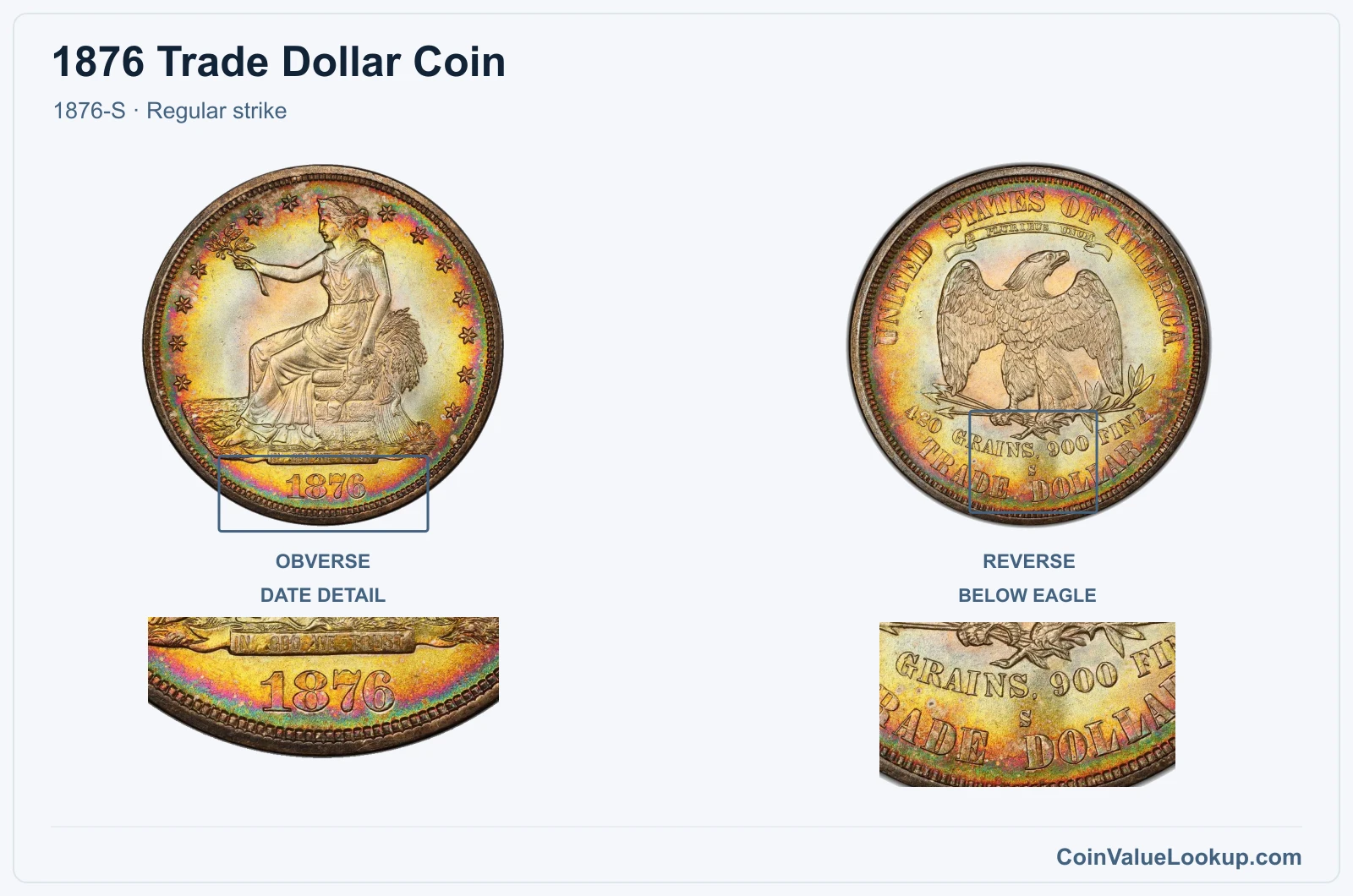
The 1876-S Trade Dollar, struck at San Francisco, is the most commonly encountered mint for this date. The "S" mintmark appears below the eagle on the reverse.
Guide estimates start at $232 for G4 and reach $2,026 at MS63.
San Francisco produced Trade Dollars in large quantities for Pacific trade, so circulated examples are relatively available. The key is confirming which type combination you have — Type I/I, Type I/II or Type II/II — since the San Francisco mint used multiple die pairings this year, and each has its own value track.
Range Grade
Price Auction Records Appraisal PO PO 1
—
Coin Identifier FR FR 2
—
Coin Identifier AG AG 3
—
Coin Identifier G G 4
—
Coin Identifier
G 6
—
Coin Identifier VG VG 8
—
Coin Identifier
VG 10
Coin Identifier F F 12
Coin Identifier
F 15
Coin Identifier VF VF 20
Coin Identifier
VF 25
Coin Identifier
VF 30
Coin Identifier
VF 35
Coin Identifier XF XF 40
Coin Identifier
XF 45
Coin Identifier AU AU 50
Coin Identifier
AU 53
Coin Identifier
AU 55
Coin Identifier
AU 58
Coin Identifier MS MS 60
Coin Identifier
MS 61
Coin Identifier
MS 62
Coin Identifier
MS 63
Coin Identifier
MS 64
Coin Identifier
MS 65
Coin Identifier
MS 66
Coin Identifier
MS 67
—
—
—
MS 68
—
—
—
MS 69
—
—
—
MS 70
—
—
—
1876 Trade Dollar — S Type I/I
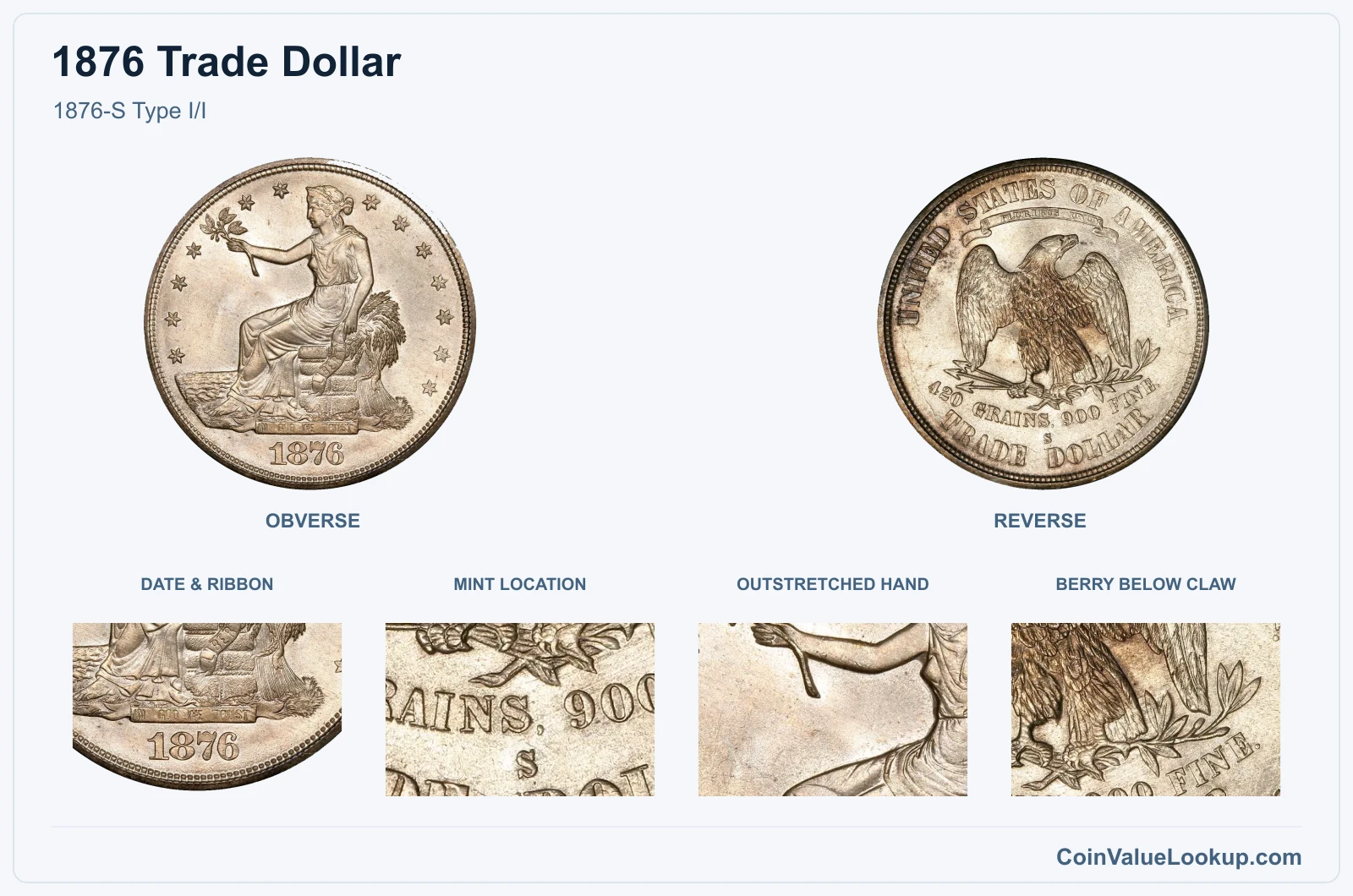
The 1876-S Type I/I pairs a Type I obverse with a Type I reverse. Guide estimates are $232 at G4 and $2,026 at MS63.
This is the baseline San Francisco variety for the year.
To confirm you have this specific pairing rather than the Type I/II or II/II combination, compare the ribbon and hand details on the obverse and the arrow arrangement on the reverse against attributed reference images. Getting the type wrong means using the wrong price column, so take your time with it.
Range Grade
Price Auction Records Appraisal PO PO 1
—
Coin Identifier FR FR 2
—
Coin Identifier AG AG 3
—
Coin Identifier G G 4
—
Coin Identifier
G 6
—
Coin Identifier VG VG 8
—
Coin Identifier
VG 10
—
Coin Identifier F F 12
—
Coin Identifier
F 15
—
Coin Identifier VF VF 20
—
Coin Identifier
VF 25
—
Coin Identifier
VF 30
—
Coin Identifier
VF 35
Coin Identifier XF XF 40
—
Coin Identifier
XF 45
—
—
— AU AU 50
—
—
—
AU 53
—
—
—
AU 55
—
—
—
AU 58
—
—
— MS MS 60
—
—
—
MS 61
—
—
—
MS 62
Coin Identifier
MS 63
Coin Identifier
MS 64
Coin Identifier
MS 65
Coin Identifier
MS 66
—
Coin Identifier
MS 67
—
—
—
MS 68
—
—
—
MS 69
—
—
—
MS 70
—
—
—
1876 Trade Dollar — S Type-I/II
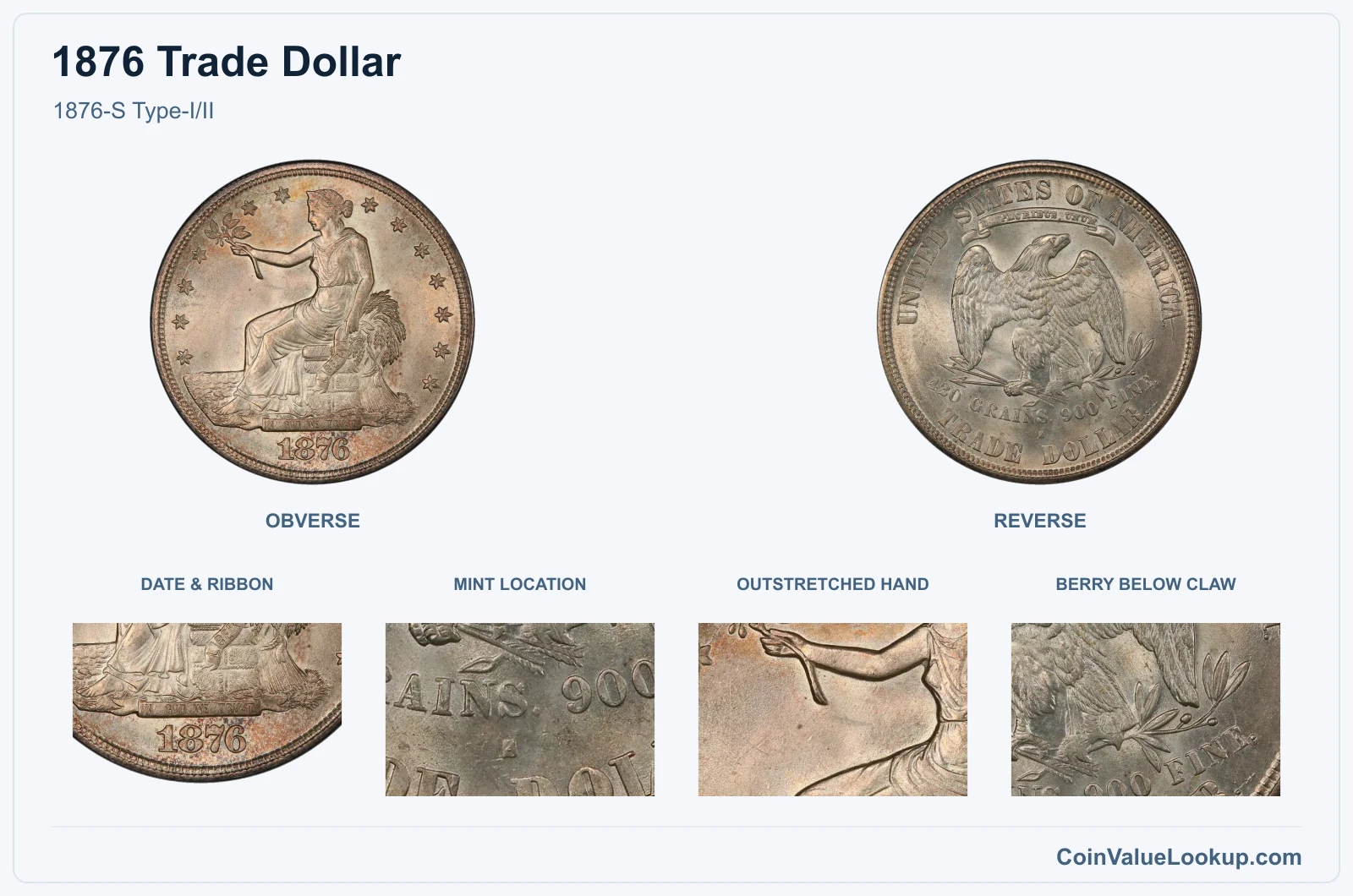
The 1876-S Type-I/II pairs a Type I obverse with a Type II reverse. Guide estimates run from $232 at G4 up to $3,357 at MS63.
That MS63 figure is noticeably higher than the Type I/I pairing from the same mint, so accurate attribution pays off here.
The difference between a Type I and Type II reverse comes down to specific design elements around the eagle and lettering. Side-by-side comparison with known examples is the reliable way to tell them apart.
Do not assume you have the more valuable variety without careful examination — wishful thinking is not a diagnostic tool.
Range Grade
Price Auction Records Appraisal PO PO 1
—
Coin Identifier FR FR 2
—
Coin Identifier AG AG 3
—
Coin Identifier G G 4
—
Coin Identifier
G 6
—
Coin Identifier VG VG 8
—
Coin Identifier
VG 10
—
Coin Identifier F F 12
—
Coin Identifier
F 15
—
Coin Identifier VF VF 20
—
Coin Identifier
VF 25
—
Coin Identifier
VF 30
—
Coin Identifier
VF 35
—
Coin Identifier XF XF 40
—
Coin Identifier
XF 45
—
Coin Identifier AU AU 50
—
Coin Identifier
AU 53
—
Coin Identifier
AU 55
—
Coin Identifier
AU 58
—
Coin Identifier MS MS 60
—
Coin Identifier
MS 61
—
Coin Identifier
MS 62
—
Coin Identifier
MS 63
Coin Identifier
MS 64
Coin Identifier
MS 65
—
—
—
MS 66
—
—
—
MS 67
—
—
—
MS 68
—
—
—
MS 69
—
—
—
MS 70
—
—
—
1876 Trade Dollar — S Type-II/II
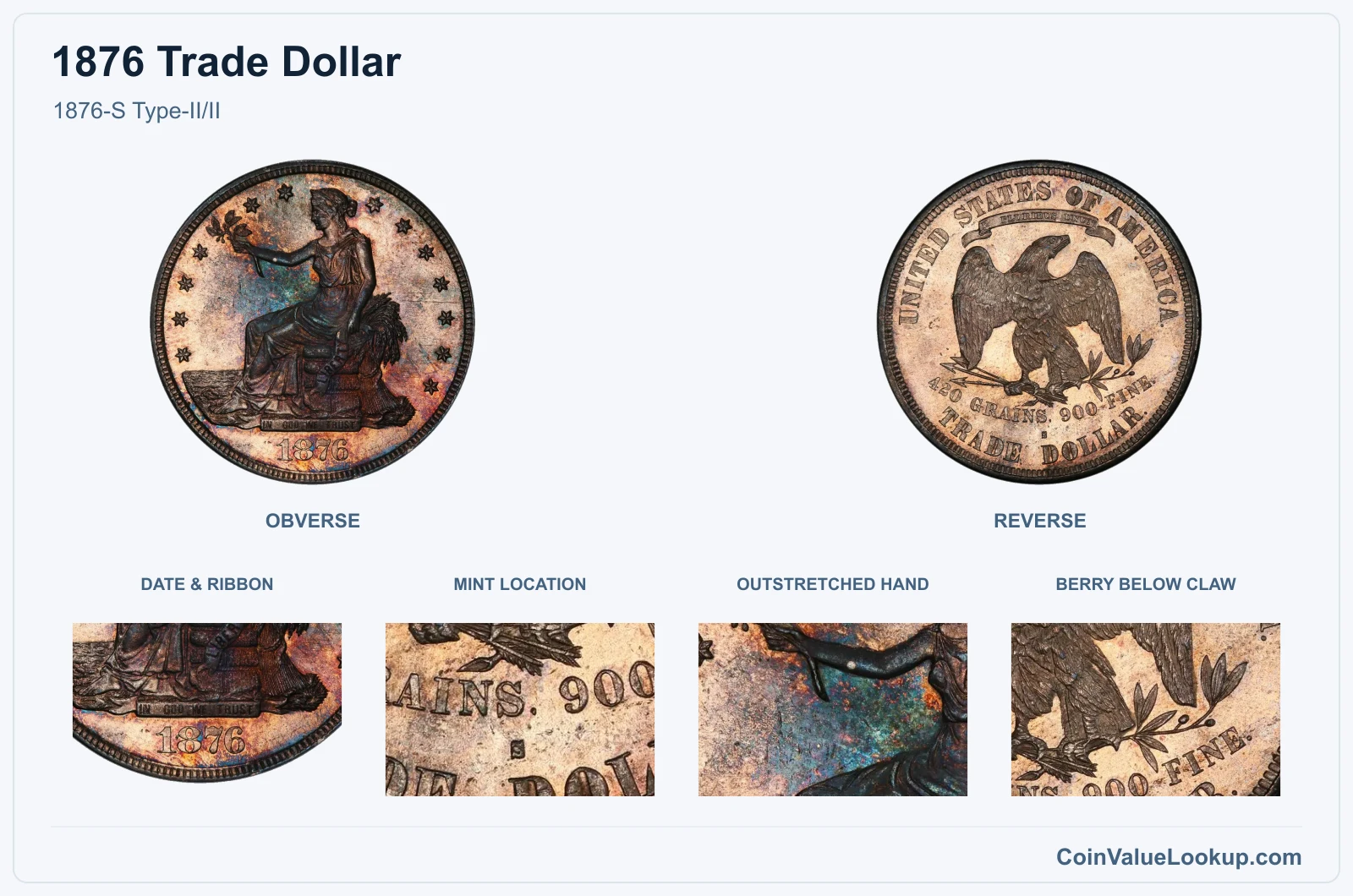
The 1876-S Type-II/II uses a Type II obverse paired with a Type II reverse. Guide estimates match the Type-I/II listing: $232 at G4 and $3,357 at MS63.
Both the Type-I/II and Type-II/II San Francisco varieties track higher than the Type I/I in upper grades.
Confirming you have a Type II obverse rather than a Type I requires attention to the ribbon and hand details on Liberty's side. If you have already identified a Type II reverse, check the obverse next.
Accurate type attribution is the difference between a $2,026 and a $3,357 guide value at MS63.
Range Grade
Price Auction Records Appraisal PO PO 1
—
Coin Identifier FR FR 2
—
Coin Identifier AG AG 3
—
Coin Identifier G G 4
—
Coin Identifier
G 6
—
Coin Identifier VG VG 8
—
Coin Identifier
VG 10
—
Coin Identifier F F 12
—
Coin Identifier
F 15
—
Coin Identifier VF VF 20
—
Coin Identifier
VF 25
—
Coin Identifier
VF 30
—
Coin Identifier
VF 35
—
Coin Identifier XF XF 40
—
Coin Identifier
XF 45
—
Coin Identifier AU AU 50
Coin Identifier
AU 53
Coin Identifier
AU 55
—
Coin Identifier
AU 58
—
Coin Identifier MS MS 60
—
Coin Identifier
MS 61
Coin Identifier
MS 62
Coin Identifier
MS 63
—
Coin Identifier
MS 64
Coin Identifier
MS 65
—
—
—
MS 66
—
—
—
MS 67
—
—
—
MS 68
—
—
—
MS 69
—
—
—
MS 70
—
—
—
1876 Trade Dollar — PR
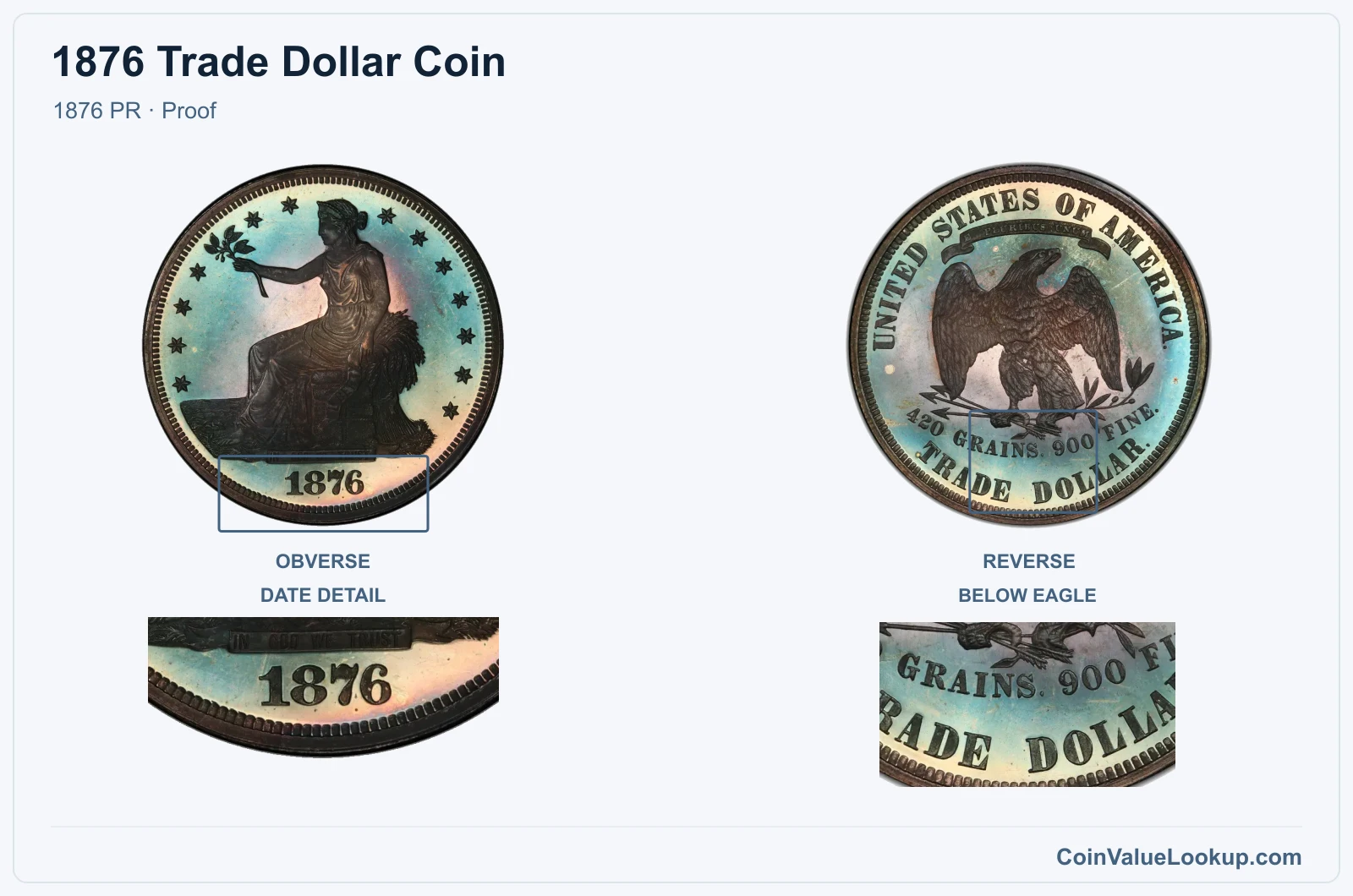
The 1876 Proof Trade Dollar was struck at Philadelphia with no mintmark, using specially prepared dies and planchets. A proof is a manufacturing finish — mirror fields, sharp strikes — not simply a high-grade or shiny business strike.
No supported numeric price range is available for this version, so individual assessment based on authenticated identity, condition and surface quality is necessary. Proof Trade Dollars should be certified by a recognized grading service before any serious buying or selling discussion.
An uncertified coin claimed to be a proof needs professional verification, because many business strikes have been polished to mimic proof surfaces.
Range Grade
Price Auction Records Appraisal PR PR 1
—
Coin Identifier
PR 2
—
Coin Identifier
PR 3
—
Coin Identifier
PR 4
—
Coin Identifier
PR 6
—
Coin Identifier
PR 8
—
Coin Identifier
PR 10
—
Coin Identifier
PR 12
—
Coin Identifier
PR 15
—
Coin Identifier
PR 20
—
Coin Identifier
PR 25
—
Coin Identifier
PR 30
—
Coin Identifier
PR 35
—
Coin Identifier
PR 40
—
Coin Identifier
PR 45
—
Coin Identifier
PR 50
—
Coin Identifier
PR 53
—
Coin Identifier
PR 55
Coin Identifier
PR 58
Coin Identifier
PR 60
Coin Identifier
PR 61
Coin Identifier
PR 62
Coin Identifier
PR 63
Coin Identifier
PR 64
Coin Identifier
PR 65
Coin Identifier
PR 66
Coin Identifier
PR 67
—
Coin Identifier
PR 68
—
—
—
PR 69
—
—
—
PR 70
—
—
—
1876 Trade Dollar Error List
1. 1876 Trade Dollar — Repunched Date
A Repunched Date variety has been reported on the 1876-S Trade Dollar. This occurs when the date numerals were punched into the die more than once, with the second impression slightly offset from the first.
The result is remnants of an earlier date position visible beside or beneath the final numerals — look for doubling or shadow digits, particularly under magnification.
This is distinct from doubled die varieties, which affect the entire design from the hubbing process. It is also different from machine doubling, which produces flat, shelf-like distortion rather than the distinct separated impressions of a genuine repunched date.
Damage to the date area from circulation or contact can also mimic repunching at first glance.
No specific price range is available for this variety. Value depends on the visibility of the repunching, overall coin condition and the specific die involved.
Professional attribution is recommended before paying a premium.
2. 1876 Trade Dollar — Doubled Die Reverse
A Doubled Die Reverse has been reported on the 1876-CC Trade Dollar. To identify this variety, compare the reverse legends and design contours against a normal 1876-CC coin.
Genuine die doubling produces a consistent, directional shift in the affected design elements that repeats across every coin struck from that die.
Do not confuse this with machine doubling, which creates flat, shelflike distortion without the raised, separated profiles of a true doubled die. Reflections from proof-like surfaces or random contact damage can also create misleading appearances of doubling under certain lighting.
No specific price range is available for the doubled die reverse variety. The value depends on the strength and visibility of the doubling, the coin's overall grade and surface preservation.
Given that Carson City Trade Dollars already command premiums, a confirmed doubled die adds further collector interest, but authentication by a recognized grading service is the appropriate step before assuming you hold this variety.