1878 Trade Dollar Coin Value: How Much Is It Worth?
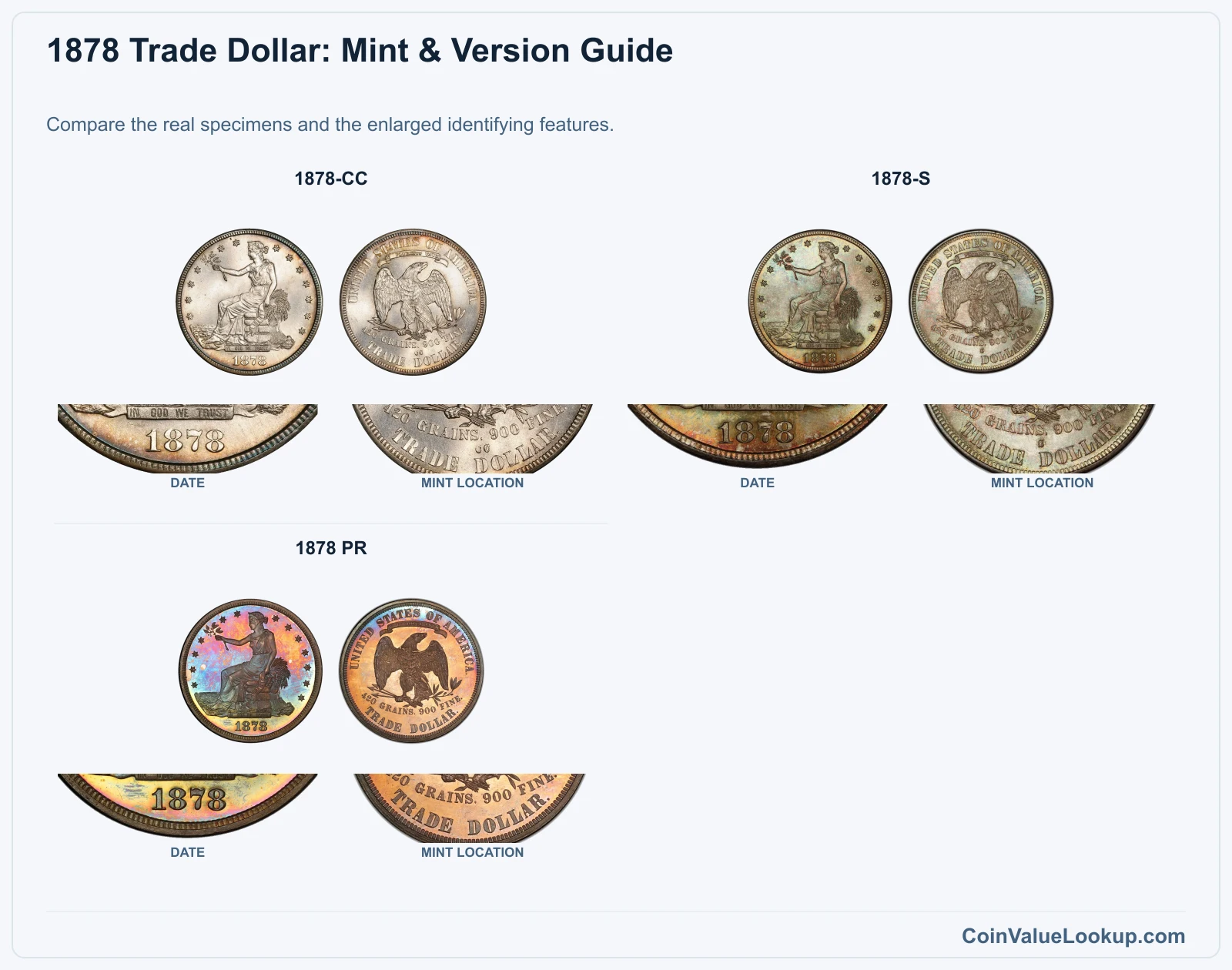
The 1878 Trade Dollar is a coin with real silver weight and genuine collector demand. Guide estimates for this year range from about $182.00 in well-worn grades up to around $30,968.00 for top-condition examples, depending on mint, finish and grade.
Not every coin qualifies for those higher figures, though.
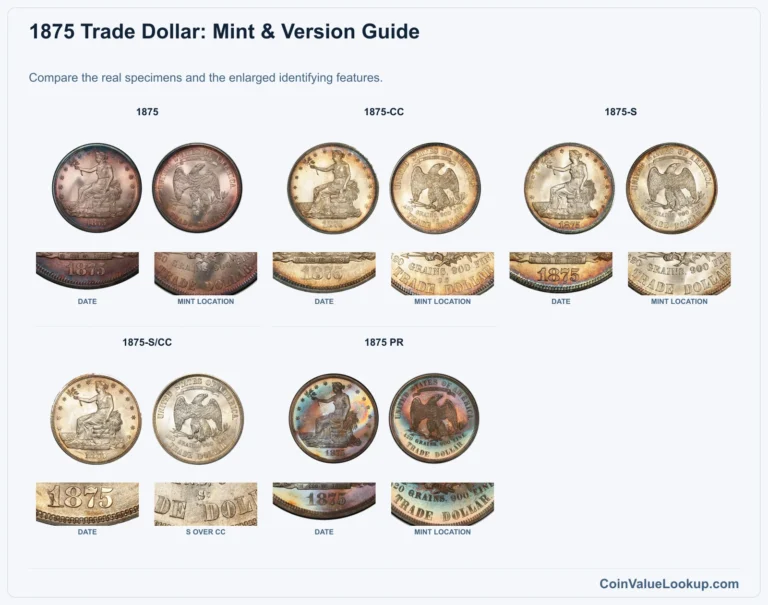
Three distinct branches exist for 1878: the Carson City (CC), San Francisco (S) and a Philadelphia proof-only issue. Identifying which one you have is the first step, because the price gap between them is substantial.
Fast Way to Identify Your 1878 Trade Dollar
The quickest way to start figuring out what your 1878 Trade Dollar is worth is to upload clear photos of both sides. A front and back image lets us provide a preliminary identification of your coin's mint, version and approximate condition.
Snap the photos in even lighting, avoiding glare on the silver surface, and make sure the mintmark area below the eagle is visible.
1878 Trade Dollar Value
Upload both sides of your 1878 Trade Dollar.
Front Obverse
Upload photo
Back Reverse
Upload photo
Which 1878 Trade Dollar Versions Are Worth Money?
- 1878-CC Trade Dollar: Carson City mint, guide estimates from $623 (G4) to $30,968 (MS63), the highest valued business-strike branch this year.
- 1878 Proof: Philadelphia proof-only issue, guide estimate around $4,109 in PR63; a proof is a special manufacturing finish, not just a shiny coin.
- 1878-S Doubled Die Reverse: A reported error variety on the San Francisco issue; value depends on the specific coin's condition and the visibility of doubling.
Step 1: Identify Your 1878 Trade Dollar Mint Mark and Version
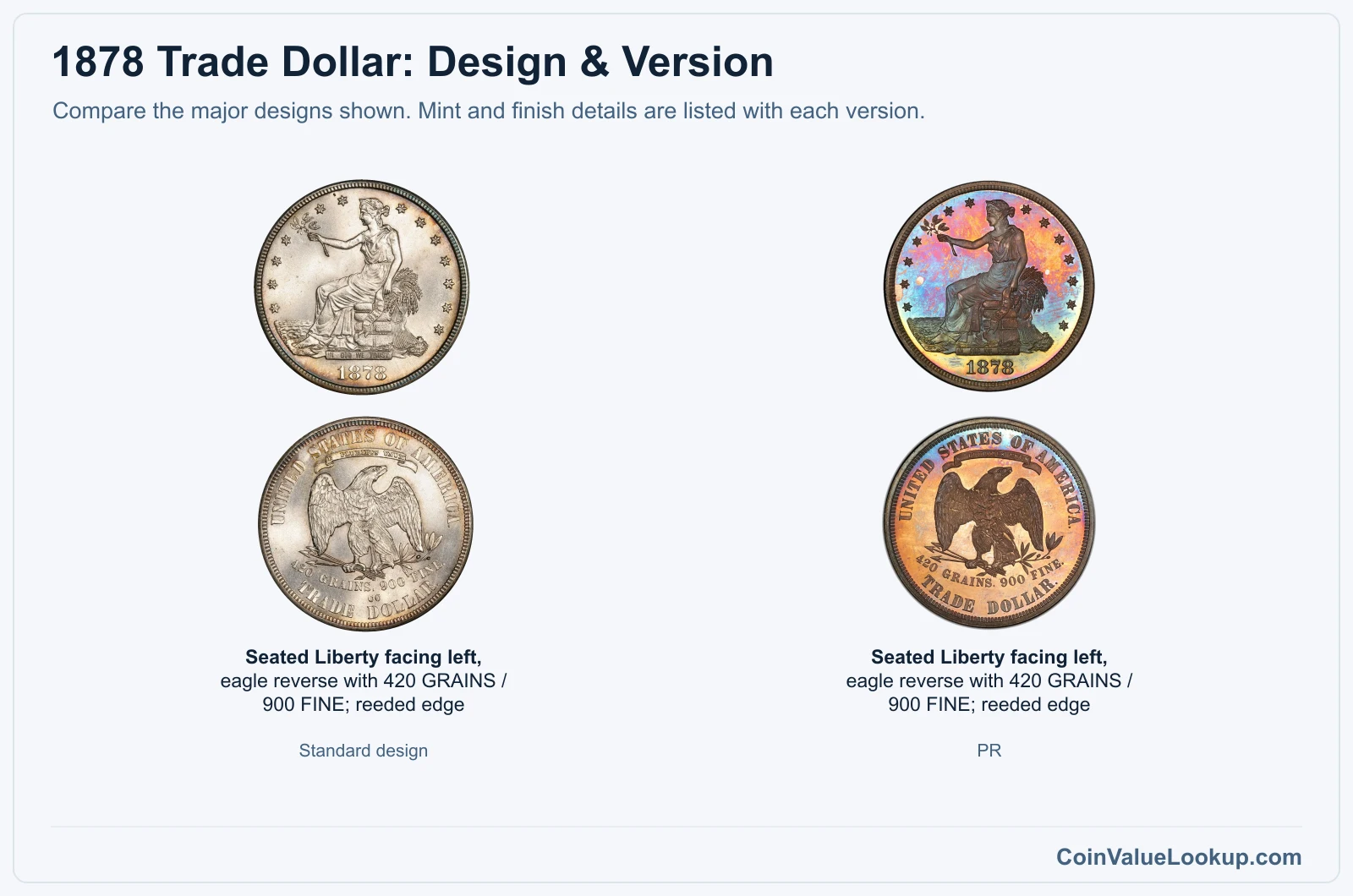
Flip your coin to the reverse and look just below the eagle, above the denomination text. A small "CC" means Carson City.
An "S" means San Francisco. No mintmark at all points to Philadelphia, which in 1878 struck Trade Dollars only as proofs.
All three versions share the same basic design: Seated Liberty facing left on the obverse, an eagle clutching arrows and an olive branch on the reverse, with 420 GRAINS and 900 FINE stamped below. The edge is reeded.
Every genuine example weighs 27.22 grams and is composed of 90% silver and 10% copper.
If you see small stamped symbols punched into the surfaces, those are chopmarks, applied by Asian merchants who tested the coin in trade. They are not mint errors.
Chopmarks affect value in their own way but should not be confused with die varieties or manufacturing mistakes.
Step 2: Check Your 1878 Trade Dollar Grade
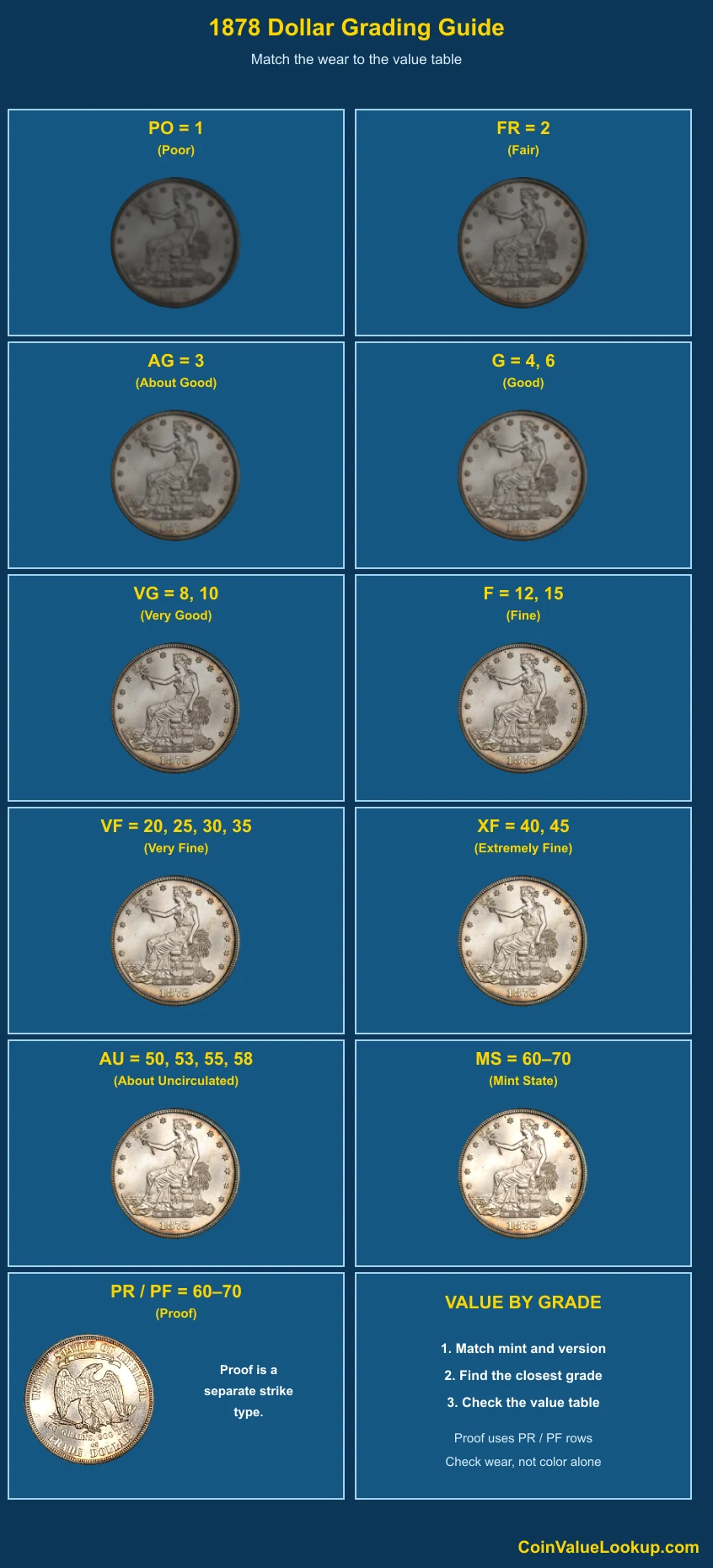
Wear shows up first on the high points of Liberty's head, her right shoulder and the forward knee on the obverse. On the reverse, check the eagle's breast feathers and the tops of the wings.
A coin in Good condition will have a flat, mostly featureless Liberty but a readable date and legends. Around AU, you should still see most of the original luster with only slight friction on those high spots.
Use the comparison image to judge your coin against circulated, About Uncirculated and Mint State examples side by side. Keep proof coins in a separate mental category, since proof is a way a coin was made, not a higher grade than Mint State.
Also evaluate the surfaces honestly. Cleaning, polishing, harsh wiping or heavy contact marks all reduce a coin's desirability and comparability to guide prices, even if the overall detail looks sharp.
Step 3: Check 1878 Trade Dollar Value by Mint and Version
1878 Trade Dollar — CC
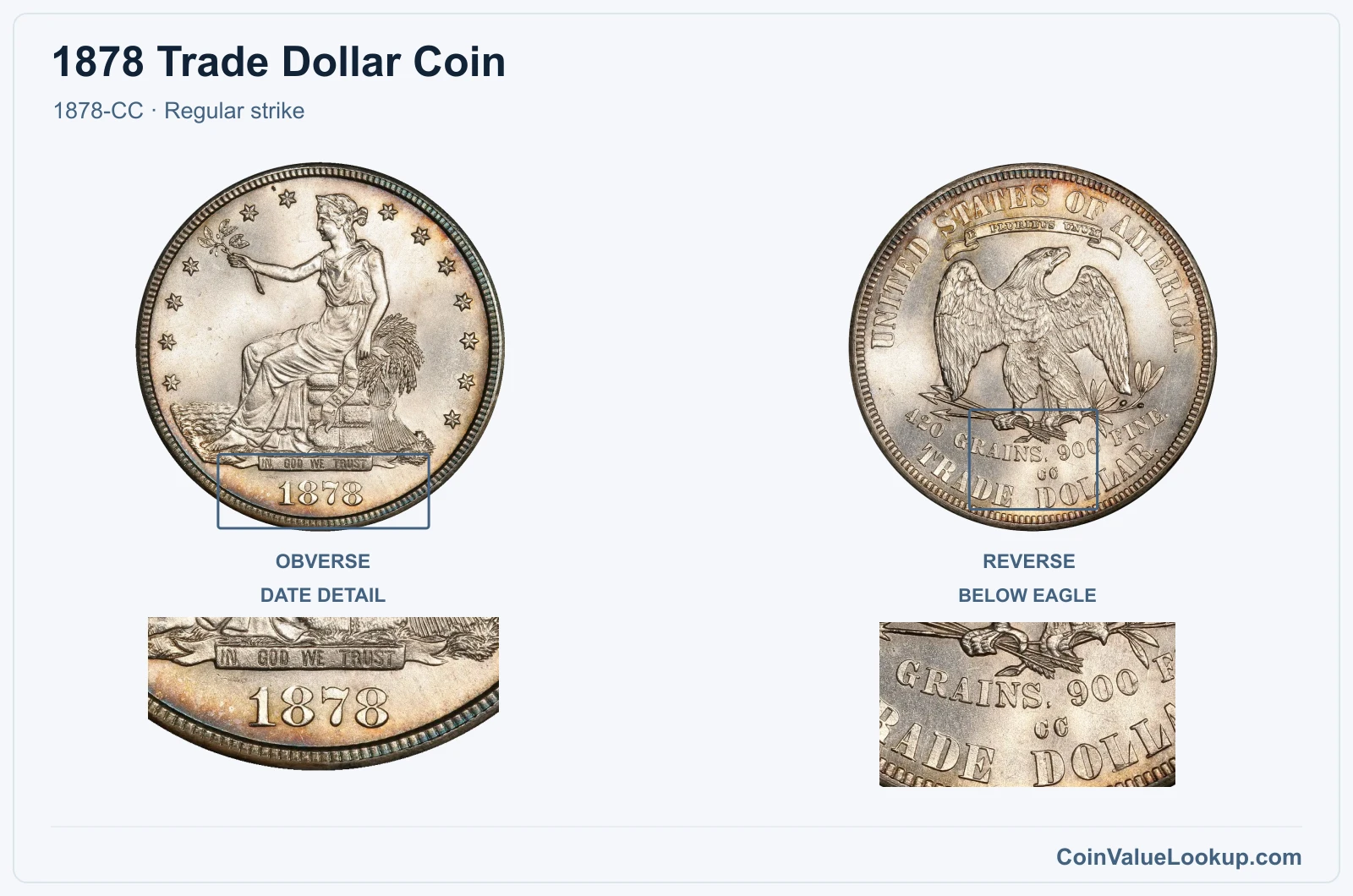
The 1878-CC Trade Dollar was struck at the Carson City Mint in Nevada. Look for the small "CC" mintmark on the reverse beneath the eagle.
Guide estimates run from about $623 in G4 to roughly $30,968 in MS63, according to USA Coin Book.
Those are serious numbers compared to the San Francisco issue. Carson City coins have long carried a premium because of the mint's relatively limited output and its Old West mystique.
Original, uncleaned surfaces matter enormously here. A cleaned CC example loses much of its comparative value, even if the detail looks fine to the naked eye.
When examining yours, pay attention to the ribbon, hand and eagle arrow details against attributed images to help confirm the correct type combination.
Range Grade
Price Auction Records Appraisal PO PO 1
—
Coin Identifier FR FR 2
—
Coin Identifier AG AG 3
—
Coin Identifier G G 4
—
Coin Identifier
G 6
—
Coin Identifier VG VG 8
—
Coin Identifier
VG 10
Coin Identifier F F 12
Coin Identifier
F 15
Coin Identifier VF VF 20
Coin Identifier
VF 25
Coin Identifier
VF 30
Coin Identifier
VF 35
Coin Identifier XF XF 40
Coin Identifier
XF 45
Coin Identifier AU AU 50
Coin Identifier
AU 53
Coin Identifier
AU 55
Coin Identifier
AU 58
Coin Identifier MS MS 60
Coin Identifier
MS 61
Coin Identifier
MS 62
Coin Identifier
MS 63
Coin Identifier
MS 64
Coin Identifier
MS 65
Coin Identifier
MS 66
—
Coin Identifier
MS 67
—
—
—
MS 68
—
—
—
MS 69
—
—
—
MS 70
—
—
—
1878 Trade Dollar — S
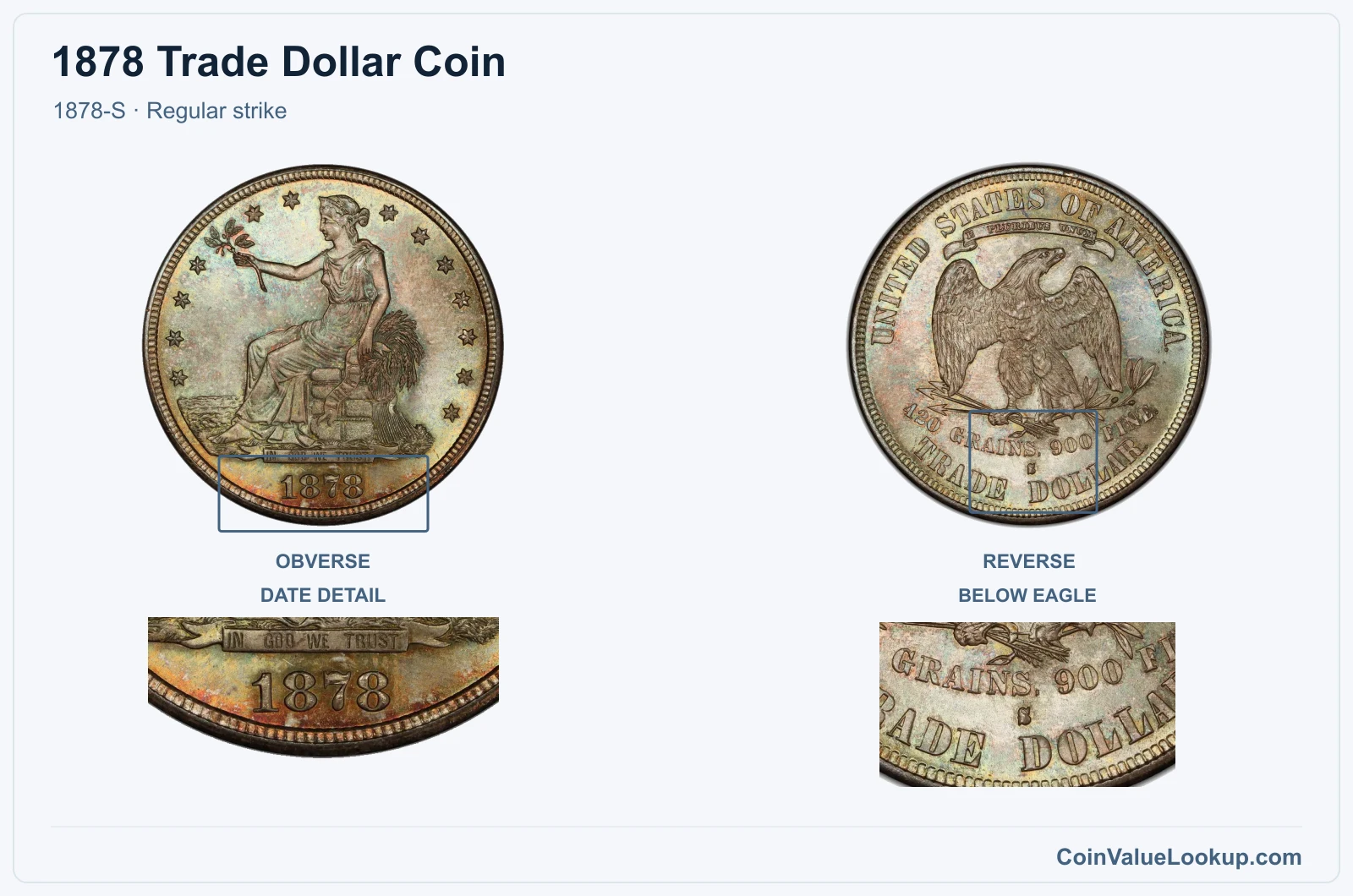
The 1878-S Trade Dollar carries a small "S" mintmark below the eagle on the reverse. San Francisco produced large quantities of Trade Dollars for Pacific Rim commerce, so these are the most available 1878 branch.
Guide estimates range from about $182 in G4 to around $2,767 in MS63, per USA Coin Book. That lower floor reflects higher surviving populations, but nice uncirculated examples still bring solid money.
As with any Trade Dollar, check for chopmarks and cleaning. A coin with original toning and sharp detail on Liberty's knee and the eagle's breast will always outperform a scrubbed one at the same technical grade.
Coin Value Lookup is a good starting point if you want to look up other dates or denominations in this series or compare across different coin types.
Range Grade
Price Auction Records Appraisal PO PO 1
—
Coin Identifier FR FR 2
—
Coin Identifier AG AG 3
—
Coin Identifier G G 4
Coin Identifier
G 6
Coin Identifier VG VG 8
Coin Identifier
VG 10
Coin Identifier F F 12
Coin Identifier
F 15
Coin Identifier VF VF 20
Coin Identifier
VF 25
Coin Identifier
VF 30
Coin Identifier
VF 35
Coin Identifier XF XF 40
Coin Identifier
XF 45
Coin Identifier AU AU 50
Coin Identifier
AU 53
Coin Identifier
AU 55
Coin Identifier
AU 58
Coin Identifier MS MS 60
Coin Identifier
MS 61
Coin Identifier
MS 62
Coin Identifier
MS 63
Coin Identifier
MS 64
Coin Identifier
MS 65
Coin Identifier
MS 66
Coin Identifier
MS 67
Coin Identifier
MS 68
Coin Identifier
MS 69
—
—
—
MS 70
—
—
—
1878 Trade Dollar — PR
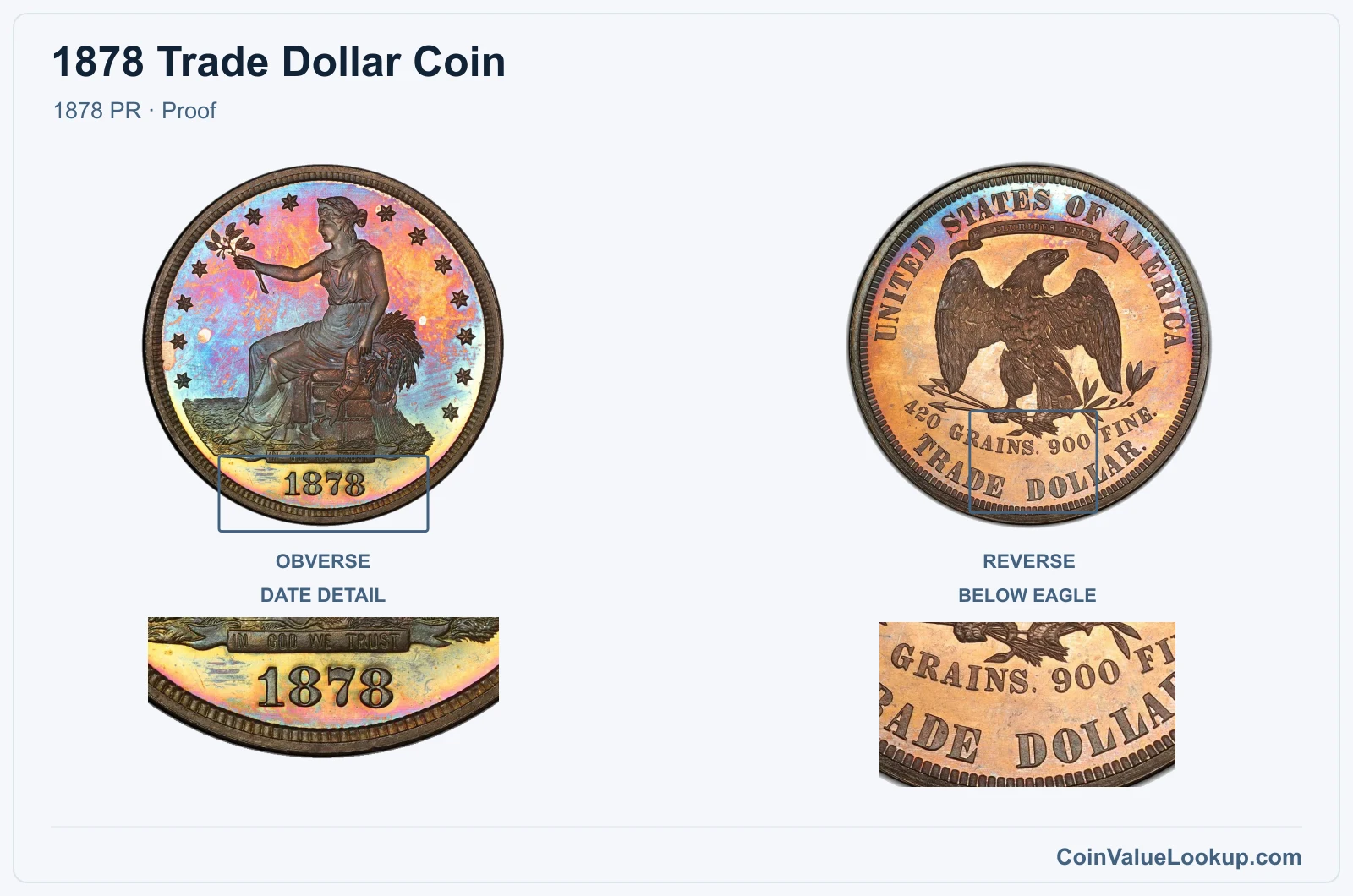
Philadelphia did not strike 1878 Trade Dollars for general circulation. Every Philadelphia-mint example from this year is a proof, identifiable by the absence of a mintmark and the coin's distinctive mirrored fields and sharp, squared-off rims.
A proof is a manufacturing method, not a grade above Mint State. These coins were struck on specially prepared planchets using polished dies, typically with multiple strikes for full detail.
Do not assume a shiny or well-preserved business strike is a proof; the surfaces and strike characteristics are fundamentally different.
The USA Coin Book guide estimate places a PR63 example at about $4,109. Examine the ribbon in Liberty's hand and the eagle's arrow arrangement carefully against attributed images to confirm the correct obverse and reverse type pairing.
Range Grade
Price Auction Records Appraisal PR PR 1
—
Coin Identifier
PR 2
—
Coin Identifier
PR 3
—
Coin Identifier
PR 4
—
Coin Identifier
PR 6
—
Coin Identifier
PR 8
—
Coin Identifier
PR 10
—
Coin Identifier
PR 12
—
Coin Identifier
PR 15
—
Coin Identifier
PR 20
—
Coin Identifier
PR 25
—
Coin Identifier
PR 30
—
Coin Identifier
PR 35
—
Coin Identifier
PR 40
Coin Identifier
PR 45
Coin Identifier
PR 50
—
Coin Identifier
PR 53
—
Coin Identifier
PR 55
Coin Identifier
PR 58
Coin Identifier
PR 60
Coin Identifier
PR 61
Coin Identifier
PR 62
Coin Identifier
PR 63
Coin Identifier
PR 64
Coin Identifier
PR 65
Coin Identifier
PR 66
Coin Identifier
PR 67
Coin Identifier
PR 68
Coin Identifier
PR 69
—
—
—
PR 70
—
—
—
1878 Trade Dollar Error List
1. 1878 Trade Dollar — Doubled Die Reverse
A Doubled Die Reverse has been reported on the 1878-S Trade Dollar specifically. This variety shows doubling on reverse design elements such as legends or design contours, caused by a misaligned secondary impression of the die during its manufacturing process.
To check for it, compare your coin's reverse lettering and device outlines closely against a normal 1878-S example under magnification.
This reported variety applies to the San Francisco mint issue; do not assume other 1878 mints share the same die. No specific price range is available, so value depends on the individual coin's condition, the strength and visibility of the doubling, and third-party verification.
Be careful not to confuse it with machine doubling, which produces flat, shelf-like distortion rather than the rounded, separated contours of a true doubled die. Reflections, surface damage and worn dies can also mimic doubling to an untrained eye.
Professional authentication is advisable before paying any premium.