1897 Barber Half Dollar Coin Value: How Much Is It Worth?
The 1897 Barber Half Dollar sits in a sweet spot for collectors of the series. Across the three business-strike mints — Philadelphia, New Orleans, and San Francisco — retail guide estimates range from about $56 at G4 to $4,961 at MS63, based on a USA Coin Book snapshot.
The O and S mintmarks carry noticeably stronger premiums than the Philadelphia issue, so checking your mintmark matters.
Fast Way to Identify Your 1897 Barber Half Dollar
Want a quick read on what you have? Upload clear photos of the front and back of your 1897 Barber Half Dollar, and our identifier can give you a preliminary take on the mint, version, and general condition.
It is not a substitute for professional authentication, but it is a solid starting point.
1897 Barber Half Dollar Value
Upload both sides of your 1897 Barber Half Dollar.
Front Obverse
Upload photo
Back Reverse
Upload photo
Which 1897 Barber Half Dollar Versions Are Worth Money?
- The 1897-O (New Orleans) carries strong premiums, with guide estimates from $225 at G4 up to $4,961 at MS63 — well above the Philadelphia issue at similar grades.
- The 1897-S (San Francisco) is close behind the O-mint, estimated around $243 at G4 and $4,689 at MS63.
- Upper circulated and Mint State examples with original, problem-free surfaces can be dramatically more valuable than heavily worn or cleaned pieces.
- Always confirm the mintmark and finish before checking value — an O or S under the eagle tail changes everything.
Step 1: Identify Your 1897 Barber Half Dollar Mint Mark and Version
The 1897 Barber Half Dollar features Charles Barber's Liberty head facing right on the obverse and a heraldic eagle on the reverse. The date appears at the bottom of the obverse.
All regular issues are struck in 90% silver and 10% copper, weighing about 12.5 grams with a 30.6mm diameter and a reeded edge.
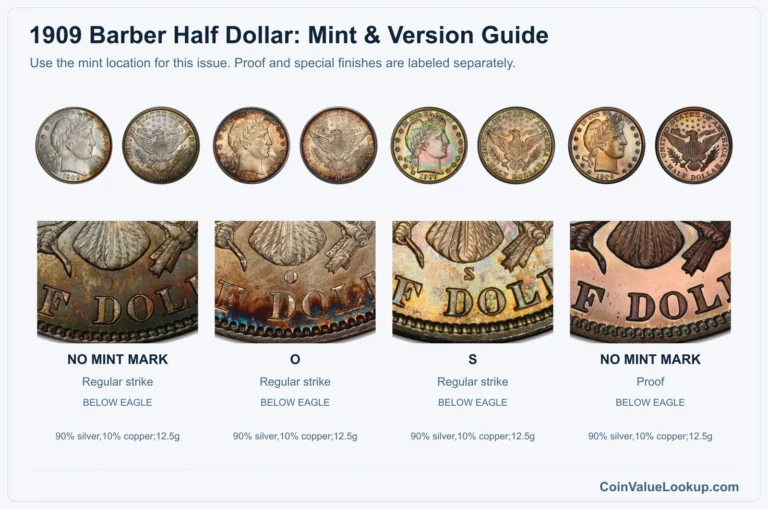
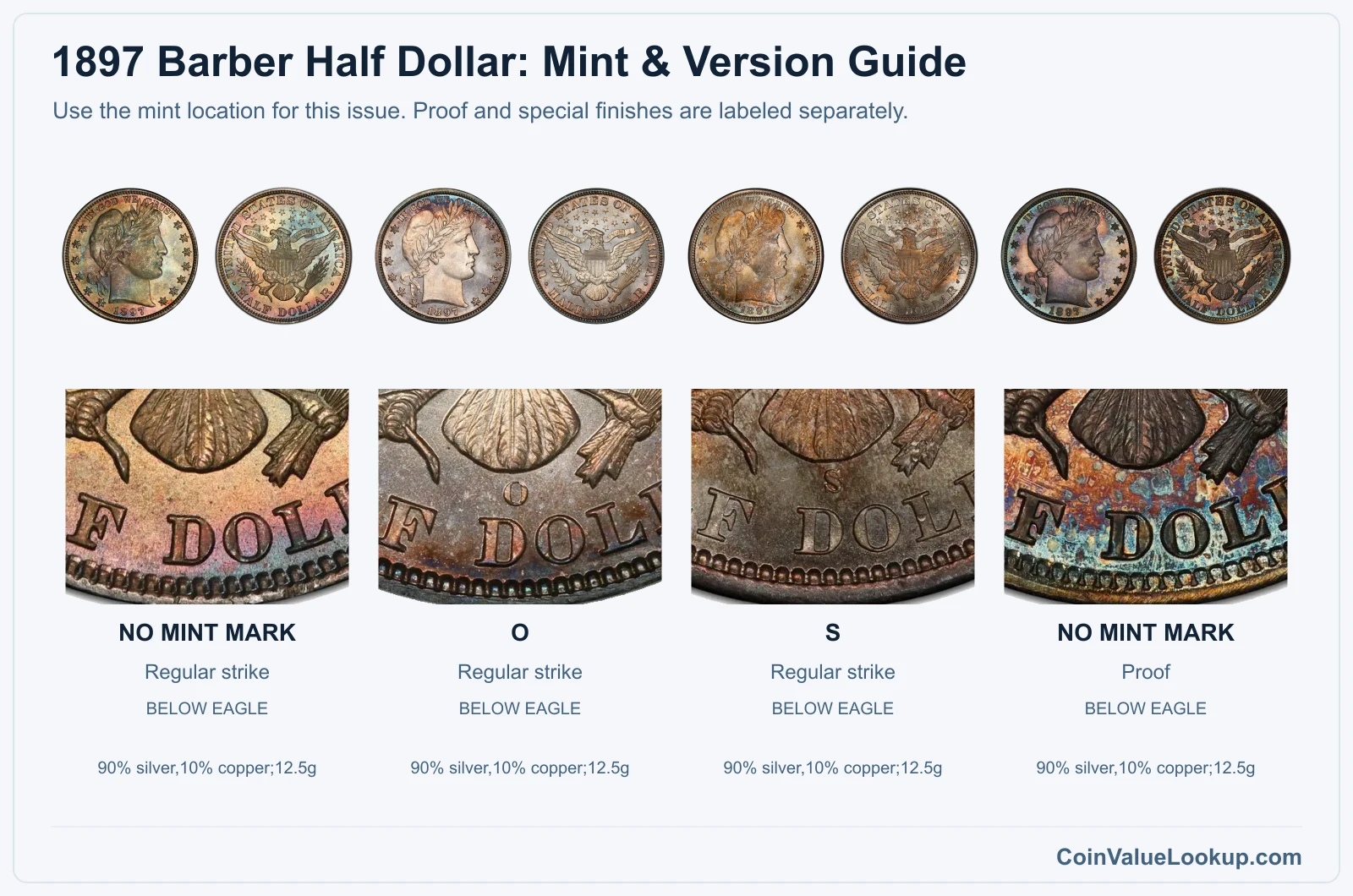
Three mints produced business strikes this year: Philadelphia, New Orleans, and San Francisco. Philadelphia coins carry no mintmark.
For the O (New Orleans) and S (San Francisco) versions, look on the reverse just below the eagle's tail feathers and above the words HALF DOLLAR.
The mintmark can be small and partially obscured by wear or toning, so use good lighting and a loupe if possible. A proof version exists from Philadelphia only, identifiable by its mirrored fields and sharp rim detail — not by polishing or shininess alone.
Do not assume a coin is a special variety just because it has an unusual mark or scratch. Confirm the date, mintmark, and finish before referencing any value chart.
Step 2: Check Your 1897 Barber Half Dollar Grade
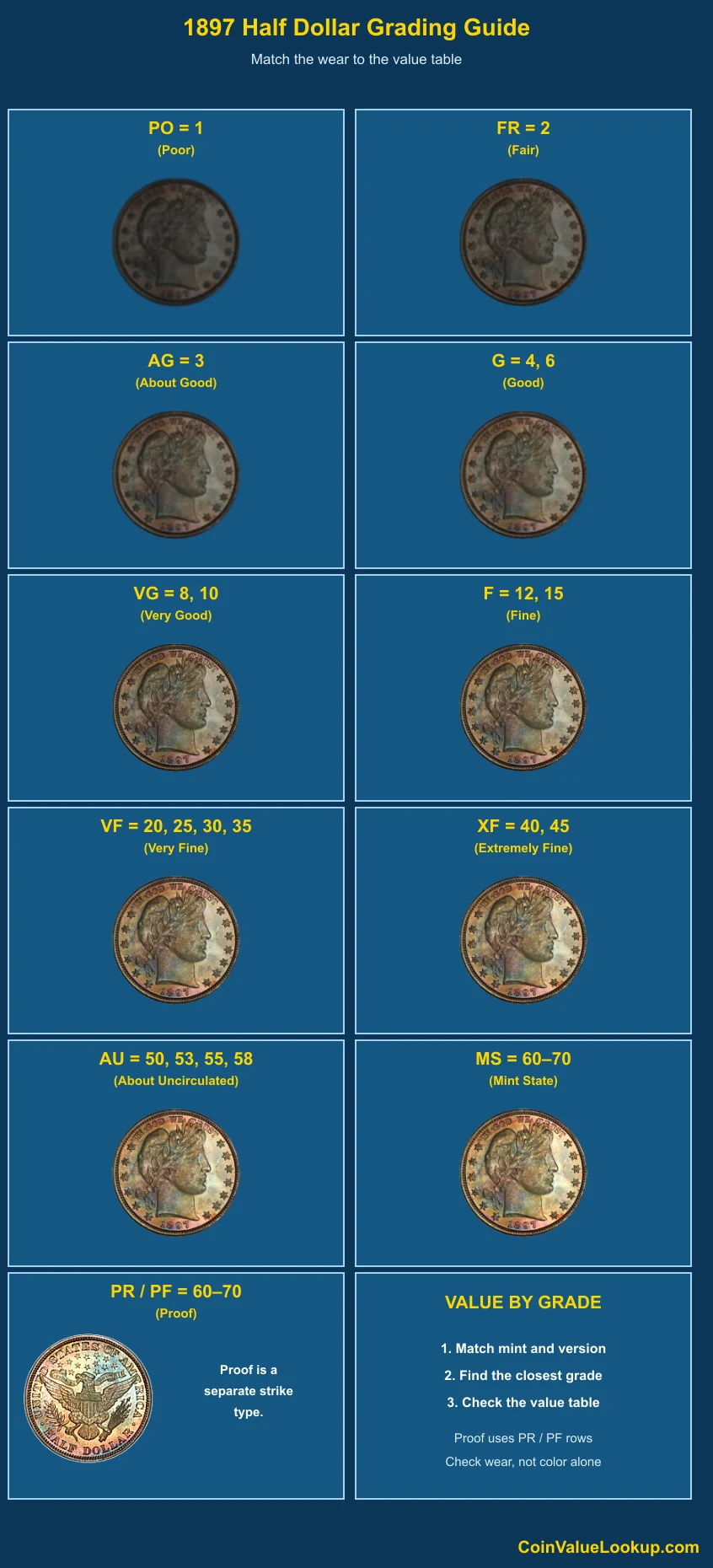
Grading a Barber Half Dollar means looking at the whole coin, not just one spot. Start with Liberty's cheek and the hair detail above the forehead on the obverse, then check the headband where LIBERTY is inscribed.
On the reverse, examine the eagle's head, wing tips, and tail feathers for corresponding wear.
A common trap with 1897 coins, especially New Orleans strikes, is confusing a weak strike with actual wear. The eagle's claw and arrow feathers on O-mint coins sometimes came off the press looking soft, so a coin with full luster but mushy details in those areas may still be uncirculated.
Compare your coin against the grade comparison image provided to see the difference between strike softness and friction.
Luster matters. A coin with original, unbroken cartwheel luster grades very differently from one that has been cleaned and re-toned.
Proof is a manufacturing finish with mirrored fields, not a grade above Mint State — keep that distinction in mind.
Step 3: Check 1897 Barber Half Dollar Value by Mint and Version
1897 Barber Half Dollar — No Mint Mark — Regular Issue
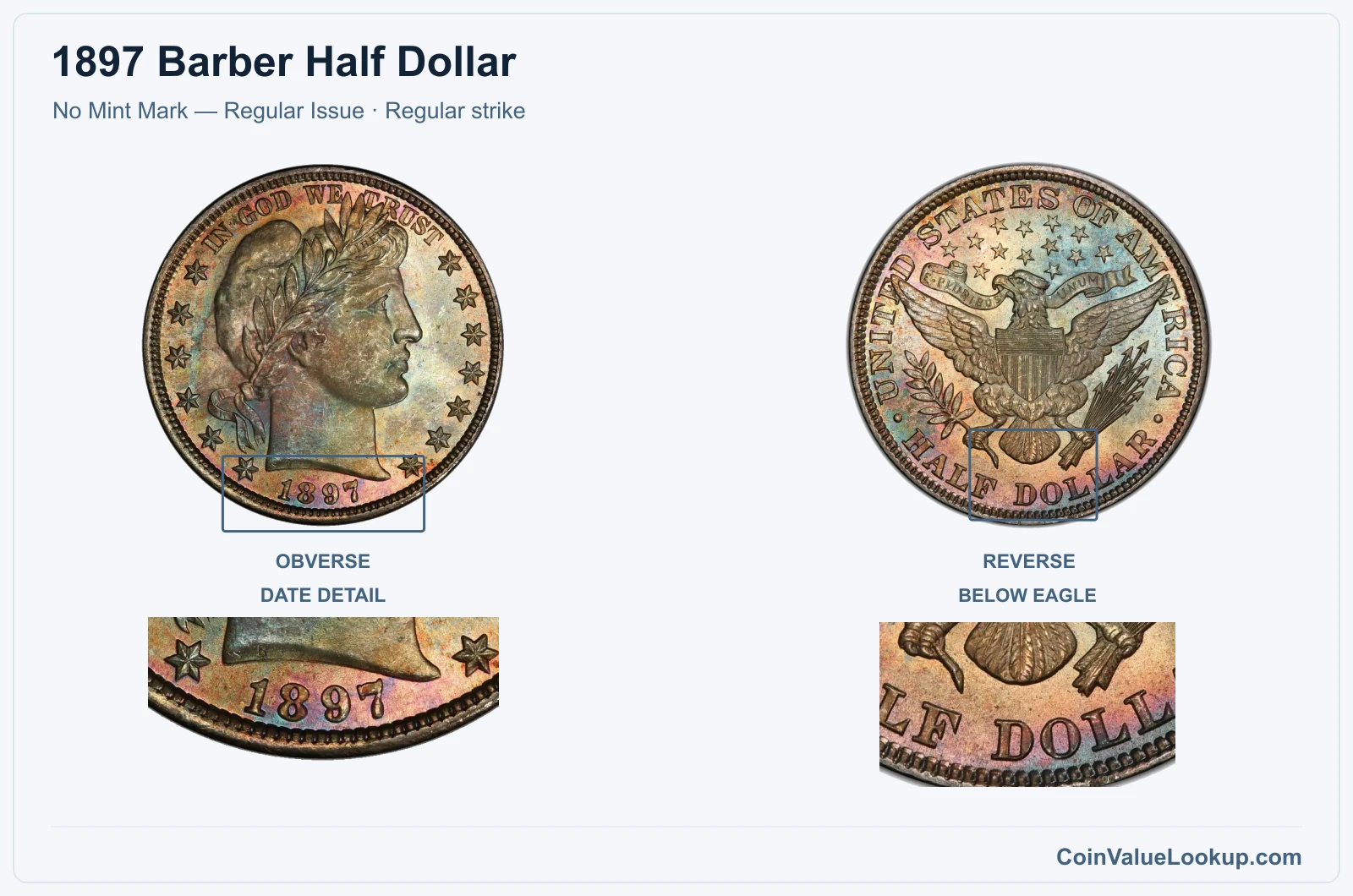
The 1897 Philadelphia Barber Half Dollar has no mintmark. You will find a blank space below the eagle's tail on the reverse.
This is the most available version of the three business strikes for the year.
USA Coin Book guide estimates place a well-worn G4 example around $56 and a choice uncirculated MS63 around $1,261. Original surfaces and full luster push the value considerably above a cleaned or damaged coin at the same technical grade.
Even so, the Philadelphia issue is the affordable entry point for the date compared to its branch-mint siblings.
Range Grade
Price Auction Records Appraisal PO PO 1
—
Coin Identifier FR FR 2
—
Coin Identifier AG AG 3
—
Coin Identifier G G 4
—
Coin Identifier
G 6
—
Coin Identifier VG VG 8
—
Coin Identifier
VG 10
Coin Identifier F F 12
—
Coin Identifier
F 15
Coin Identifier VF VF 20
Coin Identifier
VF 25
Coin Identifier
VF 30
Coin Identifier
VF 35
Coin Identifier XF XF 40
Coin Identifier
XF 45
Coin Identifier AU AU 50
Coin Identifier
AU 53
Coin Identifier
AU 55
Coin Identifier
AU 58
Coin Identifier MS MS 60
Coin Identifier
MS 61
Coin Identifier
MS 62
Coin Identifier
MS 63
Coin Identifier
MS 64
Coin Identifier
MS 65
Coin Identifier
MS 66
Coin Identifier
MS 67
Coin Identifier
MS 68
—
—
—
MS 69
—
—
—
MS 70
—
—
—
1897 Barber Half Dollar — O — Regular Issue
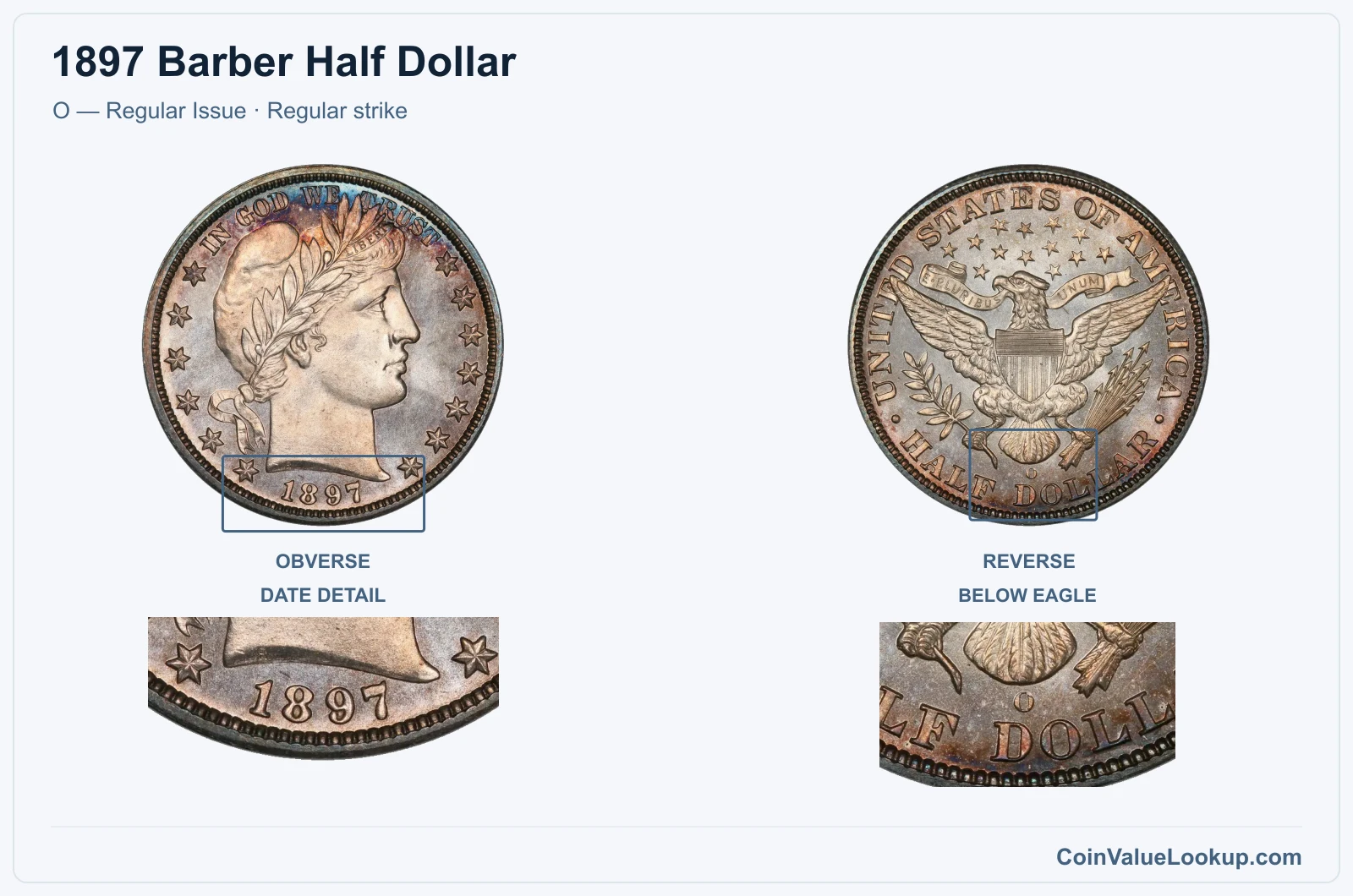
The 1897-O was struck at the New Orleans Mint and carries a small "O" mintmark on the reverse, positioned below the eagle's tail feathers. This is one of the pricier regular-issue Barber halves for the year.
Guide estimates from USA Coin Book put a G4 around $225 and an MS63 at approximately $4,961. That is a steep jump from the Philadelphia version at the same grades.
Strike quality on New Orleans Barber halves can be inconsistent — the eagle's claw and arrow feathers sometimes appear mushy even on higher-grade coins. Do not mistake weak striking for heavy wear; check the overall luster before downgrading.
Original, problem-free examples in upper circulated or Mint State grades are especially sought after because so many surviving O-mint halves show damage or cleaning.
Range Grade
Price Auction Records Appraisal PO PO 1
Coin Identifier FR FR 2
Coin Identifier AG AG 3
Coin Identifier G G 4
Coin Identifier
G 6
Coin Identifier VG VG 8
Coin Identifier
VG 10
Coin Identifier F F 12
Coin Identifier
F 15
Coin Identifier VF VF 20
Coin Identifier
VF 25
Coin Identifier
VF 30
Coin Identifier
VF 35
Coin Identifier XF XF 40
Coin Identifier
XF 45
Coin Identifier AU AU 50
Coin Identifier
AU 53
—
Coin Identifier
AU 55
Coin Identifier
AU 58
Coin Identifier MS MS 60
—
Coin Identifier
MS 61
—
Coin Identifier
MS 62
Coin Identifier
MS 63
Coin Identifier
MS 64
Coin Identifier
MS 65
Coin Identifier
MS 66
Coin Identifier
MS 67
Coin Identifier
MS 68
Coin Identifier
MS 69
—
—
—
MS 70
—
—
—
1897 Barber Half Dollar — S — Regular Issue
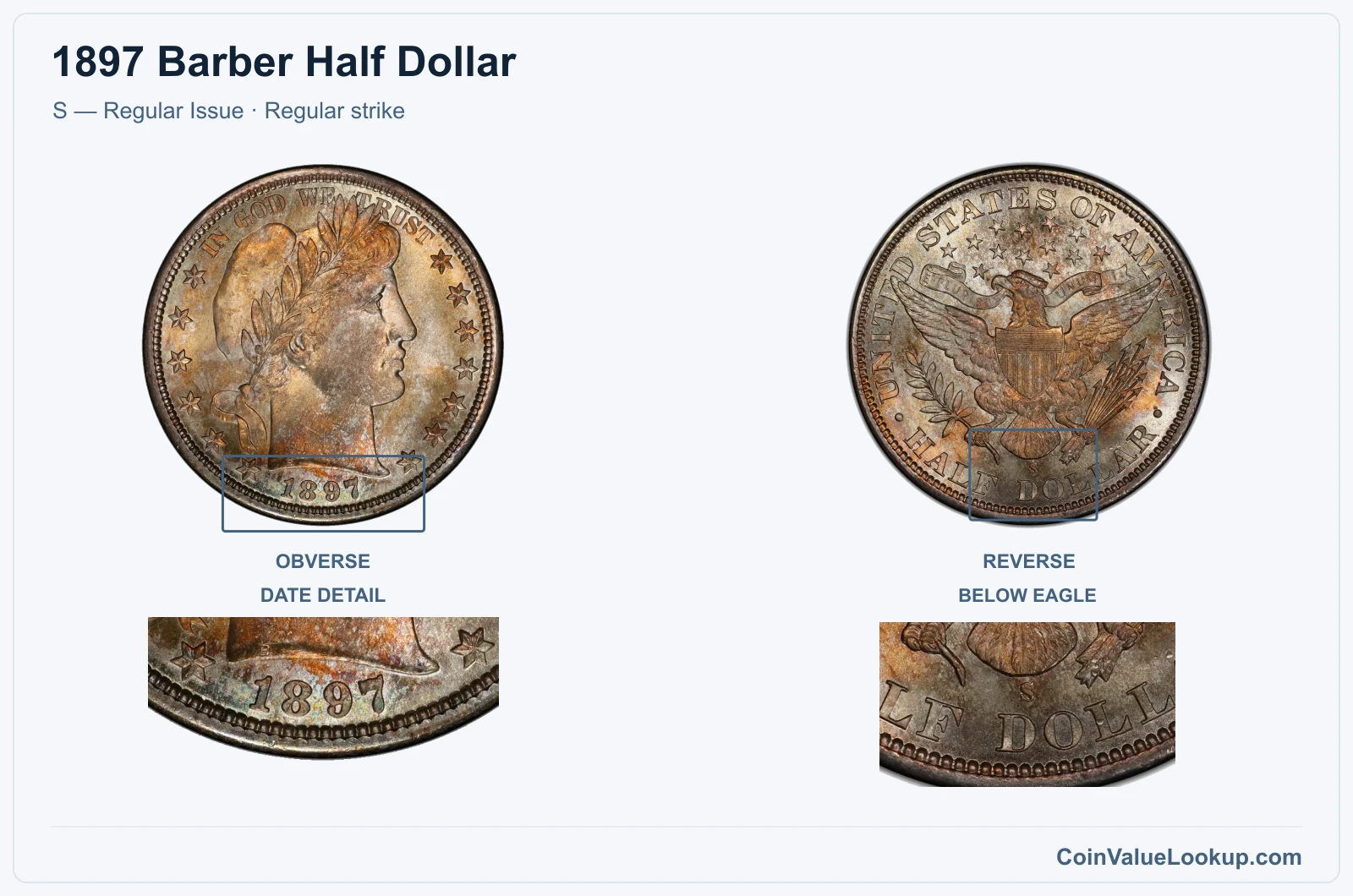
The 1897-S comes from San Francisco and displays an "S" mintmark in the same reverse position below the eagle's tail. Like the O-mint, it commands a meaningful premium over Philadelphia.
USA Coin Book estimates a G4 at roughly $243 and an MS63 at about $4,689. These are guide-level snapshots, not guaranteed sale prices, but they illustrate the gap between mintmarks clearly.
San Francisco strikes tend to be a bit sharper than New Orleans on average, though each coin deserves individual evaluation.
Coin Value Lookup is a handy place to look up guides like this one for other dates and denominations in the Barber series when you are comparing your coins.
Range Grade
Price Auction Records Appraisal PO PO 1
—
Coin Identifier FR FR 2
Coin Identifier AG AG 3
Coin Identifier G G 4
Coin Identifier
G 6
Coin Identifier VG VG 8
Coin Identifier
VG 10
Coin Identifier F F 12
Coin Identifier
F 15
Coin Identifier VF VF 20
Coin Identifier
VF 25
Coin Identifier
VF 30
Coin Identifier
VF 35
Coin Identifier XF XF 40
Coin Identifier
XF 45
Coin Identifier AU AU 50
Coin Identifier
AU 53
Coin Identifier
AU 55
Coin Identifier
AU 58
Coin Identifier MS MS 60
—
Coin Identifier
MS 61
Coin Identifier
MS 62
Coin Identifier
MS 63
Coin Identifier
MS 64
Coin Identifier
MS 65
Coin Identifier
MS 66
Coin Identifier
MS 67
Coin Identifier
MS 68
Coin Identifier
MS 69
—
—
—
MS 70
—
—
—
1897 Barber Half Dollar — No Mint Mark — Proof
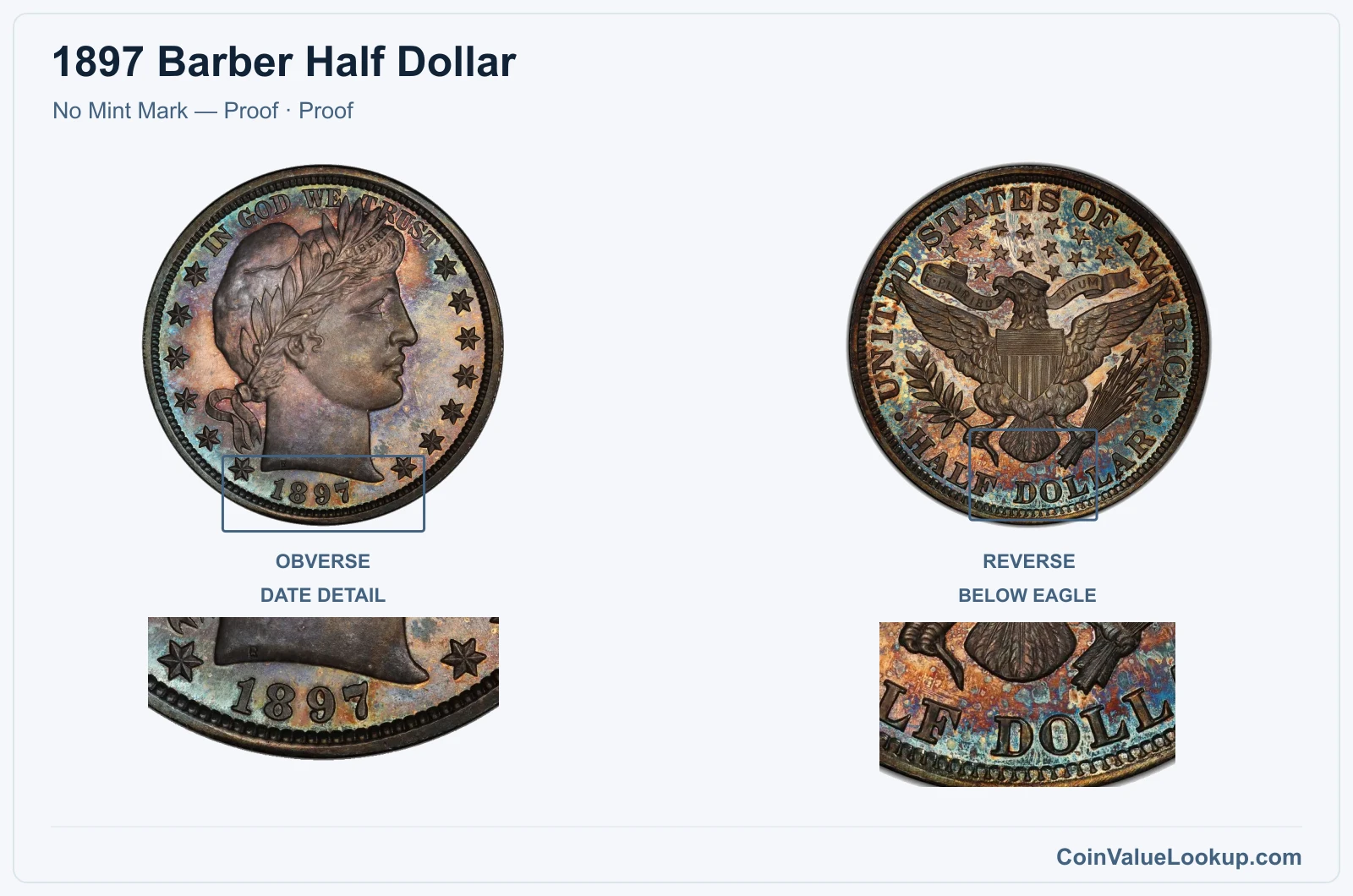
Philadelphia also produced proof Barber Half Dollars in 1897. These coins were made with specially prepared dies and polished planchets, resulting in deeply mirrored fields and crisp, squared-off rims that business strikes do not show.
A PR63 example carries a USA Coin Book guide estimate of about $1,363. Cameo contrast — where the devices appear frosty against the mirror fields — is a characteristic some proofs display, but it exists on a spectrum within the proof category, not as a separate mint version.
Polishing a business strike does not create a proof. Genuine proofs have a distinctive look that comes from the manufacturing process itself.
If you suspect you have one, professional attribution from a grading service is the safest route.
Range Grade
Price Auction Records Appraisal PR PR 1
—
Coin Identifier
PR 2
—
Coin Identifier
PR 3
—
Coin Identifier
PR 4
—
Coin Identifier
PR 6
—
Coin Identifier
PR 8
—
Coin Identifier
PR 10
—
Coin Identifier
PR 12
—
Coin Identifier
PR 15
—
Coin Identifier
PR 20
—
Coin Identifier
PR 25
—
Coin Identifier
PR 30
—
Coin Identifier
PR 35
—
Coin Identifier
PR 40
—
Coin Identifier
PR 45
—
Coin Identifier
PR 50
—
Coin Identifier
PR 53
—
Coin Identifier
PR 55
—
Coin Identifier
PR 58
—
Coin Identifier
PR 60
Coin Identifier
PR 61
Coin Identifier
PR 62
Coin Identifier
PR 63
Coin Identifier
PR 64
Coin Identifier
PR 65
Coin Identifier
PR 66
Coin Identifier
PR 67
Coin Identifier
PR 68
Coin Identifier
PR 69
—
—
—
PR 70
—
—
—
1897 Barber Half Dollar Error List
1. 1897 Barber Half Dollar — Repunched Date
A repunched date variety has been reported for the 1897 Barber Half Dollar, specifically involving the digits 9 and 7. The diagnostic to look for is remnants of an earlier date-punch position visible beside or slightly south of the final numerals.
Under magnification, you may see faint ghost images of the numbers offset from their final placement.
This is different from machine doubling, which tends to produce flat, shelf-like distortion across wider areas of the design. It is also different from simple date damage, where hits or scratches can mimic a second impression.
A true repunched date shows a deliberate second positioning of the date punch by the die maker.
No numerical price range is available for this variety. Value depends on the visibility of the repunching, the coin's overall condition, and collector demand for the specific variety.
Professional attribution is recommended before buying or selling based on this feature.
2. 1897 Barber Half Dollar — Reported Planchet Flaw
A planchet flaw has been reported on the reverse of an 1897-O Barber Half Dollar, discussed in collector forums and grading conversations. The defect appears as a metal irregularity on the reverse surface — something that was present in the planchet before or during striking rather than caused by post-mint damage.
The source describes it as a planchet flaw without specifying a precise mechanism such as lamination or inclusion, so it is best to keep the description general. What you are looking for is a raised or recessed area of disturbed metal that follows the coin's surface flow rather than cutting across it like a scratch would.
Scraping, corrosion, or deliberately altered surfaces can mimic planchet flaws, so careful examination matters. No numerical price range is available for this variety.
Condition, the size and visibility of the flaw, and buyer interest all factor into any premium. Have a grading service examine the coin if you believe yours matches.