1904 Barber Half Dollar Coin Value: How Much Is It Worth?
A 1904 Barber Half Dollar can range from about $44 in well-worn Good-4 condition up to $23,158 at the MS63 grade level, depending on which mint struck it. Three mints produced this date — Philadelphia, New Orleans, and San Francisco — and the San Francisco coin is a serious condition rarity that commands steep premiums in higher grades.
These figures come from a USA Coin Book retail guide snapshot and reflect numismatic estimates, not guaranteed sale prices. Proofs exist separately from Philadelphia.
Fast Way to Identify Your 1904 Barber Half Dollar
The quickest way to start figuring out what your 1904 Barber Half Dollar is worth is to upload clear photos of the front and back of your coin. This gives us a preliminary identification of your mint version and an approximate condition range.
Sharp, well-lit images showing the full date, Liberty's head, and the reverse mintmark area help the most.
1904 Barber Half Dollar Value
Upload both sides of your 1904 Barber Half Dollar.
Front Obverse
Upload photo
Back Reverse
Upload photo
Which 1904 Barber Half Dollar Versions Are Worth Money?
- The 1904-S (San Francisco) is a major condition rarity — guide values jump from $105 in G4 to $23,158 in MS63, reflecting extreme scarcity in Mint State.
- The 1904-O (New Orleans) carries a significant premium over Philadelphia in higher grades, listed at $4,894 in MS63 versus $1,145 for the Philadelphia coin.
- Philadelphia Proof issues, struck with mirrored fields, are listed around $1,363 at PR63 and are collectible as a separate finish category.
- Any 1904 Barber Half in original, problem-free condition well above heavy wear grades can be considerably more valuable than a typical worn survivor.
Step 1: Identify Your 1904 Barber Half Dollar Mint Mark and Version
First, confirm you have a genuine 1904 date on the obverse, with the classic Barber Liberty head facing right, and HALF DOLLAR on the reverse beneath a heraldic eagle. The coin is 90% silver and 10% copper, weighing about 12.5 grams with a 30.6 mm diameter and a reeded edge.
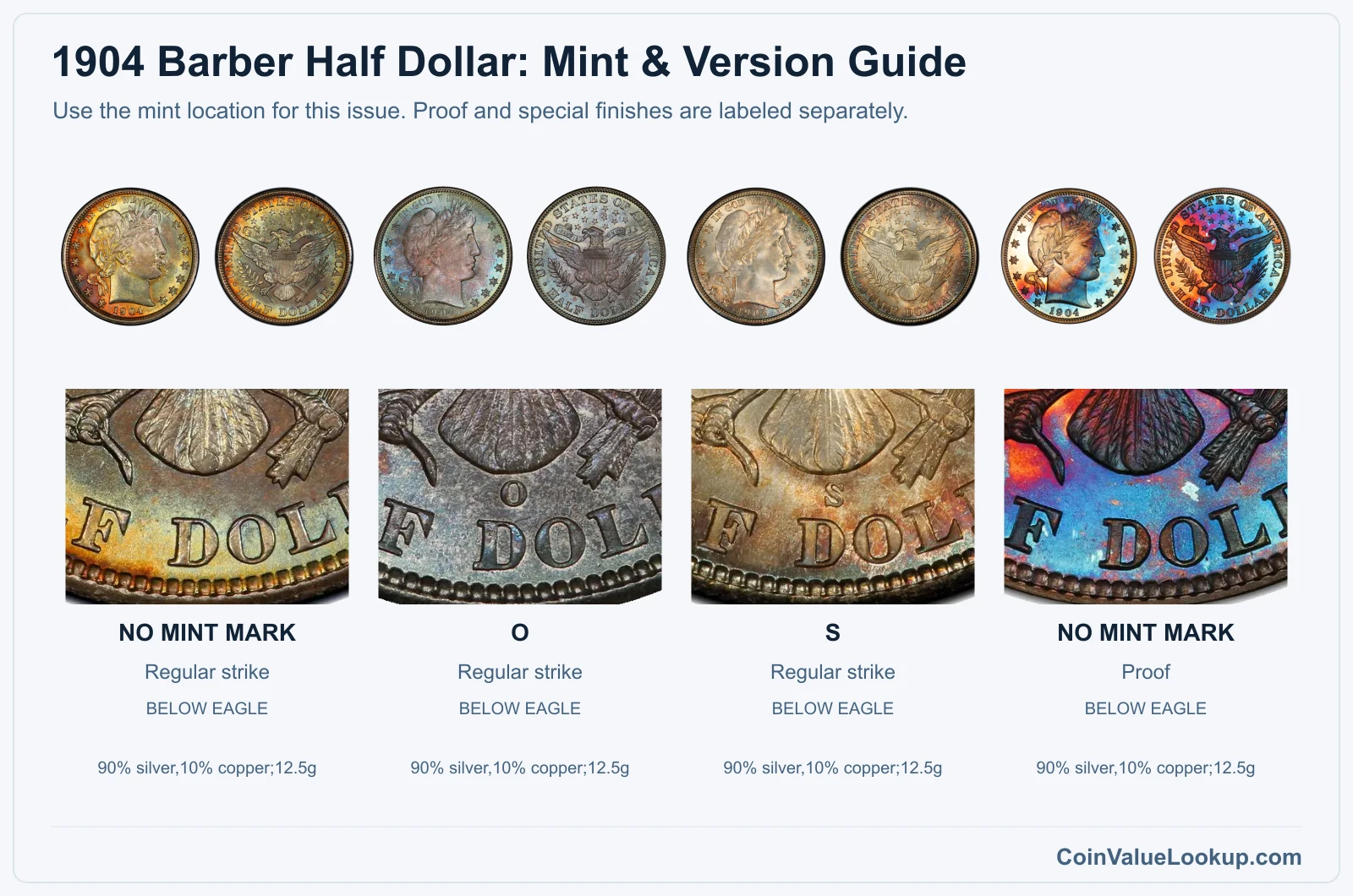
Three business-strike mints produced 1904 halves: Philadelphia, New Orleans, and San Francisco. There is no Denver issue for this year, so do not assume a "D" mintmark belongs here.
To find the mintmark, flip to the reverse and look just below the eagle's tail feathers, above the words HALF DOLLAR. Philadelphia coins carry no mintmark at all.
An "O" means New Orleans, and an "S" means San Francisco. The letter can be small and partially obscured by wear or toning, so use good light and a loupe if you have one.
The San Francisco issue is the key coin of the three. It is a recognized condition rarity, meaning survivors in original, problem-free condition above the lowest grades are genuinely scarce.
Step 2: Check Your 1904 Barber Half Dollar Grade
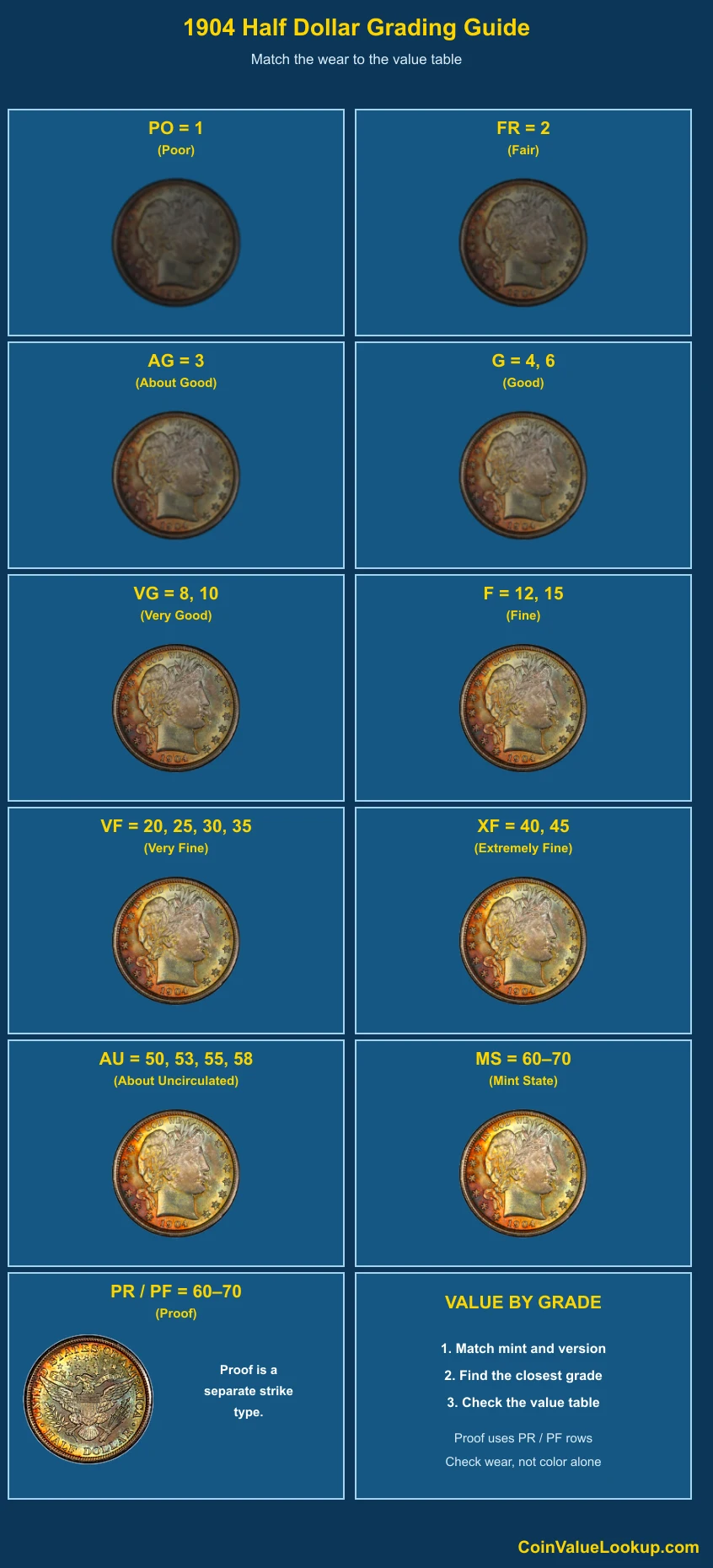
When grading a 1904 Barber Half Dollar, look at the whole coin, not just the word LIBERTY on the headband. Hub changes during the series altered how quickly individual letters wore, so relying on LIBERTY alone can mislead you.
On the obverse, check Liberty's cheek, the hair above her ear, and the wreath leaves for smoothness. On the reverse, examine the eagle's head, wing tips, and tail feathers.
Compare your coin against the grade comparison image to see how much detail remains at each level.
New Orleans strikes sometimes show weakness at the eagle's claws and arrow feathers even on higher-grade coins. That is a strike characteristic, not wear — learn to tell the difference.
Genuine wear removes luster uniformly across high points, while a weak strike leaves luster intact in surrounding fields.
A Proof is a special mirror-finish manufacturing method, not a grade above Mint State. If your coin simply looks shiny, that could be polishing or dipping rather than proof status.
Cleaning, whizzing, and artificial toning all reduce a coin's desirability and value compared to original, untouched surfaces.
Step 3: Check 1904 Barber Half Dollar Value by Mint and Version
1904 Barber Half Dollar — No Mint Mark — Regular Issue
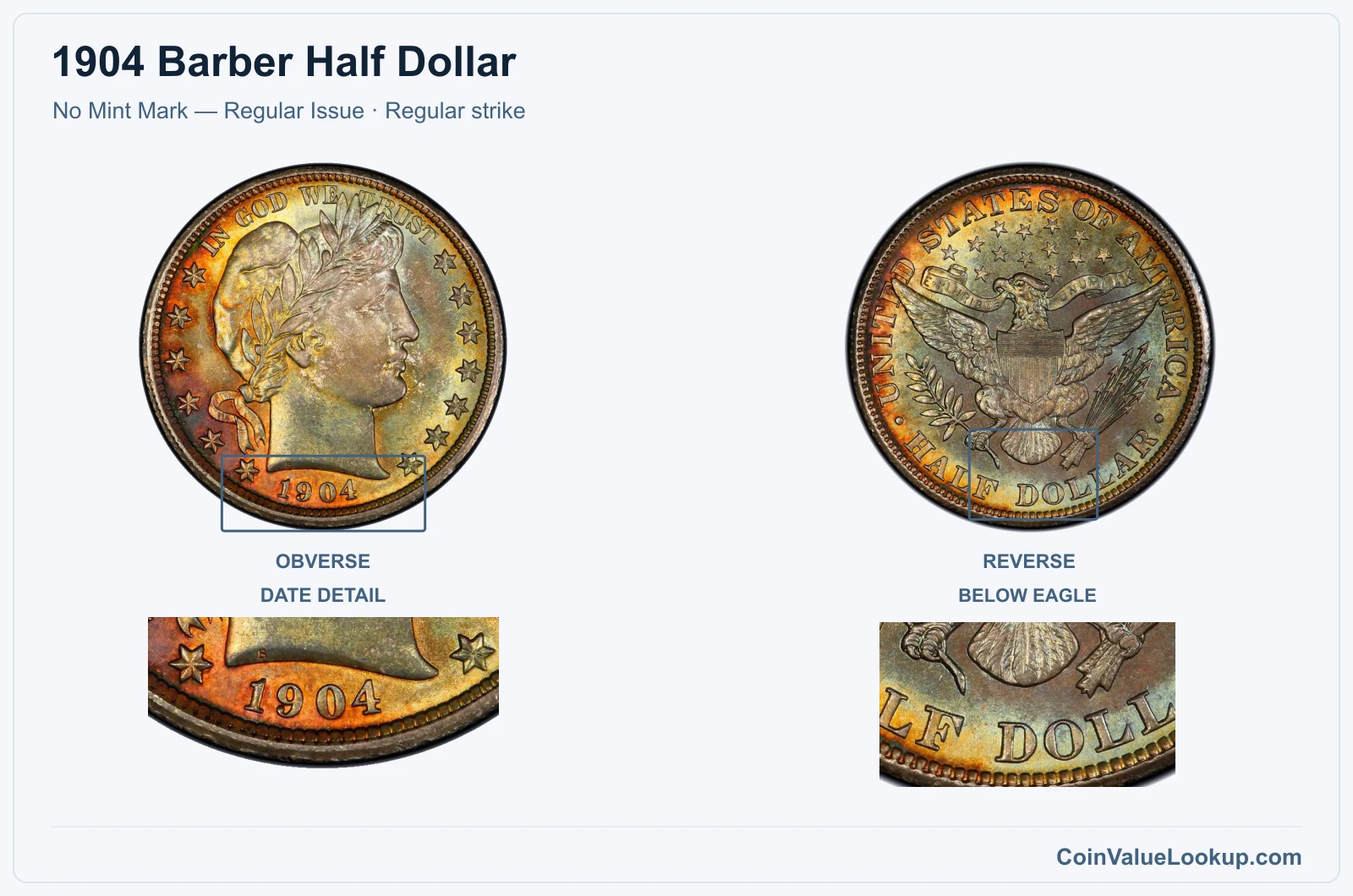
The 1904 Philadelphia half dollar carries no mintmark — the space below the eagle's tail on the reverse is blank. This is the most available of the three business-strike issues for the year, though higher-grade survivors with original surfaces are still uncommon for any Barber half.
A USA Coin Book guide estimate places this coin at about $44 in G4 and around $1,145 in MS63. The difference is enormous, so condition matters.
Look for overall sharpness on Liberty's hair and the eagle's feathers, and check that the coin has not been cleaned or polished. Original toning and luster are strong positives when evaluating any Barber half.
Range Grade
Price Auction Records Appraisal PO PO 1
—
Coin Identifier FR FR 2
—
Coin Identifier AG AG 3
—
Coin Identifier G G 4
—
Coin Identifier
G 6
—
Coin Identifier VG VG 8
Coin Identifier
VG 10
—
Coin Identifier F F 12
Coin Identifier
F 15
Coin Identifier VF VF 20
Coin Identifier
VF 25
Coin Identifier
VF 30
Coin Identifier
VF 35
Coin Identifier XF XF 40
Coin Identifier
XF 45
Coin Identifier AU AU 50
Coin Identifier
AU 53
Coin Identifier
AU 55
Coin Identifier
AU 58
Coin Identifier MS MS 60
—
Coin Identifier
MS 61
Coin Identifier
MS 62
Coin Identifier
MS 63
Coin Identifier
MS 64
Coin Identifier
MS 65
Coin Identifier
MS 66
Coin Identifier
MS 67
Coin Identifier
MS 68
—
—
—
MS 69
—
—
—
MS 70
—
—
—
1904 Barber Half Dollar — O — Regular Issue
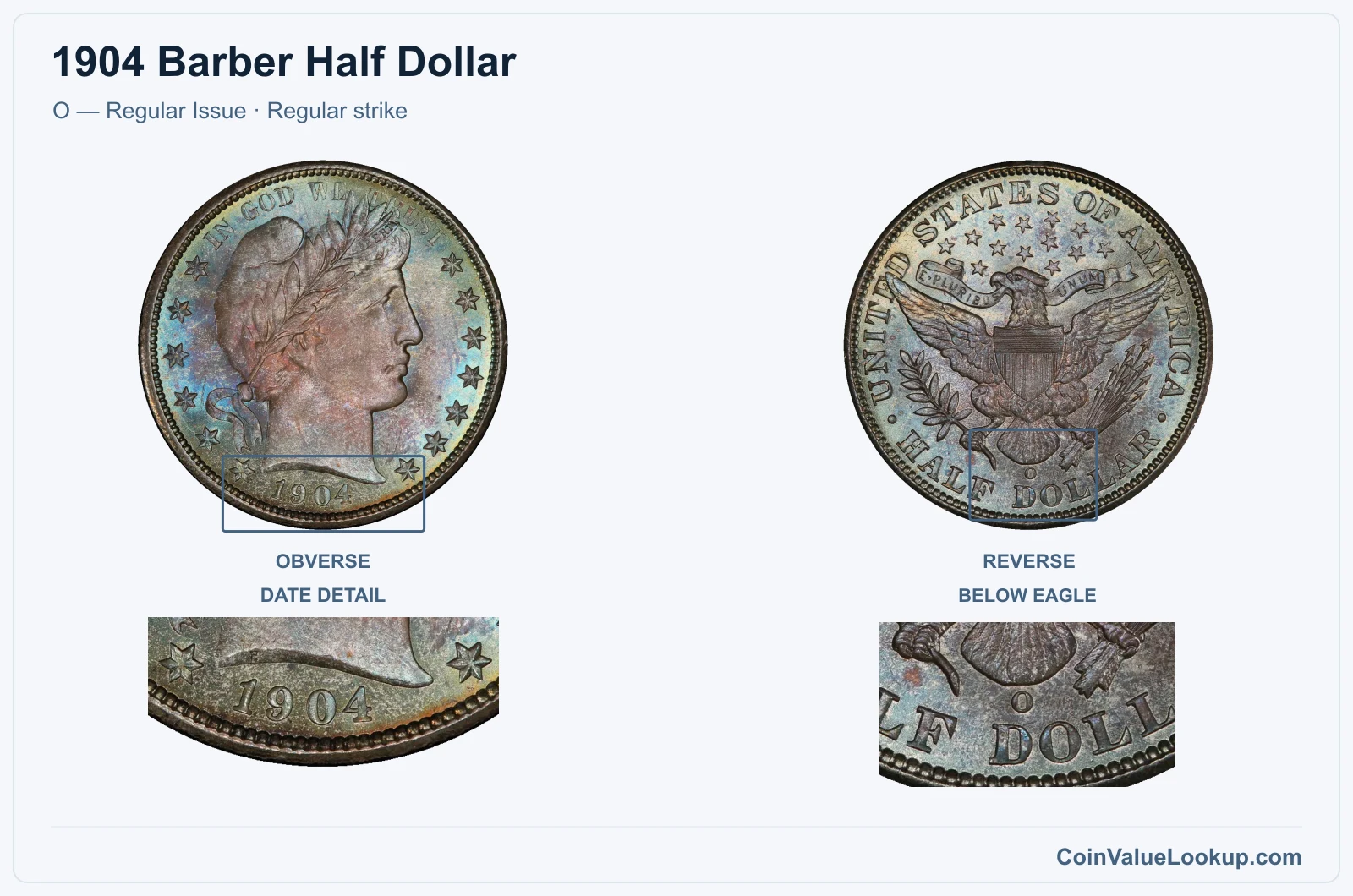
Look for a small "O" mintmark on the reverse, centered below the eagle's tail feathers and above HALF DOLLAR. This confirms a New Orleans Mint origin.
The 1904-O carries higher guide estimates than the Philadelphia issue, with the USA Coin Book listing about $57 at G4 and roughly $4,894 at MS63. That steep jump reflects genuine scarcity in upper grades.
New Orleans coins frequently show softer strikes on the eagle's claws and arrow feathers, which is a manufacturing trait and not wear. Do not downgrade your coin for that softness alone.
Evaluate the overall surfaces, luster, and contact marks to get a more accurate condition assessment.
Coin Value Lookup is a useful starting point if you are trying to look up values across different Barber dates and mints. It offers guides for a wide range of U.S. coin series.
Range Grade
Price Auction Records Appraisal PO PO 1
—
Coin Identifier FR FR 2
—
Coin Identifier AG AG 3
—
Coin Identifier G G 4
Coin Identifier
G 6
—
Coin Identifier VG VG 8
Coin Identifier
VG 10
—
Coin Identifier F F 12
Coin Identifier
F 15
Coin Identifier VF VF 20
Coin Identifier
VF 25
Coin Identifier
VF 30
Coin Identifier
VF 35
Coin Identifier XF XF 40
Coin Identifier
XF 45
Coin Identifier AU AU 50
Coin Identifier
AU 53
Coin Identifier
AU 55
Coin Identifier
AU 58
Coin Identifier MS MS 60
—
Coin Identifier
MS 61
Coin Identifier
MS 62
Coin Identifier
MS 63
Coin Identifier
MS 64
Coin Identifier
MS 65
Coin Identifier
MS 66
Coin Identifier
MS 67
Coin Identifier
MS 68
—
—
—
MS 69
—
—
—
MS 70
—
—
—
1904 Barber Half Dollar — S — Regular Issue
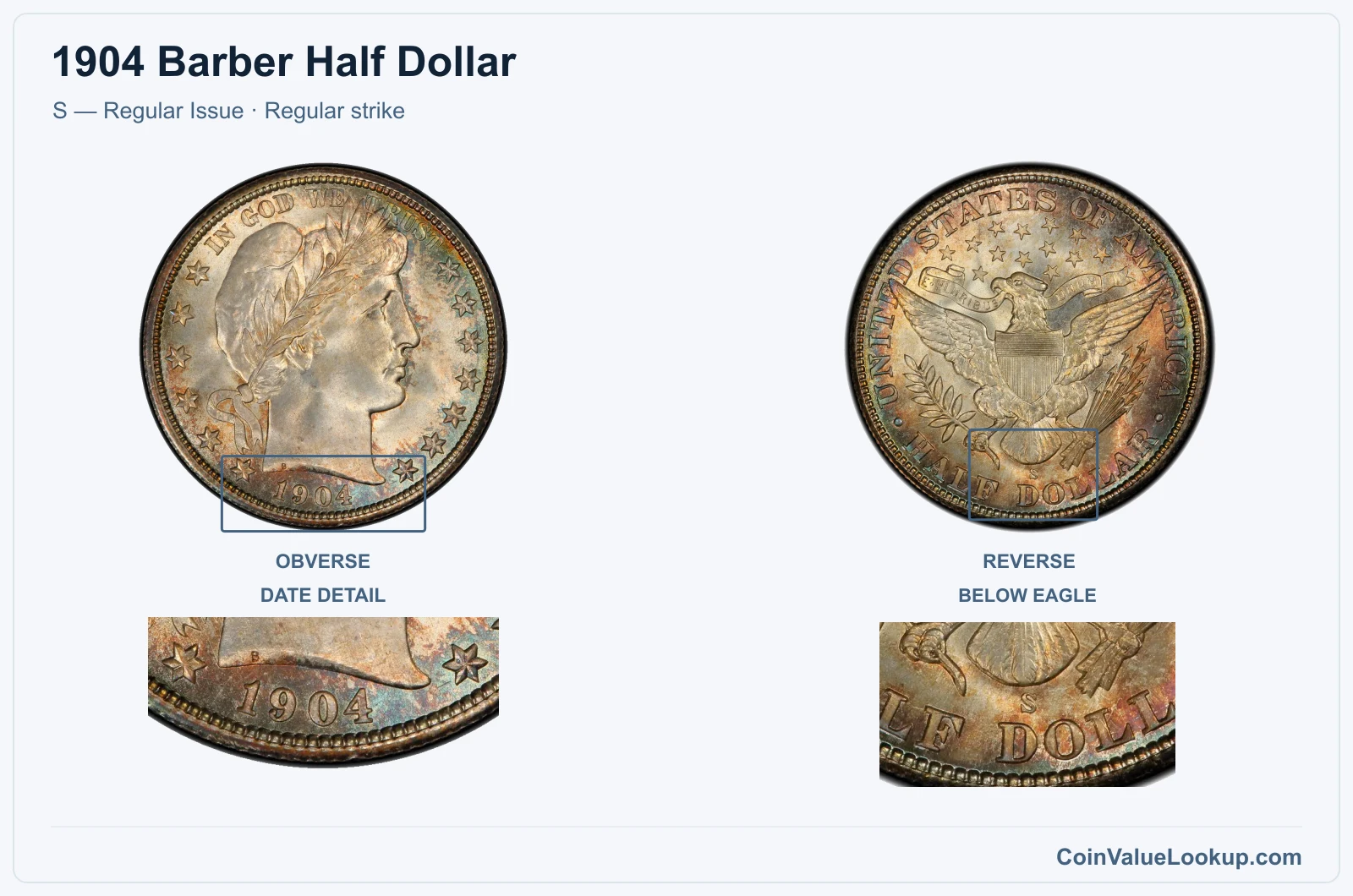
The 1904-S is the coin to watch. It is a recognized condition rarity in the Barber half series, meaning that while worn examples exist, problem-free coins in mid-to-upper circulated and Mint State grades are genuinely hard to find.
Confirm the "S" mintmark below the eagle's tail on the reverse. A USA Coin Book guide estimate places the 1904-S at about $105 in G4 and a striking $23,158 in MS63.
That is not a typo — the survival rate in Mint State is that low. Even an original, lightly circulated example with honest wear and no cleaning can carry a strong premium compared to heavily worn pieces.
Because the values are so high at better grades, authentication and professional grading by a recognized third-party service are worth serious consideration before selling or buying an upper-grade 1904-S. Problem-free original surfaces are everything with this coin.
Range Grade
Price Auction Records Appraisal PO PO 1
—
Coin Identifier FR FR 2
—
Coin Identifier AG AG 3
Coin Identifier G G 4
Coin Identifier
G 6
Coin Identifier VG VG 8
Coin Identifier
VG 10
Coin Identifier F F 12
Coin Identifier
F 15
Coin Identifier VF VF 20
Coin Identifier
VF 25
Coin Identifier
VF 30
Coin Identifier
VF 35
Coin Identifier XF XF 40
Coin Identifier
XF 45
Coin Identifier AU AU 50
Coin Identifier
AU 53
Coin Identifier
AU 55
Coin Identifier
AU 58
Coin Identifier MS MS 60
—
Coin Identifier
MS 61
Coin Identifier
MS 62
Coin Identifier
MS 63
Coin Identifier
MS 64
Coin Identifier
MS 65
Coin Identifier
MS 66
Coin Identifier
MS 67
Coin Identifier
MS 68
—
—
—
MS 69
—
—
—
MS 70
—
—
—
1904 Barber Half Dollar — No Mint Mark — Proof
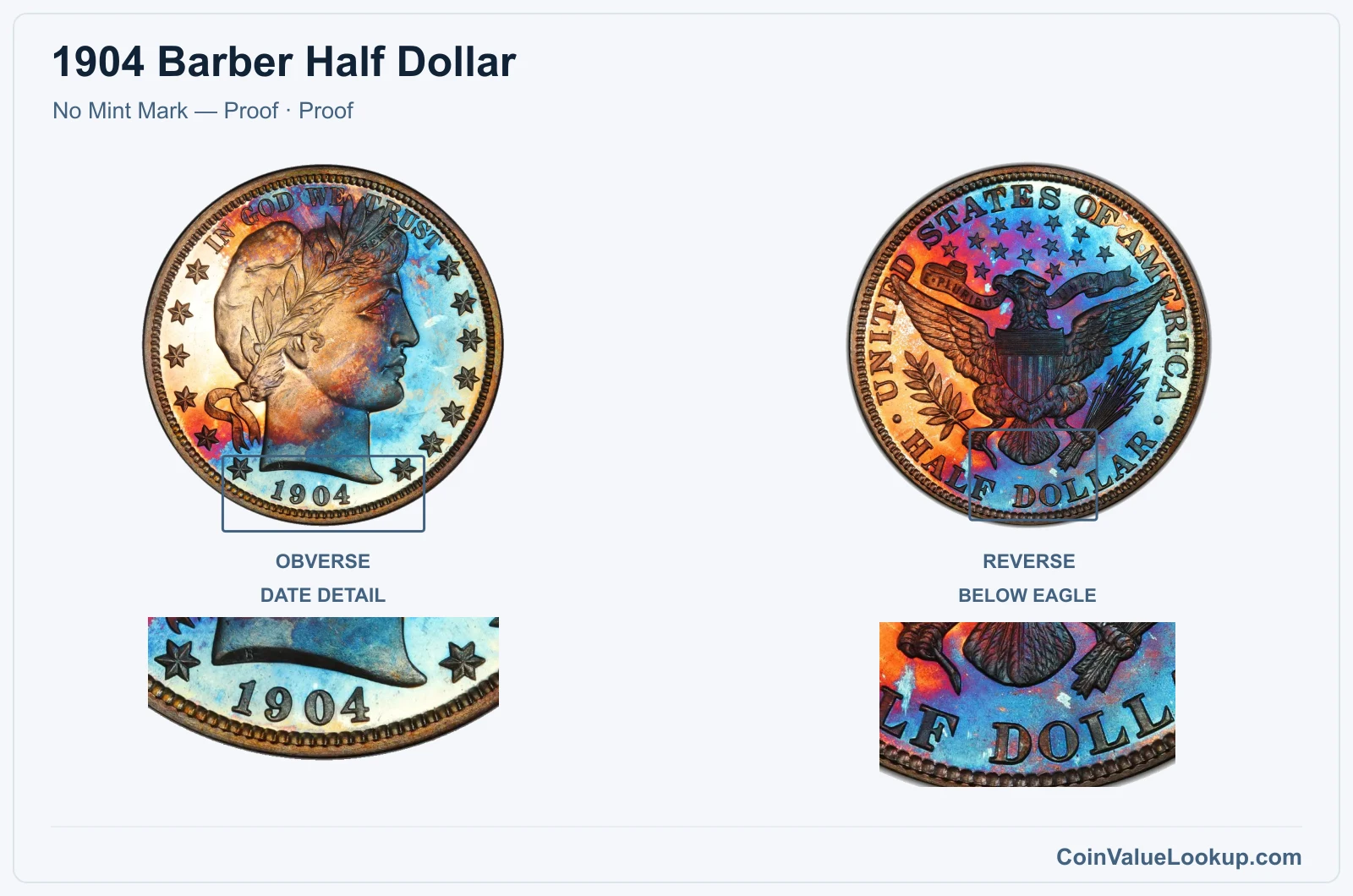
Philadelphia struck a limited number of Proof Barber half dollars in 1904, identifiable by deeply mirrored fields and sharp, squared rims that business strikes do not display. A USA Coin Book guide estimate lists about $1,363 at PR63.
Do not confuse a polished business strike with a genuine Proof. Real Proofs show consistent mirror surfaces across the entire field, with die-struck detail that is crisper than any business strike.
Cameo contrast — frosted devices against mirror fields — can appear on some Proofs but varies by individual die state. If you believe you have a Proof, third-party attribution is the safest path to confirming it.
Range Grade
Price Auction Records Appraisal PR PR 1
—
Coin Identifier
PR 2
—
Coin Identifier
PR 3
—
Coin Identifier
PR 4
—
Coin Identifier
PR 6
—
Coin Identifier
PR 8
—
Coin Identifier
PR 10
—
Coin Identifier
PR 12
—
Coin Identifier
PR 15
—
Coin Identifier
PR 20
—
Coin Identifier
PR 25
—
Coin Identifier
PR 30
—
Coin Identifier
PR 35
—
Coin Identifier
PR 40
—
Coin Identifier
PR 45
—
Coin Identifier
PR 50
—
Coin Identifier
PR 53
Coin Identifier
PR 55
—
Coin Identifier
PR 58
—
Coin Identifier
PR 60
Coin Identifier
PR 61
Coin Identifier
PR 62
Coin Identifier
PR 63
Coin Identifier
PR 64
Coin Identifier
PR 65
Coin Identifier
PR 66
Coin Identifier
PR 67
Coin Identifier
PR 68
Coin Identifier
PR 69
—
—
—
PR 70
—
—
—
1904 Barber Half Dollar Error List
1. 1904 Barber Half Dollar — Off-Center Strike
An off-center strike occurs when the coin blank is not properly seated in the collar before the dies come together. The result is a displaced design with an unstruck crescent of blank metal along part of the rim.
The 1904 Barber Half Dollar has been listed as a candidate for this error type.
To spot one, look for a design that is clearly shifted in one direction, leaving a visible arc of featureless planchet. The date should still be fully or partially readable for the coin to carry collector interest.
More displacement generally means more visual impact, but losing the date typically hurts desirability.
Do not confuse an off-center strike with a clipped planchet, a misaligned die that shifts only one side, or post-mint damage from being hit or flattened after leaving the press. Condition, the degree of off-center shift, and date visibility all affect value.
No specific price range is available for this particular date, so individual assessment based on the actual coin is essential.