1905 Barber Half Dollar Coin Value: How Much Is It Worth?
A 1905 Barber Half Dollar can range from about $44 in well-worn G4 condition to around $2,130 at MS63, depending on the mint and grade. Three mints struck business issues this year — Philadelphia, New Orleans, and San Francisco — with no Denver coins.
Proofs from Philadelphia carry separate pricing. Condition and mintmark matter enormously, so read on before you price yours.
Fast Way to Identify Your 1905 Barber Half Dollar
The quickest way to get a preliminary identification of your 1905 Barber Half Dollar is to upload clear photos of both sides. A shot of the front showing the date and Liberty's head, plus the back showing the eagle and the mintmark area, gives a solid starting point.
That alone can help narrow down which version you have.
1905 Barber Half Dollar Value
Upload both sides of your 1905 Barber Half Dollar.
Front Obverse
Upload photo
Back Reverse
Upload photo
Which 1905 Barber Half Dollar Versions Are Worth Money?
- The 1905-O (New Orleans) had a low mintage, making it the scarcest regular-issue branch this year — guide values reach about $2,130 at MS63.
- Philadelphia coins without a mintmark can surprise in upper grades, where surviving populations drop off sharply.
- The 1905-S San Francisco issue guides near $2,005 at MS63, close behind the O-mint in that grade.
- Original, problem-free coins in higher circulated or Mint State grades are worth substantially more than heavily worn pieces — condition is everything with Barber halves.
- A Proof 1905 from Philadelphia is a distinct collectible, with guide values around $1,363 at PR63.
Step 1: Identify Your 1905 Barber Half Dollar Mint Mark and Version
The 1905 Barber Half Dollar features Charles Barber's Liberty head facing right on the obverse and a heraldic eagle on the reverse. All regular issues are struck in 90% silver and 10% copper, weigh about 12.5 grams, and measure 30.6 mm with a reeded edge.
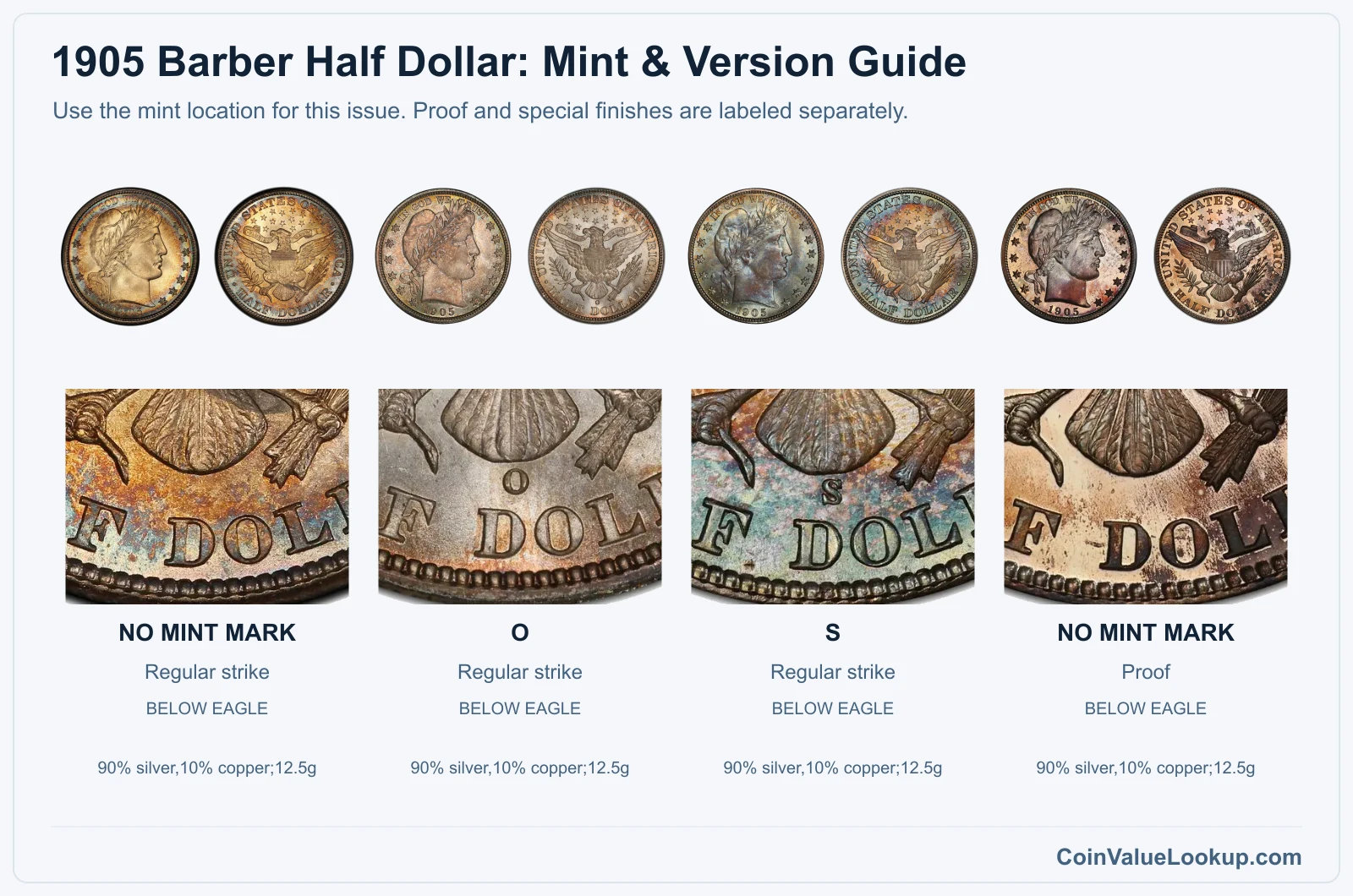
To determine your mint, flip the coin over and look just below the eagle's tail feathers, above the words HALF DOLLAR. A small "O" means New Orleans.
A small "S" means San Francisco. No letter at all means Philadelphia.
There was no Denver issue this year, so if you see a "D" mintmark, you are looking at a different date. The New Orleans coin had a notably low mintage, making it the scarcer branch, but Philadelphia pieces in higher grades also deserve attention since survival rates thin out quickly above VF.
Coin Value Lookup is a handy starting point if you want to look up guides for other dates or denominations in the Barber series. Bookmark it and come back whenever a new coin lands in your hands.
Step 2: Check Your 1905 Barber Half Dollar Grade
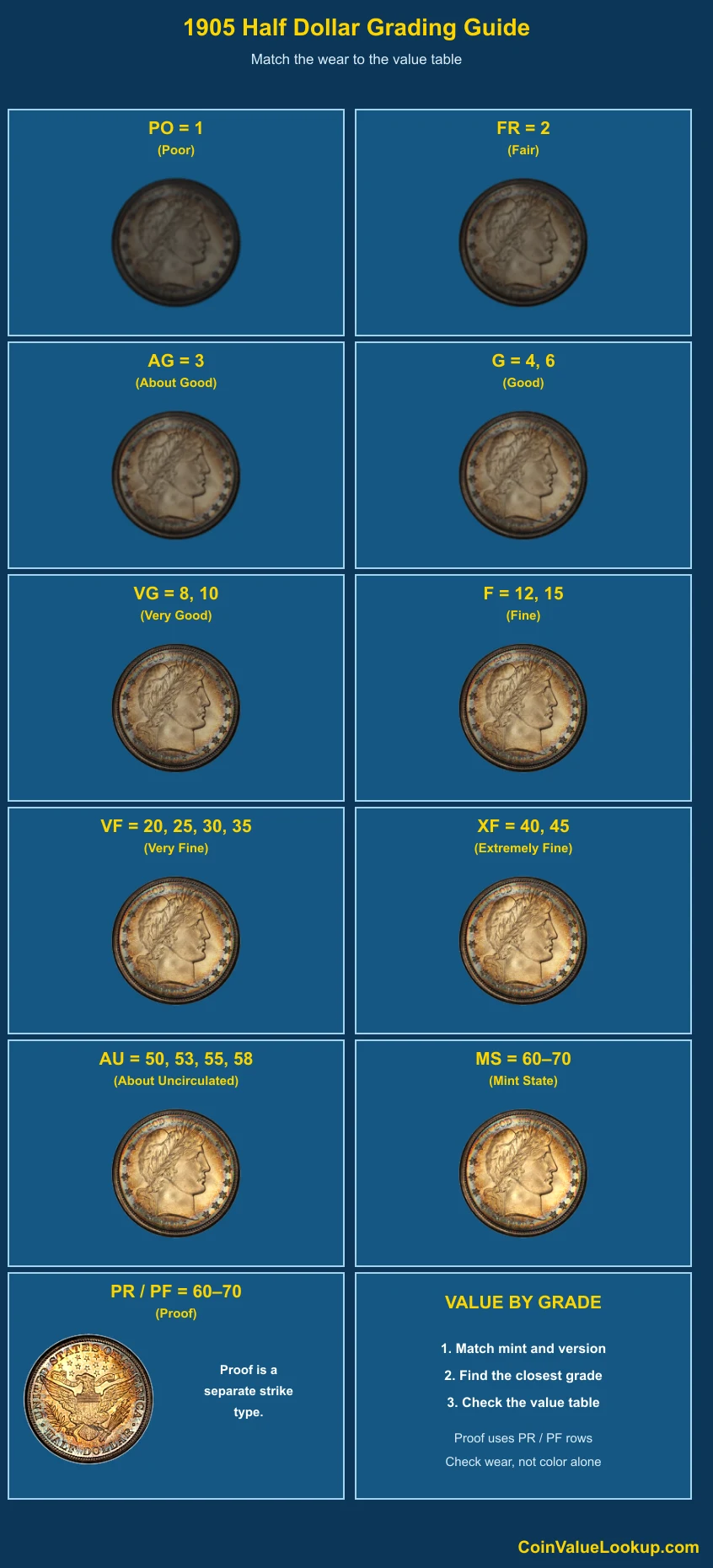
Start by examining Liberty's cheek and the hair detail above her ear on the obverse. On the reverse, check the eagle's head, wing tips, and tail feathers.
Compare your coin side by side with the grade comparison image to see where it falls.
Heavy wear flattens the headband first, then erases the hair curls and eventually the word LIBERTY on the headband. But do not rely on LIBERTY alone — a hub change around 1901 altered how quickly those letters wore, so the overall surface tells a more honest story.
New Orleans strikes can look deceptively worn because of weak strikes at the eagle's claw and arrow feathers. Separate genuine friction from strike softness by checking whether luster survives in the recessed areas.
If the fields still show cartwheel shine but the eagle's talons are mushy, that is likely a strike issue, not wear.
Proof is a manufacturing finish with mirrored fields and sharp rims — not a grade above Mint State. A polished circulated coin is not a Proof, no matter how shiny it looks.
Step 3: Check 1905 Barber Half Dollar Value by Mint and Version
1905 Barber Half Dollar — No Mint Mark — Regular Issue
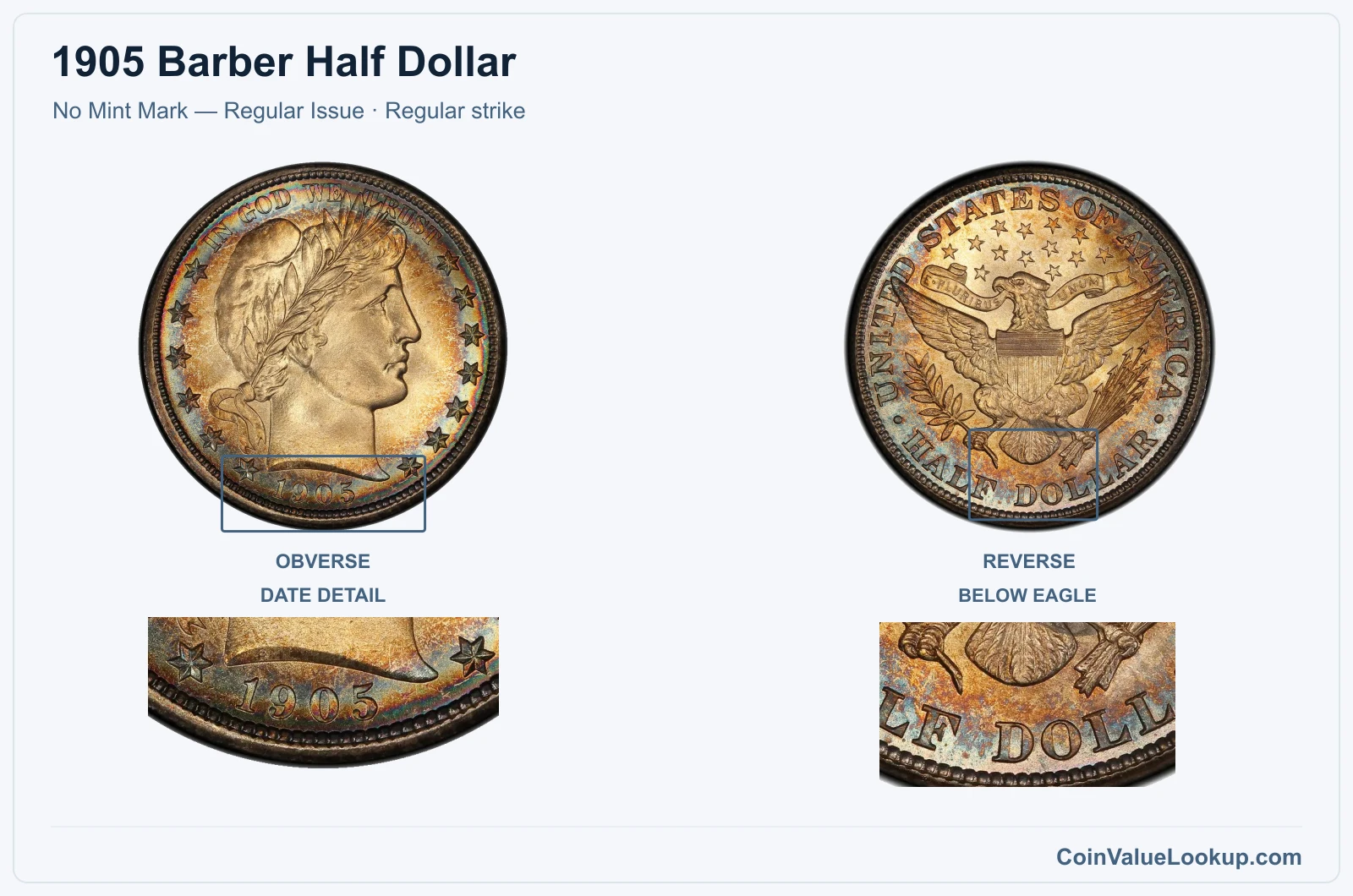
The 1905 Philadelphia half dollar carries no mintmark. Look below the eagle's tail on the reverse and confirm a blank space there.
Guide estimates place this coin at about $44 in G4 and around $1,541 at MS63, per USA Coin Book.
Philadelphia had the largest mintage of the three facilities this year, so low-grade examples turn up regularly. The jump in value from worn to Mint State is steep, though.
If your coin still has original luster and sharp hair detail above Liberty's ear, it is worth a careful look. Cleaned or damaged surfaces reduce value significantly, even on a coin that otherwise looks high-grade.
Range Grade
Price Auction Records Appraisal PO PO 1
—
Coin Identifier FR FR 2
—
Coin Identifier AG AG 3
—
Coin Identifier G G 4
—
Coin Identifier
G 6
—
Coin Identifier VG VG 8
Coin Identifier
VG 10
Coin Identifier F F 12
Coin Identifier
F 15
Coin Identifier VF VF 20
Coin Identifier
VF 25
—
Coin Identifier
VF 30
Coin Identifier
VF 35
Coin Identifier XF XF 40
—
Coin Identifier
XF 45
Coin Identifier AU AU 50
Coin Identifier
AU 53
Coin Identifier
AU 55
Coin Identifier
AU 58
Coin Identifier MS MS 60
Coin Identifier
MS 61
—
Coin Identifier
MS 62
Coin Identifier
MS 63
Coin Identifier
MS 64
Coin Identifier
MS 65
Coin Identifier
MS 66
Coin Identifier
MS 67
Coin Identifier
MS 68
—
Coin Identifier
MS 69
—
—
—
MS 70
—
—
—
1905 Barber Half Dollar — O — Regular Issue
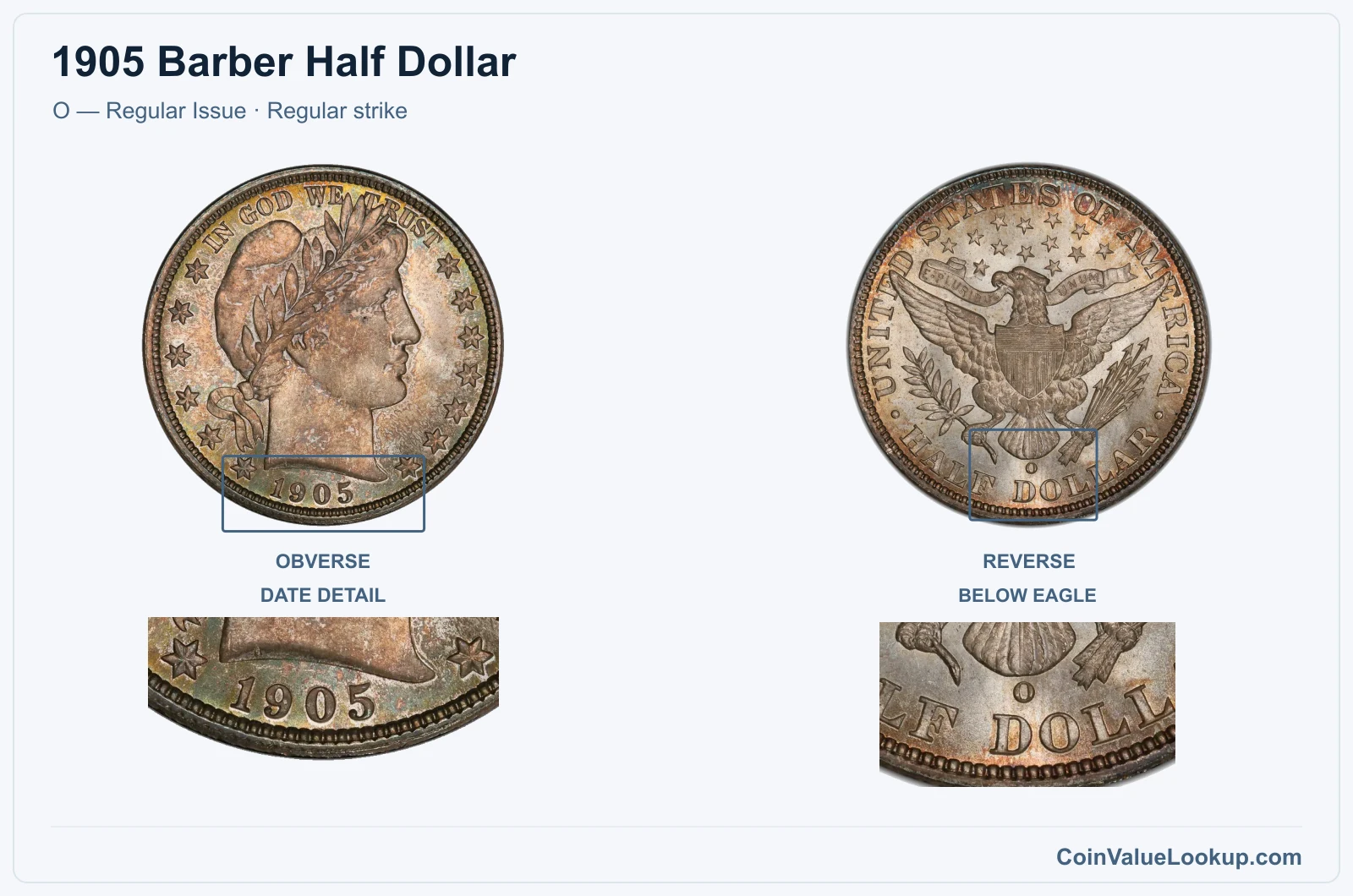
The 1905-O was struck at New Orleans and carries a small "O" mintmark below the eagle's tail feathers. This is the low-mintage branch for the year, and collectors actively seek it out.
Guide estimates run about $74 at G4 and roughly $2,130 at MS63, based on USA Coin Book figures. Even well-circulated examples command a premium over their Philadelphia and San Francisco siblings.
One thing to watch: New Orleans Barber halves are notorious for soft strikes, especially around the eagle's claws and arrow feathers. That weakness can mimic wear, so check the fields for remaining luster before assuming the coin is heavily circulated.
Original surfaces without cleaning or tooling marks add real value here.
Range Grade
Price Auction Records Appraisal PO PO 1
—
Coin Identifier FR FR 2
—
Coin Identifier AG AG 3
—
Coin Identifier G G 4
—
Coin Identifier
G 6
Coin Identifier VG VG 8
Coin Identifier
VG 10
—
Coin Identifier F F 12
Coin Identifier
F 15
Coin Identifier VF VF 20
Coin Identifier
VF 25
Coin Identifier
VF 30
Coin Identifier
VF 35
Coin Identifier XF XF 40
—
Coin Identifier
XF 45
Coin Identifier AU AU 50
Coin Identifier
AU 53
Coin Identifier
AU 55
Coin Identifier
AU 58
Coin Identifier MS MS 60
Coin Identifier
MS 61
Coin Identifier
MS 62
Coin Identifier
MS 63
Coin Identifier
MS 64
Coin Identifier
MS 65
Coin Identifier
MS 66
Coin Identifier
MS 67
Coin Identifier
MS 68
Coin Identifier
MS 69
—
—
—
MS 70
—
—
—
1905 Barber Half Dollar — S — Regular Issue
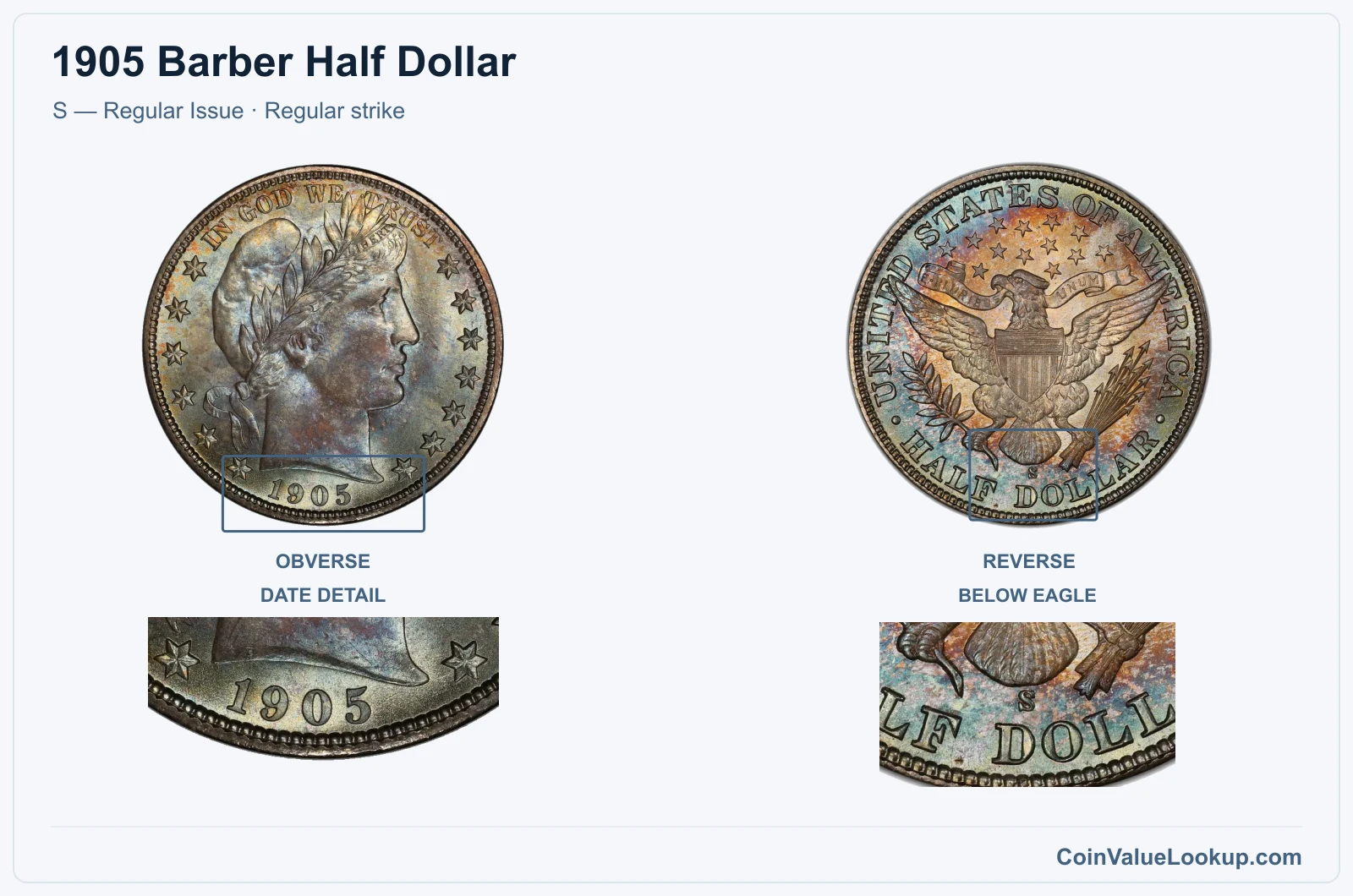
The 1905-S was struck in San Francisco and shows a small "S" below the eagle's tail. Guide estimates sit at about $44 in G4 and approximately $2,005 at MS63 per USA Coin Book.
In lower grades, the S-mint tracks right alongside Philadelphia pricing. The gap widens dramatically as you move into uncirculated territory.
A coin with full cartwheel luster and no signs of cleaning is a different animal from one that has been scrubbed or dipped.
Confirm the mintmark under magnification — corrosion or a filled die can sometimes obscure it. If the letter is clear and the coin is problem-free, you have a solid collectible.
Range Grade
Price Auction Records Appraisal PO PO 1
—
Coin Identifier FR FR 2
—
Coin Identifier AG AG 3
—
Coin Identifier G G 4
—
Coin Identifier
G 6
—
Coin Identifier VG VG 8
Coin Identifier
VG 10
Coin Identifier F F 12
Coin Identifier
F 15
Coin Identifier VF VF 20
Coin Identifier
VF 25
Coin Identifier
VF 30
Coin Identifier
VF 35
Coin Identifier XF XF 40
Coin Identifier
XF 45
Coin Identifier AU AU 50
Coin Identifier
AU 53
Coin Identifier
AU 55
Coin Identifier
AU 58
Coin Identifier MS MS 60
—
Coin Identifier
MS 61
Coin Identifier
MS 62
Coin Identifier
MS 63
Coin Identifier
MS 64
Coin Identifier
MS 65
Coin Identifier
MS 66
Coin Identifier
MS 67
Coin Identifier
MS 68
—
Coin Identifier
MS 69
—
—
—
MS 70
—
—
—
1905 Barber Half Dollar — No Mint Mark — Proof
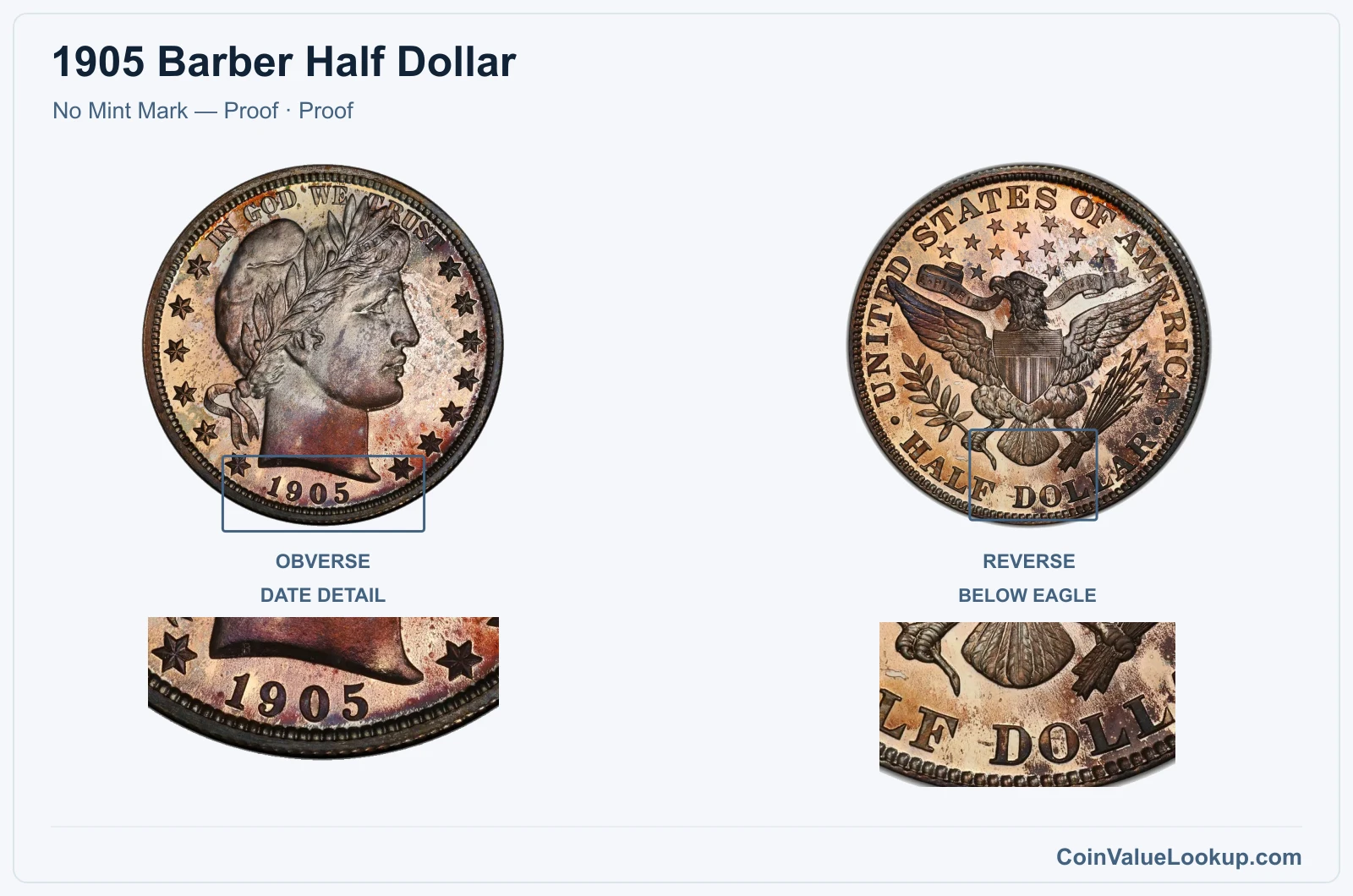
Proof 1905 Barber Half Dollars were struck at Philadelphia for collectors, using specially prepared dies and planchets. They have deeply mirrored fields and crisp, squared-off rims that business strikes cannot match.
There is no mintmark.
A guide estimate from USA Coin Book places the PR63 value at about $1,363. Within the Proof category, coins showing stronger contrast between frosted devices and reflective fields can trade differently, but that is a matter of individual assessment.
The single most common mistake is confusing a polished circulated coin for a Proof. Real Proofs show mirror surfaces struck into the metal from the start, not buffed onto them afterward.
Check the rim — a Proof rim is sharp and well-defined, while a polished coin typically shows rounded or worn edges. Third-party certification is the surest way to confirm Proof status.
Range Grade
Price Auction Records Appraisal PR PR 1
—
Coin Identifier
PR 2
—
Coin Identifier
PR 3
—
Coin Identifier
PR 4
—
Coin Identifier
PR 6
—
Coin Identifier
PR 8
—
Coin Identifier
PR 10
—
Coin Identifier
PR 12
—
Coin Identifier
PR 15
—
Coin Identifier
PR 20
—
Coin Identifier
PR 25
—
Coin Identifier
PR 30
—
Coin Identifier
PR 35
—
Coin Identifier
PR 40
—
Coin Identifier
PR 45
—
Coin Identifier
PR 50
—
Coin Identifier
PR 53
—
Coin Identifier
PR 55
—
Coin Identifier
PR 58
Coin Identifier
PR 60
Coin Identifier
PR 61
Coin Identifier
PR 62
Coin Identifier
PR 63
Coin Identifier
PR 64
Coin Identifier
PR 65
Coin Identifier
PR 66
Coin Identifier
PR 67
Coin Identifier
PR 68
Coin Identifier
PR 69
—
—
—
PR 70
—
—
—
1905 Barber Half Dollar Error List
1. 1905 Barber Half Dollar — Repunched Mintmark
A repunched mintmark (RPM) has been reported on the 1905-S Barber Half Dollar. This occurs when the mintmark punch was applied more than once at slightly different positions, leaving a visible trace of the earlier impression alongside the final "S."
To check, examine the mintmark area below the eagle's tail under at least 5x magnification. You are looking for a secondary outline or partial letter offset from the primary "S." Compare your coin to a normal 1905-S at the same magnification so you can see the difference clearly.
Several things mimic an RPM. Machine doubling produces flat, shelf-like doubling rather than a rounded secondary impression.
A die chip near the mintmark can add a bump that looks like extra metal. Corrosion or contact damage around the letter can also create misleading shapes.
No specific price range has been established for this variety in the supplied data. The value of any RPM depends on the visibility of the repunching, the coin's overall condition, and collector demand for the specific variety.