1907 Barber Half Dollar Coin Value: How Much Is It Worth?
A 1907 Barber Half Dollar in well-worn G4 condition starts around $44 according to a USA Coin Book guide snapshot, while an MS63 example can reach $6,849 depending on the mint. That top figure belongs to the San Francisco issue, which is genuinely scarce in upper grades.
Proofs and recognized die varieties occupy their own pricing tiers, so identifying your specific coin matters before anything else.
Fast Way to Identify Your 1907 Barber Half Dollar
The quickest way to start figuring out what you have is to upload clear photos of both the front and back of your coin. Our identifier can give you a preliminary read on the year, mint, and general type.
It is not a substitute for professional authentication or exact grading, but it will point you in the right direction before you dig deeper.
1907 Barber Half Dollar Value
Upload both sides of your 1907 Barber Half Dollar.
Front Obverse
Upload photo
Back Reverse
Upload photo
Which 1907 Barber Half Dollar Versions Are Worth Money?
- The 1907-S half dollar jumps from about $61 at G4 to $6,849 at MS63 per USA Coin Book, making higher-grade survivors especially worth checking.
- A 1907-S/S repunched mintmark is a recognized variety that can carry a premium over a normal S-mint coin.
- Proof 1907 half dollars from Philadelphia are listed around $1,363 at PR63 and are distinguished by mirrored fields, not just a shiny surface.
- Original, problem-free coins in upper circulated or Mint State grades can be worth dramatically more than heavily worn examples across all four mints.
- Several die errors are reported for 1907, including doubled die reverse, inverted mintmark, and the so-called mumps die bulge on O-mint coins.
Step 1: Identify Your 1907 Barber Half Dollar Mint Mark and Version
The 1907 Barber Half Dollar shows Charles Barber's Liberty head facing right on the obverse, with HALF DOLLAR and a heraldic eagle on the reverse. The date sits at the bottom of the obverse.
All business-strike versions are 90% silver and 10% copper, weigh about 12.5 grams, measure 30.6 mm across, and have a reeded edge.
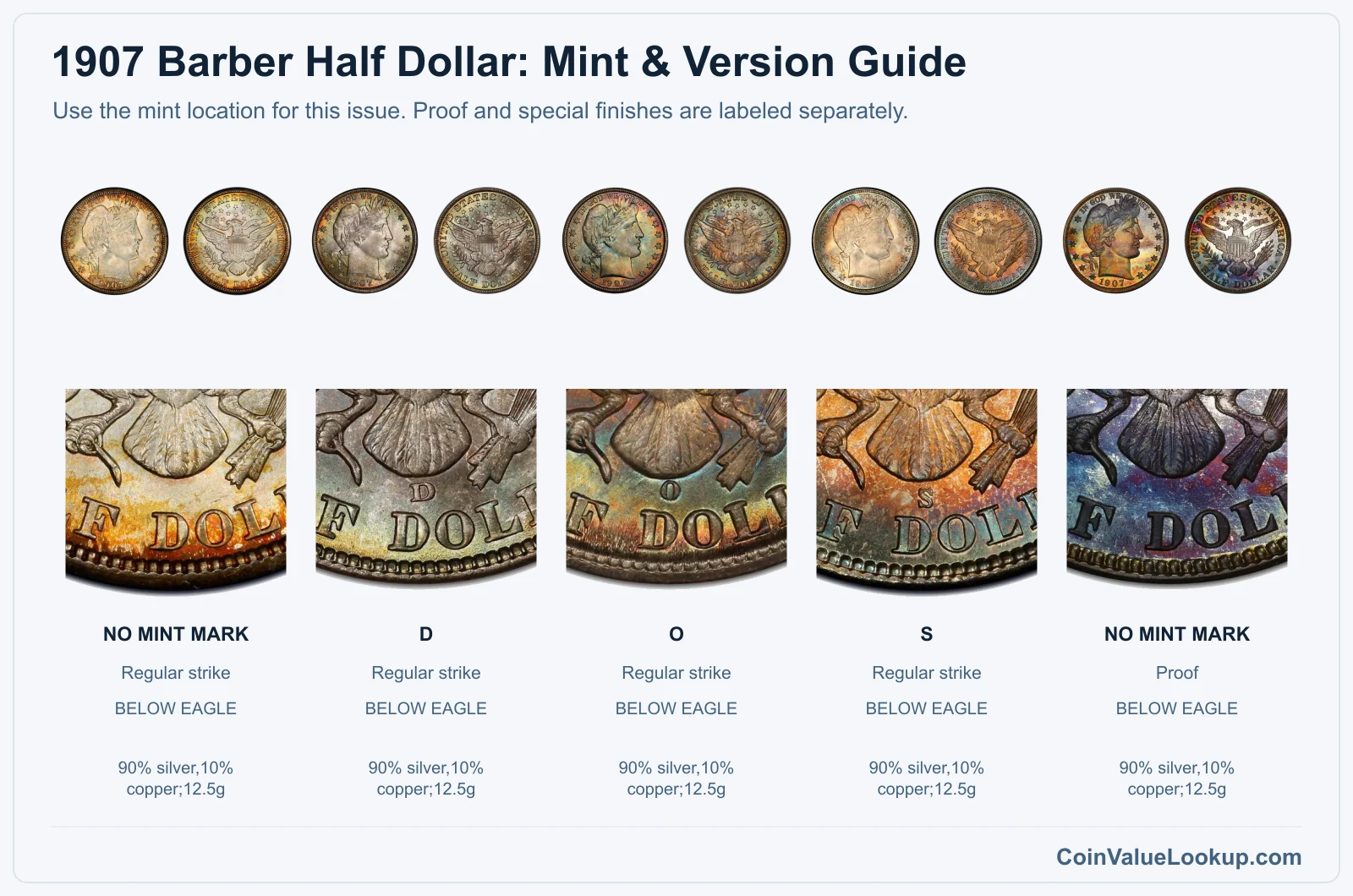
Four mints struck this coin: Philadelphia, Denver, New Orleans, and San Francisco. Philadelphia coins carry no mintmark at all.
For the other three, flip the coin over and look just below the eagle's tail feathers and above the words HALF DOLLAR for a small D, O, or S.
Proofs were made only at Philadelphia and also lack a mintmark, so do not assume a no-mintmark coin is automatically a proof. Proof status comes from the manufacturing method, not the absence of a letter.
The San Francisco mint produced an S/S repunched mintmark variety that is recognized by collectors. New Orleans coins are often weakly struck, especially on the eagle's claws and arrow feathers, but a soft strike is a characteristic of the mint, not a separate error variety.
Step 2: Check Your 1907 Barber Half Dollar Grade
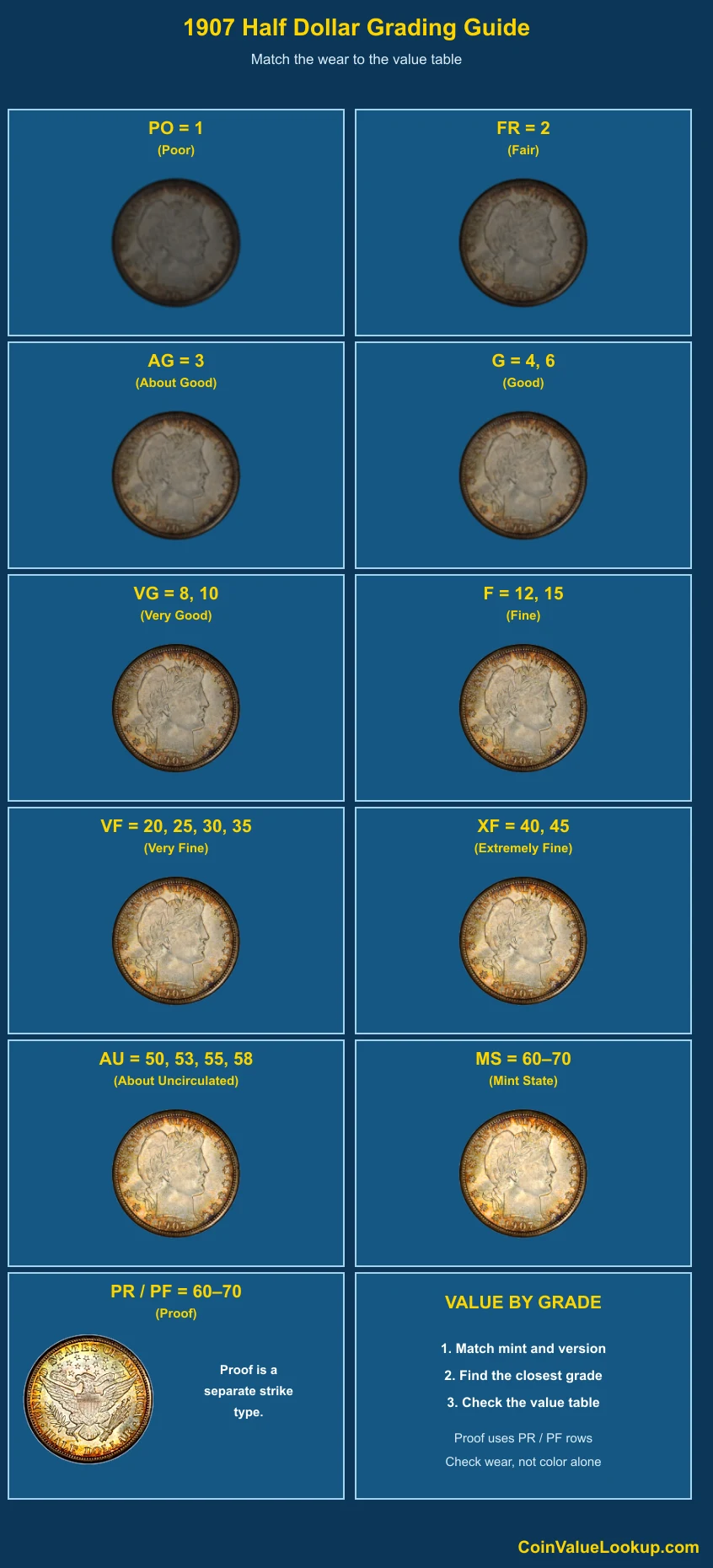
Start by examining Liberty's cheek and the hair detail above her ear. On a heavily worn coin those areas blend together into flat metal.
The headband lettered LIBERTY loses definition progressively, but do not rely on just those letters because hub changes during the Barber series can affect how quickly they wear.
On the reverse, check the eagle's head, the tips of the wings, and the tail feathers. Coins that still show sharp separation in those areas with full original luster fall into Mint State territory.
Compare your coin against the grade comparison image. Look at overall surface preservation, not just one spot.
A common mistake with New Orleans pieces is confusing a weak original strike with heavy wear. If the eagle's claws and arrow feathers look soft but Liberty's cheek still has roundness and luster, you may have a lightly circulated coin with a characteristically mushy strike rather than a worn-out one.
Cleaning, polishing, or other surface problems reduce a coin's desirability regardless of how much detail remains.
Step 3: Check 1907 Barber Half Dollar Value by Mint and Version
1907 Barber Half Dollar — No Mint Mark — Regular Issue
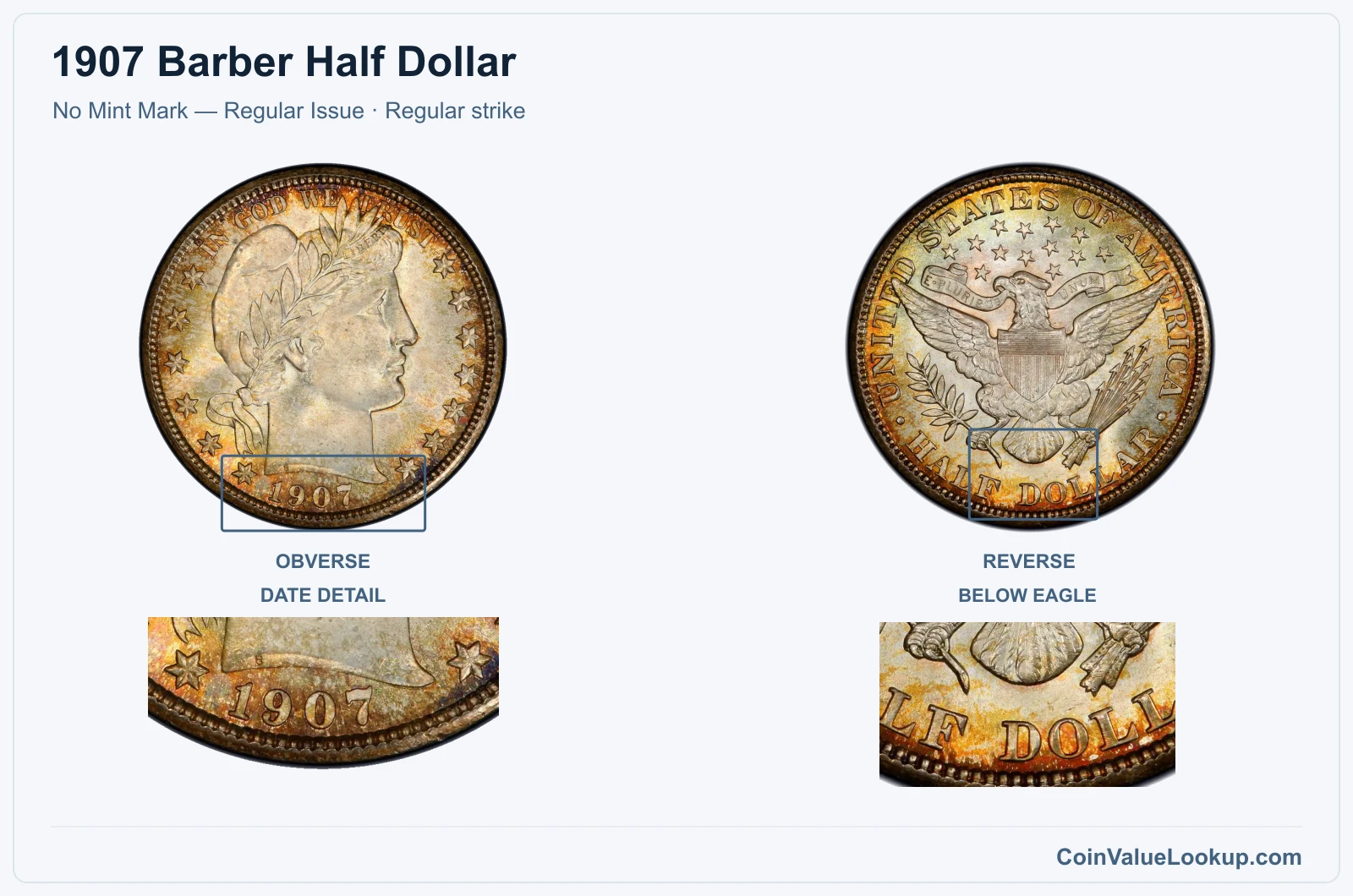
The Philadelphia issue carries no mintmark. In G4 condition, USA Coin Book lists it around $44, climbing to roughly $947 at MS63.
That is the baseline for the series this year.
When examining a no-mintmark coin, check the area below the eagle's tail carefully to confirm nothing is lurking there. A faint D, O, or S changes everything.
Original surfaces and honest wear matter more to collectors than a coin that has been cleaned to look shiny. If your Philadelphia half still has good luster and sharp detail on Liberty's hair, it is worth a closer grade assessment.
Range Grade
Price Auction Records Appraisal PO PO 1
—
Coin Identifier FR FR 2
—
Coin Identifier AG AG 3
—
Coin Identifier G G 4
—
Coin Identifier
G 6
—
Coin Identifier VG VG 8
Coin Identifier
VG 10
Coin Identifier F F 12
Coin Identifier
F 15
Coin Identifier VF VF 20
Coin Identifier
VF 25
Coin Identifier
VF 30
Coin Identifier
VF 35
Coin Identifier XF XF 40
Coin Identifier
XF 45
Coin Identifier AU AU 50
Coin Identifier
AU 53
Coin Identifier
AU 55
Coin Identifier
AU 58
Coin Identifier MS MS 60
—
Coin Identifier
MS 61
Coin Identifier
MS 62
Coin Identifier
MS 63
Coin Identifier
MS 64
Coin Identifier
MS 65
Coin Identifier
MS 66
Coin Identifier
MS 67
Coin Identifier
MS 68
—
—
—
MS 69
—
—
—
MS 70
—
—
—
1907 Barber Half Dollar — D — Regular Issue
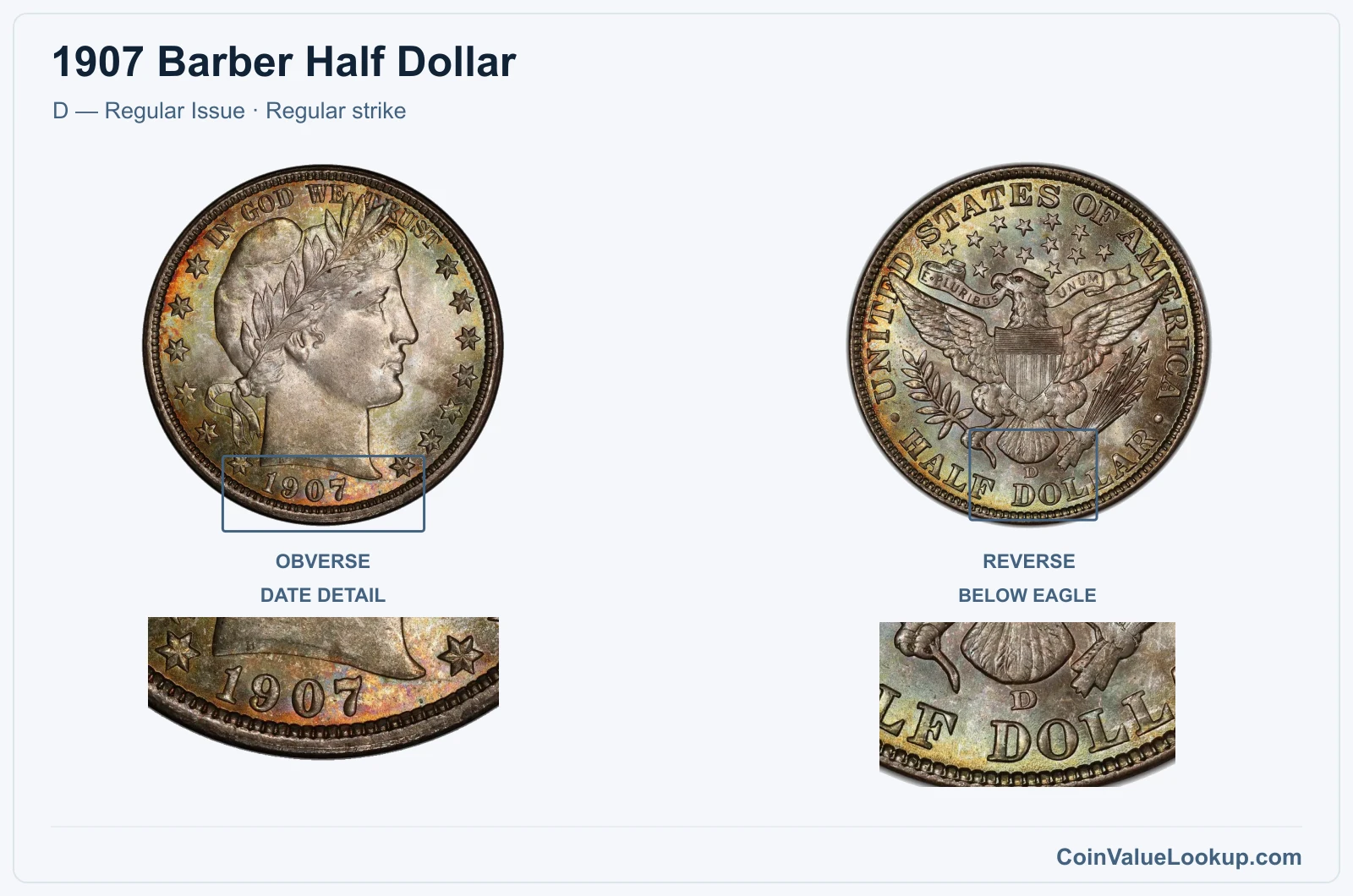
Denver struck 1907 halves with a small D mintmark below the eagle's tail. Guide values sit at about $44 in G4 and around $1,145 at MS63 per USA Coin Book, a noticeable step above the Philadelphia coin in top grades.
Denver Barber halves from this era are not usually considered rare dates, but well-preserved examples are always harder to find than worn ones. Look for full feather detail on the eagle and clean fields free of scratches or cleaning marks.
Those are the coins that command the stronger prices.
Range Grade
Price Auction Records Appraisal PO PO 1
—
Coin Identifier FR FR 2
—
Coin Identifier AG AG 3
—
Coin Identifier G G 4
—
Coin Identifier
G 6
—
Coin Identifier VG VG 8
—
Coin Identifier
VG 10
Coin Identifier F F 12
Coin Identifier
F 15
Coin Identifier VF VF 20
Coin Identifier
VF 25
Coin Identifier
VF 30
Coin Identifier
VF 35
Coin Identifier XF XF 40
Coin Identifier
XF 45
Coin Identifier AU AU 50
Coin Identifier
AU 53
Coin Identifier
AU 55
Coin Identifier
AU 58
Coin Identifier MS MS 60
Coin Identifier
MS 61
Coin Identifier
MS 62
Coin Identifier
MS 63
Coin Identifier
MS 64
Coin Identifier
MS 65
Coin Identifier
MS 66
Coin Identifier
MS 67
Coin Identifier
MS 68
Coin Identifier
MS 69
—
—
—
MS 70
—
—
—
1907 Barber Half Dollar — O — Regular Issue
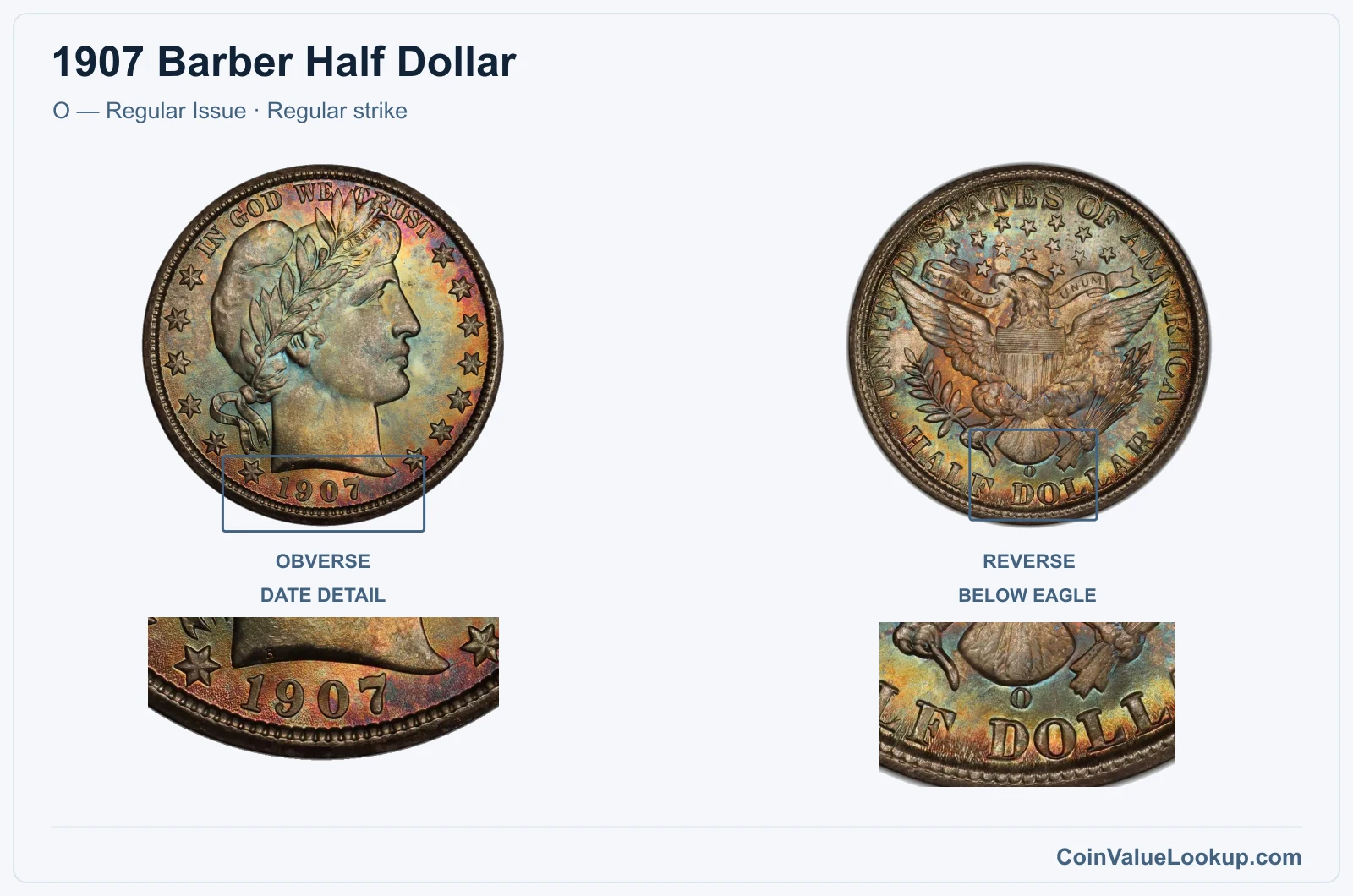
New Orleans placed an O below the eagle's tail. USA Coin Book lists about $44 at G4 and roughly $1,205 at MS63.
The O-mint is known for characteristically weak strikes, particularly on the eagle's claws and arrow feathers.
Do not mistake that softness for wear. If Liberty's cheek and hair still show luster and roundness, the coin may grade higher than it first appears.
That strike weakness is normal for the New Orleans facility and does not create a separate collectible variety on its own. A genuinely sharp O-mint coin in Mint State is a pleasant find, though.
Coin Value Lookup is a handy starting point if you want to look up other Barber half dollar dates or different denominations in the series.
Range Grade
Price Auction Records Appraisal PO PO 1
—
Coin Identifier FR FR 2
—
Coin Identifier AG AG 3
—
Coin Identifier G G 4
—
Coin Identifier
G 6
Coin Identifier VG VG 8
—
Coin Identifier
VG 10
Coin Identifier F F 12
Coin Identifier
F 15
Coin Identifier VF VF 20
Coin Identifier
VF 25
Coin Identifier
VF 30
Coin Identifier
VF 35
Coin Identifier XF XF 40
Coin Identifier
XF 45
Coin Identifier AU AU 50
Coin Identifier
AU 53
Coin Identifier
AU 55
Coin Identifier
AU 58
Coin Identifier MS MS 60
Coin Identifier
MS 61
Coin Identifier
MS 62
Coin Identifier
MS 63
Coin Identifier
MS 64
Coin Identifier
MS 65
Coin Identifier
MS 66
Coin Identifier
MS 67
Coin Identifier
MS 68
—
—
—
MS 69
—
—
—
MS 70
—
—
—
1907 Barber Half Dollar — S — Regular Issue
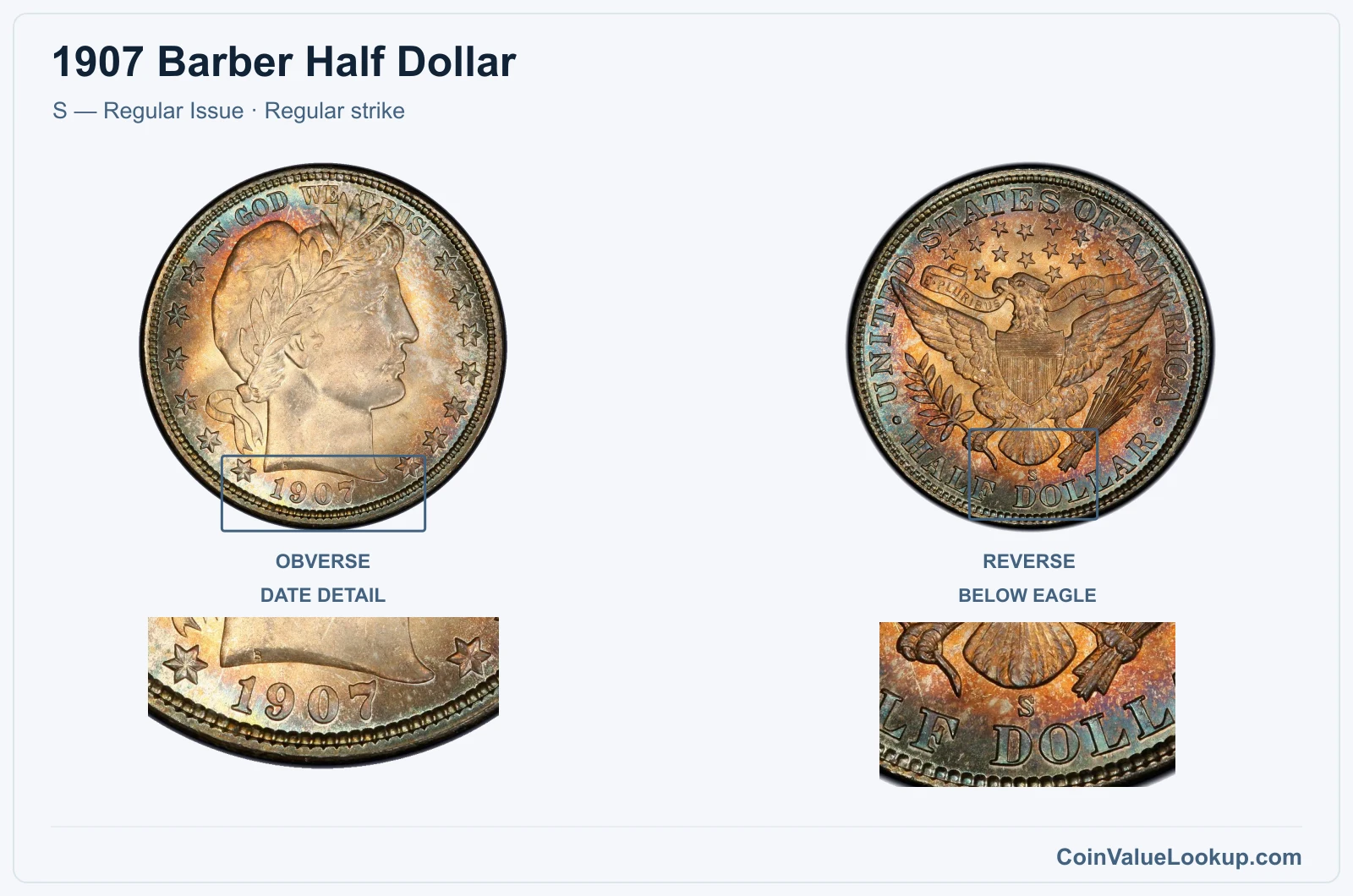
The San Francisco half carries an S mintmark and is the standout of the four regular issues this year. USA Coin Book lists approximately $61 at G4 but a striking $6,849 at MS63.
That enormous spread tells you surviving high-grade examples are genuinely difficult to locate.
Most 1907-S halves you encounter will be well worn. If yours still shows strong detail on Liberty's hair ribbons and the eagle's breast feathers with original luster intact, it deserves careful evaluation.
The S/S repunched mintmark is a recognized variety on this date as well, so inspect the mintmark under magnification for any trace of a second impression. Condition, original surfaces, and the absence of cleaning are critical to realizing the upper values.
Range Grade
Price Auction Records Appraisal PO PO 1
—
Coin Identifier FR FR 2
—
Coin Identifier AG AG 3
—
Coin Identifier G G 4
—
Coin Identifier
G 6
Coin Identifier VG VG 8
Coin Identifier
VG 10
Coin Identifier F F 12
Coin Identifier
F 15
Coin Identifier VF VF 20
Coin Identifier
VF 25
Coin Identifier
VF 30
Coin Identifier
VF 35
Coin Identifier XF XF 40
Coin Identifier
XF 45
Coin Identifier AU AU 50
Coin Identifier
AU 53
Coin Identifier
AU 55
—
Coin Identifier
AU 58
Coin Identifier MS MS 60
Coin Identifier
MS 61
—
Coin Identifier
MS 62
Coin Identifier
MS 63
Coin Identifier
MS 64
Coin Identifier
MS 65
Coin Identifier
MS 66
Coin Identifier
MS 67
Coin Identifier
MS 68
—
—
—
MS 69
—
—
—
MS 70
—
—
—
1907 Barber Half Dollar — No Mint Mark — Proof
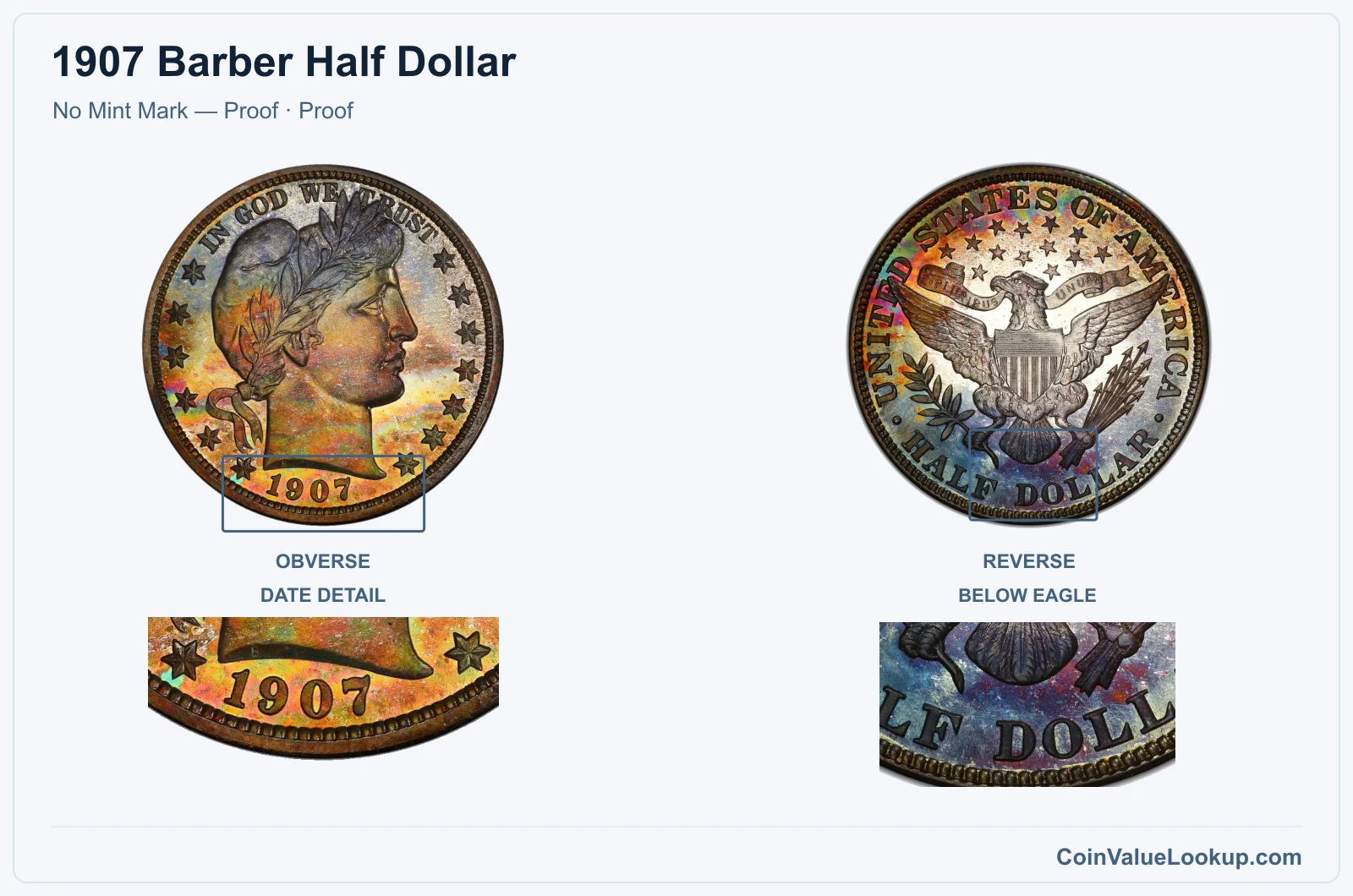
Proof 1907 Barber Half Dollars were struck at Philadelphia with specially prepared dies and polished planchets, producing mirrored fields and sharp design edges. They carry no mintmark, just like the regular Philadelphia issue, so identification depends on surface quality rather than a letter.
USA Coin Book lists about $1,363 at PR63. Genuine proofs show deeply reflective fields that a polished circulation coin cannot replicate.
Look at the rim detail and the knife-sharp edges of the lettering. Polishing a business strike does not turn it into a proof.
If you suspect you have one, third-party authentication is the safest route to confirmation.
Range Grade
Price Auction Records Appraisal PR PR 1
—
Coin Identifier
PR 2
—
Coin Identifier
PR 3
—
Coin Identifier
PR 4
—
Coin Identifier
PR 6
—
Coin Identifier
PR 8
—
Coin Identifier
PR 10
—
Coin Identifier
PR 12
—
Coin Identifier
PR 15
—
Coin Identifier
PR 20
—
Coin Identifier
PR 25
—
Coin Identifier
PR 30
—
Coin Identifier
PR 35
—
Coin Identifier
PR 40
—
Coin Identifier
PR 45
—
Coin Identifier
PR 50
—
Coin Identifier
PR 53
—
Coin Identifier
PR 55
—
Coin Identifier
PR 58
—
Coin Identifier
PR 60
Coin Identifier
PR 61
Coin Identifier
PR 62
Coin Identifier
PR 63
Coin Identifier
PR 64
Coin Identifier
PR 65
Coin Identifier
PR 66
Coin Identifier
PR 67
Coin Identifier
PR 68
Coin Identifier
PR 69
—
—
—
PR 70
—
—
—
1907 Barber Half Dollar Error List
1. 1907 Barber Half Dollar — Doubled Die Reverse
A Doubled Die Reverse has been reported for the 1907 Philadelphia half dollar, involving recut elements in the outer reverse legend. To check for this, compare the reverse lettering on your coin against a known normal example under magnification.
Look for a secondary outline or thickening on individual letters that appears consistent across multiple characters.
The key distinction is that true doubled die impressions affect the design uniformly because they originate in the die-making process. Machine doubling, by contrast, tends to produce flat, shelf-like displacement and usually lacks the crispness of a genuine hub doubling.
Random nicks or reflections from lighting can also mimic doubling. No specific price range is established for this variety; value depends on the visibility of the doubling, overall coin condition, and collector demand for the particular die.
2. 1907 Barber Half Dollar — Repunched Mintmark
A repunched mintmark has been reported on the 1907-S, described as an S/S with the secondary punch to the north. A D/D variety has also been listed in survey records, though without a confirmed specimen photograph.
To identify a repunched mintmark, examine the letter under at least 5x magnification. You are looking for remnants of a separately positioned punch, a partial second outline that does not align perfectly with the final mintmark.
On the S/S, traces of the earlier S should appear slightly above the primary letter.
Do not confuse this with machine doubling, which creates flat shelf-like distortion, or with a die chip or corrosion deposits around the mark. No specific price range is adopted for this variety.
Value depends on the clarity of the secondary punch, the coin's grade, and how much collector interest exists for the specific die.
3. 1907 Barber Half Dollar — Misplaced Date
A misplaced date variety has been listed for the 1907-O half dollar in collector society records, though no confirmed specimen has been reported by a respondent. The diagnostic involves looking at the denticles below the date for fragments of extra numerals, evidence that the date punch initially struck in the wrong position before being corrected.
These fragments are usually small and subtle. You will need magnification and good lighting.
The key distinction is between a genuine misplaced punch, which shows recognizable partial digit shapes among the denticles, and ordinary repunching beside the final date digits, which appears as thickening or doubling of the numbers themselves. Rim damage can also create confusing marks.
No price range is established for this variety; value would depend on confirmation, visibility, and overall coin condition.
4. 1907 Barber Half Dollar — Inverted Mintmark
An inverted mintmark has been reported for the 1907-S, with one specimen noted in a collector society survey. The variety involves the S mintmark being punched upside down into the die before striking.
To check for this, compare the shape and orientation of the S on your coin to a normal 1907-S at the same magnification. An inverted S will appear subtly different in the proportions and curves of the letter's serifs when compared side by side.
The difference can be easy to miss without a direct reference.
Do not confuse an unusual punch style or a repunched mintmark with an inversion. Post-mint damage to the mintmark area can also distort the letter's appearance.
No specific price is established for this variety. Value would depend on confirmation, the coin's condition, and how clearly the inversion can be demonstrated.
5. 1907 Barber Half Dollar — Lamination / Split Planchet
A lamination or split planchet error has been reported on a 1907-O half dollar, specifically noted on the reverse. This type of error occurs when the metal separates into layers, creating a peeling flap, a missing patch, or visible separation within the coin's body.
Look for an area where the surface metal lifts away or is entirely absent, revealing a rough underlayer. Photograph both the affected face and the edge of the coin together, since edge views often show the separation most clearly.
Do not confuse lamination with deliberate scraping, environmental corrosion, or a coin that has been cut or filed. Genuine laminations typically follow the contour of the planchet rather than showing tool marks.
No price range is adopted. Value depends on the size, location, and visual drama of the lamination, as well as the coin's overall condition.
6. 1907 Barber Half Dollar — Off-Center Strike
Off-center strikes have been reported for the 1907 half dollar. This error occurs when the planchet is not properly seated between the dies, resulting in a displaced design and an unstruck crescent of blank metal along part of the rim.
The most collectible off-center coins still show a readable date, because without the date, attributing the coin to a specific year becomes difficult. Look for a clear crescent of flat, featureless metal on one side paired with a design that is shifted in the opposite direction.
Do not confuse this with a clipped planchet, which produces a curved bite from a feeding error, or with post-mint flattening from a vise or similar tool. No price range is adopted for this error.
Value depends on the percentage of off-center displacement, date visibility, and overall condition.
7. 1907 Barber Half Dollar — Broadstrike
A broadstrike error has been reported for the 1907 half dollar. Broadstrikes happen when the coin is struck without the normal collar that confines the planchet and creates the reeded edge.
The result is a coin that spreads wider than normal with a distorted or absent edge reeding.
The full design should still be present and roughly centered, which distinguishes a broadstrike from an off-center strike. Look at the rim and edge profile: on a genuine broadstrike, the metal flows outward beyond the normal diameter, and the reeding is weak, partial, or missing entirely.
A coin that has been flattened after minting by mechanical pressure may look similar, but typically shows distortion in the design fields and unnatural thinning. No price range is established.
Value depends on the degree of spread, the preservation of design details, and overall coin condition.
8. 1907 Barber Half Dollar — Mumps Die-Bulge Variety
The mumps die-bulge variety has been reported on the 1907-O half dollar. This colorful name comes from an abnormal raised swelling on Liberty's neck and jaw area, giving the portrait a puffy appearance reminiscent of the illness.
The published listing includes 1906-O, 1907-O, and 1908-O as dates affected.
To identify this, compare the neck and jaw contour of your coin against a normal 1907-O at the same angle. The bulge is a die-state issue, meaning it originated from deterioration or damage within the die itself, and it should appear in the same location on every coin struck from that die.
Do not mistake post-mint damage, corrosion buildup, or tricky lighting on a normal portrait for this variety. A genuine mumps bulge is raised metal that is part of the strike, not surface debris.
No price range is adopted; value depends on the clarity of the bulge, the coin's condition, and collector interest in the specific die state.