1833 Capped Bust Half Dollar Coin Value: How Much Is It Worth?
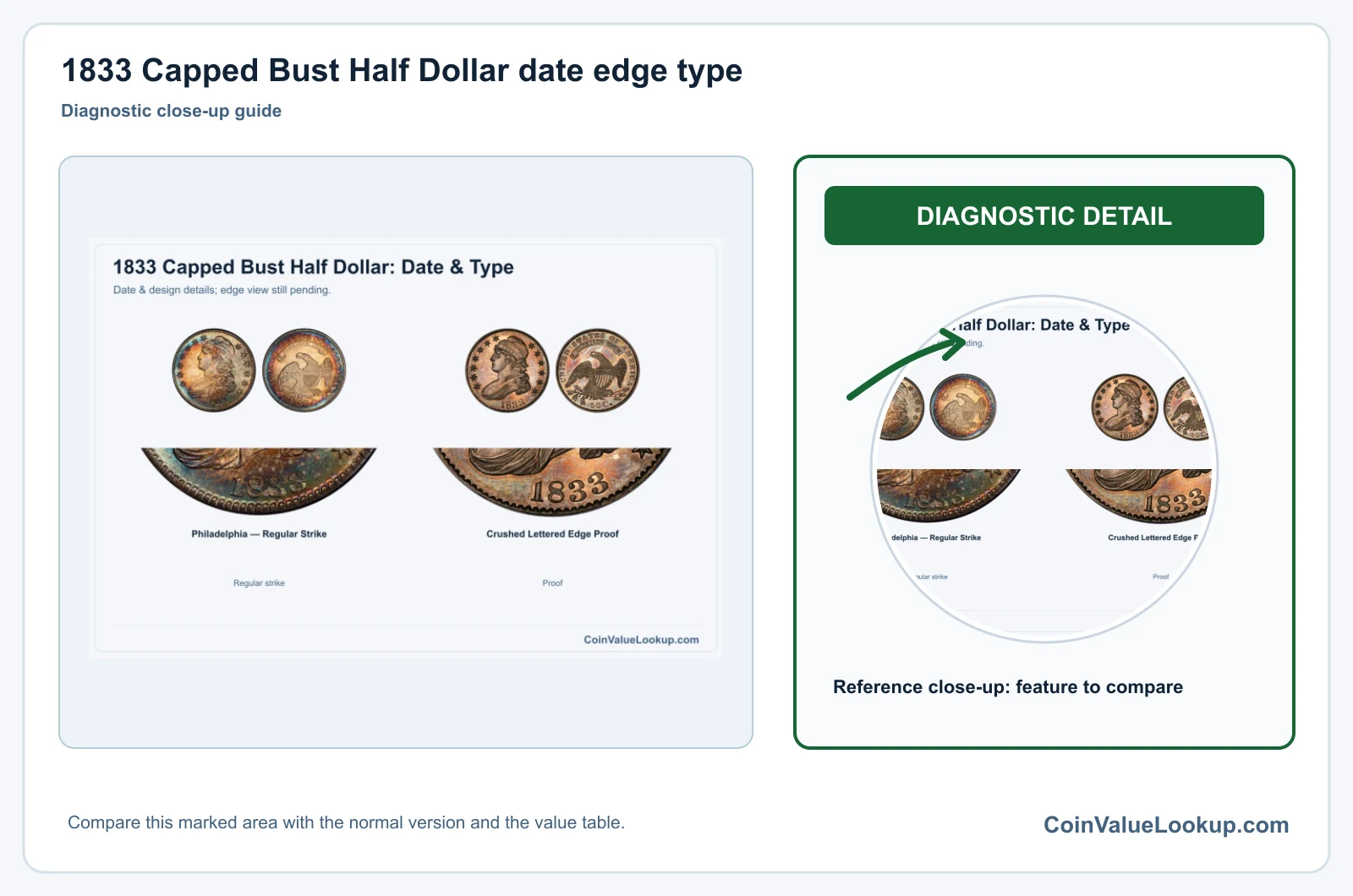
The 1833 Capped Bust Half Dollar is a silver coin that circulated heavily in its day, and survivors still turn up regularly. Guide estimates for the ordinary Philadelphia regular strike run from about $100 at G4 to roughly $487 at AU50.
Grade matters enormously, and rare Proof examples or recognized varieties demand their own separate valuations.
Fast Way to Identify Your 1833 Capped Bust Half Dollar
Snap clear photos of the front, back, and edge of your coin and upload them to our identifier. It can offer a preliminary identification of your 1833 Half Dollar's version and condition based on those images.
This is not a substitute for professional authentication, but it gives you a solid starting point.
1833 Capped Bust Half Dollar Value
Upload both sides of your 1833 Capped Bust Half Dollar.
Front Obverse
Upload photo
Back Reverse
Upload photo
Which 1833 Capped Bust Half Dollar Versions Are Worth Money?
- The Philadelphia regular strike in AU50 condition carries a guide estimate around $487, dropping to about $100 at G4 — grade drives everything on this common version.
- Crushed Lettered Edge Proofs are rare specialist coins; one graded PR65 sold for $141,000 at Stack's Bowers in February 2016.
Step 1: Identify Your 1833 Capped Bust Half Dollar Mint Mark and Version
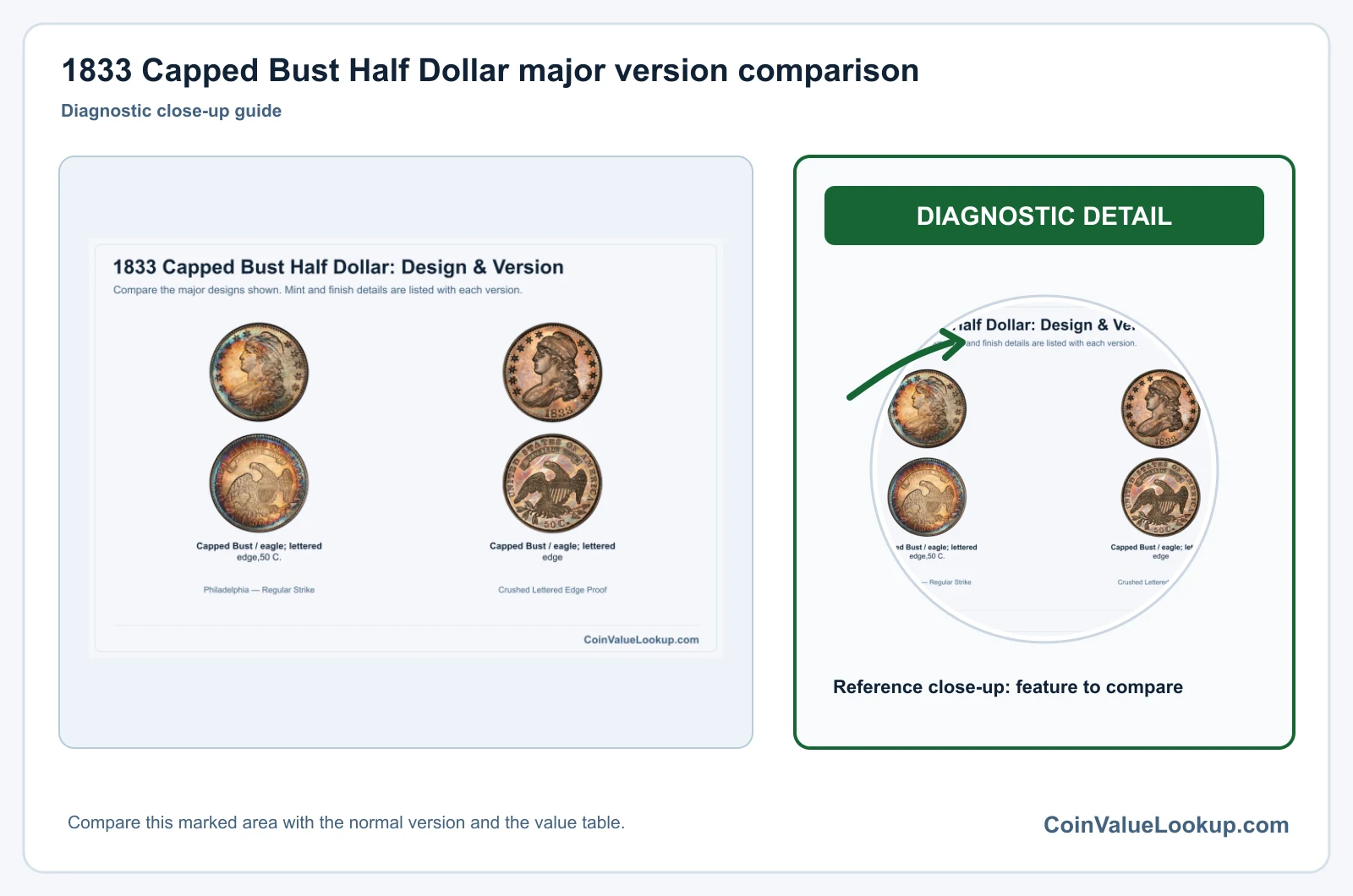
Every 1833 Capped Bust Half Dollar was struck at the Philadelphia Mint. There is no mintmark on this coin, so do not look for one.
The obverse shows Liberty wearing a cap, surrounded by stars, with the date below. Flip it over and you will see an eagle with a shield on its breast, "UNITED STATES OF AMERICA" around the rim, and "50 C." at the bottom.
Check the edge. The regular strike has a lettered edge reading FIFTY CENTS OR HALF A DOLLAR.
The coin measures 32.5 mm, weighs nominally 13.48 grams, and is approximately 89.24% silver with a copper balance.
For most people, the main version to confirm is the Philadelphia regular strike. Proof status is a different matter entirely: a bright, shiny coin is not automatically a Proof.
Prooflike surfaces can result from early die strikes or polishing, and only professional attribution can confirm true Proof manufacture. Read the date carefully and compare your coin's details against known examples before assuming anything special.
Step 2: Check Your 1833 Capped Bust Half Dollar Grade
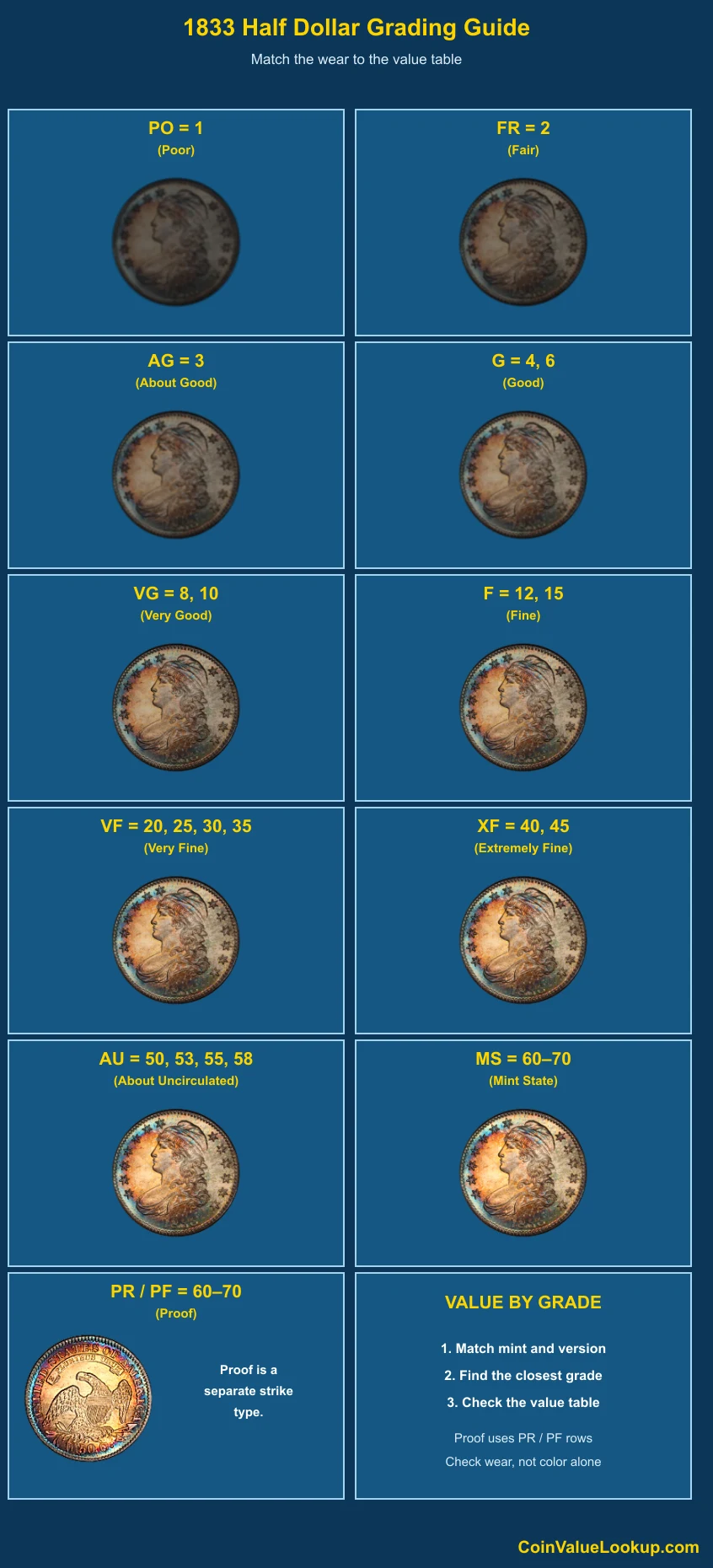
Start by examining the high points on both sides. On the obverse, check Liberty's forehead curls, cheek, and the top of the cap for wear.
The shoulder clasp loses detail early too.
On the reverse, the eagle's breast feathers and wing tips are the first areas to flatten. Compare your coin against the type-matched grading image to see where your example falls on the wear spectrum.
Separate original weak strike from actual wear. Some areas may look soft because the die did not fully impress the metal, not because the coin circulated.
Rubbed luster has a different texture than never-there detail.
Also note any cleaning, scratches, or holes. These reduce a coin's desirability and value regardless of how much original detail remains.
Proof is a manufacturing finish graded on its own PR scale, not a grade above Mint State.
Step 3: Check 1833 Capped Bust Half Dollar Value by Mint and Version
1833 Capped Bust Half Dollar — Philadelphia — Regular Strike
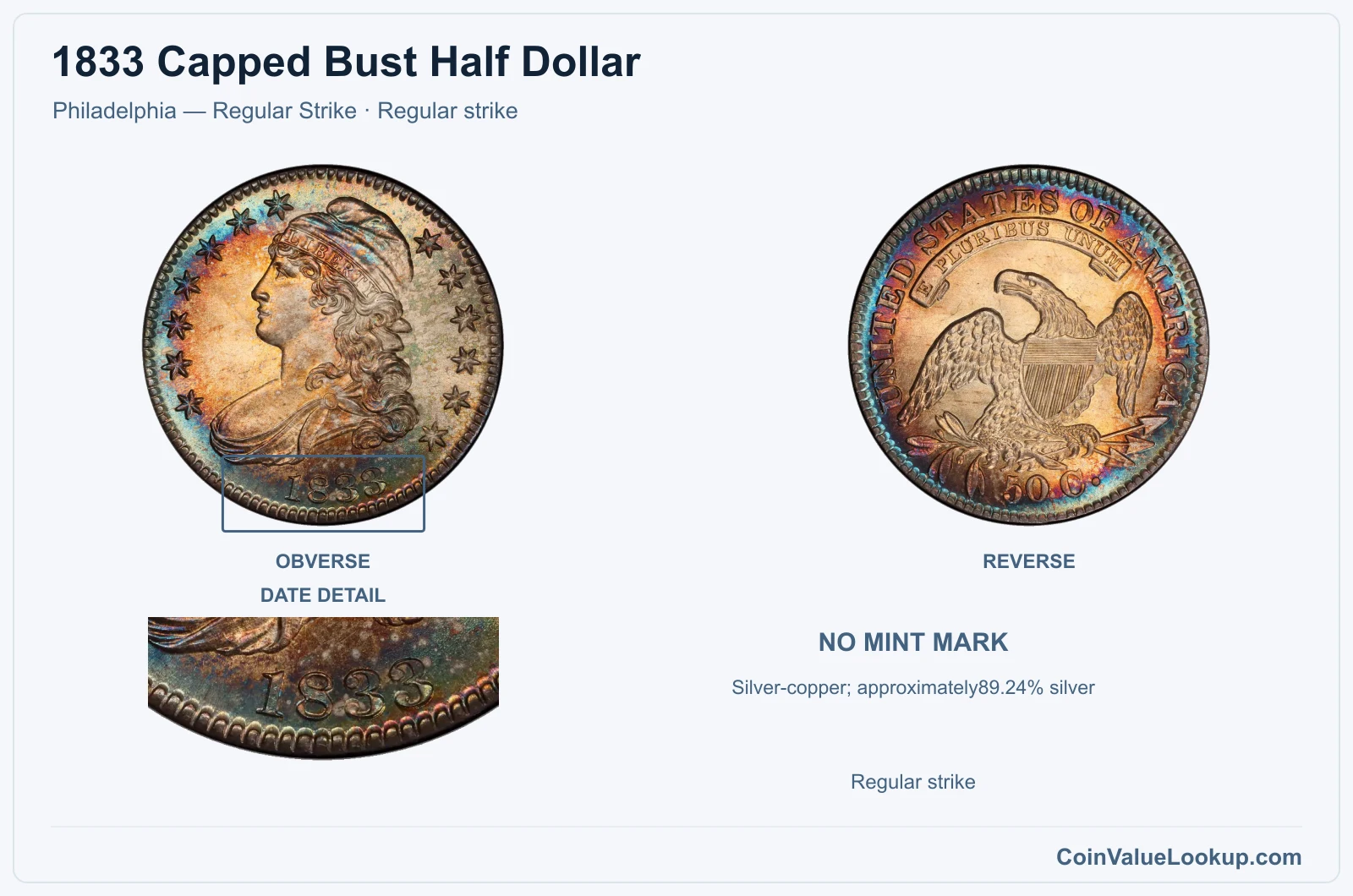
The Philadelphia regular strike is the version most collectors encounter. It has the standard lettered edge reading FIFTY CENTS OR HALF A DOLLAR, struck in silver-copper alloy of approximately 89.24% silver.
USA Coin Book guide estimates place this coin at about $100 in G4, around $152 in VF20, and roughly $487 in AU50. These are retail guide estimates, not guaranteed sale prices.
Your coin's actual value depends on its exact condition, surface quality, and whether it has been cleaned or damaged.
Do not confuse this coin with the Crushed Lettered Edge Proof. A worn or polished regular strike edge is not the same as a deliberately manufactured Proof edge.
Range Grade
Price Auction Records Appraisal PO PO 1
—
Coin Identifier FR FR 2
Coin Identifier AG AG 3
Coin Identifier G G 4
—
Coin Identifier
G 6
—
Coin Identifier VG VG 8
—
Coin Identifier
VG 10
Coin Identifier F F 12
Coin Identifier
F 15
Coin Identifier VF VF 20
Coin Identifier
VF 25
Coin Identifier
VF 30
Coin Identifier
VF 35
Coin Identifier XF XF 40
Coin Identifier
XF 45
Coin Identifier AU AU 50
Coin Identifier
AU 53
Coin Identifier
AU 55
Coin Identifier
AU 58
Coin Identifier MS MS 60
Coin Identifier
MS 61
Coin Identifier
MS 62
Coin Identifier
MS 63
Coin Identifier
MS 64
Coin Identifier
MS 65
Coin Identifier
MS 66
Coin Identifier
MS 67
Coin Identifier
MS 68
Coin Identifier
MS 69
—
—
—
MS 70
—
—
—
1833 Capped Bust Half Dollar — Crushed Lettered Edge Proof
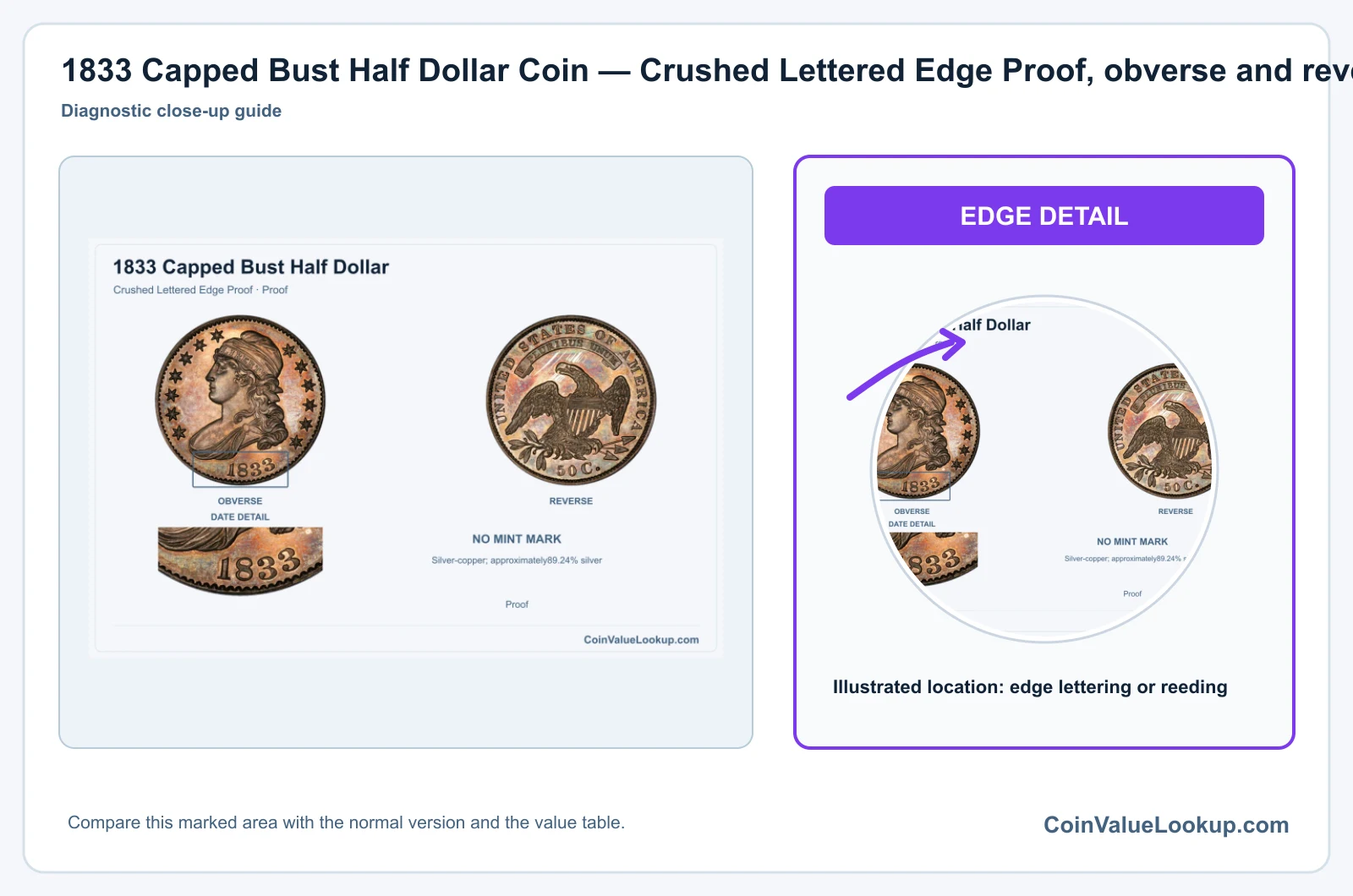
The 1833 Crushed Lettered Edge Proof is a genuinely rare coin made for presentation or collector purposes, not for circulation. The edge lettering was applied with a different pressure profile than the regular issue, and the surfaces show characteristics of deliberate Proof manufacture.
A single example graded PR65 sold for $141,000 at Stack's Bowers in February 2016. That is one historical sale, not a current market range.
Other grades and conditions would command different figures.
If you think you have one, show both faces, the edge, and any Proof surface or rim evidence to a professional grading service. Gloss from polishing or prooflike surfaces from fresh dies do not make a coin a Proof.
This branch requires professional attribution before you assign it any value.
Coin Value Lookup is a good place to start researching your coin's series and narrowing down what you might have before seeking professional opinions.
Ordinary-issue reference: Ordinary-issue reference only: The table below shows prices for the 1833 Capped Bust Half Dollar (proof). It does not represent the value of the specific Crushed Lettered Edge Proof variety or its variety premium. Year, mint, metal and strike type are matched; the specific variety is not priced by this table.
Range Grade
Price Auction Records Appraisal PR PR 1
—
Coin Identifier
PR 2
—
Coin Identifier
PR 3
—
Coin Identifier
PR 4
—
Coin Identifier
PR 6
—
Coin Identifier
PR 8
—
Coin Identifier
PR 10
—
Coin Identifier
PR 12
—
Coin Identifier
PR 15
—
Coin Identifier
PR 20
—
Coin Identifier
PR 25
—
Coin Identifier
PR 30
—
Coin Identifier
PR 35
—
Coin Identifier
PR 40
—
Coin Identifier
PR 45
—
Coin Identifier
PR 50
—
Coin Identifier
PR 53
—
Coin Identifier
PR 60
—
—
—
PR 61
—
—
—
PR 62
—
—
—
PR 63
—
—
—
PR 64
—
—
—
PR 65
Coin Identifier
PR 66
—
—
—
PR 67
—
—
—
PR 68
—
—
—
PR 69
—
—
—
PR 70
—
—
—
1833 Capped Bust Half Dollar Error List
1. 1833 Capped Bust Half Dollar — Defective Planchet
A defective planchet error on the 1833 Half Dollar means the blank metal disc had a flaw before striking. The Rippere catalog documents an 1833 example with a minor rim defect, graded ANACS VF20.
On that coin, look for a void or irregularity along the rim where metal was missing or improperly formed, with the surrounding struck detail confirming the defect existed before the coin was struck.
This is different from post-mint damage. Gouges, corrosion pits, and deliberate metal removal happen after the coin leaves the press and lack the telltale struck-over characteristics of a genuine planchet flaw.
If the surrounding design flows naturally around the defect, that supports a pre-strike origin.
No specific price range is adopted for this error. Value depends on the size and visibility of the defect, the coin's overall condition, and collector demand for the specific type of flaw.
2. 1833 Capped Bust Half Dollar — Die Crack / Die Chip
Die cracks on 1833 Half Dollars are documented in the Overton die-variety reference. One published description places a reverse crack running below the "5" in 50 C., across the tips of the olive leaves toward "UN" in UNITED.
This crack represents a late die state, meaning not every coin from that particular die pair will show it.
Die cracks appear as thin raised lines on the coin's surface because metal fills the crack in the die during striking. They follow no natural design contour and often connect nearby design elements in a straight or gently curved path.
Do not confuse die cracks with incuse scratches, surface corrosion, or foreign material stuck to the coin. Scratches are recessed into the surface rather than raised.
Corrosion tends to be pitted and irregular rather than linear.
No numerical price range is adopted for this error. The crack's location, prominence, and the coin's overall grade all factor into what a collector might pay.