1797 Draped Bust Half Dollar Coin Value: How Much Is It Worth?
A 1797 Draped Bust Half Dollar is a serious early American coin. Guide estimates for the ordinary Philadelphia issue range from approximately $46,820 at G4 to $201,340 at AU50.
Collector value far exceeds its face value and silver content, and condition or variety differences can push prices substantially higher or lower.
Fast Way to Identify Your 1797 Draped Bust Half Dollar
Upload clear photos of the front and back of your coin for a preliminary identification. This helps confirm the date, design type, and overall condition before you dig deeper into value.
Sharp, well-lit images showing the full rim on both sides give the best starting point for figuring out what you have.
1797 Draped Bust Half Dollar Value
Upload both sides of your 1797 Draped Bust Half Dollar.
Front Obverse
Upload photo
Back Reverse
Upload photo
Which 1797 Draped Bust Half Dollar Versions Are Worth Money?
- Philadelphia — Small Eagle, 15 Stars: The only regular issue for 1797, with USA Coin Book guide values from roughly $46,820 at G4 up to about $201,340 at AU50. Fifteen stars around Liberty distinguish this date from the 1796 sixteen-star variety.
- Die Crack / Die Chip examples: Reported for 1797 Half Dollars, these show raised lines through stars or the wreath. No set premium is established, but visible die failures on early federal coinage draw specialist attention and merit individual evaluation.
Step 1: Identify Your 1797 Draped Bust Half Dollar Mint Mark and Version
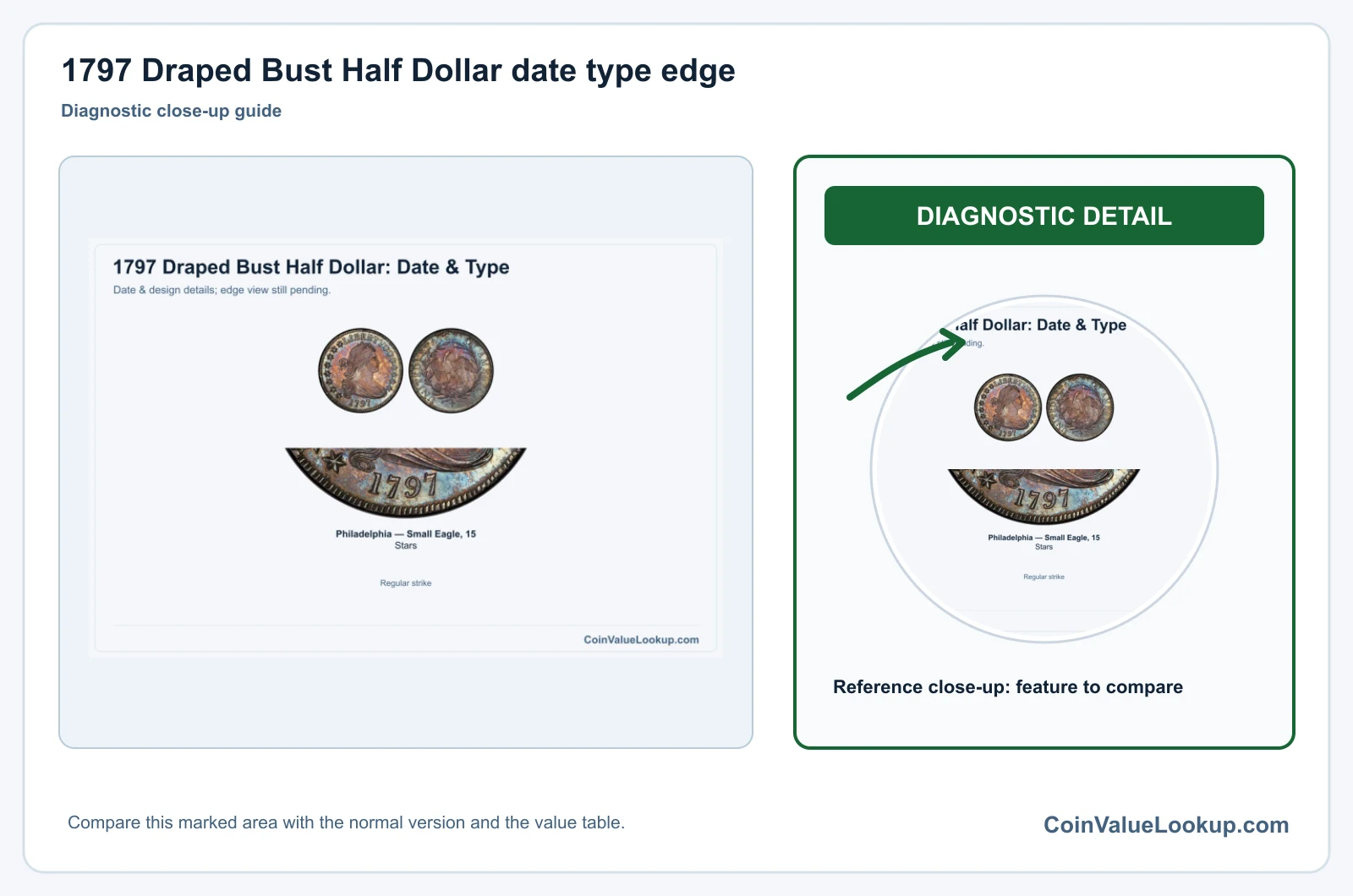
Every 1797 Half Dollar was struck at Philadelphia. There is no mintmark, and the absence of one is completely normal for this issue.
Confirm you actually have a half dollar by checking both sides and the lettered edge, which reads FIFTY CENTS OR HALF A DOLLAR. That edge inscription is your best friend for separating this from other Draped Bust denominations that look similar at a glance.
The expected design is Draped Bust on the obverse paired with a Small Eagle on the reverse. The coin should measure roughly 32.5 mm in diameter and weigh about 13.48 grams.
Weight is a useful screening clue, but it does not authenticate a coin on its own.
The normal 1797 configuration shows fifteen stars around Liberty's portrait. Do not confuse this with the 1796 date, which can appear with either fifteen or sixteen stars.
Prices and rarity differ between dates, so read yours carefully.
Step 2: Check Your 1797 Draped Bust Half Dollar Grade
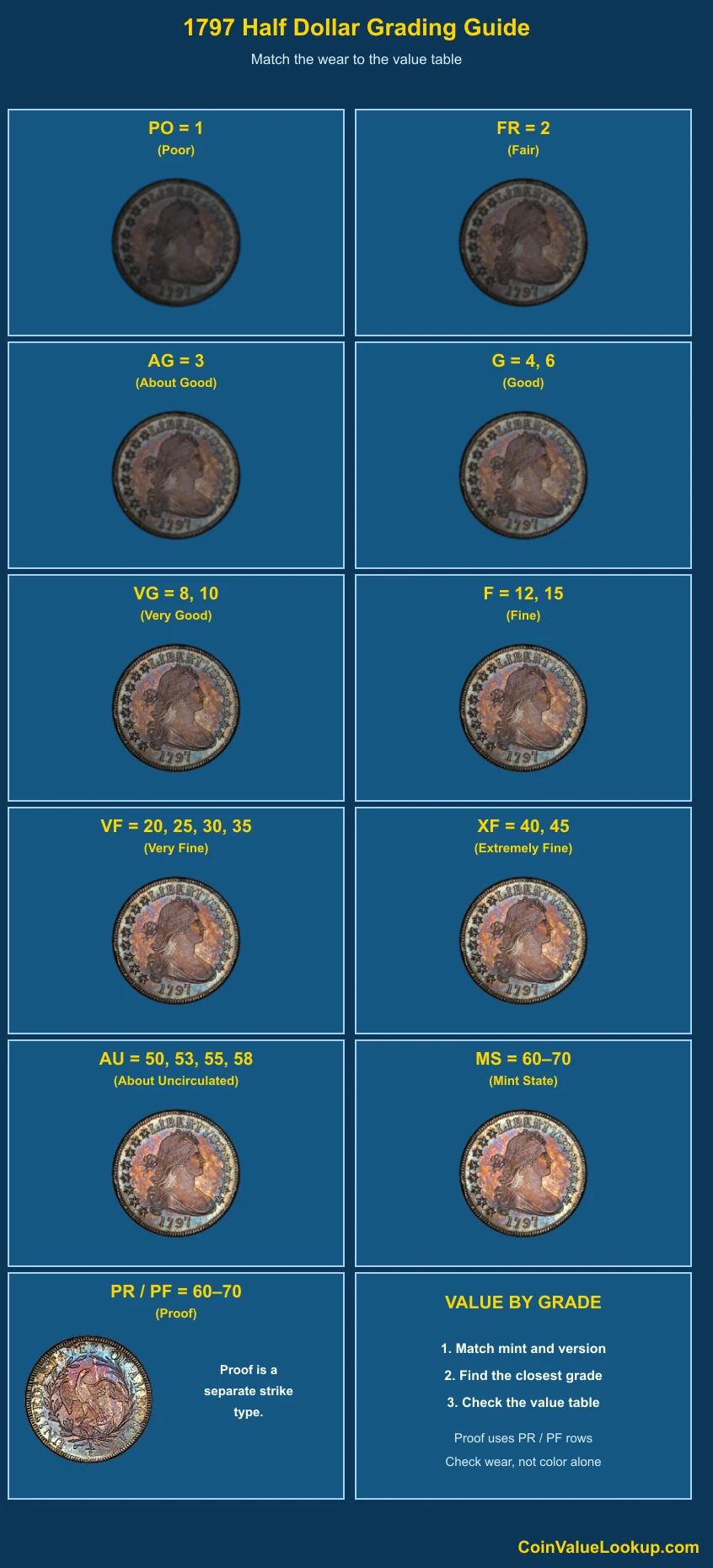
Focus your wear check on Liberty's hair directly above the forehead, her cheek, and the drapery across her shoulder. These are the highest points and the first to lose detail.
Compare against other Draped Bust half dollars, not modern types like the Kennedy.
On the reverse, examine the eagle's breast feathers and wing detail. Some softness in the eagle can be original strike weakness rather than wear.
The key distinction is whether surrounding protected areas still show full luster. If luster is gone uniformly, that points to circulation wear rather than a weak strike.
Look at the comparison image to calibrate your eye for each grade level. Cleaning, holes, plugs, tooling, and heavy scratches place a coin in a "Details" category, which does not follow the same price curve as a straight-graded example.
A cleaned G4 coin is worth meaningfully less than a problem-free G4.
Coin Value Lookup is a good starting point if you want to look up guides for other early American denominations alongside this one.
Step 3: Check 1797 Draped Bust Half Dollar Value by Mint and Version
1797 Draped Bust Half Dollar — Philadelphia — Small Eagle, 15 Stars
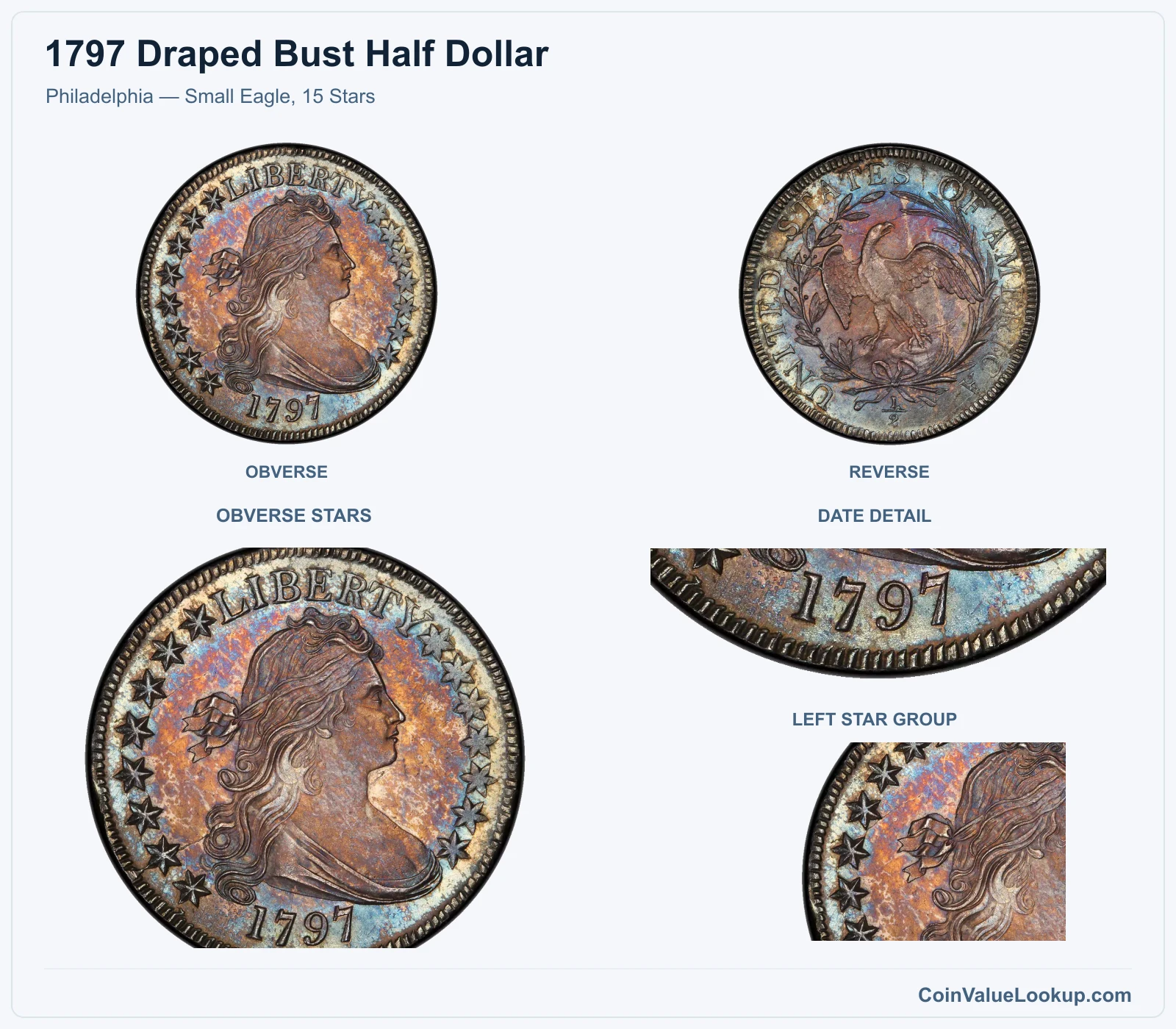
The Philadelphia Small Eagle issue with fifteen stars is the standard — and only — variety for the 1797 Half Dollar. It was struck in a silver-copper alloy at the early federal silver standard of approximately 89% silver.
No mintmark appears, which is correct for all Philadelphia production of this era.
Guide estimates from USA Coin Book place the coin at roughly $46,820 in G4, around $77,974 in VF20, and approximately $201,340 in AU50. Do not apply price data from the 1796 fifteen- or sixteen-star half dollars to this date.
The two years share a design but have distinct survivor populations and market histories.
Range Grade
Price Auction Records Appraisal PO PO 1
—
Coin Identifier FR FR 2
Coin Identifier AG AG 3
Coin Identifier G G 4
Coin Identifier
G 6
Coin Identifier VG VG 8
Coin Identifier
VG 10
Coin Identifier F F 12
Coin Identifier
F 15
Coin Identifier VF VF 20
Coin Identifier
VF 25
Coin Identifier
VF 30
Coin Identifier
VF 35
Coin Identifier XF XF 40
Coin Identifier
XF 45
Coin Identifier AU AU 50
Coin Identifier
AU 53
Coin Identifier
AU 55
Coin Identifier
AU 58
—
Coin Identifier MS MS 60
—
Coin Identifier
MS 61
—
Coin Identifier
MS 62
—
Coin Identifier
MS 63
Coin Identifier
MS 64
—
Coin Identifier
MS 65
—
Coin Identifier
MS 66
Coin Identifier
MS 67
—
—
—
MS 68
—
—
—
MS 69
—
—
—
MS 70
—
—
—
1797 Draped Bust Half Dollar Error List
1. 1797 Draped Bust Half Dollar — Die Crack / Die Chip
Die cracks and die chips are reported for the 1797 Half Dollar. One documented example shows a raised line running from around the second obverse star toward a nearby curl, with additional fractures visible through the wreath on the reverse.
The key diagnostic is that die cracks appear as raised lines on the coin's surface, following the path where the steel die fractured during use.
Do not confuse these with incuse scratches, corrosion lines, or foreign material sitting on the surface. A genuine die crack is raised above the field and follows a consistent path that can often be traced across multiple examples struck from the same die.
Scratches, by contrast, are recessed into the metal.
No specific price premium has been established here. The value impact depends on the crack's visibility, location, and the coin's overall condition.
Dramatic or well-placed cracks on early federal coins can attract specialist interest, but each piece needs individual assessment.