1990 Kennedy Half Dollar Coin Value: How Much Is It Worth?
The 1990 Kennedy half dollar carries a face value of 50 cents, and most circulated clad examples are worth exactly that. Collector guide estimates for well-preserved or proof examples range from about $3.62 to $6.25, depending on the mint, finish and grade.
Before checking any price chart, you need to identify whether your coin is a business strike or a proof, and which mint produced it.
Fast Way to Identify Your 1990 Kennedy Half Dollar
The quickest way to start figuring out what you have is to snap clear photos of both sides of your coin and upload them here for a preliminary identification. Good lighting and a steady hand help.
This step can narrow down the mint, finish and general condition so you know which version to look up next.
1990 Kennedy Half Dollar Value
Upload both sides of your 1990 Kennedy Half Dollar.
Front Obverse
Upload photo
Back Reverse
Upload photo
Which 1990 Kennedy Half Dollar Versions Are Worth Money?
- Check mint and finish first — the San Francisco proof carries a higher guide estimate than either business strike at comparable grades.
- Well-preserved Philadelphia and Denver coins in original, high-grade condition can exceed face value, with guide estimates around $3.62 at MS65.
- Mint-made errors such as clipped planchets, off-center strikes and missing clad layers are reported for this date and can add collector interest beyond face value.
Step 1: Identify Your 1990 Kennedy Half Dollar Mint Mark and Version
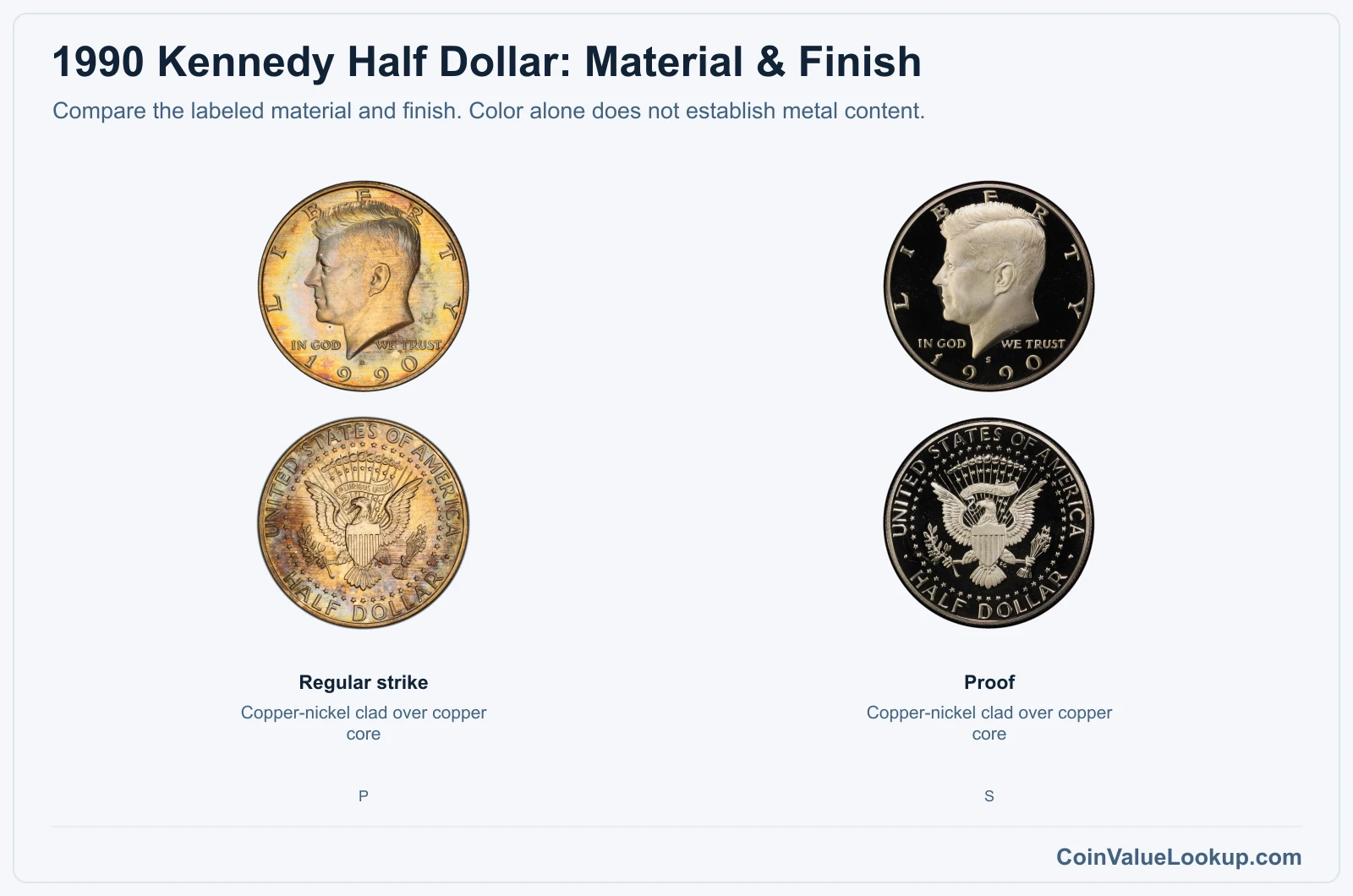
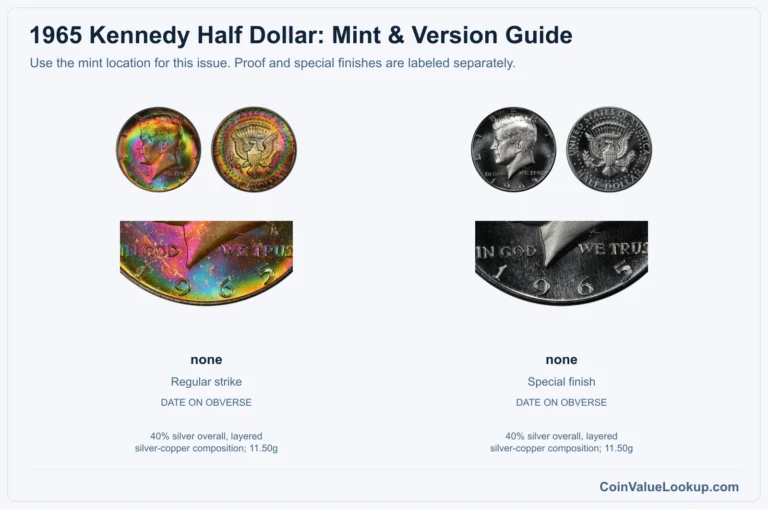
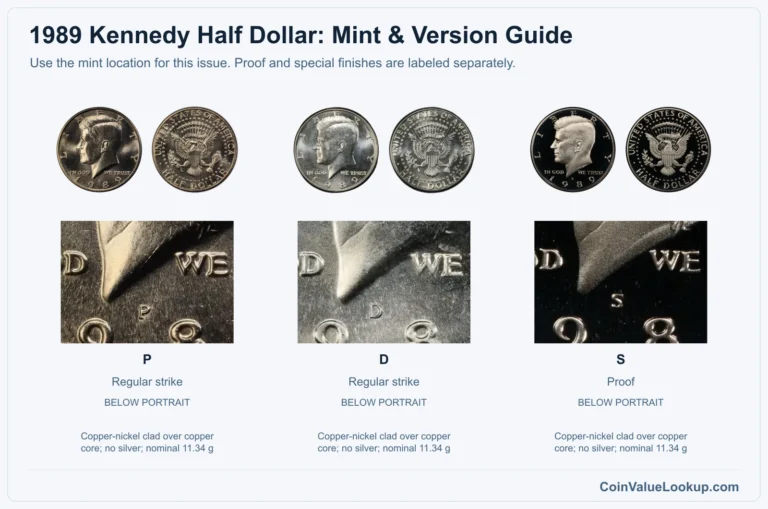
Flip the coin to the obverse and look just below Kennedy's portrait, above the date. That is where the mintmark lives.
A "P" means Philadelphia, "D" means Denver, and "S" means San Francisco. If your coin has no mintmark at all, that is still Philadelphia — the mint did not stamp a P on half dollars until 1980.
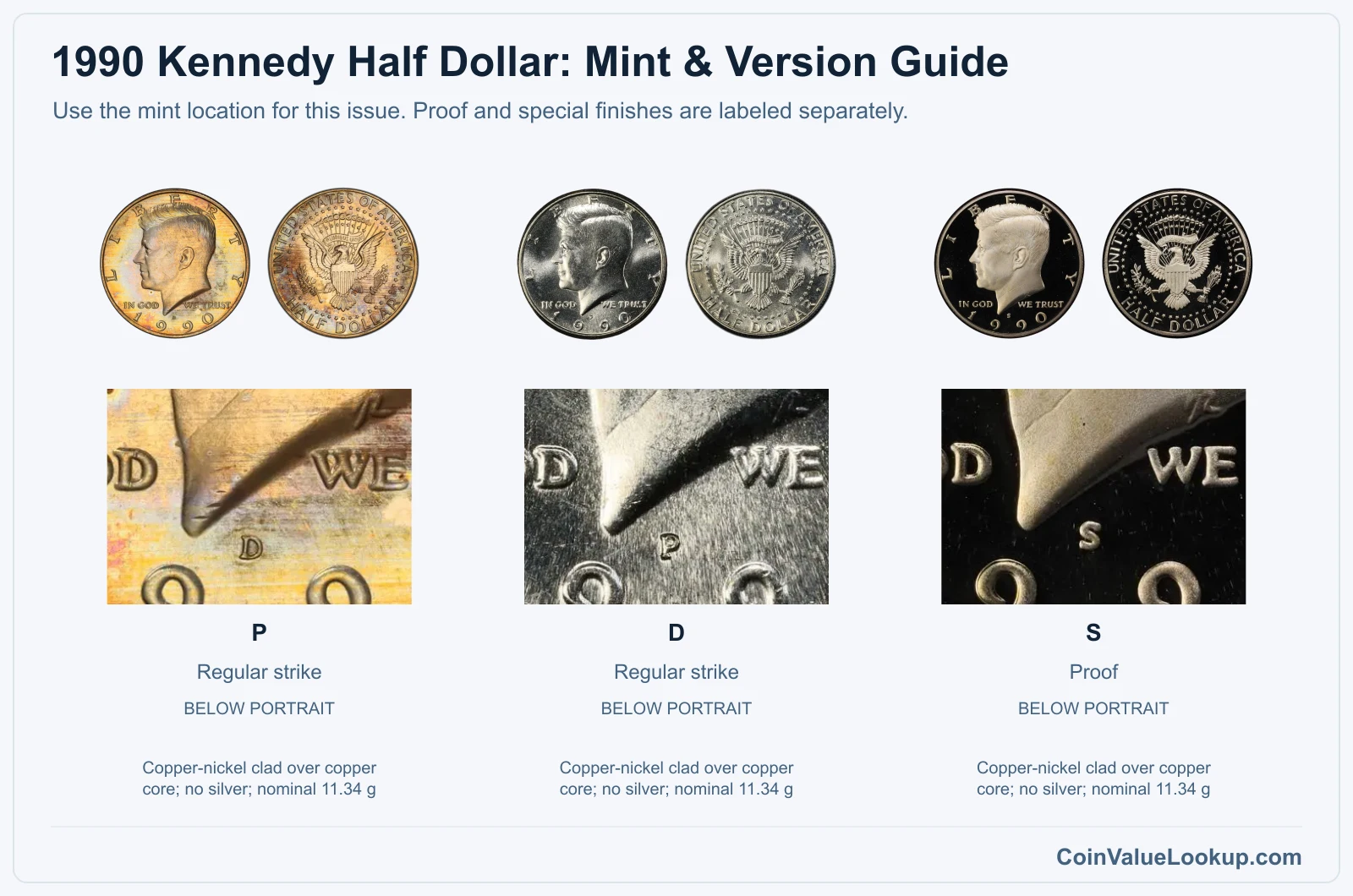
All three 1990 versions are copper-nickel clad. None contain silver.
Do not assume a half dollar is silver just because it looks shiny or has unusual toning — lighting and surface chemistry can fool you.
To confirm composition, check the edge. A clad coin shows a visible copper-colored stripe sandwiched between silvery layers.
If you have a kitchen scale, the nominal weight is about 11.34 grams. Original mint packaging can also confirm a proof versus a business strike.
Step 2: Check Your 1990 Kennedy Half Dollar Grade
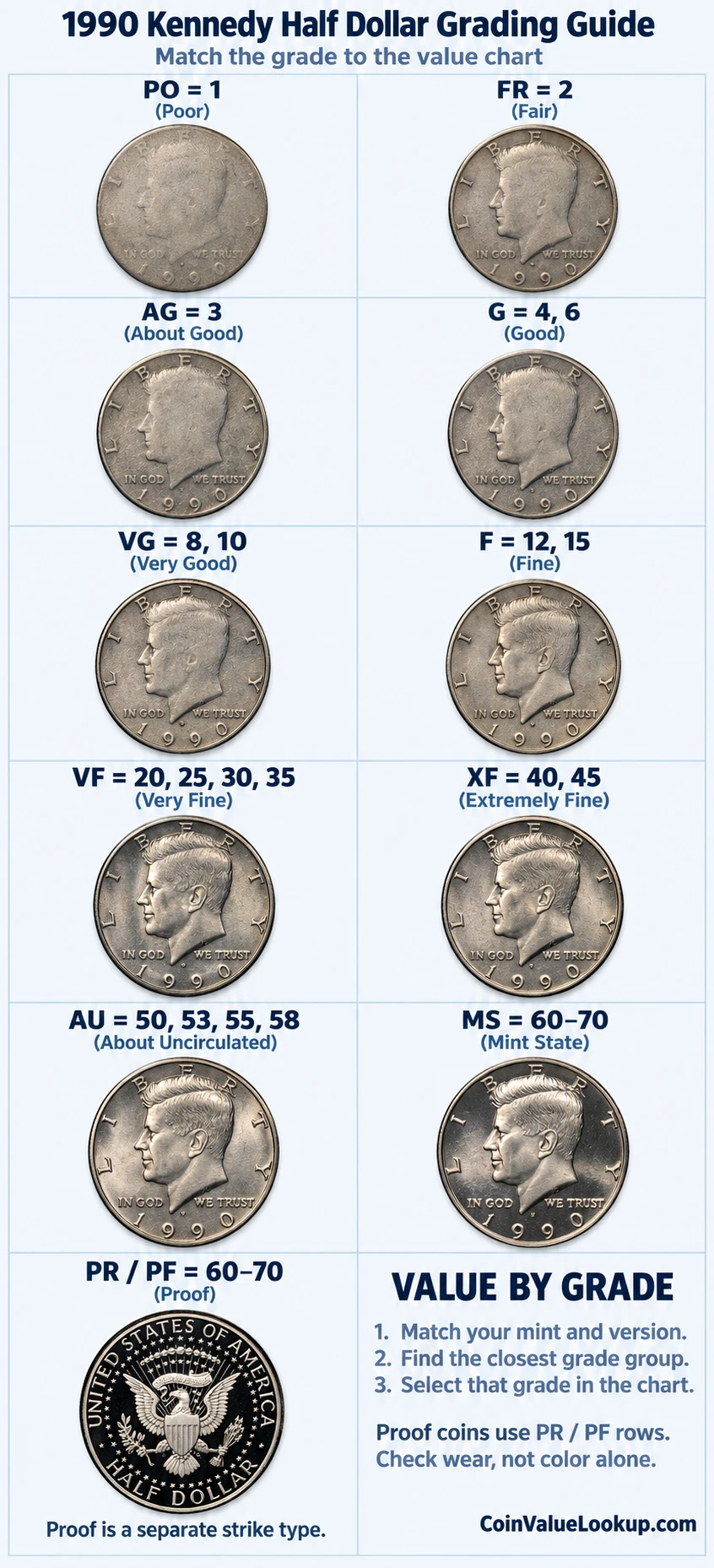
Start by examining Kennedy's cheek, the line of his jaw, and the hair above his ear. Those high points lose detail first.
On the reverse, the eagle's breast feathers and the tops of the wings show wear early. If those areas are fully detailed with original luster, you are likely looking at a Mint State coin.
Bag marks — small nicks from coins banging together in mint bags — can lower a Mint State grade without being actual circulation wear. A coin with perfect design detail but heavy contact marks will grade lower than a clean example.
Proofs are graded on a different scale. Look for hairlines from handling, haze from improper storage, and any contact marks on the mirrored fields.
Use the comparison image to see how these wear patterns progress across grades for the Kennedy series.
Step 3: Check 1990 Kennedy Half Dollar Value by Mint and Version
1990 Kennedy Half Dollar — P — clad business
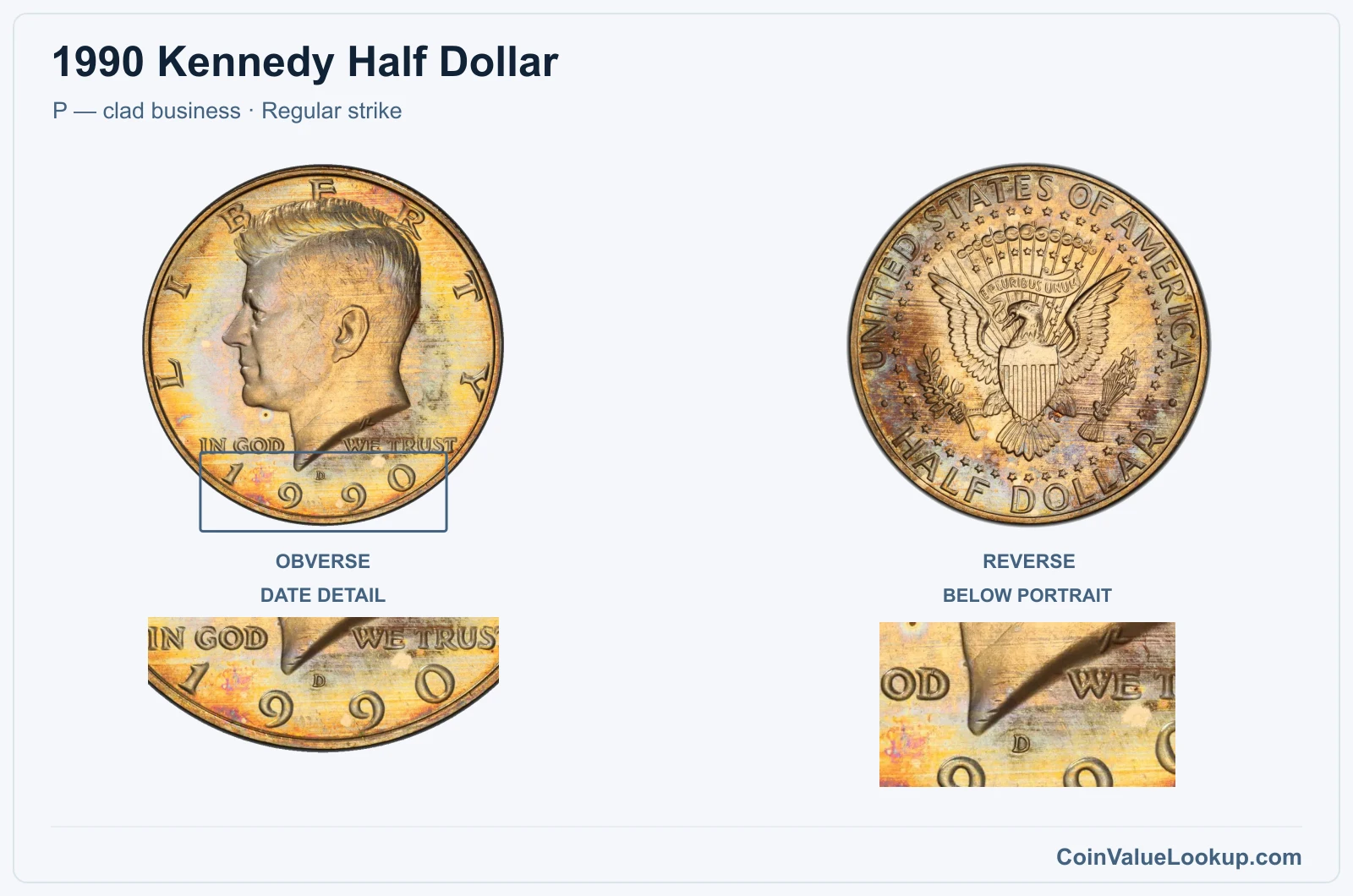
The 1990 Philadelphia half dollar has a "P" mintmark on the obverse, below Kennedy's portrait. It is struck on a copper-nickel clad planchet weighing about 11.34 grams — no silver content here.
Most circulated examples trade at face value. A well-preserved piece graded MS65 carries a USA Coin Book guide estimate of about $3.62.
That is not a guaranteed buy price, just a reference point. Finding one in true MS65 condition means original luster, minimal bag marks and sharp hair detail above the ear.
Range Grade
Price Auction Records Appraisal PO PO 1
—
Coin Identifier FR FR 2
—
Coin Identifier AG AG 3
—
Coin Identifier G G 4
—
Coin Identifier
G 6
—
Coin Identifier VG VG 8
—
Coin Identifier
VG 10
—
Coin Identifier F F 12
—
Coin Identifier
F 15
—
Coin Identifier VF VF 20
—
Coin Identifier
VF 25
—
Coin Identifier
VF 30
—
Coin Identifier
VF 35
—
Coin Identifier XF XF 40
—
Coin Identifier
XF 45
—
Coin Identifier AU AU 50
—
Coin Identifier
AU 53
—
Coin Identifier
AU 55
—
Coin Identifier
AU 58
—
Coin Identifier MS MS 60
—
Coin Identifier
MS 61
—
Coin Identifier
MS 62
—
Coin Identifier
MS 63
—
Coin Identifier
MS 64
Coin Identifier
MS 65
—
Coin Identifier
MS 66
Coin Identifier
MS 67
Coin Identifier
MS 68
—
—
—
MS 69
—
—
—
MS 70
—
—
—
1990 Kennedy Half Dollar — D — clad business
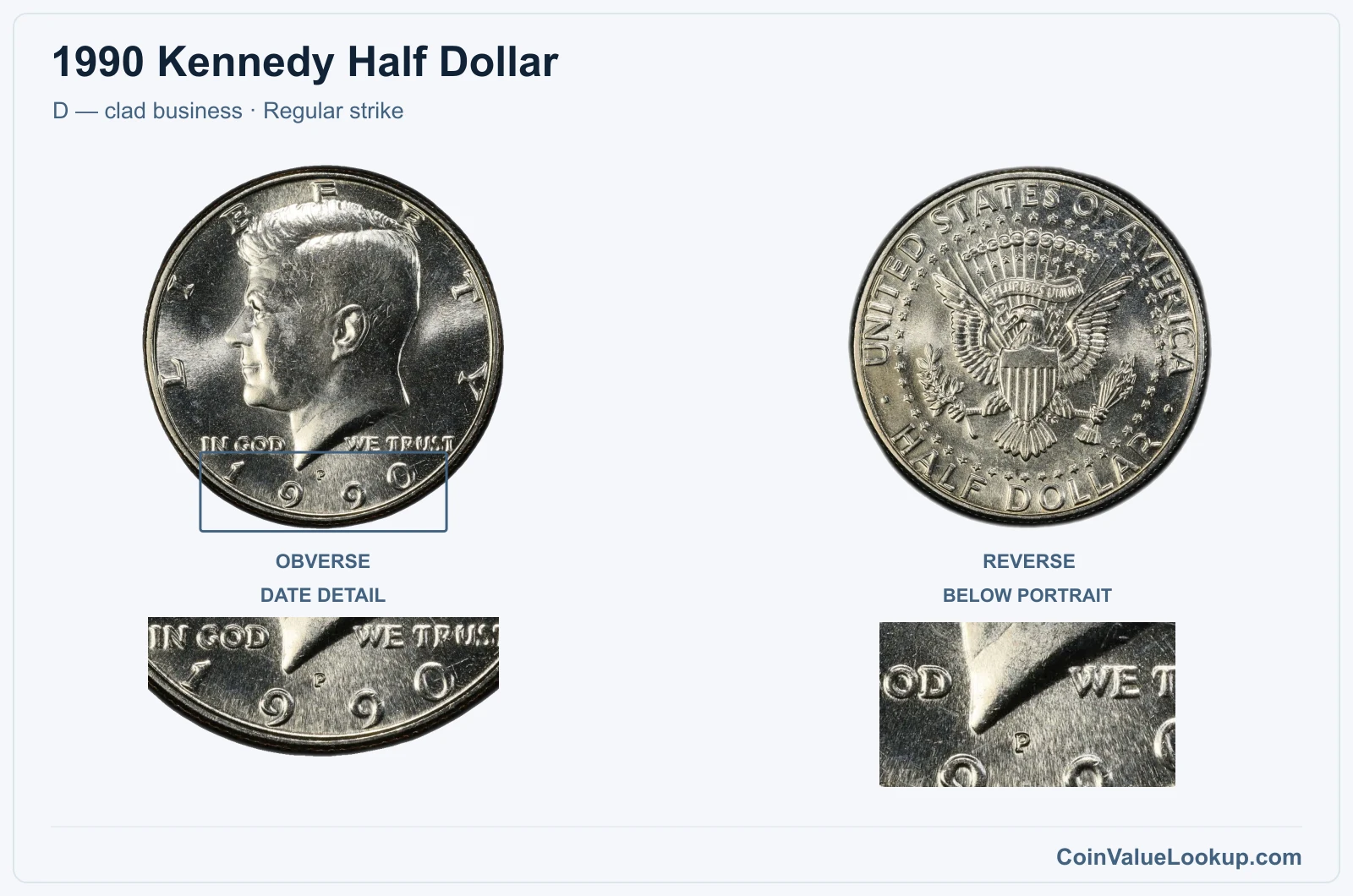
The Denver version is identified by a "D" mintmark in the same location beneath Kennedy's portrait. Same clad composition, same weight, same design.
Like its Philadelphia sibling, a worn 1990-D is a face-value coin. The USA Coin Book guide estimate at MS65 is approximately $3.62.
Pulling one from circulation in that grade would be unusual after three decades of handling, so check rolls and original bank-wrapped sets if you are hunting for a nice one.
Coin Value Lookup is a good starting point if you want to look up values for other dates and mints in the Kennedy half dollar series.
Range Grade
Price Auction Records Appraisal PO PO 1
—
Coin Identifier FR FR 2
—
Coin Identifier AG AG 3
—
Coin Identifier G G 4
—
Coin Identifier
G 6
—
Coin Identifier VG VG 8
—
Coin Identifier
VG 10
—
Coin Identifier F F 12
—
Coin Identifier
F 15
—
Coin Identifier VF VF 20
—
Coin Identifier
VF 25
—
Coin Identifier
VF 30
—
Coin Identifier
VF 35
—
Coin Identifier XF XF 40
—
Coin Identifier
XF 45
—
Coin Identifier AU AU 50
—
Coin Identifier
AU 53
—
Coin Identifier
AU 55
—
Coin Identifier
AU 58
—
Coin Identifier MS MS 60
—
Coin Identifier
MS 61
Coin Identifier
MS 62
Coin Identifier
MS 63
—
Coin Identifier
MS 64
Coin Identifier
MS 65
Coin Identifier
MS 66
Coin Identifier
MS 67
Coin Identifier
MS 68
—
—
—
MS 69
—
—
—
MS 70
—
—
—
1990 Kennedy Half Dollar — S — clad proof
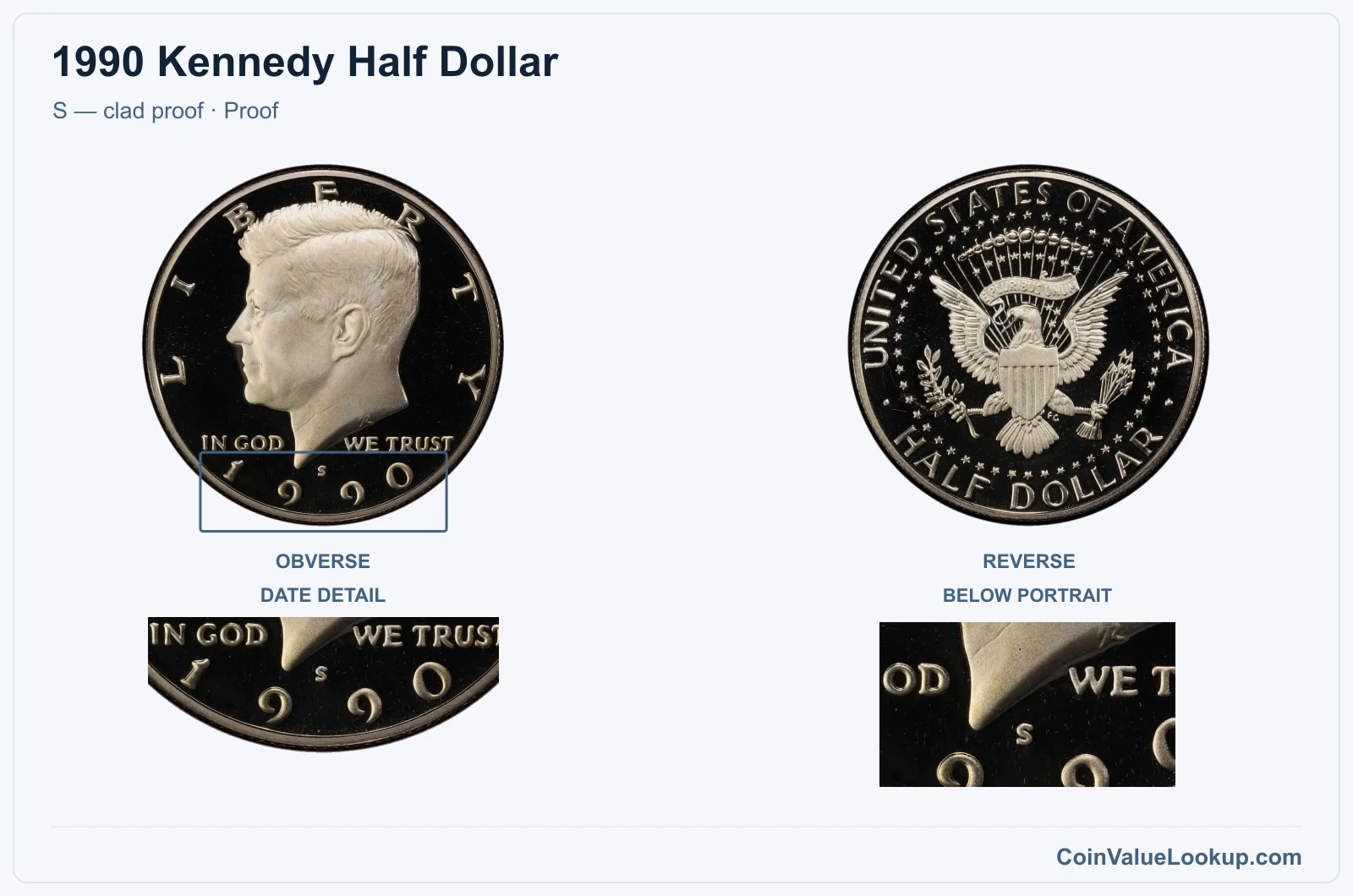
The 1990-S is a clad proof struck at San Francisco. Look for the "S" mintmark, mirror-like fields and frosted raised devices — that contrast between flat reflective surfaces and textured design elements is the hallmark of a proof finish.
This coin was sold in annual proof sets, not released into circulation. The USA Coin Book guide estimate at PR65 is about $6.25, the highest listed guide value among the three 1990 versions.
Grade depends heavily on whether the original owner handled it carefully; hairlines and haze from improper storage are the usual enemies of proof surfaces.
Range Grade
Price Auction Records Appraisal PR PR 1
—
Coin Identifier
PR 2
—
Coin Identifier
PR 3
—
Coin Identifier
PR 4
—
Coin Identifier
PR 6
—
Coin Identifier
PR 8
—
Coin Identifier
PR 10
—
Coin Identifier
PR 12
—
Coin Identifier
PR 15
—
Coin Identifier
PR 20
—
Coin Identifier
PR 25
—
Coin Identifier
PR 30
—
Coin Identifier
PR 35
—
Coin Identifier
PR 40
—
Coin Identifier
PR 45
—
Coin Identifier
PR 50
—
Coin Identifier
PR 53
—
Coin Identifier
PR 55
—
Coin Identifier
PR 58
—
Coin Identifier
PR 60
—
Coin Identifier
PR 61
—
Coin Identifier
PR 62
—
Coin Identifier
PR 63
—
Coin Identifier
PR 64
—
Coin Identifier
PR 65
—
Coin Identifier
PR 66
—
Coin Identifier
PR 67
—
Coin Identifier
PR 68
Coin Identifier
PR 69
Coin Identifier
PR 70
Coin Identifier
1990 Kennedy Half Dollar Error List
1. 1990 Kennedy Half Dollar — Clipped Planchet
A clipped planchet error occurs when part of the metal blank is missing before the coin is struck. On a 1990 half dollar, look for a curved, straight or ragged absence along the edge where metal was never present.
The design near the clip often shows weakness because the incomplete blank could not fill the die fully.
Compare the edge texture at the clip to the normal reeded edge elsewhere. A genuine clip typically shows metal flow consistent with striking.
A filed notch, post-mint cut or corrosion damage will look different — rougher, with no corresponding design weakness on the opposite side. No specific price range is available for this error; value depends on the size and visibility of the clip, overall condition and collector demand.
2. 1990 Kennedy Half Dollar — Off-Center Strike
An off-center strike happens when the planchet is not seated properly between the dies, leaving part of the coin blank while the design shifts to one side. On a 1990 half dollar, you will see a crescent-shaped unstruck area and the visible design displaced from center.
The date should still be readable for the error to carry strong collector appeal. Compare this to a clipped planchet, which removes metal from the blank before striking, or a coin that was simply flattened unevenly after leaving the mint.
Post-mint damage usually lacks the clean unstruck crescent and consistent design displacement. No adopted price range is available; value depends on the percentage off-center, whether the date is visible, and the coin's overall condition.
3. 1990 Kennedy Half Dollar — Missing FG Initials
The initials "FG" for reverse designer Frank Gasparro normally appear near the eagle's tail feathers on the reverse. On a reported Missing FG error, those initials are absent or nearly invisible due to die polishing at the mint that removed the shallow letters from the working die.
To check, compare your coin's reverse to a normal 1990 half dollar, focusing on the area around the eagle's right leg. The surrounding design details should still be relatively sharp if the cause is die polishing rather than simple wear.
Wear from circulation, grease fill during striking, or deliberate removal after minting can all make the initials disappear too. Those lookalikes are not mint errors.
No specific price data is available for this variety; value depends on how clearly the initials are missing and the coin's overall grade.
4. 1990 Kennedy Half Dollar — Broadstrike
A broadstruck coin was struck without the retaining collar that normally constrains the planchet and forms the reeded edge. The result is a half dollar that spreads outward, appearing slightly larger than normal with a smooth or distorted edge instead of clean reeding.
The entire design is still present and roughly centered — that is what separates a broadstrike from an off-center strike, where part of the design is missing. Also check that the coin was not simply flattened after minting; post-mint damage usually distorts the design unevenly and lacks the consistent outward metal spread of a genuine broadstrike.
Certified examples have been reported for the 1990 date. No adopted price range is available; value depends on how dramatic the spread is and the coin's condition.
5. 1990 Kennedy Half Dollar — Missing Clad Layer
A missing clad layer error means one of the outer copper-nickel layers was absent from the planchet before striking. The affected side may show the exposed copper core, giving it a distinctly different color — often a warm brownish or reddish tone compared to the normal silvery surface.
Weigh the coin if possible. A normal 1990 half dollar is about 11.34 grams; a missing clad layer will weigh noticeably less.
Also examine the edge, where the layer structure should look abnormal compared to the usual sandwich of outer and inner metals.
Toning, environmental damage, plating and deliberate surface removal can all mimic this error's appearance. If only the color looks off but the weight and edge are normal, it is probably not a genuine missing clad layer.
No specific price data is available; value varies with the extent of the missing layer and the coin's overall preservation.
6. 1990 Kennedy Half Dollar — Double / Multiple Strike
A double-struck coin received two or more impressions from the dies, with the second strike landing in a different position or rotation than the first. On a 1990 half dollar, look for two distinct sets of design elements — separate outlines of Kennedy's portrait or the eagle, displaced from each other.
This is different from a doubled die, where the doubling is on the die itself and appears identical on every coin struck from it. A double strike affects only one coin and usually produces dramatic, obvious displacement rather than subtle doubling on lettering.
Also watch for post-mint impressions caused by vise jaws or other mechanical damage, which can press a design into the coin's surface after it left the mint. Those typically look flatter and lack the full relief of a genuine second strike.
No adopted price is available; value depends on the degree of displacement and the coin's condition.