2001 Kennedy Half Dollar Coin Value: How Much Is It Worth?
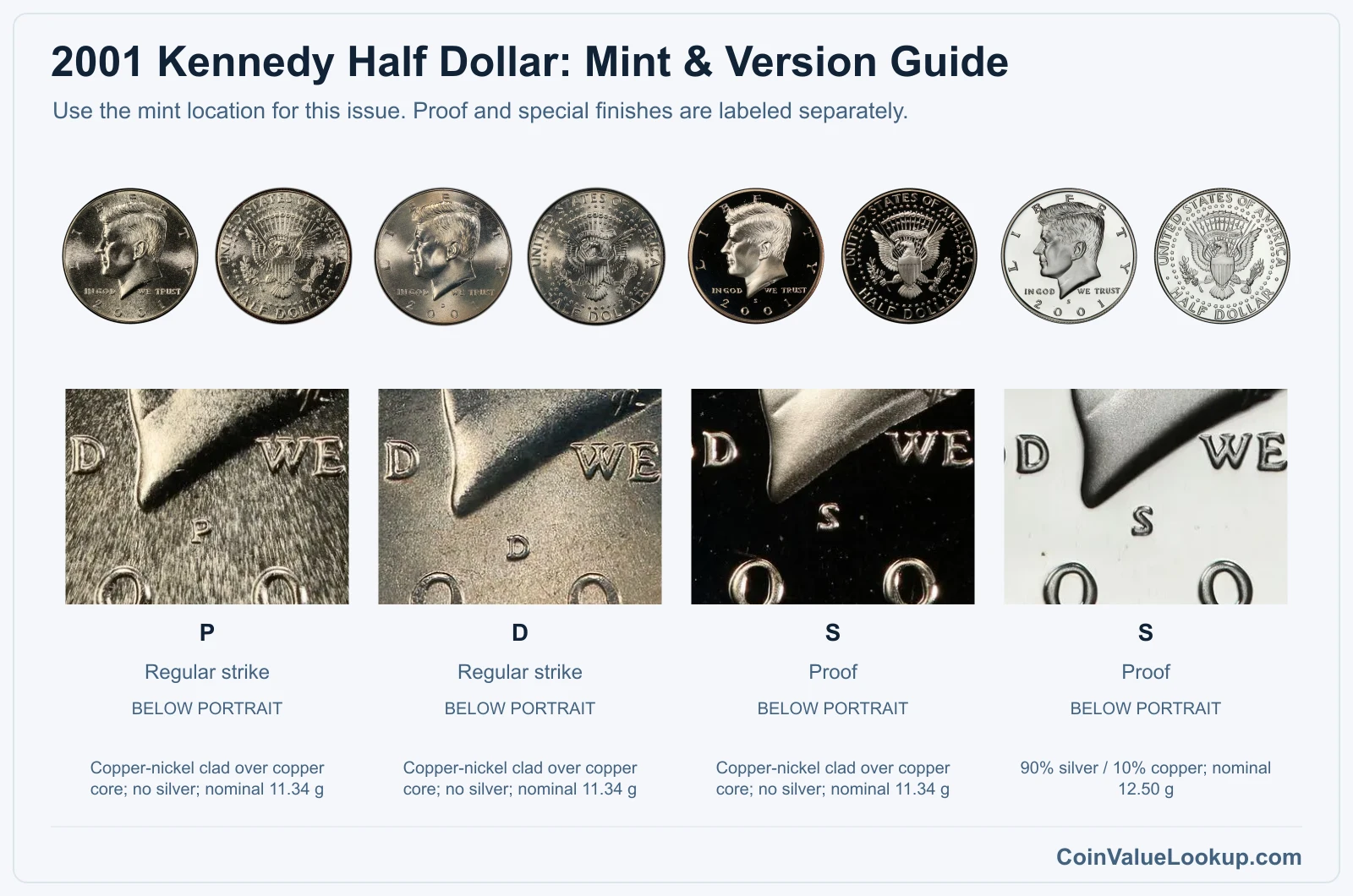
The 2001 Kennedy half dollar carries a face value of fifty cents, and most circulated clad examples are worth exactly that. Collector guide estimates for specific mint marks and finishes range from about $3.62 in Mint State 65 for business strikes up to $36.00 for the silver proof in PR65, according to USA Coin Book.
Before checking any price chart, you need to identify your coin's mint, finish and composition, because those details determine which branch — and which value — actually applies.
Fast Way to Identify Your 2001 Kennedy Half Dollar
The quickest way to start is to snap a clear photo of both sides of your coin and upload them here. A preliminary identification can help you figure out the mint mark, finish type and general condition so you know which version you are working with.
Good lighting and a steady hand make a big difference.
2001 Kennedy Half Dollar Value
Upload both sides of your 2001 Kennedy Half Dollar.
Front Obverse
Upload photo
Back Reverse
Upload photo
Which 2001 Kennedy Half Dollar Versions Are Worth Money?
- The 2001-S silver proof, composed of 90% silver, carries the highest listed guide value at $36.00 in PR65 — check weight and edge to confirm it is not the clad proof.
- Clad proof (S mint) is a step above face value at about $7.29 in PR65 but must be distinguished from the silver version.
- High-grade uncirculated P or D business strikes in MS65 condition list around $3.62 — most circulated examples are only worth face value.
- Mint-made errors such as off-center strikes, doubled dies and broadstrikes have been reported for this date and can carry a premium depending on severity and condition.
Step 1: Identify Your 2001 Kennedy Half Dollar Mint Mark and Version
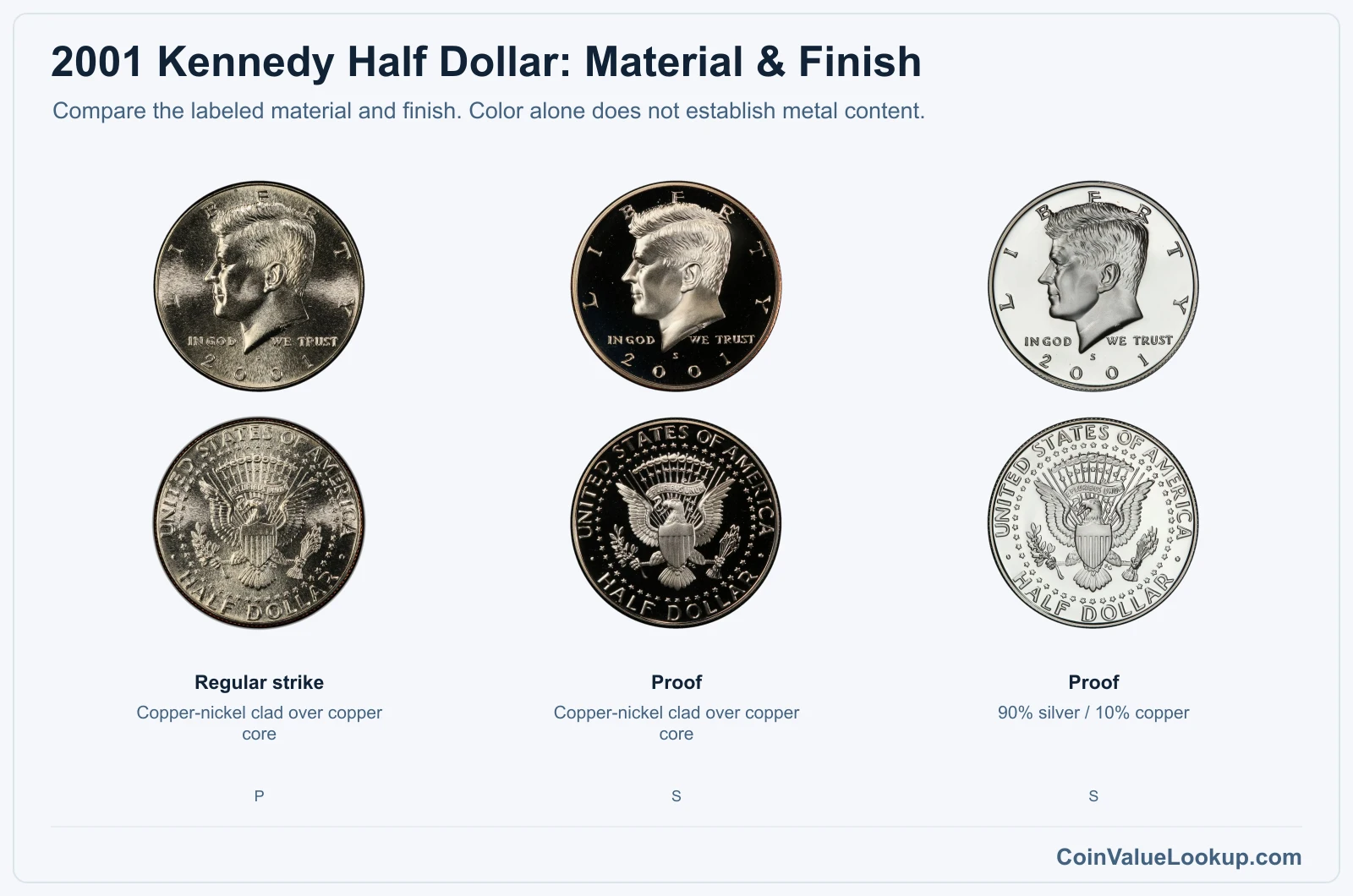
Flip your coin to the obverse and look just beneath Kennedy's portrait, above the date. That is where the mint mark lives.
A "P" means Philadelphia, "D" means Denver, and "S" means San Francisco. Before 1980, Philadelphia coins carried no mint mark at all, but by 2001 the P was standard.
All P and D strikes for this year are copper-nickel clad over a copper core, weighing about 11.34 grams. The S mint mark appears on two different coins: a clad proof and a 90% silver proof.
Both say "S," so the mark alone does not tell you which one you have.
To separate clad from silver, compare weight and edge appearance. The silver proof should weigh roughly 12.50 grams.
A clad coin's edge often shows a visible copper stripe; a silver coin's edge is uniformly silver-toned. Original government packaging can also confirm the composition.
Do not assume a coin is silver just because it looks bright or has deep mirror fields. Lighting, toning and even old cleaning can mimic the look of a different alloy.
Step 2: Check Your 2001 Kennedy Half Dollar Grade
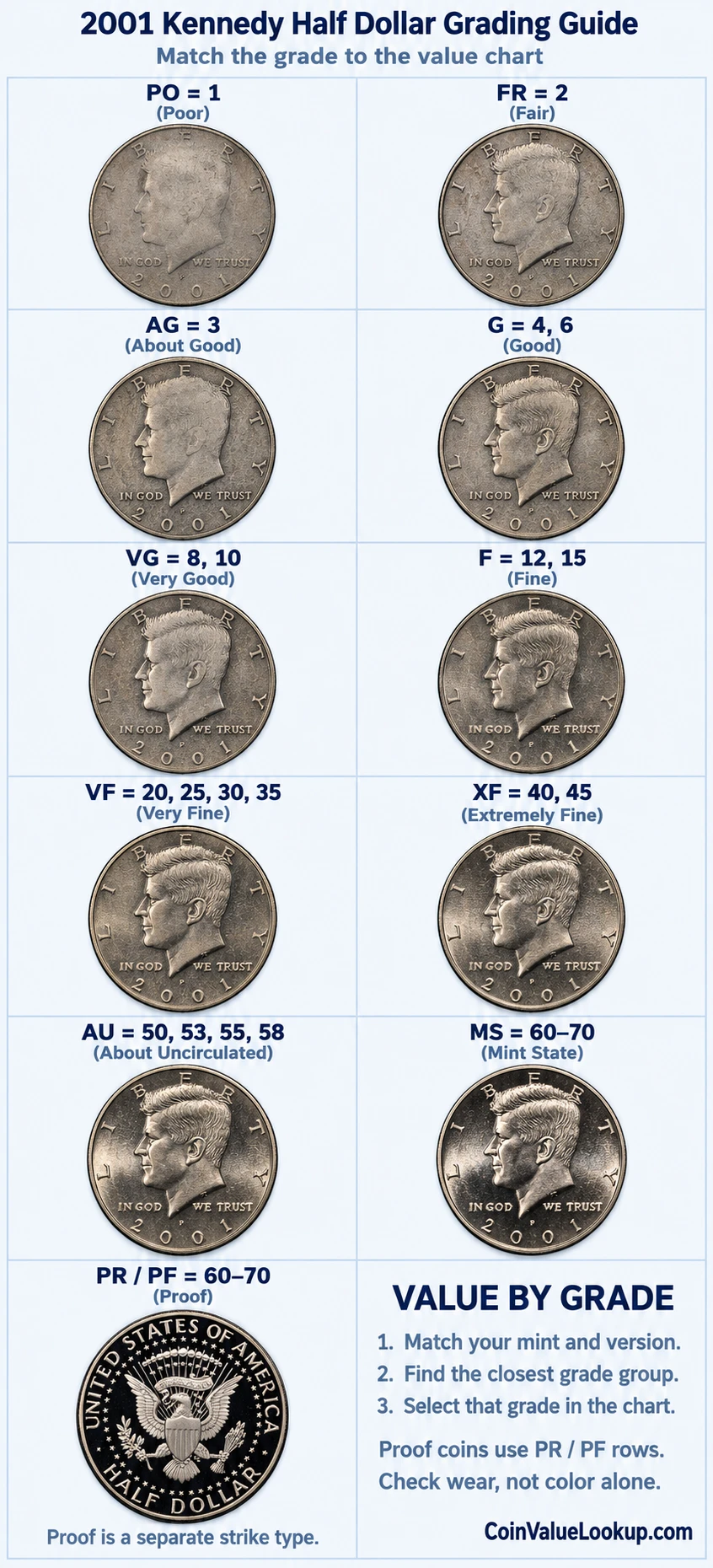
Start with Kennedy's cheek and jawline on the obverse. Circulated coins lose detail there first — the high point flattens out and the skin texture disappears.
Next, check the hair above and behind the ear; on a well-worn coin those strands merge into a smooth blob.
On the reverse, the eagle's breast feathers and wing tips show wear early. If those areas are mushy but the rest looks sharp, you are probably in the VF-to-AU range.
Mint State coins can still look rough. Bag marks — small nicks and scuffs from contact with other coins during storage — drag down the grade without being circulation wear.
A coin covered in tiny hits across the cheek may technically be uncirculated but still grade below MS65.
Proofs get their own grading scale. Look for hairlines from improper handling, haze from humidity exposure, and contact marks on the mirror fields.
Use the comparison image to match your coin against known grade examples of the same type.
Step 3: Check 2001 Kennedy Half Dollar Value by Mint and Version
2001 Kennedy Half Dollar — P — clad business
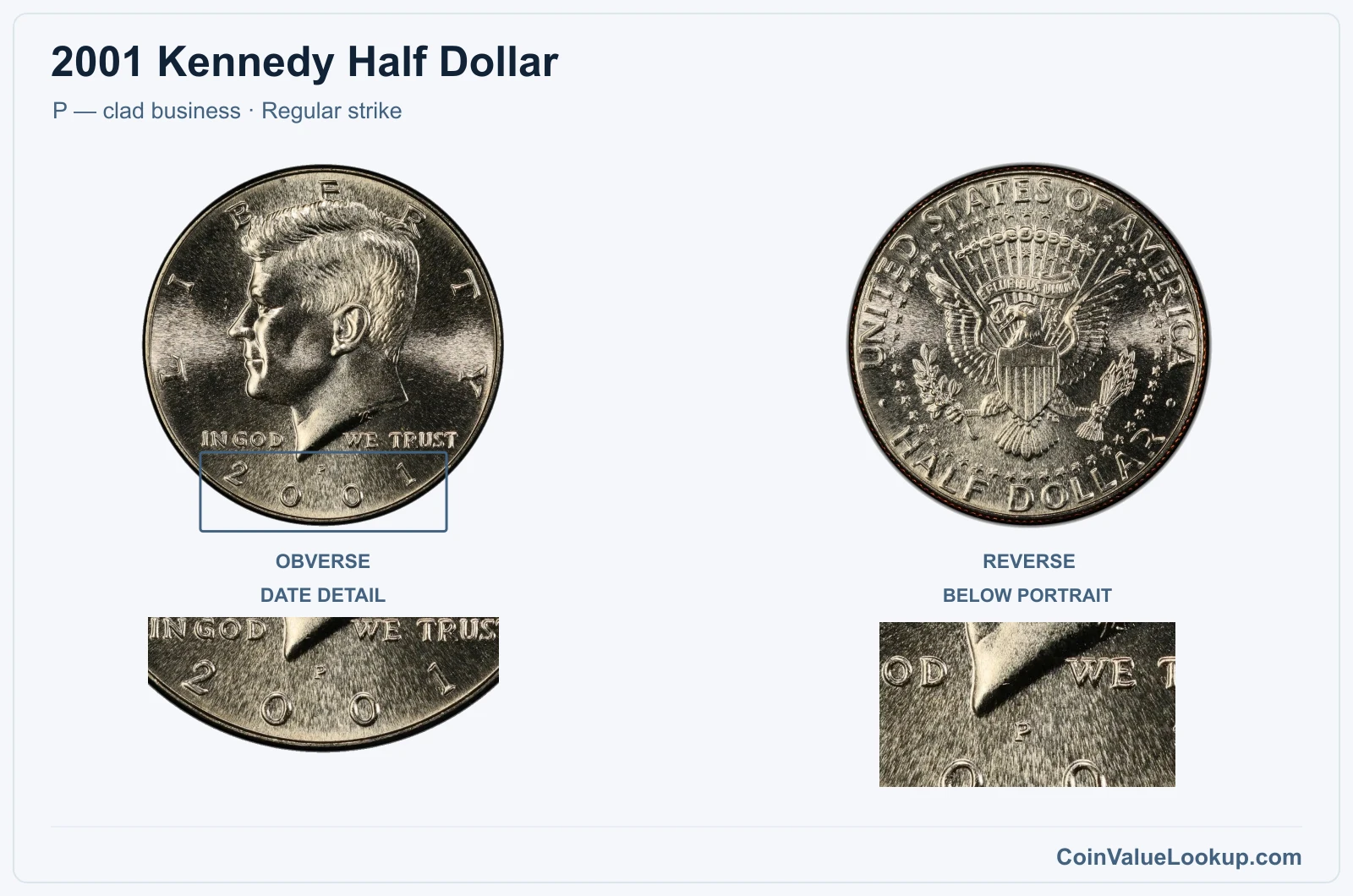
The 2001-P is a standard Philadelphia business strike in copper-nickel clad, weighing about 11.34 grams. Look for the small "P" mint mark beneath Kennedy's portrait.
Millions were produced, and any example that saw actual circulation is almost certainly a face-value coin.
In higher grades the picture changes a little. A USA Coin Book guide estimate puts a MS65 example at roughly $3.62.
That is not a fortune, but it does mean a truly clean, well-struck roll coin is worth pulling aside. Check the cheek and hair for bag marks before getting excited.
Range Grade
Price Auction Records Appraisal PO PO 1
—
Coin Identifier FR FR 2
—
Coin Identifier AG AG 3
—
Coin Identifier G G 4
—
Coin Identifier
G 6
—
Coin Identifier VG VG 8
—
Coin Identifier
VG 10
—
Coin Identifier F F 12
—
Coin Identifier
F 15
—
Coin Identifier VF VF 20
—
Coin Identifier
VF 25
—
Coin Identifier
VF 30
—
Coin Identifier
VF 35
—
Coin Identifier XF XF 40
—
Coin Identifier
XF 45
—
Coin Identifier AU AU 50
—
Coin Identifier
AU 53
—
Coin Identifier
AU 55
—
Coin Identifier
AU 58
—
Coin Identifier MS MS 60
—
Coin Identifier
MS 61
—
Coin Identifier
MS 62
—
Coin Identifier
MS 63
Coin Identifier
MS 64
—
Coin Identifier
MS 65
—
Coin Identifier
MS 66
Coin Identifier
MS 67
Coin Identifier
MS 68
Coin Identifier
MS 69
—
Coin Identifier
MS 70
—
—
—
2001 Kennedy Half Dollar — D — clad business
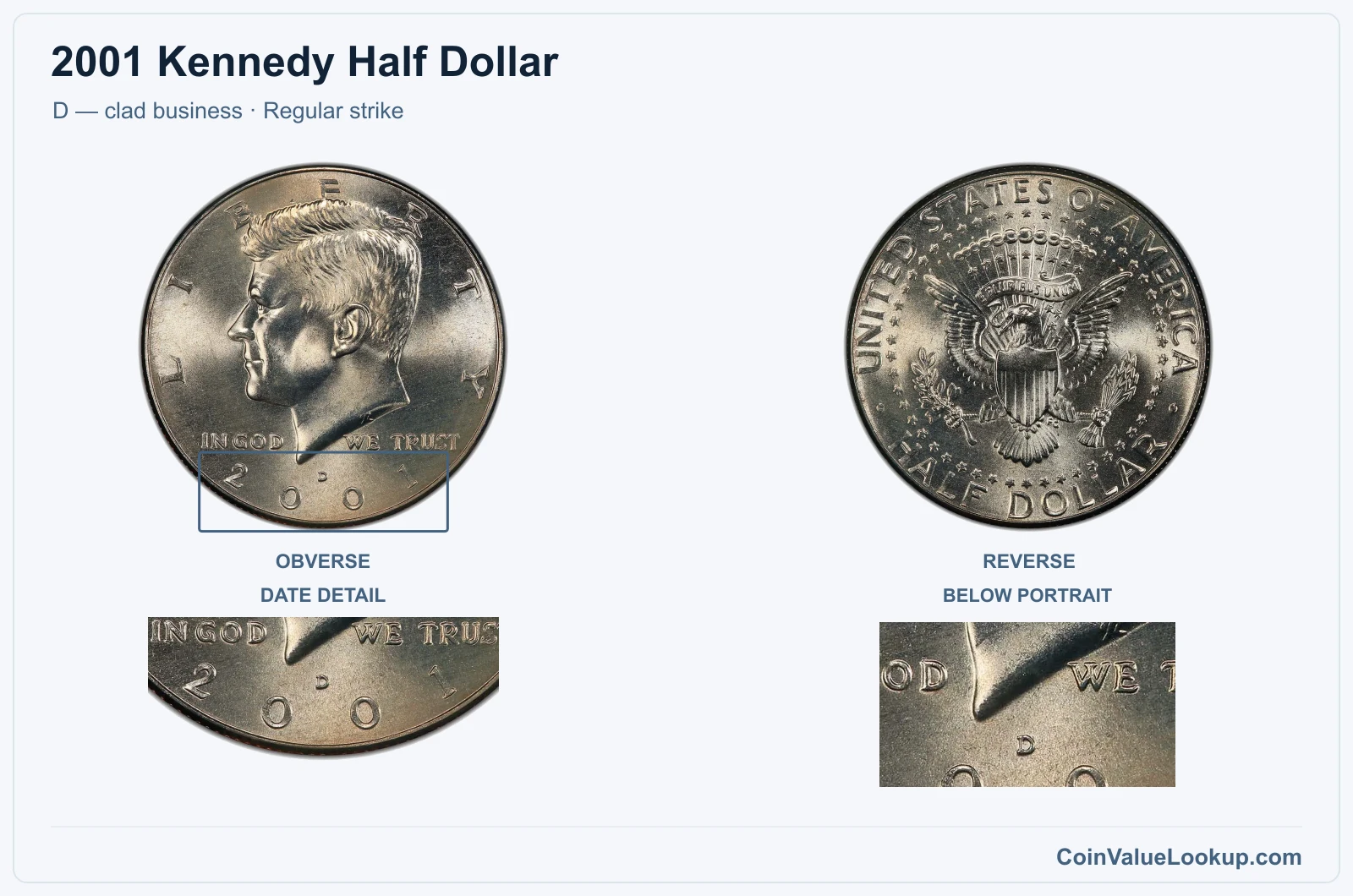
Denver's 2001-D Kennedy half is the same copper-nickel clad composition and weight as the Philadelphia version, about 11.34 grams. The "D" mint mark sits in the same spot beneath Kennedy's portrait.
Value-wise, it tracks the P strike closely. The USA Coin Book guide estimate lists MS65 at $3.62.
Worn examples are face-value coins. If you find one in original mint-set packaging with clean surfaces, that is your best shot at the higher end.
Loose pocket coins are not going to get you there.
Coin Value Lookup is a good starting point if you want to look up guides for other Kennedy half dollar dates or denominations while you are sorting through a collection.
Range Grade
Price Auction Records Appraisal PO PO 1
—
Coin Identifier FR FR 2
—
Coin Identifier AG AG 3
—
Coin Identifier G G 4
—
Coin Identifier
G 6
—
Coin Identifier VG VG 8
—
Coin Identifier
VG 10
—
Coin Identifier F F 12
—
Coin Identifier
F 15
—
Coin Identifier VF VF 20
—
Coin Identifier
VF 25
—
Coin Identifier
VF 30
—
Coin Identifier
VF 35
—
Coin Identifier XF XF 40
—
Coin Identifier
XF 45
—
Coin Identifier AU AU 50
—
Coin Identifier
AU 53
—
Coin Identifier
AU 55
—
Coin Identifier
AU 58
—
Coin Identifier MS MS 60
—
Coin Identifier
MS 61
—
Coin Identifier
MS 62
—
Coin Identifier
MS 63
—
Coin Identifier
MS 64
—
Coin Identifier
MS 65
Coin Identifier
MS 66
Coin Identifier
MS 67
Coin Identifier
MS 68
Coin Identifier
MS 69
—
—
—
MS 70
—
—
—
2001 Kennedy Half Dollar — S — clad proof
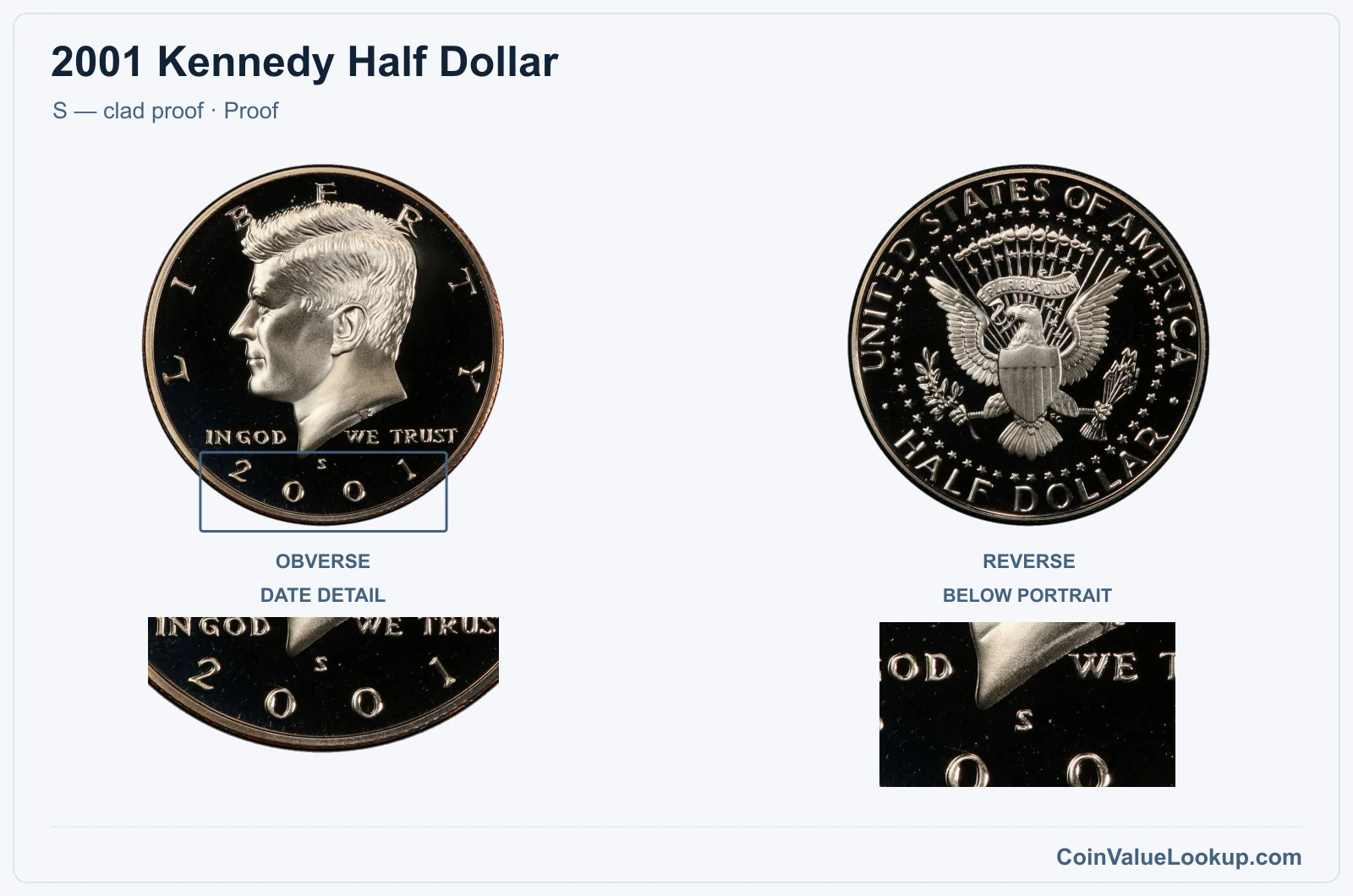
The 2001-S clad proof was struck at San Francisco on copper-nickel clad planchets, same 11.34-gram weight as business strikes. Proof finish means mirror-like fields with frosted raised devices — it is a manufacturing method, not a higher grade.
USA Coin Book lists a PR65 at about $7.29. That is modest, but proofs in original government packaging with no hairlines or haze hold up better over time.
Examine the flat fields under a single directed light source; that is where handling damage shows most clearly.
Do not confuse this with the silver proof just because both carry an S mint mark. Weight and edge color are your friends here.
Range Grade
Price Auction Records Appraisal PR PR 1
—
Coin Identifier
PR 2
—
Coin Identifier
PR 3
—
Coin Identifier
PR 4
—
Coin Identifier
PR 6
—
Coin Identifier
PR 8
—
Coin Identifier
PR 10
—
Coin Identifier
PR 12
—
Coin Identifier
PR 15
—
Coin Identifier
PR 20
—
Coin Identifier
PR 25
—
Coin Identifier
PR 30
—
Coin Identifier
PR 35
—
Coin Identifier
PR 40
—
Coin Identifier
PR 45
—
Coin Identifier
PR 50
—
Coin Identifier
PR 53
—
Coin Identifier
PR 55
—
Coin Identifier
PR 58
—
Coin Identifier
PR 60
—
Coin Identifier
PR 61
—
Coin Identifier
PR 62
—
Coin Identifier
PR 63
—
Coin Identifier
PR 64
—
Coin Identifier
PR 65
—
Coin Identifier
PR 66
—
Coin Identifier
PR 67
Coin Identifier
PR 68
Coin Identifier
PR 69
Coin Identifier
PR 70
Coin Identifier
2001 Kennedy Half Dollar — S — silver proof
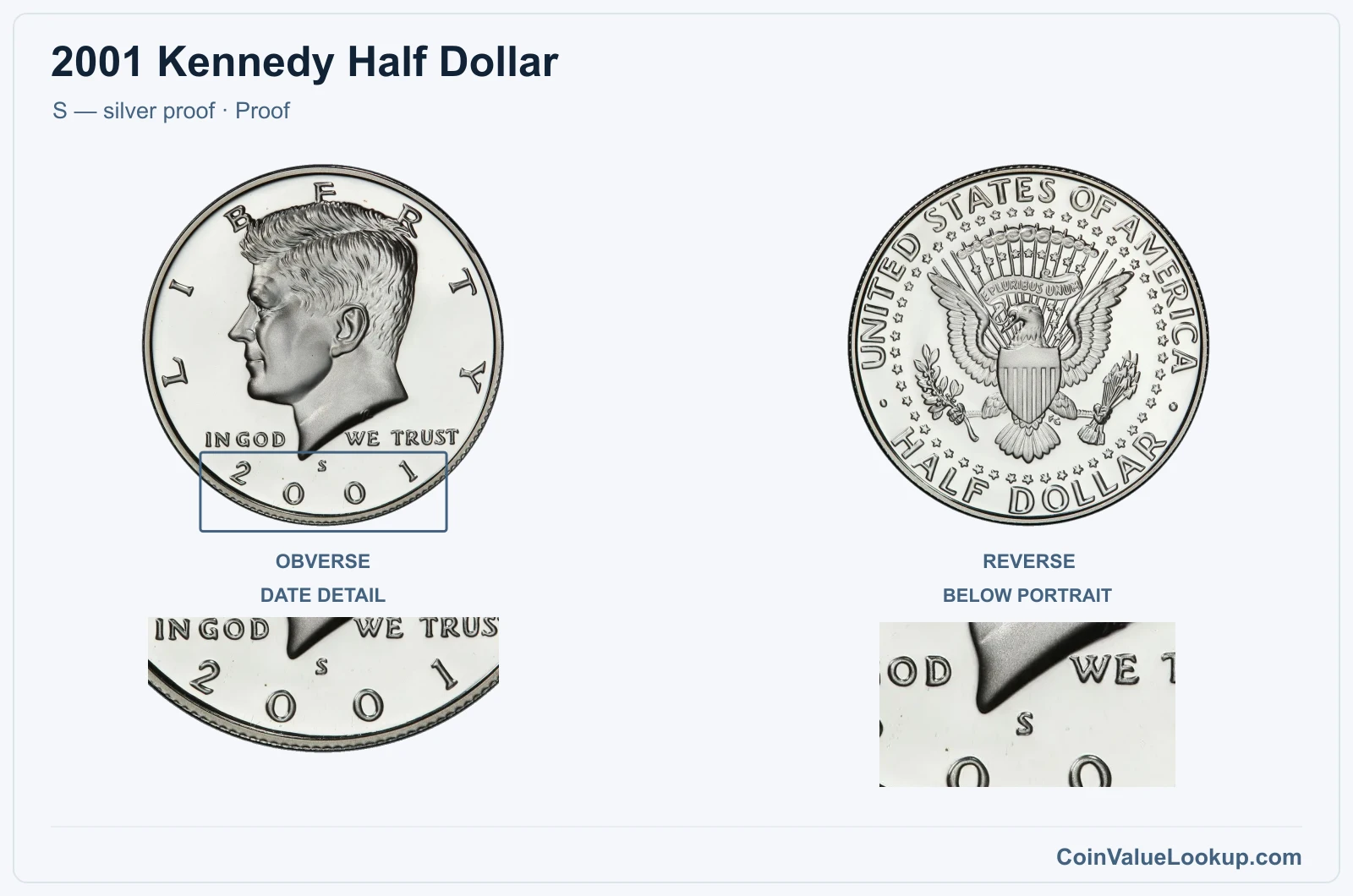
This is the one collectors actually care about. The 2001-S silver proof is struck on a 90% silver, 10% copper planchet weighing approximately 12.50 grams.
That is a full gram heavier than the clad version, and the edge should be uniformly silver-colored with no copper stripe.
USA Coin Book's guide estimate places a PR65 at $36.00. The silver content alone gives it a floor value, and a well-preserved example in original packaging commands the most interest.
Both S-mint proofs share the same mint mark, so you cannot tell them apart by looking at the mark. Weigh the coin on a digital scale accurate to at least 0.1 grams.
If you see 12.4–12.5 grams, silver. Around 11.3 grams, clad.
Packaging and the original Certificate of Authenticity also help confirm composition.
Range Grade
Price Auction Records Appraisal PR PR 1
—
Coin Identifier
PR 2
—
Coin Identifier
PR 3
—
Coin Identifier
PR 4
—
Coin Identifier
PR 6
—
Coin Identifier
PR 8
—
Coin Identifier
PR 10
—
Coin Identifier
PR 12
—
Coin Identifier
PR 15
—
Coin Identifier
PR 20
—
Coin Identifier
PR 25
—
Coin Identifier
PR 30
—
Coin Identifier
PR 35
—
Coin Identifier
PR 40
—
Coin Identifier
PR 45
—
Coin Identifier
PR 50
—
Coin Identifier
PR 53
—
Coin Identifier
PR 55
—
Coin Identifier
PR 58
—
Coin Identifier
PR 60
—
Coin Identifier
PR 61
—
Coin Identifier
PR 62
—
Coin Identifier
PR 63
—
Coin Identifier
PR 64
—
Coin Identifier
PR 65
—
Coin Identifier
PR 66
—
Coin Identifier
PR 67
Coin Identifier
PR 68
Coin Identifier
PR 69
Coin Identifier
PR 70
Coin Identifier
2001 Kennedy Half Dollar Error List
1. 2001 Kennedy Half Dollar — Off-Center Strike
An off-center strike happens when the planchet is not seated properly in the collar before the dies come together. The result is a crescent-shaped blank area on one side and a shifted design on the other.
The date and mint mark should still be visible for the coin to be most collectible.
Severity matters. A 5% off-center shift is barely noticeable; 20% or more with a full date is where interest really picks up.
Condition and the percentage of displacement both affect value, so no single price fits every example.
Do not confuse an off-center strike with a clipped planchet, which removes a curved bite from the edge, or with post-mint damage from a vise or hammer. A genuine off-center coin has properly struck detail on the portion that did receive the impression — the unstruck crescent is smooth, original planchet surface.
2. 2001 Kennedy Half Dollar — Doubled Die Obverse
A doubled die obverse on the 2001 Kennedy half shows consistent doubling in the obverse design elements — lettering, date or portrait details. The key word is consistent: every example struck from that die shows the same doubling in the same location.
To check, compare your coin's obverse lettering and design contours against a known normal example under the same lighting. Look for separation, notching or a shelf-like extra thickness on letter edges.
A loupe of at least 5x helps.
Machine doubling is the common lookalike. It produces a flat, shelf-like distortion without the raised, rounded profile of a true doubled die.
Reflections and worn die contours can also mimic doubling under certain angles. Value depends on the strength and visibility of the doubling as well as overall coin condition.
3. 2001 Kennedy Half Dollar — Doubled Die Reverse
A doubled die reverse is the same concept applied to the back of the coin. On the 2001 Kennedy half, check reverse legends like UNITED STATES OF AMERICA and E PLURIBUS UNUM, plus the eagle's design contours, for consistent doubled impressions.
Compare closely against a normal reverse under magnification. True hub doubling shows raised, rounded extra lines or notching that repeats on every coin from that die.
It is not random — the doubling has a specific direction and location.
Machine doubling again is the main impostor. It tends to look flat and shelf-like rather than raised and rounded.
Random post-strike damage, scratches, and lighting tricks also fool people. Condition and the clarity of the doubling both influence what a particular example might bring.
4. 2001 Kennedy Half Dollar — Broadstrike
A broadstrike occurs when the coin is struck without the retaining collar that normally forms the rim and edge. The result is a coin that spreads outward, appearing slightly larger than normal with a weak or missing rim.
The full design is present, just expanded.
Check the edge profile carefully. A genuine broadstrike has no reeding and the metal flows freely past the normal diameter.
The design should still be relatively well-centered — if it is both spread and shifted, you may have an off-center broadstrike combination.
Post-mint flattening from machinery or deliberate squashing produces a similar spread look, but the detail will be mushier and the surfaces may show contact evidence. Value depends on how dramatic the spread is and overall condition of the coin.