1844 Liberty Seated Half Dollar Coin Value: How Much Is It Worth?
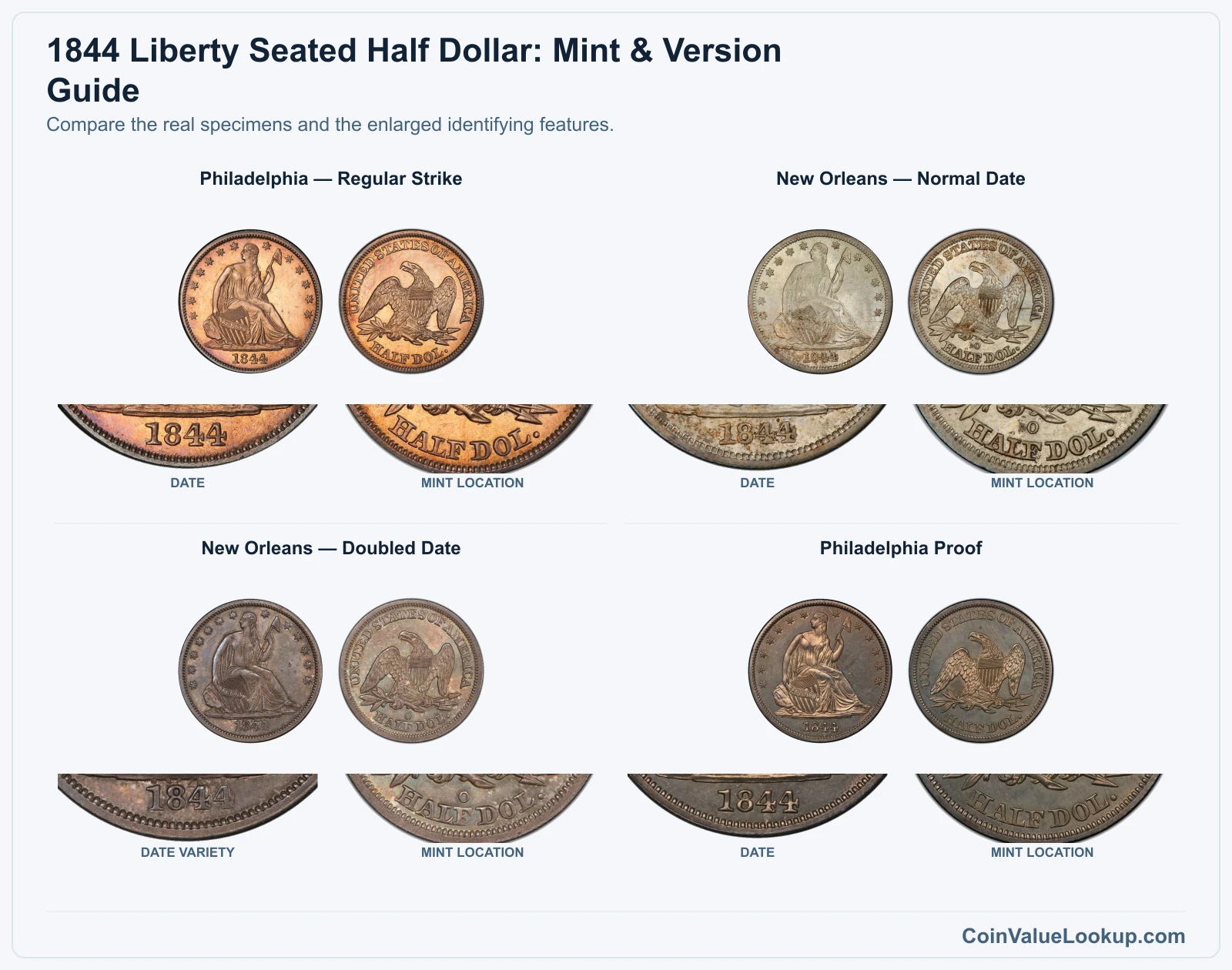
The 1844 Liberty Seated Half Dollar is a collectible silver coin struck at Philadelphia and New Orleans. Ordinary circulated examples start around $80 at G4 and climb to roughly $576 near AU50, depending on mint and condition.
However, the rare Doubled Date variety from New Orleans and scarce Proof strikes occupy a completely different price tier, so identifying your exact version matters.
Fast Way to Identify Your 1844 Liberty Seated Half Dollar
The quickest way to start figuring out what you have is to upload clear photos of both sides of your coin. That lets us run a preliminary identification on the mint, version and general condition.
Snap the front (Liberty seated) and back (eagle with HALF DOL.) in even lighting, and avoid casting shadows over the date or mintmark area.
1844 Liberty Seated Half Dollar Value
Upload both sides of your 1844 Liberty Seated Half Dollar.
Front Obverse
Upload photo
Back Reverse
Upload photo
Which 1844 Liberty Seated Half Dollar Versions Are Worth Money?
- New Orleans Doubled Date — Guide values jump from $810 at G4 to $6,848 at AU50 because the visibly misplaced first date punch is a recognized major variety.
- Philadelphia Proof — A PR62 example sold for $22,913 at a Legend auction in May 2021; these are extremely rare presentation-quality strikes.
- New Orleans Normal Date in high grades — At AU50 the guide lists $576, so well-preserved examples with original surfaces carry a meaningful premium over worn pieces.
- Philadelphia Regular Strike — Even ordinary coins range from $80 at G4 to $576 at AU50 in guide estimates, reflecting the silver content and series demand.
Step 1: Identify Your 1844 Liberty Seated Half Dollar Mint Mark and Version
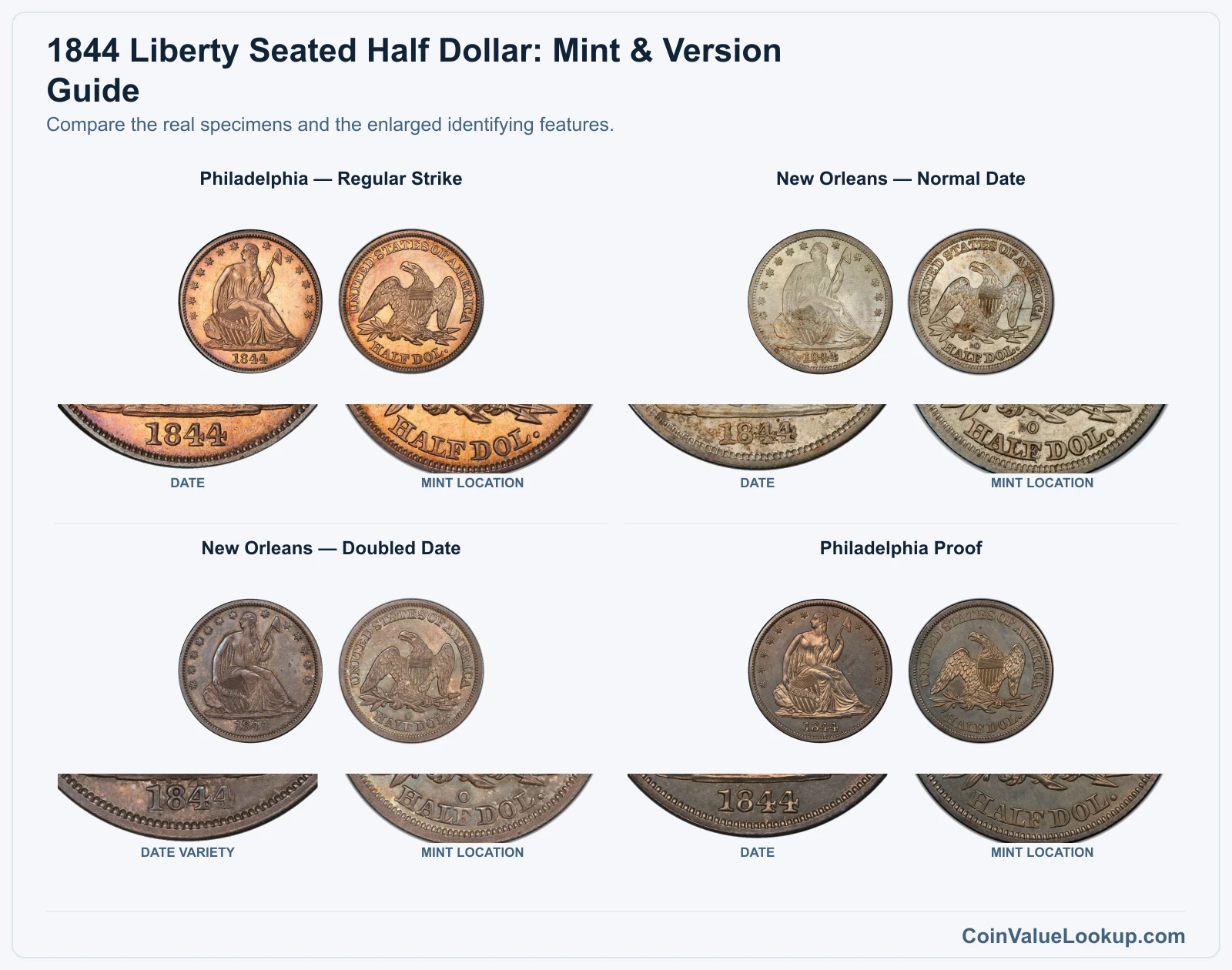
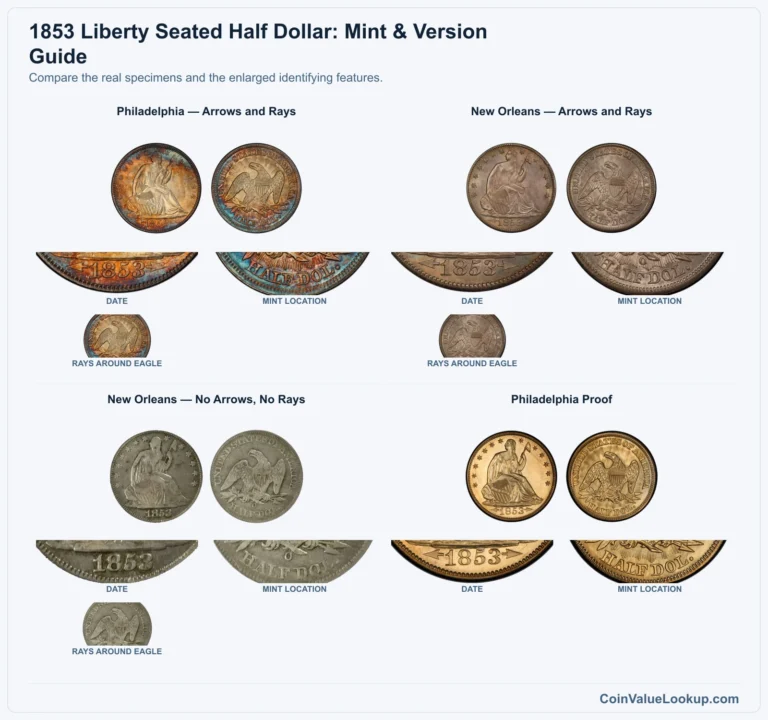
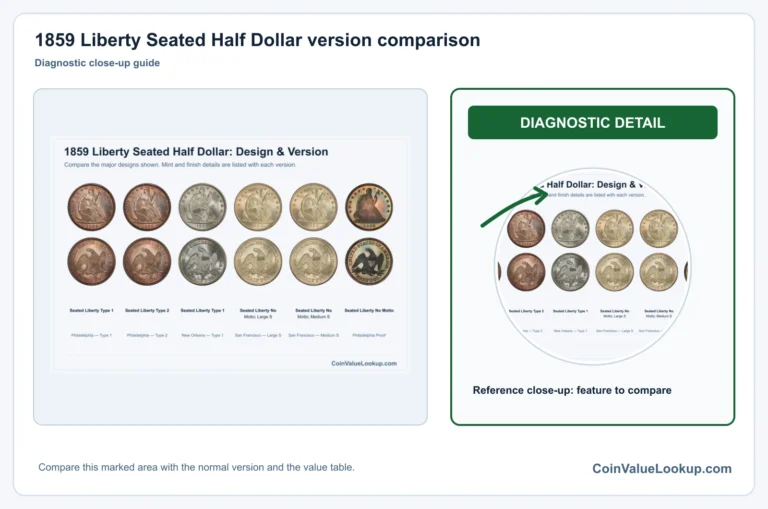
The 1844 half dollar features the Seated Liberty design on the obverse and a heraldic eagle with HALF DOL. on the reverse.
This is the No Motto type, meaning there is no IN GOD WE TRUST banner above the eagle.
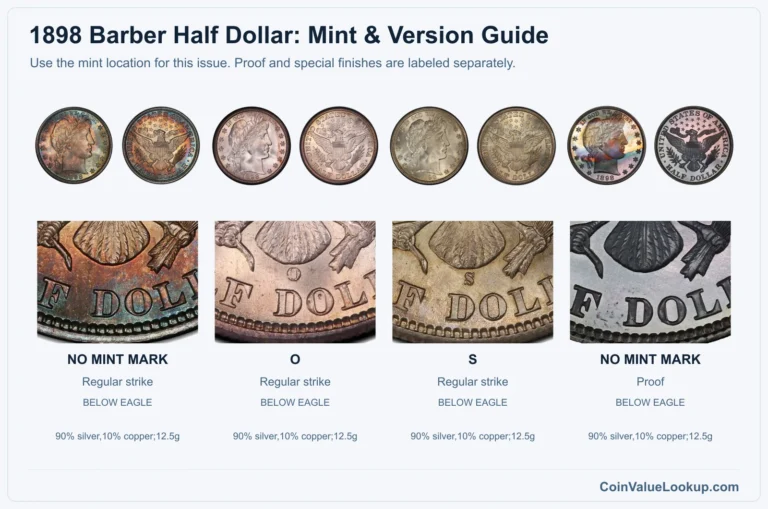
Philadelphia coins carry no mintmark at all. New Orleans coins show a small O on the reverse, below the eagle.
Check that spot carefully under magnification.
The coin is 90% silver and 10% copper, with a nominal weight of 13.36 grams and a reeded edge. A bright surface does not mean high purity or proof status; many cleaned coins look shiny.
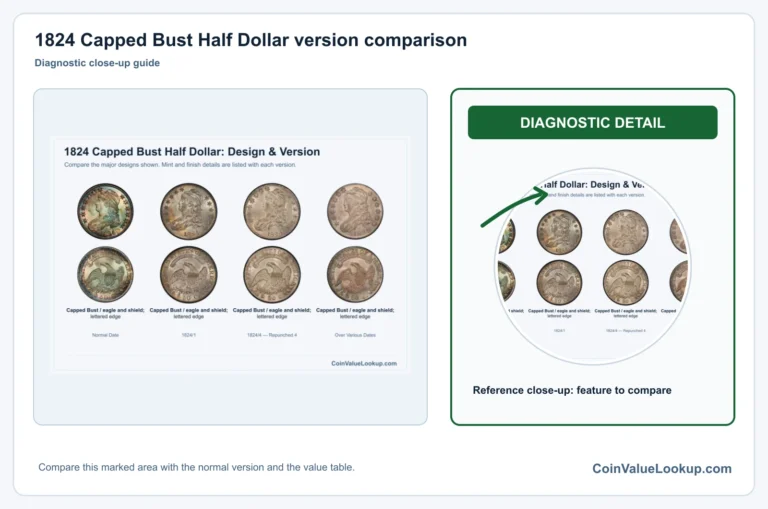
Your main task is sorting the coin into one of these branches: Philadelphia Regular Strike, New Orleans Normal Date, or New Orleans Doubled Date. The Doubled Date is a specific die variety where the date was first punched too high, leaving remnants of the digits 1, 8, and 4 in the rock base above the correctly positioned date.
That is different from minor machine doubling or wear artifacts. A genuine Proof is a special manufacturing finish, not simply a high grade above Mint State, and needs professional attribution.
Step 2: Check Your 1844 Liberty Seated Half Dollar Grade
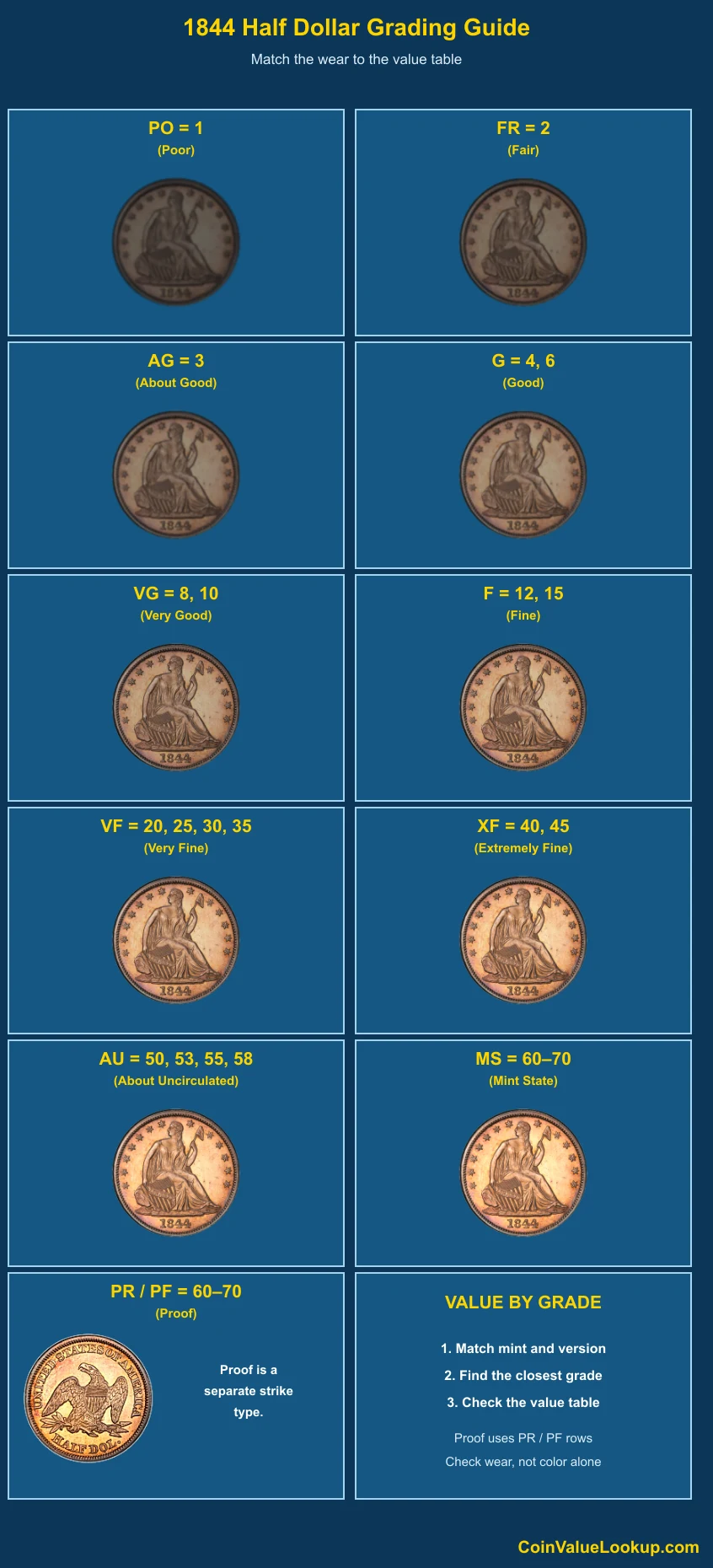
Start by examining Liberty's head, breast, knee and the lines on her shield. These are the first areas to lose detail as a coin wears.
On the reverse, check the eagle's breast feathers, wing tips and claws.
The key distinction is between a weakly struck coin and a worn one. A soft strike leaves mushy detail but intact luster in protected areas.
Genuine wear flattens the high points and breaks the original mint luster across the surface.
Compare your coin side by side with the type-matched grading photographs. Look at both faces at the same angle and lighting.
Cleaning, holes, scratches and tooled surfaces all reduce a coin's value, sometimes drastically. If you are tempted to polish your half dollar, don't.
A coin with original toning, even if dark, is almost always preferred by collectors over one that has been scrubbed.
Step 3: Check 1844 Liberty Seated Half Dollar Value by Mint and Version
1844 Liberty Seated Half Dollar — Philadelphia — Regular Strike
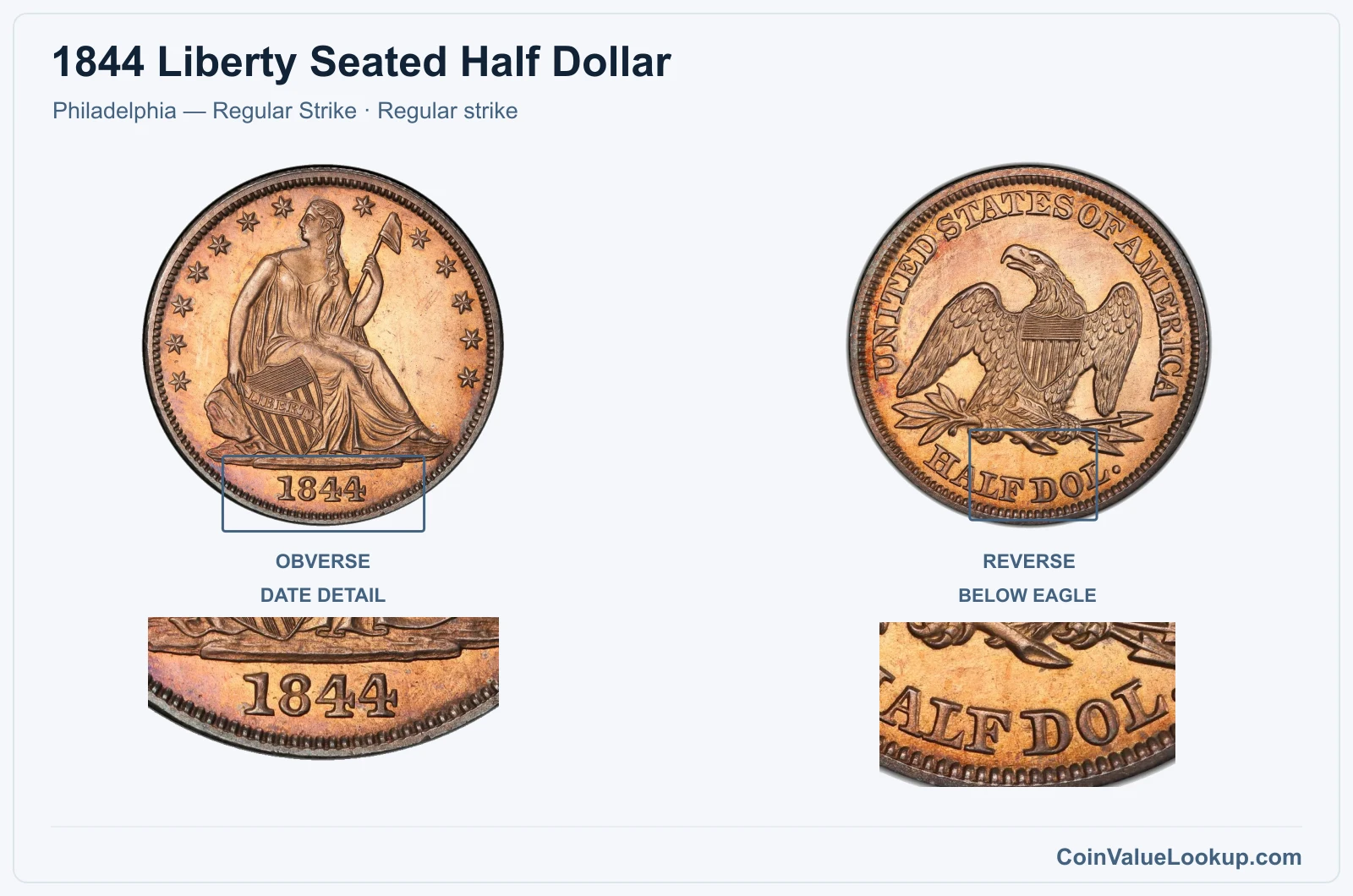
Philadelphia struck 1844 half dollars without a mintmark. In circulated grades, guide estimates run about $80 at G4, $205 at VF20, and $576 at AU50.
These are the baseline coins for the date.
Before you settle on ordinary-date values, check the border dentils near the date for any stray digit fragments. A misplaced numeral in the dentils is a separate error variety covered below.
If the date area looks clean and normal, the Philadelphia regular strike values apply.
Range Grade
Price Auction Records Appraisal PO PO 1
—
Coin Identifier FR FR 2
—
Coin Identifier AG AG 3
—
Coin Identifier G G 4
—
Coin Identifier
G 6
—
Coin Identifier VG VG 8
—
Coin Identifier
VG 10
—
Coin Identifier F F 12
—
Coin Identifier
F 15
Coin Identifier VF VF 20
—
Coin Identifier
VF 25
Coin Identifier
VF 30
Coin Identifier
VF 35
Coin Identifier XF XF 40
Coin Identifier
XF 45
Coin Identifier AU AU 50
Coin Identifier
AU 53
Coin Identifier
AU 55
Coin Identifier
AU 58
Coin Identifier MS MS 60
Coin Identifier
MS 61
Coin Identifier
MS 62
Coin Identifier
MS 63
Coin Identifier
MS 64
Coin Identifier
MS 65
—
—
—
MS 66
—
—
—
MS 67
—
—
—
MS 68
—
—
—
MS 69
—
—
—
MS 70
—
—
—
1844 Liberty Seated Half Dollar — New Orleans — Normal Date
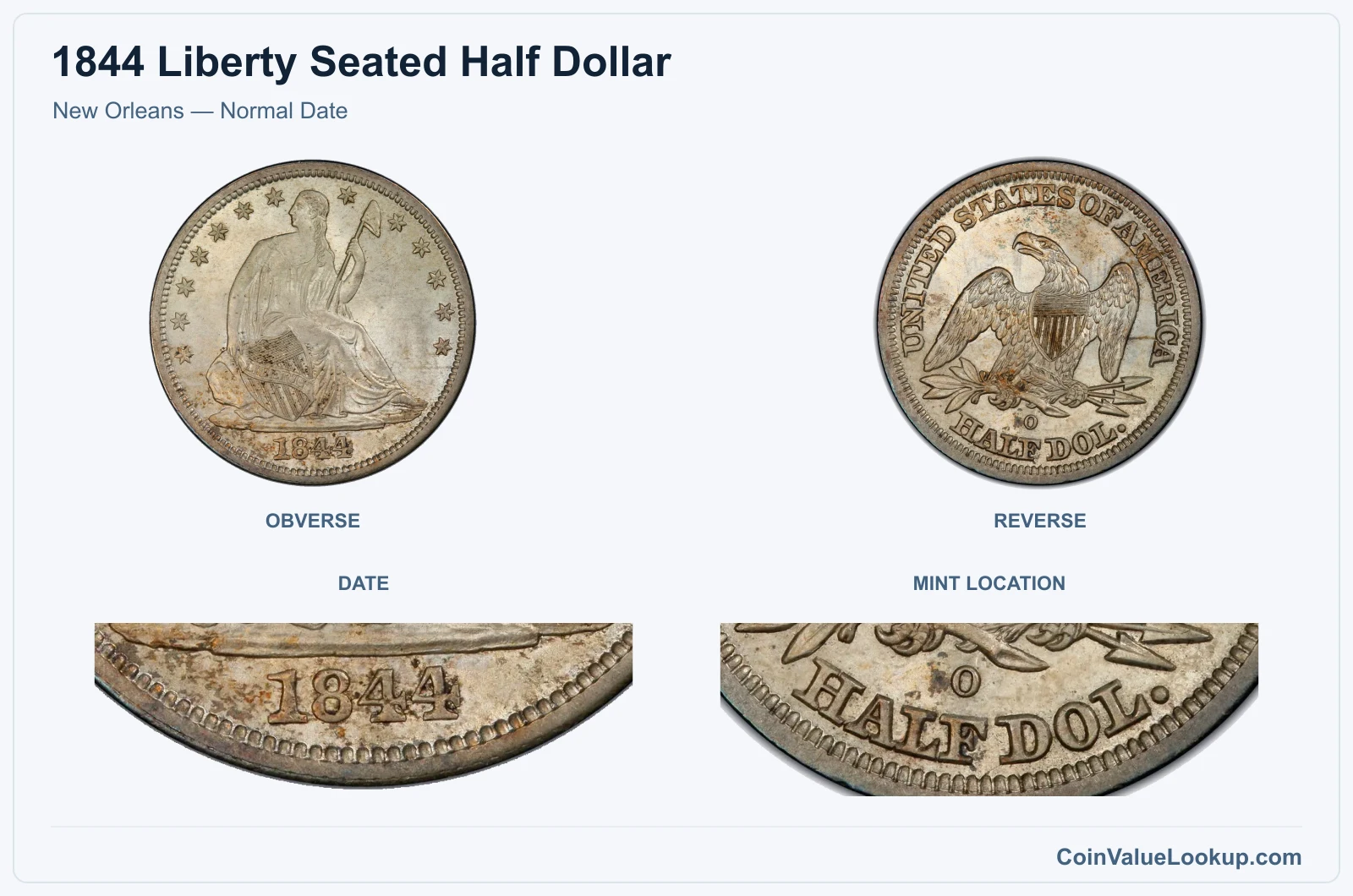
The New Orleans issue carries a small O mintmark on the reverse beneath the eagle. Guide estimates are close to Philadelphia: roughly $80 at G4, $237 at VF20, and $576 at AU50.
The critical step here is ruling out the Doubled Date variety before applying these prices. Look closely above the normally positioned date digits.
If you see no ghosted remnants of 1, 8, or 4 protruding into the rock base, you likely have the normal-date version. A loupe at 5x or higher helps.
Coin Value Lookup is a good starting point if you want to compare values across other Liberty Seated dates and denominations.
Range Grade
Price Auction Records Appraisal PO PO 1
—
Coin Identifier FR FR 2
—
Coin Identifier AG AG 3
—
Coin Identifier G G 4
Coin Identifier
G 6
—
Coin Identifier VG VG 8
Coin Identifier
VG 10
Coin Identifier F F 12
—
Coin Identifier
F 15
—
Coin Identifier VF VF 20
—
Coin Identifier
VF 25
Coin Identifier
VF 30
Coin Identifier
VF 35
Coin Identifier XF XF 40
Coin Identifier
XF 45
Coin Identifier AU AU 50
Coin Identifier
AU 53
Coin Identifier
AU 55
Coin Identifier
AU 58
Coin Identifier MS MS 60
Coin Identifier
MS 61
Coin Identifier
MS 62
Coin Identifier
MS 63
Coin Identifier
MS 64
Coin Identifier
MS 65
Coin Identifier
MS 66
—
—
—
MS 67
—
—
—
MS 68
—
—
—
MS 69
—
—
—
MS 70
—
—
—
1844 Liberty Seated Half Dollar — New Orleans — Doubled Date
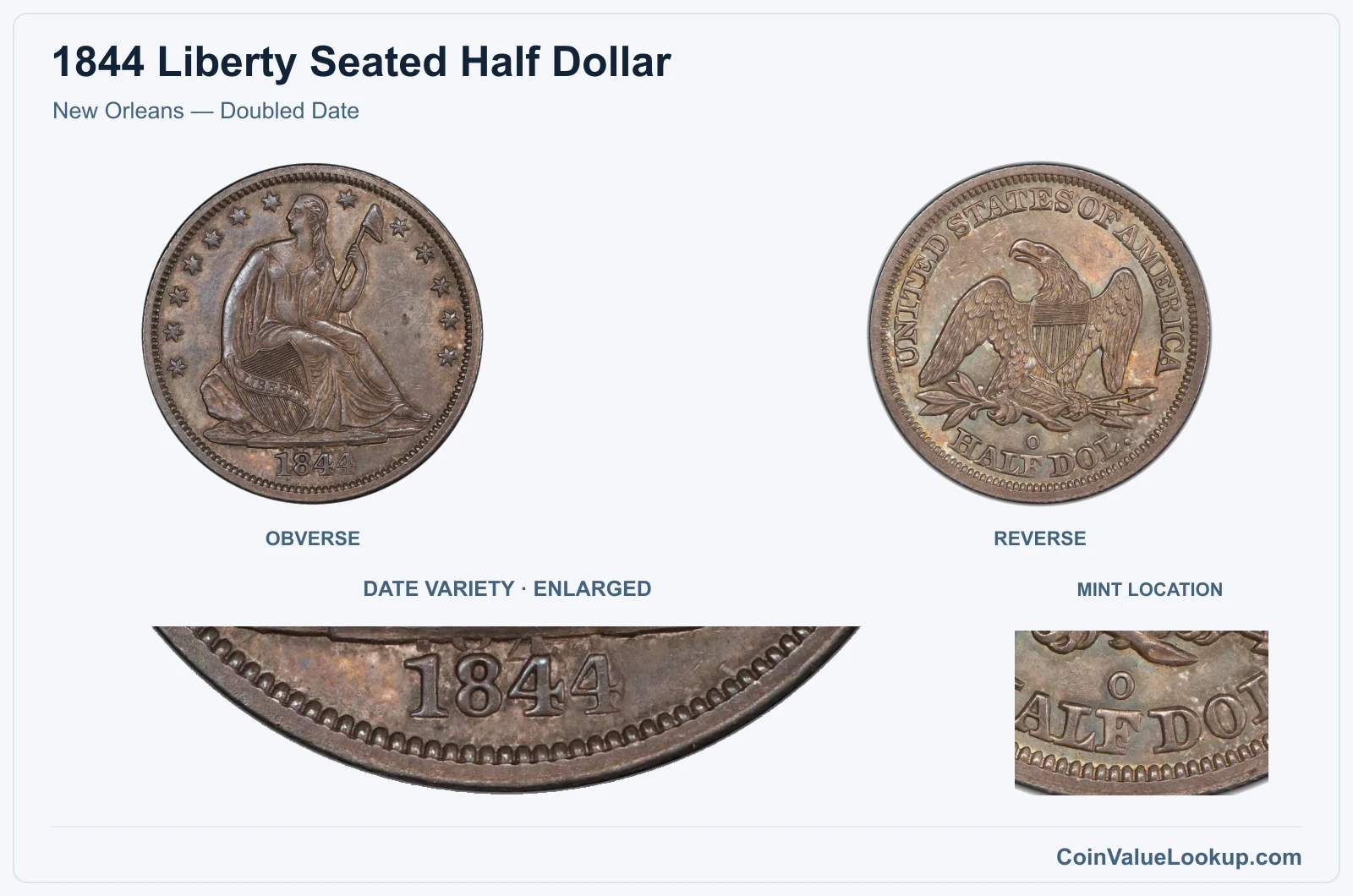
This is the headline variety for 1844. On the Doubled Date, the die's first date punch landed too high, leaving the tops of the digits 1, 8, and 4 visible in the rock base above the final, correctly placed date.
These remnants are distinct even on well-worn coins.
Do not confuse this with generic machine doubling, which produces flat shelf-like doubling without a clearly shifted second impression. The Doubled Date shows a full positional displacement upward.
Guide values reflect the premium: about $810 at G4, $2,276 at VF20, and $6,848 at AU50. That is roughly ten times the normal-date New Orleans coin.
The stronger and more visible the remnant digits, the easier the attribution and the more desirable the piece.
Range Grade
Price Auction Records Appraisal PO PO 1
—
Coin Identifier FR FR 2
Coin Identifier AG AG 3
Coin Identifier G G 4
Coin Identifier
G 6
Coin Identifier VG VG 8
Coin Identifier
VG 10
—
Coin Identifier F F 12
Coin Identifier
F 15
Coin Identifier VF VF 20
Coin Identifier
VF 25
Coin Identifier
VF 30
—
Coin Identifier
VF 35
Coin Identifier XF XF 40
Coin Identifier
XF 45
Coin Identifier AU AU 50
Coin Identifier
AU 53
Coin Identifier
AU 55
Coin Identifier
AU 58
Coin Identifier MS MS 60
—
Coin Identifier
MS 61
—
Coin Identifier
MS 62
Coin Identifier
MS 63
—
Coin Identifier
MS 64
Coin Identifier
MS 65
—
—
—
MS 66
—
—
—
MS 67
—
—
—
MS 68
—
—
—
MS 69
—
—
—
MS 70
—
—
—
1844 Liberty Seated Half Dollar — Philadelphia Proof
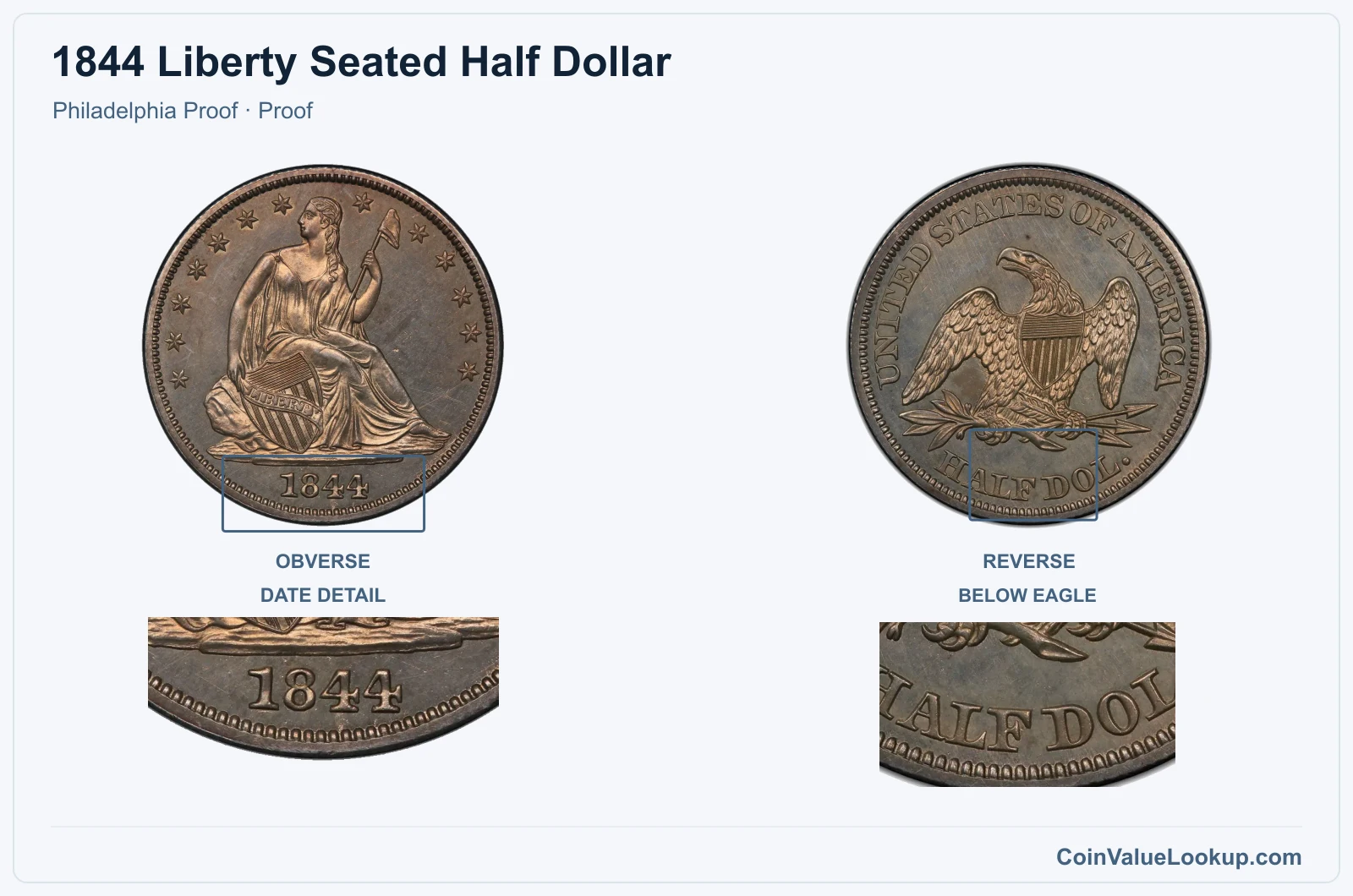
A small number of 1844 Proof half dollars were struck at Philadelphia using specially prepared dies and polished planchets. These are not simply high-grade circulation strikes that happen to look nice.
One documented sale is a PR62 example that brought $22,913 at a Legend auction in May 2021. That is a single historical result, not a current market range, but it shows the level of demand for confirmed proofs of this date.
Professional attribution is essential. Bright, lightly circulated coins can mimic proof surfaces, so certification by a major grading service is the standard way to confirm proof manufacture.
Range Grade
Price Auction Records Appraisal PR PR 1
—
Coin Identifier
PR 2
—
Coin Identifier
PR 3
—
Coin Identifier
PR 4
—
Coin Identifier
PR 6
—
Coin Identifier
PR 8
—
Coin Identifier
PR 10
—
Coin Identifier
PR 12
—
Coin Identifier
PR 15
—
Coin Identifier
PR 20
—
Coin Identifier
PR 25
—
Coin Identifier
PR 30
—
Coin Identifier
PR 35
—
Coin Identifier
PR 40
—
Coin Identifier
PR 45
—
Coin Identifier
PR 50
—
Coin Identifier
PR 53
—
Coin Identifier
PR 55
—
Coin Identifier
PR 58
—
Coin Identifier
PR 60
—
Coin Identifier
PR 61
—
Coin Identifier
PR 62
Coin Identifier
PR 63
—
—
—
PR 64
—
—
—
PR 65
—
—
—
PR 66
—
—
—
PR 67
—
—
—
PR 68
—
—
—
PR 69
—
—
—
PR 70
—
—
—
1844 Liberty Seated Half Dollar Error List
1. 1844 Liberty Seated Half Dollar — Misplaced Date in Dentils
On the 1844 Philadelphia half dollar, one documented die shows the top of the digit 8 protruding into the border dentils below the date. This happened when a date punch partially landed outside the intended field, leaving a fragment embedded among the dentils.
To spot it, examine the dentils directly beneath and slightly left of the primary 8 under at least 5x magnification. You are looking for a curved element that matches the top loop of an 8 but sits too low, partially buried in the rim area.
This is different from the 1844-O Doubled Date, where the misplaced digits appear above the date in the rock base. Do not confuse worn design elements, rim damage, or post-mint scratches with a genuine misplaced date fragment.
Comparing against a known example at the same scale is the best way to confirm. Value depends on the coin's condition and the clarity of the error.
2. 1844 Liberty Seated Half Dollar — Repunched Mintmark
Some 1844-O half dollars show a repunched mintmark, where the O on the reverse was struck more than once in slightly different positions. The result is a visible remnant or shadow of an additional O overlapping the primary mintmark.
Look at the reverse beneath the eagle. Under magnification you may see traces of an earlier O peeking out from behind the final one, shifted in one direction.
The remnant should be raised, matching the texture and profile of the primary mintmark.
Do not mistake machine doubling, which creates a flat shelf beside the letter, for a true repunched mark. Die chips or corrosion around the O can also mimic an extra impression.
A genuine repunched mintmark will show consistent depth and a coherent letter shape. The value impact depends on the coin's overall condition and how prominent the repunching is.
3. 1844 Liberty Seated Half Dollar — Die Crack / Die Chip
Die cracks are raised, irregular lines on the coin's surface caused by fractures in the steel die during production. On 1844-O half dollars, documented examples include cracks arching through the word STATES on the reverse and another running from OF toward the rim above AMERICA.
These lines are raised above the field because metal flowed into the crack in the die face. Run your fingernail across a suspected crack; if it catches slightly and the line is raised, that supports a die crack rather than a scratch.
Incuse scratches, corrosion tracks, or foreign material sitting on the surface can look similar at first glance. Scratches are recessed into the metal, not raised.
A genuine die crack typically follows a somewhat irregular but continuous path and may connect design elements. Value depends on the coin's grade and the crack's prominence, but no specific price range is established for these.
4. 1844 Liberty Seated Half Dollar — Die Gouge / Named Raised-Line Variety
A die gouge is a raised line or lump on the coin caused by damage to the die itself, not to the struck coin. On the 1844-O half dollar, one documented reverse die shows a vertical gouge running from the rim at approximately the 5 o'clock position inward toward the design.
The key word is raised. Because the gouge was cut into the die, metal fills that groove during striking, producing a line that sits above the surrounding field.
This is the opposite of a scratch, which is pressed into the coin's surface after minting.
To tell the difference, examine the line's profile under magnification. A post-mint scratch will be incuse and often show displaced metal along its edges.
A die gouge will be smooth-topped and raised, blending into the surrounding field. Value varies with condition and visibility; no fixed price range is established for this category.