1867 Liberty Seated Half Dollar Coin Value: How Much Is It Worth?
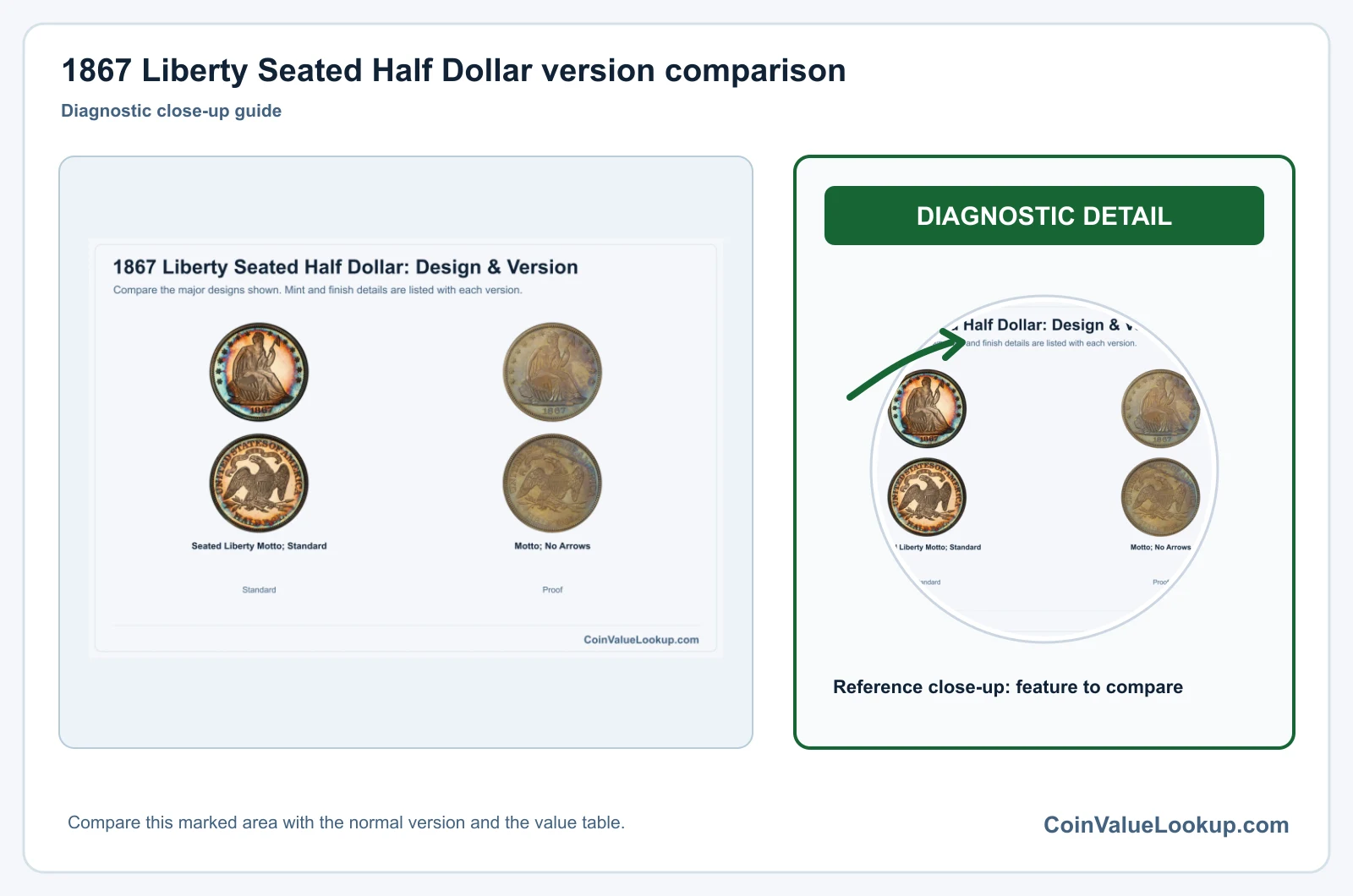
A Philadelphia-struck 1867 Liberty Seated Half Dollar runs roughly $141 in G4 up to about $947 in AU50 according to USA Coin Book guide estimates. That is a wide spread, and it only covers one mint.
San Francisco coins, Proof strikes, and specific varieties each follow their own pricing paths, so confirming mint, grade, and exact version matters before settling on a number.
Fast Way to Identify Your 1867 Liberty Seated Half Dollar
Snap a clear photo of both sides of your coin and upload them here. A preliminary identification can help you figure out whether you have a Philadelphia or San Francisco issue, spot an obvious mintmark style, and point you toward the right version for further research.
Two good photos — front and back — are all you need to get started.
1867 Liberty Seated Half Dollar Value
Upload both sides of your 1867 Liberty Seated Half Dollar.
Front Obverse
Upload photo
Back Reverse
Upload photo
Which 1867 Liberty Seated Half Dollar Versions Are Worth Money?
- Philadelphia coins guide at $141 (G4) to $947 (AU50); San Francisco pieces guide lower at $91 (G4) to $630 (AU50) — confirm your mint first.
- Philadelphia Proofs guide at roughly $1,896 in PR63, a separate finish that commands its own market.
- Named die varieties — repunched dates, doubled dies, die gouges — can affect value; check the date and reverse lettering closely.
Step 1: Identify Your 1867 Liberty Seated Half Dollar Mint Mark and Version
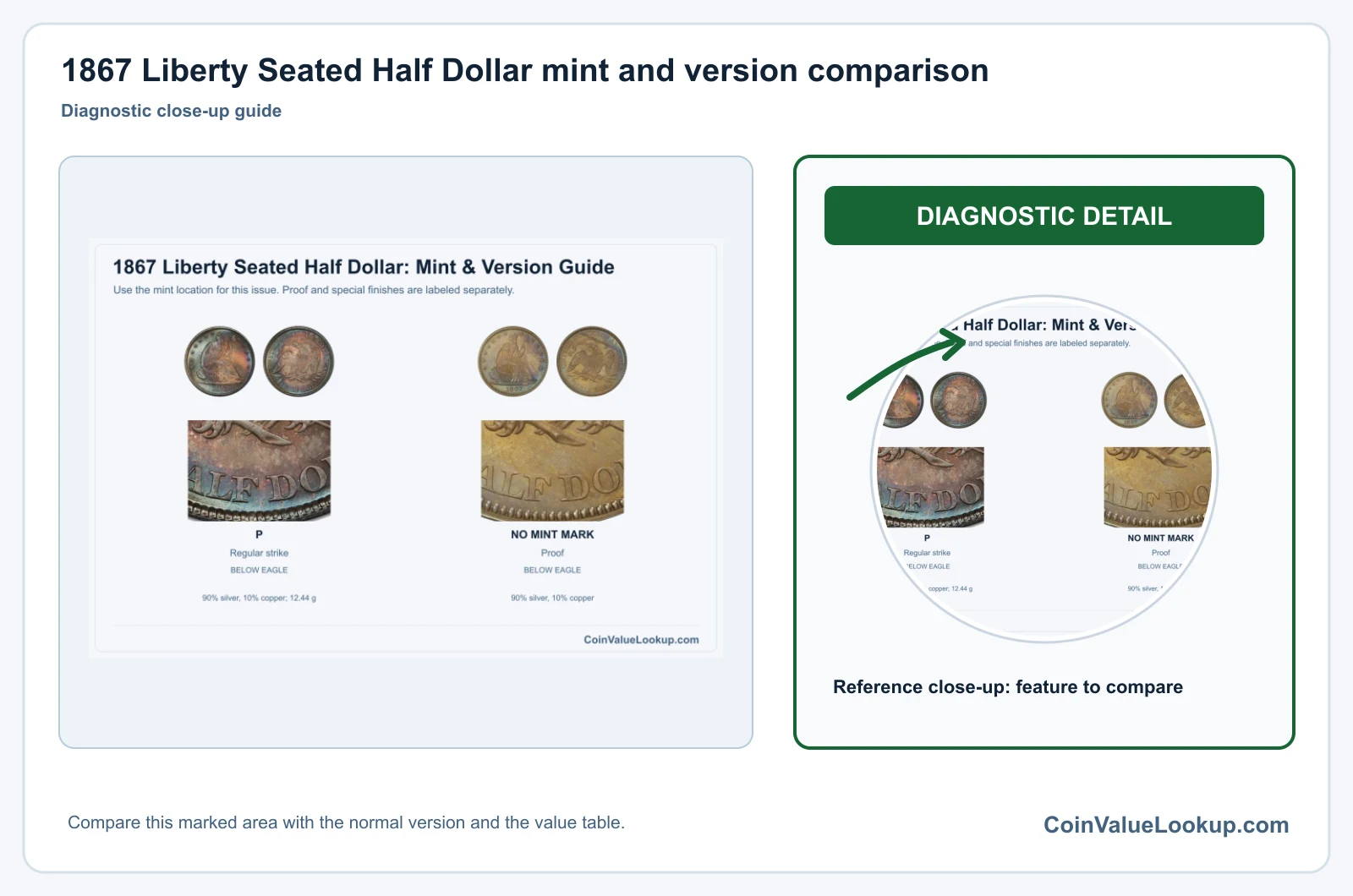
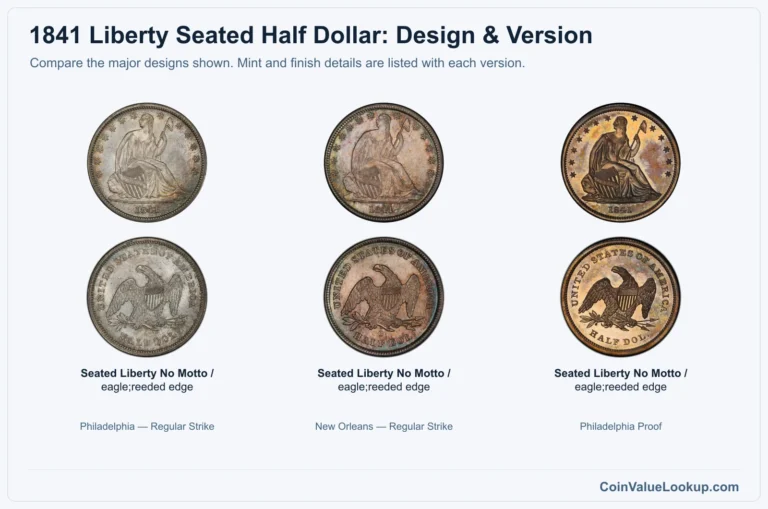
The obverse shows Liberty seated on a rock, holding a shield and a pole topped with a cap. The reverse features an eagle with a motto banner reading IN GOD WE TRUST above it and HALF DOL below.
This is the "With Motto" design, used from 1866 onward.
To determine the mint, flip the coin over and look below the eagle's tail feathers. A blank space means Philadelphia.
A small "S" means San Francisco. No other mint struck this date.
The 1867 half dollar is 90% silver and 10% copper, weighing 12.44 grams under the old standard. Later issues from 1873 onward were bumped to 12.50 grams, marked by arrows flanking the date — but that does not apply to 1867 coins.
Proof strikes exist from Philadelphia. A Proof is a special manufacturing finish with mirrored fields and sharp rims, not a grade above Mint State.
A reflective obverse alone does not make a coin a Proof; polished circulation dies can mimic that look.
Step 2: Check Your 1867 Liberty Seated Half Dollar Grade
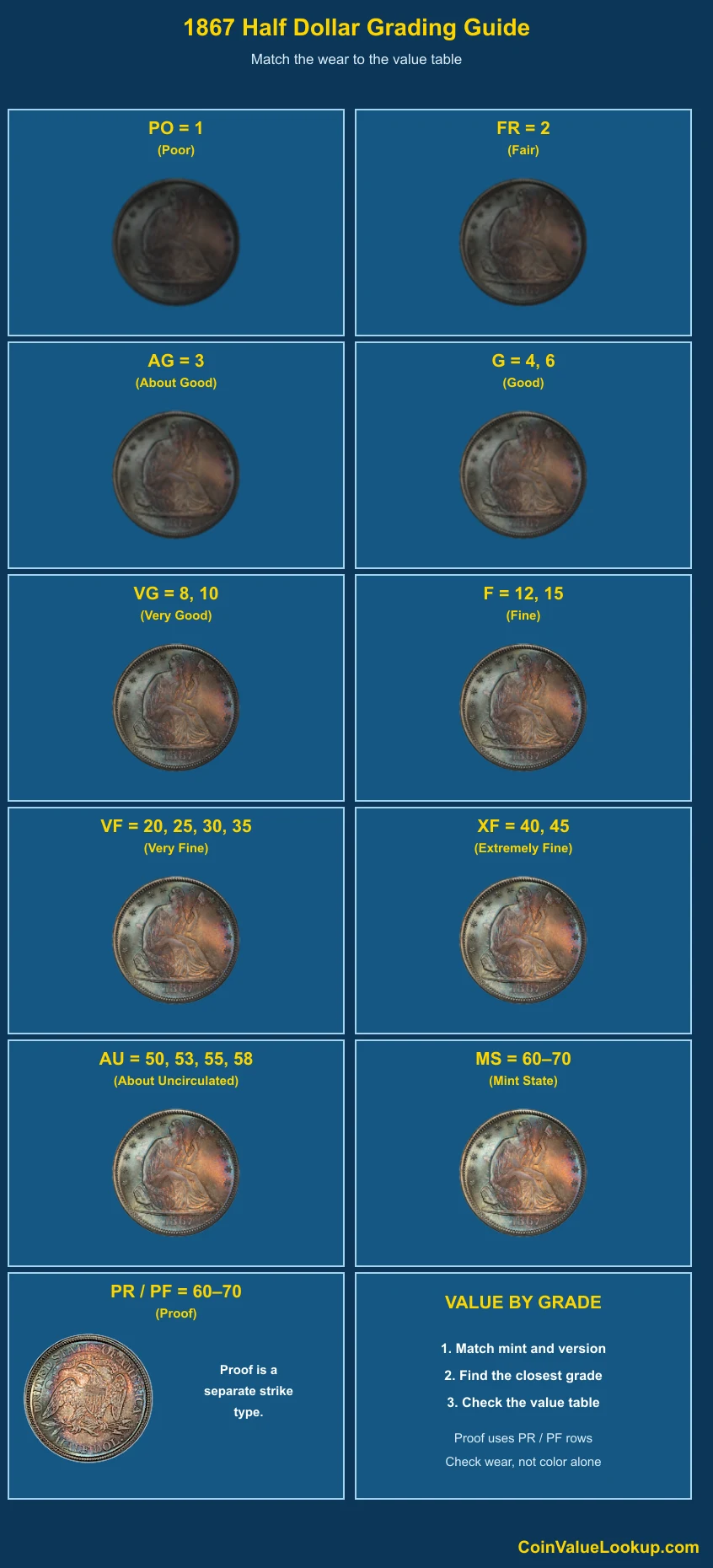
Start at the high points. On the obverse, check Liberty's head, her knee, and the breast area for flatness or loss of detail.
On the reverse, the eagle's shield and the tops of the wings show wear first. Compare your coin against the reference image to gauge where it falls.
Luster is your secret weapon. A coin that looks flat in detail but still shows cartwheel luster in protected areas may be weakly struck rather than heavily worn.
Tilt the coin under a single light source and watch for that rotating sheen.
Cleaning, rim dings, and holes all reduce value independently of the wear grade. A cleaned AU can sell for less than an original VF.
If the surfaces look unnaturally bright or show hairline scratches in one direction, someone probably went after it with polish at some point.
Step 3: Check 1867 Liberty Seated Half Dollar Value by Mint and Version
1867 Liberty Seated Half Dollar — Philadelphia — Standard
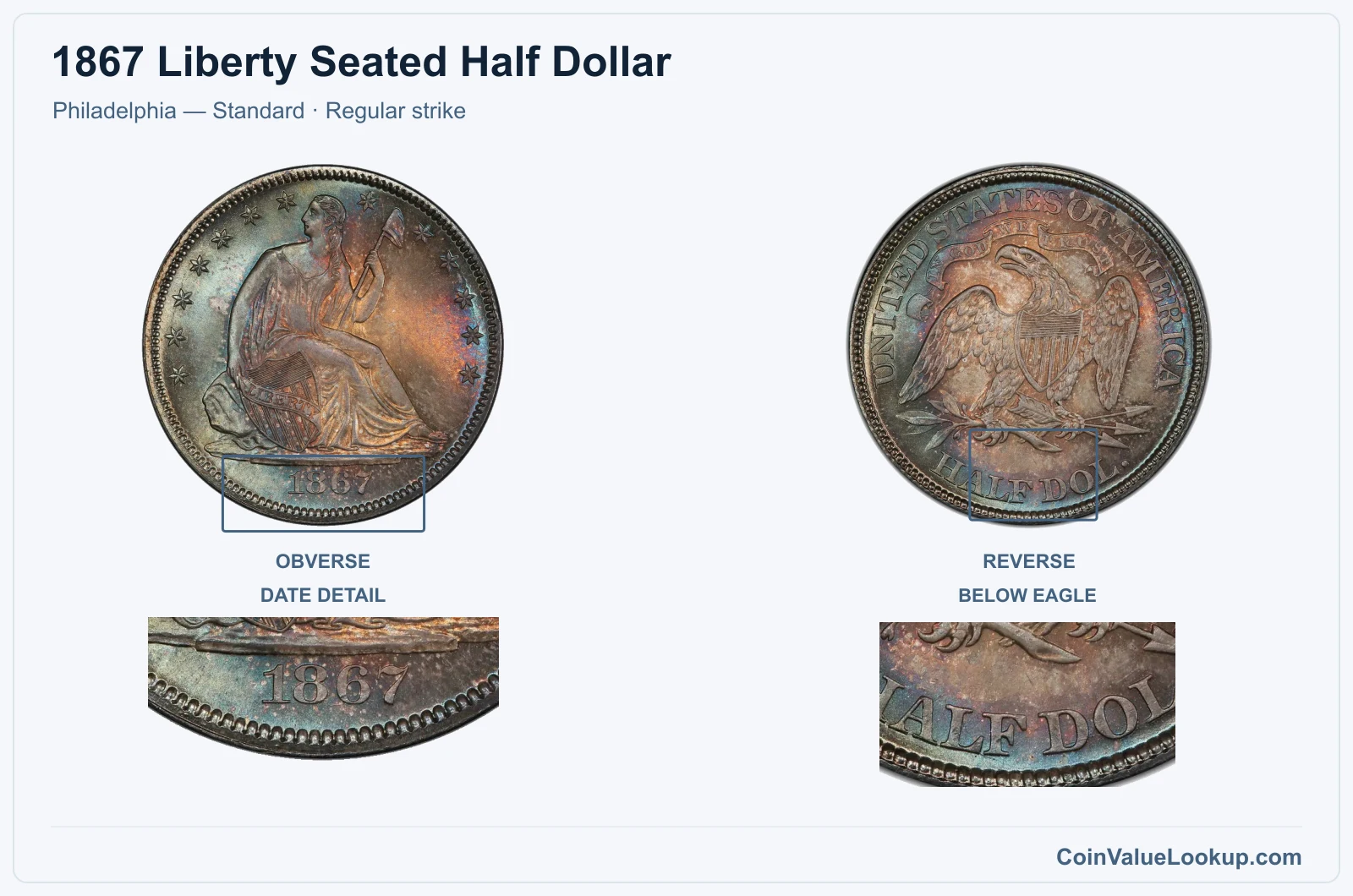
The standard 1867 Philadelphia half dollar has no mintmark below the eagle. It was struck for circulation in 90% silver at 12.44 grams.
USA Coin Book guide estimates place this coin at about $141 in G4, $394 in VF20, and $947 in AU50.
Philadelphia issues tend to guide higher than their San Francisco counterparts at every grade level for this date. Still, actual sale prices depend on eye appeal, originality, and whether the coin has been cleaned.
Look for even, original gray or blue-gray toning and undisturbed surfaces when evaluating one of these.
Range Grade
Price Auction Records Appraisal PO PO 1
—
Coin Identifier FR FR 2
Coin Identifier AG AG 3
—
Coin Identifier G G 4
—
Coin Identifier
G 6
—
Coin Identifier VG VG 8
—
Coin Identifier
VG 10
—
Coin Identifier F F 12
—
Coin Identifier
F 15
Coin Identifier VF VF 20
Coin Identifier
VF 25
Coin Identifier
VF 30
Coin Identifier
VF 35
Coin Identifier XF XF 40
Coin Identifier
XF 45
Coin Identifier AU AU 50
Coin Identifier
AU 53
Coin Identifier
AU 55
Coin Identifier
AU 58
Coin Identifier MS MS 60
Coin Identifier
MS 61
—
Coin Identifier
MS 62
Coin Identifier
MS 63
Coin Identifier
MS 64
Coin Identifier
MS 65
Coin Identifier
MS 66
Coin Identifier
MS 67
Coin Identifier
MS 68
Coin Identifier
MS 69
—
—
—
MS 70
—
—
—
1867 Liberty Seated Half Dollar — San Francisco — Very Small S
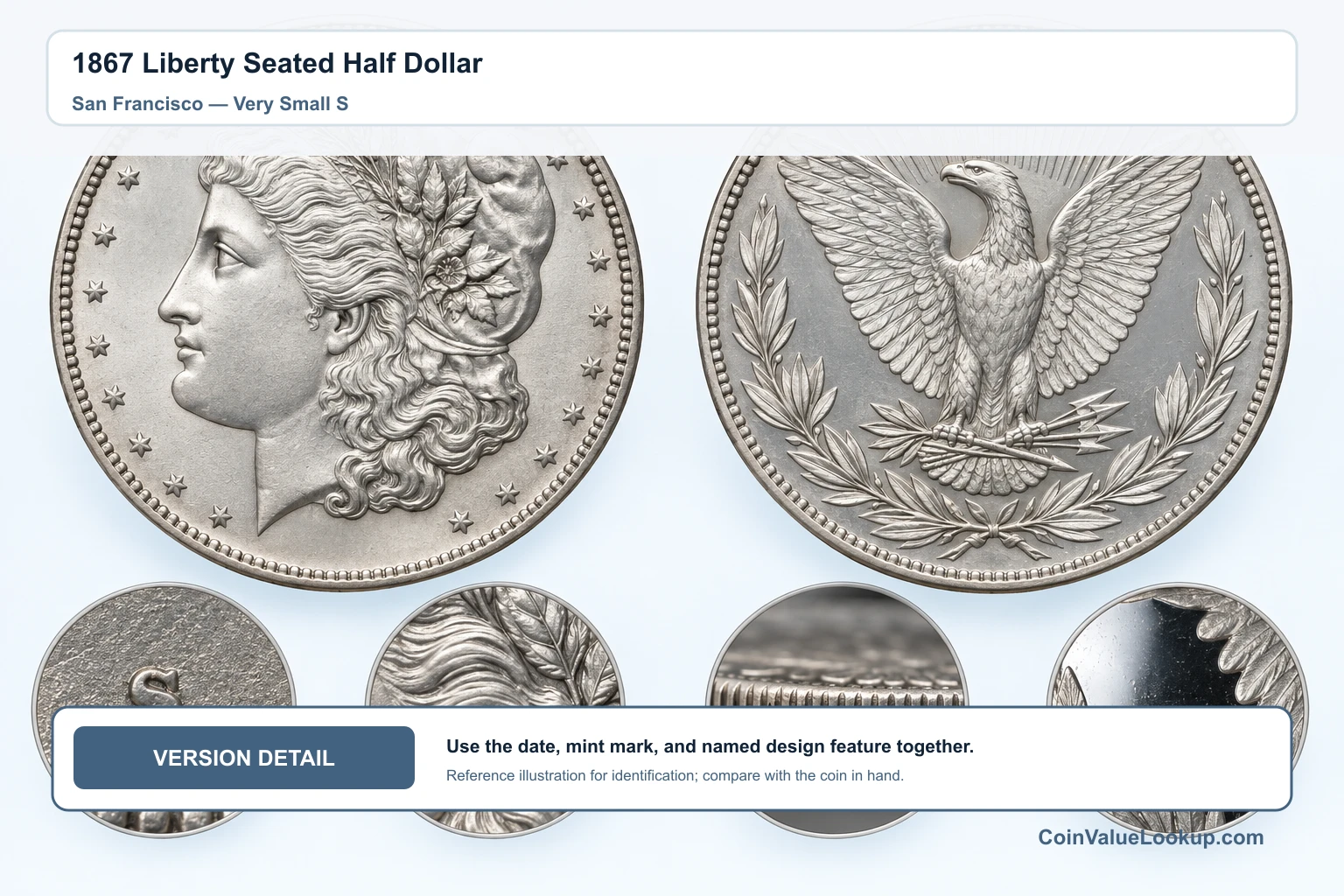
San Francisco struck 1867 half dollars carrying a very small "S" mintmark below the eagle on the reverse. This mintmark style is tiny and can be hard to spot on worn coins, so use magnification and good lighting.
Guide estimates from USA Coin Book put the 1867-S at $91 in G4, $331 in VF20, and $630 in AU50. Those figures sit below the Philadelphia version at the same grades.
The very small S is the expected mintmark style for this year; if you see an unusually large or oddly positioned S, compare it carefully against known examples before drawing conclusions.
Coin Value Lookup is a good starting point if you want to look up guides for other dates or denominations in this series.
Ordinary-issue reference: Ordinary-issue reference only: The table below shows prices for the 1867-S Liberty Seated Half Dollar (regular strike). It does not represent the value of the specific San Francisco — Very Small S variety or its variety premium. Year, mint, metal and strike type are matched; the specific variety is not priced by this table.
Range Grade
Price Auction Records Appraisal PO PO 1
—
Coin Identifier FR FR 2
—
Coin Identifier AG AG 3
—
Coin Identifier G G 4
—
Coin Identifier
G 6
—
Coin Identifier VG VG 8
—
Coin Identifier
VG 10
Coin Identifier F F 12
Coin Identifier
F 15
—
Coin Identifier VF VF 20
Coin Identifier
VF 25
Coin Identifier
VF 30
Coin Identifier
VF 35
Coin Identifier XF XF 40
Coin Identifier
XF 45
Coin Identifier AU AU 50
Coin Identifier
AU 53
Coin Identifier
AU 55
Coin Identifier
AU 58
Coin Identifier MS MS 60
Coin Identifier
MS 61
Coin Identifier
MS 62
Coin Identifier
MS 63
Coin Identifier
MS 64
Coin Identifier
MS 65
Coin Identifier
MS 66
Coin Identifier
MS 67
—
—
—
MS 68
—
—
—
MS 69
—
—
—
MS 70
—
—
—
1867 Liberty Seated Half Dollar — Philadelphia Proof
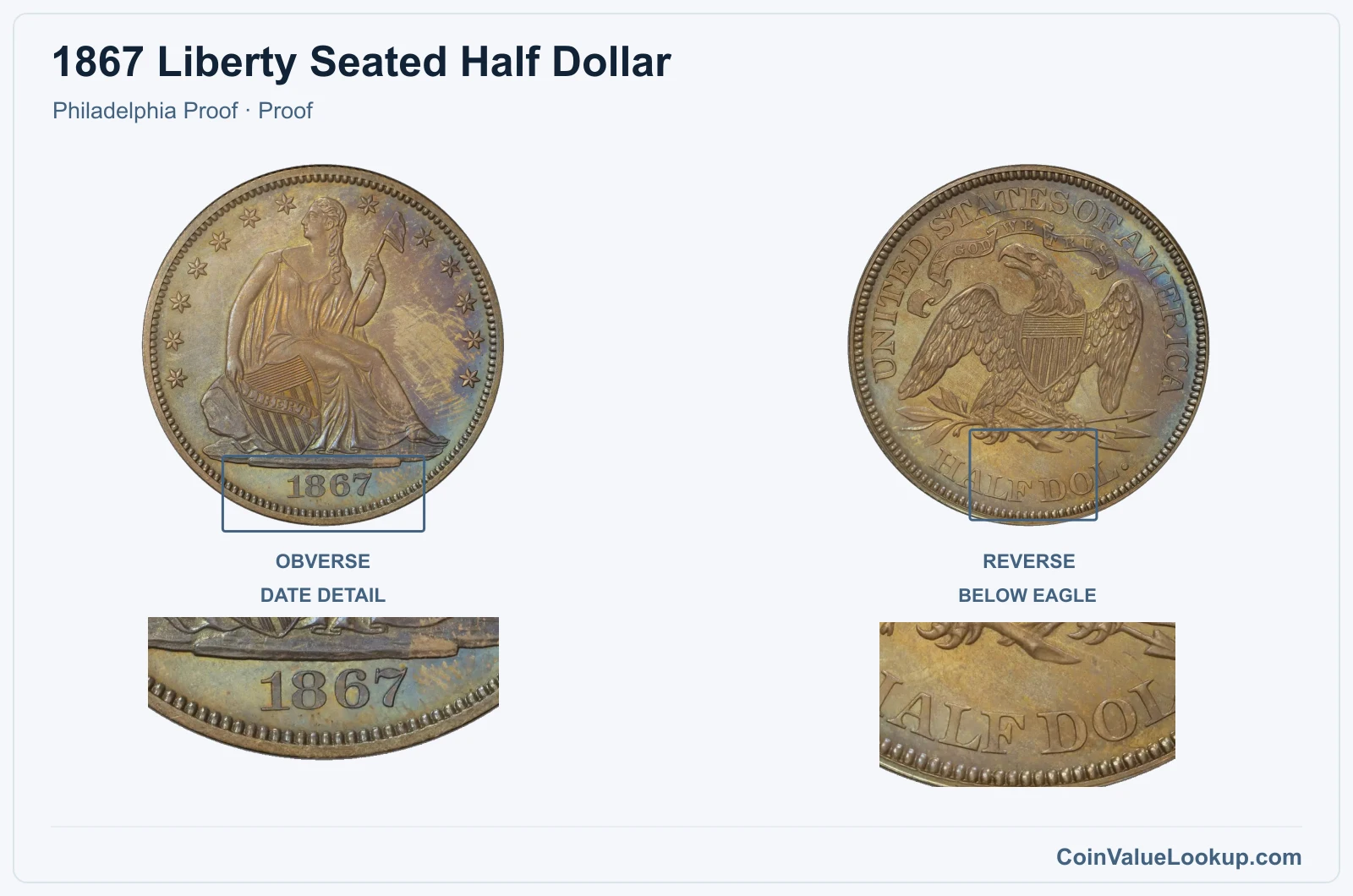
Philadelphia produced Proof half dollars in 1867 with mirrored fields and precisely struck devices. These carry no mintmark, just like the regular Philadelphia issue, so surface quality is how you tell them apart.
Genuine Proofs show deeply reflective fields, squared-off rims, and exceptionally sharp detail in the stars and denticles.
USA Coin Book guides the 1867 Proof at approximately $1,896 in PR63. Keep in mind that a shiny obverse alone does not confirm Proof status — polished circulation dies can produce misleading reflectivity.
Third-party certification is the safest way to verify a Proof. Contrast designations such as Cameo exist within the Proof finish category and can affect desirability.
Range Grade
Price Auction Records Appraisal PR PR 1
—
Coin Identifier
PR 2
—
Coin Identifier
PR 3
—
Coin Identifier
PR 4
—
Coin Identifier
PR 6
—
Coin Identifier
PR 8
—
Coin Identifier
PR 10
—
Coin Identifier
PR 12
—
Coin Identifier
PR 15
—
Coin Identifier
PR 20
—
Coin Identifier
PR 25
—
Coin Identifier
PR 30
—
Coin Identifier
PR 35
—
Coin Identifier
PR 40
—
Coin Identifier
PR 45
—
Coin Identifier
PR 50
—
Coin Identifier
PR 53
—
Coin Identifier
PR 55
—
Coin Identifier
PR 58
—
Coin Identifier
PR 60
Coin Identifier
PR 61
Coin Identifier
PR 62
Coin Identifier
PR 63
Coin Identifier
PR 64
Coin Identifier
PR 65
Coin Identifier
PR 66
Coin Identifier
PR 67
Coin Identifier
PR 68
—
—
—
PR 69
—
—
—
PR 70
—
—
—
1867 Liberty Seated Half Dollar Error List
1. 1867 Liberty Seated Half Dollar — Repunched Date
Repunched date varieties are cataloged for the 1867 half dollar, including Philadelphia examples and a San Francisco recut 186/1 variety. The diagnostic is extra numeral remnants visible near the base or tops of the date digits — look for ghost outlines of numbers slightly offset from the final punched position.
Use at least 5x magnification and angled light. The remnants are raised metal, part of the die impression.
Machine doubling, by contrast, produces flat, shelf-like doubling and is far less collectible. Damaged or corroded digits can also mimic a repunch.
Condition, the clarity of the extra digits, and which specific repunched variety you have all influence what a collector might pay. No fixed premium applies across the board.
2. 1867 Liberty Seated Half Dollar — Repunched Mintmark
A repunched mintmark has been cataloged on the 1867 San Francisco half dollar, described as a Recut S. You are looking for traces of an earlier mintmark impression near or overlapping the final S below the eagle.
Genuine repunched mintmarks show raised outlines from the original placement. Machine doubling around the mintmark tends to look flat and shelf-like, while corrosion and die chips can add shapeless lumps that fool the eye.
Check with magnification and compare against known reference images for this specific date.
Value depends on the visibility of the repunch and the coin's overall condition. No standard premium is established — individual assessment is necessary.
3. 1867 Liberty Seated Half Dollar — Doubled Die Reverse
A doubled die reverse is reported for the 1867 San Francisco half dollar, with doubling visible on the motto lettering. Look for separated or notched contours on IN GOD WE TRUST compared to normal, clean-edged letters.
The doubling originates from a misaligned hub impression during die production, so it appears as raised, consistent separation. Machine doubling, the common lookalike, is flat and often appears on only one side of the letter strokes.
Random nicks and reflections under certain lighting can also suggest doubling that is not really there.
Actual value depends on how strong the doubling is, the die pair involved, and the coin's grade. No specific price range is established for this variety.
4. 1867 Liberty Seated Half Dollar — Die Crack / Die Chip
Die cracks and die chips are documented on 1867 San Francisco half dollars, with raised cracks reported near Liberty's foot and stars on the obverse, and through AMERICA on the reverse. These show up as thin, raised lines of metal running across the coin's surface — the result of a cracked die transferring its flaw into every coin it strikes.
Do not confuse die cracks with incuse scratches, which are cut into the surface rather than raised above it. Corrosion lines and foreign material stuck to the surface can also imitate cracks at first glance.
Run a fingernail across the line: a die crack is raised, a scratch is recessed.
Pricing varies with the crack's prominence and the coin's condition. Many die cracks add only modest interest, but dramatic examples attract specialist attention.
5. 1867 Liberty Seated Half Dollar — Clashed Dies
A heavily clashed obverse has been documented on the 1867 San Francisco half dollar. Die clashing happens when the obverse and reverse dies strike each other without a planchet between them, transferring ghost impressions of the opposing design onto each die.
Subsequent coins then carry faint traces of the eagle on the obverse or Liberty's outline on the reverse.
The key diagnostic is recognizing design elements that do not belong on that side of the coin. These marks follow the outline of the opposing die, not random patterns.
Scratches, stray raised lines, and brockage impressions from struck coins can look similar but lack the systematic mirror-image relationship of a true clash.
Value depends on how dramatically the clash shows and the coin's overall grade.
6. 1867 Liberty Seated Half Dollar — Die Gouge / Named Raised-Line Variety
Heavy die gouges have been cataloged on the 1867 San Francisco reverse, appearing as raised lines through the eagle's wing, shield, or surrounding letters. A die gouge is damage to the die surface that produces a corresponding raised line on every coin struck from that die.
The critical distinction: a die gouge is raised on the coin's surface. An incuse scratch — caused by contact damage after the coin left the press — sits below the surface.
Tilt the coin under a light and check whether the line catches light like a ridge or sinks into shadow like a groove.
Die cracks can look similar, but gouges tend to be thicker and less linear. No standard price premium applies; value depends on the visibility and the specific variety, plus the coin's condition and eye appeal.