1921 Walking Liberty Half Dollar Coin Value: How Much Is It Worth?
The 1921 Walking Liberty Half Dollar is a 90% silver coin that commands serious attention from collectors. Guide estimates across its three mint branches range from about $118.00 in well-worn condition to $38,850.00 at the MS63 level, depending on mint, grade and originality of surfaces.
These figures are guide anchors, not guaranteed selling prices or current silver-melt quotes.
Condition matters enormously with this date, and so does which mint struck your coin. Cleaned or damaged pieces fall well below problem-free examples, even when the grade looks right.
Strong central detail is genuinely scarce on 1921 Walkers, so careful evaluation pays off.
Fast Way to Identify Your 1921 Walking Liberty Half Dollar
Snap clear photos of both sides of your coin and upload them for a preliminary identification. The identifier can help you figure out which mint branch you have and give you a starting point on condition.
Good lighting and a steady hand go a long way. This is not a substitute for professional authentication or exact grading, but it gets you oriented fast.
1921 Walking Liberty Half Dollar Value
Upload both sides of your 1921 Walking Liberty Half Dollar.
Front Obverse
Upload photo
Back Reverse
Upload photo
Which 1921 Walking Liberty Half Dollar Versions Are Worth Money?
- The 1921-S in MS63 carries a guide estimate of $38,850.00, driven by the difficulty of finding this mint in uncirculated condition with full surfaces.
- The 1921-D in lower grades starts around $299.00 at G4, making it the priciest of the three mints in circulated condition.
- The 1921 Philadelphia at G4 lists around $193.00, still well above common-date Walkers, reflecting genuine scarcity for this year.
- All three 1921 mints are worth checking for reported error varieties such as doubled dies or repunched mintmarks, which can add value beyond standard guide figures.
Step 1: Identify Your 1921 Walking Liberty Half Dollar Mint Mark and Version
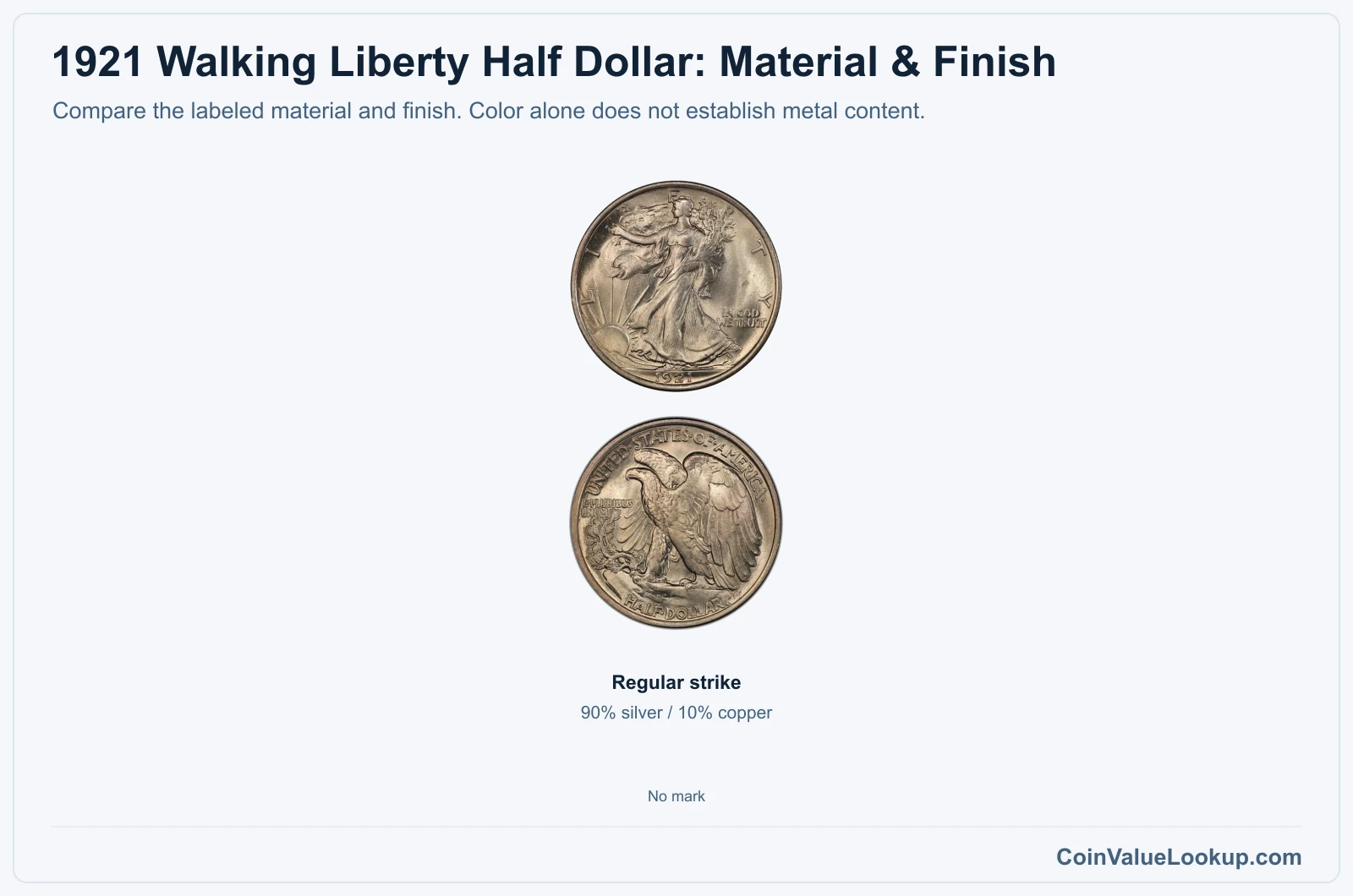
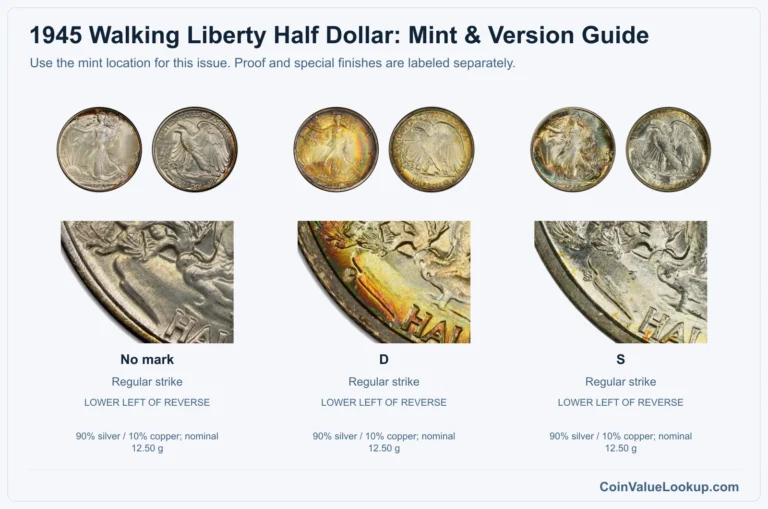
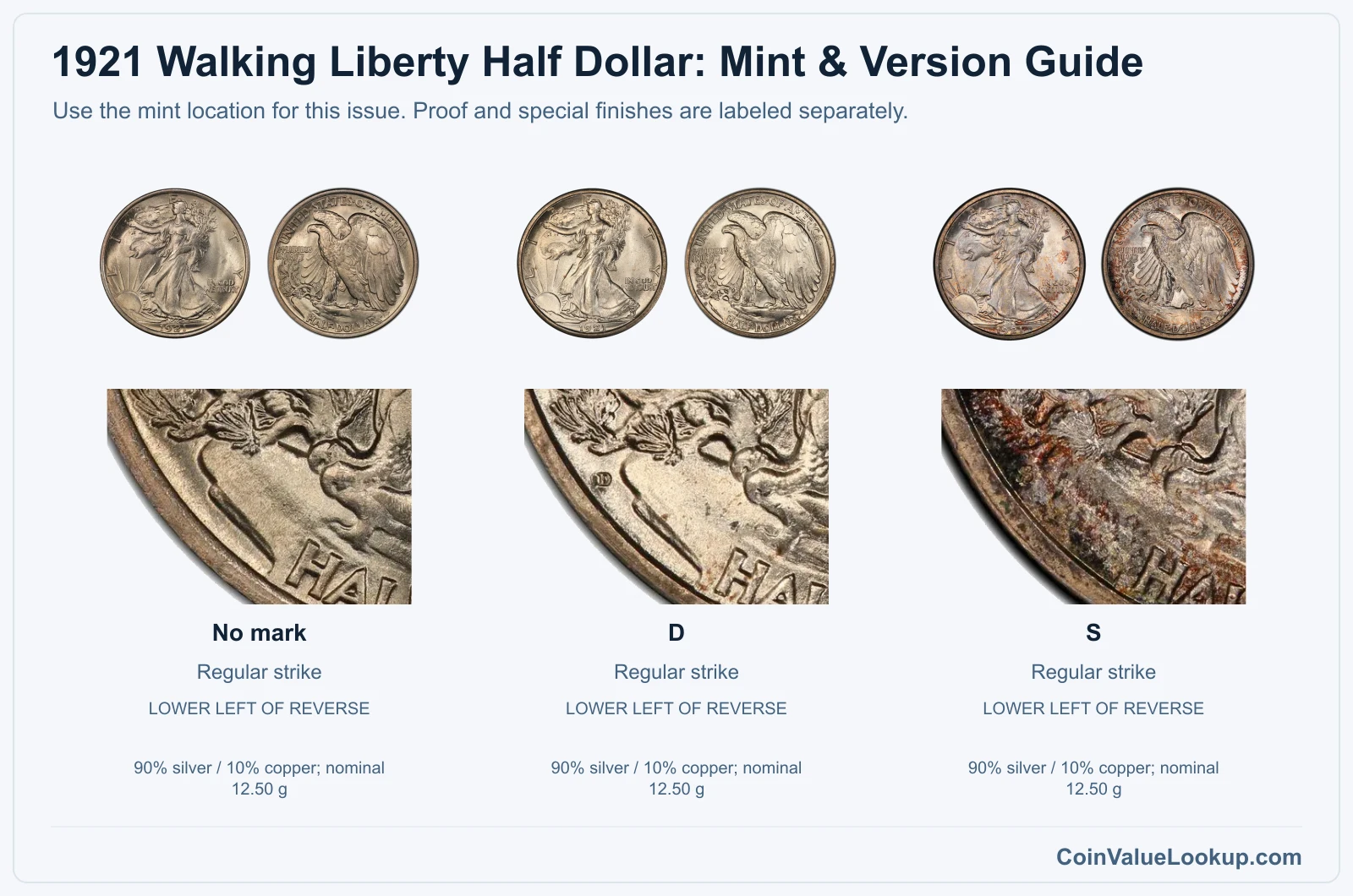
The 1921 Walking Liberty Half Dollar was struck at three mints: Philadelphia (no mintmark), Denver (D) and San Francisco (S). The coin is 90% silver and 10% copper, weighing a nominal 12.50 grams.
Toning does not change the alloy.
For 1921 issues, the mintmark sits on the reverse at the lower left, roughly at the 8 o'clock position near the rim. Philadelphia coins carry no mintmark at all, so a blank reverse lower-left is normal, not a sign of a missing letter.
All three branches are business strikes with the classic Walking Liberty obverse and the eagle-on-rock reverse. There are no proof issues for this date in the supplied branches.
Separate your coin by mint first, then focus on wear and surface quality before reaching for a price chart.
Step 2: Check Your 1921 Walking Liberty Half Dollar Grade
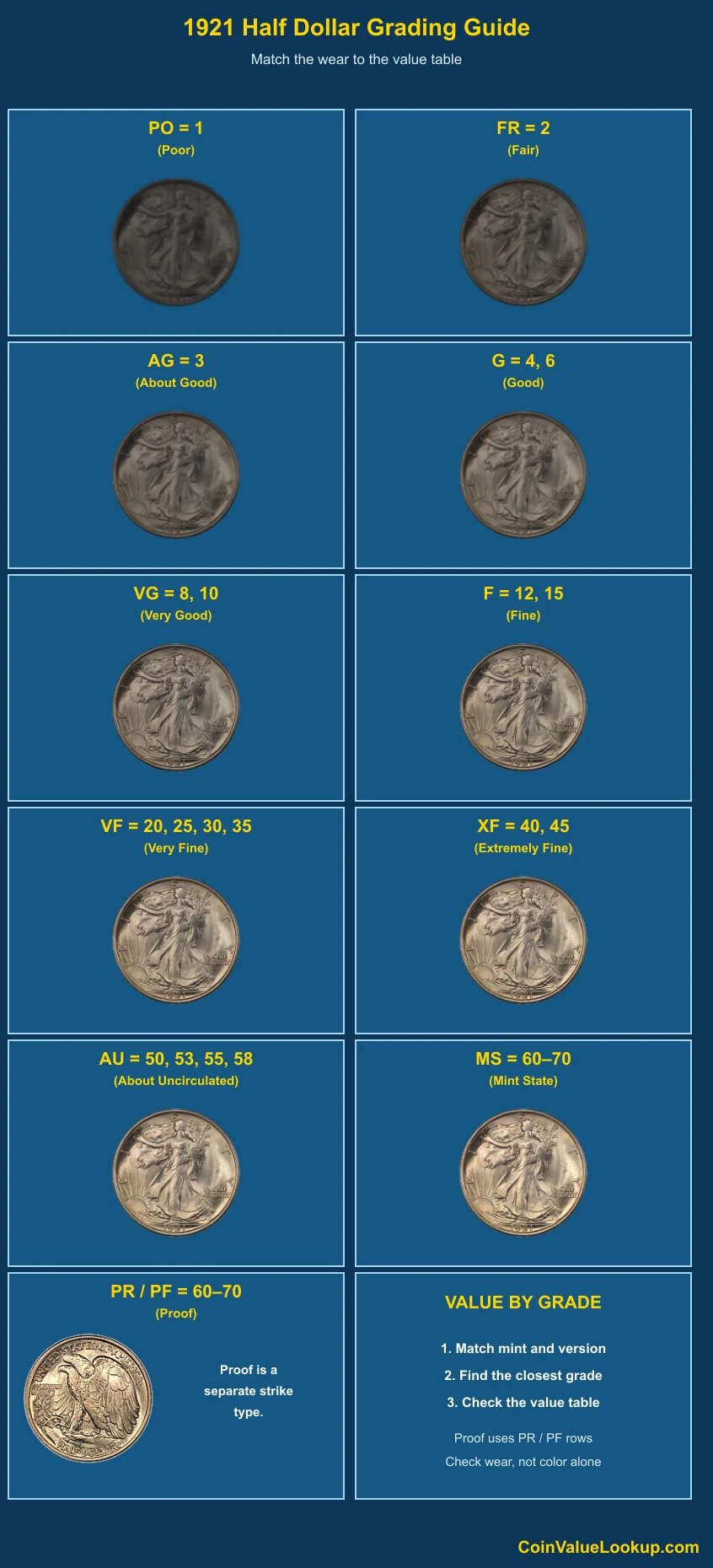
Start with Liberty's head, breast, left hand holding the branches, and the skirt folds at the knee. These are the first areas to show smoothing from circulation.
On the reverse, check the eagle's breast feathers, legs and wing tips.
Here is the catch with Walkers: weak central strikes happen on coins that never circulated. A soft hand or mushy head does not automatically mean the coin is worn.
Look at the fields and protected areas for original mint luster. If the luster is intact but the strike is soft, you likely have a weakly struck but uncirculated piece.
Compare your coin against the grading comparison image to see how wear progresses from Good through Mint State. Focus on whether high-point softness comes with actual smoothing and luster loss, or just incomplete metal flow from the strike.
Step 3: Check 1921 Walking Liberty Half Dollar Value by Mint and Version
1921 Walking Liberty Half Dollar
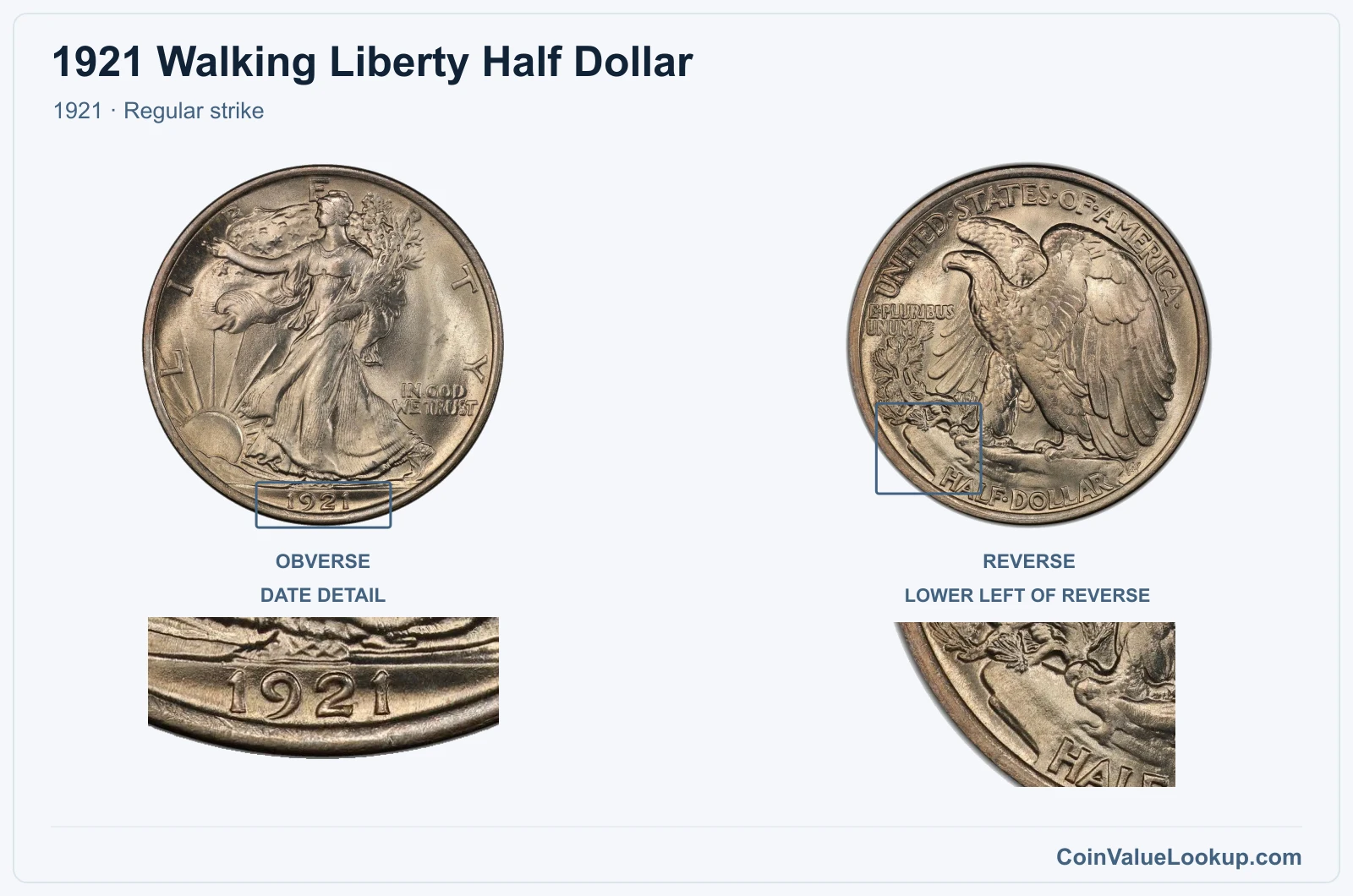
The 1921 Philadelphia half dollar has no mintmark. Look at the reverse lower left and confirm the space is blank.
In G4, the guide estimate sits at $193.00; jump to MS63 and it climbs to $10,038.00, per USA Coin Book.
Original, problem-free surfaces are key. A cleaned coin or one with damage is not worth the same as a piece with honest wear and no issues.
Silver content gives every example a floor, but collector value depends on grade and eye appeal. Check that central details match the actual wear level rather than a weak strike before settling on a grade.
Coin Value Lookup is a good starting point when you want to look up guides for other dates in the Walking Liberty series or different denominations altogether.
Range Grade
Price Auction Records Appraisal PO PO 1
—
Coin Identifier FR FR 2
Coin Identifier AG AG 3
Coin Identifier G G 4
Coin Identifier
G 6
Coin Identifier VG VG 8
Coin Identifier
VG 10
Coin Identifier F F 12
Coin Identifier
F 15
Coin Identifier VF VF 20
Coin Identifier
VF 25
Coin Identifier
VF 30
Coin Identifier
VF 35
Coin Identifier XF XF 40
Coin Identifier
XF 45
Coin Identifier AU AU 50
Coin Identifier
AU 53
Coin Identifier
AU 55
Coin Identifier
AU 58
Coin Identifier MS MS 60
—
Coin Identifier
MS 61
Coin Identifier
MS 62
Coin Identifier
MS 63
Coin Identifier
MS 64
Coin Identifier
MS 65
Coin Identifier
MS 66
Coin Identifier
MS 67
—
—
—
MS 68
—
—
—
MS 69
—
—
—
MS 70
—
—
—
1921 Walking Liberty Half Dollar — D
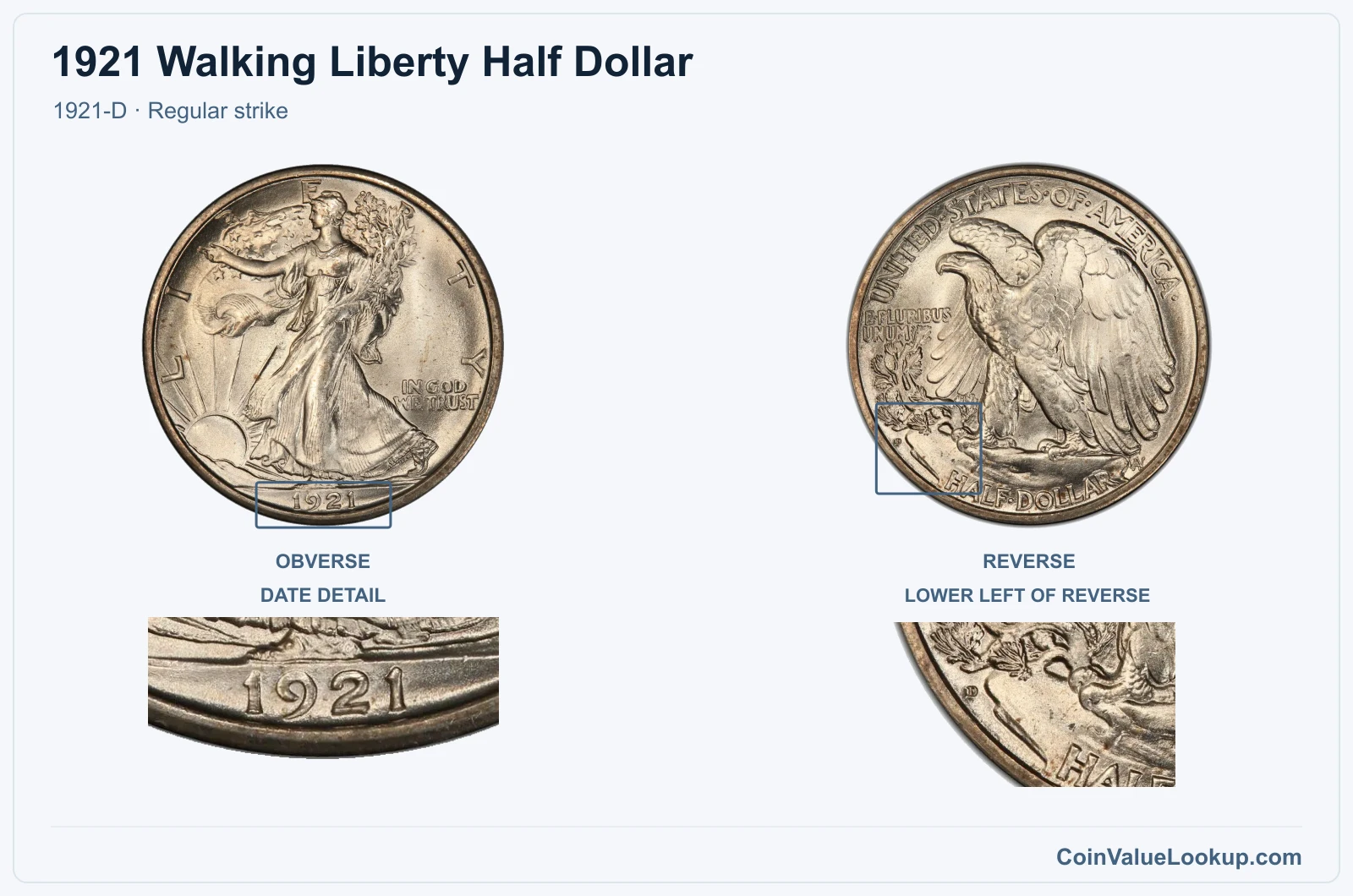
The 1921-D carries a D mintmark on the reverse lower left. This Denver issue is the scarcest of the three mints in lower grades, with a G4 guide estimate of $299.00 from USA Coin Book.
At MS63, the estimate reaches $15,271.00.
Before referencing any price chart, confirm you are looking at genuine wear and not just a weak strike. The 1921-D is known for soft central details even on well-preserved coins.
Surviving luster in the fields and lack of actual smoothing on Liberty's head and hand separate an uncirculated weak strike from a lightly circulated piece. Cleaned or damaged examples trade at a significant discount, so original surfaces matter.
Range Grade
Price Auction Records Appraisal PO PO 1
—
Coin Identifier FR FR 2
Coin Identifier AG AG 3
Coin Identifier G G 4
Coin Identifier
G 6
Coin Identifier VG VG 8
Coin Identifier
VG 10
Coin Identifier F F 12
Coin Identifier
F 15
Coin Identifier VF VF 20
Coin Identifier
VF 25
Coin Identifier
VF 30
Coin Identifier
VF 35
Coin Identifier XF XF 40
Coin Identifier
XF 45
Coin Identifier AU AU 50
Coin Identifier
AU 53
Coin Identifier
AU 55
Coin Identifier
AU 58
Coin Identifier MS MS 60
Coin Identifier
MS 61
Coin Identifier
MS 62
Coin Identifier
MS 63
Coin Identifier
MS 64
Coin Identifier
MS 65
Coin Identifier
MS 66
Coin Identifier
MS 67
—
—
—
MS 68
—
—
—
MS 69
—
—
—
MS 70
—
—
—
1921 Walking Liberty Half Dollar — S
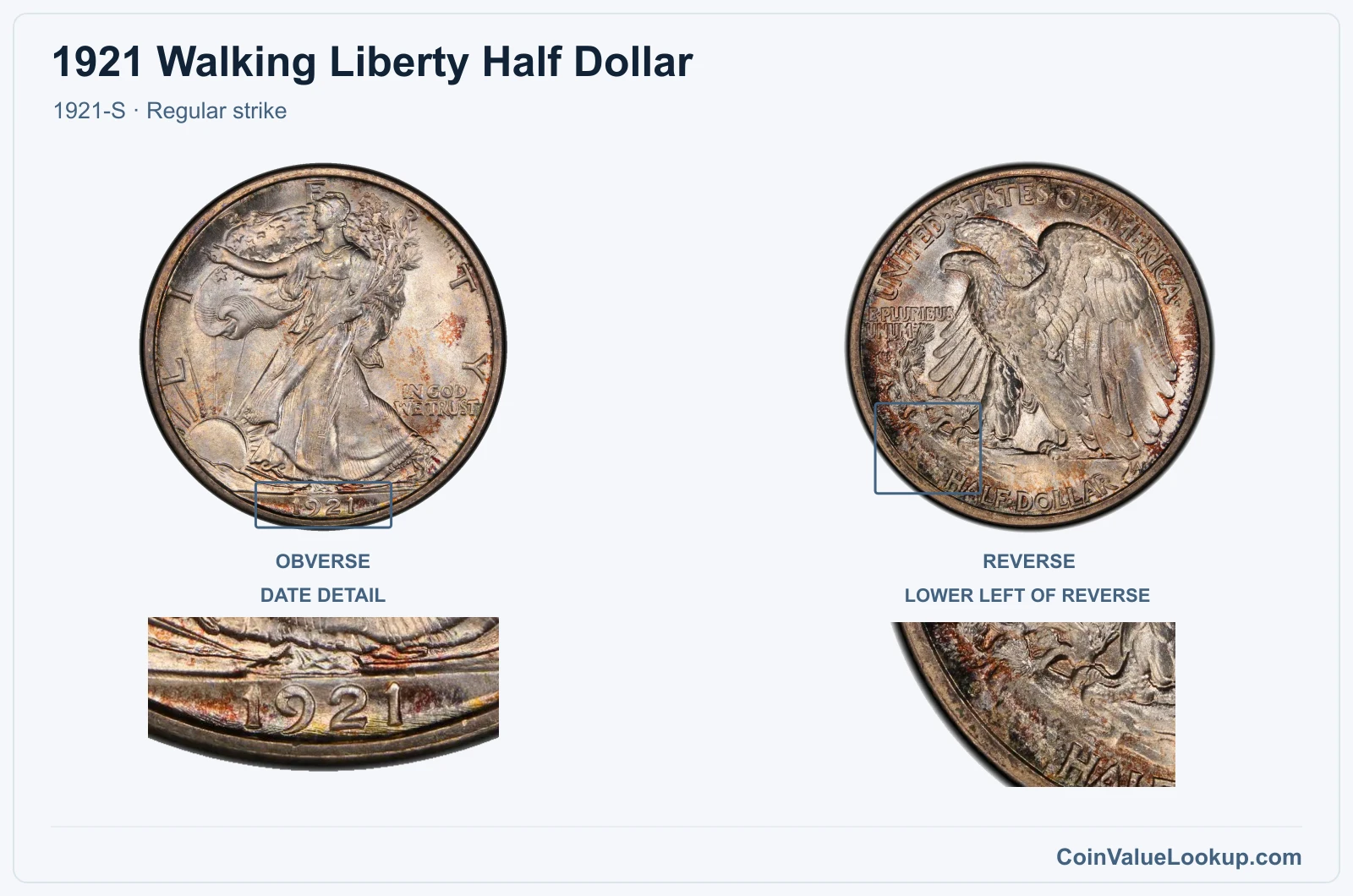
The 1921-S has an S mintmark on the reverse lower left. At G4 it carries the lowest entry point of the three mints at $118.00, but in MS63 it explodes to $38,850.00 according to USA Coin Book.
That spread tells you almost everything: plenty survived in worn condition, but finding one with original mint-state surfaces is extremely difficult.
Verify the mintmark carefully and assess the coin's actual wear honestly. Weak strikes plague this issue, and a soft head or hand does not mean the coin circulated.
Look for luster breaks and real smoothing. As always, cleaned or damaged coins do not qualify for problem-free guide estimates, regardless of how much detail remains.
Range Grade
Price Auction Records Appraisal PO PO 1
—
Coin Identifier FR FR 2
—
Coin Identifier AG AG 3
Coin Identifier G G 4
Coin Identifier
G 6
Coin Identifier VG VG 8
Coin Identifier
VG 10
Coin Identifier F F 12
Coin Identifier
F 15
Coin Identifier VF VF 20
Coin Identifier
VF 25
Coin Identifier
VF 30
Coin Identifier
VF 35
Coin Identifier XF XF 40
Coin Identifier
XF 45
Coin Identifier AU AU 50
Coin Identifier
AU 53
Coin Identifier
AU 55
Coin Identifier
AU 58
Coin Identifier MS MS 60
—
Coin Identifier
MS 61
Coin Identifier
MS 62
Coin Identifier
MS 63
Coin Identifier
MS 64
Coin Identifier
MS 65
Coin Identifier
MS 66
Coin Identifier
MS 67
—
—
—
MS 68
—
—
—
MS 69
—
—
—
MS 70
—
—
—
1921 Walking Liberty Half Dollar Error List
1. 1921 Walking Liberty Half Dollar — Doubled Die Obverse
A Doubled Die Obverse on the 1921 Walking Liberty Half Dollar shows consistent doubling on obverse design elements such as letters or portions of Liberty. Under magnification, look for separation or notching on inscriptions like IN GOD WE TRUST or LIBERTY that appears uniform across the affected area.
The key distinction is consistency. Machine doubling tends to produce a flat, shelf-like appearance, while a genuine doubled die shows rounded, raised secondary contours.
Reflections or worn die lines can also mimic doubling under certain lighting. Compare your coin side by side with a known normal example under the same light angle.
No specific price range is adopted for this variety. Value depends on the strength and visibility of the doubling, the coin's overall condition, and which die is involved.
2. 1921 Walking Liberty Half Dollar — Doubled Die Reverse
A Doubled Die Reverse affects the eagle side of the 1921 Walking Liberty Half Dollar. Examine reverse legends and design contours, particularly around lettering such as UNITED STATES OF AMERICA and E PLURIBUS UNUM, for consistent separation or doubling.
Machine doubling is the most common lookalike. It typically leaves a flat, mushy shelf rather than the crisp secondary image of a true doubled die.
Random damage and die deterioration can also create misleading marks. Compare your coin closely with a normal example at matching magnification before drawing conclusions.
No numerical price is adopted for this error. The value of any doubled die reverse depends on how prominent the doubling is, the coin's grade, and collector demand for that particular die pair.
3. 1921 Walking Liberty Half Dollar — Repunched Mintmark
Repunched mintmarks have been reported on 1921 Walking Liberty Half Dollars struck at branch mints. This error occurs when the mintmark punch was applied more than once in slightly different positions, leaving traces of a second impression near the final letter.
Inspect the D or S mintmark on the reverse lower left under magnification. Look for remnants of a shifted letter, such as a partial outline or serif from an earlier placement.
Compare what you see with a normal mintmark at the same magnification to be sure.
Die chips, corrosion around the mark, or machine doubling can mimic a repunched mintmark. Genuine examples show a distinct secondary punch impression.
No specific price is adopted for this variety; value depends on visibility, die attribution and overall coin condition.
4. 1921 Walking Liberty Half Dollar — Off-Center Strike
An off-center strike on a 1921 Walking Liberty Half Dollar happens when the planchet is not properly seated between the dies at the moment of striking. The result is a displaced design with an unstruck crescent of blank metal along part of the edge.
The percentage of off-center displacement and whether the date remains visible are the two biggest factors collectors care about. A coin that is five percent off-center with a full date is a different proposition from one struck forty percent off-center with no date.
Do not confuse an off-center strike with a clipped planchet, a one-sided die misalignment, or post-mint damage such as flattening from a vise. No numerical price is adopted for this error; value hinges on the degree of the error, the coin's condition, and date visibility.
5. 1921 Walking Liberty Half Dollar — Clipped Planchet
Clipped planchet errors on the 1921 Walking Liberty Half Dollar result from a blank that was improperly cut from the silver strip before striking. The clip may be curved, straight or ragged, depending on how the cutting went wrong.
Look for a missing section of the rim and edge with metal flow or weakness opposite the clip area. That opposite-side weakness, called the Blakesley effect, is a good authentication clue.
The edge texture at the clip should look different from a filed notch or deliberate cut.
Post-mint damage such as edge cuts, filed areas and corrosion can all mimic a genuine clip. No specific price is adopted for this variety.
Value depends on the size and type of the clip, the coin's overall grade, and whether the date and major design elements survive intact.