1928 Walking Liberty Half Dollar Coin Value: How Much Is It Worth?
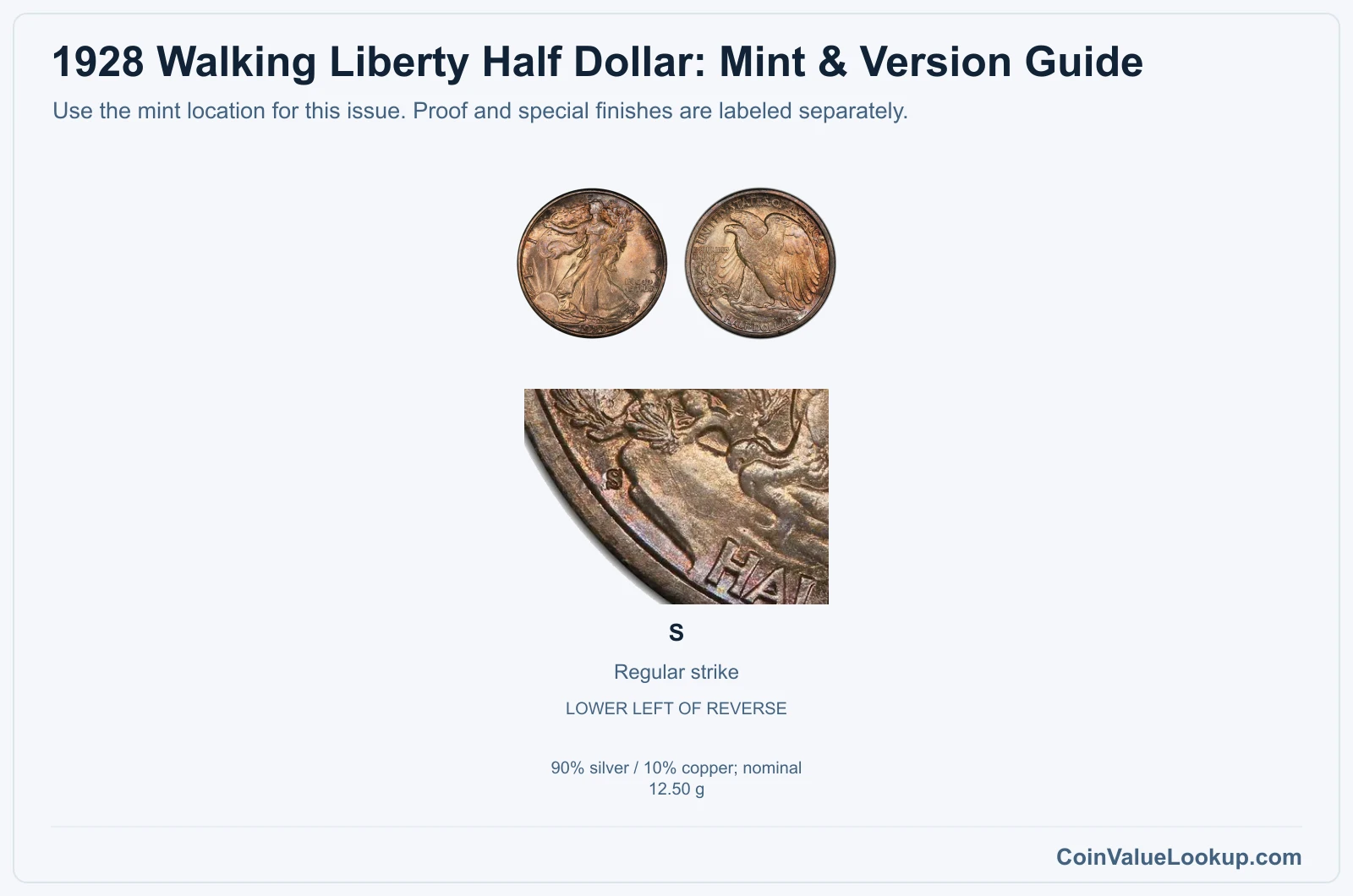
The 1928 Walking Liberty Half Dollar is a 90% silver coin that draws attention from collectors for both its classic design and its metal content. Guide estimates for the single branch issued this year, the 1928-S, range from about $39.00 in Good-4 condition to $3,103.00 at the MS63 level.
These are reference anchors from a published guide, not guaranteed sale prices or current silver-melt quotes. Mint, condition, and any mint-made errors all play a role in what your coin is actually worth.
Fast Way to Identify Your 1928 Walking Liberty Half Dollar
The quickest way to start figuring out what you have is to upload clear photos of the front and back of your coin. That lets us run a preliminary identification covering the mint, general condition, and design details.
Snap both sides in even lighting, and include the edge if you suspect damage or an error. This is not a certified authentication or precise grade assignment, but it gets you pointed in the right direction fast.
1928 Walking Liberty Half Dollar Value
Upload both sides of your 1928 Walking Liberty Half Dollar.
Front Obverse
Upload photo
Back Reverse
Upload photo
Which 1928 Walking Liberty Half Dollar Versions Are Worth Money?
- The 1928-S is the sole business-strike branch this year. In lower grades it trades near silver value, but an MS63 example can reach the $3,103 guide level, so condition is everything.
- Watch for original, problem-free surfaces. Cleaned or damaged coins are not equivalent to naturally toned examples, even at the same apparent grade.
- Strong central detail on a 1928-S Walker is relatively scarce due to strike quality; coins that combine sharp hand and head features with full luster stand out.
- Check for mint-made errors such as laminations, die cracks, clipped planchets, off-center strikes, and wrong-planchet strikes, which are reported for this date.
Step 1: Identify Your 1928 Walking Liberty Half Dollar Mint Mark and Version
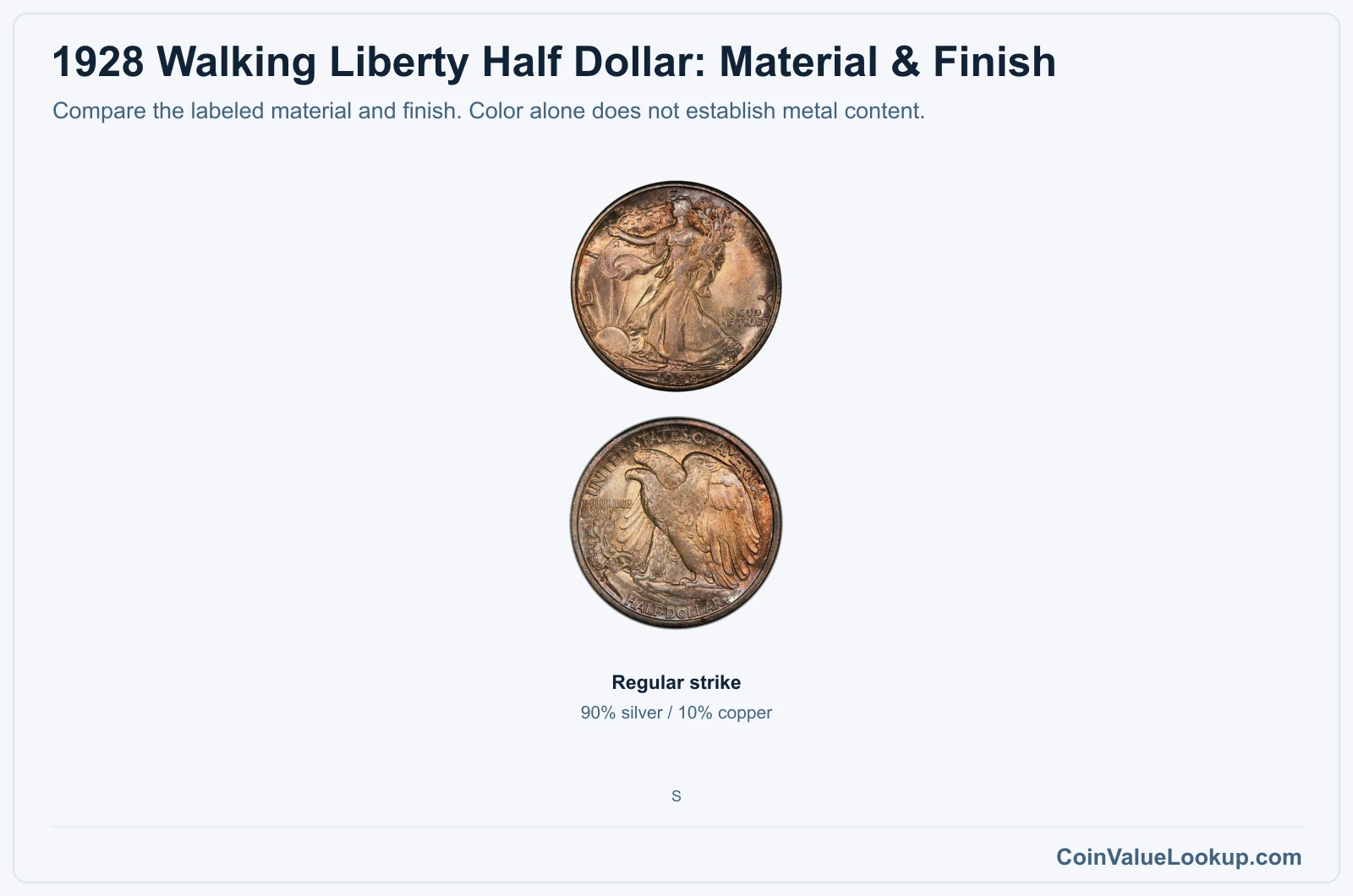
The 1928 Walking Liberty Half Dollar was struck only at the San Francisco Mint, so the only business-strike branch for this date is the 1928-S. The coin is 90% silver and 10% copper, with a nominal weight of 12.50 grams.
Toning may change the surface color but does not alter the underlying alloy.
To find the mintmark, look on the reverse at the lower left, roughly beneath the eagle's tail feathers. A small "S" confirms San Francisco production.
Philadelphia coins carry no mintmark, but Philadelphia did not produce a business-strike Walker in 1928.
Be careful not to confuse the mintmark placement on very early dates in this series. The 1916 issue and early 1917 D and S coins placed the mintmark on the obverse beneath IN GOD WE TRUST.
Later dates, including 1928, moved it to the reverse.
Original surfaces matter. Cleaning, whizzing, or harsh polishing can drop a coin's value well below what a grade-based chart suggests.
Step 2: Check Your 1928 Walking Liberty Half Dollar Grade
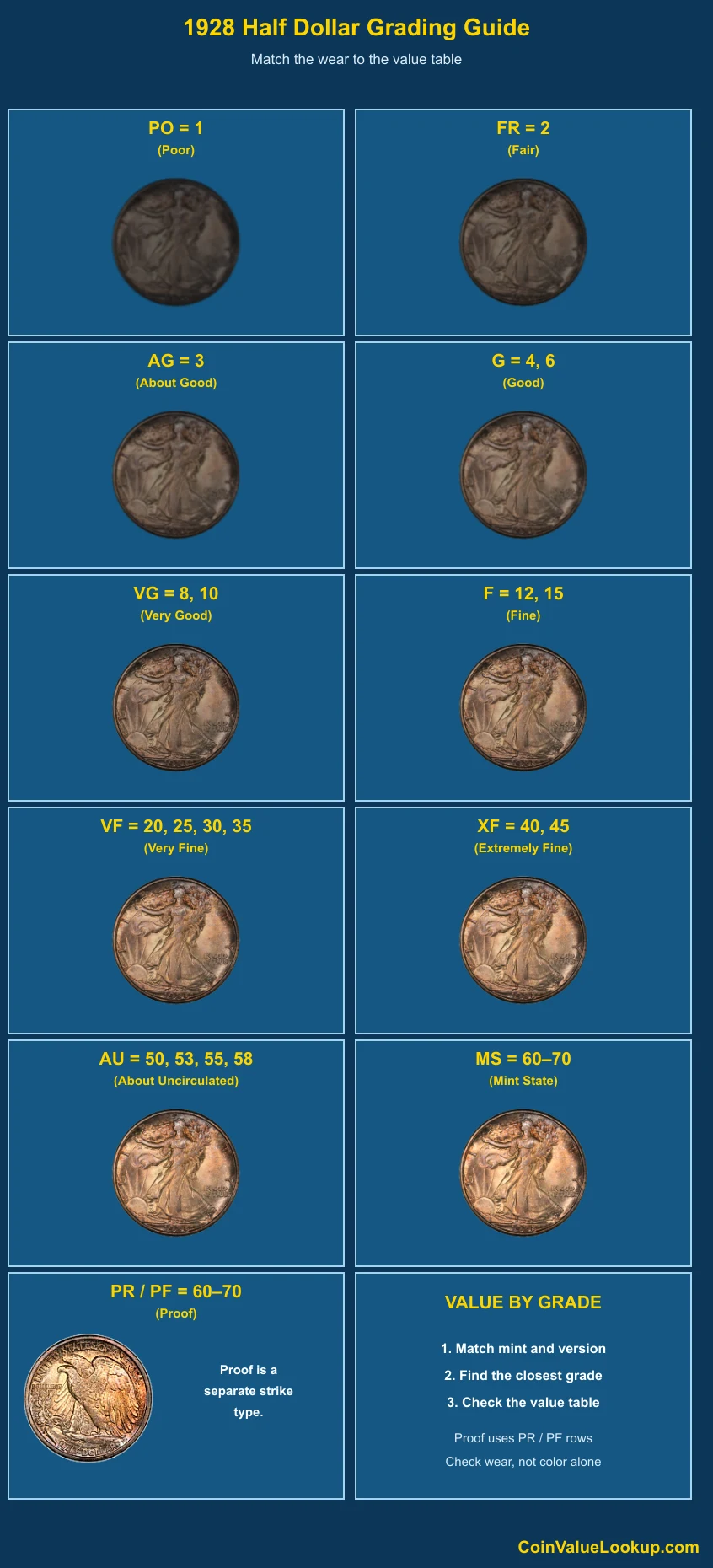
Start with Liberty's head, her left hand holding the branches, and the lines across her skirt at the knee. These are the highest points on the obverse and the first to show smoothing from circulation.
On the reverse, check the eagle's breast feathers, leg, and the tops of the wing feathers.
Here is the tricky part with Walkers: weak central details are common even on coins that never circulated. The San Francisco Mint was notorious for mushy strikes on this series, so a soft hand or incomplete head detail does not automatically mean wear.
Look at the surrounding luster instead. A coin with full, unbroken cartwheel luster across the fields but soft central detail was likely struck that way.
One with interrupted luster and matching smoothness on the high points actually circulated.
Use the comparison image to see how a well-preserved example looks versus a worn one. Genuine wear produces a different texture than a strike weakness, and the distinction matters for accurate grading.
Step 3: Check 1928 Walking Liberty Half Dollar Value by Mint and Version
1928 Walking Liberty Half Dollar — S
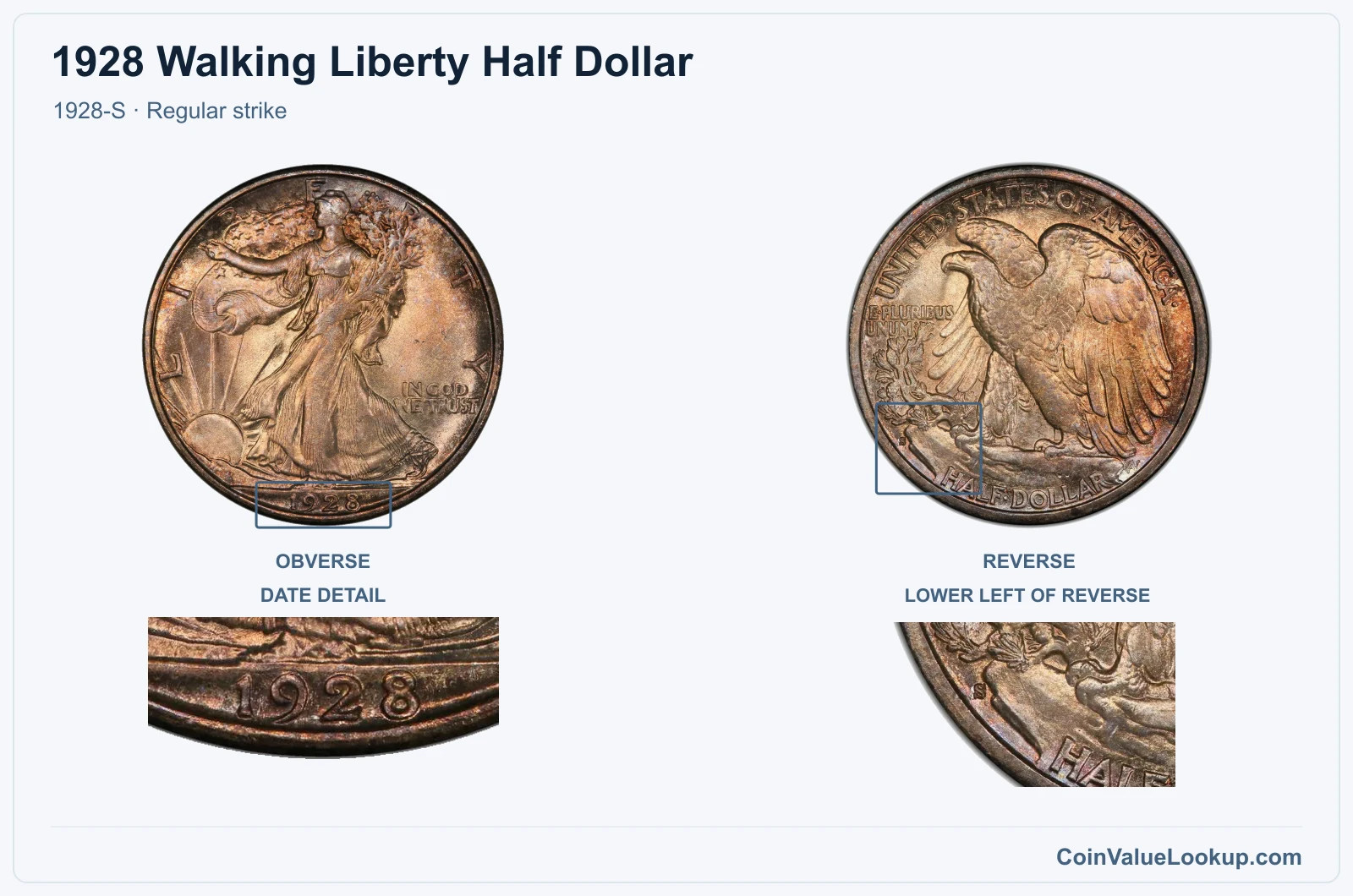
The 1928-S is the only regular-issue Walking Liberty Half Dollar produced this year. It was struck at the San Francisco Mint, and you will find the small "S" mintmark on the reverse lower left.
The coin is 90% silver and 10% copper at a nominal weight of 12.50 grams.
USA Coin Book guide estimates place this coin at roughly $39.00 in Good-4 and $3,103.00 in MS63. That is a huge spread, and it tells you that condition drives the value here far more than simple scarcity.
A well-worn pocket piece trades close to its silver weight, while an uncirculated survivor with strong luster commands a serious premium.
Coin Value Lookup is a good starting point if you want to compare this date against other years in the Walking Liberty series or check values for different denominations entirely.
Before referencing any price chart, confirm the mintmark, check for signs of cleaning, and assess actual wear versus strike weakness. Cleaned or damaged pieces should not be valued the same as problem-free examples, regardless of how much detail remains.
Range Grade
Price Auction Records Appraisal PO PO 1
—
Coin Identifier FR FR 2
—
Coin Identifier AG AG 3
—
Coin Identifier G G 4
—
Coin Identifier
G 6
Coin Identifier VG VG 8
Coin Identifier
VG 10
Coin Identifier F F 12
Coin Identifier
F 15
Coin Identifier VF VF 20
Coin Identifier
VF 25
Coin Identifier
VF 30
Coin Identifier
VF 35
Coin Identifier XF XF 40
Coin Identifier
XF 45
Coin Identifier AU AU 50
Coin Identifier
AU 53
Coin Identifier
AU 55
Coin Identifier
AU 58
Coin Identifier MS MS 60
—
Coin Identifier
MS 61
Coin Identifier
MS 62
Coin Identifier
MS 63
Coin Identifier
MS 64
Coin Identifier
MS 65
Coin Identifier
MS 66
Coin Identifier
MS 67
—
—
—
MS 68
—
—
—
MS 69
—
—
—
MS 70
—
—
—
1928 Walking Liberty Half Dollar Error List
1. 1928 Walking Liberty Half Dollar — Lamination / Split Planchet
A lamination error on a 1928 Walking Liberty Half Dollar shows up as peeling, flaking, or a retained flap of metal on the coin's surface. The planchet separated internally during or after striking, leaving a visible layer that may lift away or remain partially attached.
To document one properly, photograph the affected face and the edge together so the depth of the separation is visible. Compare the area to normal surface texture elsewhere on the coin.
Don't confuse this with post-mint scraping, corrosion pitting, or a coin that someone deliberately cut or filed. Genuine laminations follow the metal's internal structure and usually have smooth, natural-looking edges where they separate.
The value of a lamination error depends on its size, location, and the overall condition of the coin, so individual assessment matters.
2. 1928 Walking Liberty Half Dollar — Die Crack / Die Chip
Die cracks appear as thin, raised lines running across a coin's surface. Die chips show up as small raised blobs, often near lettering or design elements.
Both happen because the steel die fractured during use, and the crack or missing chip transferred as raised metal onto every coin struck afterward.
On a 1928 Walking Liberty Half Dollar, look closely at the rim area and around high-relief portions of the design. A crack that connects the rim to interior design elements is sometimes called a cud when it produces a larger raised area.
The key distinction from damage: die cracks are raised, not incised. Scratches cut into the surface are incuse and post-mint.
Corrosion lines or foreign material stuck to the surface can also mimic a crack at first glance. The premium depends on how dramatic the crack is, where it falls on the design, and the coin's overall grade.
3. 1928 Walking Liberty Half Dollar — Off-Center Strike
An off-center strike happens when the planchet is not seated properly between the dies, so part of the design is missing and a blank crescent of unstruck metal appears on one side. The percentage of displacement matters a lot: a 5% off-center coin is a curiosity, while a 50% off-center piece with a readable date is a different animal entirely.
For a 1928 Walking Liberty Half Dollar, check that the date is still visible, because date-identifiable off-center errors carry a much stronger premium.
Don't confuse an off-center strike with a clipped planchet, which removes material from the blank before striking. Post-mint flattening or one-sided die misalignment can also look similar to an untrained eye.
Value depends on the degree of displacement, date visibility, and the coin's condition, so each example needs individual evaluation.
4. 1928 Walking Liberty Half Dollar — Clipped Planchet
A clipped planchet error occurs when the blank is punched incorrectly from the metal strip before striking, leaving a missing curved, straight, or irregular portion. The result is a coin that is visibly incomplete along part of its rim.
On a 1928 Walking Liberty Half Dollar, look at the edge texture around the missing area. Genuine clips often show a distinctive metal-flow weakness on the opposite side of the coin, called the Blakesley effect.
That opposing weakness is a strong diagnostic.
Filed notches, deliberate edge cuts, and corrosion eating away at the rim can all mimic a clip. Check whether the missing section follows a natural curve consistent with the strip-punching process and whether the adjacent edge has the original reeded texture intact.
Value varies with the size and location of the clip and the coin's overall condition.
5. 1928 Walking Liberty Half Dollar — Wrong Planchet / Off-Metal Strike
A wrong-planchet error means the coin was struck on a blank intended for a different denomination or composition. These are rare and dramatic when genuine.
For a 1928 Walking Liberty Half Dollar, the first step is to weigh the coin and measure its diameter. A normal example is 90% silver, 10% copper, and weighs about 12.50 grams.
If those numbers are significantly off and the design appears complete or partially impressed, a wrong-planchet strike is possible.
Be very cautious, though. Plating, acid treatments, corrosion, and deliberate alterations can all change a coin's appearance and apparent weight enough to fool a casual inspection.
A coin that simply looks odd is not necessarily a wrong-planchet error. Professional authentication is strongly recommended before drawing conclusions.
Because no specific price data is available for this error on the 1928 date, value depends entirely on the individual piece.