1934 Walking Liberty Half Dollar Coin Value: How Much Is It Worth?
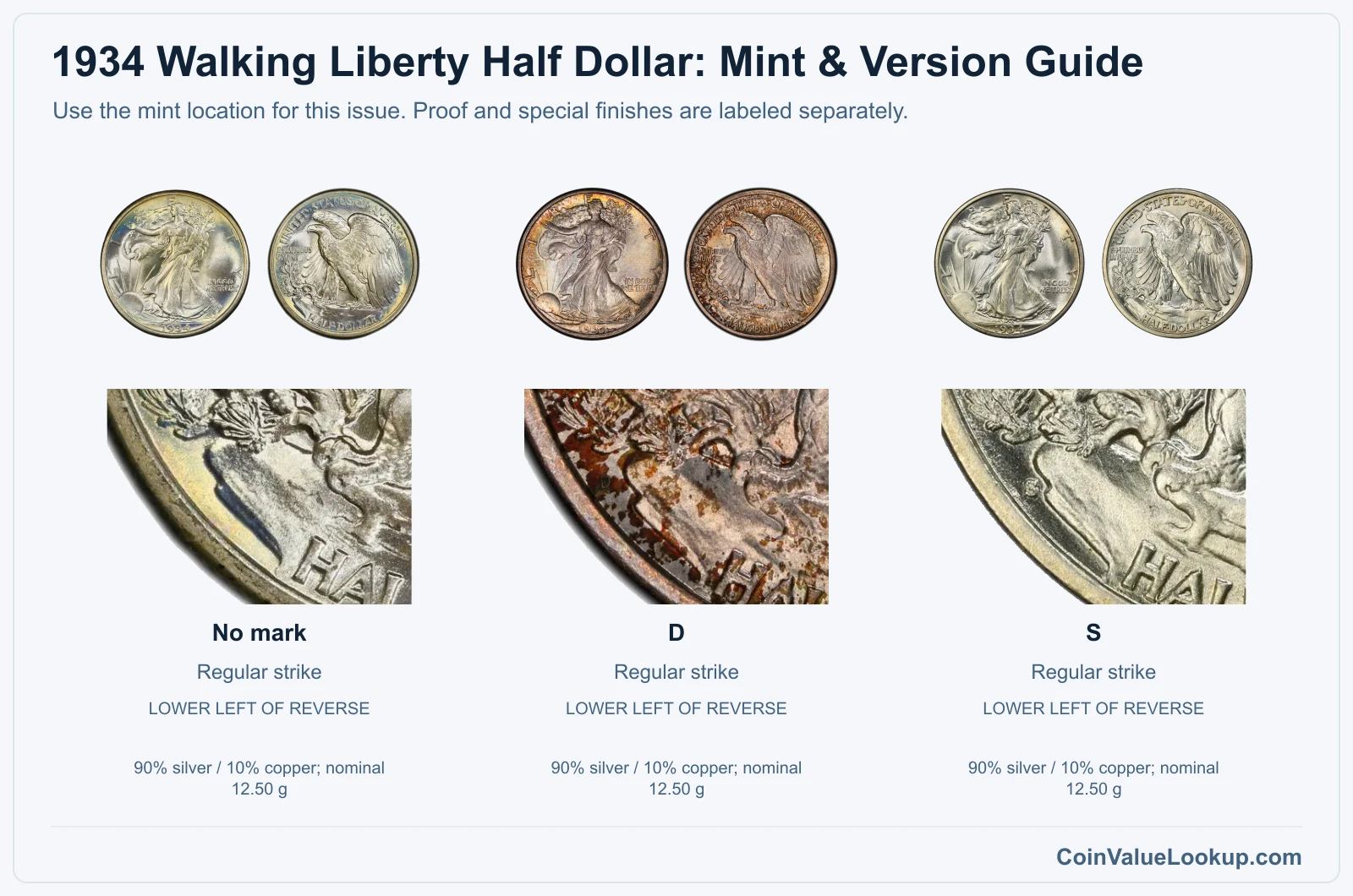
The 1934 Walking Liberty Half Dollar is a 90% silver coin that remains popular with collectors for its classic Adolph Weinman design. Guide estimates for the three business-strike branches range from about $34.00 in well-worn Good-4 condition up to $1,082.00 for a choice Mint State example, depending on the mint and grade.
These are guide anchors, not guaranteed selling prices, and the actual silver content provides a baseline floor for every surviving piece.
Fast Way to Identify Your 1934 Walking Liberty Half Dollar
Snap a clear photo of the front and back of your coin and upload both images. That gives a preliminary identification of the mint, approximate grade and version so you can compare it against the guide values below.
Good lighting and a steady hand help, especially for the mintmark area on the reverse lower left.
1934 Walking Liberty Half Dollar Value
Upload both sides of your 1934 Walking Liberty Half Dollar.
Front Obverse
Upload photo
Back Reverse
Upload photo
Which 1934 Walking Liberty Half Dollar Versions Are Worth Money?
- The 1934-S (San Francisco) jumps to around $1,082 at MS63 per the USA Coin Book guide, far above the Philadelphia and Denver issues at the same grade, making it the branch to check first.
- The 1934-D (Denver) carries a guide estimate of about $362 at MS63, a meaningful premium over the Philadelphia strike at the same level.
- The 1934 Philadelphia issue lists at roughly $141 at MS63; even well-circulated G4 examples of all three branches start around $34 thanks to silver content.
- Original, problem-free surfaces matter across every branch. Cleaned or damaged coins trade below guide estimates regardless of the date or mint.
Step 1: Identify Your 1934 Walking Liberty Half Dollar Mint Mark and Version
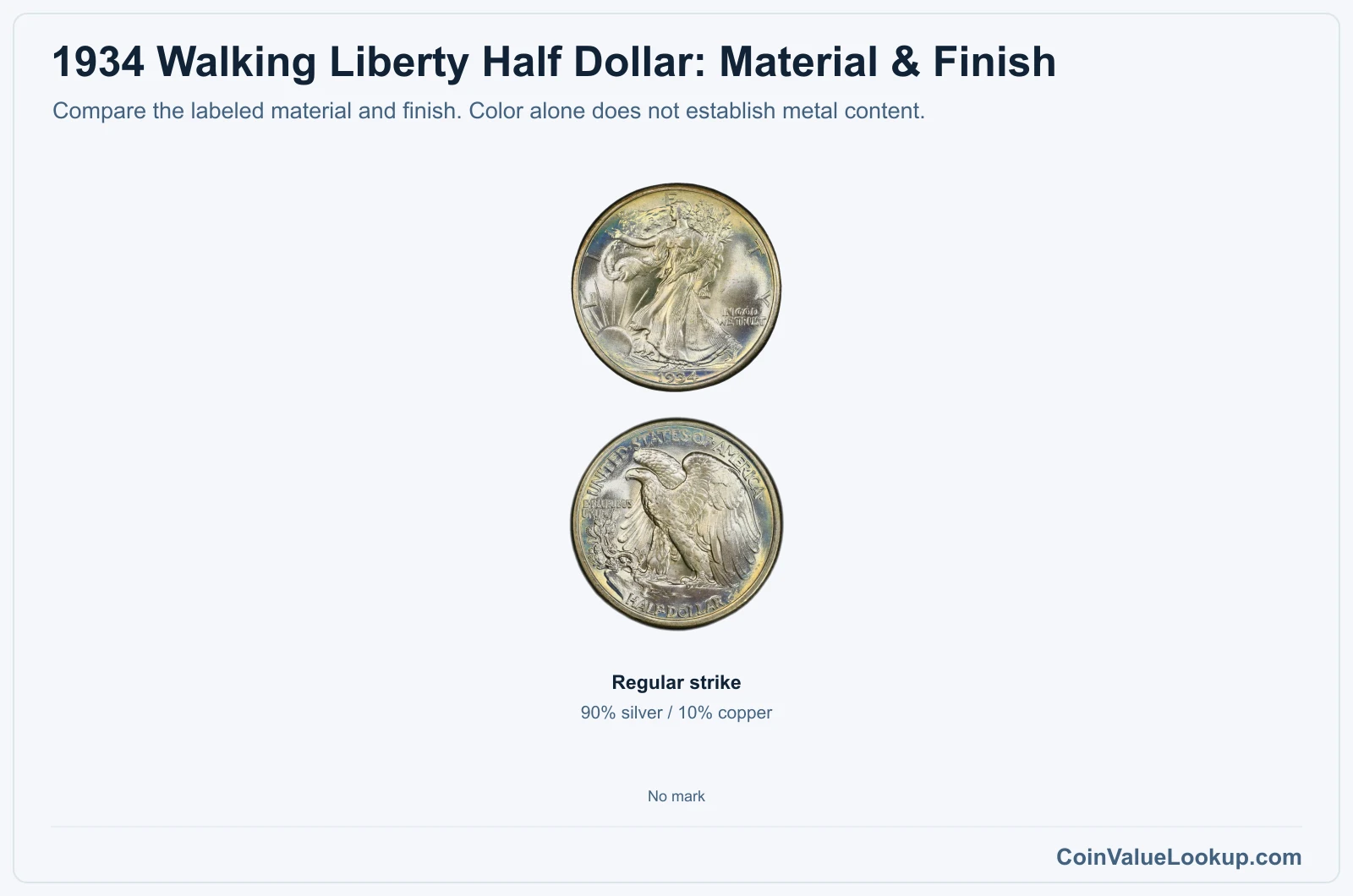
All three 1934 branches share the same 90% silver, 10% copper composition at a nominal 12.50 g. The design shows Liberty striding toward the sun on the obverse and an eagle perched on a rock on the reverse.
To tell them apart, flip the coin over and look at the lower left of the reverse, just below the branch the eagle is standing on. A "D" means Denver, an "S" means San Francisco, and no letter at all means Philadelphia.
That mintmark location applies to 1934 and most later dates in the series; only the 1916 and early 1917 issues carried the mark on the obverse.
Don't confuse natural silver toning or surface color with a different alloy. The coin is still 90% silver regardless of whether it has turned charcoal gray or remained bright.
Cleaned or damaged pieces, however, trade well below problem-free examples at the same grade.
Step 2: Check Your 1934 Walking Liberty Half Dollar Grade
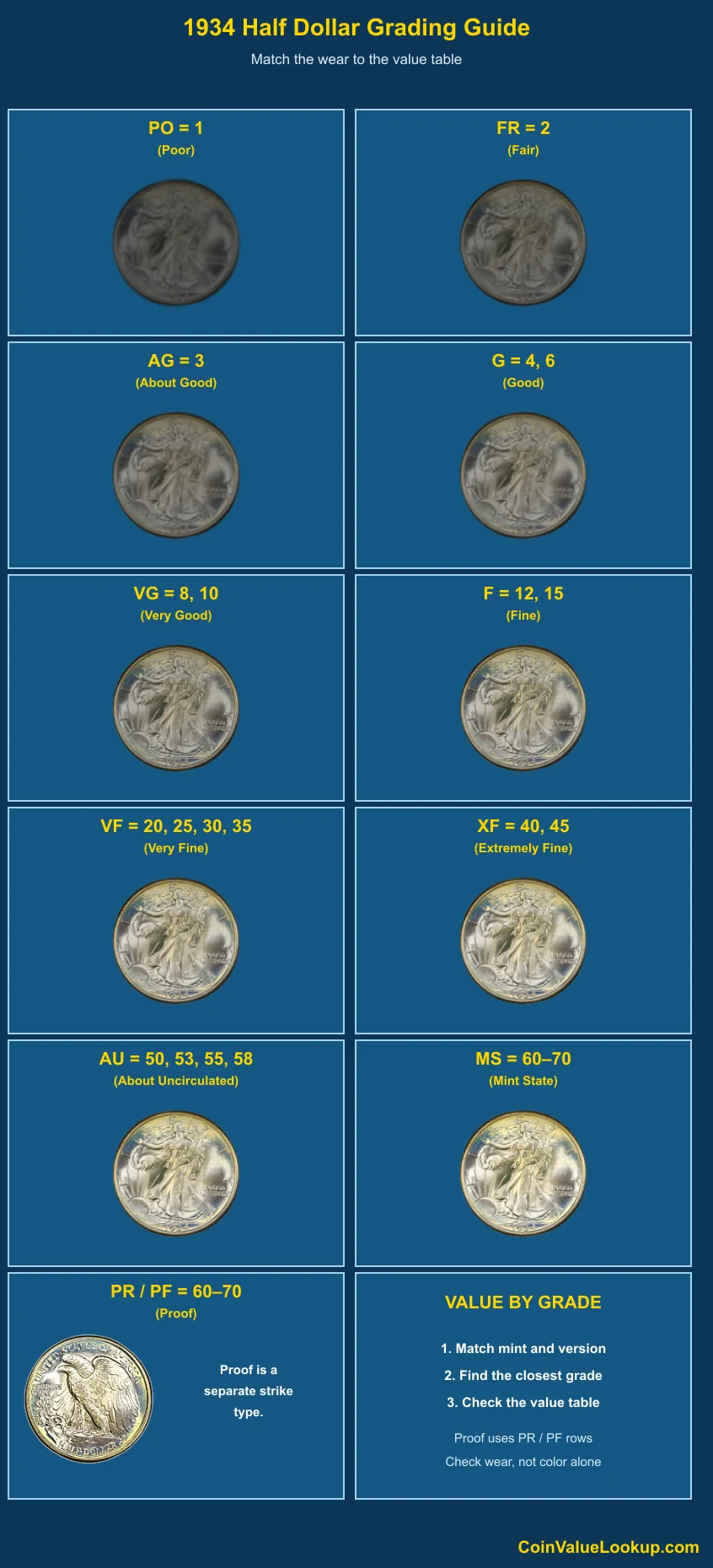
Start with Liberty's head, her left hand holding the branches, and the area around her knee and skirt folds. These are the highest points and the first to show smoothing from circulation.
On the reverse, check the eagle's breast feathers, legs and wing tips.
Here is the tricky part with Walkers: weak central strikes are common even on coins that never circulated. A soft hand or mushy head does not automatically mean the coin is worn.
Look at the surrounding luster. If the fields still carry original mint frost but the central details are soft, you likely have a strike issue rather than wear.
Compare your coin to the grading image for this type. Genuine wear produces a progressive loss of luster and flattening that spreads outward from the high points, whereas a strike weakness is usually confined to a specific zone with full luster around it.
If you can see every skirt line, a sharp hand, and full eagle feathers with unbroken cartwheel luster, you are looking at a solidly Mint State coin. If the entire surface is smooth and gray with no luster, you are down in the Good range.
Step 3: Check 1934 Walking Liberty Half Dollar Value by Mint and Version
1934 Walking Liberty Half Dollar
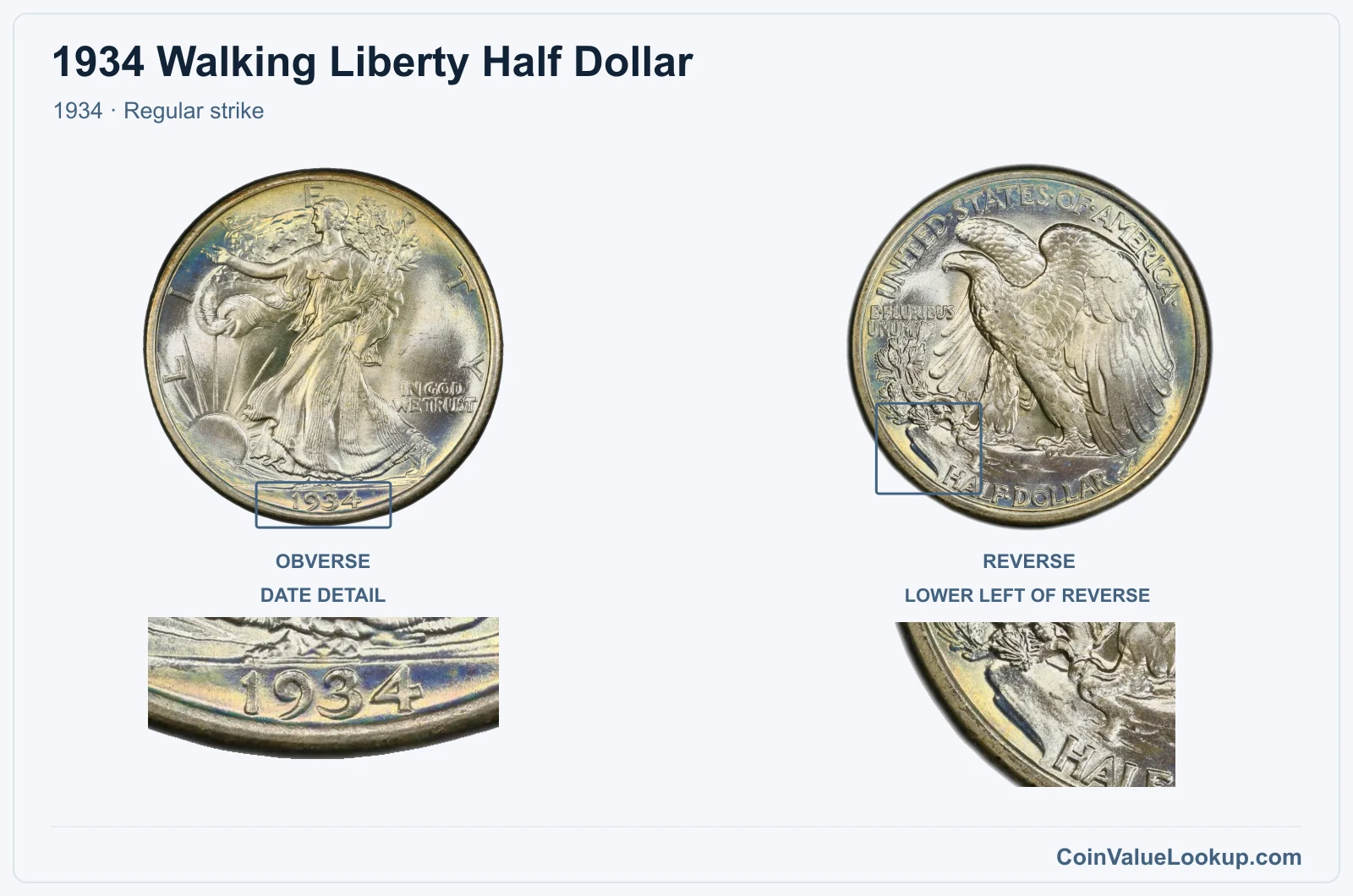
The 1934 Philadelphia half dollar has no mintmark. Look at the reverse lower left; if the space is blank, you have the Philly issue.
USA Coin Book guide estimates place this branch at about $34 in G4 and around $141 in MS63.
Those are not guaranteed buy prices. They are reference anchors that assume a problem-free coin with original surfaces.
A cleaned or scratched example will trade lower. Silver content supports a baseline value in any condition, but collectors pay the premium for eye appeal and correct grade.
Strong central detail on a Philadelphia Walker is a plus, since many survivors show typically soft strikes on Liberty's hand and head.
Range Grade
Price Auction Records Appraisal PO PO 1
—
Coin Identifier FR FR 2
—
Coin Identifier AG AG 3
—
Coin Identifier G G 4
—
Coin Identifier
G 6
—
Coin Identifier VG VG 8
Coin Identifier
VG 10
—
Coin Identifier F F 12
—
Coin Identifier
F 15
Coin Identifier VF VF 20
—
Coin Identifier
VF 25
—
Coin Identifier
VF 30
—
Coin Identifier
VF 35
—
Coin Identifier XF XF 40
Coin Identifier
XF 45
—
Coin Identifier AU AU 50
—
Coin Identifier
AU 53
Coin Identifier
AU 55
Coin Identifier
AU 58
Coin Identifier MS MS 60
—
Coin Identifier
MS 61
Coin Identifier
MS 62
Coin Identifier
MS 63
Coin Identifier
MS 64
Coin Identifier
MS 65
Coin Identifier
MS 66
Coin Identifier
MS 67
Coin Identifier
MS 68
Coin Identifier
MS 69
—
—
—
MS 70
—
—
—
1934 Walking Liberty Half Dollar — D
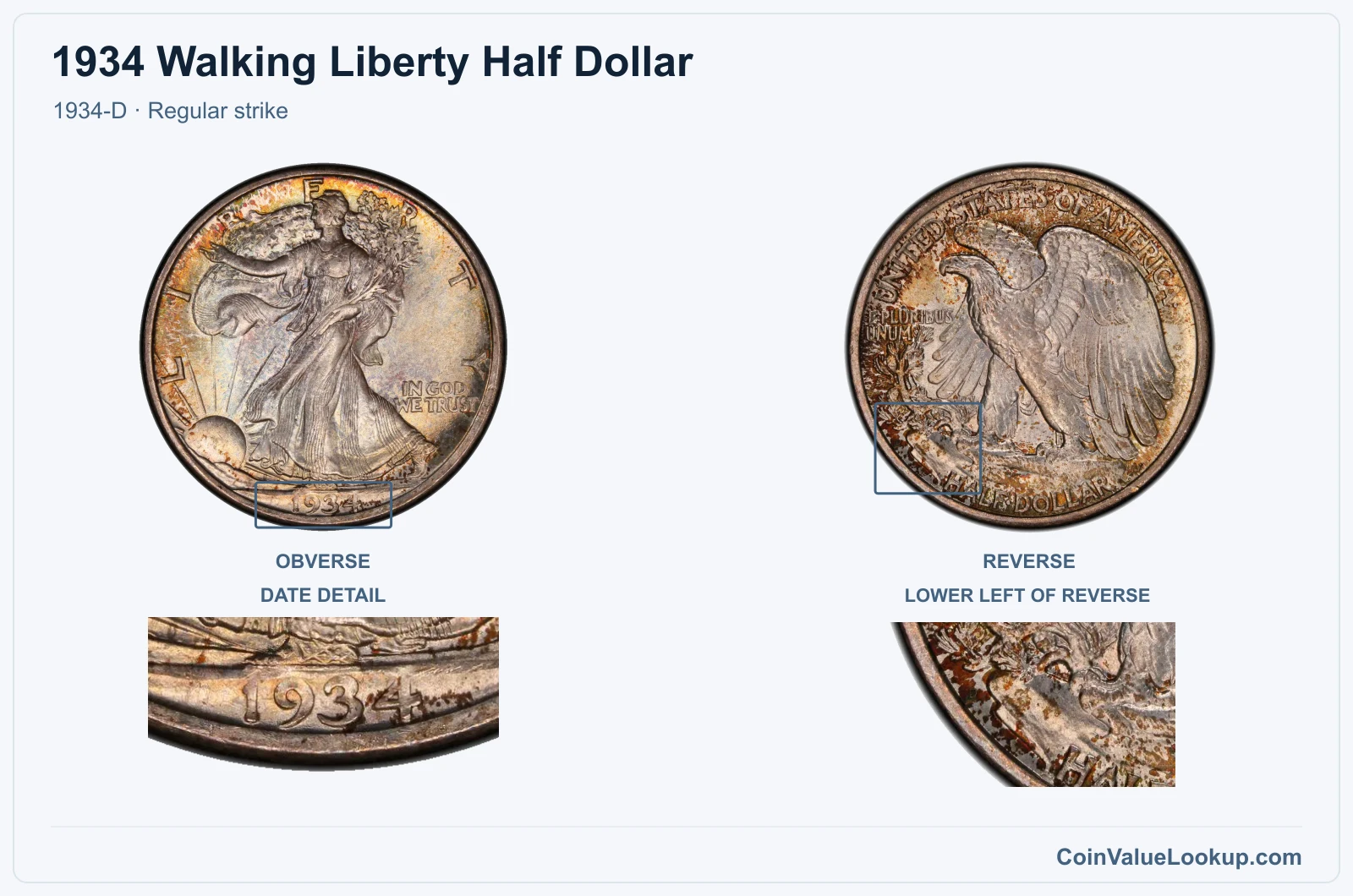
A small "D" on the reverse lower left identifies the Denver mint strike. In heavily worn G4 condition the guide estimate is about $34, on par with Philadelphia.
The gap widens at higher grades: an MS63 example lists around $362 per USA Coin Book.
That jump reflects how scarce nice uncirculated Denver pieces are compared to Philadelphia survivors. Before you assume yours is Mint State, check for actual luster, not just remaining detail.
A lightly circulated 1934-D with honest wear is still a solid coin; just don't confuse a weak strike for a higher grade than the surfaces support.
Coin Value Lookup is a handy starting point when you want to compare this half dollar against other dates and denominations in the series. You can look up guides for different years without hunting through multiple sites.
Range Grade
Price Auction Records Appraisal PO PO 1
—
Coin Identifier FR FR 2
—
Coin Identifier AG AG 3
—
Coin Identifier G G 4
—
Coin Identifier
G 6
—
Coin Identifier VG VG 8
—
Coin Identifier
VG 10
—
Coin Identifier F F 12
—
Coin Identifier
F 15
—
Coin Identifier VF VF 20
—
Coin Identifier
VF 25
—
Coin Identifier
VF 30
—
Coin Identifier
VF 35
—
Coin Identifier XF XF 40
Coin Identifier
XF 45
Coin Identifier AU AU 50
Coin Identifier
AU 53
Coin Identifier
AU 55
Coin Identifier
AU 58
Coin Identifier MS MS 60
Coin Identifier
MS 61
Coin Identifier
MS 62
Coin Identifier
MS 63
Coin Identifier
MS 64
Coin Identifier
MS 65
Coin Identifier
MS 66
Coin Identifier
MS 67
Coin Identifier
MS 68
—
—
—
MS 69
—
—
—
MS 70
—
—
—
1934 Walking Liberty Half Dollar — S
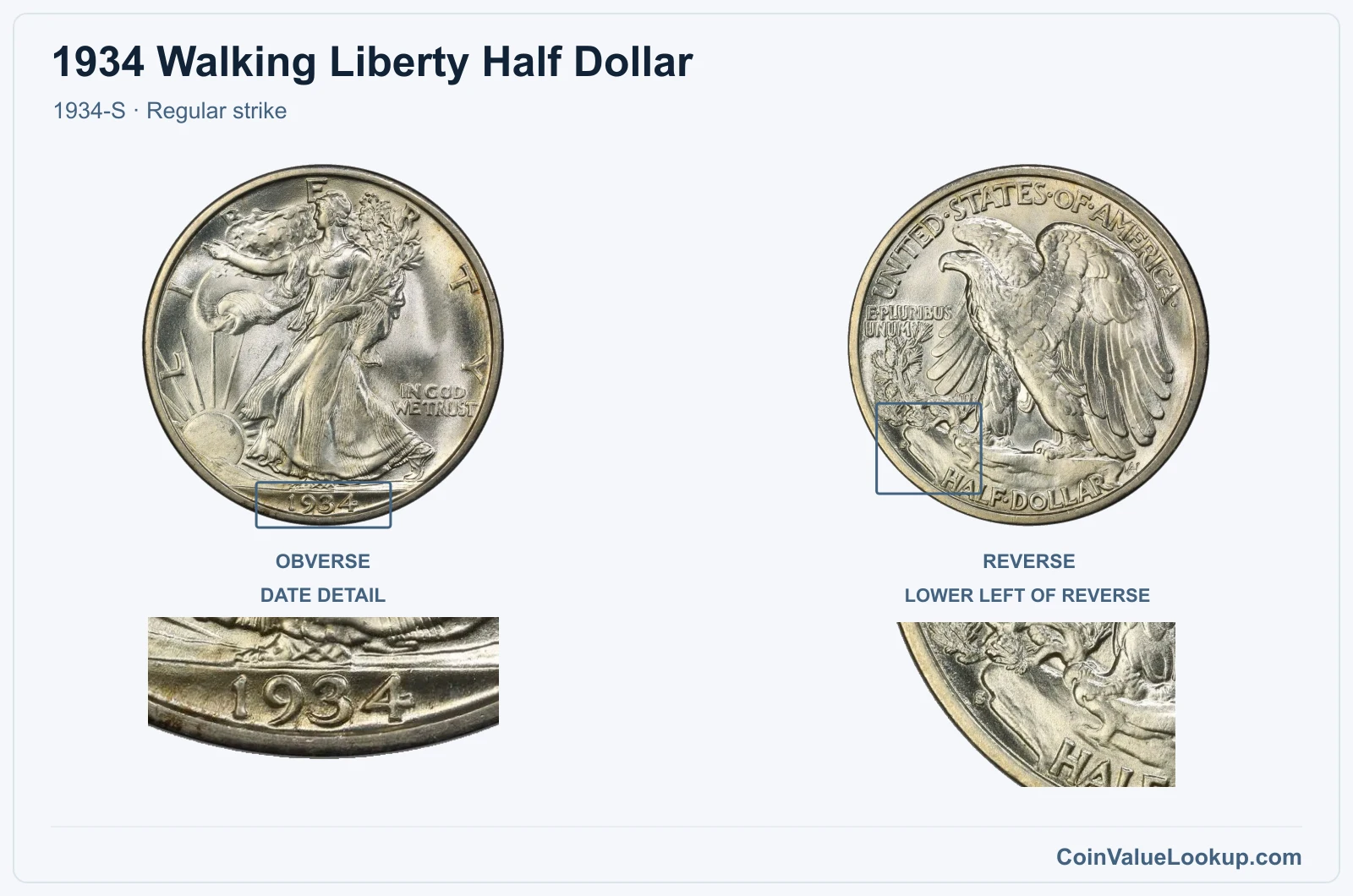
The "S" mintmark on the reverse lower left marks this as the San Francisco issue, and it is the standout branch for 1934. The USA Coin Book guide places a G4 example at about $34, similar to the other two mints.
At MS63, though, the estimate climbs to roughly $1,082.
That gap tells you something: plenty of 1934-S halves circulated hard, but far fewer survived in choice uncirculated condition. If you have one with full cartwheel luster and minimal contact marks, it deserves careful handling and probably professional grading.
Weak central strikes are especially common on San Francisco Walkers, so use luster and surface smoothness rather than just head and hand sharpness to judge the grade. Cleaned or damaged pieces will not command anywhere near the MS63 figure, even if they look bright.
Range Grade
Price Auction Records Appraisal PO PO 1
—
Coin Identifier FR FR 2
—
Coin Identifier AG AG 3
—
Coin Identifier G G 4
—
Coin Identifier
G 6
—
Coin Identifier VG VG 8
—
Coin Identifier
VG 10
—
Coin Identifier F F 12
—
Coin Identifier
F 15
Coin Identifier VF VF 20
—
Coin Identifier
VF 25
—
Coin Identifier
VF 30
—
Coin Identifier
VF 35
Coin Identifier XF XF 40
Coin Identifier
XF 45
Coin Identifier AU AU 50
Coin Identifier
AU 53
Coin Identifier
AU 55
Coin Identifier
AU 58
Coin Identifier MS MS 60
Coin Identifier
MS 61
Coin Identifier
MS 62
Coin Identifier
MS 63
Coin Identifier
MS 64
Coin Identifier
MS 65
Coin Identifier
MS 66
Coin Identifier
MS 67
Coin Identifier
MS 68
—
—
—
MS 69
—
—
—
MS 70
—
—
—
1934 Walking Liberty Half Dollar Error List
1. 1934 Walking Liberty Half Dollar — Off-Center Strike
An off-center strike happens when the planchet is not seated properly between the dies. The result is a crescent-shaped blank area on one side and a shifted design on the other.
The key diagnostic is that part of the design is simply missing, not just weak or blurry. Make sure the date is still visible; dateless off-center coins lose much of their collector premium.
Do not confuse this with a misaligned die, which shifts one side relative to the other but still strikes the full planchet, or with post-mint damage like a flattened rim. A genuine off-center error will have a smooth, unstruck area that matches the original planchet edge.
No specific price is adopted for this error on the 1934 Walker; value depends on the percentage of off-center shift, date visibility and overall condition.
2. 1934 Walking Liberty Half Dollar — Struck-Through Error
A struck-through error occurs when foreign material, often grease or a fragment of metal, sits between the die and the planchet during striking. The coin ends up with a localized depression, a filled area, or an impression of whatever got in the way.
If grease was the culprit, you will typically see a smooth, slightly sunken patch where design detail is absent. A retained foreign object may leave a distinct outline or texture.
The difference from ordinary wear or cleaning is that the affected zone is sharply bounded and the surrounding design remains fully struck. Scratches cross existing design elements; a struck-through area replaces them.
No adopted price is available for this error on the 1934 Walking Liberty Half Dollar. Value will depend on the size, location and visual drama of the obstruction, plus the coin's overall condition.
3. 1934 Walking Liberty Half Dollar — Lamination / Split Planchet
Lamination errors show up as peeling, flaking or splitting within the metal itself. On a 1934 Walker you might see a thin flap of silver lifting away from the surface, or a visible crack where the alloy has separated internally.
Photograph both the affected face and the edge of the coin together; that edge view often confirms the separation runs through the planchet rather than just sitting on the surface.
This is different from corrosion pitting, deliberate scraping, or a coin that someone tried to split apart. Genuine lamination follows the metal's internal structure and usually has irregular, natural-looking edges rather than tool marks.
No specific price is adopted for this error. Value depends on how dramatic the separation is and whether the coin retains an identifiable date and design around the affected area.
4. 1934 Walking Liberty Half Dollar — Double / Multiple Strike
A double-strike error means the coin received two (or more) separate impressions from the dies. You will see a second, displaced or rotated copy of part of the design overlapping the first.
The two images are distinct enough that you can trace separate outlines of Liberty or the eagle.
Do not confuse this with a doubled die, which is a different category. A doubled die produces slightly split or shelf-like doubling from a die-manufacturing issue, while a double strike creates two fully formed, often dramatically offset impressions from the coin being struck again.
Also watch for post-mint "vise job" impressions where someone deliberately restruck a coin outside the Mint. A genuine double strike will show proper strike characteristics on both impressions.
No adopted price is available; value depends on the degree of displacement and the coin's condition.
5. 1934 Walking Liberty Half Dollar — Wrong Planchet / Off-Metal Strike
A wrong-planchet error means the 1934 Walking Liberty Half Dollar dies struck a blank intended for a different denomination or composition. The coin will look visually off: the weight, diameter, or edge will not match a standard half dollar.
You might notice the design is incomplete because the planchet was too small, or the coin feels suspiciously light or heavy.
To check, weigh the coin and measure its diameter. A normal 1934 half dollar should be about 12.50 g and 30.6 mm.
Significant deviation is a clue. Be careful to rule out plating, acid treatment, heavy corrosion, or intentional alteration, all of which can change a coin's appearance and weight without being mint errors.
No numerical price is adopted for this error on the 1934 issue. Value depends on the specific wrong planchet involved and the coin's overall preservation.