1978 Jefferson Nickel Coin Value: How Much Is It Worth?
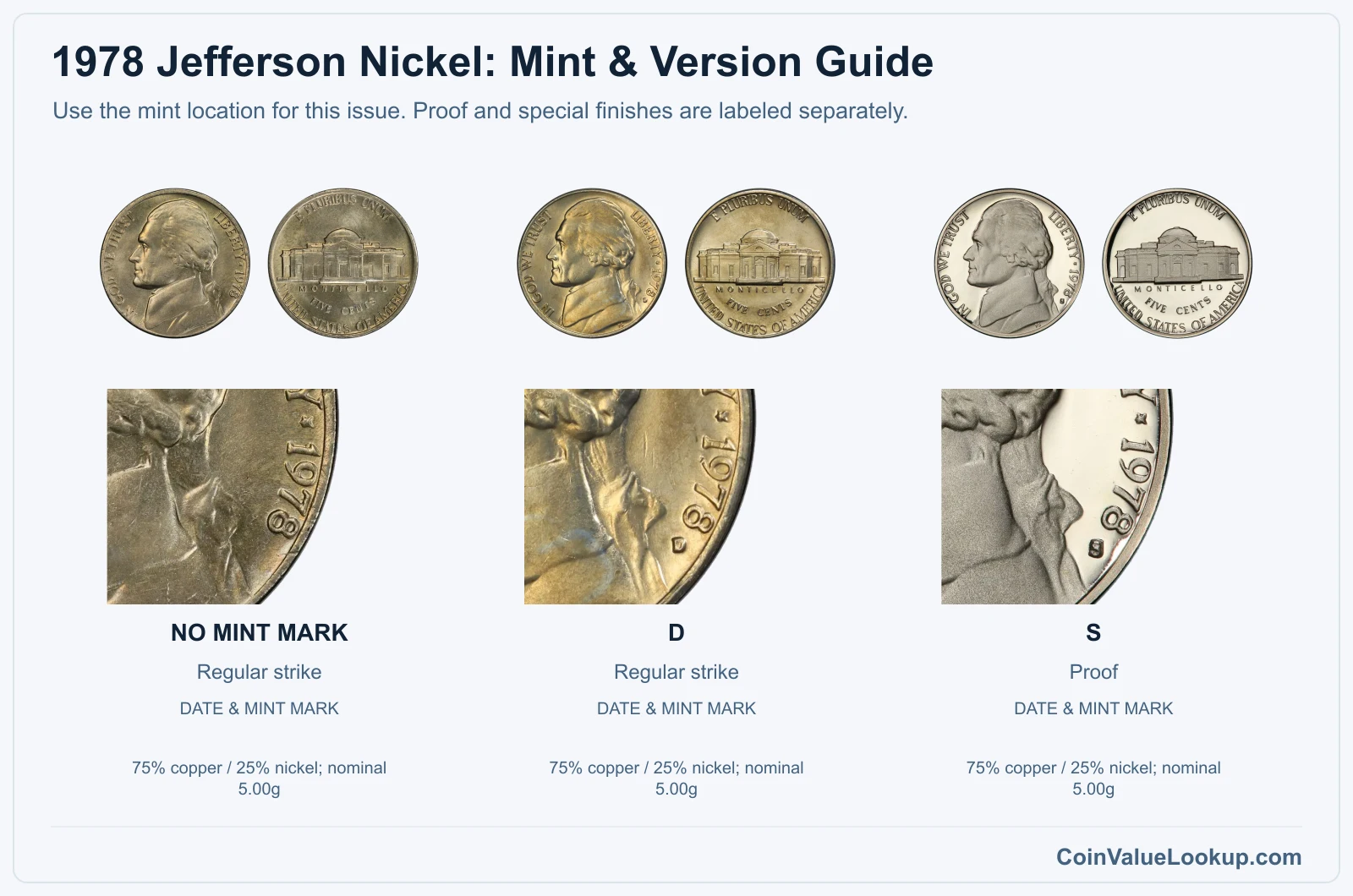
Most 1978 Jefferson nickels pulled from circulation are worth face value — five cents, full stop. The coins become collectible in uncirculated condition, where guide estimates from USA Coin Book range from about $0.30 at MS60 to $3.62 at MS65, depending on grade.
Proofs and authenticated error strikes occupy their own pricing lanes and should not be lumped together with ordinary business strikes.
Fast Way to Identify Your 1978 Jefferson Nickel
The quickest way to start figuring out what you have is to upload clear photos of the front and back of your coin. That lets us offer a preliminary identification of the mint, finish, and any obvious unusual features.
Snap both sides in good light, keep the coin flat, and make sure the date and any small mintmark below it are in focus.
1978 Jefferson Nickel Value
Upload both sides of your 1978 Jefferson Nickel.
Front Obverse
Upload photo
Back Reverse
Upload photo
Which 1978 Jefferson Nickel Versions Are Worth Money?
- High-grade uncirculated business strikes — especially those certified with Full Steps detail — can command a premium over the base guide values.
- San Francisco proofs trade in a separate market from circulation strikes; base proof guide value sits around $2.50 at PR65.
- Authenticated wrong-planchet errors, such as a nickel struck on a cent blank, have sold individually for over $200 at auction.
Step 1: Identify Your 1978 Jefferson Nickel Mint Mark and Version
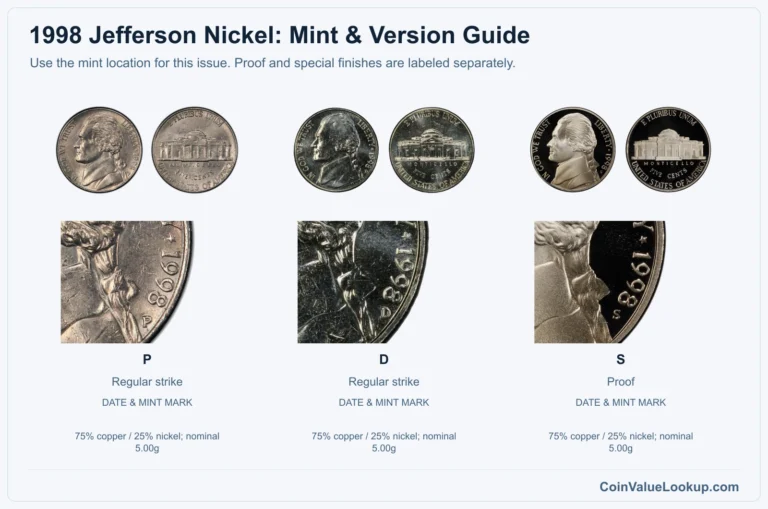
Three versions of the 1978 Jefferson nickel exist. A coin with no mintmark below the date was struck at Philadelphia for general circulation.
A small "D" in the same spot means Denver, also a circulation strike. An "S" identifies a San Francisco proof, sold in special sets — not released into pocket change.
All three share the same composition: 75% copper and 25% nickel in a solid alloy, weighing nominally 5 grams with a plain edge and a diameter of 21.2 mm. This is not a clad sandwich; the entire coin is the same copper-nickel blend throughout, so any color anomaly you see is surface-level, not a missing layer.
A proof finish shows mirror-like fields and sharply struck details. That is a manufacturing method, not a grade above Mint State.
Recording the date, mintmark, finish, weight, and both faces gives you the information needed to place the coin in the right category.
Step 2: Check Your 1978 Jefferson Nickel Grade
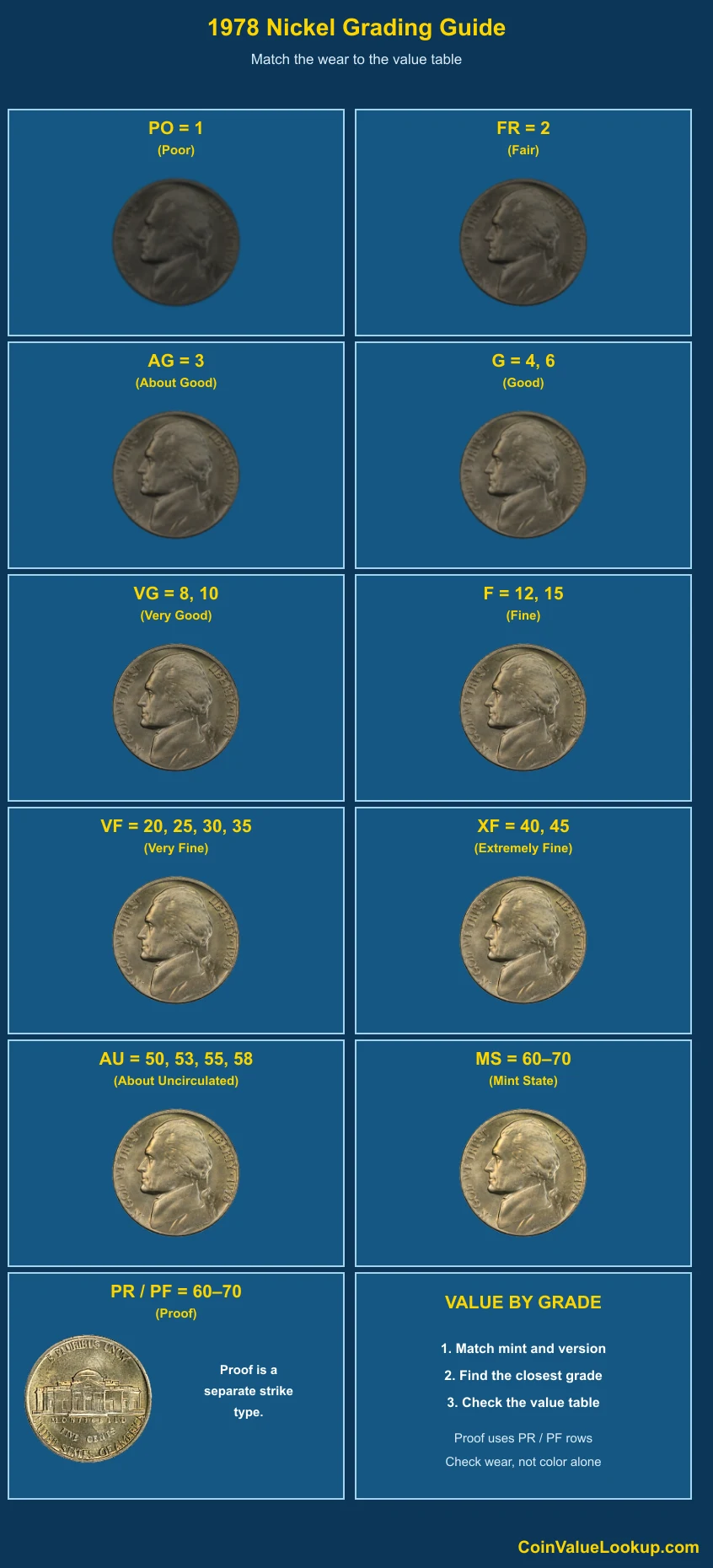
Start with Jefferson's cheekbone and the hair detail behind his ear — those are the first spots to show wear. On the reverse, the columns and steps of Monticello lose sharpness as the coin circulates.
Surface luster, bag marks, and overall eye appeal all factor into a coin's grade.
Full Steps is a separate strike-quality designation, not a wear grade. It means the horizontal steps at the base of Monticello are uninterrupted and fully formed.
A weakly struck coin can lack Full Steps even without any wear at all, so don't confuse a soft strike with a worn coin. Use the comparison image to judge where your piece falls on the spectrum from heavily circulated to gem uncirculated.
Step 3: Check 1978 Jefferson Nickel Value by Mint and Version
1978 Jefferson Nickel — No mintmark (Philadelphia) Business strike
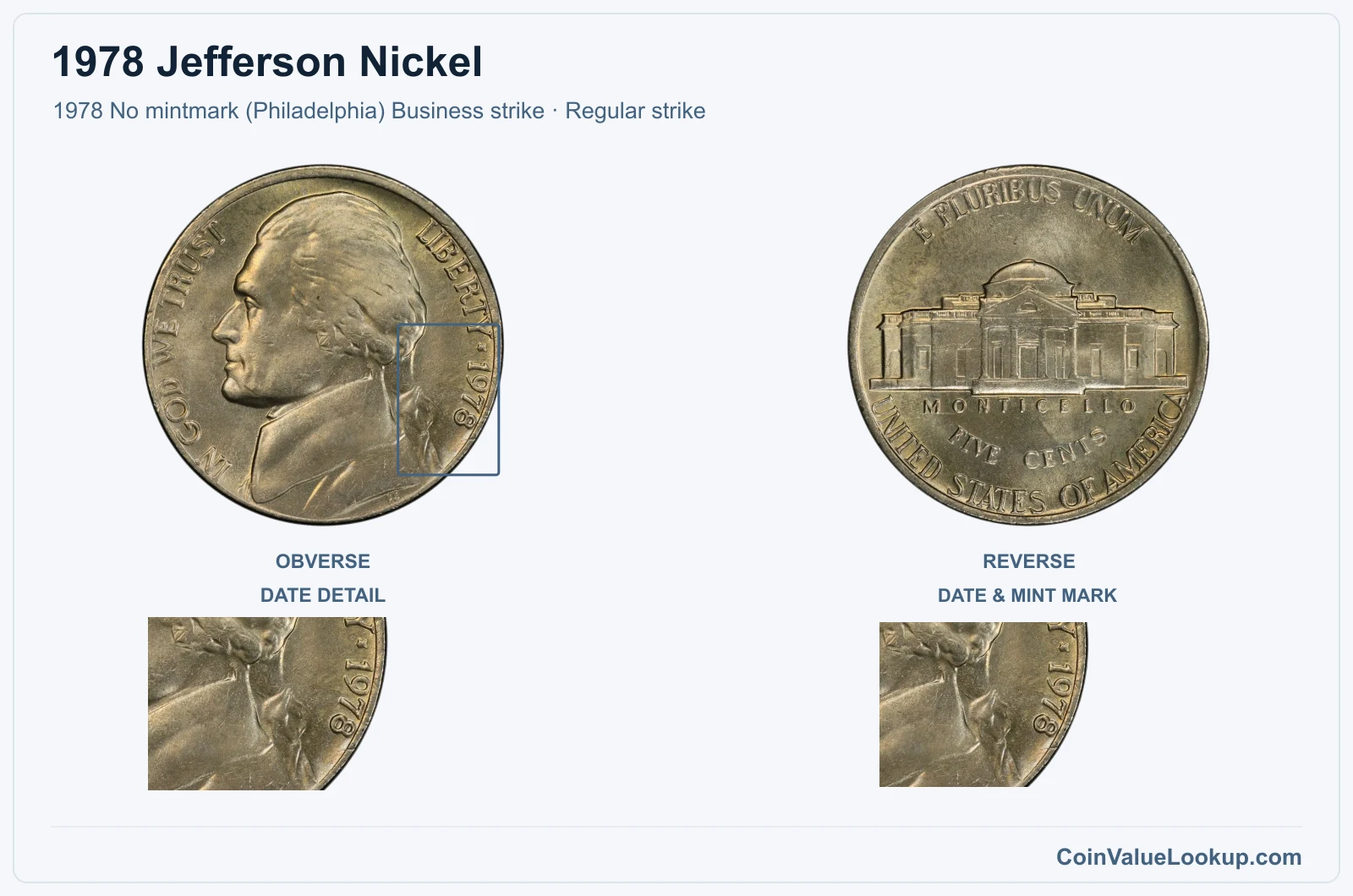
The 1978 Philadelphia nickel carries no mintmark. Look below the date on the obverse — if the space is empty, you have the Philadelphia issue.
These were produced in large numbers for everyday commerce, so circulated examples are common at face value.
In uncirculated grades, USA Coin Book guide estimates place the coin at roughly $0.30 around MS60 and about $3.62 at MS65. Coins certified with Full Steps can carry a premium above those baseline figures because the complete step detail reflects a strong strike, which is a separate quality from surface preservation.
Coin Value Lookup is a handy starting point if you want to look up guides for other dates and denominations in the Jefferson nickel series or beyond.
| Range | Grade | Price | Auction Records | Appraisal |
|---|---|---|---|---|
| PO | PO 1 | — | Coin Identifier | |
| FR | FR 2 | — | Coin Identifier | |
| AG | AG 3 | — | Coin Identifier | |
| G | G 4 | — | Coin Identifier | |
| G 6 | — | Coin Identifier | ||
| VG | VG 8 | — | Coin Identifier | |
| VG 10 | — | Coin Identifier | ||
| F | F 12 | — | Coin Identifier | |
| F 15 | — | Coin Identifier | ||
| VF | VF 20 | — | Coin Identifier | |
| VF 25 | — | Coin Identifier | ||
| VF 30 | — | Coin Identifier | ||
| VF 35 | — | Coin Identifier | ||
| XF | XF 40 | — | Coin Identifier | |
| XF 45 | — | Coin Identifier | ||
| AU | AU 50 | — | Coin Identifier | |
| AU 53 | — | Coin Identifier | ||
| AU 55 | — | Coin Identifier | ||
| AU 58 | — | Coin Identifier | ||
| MS | MS 60 | — | Coin Identifier | |
| MS 61 | — | Coin Identifier | ||
| MS 62 | — | Coin Identifier | ||
| MS 63 | — | Coin Identifier | ||
| MS 64 | Coin Identifier | |||
| MS 65 | — | Coin Identifier | ||
| MS 66 | Coin Identifier | |||
| MS 67 | — | — | — | |
| MS 68 | — | — | — | |
| MS 69 | — | — | — | |
| MS 70 | — | — | — |
1978 Jefferson Nickel — D Business strike
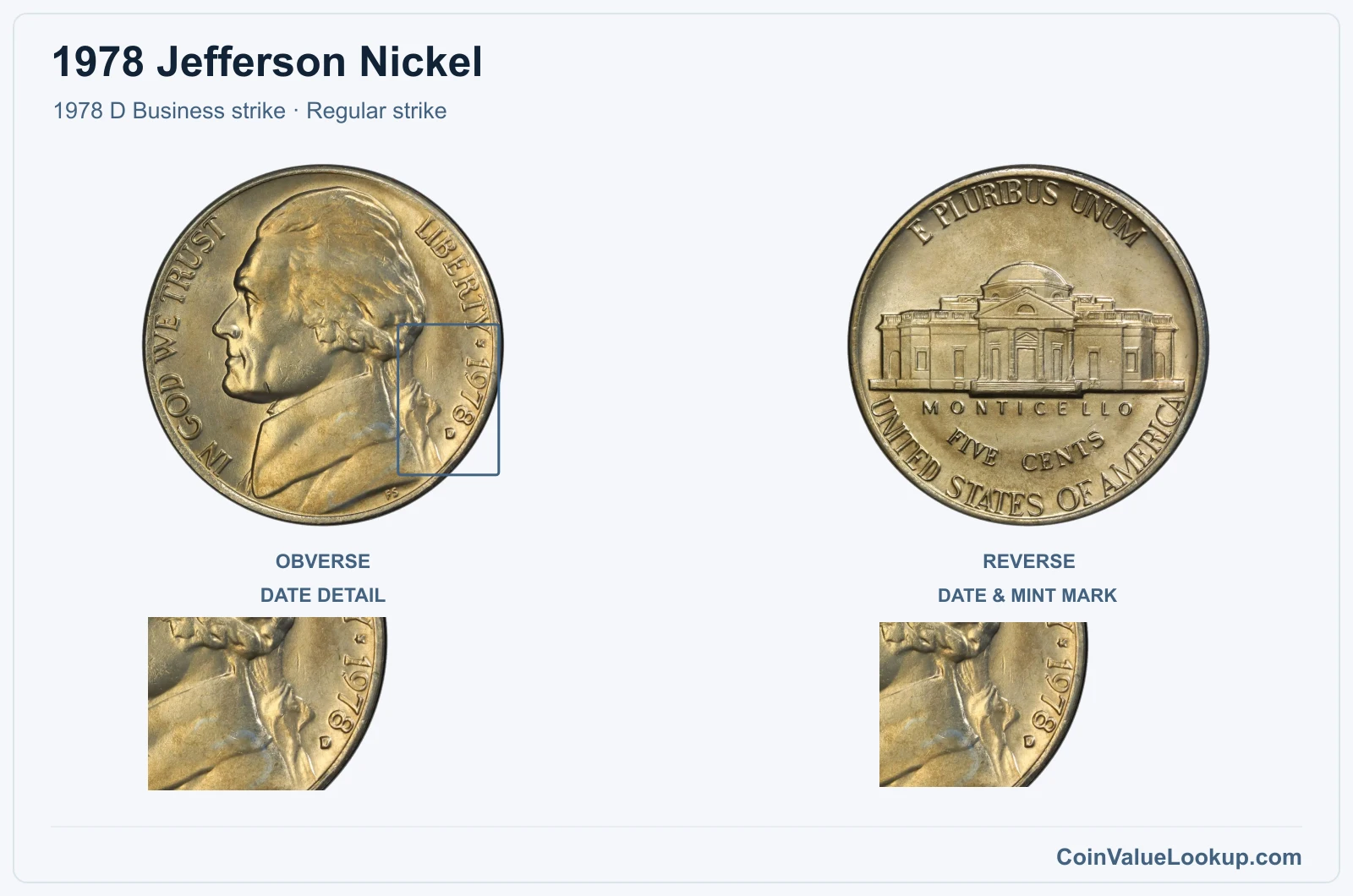
The Denver issue shows a small "D" mintmark on the obverse, just below the date. Like its Philadelphia counterpart, the 1978-D was a high-production circulation strike and turns up constantly in change jars and rolls.
USA Coin Book guide estimates mirror the Philadelphia numbers: approximately $0.30 at MS60 and $3.62 at MS65. The practical difference between the two mints usually comes down to strike quality and the availability of well-preserved examples.
As with Philadelphia strikes, Full Steps attribution can push the value above those guide figures for a certified coin.
| Range | Grade | Price | Auction Records | Appraisal |
|---|---|---|---|---|
| PO | PO 1 | — | Coin Identifier | |
| FR | FR 2 | — | Coin Identifier | |
| AG | AG 3 | — | Coin Identifier | |
| G | G 4 | — | Coin Identifier | |
| G 6 | — | Coin Identifier | ||
| VG | VG 8 | — | Coin Identifier | |
| VG 10 | — | Coin Identifier | ||
| F | F 12 | — | Coin Identifier | |
| F 15 | — | Coin Identifier | ||
| VF | VF 20 | — | Coin Identifier | |
| VF 25 | — | Coin Identifier | ||
| VF 30 | — | Coin Identifier | ||
| VF 35 | — | Coin Identifier | ||
| XF | XF 40 | — | Coin Identifier | |
| XF 45 | — | Coin Identifier | ||
| AU | AU 50 | — | Coin Identifier | |
| AU 53 | — | Coin Identifier | ||
| AU 55 | — | Coin Identifier | ||
| AU 58 | — | Coin Identifier | ||
| MS | MS 60 | — | Coin Identifier | |
| MS 61 | — | Coin Identifier | ||
| MS 62 | — | Coin Identifier | ||
| MS 63 | Coin Identifier | |||
| MS 64 | — | Coin Identifier | ||
| MS 65 | — | Coin Identifier | ||
| MS 66 | — | Coin Identifier | ||
| MS 67 | — | — | — | |
| MS 68 | — | — | — | |
| MS 69 | — | — | — | |
| MS 70 | — | — | — |
1978 Jefferson Nickel — S Proof
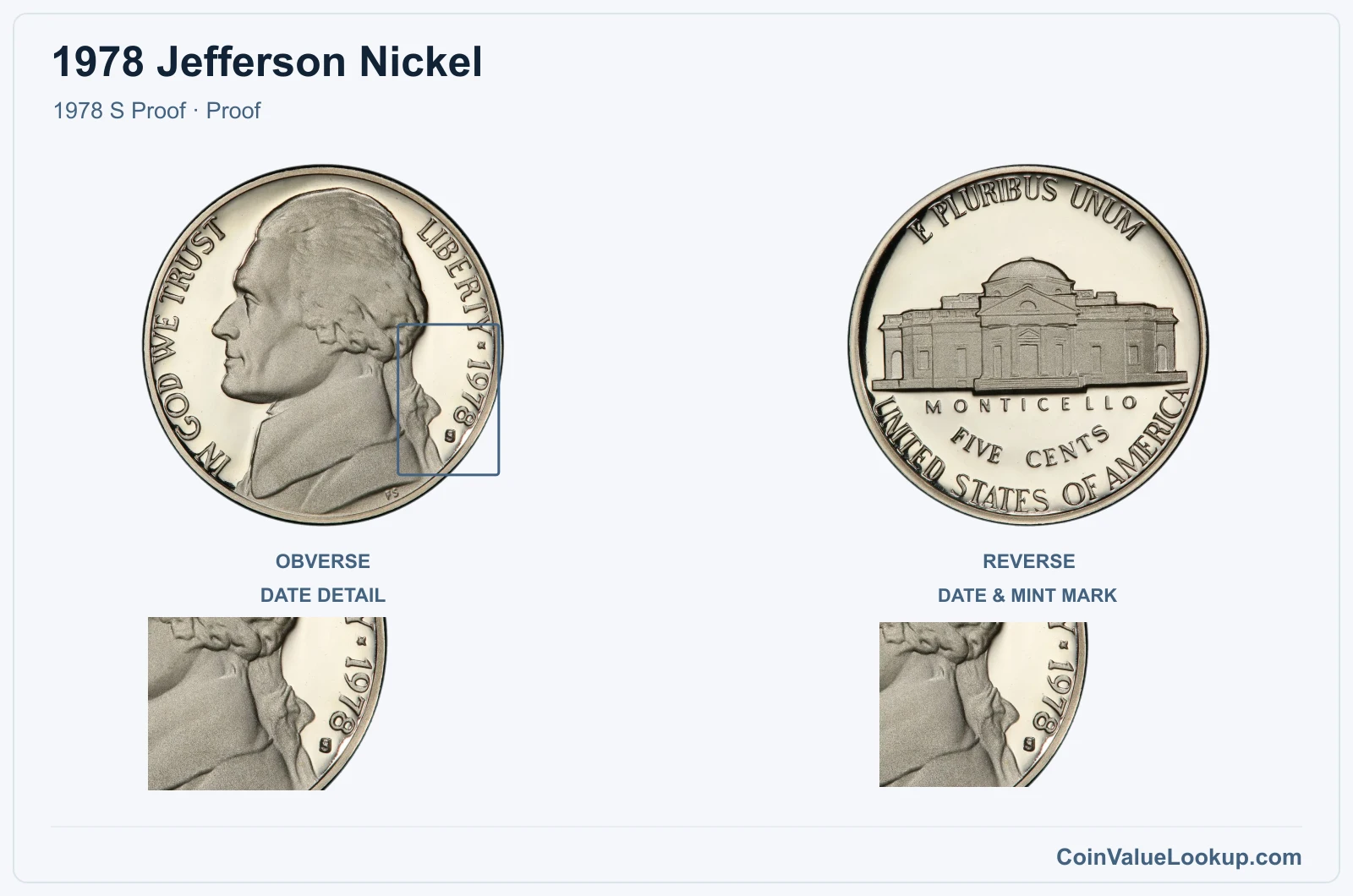
San Francisco struck proofs only in 1978 — no business-strike "S" nickels exist for this year. The mintmark is a small "S" on the obverse below the date.
Proofs display mirror fields and crisp device edges that are visibly different from any circulation strike.
The USA Coin Book base proof guide estimate is about $2.50 at PR65. That figure covers a standard proof finish.
Cameo and deep-cameo contrast levels are treated as separate categories with their own markets, so do not apply the base PR65 number to a coin graded PR70 DCAM, for instance. These proofs came in government-issued sets and were never meant for spending, so most survivors are well preserved.
| Range | Grade | Price | Auction Records | Appraisal |
|---|---|---|---|---|
| PR | PR 1 | — | Coin Identifier | |
| PR 2 | — | Coin Identifier | ||
| PR 3 | — | Coin Identifier | ||
| PR 4 | — | Coin Identifier | ||
| PR 6 | — | Coin Identifier | ||
| PR 8 | — | Coin Identifier | ||
| PR 10 | — | Coin Identifier | ||
| PR 12 | — | Coin Identifier | ||
| PR 15 | — | Coin Identifier | ||
| PR 20 | — | Coin Identifier | ||
| PR 25 | — | Coin Identifier | ||
| PR 30 | — | Coin Identifier | ||
| PR 35 | — | Coin Identifier | ||
| PR 40 | — | Coin Identifier | ||
| PR 45 | — | Coin Identifier | ||
| PR 50 | — | Coin Identifier | ||
| PR 53 | — | Coin Identifier | ||
| PR 55 | — | Coin Identifier | ||
| PR 58 | — | Coin Identifier | ||
| PR 60 | — | Coin Identifier | ||
| PR 61 | — | Coin Identifier | ||
| PR 62 | — | Coin Identifier | ||
| PR 63 | — | Coin Identifier | ||
| PR 64 | — | Coin Identifier | ||
| PR 65 | — | Coin Identifier | ||
| PR 66 | Coin Identifier | |||
| PR 67 | Coin Identifier | |||
| PR 68 | Coin Identifier | |||
| PR 69 | Coin Identifier | |||
| PR 70 | Coin Identifier |
1978 Jefferson Nickel Error List
1. 1978 Jefferson Nickel — Struck on cent planchet
A 1978 nickel struck on a cent-sized copper planchet is a genuine wrong-planchet error. The coin will be noticeably smaller than a normal nickel and lighter — a Lincoln cent blank weighs about 3.1 grams versus the nickel's 5 grams.
Jefferson's portrait and Monticello will appear on both sides, but outer portions of the design and lettering are cropped off because the smaller blank couldn't capture the full die impression.
The copper color alone does not prove this error. Environmental damage, chemical exposure, and copper plating can all turn a normal nickel reddish-brown.
Weight and diameter are the reliable checks. A Heritage Auctions sale in April 2006 recorded a Philadelphia example graded PCGS MS62 RB at $207, giving one data point for what an authenticated piece can bring.
Third-party certification is important here because the look-alikes are common and the genuine article is not.
2. 1978 Jefferson Nickel — Major die break
A major die break shows up as a raised, irregular blob of metal on the coin's surface — the result of a chunk of the steel die literally breaking away during production. The area where the die piece was missing fills with metal under striking pressure, producing a distinctive lumpy feature that is part of the coin rather than stuck on top.
A 1978-D example graded ANACS AU50 has been documented through Heritage Auctions, though no specific price range is established from that listing. Value depends heavily on the break's size, location, and the coin's overall condition, so each piece needs individual assessment by an authenticated identity.
Don't confuse a die break with a gouge, corrosion pit, or foreign metal attached after minting. Post-mint damage tends to be recessed or rough-edged, while a genuine die break is raised and shows flow consistent with the strike.
3. 1978 Jefferson Nickel — Off-Center Strike
An off-center strike happens when the blank is not seated properly between the dies, so the design lands shifted to one side. The telltale sign is an unstruck crescent of bare metal on part of the coin's edge, paired with a design that is visibly displaced from center.
For a 1978 nickel, the date needs to remain visible to confirm the year — no date, no premium, generally speaking. The degree of off-center displacement and the coin's condition both influence value, but no specific price range is established here.
Be careful with look-alikes. A clipped planchet removes a bite-shaped section but leaves the design centered.
Post-mint flattening or a one-sided die misalignment can also mimic the appearance. A genuine off-center error will show the blank's original rim on the struck portion and bare metal where the die never reached.
4. 1978 Jefferson Nickel — Broadstrike
A broadstrike occurs when the coin is struck without the normal retaining collar that forms the edge and constrains the metal. The result is a coin that spreads outward, appearing slightly larger than normal with a weak or absent rim.
The design is still centered — that is the key distinction from an off-center strike.
On a 1978 nickel, look for metal that has flowed beyond the expected 21.2 mm diameter while the portrait and Monticello remain roughly centered. The edge profile will lack the sharp, defined rim of a properly struck coin.
No specific price range is adopted for this error. Condition, the degree of spread, and third-party authentication all factor into what a particular coin might bring.
Do not confuse a broadstrike with a coin that was flattened after leaving the mint — post-mint damage tends to distort the design unevenly and leaves tool marks or surface scratches that a struck-in error would not.