1980 Jefferson Nickel Coin Value: How Much Is It Worth?
The 1980 Jefferson nickel is a common coin in most grades. Worn examples are generally worth face value, while uncirculated pieces carry modest premiums — guide estimates for business strikes range from roughly $0.30 at MS60 to about $3.62–$4.96 at MS65, depending on the mint.
S-mint proofs and authenticated error coins occupy their own separate markets. These guide figures reflect published retail estimates, not guaranteed buy prices for any individual coin.
Fast Way to Identify Your 1980 Jefferson Nickel
Want a quick read on your 1980 nickel? Upload clear photos of the front and back, and our identifier can offer a preliminary take on which version you have — mint, finish, and general condition.
It is not a substitute for professional grading or authentication, but it is a solid starting point before you dig deeper.
1980 Jefferson Nickel Value
Upload both sides of your 1980 Jefferson Nickel.
Front Obverse
Upload photo
Back Reverse
Upload photo
Which 1980 Jefferson Nickel Versions Are Worth Money?
- Uncirculated 1980-P nickels in MS65 condition carry a guide estimate around $4.96 — the highest base retail figure among the three versions at that grade.
- 1980-D business strikes in MS65 grade have a guide estimate near $3.62, slightly below the P-mint at the same level.
- 1980-S proofs are collector-only strikes with a PR65 guide estimate around $3.62; cameo and deep cameo designations are separate and not included in that figure.
- A 1980 nickel struck on a cent-sized blank sold at Heritage Auctions in November 2020 for $216 — a dramatic wrong-planchet error.
- A 1980-D nickel struck 50% off-center on a dime blank reached $1,495 at Heritage Auctions in August 2010, showing how rare planchet-and-strike combinations drive value.
Step 1: Identify Your 1980 Jefferson Nickel Mint Mark and Version
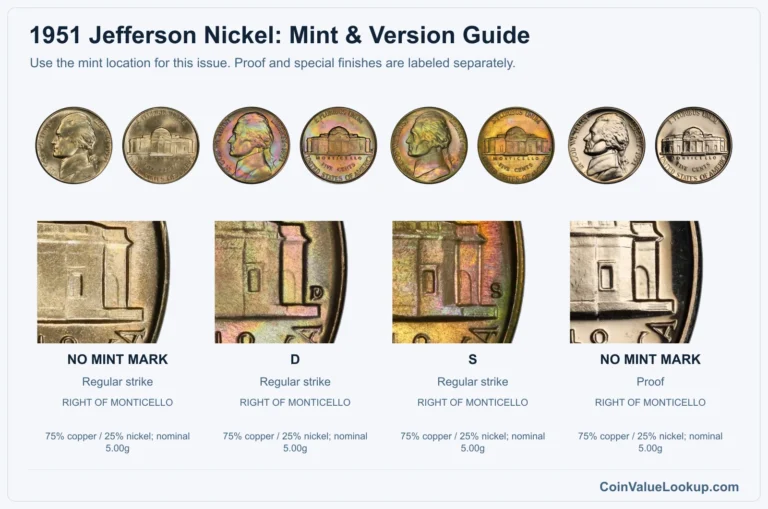
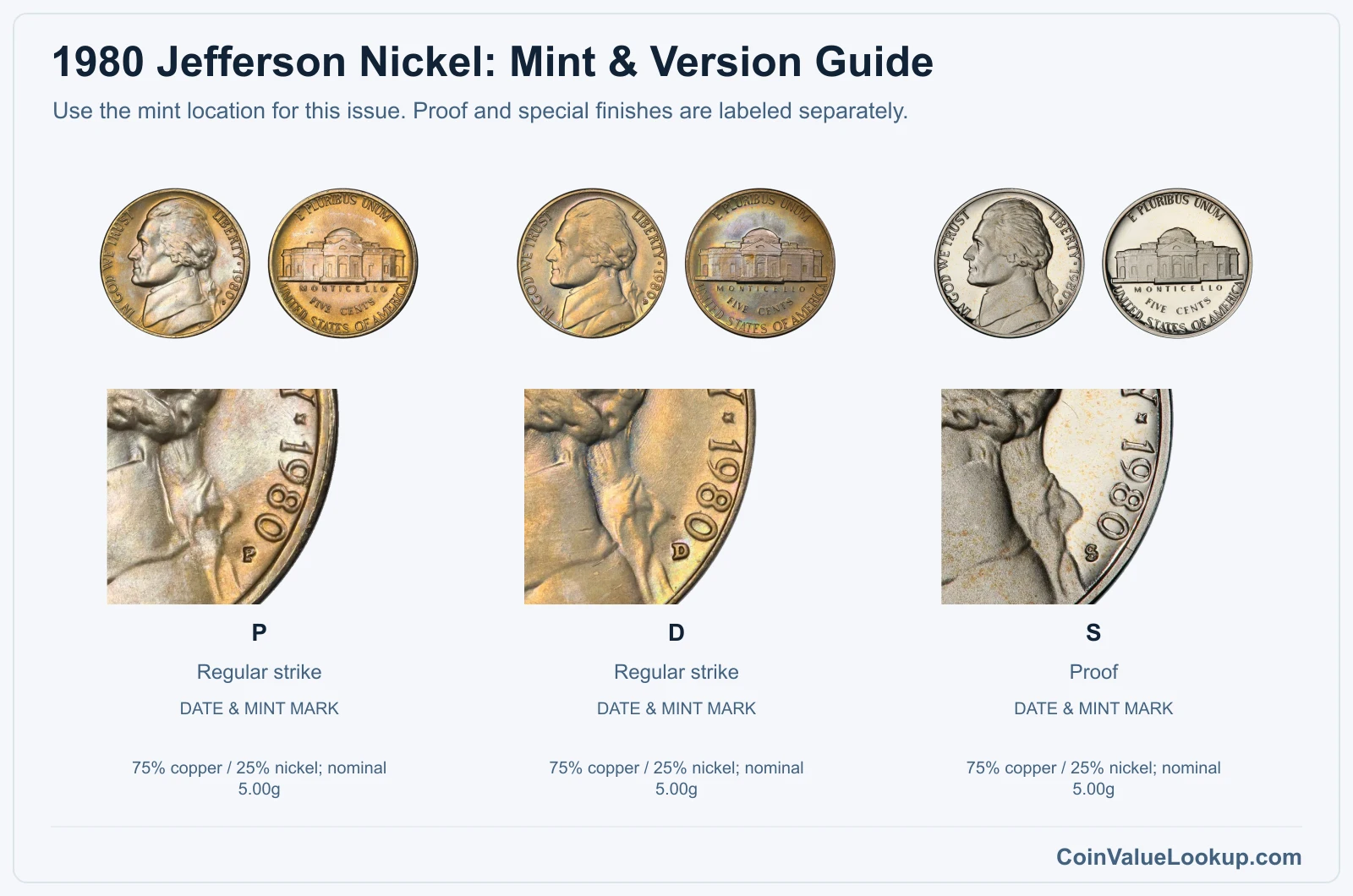
The 1980 Jefferson nickel comes in three versions: Philadelphia (P), Denver (D), and San Francisco (S) proof. Look for the mintmark on the obverse, just below the date and to the right.
The P mintmark appears on Philadelphia nickels starting in 1980, so every business strike from that year should show either a P or a D.
All three versions share the same composition: 75% copper and 25% nickel, weighing about 5 grams with a 21.2 mm diameter and a plain edge. Do not confuse a normal copper-nickel nickel with a silver issue — there is no silver collector branch for 1980.
The S-mint coin is a proof, struck with polished dies for collectors. It has mirror-like fields and sharper detail than a business strike.
If your coin has a satin or frosty look and came from a roll or pocket change, it is a P or D business strike, not a proof.
Step 2: Check Your 1980 Jefferson Nickel Grade
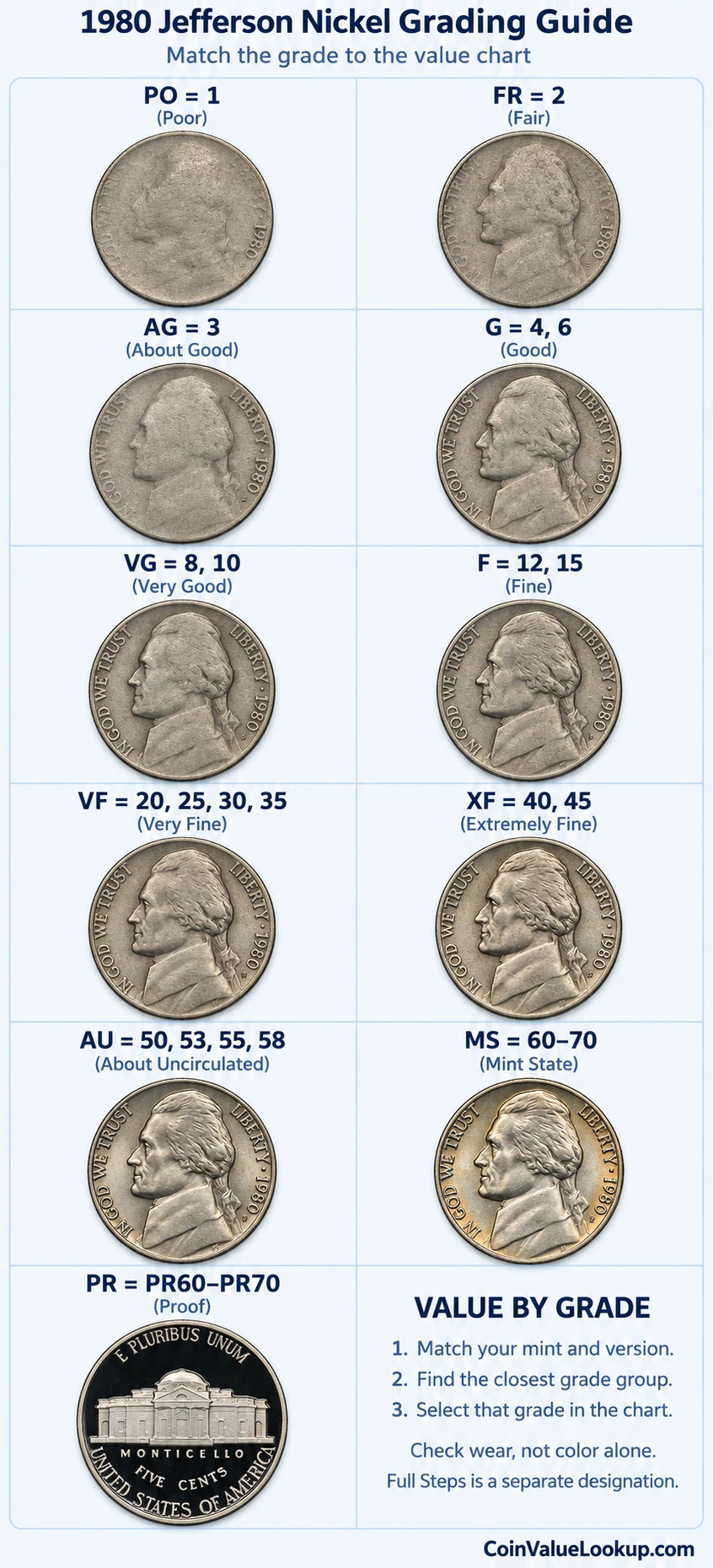
Start with Jefferson's cheek and hair. On a well-circulated coin, the cheekbone flattens first, followed by the hair detail above the ear.
A coin that still shows full, undisturbed luster across the high points is likely uncirculated.
Flip to the reverse. The Monticello building's columns and steps give you supporting evidence — look for sharpness in those areas.
Sharp steps can reflect a strong strike rather than low wear, so do not confuse strike quality with grade.
The comparison image is your friend here. Line up your coin against it and check matching wear patterns.
Certified Full Steps is a separate designation for business strikes with uninterrupted step lines, and it is not the same as an error. Proof coins are graded on a proof scale, and cameo or deep cameo contrast is a distinct filter, not an upgrade within the proof number.
Step 3: Check 1980 Jefferson Nickel Value by Mint and Version
1980 Jefferson Nickel — P Business strike
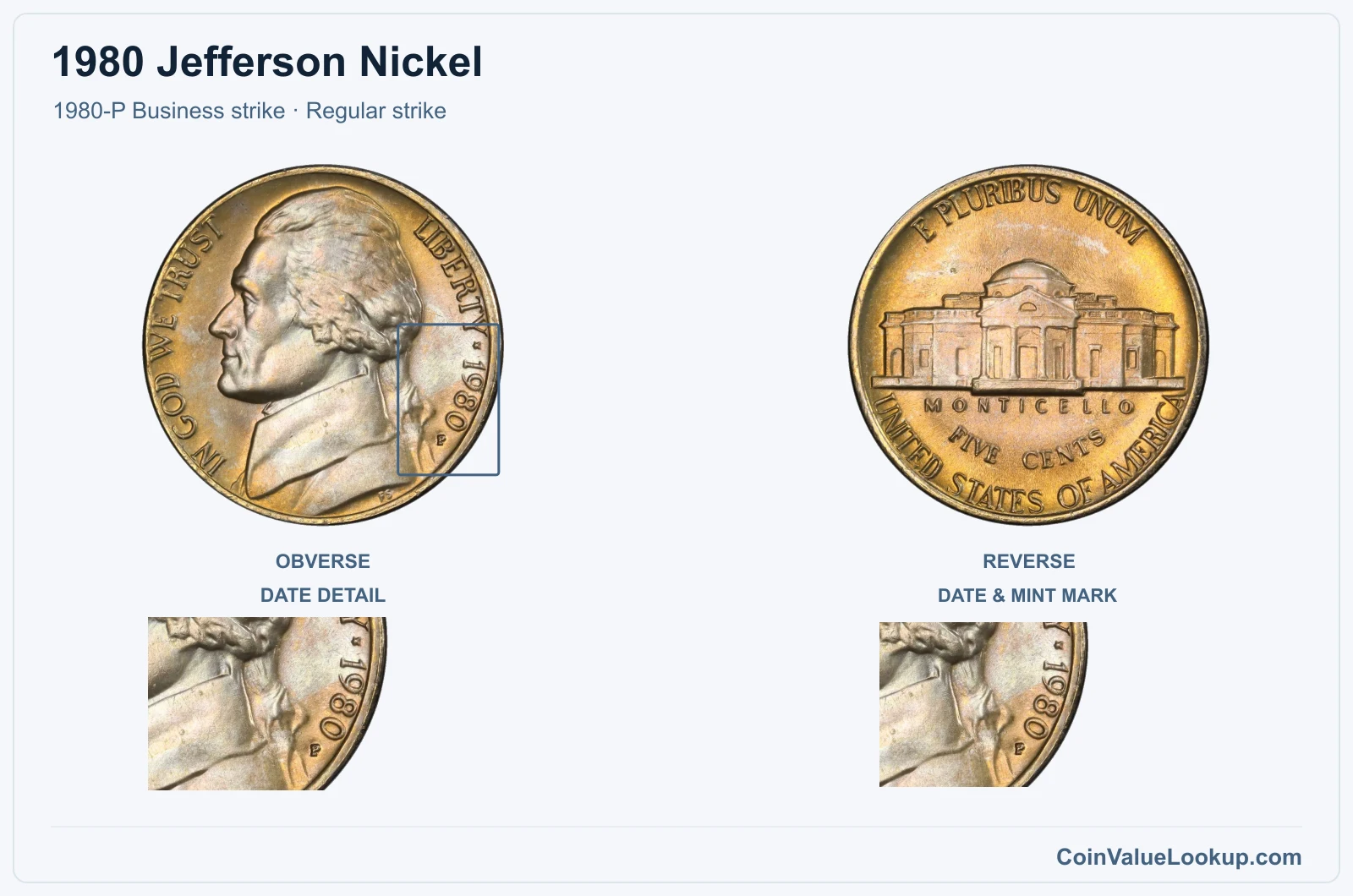
The 1980-P Jefferson nickel is a standard business strike from the Philadelphia Mint. It carries a P mintmark below the date — a feature that became routine on nickels starting this year.
The alloy is 75% copper and 25% nickel at a nominal 5 grams.
Guide estimates from USA Coin Book place this version at about $0.30 in MS60 condition and around $4.96 in MS65. Circulated examples are worth face value.
If yours looks fresh from a roll with full luster and no contact marks, it is worth a closer look at the grade.
Coin Value Lookup is a good place to browse guides for Jefferson nickels and other series if you are comparing values across years or mints.
| Range | Grade | Price | Auction Records | Appraisal |
|---|---|---|---|---|
| PO | PO 1 | — | Coin Identifier | |
| FR | FR 2 | — | Coin Identifier | |
| AG | AG 3 | — | Coin Identifier | |
| G | G 4 | — | Coin Identifier | |
| G 6 | — | Coin Identifier | ||
| VG | VG 8 | — | Coin Identifier | |
| VG 10 | — | Coin Identifier | ||
| F | F 12 | — | Coin Identifier | |
| F 15 | — | Coin Identifier | ||
| VF | VF 20 | — | Coin Identifier | |
| VF 25 | — | Coin Identifier | ||
| VF 30 | — | Coin Identifier | ||
| VF 35 | — | Coin Identifier | ||
| XF | XF 40 | — | Coin Identifier | |
| XF 45 | — | Coin Identifier | ||
| AU | AU 50 | — | Coin Identifier | |
| AU 53 | — | Coin Identifier | ||
| AU 55 | — | Coin Identifier | ||
| AU 58 | — | Coin Identifier | ||
| MS | MS 60 | — | Coin Identifier | |
| MS 61 | Coin Identifier | |||
| MS 62 | Coin Identifier | |||
| MS 63 | Coin Identifier | |||
| MS 64 | Coin Identifier | |||
| MS 65 | Coin Identifier | |||
| MS 66 | Coin Identifier | |||
| MS 67 | — | — | — | |
| MS 68 | — | — | — | |
| MS 69 | — | — | — | |
| MS 70 | — | — | — |
1980 Jefferson Nickel — D Business strike
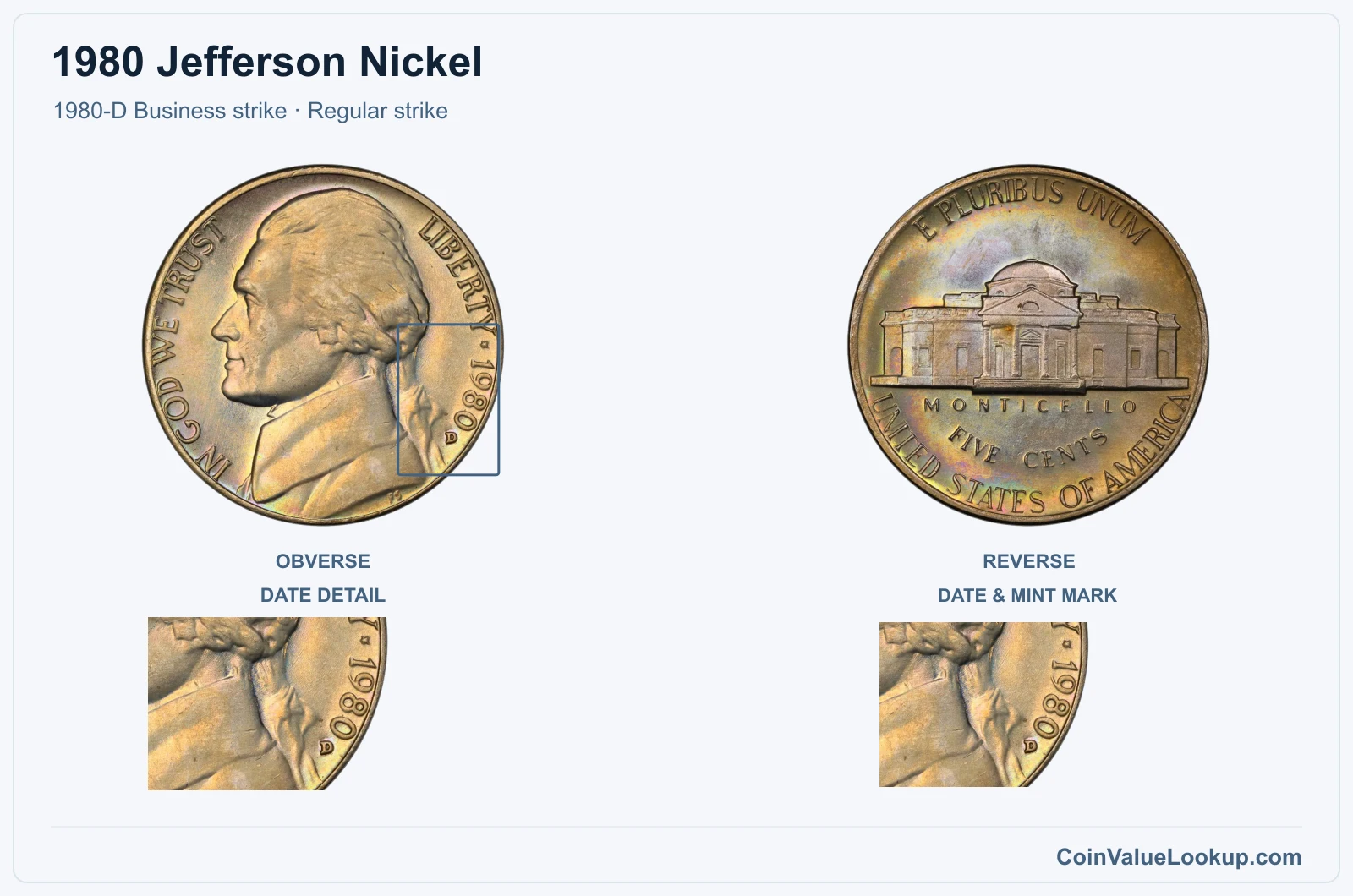
The 1980-D business strike was produced at the Denver Mint and carries a D mintmark on the obverse below the date. Same alloy, same weight, same design as the P-mint version.
Published guide estimates put the 1980-D at about $0.30 in MS60 and roughly $3.62 in MS65, slightly below the Philadelphia issue at MS65. As with the P-mint coin, circulated pieces are common enough that they trade at face value.
The premium only kicks in once a coin is clearly uncirculated with strong eye appeal.
| Range | Grade | Price | Auction Records | Appraisal |
|---|---|---|---|---|
| PO | PO 1 | — | Coin Identifier | |
| FR | FR 2 | — | Coin Identifier | |
| AG | AG 3 | — | Coin Identifier | |
| G | G 4 | — | Coin Identifier | |
| G 6 | — | Coin Identifier | ||
| VG | VG 8 | — | Coin Identifier | |
| VG 10 | — | Coin Identifier | ||
| F | F 12 | — | Coin Identifier | |
| F 15 | — | Coin Identifier | ||
| VF | VF 20 | — | Coin Identifier | |
| VF 25 | — | Coin Identifier | ||
| VF 30 | — | Coin Identifier | ||
| VF 35 | — | Coin Identifier | ||
| XF | XF 40 | — | Coin Identifier | |
| XF 45 | — | Coin Identifier | ||
| AU | AU 50 | — | Coin Identifier | |
| AU 53 | — | Coin Identifier | ||
| AU 55 | — | Coin Identifier | ||
| AU 58 | — | Coin Identifier | ||
| MS | MS 60 | — | Coin Identifier | |
| MS 61 | — | Coin Identifier | ||
| MS 62 | Coin Identifier | |||
| MS 63 | — | Coin Identifier | ||
| MS 64 | Coin Identifier | |||
| MS 65 | Coin Identifier | |||
| MS 66 | — | Coin Identifier | ||
| MS 67 | — | — | — | |
| MS 68 | — | — | — | |
| MS 69 | — | — | — | |
| MS 70 | — | — | — |
1980 Jefferson Nickel — S Proof
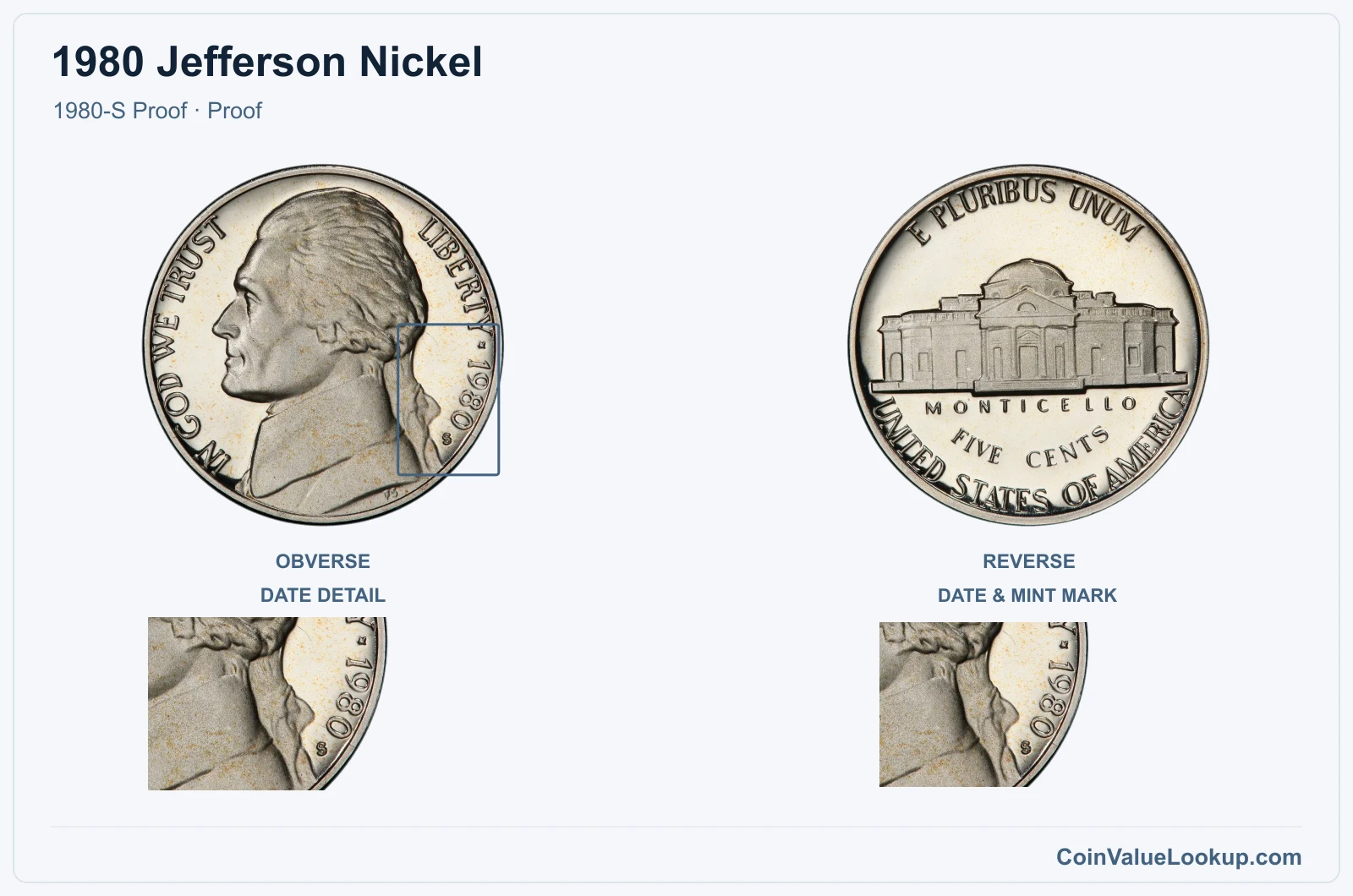
The 1980-S proof was struck at the San Francisco Mint exclusively for collector sets. It has mirror-like fields and sharp, well-defined devices — a finish that sets it apart immediately from any business strike.
The PR65 guide estimate is approximately $3.62 according to USA Coin Book. Cameo and deep cameo designations reflect the degree of frosted contrast on the devices against the mirrored fields, and they carry their own separate market.
The base PR65 figure does not include a cameo premium. If your coin has the S mintmark and that glassy proof look, keep it protected — handling will tone down those mirrors in a hurry.
| Range | Grade | Price | Auction Records | Appraisal |
|---|---|---|---|---|
| PR | PR 1 | — | Coin Identifier | |
| PR 2 | — | Coin Identifier | ||
| PR 3 | — | Coin Identifier | ||
| PR 4 | — | Coin Identifier | ||
| PR 6 | — | Coin Identifier | ||
| PR 8 | — | Coin Identifier | ||
| PR 10 | — | Coin Identifier | ||
| PR 12 | — | Coin Identifier | ||
| PR 15 | — | Coin Identifier | ||
| PR 20 | — | Coin Identifier | ||
| PR 25 | — | Coin Identifier | ||
| PR 30 | — | Coin Identifier | ||
| PR 35 | — | Coin Identifier | ||
| PR 40 | — | Coin Identifier | ||
| PR 45 | — | Coin Identifier | ||
| PR 50 | — | Coin Identifier | ||
| PR 53 | — | Coin Identifier | ||
| PR 55 | — | Coin Identifier | ||
| PR 58 | — | Coin Identifier | ||
| PR 60 | — | Coin Identifier | ||
| PR 61 | — | Coin Identifier | ||
| PR 62 | — | Coin Identifier | ||
| PR 63 | — | Coin Identifier | ||
| PR 64 | — | Coin Identifier | ||
| PR 65 | — | Coin Identifier | ||
| PR 66 | — | Coin Identifier | ||
| PR 67 | — | Coin Identifier | ||
| PR 68 | Coin Identifier | |||
| PR 69 | Coin Identifier | |||
| PR 70 | Coin Identifier |
1980 Jefferson Nickel Error List
1. 1980 Jefferson Nickel — Struck on cent blank
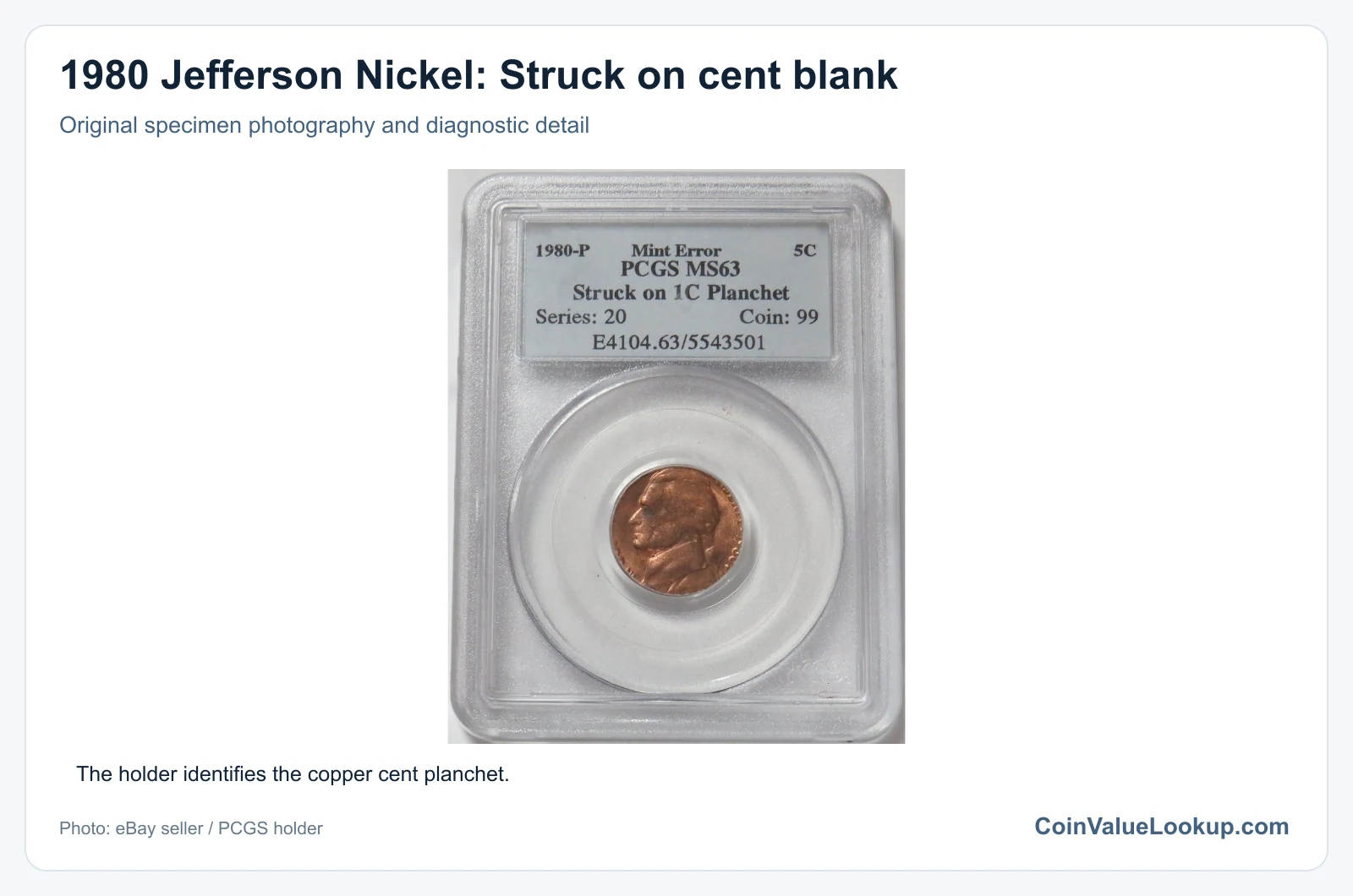
This error occurs when a nickel die strikes a copper cent-sized blank instead of the correct nickel planchet. The result is a coin with the Jefferson nickel design on a noticeably smaller, lighter planchet — about 3.1 grams instead of the normal 5 grams.
Peripheral design details will be cropped or missing because the blank is too small to receive the full impression.
A 1980-P example graded NGC MS64 RB sold at Heritage Auctions in November 2020 for $216. Do not assume every copper-toned nickel is this error.
Copper plating, environmental toning, and ground-down coins can mimic the look. Confirmed attribution requires checking the weight and alloy, not just the color.
2. 1980 Jefferson Nickel — Off-center strike
An off-center strike happens when the blank is not properly seated between the dies. The design shifts in one direction, leaving an unstruck crescent of bare metal on the opposite side.
The farther off-center, the more dramatic the appearance — and the more detail is lost.
A documented 1980-P example graded ANACS MS62 was struck approximately 75% off-center at the 11 o'clock position. Value depends on the authenticated identity, condition, and severity of the displacement.
Do not confuse a true off-center strike with a single-die misalignment, a cut rim, or post-mint damage. A genuine off-center coin retains the date and partial design on a full-size blank with an unstruck area.
3. 1980 Jefferson Nickel — Double strike with uniface second strike
A double-struck coin received two separate impressions from the dies, with the second strike landing far from the first. In this case, a 1980-P nickel graded ANACS AU50 shows a second strike about 95% off-center, with one face blocked during the second impression — producing a uniface effect on the displaced area.
This is not the same as die doubling, where a single strike shows split or doubled design elements from a misaligned die. It is also different from a simple off-center strike, which involves only one impression.
The combined visual — two overlapping impressions with one being nearly entirely off the planchet — is distinctive. Value for such pieces depends on authenticated identity, condition, and error severity.
4. 1980 Jefferson Nickel — Off-center on dime blank
This is a two-part error: a nickel die struck a clad dime-sized blank, and the strike itself landed off-center. The result is a small coin with partial Jefferson nickel design on a blank clearly too small and thin for a nickel.
A 1980-D example graded NGC MS67, struck 50% off-center on a dime blank, sold at Heritage Auctions in August 2010 for $1,495. That price reflects the combination of wrong planchet, off-center strike, and high grade.
An ordinary off-center nickel on a correct blank looks similar at first glance, so check the size and edge — the dime blank is noticeably smaller and shows a clad edge rather than the solid copper-nickel of a normal nickel planchet.
5. 1980 Jefferson Nickel — Doubled Die Obverse
A doubled die obverse on a 1980 nickel shows consistent doubling on obverse design elements — letters, the date, or portions of Jefferson's portrait. Under magnification, look for separation or notching on letter edges that repeats across the design in the same direction.
This is different from machine doubling, which typically produces a flat, shelf-like distortion without the raised, split character of a true doubled die. Reflections and worn die contours can also fool you.
Condition, the visibility of the doubling, and the specific variety all affect what a doubled die example might be worth, so authentication matters before assuming a premium.
6. 1980 Jefferson Nickel — Die Crack / Die Chip
Die cracks appear as thin raised lines on the coin's surface, formed when the steel die develops fractures from repeated use. A die chip is a small raised blob where a piece of the die face broke away.
A cud is a larger raised area connected to the rim, caused by a significant break at the die's edge.
On a 1980 nickel, look for these raised features against the flat field. They will be raised, not incised.
Incuse scratches, corrosion spots, or foreign material stuck to the surface can mimic cracks or chips, so compare carefully. The value of die crack and cud errors depends on size, location, visibility, and overall coin condition.
7. 1980 Jefferson Nickel — Clipped Planchet
A clipped planchet error means the blank was incomplete before it was struck. The missing portion can be curved, straight, or ragged, depending on what went wrong during blank production.
You will often see design weakness on the side opposite the clip, caused by incomplete metal flow during striking.
Compare the edge texture carefully. A genuine clip shows the original blank edge or a distinctive thinning where metal was absent.
A filed notch, deliberate edge cut, or corrosion-eaten rim will have different surface characteristics. Value depends on the size of the clip, the coin's overall condition, and whether the error has been authenticated.
8. 1980 Jefferson Nickel — Struck-Through Error
A struck-through error occurs when foreign material — grease, cloth fibers, metal fragments, or other debris — gets between the die and the blank during striking. The result is a localized depression or incomplete area where the design did not fully transfer.
Grease-filled die errors tend to produce smooth, featureless patches, while a retained foreign object can leave an impression of the object itself. These look different from ordinary wear, which affects high points first, or from scratches and cleaning marks, which disturb the surface rather than leaving sunken blank areas.
Condition and the size and clarity of the struck-through area all affect potential value for a 1980 nickel with this type of error.