1983 Jefferson Nickel Coin Value: How Much Is It Worth?
Most 1983 Jefferson nickels you pull from a jar are worth face value in circulated condition. Uncirculated examples carry modest guide estimates — roughly $1.88 to $11 depending on mint and grade (MS60 through MS65, per USA Coin Book).
S-mint proofs and confirmed error strikes occupy their own separate markets. These guide figures are retail estimates, not guaranteed cash offers for any particular coin.
Fast Way to Identify Your 1983 Jefferson Nickel
Want a quick read on your 1983 nickel? Upload clear photos of the front and back, and our identifier can give you a preliminary take on the mint, finish, and general version.
This is not authentication or exact grading — it is a starting point so you know what you are looking at before digging deeper.
1983 Jefferson Nickel Value
Upload both sides of your 1983 Jefferson Nickel.
Front Obverse
Upload photo
Back Reverse
Upload photo
Which 1983 Jefferson Nickel Versions Are Worth Money?
- Uncirculated 1983-P nickels in MS65 grade carry a USA Coin Book guide estimate around $11 — the highest base figure among the three regular versions at that grade level.
- 1983-D business strikes in MS65 guide at roughly $4.96; still well above face value for a sharp example.
- 1983-S proofs are collector strikes sold in sets; a PR65 example guides near $3.08, with cameo and deep cameo designations tracked separately.
- A 1983 nickel struck on a leftover copper cent blank is a genuine wrong-planchet error — a Heritage auction example from the P mint sold for $4,800 in 2021.
- A Denver-mint version of the same copper-blank error brought $4,312.50 at Heritage in 2010, confirming both mints produced this type.
- Major die breaks and off-center strikes on authenticated 1983 nickels are collected individually based on severity and condition.
Step 1: Identify Your 1983 Jefferson Nickel Mint Mark and Version
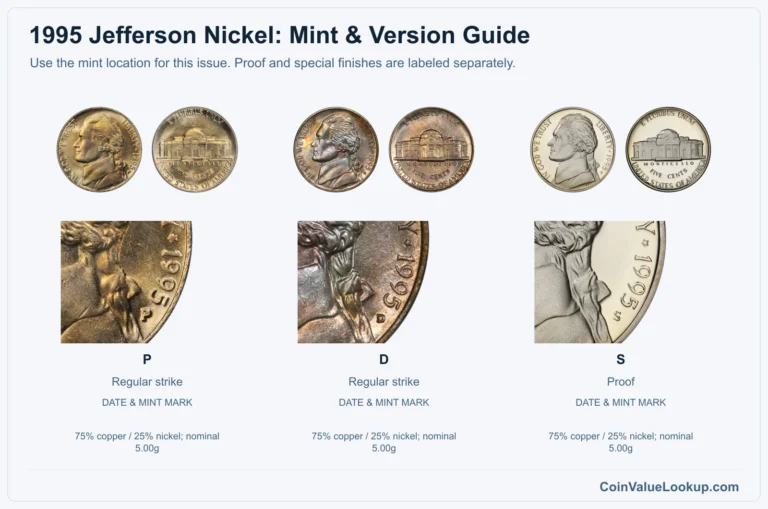
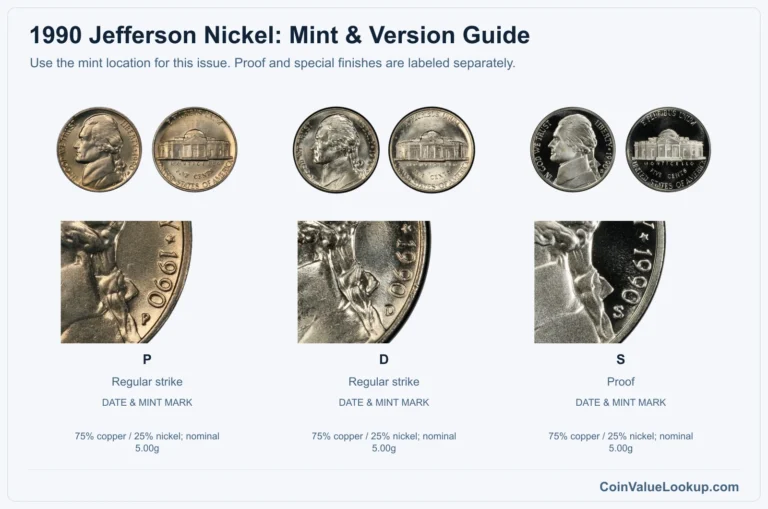
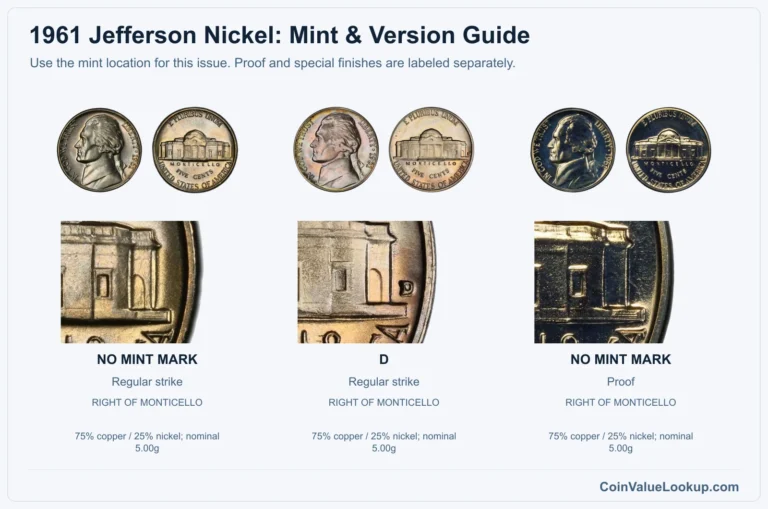
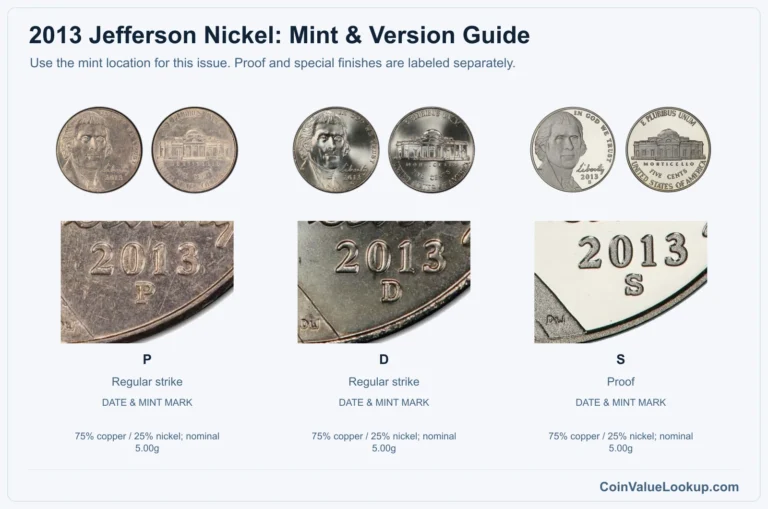
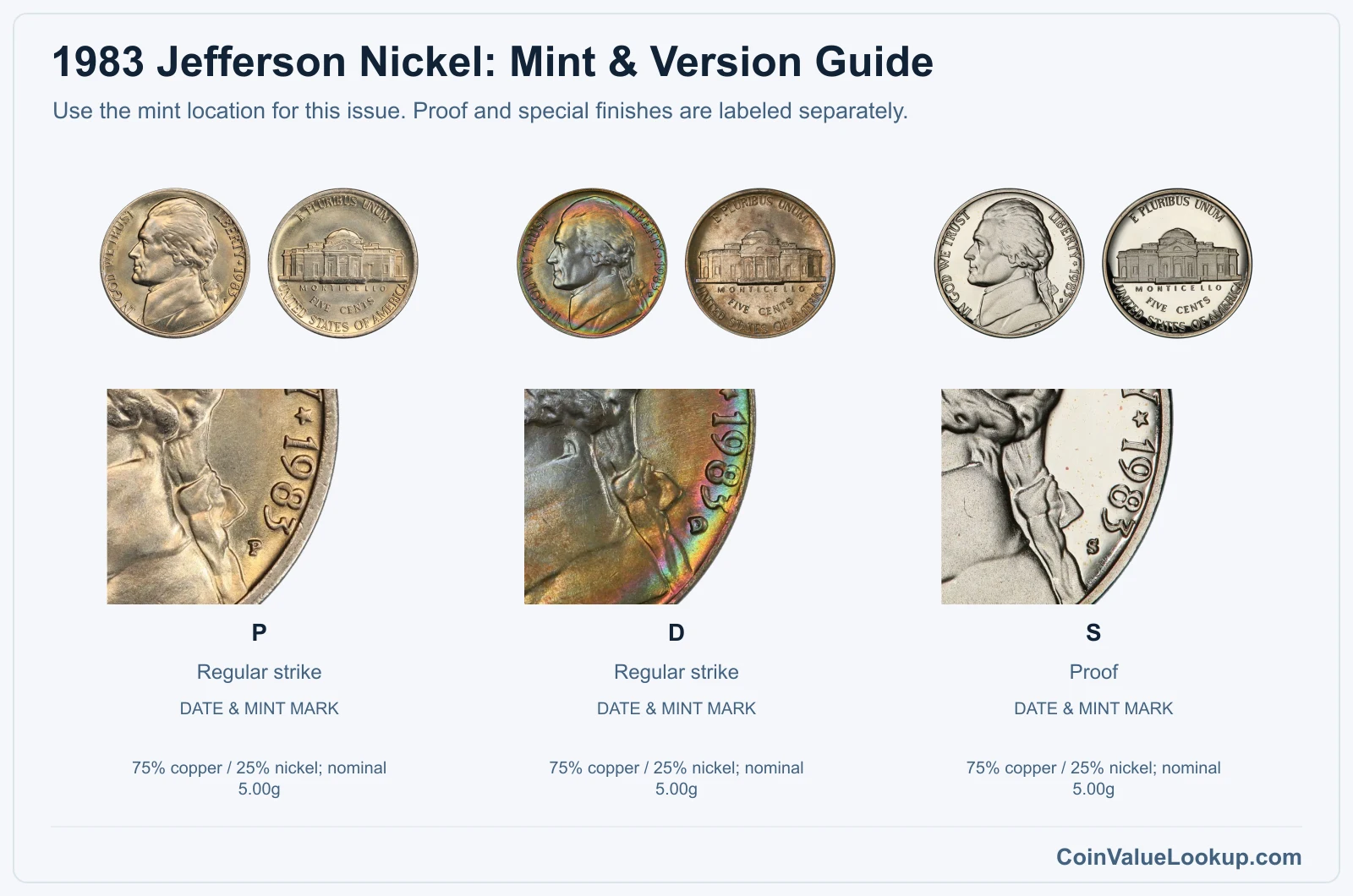
Three versions exist for 1983: the P (Philadelphia), D (Denver), and S (San Francisco proof). The mintmark sits on the obverse, just below the date.
Philadelphia coins carry a small "P" — this became standard starting in 1980, so a missing letter is not a special variety here; it likely means the mark is weak or obscured.
All three are struck in 75% copper and 25% nickel, weigh about 5 grams, measure 21.2 mm across, and have a plain edge. Do not confuse the normal copper-nickel alloy with a clad sandwich — it is a solid homogeneous mix.
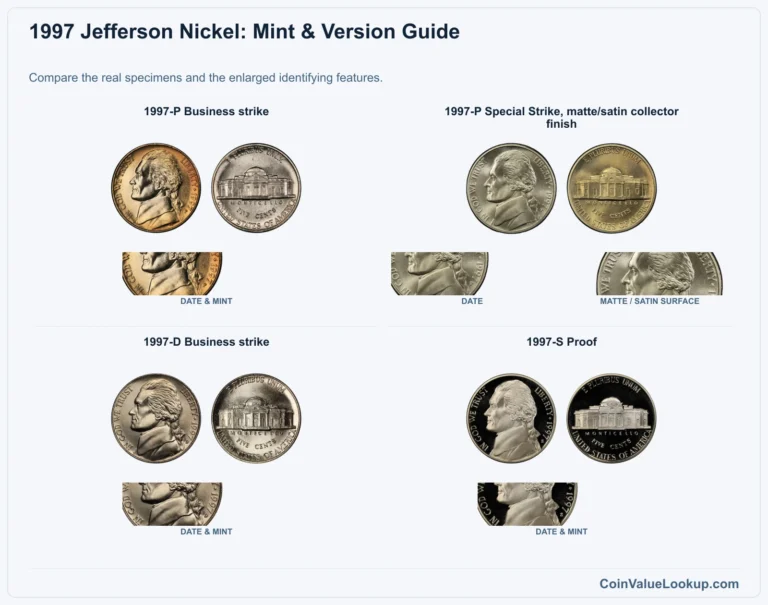
Before checking any price chart, confirm the mintmark and finish. A proof has mirror-like fields and was sold in collector sets from San Francisco.
A business strike from P or D has the typical satin-to-lustrous surface you see in pocket change. Getting this right first saves you from reading the wrong column.
Step 2: Check Your 1983 Jefferson Nickel Grade
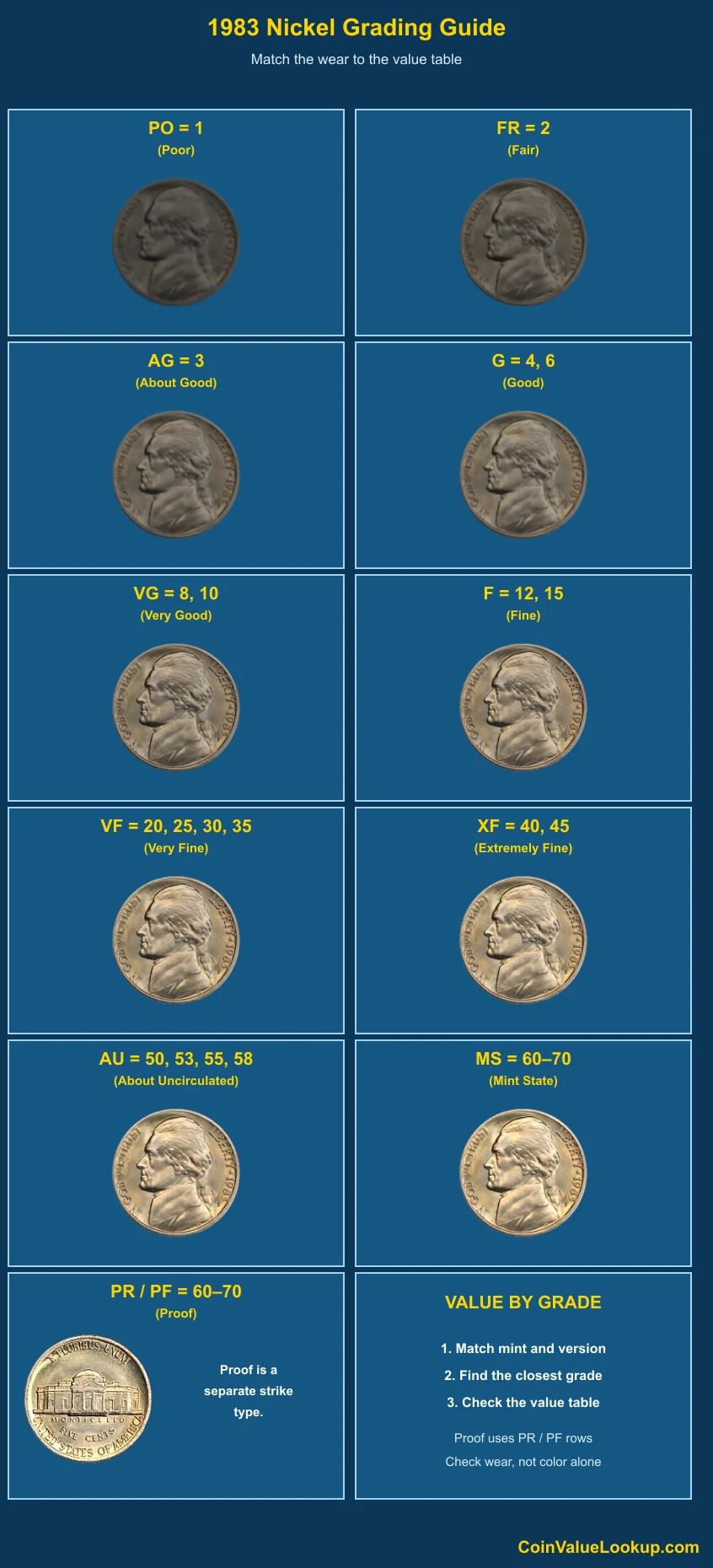
Start with Jefferson's cheek and the hair detail above his ear. On a well-worn coin, these areas flatten first and lose their original luster.
A coin still showing full hair strands and sharp cheekbone definition is in much better shape.
Flip it over and check the Monticello reverse, especially the steps at the base. Sharp, uninterrupted steps can indicate a strong strike, but weak steps alone do not prove the coin circulated — strike quality varies.
Full Steps is a certified designation applied to Mint State business strikes with complete step lines, and it is not a mint error.
Use the comparison image to match your coin's wear pattern against known grade benchmarks. Luster is a big tell: a coin with unbroken cartwheel luster across both sides is likely uncirculated, while one with dull or disrupted fields has seen some use.
Step 3: Check 1983 Jefferson Nickel Value by Mint and Version
1983 Jefferson Nickel — P Business strike
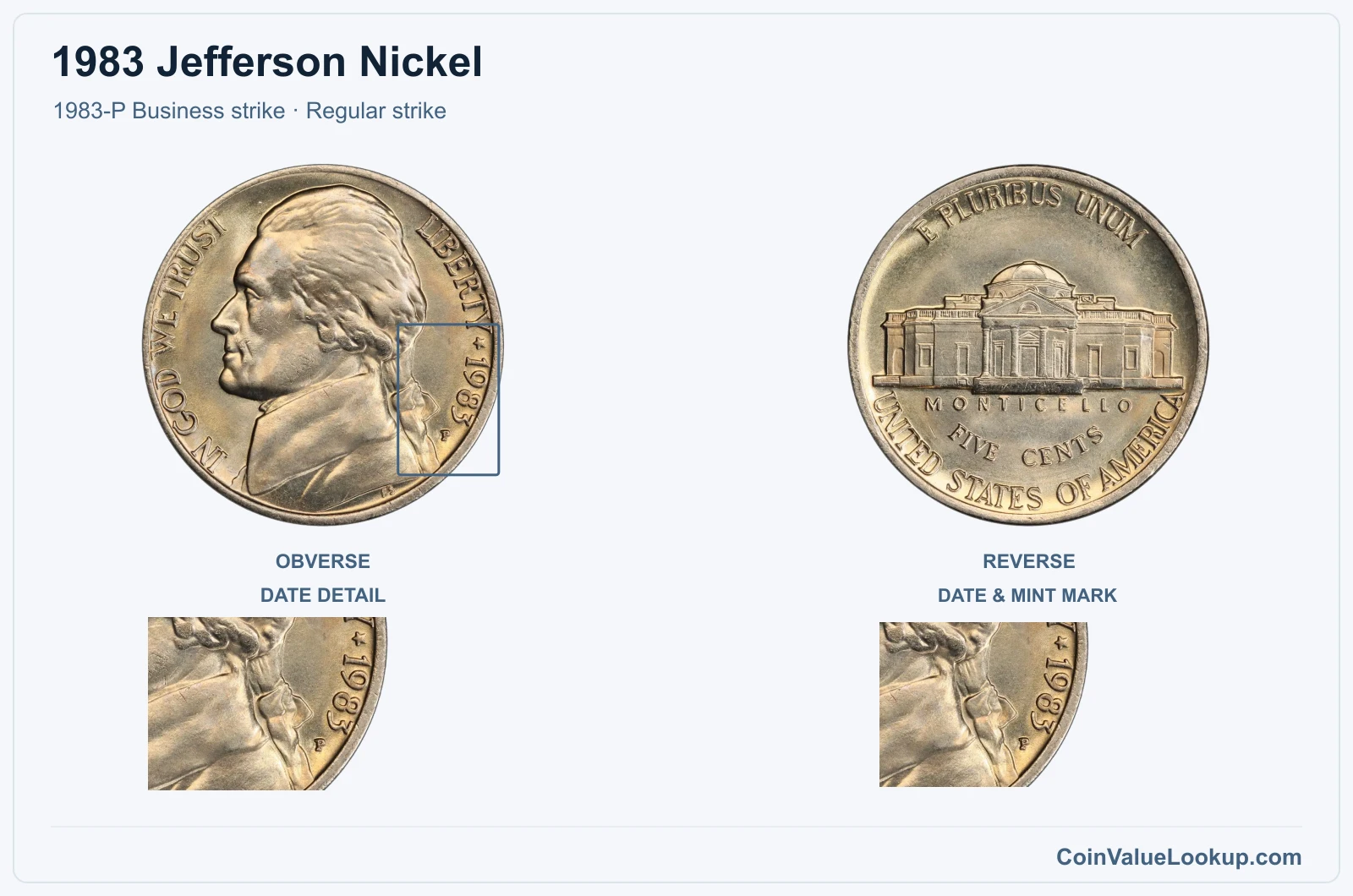
The 1983-P is the Philadelphia business strike, carrying the small "P" mintmark below the date. It is the standard Jefferson portrait obverse with a Monticello reverse, struck in 75% copper and 25% nickel at a nominal weight of 5 grams.
USA Coin Book guide estimates place this version at about $2.50 in MS60 and around $11 in MS65. Those are retail guide figures, not buyback prices.
Circulated pieces are common and trade at face value. The jump to double digits in MS65 reflects the relative scarcity of well-preserved, sharply struck survivors — most 1983-P nickels went straight into commerce.
| Range | Grade | Price | Auction Records | Appraisal |
|---|---|---|---|---|
| PO | PO 1 | — | Coin Identifier | |
| FR | FR 2 | — | Coin Identifier | |
| AG | AG 3 | — | Coin Identifier | |
| G | G 4 | — | Coin Identifier | |
| G 6 | — | Coin Identifier | ||
| VG | VG 8 | — | Coin Identifier | |
| VG 10 | — | Coin Identifier | ||
| F | F 12 | — | Coin Identifier | |
| F 15 | — | Coin Identifier | ||
| VF | VF 20 | — | Coin Identifier | |
| VF 25 | — | Coin Identifier | ||
| VF 30 | — | Coin Identifier | ||
| VF 35 | — | Coin Identifier | ||
| XF | XF 40 | — | Coin Identifier | |
| XF 45 | — | Coin Identifier | ||
| AU | AU 50 | — | Coin Identifier | |
| AU 53 | — | Coin Identifier | ||
| AU 55 | — | Coin Identifier | ||
| AU 58 | Coin Identifier | |||
| MS | MS 60 | — | Coin Identifier | |
| MS 61 | — | Coin Identifier | ||
| MS 62 | — | Coin Identifier | ||
| MS 63 | Coin Identifier | |||
| MS 64 | Coin Identifier | |||
| MS 65 | Coin Identifier | |||
| MS 66 | Coin Identifier | |||
| MS 67 | — | Coin Identifier | ||
| MS 68 | — | — | — | |
| MS 69 | — | — | — | |
| MS 70 | — | — | — |
1983 Jefferson Nickel — D Business strike
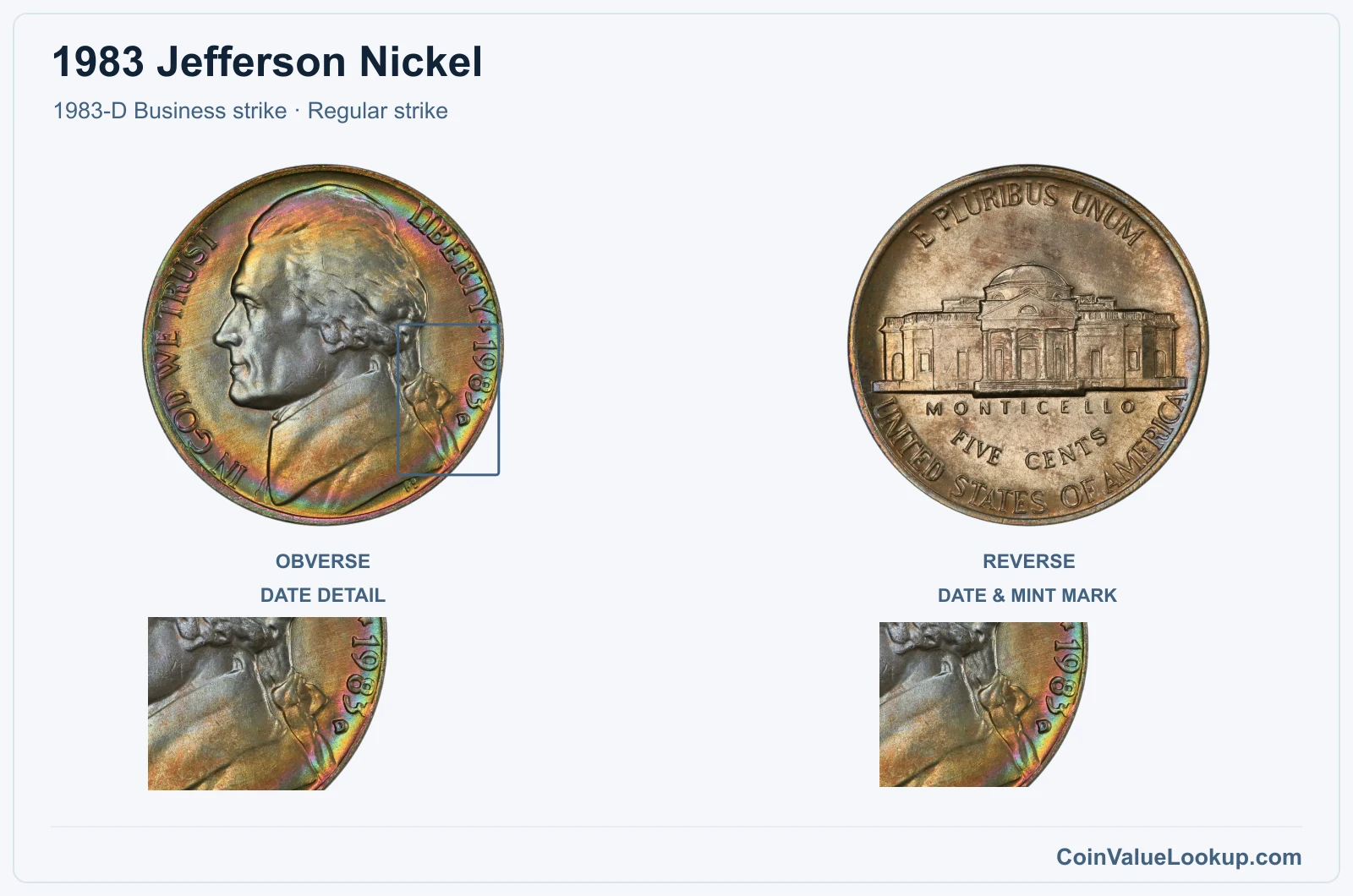
Denver's 1983-D business strike shares the same design and alloy as its Philadelphia sibling. Look for the "D" mintmark on the obverse below the date.
Guide estimates from USA Coin Book run about $1.88 in MS60 and roughly $4.96 in MS65. Lower than the P-mint at the same grades, but still a meaningful step above five cents if you have a clean, lustrous example.
There is no silver collector branch for this coin — it is copper-nickel all the way through.
Coin Value Lookup is a handy starting point if you want to look up guide values for other dates and denominations in the Jefferson nickel series.
| Range | Grade | Price | Auction Records | Appraisal |
|---|---|---|---|---|
| PO | PO 1 | — | Coin Identifier | |
| FR | FR 2 | — | Coin Identifier | |
| AG | AG 3 | — | Coin Identifier | |
| G | G 4 | — | Coin Identifier | |
| G 6 | — | Coin Identifier | ||
| VG | VG 8 | — | Coin Identifier | |
| VG 10 | — | Coin Identifier | ||
| F | F 12 | — | Coin Identifier | |
| F 15 | — | Coin Identifier | ||
| VF | VF 20 | — | Coin Identifier | |
| VF 25 | — | Coin Identifier | ||
| VF 30 | — | Coin Identifier | ||
| VF 35 | — | Coin Identifier | ||
| XF | XF 40 | — | Coin Identifier | |
| XF 45 | — | Coin Identifier | ||
| AU | AU 50 | — | Coin Identifier | |
| AU 53 | — | Coin Identifier | ||
| AU 55 | — | Coin Identifier | ||
| AU 58 | — | Coin Identifier | ||
| MS | MS 60 | — | Coin Identifier | |
| MS 61 | — | Coin Identifier | ||
| MS 62 | — | Coin Identifier | ||
| MS 63 | — | Coin Identifier | ||
| MS 64 | — | Coin Identifier | ||
| MS 65 | Coin Identifier | |||
| MS 66 | Coin Identifier | |||
| MS 67 | — | Coin Identifier | ||
| MS 68 | — | — | — | |
| MS 69 | — | — | — | |
| MS 70 | — | — | — |
1983 Jefferson Nickel — S Proof
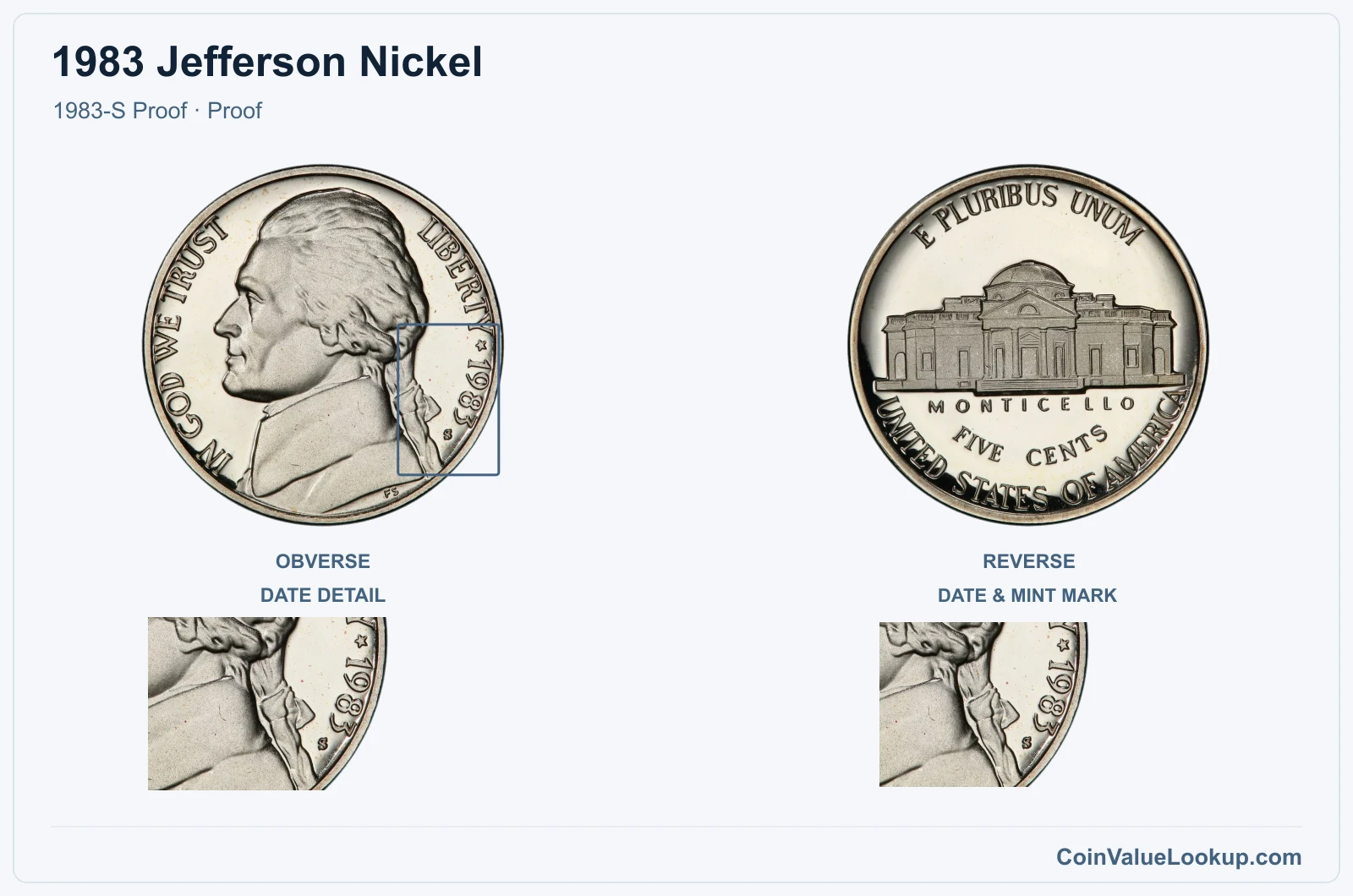
The 1983-S proof was struck at San Francisco for collector sets. It has the same 75% copper / 25% nickel composition and 5-gram weight, but the manufacturing process produces mirror fields and frosted design elements that set it apart from business strikes.
A PR65 example guides at about $3.08 according to USA Coin Book. Cameo and deep cameo designations — describing the degree of frost contrast against the mirrors — are tracked separately and can carry different premiums, but no specific cameo price is adopted here.
Proof is a finish, not a grade above Mint State, so do not compare PR65 directly to MS65 as though one outranks the other.
| Range | Grade | Price | Auction Records | Appraisal |
|---|---|---|---|---|
| PR | PR 1 | — | Coin Identifier | |
| PR 2 | — | Coin Identifier | ||
| PR 3 | — | Coin Identifier | ||
| PR 4 | — | Coin Identifier | ||
| PR 6 | — | Coin Identifier | ||
| PR 8 | — | Coin Identifier | ||
| PR 10 | — | Coin Identifier | ||
| PR 12 | — | Coin Identifier | ||
| PR 15 | — | Coin Identifier | ||
| PR 20 | — | Coin Identifier | ||
| PR 25 | — | Coin Identifier | ||
| PR 30 | — | Coin Identifier | ||
| PR 35 | — | Coin Identifier | ||
| PR 40 | — | Coin Identifier | ||
| PR 45 | — | Coin Identifier | ||
| PR 50 | — | Coin Identifier | ||
| PR 53 | — | Coin Identifier | ||
| PR 55 | — | Coin Identifier | ||
| PR 58 | — | Coin Identifier | ||
| PR 60 | — | Coin Identifier | ||
| PR 61 | — | Coin Identifier | ||
| PR 62 | — | Coin Identifier | ||
| PR 63 | — | Coin Identifier | ||
| PR 64 | — | Coin Identifier | ||
| PR 65 | — | Coin Identifier | ||
| PR 66 | — | Coin Identifier | ||
| PR 67 | — | Coin Identifier | ||
| PR 68 | Coin Identifier | |||
| PR 69 | Coin Identifier | |||
| PR 70 | Coin Identifier |
1983 Jefferson Nickel Error List
1. 1983 Jefferson Nickel — Struck on leftover copper cent blank
This is a wrong-planchet error: a 1983 Jefferson nickel design struck on a leftover copper cent blank at the Philadelphia Mint. The old copper alloy (pre-1982 composition) persisted in some mint hoppers after the cent switched to zinc-plated steel cores in late 1982, so a stray blank could end up in the nickel press.
The coin weighs roughly 3.1 grams instead of the normal 5 grams and is noticeably smaller, so peripheral design details get cropped. It looks copper-colored, but color alone is not proof — copper plating, toning, and ground-down coins can mimic the appearance.
Confirmed attribution requires verifying weight, alloy, and dimensions through a grading service.
A PCGS MS65 Red example sold through Heritage Auctions in April 2021 for $4,800. That is one recorded sale, not a guaranteed market price for every specimen.
2. 1983 Jefferson Nickel — Struck on leftover bronze cent blank
The Denver Mint produced its own version of this wrong-planchet error — a 1983-D nickel struck on a leftover bronze cent blank. At roughly 3.06 grams it is significantly underweight for a nickel, and the smaller blank diameter clips the outer design.
The date and D mintmark are mostly visible on authenticated examples, which helps distinguish it from the Philadelphia copper-blank error. As with the P-mint version, do not diagnose this from color alone.
Copper plating, environmental toning, and deliberately altered coins look similar to an untrained eye. Professional attribution through a service like NGC or PCGS is the reliable path.
An NGC MS64 Red specimen sold at Heritage Auctions in August 2010 for $4,312.50. That sale documents one coin's realized price at one point in time.
3. 1983 Jefferson Nickel — Major die break
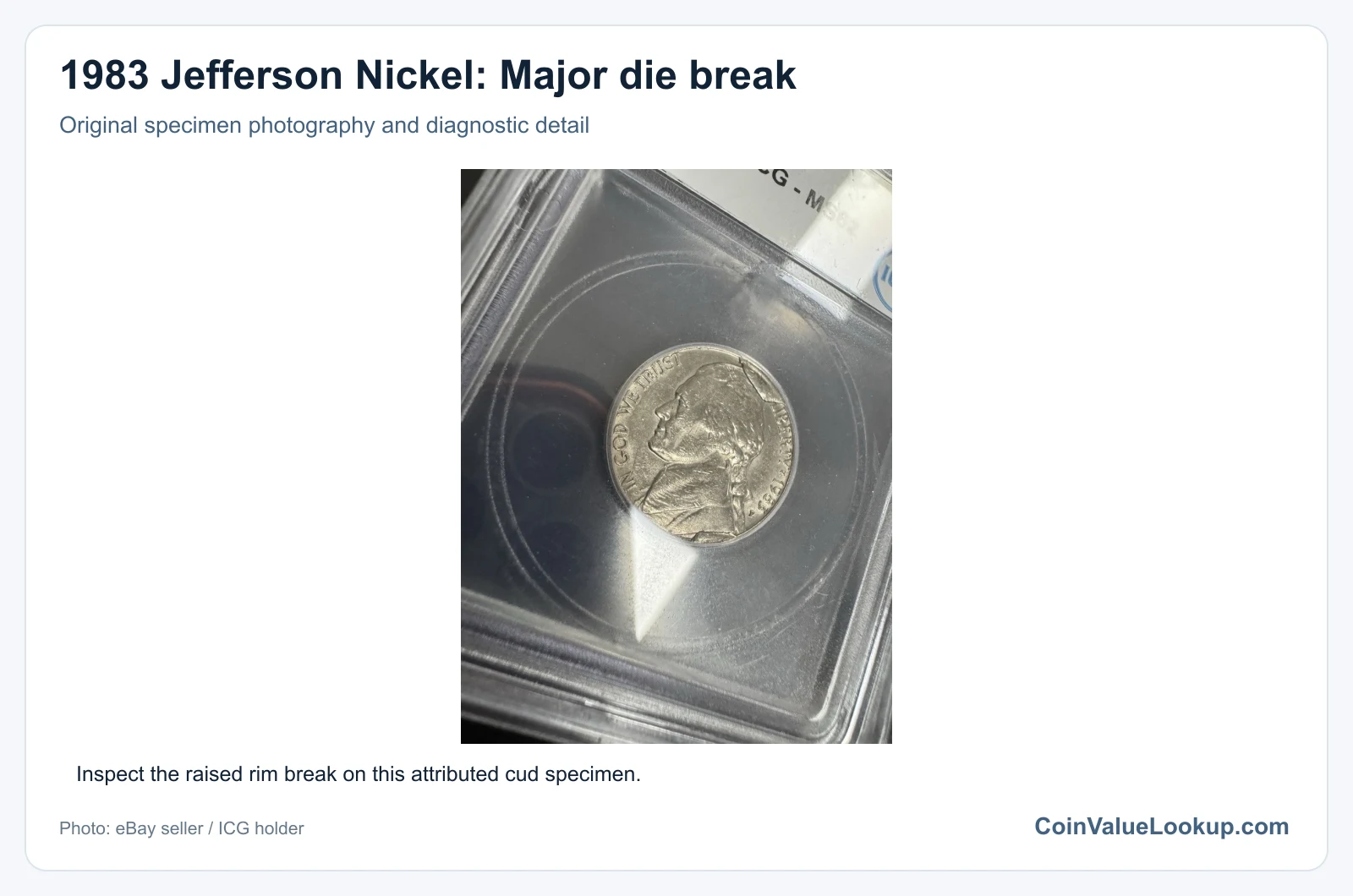
A major die break — sometimes called a cud — happens when a chunk of the die fractures and falls away. The result is a raised, featureless blob of metal connected to the rim, replacing whatever design detail occupied that area.
A Philadelphia-mint 1983 nickel with this error was authenticated by ANACS in AU50 condition and appeared at Heritage Auctions. No specific realized price is adopted here because value depends heavily on the size, location, and visual impact of the break, plus the coin's overall condition.
Each major die break is essentially unique.
Do not confuse a cud with an incuse gouge, corrosion buildup, or foreign metal stuck to the surface. A genuine die break is raised above the field, merges smoothly into the rim, and appears on every coin struck after the fracture occurred.
4. 1983 Jefferson Nickel — Off-center strike
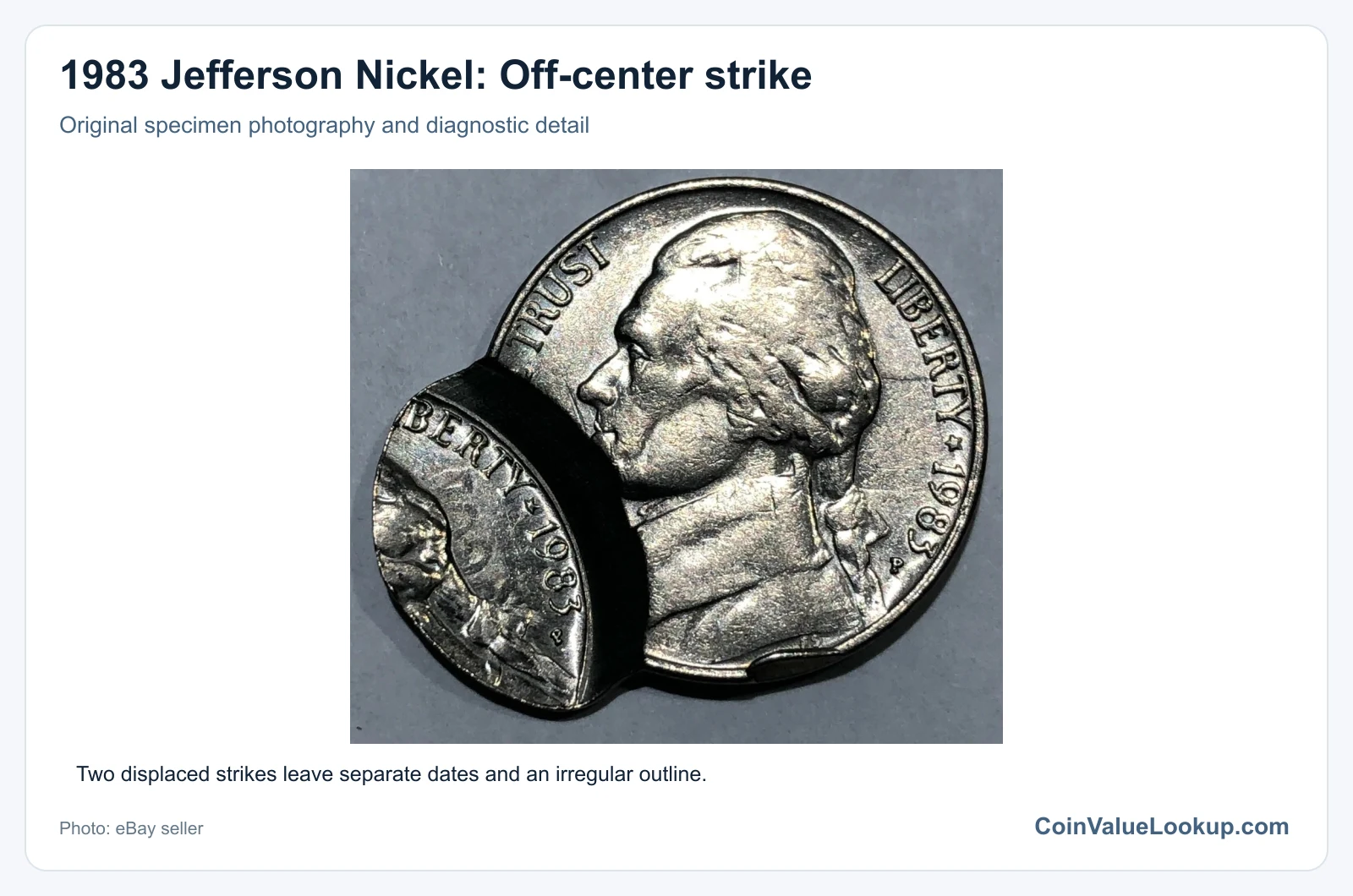
An off-center strike occurs when the blank is not properly seated in the collar before the dies come together. The result is a displaced design with an unstruck crescent along one edge.
A 1983-P nickel struck approximately 15% off center at the 1:00 position was certified ANACS MS64 and listed through Heritage Auctions. No specific price is adopted because off-center value varies with the percentage of displacement, whether the date remains visible, and overall preservation.
A 15% shift is moderate — enough to be obviously wrong, but not dramatic enough to erase the date.
Look-alikes include single-die misalignment (which shifts one side only), a cut or filed rim, and post-mint damage. A true off-center strike affects both obverse and reverse equally, displacing the entire design in one direction.