1988 Jefferson Nickel Coin Value: How Much Is It Worth?
Most 1988 Jefferson nickels are worth face value in circulated condition. Uncirculated examples carry modest guide estimates, with MS60 around $0.30 and MS65 near $3.62 depending on the mint.
S-mint proofs and authenticated error coins occupy separate, sometimes much higher, price tiers. All guide figures cited here reflect published retail estimates at specific grades and are not guaranteed purchase offers for any individual coin.
Fast Way to Identify Your 1988 Jefferson Nickel
Snap clear photos of both sides of your 1988 nickel and upload them here for a preliminary identification. The images help determine which mint produced your coin and whether the strike, edge, or surface shows anything unusual.
This is not a substitute for professional authentication or certified grading, but it gives you a solid starting point.
1988 Jefferson Nickel Value
Upload both sides of your 1988 Jefferson Nickel.
Front Obverse
Upload photo
Back Reverse
Upload photo
Which 1988 Jefferson Nickel Versions Are Worth Money?
- Uncirculated 1988-P and 1988-D nickels in MS65 condition carry guide estimates near $3.62, well above face value for a common modern coin.
- 1988-S proofs are collector strikes with a PR65 guide estimate around $6.25; cameo or deep cameo contrast may affect value separately.
- A 1988-D nickel struck over a 1988-D cent is a dramatic double-denomination error; one NGC MS66 Red example sold at Heritage in September 2024 for $600.
- Multiple-strike and off-center errors with retained dates have an active collector following; a 1988-D 60% off-center example brought $104 at Heritage in October 2010.
- Broadstrikes, curved clips, wrong-planchet strikes, doubled die obverses, and repunched mintmarks have all been reported for this date and can carry premiums when authenticated.
Step 1: Identify Your 1988 Jefferson Nickel Mint Mark and Version
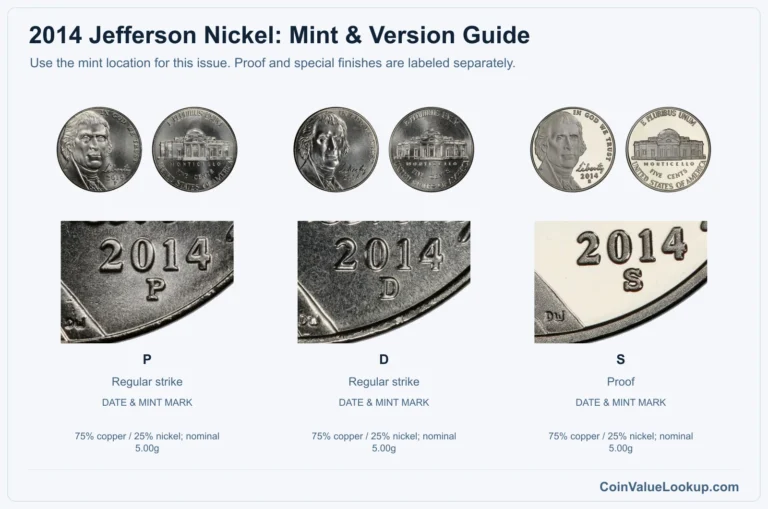
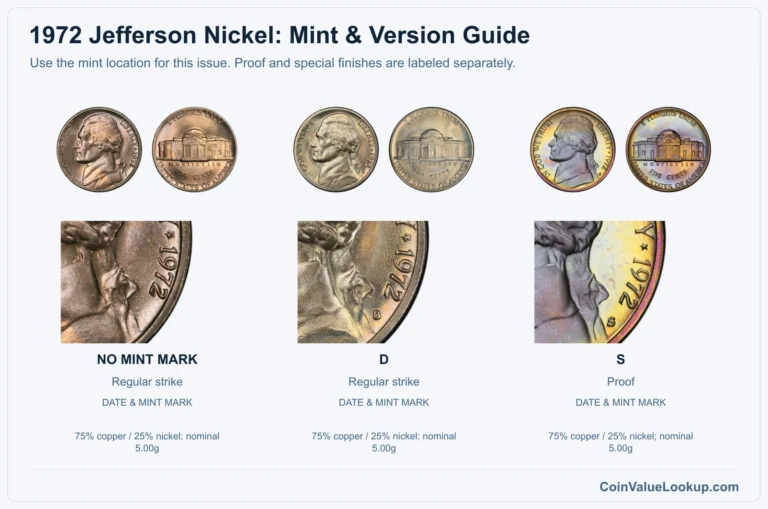
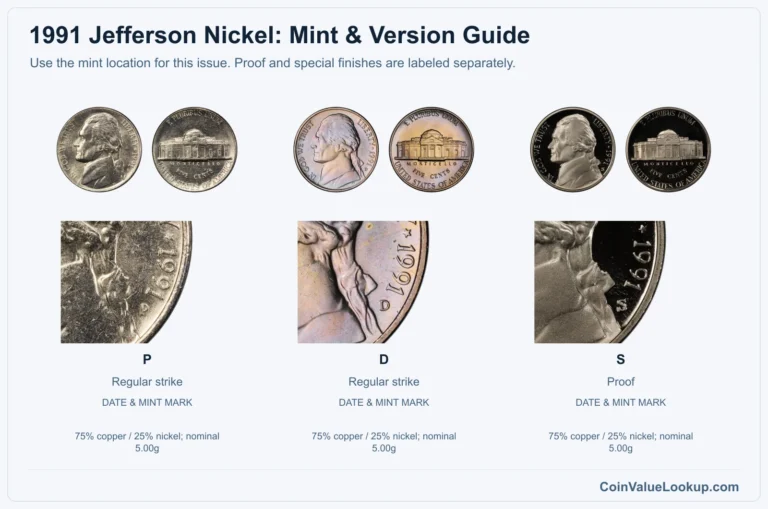
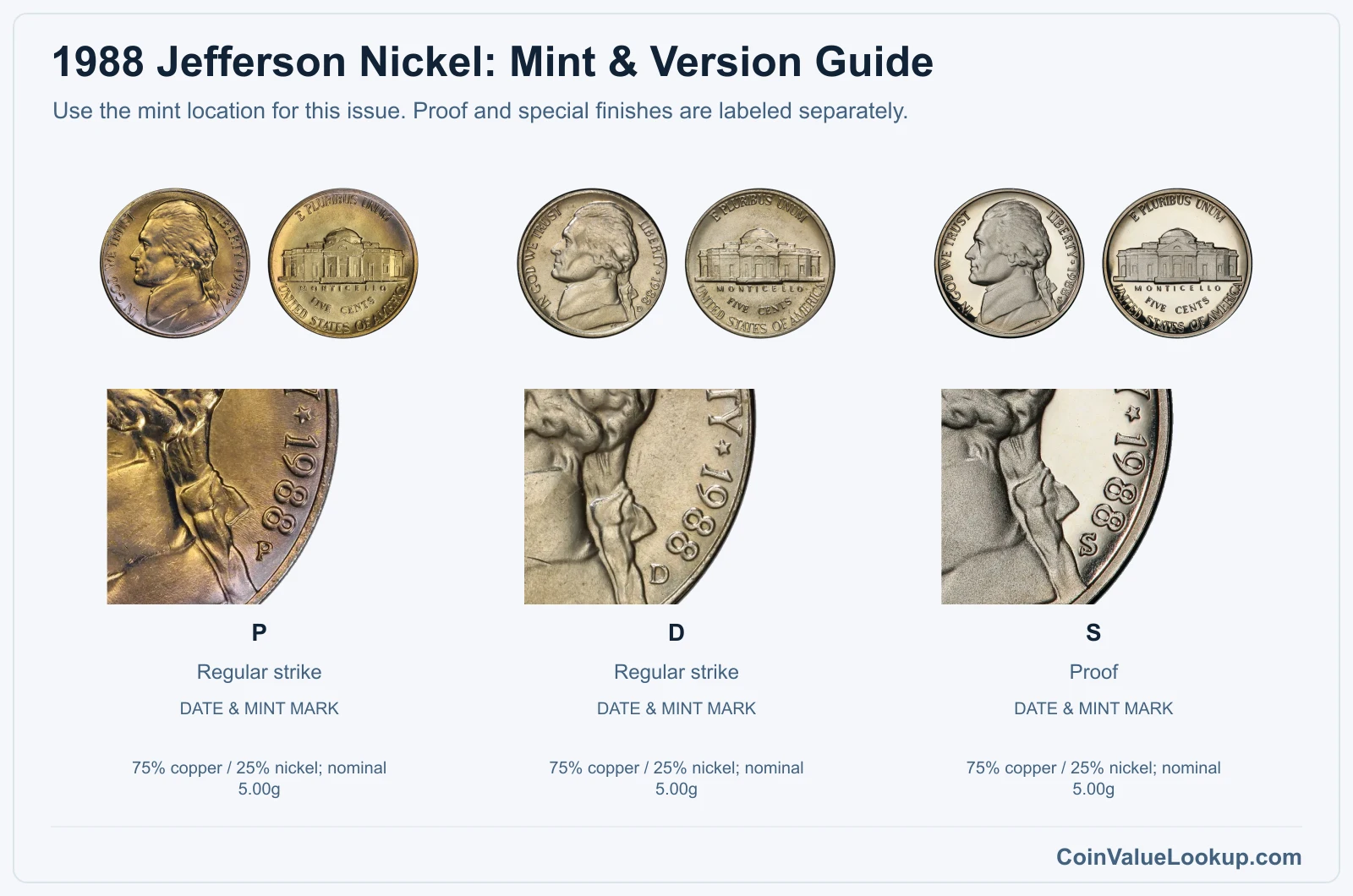
Three versions of the 1988 Jefferson nickel exist. The Philadelphia issue carries a small "P" mintmark on the obverse, just below the date.
The Denver coin shows a "D" in the same spot. The San Francisco proof has an "S" there instead.
All three share the same composition: 75% copper and 25% nickel, weighing about 5 grams with a 21.2 mm diameter and a plain edge. If you see a reeded edge or a noticeably different weight, you may have something struck on the wrong blank, which is a separate category entirely.
Before jumping to a price chart, confirm the mintmark letter and the finish. Business strikes have a satiny or slightly frosty look.
Proofs are mirror-like with sharp detail. Mixing these up will send you to the wrong column every time.
Step 2: Check Your 1988 Jefferson Nickel Grade
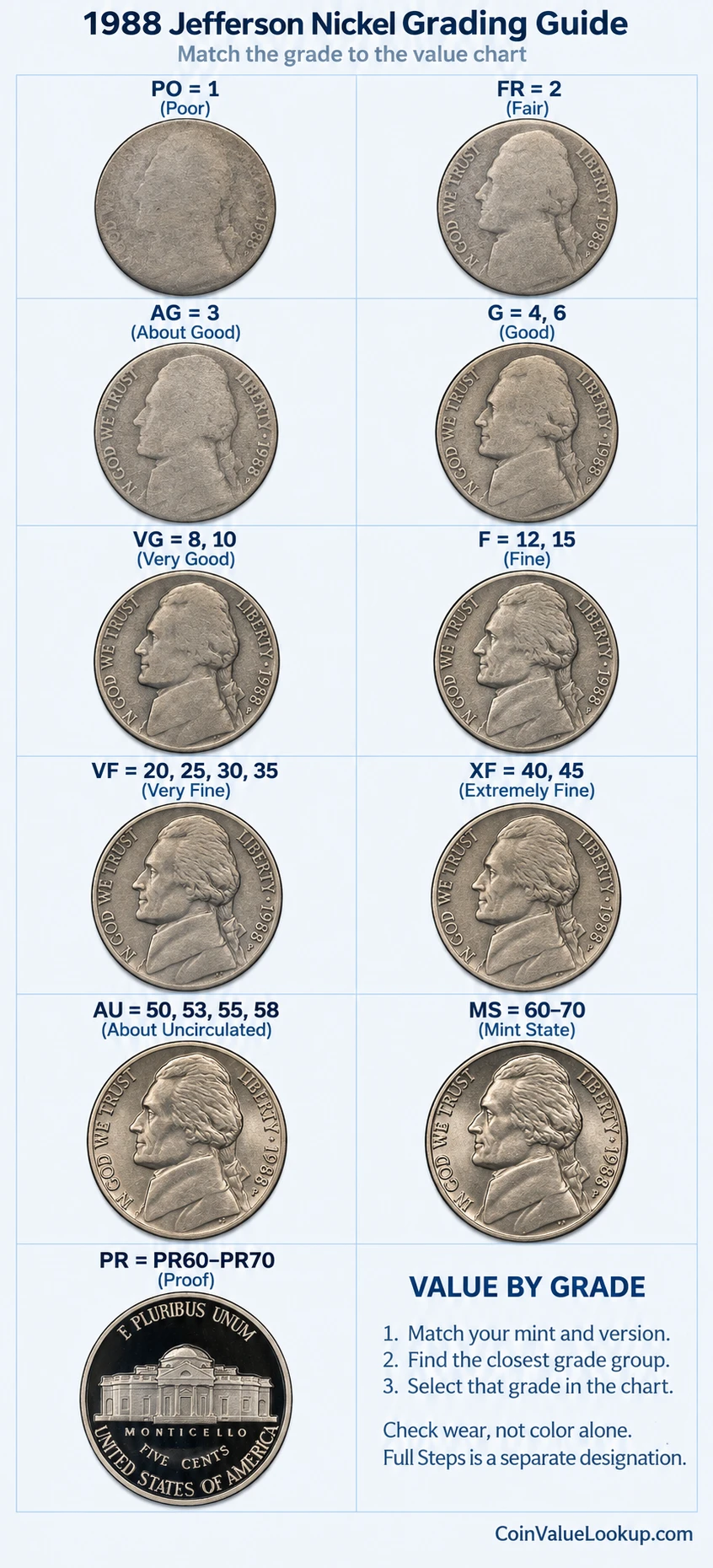
Start with Jefferson's cheek and the hair detail above his ear. On a well-worn coin those areas flatten first, and the original mint luster disappears.
A coin with full, undisturbed luster across both sides is a candidate for Mint State grades.
Flip the coin over and check Monticello's columns and steps. Sharp steps can reflect a strong strike rather than low wear, so do not assume crisp steps automatically mean a higher circulated grade.
The comparison image nearby shows how wear progresses from light rub to heavy flattening.
Certified "Full Steps" is a designation added to qualifying Mint State business strikes. It is not a mint error.
Similarly, proof cameo and deep cameo contrast are separate filters within proof grades, not upgrades above Mint State.
Step 3: Check 1988 Jefferson Nickel Value by Mint and Version
1988 Jefferson Nickel — P Business strike
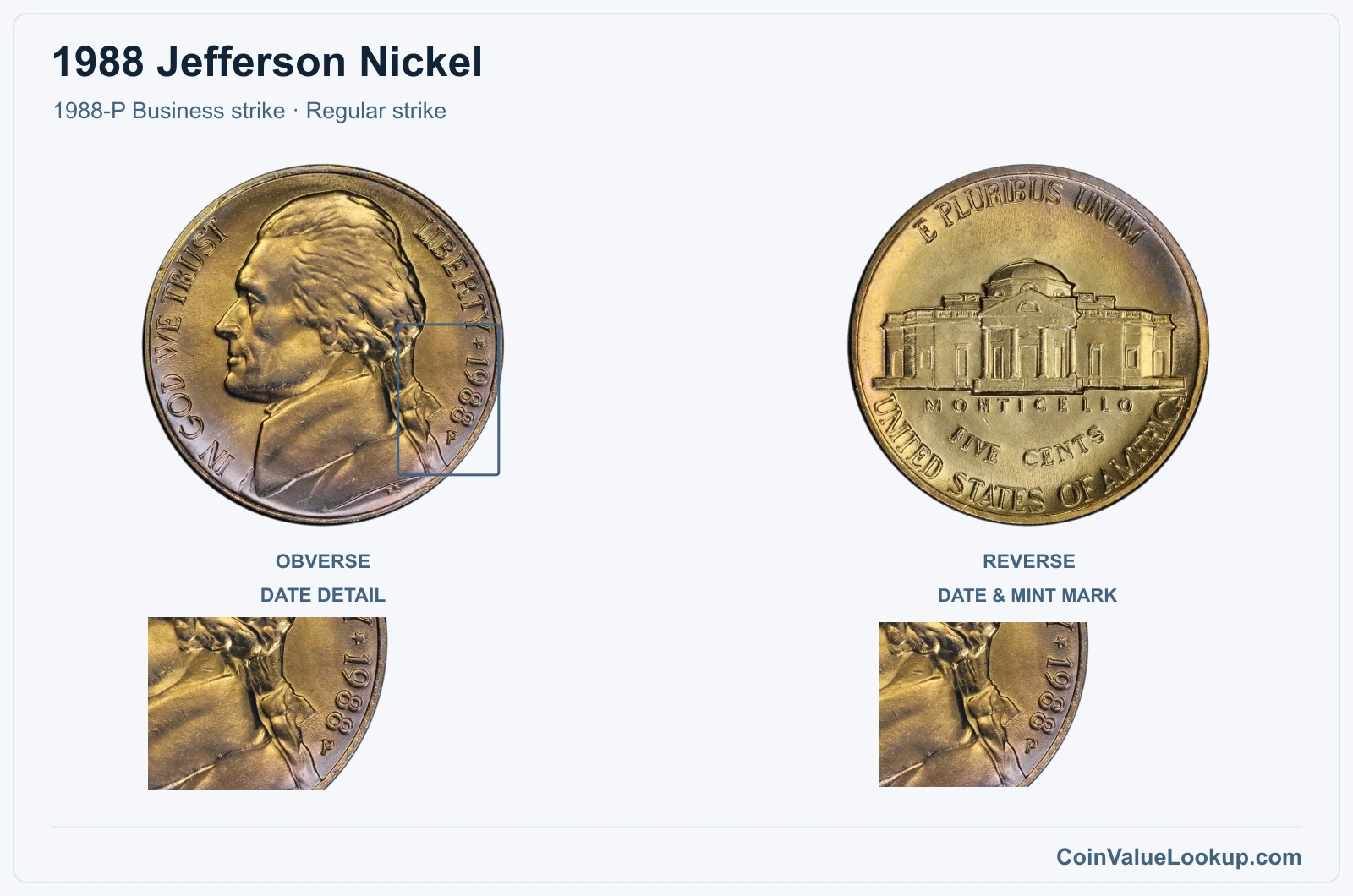
The 1988-P is a standard business strike from Philadelphia, bearing the small "P" mintmark below the date. It weighs about 5 grams in 75% copper and 25% nickel with a plain edge.
There is no silver collector version for this year.
Guide estimates place an MS60 example at roughly $0.30 and an MS65 around $3.62 according to USA Coin Book. In worn grades these trade at face value.
If your coin has full, unbroken luster and sharp detail on both Jefferson's portrait and Monticello, it is worth getting a closer look at the grade.
| Range | Grade | Price | Auction Records | Appraisal |
|---|---|---|---|---|
| PO | PO 1 | — | Coin Identifier | |
| FR | FR 2 | — | Coin Identifier | |
| AG | AG 3 | — | Coin Identifier | |
| G | G 4 | — | Coin Identifier | |
| G 6 | — | Coin Identifier | ||
| VG | VG 8 | — | Coin Identifier | |
| VG 10 | — | Coin Identifier | ||
| F | F 12 | — | Coin Identifier | |
| F 15 | — | Coin Identifier | ||
| VF | VF 20 | — | Coin Identifier | |
| VF 25 | — | Coin Identifier | ||
| VF 30 | — | Coin Identifier | ||
| VF 35 | — | Coin Identifier | ||
| XF | XF 40 | — | Coin Identifier | |
| XF 45 | — | Coin Identifier | ||
| AU | AU 50 | — | Coin Identifier | |
| AU 53 | — | Coin Identifier | ||
| AU 55 | — | Coin Identifier | ||
| AU 58 | — | Coin Identifier | ||
| MS | MS 60 | — | Coin Identifier | |
| MS 61 | — | Coin Identifier | ||
| MS 62 | — | Coin Identifier | ||
| MS 63 | — | Coin Identifier | ||
| MS 64 | Coin Identifier | |||
| MS 65 | — | Coin Identifier | ||
| MS 66 | Coin Identifier | |||
| MS 67 | — | — | — | |
| MS 68 | — | — | — | |
| MS 69 | — | — | — | |
| MS 70 | — | — | — |
1988 Jefferson Nickel — D Business strike
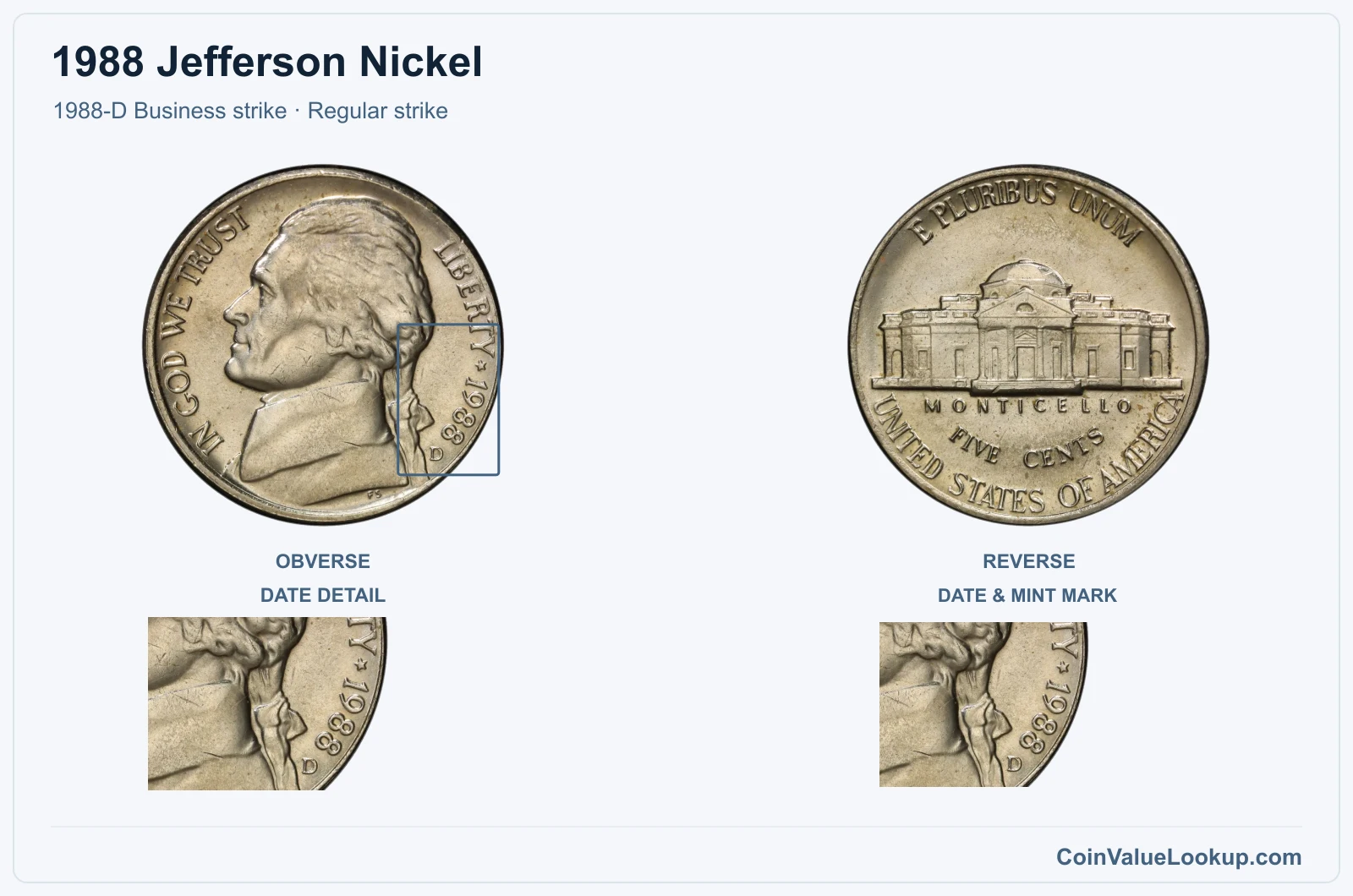
Denver's 1988-D nickel is the same design and alloy as the Philadelphia issue, distinguished by the "D" mintmark below the date. Same weight, same plain edge, same composition.
Retail guide estimates mirror the P-mint: about $0.30 at MS60 and $3.62 at MS65. Circulated pieces are face-value coins.
The D-mint is also the host for several documented errors, including the struck-over-cent variety, so inspect the surfaces carefully before tossing it back into a jar.
Coin Value Lookup is a good place to look up guides for other dates and denominations in the Jefferson series if you are sorting a batch.
| Range | Grade | Price | Auction Records | Appraisal |
|---|---|---|---|---|
| PO | PO 1 | — | Coin Identifier | |
| FR | FR 2 | — | Coin Identifier | |
| AG | AG 3 | — | Coin Identifier | |
| G | G 4 | — | Coin Identifier | |
| G 6 | — | Coin Identifier | ||
| VG | VG 8 | — | Coin Identifier | |
| VG 10 | — | Coin Identifier | ||
| F | F 12 | — | Coin Identifier | |
| F 15 | — | Coin Identifier | ||
| VF | VF 20 | — | Coin Identifier | |
| VF 25 | — | Coin Identifier | ||
| VF 30 | — | Coin Identifier | ||
| VF 35 | — | Coin Identifier | ||
| XF | XF 40 | — | Coin Identifier | |
| XF 45 | — | Coin Identifier | ||
| AU | AU 50 | — | Coin Identifier | |
| AU 53 | — | Coin Identifier | ||
| AU 55 | — | Coin Identifier | ||
| AU 58 | — | Coin Identifier | ||
| MS | MS 60 | — | Coin Identifier | |
| MS 61 | — | Coin Identifier | ||
| MS 62 | — | Coin Identifier | ||
| MS 63 | Coin Identifier | |||
| MS 64 | Coin Identifier | |||
| MS 65 | — | Coin Identifier | ||
| MS 66 | Coin Identifier | |||
| MS 67 | Coin Identifier | |||
| MS 68 | — | — | — | |
| MS 69 | — | — | — | |
| MS 70 | — | — | — |
1988 Jefferson Nickel — S Proof
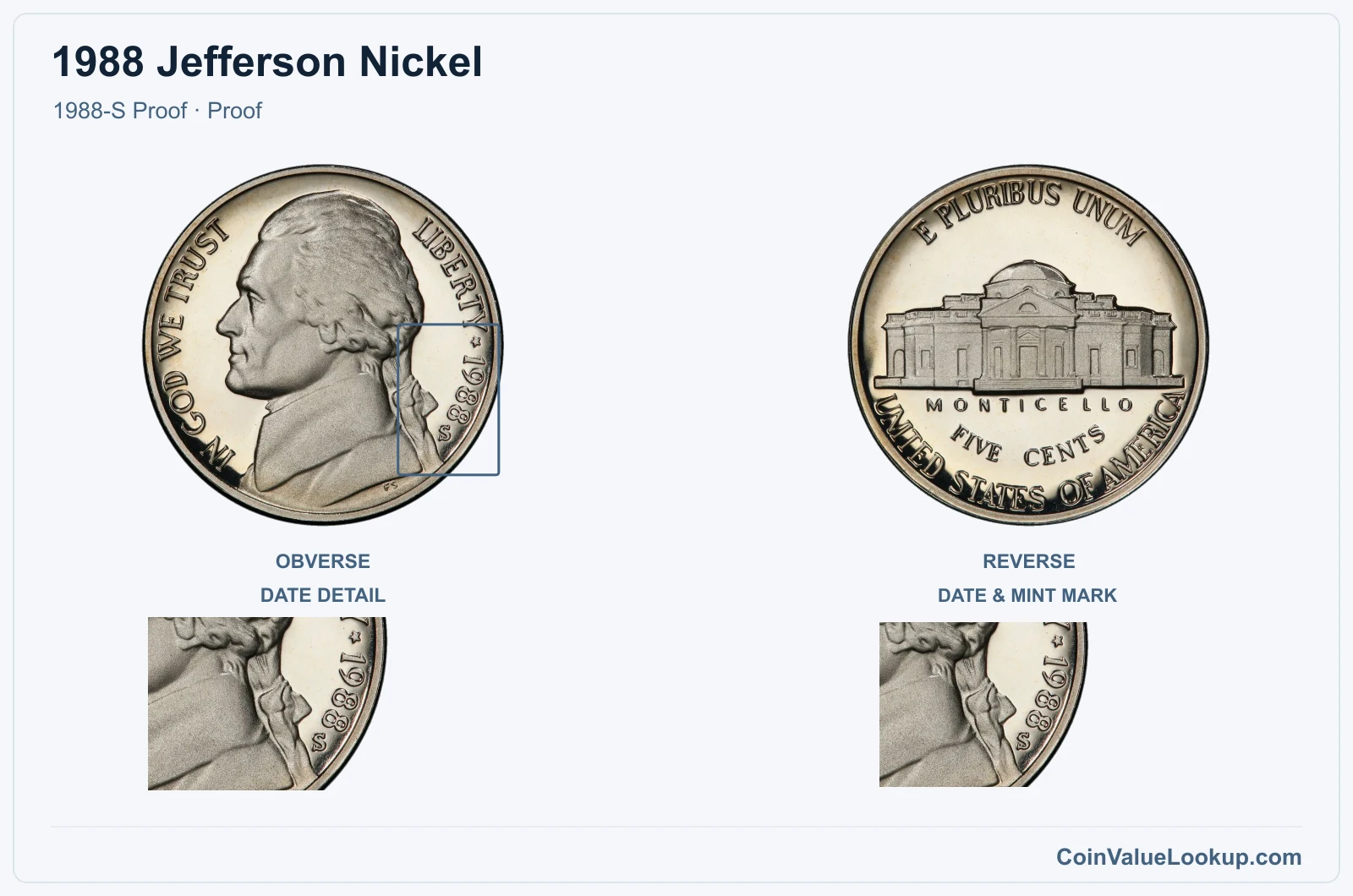
The 1988-S proof was struck at San Francisco exclusively for collector sets. It carries the "S" mintmark and has mirror-like fields with frosted design elements.
Composition and weight match the business strikes.
A PR65 example carries a guide estimate of about $6.25 per USA Coin Book. Cameo and deep cameo contrast levels exist as separate designations within proof grading, and their values are tracked independently.
Do not compare proof prices directly to business-strike MS grades; the manufacturing methods are fundamentally different. These coins were never intended for circulation, so finding one in pocket change would itself be unusual.
| Range | Grade | Price | Auction Records | Appraisal |
|---|---|---|---|---|
| PR | PR 1 | — | Coin Identifier | |
| PR 2 | — | Coin Identifier | ||
| PR 3 | — | Coin Identifier | ||
| PR 4 | — | Coin Identifier | ||
| PR 6 | — | Coin Identifier | ||
| PR 8 | — | Coin Identifier | ||
| PR 10 | — | Coin Identifier | ||
| PR 12 | — | Coin Identifier | ||
| PR 15 | — | Coin Identifier | ||
| PR 20 | — | Coin Identifier | ||
| PR 25 | — | Coin Identifier | ||
| PR 30 | — | Coin Identifier | ||
| PR 35 | — | Coin Identifier | ||
| PR 40 | — | Coin Identifier | ||
| PR 45 | — | Coin Identifier | ||
| PR 50 | — | Coin Identifier | ||
| PR 53 | — | Coin Identifier | ||
| PR 55 | — | Coin Identifier | ||
| PR 58 | — | Coin Identifier | ||
| PR 60 | — | Coin Identifier | ||
| PR 61 | — | Coin Identifier | ||
| PR 62 | — | Coin Identifier | ||
| PR 63 | — | Coin Identifier | ||
| PR 64 | — | Coin Identifier | ||
| PR 65 | — | Coin Identifier | ||
| PR 66 | — | Coin Identifier | ||
| PR 67 | — | Coin Identifier | ||
| PR 68 | Coin Identifier | |||
| PR 69 | Coin Identifier | |||
| PR 70 | Coin Identifier |
1988 Jefferson Nickel Error List
1. 1988 Jefferson Nickel — Struck over a1988-Dcent
This is a double-denomination error: a 1988-D Lincoln cent planchet that received a Jefferson nickel strike on top. The surviving cent design is visible beneath the nickel impression, confirming the underlying denomination.
That is the key diagnostic. You need to see traces of Lincoln's portrait or the Memorial under the nickel design, not just copper color.
One example graded NGC MS66 Red sold through Heritage Auctions in September 2024 for $600. A coin that simply looks copper-toned is not the same thing.
Unstruck wrong-planchet blanks, environmental toning, and vise-job fakes can all mimic the appearance at a glance. Authentication by a major grading service is essential for this category.
2. 1988 Jefferson Nickel — Multiple strikes offcenter
A multiple-strike error means the coin was hit more than once by the dies, with at least one impression displaced from the first. On the reported 1988-D example, the coin is 60% off-center with multiple visible impressions and a retained date.
That retained date matters because it confirms the year and mint.
One such piece, graded NGC MS67, sold through Heritage Auctions in October 2010 for $104. Look for two or more overlapping design images on the same planchet.
Die doubling is a completely different phenomenon, producing tight separation on lettering rather than a dramatically shifted second image. Tool marks from pliers or a vise can also create misleading double impressions, so compare carefully.
3. 1988 Jefferson Nickel — Broadstrike
A broadstrike happens when a coin is struck without the collar die fully containing the blank. The result is a coin that spreads wider than normal, with a complete central design but a missing or irregular rim.
The edge looks spread and rounded rather than sharply defined.
A 1988-P broadstrike graded ICG MS65 has been documented through Heritage Auctions. No specific sale price is available, so value depends on the individual coin's condition, the severity of the spread, and third-party authentication.
Do not confuse a broadstrike with post-mint flattening, ground damage, or a coin that has been hammered. Genuine broadstrikes retain full design detail in the center while showing uniform expansion outward.
4. 1988 Jefferson Nickel — Curved clip
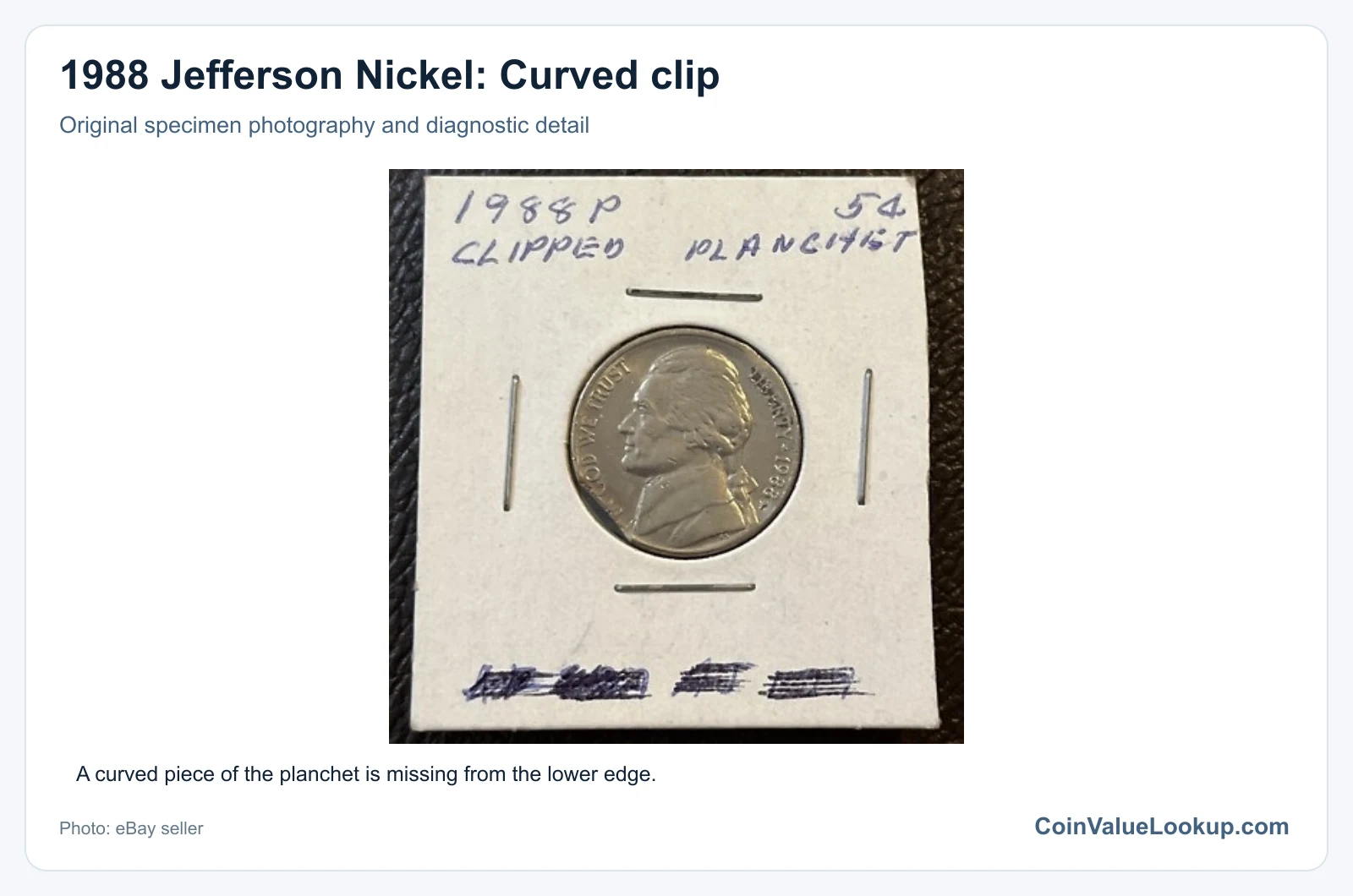
A curved clip occurs when the blank is punched from an area of strip metal that overlaps a previously punched hole. The result is a crescent-shaped missing section with a natural, smooth contour and characteristic metal-flow lines near the clip boundary.
The rim thins gradually into the missing area rather than stopping abruptly.
A 1988-P curved clip graded ANACS MS62 has been documented. No specific sale price is adopted, so value depends on the size of the clip, the coin's overall condition, and whether the date and mintmark remain visible.
Clips made by pliers, saws, or deliberate edge breaks leave tool marks and lack the natural flow transitions seen on a genuine clipped planchet.
5. 1988 Jefferson Nickel — Wrong Planchet / Off-Metal Strike
A wrong-planchet or off-metal strike means a 1988 nickel die struck a blank intended for a different denomination or composition. The finished coin carries the Jefferson nickel design but may show an incorrect weight, diameter, or edge characteristic compared to a normal nickel.
To check, weigh your coin and measure the diameter. A standard 1988 nickel is 5 grams and 21.2 mm with a plain edge.
Any significant deviation deserves closer inspection. Value depends on the specific wrong planchet involved, the completeness of the design, and the coin's condition.
Plating loss, corrosion, acid exposure, and deliberate alteration can all change a coin's appearance and weight enough to mimic an off-metal strike. Third-party authentication is the only reliable way to confirm this type of error.
6. 1988 Jefferson Nickel — Doubled Die Obverse
A doubled die obverse on the 1988 nickel shows consistent doubling in the obverse lettering or design elements, created during die manufacturing. The separation appears as notching or a secondary outline on letters like LIBERTY or IN GOD WE TRUST rather than a flat, shelf-like distortion.
Compare the obverse lettering on your coin to a normal 1988 nickel under the same lighting and magnification. Genuine die doubling is uniform across affected areas.
Machine doubling, which is far more common, tends to produce flat shelving on one side of the letters and carries little to no premium.
No specific price data is available for this variety. Value depends on the visibility of the doubling, the coin's grade, and authentication by a recognized service.
7. 1988 Jefferson Nickel — Repunched Mintmark
A repunched mintmark on a 1988 nickel shows remnants of a second mintmark position near the primary letter. You might see a partial extra outline or a shadow of the original punch slightly offset from the final position.
Inspect the mintmark area below the date under magnification. Compare your coin to a normal example at the same zoom level.
The extra impression should be consistent in shape with the mintmark letter, not a random blob.
Die chips, corrosion around the letter, and machine doubling can all mimic a repunched mintmark to the untrained eye. No specific price data is available for this variety, so value will depend on the clarity of the repunching, the coin's overall condition, and whether a grading service confirms the attribution.