1991 Jefferson Nickel Coin Value: How Much Is It Worth?
Most 1991 Jefferson nickels pulled from pocket change are worth face value and not much more. Uncirculated examples carry modest premiums, with selected retail guide anchors of roughly $0.36 at MS60 up to $3.36 at MS65 for business strikes, and about $5.63 at PR65 for San Francisco proofs.
These guide figures are not guaranteed cash offers for every coin. Authenticated errors and certified Full Steps designations can push values higher, so it pays to know what you have.
Fast Way to Identify Your 1991 Jefferson Nickel
The quickest way to start figuring out what your 1991 nickel is worth is to snap clear photos of the front and back, then upload them to our identification tool. It can help with preliminary identification of your coin's mint, finish, and general type.
Have good lighting and try to capture the mintmark area below the date clearly.
1991 Jefferson Nickel Value
Upload both sides of your 1991 Jefferson Nickel.
Front Obverse
Upload photo
Back Reverse
Upload photo
Which 1991 Jefferson Nickel Versions Are Worth Money?
- High-grade 1991-P and 1991-D nickels certified with a Full Steps designation can carry premiums above ordinary uncirculated examples, though worn coins do not share those values.
- 1991-S proofs, especially those with strong cameo contrast, have their own collector market separate from business strikes.
- A confirmed struck-over-a-cent error (double denomination) is a standout rarity; one NGC-certified example sold at Heritage Auctions in September 2019 for $432.
- Authenticated mint errors such as broadstrikes, clipped planchets, and off-center strikes are reported for this year and can add value depending on condition and visibility.
Step 1: Identify Your 1991 Jefferson Nickel Mint Mark and Version
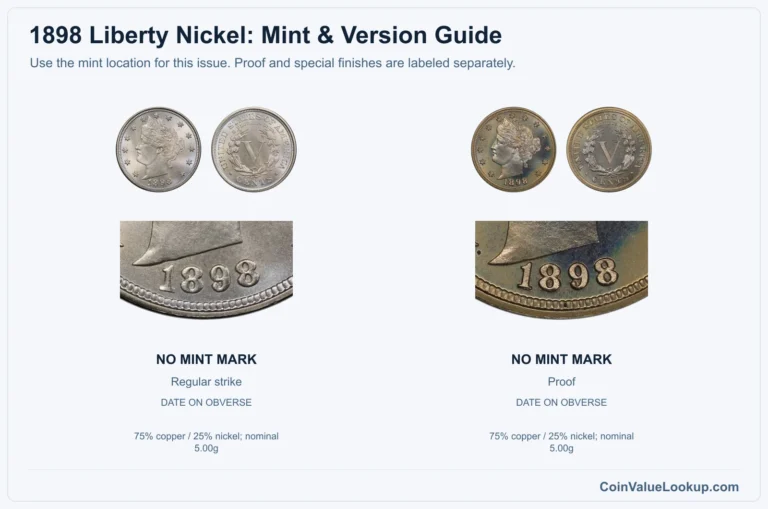
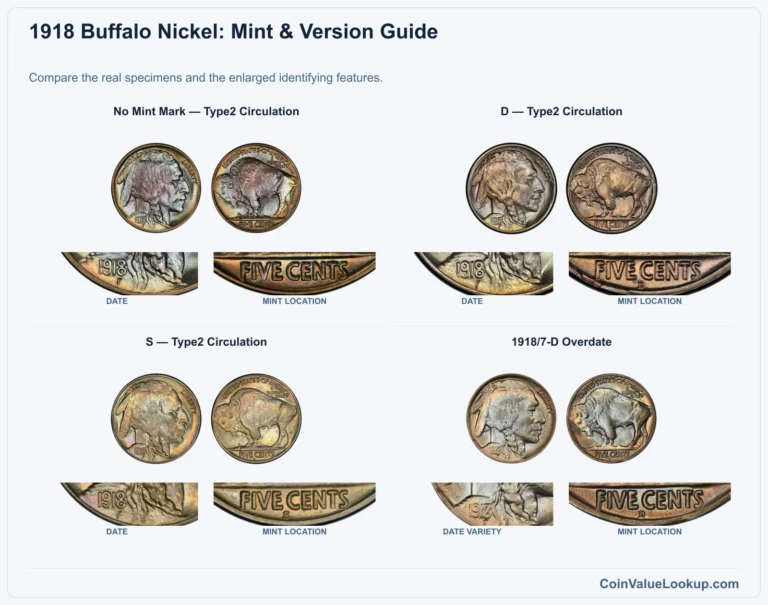
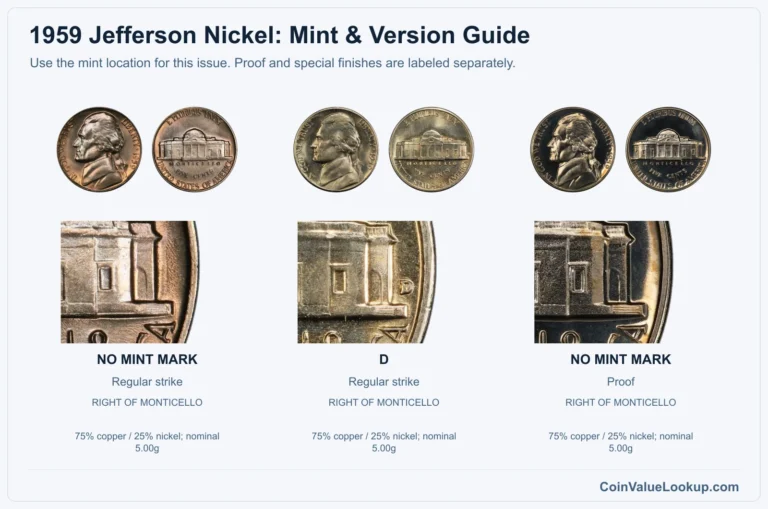
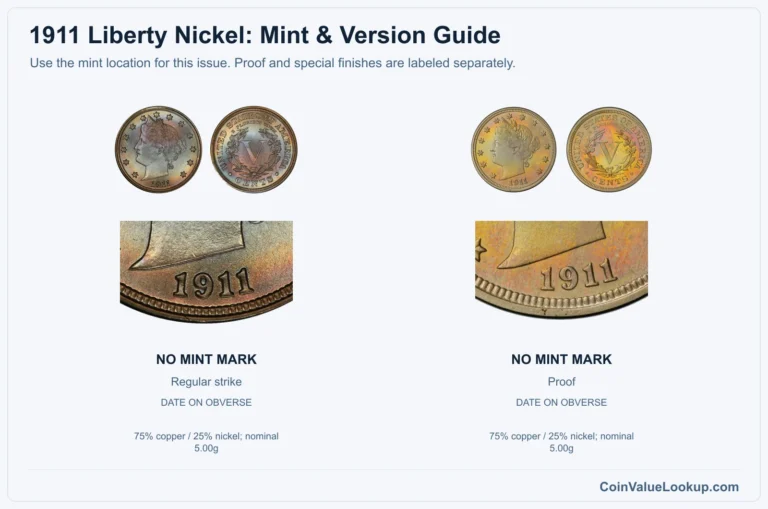
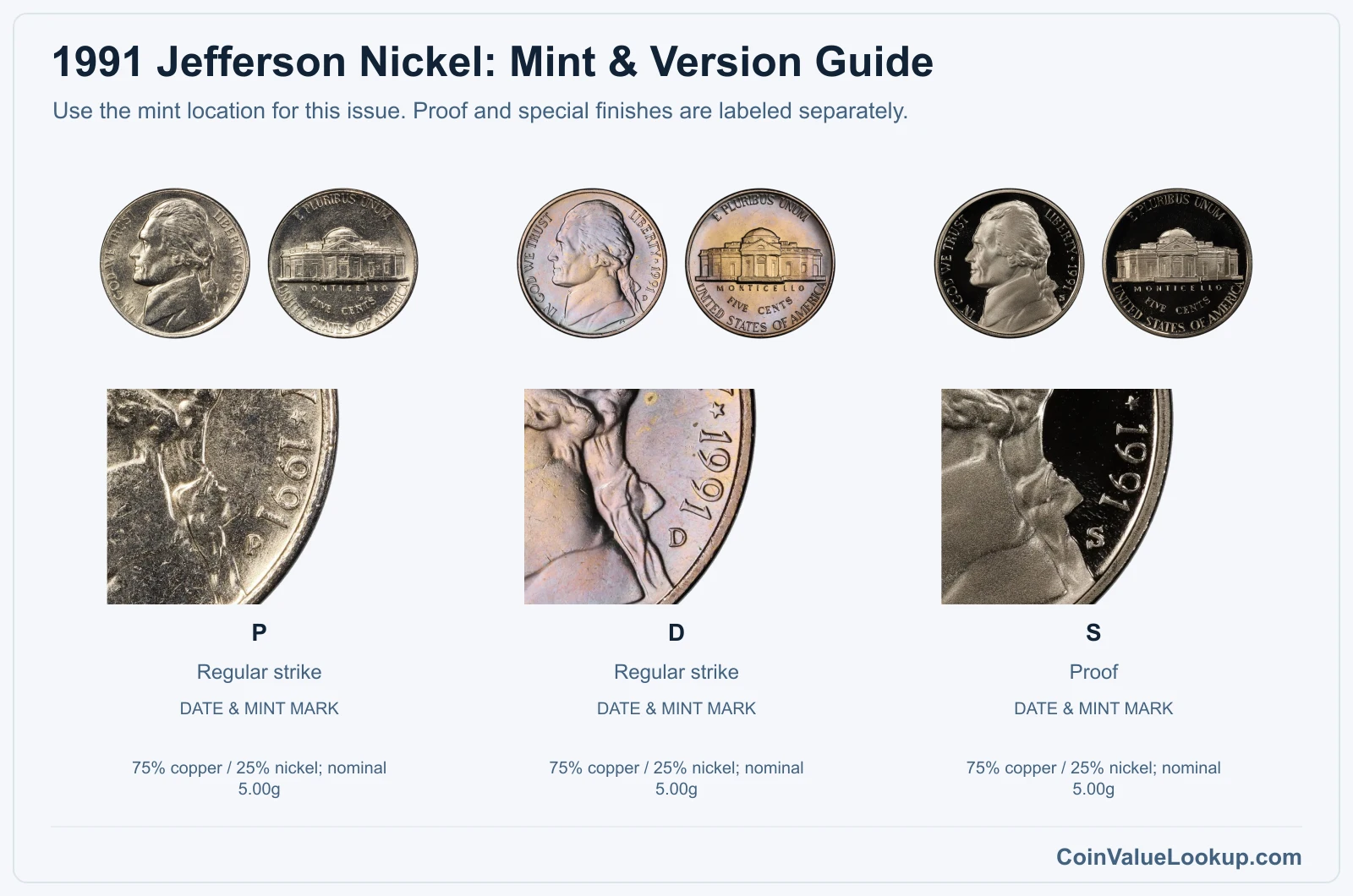
Three versions of the 1991 Jefferson nickel exist: the Philadelphia (P) business strike, the Denver (D) business strike, and the San Francisco (S) proof. To tell them apart, look on the obverse just below the date for a small letter.
A "P" means Philadelphia, a "D" means Denver, and an "S" means San Francisco proof.
All three share the same composition: 75% copper and 25% nickel, weighing about 5 grams with a 21.2 mm diameter and a plain edge. The design is the standard Jefferson portrait on the obverse and Monticello on the reverse.
Proofs have a mirror-like finish with sharp detail. Do not assume a shiny coin is a proof just because it looks clean.
Genuine proofs come from collector sets and carry an "S" mintmark. A frosted or cameo appearance needs correct attribution and provenance rather than a guess based on brightness alone.
Step 2: Check Your 1991 Jefferson Nickel Grade
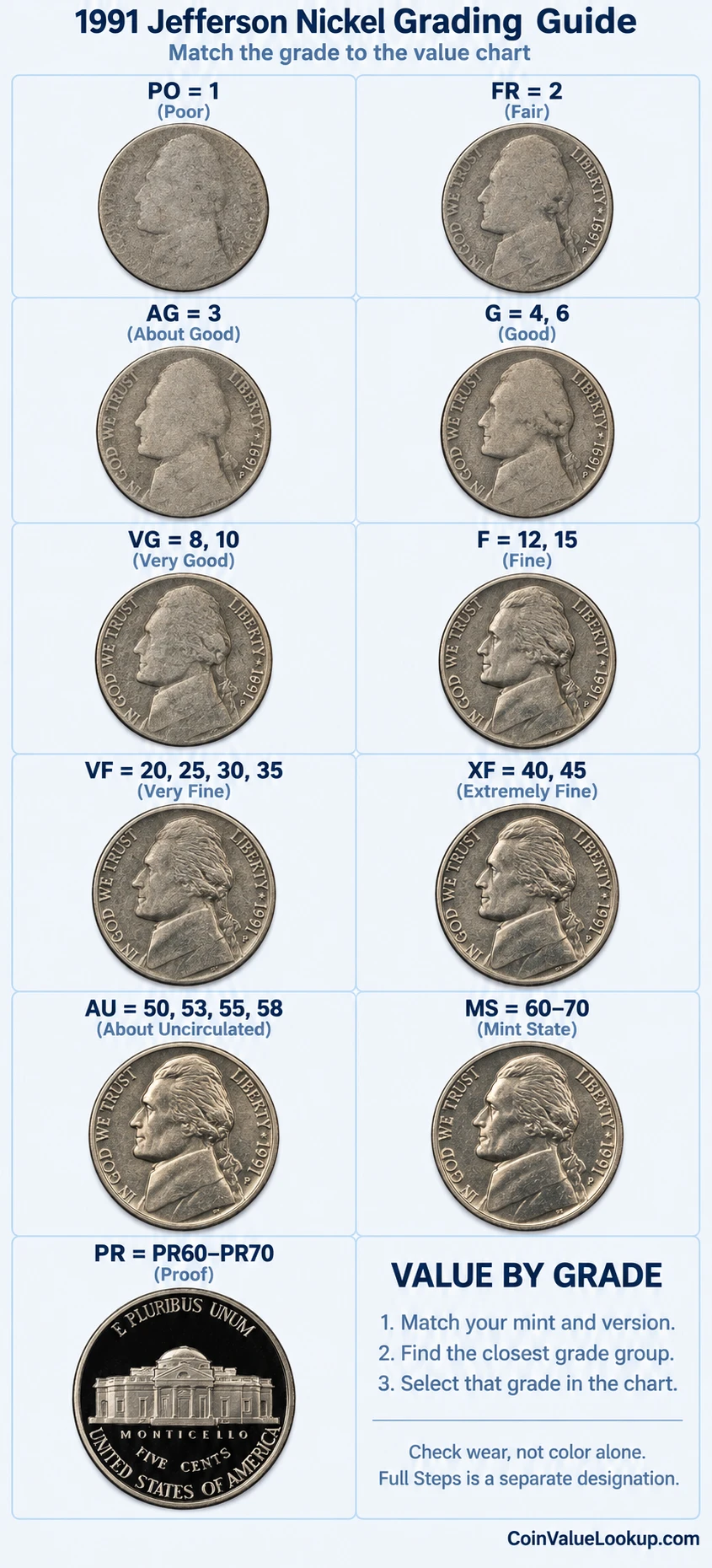
Start by examining Jefferson's cheek and the hair detail above his ear. These are the first areas to show wear.
A coin with full original luster and no contact wear on those high points is a candidate for Mint State grades.
Monticello's steps and columns on the reverse offer supporting evidence. Soft or mushy steps might indicate wear, or they might just reflect a weak strike, so check both sides together.
Use the comparison image to match your coin's wear pattern against known grade examples. Full Steps is a separate designation for Mint State coins describing strike quality, not a higher numerical grade.
Similarly, proof cameo is a finish description, not a grade above regular proof.
A coin with obvious rub on the cheek but nice reverse detail probably falls in the AU range. Heavy wear across both sides pushes it lower.
Be honest with yourself when comparing; it saves disappointment later.
Step 3: Check 1991 Jefferson Nickel Value by Mint and Version
1991 Jefferson Nickel — P Business strike
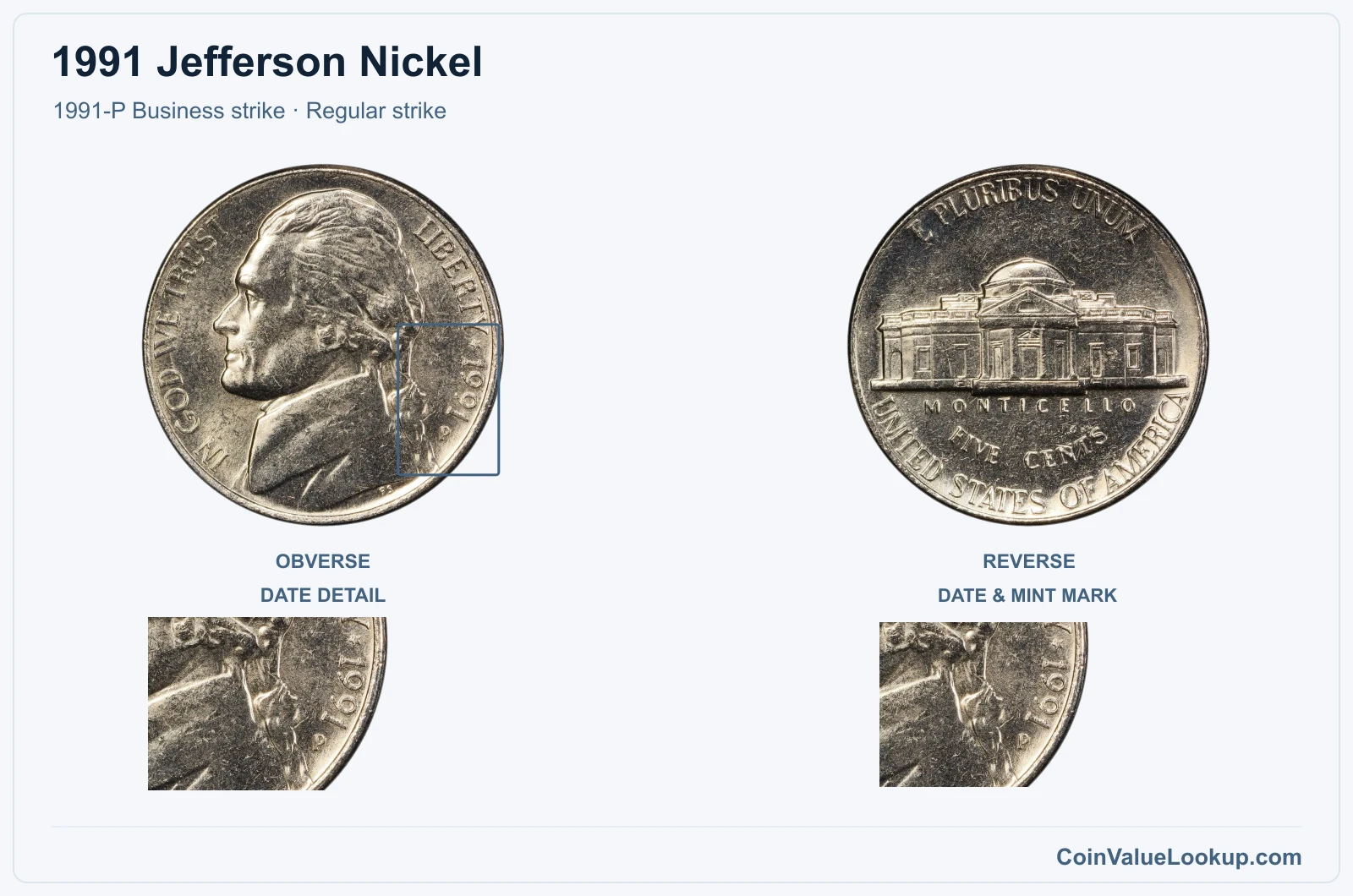
The 1991-P is the Philadelphia business strike. Look for the small "P" mintmark on the obverse beneath the date.
It has the standard copper-nickel composition at roughly 5 grams and 21.2 mm with a plain edge.
Retail guide anchors place this coin around $0.36 in MS60 condition and about $3.36 in MS65, according to USA Coin Book. Circulated examples are generally worth face value.
Certified coins with a Full Steps designation can command premiums above those baseline figures, but that is a separate market from ordinary uncirculated pieces.
Coin Value Lookup is a handy starting point if you want to look up guides for other years and denominations in the Jefferson nickel series.
| Range | Grade | Price | Auction Records | Appraisal |
|---|---|---|---|---|
| PO | PO 1 | — | Coin Identifier | |
| FR | FR 2 | — | Coin Identifier | |
| AG | AG 3 | — | Coin Identifier | |
| G | G 4 | — | Coin Identifier | |
| G 6 | — | Coin Identifier | ||
| VG | VG 8 | — | Coin Identifier | |
| VG 10 | — | Coin Identifier | ||
| F | F 12 | — | Coin Identifier | |
| F 15 | — | Coin Identifier | ||
| VF | VF 20 | — | Coin Identifier | |
| VF 25 | — | Coin Identifier | ||
| VF 30 | — | Coin Identifier | ||
| VF 35 | — | Coin Identifier | ||
| XF | XF 40 | — | Coin Identifier | |
| XF 45 | — | Coin Identifier | ||
| AU | AU 50 | — | Coin Identifier | |
| AU 53 | — | Coin Identifier | ||
| AU 55 | — | Coin Identifier | ||
| AU 58 | — | Coin Identifier | ||
| MS | MS 60 | — | Coin Identifier | |
| MS 61 | — | Coin Identifier | ||
| MS 62 | — | Coin Identifier | ||
| MS 63 | — | Coin Identifier | ||
| MS 64 | Coin Identifier | |||
| MS 65 | — | Coin Identifier | ||
| MS 66 | — | Coin Identifier | ||
| MS 67 | Coin Identifier | |||
| MS 68 | — | — | — | |
| MS 69 | — | — | — | |
| MS 70 | — | — | — |
1991 Jefferson Nickel — D Business strike
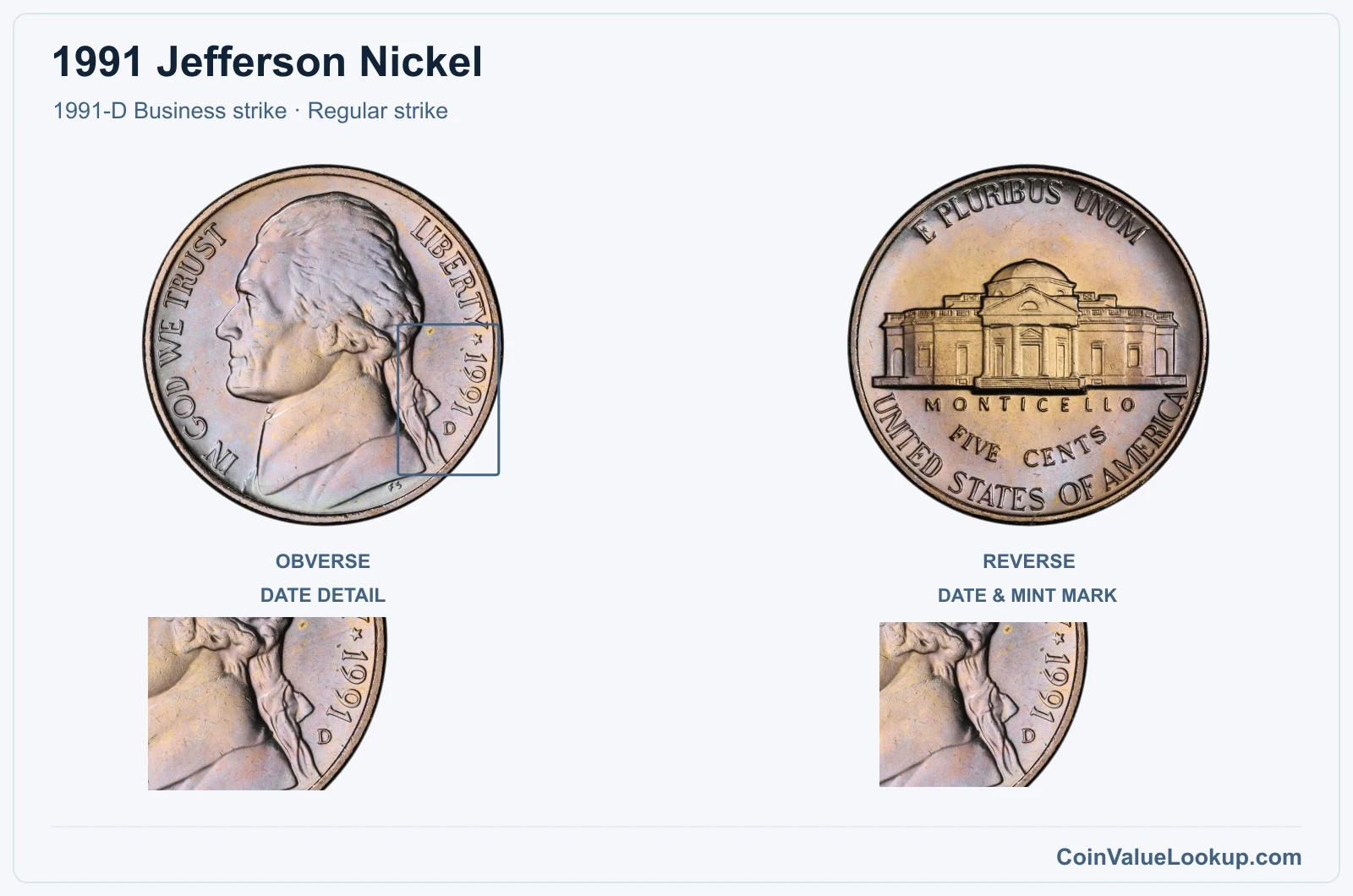
The 1991-D was struck at the Denver Mint. You will find a "D" mintmark on the obverse below the date.
Same alloy, same weight, same design as its Philadelphia sibling.
Guide estimates from USA Coin Book put this version at roughly $0.36 in MS60 and $3.36 in MS65. Worn pieces from circulation trade at face value.
As with the P mint, a Full Steps designation on a certified example opens up a different tier of collector interest, because those sharp Monticello steps are tough to find on average strikes.
| Range | Grade | Price | Auction Records | Appraisal |
|---|---|---|---|---|
| PO | PO 1 | — | Coin Identifier | |
| FR | FR 2 | — | Coin Identifier | |
| AG | AG 3 | — | Coin Identifier | |
| G | G 4 | — | Coin Identifier | |
| G 6 | — | Coin Identifier | ||
| VG | VG 8 | — | Coin Identifier | |
| VG 10 | — | Coin Identifier | ||
| F | F 12 | — | Coin Identifier | |
| F 15 | — | Coin Identifier | ||
| VF | VF 20 | — | Coin Identifier | |
| VF 25 | — | Coin Identifier | ||
| VF 30 | — | Coin Identifier | ||
| VF 35 | — | Coin Identifier | ||
| XF | XF 40 | — | Coin Identifier | |
| XF 45 | — | Coin Identifier | ||
| AU | AU 50 | — | Coin Identifier | |
| AU 53 | — | Coin Identifier | ||
| AU 55 | — | Coin Identifier | ||
| AU 58 | — | Coin Identifier | ||
| MS | MS 60 | Coin Identifier | ||
| MS 61 | — | Coin Identifier | ||
| MS 62 | — | Coin Identifier | ||
| MS 63 | — | Coin Identifier | ||
| MS 64 | — | Coin Identifier | ||
| MS 65 | Coin Identifier | |||
| MS 66 | — | Coin Identifier | ||
| MS 67 | — | — | — | |
| MS 68 | — | — | — | |
| MS 69 | — | — | — | |
| MS 70 | — | — | — |
1991 Jefferson Nickel — S Proof
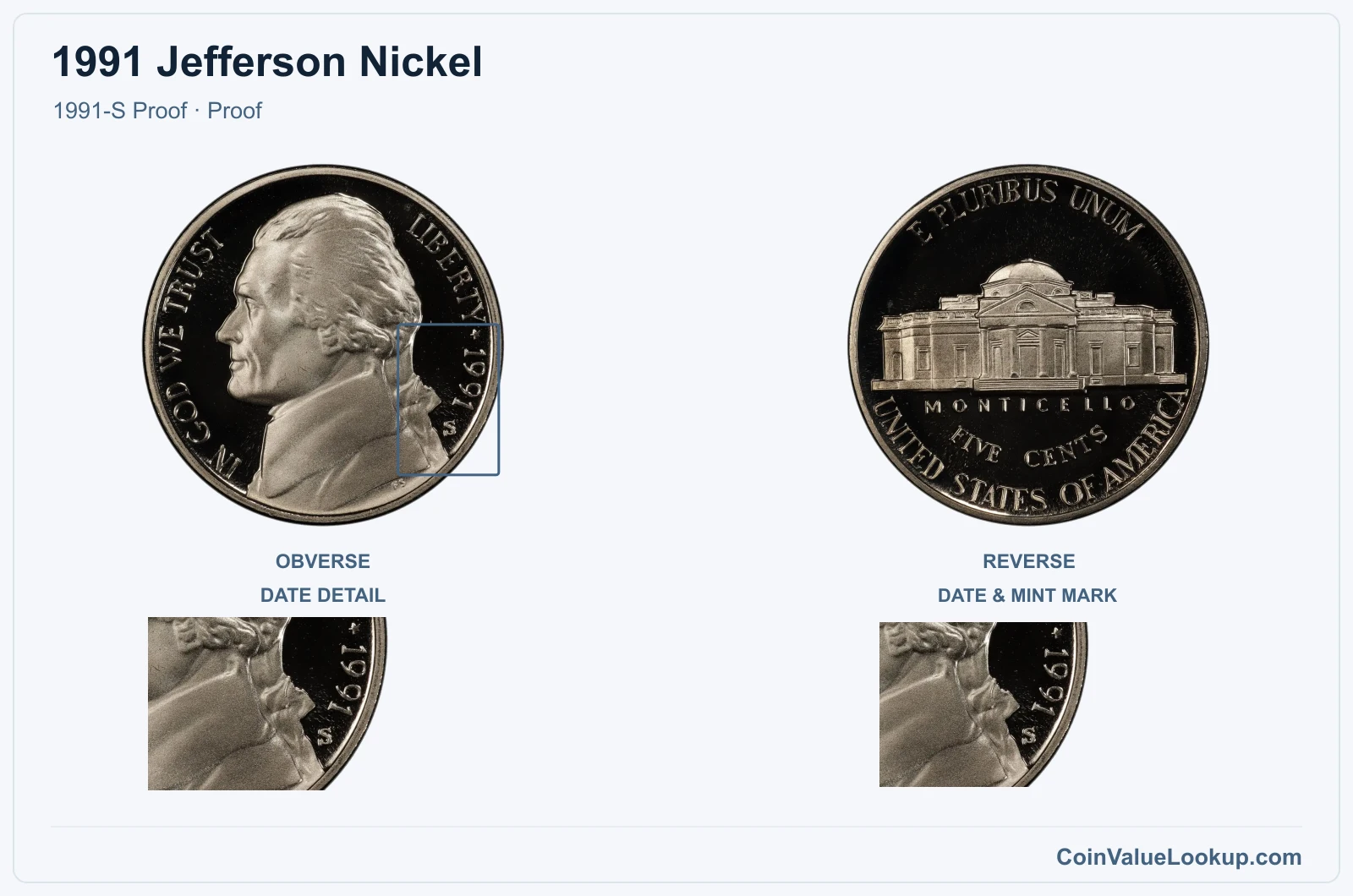
The 1991-S proof was produced at the San Francisco Mint for collector sets. It carries an "S" mintmark and has a mirror-field finish with frosted design elements when well preserved.
Same 75% copper, 25% nickel composition as the business strikes.
A USA Coin Book retail guide anchor puts the generic PR65 value at about $5.63. That figure is not specific to deep cameo pieces; strong cameo contrast can carry its own premium.
If you believe you have a proof, confirm the "S" mintmark and check its provenance, because cleaned or polished business strikes can mimic the look to an untrained eye.
| Range | Grade | Price | Auction Records | Appraisal |
|---|---|---|---|---|
| PR | PR 1 | — | Coin Identifier | |
| PR 2 | — | Coin Identifier | ||
| PR 3 | — | Coin Identifier | ||
| PR 4 | — | Coin Identifier | ||
| PR 6 | — | Coin Identifier | ||
| PR 8 | — | Coin Identifier | ||
| PR 10 | — | Coin Identifier | ||
| PR 12 | — | Coin Identifier | ||
| PR 15 | — | Coin Identifier | ||
| PR 20 | — | Coin Identifier | ||
| PR 25 | — | Coin Identifier | ||
| PR 30 | — | Coin Identifier | ||
| PR 35 | — | Coin Identifier | ||
| PR 40 | — | Coin Identifier | ||
| PR 45 | — | Coin Identifier | ||
| PR 50 | — | Coin Identifier | ||
| PR 53 | — | Coin Identifier | ||
| PR 55 | — | Coin Identifier | ||
| PR 58 | — | Coin Identifier | ||
| PR 60 | — | Coin Identifier | ||
| PR 61 | — | Coin Identifier | ||
| PR 62 | — | Coin Identifier | ||
| PR 63 | — | Coin Identifier | ||
| PR 64 | — | Coin Identifier | ||
| PR 65 | — | Coin Identifier | ||
| PR 66 | — | Coin Identifier | ||
| PR 67 | — | Coin Identifier | ||
| PR 68 | — | Coin Identifier | ||
| PR 69 | Coin Identifier | |||
| PR 70 | Coin Identifier |
1991 Jefferson Nickel Error List
1. 1991 Jefferson Nickel — Struck over a cent
This is a double denomination error: a 1991 nickel struck on top of a Lincoln cent that had already been struck. The cent's design survives underneath the nickel impression, so you can see an inverted Memorial Building ghosting through Jefferson's portrait.
The date and P mintmark remain readable on the nickel side.
One example, graded NGC MS62 RB, sold through Heritage Auctions in September 2019 for $432. That is a single recorded sale, not a guaranteed market range.
The "RB" (Red-Brown) color designation comes from the underlying copper cent planchet showing through.
Do not confuse this with a nickel struck on a blank copper planchet or a coin altered in a vise. A genuine double denomination will show complete design elements from both denominations, not just discoloration or a strange texture.
2. 1991 Jefferson Nickel — Wrong Planchet / Off-Metal Strike
A wrong-planchet or double-denomination error occurs when a 1991 nickel die strikes a blank (or already-struck coin) intended for a different denomination. The struck-over-a-cent error described above is one confirmed example of this category.
To check, compare your coin's weight, diameter, and edge against normal nickel specs: about 5 grams, 21.2 mm, plain edge. A wrong-planchet piece will differ in at least one measurable way, and the design may appear incomplete or distorted.
Condition, the visibility of both designs, and the specific planchet involved all affect value. Plating loss, corrosion, acid damage, or deliberate alteration can make a normal nickel look odd.
If the weight and diameter match standard specs and there is no trace of another denomination's design, you likely have damage rather than an error.
3. 1991 Jefferson Nickel — Broadstrike
A broadstrike happens when the coin is struck without the normal retaining collar that shapes its edge. The result is a nickel that spreads outward, appearing slightly wider than normal with a rounded, undefined rim.
The full design is still present but stretched toward the edges.
Hold the coin against a normal 1991 nickel for comparison. A genuine broadstrike will be noticeably wider, and the edge will lack the crisp vertical wall of a properly struck coin.
The design remains centered, which separates this from an off-center strike.
Value depends on condition and how dramatic the spread is. Do not confuse a broadstrike with a coin that was flattened on railroad tracks or in a vise after leaving the mint.
Post-mint damage typically shows uneven distortion and surface marks that a press-struck broadstrike does not.
4. 1991 Jefferson Nickel — Clipped Planchet
A clipped planchet error means the blank was incompletely punched from the metal strip before striking. The result is a missing section, which can be curved, straight, or irregular depending on where the punch overlapped.
Look for a corresponding area of weakness on the opposite side of the coin from the clip. This occurs because metal could not flow evenly during the strike.
The edge at the clip site usually shows the raw texture of the blank rather than a clean cut.
Condition and clip size affect value. A tiny clip is less dramatic than one removing a large portion of the coin.
Do not mistake a filed edge, a deliberate notch, or corrosion damage for a genuine clip. Post-mint alterations usually leave tool marks or uneven surfaces that differ from the smooth contour of a true clipped blank.
5. 1991 Jefferson Nickel — Off-Center Strike
An off-center strike occurs when the blank is not seated properly between the dies. Part of the design is missing, replaced by a blank crescent of unstruck metal.
The more off-center the strike, the more dramatic the appearance.
Collectors generally prize off-center errors that still show the date, because without a readable date the coin is harder to attribute to a specific year. A 1991 nickel struck, say, 10% off-center with the date visible is a more appealing collectible than one struck 50% off-center with the date lost.
Value varies with the degree of displacement and the coin's condition. Watch out for lookalikes: a clipped planchet can remove part of the design, and post-mint flattening can shift the appearance.
A genuine off-center strike will have a clean unstruck crescent and consistent metal thickness across the blank area.