2010 Jefferson Nickel Coin Value: How Much Is It Worth?
Most 2010 Jefferson nickels you pull from pocket change are worth face value or close to it. According to USA Coin Book retail guide estimates, ordinary Philadelphia and Denver business strikes run about $0.30 at MS60 and around $0.61 at MS65.
Proofs, satin-finish Mint Set coins, certified Full Steps examples, and authentic mint errors each occupy their own pricing lanes and deserve closer attention.
Fast Way to Identify Your 2010 Jefferson Nickel
Want a quick read on what you have? Upload clear photos of both the front and back of your 2010 nickel, and our identifier can give you a preliminary take on the mint, finish, and version.
It is not a substitute for professional authentication or grading, but it is a solid first step before you dig deeper.
2010 Jefferson Nickel Value
Upload both sides of your 2010 Jefferson Nickel.
Front Obverse
Upload photo
Back Reverse
Upload photo
Which 2010 Jefferson Nickel Versions Are Worth Money?
- Certified high-grade P or D business strikes with Full Steps designations can command premiums well above ordinary MS60–MS65 guide levels.
- The 2010-S proof nickel has a USA Coin Book retail guide value of about $5.30 at PR65, serving a different collector market than circulation strikes.
- Satin-finish P and D coins from the 2010 Mint Set are the last year of that finish and are graded on the SP scale, not the MS scale.
- Authentic mint errors such as doubled dies, off-center strikes, and lamination errors on 2010 nickels each require individual assessment but can carry significant premiums.
Step 1: Identify Your 2010 Jefferson Nickel Mint Mark and Version
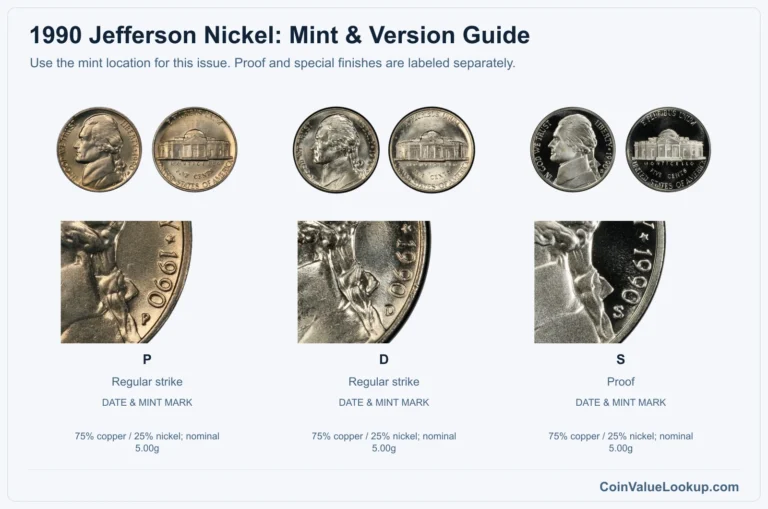
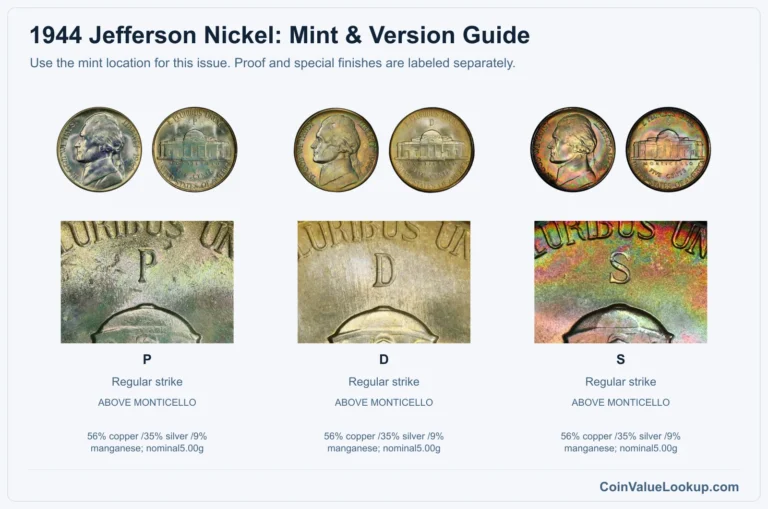
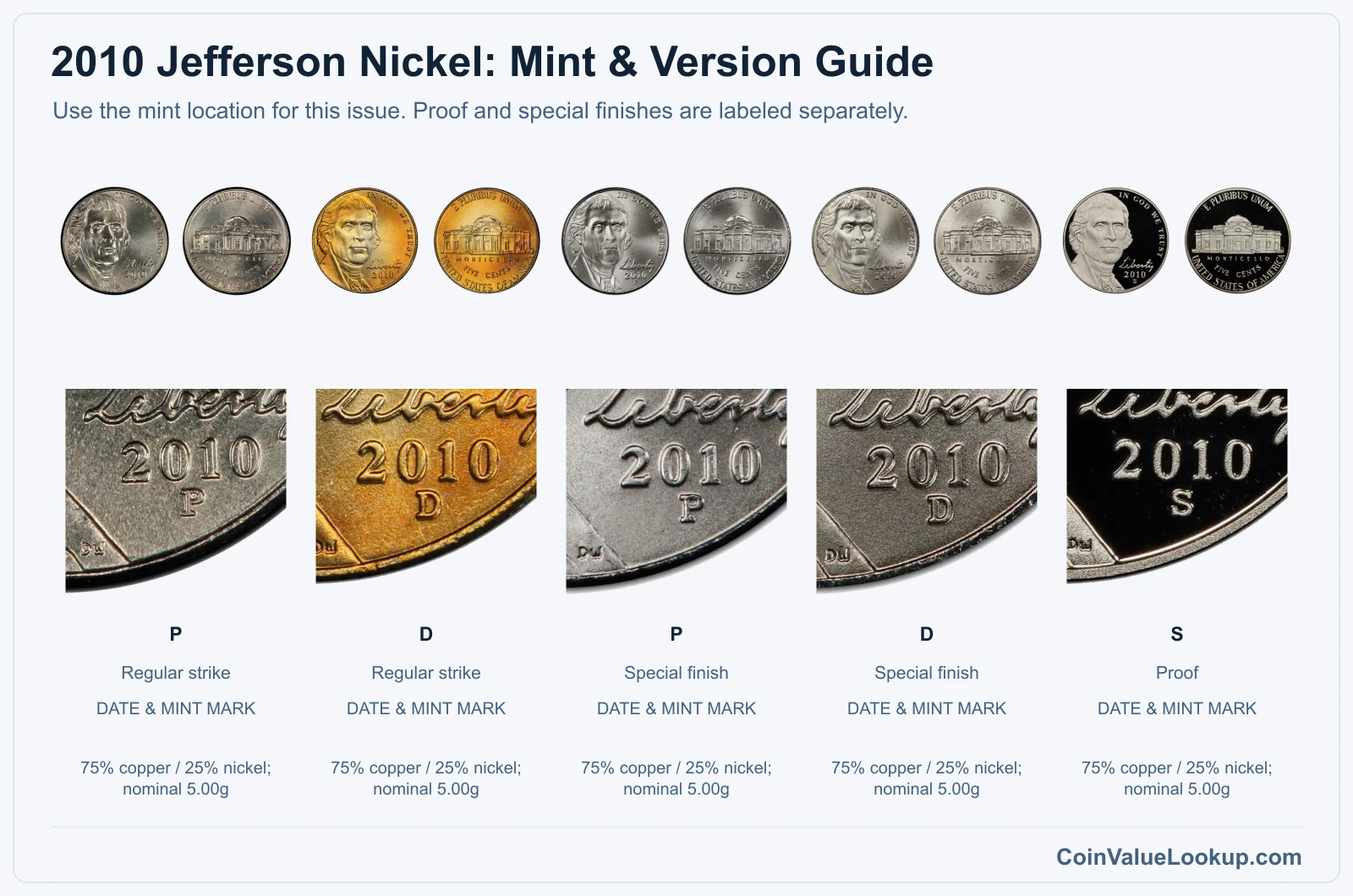
Flip the coin to the obverse and look just below the date for the mintmark. A "P" means Philadelphia, a "D" means Denver, and an "S" means San Francisco proof.
All three share the same forward-facing Jefferson portrait on the obverse and the familiar Monticello reverse.
The standard alloy is 75% copper and 25% nickel, weighing 5.00 grams with a 21.2 mm diameter and a plain edge. If your coin feels lighter or heavier than that, or has a reeded edge, something unusual may be going on.
Before you grade, figure out the original finish. Circulation strikes from P and D have a standard brilliant luster.
Satin-finish coins came only in 2010 Mint Sets, and 2010 was the final year for that finish, so they have a soft, matte-like sheen that looks nothing like a normal business strike. S-mint proofs show deep mirror fields.
Mixing these categories up will throw off every comparison you make afterward.
Step 2: Check Your 2010 Jefferson Nickel Grade
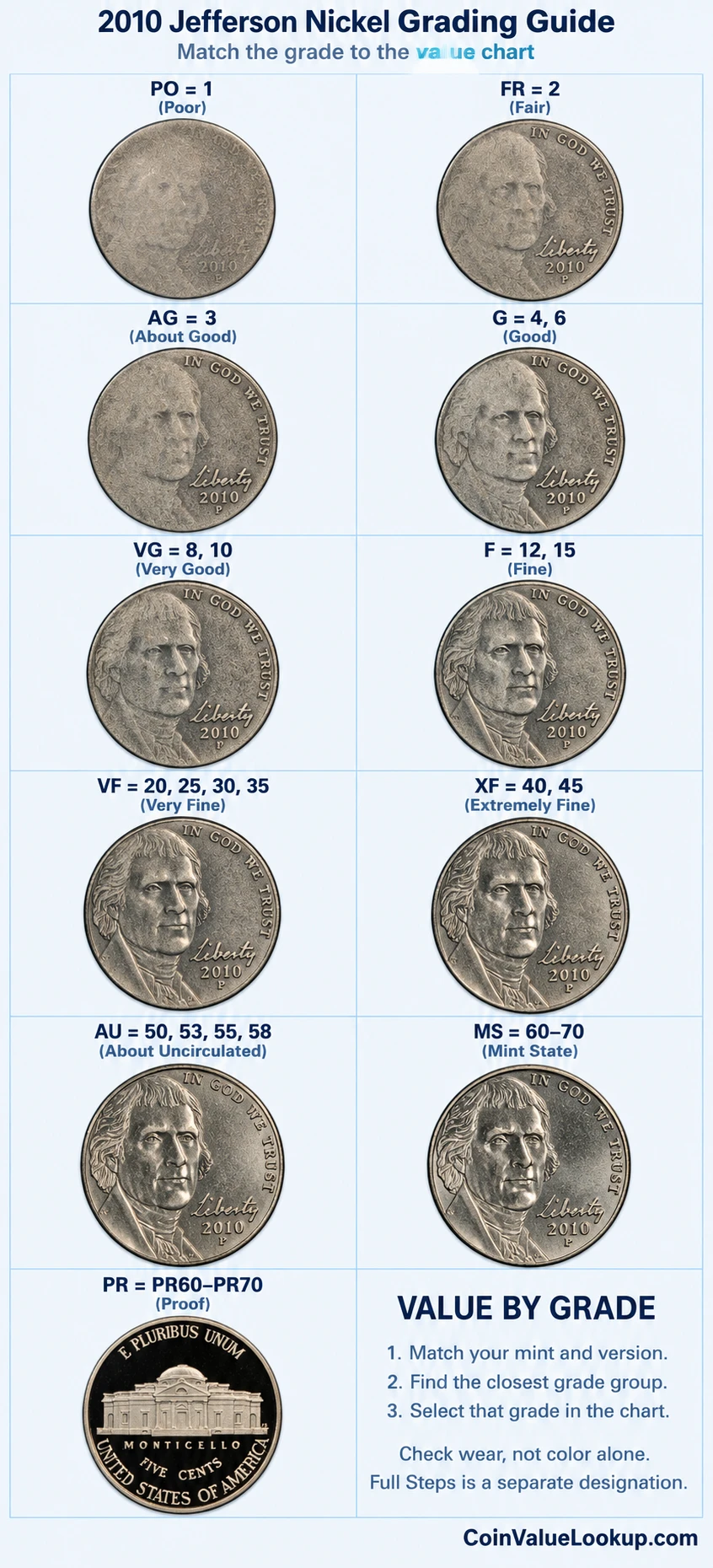
Start on the obverse. Jefferson's cheekbone, the hair above his ear, and the shoulder collar are the highest points and the first to show friction.
Even light rub will dull the original luster in those spots, separating a true Mint State coin from one that has been in a register.
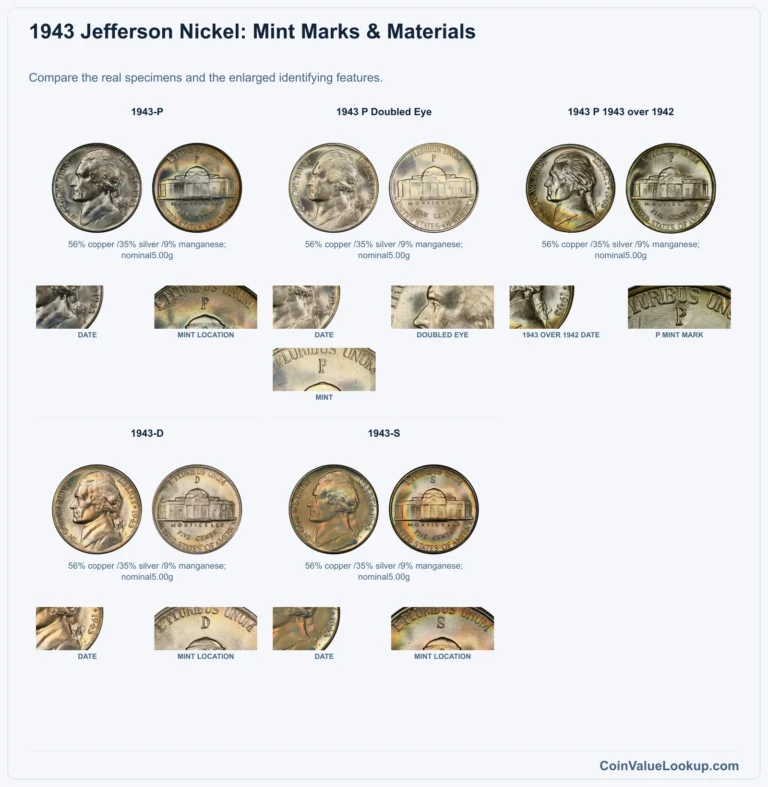
On the reverse, check the steps of Monticello. A Full Steps designation means sharply struck, fully separated steps, but that label is independent of the numerical grade.
A coin can be MS65 without Full Steps, or MS63 with them.
Use the comparison image to judge contact marks and luster across the full surface. Proof coins are graded on a separate scale; mirror reflectivity and hairlines matter more than high-point wear.
A proof with a few too many hairlines might still look shinier than a business strike in higher grade, so compare proofs only to other proofs.
Step 3: Check 2010 Jefferson Nickel Value by Mint and Version
2010 Jefferson Nickel — P Business strike
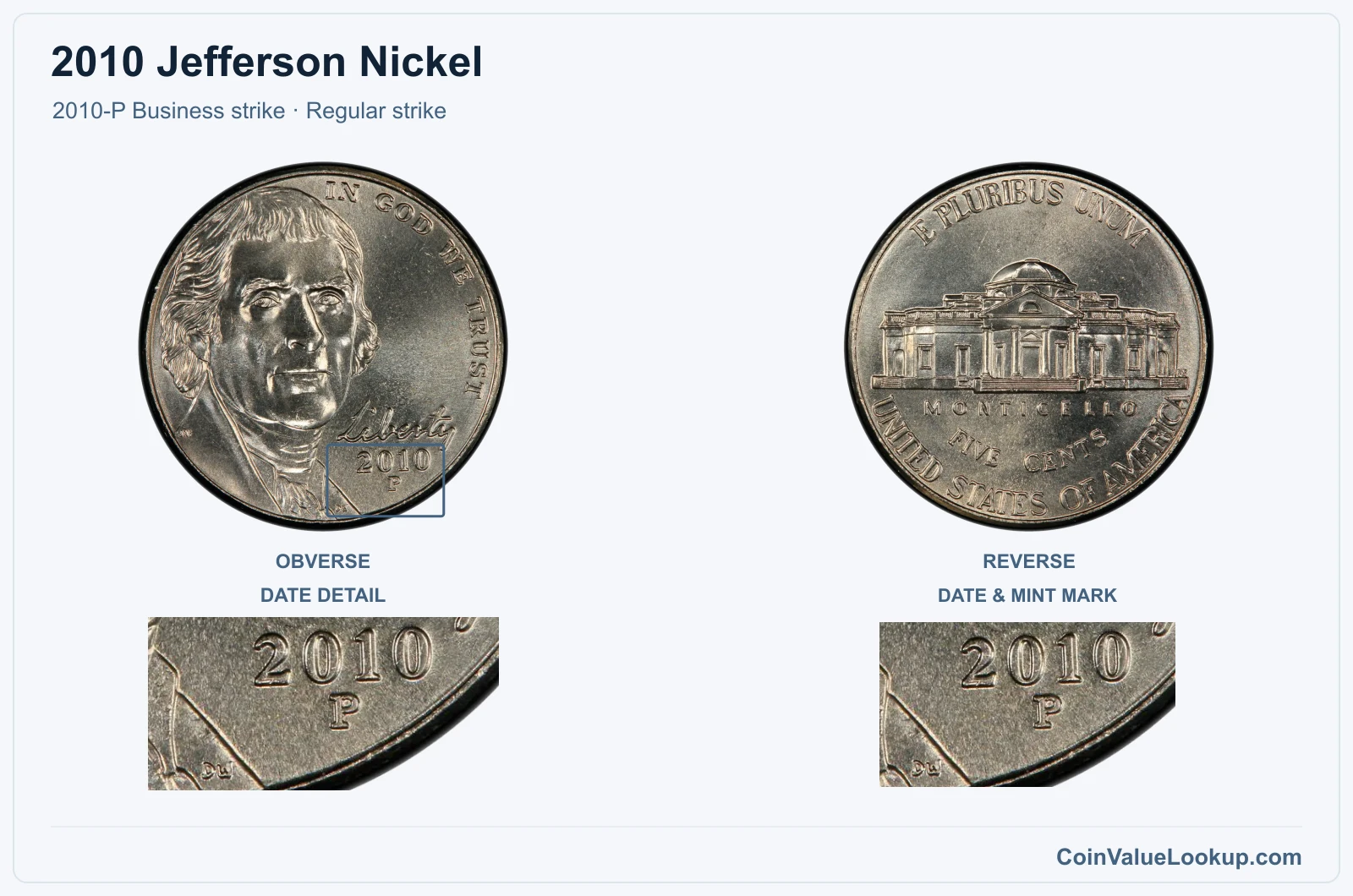
The 2010-P business strike is the standard Philadelphia issue you will find in circulation. It carries a "P" mintmark below the date on the obverse.
USA Coin Book lists retail guide values of roughly $0.30 at MS60 and $0.61 at MS65 for ordinary examples without special designations.
Those figures do not reflect Full Steps or deep-cameo premiums, which are separate categories. In practice, most circulated 2010-P nickels are worth face value.
The coins that break away from the pack are the ones certified in upper Mint State grades with clean surfaces and sharp strikes.
| Range | Grade | Price | Auction Records | Appraisal |
|---|---|---|---|---|
| PO | PO 1 | — | Coin Identifier | |
| FR | FR 2 | — | Coin Identifier | |
| AG | AG 3 | — | Coin Identifier | |
| G | G 4 | — | Coin Identifier | |
| G 6 | — | Coin Identifier | ||
| VG | VG 8 | — | Coin Identifier | |
| VG 10 | — | Coin Identifier | ||
| F | F 12 | — | Coin Identifier | |
| F 15 | — | Coin Identifier | ||
| VF | VF 20 | — | Coin Identifier | |
| VF 25 | — | Coin Identifier | ||
| VF 30 | — | Coin Identifier | ||
| VF 35 | — | Coin Identifier | ||
| XF | XF 40 | — | Coin Identifier | |
| XF 45 | — | Coin Identifier | ||
| AU | AU 50 | — | Coin Identifier | |
| AU 53 | — | Coin Identifier | ||
| AU 55 | — | Coin Identifier | ||
| AU 58 | — | Coin Identifier | ||
| MS | MS 60 | — | Coin Identifier | |
| MS 61 | — | Coin Identifier | ||
| MS 62 | — | Coin Identifier | ||
| MS 63 | — | Coin Identifier | ||
| MS 64 | — | Coin Identifier | ||
| MS 65 | — | Coin Identifier | ||
| MS 66 | Coin Identifier | |||
| MS 67 | Coin Identifier | |||
| MS 68 | — | — | — | |
| MS 69 | — | — | — | |
| MS 70 | — | — | — |
2010 Jefferson Nickel — P Satin Finish Special Strike
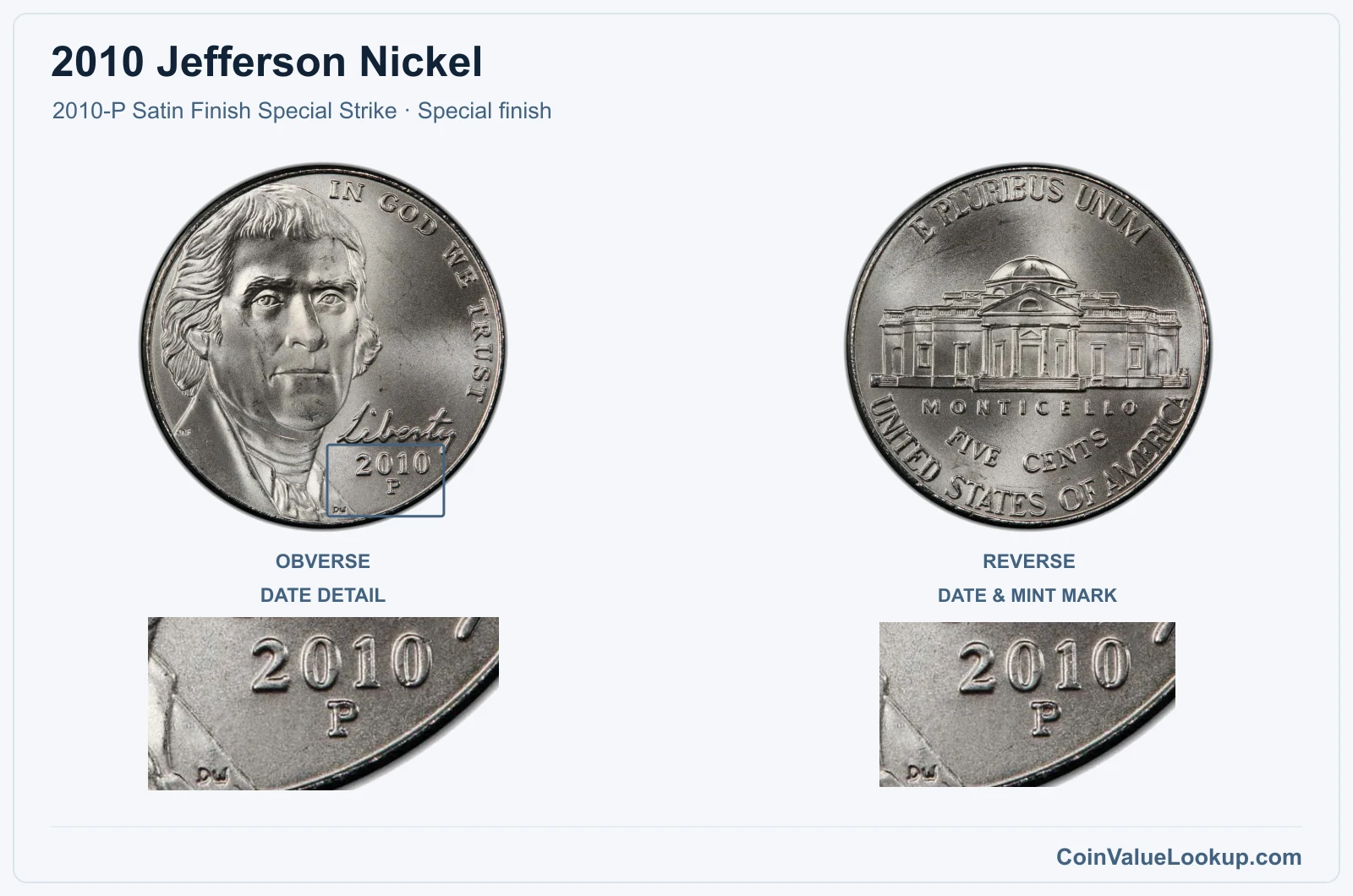
The 2010-P satin-finish nickel was produced exclusively for that year's Mint Set. It has the same "P" mintmark and copper-nickel composition as the business strike, but the surface has a distinctive soft, low-reflectivity sheen that is immediately different from a normal brilliant coin.
2010 was the last year the U.S. Mint used the satin finish for Mint Set coins, which gives these pieces a natural bookend appeal for set collectors. They are graded on the SP (Specimen) scale rather than the MS scale.
Because the finish and grading context differ from business strikes, value depends on the individual coin's authenticated identity and condition. No single guide range covers them cleanly.
| Range | Grade | Price | Auction Records | Appraisal |
|---|---|---|---|---|
| SP | SP 1 | — | Coin Identifier | |
| SP 2 | — | Coin Identifier | ||
| SP 3 | — | Coin Identifier | ||
| SP 4 | — | Coin Identifier | ||
| SP 6 | — | Coin Identifier | ||
| SP 8 | — | Coin Identifier | ||
| SP 10 | — | Coin Identifier | ||
| SP 12 | — | Coin Identifier | ||
| SP 15 | — | Coin Identifier | ||
| SP 20 | — | Coin Identifier | ||
| SP 25 | — | Coin Identifier | ||
| SP 30 | — | Coin Identifier | ||
| SP 35 | — | Coin Identifier | ||
| SP 40 | — | Coin Identifier | ||
| SP 45 | — | Coin Identifier | ||
| SP 50 | — | Coin Identifier | ||
| SP 53 | — | Coin Identifier | ||
| SP 55 | — | Coin Identifier | ||
| SP 58 | — | Coin Identifier | ||
| SP 60 | — | Coin Identifier | ||
| SP 61 | — | Coin Identifier | ||
| SP 62 | — | Coin Identifier | ||
| SP 63 | — | Coin Identifier | ||
| SP 64 | — | Coin Identifier | ||
| SP 65 | — | Coin Identifier | ||
| SP 66 | — | Coin Identifier | ||
| SP 67 | — | Coin Identifier | ||
| SP 68 | — | Coin Identifier | ||
| SP 69 | — | — | — | |
| SP 70 | — | — | — |
2010 Jefferson Nickel — D Satin Finish Special Strike
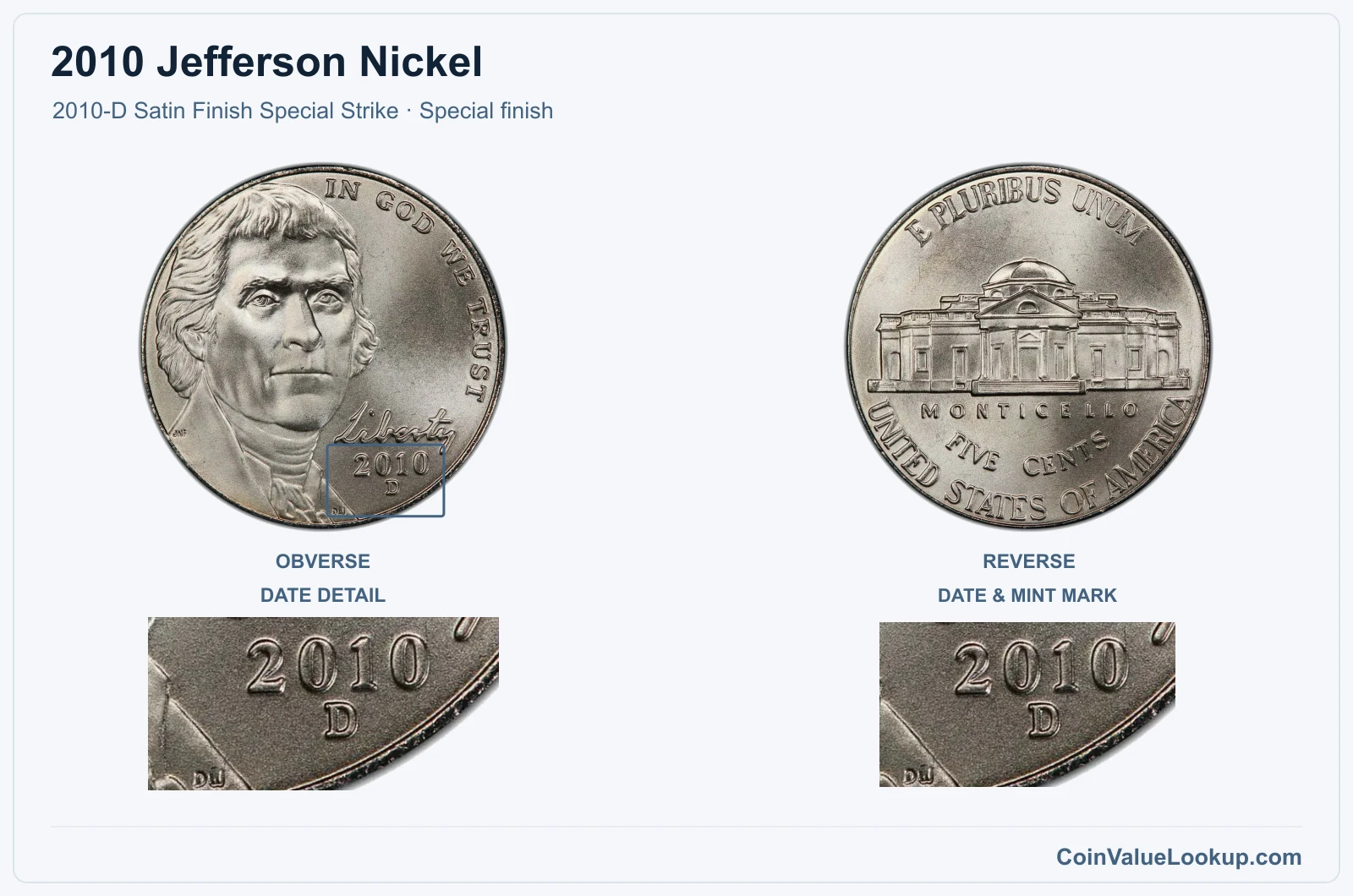
The 2010-D satin-finish nickel mirrors its Philadelphia counterpart as a Mint Set exclusive, but carries the "D" mintmark. Same copper-nickel alloy, same soft matte-like surface, same SP grading scale.
As the final year for the satin finish program, these Denver coins share the same collector interest as the P version. Distinguishing one from a regular D business strike is straightforward under good light: the satin coin lacks the cartwheel luster of a normal strike.
Value hinges on authenticated finish, preservation, and any error present. No standardized guide range is adopted for these pieces.
Coin Value Lookup is a handy starting point if you want to compare this nickel's details against other years or denominations in the Jefferson series.
| Range | Grade | Price | Auction Records | Appraisal |
|---|---|---|---|---|
| SP | SP 1 | — | Coin Identifier | |
| SP 2 | — | Coin Identifier | ||
| SP 3 | — | Coin Identifier | ||
| SP 4 | — | Coin Identifier | ||
| SP 6 | — | Coin Identifier | ||
| SP 8 | — | Coin Identifier | ||
| SP 10 | — | Coin Identifier | ||
| SP 12 | — | Coin Identifier | ||
| SP 15 | — | Coin Identifier | ||
| SP 20 | — | Coin Identifier | ||
| SP 25 | — | Coin Identifier | ||
| SP 30 | — | Coin Identifier | ||
| SP 35 | — | Coin Identifier | ||
| SP 40 | — | Coin Identifier | ||
| SP 45 | — | Coin Identifier | ||
| SP 50 | — | Coin Identifier | ||
| SP 53 | — | Coin Identifier | ||
| SP 55 | — | Coin Identifier | ||
| SP 58 | — | Coin Identifier | ||
| SP 60 | — | Coin Identifier | ||
| SP 61 | — | Coin Identifier | ||
| SP 62 | — | Coin Identifier | ||
| SP 63 | — | Coin Identifier | ||
| SP 64 | — | Coin Identifier | ||
| SP 65 | — | Coin Identifier | ||
| SP 66 | — | Coin Identifier | ||
| SP 67 | — | Coin Identifier | ||
| SP 68 | — | Coin Identifier | ||
| SP 69 | — | Coin Identifier | ||
| SP 70 | — | — | — |
2010 Jefferson Nickel — D Business strike
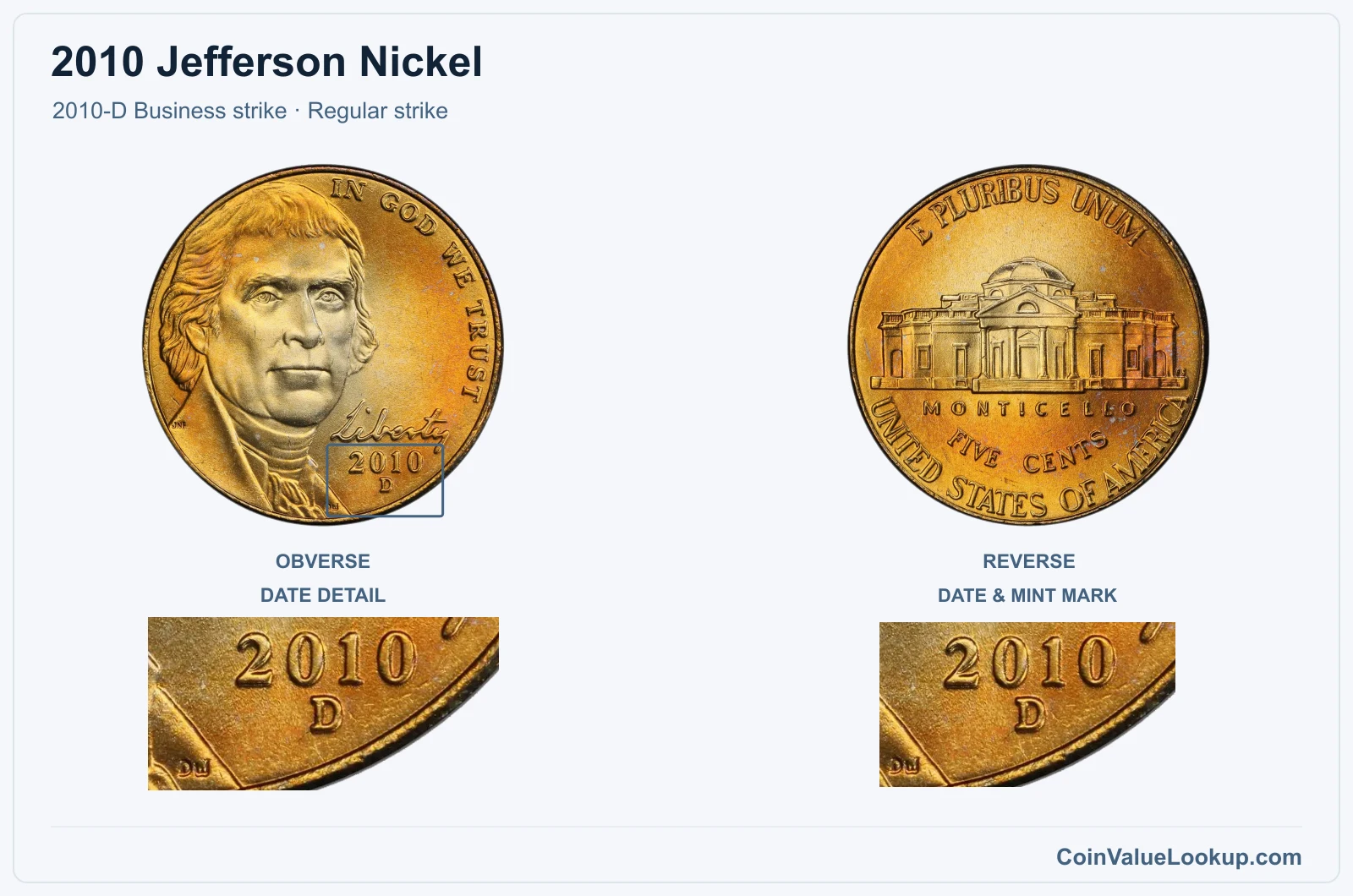
The 2010-D business strike is Denver's standard-issue nickel for circulation. Look for the "D" mintmark below the date.
USA Coin Book retail guide estimates place it at about $0.30 in MS60 and $0.61 in MS65, identical to the Philadelphia business strike.
Again, those numbers are for ordinary coins without Full Steps or other special designations. High-grade certified examples with strong step detail trade in a different bracket entirely.
If your coin shows any wear at all, it is almost certainly a face-value piece.
| Range | Grade | Price | Auction Records | Appraisal |
|---|---|---|---|---|
| PO | PO 1 | — | Coin Identifier | |
| FR | FR 2 | — | Coin Identifier | |
| AG | AG 3 | — | Coin Identifier | |
| G | G 4 | — | Coin Identifier | |
| G 6 | — | Coin Identifier | ||
| VG | VG 8 | — | Coin Identifier | |
| VG 10 | — | Coin Identifier | ||
| F | F 12 | — | Coin Identifier | |
| F 15 | — | Coin Identifier | ||
| VF | VF 20 | — | Coin Identifier | |
| VF 25 | — | Coin Identifier | ||
| VF 30 | — | Coin Identifier | ||
| VF 35 | — | Coin Identifier | ||
| XF | XF 40 | — | Coin Identifier | |
| XF 45 | — | Coin Identifier | ||
| AU | AU 50 | — | Coin Identifier | |
| AU 53 | — | Coin Identifier | ||
| AU 55 | — | Coin Identifier | ||
| AU 58 | — | Coin Identifier | ||
| MS | MS 60 | — | Coin Identifier | |
| MS 61 | — | Coin Identifier | ||
| MS 62 | — | Coin Identifier | ||
| MS 63 | — | Coin Identifier | ||
| MS 64 | — | Coin Identifier | ||
| MS 65 | — | Coin Identifier | ||
| MS 66 | Coin Identifier | |||
| MS 67 | Coin Identifier | |||
| MS 68 | Coin Identifier | |||
| MS 69 | — | — | — | |
| MS 70 | — | — | — |
2010 Jefferson Nickel — S Proof
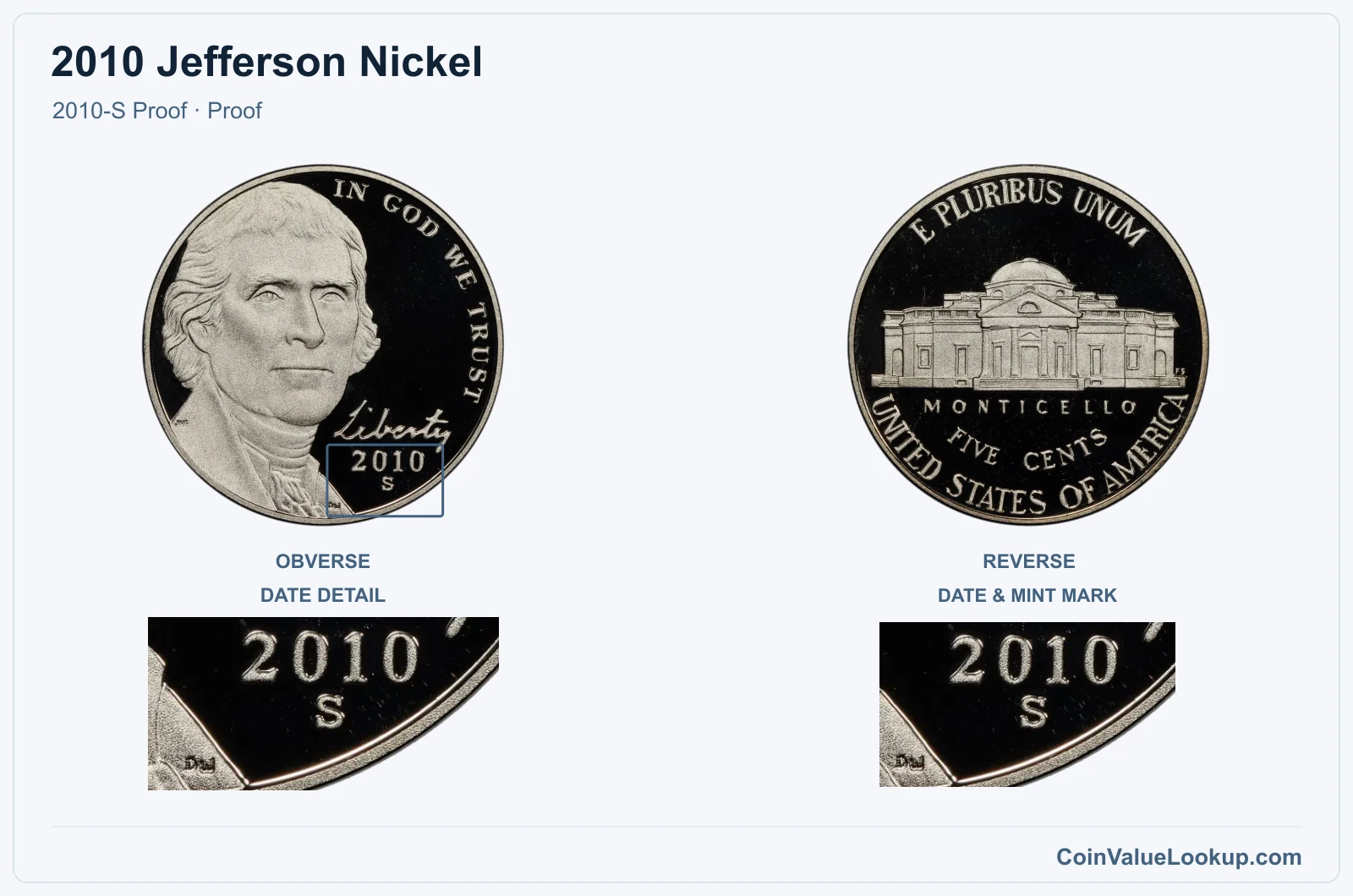
The 2010-S proof was struck at San Francisco for collector sets. It features mirror-like fields and frosted design elements, and it carries the "S" mintmark.
USA Coin Book lists a retail guide value of approximately $5.30 at PR65.
A proof is a method of manufacture, not a grade above Mint State. Proof nickels can still have contact marks or hairlines that lower their grade.
Do not assume a shiny coin from circulation is a proof; genuine S-mint proofs were sold in sealed sets, not released into change. Cameo and deep-cameo contrast designations can add further value, but those premiums are not covered by the base PR65 figure.
| Range | Grade | Price | Auction Records | Appraisal |
|---|---|---|---|---|
| PR | PR 1 | — | Coin Identifier | |
| PR 2 | — | Coin Identifier | ||
| PR 3 | — | Coin Identifier | ||
| PR 4 | — | Coin Identifier | ||
| PR 6 | — | Coin Identifier | ||
| PR 8 | — | Coin Identifier | ||
| PR 10 | — | Coin Identifier | ||
| PR 12 | — | Coin Identifier | ||
| PR 15 | — | Coin Identifier | ||
| PR 20 | — | Coin Identifier | ||
| PR 25 | — | Coin Identifier | ||
| PR 30 | — | Coin Identifier | ||
| PR 35 | — | Coin Identifier | ||
| PR 40 | — | Coin Identifier | ||
| PR 45 | — | Coin Identifier | ||
| PR 50 | — | Coin Identifier | ||
| PR 53 | — | Coin Identifier | ||
| PR 55 | — | Coin Identifier | ||
| PR 58 | — | Coin Identifier | ||
| PR 60 | — | Coin Identifier | ||
| PR 61 | — | Coin Identifier | ||
| PR 62 | — | Coin Identifier | ||
| PR 63 | — | Coin Identifier | ||
| PR 64 | — | Coin Identifier | ||
| PR 65 | — | Coin Identifier | ||
| PR 66 | — | Coin Identifier | ||
| PR 67 | — | Coin Identifier | ||
| PR 68 | — | Coin Identifier | ||
| PR 69 | Coin Identifier | |||
| PR 70 | Coin Identifier |
2010 Jefferson Nickel Error List
1. 2010 Jefferson Nickel — Doubled die reverse
A doubled die reverse on the 2010 Jefferson nickel has been documented on P-mint examples with specialist attribution. The diagnostic area to examine is the top of the central doorway frame on Monticello's reverse.
Look for extra raised detail, such as a secondary outline or notching, just below the top of that frame.
Compare your coin to a normal example under the same lighting. True hub doubling shows consistent raised separation.
Machine doubling, by contrast, leaves a flat shelf of displaced metal with no real depth. Glare and normal wear can also mimic doubling if you are not careful.
Photograph the full dated obverse and a tight closeup of the doorway area. Value depends on the strength of the doubling, overall condition, and professional authentication.
2. 2010 Jefferson Nickel — Clashed Dies
Die clash errors on 2010 nickels occur when the obverse and reverse dies strike each other without a planchet between them. The result is faint traces of the opposite design impressed into the die, which then transfer onto subsequent coins as raised ghost features.
On the obverse you might see faint Monticello outlines in the field, or on the reverse you might catch hints of Jefferson's profile. These marks align with the expected position of the opposing die.
Do not confuse random scratches, bag marks, or raised lines from a damaged planchet with a genuine clash. Value depends on how bold and identifiable the transferred design is, the coin's overall condition, and professional verification.
3. 2010 Jefferson Nickel — Off-Center Strike
An off-center strike happens when the planchet is not properly seated between the dies. The result is a design that is shifted to one side, leaving an unstruck crescent of blank metal on the opposite edge.
The key factor for collectibility is how far off center the strike is and whether the full date remains visible. A slight 2–3% shift is common and adds little.
Larger shifts with a readable date attract attention. Do not confuse a clipped planchet, which removes a piece of the blank before striking, with an off-center strike.
Post-mint damage such as vice flattening can also mimic the look. Condition, percentage of displacement, and date visibility all influence what a specific example is worth.
4. 2010 Jefferson Nickel — Feeder-Finger Marks
Feeder-finger marks come from the mechanical fingers that push blank planchets into the striking chamber. When those fingers contact the planchet surface at the wrong moment, they leave parallel, evenly spaced raised lines or impressions on the finished coin.
The key diagnostic is consistency. Genuine feeder-finger marks tend to appear as a set of parallel lines, often in the same area across multiple coins from the same press run.
Random handling scratches, cleaning hairlines, and die-polish lines are not parallel in the same way and lack the raised relief you see with a true feeder-finger impression. Value depends on the boldness of the marks, overall coin condition, and whether the error can be confirmed through comparison with known examples.
5. 2010 Jefferson Nickel — Struck-Through Error
A struck-through error occurs when foreign material, such as grease, thread, or a metal fragment, gets trapped between the die and the planchet during striking. The result is a localized depression or incomplete area of the design where the obstruction blocked the full force of the die.
Grease-filled dies tend to produce soft, smooth depressions in letters or design elements. A retained foreign object, like a staple or wire, leaves a more distinct impression and is generally more collectible.
Do not mistake normal wear, weak strikes from a tired die, or post-mint scratches for a struck-through error. The affected area should be recessed and confined, not broad and gradual.
Professional assessment considers what caused the obstruction and how dramatic the visual impact is.
6. 2010 Jefferson Nickel — Die Crack / Die Chip
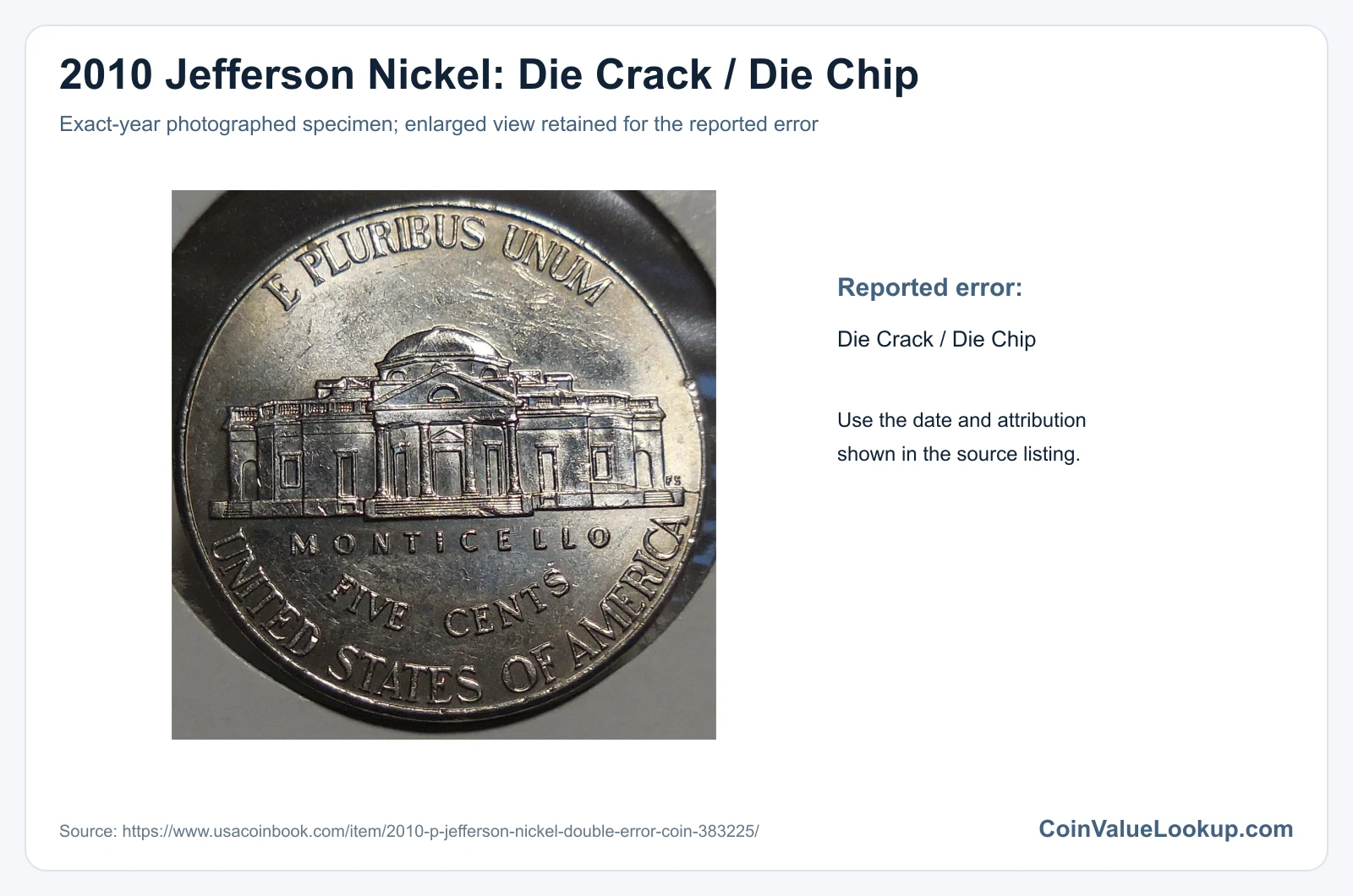
Die cracks appear as thin raised lines on the coin's surface, created when a crack forms in the steel die. As the crack fills with metal during striking, it transfers as a raised ridge.
A die chip is a small raised blob where a piece of the die face has broken away.
Rim-to-rim cracks and large interior chips tend to be more collectible than minor hairline cracks. A "cud" is a special case where a die break connects to the rim and leaves a raised, featureless lump.
Do not confuse incuse scratches, which are recessed, with die cracks, which are raised. Corrosion bumps and foreign material stuck to the surface can also fool you.
Value scales with the size, location, and visual drama of the break.
7. 2010 Jefferson Nickel — Lamination / Split Planchet
A lamination error on a 2010 nickel shows up as peeling, flaking, or separation within the metal itself. You may see a retained flap of metal that has partially lifted from the surface, or a missing layer exposing a different texture underneath.
This occurs when impurities or gas pockets in the alloy strip cause the metal layers to separate during or after striking. Photograph the affected face and the edge together so the depth of the separation is visible.
Do not confuse deliberate scraping, corrosion pitting, or acid damage with a lamination. Genuine laminations follow the contour of the coin and reveal clean metal underneath the flap.
The size of the affected area and whether the flap is retained both influence value.
8. 2010 Jefferson Nickel — Doubled Die Obverse
A doubled die obverse on a 2010 nickel shows consistent doubling on obverse design elements such as lettering, the date, or Jefferson's profile. The doubling comes from a misalignment during hub-to-die transfer and results in raised, separated outlines rather than a flat smear.
Compare your coin's obverse inscriptions to a normal example under the same magnification and lighting. True hub doubling produces notching or separation that looks intentional and repeats on every coin struck by that die.
Machine doubling, the most common lookalike, creates a flat, shelf-like displacement with no real depth. Worn die contours and reflections under certain angles can also create illusions.
Authentication by a specialist is the only way to confirm a genuine doubled die variety.
9. 2010 Jefferson Nickel — Clipped Planchet
A clipped planchet error means a portion of the blank was missing before the coin was struck. The clip can be curved, straight, or ragged depending on where the punching error occurred in the blanking process.
Look at the edge in the affected area. A genuine clip often shows a smooth, rounded edge where the metal was sheared, and you may see the Blakesley effect, a zone of weakness on the opposite side of the coin from the clip.
Post-mint damage like a filed notch or deliberate cut will show tool marks and sharp angles. Corrosion can also eat away at an edge and mimic a clip.
Weigh the coin if possible; a clipped planchet will be underweight.
10. 2010 Jefferson Nickel — Improper Annealing
An improperly annealed 2010 nickel, sometimes called a "Black Beauty," has a noticeably dark or discolored surface caused by issues during the heating process that softens planchets before striking. The coin may appear charcoal gray, dark brown, or mottled compared to the normal silvery appearance.
The surface discoloration is a screening clue, not proof by itself. Environmental toning from years in a damp holder, heat applied after minting, or chemical exposure can all darken a nickel.
Compare your coin's edge and overall texture to a normal example. A genuine annealing error often has a uniformly unusual surface that extends to the rim and edge.
Professional evaluation considers whether the discoloration is consistent with a planchet-preparation issue rather than post-mint environmental damage.
11. 2010 Jefferson Nickel — Wrong Planchet / Off-Metal Strike
A wrong-planchet error means a 2010 nickel was struck on a blank intended for a different denomination or even a different country's coin. These are dramatic errors because the weight, diameter, or edge will not match a standard nickel.
Start by weighing your coin. A normal 2010 nickel is 5.00 grams and 21.2 mm across with a plain edge.
If your coin deviates significantly, measure the diameter and examine the edge type. Do not assume a coin is wrong-planchet just because it looks odd.
Plating loss, corrosion, acid treatment, and deliberate alteration can all change a coin's appearance and weight. Professional authentication is essential for this category because confirmed wrong-planchet nickels are among the most valuable modern errors.