2011 Jefferson Nickel Coin Value: How Much Is It Worth?
The 2011 Jefferson nickel is a common modern coin, and most circulated examples are worth face value. For uncirculated business-strike pieces in MS60 to MS65, a USA Coin Book retail guide suggests around $0.30 to $0.61.
Proofs and coins with certified exceptional quality or special designations occupy their own pricing tiers.
Fast Way to Identify Your 2011 Jefferson Nickel
Want a quick read on your 2011 nickel? Upload clear photos of the front and back, and our identifier can give you a preliminary identification of the mint, version, and finish.
That is the fastest way to figure out what you are working with before diving deeper into values or possible errors.
2011 Jefferson Nickel Value
Upload both sides of your 2011 Jefferson Nickel.
Front Obverse
Upload photo
Back Reverse
Upload photo
Which 2011 Jefferson Nickel Versions Are Worth Money?
- Most circulated 2011-P and 2011-D nickels trade near face value; certified high-grade Mint State or Full Steps examples can command premiums above ordinary guide levels.
- The 2011-S proof is a collector-only issue with a separate market; a shiny circulated coin is not automatically a proof.
- Authentic error coins, such as off-center strikes or doubled dies, require individual assessment because value depends on the specific error and the coin's condition.
Step 1: Identify Your 2011 Jefferson Nickel Mint Mark and Version
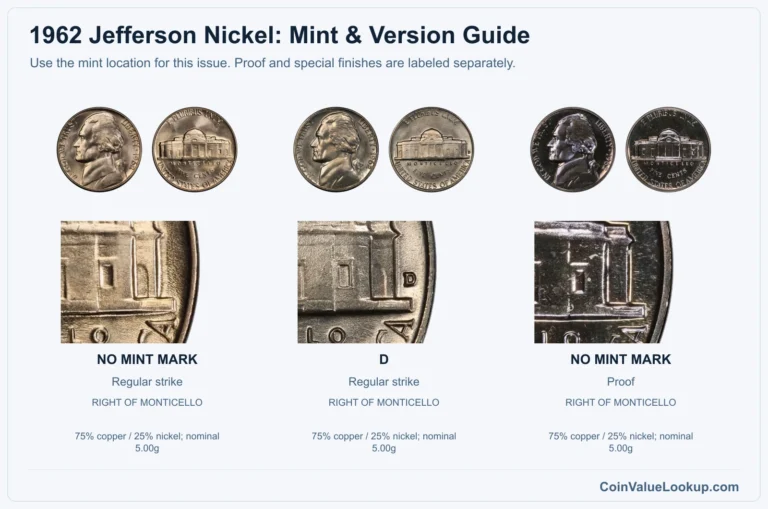
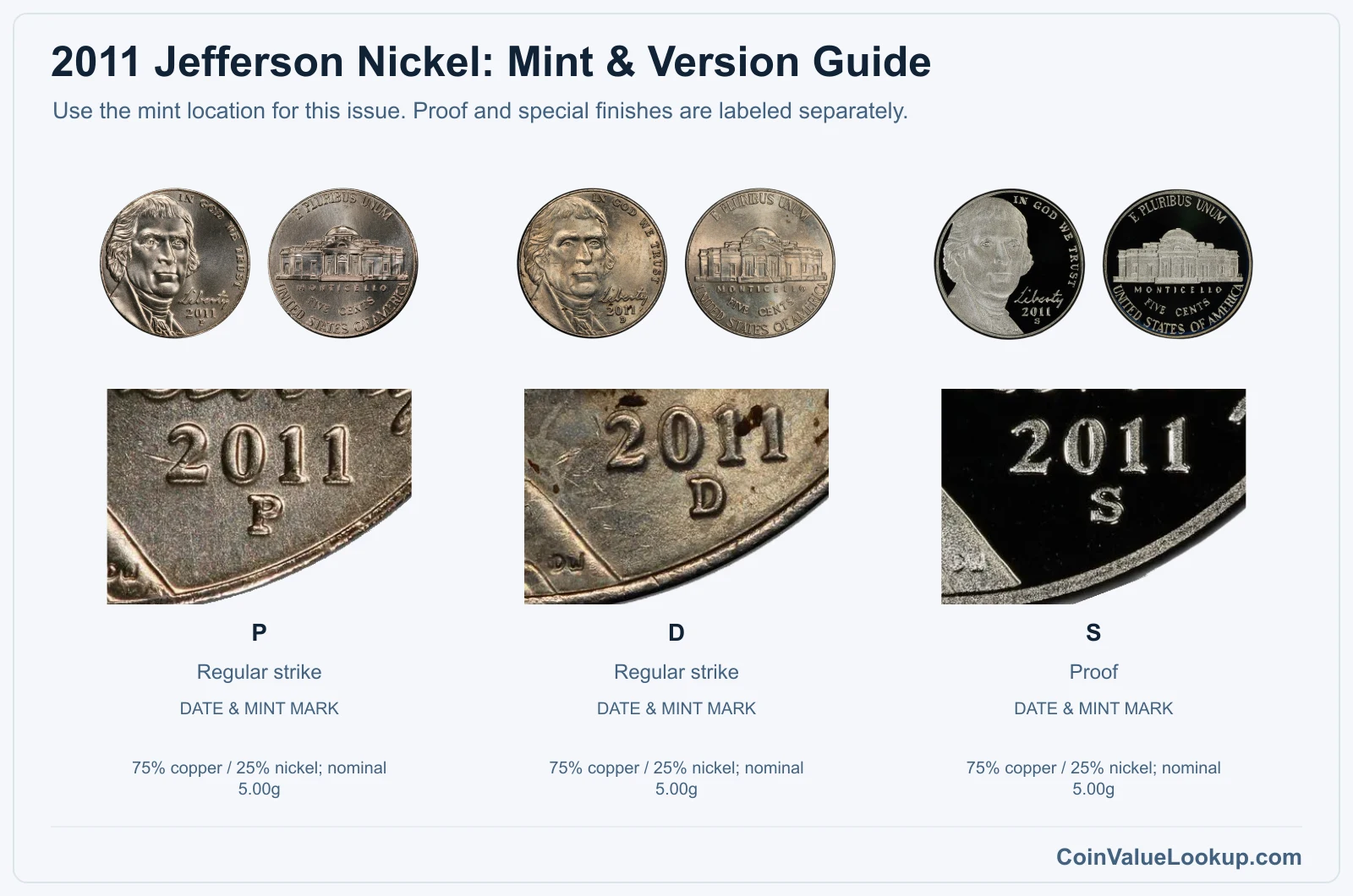
Flip your coin to the obverse and look below the date for a small mintmark: P for Philadelphia, D for Denver, or S for San Francisco. The S mark means proof, struck exclusively for collectors.
All three versions share the forward-facing Jefferson portrait on the obverse and the Monticello building on the reverse. The standard alloy is 75% copper and 25% nickel, weighing 5 grams with a 21.2 mm diameter and a plain edge.
One detail worth knowing: the U.S. Mint used a satin finish for Mint Set coins from 2005 through 2010, but switched back to a brilliant uncirculated finish in 2011. So if you see a 2011 nickel, there is no normal satin-finish variety for this year.
Figure out the original finish before you start grading, because a reflective surface alone does not make a coin a proof.
Step 2: Check Your 2011 Jefferson Nickel Grade
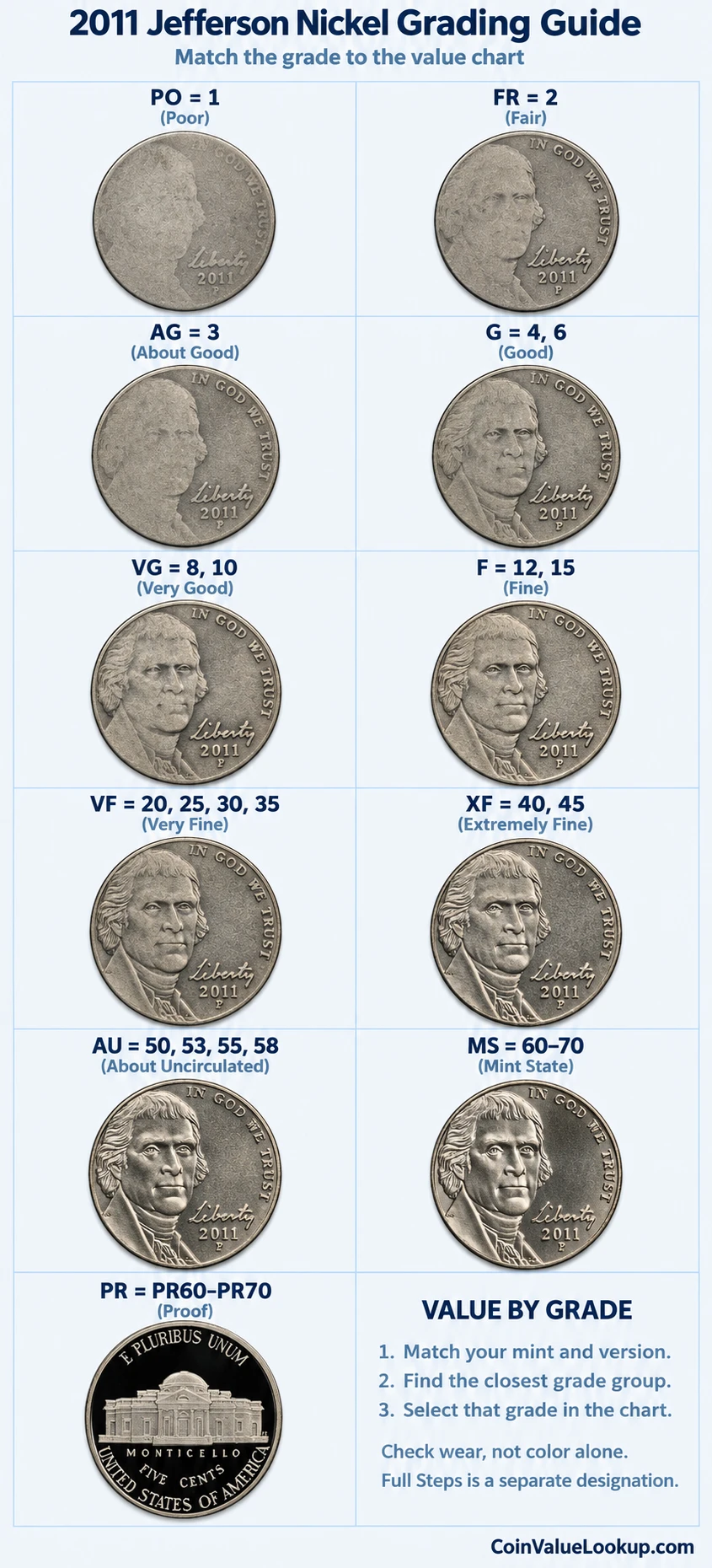
Start on the obverse. The first places to lose detail are Jefferson's raised cheekbone, the hair above his ear, and the shoulder area.
If those spots still show sharp, crisp lines, you are likely looking at an uncirculated coin.
On the reverse, check the steps at the base of Monticello. Step sharpness reflects how well the coin was struck, and a Full Steps designation is awarded independently of the numerical grade.
A coin can be MS65 without Full Steps, or MS63 with them.
Proof coins have mirrored fields and frosted devices. That contrast is a finish characteristic, not an upgrade beyond Mint State.
Compare your coin to the reference image for the same portrait type to judge wear accurately. Look for contact marks and luster breaks across the entire surface, not just the high points.
Step 3: Check 2011 Jefferson Nickel Value by Mint and Version
2011 Jefferson Nickel — P Business strike
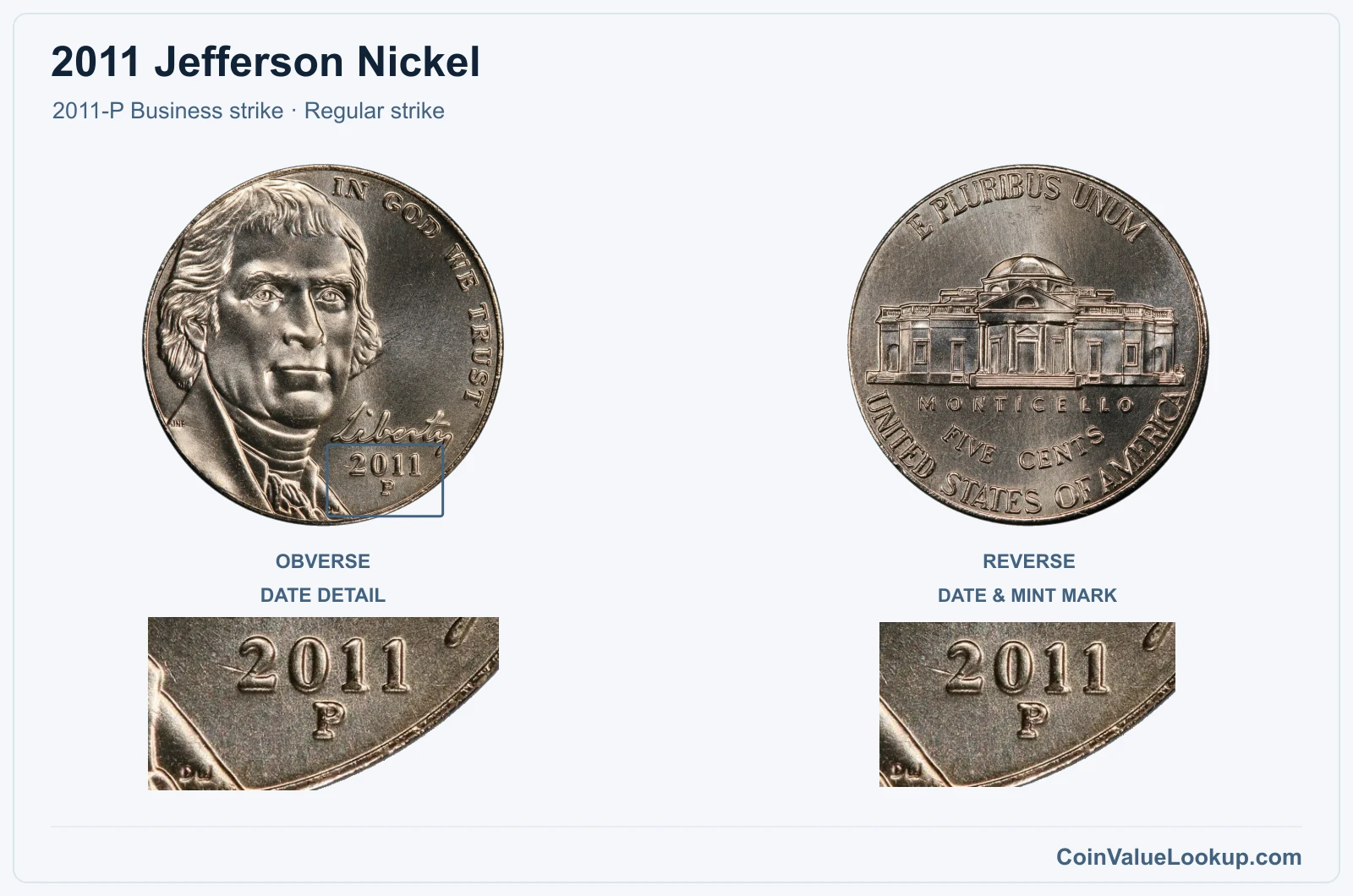
The 2011-P nickel was struck at Philadelphia in 75% copper and 25% nickel, weighing about 5 grams. It carries a small P mintmark below the date on the obverse.
USA Coin Book guide estimates place ordinary examples around $0.30 in MS60 and $0.61 in MS65. Those figures cover standard business strikes and do not reflect coins with a Full Steps designation or deep cameo contrast, which are priced on a different curve.
In circulated grades, this coin is worth face value.
| Range | Grade | Price | Auction Records | Appraisal |
|---|---|---|---|---|
| PO | PO 1 | — | Coin Identifier | |
| FR | FR 2 | — | Coin Identifier | |
| AG | AG 3 | — | Coin Identifier | |
| G | G 4 | — | Coin Identifier | |
| G 6 | — | Coin Identifier | ||
| VG | VG 8 | — | Coin Identifier | |
| VG 10 | — | Coin Identifier | ||
| F | F 12 | — | Coin Identifier | |
| F 15 | — | Coin Identifier | ||
| VF | VF 20 | — | Coin Identifier | |
| VF 25 | — | Coin Identifier | ||
| VF 30 | — | Coin Identifier | ||
| VF 35 | — | Coin Identifier | ||
| XF | XF 40 | — | Coin Identifier | |
| XF 45 | — | Coin Identifier | ||
| AU | AU 50 | — | Coin Identifier | |
| AU 53 | — | Coin Identifier | ||
| AU 55 | — | Coin Identifier | ||
| AU 58 | — | Coin Identifier | ||
| MS | MS 60 | — | Coin Identifier | |
| MS 61 | — | Coin Identifier | ||
| MS 62 | — | Coin Identifier | ||
| MS 63 | — | Coin Identifier | ||
| MS 64 | — | Coin Identifier | ||
| MS 65 | — | Coin Identifier | ||
| MS 66 | Coin Identifier | |||
| MS 67 | Coin Identifier | |||
| MS 68 | — | — | — | |
| MS 69 | — | — | — | |
| MS 70 | — | — | — |
2011 Jefferson Nickel — D Business strike
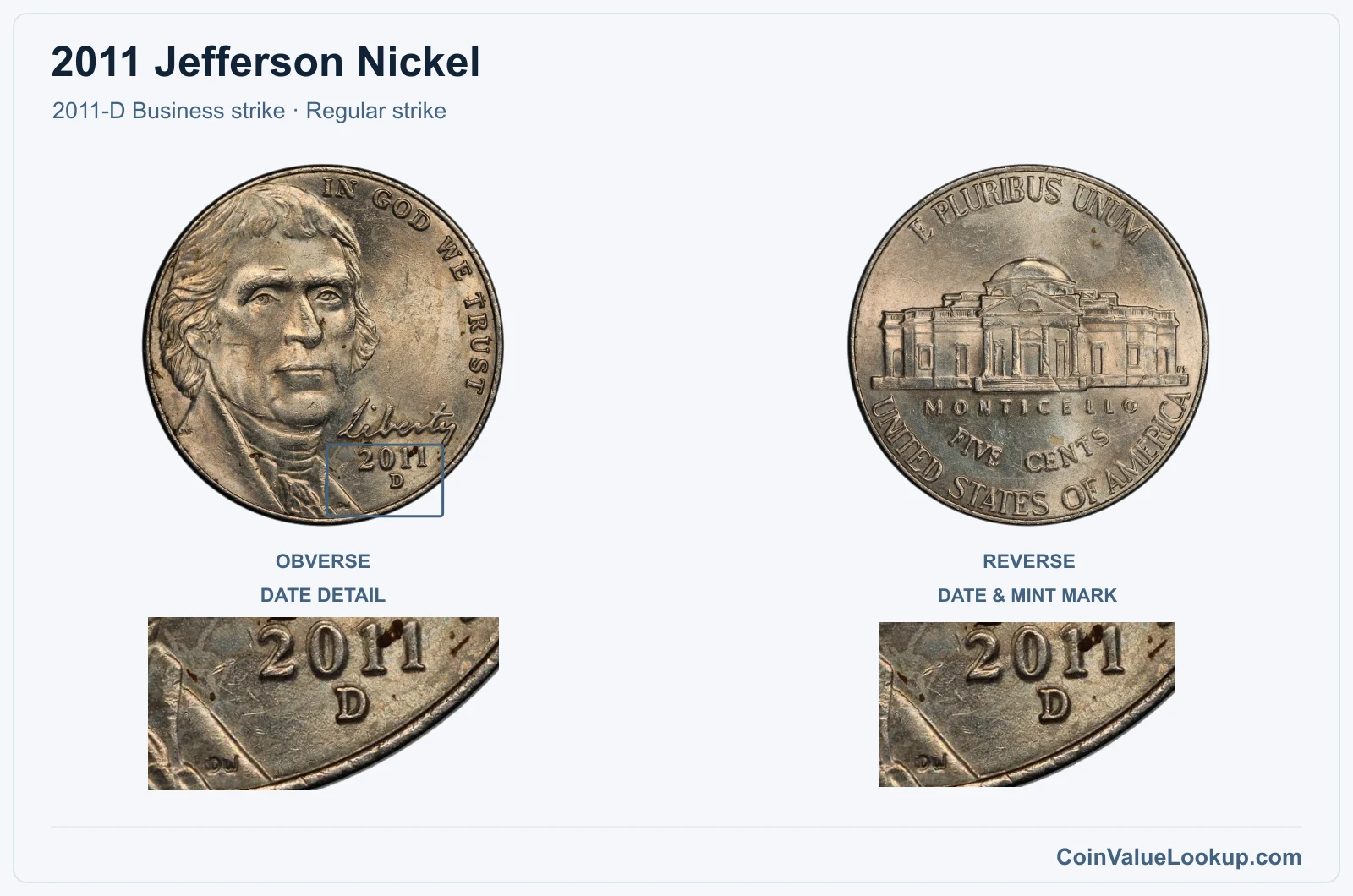
Denver's 2011-D nickel shares the same copper-nickel composition, weight, and design as its Philadelphia counterpart. The D mintmark sits in the same position below the date.
Retail guide anchors from USA Coin Book are identical to the P issue: roughly $0.30 at MS60 and $0.61 at MS65 for ordinary strikes. Again, Full Steps coins are a separate conversation.
Most pocket change examples are worth five cents.
Coin Value Lookup is a handy starting point if you want to look up guides for other Jefferson nickel dates or different series altogether.
| Range | Grade | Price | Auction Records | Appraisal |
|---|---|---|---|---|
| PO | PO 1 | — | Coin Identifier | |
| FR | FR 2 | — | Coin Identifier | |
| AG | AG 3 | — | Coin Identifier | |
| G | G 4 | — | Coin Identifier | |
| G 6 | — | Coin Identifier | ||
| VG | VG 8 | — | Coin Identifier | |
| VG 10 | — | Coin Identifier | ||
| F | F 12 | — | Coin Identifier | |
| F 15 | — | Coin Identifier | ||
| VF | VF 20 | — | Coin Identifier | |
| VF 25 | — | Coin Identifier | ||
| VF 30 | — | Coin Identifier | ||
| VF 35 | — | Coin Identifier | ||
| XF | XF 40 | — | Coin Identifier | |
| XF 45 | — | Coin Identifier | ||
| AU | AU 50 | — | Coin Identifier | |
| AU 53 | — | Coin Identifier | ||
| AU 55 | — | Coin Identifier | ||
| AU 58 | — | Coin Identifier | ||
| MS | MS 60 | — | Coin Identifier | |
| MS 61 | — | Coin Identifier | ||
| MS 62 | — | Coin Identifier | ||
| MS 63 | — | Coin Identifier | ||
| MS 64 | — | Coin Identifier | ||
| MS 65 | — | Coin Identifier | ||
| MS 66 | — | Coin Identifier | ||
| MS 67 | — | — | — | |
| MS 68 | — | — | — | |
| MS 69 | — | — | — | |
| MS 70 | — | — | — |
2011 Jefferson Nickel — S Proof
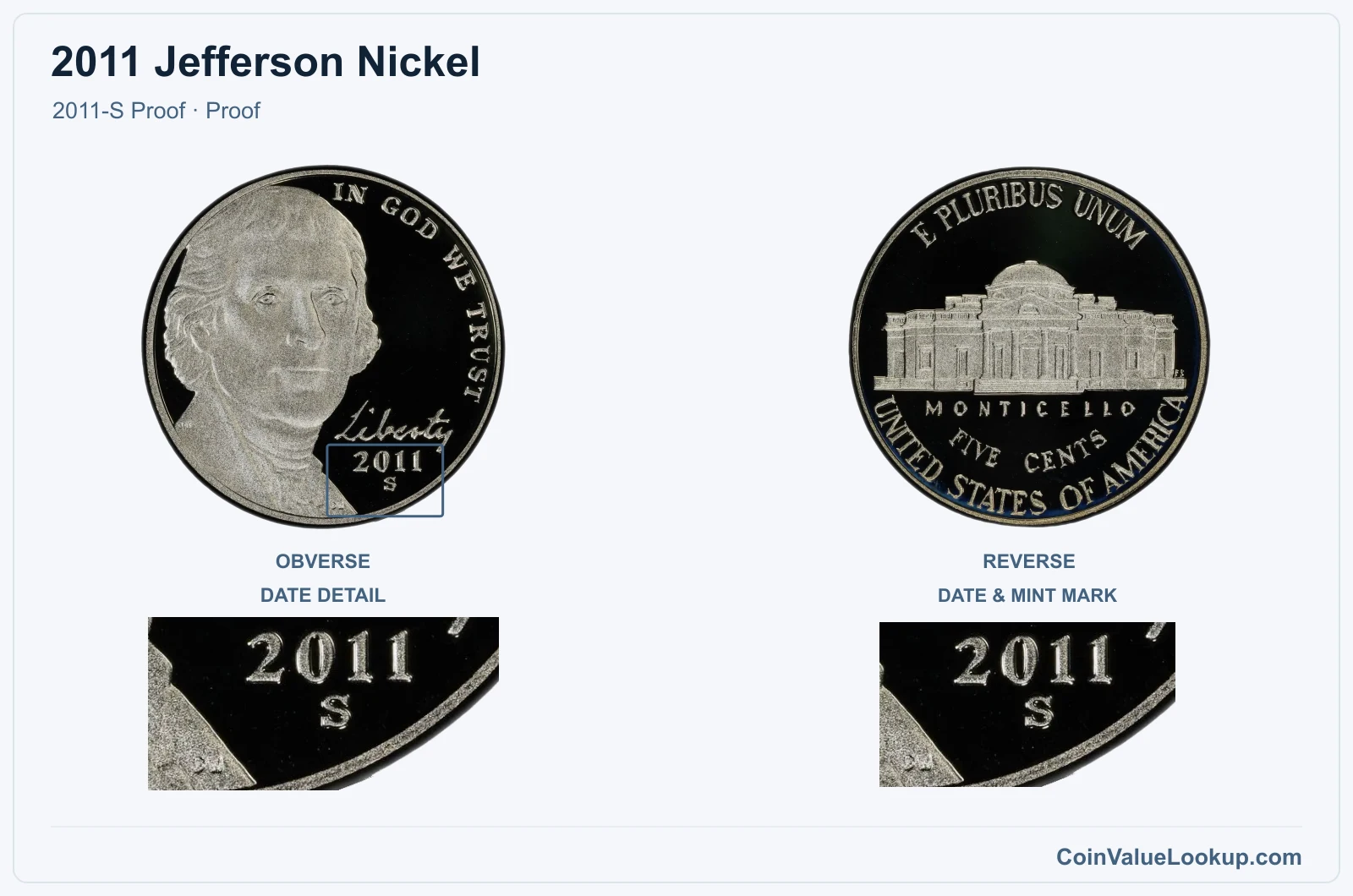
The 2011-S proof was struck at San Francisco solely for collector sets. Same alloy and weight as the business strikes, but the mirrored fields and frosted devices give it a completely different look.
A USA Coin Book guide estimate puts a PR65 example at about $5.30. That is for a standard proof; deep cameo or exceptionally graded pieces fall outside that baseline figure.
If you think you have a proof, confirm the S mintmark and check for the sharp, mirror-like field finish that business strikes simply do not have.
| Range | Grade | Price | Auction Records | Appraisal |
|---|---|---|---|---|
| PR | PR 1 | — | Coin Identifier | |
| PR 2 | — | Coin Identifier | ||
| PR 3 | — | Coin Identifier | ||
| PR 4 | — | Coin Identifier | ||
| PR 6 | — | Coin Identifier | ||
| PR 8 | — | Coin Identifier | ||
| PR 10 | — | Coin Identifier | ||
| PR 12 | — | Coin Identifier | ||
| PR 15 | — | Coin Identifier | ||
| PR 20 | — | Coin Identifier | ||
| PR 25 | — | Coin Identifier | ||
| PR 30 | — | Coin Identifier | ||
| PR 35 | — | Coin Identifier | ||
| PR 40 | — | Coin Identifier | ||
| PR 45 | — | Coin Identifier | ||
| PR 50 | — | Coin Identifier | ||
| PR 53 | — | Coin Identifier | ||
| PR 55 | — | Coin Identifier | ||
| PR 58 | — | Coin Identifier | ||
| PR 60 | — | Coin Identifier | ||
| PR 61 | — | Coin Identifier | ||
| PR 62 | — | Coin Identifier | ||
| PR 63 | — | Coin Identifier | ||
| PR 64 | — | Coin Identifier | ||
| PR 65 | — | Coin Identifier | ||
| PR 66 | — | Coin Identifier | ||
| PR 67 | — | Coin Identifier | ||
| PR 68 | — | Coin Identifier | ||
| PR 69 | Coin Identifier | |||
| PR 70 | Coin Identifier |
2011 Jefferson Nickel Error List
1. 2011 Jefferson Nickel — Off-center strike
An off-center strike happens when the planchet is not seated properly in the collar, so the dies hit an area that is partially off the intended target. The result is a blank crescent on one side of the coin where no design was impressed.
A 2011-P example graded NGC AU Details (with noted damage) sold through Heritage Auctions in January 2022 for $63. That price reflects both the genuine error and the coin's damage qualification, so it is a single data point rather than a broad market value.
Do not confuse an off-center strike with a misaligned die, which shifts the design slightly but still covers the full planchet, or with a coin that simply has a damaged or trimmed rim. A true off-center piece will show a clear, unimpressed area with no design elements at all.
2. 2011 Jefferson Nickel — Doubled Die Obverse
Doubled die obverse errors on 2011 nickels have been reported. These show a consistent doubling of obverse design elements, such as lettering or portions of the portrait, caused by a misaligned hub impression during die production.
To check, compare your coin's obverse letters and profile details against a normal 2011 nickel under good lighting and magnification. Genuine hub doubling produces uniform separation or notching on affected elements, and it will appear in the same spot on every coin struck by that die.
Machine doubling is the most common lookalike. It tends to produce a flat, shelf-like distortion rather than the rounded, separated profiles of a true doubled die.
Reflections and normal die wear can also mimic doubling under certain angles. Value depends on the visibility of the doubling and the coin's overall condition.
3. 2011 Jefferson Nickel — Doubled Die Reverse
Doubled die reverse varieties have also been reported for the 2011 nickel. The same principle applies as with the obverse: a hub alignment error during die manufacturing causes portions of the reverse design to appear doubled.
Examine the reverse legends and architectural details of Monticello closely with magnification. True doubling will be consistent and repeatable across multiple coins from the same die, showing clean separation of affected elements.
Machine doubling is again the usual suspect. It creates a flat, mechanical-looking shelf alongside the design rather than a distinct second impression.
Random scratches and corrosion can also create misleading raised lines. Condition and the strength of the visible doubling both affect what a doubled die reverse coin might be worth, so individual assessment is necessary.
4. 2011 Jefferson Nickel — Die Crack / Die Chip
Die cracks and die chips on 2011 nickels result from stress fractures in the steel die. A crack shows up on the finished coin as a thin raised line, because metal flows into the gap during striking.
A die chip appears as a small raised blob where a piece of the die surface broke away.
Look for raised lines that run across the design or connect to the rim. An interior chip will appear as an irregular raised lump in the field or on a device.
A rim-connected break large enough to displace design is sometimes called a cud, which is a more dramatic form of the same problem.
Do not confuse die cracks with incuse scratches, which are pressed into the surface rather than raised. Corrosion and foreign material stuck to the coin can also mimic small chips.
Value depends on size, location, and the coin's grade.
5. 2011 Jefferson Nickel — Clashed Dies
Die clash errors occur when the obverse and reverse dies strike each other without a planchet between them. The impact transfers a ghostly impression of one die's design onto the face of the other die, and every coin struck afterward carries traces of those transferred elements.
On a clashed 2011 nickel, you might see faint outlines of Monticello's features appearing in the obverse field, or hints of Jefferson's portrait showing up on the reverse. These traces will align with where the opposite design would naturally fall during a normal strike.
Scratches, random raised marks, and brockage errors can look similar at first glance. A brockage involves a previously struck coin acting as a die, producing a much more dramatic and mirror-image impression.
Clashed die traces are subtler and follow a predictable pattern. Value varies with the clarity of the clash and overall coin condition.