2014 Jefferson Nickel Coin Value: How Much Is It Worth?
Most 2014 Jefferson nickels you pull from pocket change are worth face value or close to it. Ordinary Philadelphia and Denver business strikes carry USA Coin Book retail guide estimates of about $0.30 at MS60 and $0.61 at MS65.
Proofs and certified high-grade coins with the Full Steps designation occupy a different tier. Authenticated mint errors also call for individual assessment.
Fast Way to Identify Your 2014 Jefferson Nickel
Snap clear photos of the front and back of your 2014 nickel and upload them here for a preliminary identification. Good lighting and a steady shot help distinguish the mintmark, finish, and any unusual features.
This is not a substitute for professional authentication or grading, but it is a solid first step toward figuring out what you have.
2014 Jefferson Nickel Value
Upload both sides of your 2014 Jefferson Nickel.
Front Obverse
Upload photo
Back Reverse
Upload photo
Which 2014 Jefferson Nickel Versions Are Worth Money?
- Certified exceptional Mint State examples, especially those earning the Full Steps designation, can command premiums well above ordinary guide estimates for P and D strikes.
- The 2014-S proof occupies a separate collector market; a USA Coin Book guide estimate places PR65 around $5.30.
Step 1: Identify Your 2014 Jefferson Nickel Mint Mark and Version
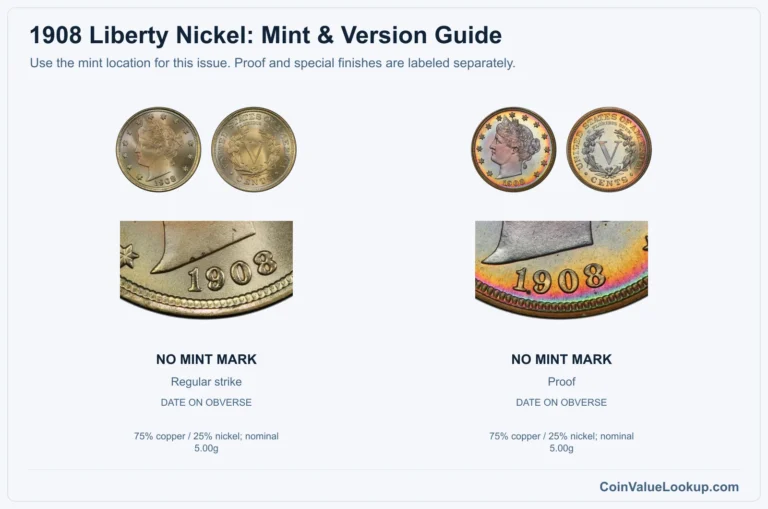
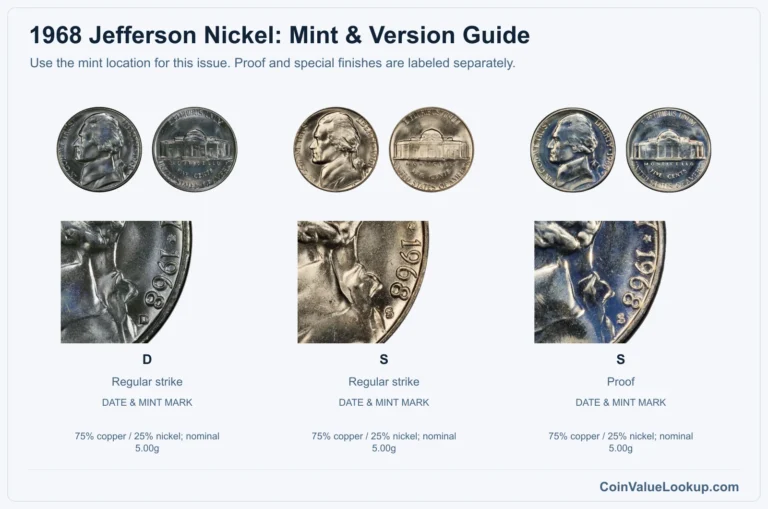
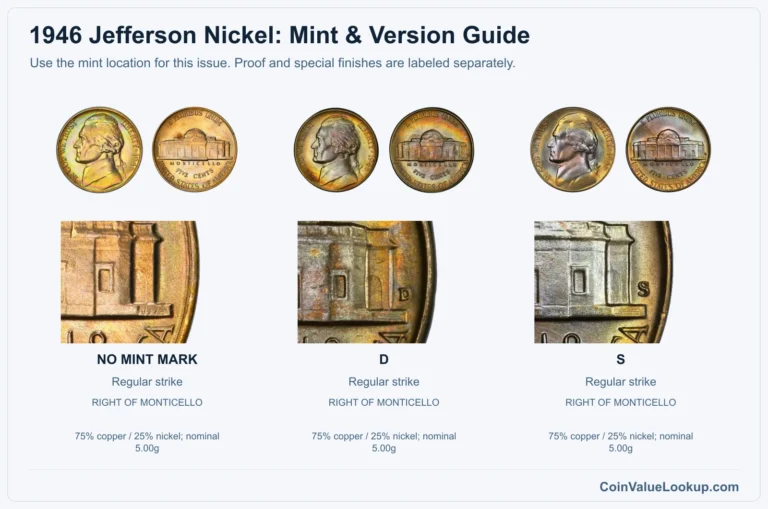
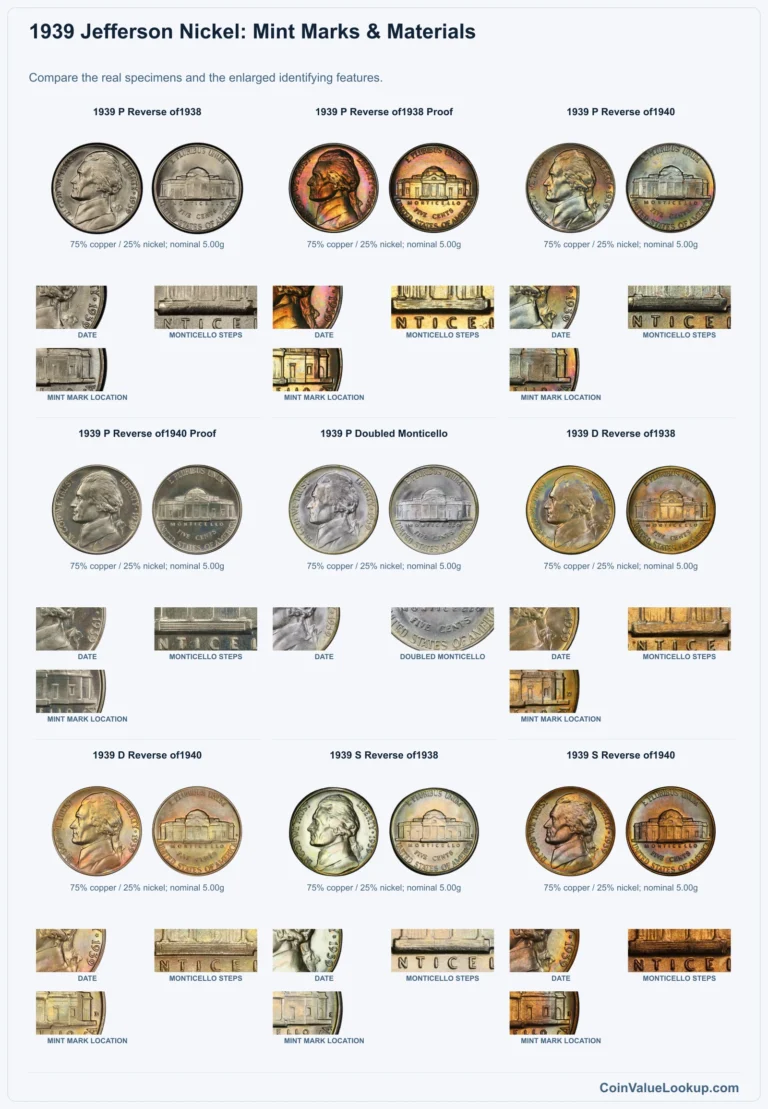
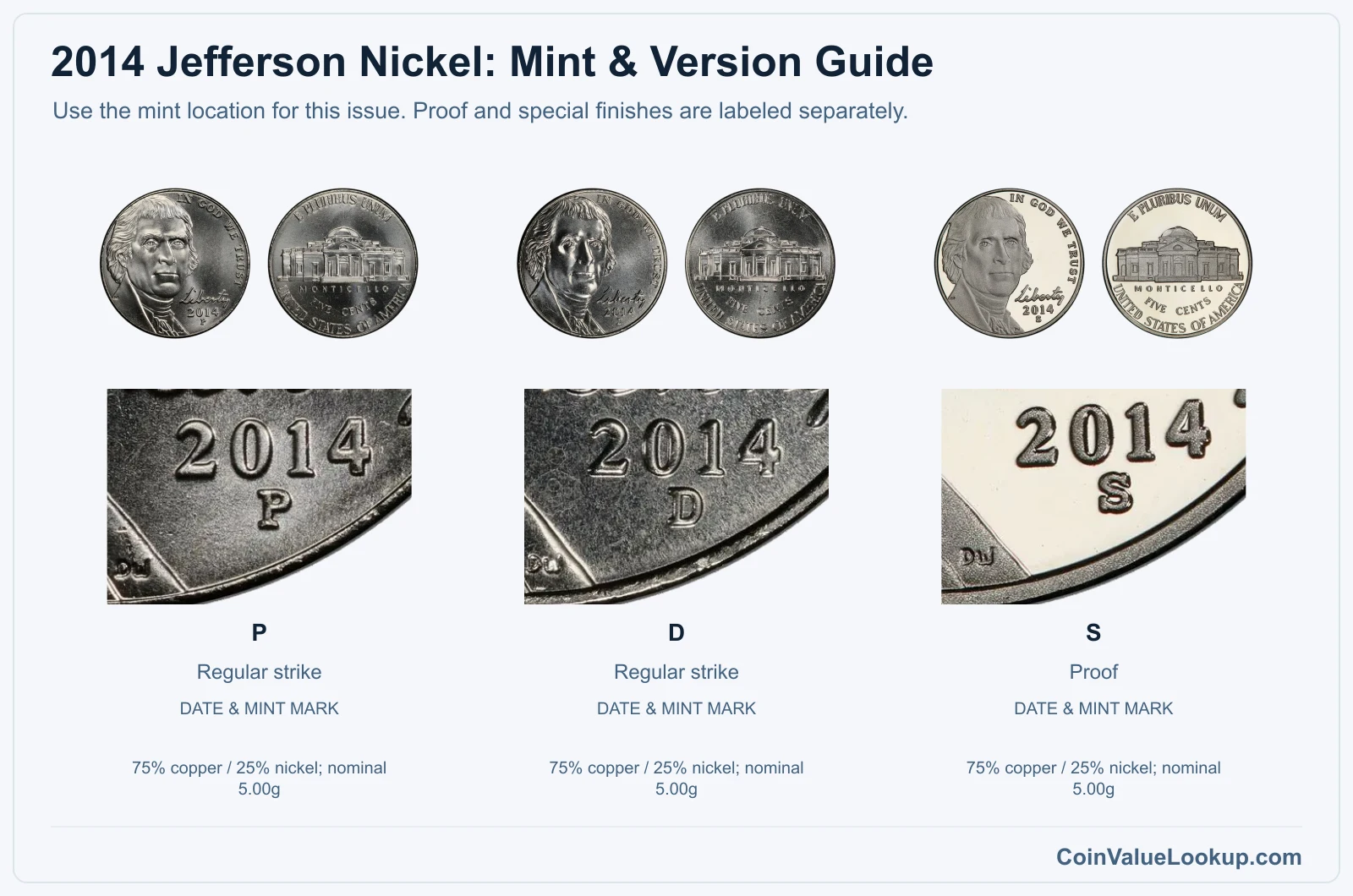
Flip the coin to the obverse and look for the mintmark just below the date: P for Philadelphia, D for Denver, or S for San Francisco. All three use the same forward-facing Jefferson portrait on the obverse and Monticello on the reverse.
The standard alloy is 75% copper and 25% nickel, weighing 5 grams with a plain edge and a diameter of 21.2 mm. There is no silver version and no satin finish for this year; the Mint returned to the brilliant uncirculated finish in 2011.
P and D coins are business strikes made for circulation. The S coin is a proof, produced with specially prepared dies for collector sets.
A circulated coin that happens to look shiny is not a proof; true proofs have sharp, squared rims and mirror-like fields that are obvious under a lamp. Identifying the correct finish matters because proof values follow a completely separate track.
Step 2: Check Your 2014 Jefferson Nickel Grade
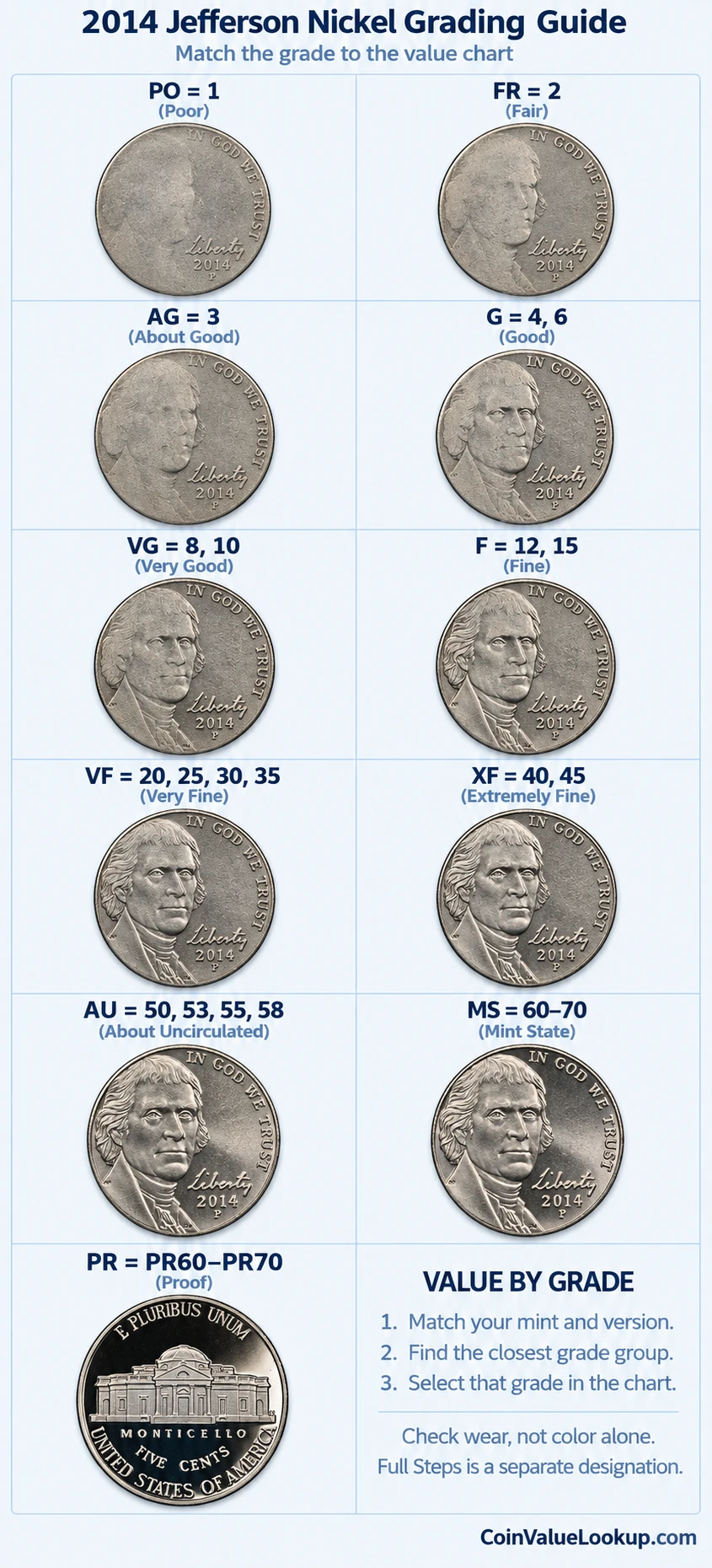
Start with Jefferson's cheek, the hair detail above his ear, and the shoulder area. Those are the highest points and the first to show rub.
Even light friction across the cheek will knock a coin out of the Mint State range.
On the reverse, inspect the columns and steps of Monticello. The steps are the key to the Full Steps designation, which is about strike sharpness, not wear.
A coin can grade MS65 without Full Steps and MS63 with them; the two labels measure different things.
Luster is your next checkpoint. Original mint luster should be unbroken across both faces.
Bag marks, small nicks from contact with other coins, separate an MS60 from an MS65 or higher. Compare your coin to the reference image of the same portrait type to calibrate your eye.
Proof coins are judged on reflectivity, hairlines, and haze rather than the usual circulation-wear scale.
Step 3: Check 2014 Jefferson Nickel Value by Mint and Version
2014 Jefferson Nickel — P Business strike
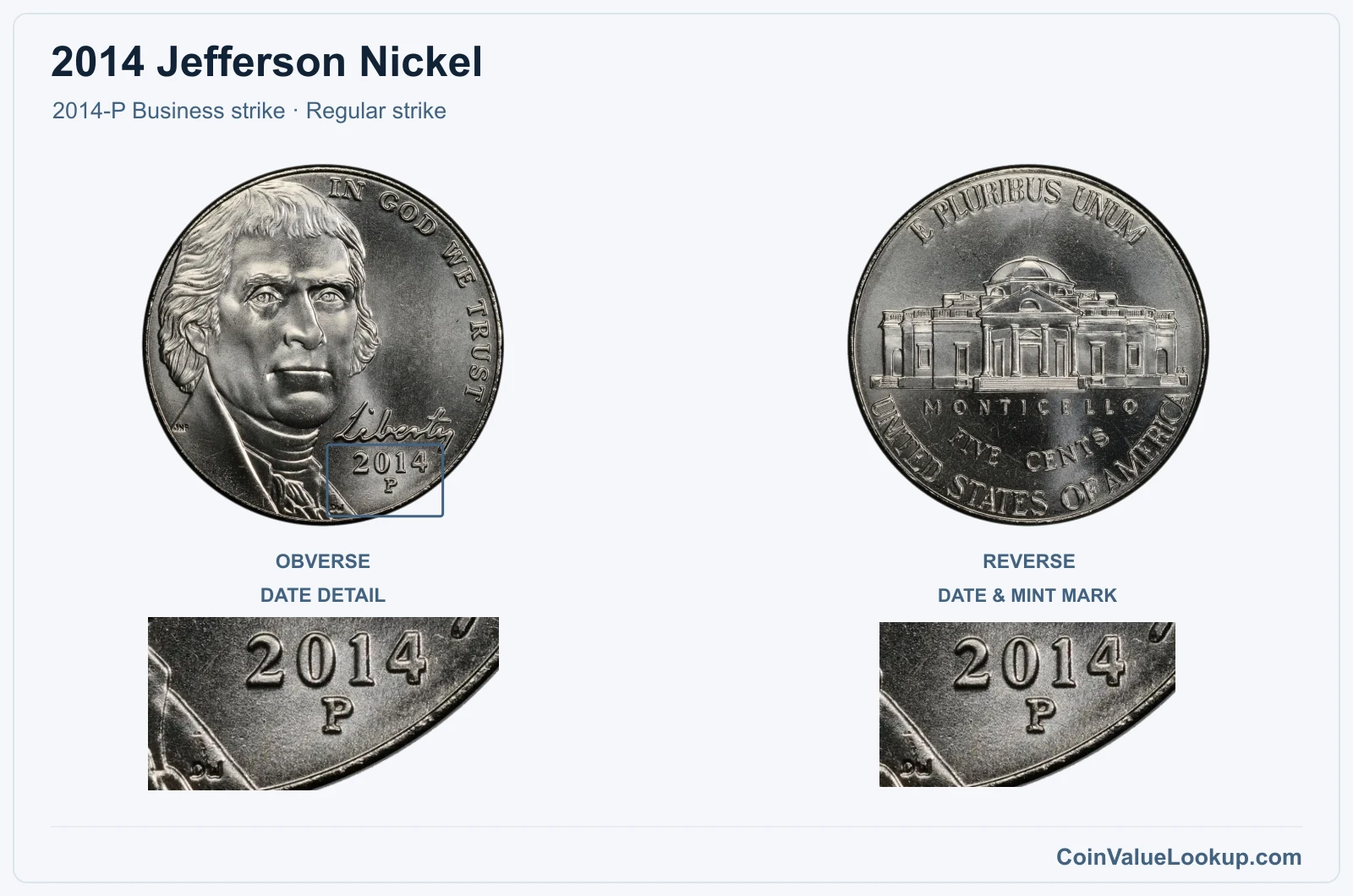
The 2014-P is your standard Philadelphia business strike. It carries a small P mintmark below the date on the obverse.
Struck on a 75% copper / 25% nickel planchet at a nominal 5 grams.
USA Coin Book retail guide estimates place ordinary examples at about $0.30 in MS60 and $0.61 in MS65. Those figures cover run-of-the-mill coins without special designations.
A certified Full Steps example or a coin grading well above MS65 can be worth considerably more, so do not assume every Philadelphia nickel is a thirty-cent coin.
Coin Value Lookup is a good place to look up guides for other years and denominations while you are sorting through a batch.
| Range | Grade | Price | Auction Records | Appraisal |
|---|---|---|---|---|
| PO | PO 1 | — | Coin Identifier | |
| FR | FR 2 | — | Coin Identifier | |
| AG | AG 3 | — | Coin Identifier | |
| G | G 4 | — | Coin Identifier | |
| G 6 | — | Coin Identifier | ||
| VG | VG 8 | — | Coin Identifier | |
| VG 10 | — | Coin Identifier | ||
| F | F 12 | — | Coin Identifier | |
| F 15 | — | Coin Identifier | ||
| VF | VF 20 | — | Coin Identifier | |
| VF 25 | — | Coin Identifier | ||
| VF 30 | — | Coin Identifier | ||
| VF 35 | — | Coin Identifier | ||
| XF | XF 40 | — | Coin Identifier | |
| XF 45 | — | Coin Identifier | ||
| AU | AU 50 | — | Coin Identifier | |
| AU 53 | — | Coin Identifier | ||
| AU 55 | — | Coin Identifier | ||
| AU 58 | — | Coin Identifier | ||
| MS | MS 60 | — | Coin Identifier | |
| MS 61 | — | Coin Identifier | ||
| MS 62 | — | Coin Identifier | ||
| MS 63 | — | Coin Identifier | ||
| MS 64 | — | Coin Identifier | ||
| MS 65 | — | Coin Identifier | ||
| MS 66 | — | Coin Identifier | ||
| MS 67 | Coin Identifier | |||
| MS 68 | Coin Identifier | |||
| MS 69 | — | — | — | |
| MS 70 | — | — | — |
2014 Jefferson Nickel — D Business strike
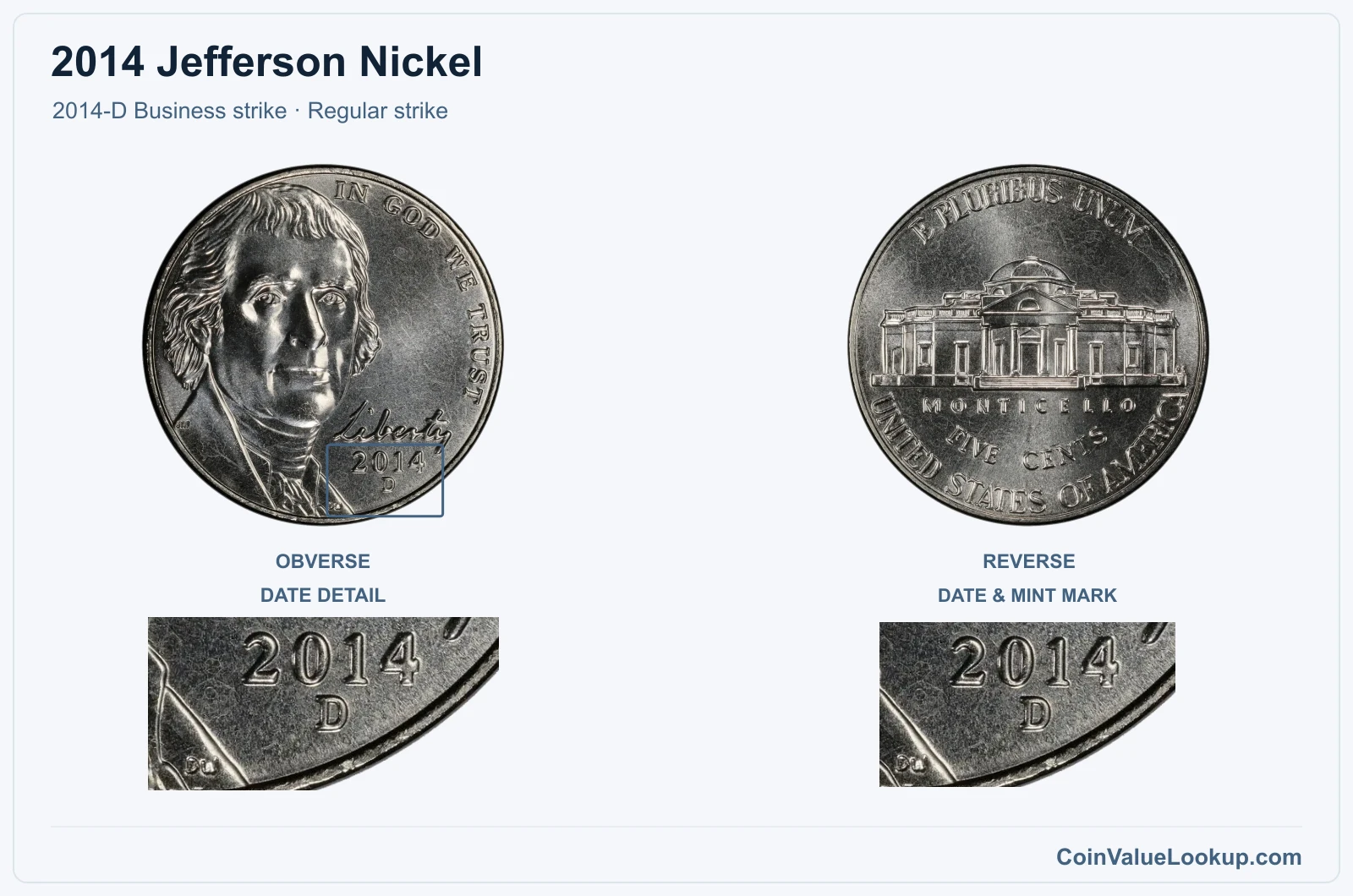
Denver's 2014 contribution looks identical to the Philadelphia issue except for the D mintmark below the date. Same alloy, same weight, same design.
USA Coin Book guide estimates mirror the P mint: roughly $0.30 at MS60 and $0.61 at MS65 for ordinary strikes. As with the P, these numbers do not reflect coins carrying the Full Steps designation or those certified at superb gem grades and above.
If you have a sharp, clean example with unbroken luster and fully defined Monticello steps, it is worth a closer look before you toss it back in the jar.
| Range | Grade | Price | Auction Records | Appraisal |
|---|---|---|---|---|
| PO | PO 1 | — | Coin Identifier | |
| FR | FR 2 | — | Coin Identifier | |
| AG | AG 3 | — | Coin Identifier | |
| G | G 4 | — | Coin Identifier | |
| G 6 | — | Coin Identifier | ||
| VG | VG 8 | — | Coin Identifier | |
| VG 10 | — | Coin Identifier | ||
| F | F 12 | — | Coin Identifier | |
| F 15 | — | Coin Identifier | ||
| VF | VF 20 | — | Coin Identifier | |
| VF 25 | — | Coin Identifier | ||
| VF 30 | — | Coin Identifier | ||
| VF 35 | — | Coin Identifier | ||
| XF | XF 40 | — | Coin Identifier | |
| XF 45 | — | Coin Identifier | ||
| AU | AU 50 | — | Coin Identifier | |
| AU 53 | — | Coin Identifier | ||
| AU 55 | — | Coin Identifier | ||
| AU 58 | — | Coin Identifier | ||
| MS | MS 60 | — | Coin Identifier | |
| MS 61 | — | Coin Identifier | ||
| MS 62 | — | Coin Identifier | ||
| MS 63 | — | Coin Identifier | ||
| MS 64 | — | Coin Identifier | ||
| MS 65 | — | Coin Identifier | ||
| MS 66 | — | Coin Identifier | ||
| MS 67 | — | Coin Identifier | ||
| MS 68 | — | — | — | |
| MS 69 | — | — | — | |
| MS 70 | — | — | — |
2014 Jefferson Nickel — S Proof
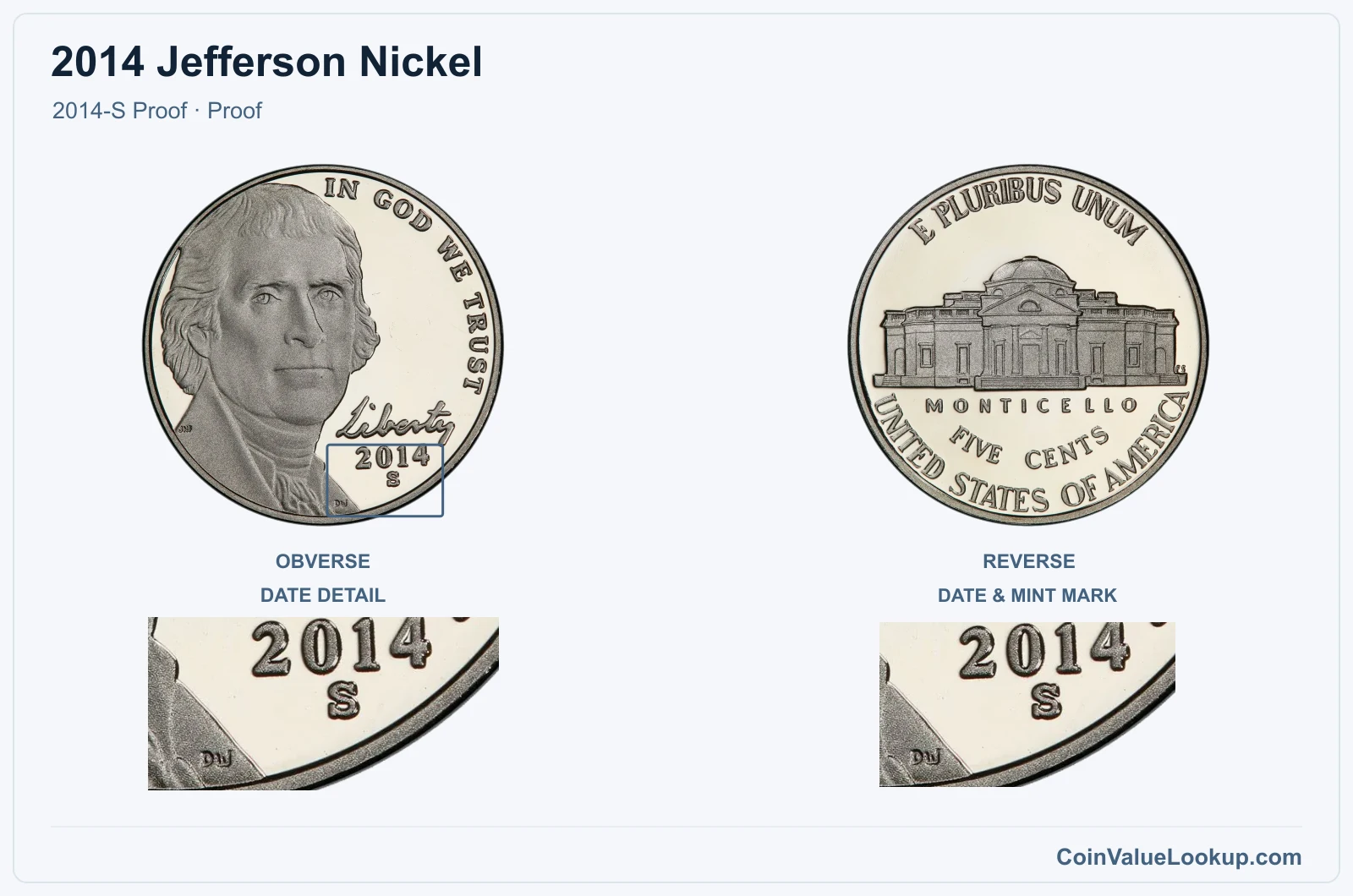
The 2014-S proof was struck at San Francisco for collector sets. Look for the S mintmark below the date, mirror-like fields, and frosted design elements.
The edge should feel sharp and squared compared with a business strike.
USA Coin Book places the PR65 guide estimate at about $5.30. That figure covers a standard proof; deep cameo contrast or higher grades follow a different curve not reflected in this anchor.
A proof is a manufacturing method, not a grade above Mint State, so PR65 is not inherently better than MS65 — they are separate scales for separate finishes.
| Range | Grade | Price | Auction Records | Appraisal |
|---|---|---|---|---|
| PR | PR 1 | — | Coin Identifier | |
| PR 2 | — | Coin Identifier | ||
| PR 3 | — | Coin Identifier | ||
| PR 4 | — | Coin Identifier | ||
| PR 6 | — | Coin Identifier | ||
| PR 8 | — | Coin Identifier | ||
| PR 10 | — | Coin Identifier | ||
| PR 12 | — | Coin Identifier | ||
| PR 15 | — | Coin Identifier | ||
| PR 20 | — | Coin Identifier | ||
| PR 25 | — | Coin Identifier | ||
| PR 30 | — | Coin Identifier | ||
| PR 35 | — | Coin Identifier | ||
| PR 40 | — | Coin Identifier | ||
| PR 45 | — | Coin Identifier | ||
| PR 50 | — | Coin Identifier | ||
| PR 53 | — | Coin Identifier | ||
| PR 55 | — | Coin Identifier | ||
| PR 58 | — | Coin Identifier | ||
| PR 60 | — | Coin Identifier | ||
| PR 61 | — | Coin Identifier | ||
| PR 62 | — | Coin Identifier | ||
| PR 63 | — | Coin Identifier | ||
| PR 64 | — | Coin Identifier | ||
| PR 65 | — | Coin Identifier | ||
| PR 66 | — | Coin Identifier | ||
| PR 67 | — | Coin Identifier | ||
| PR 68 | — | Coin Identifier | ||
| PR 69 | — | Coin Identifier | ||
| PR 70 | Coin Identifier |
2014 Jefferson Nickel Error List
1. 2014 Jefferson Nickel — Design creep
Design creep on a 2014 nickel occurs when a reverse die softens during use and physically expands, pushing the peripheral lettering toward or off the rim. This has been reported on Philadelphia mint strikes.
To check, compare your coin's reverse lettering position and overall diameter against a normal example. The letters near the rim may look crowded, partially missing, or shifted outward.
Both faces should be examined because the die deformed, which is different from the entire coin shifting during striking.
Do not confuse this with ordinary die wear, an off-center strike, or a coin that was physically trimmed. A trimmed coin will show tooling marks on the edge.
Value depends on the authenticated identity of the error, its severity, and the coin's condition; each specimen needs individual assessment.
2. 2014 Jefferson Nickel — Struck on dime blank
One confirmed 2014-P Jefferson nickel struck on a dime-sized clad planchet has been certified by NGC at MS63, under certification number 2659678-005. The smaller blank causes the nickel design to be visibly cropped around the perimeter, leaving an incomplete image with a clad edge rather than the normal solid nickel-alloy edge.
Look at the diameter first. A nickel is 21.2 mm; a dime blank is noticeably smaller.
You should be able to see the date and enough design to identify it as a nickel, but the outer portions will be missing. The clad layering visible on the edge is another giveaway.
Do not confuse this with a trimmed nickel or one that has had chemical color changes. Value requires individual assessment based on authenticated identity, condition, and how dramatic the wrong-planchet error appears.
3. 2014 Jefferson Nickel — Die Crack / Die Chip
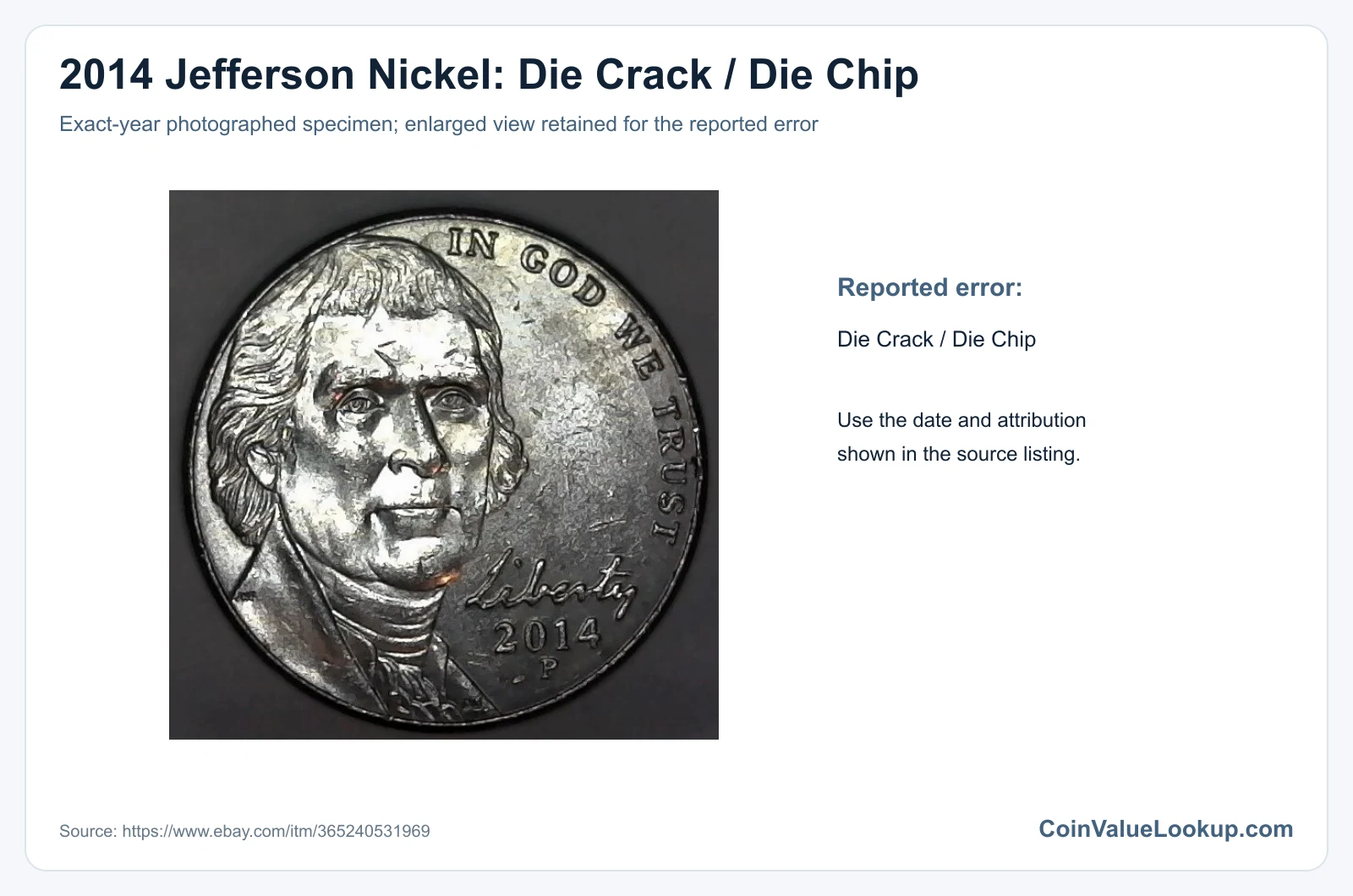
Die cracks and die chips have been reported on 2014 Jefferson nickels, specifically described as retained die crack errors. These appear as raised lines or small raised lumps on the coin's surface, transferred from a cracked or chipped die during striking.
A crack that connects to the rim is sometimes called a cud and usually commands more attention. Interior cracks and tiny chips are more common.
Look under magnification for a raised line that follows no part of the normal design; it should be consistent in relief across the surface.
Don't mistake incuse scratches, surface corrosion, or foreign material stuck to the coin for a die crack. Scratches are recessed, not raised.
Value depends on visibility, location, the coin's condition, and whether the error has been authenticated.
4. 2014 Jefferson Nickel — Doubled Die Obverse
Doubled die obverse errors have been reported for the 2014 Jefferson nickel. The doubling affects obverse design elements such as lettering or date numerals and results from a misalignment during the die-making process.
To identify one, compare the obverse legends and design details of your coin against a known normal example under the same lighting. True hub doubling produces consistent separation, notching, or a shelf-like profile on affected elements.
It will repeat identically on every coin struck by that die.
Machine doubling is the common lookalike. It tends to produce a flat, shelf-like displacement without the defined secondary image that hub doubling shows.
Reflections and worn die contours can also mimic doubling at first glance. Value depends on the strength and visibility of the doubling, overall condition, and professional authentication.
5. 2014 Jefferson Nickel — Doubled Die Reverse
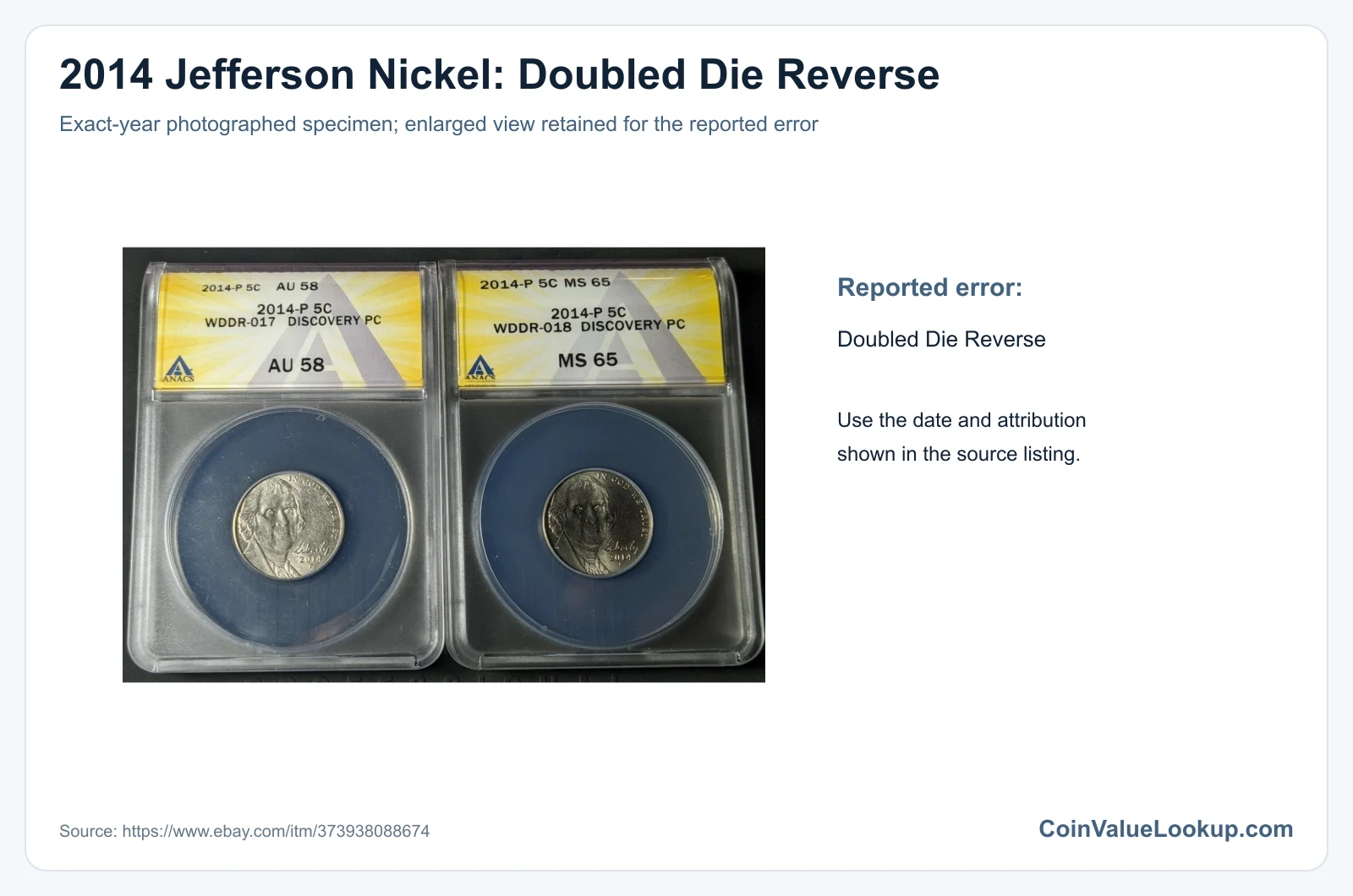
Doubled die reverse errors have also been reported on 2014 Jefferson nickels, affecting reverse legends or design elements of Monticello. The cause is similar to the obverse variety: a misalignment during the die-hubbing process.
Examine the reverse lettering and architectural details closely, using magnification and consistent lighting. Genuine doubling will show a repeatable secondary image with defined edges, not a mushy flat spread.
Compare your coin side by side with a normal specimen to see if the doubling is consistent.
Machine doubling, stray reflections, and random post-mint damage can all look like doubled dies to the untrained eye. Value depends on visibility, severity, and condition, and authentication by a third-party grading service is the safest way to confirm the variety.
6. 2014 Jefferson Nickel — Feeder-Finger Marks
Feeder finger errors have been reported on 2014 Jefferson nickels. These marks come from the mechanical fingers that push blank planchets into position between the dies.
When the timing is off, the fingers leave parallel or repeated impressions on the coin's surface.
The key diagnostic is the mark's character: feeder finger impressions are typically parallel, evenly spaced, and raised or indented in a consistent pattern across part of the design. They do not follow the coin's design elements.
Handling scratches, cleaning hairlines, and die-polish lines can look similar. Scratches from handling are usually random, not parallel, and cleaning hairlines tend to be fine and widespread.
Value is driven by the clarity of the marks, the coin's overall condition, and authenticated identity.
7. 2014 Jefferson Nickel — Lamination / Split Planchet
Lamination errors have been reported on 2014 Jefferson nickels. A lamination occurs when impurities or gas trapped within the planchet alloy cause layers to separate.
The result can be a peeling flap of metal, a missing patch, or a visible split along the edge.
To check, examine the coin's surface for areas where the metal appears to lift, bubble, or flake. Photograph the edge alongside the affected face; a true lamination will show separation within the alloy layers, not surface damage sitting on top.
Corrosion, deliberate scraping, and coins that have been intentionally cut or pried can all mimic lamination. Corrosion typically pits the surface rather than peeling it.
Value depends on the size and location of the lamination, the coin's condition, and professional authentication.
8. 2014 Jefferson Nickel — Clipped Planchet
Clipped planchet errors have been reported for 2014 Jefferson nickels. A clip happens when the blanking press punches a planchet from an area of strip that overlaps a previous punch-out, leaving a curved missing section.
Look for a crescent-shaped absence along the edge. The missing area should have a distinct edge texture, and you may notice design weakness directly opposite the clip, caused by uneven metal flow during striking.
That opposite weakness is a useful confirmation clue.
A filed notch, a deliberate edge cut, or corrosion eating into the rim can mimic a clip. Filed edges show tooling marks visible under magnification.
Value depends on the clip's size and shape, the coin's grade, and whether the error has been properly authenticated.
9. 2014 Jefferson Nickel — Off-Center Strike
Off-center strikes have been reported on 2014 Jefferson nickels. This error occurs when the planchet is not properly centered between the dies, producing a displaced design and an unstruck crescent of blank metal on one side.
The percentage of off-center displacement matters. A coin that is 5% off-center is mildly interesting; one that is 50% off-center with a visible date is a different story entirely.
Always confirm the date is readable, because an undated off-center nickel is much harder to attribute.
Do not confuse an off-center strike with a clipped planchet, a one-sided die misalignment, or post-mint flattening. A true off-center strike shows a complete unstruck blank area with a normal-thickness edge.
Value depends on the degree of displacement, date visibility, condition, and authentication.
10. 2014 Jefferson Nickel — Improper Annealing
Improper annealing errors have been reported on 2014 Jefferson nickels. Annealing is the heat-treatment step that softens planchets before striking.
When it goes wrong, the coin can display unusual surface discoloration, a rough or grainy texture, or both.
To screen for this, compare your coin's surface and edge against a normal example. An improperly annealed coin may show dark streaks, a woodgrain-like pattern, or an oddly matte surface that differs from ordinary toning.
Environmental toning, corrosion, or heat damage applied after the coin left the Mint can all produce similar discoloration. Post-mint damage usually lacks the even, alloy-deep character of an annealing error.
Surface appearance alone is a screening clue, not proof; authenticated specimens carry more weight. Value depends on severity, condition, and professional confirmation of the error's origin.