2021 Jefferson Nickel Coin Value: How Much Is It Worth?
A 2021 Jefferson nickel in average circulated condition is worth face value — five cents, no more. Once you move into uncirculated territory, a USA Coin Book guide estimate places ordinary P and D mint examples around $0.30 at MS60 and $0.61 at MS65.
The 2021-S proof carries a separate $5.30 guide anchor at PR65. Genuine errors and exceptional condition coins need individual assessment.
Fast Way to Identify Your 2021 Jefferson Nickel
The quickest way to start figuring out what you have is to snap clear photos of both sides of your nickel and upload them here. Good lighting and a steady hand help.
This gives you a preliminary identification of the mint, finish and any obvious features worth a closer look. It is not a substitute for professional authentication, but it points you in the right direction.
2021 Jefferson Nickel Value
Upload both sides of your 2021 Jefferson Nickel.
Front Obverse
Upload photo
Back Reverse
Upload photo
Which 2021 Jefferson Nickel Versions Are Worth Money?
- The 2021-S proof nickel carries a $5.30 guide estimate at PR65, well above face value, because it was sold only in collector sets from San Francisco.
- A documented doubled-die reverse on the 2021-P nickel shows duplicated detail at the Monticello doorway — worth checking with magnification since genuine examples need individual assessment for value.
- Uncirculated 2021-P and 2021-D nickels in true MS65 or higher condition guide at $0.61 per USA Coin Book, modest but above face value for a modern coin pulled from a roll.
- Rotated die errors on 2021 nickels have been reported and can carry meaningful premiums depending on the degree of rotation and overall condition.
Step 1: Identify Your 2021 Jefferson Nickel Mint Mark and Version
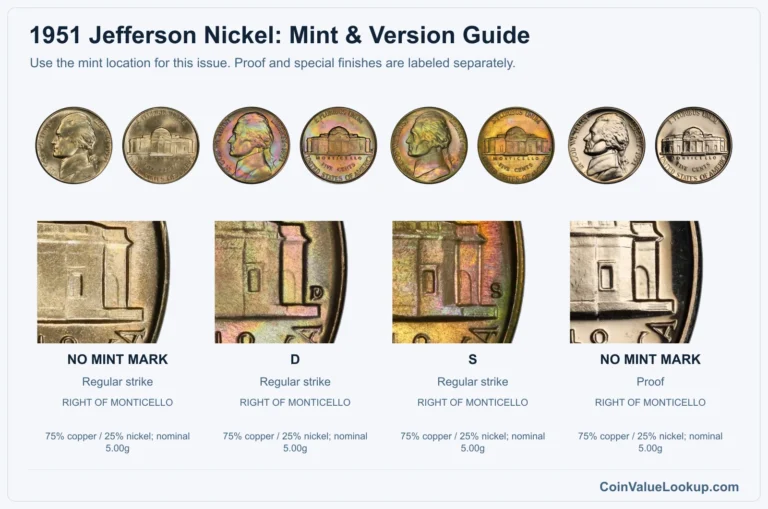
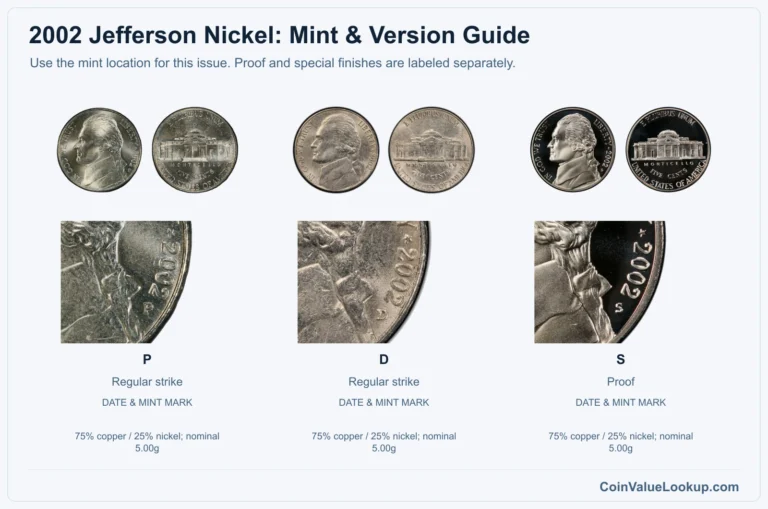
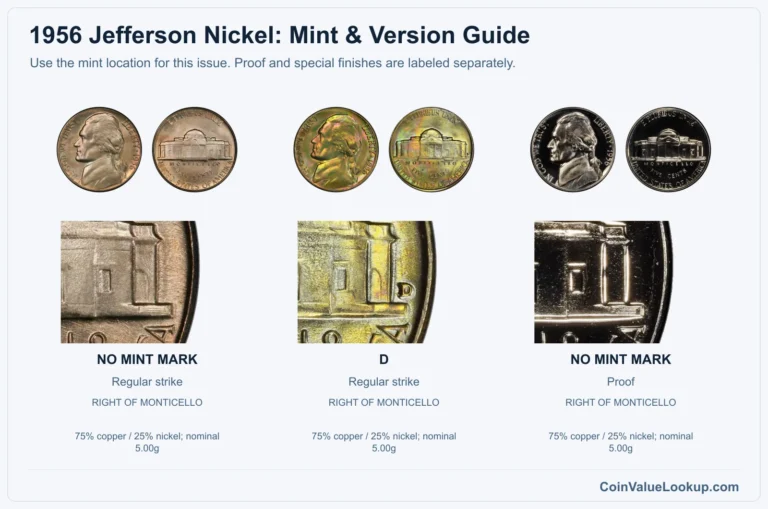
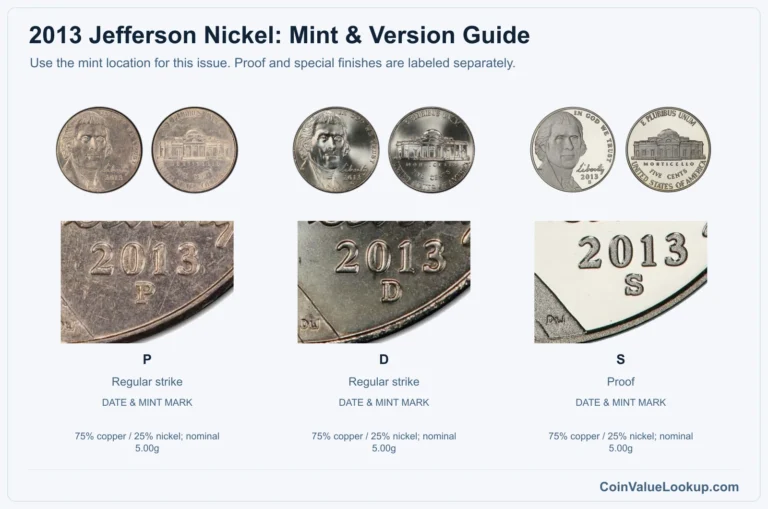
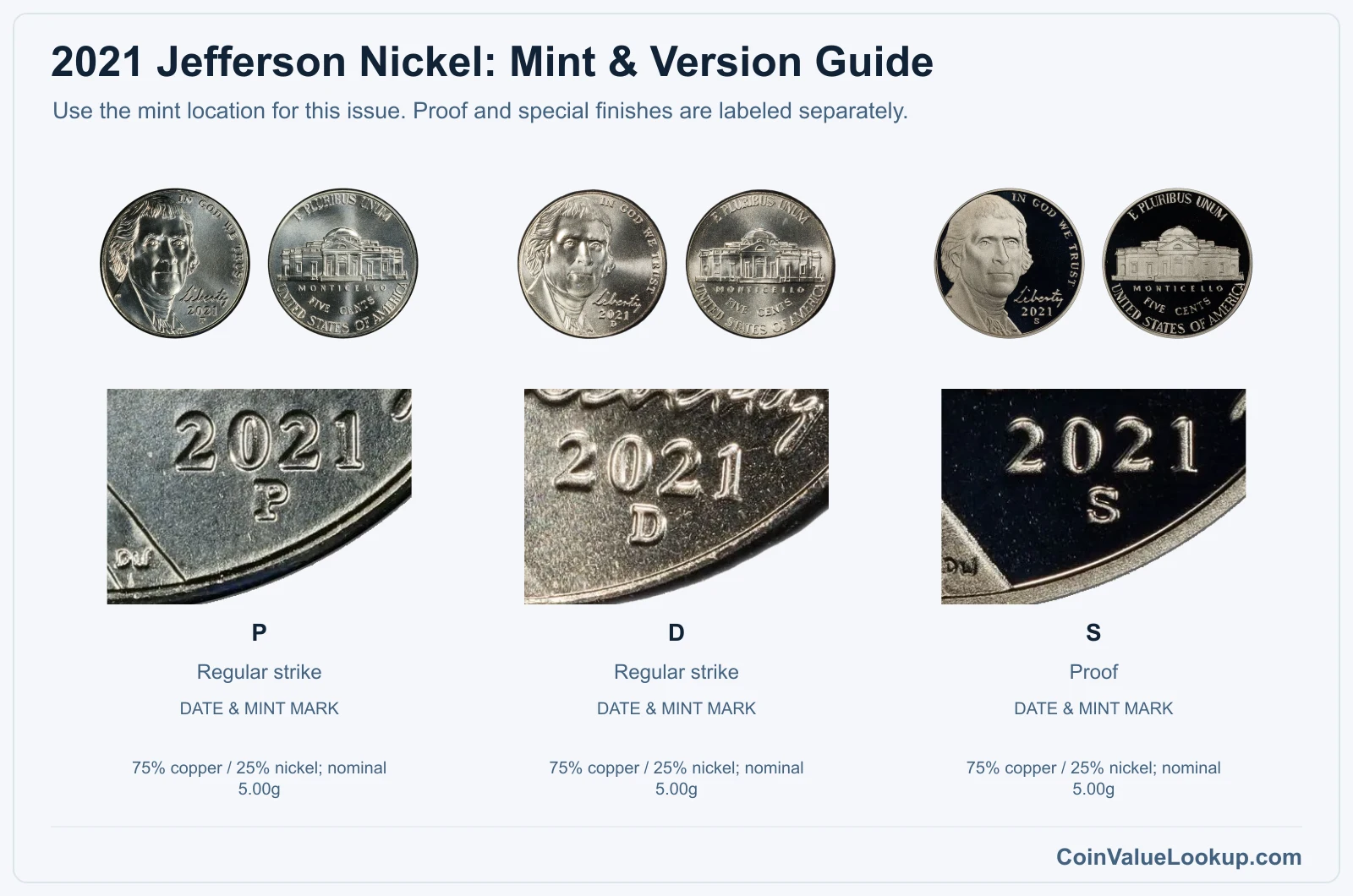
Flip the coin to the obverse and look below the date for a small letter. A "P" means Philadelphia, a "D" means Denver, and an "S" means San Francisco proof.
All three are struck in the same 75% copper, 25% nickel composition, weigh about 5 grams, measure 21.2 mm across, and have a plain edge.
The design is the modern forward-facing Jefferson portrait on the obverse with Monticello on the reverse. That has been the standard since 2006, so the 2021 looks like its recent neighbors.
Do not confuse finish with grade. A proof is a special manufacturing method — mirror fields, sharp rims — not a grade above Mint State.
Business strikes from P and D have a satiny or cartwheel luster instead. Knowing the difference matters before you look up any price.
Full Steps refers to strike sharpness on the Monticello steps, and it is a separate designation from the numerical grade. Missing steps do not automatically mean your coin has an error; it usually just means the strike was soft in that area.
Step 2: Check Your 2021 Jefferson Nickel Grade
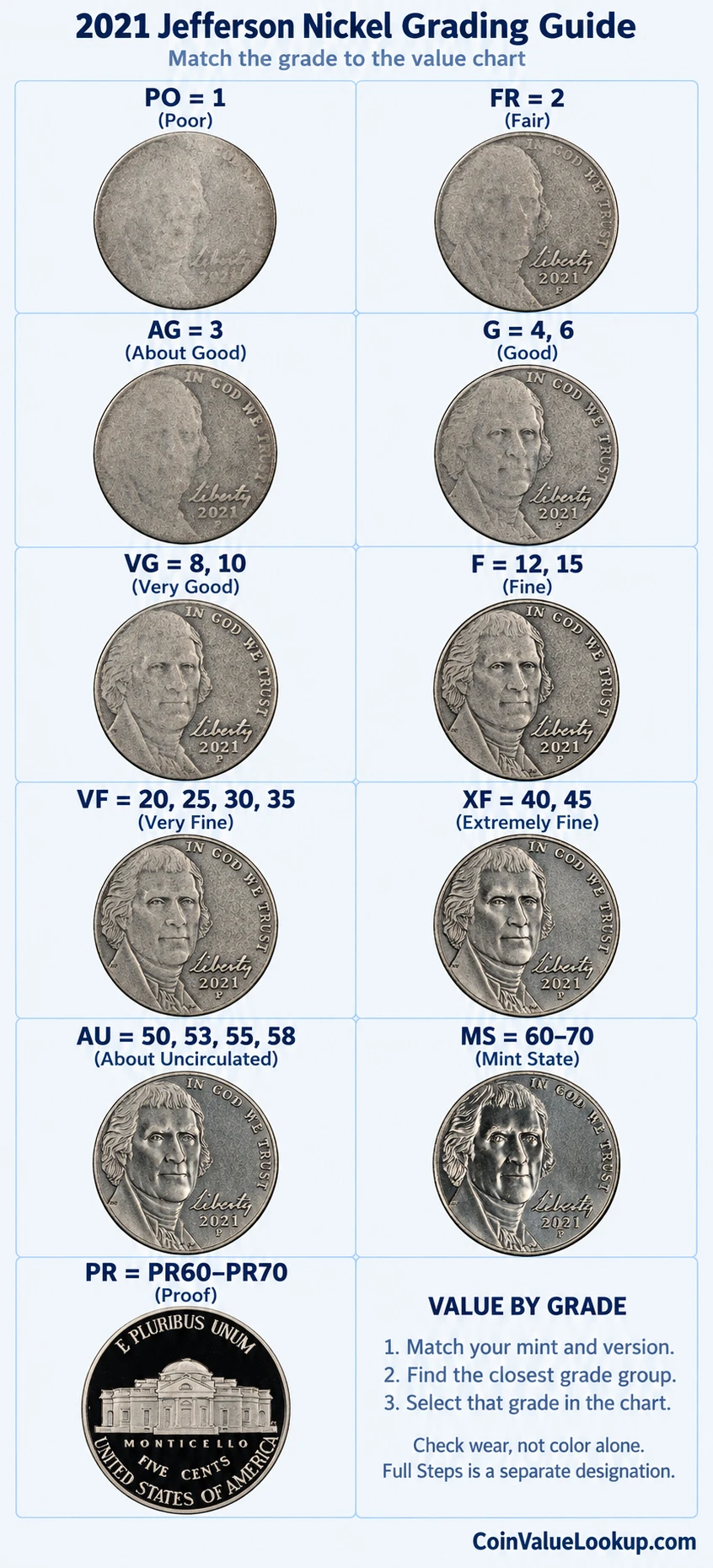
Start with the obverse. Jefferson's cheekbone, the hair detail above his ear, and the shoulder collar are the first places to lose definition as a coin circulates.
A coin with full sharp detail and no wear is a candidate for Mint State grades.
Next, look at luster. An uncirculated nickel should have unbroken cartwheel luster across both sides.
Bag marks and contact scuffs from other coins separate an MS60 from an MS65, even when no actual wear is present. Compare your coin to the reference comparison image to gauge where yours falls.
On the reverse, check the Monticello steps independently. Strike sharpness there does not change the wear grade, but it can affect a Full Steps designation.
A weakly struck coin can still be MS65 if luster and surfaces support it.
Reflective surfaces alone do not prove a coin is a proof. Proofs are graded on a PR scale and come from San Francisco with an S mintmark.
If your coin came from pocket change with a P or D, it is a business strike regardless of how shiny it looks.
Step 3: Check 2021 Jefferson Nickel Value by Mint and Version
2021 Jefferson Nickel — P Business strike
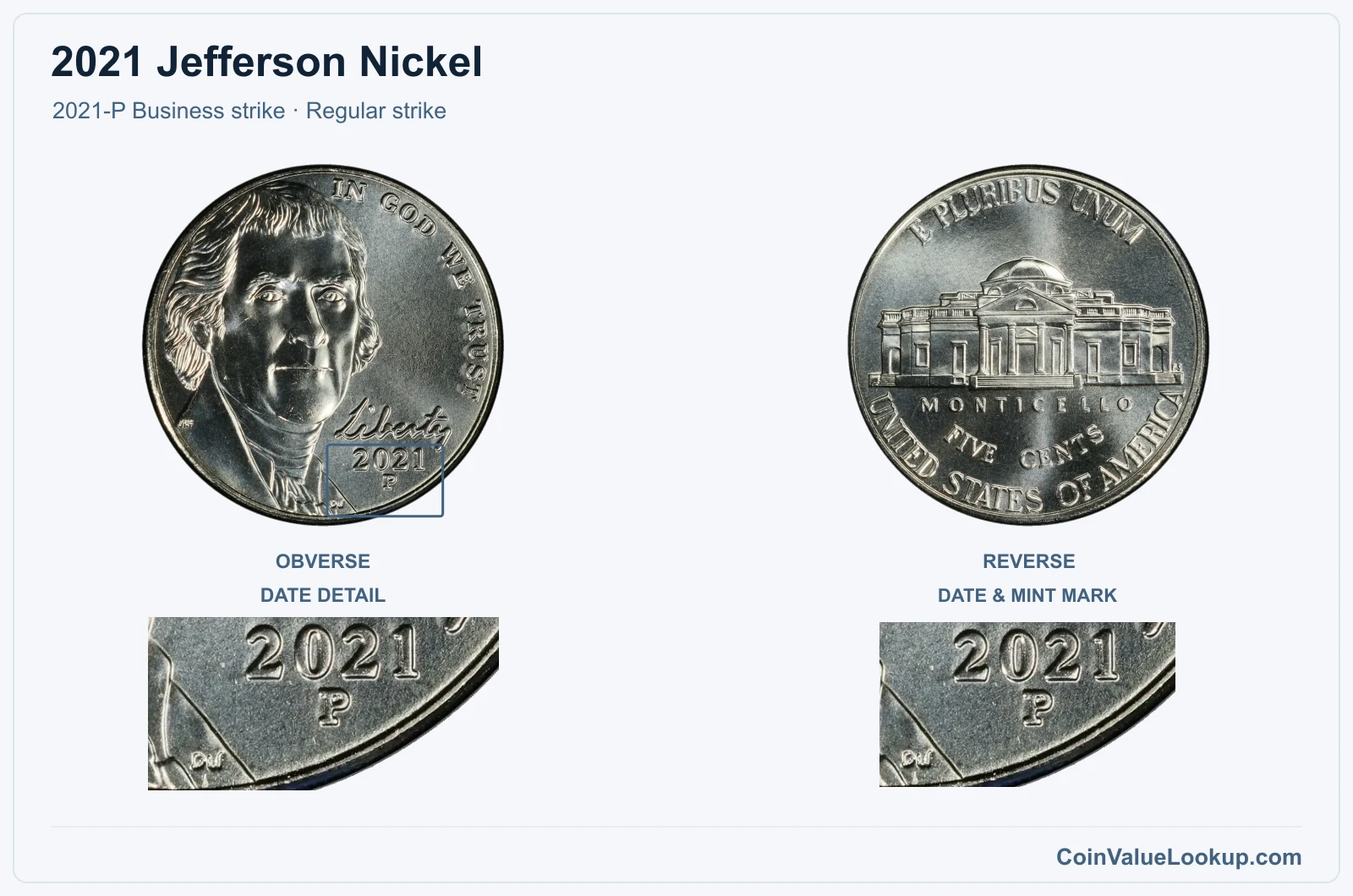
The 2021-P is the Philadelphia business strike, carrying a small "P" mintmark on the obverse below the date. It is composed of 75% copper and 25% nickel at a nominal weight of 5 grams.
Billions of nickels roll out of Philadelphia, so most circulated examples are worth exactly five cents.
In uncirculated condition, USA Coin Book guide estimates place this coin at about $0.30 in MS60 and $0.61 in MS65. Those are guide figures, not guaranteed buy prices.
To reach MS65 a coin needs strong luster and minimal contact marks — not easy when nickels get tossed into bins at the mint.
| Range | Grade | Price | Auction Records | Appraisal |
|---|---|---|---|---|
| PO | PO 1 | — | Coin Identifier | |
| FR | FR 2 | — | Coin Identifier | |
| AG | AG 3 | — | Coin Identifier | |
| G | G 4 | — | Coin Identifier | |
| G 6 | — | Coin Identifier | ||
| VG | VG 8 | — | Coin Identifier | |
| VG 10 | — | Coin Identifier | ||
| F | F 12 | — | Coin Identifier | |
| F 15 | — | Coin Identifier | ||
| VF | VF 20 | — | Coin Identifier | |
| VF 25 | — | Coin Identifier | ||
| VF 30 | — | Coin Identifier | ||
| VF 35 | — | Coin Identifier | ||
| XF | XF 40 | — | Coin Identifier | |
| XF 45 | — | Coin Identifier | ||
| AU | AU 50 | — | Coin Identifier | |
| AU 53 | — | Coin Identifier | ||
| AU 55 | — | Coin Identifier | ||
| AU 58 | — | Coin Identifier | ||
| MS | MS 60 | — | Coin Identifier | |
| MS 61 | — | Coin Identifier | ||
| MS 62 | — | Coin Identifier | ||
| MS 63 | — | Coin Identifier | ||
| MS 64 | — | Coin Identifier | ||
| MS 65 | — | Coin Identifier | ||
| MS 66 | — | Coin Identifier | ||
| MS 67 | — | Coin Identifier | ||
| MS 68 | — | — | — | |
| MS 69 | — | — | — | |
| MS 70 | — | — | — |
2021 Jefferson Nickel — D Business strike
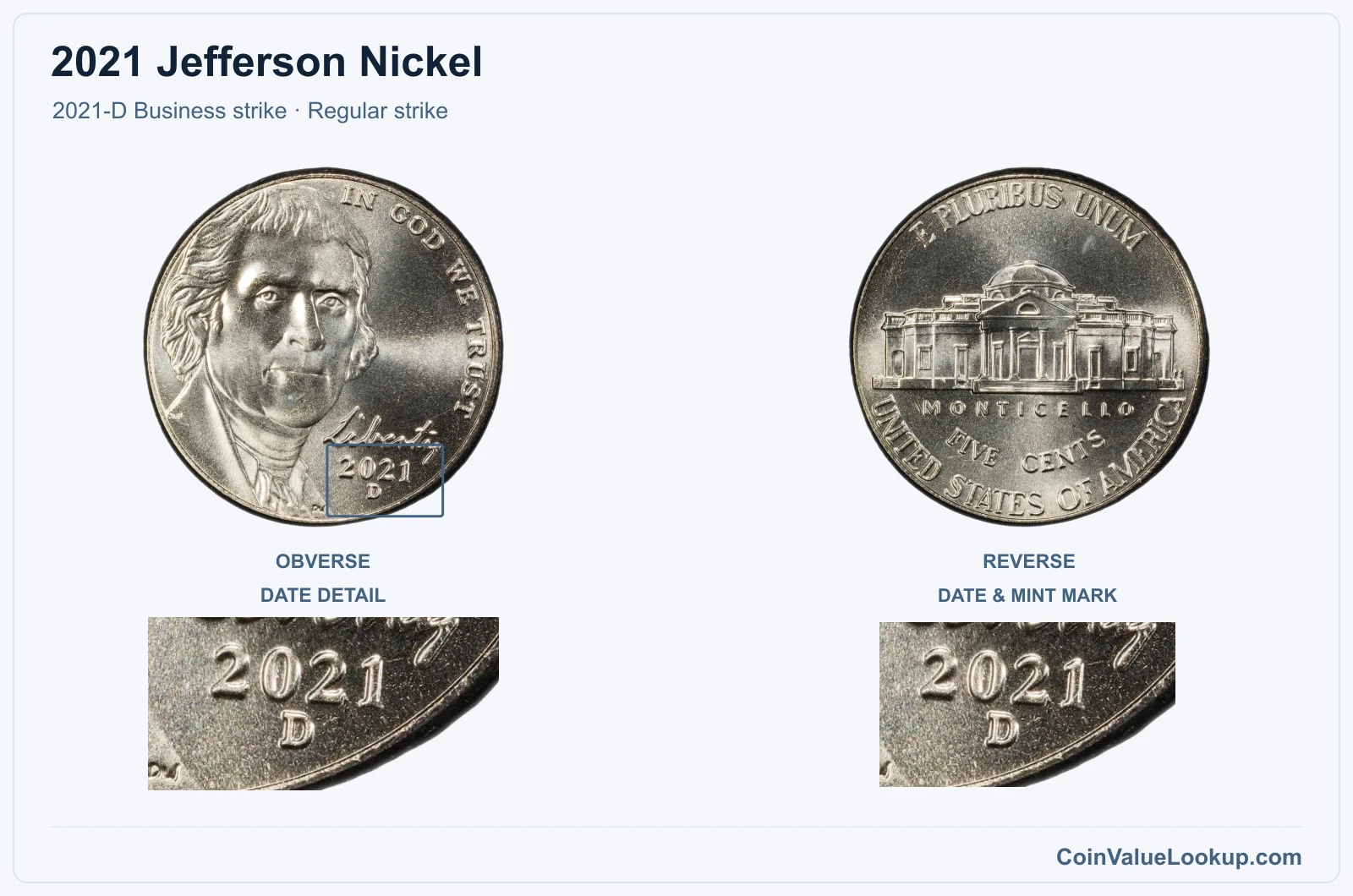
The 2021-D comes from Denver and shows a "D" mintmark on the obverse. Same composition, same weight, same design as the Philadelphia issue.
In practice, the two are interchangeable in most collections unless you are filling album holes.
Guide estimates from USA Coin Book match the P at $0.30 for MS60 and $0.61 for MS65. Circulated pieces are face value.
If you are building a date-and-mint set, pull a nice one from a fresh bank roll rather than hunting through pocket change — your odds of a clean MS65 surface improve dramatically.
Coin Value Lookup is a useful starting point if you want to check values across different years and mints of the Jefferson nickel series.
| Range | Grade | Price | Auction Records | Appraisal |
|---|---|---|---|---|
| PO | PO 1 | — | Coin Identifier | |
| FR | FR 2 | — | Coin Identifier | |
| AG | AG 3 | — | Coin Identifier | |
| G | G 4 | — | Coin Identifier | |
| G 6 | — | Coin Identifier | ||
| VG | VG 8 | — | Coin Identifier | |
| VG 10 | — | Coin Identifier | ||
| F | F 12 | — | Coin Identifier | |
| F 15 | — | Coin Identifier | ||
| VF | VF 20 | — | Coin Identifier | |
| VF 25 | — | Coin Identifier | ||
| VF 30 | — | Coin Identifier | ||
| VF 35 | — | Coin Identifier | ||
| XF | XF 40 | — | Coin Identifier | |
| XF 45 | — | Coin Identifier | ||
| AU | AU 50 | — | Coin Identifier | |
| AU 53 | — | Coin Identifier | ||
| AU 55 | — | Coin Identifier | ||
| AU 58 | — | Coin Identifier | ||
| MS | MS 60 | — | Coin Identifier | |
| MS 61 | — | Coin Identifier | ||
| MS 62 | — | Coin Identifier | ||
| MS 63 | — | Coin Identifier | ||
| MS 64 | — | Coin Identifier | ||
| MS 65 | — | Coin Identifier | ||
| MS 66 | — | Coin Identifier | ||
| MS 67 | — | Coin Identifier | ||
| MS 68 | — | — | — | |
| MS 69 | — | — | — | |
| MS 70 | — | — | — |
2021 Jefferson Nickel — S Proof
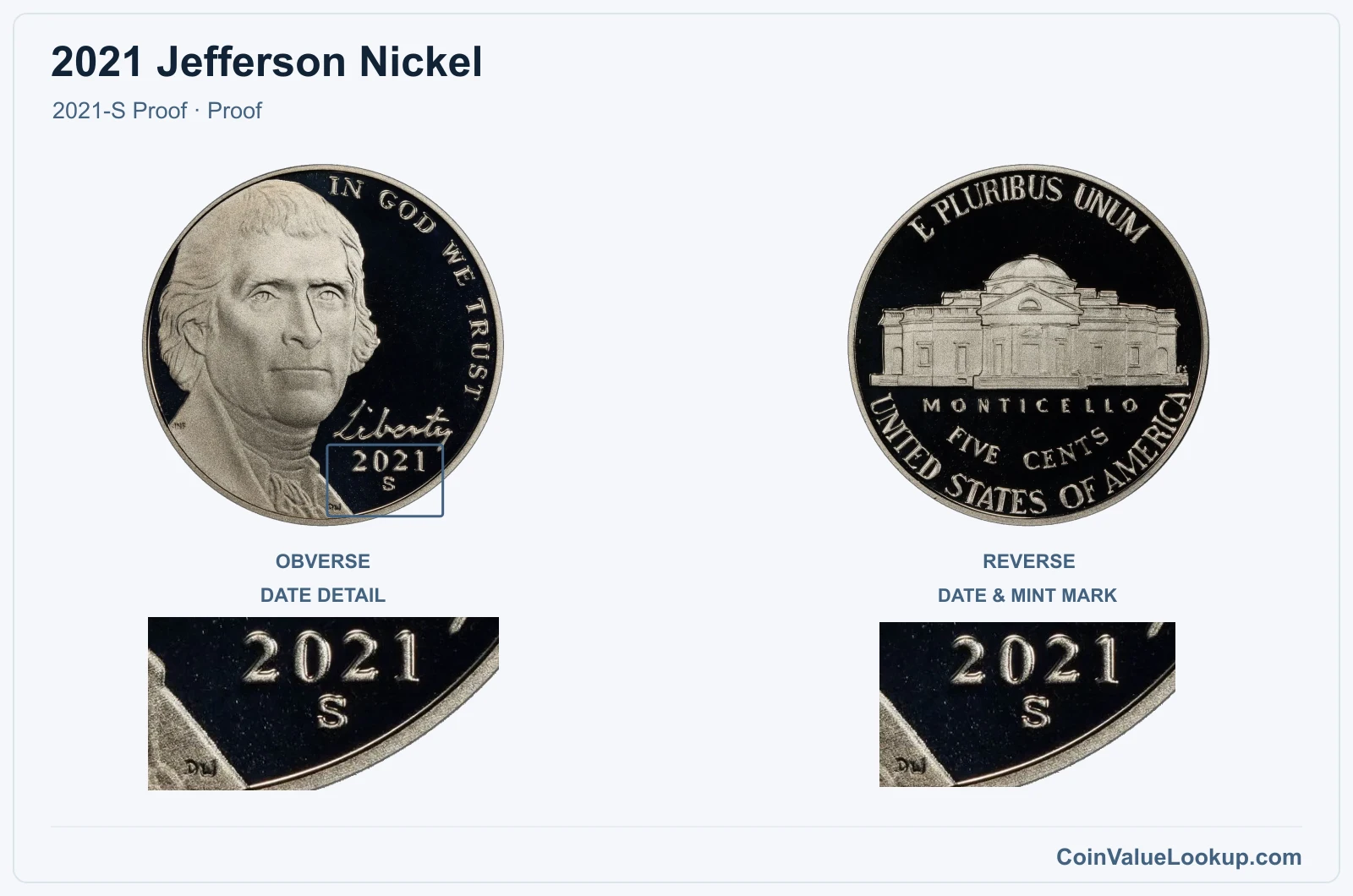
The 2021-S is a proof struck at San Francisco, identifiable by its "S" mintmark. Proofs have mirror-like fields and sharply defined devices because they are struck with specially prepared dies on polished planchets.
These were not released into circulation; they came in collector sets.
USA Coin Book lists a guide estimate of $5.30 at PR65 for this coin. That is modest but reflects the relatively large modern proof mintages.
The same 75% copper, 25% nickel composition applies. Condition still matters — haze, fingerprints or hairlines will drag a proof below PR65 quickly.
Handle by the edges.
| Range | Grade | Price | Auction Records | Appraisal |
|---|---|---|---|---|
| PR | PR 1 | — | Coin Identifier | |
| PR 2 | — | Coin Identifier | ||
| PR 3 | — | Coin Identifier | ||
| PR 4 | — | Coin Identifier | ||
| PR 6 | — | Coin Identifier | ||
| PR 8 | — | Coin Identifier | ||
| PR 10 | — | Coin Identifier | ||
| PR 12 | — | Coin Identifier | ||
| PR 15 | — | Coin Identifier | ||
| PR 20 | — | Coin Identifier | ||
| PR 25 | — | Coin Identifier | ||
| PR 30 | — | Coin Identifier | ||
| PR 35 | — | Coin Identifier | ||
| PR 40 | — | Coin Identifier | ||
| PR 45 | — | Coin Identifier | ||
| PR 50 | — | Coin Identifier | ||
| PR 53 | — | Coin Identifier | ||
| PR 55 | — | Coin Identifier | ||
| PR 58 | — | Coin Identifier | ||
| PR 60 | — | Coin Identifier | ||
| PR 61 | — | Coin Identifier | ||
| PR 62 | — | Coin Identifier | ||
| PR 63 | — | Coin Identifier | ||
| PR 64 | — | Coin Identifier | ||
| PR 65 | — | Coin Identifier | ||
| PR 66 | — | Coin Identifier | ||
| PR 67 | — | Coin Identifier | ||
| PR 68 | — | Coin Identifier | ||
| PR 69 | — | Coin Identifier | ||
| PR 70 | — | Coin Identifier |
2021 Jefferson Nickel Error List
1. 2021 Jefferson Nickel — Doubled die reverse
A doubled-die reverse has been documented on the 2021-P Jefferson nickel with visible duplication in the Monticello doorway area. To check yours, use at least 5x magnification and focus on the upper-left central door frame above the steps.
You are looking for a second, slightly offset set of raised lines that mirrors the primary design.
This is specifically attributed on P-mint examples. Keep the full date and mintmark visible when photographing for attribution purposes.
The main lookalike is machine doubling, which produces flat, shelf-like distortion rather than the raised, separated profiles of a true doubled die. Wear, reflections and post-mint damage can also mimic doubling to the naked eye.
No specific price range is adopted for this variety — value depends on the severity of the doubling, the coin's overall condition and professional attribution.
2. 2021 Jefferson Nickel — Die Crack / Die Chip
Die crack and die chip errors have been reported on 2021 Jefferson nickels. A die crack shows up as a thin raised line on the coin's surface, tracing where the steel die fractured during use.
A die chip appears as a small raised blob where a piece of the die broke away, leaving a void that fills with metal during striking.
An interior chip is different from a rim-connected break, sometimes called a cud. Cuds tend to attract more collector interest because they are larger and more dramatic.
Do not confuse die cracks with incuse scratches, surface corrosion or foreign material stuck to the coin. Cracks are raised, scratches are recessed.
Value depends on the size, location and visibility of the crack or chip, plus the coin's overall condition. No specific price range is adopted here — each piece needs individual evaluation.
3. 2021 Jefferson Nickel — Rotated Dies
Rotated die errors have been reported on 2021 Jefferson nickels. Normal United States coin alignment means the reverse is 180 degrees from the obverse — hold the obverse upright, flip it top to bottom, and the reverse should also be upright.
Any deviation from that alignment is a rotated die error.
Small rotations of a few degrees are relatively common and less desirable. Dramatic rotations — 90 degrees, 180 degrees — attract much more attention.
Before you get excited, make sure you are flipping the coin correctly and not just turning it sideways. A photograph taken at an odd angle can also create a false impression of rotation.
Value varies with the degree of rotation and the coin's condition, so no fixed price range applies. Each example warrants individual assessment.
4. 2021 Jefferson Nickel — Struck-Through Error
Struck-through errors have been reported on 2021 nickels, specifically grease-filled die errors. These happen when foreign material — grease, debris, a thread — sits between the die and the planchet during striking.
The result is a localized depression or incomplete area of design where the obstruction blocked the metal from flowing into the die.
Grease fills tend to produce smooth, slightly sunken patches. A retained foreign object might leave an impression of the object itself.
The two look different and should be described separately.
Do not mistake normal wear, cleaning damage or a weak strike for a struck-through error. Worn coins lose detail uniformly across high points, while a struck-through creates an isolated disruption.
Value depends on the size, location and clarity of the obstruction impression, plus the coin's overall grade. No numerical price range is adopted.
5. 2021 Jefferson Nickel — Improper Annealing
Improperly annealed planchet errors have been reported on 2021 nickels, sometimes appearing as dark or black toning across part or all of the coin's surface. This discoloration is a screening clue, not proof of the cause — the appearance alone does not confirm an annealing defect.
The biggest lookalike problem is environmental toning. Nickels left in damp environments, exposed to chemicals, or subjected to heat after leaving the mint can develop dark surfaces that look similar.
Corrosion and intentional artificial toning also mimic the effect.
To distinguish, check whether the coin's design detail is fully struck and whether the discoloration appears under normal surface texture rather than sitting on top of it. Comparing the edge to a normal example can also help.
Value depends on the severity, the coin's condition and proper attribution. No specific price range is adopted for this category.
6. 2021 Jefferson Nickel — Clashed Dies
Die clash errors have been reported on 2021 Jefferson nickels. A clash occurs when the obverse and reverse dies strike each other without a planchet between them, transferring traces of one design onto the opposing die.
Subsequent coins struck by those damaged dies carry ghost images of the wrong side's design.
Look for faint outlines of Monticello's features on the obverse, or traces of Jefferson's portrait on the reverse, positioned where the opposing design elements would align during normal striking.
Do not confuse a die clash with random scratches, raised lines from die polish, or a brockage error (which involves a previously struck coin, not die-to-die contact). Clash impressions follow a predictable pattern that matches the opposite die's layout.
Value depends on how prominently the transferred design shows and the coin's overall condition. No numerical price range is adopted.