1899 Liberty Nickel Coin Value: How Much Is It Worth?
The 1899 Liberty Nickel is a common Philadelphia issue that most collectors encounter in well-worn condition. A USA Coin Book guide estimate places a circulated example around $2.50 in G4, while an uncirculated MS63 coin sits near $175.
Proofs were struck separately and carry a guide estimate of about $344 in PR63. Condition, surface quality, and any die varieties all factor into what a specific coin is worth.
Fast Way to Identify Your 1899 Liberty Nickel
Want a quick read on your 1899 Liberty Nickel? Upload clear photos of the front and back, and the identifier can offer a preliminary take on which version you have and its approximate condition.
Good lighting and a steady shot of both sides go a long way toward a useful result.
1899 Liberty Nickel Value
Upload both sides of your 1899 Liberty Nickel.
Front Obverse
Upload photo
Back Reverse
Upload photo
Which 1899 Liberty Nickel Versions Are Worth Money?
- Business strikes in MS63 or above carry guide estimates well above circulated examples, around $175 at MS63 per USA Coin Book.
- Proofs were separately manufactured at Philadelphia and carry a guide estimate near $344 in PR63.
- Repunched-date varieties are recognized for 1899 and can attract a premium when clearly visible and properly attributed.
- Error coins such as wrong-planchet strikes or significant off-center pieces are individually valued based on condition and the nature of the error.
Step 1: Identify Your 1899 Liberty Nickel Mint Mark and Version
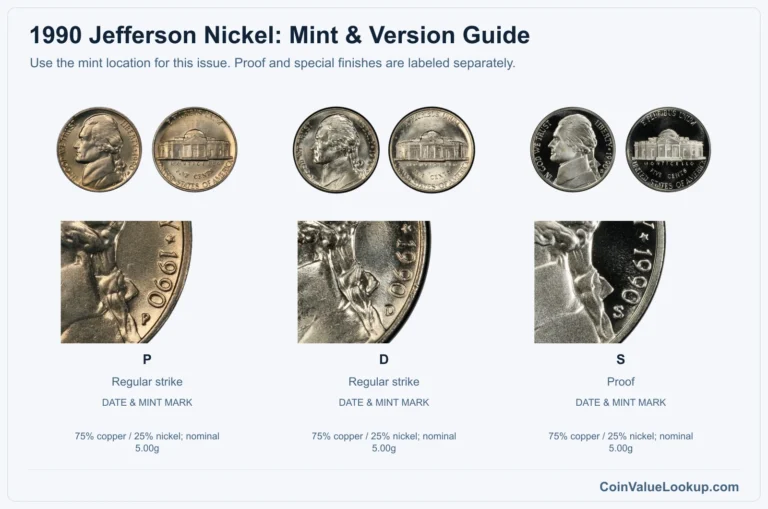
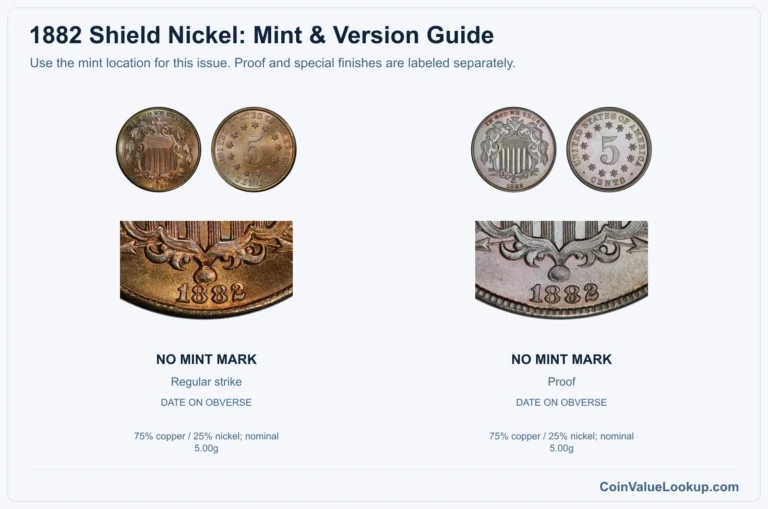
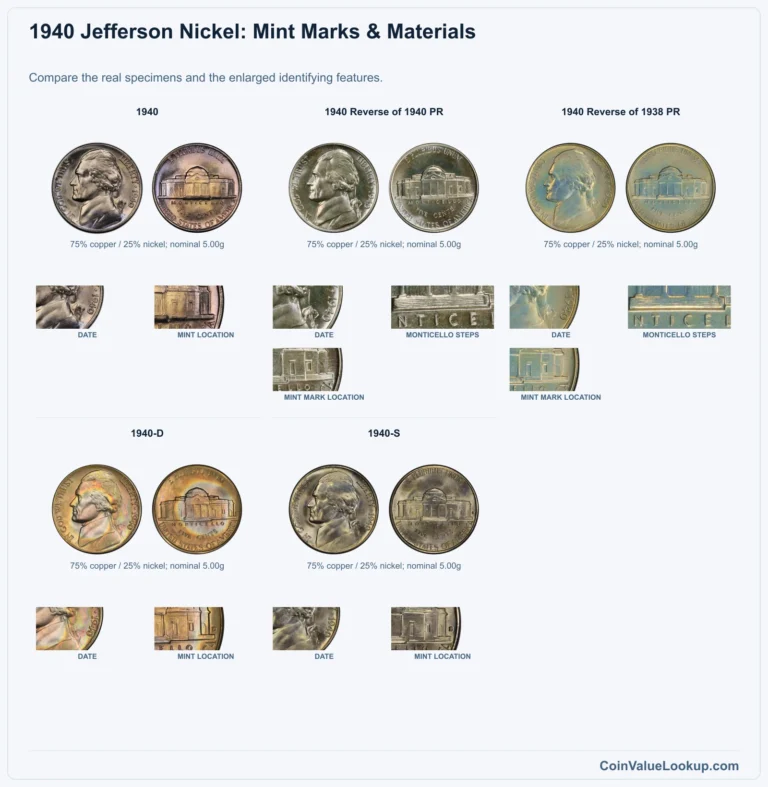
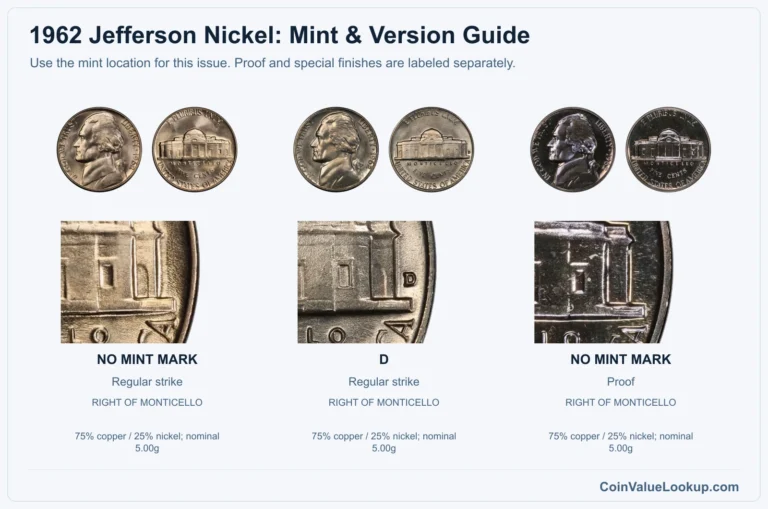
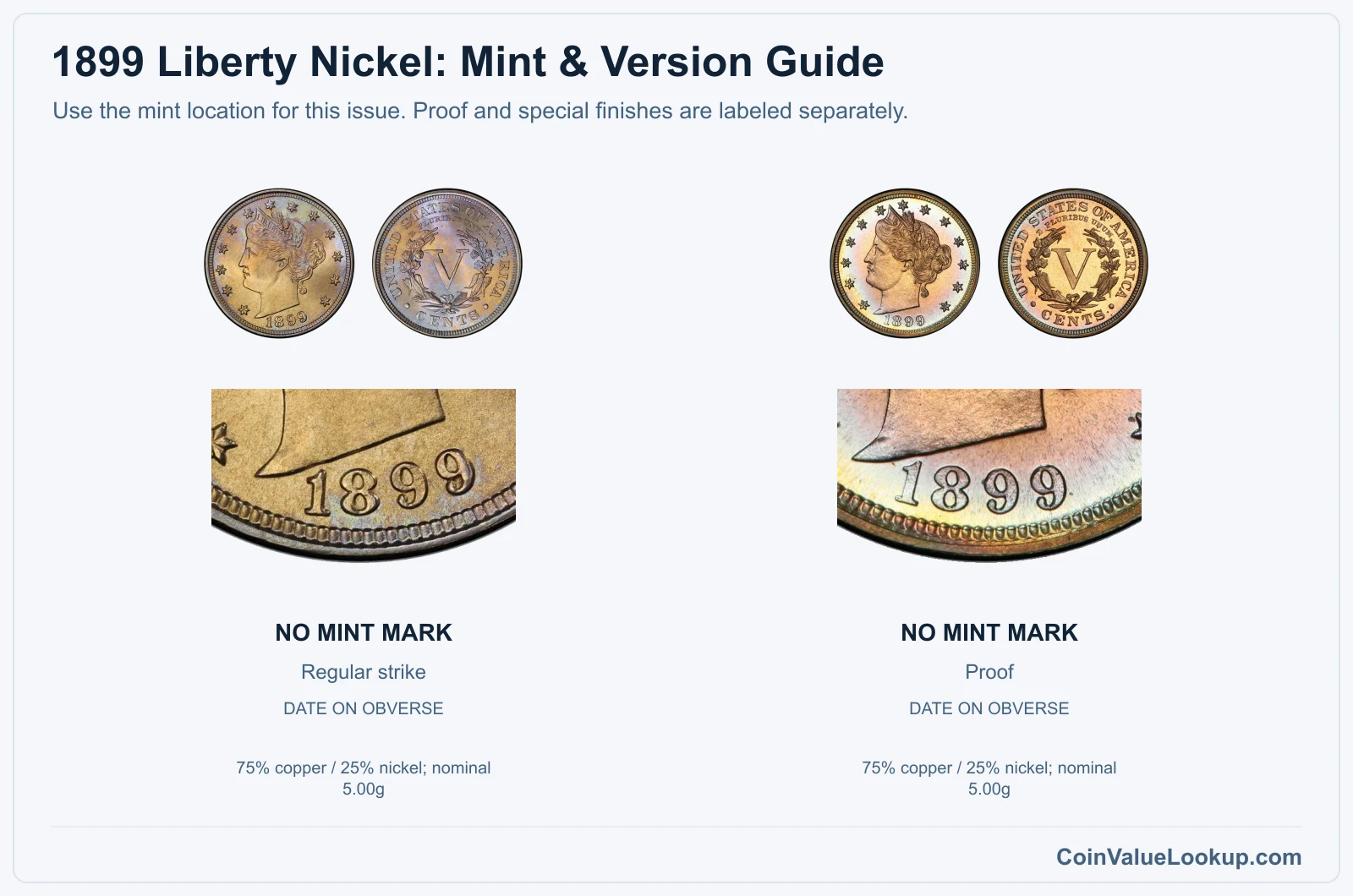
Every 1899 Liberty Nickel was struck at Philadelphia, so there is no mintmark to hunt for. The coin is composed of 75% copper and 25% nickel, weighs about 5 grams, measures 21.2 mm across, and has a plain edge.
There is no silver branch for this date.
All regular 1899 nickels carry the "CENTS" denomination on the reverse, placing them in the With CENTS design type introduced in 1883. If you see a Liberty Nickel without "CENTS" on the back, that is strictly an 1883 variety, not an 1899.
Two manufacturing categories exist: business strikes made for circulation and proofs produced for collectors. Repunched-date varieties are recognized for 1899, but claims of an 1899/8 overdate remain disputed and should not be treated as an established major variety.
Stick with what third-party services have actually attributed when evaluating repunched dates on this issue.
Step 2: Check Your 1899 Liberty Nickel Grade
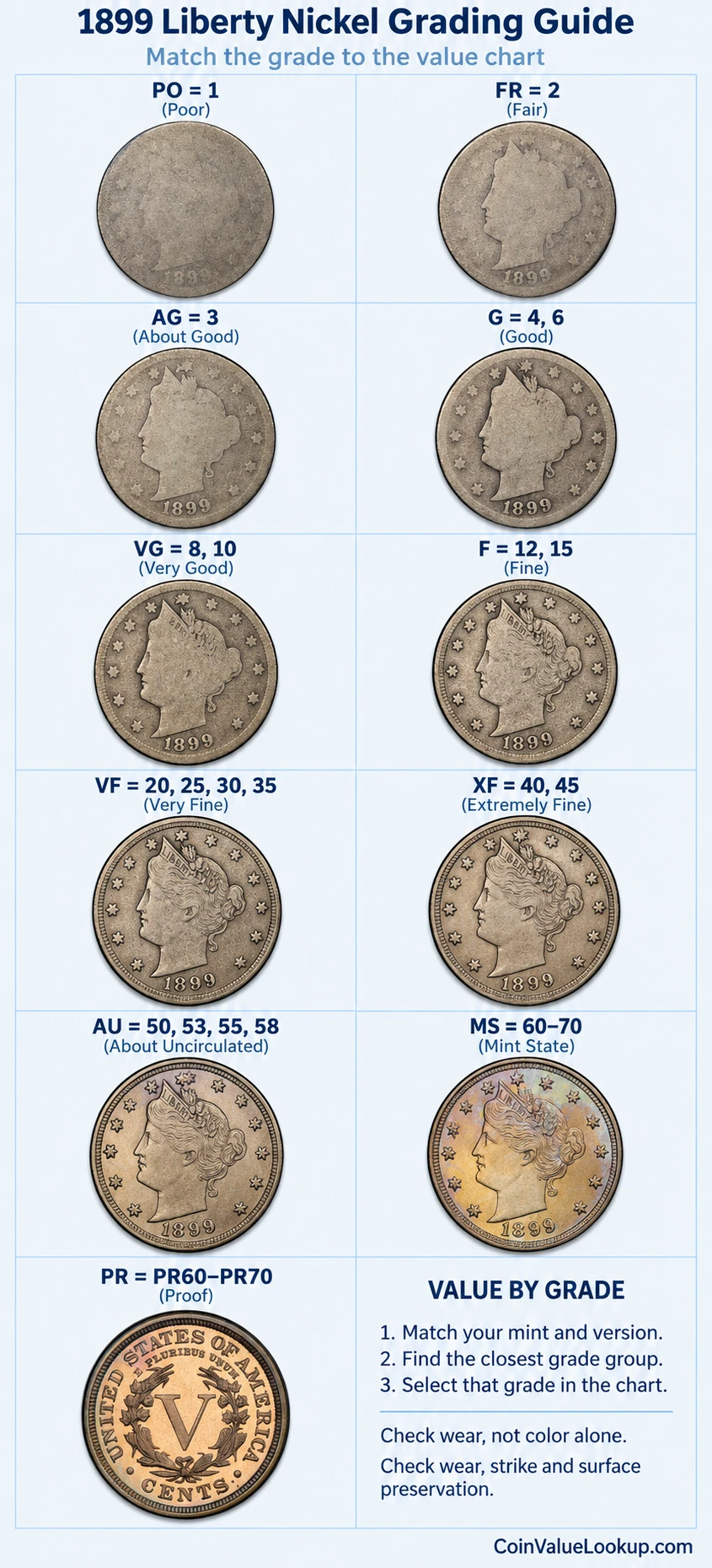
Start on the obverse. The word LIBERTY stamped into the coronet is the classic wear checkpoint: in lower grades the letters merge or vanish, while a sharp LIBERTY with full serifs points to a higher grade.
Check the high hair curls above the ear and the cheek below the eye, both are early contact points.
Flip the coin over. The ears of corn and the wreath leaves lose detail as wear progresses.
Compare your coin against the reference image to see where your example falls on the spectrum.
For uncirculated pieces, luster is king. A coin can have soft hair detail from a weak strike and still be mint state, so look at the fields for cartwheel luster and check for bag marks or contact dings.
Weak details alone do not prove circulation.
Proofs are a manufacturing method, not a grade above Mint State. Genuine proofs show mirrored fields, squared rims, and sharp design edges.
Look carefully for hairlines from cleaning, which reduce a proof's desirability quickly. Always compare against an attributed proof example before assuming you have one.
Coin Value Lookup is a handy starting point if you want to look up guides for other dates in the Liberty Nickel series or different denominations entirely.
Step 3: Check 1899 Liberty Nickel Value by Mint and Version
1899 Liberty Nickel — No Mint Mark — With CENTS Circulation
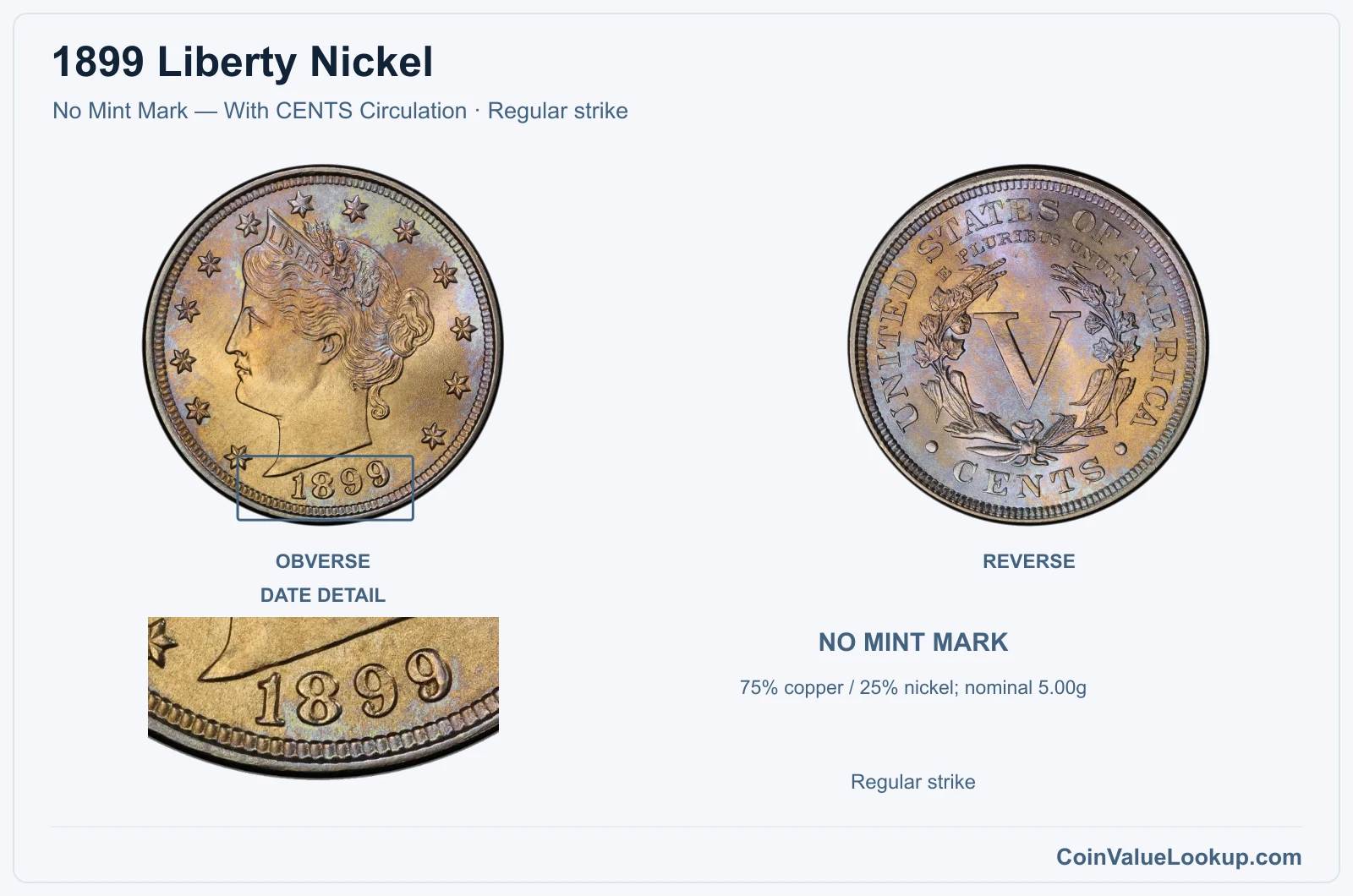
This is the standard 1899 Liberty Nickel struck for everyday commerce at Philadelphia. No mintmark appears on the coin.
The With CENTS reverse design was universal by this date, so every business strike you find will show the denomination on the back.
USA Coin Book places a guide estimate of roughly $2.50 at G4, the low end of collectible grades where LIBERTY is mostly gone. At MS63, that estimate jumps to about $175, reflecting the premium for surviving examples with original mint luster and minimal contact marks.
Repunched-date varieties exist for 1899 and are worth inspecting under magnification, though disputed overdate claims should be treated cautiously.
Range Grade
Price Auction Records Appraisal PO PO 1
—
Coin Identifier FR FR 2
—
Coin Identifier AG AG 3
—
Coin Identifier G G 4
—
Coin Identifier
G 6
—
Coin Identifier VG VG 8
Coin Identifier
VG 10
—
Coin Identifier F F 12
—
Coin Identifier
F 15
—
Coin Identifier VF VF 20
—
Coin Identifier
VF 25
—
Coin Identifier
VF 30
—
Coin Identifier
VF 35
—
Coin Identifier XF XF 40
—
Coin Identifier
XF 45
—
Coin Identifier AU AU 50
—
Coin Identifier
AU 53
—
Coin Identifier
AU 55
Coin Identifier
AU 58
Coin Identifier MS MS 60
Coin Identifier
MS 61
Coin Identifier
MS 62
Coin Identifier
MS 63
Coin Identifier
MS 64
Coin Identifier
MS 65
Coin Identifier
MS 66
Coin Identifier
MS 67
Coin Identifier
MS 68
—
—
—
MS 69
—
—
—
MS 70
—
—
—
1899 Liberty Nickel — No Mint Mark — With CENTS Proof
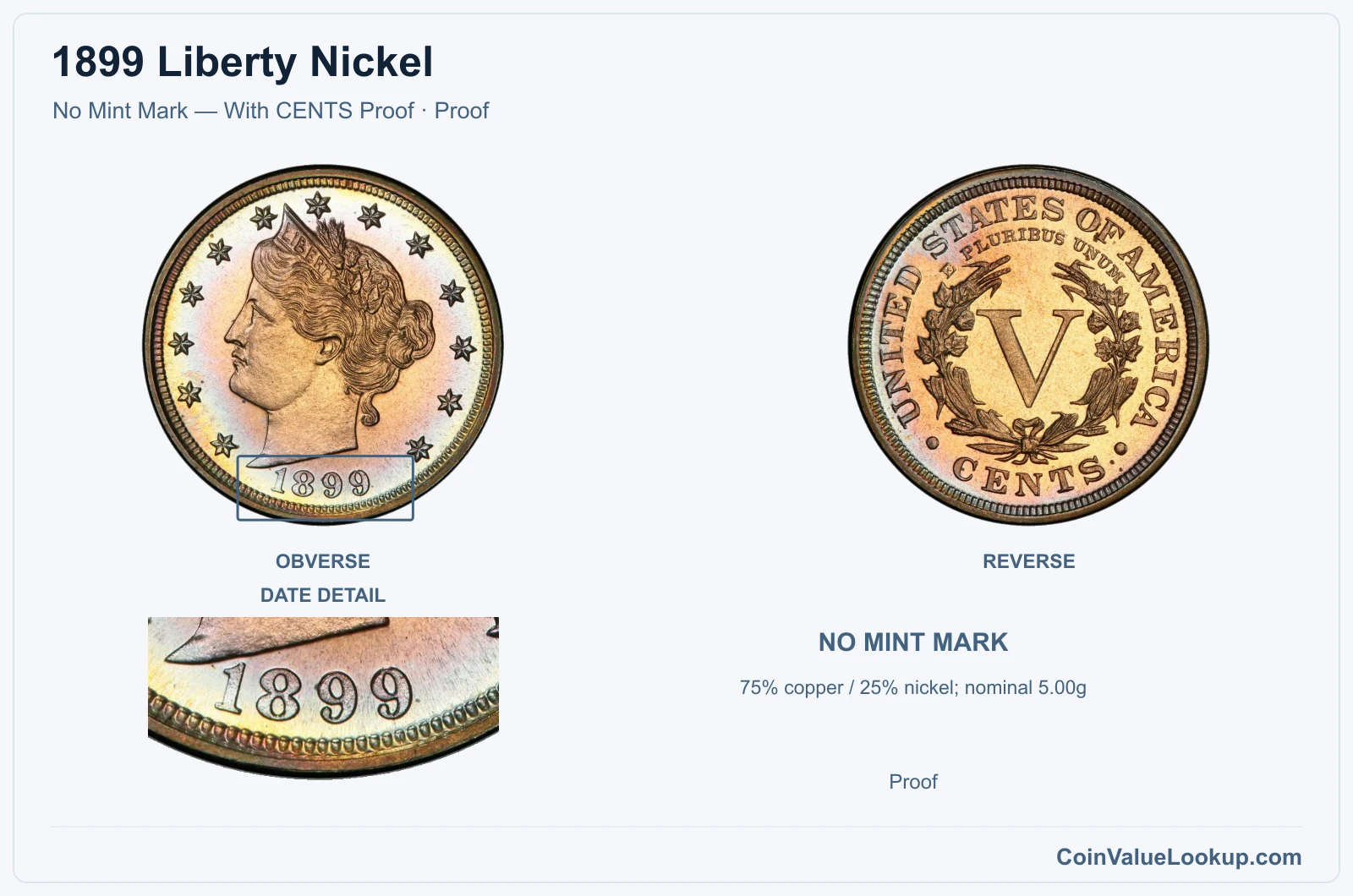
Philadelphia produced proof Liberty Nickels for collectors in 1899 as part of annual proof sets. These coins were struck on polished planchets with specially prepared dies, resulting in mirrored fields and crisp design details that business strikes do not exhibit.
A PR63 example carries a USA Coin Book guide estimate of about $344. When evaluating a suspected proof, examine the fields for a glassy reflective surface and check the rims for a squared, sharp profile.
Hairlines from past cleaning are common on surviving proofs and will lower the effective grade. Show both faces clearly, including the field and rim detail, if you want a preliminary identification.
Repunched-date varieties are recognized on 1899 nickels, but always confirm the manufacturing type before assuming a proof carries any particular die variety.
Range Grade
Price Auction Records Appraisal PR PR 1
—
Coin Identifier
PR 2
—
Coin Identifier
PR 3
—
Coin Identifier
PR 4
—
Coin Identifier
PR 6
—
Coin Identifier
PR 8
—
Coin Identifier
PR 10
—
Coin Identifier
PR 12
—
Coin Identifier
PR 15
—
Coin Identifier
PR 20
—
Coin Identifier
PR 25
—
Coin Identifier
PR 30
—
Coin Identifier
PR 35
—
Coin Identifier
PR 40
—
Coin Identifier
PR 45
—
Coin Identifier
PR 50
—
Coin Identifier
PR 53
—
Coin Identifier
PR 55
—
Coin Identifier
PR 58
—
Coin Identifier
PR 60
Coin Identifier
PR 61
—
Coin Identifier
PR 62
Coin Identifier
PR 63
Coin Identifier
PR 64
Coin Identifier
PR 65
Coin Identifier
PR 66
Coin Identifier
PR 67
Coin Identifier
PR 68
Coin Identifier
PR 69
—
—
—
PR 70
—
—
—
1899 Liberty Nickel Error List
1. 1899 Liberty Nickel — Repunched Date
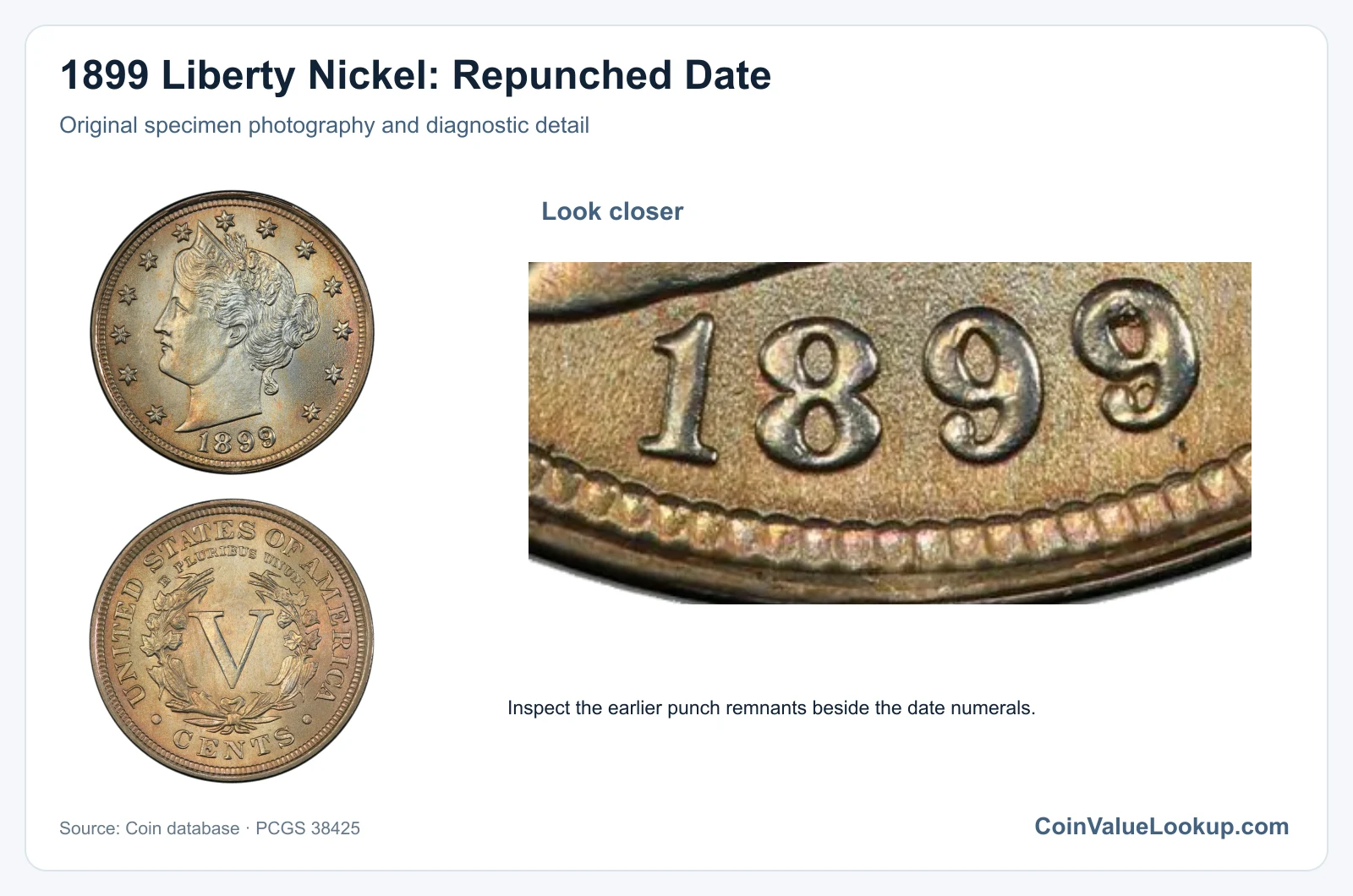
A repunched date occurs when the date punch was impressed into the die more than once in slightly different positions. On an 1899 Liberty Nickel, look for remnants of earlier digit impressions peeking out beside or beneath the final date numerals.
This is a die variety, distinct from doubled die errors that affect the entire design.
Use magnification and angled light to spot the extra punch traces, especially around the 9s. Machine doubling, which produces flat shelf-like distortion, is a common lookalike and carries no premium.
Damage to the date area from contact or corrosion can also mimic a repunched date. Condition and clarity of the repunching affect how collectors value these pieces, so no single price applies across the board.
2. 1899 Liberty Nickel — Wrong Planchet / Off-Metal Strike
A wrong-planchet error means the coin was struck on a blank intended for a different denomination. An 1899 Liberty Nickel struck on a cent planchet has been auction-listed in AU58 condition, confirming this category exists for the date.
The resulting coin will differ noticeably in weight, diameter, or edge character compared to a normal nickel.
To check, weigh the coin and measure its diameter against the standard 5-gram, 21.2 mm specification. A coin on the wrong blank may show an incomplete design because the planchet was too small or too thin to fill the dies fully.
Be cautious: plating, acid-treated surfaces, corrosion, and deliberate thinning can all make a normal nickel look unusual. Value depends on the specific planchet, the completeness of the design, and overall condition.
3. 1899 Liberty Nickel — Off-Center Strike
An off-center strike happens when the planchet is not seated properly between the dies, shifting the design to one side and leaving an unstruck crescent of blank metal. On an 1899 Liberty Nickel, the key question is whether the date remains visible, because dateless off-center coins are far less collectible.
The percentage of off-center displacement matters. A 5% shift is minor; 20% or more with a readable date draws real attention.
Look at the unstruck area: it should show the blank planchet surface, not post-mint damage. Clipped edges, one-sided die misalignment, and coins flattened after leaving the mint can resemble off-center strikes but have different characteristics.
Value depends on the degree of displacement, date visibility, and the coin's preservation.
4. 1899 Liberty Nickel — Die Break / Cud
A cud forms when a section of the die breaks away completely, usually at the rim. The broken area can no longer impress design detail, so the coin shows a raised, featureless lump connected to the rim where the missing die piece was.
Smaller interior die breaks create similar raised areas but do not reach the rim and are classified differently.
On an 1899 Liberty Nickel, inspect the entire rim on both sides for any blob of raised metal that interrupts the normal design and border. A rim dent pushed inward is post-mint damage, not a cud.
Corrosion buildup can also fool the eye. Genuine cuds show displaced design elements on either side of the break zone.
Size and location influence collector interest, and condition of the rest of the coin matters as well.
5. 1899 Liberty Nickel — Die Crack / Die Chip
Die cracks appear as thin raised lines on the coin's surface, created when a crack forms in the steel die and metal fills the gap during striking. Die chips are small raised blobs from localized die damage.
Both are common on heavily used dies.
On an 1899 Liberty Nickel, check both sides under magnification. Raised lines that follow no logical design path are candidates.
A crack running from the rim inward is typical. If the crack is incuse, meaning it sits below the surface, that is a scratch, not a die crack.
Foreign material stuck to the surface or corrosion streaks can also mimic cracks. Distinguish interior chips from rim-connected breaks, as the latter may qualify as cuds.
Value depends on the prominence and placement of the crack and the coin's overall condition.
6. 1899 Liberty Nickel — Lamination / Split Planchet
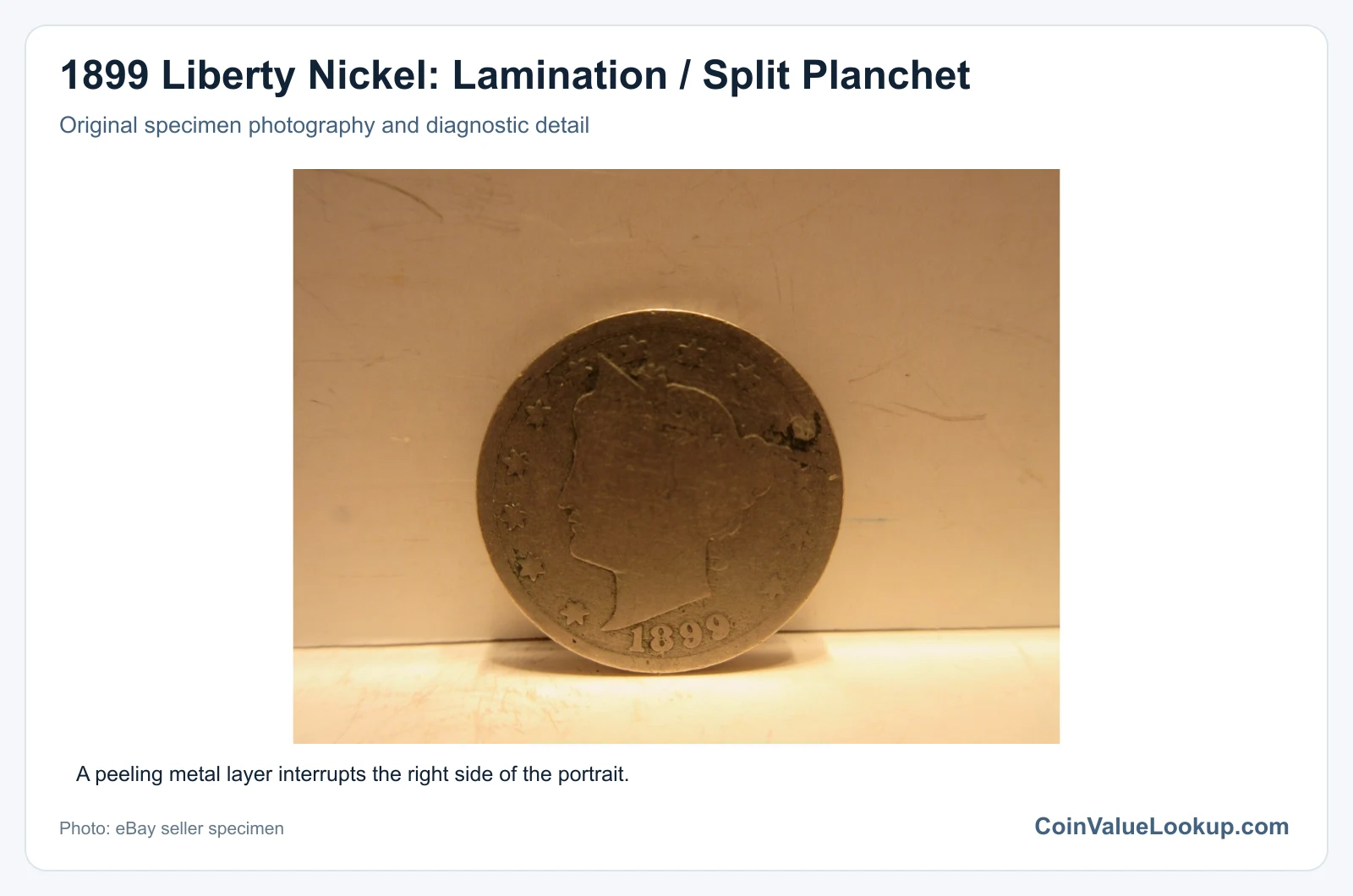
A lamination error results from impurities or gas trapped within the metal strip before the planchet is punched out. On the finished coin it appears as peeling metal, a retained flap, or a visible separation within the alloy.
The affected area may reveal a different texture or color underneath.
To document a lamination on an 1899 Liberty Nickel, photograph the edge and the affected face together so the depth of separation is visible. Post-mint scraping, deliberate cutting, and surface corrosion can look similar but lack the characteristic layered structure.
A genuine lamination follows the contour of the metal's internal structure rather than showing tool marks or sharp cut lines. Value varies with size, location, and how much of the coin's design is affected, alongside overall preservation.
7. 1899 Liberty Nickel — Clipped Planchet
A clipped planchet error occurs when the blank is punched from the metal strip in a position that overlaps an already-punched hole, producing a curved missing section. Straight clips and ragged clips from strip defects also exist.
On an 1899 Liberty Nickel, look for a missing portion of the edge with smooth, unstruck metal at the boundary.
A helpful diagnostic is the Blakesley effect: weakness in the design directly opposite the clip caused by reduced striking pressure. The edge texture at the clip should look like original planchet metal, not a filed or cut surface.
Post-mint damage such as plier marks, deliberate notching, or heavy corrosion can remove metal from the rim and imitate a clip. Value depends on the clip's size, shape, and whether the date and major design elements remain intact.