1901 Liberty Nickel Coin Value: How Much Is It Worth?
A 1901 Liberty Nickel in well-worn G4 condition books at about $2.50 according to USA Coin Book, while an MS63 example jumps to roughly $154. Proofs graded PR63 sit around $344.
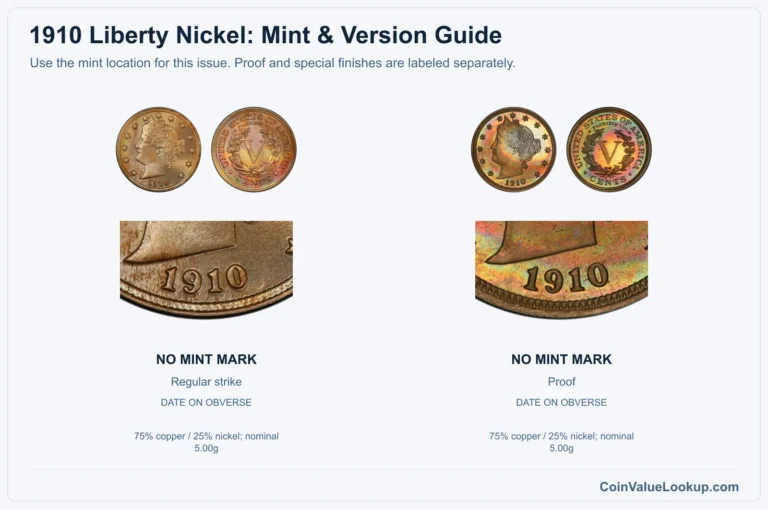
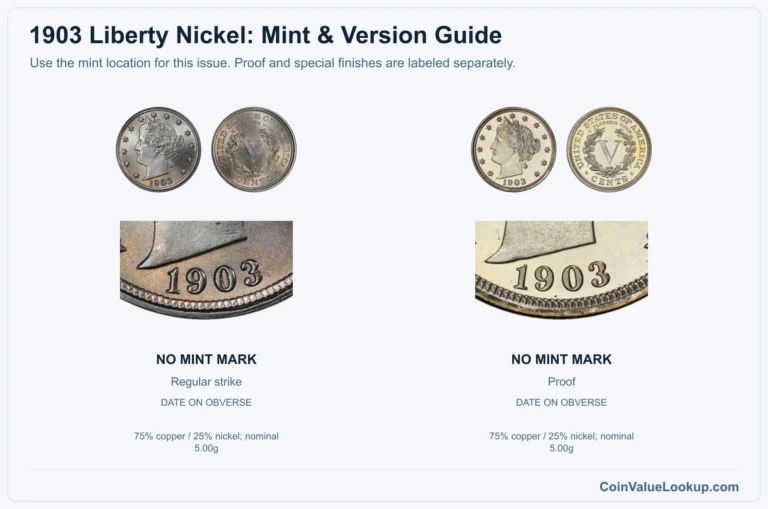
All 1901 nickels were struck at the Philadelphia Mint with no mintmark, so sorting yours comes down to strike type and condition rather than mint location.
Fast Way to Identify Your 1901 Liberty Nickel
Snap clear photos of the front and back of your 1901 Liberty Nickel and upload them here. This gives you a preliminary identification of the coin's version and general condition.
Good lighting and a steady hand help — try to capture the full rim on both sides so the date and reverse details are visible.
1901 Liberty Nickel Value
Upload both sides of your 1901 Liberty Nickel.
Front Obverse
Upload photo
Back Reverse
Upload photo
Which 1901 Liberty Nickel Versions Are Worth Money?
- Two reverse hub types (Type 1 and Type 2) exist for circulation strikes — both retain the CENTS inscription but differ in leaf position and AM letter spacing, so check which one you have.
- Proofs were struck separately at Philadelphia with polished dies; a PR63 example is valued around $344 by USA Coin Book, well above a typical circulated coin.
- High-grade uncirculated examples (MS63 range, roughly $154) carry a substantial premium over worn coins, making original luster and minimal marks worth preserving.
- Reported error categories for this date include repunched dates, laminations, wrong-planchet strikes, and off-center strikes — each worth inspecting for under magnification.
Step 1: Identify Your 1901 Liberty Nickel Mint Mark and Version
Every 1901 Liberty Nickel came from Philadelphia, so there is no mintmark to hunt for. Do not expect a D or S variant for this date.
The coin is 75% copper and 25% nickel, weighs about 5 grams, measures 21.2 mm across, and has a plain edge.
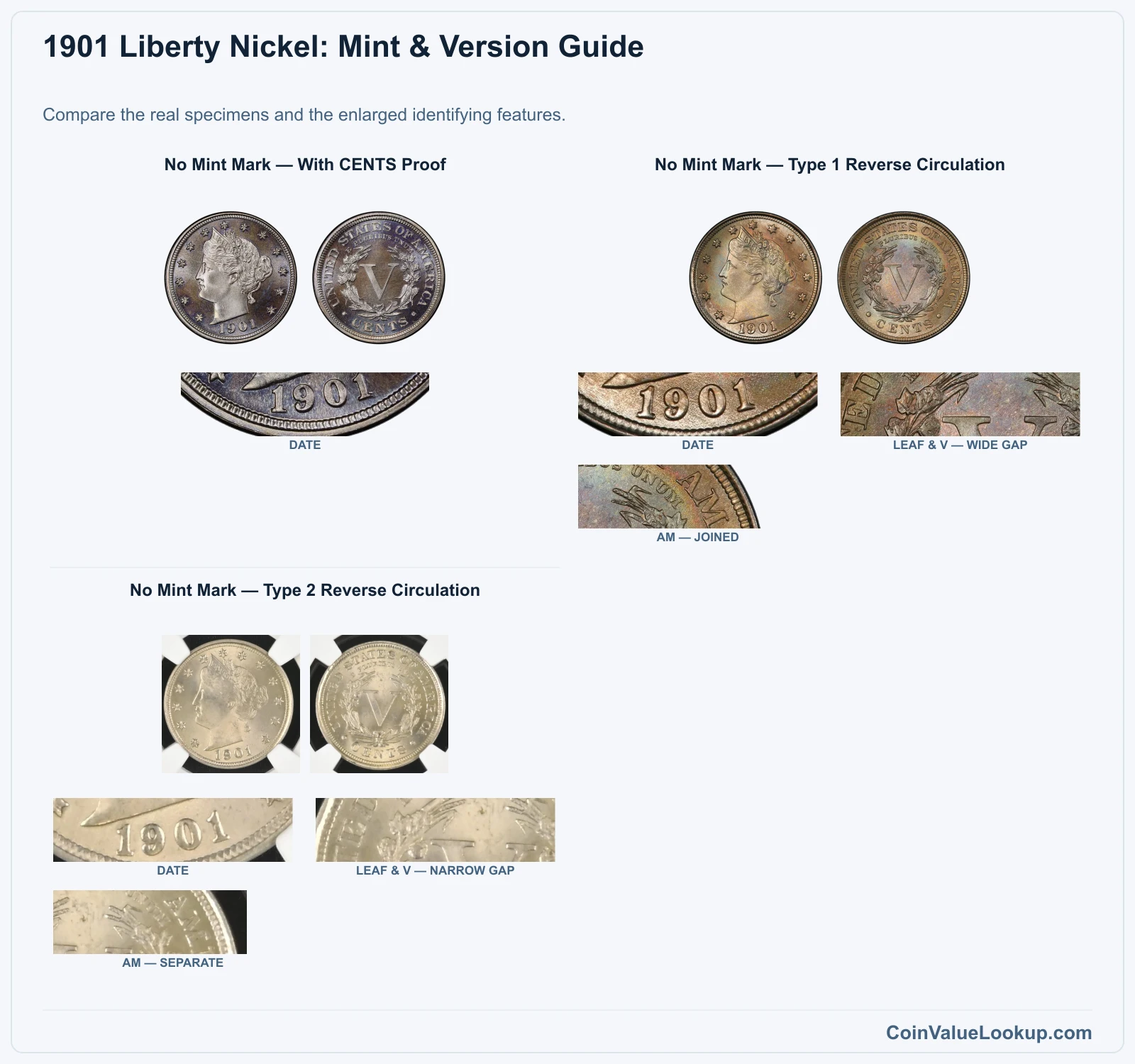
The reverse comes in two intentional hub varieties, called Type 1 and Type 2, both carrying the word CENTS below the Roman numeral V. On a Type 1 reverse, the leaf above the left arm of the V sits noticeably distant from the serif, and the bases of the letters A and M in AMERICA are connected.
On a Type 2 reverse, that leaf-to-serif gap and the AM spacing differ. Comparing your coin side by side with an attributed example of each type is the most reliable way to tell them apart.
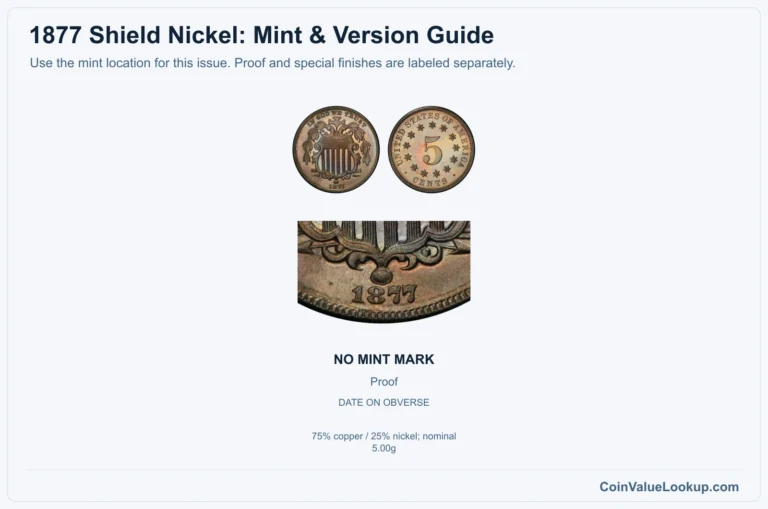
Proofs are a separate manufacturing category, not a higher grade than Mint State. They were made with polished dies and specially prepared planchets, so the fields look mirror-like rather than frosty.
If your coin has deeply reflective surfaces and sharp rims, it may be a proof — but confirmation from an attributed example or professional service is wise before assuming.
Step 2: Check Your 1901 Liberty Nickel Grade
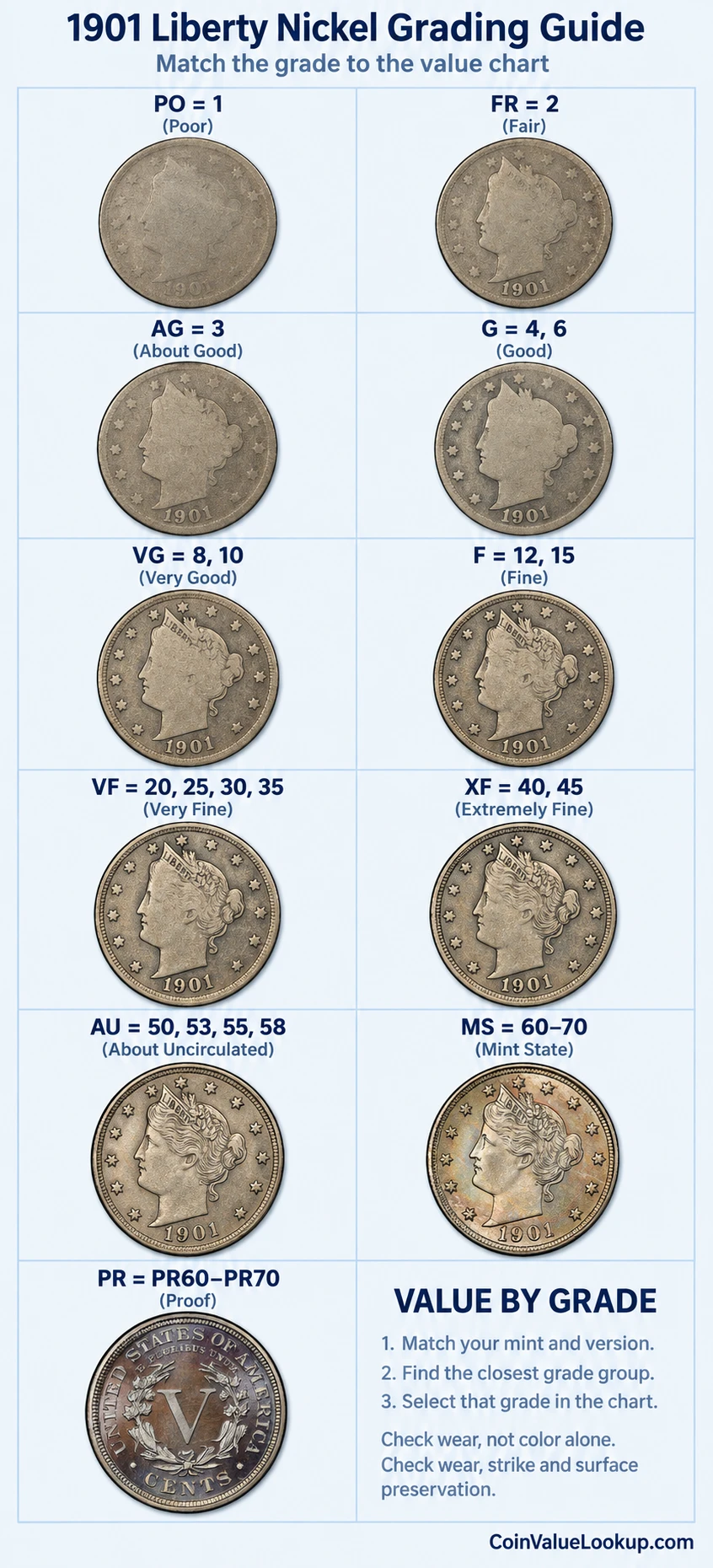
Start on the obverse. The word LIBERTY stamped across the coronet is usually the first detail to soften with wear.
In lower grades the letters merge into the headband; by About Good only a ghost remains. Check the high points of the hair curls above the forehead and the smoothness of the cheek — these lose definition before the lower-relief areas do.
Flip the coin over and examine the ears of corn flanking the wreath. Flat or mushy kernels suggest honest circulation wear, but weak strike can mimic the same look on a coin that never left the Mint.
If the surrounding fields still show luster and only isolated high spots are soft, suspect a strike issue rather than wear.
For Mint State coins, focus on luster continuity, the severity of contact marks (bag marks from storage), and overall sharpness. Use the comparison image to benchmark your coin against known grade points.
A proof should show mirror fields; hairlines from cleaning or mishandling will lower a proof's grade significantly even if the design detail is fully intact.
Step 3: Check 1901 Liberty Nickel Value by Mint and Version
1901 Liberty Nickel — No Mint Mark — With CENTS Proof
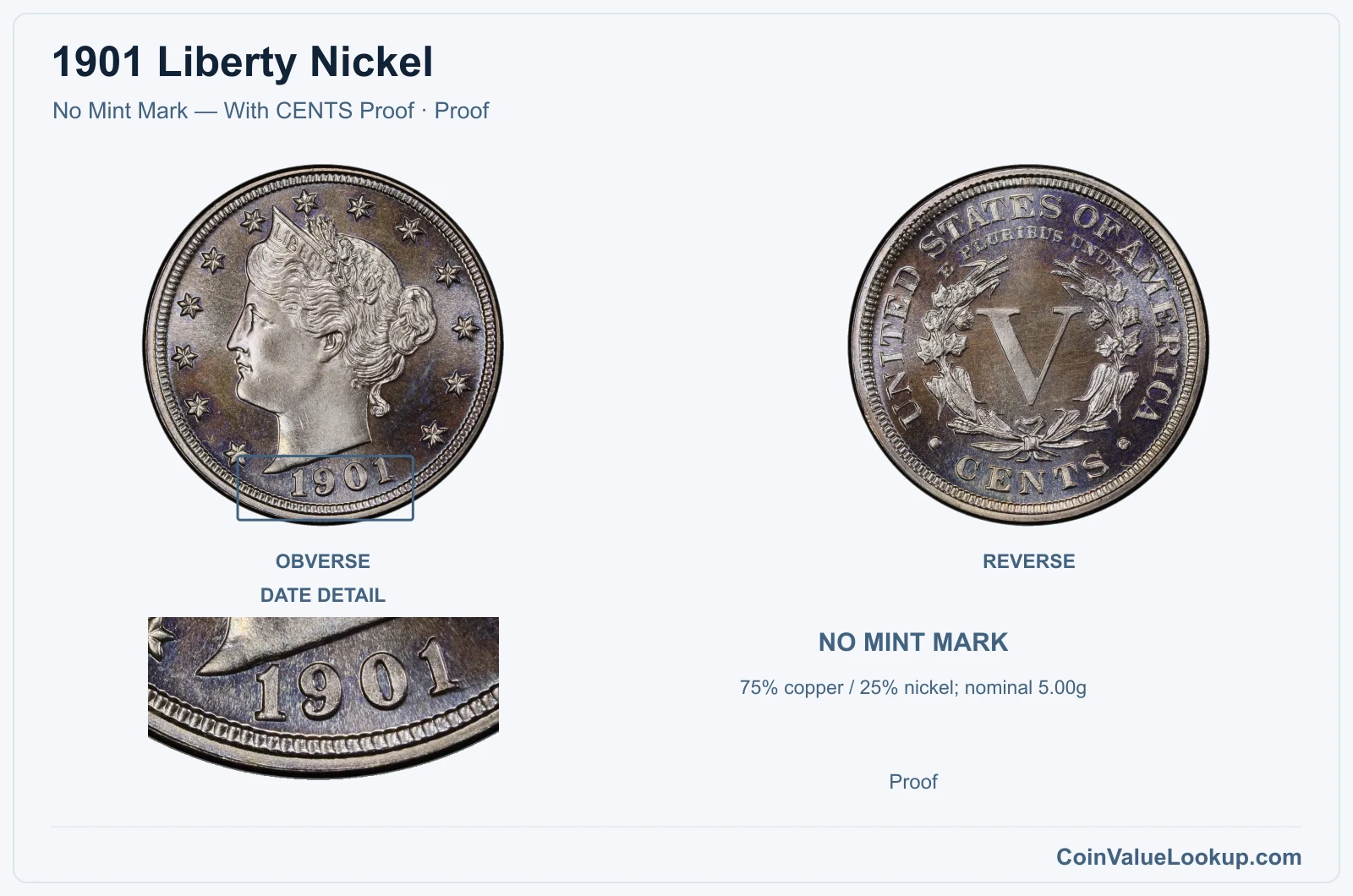
The 1901 proof Liberty Nickel was produced at Philadelphia using polished dies on prepared planchets, giving the fields a mirror-like finish distinct from the satiny or frosty look of business strikes. A USA Coin Book guide estimate places PR63 examples at about $344.
To identify a proof, examine the fields under angled light. Genuine proofs show deep reflectivity and razor-sharp rim details.
Hairlines from improper cleaning or storage will lower the effective grade even when every design element remains crisp. Photograph both faces and the rim detail if you are seeking identification of proof characteristics.
Range Grade
Price Auction Records Appraisal PR PR 1
—
Coin Identifier
PR 2
—
Coin Identifier
PR 3
—
Coin Identifier
PR 4
—
Coin Identifier
PR 6
—
Coin Identifier
PR 8
—
Coin Identifier
PR 10
—
Coin Identifier
PR 12
—
Coin Identifier
PR 15
—
Coin Identifier
PR 20
—
Coin Identifier
PR 25
—
Coin Identifier
PR 30
—
Coin Identifier
PR 35
—
Coin Identifier
PR 40
—
Coin Identifier
PR 45
—
Coin Identifier
PR 50
—
Coin Identifier
PR 53
—
Coin Identifier
PR 55
—
Coin Identifier
PR 58
Coin Identifier
PR 60
Coin Identifier
PR 61
Coin Identifier
PR 62
Coin Identifier
PR 63
Coin Identifier
PR 64
Coin Identifier
PR 65
Coin Identifier
PR 66
Coin Identifier
PR 67
Coin Identifier
PR 68
Coin Identifier
PR 69
—
—
—
PR 70
—
—
—
1901 Liberty Nickel — No Mint Mark — Type 1 Reverse Circulation
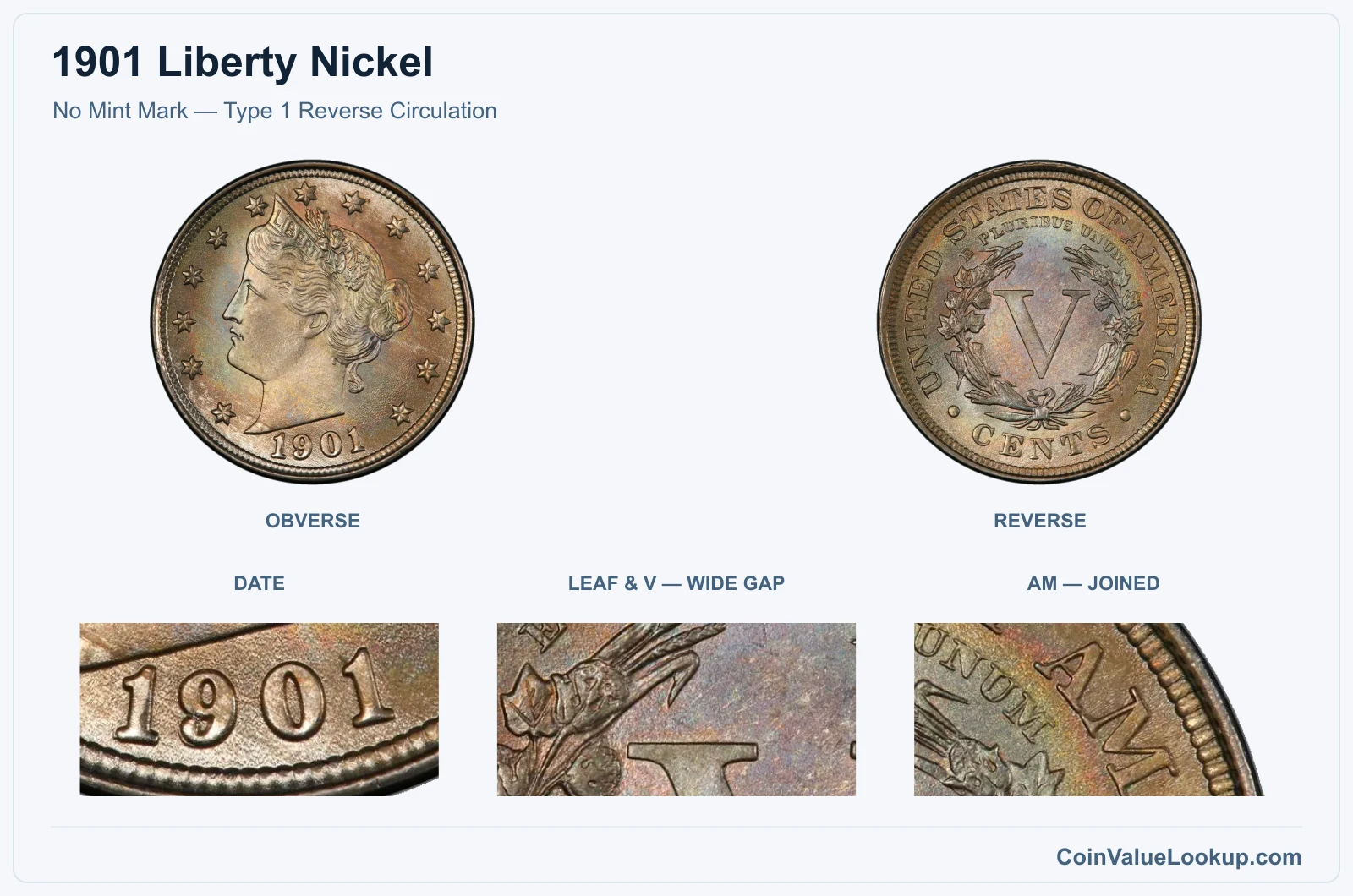
The Type 1 reverse is one of two intentional hub designs used on 1901 business-strike Liberty Nickels. Its diagnostic: the leaf above the left arm of the large V sits well away from the serif, and the bases of A and M in AMERICA are connected.
General year guide estimates from USA Coin Book place a 1901 nickel at about $2.50 in G4 and around $154 in MS63, but those figures are not broken out by reverse type. Exact subtype pricing is unavailable, so the distinction matters more for attribution completeness than for a confirmed price difference at this time.
Coin Value Lookup is a handy starting point if you want to look up guide values for other dates and denominations in the Liberty Nickel series.
Range Grade
Price Auction Records Appraisal PO PO 1
—
Coin Identifier FR FR 2
—
Coin Identifier AG AG 3
—
Coin Identifier G G 4
Coin Identifier
G 6
—
Coin Identifier VG VG 8
—
Coin Identifier
VG 10
—
Coin Identifier F F 12
—
Coin Identifier
F 15
—
Coin Identifier VF VF 20
—
Coin Identifier
VF 25
—
Coin Identifier
VF 30
—
Coin Identifier
VF 35
—
Coin Identifier XF XF 40
—
Coin Identifier
XF 45
—
Coin Identifier AU AU 50
—
Coin Identifier
AU 53
Coin Identifier
AU 55
—
Coin Identifier
AU 58
Coin Identifier MS MS 60
Coin Identifier
MS 61
Coin Identifier
MS 62
Coin Identifier
MS 63
Coin Identifier
MS 64
Coin Identifier
MS 65
Coin Identifier
MS 66
Coin Identifier
MS 67
Coin Identifier
MS 68
—
—
—
MS 69
—
—
—
MS 70
—
—
—
1901 Liberty Nickel — No Mint Mark — Type 2 Reverse Circulation
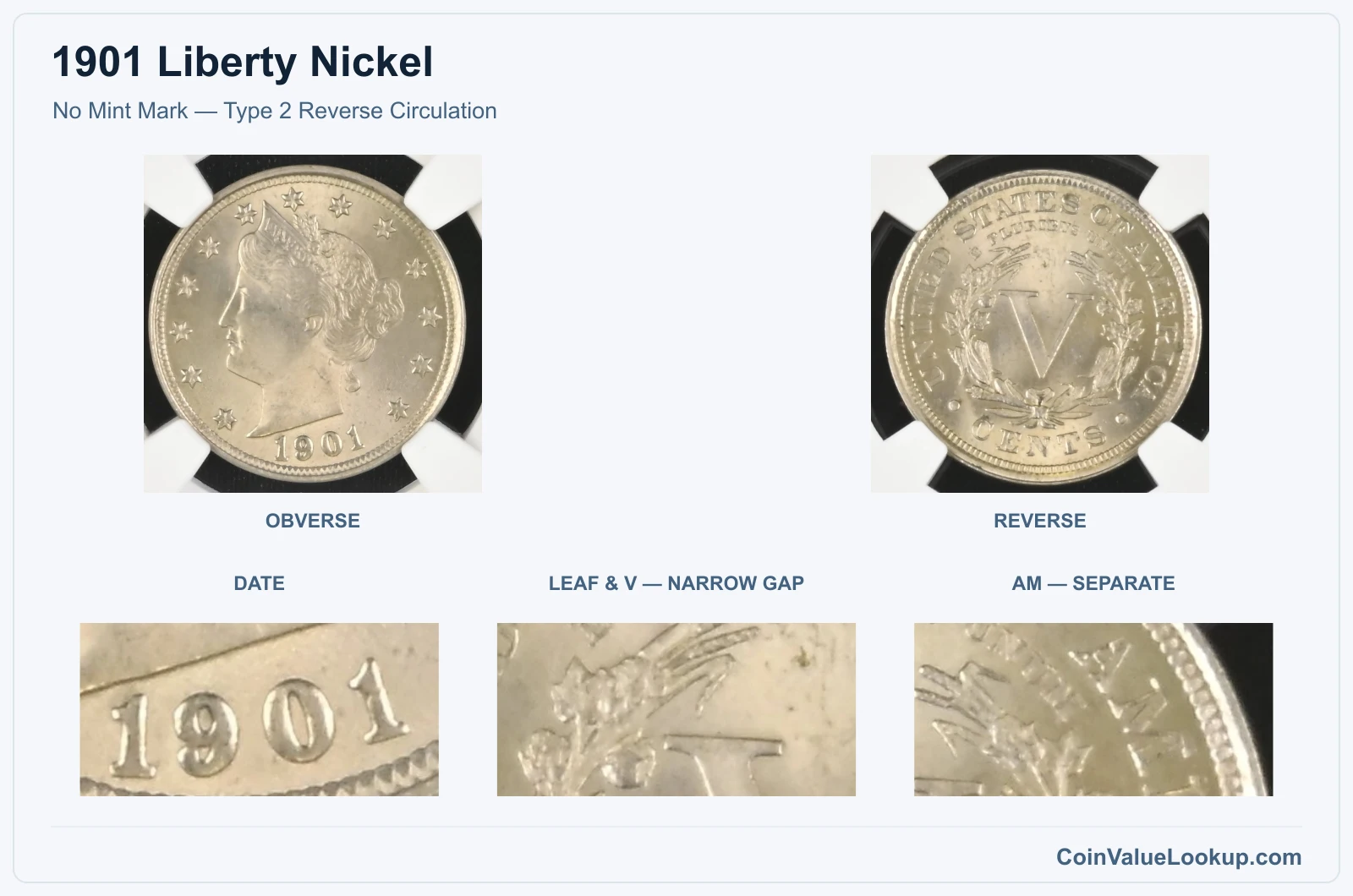
The Type 2 reverse is the companion hub variety. To distinguish it from Type 1, place an attributed Type 2 example beside your coin and compare the position of the leaf relative to the V's left serif, along with the spacing between the bases of A and M in AMERICA.
Both types still carry the CENTS inscription — this is not a No CENTS vs. With CENTS situation.
As with the Type 1, the USA Coin Book year-level anchors of roughly $2.50 in G4 and $154 in MS63 apply, but no separate subtype premium is established in available guide data. Identifying which hub your coin carries is a useful attribution exercise, though it does not currently translate into a documented price split.
Range Grade
Price Auction Records Appraisal PO PO 1
—
Coin Identifier FR FR 2
—
Coin Identifier AG AG 3
—
Coin Identifier G G 4
Coin Identifier
G 6
—
Coin Identifier VG VG 8
—
Coin Identifier
VG 10
—
Coin Identifier F F 12
—
Coin Identifier
F 15
—
Coin Identifier VF VF 20
—
Coin Identifier
VF 25
—
Coin Identifier
VF 30
—
Coin Identifier
VF 35
—
Coin Identifier XF XF 40
—
Coin Identifier
XF 45
—
Coin Identifier AU AU 50
—
Coin Identifier
AU 53
Coin Identifier
AU 55
—
Coin Identifier
AU 58
Coin Identifier MS MS 60
Coin Identifier
MS 61
Coin Identifier
MS 62
Coin Identifier
MS 63
Coin Identifier
MS 64
Coin Identifier
MS 65
Coin Identifier
MS 66
Coin Identifier
MS 67
Coin Identifier
MS 68
—
—
—
MS 69
—
—
—
MS 70
—
—
—
1901 Liberty Nickel Error List
1. 1901 Liberty Nickel — Repunched Date
A repunched date on a 1901 Liberty Nickel shows traces of an earlier position of one or more date numerals alongside the final, accepted placement. Under magnification you may see a faint shadow or partial second impression near the 1, 9, 0, or 1 — most visible where the punches overlap.
This variety results from the date punch being applied more than once to the working die, each tap slightly offset. It is a die variety, not a struck-coin doubling of the entire design.
Machine doubling, which produces flat shelf-like distortion, looks different: repunched dates show rounded, raised remnants of the extra impression.
Damage to the date area from contact or corrosion can also mimic a repunch. Condition, the clarity of the extra impression, and the specific digit involved all affect how collectors value a repunched date, so no single price figure applies across the board.
2. 1901 Liberty Nickel — Lamination / Split Planchet
Lamination errors on a 1901 Liberty Nickel appear as peeling, flaking, or splitting within the metal itself. You might see a thin flap of alloy lifting away from the surface, or a visible crack where the planchet has begun to separate into layers.
The flaw originates from impurities or gas trapped in the strip before the blank was punched.
Photograph the edge of the coin alongside the affected face — edge shots often reveal the split most clearly. A lamination can range from a tiny surface flake to a dramatic retained piece hanging by a thread.
Do not confuse lamination with post-mint scraping, corrosion pitting, or a coin that has been deliberately cut or peeled. Genuine laminations follow the contour of the metal's internal structure.
The value of a lamination error depends on its size, visibility, and the coin's overall condition; no standard price range is established for this date.
3. 1901 Liberty Nickel — Wrong Planchet / Off-Metal Strike
A wrong-planchet 1901 Liberty Nickel was reportedly struck on a cent planchet instead of the correct nickel blank. Because a cent planchet differs in weight, diameter, and possibly color, the resulting coin looks immediately off — the design may be incomplete around the edges, and the piece will feel lighter in hand.
To check, weigh and measure your coin carefully. A normal 1901 nickel is about 5 grams and 21.2 mm across.
A cent planchet of that era would diverge noticeably from both numbers. The edge profile and metal tone under natural light also differ.
Beware of plated coins, acid-treated surfaces, or deliberate alterations that can change a coin's color and apparent weight. Professional attribution is strongly recommended for any suspected wrong-planchet strike.
Value depends on the specific planchet, the completeness of the design, and overall condition.
4. 1901 Liberty Nickel — Off-Center Strike
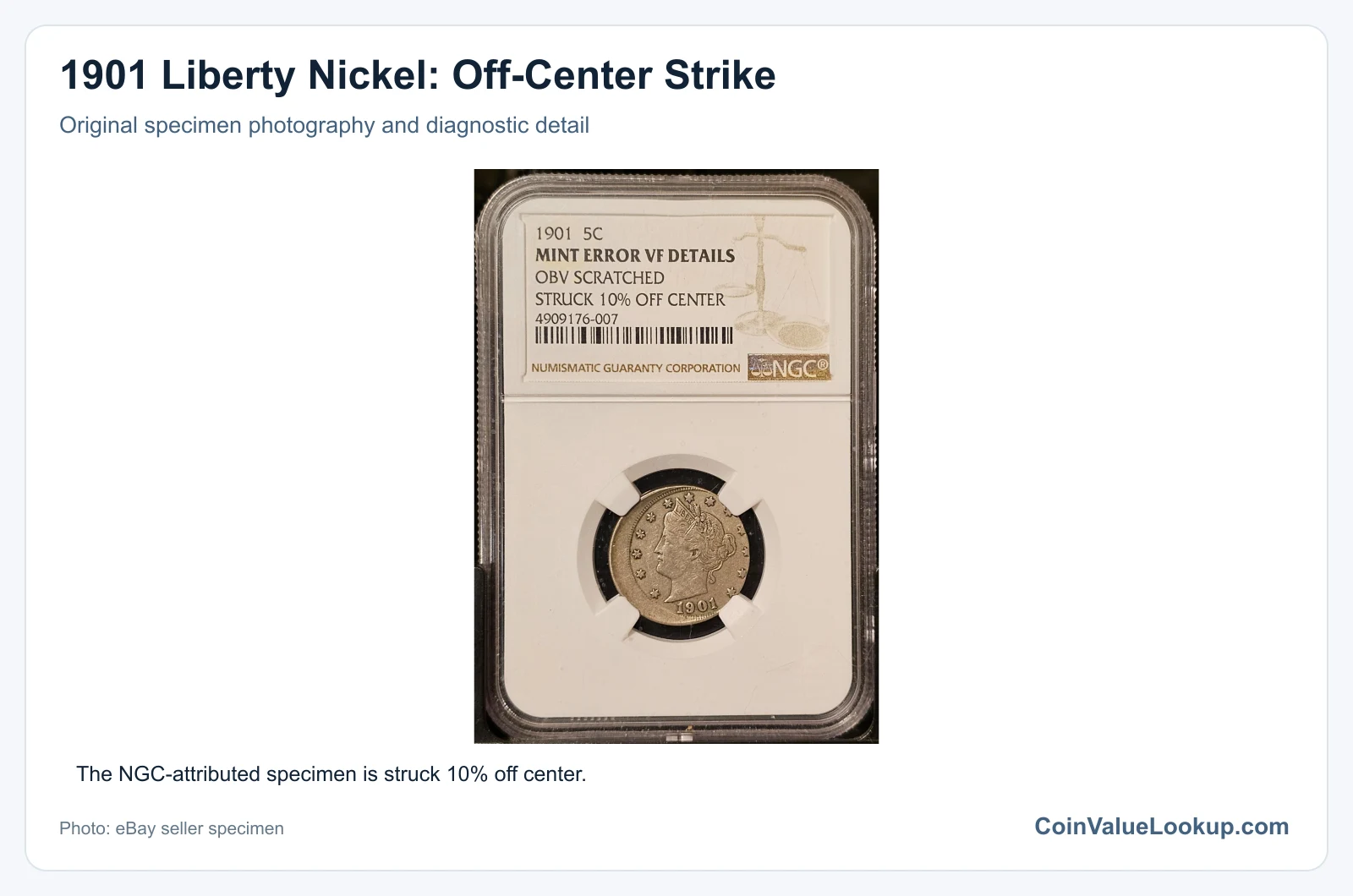
An off-center 1901 Liberty Nickel shows a crescent-shaped blank area where the die missed the planchet. The design is shifted to one side, leaving part of the coin unstruck.
A reported example exists struck roughly 25% off center.
The key collector requirement is date visibility. An off-center nickel that still shows the full 1901 date is far more desirable than one where the date has shifted off the flan.
Check that the blank crescent is smooth and uniform — this distinguishes a genuine off-center strike from a clipped planchet, which has a curved cut through the rim, or from post-mint flattening that can push metal outward.
One-sided die misalignment can also make a coin appear off-center on only one face. Value hinges on the percentage of off-center shift, date visibility, and the coin's condition, so no blanket price applies.