1904 Liberty Nickel Coin Value: How Much Is It Worth?
A 1904 Liberty Nickel in well-worn Good-4 condition carries a USA Coin Book guide value of about $2.50, while an uncirculated MS63 example rises to roughly $154. Proof strikes in PR63 are listed around $344.
These are retail guide estimates from a single snapshot, not guaranteed sale prices. Your coin's actual worth depends on its exact condition and whether it falls into an unusual category.
Fast Way to Identify Your 1904 Liberty Nickel
The quickest way to start figuring out what you have is to upload clear photos of both the front and back of your coin. Our identifier can give you a preliminary read on the version and general condition based on those images.
Snap them in good light, keep the coin flat, and try to capture the rim and edge detail too.
1904 Liberty Nickel Value
Upload both sides of your 1904 Liberty Nickel.
Front Obverse
Upload photo
Back Reverse
Upload photo
Which 1904 Liberty Nickel Versions Are Worth Money?
- Business strikes in MS63 or better carry guide values well above face, with the USA Coin Book listing $154 at MS63 for the With CENTS type.
- Proof strikes are a separate manufacturing category; a PR63 example is listed at $344 in the same guide.
- Wrong-planchet errors on a reported foreign blank have been attributed for this date, though the exact foreign denomination remains proposed rather than proven.
- Coins with original, uncleaned surfaces in any grade tend to command stronger interest than harshly cleaned examples at the same technical grade.
Step 1: Identify Your 1904 Liberty Nickel Mint Mark and Version
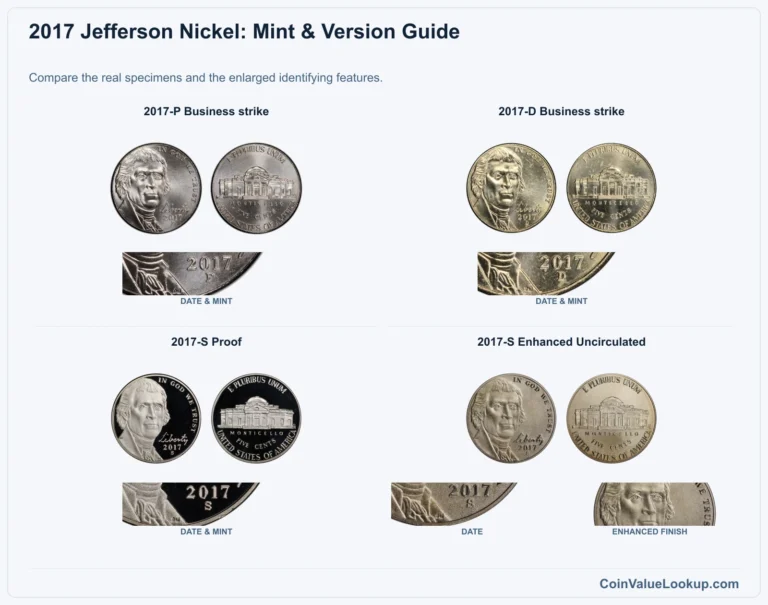
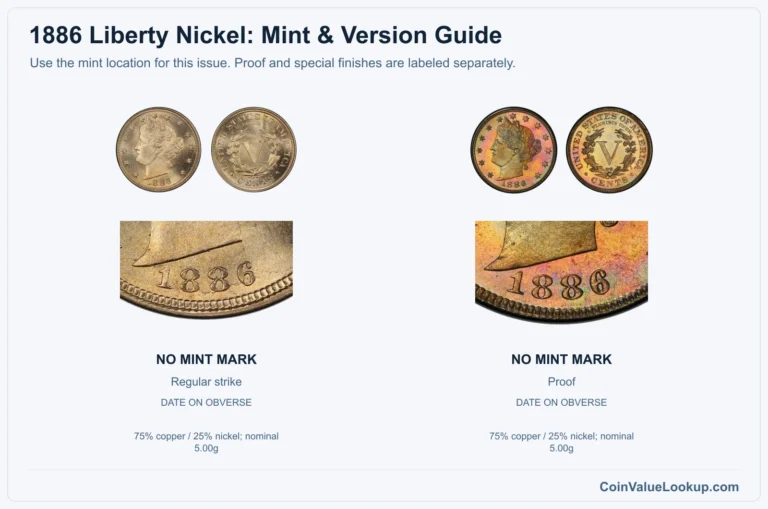
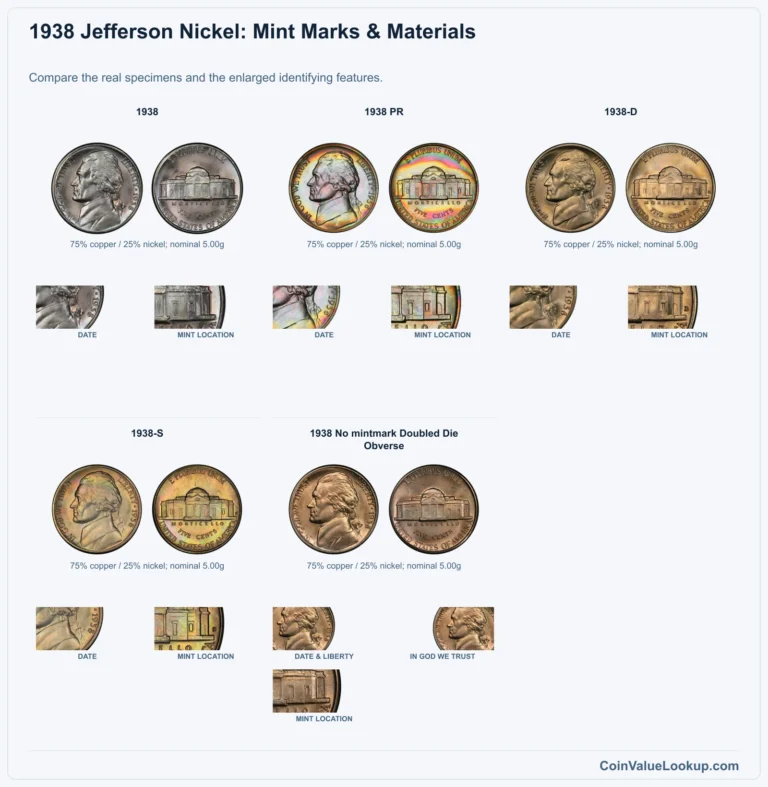
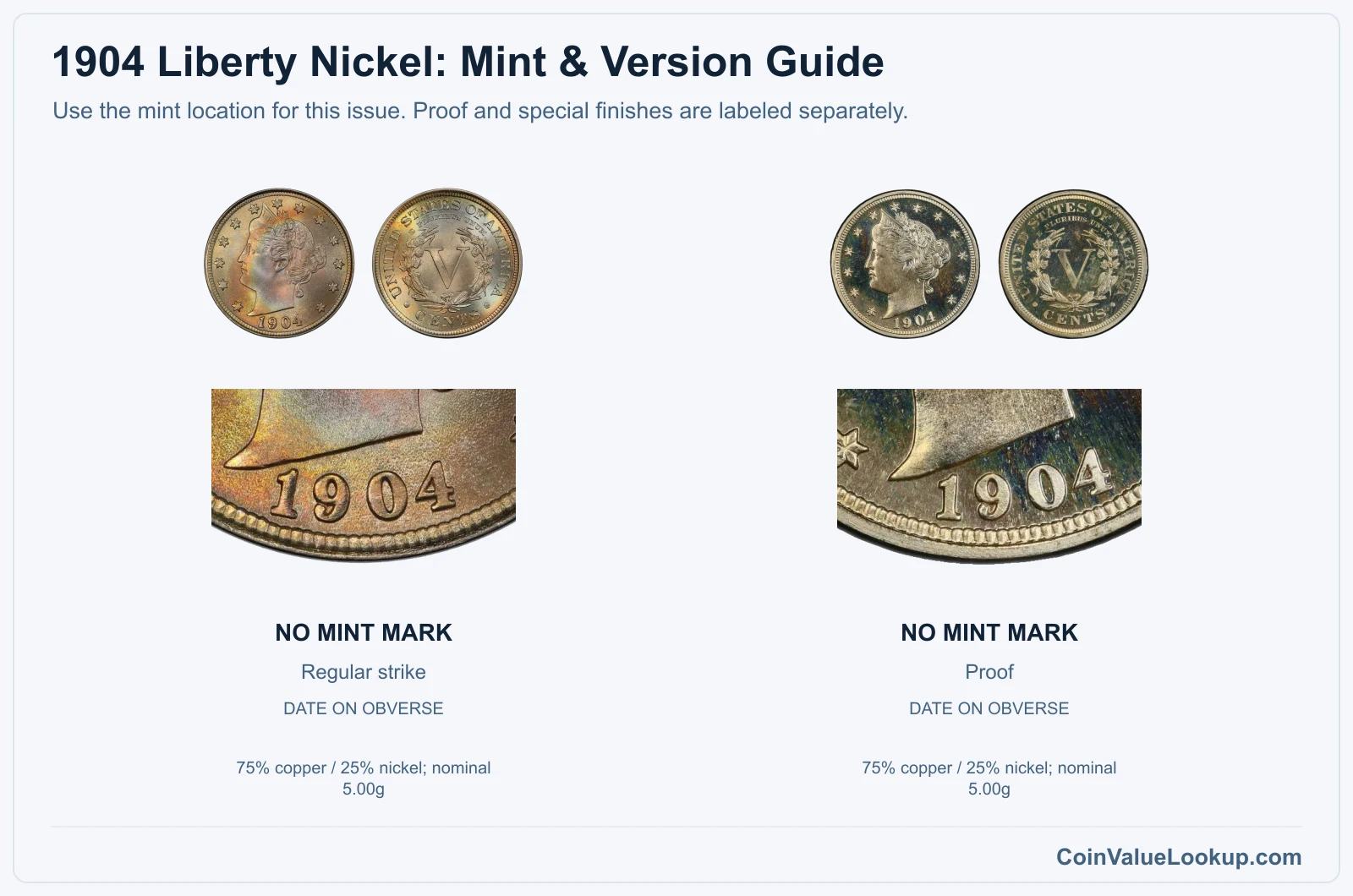
Every 1904 Liberty Nickel was struck at Philadelphia. There is no mintmark to hunt for, no branch-mint variety, and no D or S hiding anywhere on the coin.
The design is the "With CENTS" type, meaning the word CENTS appears on the reverse inside the wreath. Earlier 1883 nickels came in a "No CENTS" version, but by 1904 that distinction was long settled.
The coin is 75% copper and 25% nickel, weighs about 5 grams, and measures 21.2 mm with a plain edge. If your piece looks silver or feels unusually light, it is not a secret silver variety.
There is no regular silver branch for this date. A wrong-planchet error has been reported (more on that below), but that is a striking error, not a standard issue.
To confirm you actually have a 1904, check the date below Liberty's portrait. Worn dates can sometimes be misread as 1901 or 1907, so use magnification if the last digit is ambiguous.
Step 2: Check Your 1904 Liberty Nickel Grade
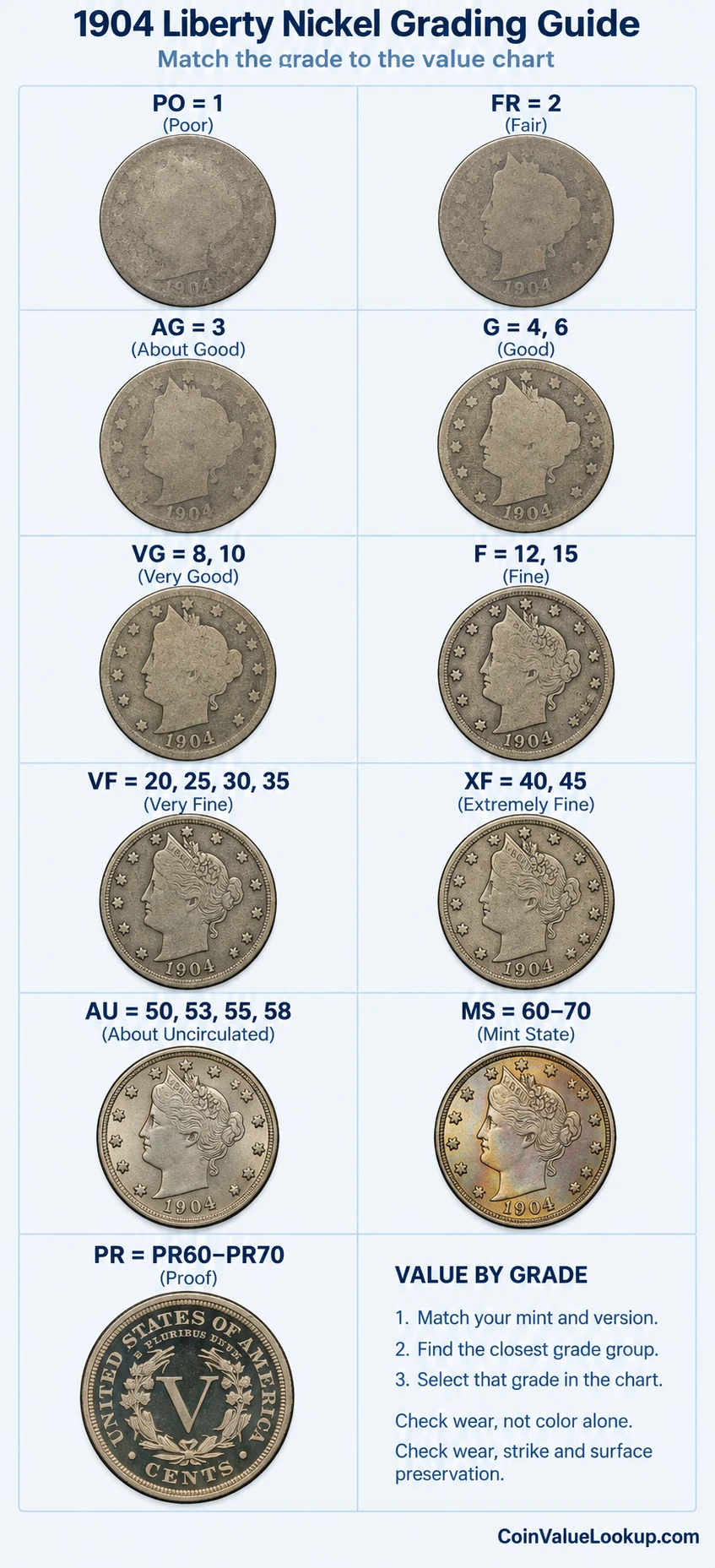
Start with the word LIBERTY on the coronet above Liberty's forehead. On a lightly worn coin, every letter is sharp.
Once the coin hits mid-grade territory, the "I" and "B" begin to soften. In lower grades, LIBERTY is partly or fully gone.
Next, look at the high points of the hair curls near the ear and the cheek below the eye. These are the first areas to show friction.
On the reverse, the corn ears at the top of the wreath and the ribbon knot at the bottom lose detail early.
Here is the tricky part: some 1904 nickels came off the press with weak strikes, especially in the hair and corn areas. Weak detail alone does not prove the coin circulated.
Compare your coin against the reference image and look at the fields, not just the devices. A mint-state coin will show cartwheel luster across those flat areas even if the hair curls look soft.
Proof is a manufacturing method, not a higher grade than Mint State. Proof Liberty Nickels have mirror-like fields and squared-off rims.
If your coin has those features, compare it with known proof examples and look for hairlines from cleaning, which lower the grade.
Step 3: Check 1904 Liberty Nickel Value by Mint and Version
1904 Liberty Nickel — No Mint Mark — With CENTS Circulation
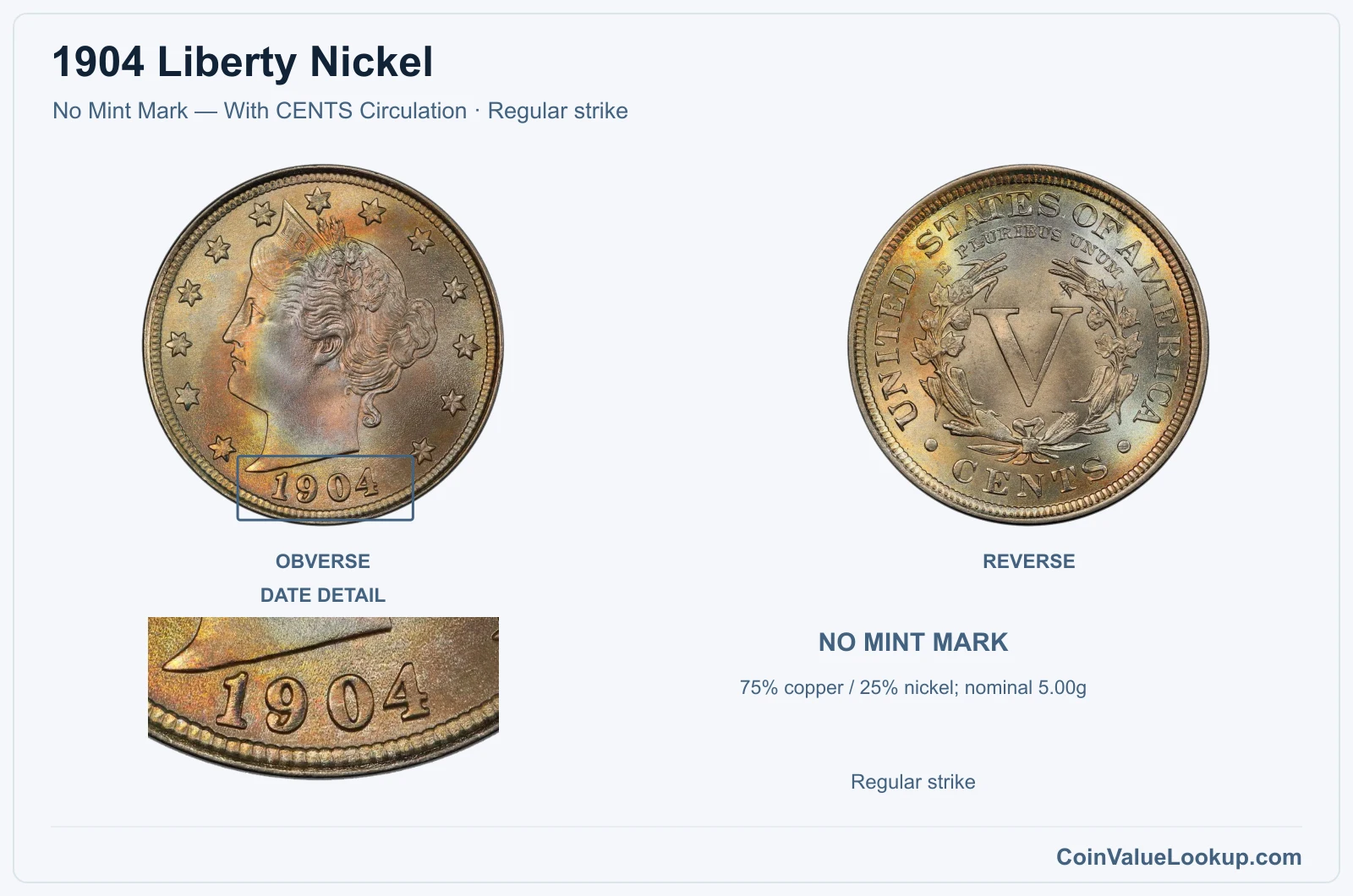
This is the standard 1904 Liberty Nickel you are most likely to encounter. Struck for circulation at Philadelphia with no mintmark, on a copper-nickel planchet.
The With CENTS reverse has been the norm since mid-1883.
USA Coin Book lists a February 2026 guide value of about $2.50 in Good-4 and around $154 in MS63. Those are retail guide estimates, not offers.
Most survivors sit in the lower circulated grades, so a genuinely uncirculated piece with full luster is a different animal entirely. Check the fields for bag marks and the hair detail for strike quality before assuming a high grade.
Coin Value Lookup is a good starting point if you want to compare guide values across other Liberty Nickel dates or denominations quickly.
Range Grade
Price Auction Records Appraisal PO PO 1
—
Coin Identifier FR FR 2
—
Coin Identifier AG AG 3
—
Coin Identifier G G 4
—
Coin Identifier
G 6
—
Coin Identifier VG VG 8
—
Coin Identifier
VG 10
—
Coin Identifier F F 12
—
Coin Identifier
F 15
—
Coin Identifier VF VF 20
—
Coin Identifier
VF 25
—
Coin Identifier
VF 30
—
Coin Identifier
VF 35
—
Coin Identifier XF XF 40
—
Coin Identifier
XF 45
Coin Identifier AU AU 50
—
Coin Identifier
AU 53
—
Coin Identifier
AU 55
Coin Identifier
AU 58
Coin Identifier MS MS 60
—
Coin Identifier
MS 61
Coin Identifier
MS 62
Coin Identifier
MS 63
Coin Identifier
MS 64
Coin Identifier
MS 65
Coin Identifier
MS 66
Coin Identifier
MS 67
Coin Identifier
MS 68
—
—
—
MS 69
—
—
—
MS 70
—
—
—
1904 Liberty Nickel — No Mint Mark — With CENTS Proof
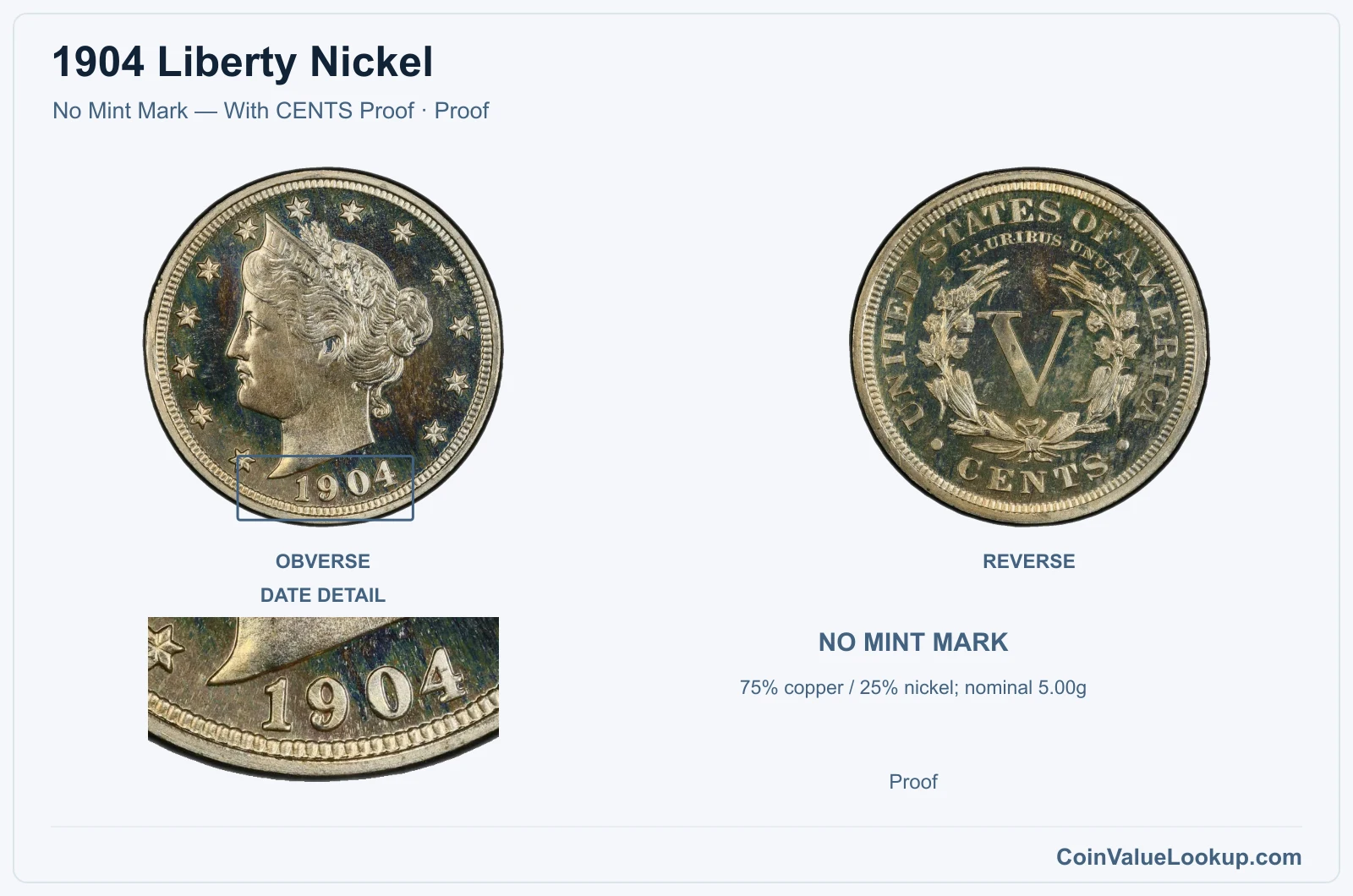
Philadelphia struck proof Liberty Nickels for collectors in 1904, and they turn up from time to time in old collections and estate lots. The fields on a genuine proof should be deeply mirrored, and the rims are typically sharper and more squared than on a business strike.
USA Coin Book places a PR63 example at roughly $344 in their February 2026 guide snapshot. That is a single retail estimate and not a guaranteed sale figure.
Actual value depends on the specific coin's eye appeal, the presence or absence of hairlines, and whether any toning is considered attractive or distracting.
When photographing a suspected proof, try to show both the reflective fields and the rim profile. Those two features, more than anything else, separate a proof from a well-preserved business strike.
Range Grade
Price Auction Records Appraisal PR PR 1
—
Coin Identifier
PR 2
—
Coin Identifier
PR 3
—
Coin Identifier
PR 4
—
Coin Identifier
PR 6
—
Coin Identifier
PR 8
—
Coin Identifier
PR 10
—
Coin Identifier
PR 12
—
Coin Identifier
PR 15
—
Coin Identifier
PR 20
—
Coin Identifier
PR 25
—
Coin Identifier
PR 30
—
Coin Identifier
PR 35
—
Coin Identifier
PR 40
—
Coin Identifier
PR 45
—
Coin Identifier
PR 50
—
Coin Identifier
PR 53
—
Coin Identifier
PR 55
—
Coin Identifier
PR 58
—
Coin Identifier
PR 60
—
Coin Identifier
PR 61
Coin Identifier
PR 62
Coin Identifier
PR 63
Coin Identifier
PR 64
Coin Identifier
PR 65
Coin Identifier
PR 66
Coin Identifier
PR 67
Coin Identifier
PR 68
—
—
—
PR 69
—
—
—
PR 70
—
—
—
1904 Liberty Nickel Error List
1. 1904 Liberty Nickel — Off-Center Strike
An off-center strike happens when the planchet is not seated properly in the collar, so the dies impress the design off to one side. You will see a blank crescent of unstruck metal on one edge, with the design shifted in the opposite direction.
For this to have meaningful collector interest, the date needs to remain visible. A 1904 nickel struck, say, 10-15% off center with a clear date is a genuinely unusual find.
The degree of displacement and the coin's overall condition both affect what a buyer would pay, but no specific price range is established here.
Do not confuse an off-center strike with a coin that was bent, hammered flat on one side after leaving the mint, or shows misaligned die doubling. Post-mint damage lacks the smooth unstruck crescent and consistent displacement you see on a true off-center piece.
2. 1904 Liberty Nickel — Lamination / Split Planchet
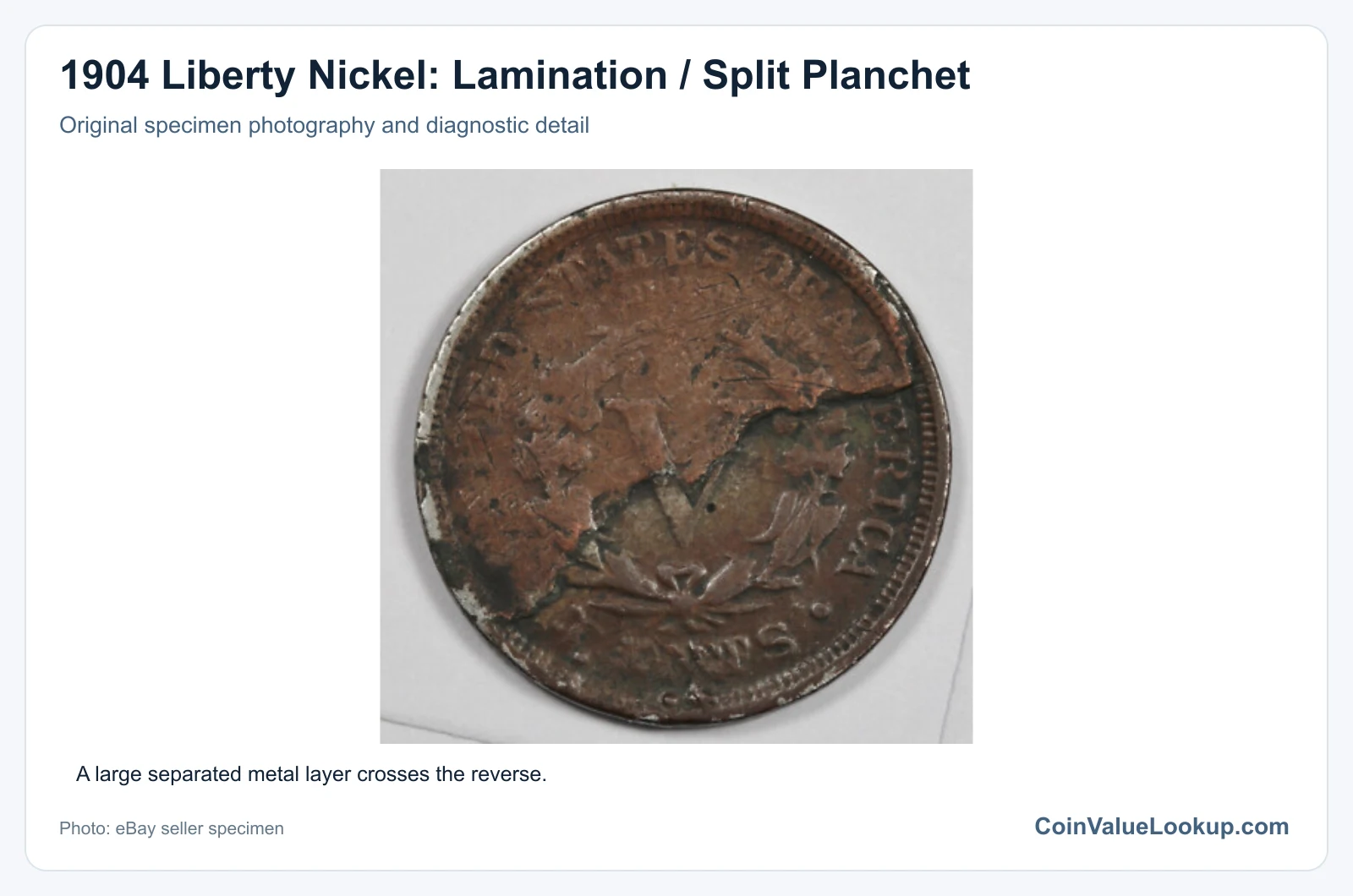
Lamination errors occur when the metal separates into layers, often visible as a flap of metal peeling away from the surface or a gap within the planchet's thickness. On a copper-nickel Liberty Nickel, these can appear as a raised blister, a retained flake, or a full split.
When photographing one, capture the edge of the coin alongside the affected face so the separation is clear. The value of a lamination error depends on how dramatic and visible it is, along with the coin's condition.
These can be confused with coins that have been scraped, corroded, or intentionally cut. Genuine laminations follow the natural structure of the metal and typically have smooth interior surfaces where the alloy separated.
Rough gouges or tool marks point to post-mint damage instead.
3. 1904 Liberty Nickel — Die Break / Cud
A die break leaves a raised, irregular blob of metal on the coin's surface where a chunk of the die itself cracked away. When that break connects to the rim, collectors call it a cud.
The result is a smooth raised lump that replaces part of the normal design along the edge.
On a 1904 Liberty Nickel, look along the rim on both sides. A cud will feel raised and look distinctly different from the surrounding lettering or design.
Its boundary against the normal design is usually sharp and irregular.
Do not mistake a rim dent or corrosion for a cud. Rim damage is depressed or rough, while a cud is raised.
Interior die chips, which appear as small raised dots or lines away from the rim, are a related but separate category. Value depends on the size, location, and the coin's overall grade.
4. 1904 Liberty Nickel — Struck-Through Error
A struck-through error happens when something, grease, a fragment of metal, thread, or other debris, gets caught between the die and the planchet during striking. The result is a localized depression or incomplete area of the design where the obstruction blocked the full impression.
On a 1904 nickel, look for a smooth, sunken area that does not match the surrounding wear pattern. Grease-filled dies tend to leave soft, rounded depressions, while a retained foreign object can leave a sharper impression of its own shape.
The main lookalikes are ordinary wear, scratches, and cleaning marks. The difference is that a struck-through affects the design uniformly within its area and often has a distinct boundary.
Condition, the size of the affected area, and what caused the obstruction all influence how much a collector would value the error.
5. 1904 Liberty Nickel — Wrong Planchet / Off-Metal Strike
A wrong-planchet error means the 1904 Liberty Nickel dies struck a blank intended for a different coin. One reported example involves a roughly 2.7-gram foreign planchet, possibly Philippine in origin, though that specific attribution remains proposed rather than proven.
Compare your coin to a normal 1904 nickel, which should weigh about 5 grams on a 21.2 mm blank with a plain edge. If yours is substantially lighter, smaller, or shows incomplete design coverage, it could be on the wrong blank.
Weigh it on a precision scale and measure the diameter.
Be cautious. Plated coins, acid-treated coins, and deliberately altered pieces can mimic a wrong-planchet strike.
Genuine examples typically show design details consistent with the full striking force of the dies but limited by the smaller or different blank. Professional authentication is strongly recommended for any suspected wrong-planchet coin.
6. 1904 Liberty Nickel — Clipped Planchet
A clipped planchet means part of the original metal blank was missing before the coin was struck. The result is a coin with a curved, straight, or ragged absence along one portion of the edge.
A curved clip is the most common type, created when the blanking punch overlaps a previously punched hole in the metal strip.
On a genuine clip, look for the Blakesley effect: a zone of weakness on the opposite side of the coin from the missing metal, where the blank did not fill the die completely. The edge at the clip itself should show the natural texture of the blank, not file marks or cuts.
One reported example is a 1904 Liberty Nickel with approximately a 10% curved clip, graded AU58 by NGC. The value of any clipped coin depends on the size of the clip, the grade, and overall eye appeal.
Filed edges, deliberate notches, and corrosion can all mimic clips but lack the corresponding opposite-side weakness.