1911 Liberty Nickel Coin Value: How Much Is It Worth?
A 1911 Liberty Nickel in well-worn G4 condition carries a guide value around $2.50, while an MS63 business strike jumps to roughly $154 according to USA Coin Book estimates. Proofs graded PR63 sit near $344.
These are retail guide figures, not guaranteed sale prices. Strike quality and original surfaces matter more than raw mintage when chasing higher grades.
Fast Way to Identify Your 1911 Liberty Nickel
Snap clear photos of both the front and back of your 1911 Liberty Nickel and upload them here for a preliminary identification. Good lighting helps — try to capture the full rim and any unusual surface details.
This step can help you figure out whether you have a business strike or proof and spot obvious issues before you dig deeper.
1911 Liberty Nickel Value
Upload both sides of your 1911 Liberty Nickel.
Front Obverse
Upload photo
Back Reverse
Upload photo
Which 1911 Liberty Nickel Versions Are Worth Money?
- Business strikes in MS63 or better carry guide values well above circulated examples — around $154 at MS63 per USA Coin Book.
- PR63 proofs list near $344; original proof surfaces without hairlines or cleaning are key to that premium.
- Strike quality and surface preservation matter more than mintage alone for determining a high-grade specimen's appeal.
- Reported error types such as off-center strikes, die breaks, and doubled dies are worth inspecting for, though individual value depends on the specific coin's condition and the error's visibility.
Step 1: Identify Your 1911 Liberty Nickel Mint Mark and Version
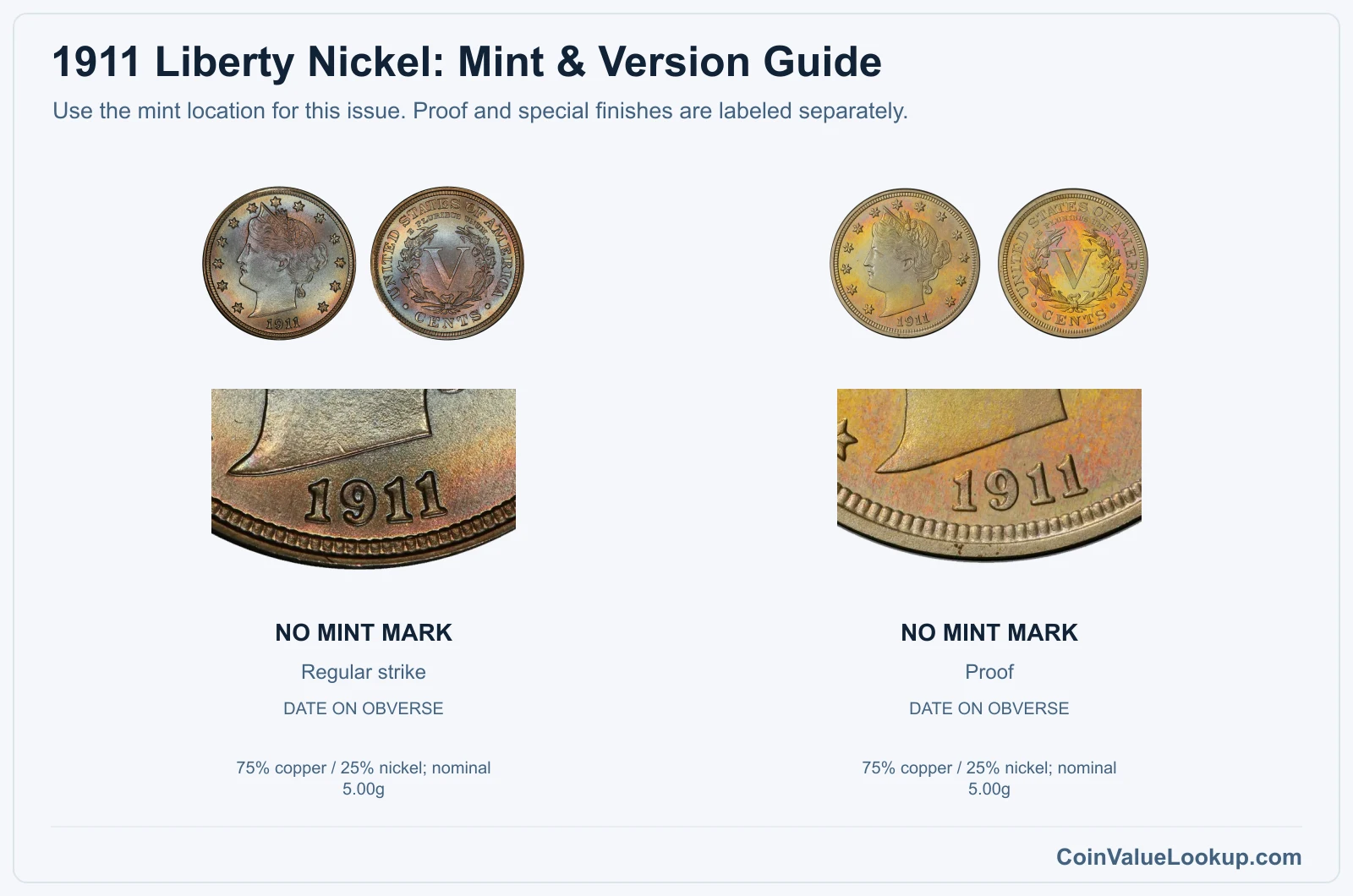
Every 1911 Liberty Nickel was struck at Philadelphia. There is no mintmark to look for, and no branch-mint issue exists for this date.
The coin is 75% copper and 25% nickel, weighs about 5 grams, measures 21.2 mm across, and has a plain edge.
The design carries the words WITH CENTS on the reverse, inside the wreath below the Roman numeral V. This is the standard type for all 1911 nickels — the earlier "No CENTS" variety only appeared in 1883.
Two legitimate manufacturing formats exist: normal business strikes and proofs. A proof is not a higher grade than mint state; it is a separate manufacturing process with different field characteristics.
Both share the same obverse portrait of Liberty and the same reverse wreath and denomination.
Step 2: Check Your 1911 Liberty Nickel Grade
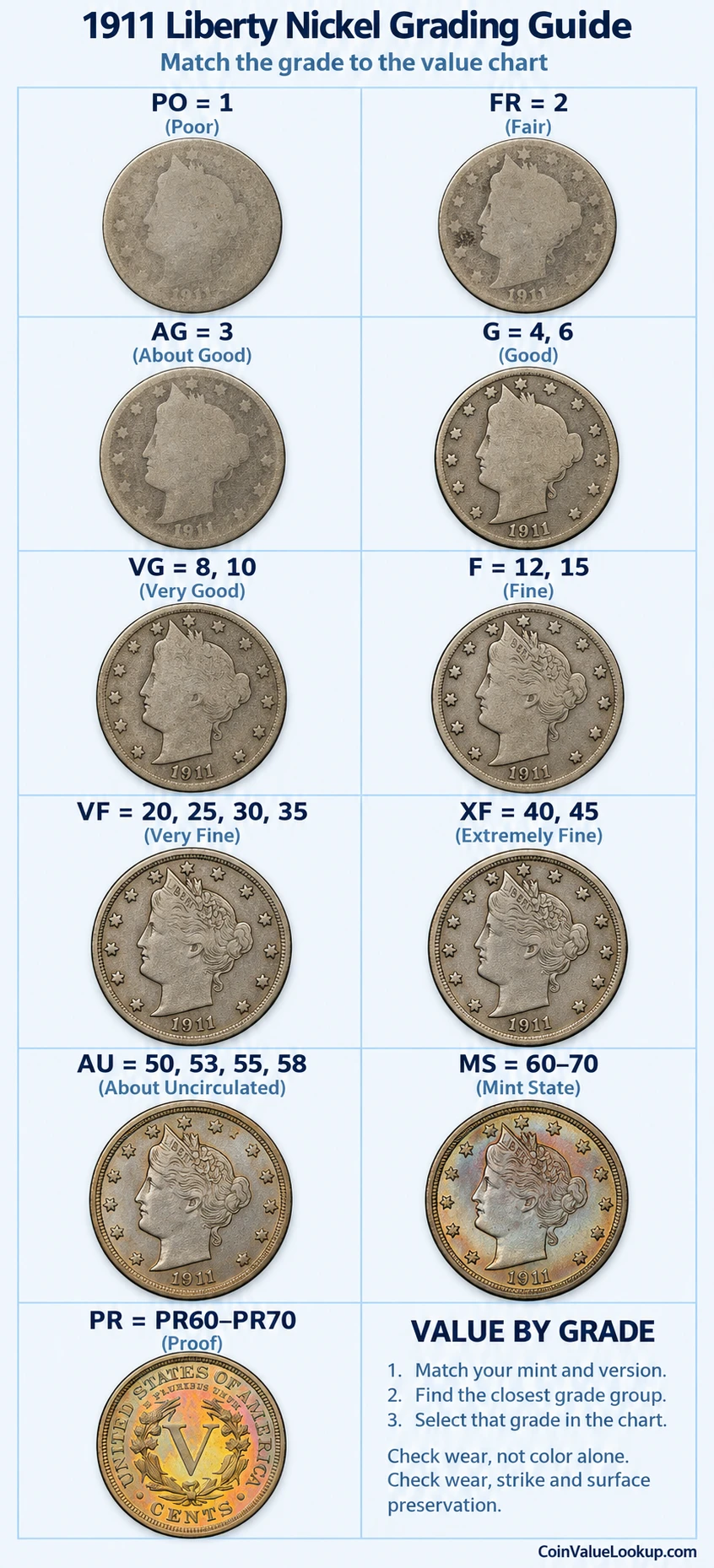
Start on the obverse. The word LIBERTY on the coronet is your primary wear checkpoint — in lower grades, letters merge or vanish entirely.
The high points of the hair curls above the forehead and the cheek below the eye lose detail early.
Flip to the reverse. The individual kernels on the corn ears and the leaf veins in the wreath show wear quickly.
Compare what you see against the reference image to separate genuine circulation wear from a soft original strike, which can mimic wear.
For mint-state coins, focus on luster, contact marks, and the sharpness of the strike. A coin can look "flat" on the high points yet never have been spent — weak strikes are common on this series.
Full, unbroken cartwheel luster across the fields is the best clue that a coin avoided circulation.
Proofs are identified by their mirrored fields, squared-off rims, and overall precision. Hairlines from cleaning or improper storage reduce a proof's appeal quickly.
Always compare your coin's surfaces to an attributed proof example rather than assuming any shiny nickel qualifies.
Step 3: Check 1911 Liberty Nickel Value by Mint and Version
1911 Liberty Nickel — No Mint Mark — With CENTS Circulation
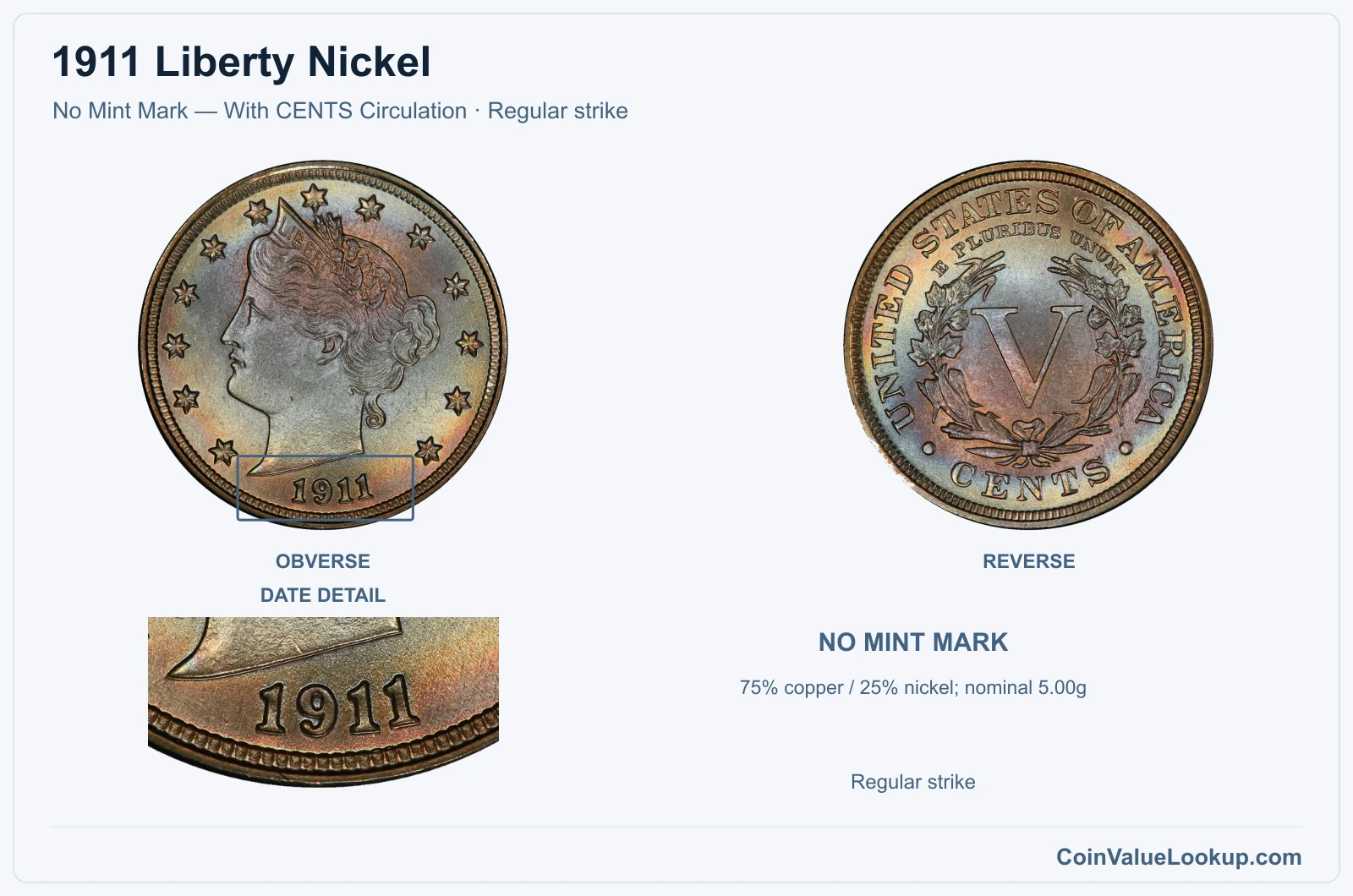
This is the standard 1911 Liberty Nickel business strike from Philadelphia. No mintmark appears anywhere on the coin.
The reverse reads CENTS within the wreath, confirming the normal design type used from 1883 onward.
USA Coin Book guide estimates place a G4 example around $2.50 and an MS63 coin near $154. That is a big spread, and it comes down to surfaces.
A coin with full, original luster, minimal bag marks, and a sharp strike will command the higher end. Weak strikes are a known quirk of Liberty Nickels, so do not automatically downgrade a soft-looking coin — check the fields for luster first.
Coin Value Lookup is a good starting point if you are researching other dates or denominations alongside your 1911 nickel. You can look up guides across a wide range of U.S. coin series.
Range Grade
Price Auction Records Appraisal PO PO 1
—
Coin Identifier FR FR 2
—
Coin Identifier AG AG 3
—
Coin Identifier G G 4
—
Coin Identifier
G 6
—
Coin Identifier VG VG 8
—
Coin Identifier
VG 10
—
Coin Identifier F F 12
—
Coin Identifier
F 15
—
Coin Identifier VF VF 20
—
Coin Identifier
VF 25
—
Coin Identifier
VF 30
—
Coin Identifier
VF 35
—
Coin Identifier XF XF 40
Coin Identifier
XF 45
Coin Identifier AU AU 50
—
Coin Identifier
AU 53
—
Coin Identifier
AU 55
Coin Identifier
AU 58
Coin Identifier MS MS 60
Coin Identifier
MS 61
Coin Identifier
MS 62
Coin Identifier
MS 63
Coin Identifier
MS 64
Coin Identifier
MS 65
Coin Identifier
MS 66
Coin Identifier
MS 67
Coin Identifier
MS 68
—
—
—
MS 69
—
—
—
MS 70
—
—
—
1911 Liberty Nickel — No Mint Mark — With CENTS Proof
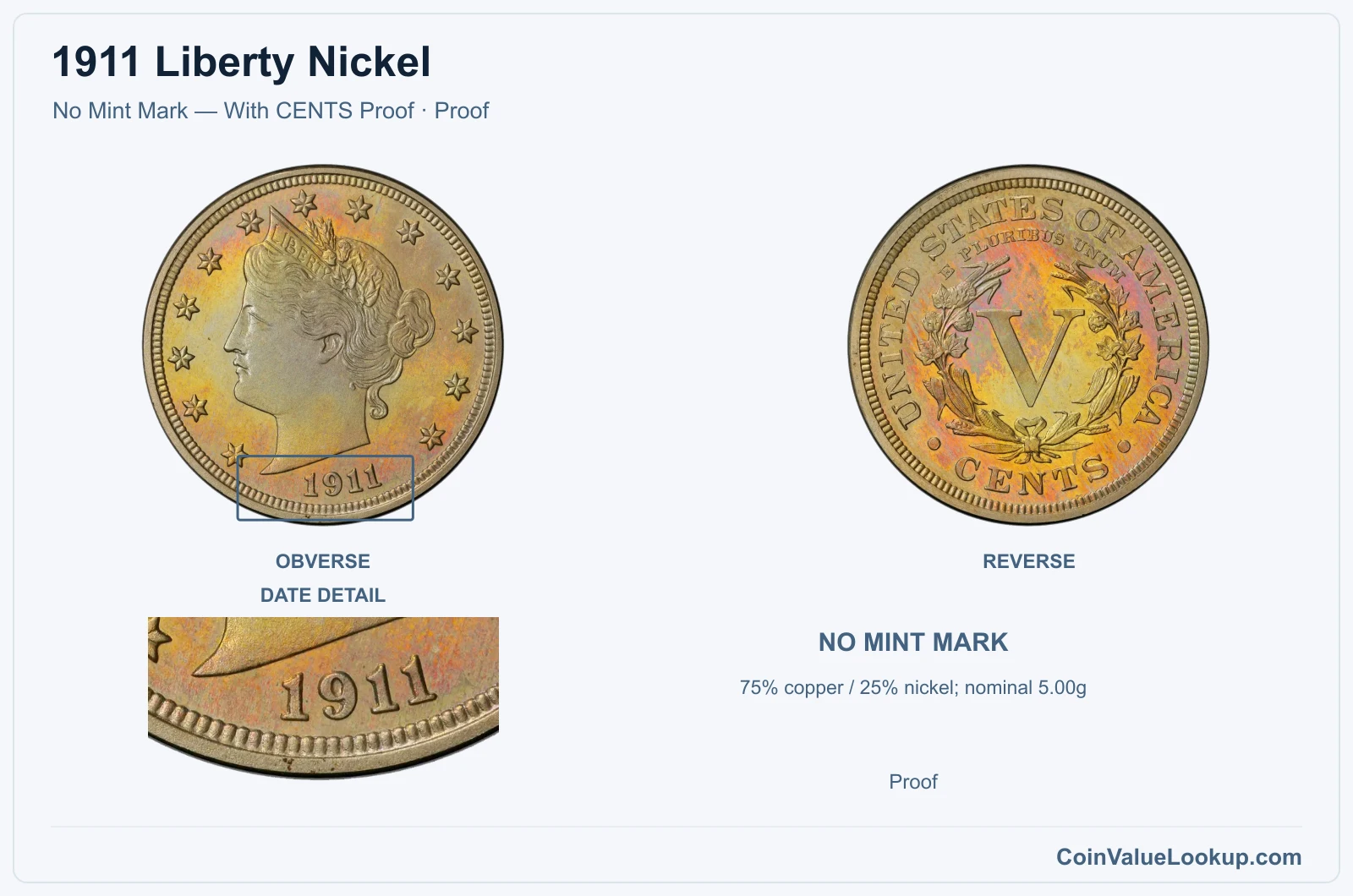
Philadelphia also produced proof 1911 Liberty Nickels for collectors. These were struck with polished dies on prepared planchets, giving the fields a mirror-like finish and the rims a sharp, squared profile.
A PR63 example carries a USA Coin Book guide value of about $344. Condition of the proof surfaces is everything — hairlines from wiping, haze from improper storage, or thumbprints can drag a proof down quickly.
When photographing for identification, capture the fields at an angle to show reflectivity, and include a close-up of the rim edge.
Remember that proof is a manufacturing category, not a grade above mint state. A poorly preserved proof can be worth less than a pristine business strike.
Show both faces and include detail of the fields and rim so the manufacturing method can be assessed.
Range Grade
Price Auction Records Appraisal PR PR 1
—
Coin Identifier
PR 2
—
Coin Identifier
PR 3
—
Coin Identifier
PR 4
—
Coin Identifier
PR 6
—
Coin Identifier
PR 8
—
Coin Identifier
PR 10
—
Coin Identifier
PR 12
—
Coin Identifier
PR 15
—
Coin Identifier
PR 20
—
Coin Identifier
PR 25
—
Coin Identifier
PR 30
—
Coin Identifier
PR 35
—
Coin Identifier
PR 40
—
Coin Identifier
PR 45
—
Coin Identifier
PR 50
—
Coin Identifier
PR 53
—
Coin Identifier
PR 55
—
Coin Identifier
PR 58
—
Coin Identifier
PR 60
—
Coin Identifier
PR 61
—
Coin Identifier
PR 62
Coin Identifier
PR 63
Coin Identifier
PR 64
Coin Identifier
PR 65
Coin Identifier
PR 66
Coin Identifier
PR 67
Coin Identifier
PR 68
Coin Identifier
PR 69
—
—
—
PR 70
—
—
—
1911 Liberty Nickel Error List
1. 1911 Liberty Nickel — Lamination / Split Planchet
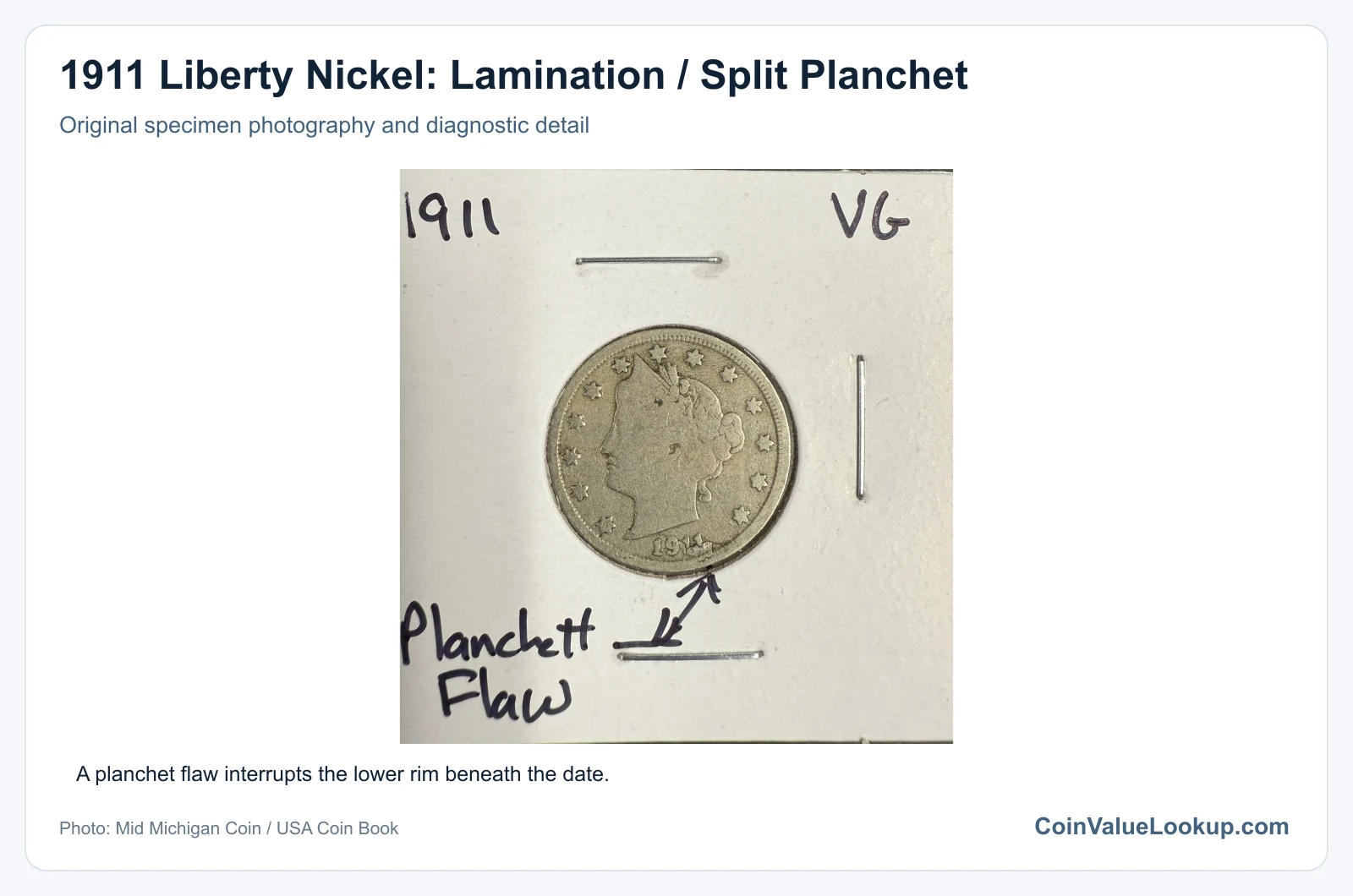
A lamination error on a 1911 Nickel shows up as peeling, flaking, or a retained flap of metal on the coin's surface. The copper-nickel alloy can separate in layers if the planchet had impurities or internal stresses before striking.
To check, run your fingernail across any suspicious area — a lamination flap will catch, while a stain or toning line will not. Photograph the edge and the affected face together so the separation is visible.
Do not confuse this with post-mint scraping, corrosion pitting, or a deliberately cut coin. Genuine lamination follows the metal's internal structure rather than showing tool marks or random surface damage.
The value of a lamination error depends on its size, visibility, and the coin's overall condition — there is no fixed premium for every example.
2. 1911 Liberty Nickel — Off-Center Strike
An off-center strike happens when the planchet is not seated properly between the dies. The result is a displaced design with a blank crescent on one side of the coin where metal was never impressed.
On a 1911 Nickel, the key question is whether the date remains fully visible. Off-center errors that retain a readable date are more collectible than those where the date disappears into the unstruck area.
The percentage of off-center displacement also matters — a 5% shift is mild, while 50% or more is dramatic.
Watch out for lookalikes. A clipped planchet leaves a curved missing section but the design is centered.
Post-mint flattening can push details sideways but usually shows damage marks. One-sided die misalignment produces a different visual pattern.
Actual value depends on the degree of displacement, date visibility, and the coin's surfaces.
3. 1911 Liberty Nickel — Die Break / Cud
A die break or cud appears as a raised, irregular blob on the coin's surface. It happens when a piece of the die cracks away, leaving a void that fills with metal during striking.
A true cud connects to the rim; interior raised lumps are die chips, a related but separate category.
On a 1911 Nickel, look along the rim on both sides. A cud will be a solid, raised area with no design detail, and its boundary will show where the die fractured.
The surrounding design may be slightly distorted.
Do not mistake a rim dent or corrosion buildup for a cud. Rim damage is depressed or rough, not raised and smooth.
The specific size, location, and sharpness of a cud all influence its collectibility — there is no single price that applies to every example.
4. 1911 Liberty Nickel — Doubled Die
A doubled die on a 1911 Nickel appears as consistent doubling of design elements — letters, the date, or portrait features show a secondary, slightly offset image. This happens during die manufacture, not during striking, which means every coin from that die carries the same doubling.
Compare your coin to a known normal example. Look for separation or notching on letter serifs, the date digits, or the stars.
The doubling should be uniform and repeatable across the affected area.
Machine doubling is the most common lookalike. It produces flat, shelf-like displacement rather than the rounded, raised secondary image of a true doubled die.
Reflections under magnification and post-mint impressions from contact can also mimic doubling. Value depends on the strength and location of the doubling and the coin's overall condition — no specific price applies universally.