1870 Shield Nickel Coin Value: How Much Is It Worth?
The 1870 Shield Nickel is a copper-nickel piece struck at Philadelphia, and most circulated examples trade in a modest range. A retail guide places problem-free coins at about $38 in G4 (a well-worn but readable grade) up to around $498 in MS63 (a lightly marked uncirculated coin).
Proof strikes and certain error varieties carry their own separate values, so identifying what you actually have matters before you price it.
Fast Way to Identify Your 1870 Shield Nickel
Snap a clear photo of the front and back of your 1870 Shield Nickel and upload both images here for a preliminary identification. This can help you figure out whether you have a standard circulation strike, a proof, or something unusual before you dig deeper into values.
Good lighting and a steady hand go a long way.
1870 Shield Nickel Value
Upload both sides of your 1870 Shield Nickel.
Front Obverse
Upload photo
Back Reverse
Upload photo
Which 1870 Shield Nickel Versions Are Worth Money?
- Circulation strikes in original Mint State condition (uncirculated, with full luster) are the most rewarding to find, with guide estimates reaching about $498 at MS63.
- Correctly identified proof strikes carry separate pricing — around $468 at PR63 — but confirming proof status requires more than a shiny surface.
- A Doubled Die Obverse or Doubled Die Reverse error, if genuine and clearly visible, can add a premium whose size depends on the strength of the doubling and the coin's condition.
Step 1: Identify Your 1870 Shield Nickel Mint Mark and Version
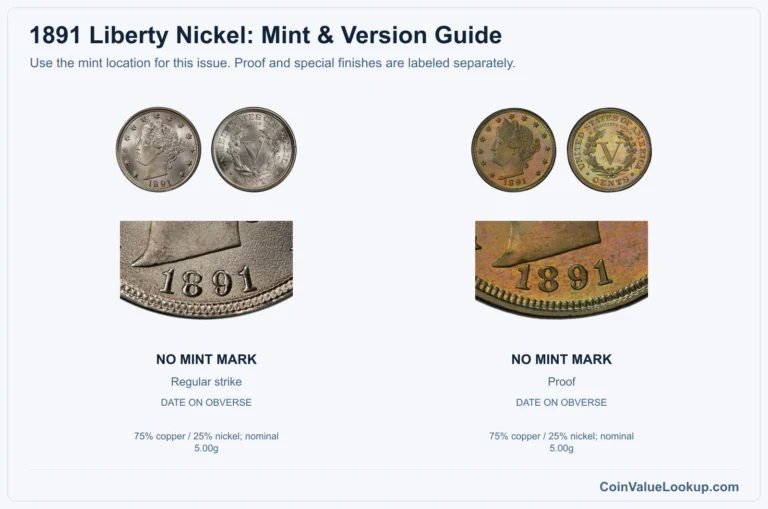
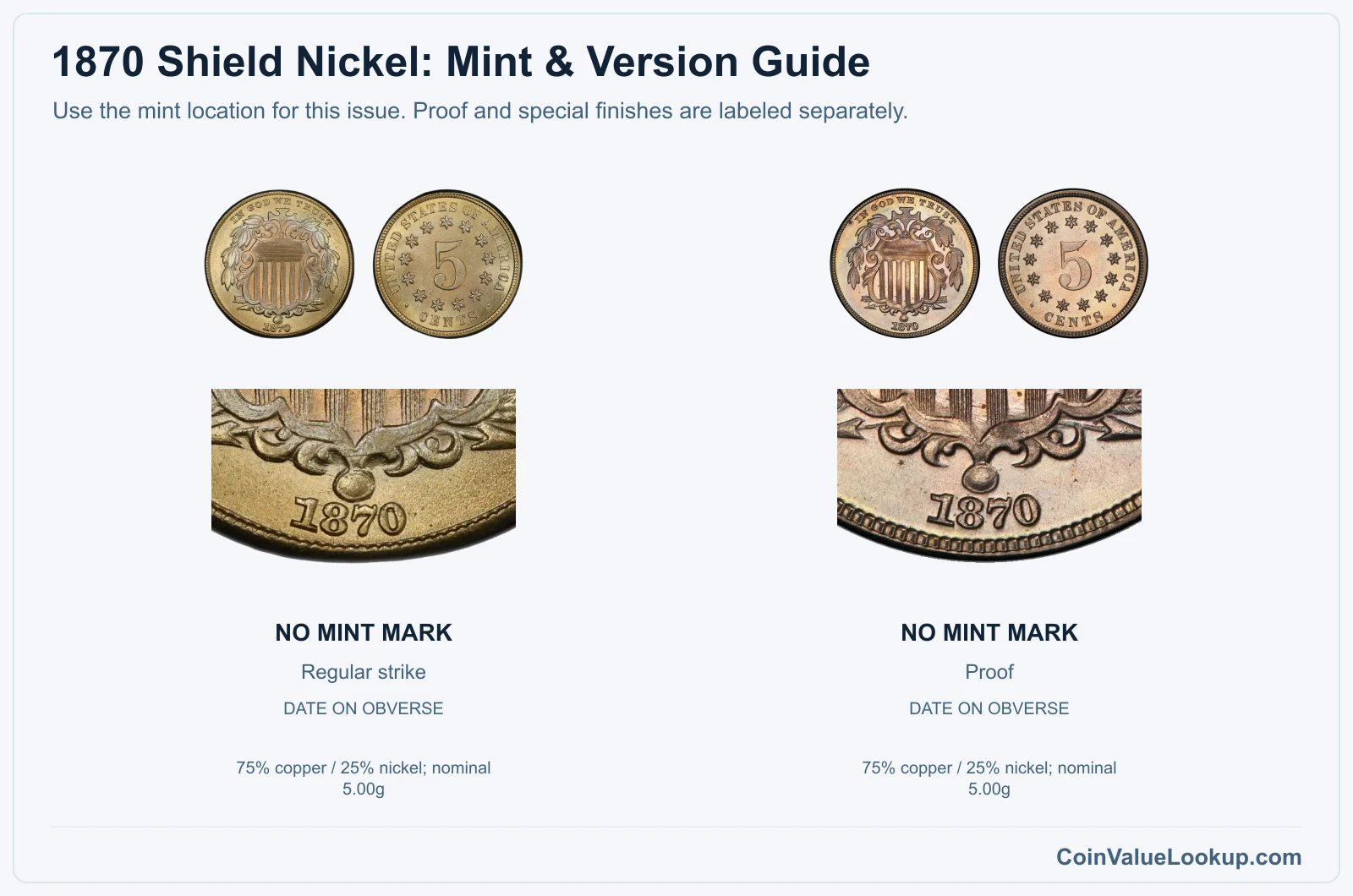
Every 1870 Shield Nickel was struck at Philadelphia, so there is no mintmark anywhere on the coin. A missing letter is completely normal — do not mistake it for a variety or error.
The obverse shows a prominent shield design, while the reverse displays a large numeral 5 surrounded by stars. This is the "No Rays" type; the ray pattern between the stars was dropped during 1867 and never came back.
The coin is struck in a copper-nickel alloy (75% copper, 25% nickel), weighs about 5 grams, and measures 20.5 mm with a plain edge. There is no legitimate silver version of this date.
One tricky point: some circulation strikes have mirror-like surfaces that can fool you into thinking you have a proof. Reflectivity alone does not make a coin a proof.
True proofs were deliberately struck with specially prepared dies and planchets, and professional authentication is the safest way to confirm proof status. Start by determining whether your coin is a business strike or a proof, then move on to grading.
And whatever you do, do not clean the coin — cleaning destroys original surfaces and tanks the value.
Step 2: Check Your 1870 Shield Nickel Grade
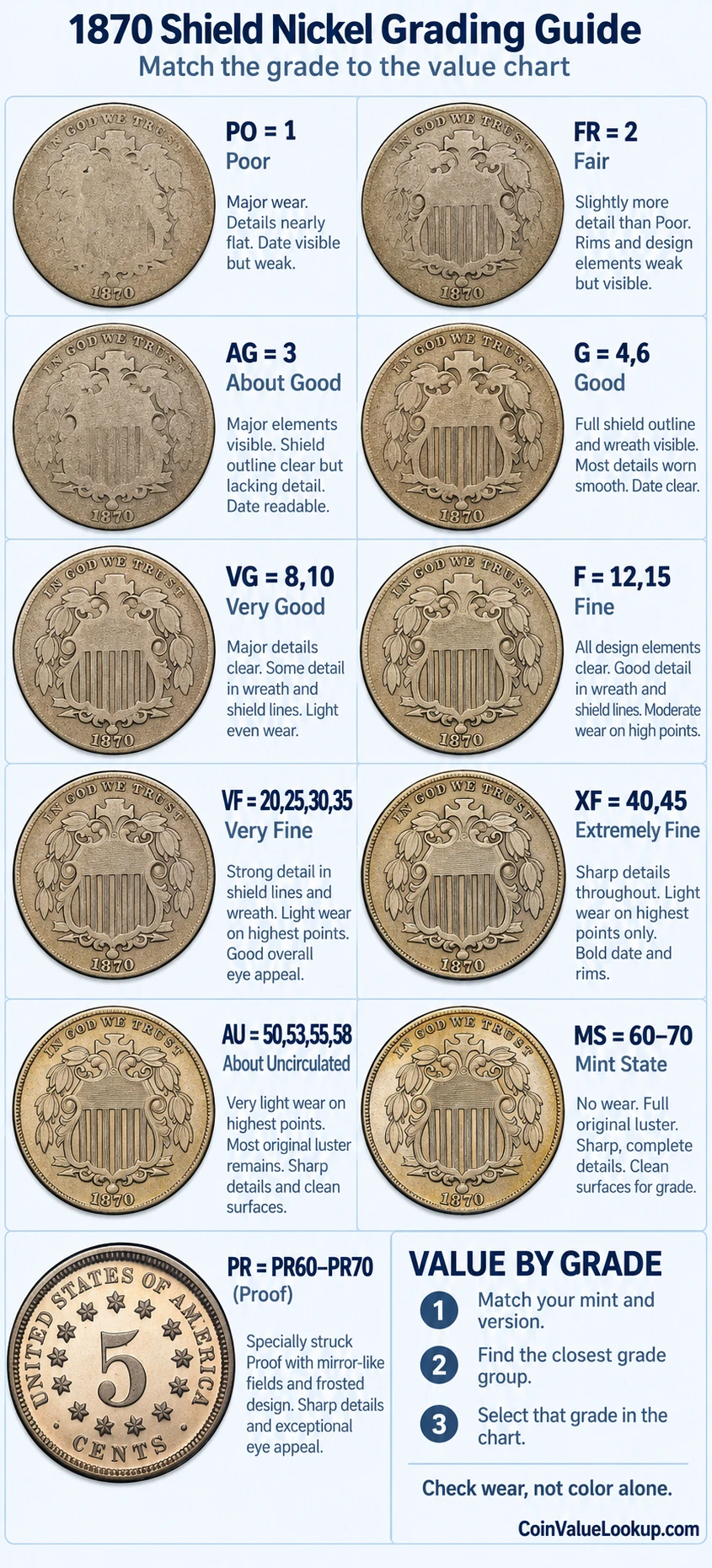
Focus on the shield on the obverse first. The horizontal and vertical lines inside the shield are the highest points and the first to lose detail from wear.
On a well-preserved coin, these lines are sharp and complete; on a worn one, they merge or vanish.
Check the cross at the top of the shield and the surrounding leaves, too. These areas pick up friction quickly, so flattening there usually means genuine circulation wear.
Here is the catch: Shield Nickels are notorious for weak strikes. A coin can leave the press with mushy shield lines even though it was never spent.
Compare the luster and surface quality on both sides — a weakly struck coin still shows original mint luster, while a worn coin does not. The comparison image can help you distinguish strike weakness from actual wear.
Finally, set aside any coin that has been cleaned, corroded, or visibly damaged. Guide values assume a problem-free surface, and impaired coins trade well below those numbers.
Step 3: Check 1870 Shield Nickel Value by Mint and Version
1870 Shield Nickel — No Mint Mark — Circulation Strike
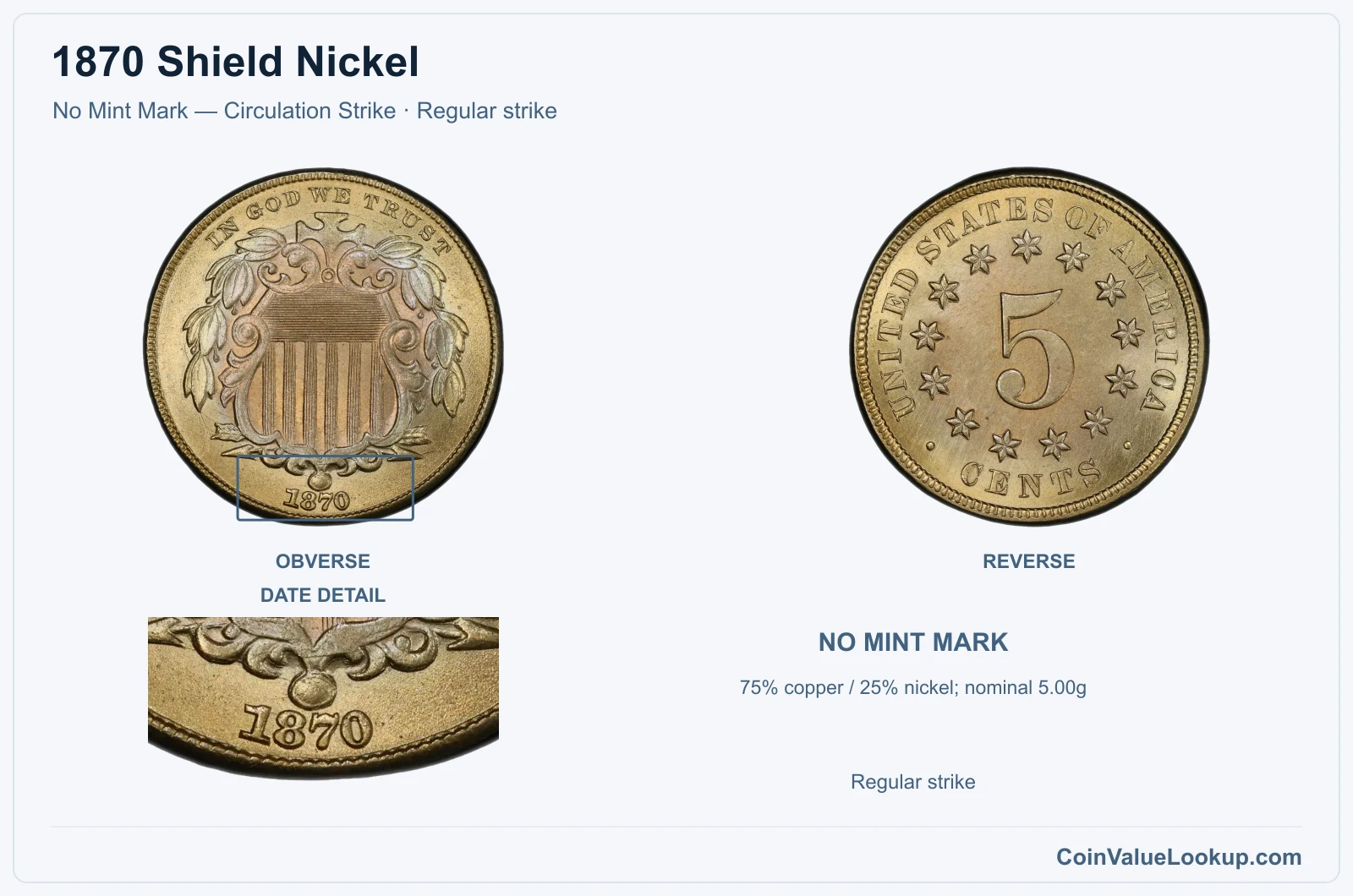
The standard 1870 Shield Nickel is a Philadelphia business strike with no mintmark. It uses the No Rays reverse introduced partway through 1867.
The alloy is 75% copper and 25% nickel at a nominal weight of 5 grams.
Retail guide estimates place a well-worn G4 example at about $38 and a clean MS63 coin at roughly $498. Those are retail guide figures from USA Coin Book, not guaranteed sale prices — actual transactions depend on eye appeal, surface quality, and market conditions.
Some of these coins come with prooflike reflective fields. That mirror finish can be dramatic, but it does not change the coin's classification.
A prooflike circulation strike is still a business strike for pricing purposes.
Coin Value Lookup is a handy starting point if you want to look up guides for other dates or denominations in this series.
Range Grade
Price Auction Records Appraisal PO PO 1
—
Coin Identifier FR FR 2
—
Coin Identifier AG AG 3
—
Coin Identifier G G 4
—
Coin Identifier
G 6
—
Coin Identifier VG VG 8
Coin Identifier
VG 10
—
Coin Identifier F F 12
—
Coin Identifier
F 15
—
Coin Identifier VF VF 20
—
Coin Identifier
VF 25
Coin Identifier
VF 30
Coin Identifier
VF 35
Coin Identifier XF XF 40
Coin Identifier
XF 45
Coin Identifier AU AU 50
Coin Identifier
AU 53
Coin Identifier
AU 55
Coin Identifier
AU 58
Coin Identifier MS MS 60
—
Coin Identifier
MS 61
Coin Identifier
MS 62
Coin Identifier
MS 63
Coin Identifier
MS 64
Coin Identifier
MS 65
Coin Identifier
MS 66
Coin Identifier
MS 67
—
Coin Identifier
MS 68
—
—
—
MS 69
—
—
—
MS 70
—
—
—
1870 Shield Nickel — No Mint Mark — Proof
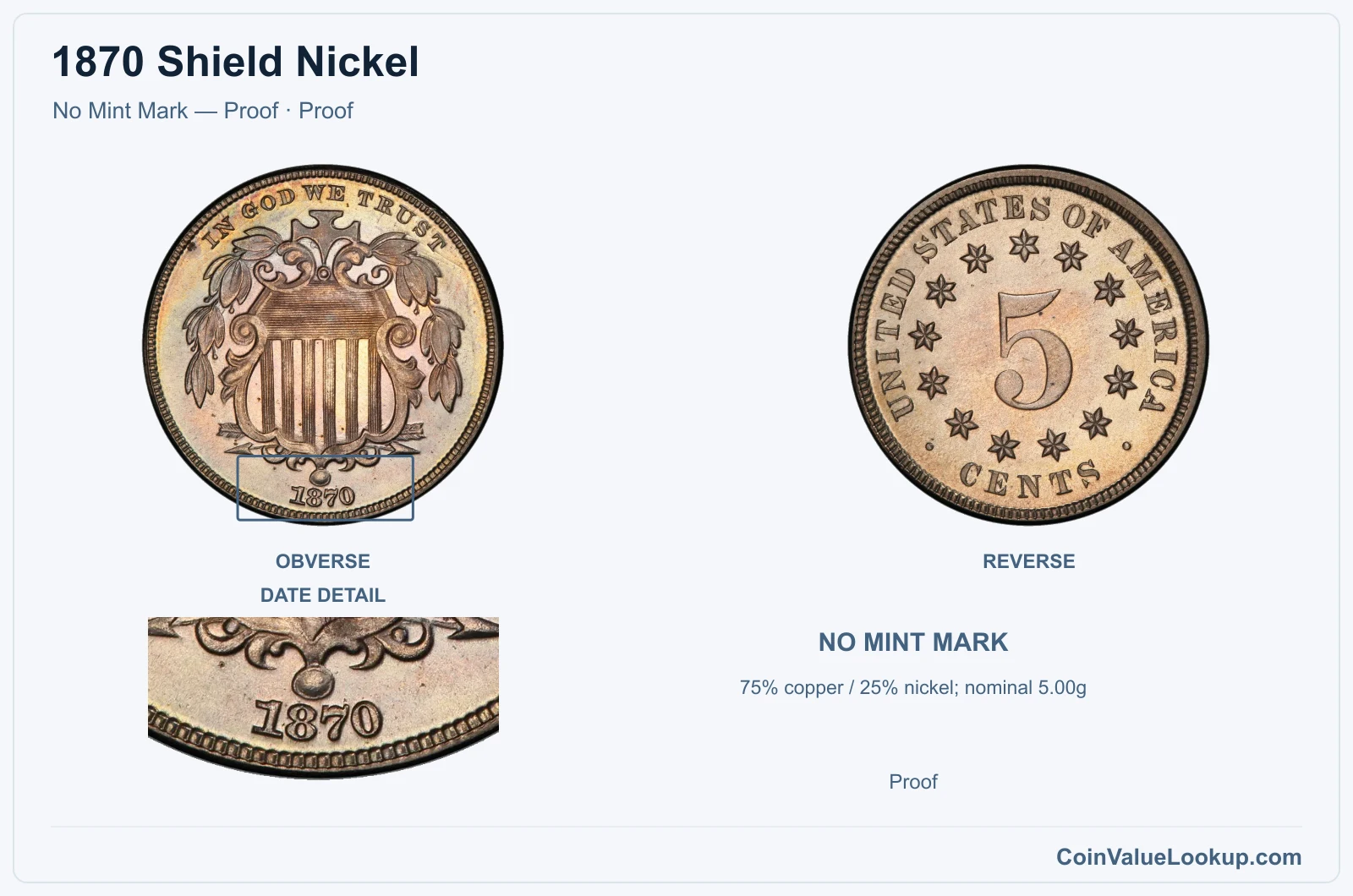
Philadelphia also produced proof 1870 Shield Nickels for collectors. A proof is a special manufacturing process — coins struck from polished dies on prepared planchets — not simply a higher grade than Mint State.
The guide places a PR63 proof at about $468.
Cameo contrast, where the devices appear frosted against mirror fields, is a visual designation applied during grading. It does not indicate a different mint or alloy; it is a surface characteristic of some proofs.
Because certain business strikes of this era show strong mirror surfaces, telling a real proof from a prooflike circulation strike can be difficult without experience. Professional certification from a major grading service is the most reliable way to confirm proof status before paying proof prices.
Range Grade
Price Auction Records Appraisal PR PR 1
—
Coin Identifier
PR 2
—
Coin Identifier
PR 3
—
Coin Identifier
PR 4
—
Coin Identifier
PR 6
—
Coin Identifier
PR 8
—
Coin Identifier
PR 10
—
Coin Identifier
PR 12
—
Coin Identifier
PR 15
—
Coin Identifier
PR 20
—
Coin Identifier
PR 25
—
Coin Identifier
PR 30
—
Coin Identifier
PR 35
—
Coin Identifier
PR 40
—
Coin Identifier
PR 45
—
Coin Identifier
PR 50
—
Coin Identifier
PR 53
—
Coin Identifier
PR 55
—
Coin Identifier
PR 58
—
Coin Identifier
PR 60
—
Coin Identifier
PR 61
—
Coin Identifier
PR 62
Coin Identifier
PR 63
Coin Identifier
PR 64
Coin Identifier
PR 65
Coin Identifier
PR 66
Coin Identifier
PR 67
—
—
—
PR 68
—
—
—
PR 69
—
—
—
PR 70
—
—
—
1870 Shield Nickel Error List
1. 1870 Shield Nickel — Doubled Die Obverse
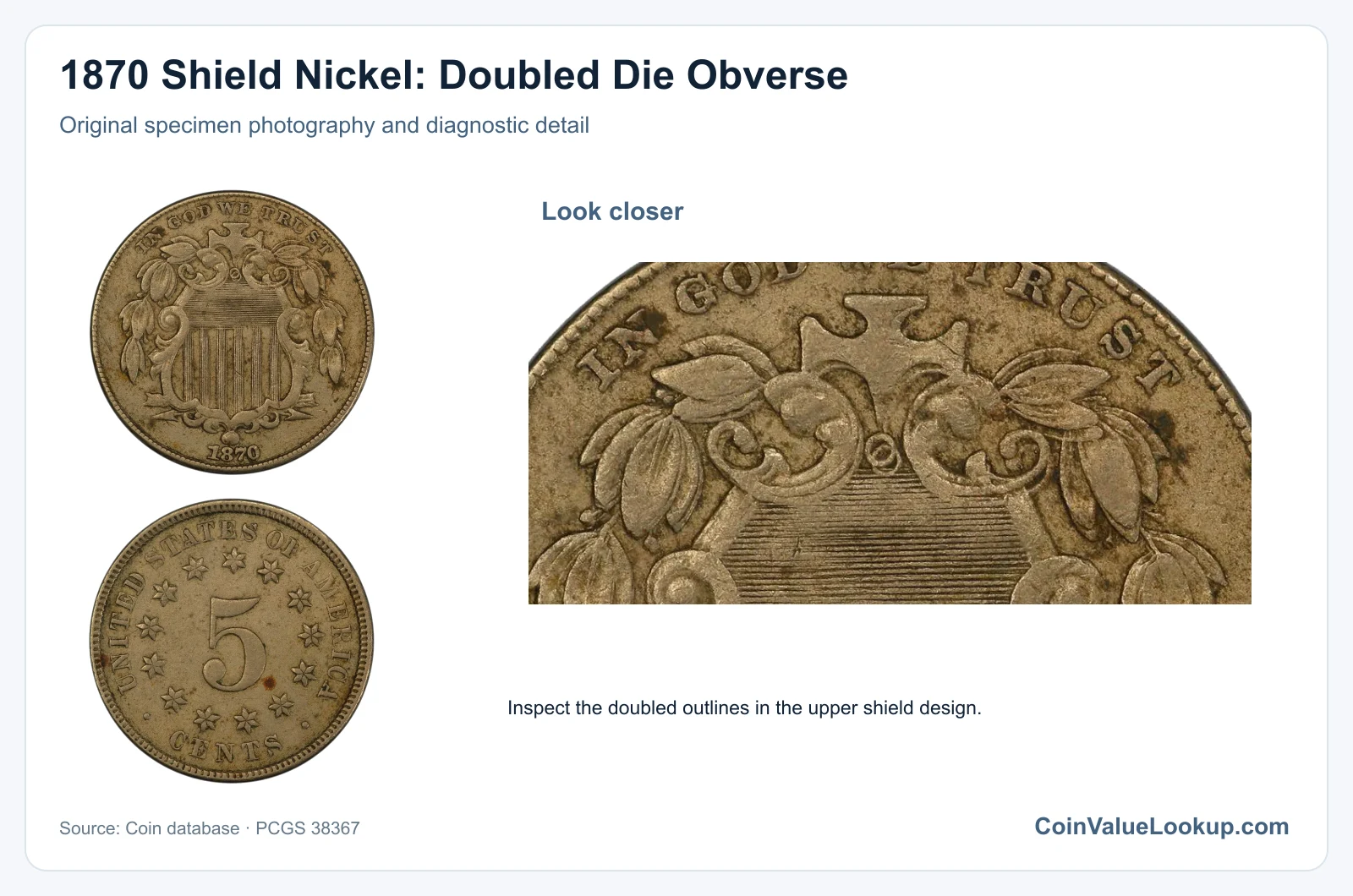
A Doubled Die Obverse has been reported for the 1870 Shield Nickel. This error occurs when a working die receives a misaligned second impression from the hub, leaving a consistent doubling on every coin struck from that die.
To check, examine the obverse lettering and design elements under magnification and compare them directly to a normal 1870 nickel under the same lighting. Look for even separation, notching, or a secondary outline on letters or shield details.
The doubling should be consistent — appearing in the same direction across multiple design elements.
Do not confuse this with machine doubling, which produces flat, shelf-like distortion rather than a rounded secondary image. Reflections and worn die contours can also mimic doubling at a glance.
The value of a genuine doubled die depends on the visibility of the doubling, the coin's overall condition, and the specific die involved.
2. 1870 Shield Nickel — Doubled Die Reverse
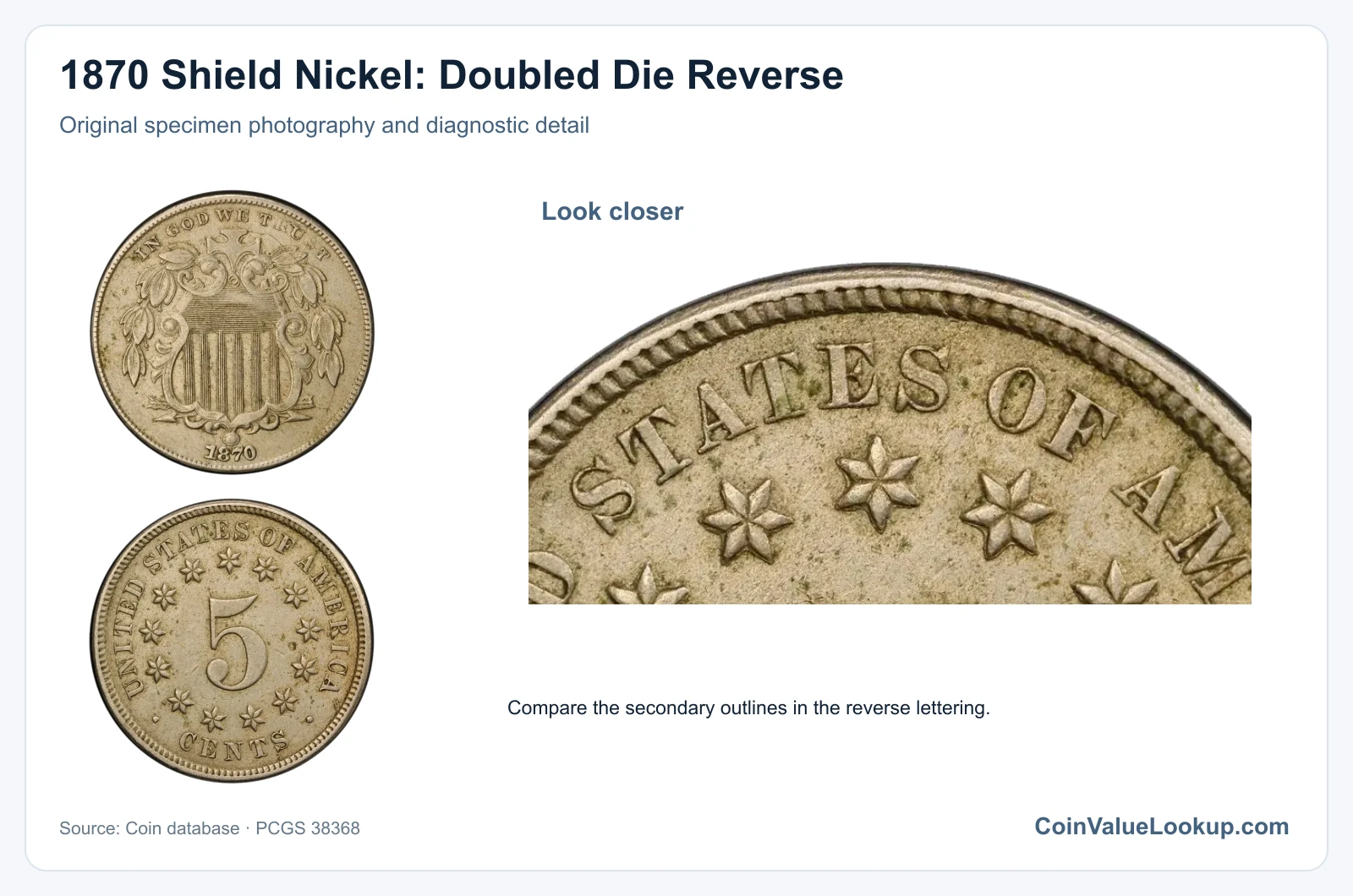
A Doubled Die Reverse has also been reported for the 1870 Shield Nickel. The same hub-doubling mechanism applies, but the affected elements appear on the reverse — the numeral 5, surrounding stars, or legends.
Compare your coin's reverse lettering and design contours closely with a known normal example. Genuine die doubling will show consistent directional separation or secondary outlines across multiple elements of the design rather than isolated spots.
Random damage, machine doubling, and optical tricks from reflective surfaces can all look like doubled dies to the untrained eye. Machine doubling in particular tends to create a flat, mechanical shelf rather than the rounded, raised secondary image of a true doubled die.
No specific price data is available for these varieties, but the value of any doubled die depends on how strong and visible the doubling is, along with the coin's grade and surface quality.