1881 Shield Nickel Coin Value: How Much Is It Worth?
The 1881 Shield Nickel is a scarce late-series date that commands solid prices even in well-worn condition. A USA Coin Book retail guide places a circulated example around $313 in G4, climbing to roughly $1,674 in MS63 for uncirculated business strikes.
Proofs carry their own market, anchored near $468 in PR63. These are guide estimates, not guaranteed sale prices.
Fast Way to Identify Your 1881 Shield Nickel
Want a quick read on your 1881 Shield Nickel? Upload clear photos of both the front and back of your coin for a preliminary identification.
Good lighting and a steady hand help — try to capture the shield detail and the numeral "5" on the reverse without glare. This step can help sort circulation strikes from proofs and flag anything unusual worth a closer look.
1881 Shield Nickel Value
Upload both sides of your 1881 Shield Nickel.
Front Obverse
Upload photo
Back Reverse
Upload photo
Which 1881 Shield Nickel Versions Are Worth Money?
- The 1881 circulation strike is a scarce date; guide values start around $313 even in G4 and reach $1,674 in MS63.
- Proofs exist independently and anchor near $468 in PR63 — correctly identifying strike type matters for accurate valuation.
- Original, uncleaned surfaces on either version preserve the most value; cleaning or damage sharply reduces what a coin will bring.
Step 1: Identify Your 1881 Shield Nickel Mint Mark and Version
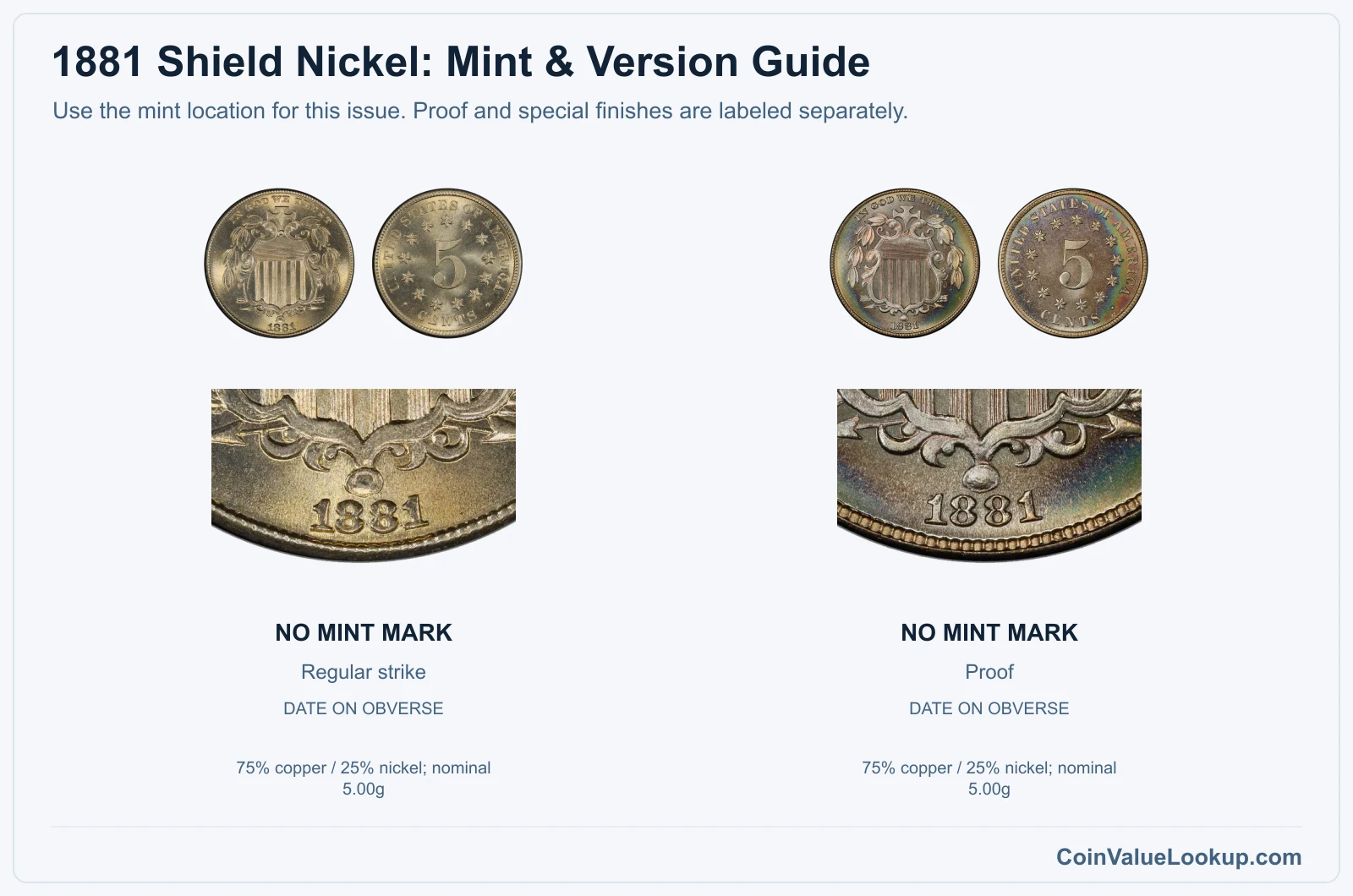
Every 1881 Shield Nickel was struck at Philadelphia. There is no mintmark, and that is perfectly normal — the absence of a mint letter is not an error on this coin.
The composition is 75% copper and 25% nickel, weighing about 5 grams with a 20.5 mm diameter and a plain edge. There is no silver version of this date.
If your coin is magnetic or the wrong size, you may have a counterfeit or a different denomination entirely.
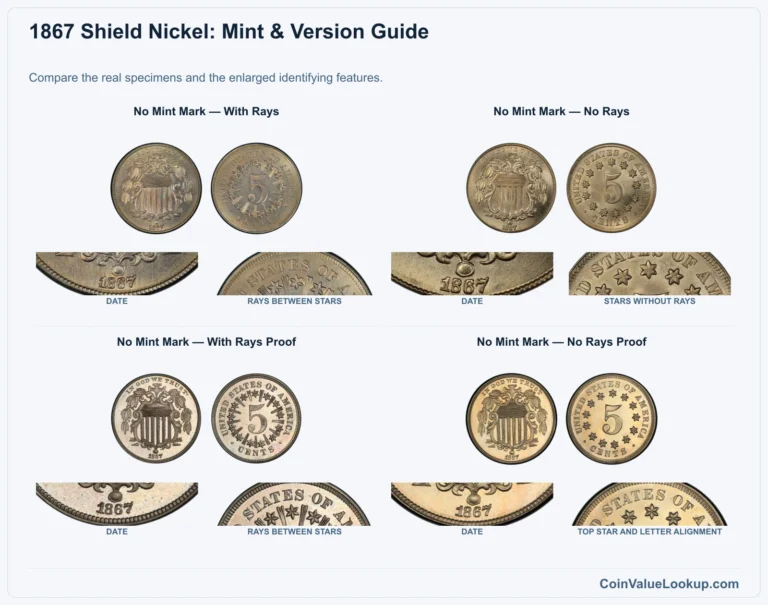
This date uses the "No Rays" design, which replaced the original With Rays reverse after 1867. The reverse shows a large numeral "5" surrounded by stars and rays on early issues, but by 1881 those rays had been gone for over a decade.
If you see rays between the stars on the reverse, you have a different coin.
The key identification challenge is telling a circulation strike from a proof. Both exist for 1881, and they share the same design.
Proofs typically show sharper rims, squared-off edges, and mirror-like fields when original surfaces survive. A business strike will usually have a slightly softer overall impression and a different luster character, even in high grade.
Step 2: Check Your 1881 Shield Nickel Grade
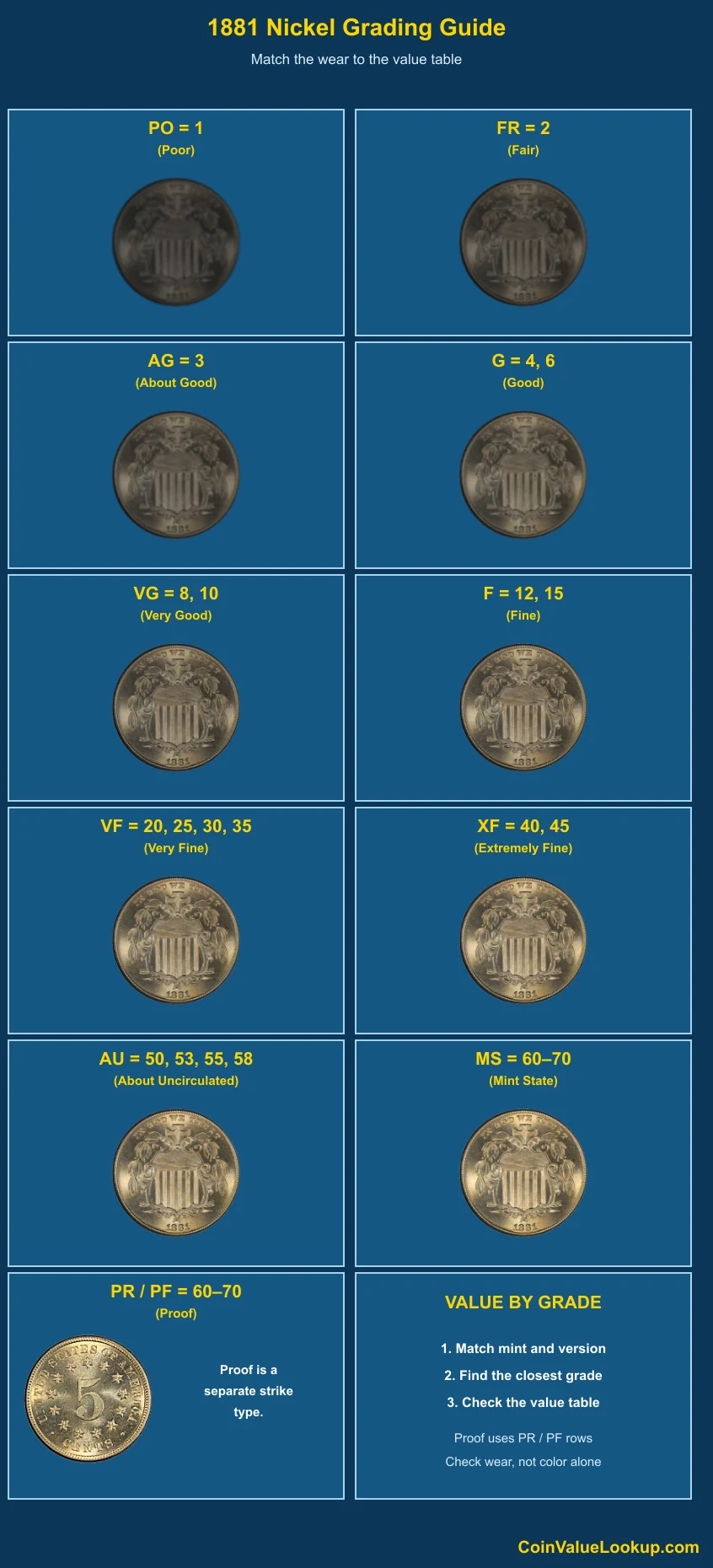
Start by examining the shield on the obverse. The horizontal and vertical lines inside the shield are the first details to soften with wear.
In lower grades like G4, only the outline of the shield and the boldest features remain sharp.
Next, check the cross and the leaves at the top of the obverse. These high points lose definition quickly in circulation.
On a coin grading VF or better, individual leaf veins and the cross detail should still be visible.
One trap with Shield Nickels: weak strikes can mimic wear. Some 1881 pieces left the press with mushy detail that has nothing to do with circulation.
Compare your coin's high points to the comparison image, and look at the fields and luster to get a fuller picture before deciding on a grade.
For proofs, grading shifts to surface preservation and hairlines. A PR63 proof may show light hairlines under magnification but retains reflective fields.
Heavier hairlines or haze drops the grade further. Do not clean your coin — cleaning permanently damages surfaces and requires a separate, lower valuation.
Step 3: Check 1881 Shield Nickel Value by Mint and Version
1881 Shield Nickel — No Mint Mark — Circulation Strike
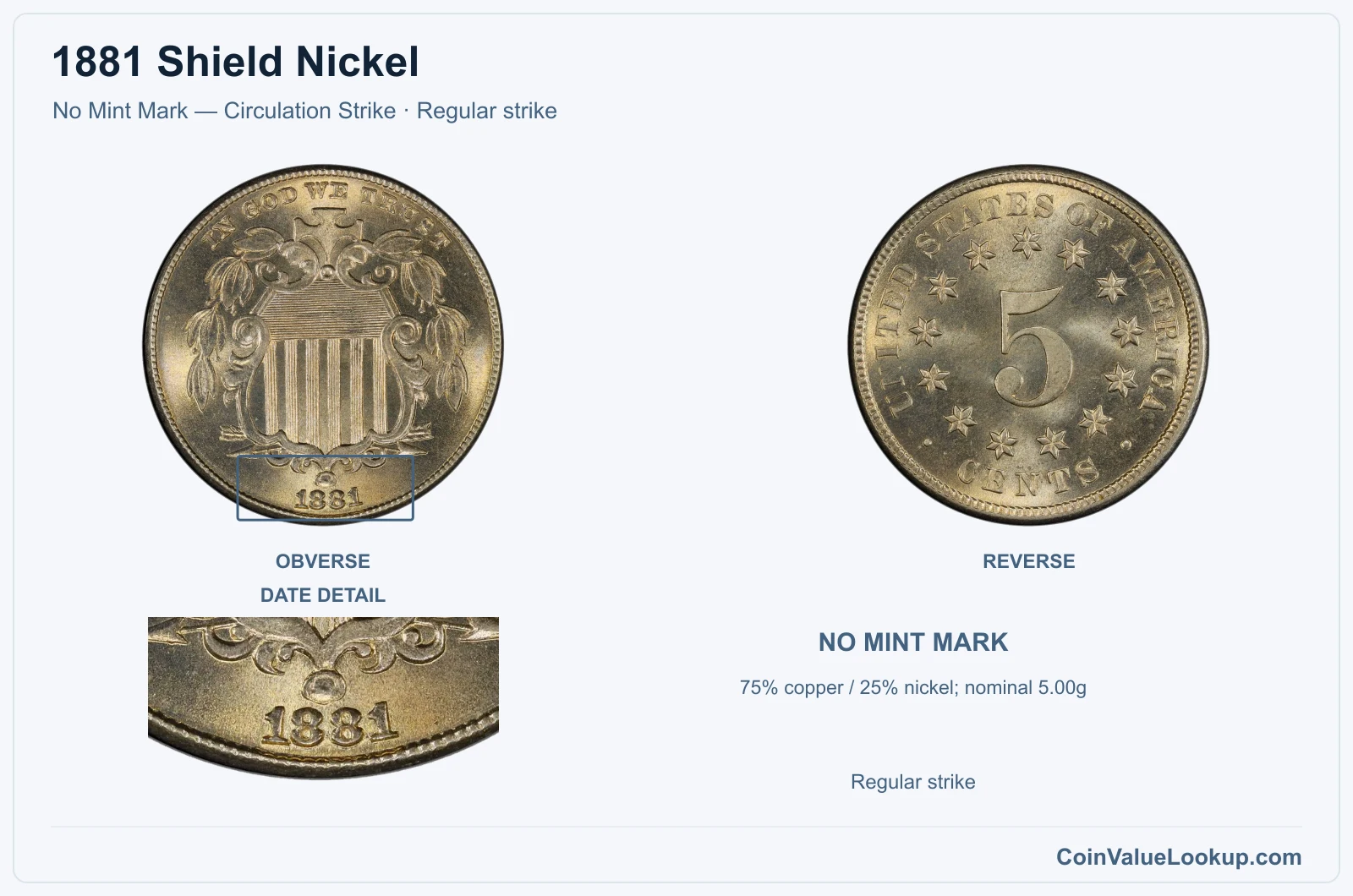
The 1881 business strike was produced in limited numbers at Philadelphia, making it one of the scarcer regular-issue Shield Nickels. There is no mintmark.
The design is the established No Rays type.
USA Coin Book guide estimates place this coin at roughly $313 in G4 and around $1,674 in MS63. Grades between those anchors scale accordingly.
Weak strikes are known for this series, so take care not to confuse soft detail from the die with actual circulation wear — check luster and field quality alongside the high-point sharpness before settling on a grade.
If you are researching other nickels or different dates, Coin Value Lookup is a handy starting point for pulling up coin value guides organized by year and denomination.
Range Grade
Price Auction Records Appraisal PO PO 1
—
Coin Identifier FR FR 2
Coin Identifier AG AG 3
Coin Identifier G G 4
Coin Identifier
G 6
Coin Identifier VG VG 8
Coin Identifier
VG 10
Coin Identifier F F 12
Coin Identifier
F 15
Coin Identifier VF VF 20
Coin Identifier
VF 25
Coin Identifier
VF 30
Coin Identifier
VF 35
Coin Identifier XF XF 40
Coin Identifier
XF 45
Coin Identifier AU AU 50
Coin Identifier
AU 53
Coin Identifier
AU 55
Coin Identifier
AU 58
Coin Identifier MS MS 60
—
Coin Identifier
MS 61
Coin Identifier
MS 62
Coin Identifier
MS 63
Coin Identifier
MS 64
Coin Identifier
MS 65
Coin Identifier
MS 66
Coin Identifier
MS 67
Coin Identifier
MS 68
—
—
—
MS 69
—
—
—
MS 70
—
—
—
1881 Shield Nickel — No Mint Mark — Proof
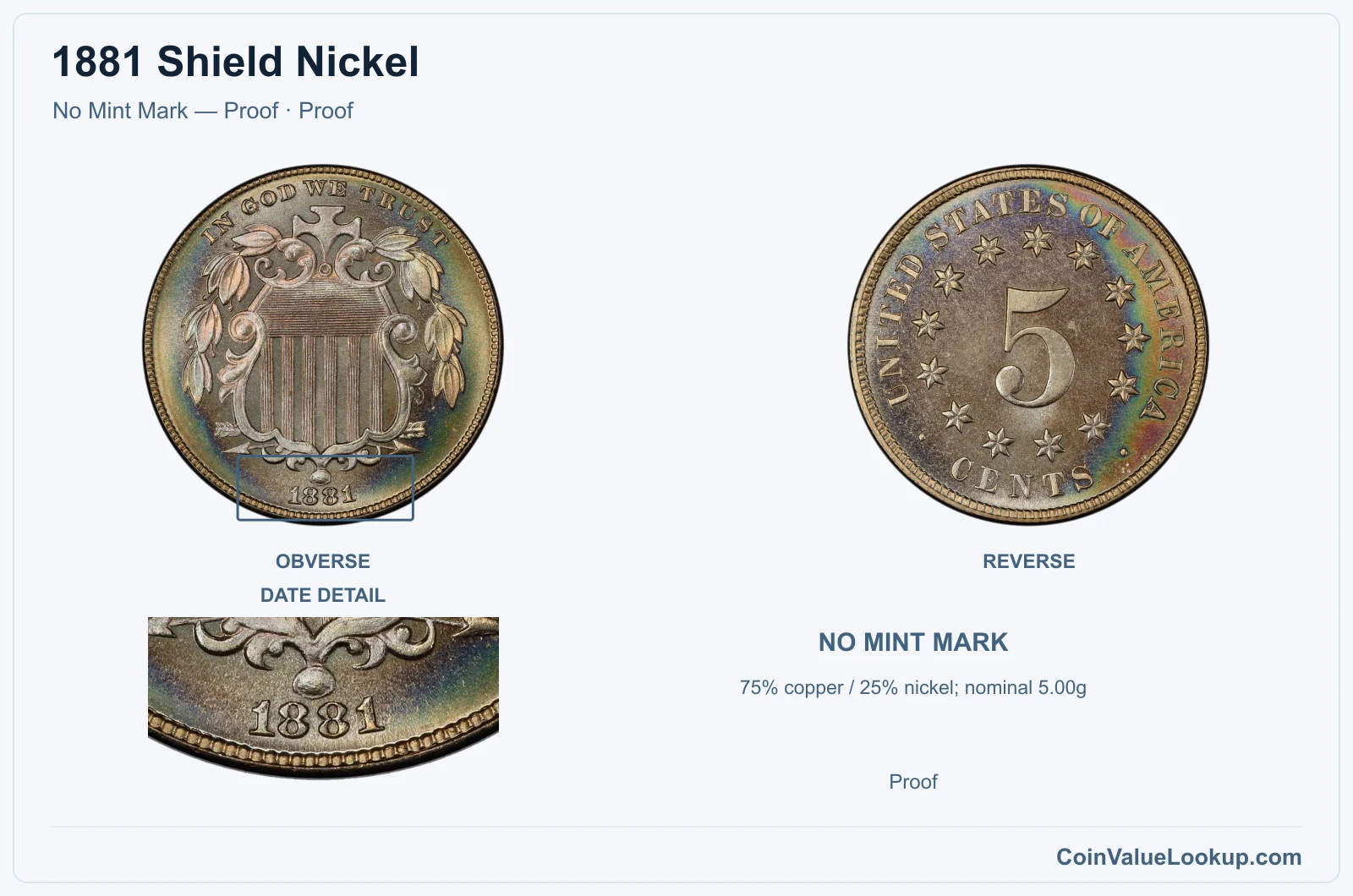
Philadelphia also struck proof 1881 Shield Nickels as dedicated collector pieces. These were made with polished dies and carefully prepared planchets, producing mirror-like fields and sharp design elements right off the press.
A PR63 example carries a USA Coin Book guide estimate of about $468. The actual value of any individual proof depends heavily on surface preservation — hairlines, haze, and toning all factor in.
Cameo contrast, where frosted devices stand out against mirror fields, is a separate designation that can affect desirability but falls outside the base proof classification.
Telling a high-grade business strike from a proof can be tricky on Shield Nickels. Look at the rim profile, the character of the fields under angled light, and whether the surfaces show the flat, glassy reflection typical of proof manufacture versus the slightly cartwheel luster of a mint-state business strike.
Range Grade
Price Auction Records Appraisal PR PR 1
—
Coin Identifier
PR 2
—
Coin Identifier
PR 3
—
Coin Identifier
PR 4
—
Coin Identifier
PR 6
—
Coin Identifier
PR 8
—
Coin Identifier
PR 10
—
Coin Identifier
PR 12
—
Coin Identifier
PR 15
—
Coin Identifier
PR 20
—
Coin Identifier
PR 25
—
Coin Identifier
PR 30
—
Coin Identifier
PR 35
—
Coin Identifier
PR 40
—
Coin Identifier
PR 45
Coin Identifier
PR 50
—
Coin Identifier
PR 53
—
Coin Identifier
PR 55
Coin Identifier
PR 58
—
Coin Identifier
PR 60
Coin Identifier
PR 61
Coin Identifier
PR 62
Coin Identifier
PR 63
Coin Identifier
PR 64
Coin Identifier
PR 65
Coin Identifier
PR 66
Coin Identifier
PR 67
Coin Identifier
PR 68
Coin Identifier
PR 69
—
—
—
PR 70
—
—
—
1881 Shield Nickel Error List
1. 1881 Shield Nickel — Doubled Die Obverse
A Doubled Die Obverse on the 1881 Shield Nickel shows consistent doubling on obverse design elements — typically visible as separation or notching on letters, the date, or shield lines. The key word is consistent: genuine doubled dies repeat the same shift across multiple devices on the same side of the coin.
To check, compare the obverse lettering and date of your coin to a known normal example under the same lighting. Look for a secondary image slightly offset from the primary design, with clean separation rather than a flat, shelf-like distortion.
Machine doubling is the most common lookalike. It tends to produce a flat shelf on one side of a letter rather than a rounded, equally strong secondary impression.
Worn-die contours and reflections can also fool you under certain angles. No specific price data is available for this variety; the value of any doubled die depends on the visibility of the doubling, overall coin condition, and collector demand for that particular die marriage.
2. 1881 Shield Nickel — Repunched Date
A Repunched Date on the 1881 Shield Nickel occurs when the date numerals were punched into the working die more than once, with a slight positional shift between impressions. The result is remnants of an earlier date position visible alongside the final digits — often a trace of a "1" or "8" slightly north, south, or to one side of its final placement.
This is mechanically different from a doubled die, which affects the entire obverse design through a hubbing misalignment. A repunched date is localized to the date area because the individual date punches were applied separately.
Lookalikes include a damaged or corroded date area and machine doubling that flattens the numerals. Genuine repunching shows a clear secondary impression with its own rounded contours.
No specific price is adopted for this variety; value depends on the strength and clarity of the repunching and the coin's overall condition.
3. 1881 Shield Nickel — Die Crack / Die Chip
Die cracks and die chips on 1881 Shield Nickels appear as raised lines or small raised blobs on the coin's surface. They originate from fractures or missing pieces in the steel die, so the resulting marks transfer as raised features — the opposite of a scratch, which is incised into the metal.
A die crack that connects to the rim is sometimes called a cud, especially when a chunk of the die has broken away and left a raised, featureless blob at the edge. Interior die chips appear as small raised lumps within the design fields or on devices.
Do not confuse these with incuse scratches, corrosion pits, or foreign material stuck to the surface. Scratches are recessed.
Corrosion is rough and uneven. Die cracks follow smooth, consistent raised paths.
No specific price data is available for die cracks on this date; the premium, if any, depends on the crack's size, location, and the coin's overall grade.