1899 Barber Quarter Coin Value: How Much Is It Worth?
The 1899 Barber Quarter is a 90% silver coin struck at up to three mints, with a proof finish also available from Philadelphia. Guide estimates for this year range from about $21.00 in well-worn condition to $2,692.00 at higher uncirculated grades, depending on which mint, finish and condition apply to your specific coin.
Not every 1899 quarter falls at the top of that spread — most circulated examples sit closer to the lower end.
Fast Way to Identify Your 1899 Barber Quarter
The quickest way to start figuring out what you have is to upload clear photos of both the front and back of your coin. Our identifier can give you a preliminary read on the mint, version and approximate condition.
Good lighting and a steady hand help — try to capture any mintmark area and the full obverse detail so nothing gets missed.
1899 Barber Quarter Value
Upload both sides of your 1899 Barber Quarter.
Front Obverse
Upload photo
Back Reverse
Upload photo
Which 1899 Barber Quarter Versions Are Worth Money?
- 1899-S quarters carry the highest guide values for business strikes — $52.00 in G4 and $2,692.00 in MS63 — because San Francisco pieces are scarcer in upper grades.
- 1899-O coins from New Orleans reach $1,252.00 at the MS63 guide level, well above the Philadelphia equivalent at the same grade.
- 1899 Proof (PR) quarters list at $799.00 in PR63; these were made in limited numbers as presentation pieces, not for circulation.
- Check the mintmark first — a worn Philadelphia quarter and a worn San Francisco quarter look almost identical from the front, but their values diverge significantly.
Step 1: Identify Your 1899 Barber Quarter Mint Mark and Version
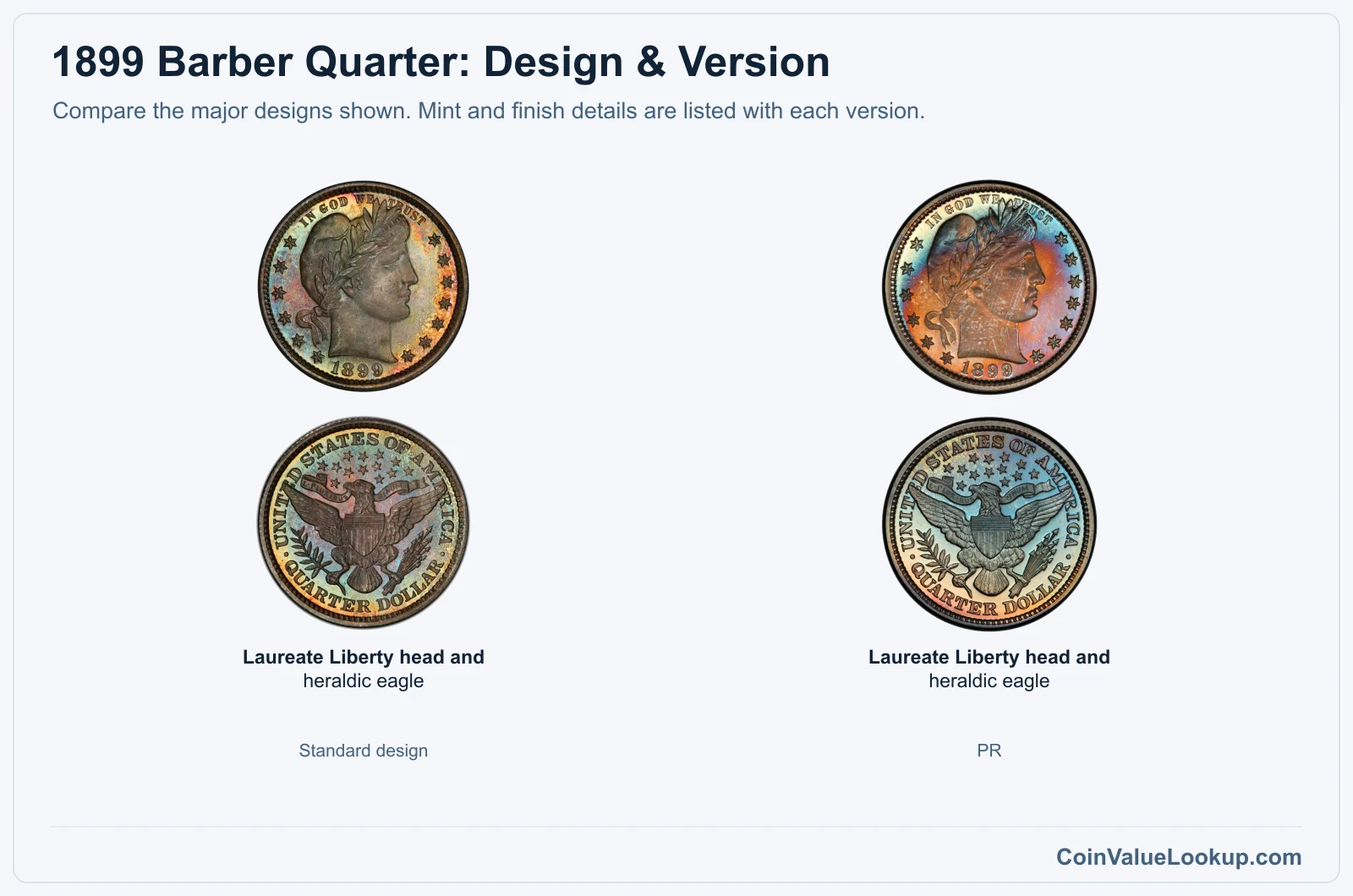
The 1899 Barber Quarter features Charles Barber's laureate Liberty head on the obverse and a heraldic eagle on the reverse. It weighs 6.25 grams in a 90% silver, 10% copper alloy.
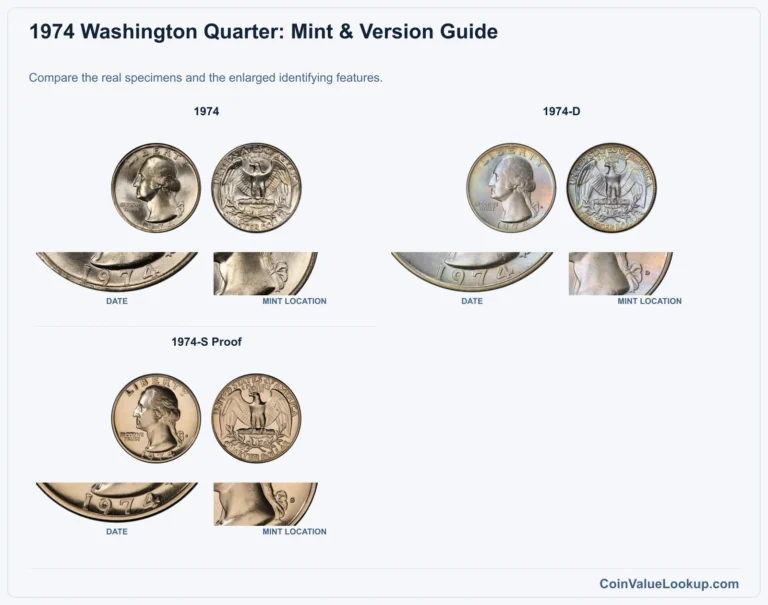
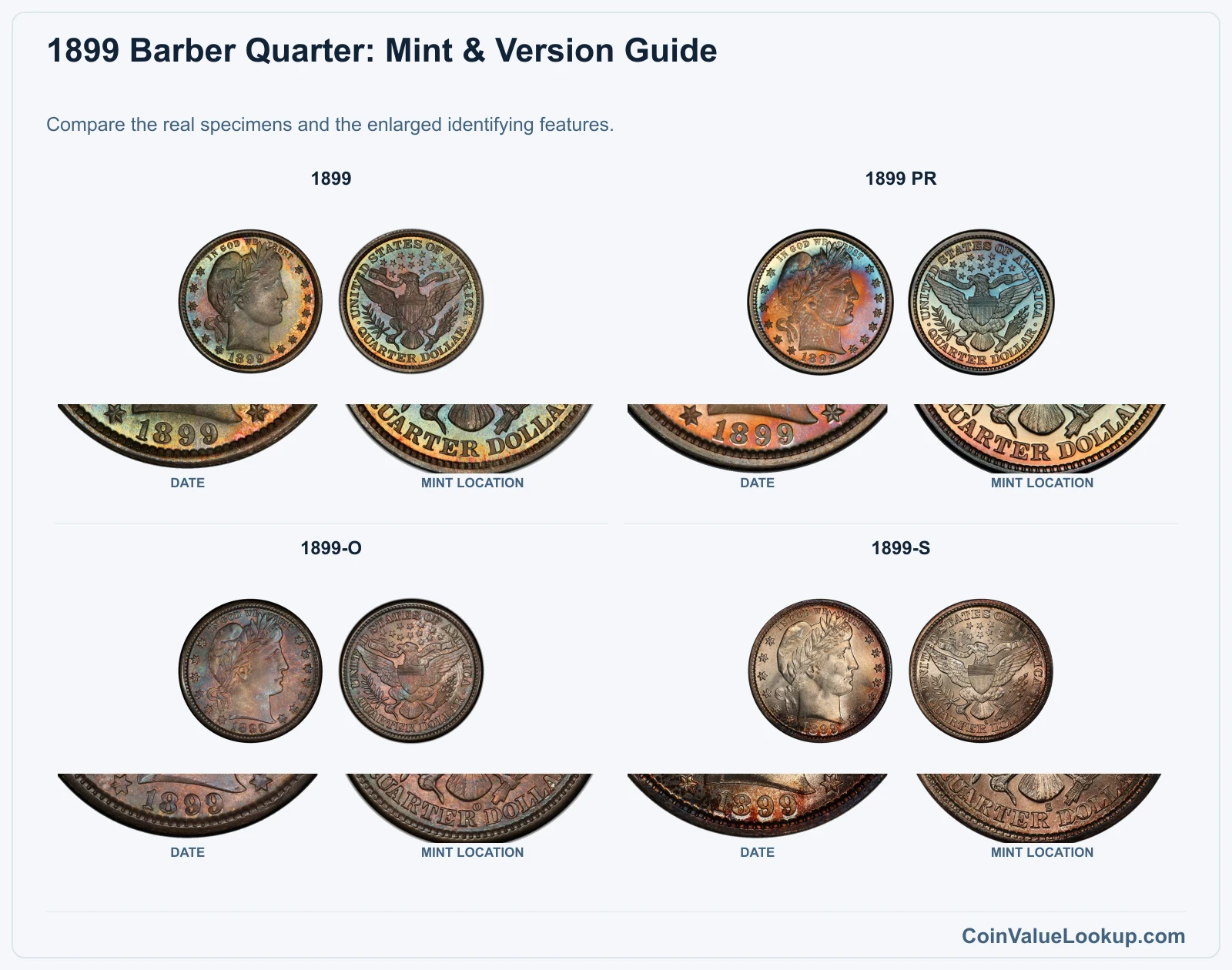
Flip the coin over and look below the eagle's tail feathers, just above the denomination. A small "O" means New Orleans, an "S" means San Francisco, and no letter at all means Philadelphia.
That mintmark is the single most important thing to check before you start pricing.
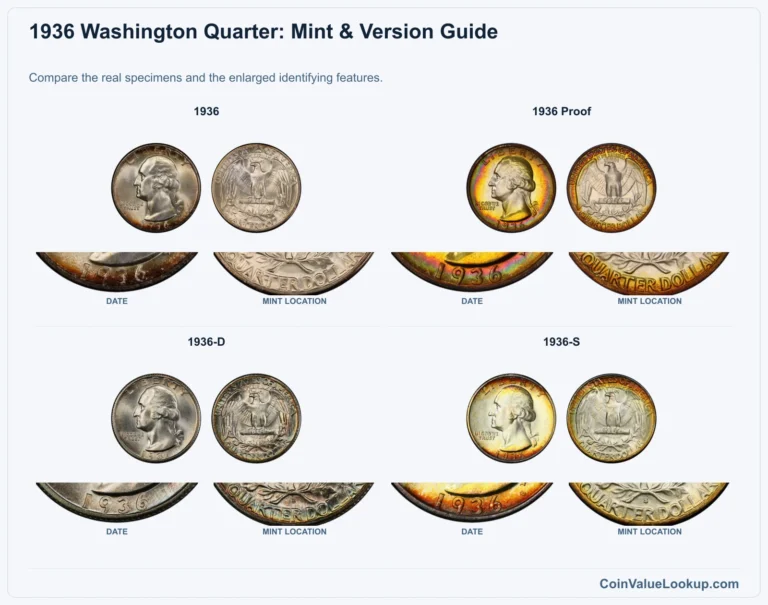
Philadelphia also produced proof strikes in 1899. A proof is a special manufacturing process — mirror-like fields, sharp rims — not simply a shiny coin.
If your quarter looks unusually reflective, compare it carefully against known proof images before assuming you have one.
The four branches for this year are: 1899 (Philadelphia business strike), 1899 PR (Philadelphia proof), 1899-O (New Orleans), and 1899-S (San Francisco). Match your coin to the right branch before checking any value guide.
Step 2: Check Your 1899 Barber Quarter Grade
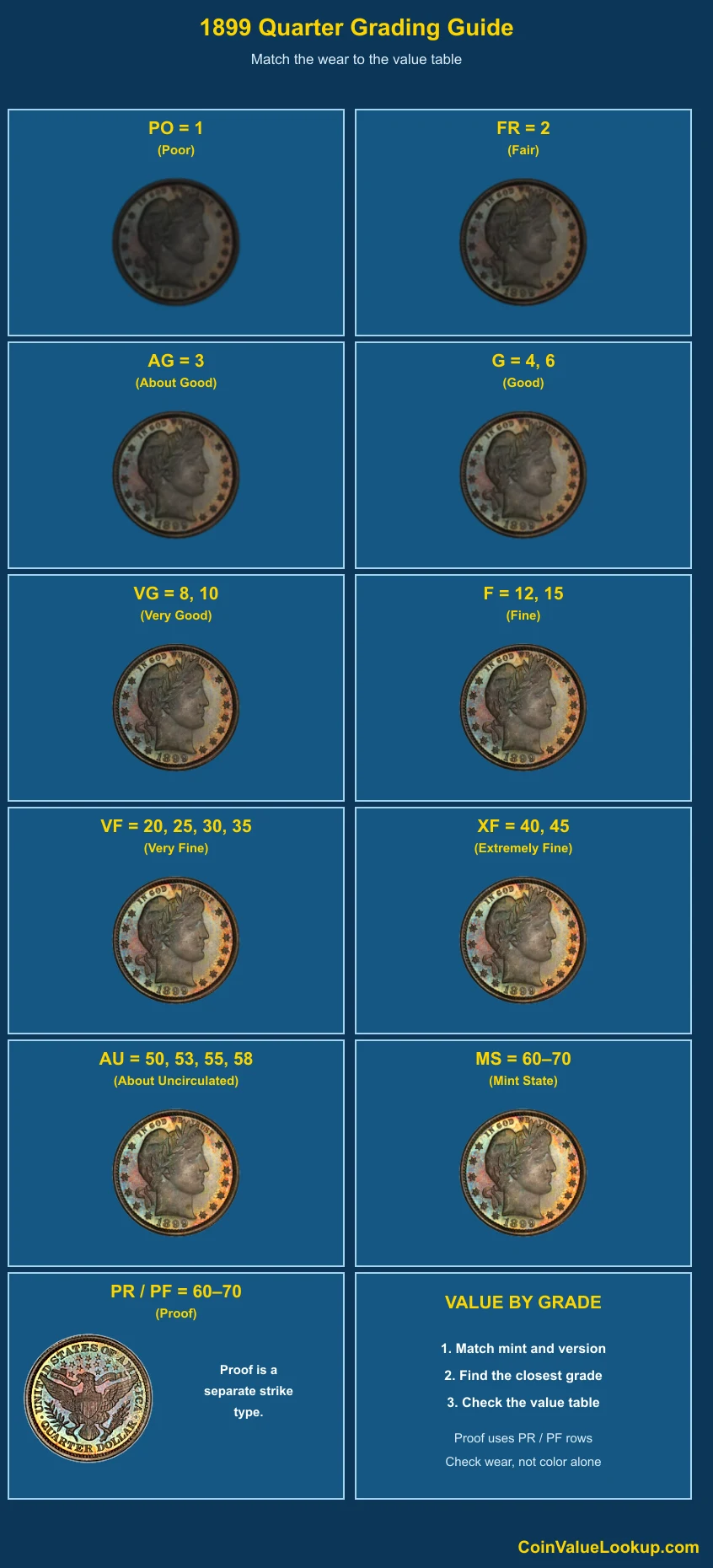
Start with Liberty's hair above the forehead and the detail in the laurel wreath. On a lightly worn coin, the hair strands begin to merge just above the ear and the cheek flattens slightly.
Heavy wear turns those areas into smooth patches.
On the reverse, check the eagle's breast feathers, wing tips and tail. These high points lose definition first.
The word LIBERTY on the headband is a handy gauge, but do not rely on it alone — a weak strike can soften letters even on an unworn coin.
Compare your coin against the reference image to judge both wear and remaining luster together. A coin with full mint luster but soft details may be weakly struck rather than worn.
Conversely, a coin with sharp detail but dull, dark surfaces may have been cleaned or environmentally damaged, which affects value regardless of the technical grade.
Step 3: Check 1899 Barber Quarter Value by Mint and Version
1899 Barber Quarter
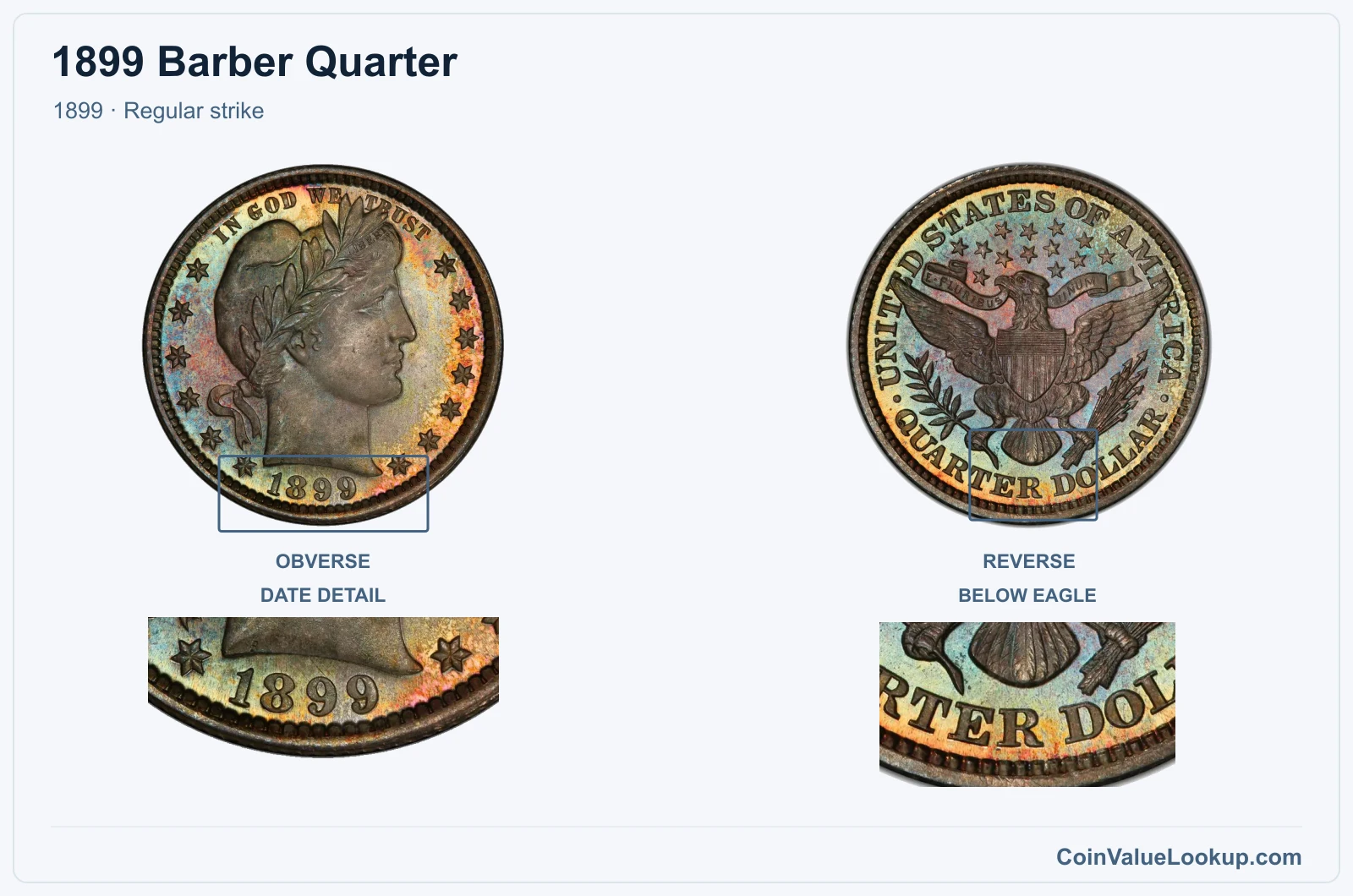
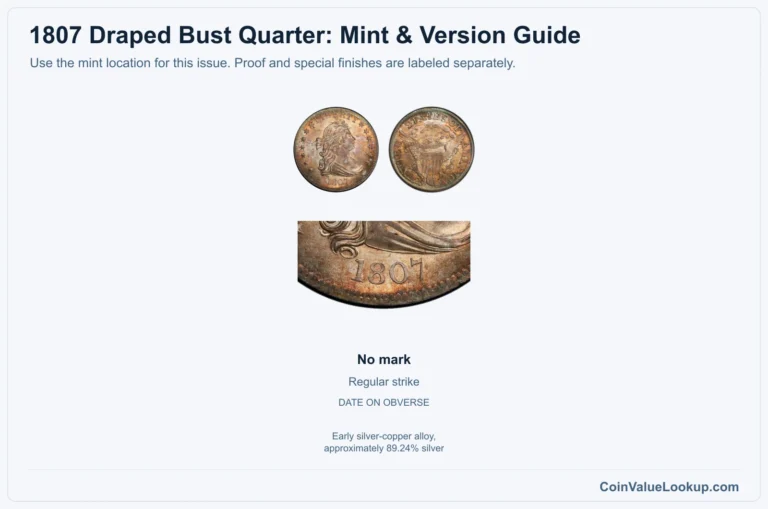
The 1899 Philadelphia business strike carries no mintmark. In well-circulated G4 condition, USA Coin Book estimates it at about $21.00.
Step up to uncirculated territory and the jump is steep: MS60 lists around $309.00, while a nicer MS63 reaches $477.00.
Before comparing your coin to those figures, confirm the surfaces are original. Cleaning strips natural toning and creates hairlines visible under magnification; a cleaned coin will not match the value of one with honest, undisturbed surfaces.
Strike quality matters too — Philadelphia strikes from this era are generally well-executed, but individual coins vary.
Range Grade
Price Auction Records Appraisal PO PO 1
—
Coin Identifier FR FR 2
—
Coin Identifier AG AG 3
—
Coin Identifier G G 4
—
Coin Identifier
G 6
Coin Identifier VG VG 8
—
Coin Identifier
VG 10
—
Coin Identifier F F 12
—
Coin Identifier
F 15
—
Coin Identifier VF VF 20
Coin Identifier
VF 25
Coin Identifier
VF 30
Coin Identifier
VF 35
Coin Identifier XF XF 40
Coin Identifier
XF 45
Coin Identifier AU AU 50
Coin Identifier
AU 53
Coin Identifier
AU 55
Coin Identifier
AU 58
Coin Identifier MS MS 60
—
Coin Identifier
MS 61
Coin Identifier
MS 62
Coin Identifier
MS 63
Coin Identifier
MS 64
Coin Identifier
MS 65
Coin Identifier
MS 66
Coin Identifier
MS 67
Coin Identifier
MS 68
—
—
—
MS 69
—
—
—
MS 70
—
—
—
1899 Barber Quarter — PR
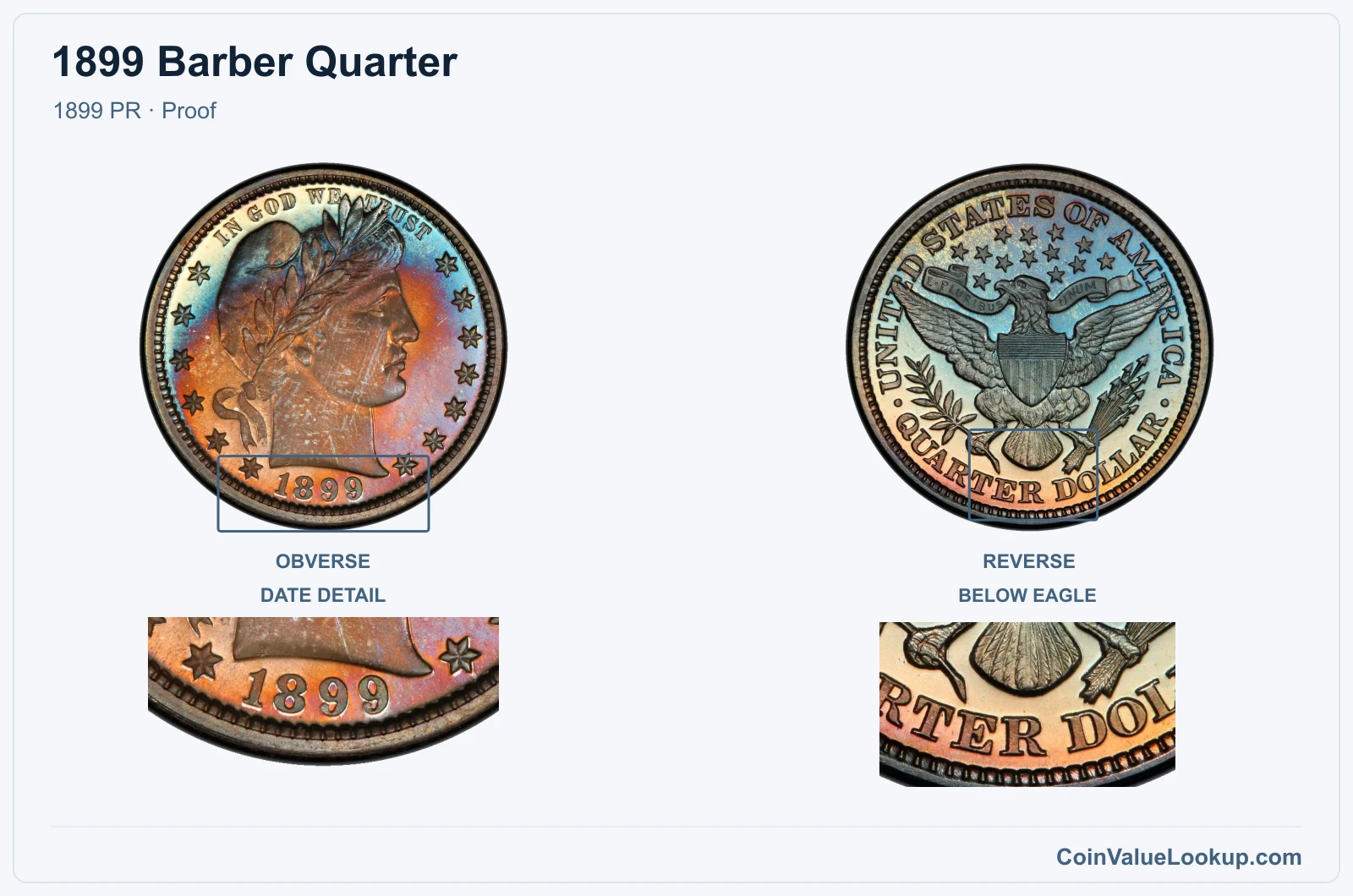
The 1899 Proof quarter was struck at Philadelphia using polished dies and specially prepared planchets. These are not simply nice-looking business strikes; they have mirror fields and squared-off rims that regular coins lack.
USA Coin Book places the PR63 grade at $799.00. Hairlines from improper storage or cleaning are the biggest value killers on proofs — even light wiping leaves marks that show up harshly against reflective surfaces.
If your coin has deeply mirrored fields but fine scratches running in one direction, it has likely been wiped at some point.
A genuine proof will also show sharper design details than any business strike, including the denticles around the rim. Do not assume proof status from brightness alone; a well-preserved business strike can look reflective under certain lighting.
Range Grade
Price Auction Records Appraisal PR PR 1
—
Coin Identifier
PR 2
—
Coin Identifier
PR 3
—
Coin Identifier
PR 4
—
Coin Identifier
PR 6
—
Coin Identifier
PR 8
—
Coin Identifier
PR 10
—
Coin Identifier
PR 12
—
Coin Identifier
PR 15
—
Coin Identifier
PR 20
—
Coin Identifier
PR 25
—
Coin Identifier
PR 30
—
Coin Identifier
PR 35
—
Coin Identifier
PR 40
—
Coin Identifier
PR 45
—
Coin Identifier
PR 50
—
Coin Identifier
PR 53
—
Coin Identifier
PR 55
—
Coin Identifier
PR 58
Coin Identifier
PR 60
—
Coin Identifier
PR 61
Coin Identifier
PR 62
Coin Identifier
PR 63
Coin Identifier
PR 64
Coin Identifier
PR 65
Coin Identifier
PR 66
Coin Identifier
PR 67
Coin Identifier
PR 68
Coin Identifier
PR 69
—
—
—
PR 70
—
—
—
1899 Barber Quarter — O
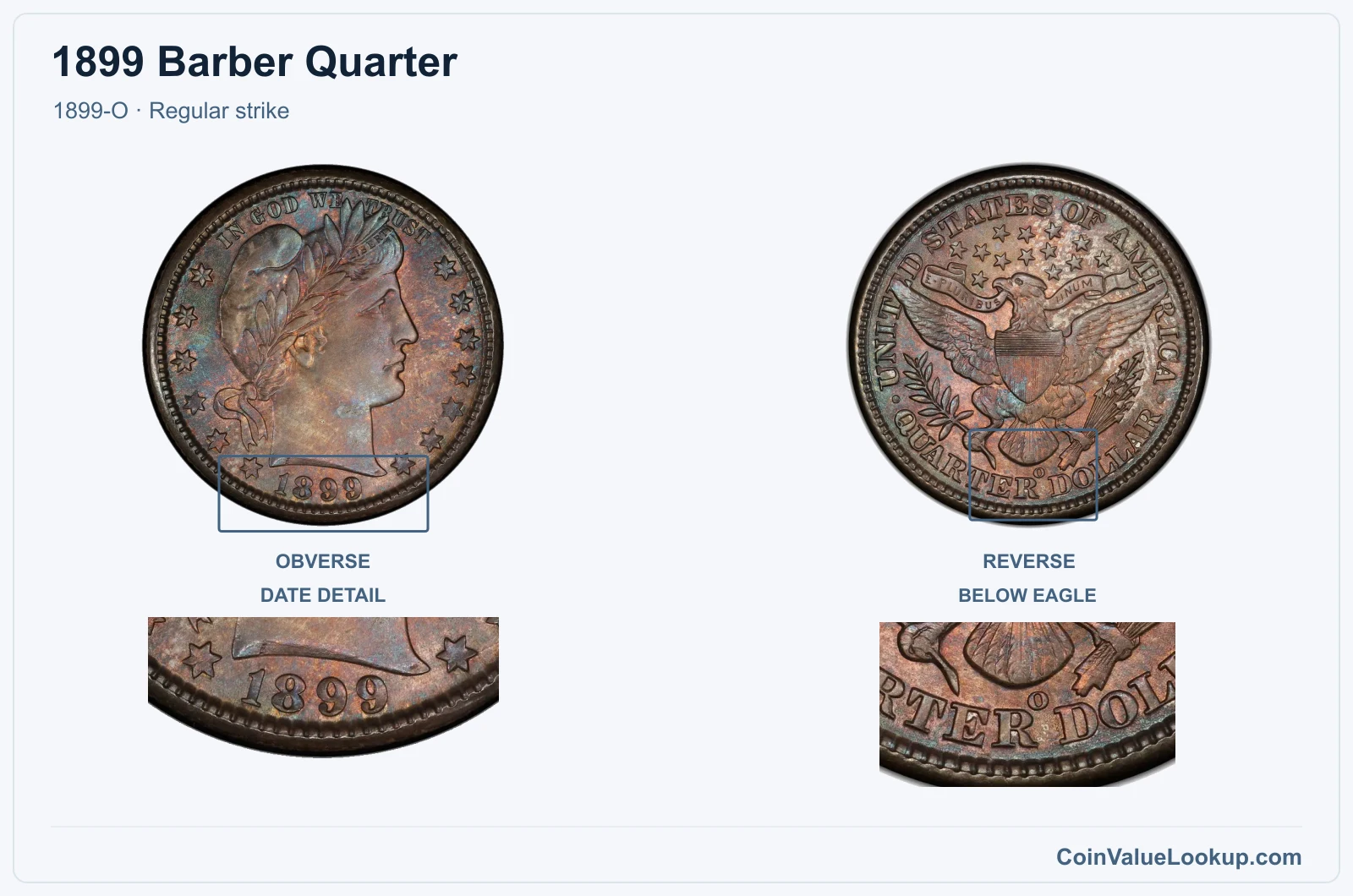
The 1899-O was struck at the New Orleans Mint. Look for the small "O" on the reverse beneath the eagle's tail feathers.
In G4 the guide sits at $25.00 — only slightly above Philadelphia. The real separation appears in higher grades: $621.00 at MS60 and $1,252.00 at MS63 per USA Coin Book.
That premium reflects how few New Orleans pieces survived without heavy wear or cleaning.
Coin Value Lookup is a good starting point if you want to compare this quarter's guide values with other dates and mints in the Barber series.
Original surfaces and strong strike details push New Orleans coins toward the upper end of their grade ranges. Damage or cleaning will pull them back toward common-date prices regardless of the mintmark.
Range Grade
Price Auction Records Appraisal PO PO 1
—
Coin Identifier FR FR 2
—
Coin Identifier AG AG 3
Coin Identifier G G 4
—
Coin Identifier
G 6
—
Coin Identifier VG VG 8
—
Coin Identifier
VG 10
—
Coin Identifier F F 12
—
Coin Identifier
F 15
—
Coin Identifier VF VF 20
—
Coin Identifier
VF 25
Coin Identifier
VF 30
Coin Identifier
VF 35
Coin Identifier XF XF 40
Coin Identifier
XF 45
Coin Identifier AU AU 50
Coin Identifier
AU 53
Coin Identifier
AU 55
Coin Identifier
AU 58
Coin Identifier MS MS 60
—
Coin Identifier
MS 61
Coin Identifier
MS 62
Coin Identifier
MS 63
Coin Identifier
MS 64
Coin Identifier
MS 65
Coin Identifier
MS 66
Coin Identifier
MS 67
Coin Identifier
MS 68
—
—
—
MS 69
—
—
—
MS 70
—
—
—
1899 Barber Quarter — S
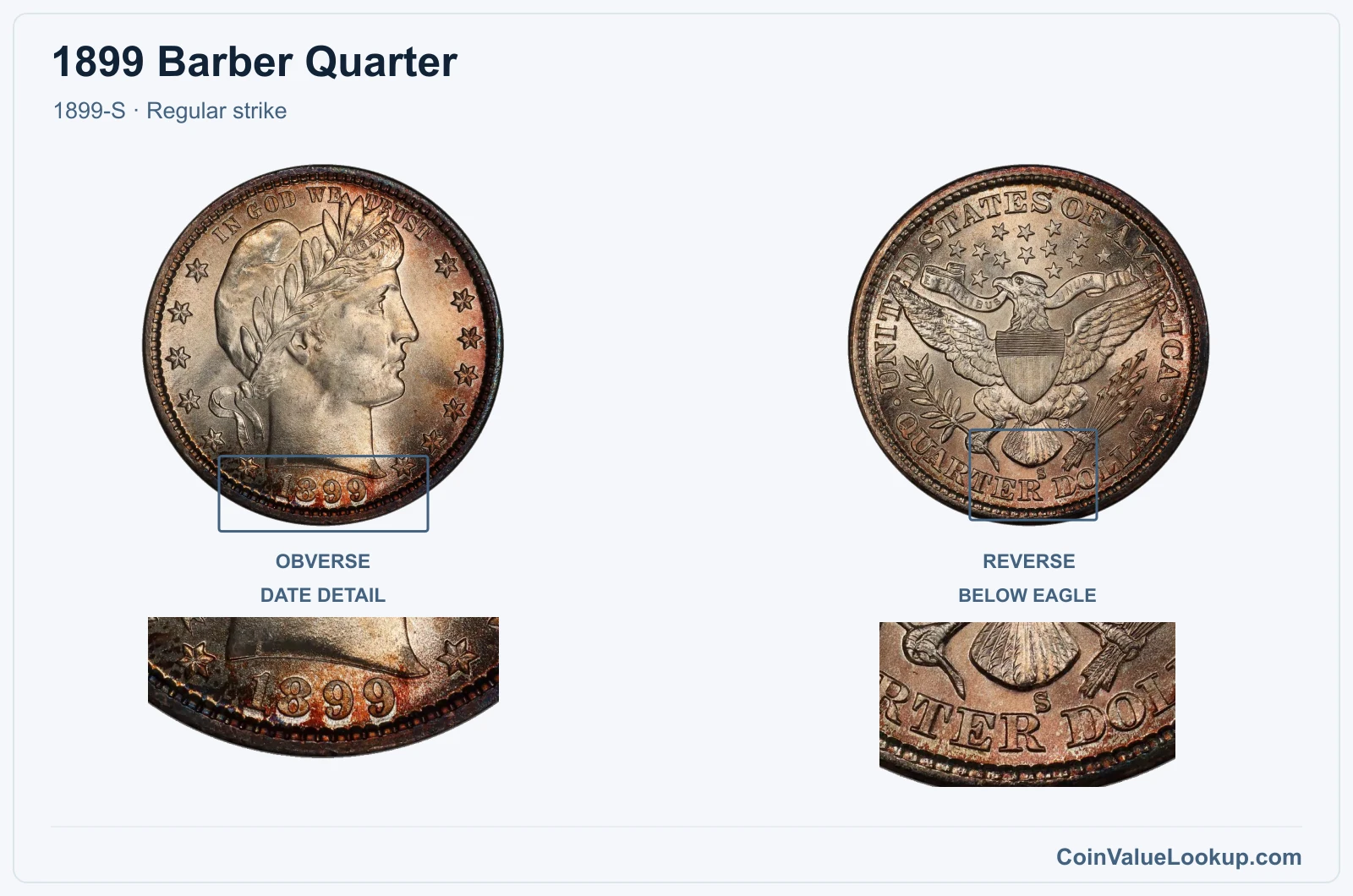
The 1899-S, struck in San Francisco, is the key business-strike coin for this date. Its guide values are the highest across the board: $52.00 in G4, $1,454.00 at MS60 and $2,692.00 at MS63 according to USA Coin Book.
Even in low grades, an 1899-S is worth more than double a Philadelphia coin in the same condition. In uncirculated grades the gap widens dramatically.
That premium exists because relatively few San Francisco quarters survived in nice shape — most saw heavy commercial use on the West Coast.
Confirm the "S" mintmark on the reverse carefully. The letter should sit cleanly between the eagle's tail and the denomination.
Match the mint, then evaluate wear and surface quality honestly before comparing to guide figures.
Range Grade
Price Auction Records Appraisal PO PO 1
—
Coin Identifier FR FR 2
—
Coin Identifier AG AG 3
—
Coin Identifier G G 4
—
Coin Identifier
G 6
Coin Identifier VG VG 8
—
Coin Identifier
VG 10
—
Coin Identifier F F 12
Coin Identifier
F 15
Coin Identifier VF VF 20
Coin Identifier
VF 25
Coin Identifier
VF 30
—
Coin Identifier
VF 35
Coin Identifier XF XF 40
Coin Identifier
XF 45
Coin Identifier AU AU 50
Coin Identifier
AU 53
Coin Identifier
AU 55
Coin Identifier
AU 58
Coin Identifier MS MS 60
—
Coin Identifier
MS 61
Coin Identifier
MS 62
Coin Identifier
MS 63
Coin Identifier
MS 64
Coin Identifier
MS 65
Coin Identifier
MS 66
Coin Identifier
MS 67
Coin Identifier
MS 68
Coin Identifier
MS 69
—
—
—
MS 70
—
—
—
1899 Barber Quarter Error List
1. 1899 Barber Quarter — Doubled Die Obverse
A Doubled Die Obverse on the 1899 Barber Quarter shows consistent doubling on obverse design elements — typically visible in the date digits, the LIBERTY headband, or the legend lettering. Under magnification, look for a clear secondary image with uniform separation or notching along one side of the affected features.
The key word is consistent. Every doubled letter or digit should show the shift in the same direction and to the same degree.
If the doubling is flat, shelf-like and only appears on the high points, you are more likely seeing machine doubling, which is a mechanical byproduct of the striking process and carries little collector premium.
No specific price data is available for this variety. Value depends on the strength of the doubling, the coin's overall condition and third-party verification.
2. 1899 Barber Quarter — Die Break / Cud
A die break or cud error on the 1899 Barber Quarter results from a piece of the die chipping away. When the missing section connects to the rim, the coin shows a raised, featureless blob along the edge — that is a cud.
Interior breaks appear as raised irregular lines across the design.
To identify one, look for a clearly raised area that displaces normal design elements. The boundary between the cud and the intact design should be distinct, not gradual.
A rim dent or corrosion spot is recessed or rough, not raised and smooth — that is the quickest way to tell them apart.
No adopted price is available for this error on the 1899 quarter. The size, location and overall coin condition all influence how collectors value a specific example.
3. 1899 Barber Quarter — Doubled Die Reverse
A Doubled Die Reverse on the 1899 Barber Quarter would show doubling on reverse legends, the eagle's design or the denomination. Sources have reported this category, though counterfeits have also been documented for 1899 DDR Barber Quarters — so authentication through a reputable third-party service is particularly important here.
Compare the reverse lettering and design contours against a normal 1899 quarter under similar lighting. Genuine hub doubling produces consistent separation across multiple design elements.
Machine doubling, by contrast, tends to appear as flat shelving on high points only and does not carry the same collector value.
No specific price data is available for this variety. The degree of doubling, the coin's condition and confirmed authenticity all affect what a collector would pay.
4. 1899 Barber Quarter — Off-Center Strike
An off-center strike happens when the planchet is not properly seated between the dies. The result is a displaced design with a blank crescent on one side of the coin.
For the 1899 Barber Quarter, this error has been reported in period sources.
The percentage of off-center displacement and whether the date remains visible are the two biggest factors collectors care about. A 5% shift is barely noticeable; 10–20% with a full date is the sweet spot for most buyers.
Past a certain point the coin becomes unidentifiable.
Do not confuse an off-center strike with a clipped planchet (which has a curved bite out of the edge) or post-mint damage from being pressed against something. No specific price data is available; value depends on the degree of displacement and the coin's overall condition.
5. 1899 Barber Quarter — Brockage
A brockage occurs when a previously struck coin sticks to a die and impresses its design — in mirror-image and incuse — onto the next coin fed into the press. On a 1899 Barber Quarter brockage, one side would show the normal design in relief while the other displays a sunken, reversed copy of either the obverse or reverse.
To identify a genuine brockage, check that the incuse image is a true mirror of the opposing design, with correct proportions and smooth contours. A die clash can leave faint impressions of the opposite design, but those are shallow and do not replace the normal design entirely.
Coins pressed together after leaving the mint will show uneven, rough impressions rather than clean incuse detail.
No adopted price is available. Condition, visual impact and the completeness of the brockage impression drive collector interest.