1913 Barber Quarter Coin Value: How Much Is It Worth?
The 1913 Barber Quarter is a silver coin struck in the final years of the Barber design series. Guide estimates for this year range from about $25.00 to $22,931.00, but that spread depends entirely on which mint produced your coin, what condition it survives in, and whether it was made as a proof.
The San Francisco issue alone accounts for the top of that range, while a well-worn Denver piece sits near the bottom.
Fast Way to Identify Your 1913 Barber Quarter
The quickest way to start figuring out what your 1913 quarter is worth is to upload clear photos of the front and back. Our identifier uses those images for a preliminary identification of the mint, version, and approximate condition.
It does not authenticate or certify your coin, but it gives you a useful starting point before you dig deeper.
1913 Barber Quarter Value
Upload both sides of your 1913 Barber Quarter.
Front Obverse
Upload photo
Back Reverse
Upload photo
Which 1913 Barber Quarter Versions Are Worth Money?
- 1913-S quarter: guide estimates reach $22,931.00 in MS63, making it the standout issue this year due to its scarcity in all grades.
- 1913 Philadelphia business strike: valued up to $1,136.00 at MS63 per USA Coin Book guide estimates.
- 1913 PR proof: guide estimate of $799.00 at PR63; a distinct collectible finish separate from regular strikes.
- Check mint and finish first; damage, heavy wear, or a bright cleaned surface does not establish a rare version.
Step 1: Identify Your 1913 Barber Quarter Mint Mark and Version
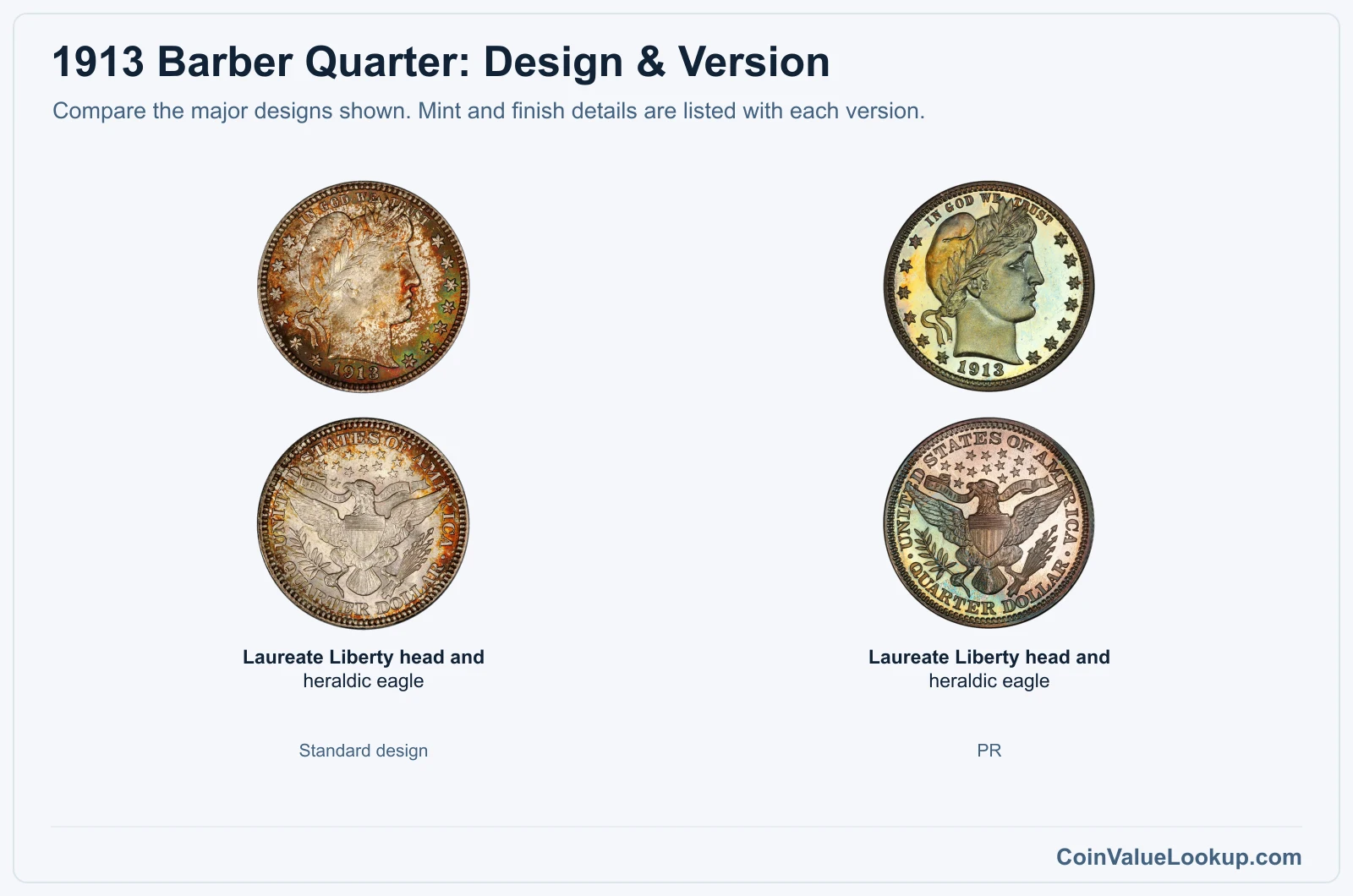
Every 1913 Barber Quarter carries the same laureate Liberty head on the obverse and a heraldic eagle on the reverse. The coin is 90% silver and 10% copper, weighing 6.25 grams.
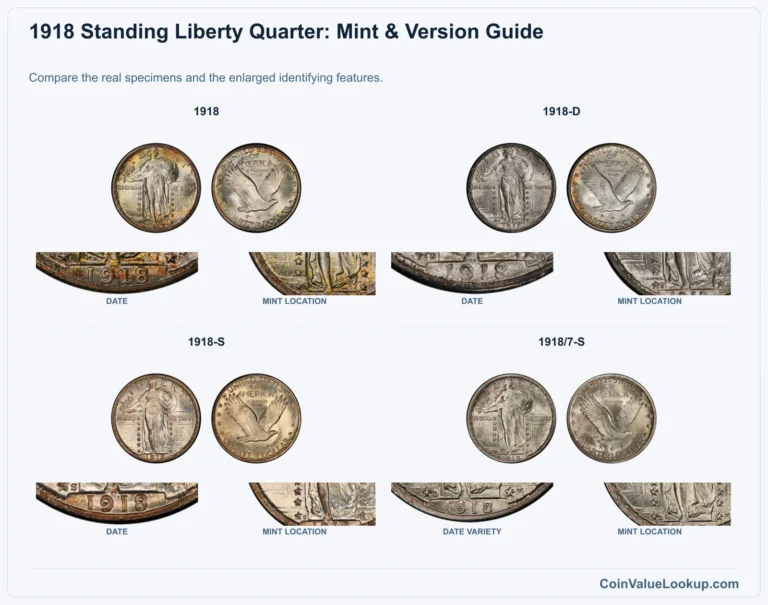
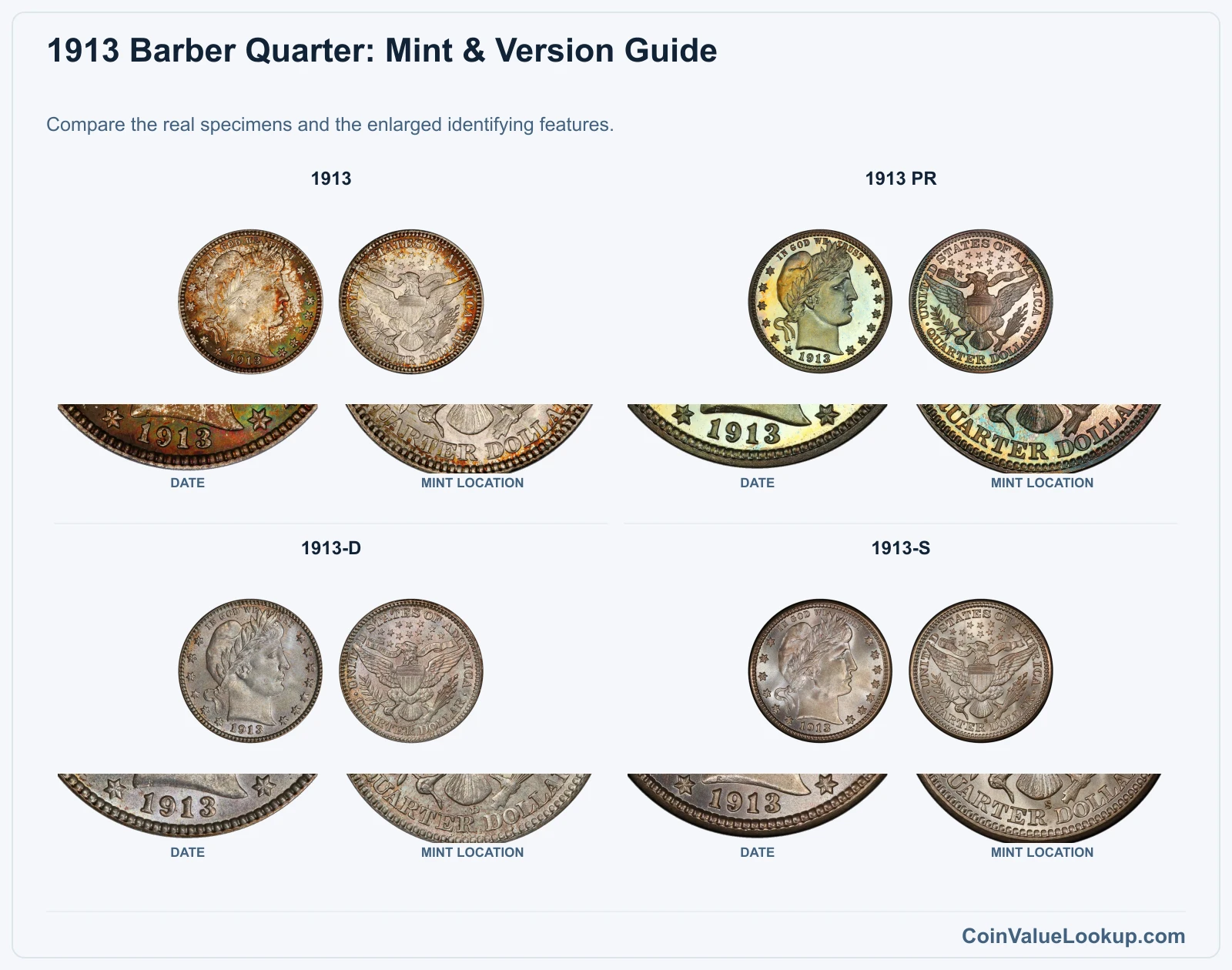
To figure out which branch you have, flip the coin over. Look below the eagle's tail feathers and above the denomination.
No letter means Philadelphia. A small "D" means Denver, and an "S" means San Francisco.
Philadelphia also produced proof versions this year. A proof 1913 quarter has mirror-like fields from specially prepared dies, distinct from a business strike that just happens to look shiny.
Do not confuse a well-preserved or cleaned regular strike with a proof; the manufacturing process is different.
So the four branches for this year are: 1913 (Philadelphia business strike), 1913 PR (Philadelphia proof), 1913-D (Denver), and 1913-S (San Francisco). Get the mint and finish right before you start comparing condition.
Step 2: Check Your 1913 Barber Quarter Grade
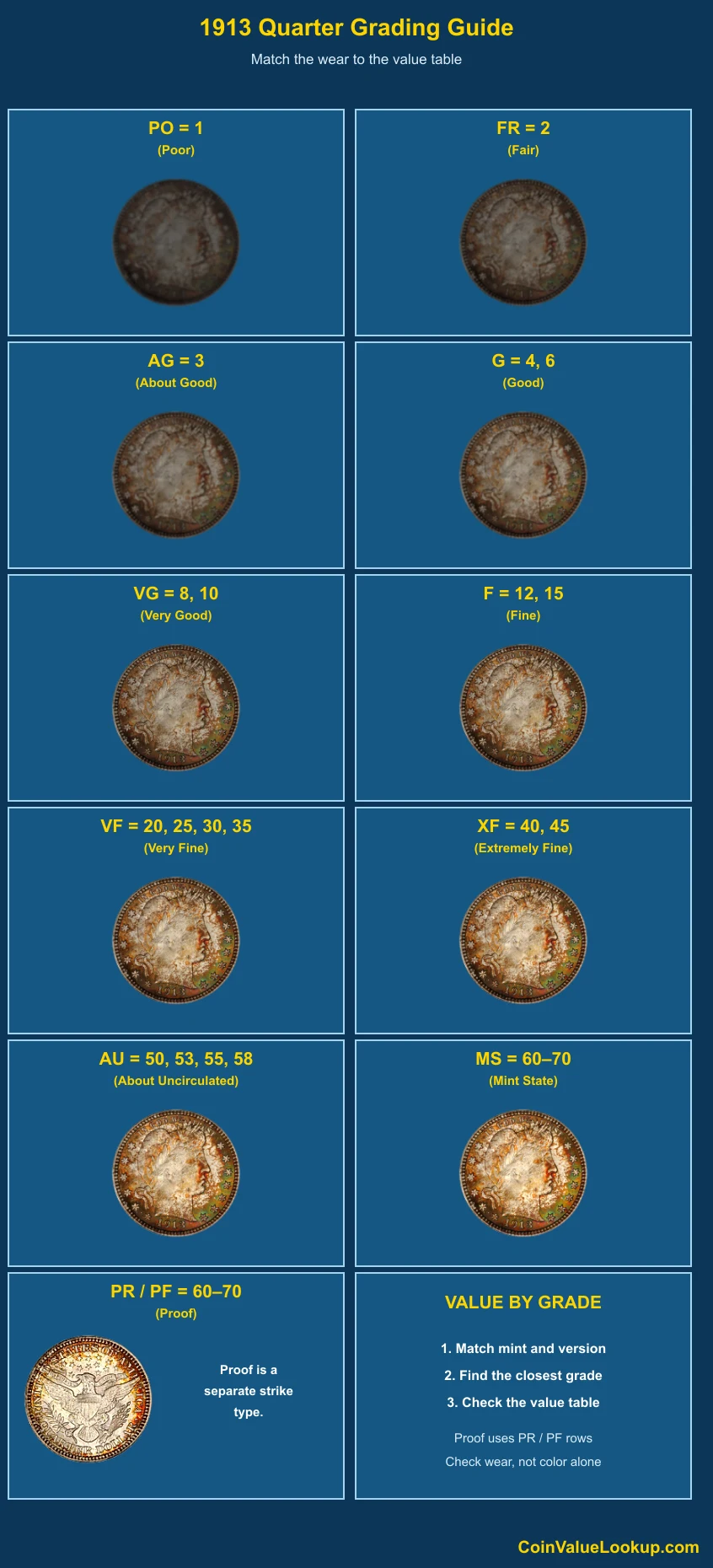
Start with Liberty's hair above the forehead. On a lightly circulated coin, the individual strands begin to merge first in this area and across the cheek.
The laurel wreath loses its leaf detail progressively as wear increases.
On the reverse, check the eagle's breast feathers, the tops of the wings, and the tail. These high points wear earliest.
The word LIBERTY on the headband is a classic wear gauge, but do not rely on it alone. Some coins came weakly struck from the mint, so a soft LIBERTY does not always mean heavy wear.
Compare luster across the whole surface alongside the high-point detail in the reference image.
A coin with full original luster and no wear lands in Mint State territory. One where LIBERTY is completely gone and the portrait is flat falls around Good-4.
Most surviving examples land somewhere in between. Cleaning, scratches, or rim damage can pull value well below what the grade alone suggests.
Step 3: Check 1913 Barber Quarter Value by Mint and Version
1913 Barber Quarter
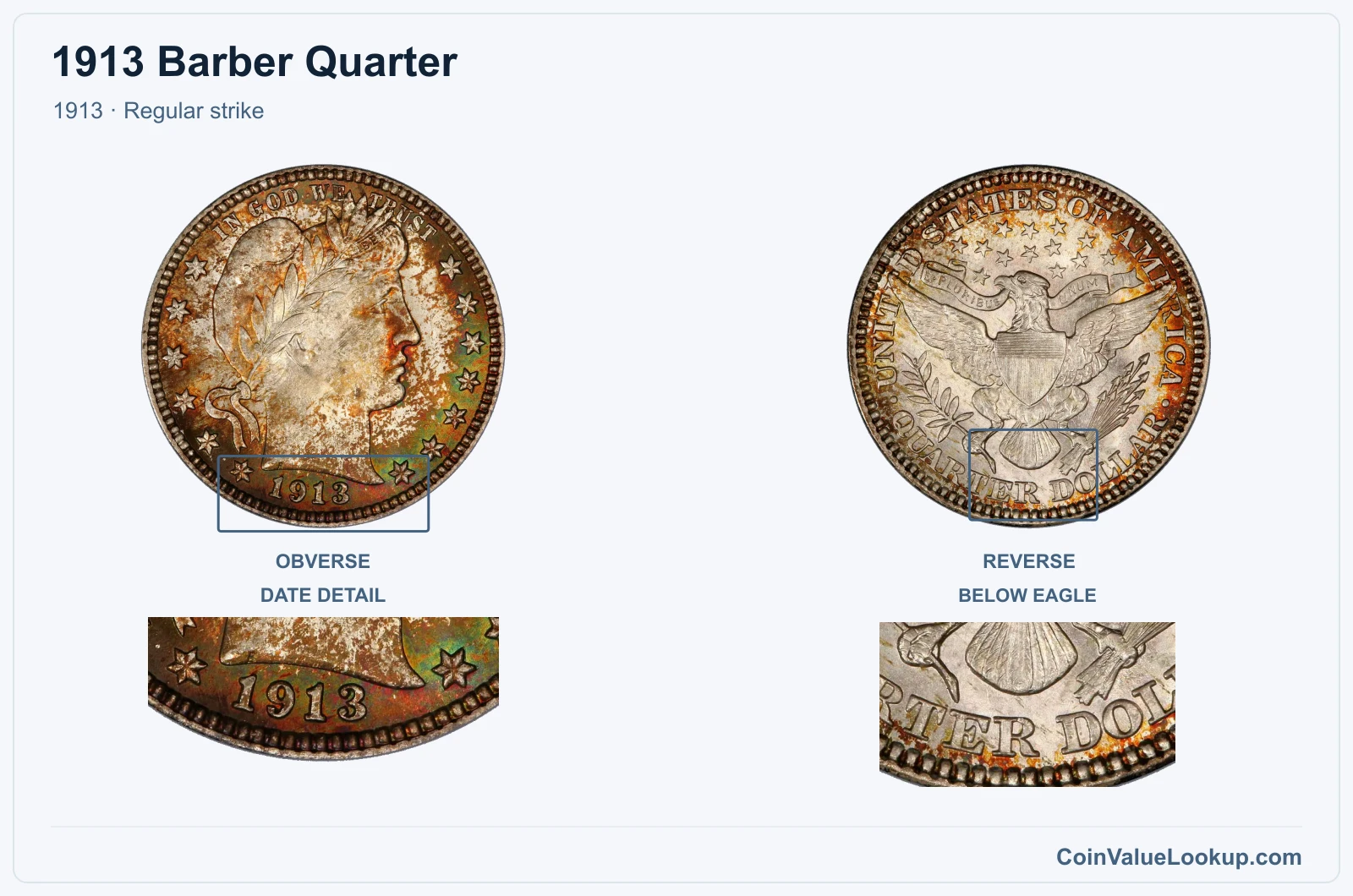
The 1913 Philadelphia business strike has no mintmark on the reverse. In heavily worn condition around Good-4, USA Coin Book estimates it at about $47.00.
Jump up to Mint State 60 and the guide puts it near $938.00, climbing to roughly $1,136.00 at MS63. These are guide estimates, not guaranteed offers.
Before assuming yours is worth the higher figures, check the surfaces honestly. Original toning and luster matter.
A coin that has been cleaned or has rim damage will trade for less than the grade alone would suggest. Match the mint, design, and condition before comparing prices.
Range Grade
Price Auction Records Appraisal PO PO 1
—
Coin Identifier FR FR 2
—
Coin Identifier AG AG 3
Coin Identifier G G 4
—
Coin Identifier
G 6
—
Coin Identifier VG VG 8
—
Coin Identifier
VG 10
Coin Identifier F F 12
Coin Identifier
F 15
Coin Identifier VF VF 20
Coin Identifier
VF 25
Coin Identifier
VF 30
Coin Identifier
VF 35
Coin Identifier XF XF 40
Coin Identifier
XF 45
Coin Identifier AU AU 50
Coin Identifier
AU 53
Coin Identifier
AU 55
Coin Identifier
AU 58
Coin Identifier MS MS 60
—
Coin Identifier
MS 61
—
Coin Identifier
MS 62
Coin Identifier
MS 63
Coin Identifier
MS 64
Coin Identifier
MS 65
Coin Identifier
MS 66
Coin Identifier
MS 67
Coin Identifier
MS 68
—
—
—
MS 69
—
—
—
MS 70
—
—
—
1913 Barber Quarter — PR
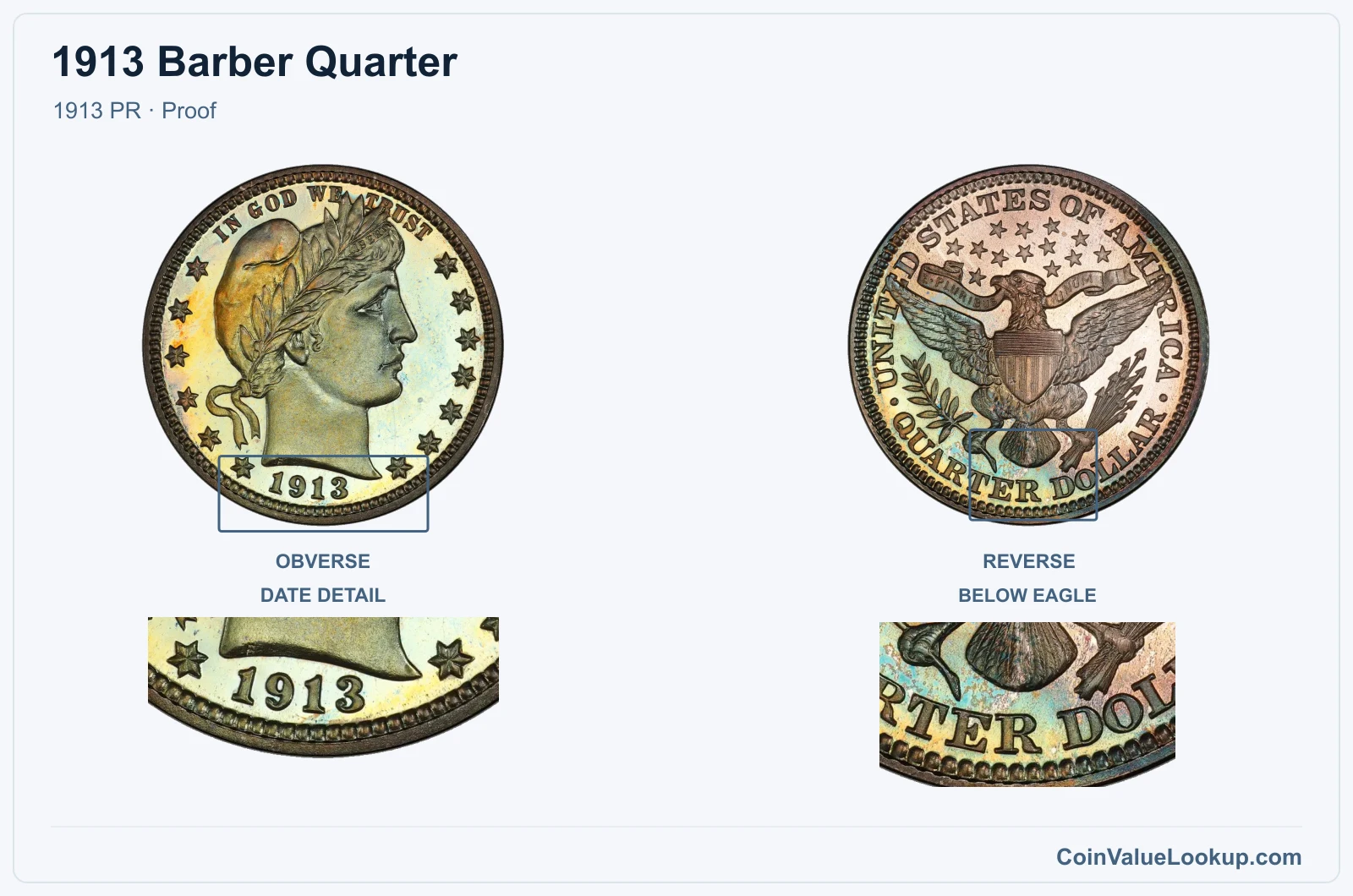
The 1913 proof quarter was struck at Philadelphia with specially prepared dies, producing mirror-like fields. There is no mintmark.
The USA Coin Book guide estimate at PR63 is about $799.00. That is a guide figure, not a guaranteed offer.
Do not confuse a shiny business strike with a proof. Proof surfaces show a distinctive reflective quality in the fields, and they were sold directly to collectors, not released into circulation.
Surface haze, hairlines from improper handling, and environmental toning all affect a proof's desirability. If your coin simply looks bright and clean, it is more likely a well-preserved or cleaned regular strike than a proof.
Coin Value Lookup can help you look up additional coin guides when you are trying to compare your quarter to other years or denominations in the Barber series.
Range Grade
Price Auction Records Appraisal PR PR 1
—
Coin Identifier
PR 2
—
Coin Identifier
PR 3
—
Coin Identifier
PR 4
—
Coin Identifier
PR 6
—
Coin Identifier
PR 8
—
Coin Identifier
PR 10
—
Coin Identifier
PR 12
—
Coin Identifier
PR 15
—
Coin Identifier
PR 20
—
Coin Identifier
PR 25
—
Coin Identifier
PR 30
—
Coin Identifier
PR 35
—
Coin Identifier
PR 40
—
Coin Identifier
PR 45
—
Coin Identifier
PR 50
—
Coin Identifier
PR 53
—
Coin Identifier
PR 55
Coin Identifier
PR 58
—
Coin Identifier
PR 60
Coin Identifier
PR 61
Coin Identifier
PR 62
Coin Identifier
PR 63
Coin Identifier
PR 64
Coin Identifier
PR 65
Coin Identifier
PR 66
Coin Identifier
PR 67
Coin Identifier
PR 68
Coin Identifier
PR 69
Coin Identifier
PR 70
—
—
—
1913 Barber Quarter — D
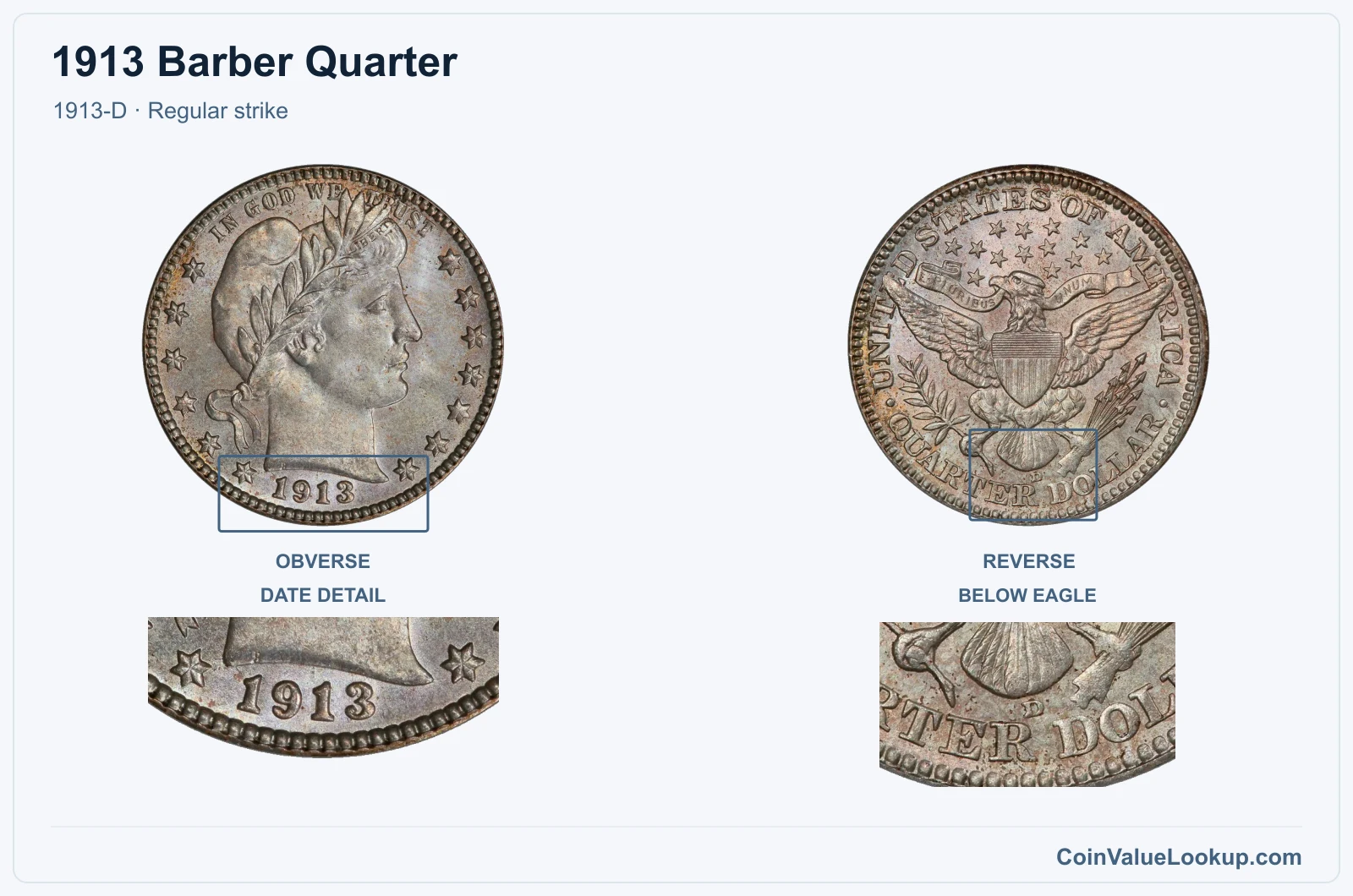
The 1913-D carries a small "D" mintmark on the reverse below the eagle's tail. In well-worn Good-4 condition, USA Coin Book estimates this version at around $25.00, which sits at the low end of the 1913 quarter spectrum.
At MS60 the guide jumps to about $459.00, and at MS63 it reaches roughly $730.00.
These are guide estimates, not guaranteed offers. Original surfaces and natural toning help a coin reach full guide value for its grade.
Cleaning or post-mint damage pulls the price down regardless of how little actual wear exists on the high points.
Range Grade
Price Auction Records Appraisal PO PO 1
—
Coin Identifier FR FR 2
—
Coin Identifier AG AG 3
—
Coin Identifier G G 4
—
Coin Identifier
G 6
—
Coin Identifier VG VG 8
—
Coin Identifier
VG 10
—
Coin Identifier F F 12
Coin Identifier
F 15
—
Coin Identifier VF VF 20
—
Coin Identifier
VF 25
Coin Identifier
VF 30
—
Coin Identifier
VF 35
—
Coin Identifier XF XF 40
Coin Identifier
XF 45
Coin Identifier AU AU 50
Coin Identifier
AU 53
Coin Identifier
AU 55
Coin Identifier
AU 58
Coin Identifier MS MS 60
—
Coin Identifier
MS 61
Coin Identifier
MS 62
Coin Identifier
MS 63
Coin Identifier
MS 64
Coin Identifier
MS 65
Coin Identifier
MS 66
Coin Identifier
MS 67
Coin Identifier
MS 68
—
—
—
MS 69
—
—
—
MS 70
—
—
—
1913 Barber Quarter — S
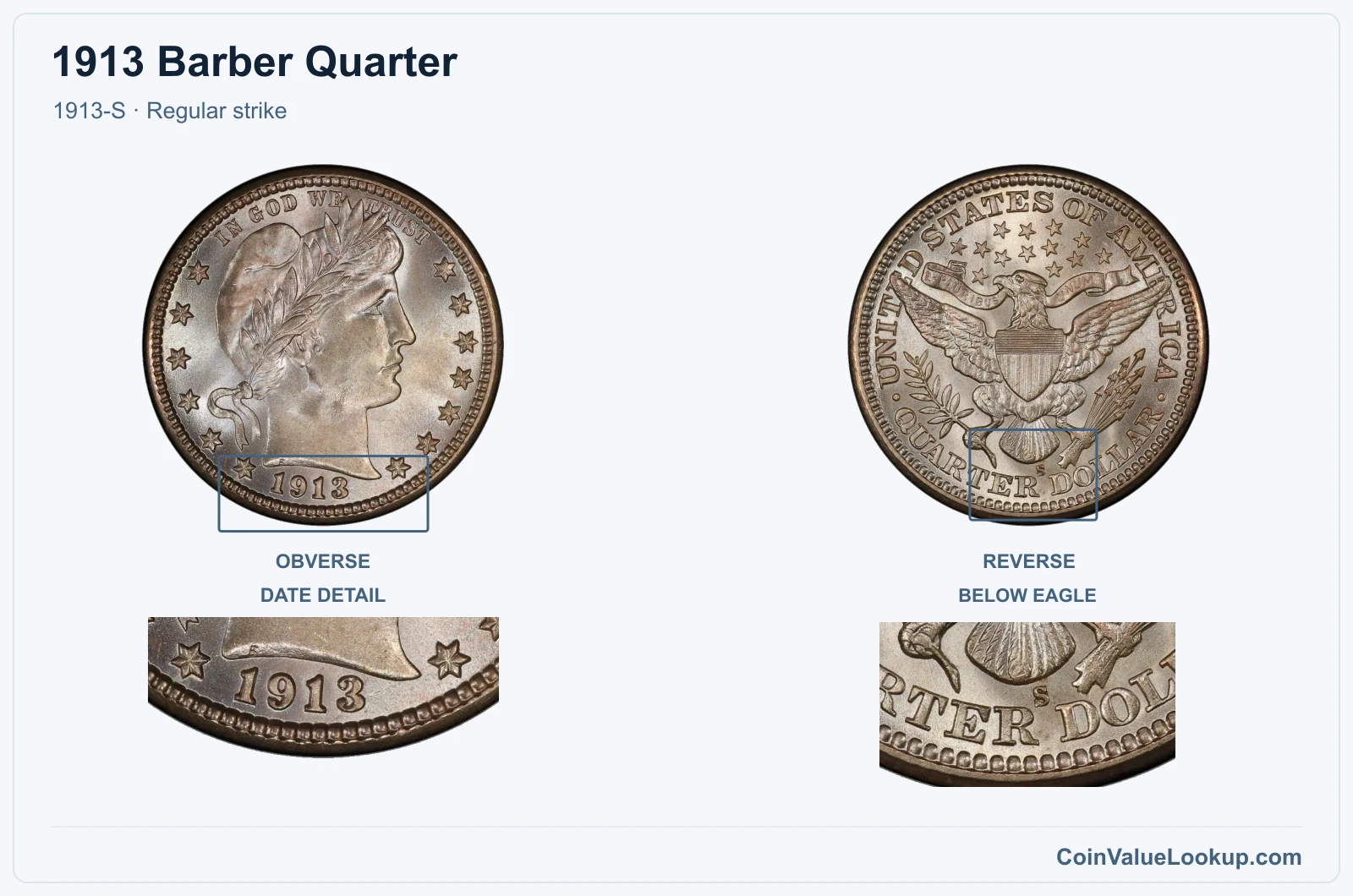
The 1913-S is the key coin for this year. That small "S" mintmark on the reverse signals San Francisco, and collectors pay a steep premium for it.
USA Coin Book estimates Good-4 at about $1,609.00, a figure that dwarfs the other mints in the same grade. At MS60, the guide reaches approximately $18,712.00, and at MS63 it climbs to roughly $22,931.00.
These are guide estimates, not guaranteed offers. The reason for the dramatic premium is simple scarcity: far fewer 1913-S quarters survive, especially with original surfaces.
Even a heavily worn example carries real value. But confirm the mintmark carefully.
A damaged or partially obscured letter can be misread, and sellers sometimes misattribute the mint. Original surfaces, proper identification, and honest grading are all critical before applying these numbers.
Range Grade
Price Auction Records Appraisal PO PO 1
Coin Identifier FR FR 2
Coin Identifier AG AG 3
Coin Identifier G G 4
Coin Identifier
G 6
Coin Identifier VG VG 8
Coin Identifier
VG 10
Coin Identifier F F 12
Coin Identifier
F 15
Coin Identifier VF VF 20
Coin Identifier
VF 25
Coin Identifier
VF 30
Coin Identifier
VF 35
Coin Identifier XF XF 40
Coin Identifier
XF 45
Coin Identifier AU AU 50
—
Coin Identifier
AU 53
—
Coin Identifier
AU 55
Coin Identifier
AU 58
Coin Identifier MS MS 60
—
Coin Identifier
MS 61
Coin Identifier
MS 62
Coin Identifier
MS 63
Coin Identifier
MS 64
Coin Identifier
MS 65
Coin Identifier
MS 66
Coin Identifier
MS 67
Coin Identifier
MS 68
Coin Identifier
MS 69
—
—
—
MS 70
—
—
—
1913 Barber Quarter Error List
1. 1913 Barber Quarter — Off-Center Strike
An off-center strike occurs when the coin blank is not seated properly between the dies, producing a displaced design with an unstruck crescent along part of the edge. On a 1913 Barber Quarter, this means the laureate head and eagle shift noticeably to one side, leaving a blank area where metal was never impressed.
The date must remain visible for the coin to be attributable to 1913, which is a key factor for collector interest. A dramatic off-center percentage with a readable date is generally more desirable than a slight misalignment.
Be careful not to confuse a genuine off-center strike with a clipped planchet, a one-sided die misalignment, or post-mint flattening from damage. Clipped coins show a curved bite from the blank rather than a shifted design.
Post-mint damage tends to distort the rim unevenly without leaving an unstruck crescent. No specific price is adopted for this error, as the value depends on the degree of displacement, the visibility of the date, and overall condition.