1915 Barber Quarter Coin Value: How Much Is It Worth?
The 1915 Barber Quarter is a late-date entry in the long-running Barber series, struck in 90% silver across up to three mints plus a proof issue. Guide estimates from USA Coin Book range from about $21.00 in well-worn grades to $938.00 for a proof at PR63, depending on which mint, finish and condition your specific coin falls into.
That spread is not one price for every coin — your quarter's value depends on its mintmark, whether it is a business strike or proof, and how much wear it has seen.
Fast Way to Identify Your 1915 Barber Quarter
Want a quick read on what you have? Upload clear photos of both the front and back of your 1915 Barber Quarter for a preliminary identification.
The mintmark location, surface condition and overall wear are visible in good images, and that is enough to point you toward the right version and approximate grade range.
1915 Barber Quarter Value
Upload both sides of your 1915 Barber Quarter.
Front Obverse
Upload photo
Back Reverse
Upload photo
Which 1915 Barber Quarter Versions Are Worth Money?
- 1915 Proof (PR63): Guide estimate of $938.00 — a specially manufactured collector finish, not simply an uncirculated coin.
- 1915-S (MS63): Guide estimate of $536.00 — the San Francisco mint issue carries a premium above Philadelphia and Denver at the same grade.
- 1915-D (MS63): Guide estimate of $477.00 — Denver strikes in high grade compete closely with the Philadelphia issue at this level.
- Check your mintmark and surface condition first; a cleaned or damaged coin does not qualify for these guide values regardless of its date.
Step 1: Identify Your 1915 Barber Quarter Mint Mark and Version
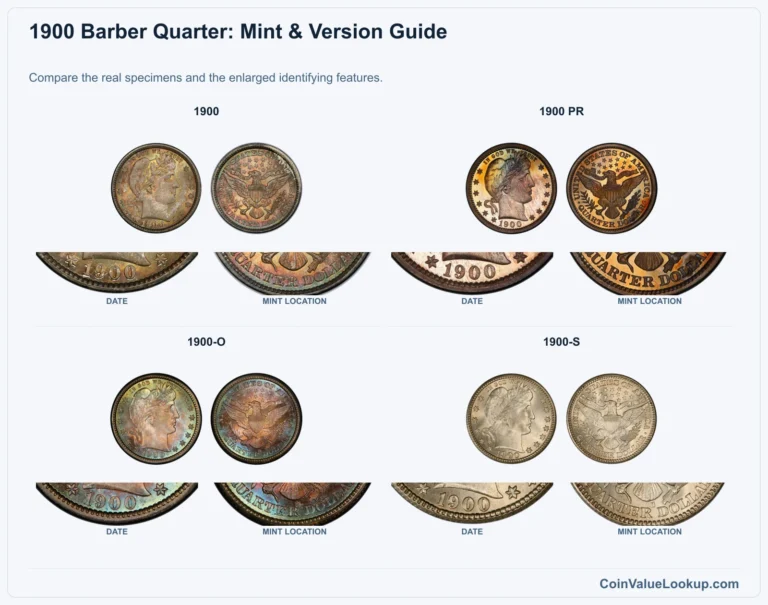
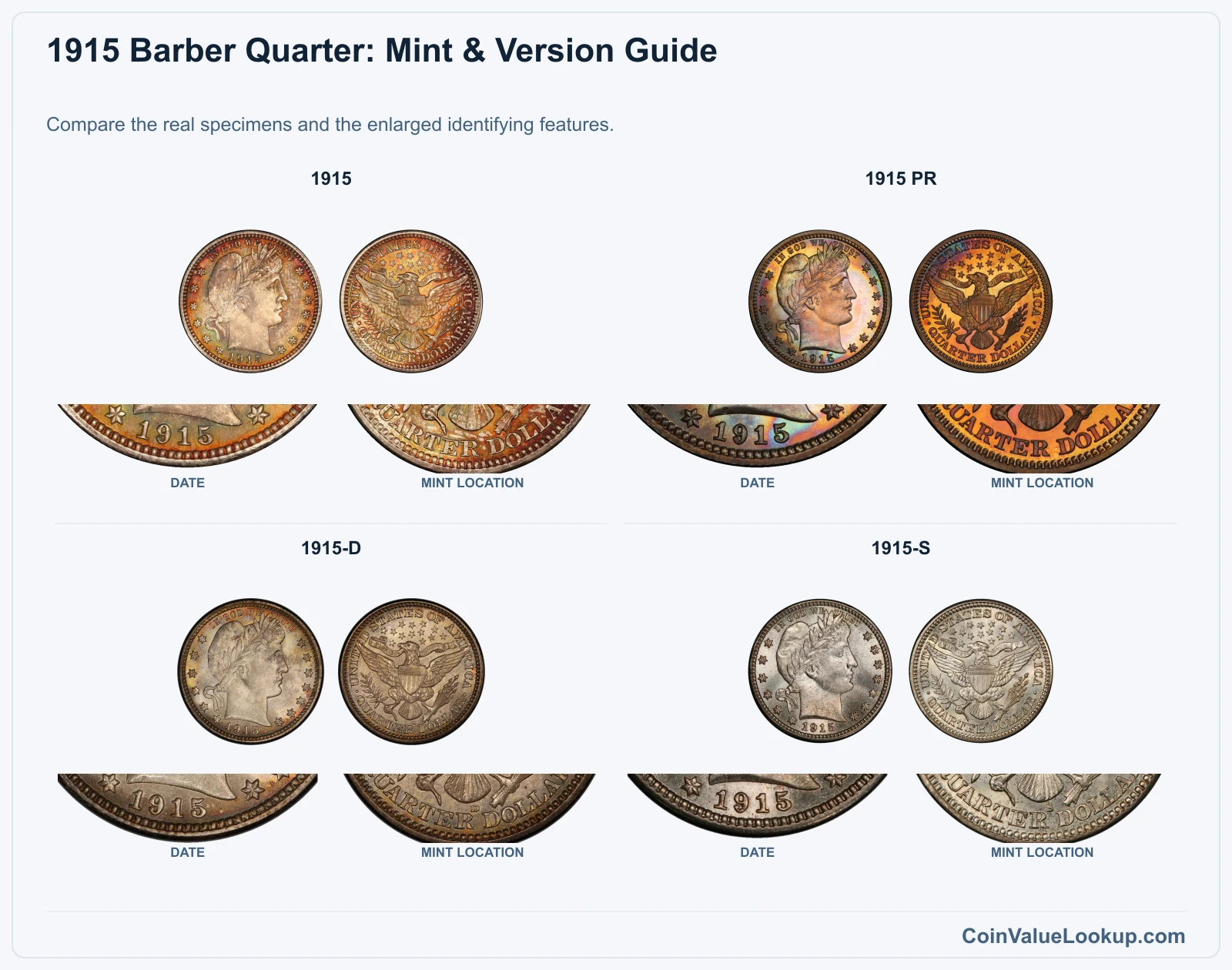
Start by flipping the coin over. The mintmark — if one exists — sits on the reverse, just below the eagle's tail feathers and above the "QUARTER DOLLAR" denomination.
No letter means Philadelphia. A "D" means Denver, and an "S" means San Francisco.
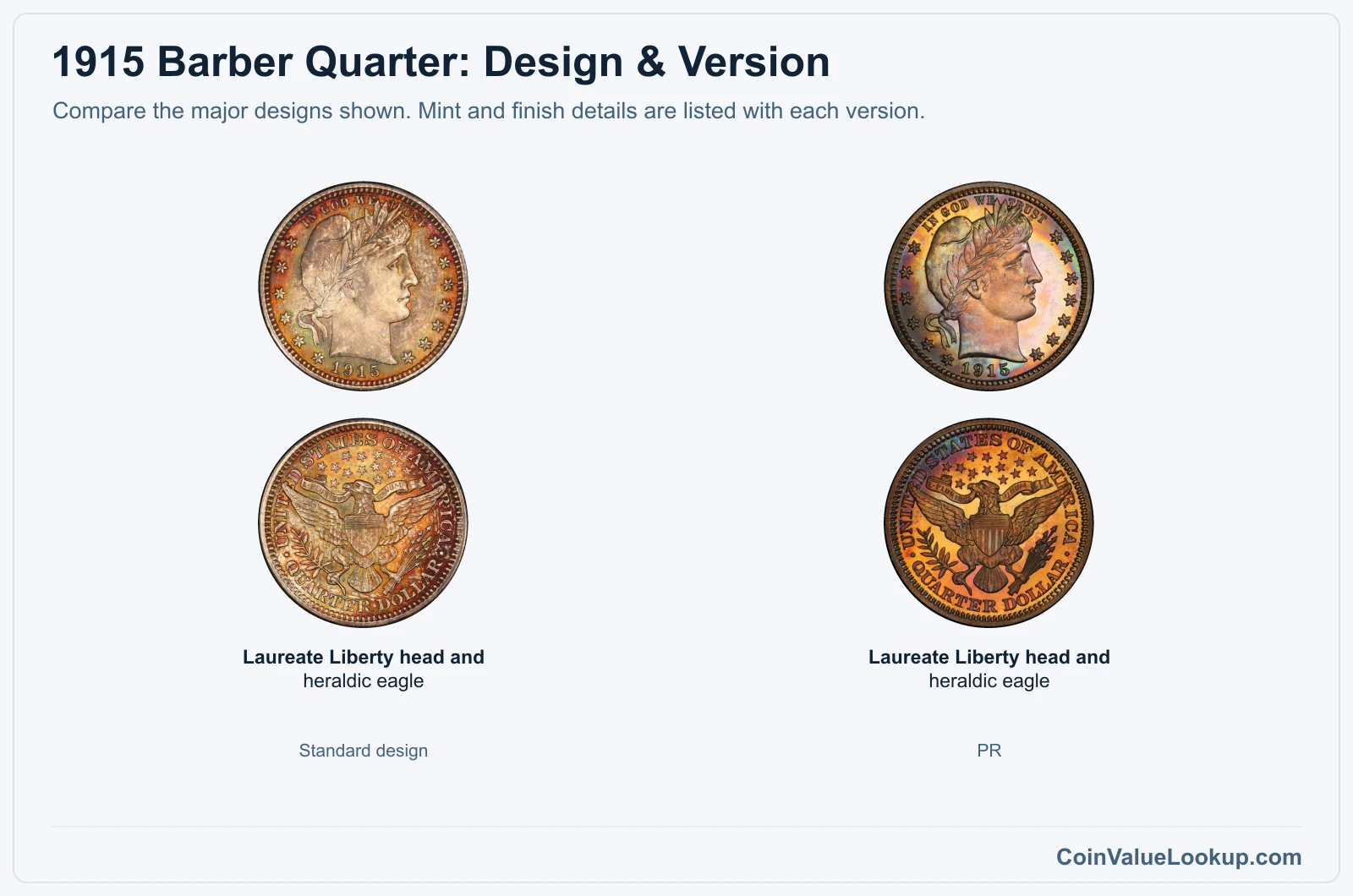
All 1915 Barber Quarters are struck in 90% silver and 10% copper, weighing 6.25 grams. The obverse features Charles Barber's laureate Liberty head facing right, while the reverse carries a heraldic eagle with a shield.
This year has four collectible branches: the 1915 Philadelphia business strike, the 1915 Proof (also Philadelphia, but a different manufacturing process), the 1915-D from Denver, and the 1915-S from San Francisco. Identifying your branch correctly is the first step before comparing condition or estimating value.
Step 2: Check Your 1915 Barber Quarter Grade
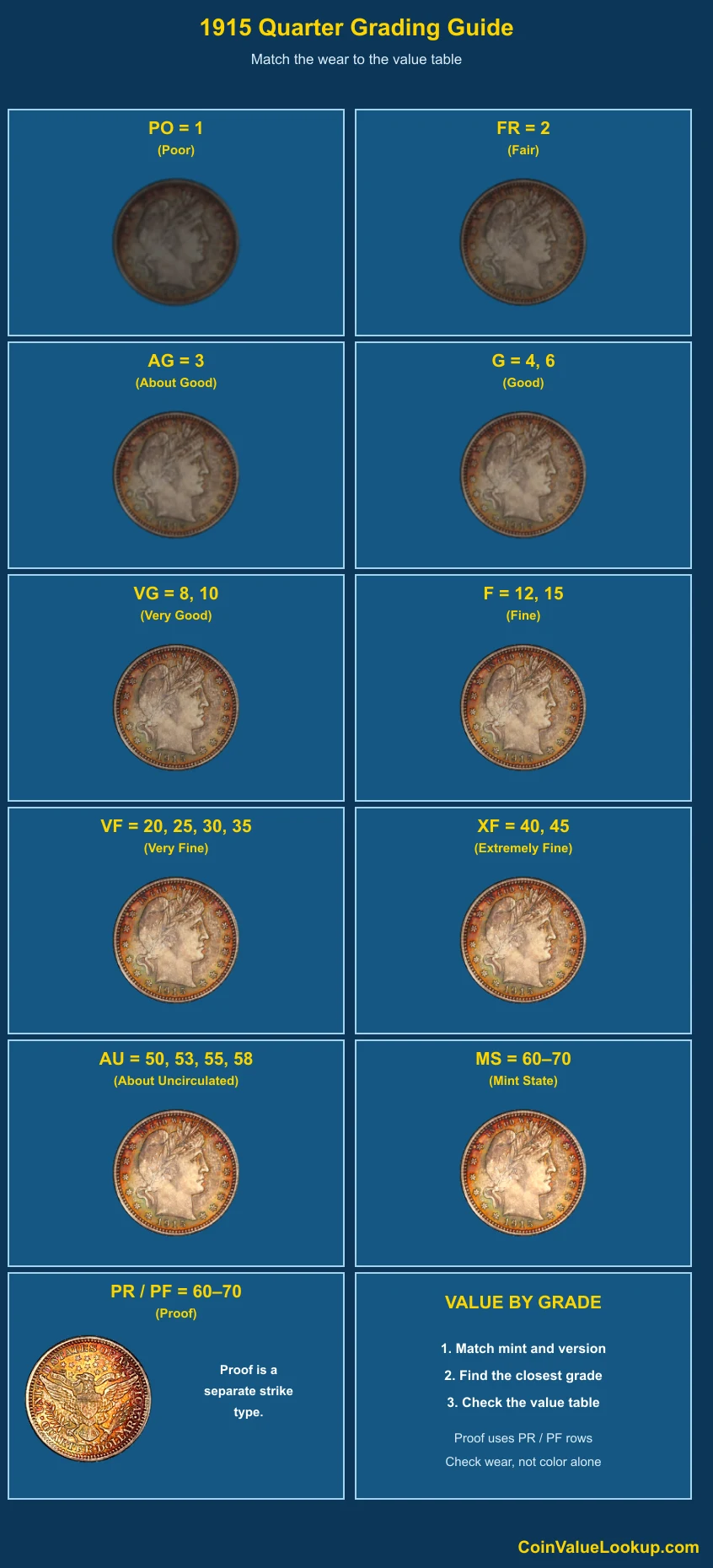
Focus on a few key spots. On the obverse, check the hair detail above Liberty's forehead, the smoothness of her cheek, and the laurel wreath.
On the reverse, look at the eagle's breast feathers, wing tops and tail.
The word LIBERTY on the headband is a useful wear indicator, but do not use it alone. Combine it with the overall sharpness and remaining luster across both sides.
Compare your coin to the grading comparison image using matching lighting. A weak strike at the mint can leave certain details soft even on an unworn coin, so look at the full picture rather than one isolated area.
Cleaning or polishing removes original luster and typically lowers a coin's collector value regardless of how sharp the details remain.
Step 3: Check 1915 Barber Quarter Value by Mint and Version
1915 Barber Quarter
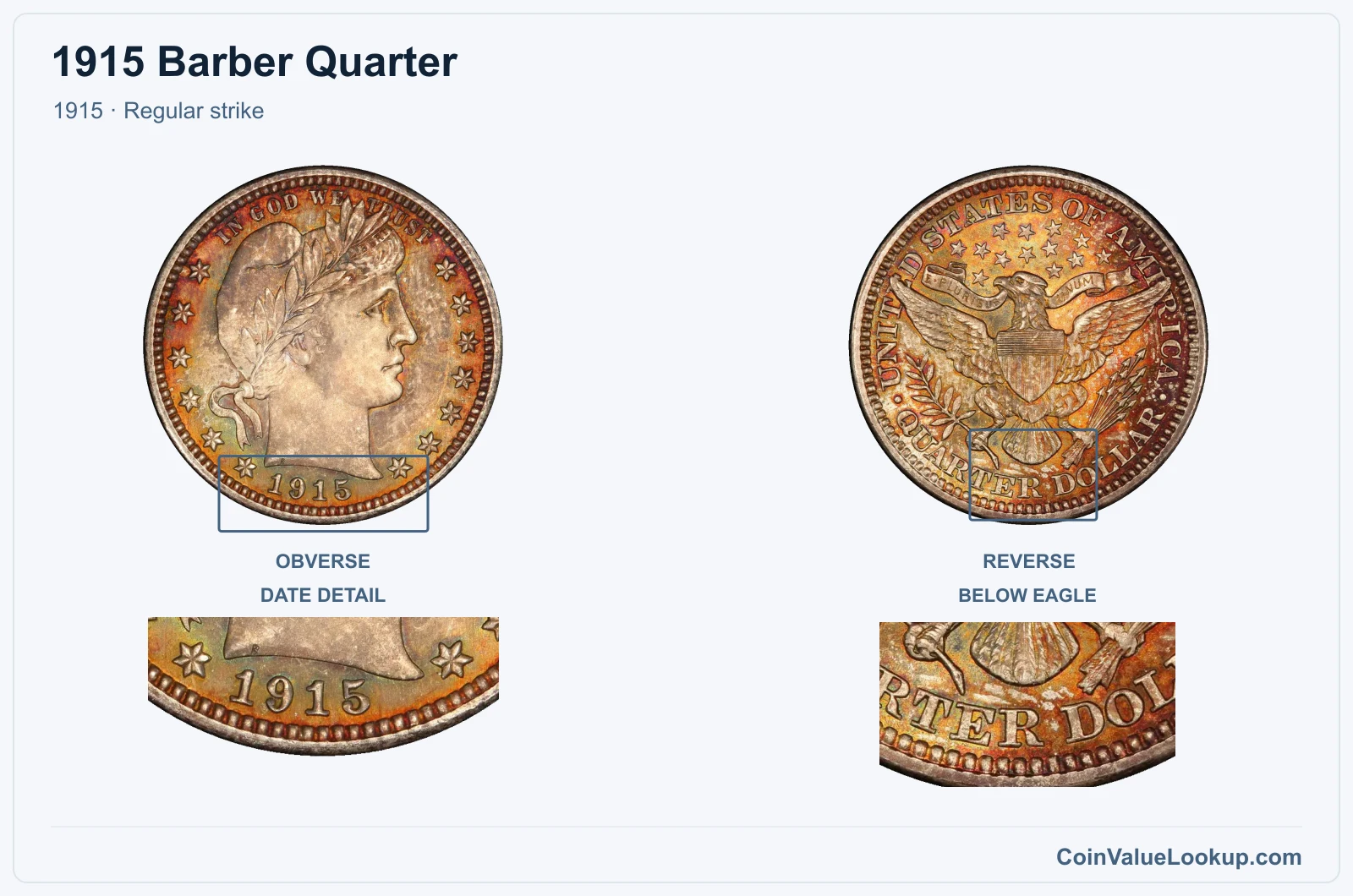
The 1915 Philadelphia Barber Quarter has no mintmark on the reverse. In heavily worn condition (G4), USA Coin Book estimates about $21.00.
Jump to uncirculated grades and the picture changes: an MS60 example sits around $309.00, while an MS63 reaches roughly $477.00.
These are guide estimates, not guaranteed sale prices. Original surfaces matter — a coin that has been cleaned or damaged will trade below these figures even if the detail looks sharp.
Match your mintmark (none), design and strike type before comparing grade.
Range Grade
Price Auction Records Appraisal PO PO 1
—
Coin Identifier FR FR 2
—
Coin Identifier AG AG 3
—
Coin Identifier G G 4
—
Coin Identifier
G 6
—
Coin Identifier VG VG 8
—
Coin Identifier
VG 10
—
Coin Identifier F F 12
—
Coin Identifier
F 15
—
Coin Identifier VF VF 20
Coin Identifier
VF 25
—
Coin Identifier
VF 30
—
Coin Identifier
VF 35
—
Coin Identifier XF XF 40
Coin Identifier
XF 45
Coin Identifier AU AU 50
Coin Identifier
AU 53
Coin Identifier
AU 55
Coin Identifier
AU 58
Coin Identifier MS MS 60
Coin Identifier
MS 61
Coin Identifier
MS 62
Coin Identifier
MS 63
Coin Identifier
MS 64
Coin Identifier
MS 65
Coin Identifier
MS 66
Coin Identifier
MS 67
Coin Identifier
MS 68
—
—
—
MS 69
—
—
—
MS 70
—
—
—
1915 Barber Quarter — PR
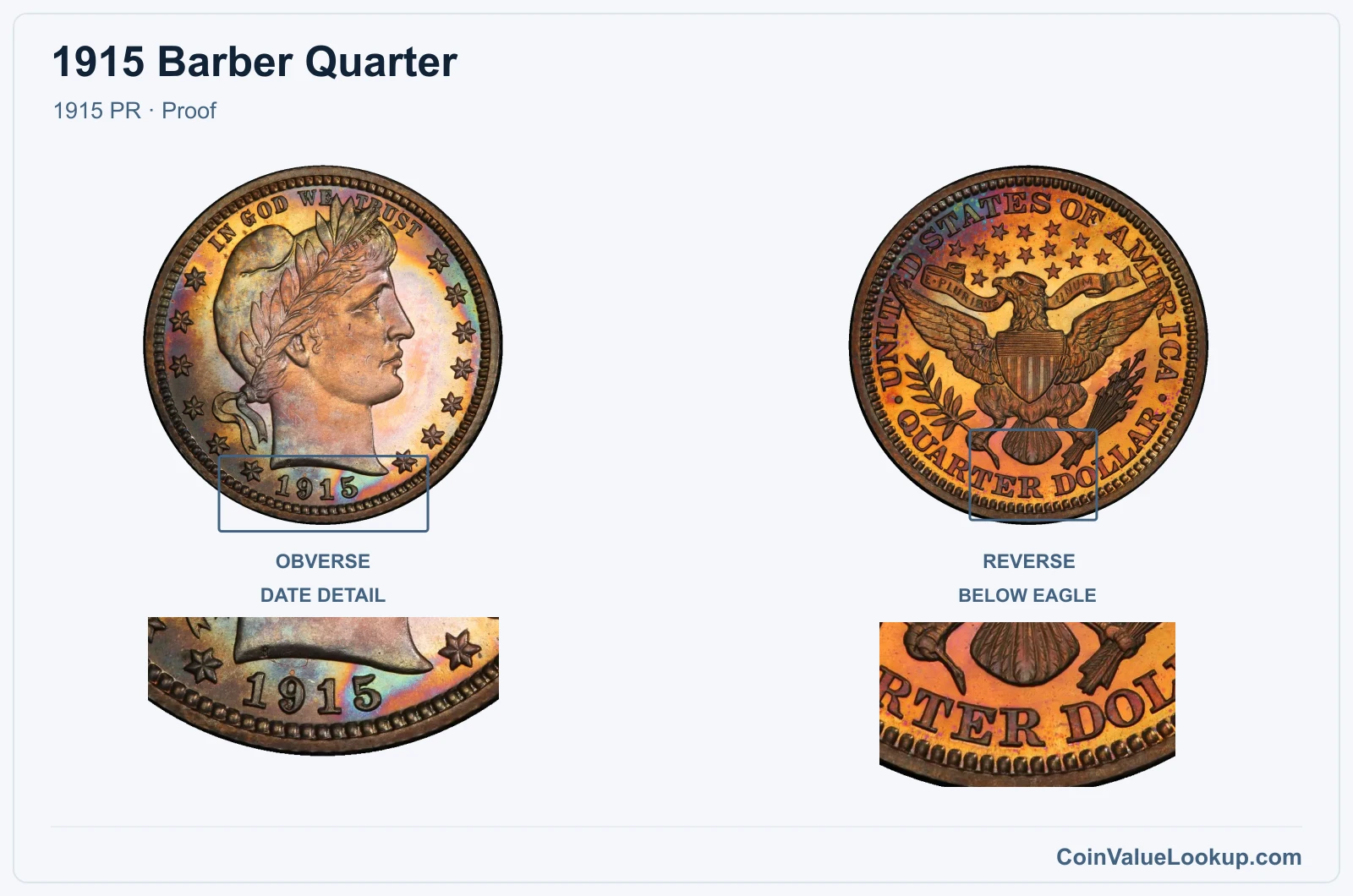
The 1915 Proof Barber Quarter was produced at Philadelphia as a special collector striking. Proofs have a distinct look: sharply struck devices, often with mirror-like fields that differ from even the best business strikes.
Do not confuse a shiny circulated coin for a proof.
At PR63, the USA Coin Book guide estimate is $938.00, the highest single anchor for any 1915 Barber Quarter branch at its listed grade. Surface haze, hairlines and any mishandling affect collector value significantly on proofs.
If you think you have one, compare it carefully with known proof examples before drawing conclusions.
Coin Value Lookup is a good starting point if you want to look up guides for other dates and denominations in the Barber series.
Range Grade
Price Auction Records Appraisal PR PR 1
—
Coin Identifier
PR 2
—
Coin Identifier
PR 3
—
Coin Identifier
PR 4
—
Coin Identifier
PR 6
—
Coin Identifier
PR 8
—
Coin Identifier
PR 10
—
Coin Identifier
PR 12
—
Coin Identifier
PR 15
—
Coin Identifier
PR 20
—
Coin Identifier
PR 25
—
Coin Identifier
PR 30
—
Coin Identifier
PR 35
—
Coin Identifier
PR 40
—
Coin Identifier
PR 45
—
Coin Identifier
PR 50
—
Coin Identifier
PR 53
—
Coin Identifier
PR 55
—
Coin Identifier
PR 58
Coin Identifier
PR 60
Coin Identifier
PR 61
Coin Identifier
PR 62
Coin Identifier
PR 63
Coin Identifier
PR 64
Coin Identifier
PR 65
Coin Identifier
PR 66
Coin Identifier
PR 67
Coin Identifier
PR 68
Coin Identifier
PR 69
—
—
—
PR 70
—
—
—
1915 Barber Quarter — D
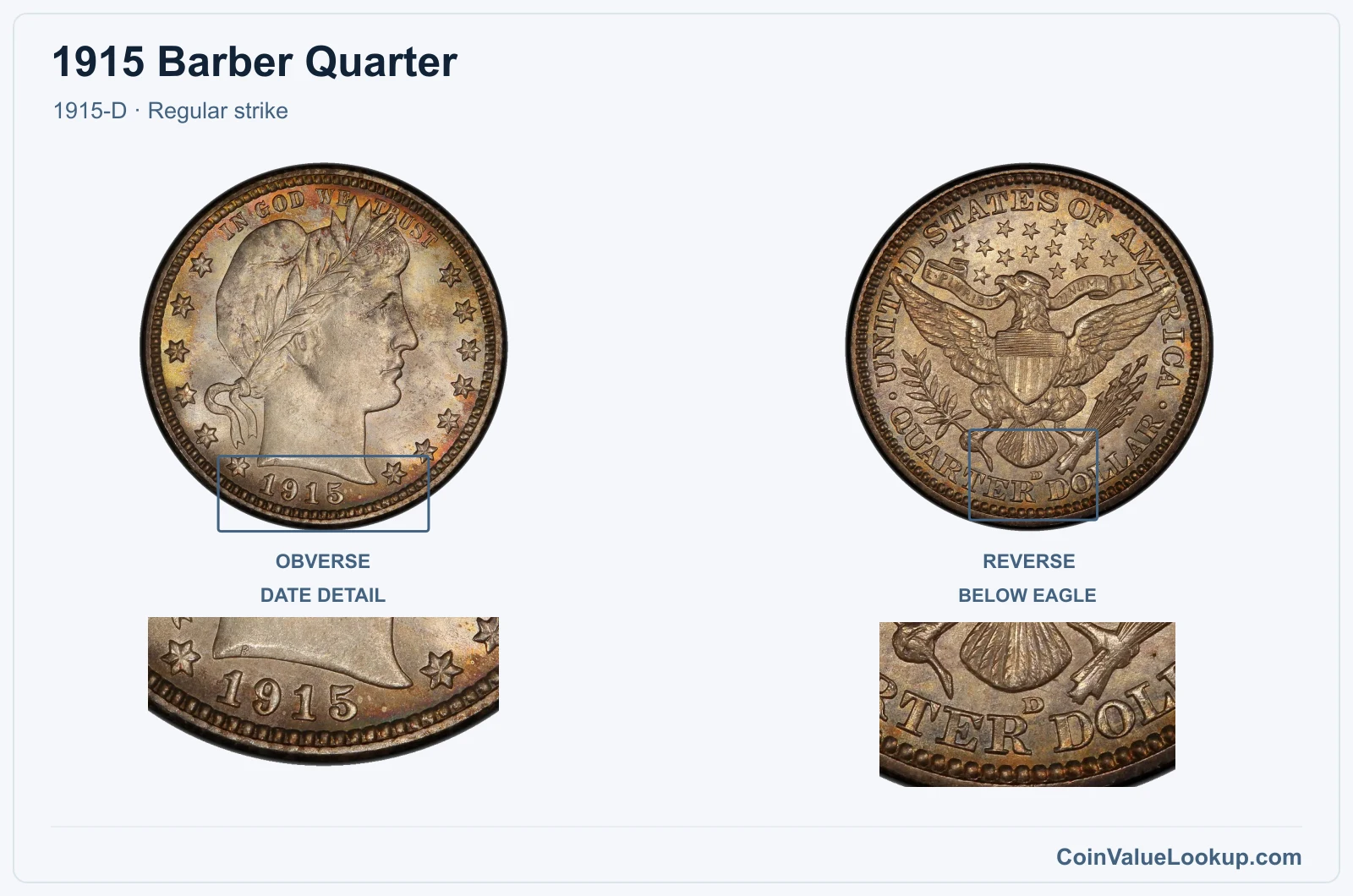
The 1915-D Barber Quarter carries a small "D" mintmark on the reverse beneath the eagle's tail. In G4 condition, the USA Coin Book guide places it at about $21.00, matching the Philadelphia issue at that grade.
At MS60, the estimate rises to $309.00, and at MS63 it reaches $477.00.
Original surfaces, wear level and strike quality all factor into comparisons. Cleaning or environmental damage can pull the value well below guide figures.
Confirm the "D" mintmark before assuming you have a Denver coin — it can be faint on worn examples.
Range Grade
Price Auction Records Appraisal PO PO 1
—
Coin Identifier FR FR 2
—
Coin Identifier AG AG 3
—
Coin Identifier G G 4
—
Coin Identifier
G 6
—
Coin Identifier VG VG 8
—
Coin Identifier
VG 10
—
Coin Identifier F F 12
—
Coin Identifier
F 15
—
Coin Identifier VF VF 20
—
Coin Identifier
VF 25
—
Coin Identifier
VF 30
—
Coin Identifier
VF 35
Coin Identifier XF XF 40
Coin Identifier
XF 45
Coin Identifier AU AU 50
Coin Identifier
AU 53
Coin Identifier
AU 55
Coin Identifier
AU 58
Coin Identifier MS MS 60
—
Coin Identifier
MS 61
Coin Identifier
MS 62
Coin Identifier
MS 63
Coin Identifier
MS 64
Coin Identifier
MS 65
Coin Identifier
MS 66
Coin Identifier
MS 67
Coin Identifier
MS 68
—
—
—
MS 69
—
—
—
MS 70
—
—
—
1915 Barber Quarter — S
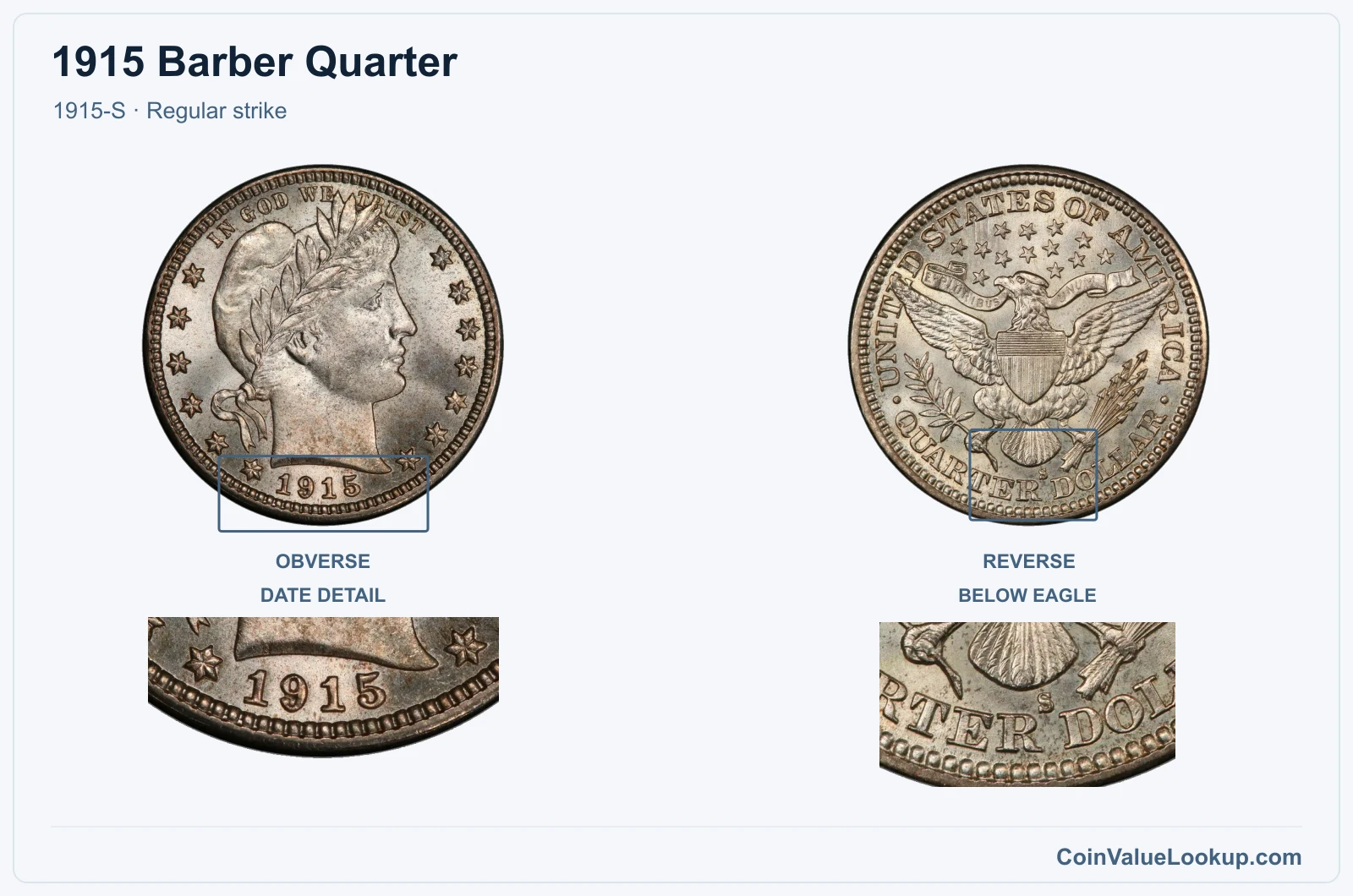
The 1915-S carries an "S" mintmark on the reverse and commands a noticeable premium over both the Philadelphia and Denver issues, especially in higher grades. At G4, the USA Coin Book guide estimate is $41.00 — roughly double the other two mints at the same grade.
At MS60 the estimate is $363.00, and at MS63 it reaches $536.00.
That higher floor even in low grades tells you collectors pay attention to the San Francisco strikes for this date. As always, original surfaces and accurate grade assessment are essential.
A cleaned 1915-S is still worth more than face value for its silver, but it will not bring collector guide prices.
Range Grade
Price Auction Records Appraisal PO PO 1
—
Coin Identifier FR FR 2
—
Coin Identifier AG AG 3
—
Coin Identifier G G 4
Coin Identifier
G 6
—
Coin Identifier VG VG 8
Coin Identifier
VG 10
—
Coin Identifier F F 12
—
Coin Identifier
F 15
Coin Identifier VF VF 20
Coin Identifier
VF 25
Coin Identifier
VF 30
—
Coin Identifier
VF 35
Coin Identifier XF XF 40
Coin Identifier
XF 45
Coin Identifier AU AU 50
—
Coin Identifier
AU 53
Coin Identifier
AU 55
Coin Identifier
AU 58
Coin Identifier MS MS 60
—
Coin Identifier
MS 61
Coin Identifier
MS 62
Coin Identifier
MS 63
Coin Identifier
MS 64
Coin Identifier
MS 65
Coin Identifier
MS 66
Coin Identifier
MS 67
Coin Identifier
MS 68
—
—
—
MS 69
—
—
—
MS 70
—
—
—
1915 Barber Quarter Error List
1. 1915 Barber Quarter — Off-Center Strike
An off-center strike happens when the planchet is not properly seated in the collar during striking, leaving part of the design missing and an unstruck crescent along one edge. On a 1915 Barber Quarter, look for a displaced design where the date remains visible — date visibility matters enormously to collectors.
Do not confuse this with a clipped planchet (a curved bite out of the edge with full design shift absent), one-sided die misalignment, or post-mint damage like a coin flattened in a vise. Genuine off-center errors show consistent design displacement across the entire surface.
No specific price data is available for this error on the 1915 Barber Quarter. Value depends on the percentage off-center, whether the date is readable, and overall condition.
A professional evaluation is recommended for any suspected example.
2. 1915 Barber Quarter — Doubled Die Reverse
A doubled die reverse shows a secondary, slightly shifted impression of the design elements on the back of the coin. On a 1915 Barber Quarter, inspect the reverse legends and the eagle's details closely with magnification, comparing them against a normal example of the same date.
The doubling should be consistent and appear as a shelf-like secondary image in the same direction across multiple design elements. Machine doubling — which is mechanical and flat-looking, not a die variety — can mimic this effect to untrained eyes.
Reflections from luster or random surface damage are also common lookalikes.
No adopted price is available for a doubled die reverse on this date. The value of any such variety depends on the strength and visibility of the doubling, the coin's condition, and collector interest.
Have a suspected example evaluated by a specialist.
3. 1915 Barber Quarter — Repunched Mintmark
A repunched mintmark occurs when the mintmark punch was applied more than once in slightly different positions, leaving traces of an earlier placement beside the final letter. On the 1915 Barber Quarter, this applies to coins with a "D" or "S" mintmark — Philadelphia coins have no mintmark to repunch.
Inspect the mintmark area under magnification and compare with a normal example at the same zoom level. Look for a partial shadow or secondary outline next to or beneath the primary letter.
Do not mistake machine doubling, a small die chip, or surface corrosion near the mintmark for a genuine repunched mintmark. Those lookalikes tend to appear flat, irregular or inconsistent with the shape of the letter.
No price data is adopted for this variety, so individual assessment based on visibility and coin condition is necessary.
4. 1915 Barber Quarter — Repunched Date
A repunched date shows remnants of an earlier date-punch position alongside the final numerals. This is different from doubling of the entire design — it is specific to the date digits and results from the date punch being applied more than once during die preparation.
On a 1915 Barber Quarter, examine each digit of the date under magnification. Look for ghost images, offset serifs, or partial secondary numbers near the base or top of the "1," "9," "1" and "5." Compare what you see with a known normal example.
Damaged dates from circulation hits or machine doubling from the striking process can both mimic a repunched date. Genuine repunching shows a consistent, die-stage character rather than random distortion.
No specific price data is adopted for this variety on the 1915 quarter; value depends on clarity of the repunching and overall coin condition.