1916 Barber Quarter Coin Value: How Much Is It Worth?
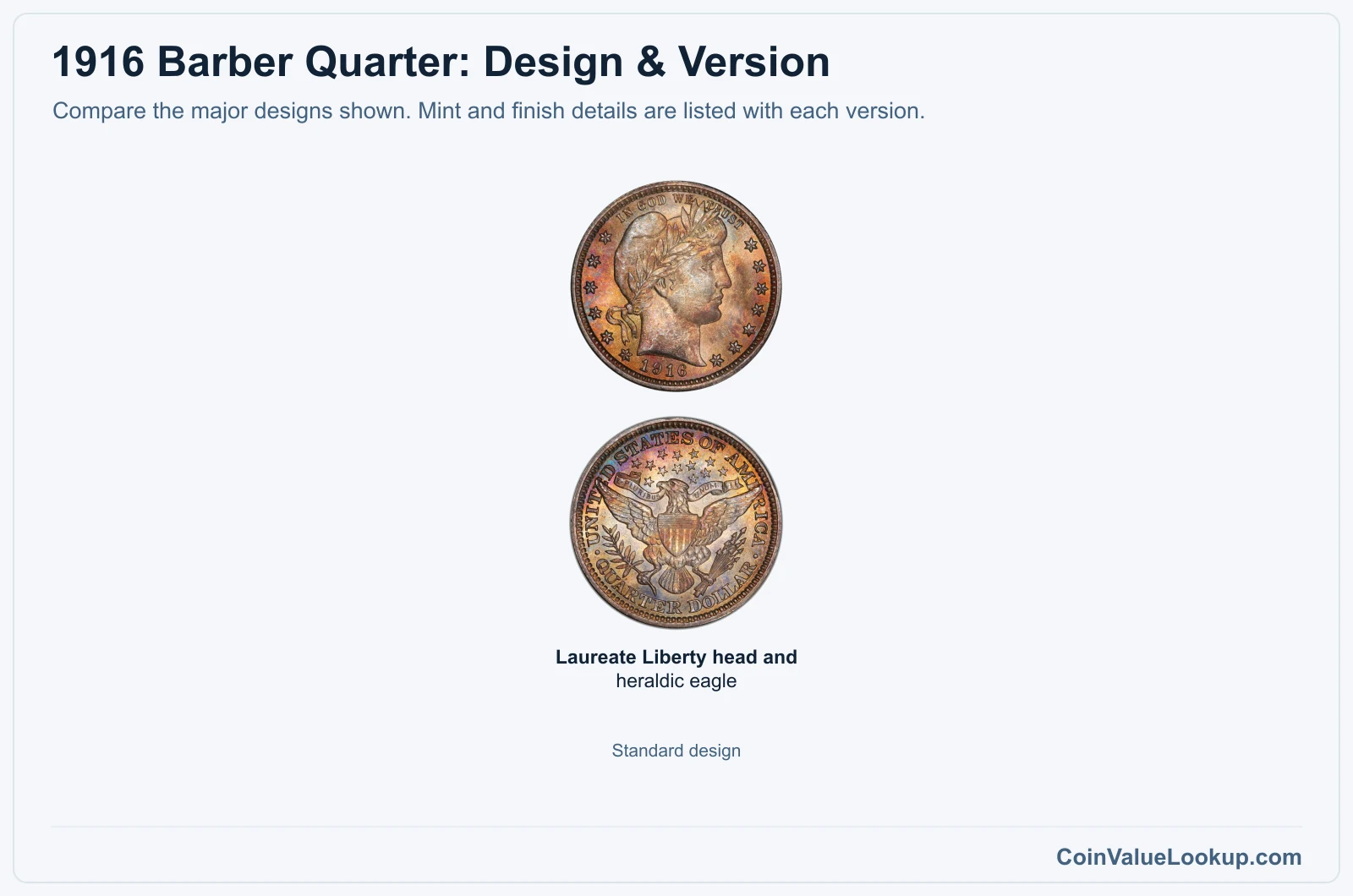
The 1916 Barber Quarter is a 90% silver coin struck in the final year of the series before the Standing Liberty design took over. Depending on the mint and condition, USA Coin Book guide estimates range from about $21.00 in well-worn grades to $477.00 in uncirculated condition.
Mint, grade and original surfaces determine where a specific coin falls within that spread.
Fast Way to Identify Your 1916 Barber Quarter
Want a quick read on your 1916 quarter? Upload clear photos of the front and back, and our identifier can give you a preliminary identification of the mint version and general condition.
That first step helps you figure out which branch of the series you actually have before digging deeper into values.
1916 Barber Quarter Value
Upload both sides of your 1916 Barber Quarter.
Front Obverse
Upload photo
Back Reverse
Upload photo
Which 1916 Barber Quarter Versions Are Worth Money?
- 1916-D quarter: USA Coin Book estimates reach $477.00 at MS63 grade, with G4 examples around $21.00. Check for the D mintmark on the reverse.
- 1916 Philadelphia quarter: Guide estimates also reach $477.00 at MS63, starting at $21.00 in G4. No mintmark present.
- Always confirm the mint and condition first. Damage, heavy cleaning or artificial toning do not make a common coin rare.
Step 1: Identify Your 1916 Barber Quarter Mint Mark and Version
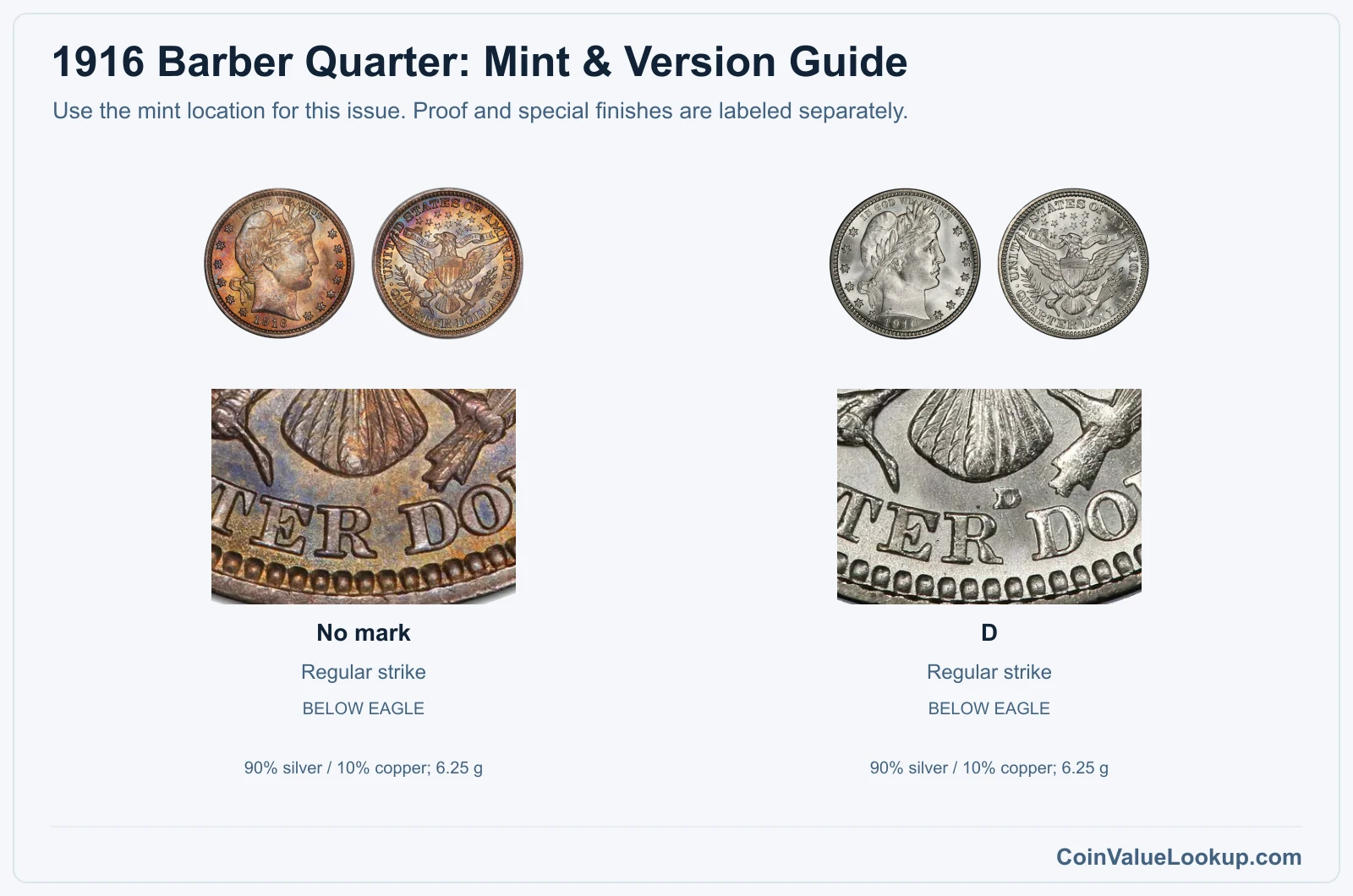
Two versions exist for 1916: the Philadelphia issue (no mintmark) and the Denver issue (D mintmark). To find the mintmark, flip the coin over and look below the eagle's tail feathers, just above the words QUARTER DOLLAR.
No letter means Philadelphia. A small D means Denver.
The coin is struck in 90% silver and 10% copper, weighing 6.25 grams. The obverse shows a laureate Liberty head facing right, while the reverse features a heraldic eagle with spread wings.
Both mints share the same design, so the mintmark is the only physical difference between them.
Step 2: Check Your 1916 Barber Quarter Grade
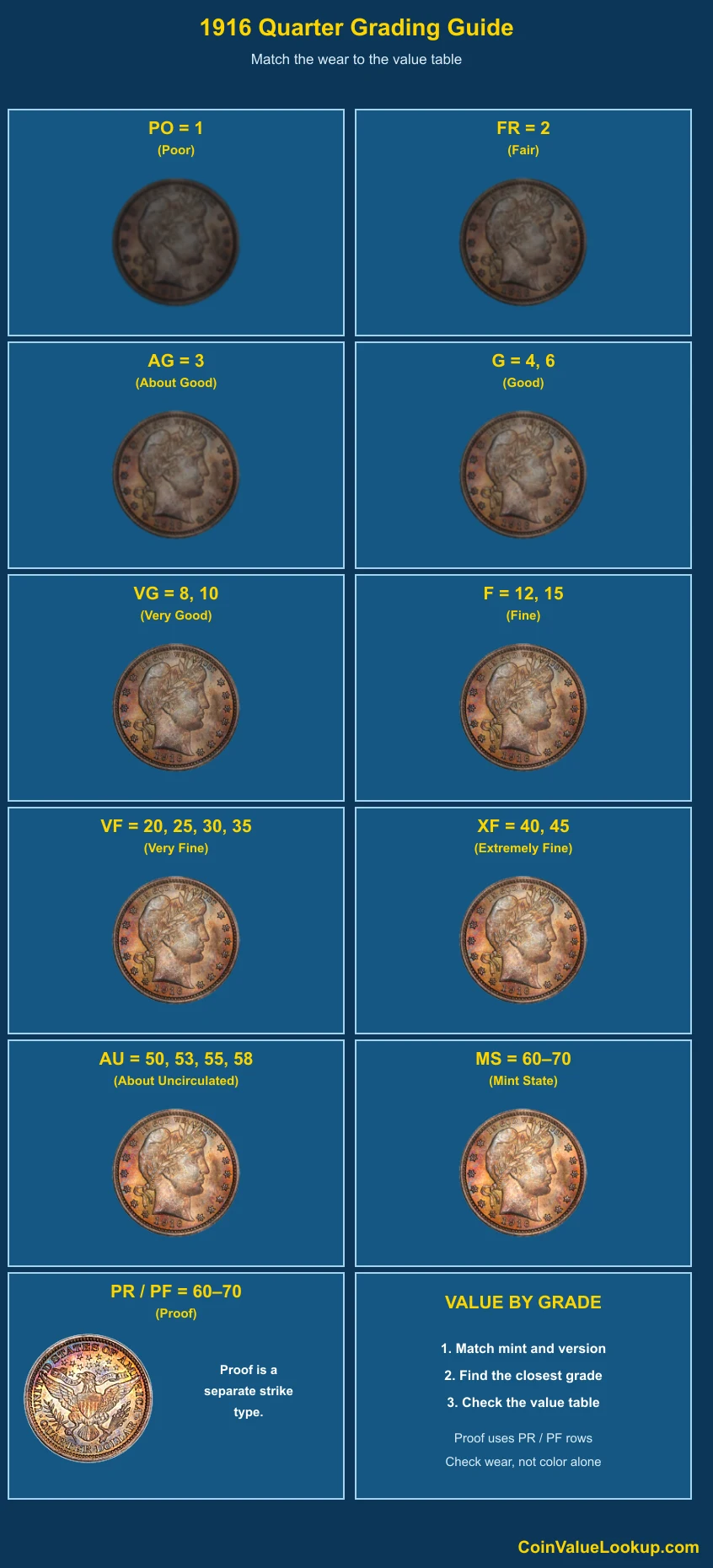
Start with the hair above Liberty's forehead and the detail in her laurel wreath. In low grades, these areas flatten first, merging into smooth patches.
The word LIBERTY on the headband is another checkpoint, though it should be read alongside overall surface wear rather than used as a standalone test.
On the reverse, check the eagle's breast feathers, wing tips and tail. Luster matters too.
A coin can have sharp detail but dull, cleaned surfaces, and that lowers its collector appeal compared to one with original toning.
Weak strikes happen on Barber quarters. A soft area on an otherwise lustrous coin does not mean wear.
Compare your coin to the grading image to see how genuine circulation loss looks versus a manufacturing softness. Cleaning or environmental damage also reduces value regardless of how much detail remains.
Step 3: Check 1916 Barber Quarter Value by Mint and Version
1916 Barber Quarter
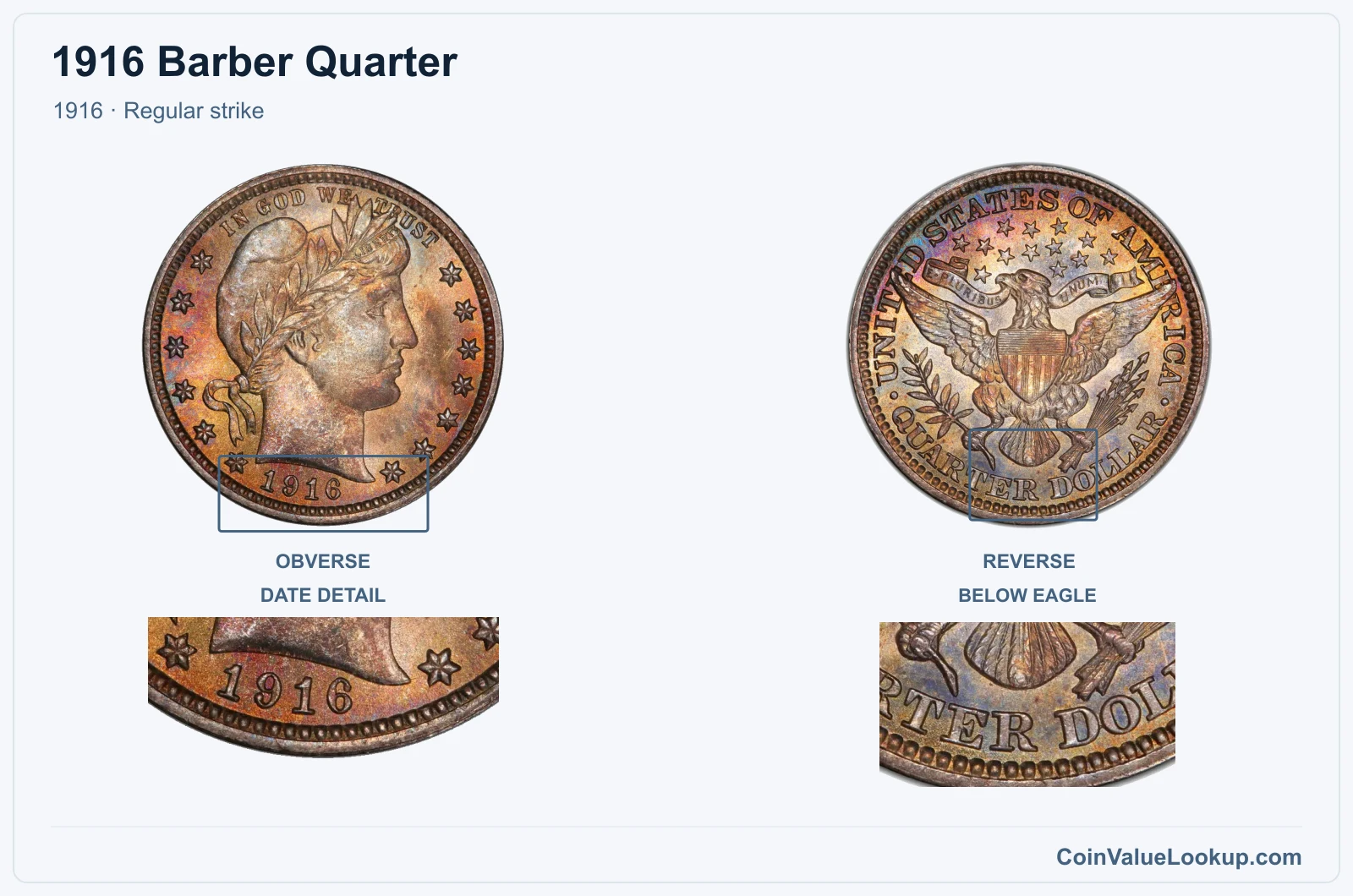
The 1916 Philadelphia quarter has no mintmark on the reverse. Look below the eagle's tail and confirm the space is blank.
USA Coin Book estimates place this version at about $21.00 in G4 (a heavily worn but readable grade), $309.00 at MS60 (uncirculated but with contact marks), and $477.00 at MS63 (a cleaner uncirculated coin with decent eye appeal). These are guide estimates, not guaranteed sale prices.
Original surfaces matter more than you might expect. A coin that has been polished or harshly cleaned can look shiny but will trade well below these figures.
Match the mint and verify the surfaces before comparing grade.
Range Grade
Price Auction Records Appraisal PO PO 1
—
Coin Identifier FR FR 2
—
Coin Identifier AG AG 3
—
Coin Identifier G G 4
—
Coin Identifier
G 6
—
Coin Identifier VG VG 8
—
Coin Identifier
VG 10
—
Coin Identifier F F 12
Coin Identifier
F 15
—
Coin Identifier VF VF 20
—
Coin Identifier
VF 25
—
Coin Identifier
VF 30
—
Coin Identifier
VF 35
—
Coin Identifier XF XF 40
—
Coin Identifier
XF 45
Coin Identifier AU AU 50
Coin Identifier
AU 53
Coin Identifier
AU 55
Coin Identifier
AU 58
Coin Identifier MS MS 60
—
Coin Identifier
MS 61
Coin Identifier
MS 62
Coin Identifier
MS 63
Coin Identifier
MS 64
Coin Identifier
MS 65
Coin Identifier
MS 66
Coin Identifier
MS 67
Coin Identifier
MS 68
—
—
—
MS 69
—
—
—
MS 70
—
—
—
1916 Barber Quarter — D
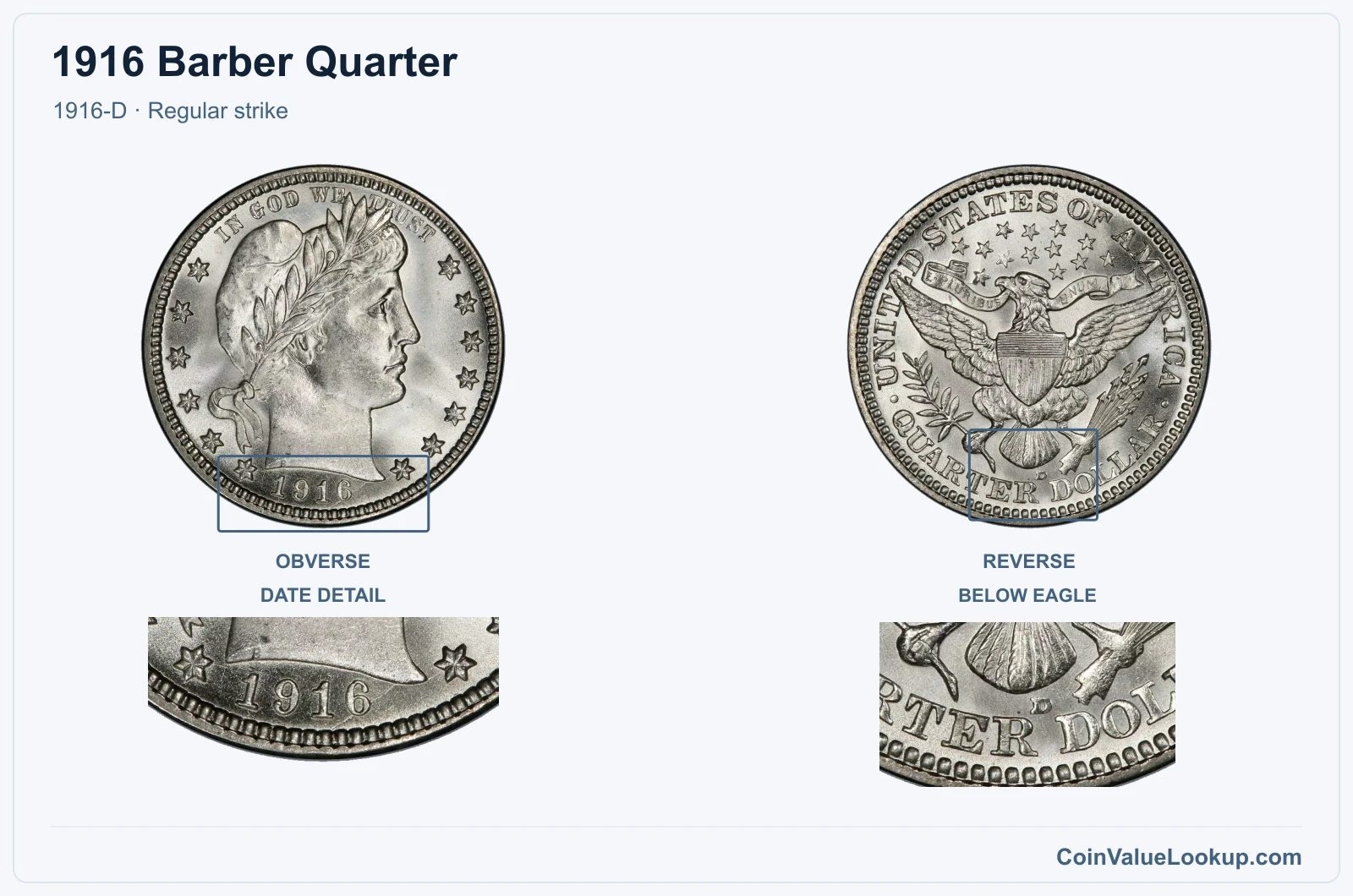
The 1916-D carries a small D mintmark on the reverse, positioned below the eagle's tail feathers. Denver quarters from this era can be softly struck, so do not confuse a weak impression with wear.
USA Coin Book guide estimates for the 1916-D sit at $21.00 in G4, $309.00 at MS60 and $477.00 at MS63. These are retail guide figures, not guaranteed offers.
Real-world results depend on eye appeal, surface quality and whether the coin has been cleaned or damaged.
Coin Value Lookup is a good starting point if you want to look up guides for other dates in the Barber Quarter series or check values across different denominations.
Range Grade
Price Auction Records Appraisal PO PO 1
—
Coin Identifier FR FR 2
—
Coin Identifier AG AG 3
—
Coin Identifier G G 4
—
Coin Identifier
G 6
—
Coin Identifier VG VG 8
—
Coin Identifier
VG 10
—
Coin Identifier F F 12
—
Coin Identifier
F 15
Coin Identifier VF VF 20
—
Coin Identifier
VF 25
—
Coin Identifier
VF 30
Coin Identifier
VF 35
Coin Identifier XF XF 40
Coin Identifier
XF 45
Coin Identifier AU AU 50
Coin Identifier
AU 53
Coin Identifier
AU 55
Coin Identifier
AU 58
Coin Identifier MS MS 60
—
Coin Identifier
MS 61
Coin Identifier
MS 62
Coin Identifier
MS 63
Coin Identifier
MS 64
Coin Identifier
MS 65
Coin Identifier
MS 66
Coin Identifier
MS 67
Coin Identifier
MS 68
Coin Identifier
MS 69
—
—
—
MS 70
—
—
—
1916 Barber Quarter Error List
1. 1916 Barber Quarter — Off-Center Strike
An off-center strike occurs when the planchet is not seated properly in the collar, resulting in a displaced design and an unstruck crescent along one edge. On a 1916 Barber Quarter, the key question is whether the date remains fully visible.
An off-center coin with a clear date is significantly more desirable than one where the date has shifted off the edge.
No specific price range is adopted for this error. Value depends on the percentage of off-center displacement, the visibility of the date and mintmark, and overall condition.
A modest 5% shift is far less dramatic than a 20% displacement.
Watch out for lookalikes. A clipped planchet, one-sided die misalignment or post-mint damage from a vise or press can mimic the appearance.
Genuine off-center strikes show a consistent unstruck crescent opposite the shifted design.
2. 1916 Barber Quarter — Repunched Mintmark
A repunched mintmark on the 1916-D Barber Quarter means the D was punched into the working die more than once, leaving traces of an earlier impression. Under magnification you may see a ghost image, a notch or doubling around the D that does not match the primary punch position.
To confirm, compare the mintmark at the same magnification against a normal 1916-D. The remnants of the secondary punch should be consistent and die-raised, not flat or mushy.
Machine doubling, small die chips and surface corrosion near the letter can all create similar-looking distortions, so careful comparison is essential.
No specific price range is adopted for this variety. Value depends on the strength and visibility of the repunching, the coin's overall grade and its surface preservation.
A subtle shift visible only at high magnification carries less weight than an obvious displaced secondary punch.