1815 Capped Bust Quarter Coin Value: How Much Is It Worth?
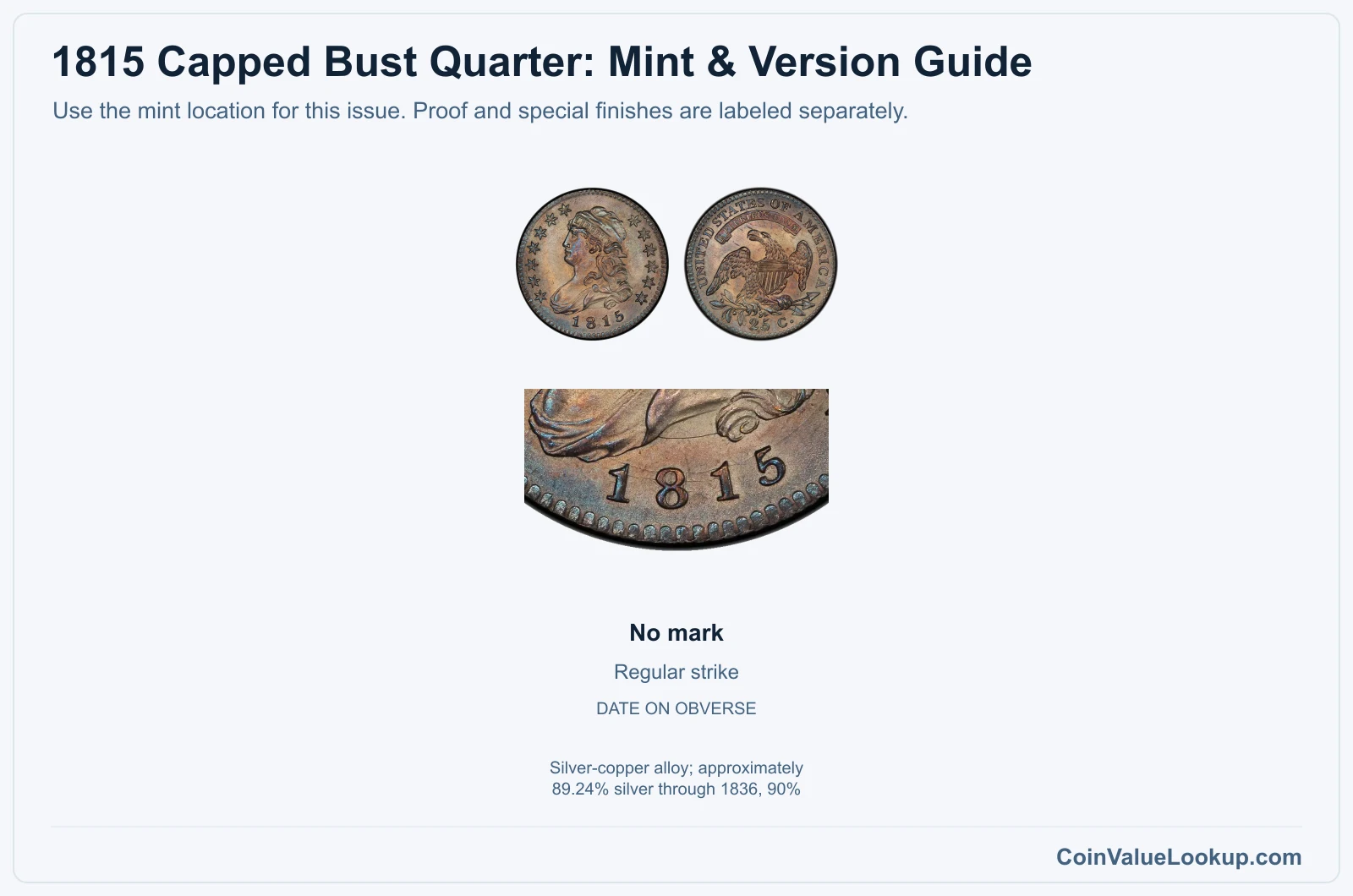
The 1815 Capped Bust Quarter is one of those early American coins that stops you mid-scroll. Struck at the Philadelphia Mint in a silver-copper alloy of roughly 89.24% silver, this quarter carries a guide value range of approximately $354.00 in well-worn condition up to $10,611.00 at higher uncirculated grades, according to USA Coin Book estimates.
Your coin's actual position in that range depends on its condition, surface originality, and strike quality.
Fast Way to Identify Your 1815 Capped Bust Quarter
Want a quick read on what you have? Upload clear photos of both the front and back of your 1815 quarter for a preliminary identification.
Good lighting and a straight-on angle help the most. This step can help you figure out the coin's general type and condition before you dig deeper into value guides or seek professional grading.
1815 Capped Bust Quarter Value
Upload both sides of your 1815 Capped Bust Quarter.
Front Obverse
Upload photo
Back Reverse
Upload photo
Which 1815 Capped Bust Quarter Versions Are Worth Money?
- 1815 Philadelphia quarter: USA Coin Book guide estimates range from $354.00 at G4 to $10,611.00 at MS63, with condition and originality driving where a coin falls.
- Always confirm the mint, finish, and surface quality before comparing to guide values; cleaning or damage can sharply reduce what a coin is worth regardless of date.
Step 1: Identify Your 1815 Capped Bust Quarter Mint Mark and Version
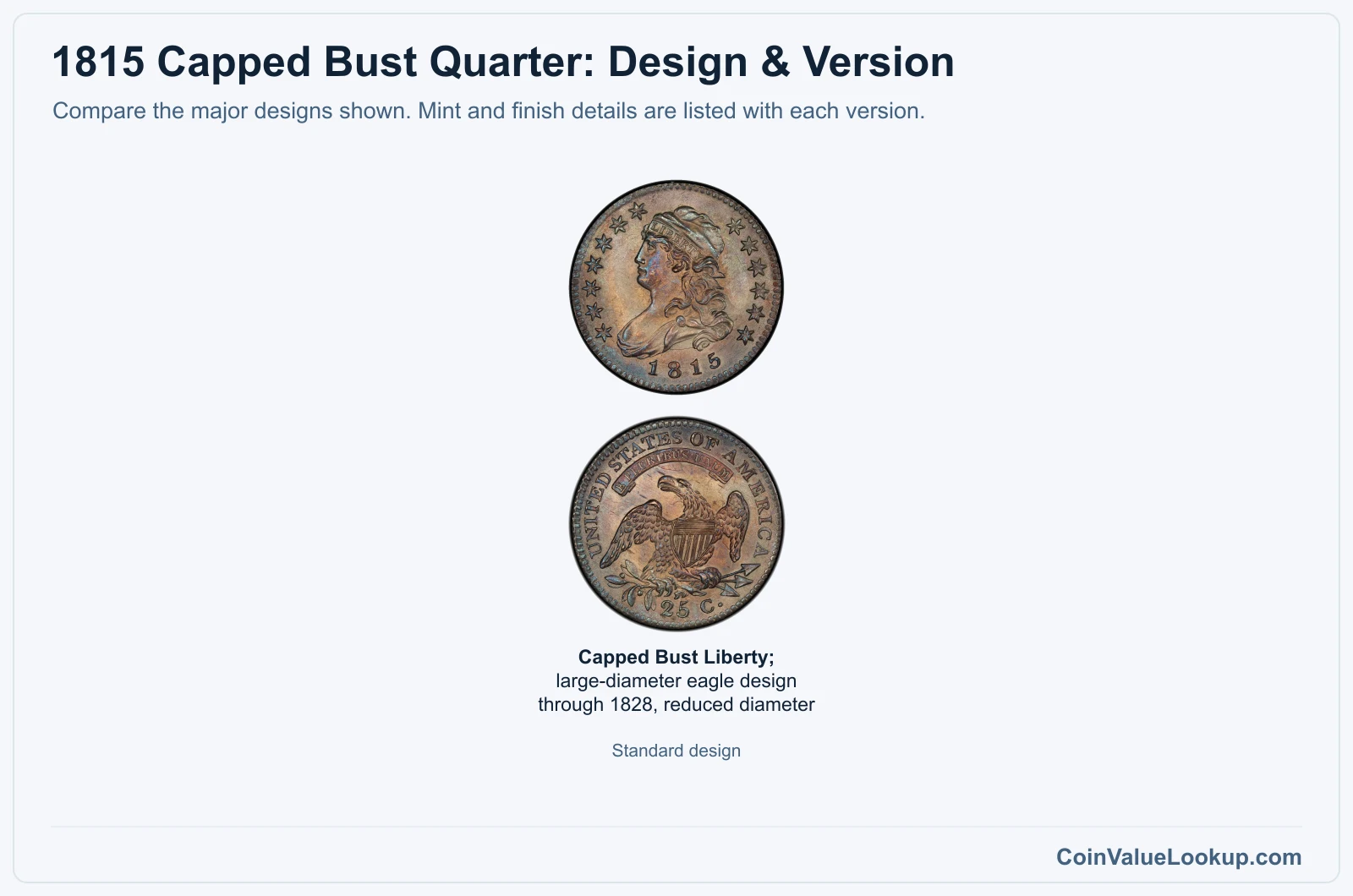
Only one mint produced quarters in 1815: Philadelphia. There is no mintmark on this coin.
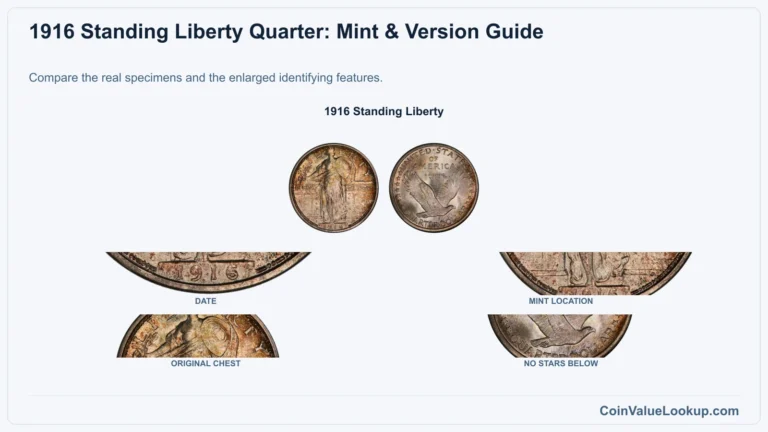
The obverse shows the Capped Bust Liberty design, and the reverse features a large-diameter heraldic eagle.
This is the earlier, larger-format Capped Bust type used through 1828, before the series was reduced in diameter beginning in 1831. The later reduced-size version also dropped the E PLURIBUS UNUM motto from the reverse, so if your coin has that motto above the eagle, you are looking at the correct large-diameter format.
Confirm the date reads 1815. Compare the denomination on the reverse and the style of the lettering to known examples.
Silver content is approximately 89.24% for this era. Cleaned or damaged coins are not rare versions, they are just hurt coins, so surface condition matters separately from the date itself.
Step 2: Check Your 1815 Capped Bust Quarter Grade
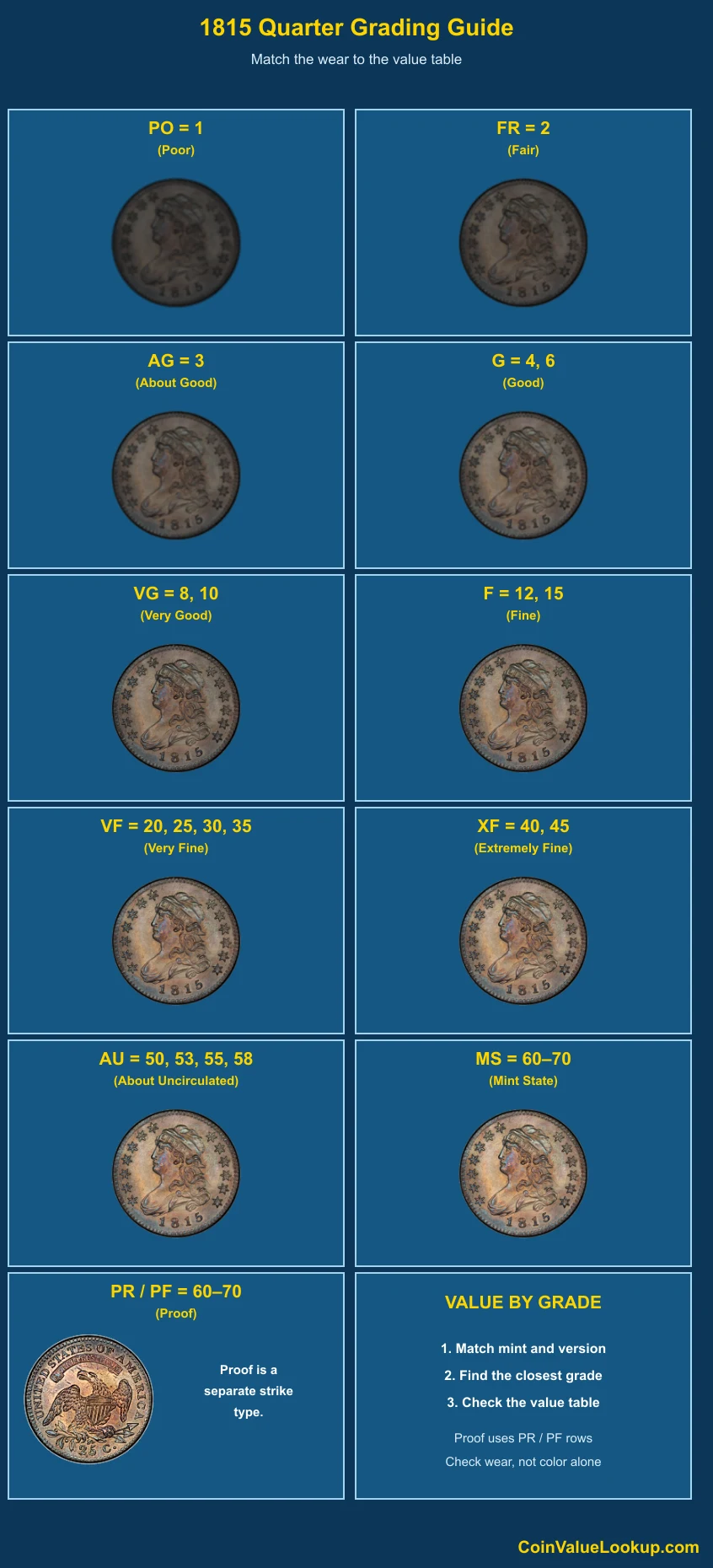
Start with the hair above Liberty's ear and the folds of the cap on the obverse. These are the first areas to lose detail as a coin circulates.
On the reverse, check the eagle's breast feathers and the tops of the wings.
A coin graded G4 (Good) will show a clear outline of the design but most fine detail is gone. At MS60 (Mint State, lowest uncirculated grade), the coin should have no wear at all, though it may show contact marks or a less-than-perfect surface.
MS63 means a sharper, more attractive uncirculated coin with fewer distractions. Keep in mind that strike weakness is a separate issue from wear.
A softly struck coin can look less detailed even without any circulation, so compare your coin's luster and high points together using the comparison image. Do not assume a bright surface means a high grade; cleaning removes original luster and actually lowers the coin's value.
Step 3: Check 1815 Capped Bust Quarter Value by Mint and Version
1815 Capped Bust Quarter
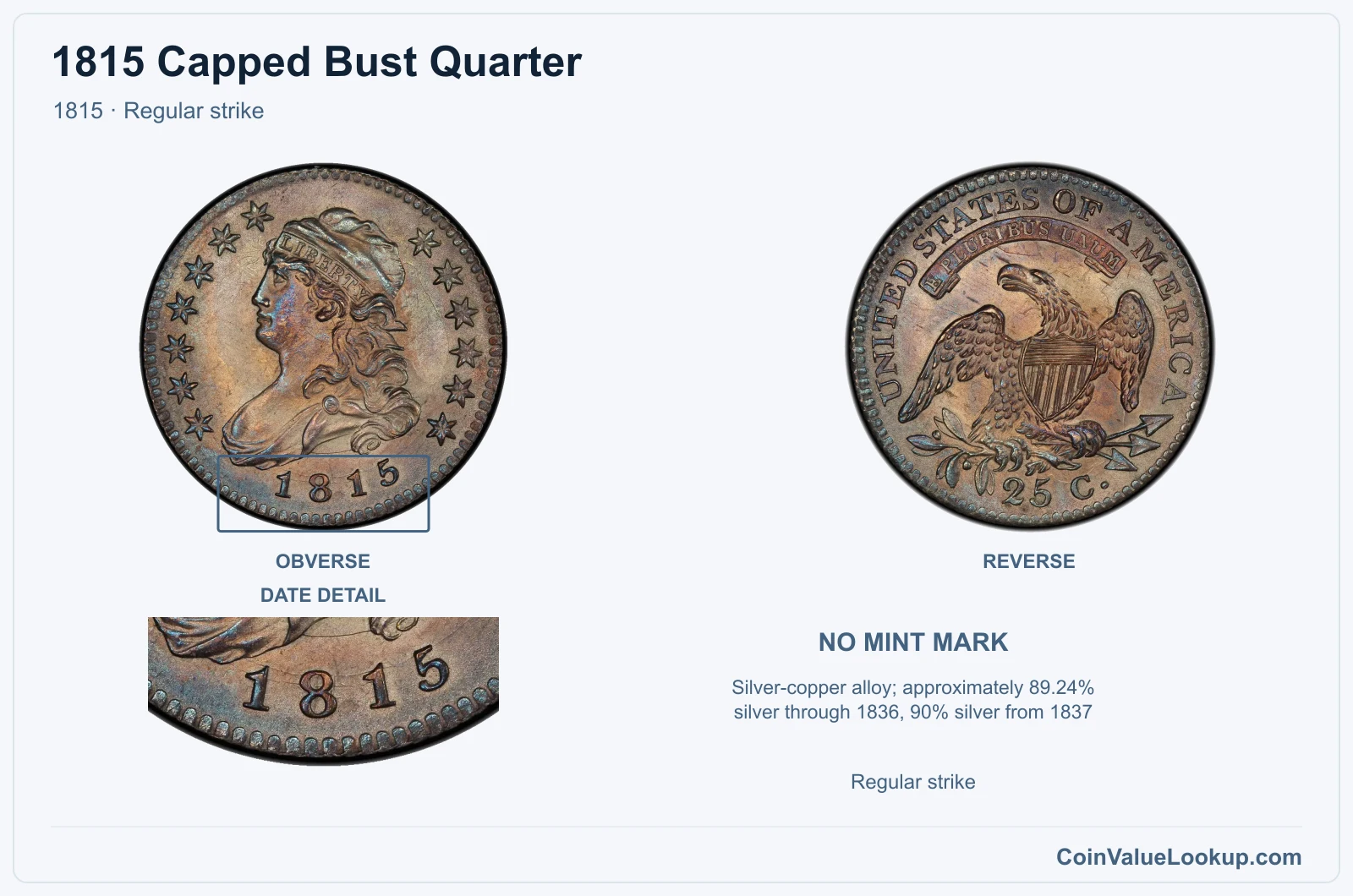
The 1815 quarter was struck only at Philadelphia, so there is no mintmark to look for. It uses the large-diameter Capped Bust design with E PLURIBUS UNUM on the reverse.
USA Coin Book estimates place this coin at about $354.00 in G4, $7,139.00 at MS60, and $10,611.00 at MS63. Those are guide figures, not guaranteed sale prices.
Original surfaces matter a lot here. A coin that has been cleaned or damaged will fall well below these benchmarks even if it otherwise looks sharp.
Coin Value Lookup is a useful starting point if you want to look up guides for other early quarter dates or different coin series. Match the mint, design type, and condition before drawing value comparisons.
Range Grade
Price Auction Records Appraisal PO PO 1
—
Coin Identifier FR FR 2
—
Coin Identifier AG AG 3
Coin Identifier G G 4
Coin Identifier
G 6
Coin Identifier VG VG 8
Coin Identifier
VG 10
Coin Identifier F F 12
Coin Identifier
F 15
Coin Identifier VF VF 20
Coin Identifier
VF 25
Coin Identifier
VF 30
Coin Identifier
VF 35
Coin Identifier XF XF 40
Coin Identifier
XF 45
Coin Identifier AU AU 50
Coin Identifier
AU 53
Coin Identifier
AU 55
Coin Identifier
AU 58
Coin Identifier MS MS 60
Coin Identifier
MS 61
Coin Identifier
MS 62
Coin Identifier
MS 63
Coin Identifier
MS 64
Coin Identifier
MS 65
Coin Identifier
MS 66
Coin Identifier
MS 67
Coin Identifier
MS 68
—
—
—
MS 69
—
—
—
MS 70
—
—
—
1815 Capped Bust Quarter Error List
1. 1815 Capped Bust Quarter — Clashed Dies
Clashed dies occur when the obverse and reverse dies strike each other without a planchet between them. The result is faint traces of one die's design transferred onto the other.
On an 1815 Capped Bust Quarter, look for ghostly outlines of the eagle on Liberty's side, or hints of Liberty's portrait on the eagle side, positioned where the opposing design would naturally align.
This error has been reported for the 1815 date. The visibility and boldness of the clash marks vary from coin to coin, and that directly affects collector interest.
No specific price data is available for this variety, so individual assessment based on the strength of the clash and the coin's overall condition is the practical approach.
Do not confuse clashed die impressions with random scratches, hairlines from cleaning, or raised lines from a damaged die. Genuine clash marks follow the pattern of the opposing design and appear in predictable locations.