1823 Capped Bust Quarter Coin Value: How Much Is It Worth?
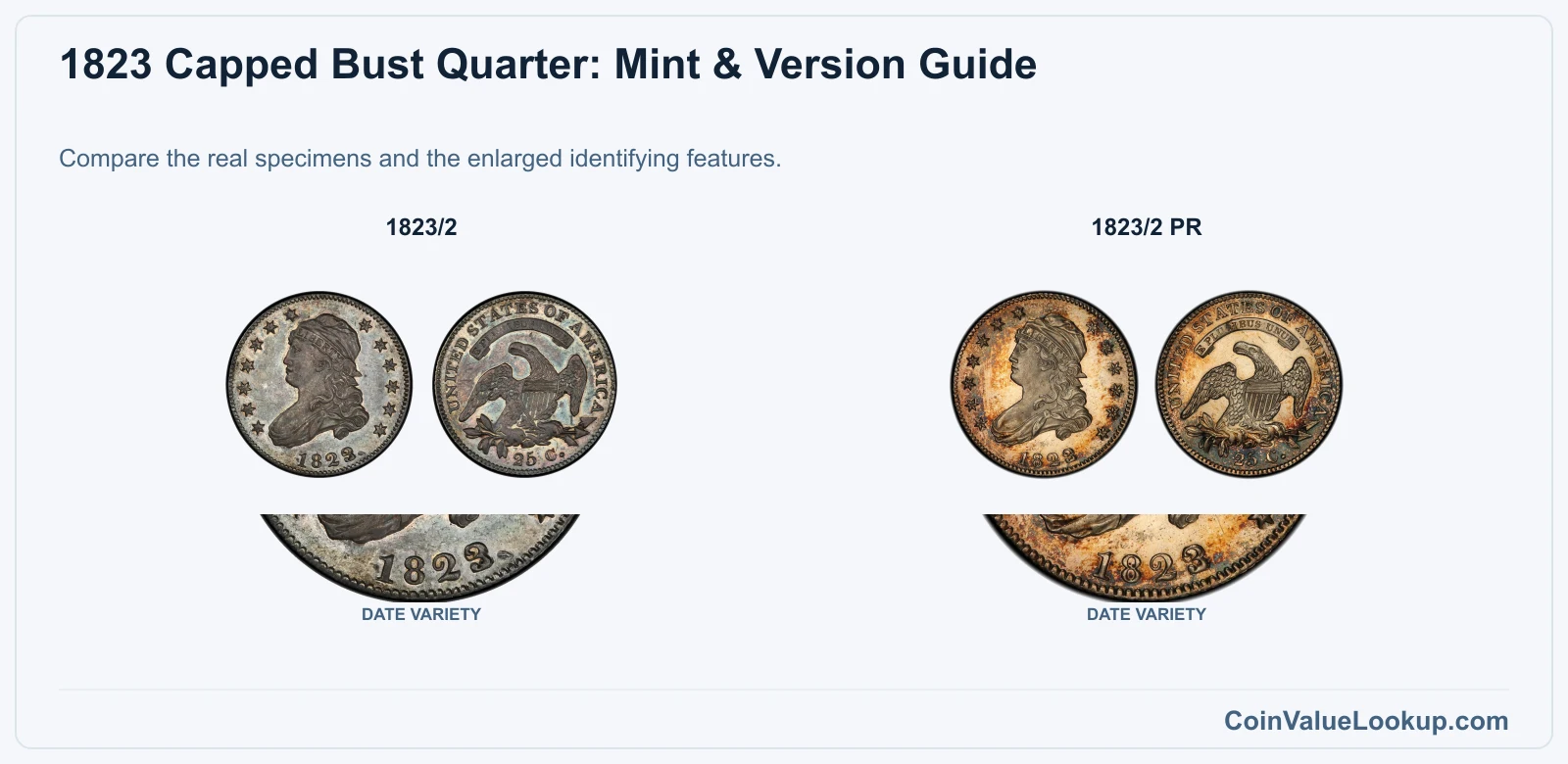
The 1823 Capped Bust Quarter is one of those early American coins that stops you mid-scroll. Every example is an overdate, with the 3 punched over a 2 in the date.
USA Coin Book guide estimates range from $54,381 at Good-4 to $438,037 at Mint State 60 for the business-strike version, though a proof finish exists as well. Mint, condition, and whether your coin is a regular strike or proof determine where it falls in that spread.
Fast Way to Identify Your 1823 Capped Bust Quarter
The quickest way to start figuring out what you have is to upload clear photos of both sides of your coin. A sharp image of the front lets us check the overdate detail, and the reverse confirms the design type.
Snap those pictures in good light and submit them for a preliminary identification based on the photos alone.
1823 Capped Bust Quarter Value
Upload both sides of your 1823 Capped Bust Quarter.
Front Obverse
Upload photo
Back Reverse
Upload photo
Which 1823 Capped Bust Quarter Versions Are Worth Money?
- The 1823/2 business strike carries USA Coin Book guide estimates of $54,381 at Good-4 and $438,037 at Mint State 60, reflecting serious collector demand for this scarce overdate.
- The 1823/2 Proof is a separate manufacturing finish with no adopted numeric guide range; value depends on individual authentication and condition assessment.
- All 1823 quarters are overdates (3 over 2), so confirming that overdate detail is the first step to proper identification.
- Proof versus business strike matters enormously; a reflective surface alone does not prove proof manufacture.
Step 1: Identify Your 1823 Capped Bust Quarter Mint Mark and Version
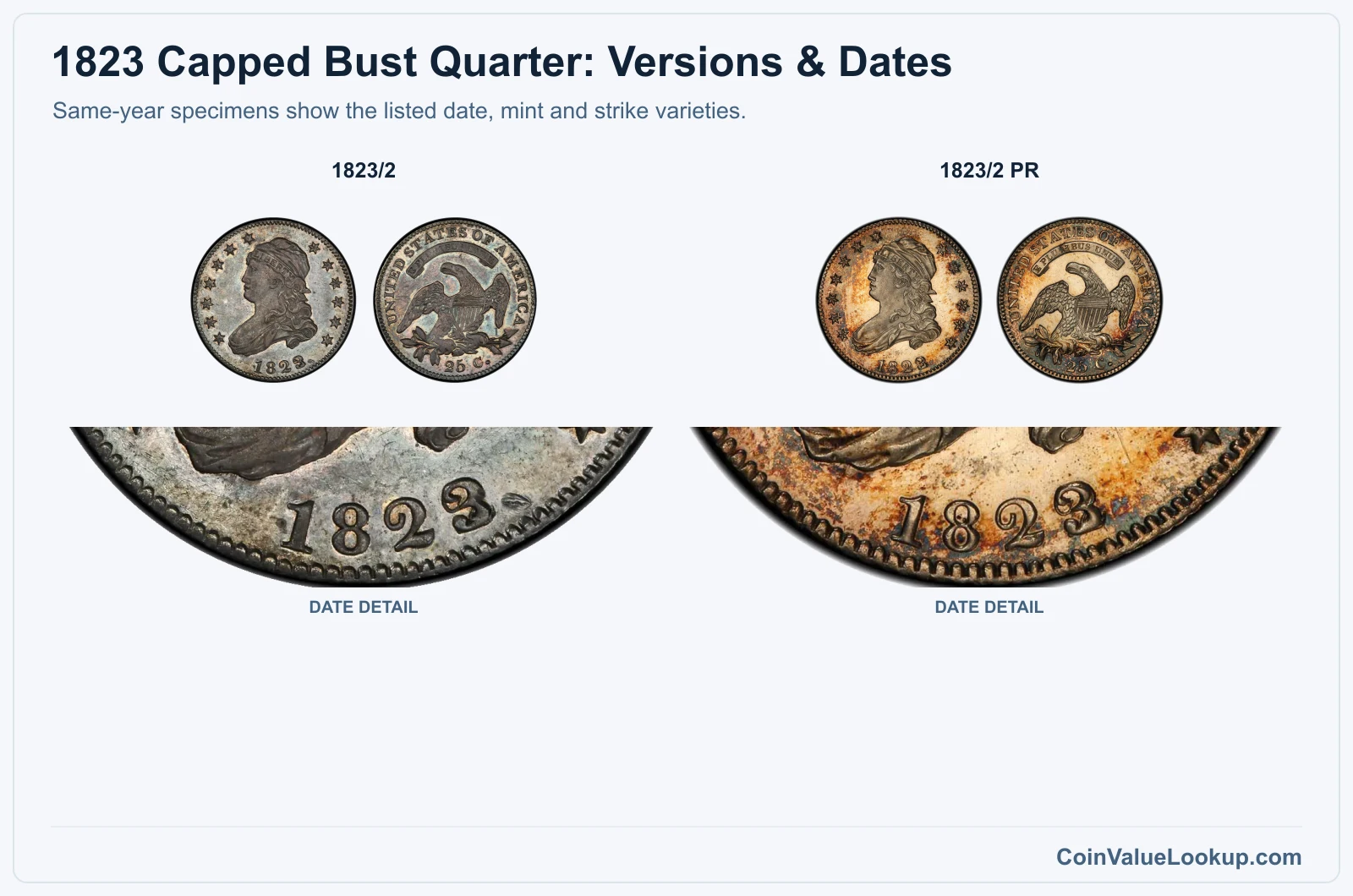
Every 1823 quarter was struck at Philadelphia, so there is no mintmark to hunt for. The denomination sits within the Capped Bust series, featuring a large-diameter eagle reverse with E PLURIBUS UNUM on a ribbon above the bird.
The key date feature is the overdate: look closely at the final digit in the date. You should see traces of a "2" beneath the "3." Both the business strike and the proof carry this overdate, so the distinction between the two comes down to how the coin was manufactured, not which digit is underneath.
The coin is a silver-copper alloy, roughly 89.24% silver. It has a larger diameter than later Capped Bust quarters made from 1831 onward.
If your coin feels smaller and lacks E PLURIBUS UNUM on the reverse, you may be looking at a different year entirely.
Coin Value Lookup is a handy starting point if you want to look up guides for other dates or denominations in this series.
Step 2: Check Your 1823 Capped Bust Quarter Grade
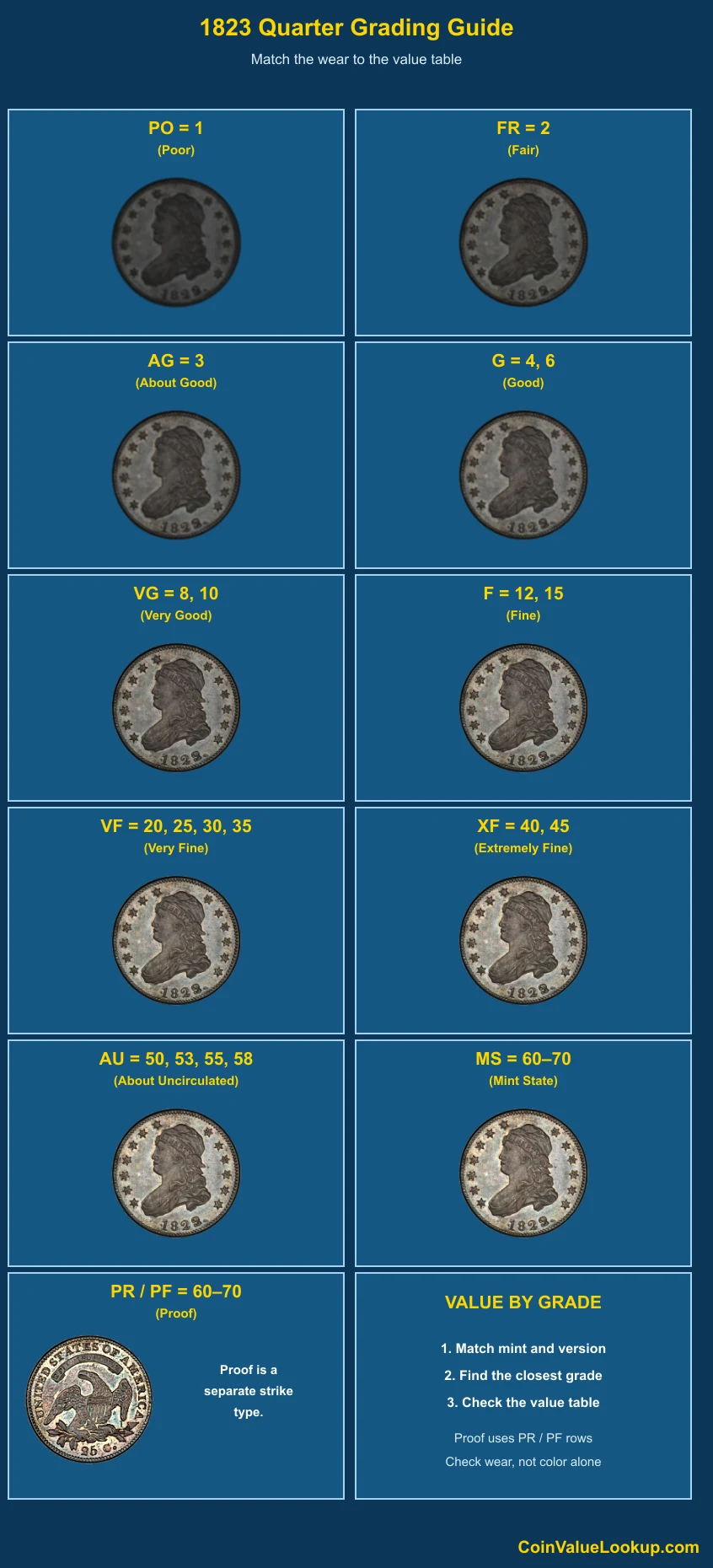
Start with the hair above Liberty's ear. On a lightly circulated coin, those curls will still show separation.
Once they begin merging into a flat mass, you are heading into lower grades.
The cap folds across the top of Liberty's head wear next. Check the cheek as well; flattening there indicates moderate to heavy wear.
On the reverse, examine the eagle's breast feathers and the tops of the wings. These are the first high points to lose definition.
Compare your coin against the reference image for this type. Keep in mind that a soft strike can leave weak detail even on an uncirculated coin.
Luster is your friend here: an original, satiny surface across the fields suggests the coin saw little or no circulation, even if certain design elements look mushy from the strike.
Step 3: Check 1823 Capped Bust Quarter Value by Mint and Version
1823 Capped Bust Quarter — /2
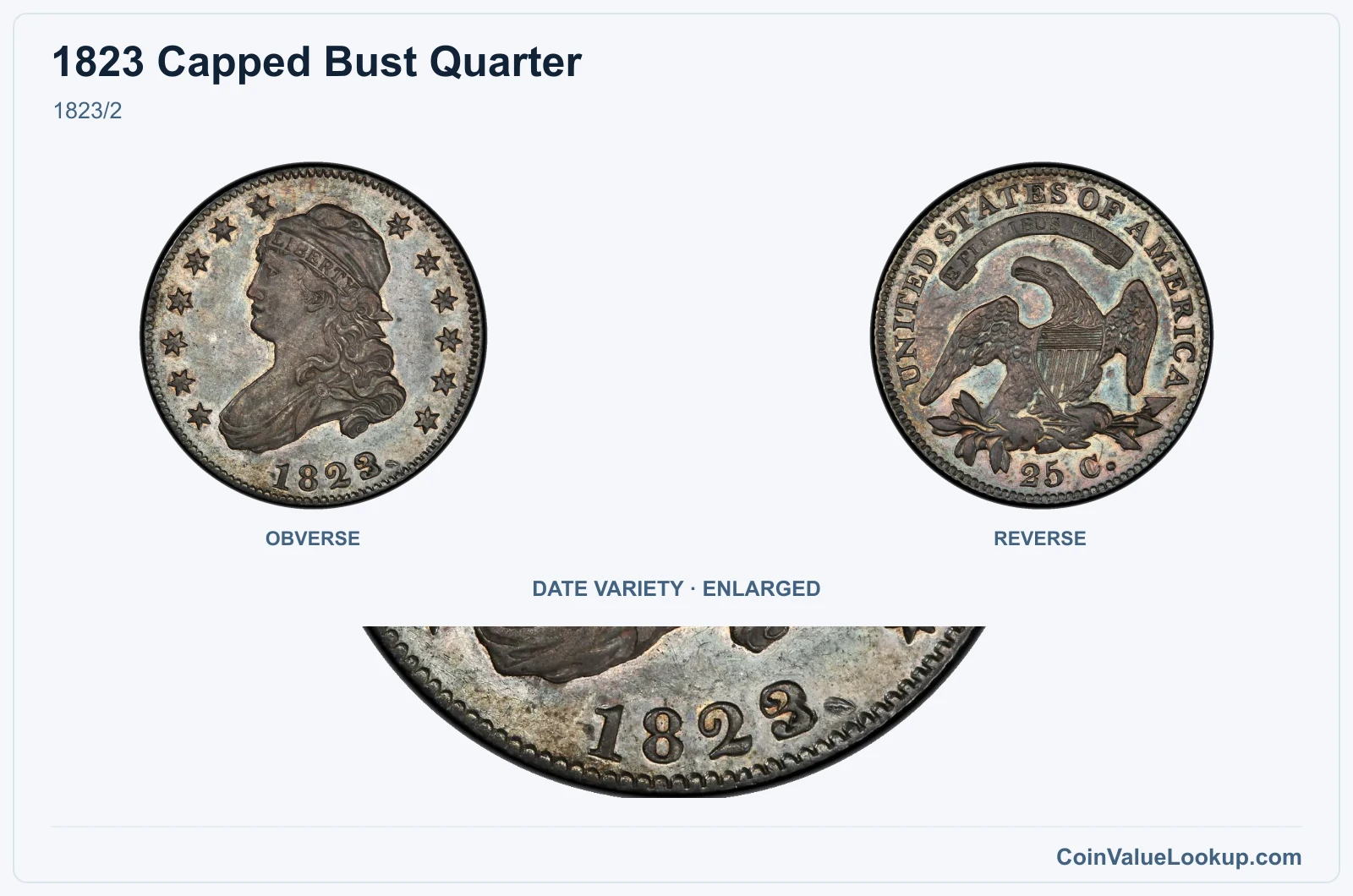
The 1823/2 business strike is the regular-issue version of this quarter. Under magnification, remnants of the underlying 2 are visible beneath the final 3 in the date.
The coin was struck at Philadelphia with no mintmark, on a large-diameter planchet in a silver-copper alloy of approximately 89.24% silver.
USA Coin Book estimates place this version at $54,381 in Good-4 and $438,037 in Mint State 60. Those are guide figures, not guaranteed sale prices.
Original surfaces matter here. A coin that has been cleaned or damaged will not command the same attention, even if the overdate detail is perfectly clear.
Range Grade
Price Auction Records Appraisal PO PO 1
—
Coin Identifier FR FR 2
—
Coin Identifier AG AG 3
—
Coin Identifier G G 4
Coin Identifier
G 6
Coin Identifier VG VG 8
—
Coin Identifier
VG 10
Coin Identifier F F 12
—
Coin Identifier
F 15
—
Coin Identifier VF VF 20
—
Coin Identifier
VF 25
—
Coin Identifier
VF 30
Coin Identifier
VF 35
—
Coin Identifier XF XF 40
—
Coin Identifier
XF 45
Coin Identifier AU AU 50
Coin Identifier
AU 53
—
Coin Identifier
AU 55
Coin Identifier
AU 58
Coin Identifier MS MS 60
—
—
—
MS 61
—
—
—
MS 62
—
—
—
MS 63
—
—
—
MS 64
—
—
—
MS 65
—
—
—
MS 66
—
—
—
MS 67
—
—
—
MS 68
—
—
—
MS 69
—
—
—
MS 70
—
—
—
1823 Capped Bust Quarter — /2 PR
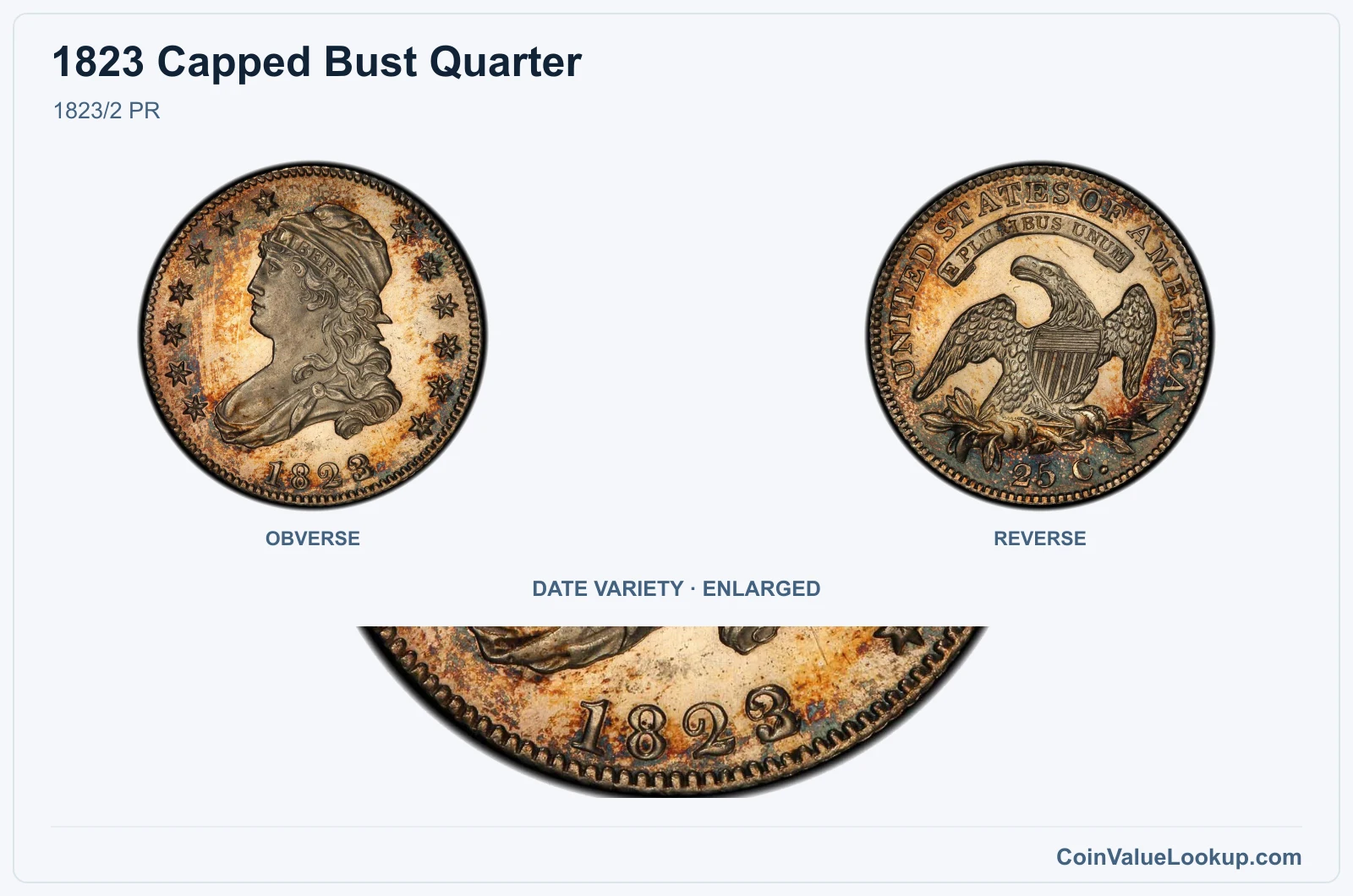
The 1823/2 Proof is the proof-finish counterpart, also showing the overdate with remnants of the 2 beneath the 3. Proof manufacture means the coin was struck with specially prepared dies on a polished planchet, producing deeply mirrored fields.
That is a different process from a business strike that simply happens to look shiny.
No numeric guide range has been adopted for this version. Value depends on authenticated identity, the coin's condition, and factors like surface haze or hairlines that accumulate over nearly two centuries.
If you believe you hold a proof, professional authentication is the practical next step, because the distinction from a well-preserved business strike is subtle and consequential.
Range Grade
Price Auction Records Appraisal PR PR 1
—
Coin Identifier
PR 2
—
Coin Identifier
PR 3
—
Coin Identifier
PR 4
—
Coin Identifier
PR 6
—
Coin Identifier
PR 8
—
Coin Identifier
PR 10
—
Coin Identifier
PR 12
—
Coin Identifier
PR 15
—
Coin Identifier
PR 20
—
Coin Identifier
PR 25
—
Coin Identifier
PR 30
—
Coin Identifier
PR 35
—
Coin Identifier
PR 40
—
Coin Identifier
PR 45
—
Coin Identifier
PR 50
—
Coin Identifier
PR 53
—
Coin Identifier
PR 55
—
Coin Identifier
PR 58
—
Coin Identifier
PR 60
—
Coin Identifier
PR 61
—
Coin Identifier
PR 62
—
Coin Identifier
PR 63
—
Coin Identifier
PR 64
Coin Identifier
PR 65
—
—
—
PR 66
—
—
—
PR 67
—
—
—
PR 68
—
—
—
PR 69
—
—
—
PR 70
—
—
—
1823 Capped Bust Quarter Error List
1. 1823 Capped Bust Quarter — Overdate
The 1823 Capped Bust Quarter is itself an overdate variety: the final digit 3 was punched into the die over a 2. Under magnification, you can see surviving contours of the earlier 2 beneath the 3, particularly curves that do not belong to the final numeral.
This is a die variety, meaning it was built into the die before any coins were struck, and every genuine 1823 quarter should show it to some degree.
Do not confuse this with a damaged or re-engraved date, which tends to show irregular scratches rather than the smooth, consistent outline of an underlying digit. Machine doubling can also produce shelf-like shadows near the numbers, but that effect is mechanical and flat, lacking the depth and shape of a true overdate.
No separate numeric price range is adopted for the overdate as an error category here; condition, the clarity of the underlying digit, and the coin's overall preservation all factor into its value.