1805 Draped Bust Quarter Coin Value: How Much Is It Worth?
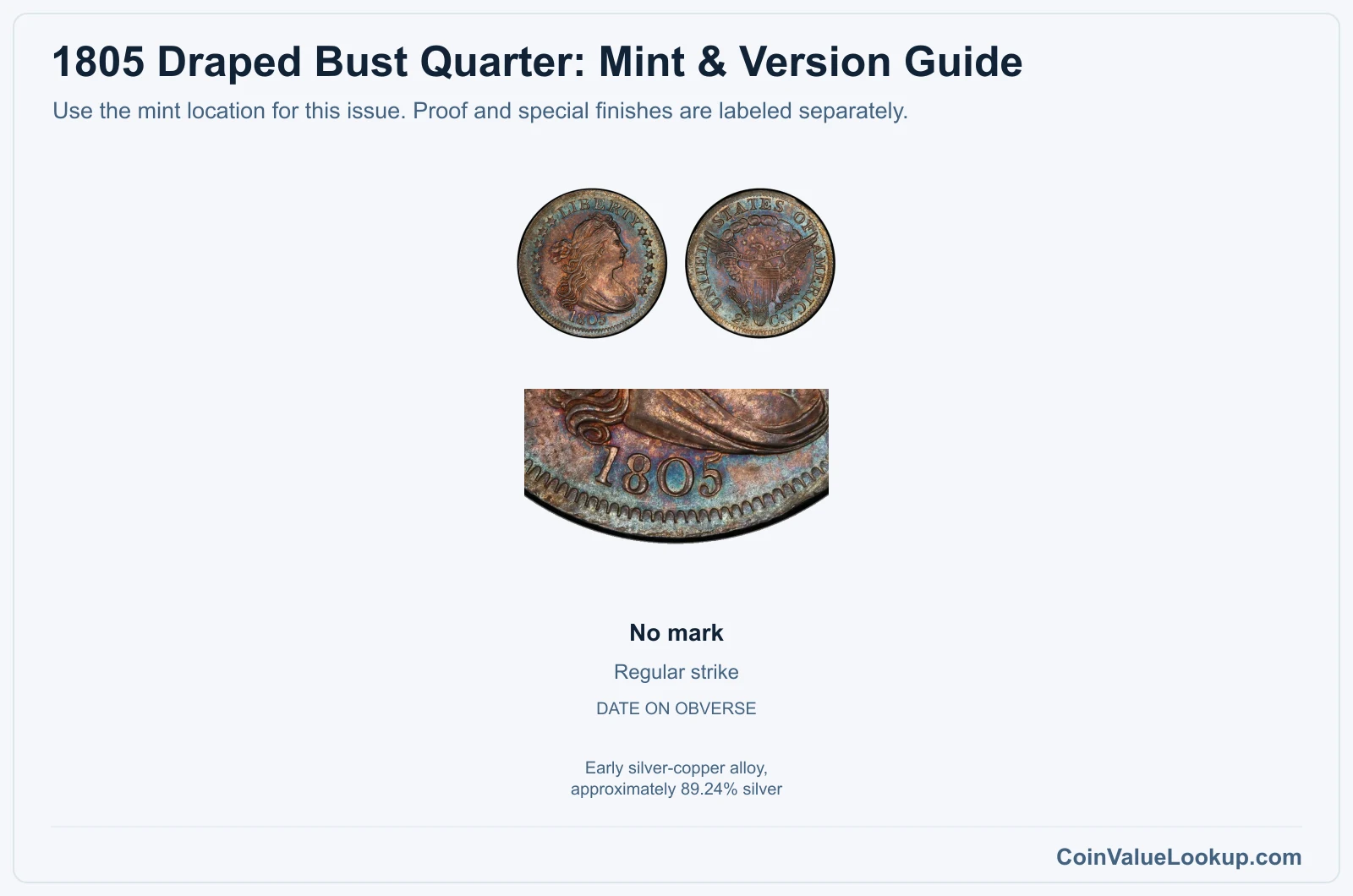
The 1805 Draped Bust quarter is a scarce early American silver coin struck at the Philadelphia Mint. USA Coin Book guide estimates for this date range from $622.00 in Good-4 condition up to $26,779.00 in MS63, depending on the coin's actual grade.
Condition, originality of surfaces, and strike quality all play a role in where your specific coin falls within that spread.
Fast Way to Identify Your 1805 Draped Bust Quarter
Want a quick read on what you have? Upload clear photos of both the front and back of your 1805 quarter, and our identifier can give you a preliminary identification.
Good lighting and a straight-on angle help. This step covers basic version and design recognition from your images, not professional authentication or precise grading.
1805 Draped Bust Quarter Value
Upload both sides of your 1805 Draped Bust Quarter.
Front Obverse
Upload photo
Back Reverse
Upload photo
Which 1805 Draped Bust Quarter Versions Are Worth Money?
- 1805 quarter: USA Coin Book estimates $622.00 at G4 and up to $26,779.00 at MS63, making higher-grade survivors the key targets.
- Confirm mint, date, and surface originality first; cleaning or damage lowers value well below guide figures regardless of apparent sharpness.
Step 1: Identify Your 1805 Draped Bust Quarter Mint Mark and Version
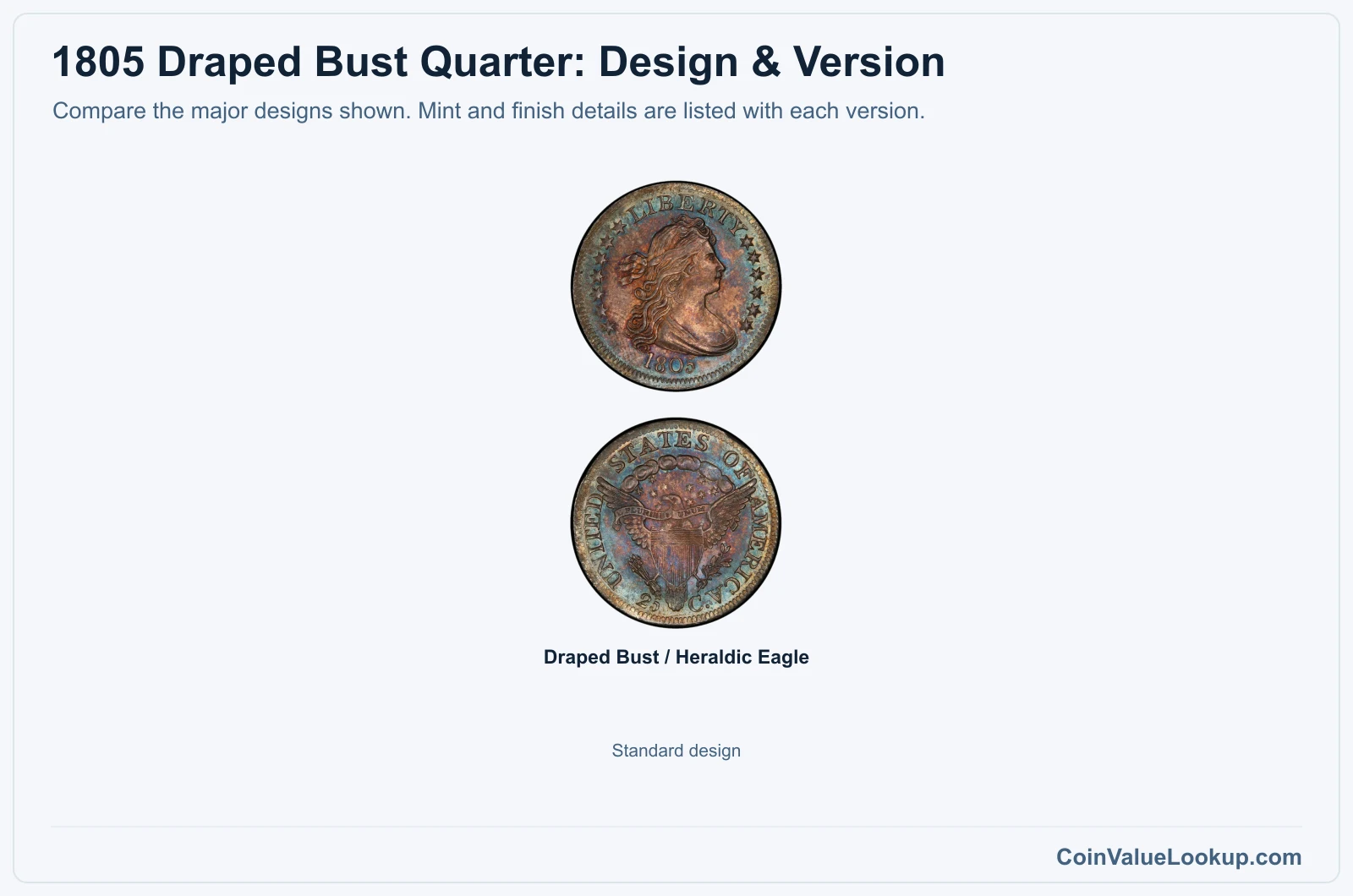
Every 1805 quarter was struck at the Philadelphia Mint, which did not place a mintmark on coins at that time. There is no "P" stamp to look for.
The obverse shows the Draped Bust portrait of Liberty facing right, with the date below. The reverse features the Heraldic Eagle design, which replaced the earlier Small Eagle reverse starting in 1804 for this denomination.
The coin is composed of an early silver-copper alloy, approximately 89.24% silver. It has a distinctive silver-gray appearance when original, sometimes with a blue or amber tone from age.
There is only one major business-strike version for 1805, so your main task is confirming the date reads 1805 and the reverse eagle matches the Heraldic Eagle type. Early dates can be misread when worn, so look carefully under magnification.
Step 2: Check Your 1805 Draped Bust Quarter Grade
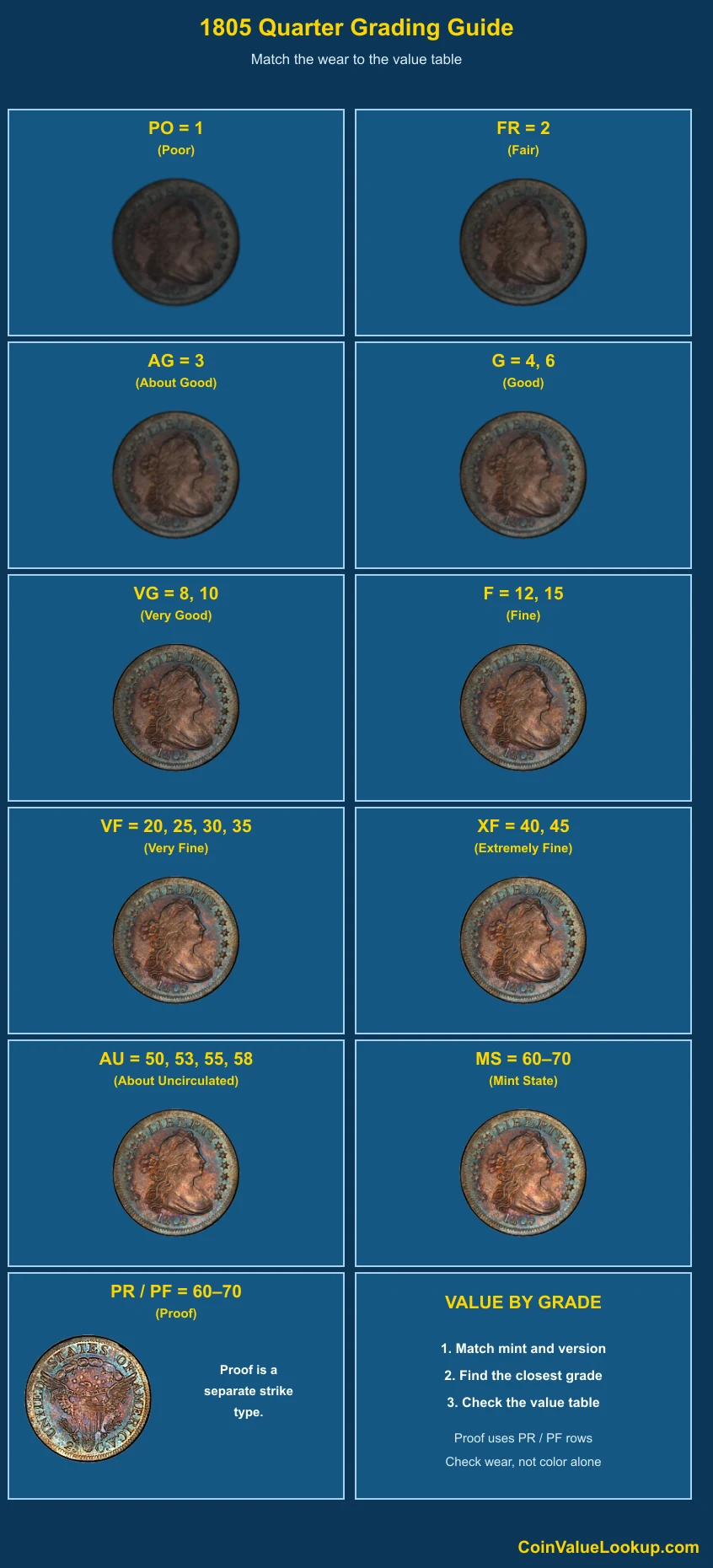
On the obverse, focus on Liberty's hair directly above the ear, the smoothness of the cheek, and the folds in the drapery across the bust. These are the first areas to show friction.
On the reverse, check the eagle's breast feathers and the tops of the wings. A coin that still shows clear feather separation and sharp wing tips is in considerably better shape than one where these have merged into flat areas.
Early quarter dies were hand-made and strikes were often uneven. A coin can be technically uncirculated yet still show weak detail in spots, so do not mistake a soft strike for wear.
Compare your coin to the reference image and look for actual smoothing from contact rather than just missing detail.
Luster matters as much as sharpness. An unworn coin will still carry some original mint luster in protected areas, while a worn coin will have lost it entirely on the high points.
Cleaned coins often look unnaturally bright and may have tiny hairlines visible under magnification, which reduces their collector value significantly.
Step 3: Check 1805 Draped Bust Quarter Value by Mint and Version
1805 Draped Bust Quarter
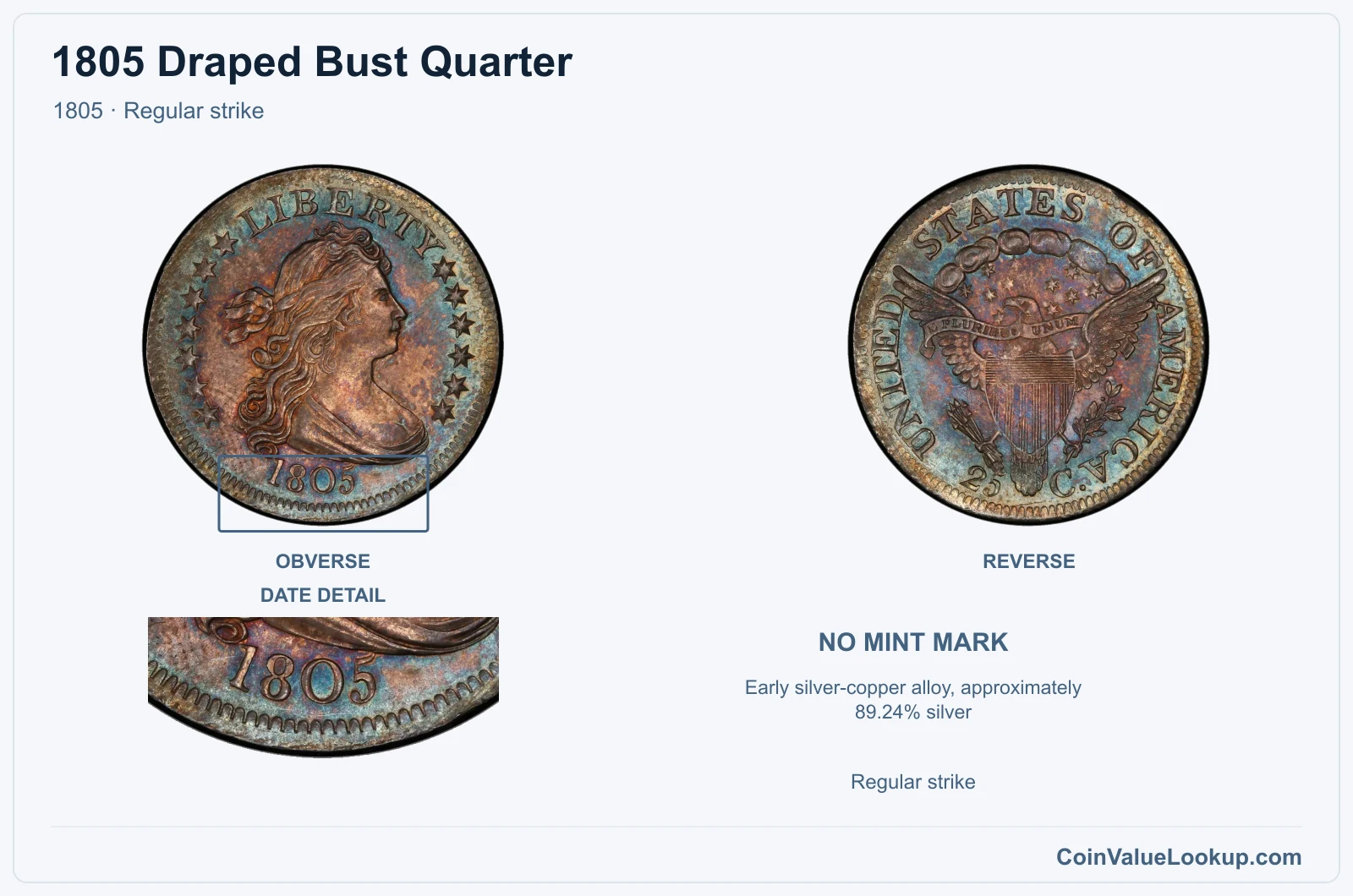
The 1805 Draped Bust quarter was struck only at Philadelphia with no mintmark. It carries the Heraldic Eagle reverse.
USA Coin Book estimates place this coin at $622.00 in G4, $14,888.00 in MS60, and $26,779.00 in MS63. These are guide estimates, not guaranteed offers.
Before comparing your coin to any price, confirm the date reads 1805 and the reverse shows the large eagle with shield, arrows, and olive branch. Original surfaces with natural toning are strongly preferred by collectors over coins that have been cleaned or polished.
A weakly struck but original example will generally outperform a harshly cleaned one at the same technical grade.
Coin Value Lookup is a good starting point if you want to look up guide values for other early American coins alongside this one. Bookmark it and come back whenever something old turns up in a collection.
Range Grade
Price Auction Records Appraisal PO PO 1
Coin Identifier FR FR 2
Coin Identifier AG AG 3
Coin Identifier G G 4
Coin Identifier
G 6
Coin Identifier VG VG 8
Coin Identifier
VG 10
Coin Identifier F F 12
Coin Identifier
F 15
Coin Identifier VF VF 20
Coin Identifier
VF 25
Coin Identifier
VF 30
Coin Identifier
VF 35
Coin Identifier XF XF 40
Coin Identifier
XF 45
Coin Identifier AU AU 50
Coin Identifier
AU 53
Coin Identifier
AU 55
Coin Identifier
AU 58
Coin Identifier MS MS 60
—
Coin Identifier
MS 61
Coin Identifier
MS 62
Coin Identifier
MS 63
Coin Identifier
MS 64
Coin Identifier
MS 65
Coin Identifier
MS 66
—
—
—
MS 67
—
—
—
MS 68
—
—
—
MS 69
—
—
—
MS 70
—
—
—
1805 Draped Bust Quarter Error List
1. 1805 Draped Bust Quarter — Double / Multiple Strike
A double or multiple strike on an 1805 Draped Bust quarter shows two or more separate impressions of the design, visibly displaced or rotated from each other. You are looking for a clearly shifted second image of Liberty's portrait or the Heraldic Eagle, not just slightly thickened lettering.
This is distinct from a doubled die, where the doubling comes from the die itself and appears identically on every coin struck by that die. A true multiple strike affects one individual coin and produces dramatic displacement you can see without magnification in strong examples.
Also watch out for post-mint damage where someone has hit the coin, creating a false impression of a second strike. Genuine double strikes maintain the correct design proportions in both impressions.
No specific price data is available for this error on the 1805 quarter. Value depends on the visibility and extent of the extra strike, the coin's overall condition, and collector demand at the time of sale.
2. 1805 Draped Bust Quarter — Die Crack / Die Chip
Die cracks on the 1805 Draped Bust quarter appear as thin raised lines running across the coin's surface, created when the steel die developed a fracture during use. These lines are raised because metal flowed into the crack during striking.
A die chip is a related feature: a small raised blob where a piece of the die surface broke away. If a crack extends to the rim and a larger section of the die has broken off, the result is called a cud, which produces a raised featureless area along the edge.
Do not confuse die cracks with scratches. Scratches are incuse, meaning they go into the surface, while die cracks sit above it.
Corrosion deposits or environmental buildup can also mimic small raised lines, so check under magnification.
No adopted price range exists for die cracks on this date. The size, location, and overall condition of the coin all influence what a collector might pay.
3. 1805 Draped Bust Quarter — Clashed Dies
Clashed dies occur when the obverse and reverse dies strike each other without a planchet between them, transferring ghost impressions of each design onto the opposite die. On the 1805 quarter, this has been reported as heavy clash marks, especially visible on the reverse.
Look for faint outlines of Liberty's bust or hair appearing in the fields of the eagle side. These transferred impressions will align with where the obverse design would sit relative to the reverse during normal striking.
Do not confuse clash marks with random scratches, contact marks, or a brockage, which is a completely different error involving a previously struck coin acting as a die. Clash marks follow the geometry of the opposing design and appear in predictable locations.
No specific price data is available for clashed die examples of the 1805 quarter. The strength and visibility of the clash marks, combined with the coin's grade and surface quality, will determine collector interest.