1807 Draped Bust Quarter Coin Value: How Much Is It Worth?
The 1807 Draped Bust quarter is the final year of its design series, struck at the Philadelphia Mint in an early silver-copper alloy of approximately 89.24% silver. USA Coin Book guide estimates for this date range from $622.00 in Good-4 condition up to $26,779.00 in MS63.
That is not a single price for every coin — your specific value depends on condition, surface quality, and whether the coin has been cleaned or damaged.
Fast Way to Identify Your 1807 Draped Bust Quarter
The quickest way to start figuring out what your 1807 quarter might be worth is to upload clear photos of the front and back. Our identifier can offer a preliminary identification based on those images, helping you match the design, date, and overall condition before you dig deeper into guide values.
1807 Draped Bust Quarter Value
Upload both sides of your 1807 Draped Bust Quarter.
Front Obverse
Upload photo
Back Reverse
Upload photo
Which 1807 Draped Bust Quarter Versions Are Worth Money?
- 1807 Draped Bust quarter: USA Coin Book estimates $622.00 at G4, $14,888.00 at MS60, and $26,779.00 at MS63 — condition drives value dramatically on this date.
- Confirm your coin has original surfaces and no cleaning before assuming a high-grade value; damage and cleaning reduce what collectors will pay regardless of apparent sharpness.
Step 1: Identify Your 1807 Draped Bust Quarter Mint Mark and Version
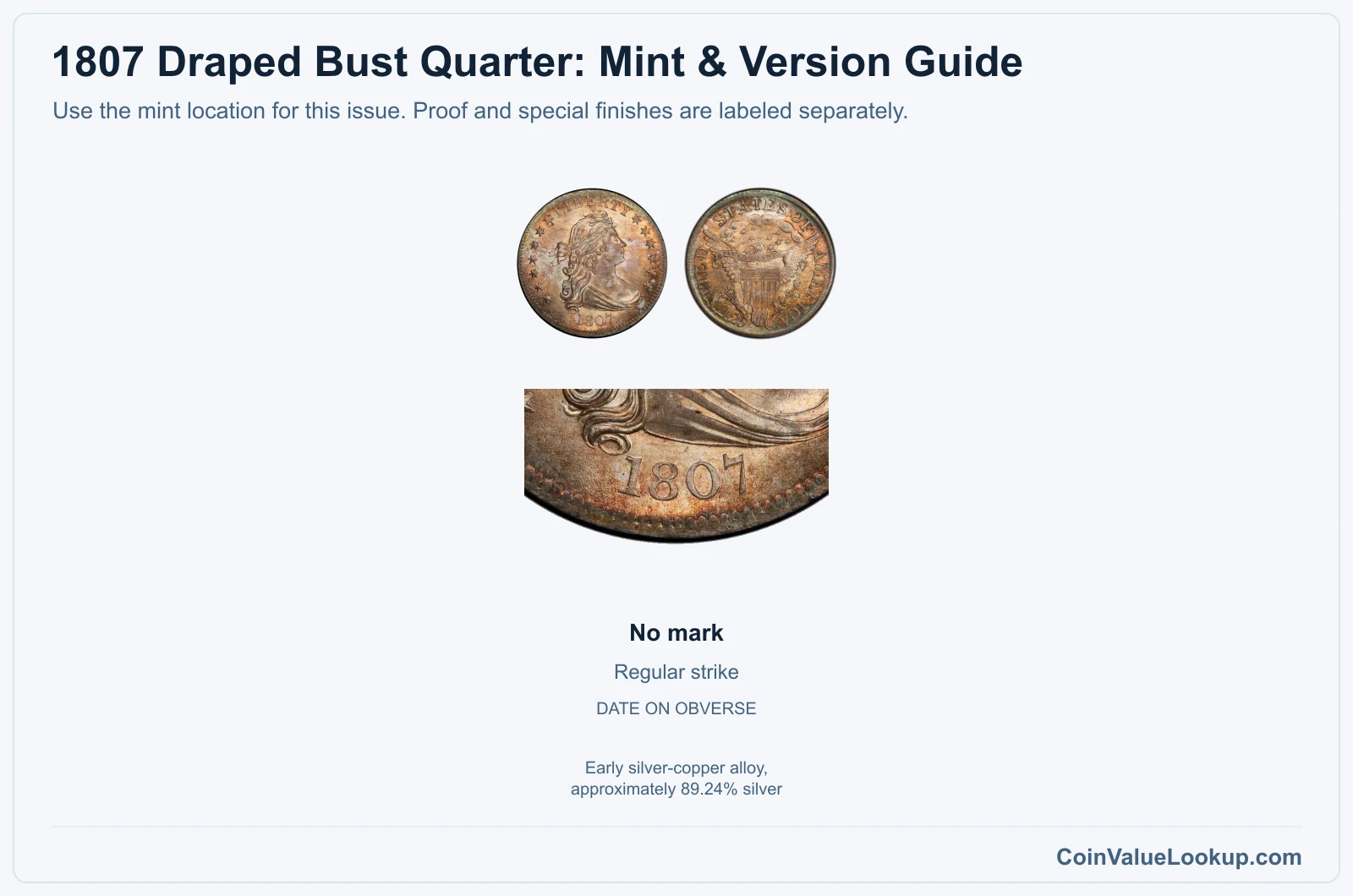
Every 1807 quarter was struck at the Philadelphia Mint. There is no mintmark — and no "P" stamp either, since that practice came much later.
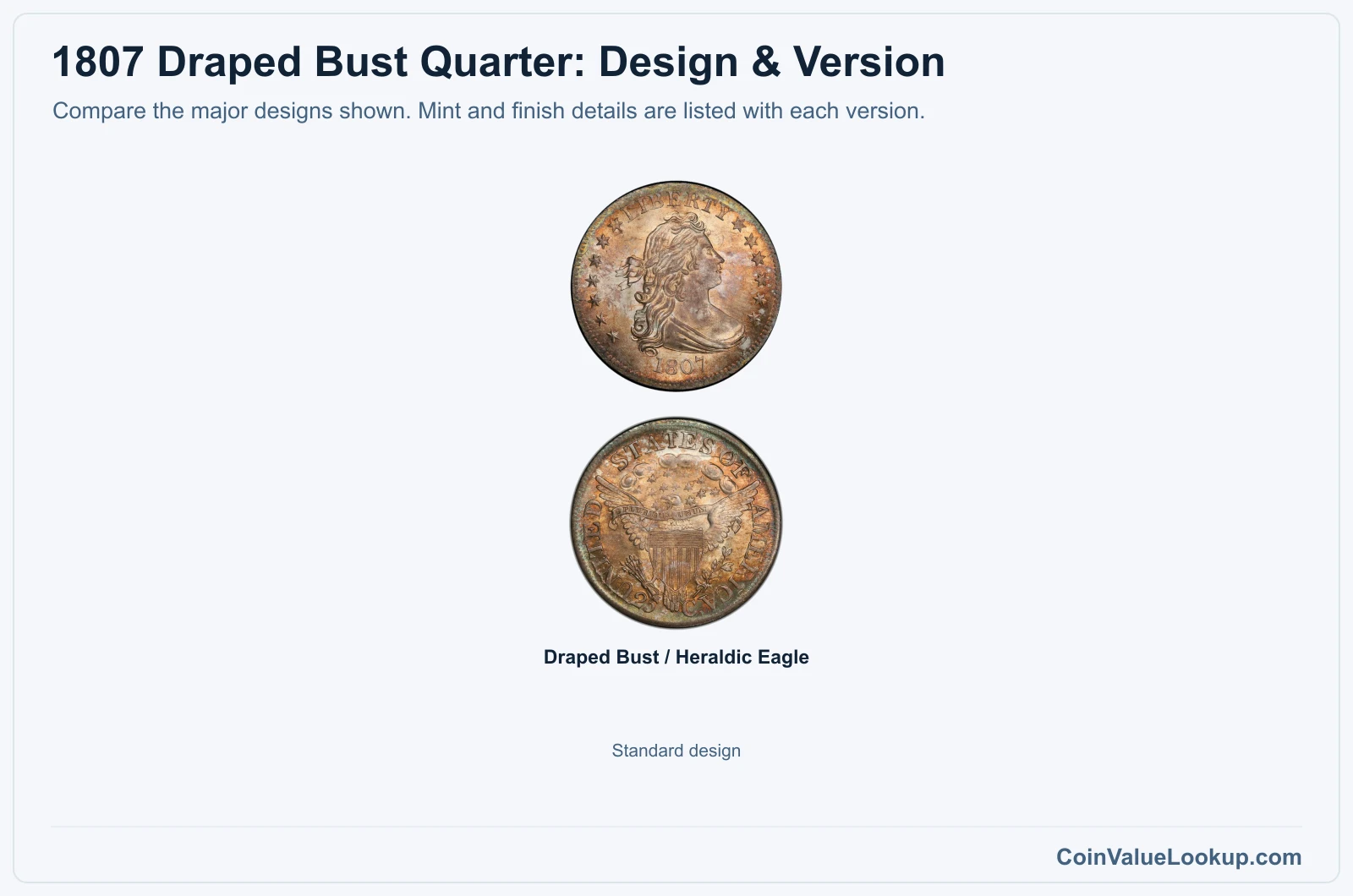
The obverse shows the Draped Bust of Liberty facing right, with the date below. The reverse features the Heraldic Eagle design, which replaced the earlier Small Eagle reverse starting in 1804.
The coin is made of an early silver-copper alloy, roughly 89.24% silver. It has a distinctive look and feel compared to later quarters — thinner, slightly uneven, and often softly struck in spots.
Read the date carefully; wear can make an 1807 look like an 1802 or 1806 if you squint hard enough.
There is only one business-strike version for this year. No proof finish, no branch mints, no mintmark varieties to chase.
Confirming the date and design match is the main identification step before you move to grading.
Step 2: Check Your 1807 Draped Bust Quarter Grade
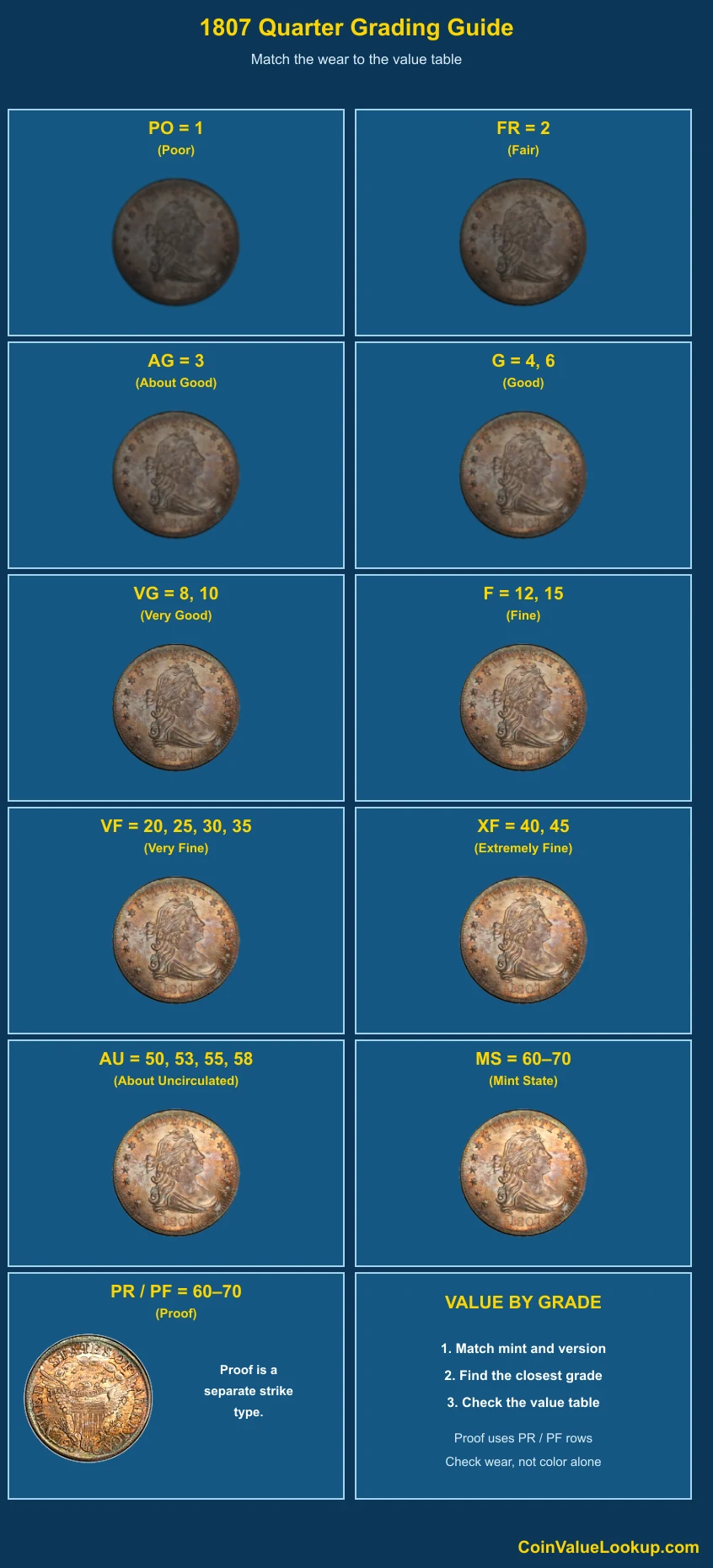
Focus on Liberty's hair detail above the ear and across the cheek first. On well-preserved examples, individual curls remain distinct and the drapery lines at the bust stay sharp.
On the reverse, check the eagle's breast feathers and wing tips. These are the highest points and wear down first.
Early quarter dies were hand-made, so don't confuse a weak strike with actual wear. Some 1807 quarters left the press with soft spots, especially near the centers, even when brand new.
A coin can be technically unworn but still show incomplete detail from the original strike.
Use the comparison image to match your coin's wear level against known grade examples. Look at luster together with surface detail — a coin with original mint luster and light rub grades differently from one that's been polished to look shiny.
Cleaning strips the natural toning and can leave hairline scratches visible under magnification, which significantly reduces the grade and value a dealer would assign.
Step 3: Check 1807 Draped Bust Quarter Value by Mint and Version
1807 Draped Bust Quarter
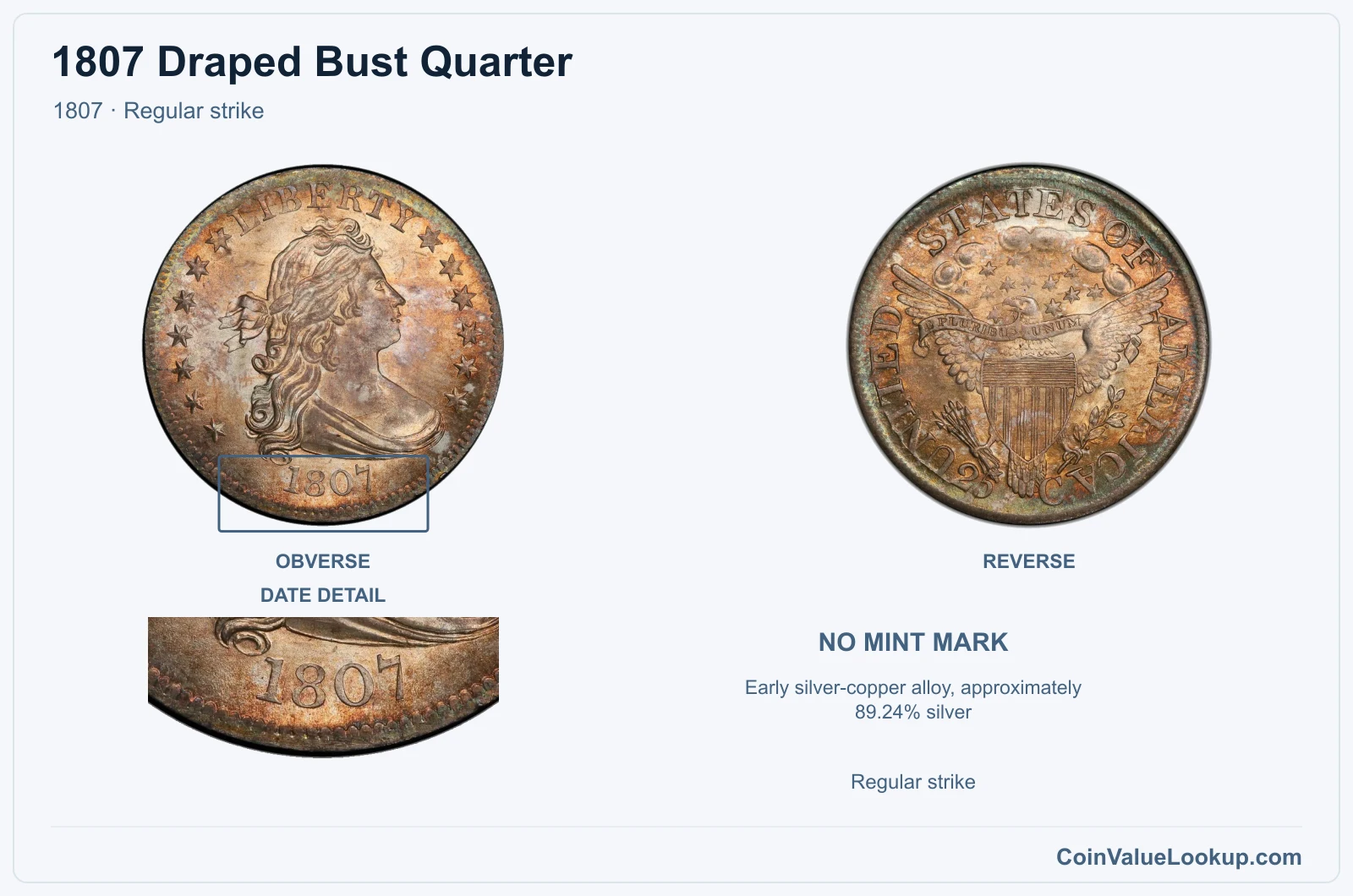
The 1807 is the sole Philadelphia Mint business-strike issue for this year, pairing the Draped Bust obverse with the Heraldic Eagle reverse. No mintmark appears anywhere on the coin.
USA Coin Book guide estimates place this version at $622.00 in G4, $14,888.00 in MS60, and $26,779.00 in MS63. These are retail guide figures, not guaranteed sale prices.
The jump from circulated to mint-state grades is steep because very few of these survived without significant wear.
Coin Value Lookup is a good starting point if you want to compare this quarter against other early dates or denominations. You can look up guides for the full Draped Bust series there.
Before comparing your coin to those grade-based estimates, confirm the surfaces are original. A cleaned or damaged coin — even one with sharp detail — will not command the same price as an example with honest, undisturbed patina.
Range Grade
Price Auction Records Appraisal PO PO 1
Coin Identifier FR FR 2
Coin Identifier AG AG 3
Coin Identifier G G 4
Coin Identifier
G 6
Coin Identifier VG VG 8
Coin Identifier
VG 10
Coin Identifier F F 12
Coin Identifier
F 15
Coin Identifier VF VF 20
Coin Identifier
VF 25
Coin Identifier
VF 30
Coin Identifier
VF 35
Coin Identifier XF XF 40
Coin Identifier
XF 45
Coin Identifier AU AU 50
Coin Identifier
AU 53
Coin Identifier
AU 55
Coin Identifier
AU 58
Coin Identifier MS MS 60
Coin Identifier
MS 61
Coin Identifier
MS 62
Coin Identifier
MS 63
Coin Identifier
MS 64
Coin Identifier
MS 65
Coin Identifier
MS 66
Coin Identifier
MS 67
Coin Identifier
MS 68
—
—
—
MS 69
—
—
—
MS 70
—
—
—
1807 Draped Bust Quarter Error List
1. 1807 Draped Bust Quarter — Lamination / Split Planchet
A lamination error on an 1807 Draped Bust quarter shows as peeling or flaking metal, sometimes with a retained flap still attached to the surface. The separation occurs within the alloy itself, so the exposed layer typically matches the coin's color rather than revealing a different metal underneath.
To document this, photograph the affected face along with an edge view showing the depth and extent of the split. Both sides of the coin matter for context.
Don't confuse lamination with post-mint scraping, corrosion pitting, or a coin that someone deliberately scored with a tool. Genuine laminations follow the contour of the planchet rather than cutting across the surface at odd angles.
No specific price data is available for this error on the 1807 quarter. The value depends on the size, visibility, and location of the flaw, along with the coin's overall grade.
2. 1807 Draped Bust Quarter — Defective Planchet
A defective planchet error means something went wrong with the metal blank before the coin was struck. You might see voids, irregular edges, or areas where the metal is visibly thinner or missing, with the surrounding struck design flowing into or around the flaw.
Photograph both faces and the edge to show the relationship between the defect and the design elements. This context helps distinguish a mint-made flaw from post-mint damage.
The main lookalikes are gouges inflicted after the coin left the mint, corrosion that ate away metal over two centuries, or deliberate removal of metal. Mint-produced defects typically show evidence of having been struck over — the design impressions interact with the flaw rather than being interrupted by it.
No adopted price range exists for this error on the 1807 quarter. Value depends on how dramatic the defect is and the coin's overall condition.
3. 1807 Draped Bust Quarter — Die Break / Cud
A die break or cud on an 1807 quarter appears as a raised, featureless blob of metal where part of the die cracked or broke away. A true cud connects to the rim, creating a lump that displaces the normal design in that area.
Smaller interior die breaks show as raised lines or irregular lumps away from the edge.
Look at the boundary carefully. A cud has a distinct, somewhat flat raised area with sharp edges where it meets the surviving design.
A rim dent, by contrast, pushes metal inward and shows displaced detail rather than added metal. Corrosion spots are recessed, not raised.
Photograph the break along with enough of the surrounding design to show which elements are affected. Both faces help establish that the coin is otherwise genuine.
No specific price data is available for this error on the 1807 quarter. The size, location, and overall condition of the coin all factor into what a collector might pay.