1841 Liberty Seated Quarter Coin Value: How Much Is It Worth?
The 1841 Liberty Seated Quarter is a coin worth paying attention to. A guide estimate places circulated Philadelphia strikes around $78 in G4, while selected mint-state examples reach roughly $2,777 at MS63.
The New Orleans issue starts near $70 in G4. Proof strikes, error varieties, and condition all shift the picture, so identifying exactly what you have comes first.
Fast Way to Identify Your 1841 Liberty Seated Quarter
The quickest way to start figuring out what your 1841 quarter is worth is to upload clear photos of both the front and back. A preliminary identification from those images can help sort out the mint, design details, and obvious variety markers before you dive deeper into grading and pricing.
1841 Liberty Seated Quarter Value
Upload both sides of your 1841 Liberty Seated Quarter.
Front Obverse
Upload photo
Back Reverse
Upload photo
Which 1841 Liberty Seated Quarter Versions Are Worth Money?
- Philadelphia business strikes in original, problem-free high grades can reach guide values near $2,777 at MS63.
- New Orleans business strikes carry guide estimates up to about $2,350 at MS63, making clean survivors worth a careful look.
- Authenticated Philadelphia proofs are rare specialist pieces valued individually by condition and provenance rather than a standard price curve.
- The 1841-O Doubled Die Obverse is a recognized variety; one graded MS63 sold for $1,620 in 2021.
Step 1: Identify Your 1841 Liberty Seated Quarter Mint Mark and Version
First, confirm you are looking at an 1841 date with the Seated Liberty obverse and eagle reverse, both in the "With Drapery" design type. That extra cloth drape at Liberty's elbow distinguishes this from the earlier No Drapery style used on some 1838–1840 quarters.
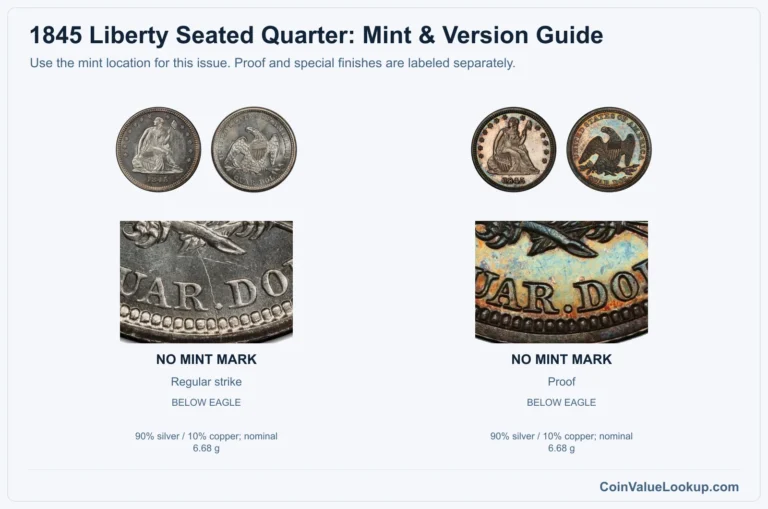
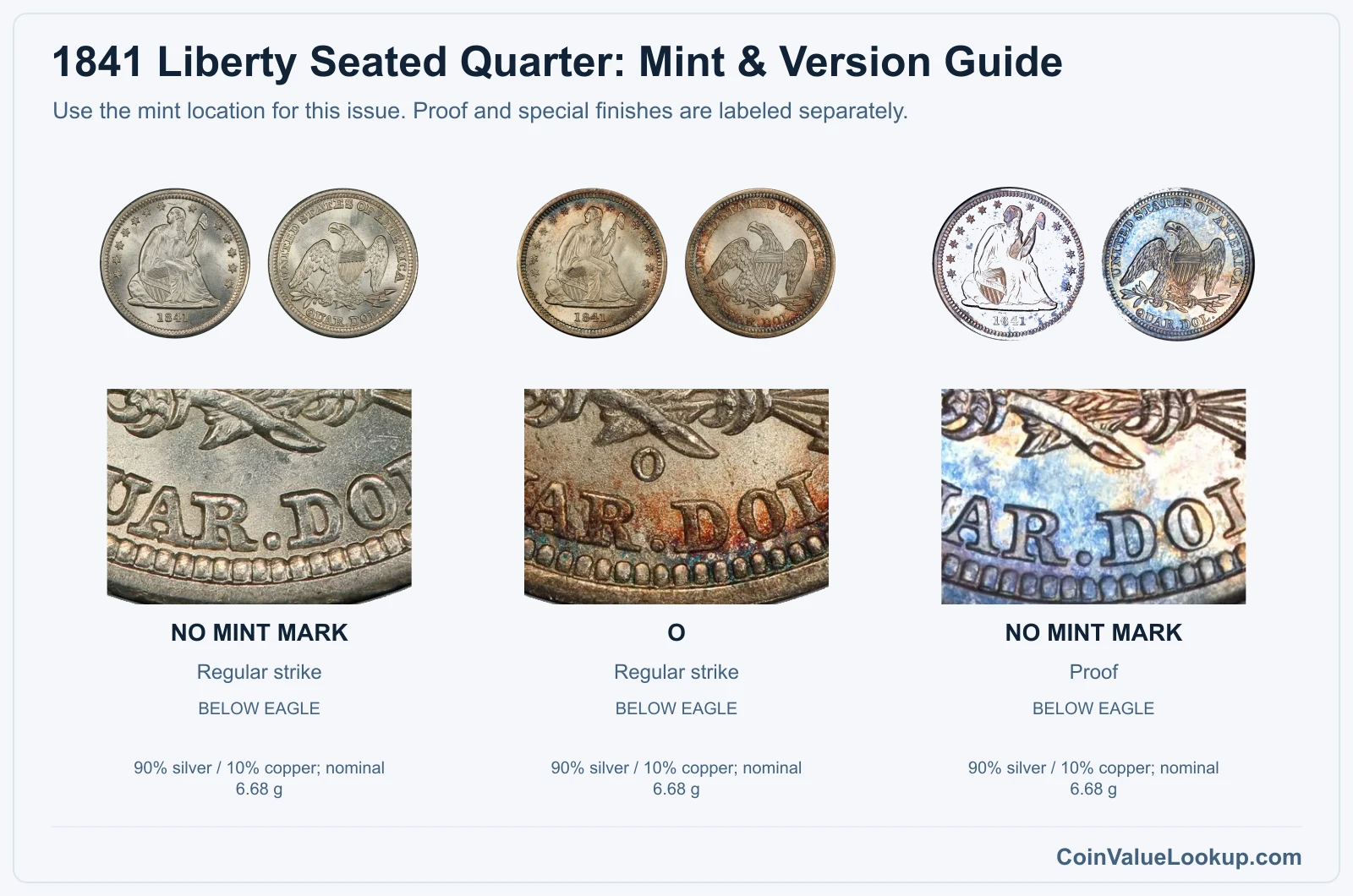
Next, flip the coin over and look below the eagle for a mintmark. No letter means Philadelphia.
A small "O" means New Orleans. That single letter is the dividing line between two different price tracks.
The coin is 90% silver and 10% copper, with a nominal weight of about 6.68 grams and a diameter around 24.3 mm. Heavy wear can reduce the weight slightly, so a worn coin weighing a fraction less does not automatically signal a fake.
Philadelphia produced both business strikes and a small number of proofs this year. New Orleans struck only business-strike coins.
A shiny or reflective surface alone does not make a coin a proof; early proof attribution requires expert die-pair analysis and often provenance documentation.
Step 2: Check Your 1841 Liberty Seated Quarter Grade
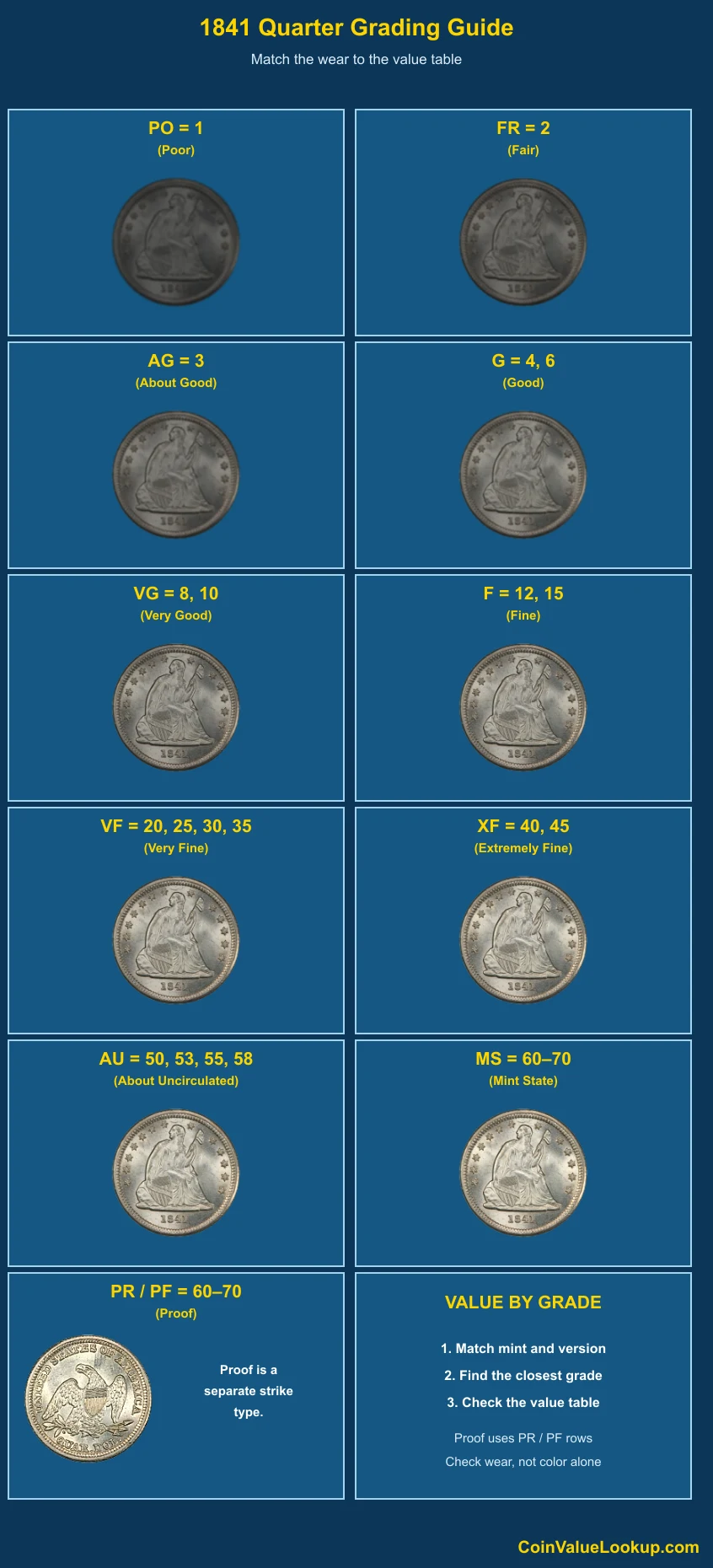
Start on the obverse. Liberty's head, the area across her breast, and her knee are the first places to lose detail as the coin circulates.
Check the small letters on the shield as well; they fade progressively with wear.
On the reverse, look at the eagle's breast feathers, the individual wing feathers, and the claws. A coin in G4 will show a full outline of Liberty and the eagle but most interior detail will be smooth.
By VF20, moderate detail remains in the protected areas of both sides.
Do not confuse a weak strike with actual wear. Some 1841 quarters, especially from New Orleans, left the press with soft detail in spots.
Remaining original luster and unbroken surface flow help separate a weakly struck coin from a genuinely worn one.
Hairlines from old cleaning, filled holes, smoothed areas, and green or dark environmental damage all reduce a coin's value compared to a problem-free example at the same apparent grade. Use the comparison image to benchmark your coin's wear against known grade points.
Step 3: Check 1841 Liberty Seated Quarter Value by Mint and Version
1841 Liberty Seated Quarter — Philadelphia Business Strike
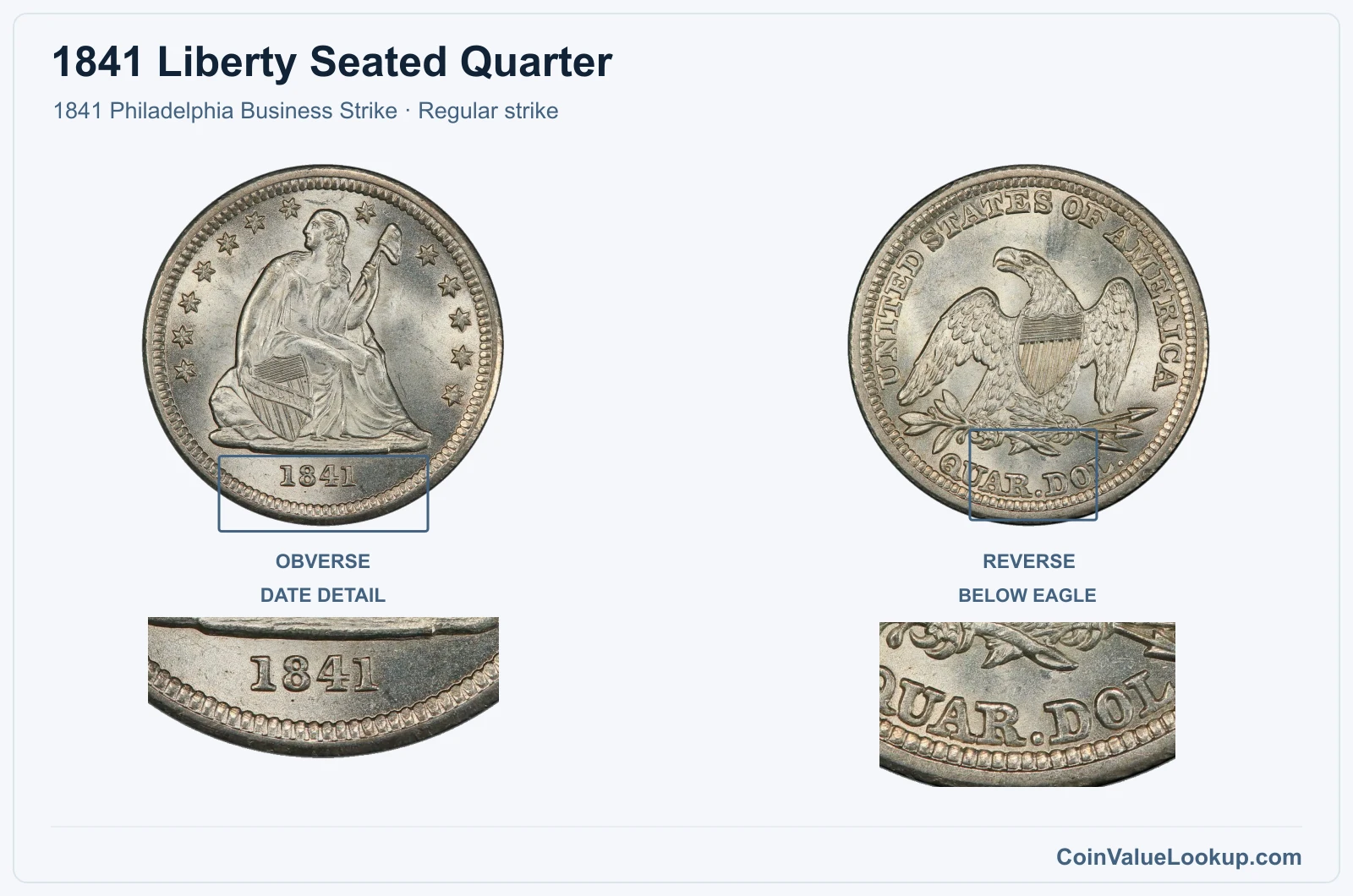
The 1841 Philadelphia business strike carries no mintmark. It follows the With Drapery design, which shows a fold of cloth at Liberty's left elbow.
Guide estimates place this version around $78 in G4, rising to roughly $290 in VF20 and about $2,777 at MS63.
Original, problem-free surfaces matter enormously at every level. A lightly circulated example with no cleaning or damage will typically outperform a higher-grade coin that has been harshly wiped.
If your Philadelphia quarter has strong luster and sharp shield letters, it is worth a closer grade comparison.
| Range | Grade | Price | Auction Records | Appraisal |
|---|---|---|---|---|
| PO | PO 1 | — | Coin Identifier | |
| FR | FR 2 | — | Coin Identifier | |
| AG | AG 3 | — | Coin Identifier | |
| G | G 4 | — | Coin Identifier | |
| G 6 | Coin Identifier | |||
| VG | VG 8 | Coin Identifier | ||
| VG 10 | — | Coin Identifier | ||
| F | F 12 | Coin Identifier | ||
| F 15 | — | Coin Identifier | ||
| VF | VF 20 | Coin Identifier | ||
| VF 25 | — | Coin Identifier | ||
| VF 30 | Coin Identifier | |||
| VF 35 | — | Coin Identifier | ||
| XF | XF 40 | Coin Identifier | ||
| XF 45 | Coin Identifier | |||
| AU | AU 50 | Coin Identifier | ||
| AU 53 | Coin Identifier | |||
| AU 55 | Coin Identifier | |||
| AU 58 | Coin Identifier | |||
| MS | MS 60 | — | Coin Identifier | |
| MS 61 | — | Coin Identifier | ||
| MS 62 | Coin Identifier | |||
| MS 63 | Coin Identifier | |||
| MS 64 | Coin Identifier | |||
| MS 65 | Coin Identifier | |||
| MS 66 | Coin Identifier | |||
| MS 67 | — | — | — | |
| MS 68 | — | — | — | |
| MS 69 | — | — | — | |
| MS 70 | — | — | — |
1841 Liberty Seated Quarter — Proof Philadelphia
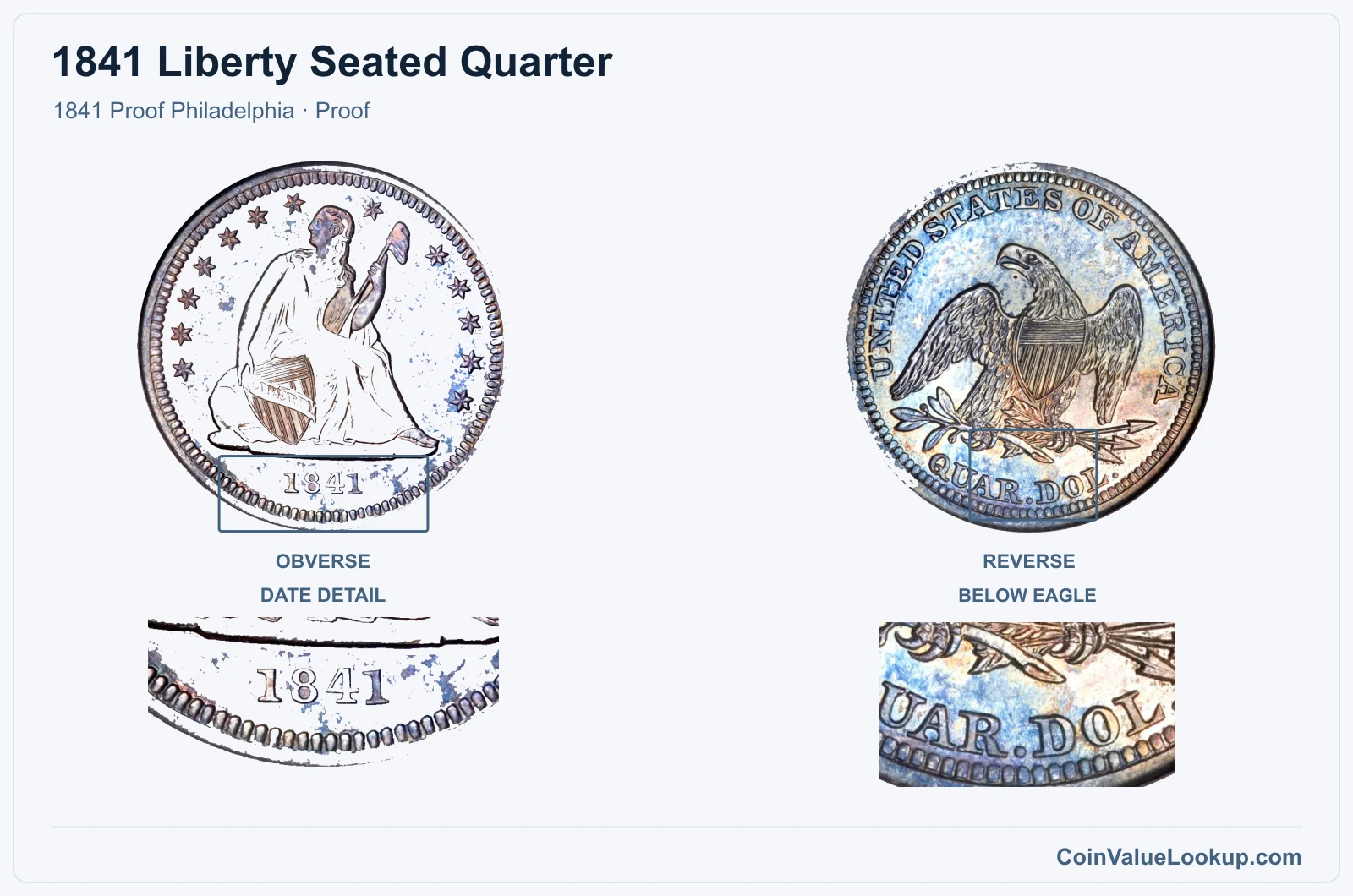
Philadelphia also produced a small number of proof quarters in 1841. These are rare specialist coins, and no standard guide price range is adopted here because each piece is assessed individually based on its authenticated identity, surface quality, and provenance.
A reflective surface alone does not make a coin a proof. Early Seated Liberty proofs require expert die-pair comparison and ideally a documented ownership history.
If you suspect you have one, professional authentication is essential before drawing any value conclusion.
Coin Value Lookup is a good starting point when you want to look up guides for other dates and denominations in the Seated Liberty series.
| Range | Grade | Price | Auction Records | Appraisal |
|---|---|---|---|---|
| PR | PR 1 | — | Coin Identifier | |
| PR 2 | — | Coin Identifier | ||
| PR 3 | — | Coin Identifier | ||
| PR 4 | — | Coin Identifier | ||
| PR 6 | — | Coin Identifier | ||
| PR 8 | — | Coin Identifier | ||
| PR 10 | — | Coin Identifier | ||
| PR 12 | — | Coin Identifier | ||
| PR 15 | — | Coin Identifier | ||
| PR 20 | — | Coin Identifier | ||
| PR 25 | — | Coin Identifier | ||
| PR 30 | — | Coin Identifier | ||
| PR 35 | — | Coin Identifier | ||
| PR 40 | — | Coin Identifier | ||
| PR 45 | — | Coin Identifier | ||
| PR 50 | — | Coin Identifier | ||
| PR 53 | — | Coin Identifier | ||
| PR 55 | — | Coin Identifier | ||
| PR 58 | Coin Identifier | |||
| PR 60 | — | Coin Identifier | ||
| PR 61 | Coin Identifier | |||
| PR 62 | — | Coin Identifier | ||
| PR 63 | — | — | — | |
| PR 64 | — | — | — | |
| PR 65 | — | Coin Identifier | ||
| PR 66 | Coin Identifier | |||
| PR 67 | — | — | — | |
| PR 68 | — | — | — | |
| PR 69 | — | — | — | |
| PR 70 | — | — | — |
1841 Liberty Seated Quarter — O Business Strike
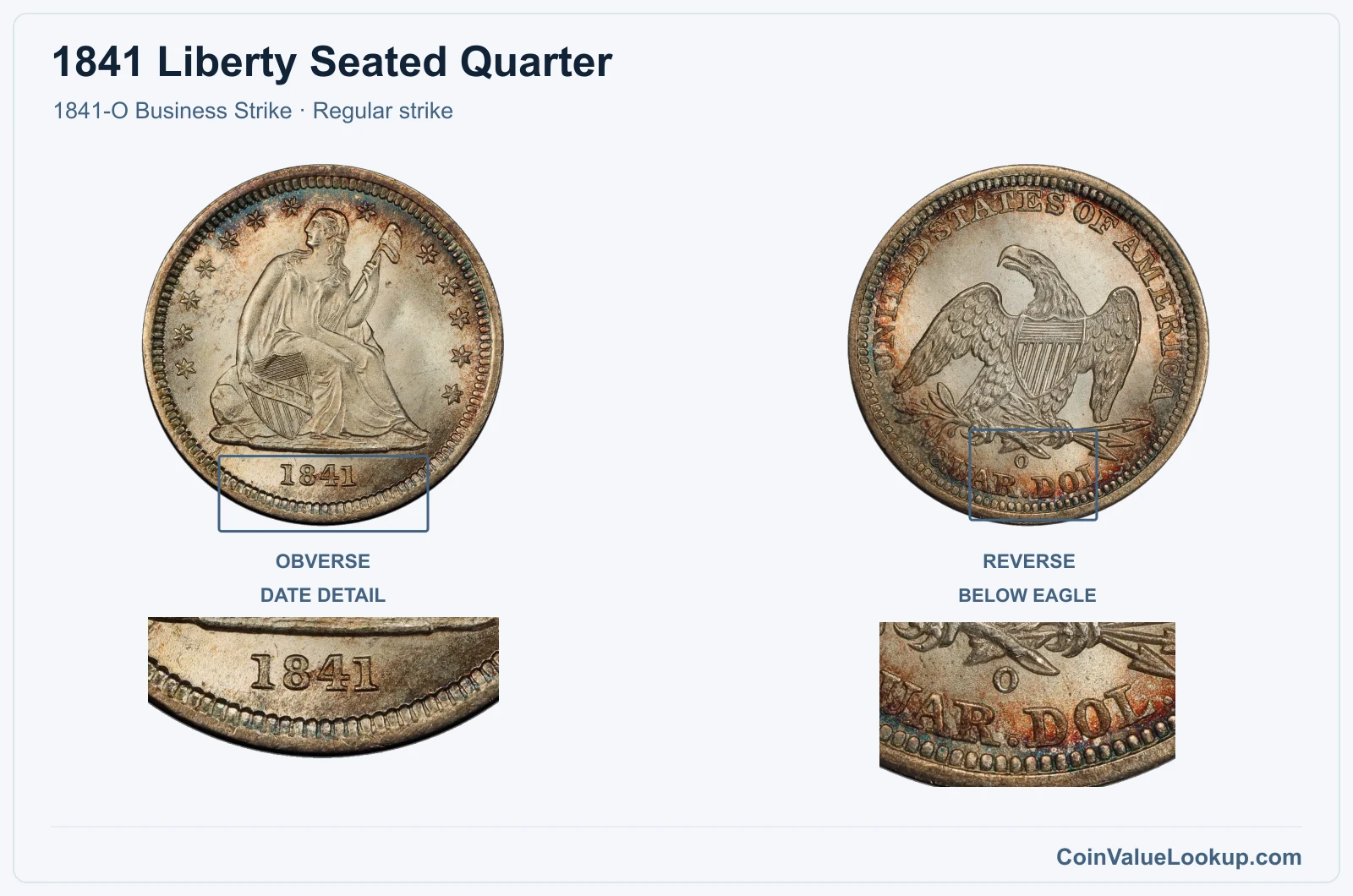
The 1841-O was struck at the New Orleans Mint and carries a small "O" mintmark on the reverse beneath the eagle. Guide estimates start around $70 in G4, climb to about $216 at VF20, and reach approximately $2,350 at MS63.
New Orleans strikes from this era are sometimes softer in certain areas than their Philadelphia counterparts, which can make grading tricky. Focus on overall wear patterns and remaining luster rather than isolated soft spots.
A well-preserved 1841-O with original surfaces is a genuinely desirable coin for series collectors.
| Range | Grade | Price | Auction Records | Appraisal |
|---|---|---|---|---|
| PO | PO 1 | — | Coin Identifier | |
| FR | FR 2 | — | Coin Identifier | |
| AG | AG 3 | — | Coin Identifier | |
| G | G 4 | — | Coin Identifier | |
| G 6 | — | Coin Identifier | ||
| VG | VG 8 | — | Coin Identifier | |
| VG 10 | — | Coin Identifier | ||
| F | F 12 | Coin Identifier | ||
| F 15 | — | Coin Identifier | ||
| VF | VF 20 | Coin Identifier | ||
| VF 25 | Coin Identifier | |||
| VF 30 | Coin Identifier | |||
| VF 35 | Coin Identifier | |||
| XF | XF 40 | Coin Identifier | ||
| XF 45 | Coin Identifier | |||
| AU | AU 50 | Coin Identifier | ||
| AU 53 | Coin Identifier | |||
| AU 55 | Coin Identifier | |||
| AU 58 | Coin Identifier | |||
| MS | MS 60 | Coin Identifier | ||
| MS 61 | Coin Identifier | |||
| MS 62 | Coin Identifier | |||
| MS 63 | Coin Identifier | |||
| MS 64 | Coin Identifier | |||
| MS 65 | — | Coin Identifier | ||
| MS 66 | — | Coin Identifier | ||
| MS 67 | Coin Identifier | |||
| MS 68 | — | — | — | |
| MS 69 | — | — | — | |
| MS 70 | — | — | — |
1841 Liberty Seated Quarter Error List
1. 1841 Liberty Seated Quarter — Doubled Die Obverse
The 1841-O Doubled Die Obverse is a recognized variety struck at the New Orleans Mint. The diagnostic to look for is doubling on the shield lines and stripes, along with separation visible on the stars.
Under magnification, you should see distinctly rounded, separated design contours rather than the flat, shelf-like distortion typical of mechanical doubling.
Keep the mintmark and date in context when comparing. Flat mechanical doubling or a weak strike can mimic true die doubling to the naked eye, so a loupe and a normal 1841-O for side-by-side reference are helpful.
One example graded MS63 sold for $1,620 in February 2021. That result reflects a specific grade and confirmed variety attribution, so your coin's value will depend on its own condition and whether the doubling matches the recognized die pair.
2. 1841 Liberty Seated Quarter — Doubled Die Reverse
A Doubled Die Reverse has also been reported for the 1841 quarter. The variety is cataloged and has appeared graded at VF-30 by a major service.
To check for it, compare the reverse legends and design contours against a normal 1841 reverse under magnification; look for clear separation or thickening in the lettering or eagle details.
Be cautious about lookalikes. Machine doubling leaves flat, shelf-like traces that lack the rounded, distinct separation of a true doubled die.
Random contact marks and light reflections can also fool the eye at first glance.
No numerical price range is adopted for this variety. Value depends heavily on the visibility of the doubling, the coin's overall condition, and whether the specific die pairing is confirmed through professional attribution.
If you spot suspicious reverse doubling, professional evaluation is the logical next step.