1877 Liberty Seated Quarter Coin Value: How Much Is It Worth?
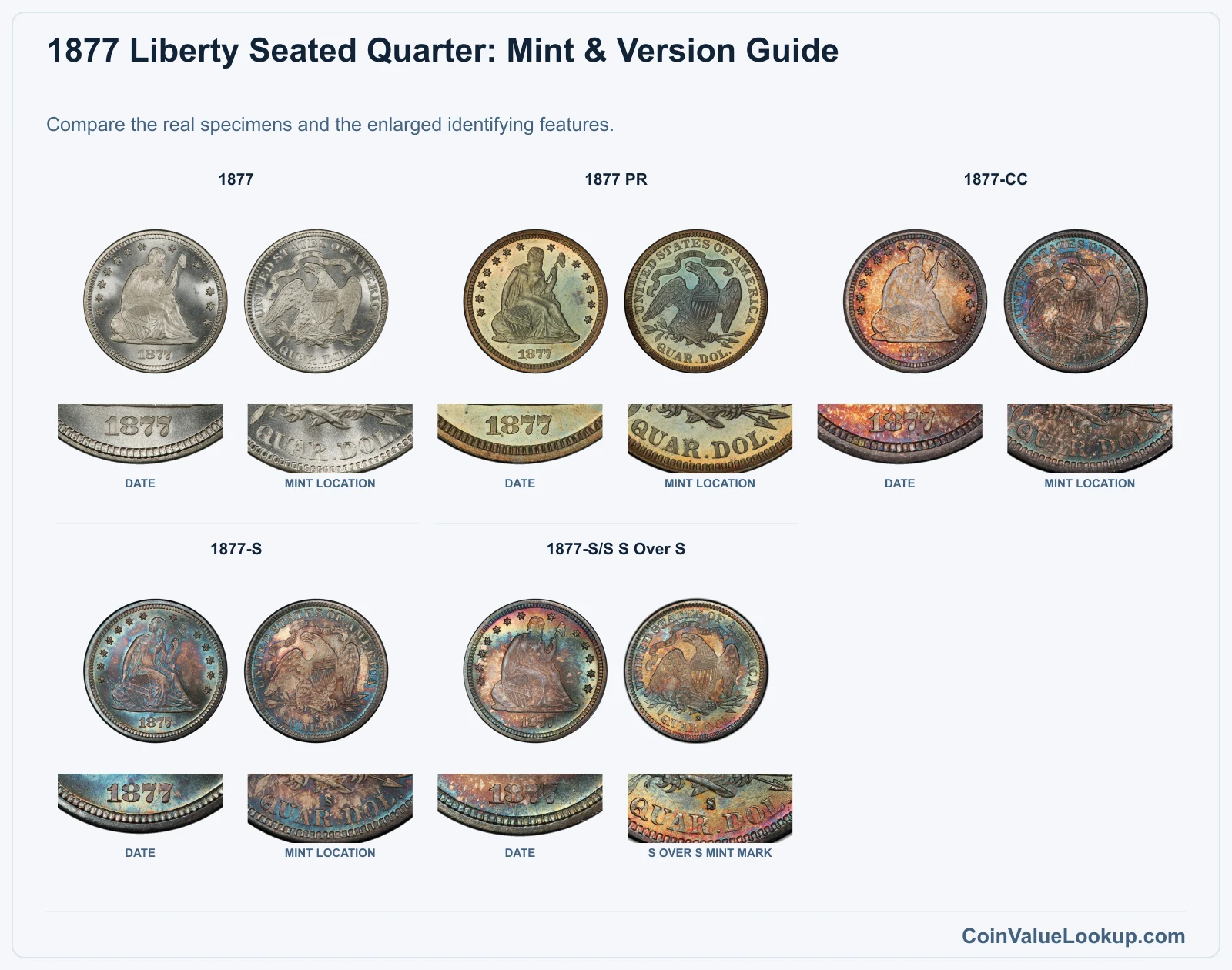
The 1877 Liberty Seated Quarter is a 90% silver coin struck across multiple mints during a period of heavy production. Guide estimates for this year range from $46.00 to $2,506.00, but that spread depends entirely on which mint produced your coin, its condition, and whether it belongs to a scarce variety.
Knowing the difference between a common Philadelphia strike and the S Over S repunched mintmark variety matters a lot here.
Fast Way to Identify Your 1877 Liberty Seated Quarter
The quickest way to start figuring out what you have is to upload clear photos of both sides of your coin. A shot of the front showing Liberty and one of the reverse showing the eagle and any mintmark below it will help with preliminary identification.
Details like the mintmark letter and overall surface condition are easier to assess from good images than from a written description alone.
1877 Liberty Seated Quarter Value
Upload both sides of your 1877 Liberty Seated Quarter.
Front Obverse
Upload photo
Back Reverse
Upload photo
Which 1877 Liberty Seated Quarter Versions Are Worth Money?
- 1877-S/S S Over S: a repunched mintmark variety with guide estimates up to $2,506.00 at MS63, making it the standout version for this year.
- 1877-CC (Carson City): the CC mintmark carries a consistent premium, with guide estimates reaching $1,454.00 at MS63.
- 1877 Proof (PR): specially manufactured at Philadelphia, estimated at $938.00 at PR63; far scarcer than any business strike.
Step 1: Identify Your 1877 Liberty Seated Quarter Mint Mark and Version
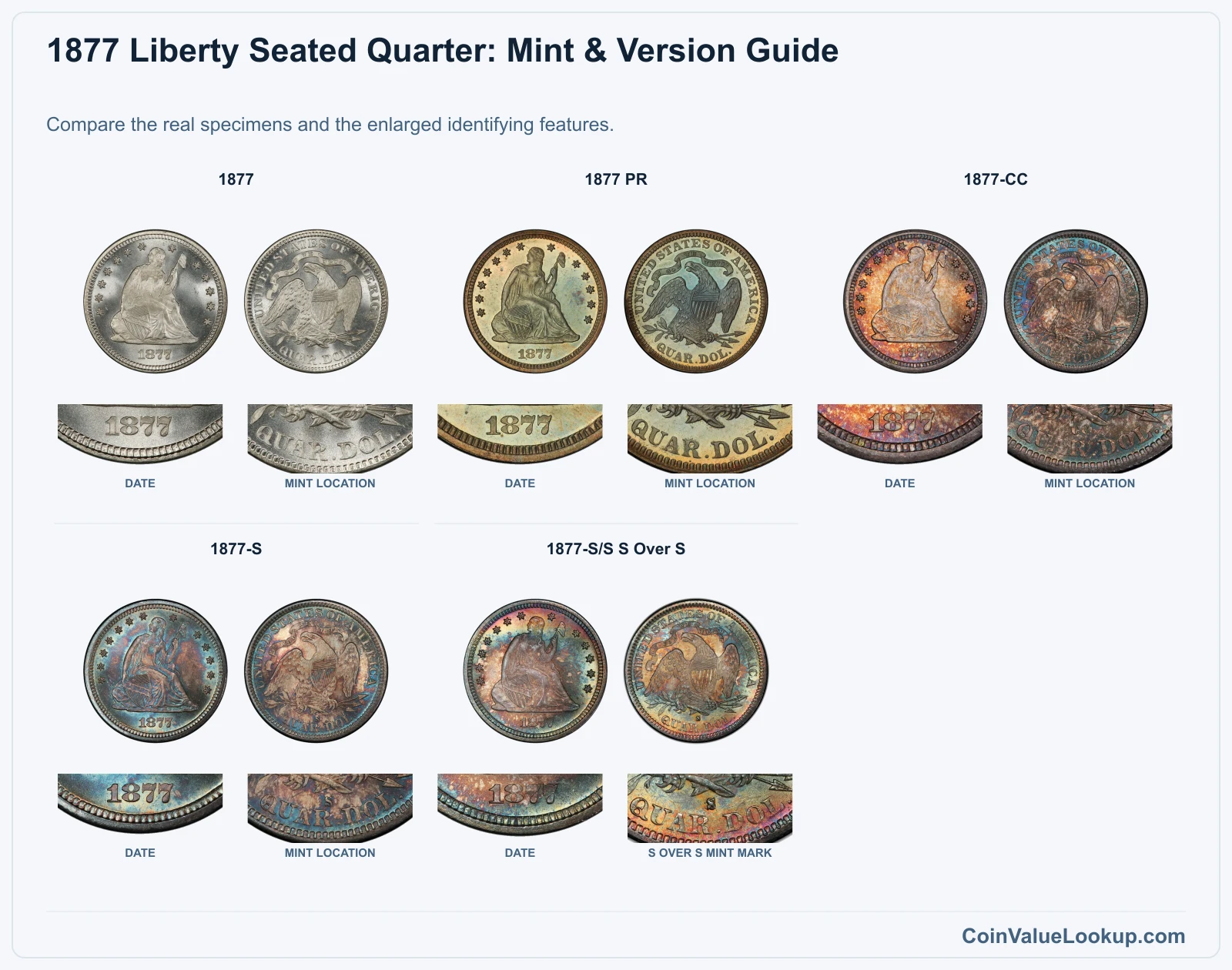
Start by flipping your quarter to the reverse. Look directly below the eagle for a small letter.
No letter means Philadelphia. An "S" means San Francisco, and "CC" means Carson City.
Only these three mints struck quarters in 1877.
All business strikes carry the Seated Liberty obverse and the eagle-with-motto reverse. The motto "In God We Trust" appears on a banner above the eagle.
Philadelphia also produced a small number of proof coins, which have mirror-like fields and sharp details from a special manufacturing process, not just a shiny appearance.
The coin is 90% silver and 10% copper, weighing 6.25 grams. If yours feels too light or attracts a magnet, it may not be genuine.
One key variety to watch for is the 1877-S/S, where the S mintmark was punched over an earlier S. This repunched mintmark is visible under magnification as a second set of serifs or outline traces around the final S.
It carries a meaningful premium over a normal 1877-S.
Step 2: Check Your 1877 Liberty Seated Quarter Grade
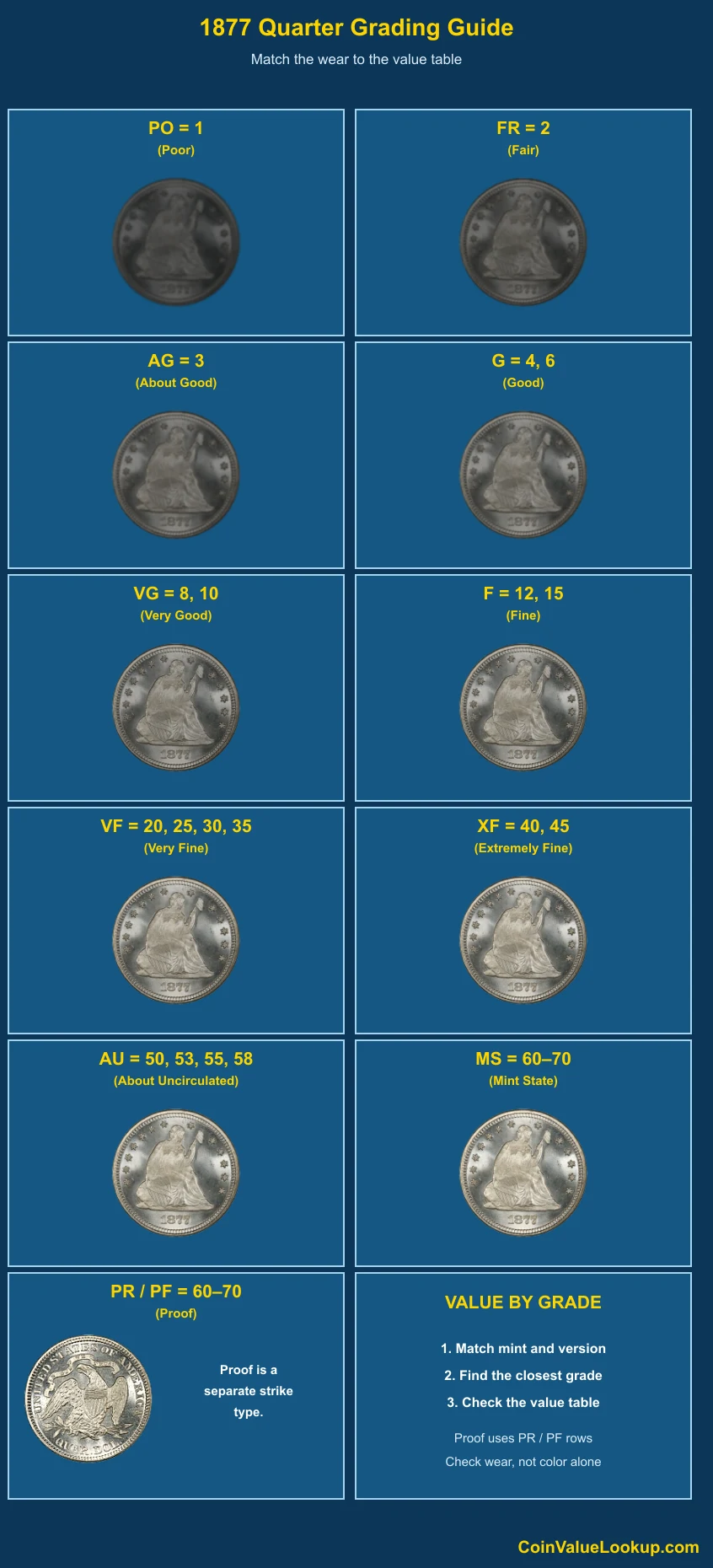
When judging wear, focus on Liberty's head, breast, knee, and the lines on her shield. These are the highest points and lose detail first.
On the reverse, check the eagle's breast feathers and upper wing tips.
Compare your coin to the reference image. A coin grading Good (G4) will show Liberty's outline but most interior detail is gone.
At Mint State (MS60), all design elements remain but the surfaces may show contact marks and lack eye appeal.
Don't confuse a weak strike with wear. Some 1877 quarters left the press with soft central details even though they were never circulated.
Luster is your friend here: an unworn coin retains original mint sheen across the fields even if the center looks mushy.
Cleaned coins are another trap. Bright, unnaturally shiny surfaces with fine hairlines visible under a light suggest someone scrubbed away the original toning.
Cleaning and other damage reduce collector value below standard guide figures, sometimes significantly.
Step 3: Check 1877 Liberty Seated Quarter Value by Mint and Version
1877 Liberty Seated Quarter
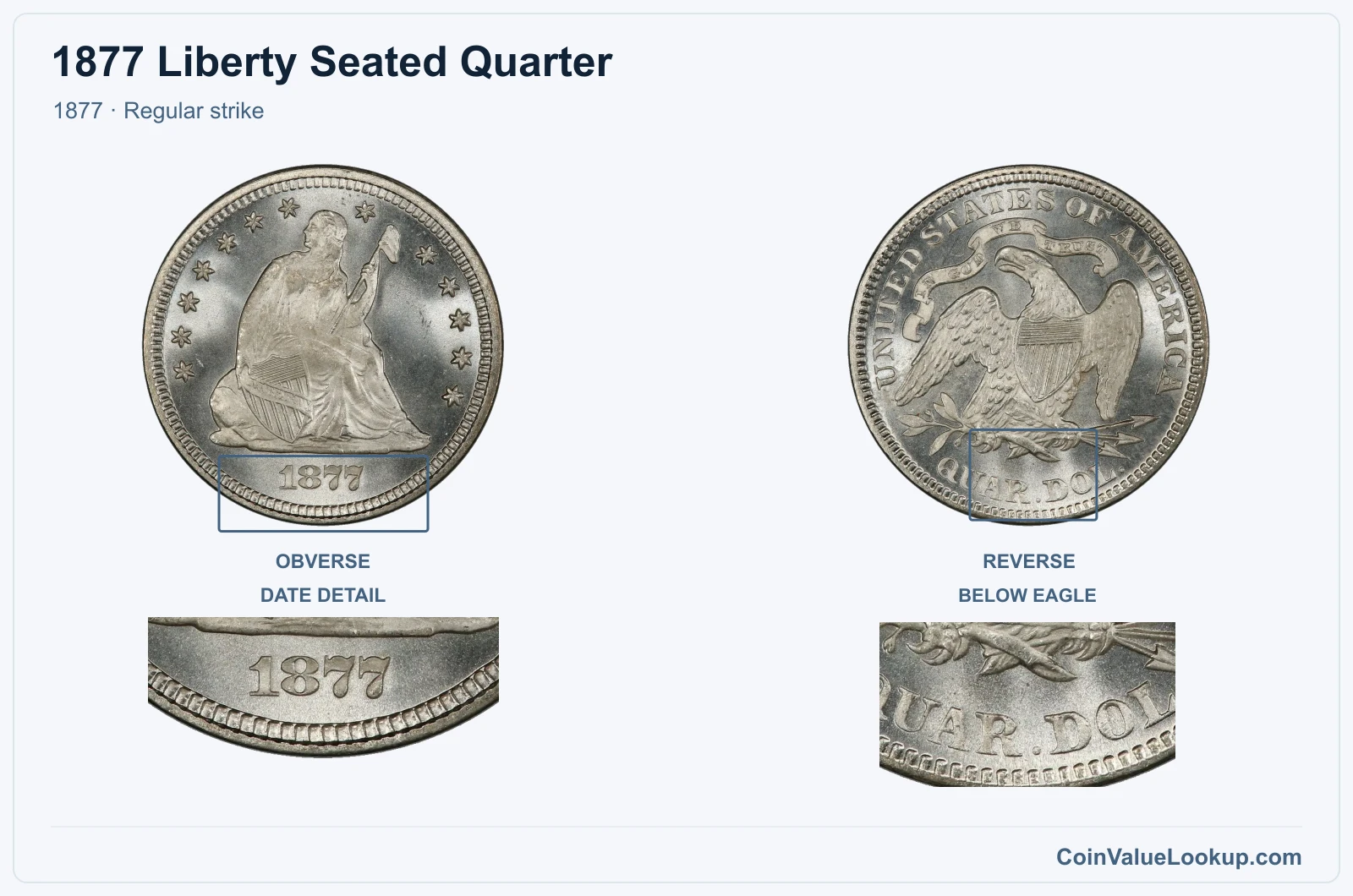
The 1877 Philadelphia quarter has no mintmark on the reverse. It is a business-strike coin in the standard Seated Liberty design with the motto banner above the eagle.
USA Coin Book guide estimates place this version at $46.00 in G4, $353.00 in MS60, and $675.00 in MS63. These are retail guide figures, not guaranteed offers.
Original, uncleaned surfaces with honest wear will track closest to these numbers. Coins with damage or evidence of cleaning typically sell below guide levels.
Confirm the absence of any mintmark letter before assuming Philadelphia origin.
Range Grade
Price Auction Records Appraisal PO PO 1
—
Coin Identifier FR FR 2
—
Coin Identifier AG AG 3
—
Coin Identifier G G 4
—
Coin Identifier
G 6
—
Coin Identifier VG VG 8
—
Coin Identifier
VG 10
—
Coin Identifier F F 12
—
Coin Identifier
F 15
—
Coin Identifier VF VF 20
Coin Identifier
VF 25
—
Coin Identifier
VF 30
—
Coin Identifier
VF 35
Coin Identifier XF XF 40
Coin Identifier
XF 45
Coin Identifier AU AU 50
Coin Identifier
AU 53
Coin Identifier
AU 55
Coin Identifier
AU 58
Coin Identifier MS MS 60
Coin Identifier
MS 61
Coin Identifier
MS 62
Coin Identifier
MS 63
Coin Identifier
MS 64
Coin Identifier
MS 65
Coin Identifier
MS 66
Coin Identifier
MS 67
Coin Identifier
MS 68
Coin Identifier
MS 69
—
—
—
MS 70
—
—
—
1877 Liberty Seated Quarter — PR
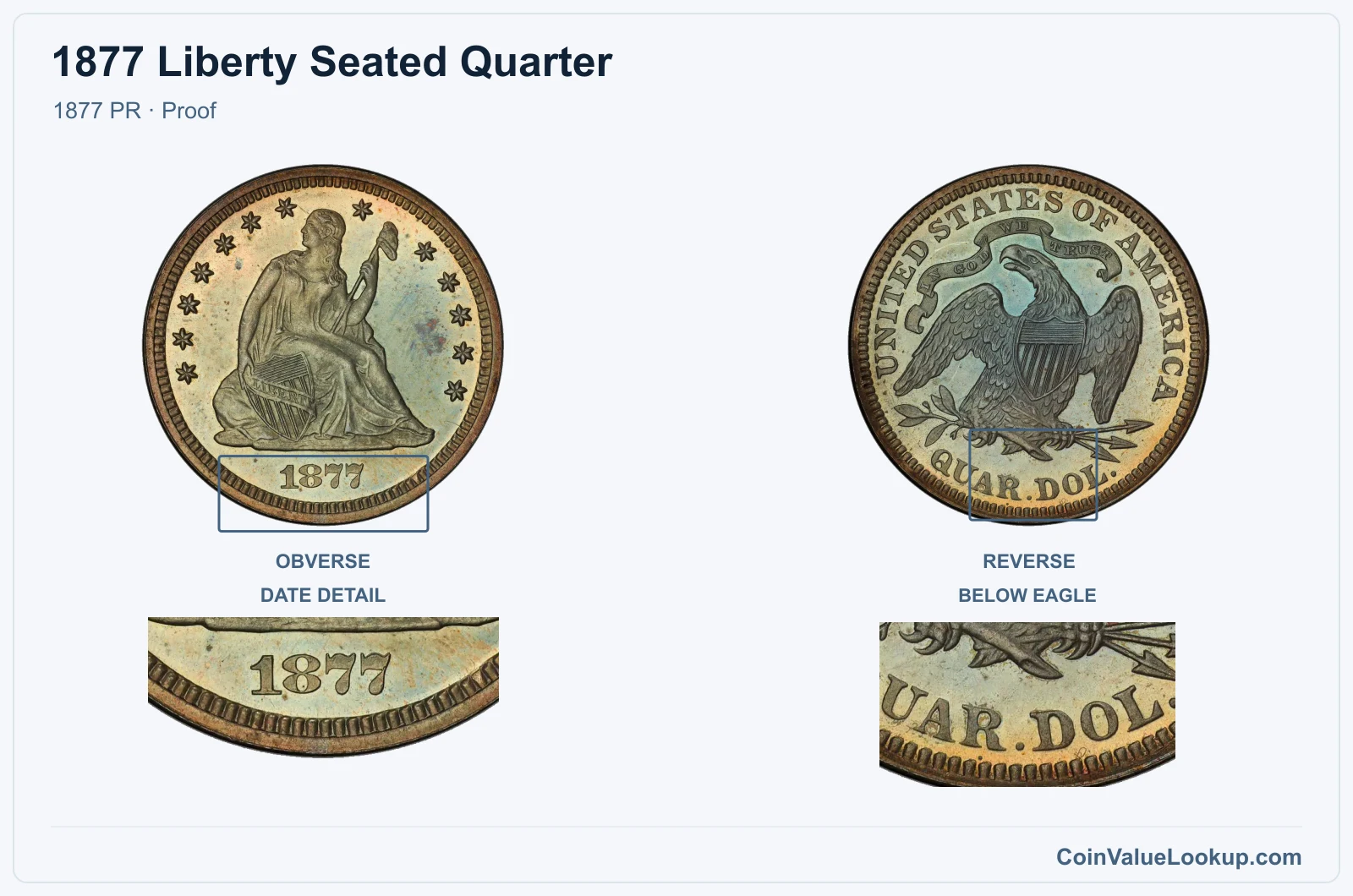
The 1877 Proof quarter was produced at Philadelphia using polished dies and specially prepared planchets. The result is a coin with mirror-like fields and exceptionally sharp design details.
This is a manufacturing method, not a grade above Mint State.
The USA Coin Book guide estimates this version at $938.00 in PR63. Proof surfaces are delicate.
Hairlines from improper handling or cleaning bring the grade down quickly and reduce collector interest. Surface haze is also common on old proofs and affects eye appeal.
A genuinely untouched proof with clear fields and sharp devices is a different animal from a polished business strike that just happens to look shiny.
Range Grade
Price Auction Records Appraisal PR PR 1
—
Coin Identifier
PR 2
—
Coin Identifier
PR 3
—
Coin Identifier
PR 4
—
Coin Identifier
PR 6
—
Coin Identifier
PR 8
—
Coin Identifier
PR 10
—
Coin Identifier
PR 12
—
Coin Identifier
PR 15
—
Coin Identifier
PR 20
—
Coin Identifier
PR 25
—
Coin Identifier
PR 30
—
Coin Identifier
PR 35
—
Coin Identifier
PR 40
—
Coin Identifier
PR 45
—
Coin Identifier
PR 50
—
Coin Identifier
PR 53
—
Coin Identifier
PR 55
Coin Identifier
PR 58
—
Coin Identifier
PR 60
—
Coin Identifier
PR 61
Coin Identifier
PR 62
Coin Identifier
PR 63
Coin Identifier
PR 64
Coin Identifier
PR 65
Coin Identifier
PR 66
Coin Identifier
PR 67
Coin Identifier
PR 68
—
—
—
PR 69
—
—
—
PR 70
—
—
—
1877 Liberty Seated Quarter — CC
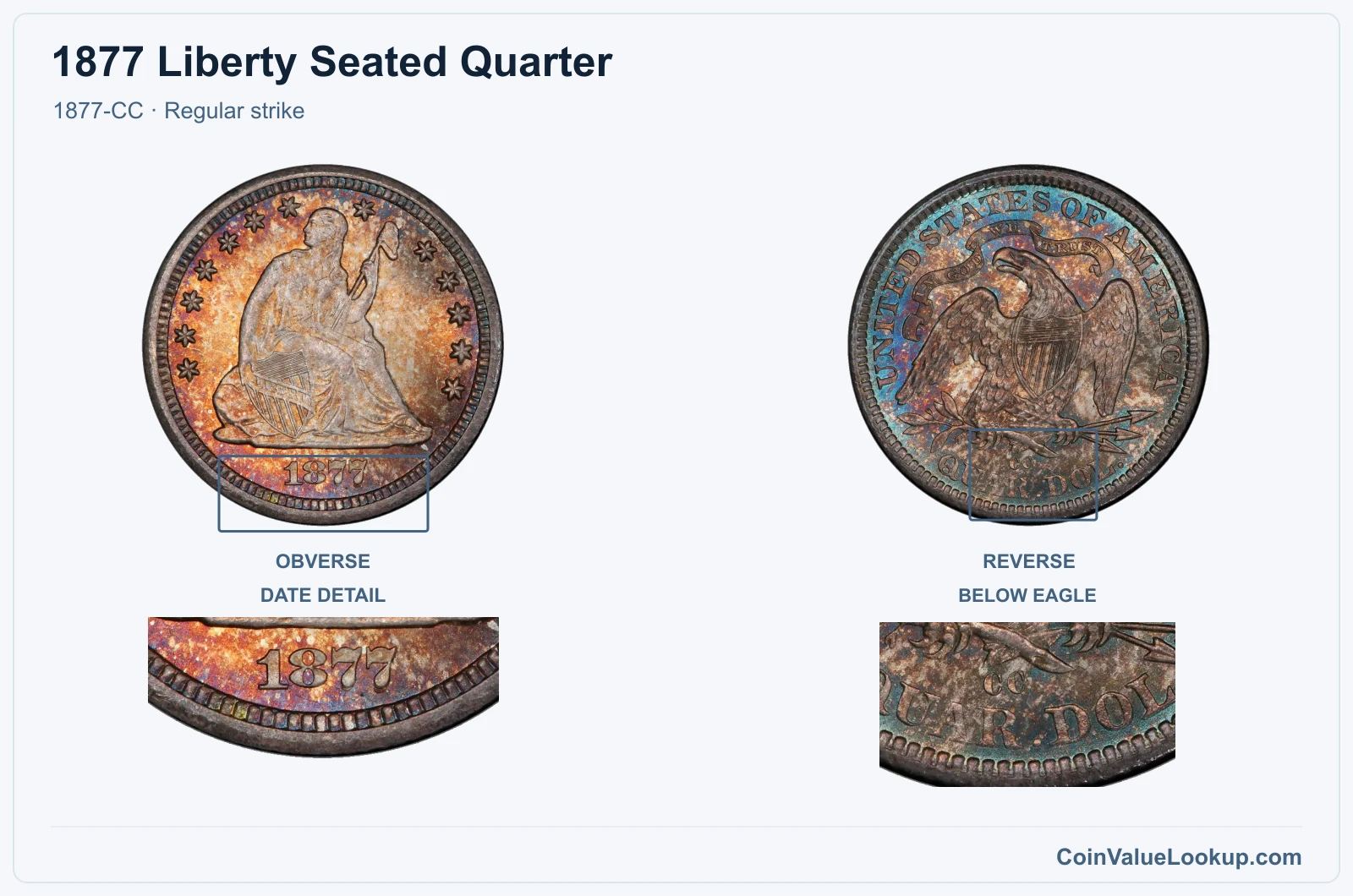
The 1877-CC quarter was struck at the Carson City Mint in Nevada. Look for the small "CC" mintmark on the reverse below the eagle.
Carson City coins carry a collector premium tied to the mint's relatively short operational history and lower output compared to Philadelphia or San Francisco. USA Coin Book guide estimates run $78.00 at G4, $648.00 at MS60, and $1,454.00 at MS63.
Even well-worn examples command more than their Philadelphia counterparts in the same grade. As always, original surfaces matter.
A cleaned or damaged CC quarter loses much of that premium. Confirm both letters of the mintmark are present and match the CC style before assuming Carson City origin.
Coin Value Lookup is a useful starting point if you want to look up guides for other Liberty Seated quarters or different denominations from the same era.
Range Grade
Price Auction Records Appraisal PO PO 1
—
Coin Identifier FR FR 2
—
Coin Identifier AG AG 3
Coin Identifier G G 4
—
Coin Identifier
G 6
Coin Identifier VG VG 8
Coin Identifier
VG 10
Coin Identifier F F 12
Coin Identifier
F 15
Coin Identifier VF VF 20
Coin Identifier
VF 25
Coin Identifier
VF 30
Coin Identifier
VF 35
Coin Identifier XF XF 40
Coin Identifier
XF 45
Coin Identifier AU AU 50
Coin Identifier
AU 53
Coin Identifier
AU 55
Coin Identifier
AU 58
Coin Identifier MS MS 60
—
Coin Identifier
MS 61
Coin Identifier
MS 62
Coin Identifier
MS 63
Coin Identifier
MS 64
Coin Identifier
MS 65
Coin Identifier
MS 66
Coin Identifier
MS 67
Coin Identifier
MS 68
—
—
—
MS 69
—
—
—
MS 70
—
—
—
1877 Liberty Seated Quarter — S
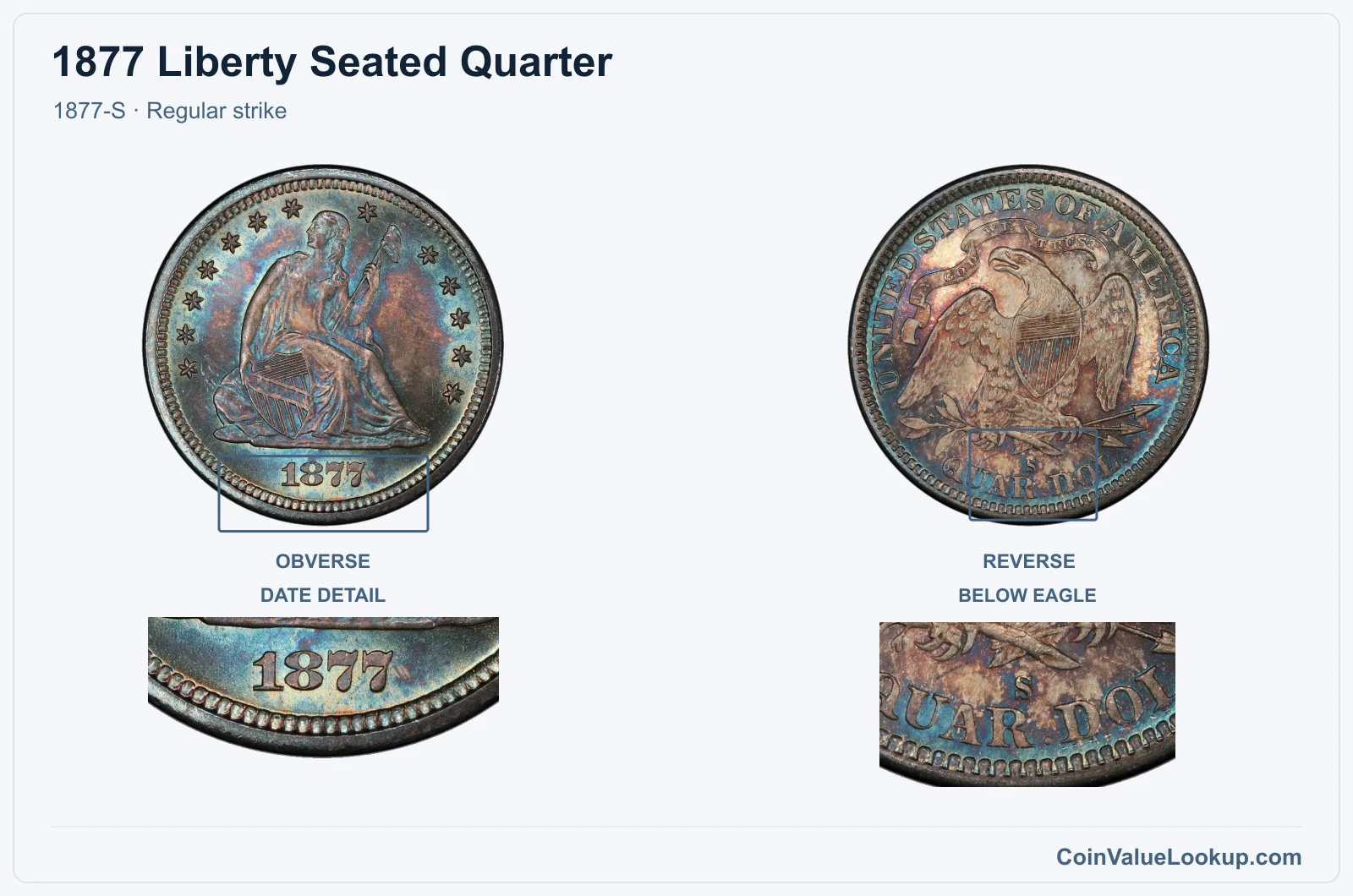
The 1877-S quarter comes from the San Francisco Mint. The mintmark is a single "S" on the reverse below the eagle.
Make sure it is a normal, cleanly placed S without traces of a second impression underneath.
USA Coin Book guide estimates put this version at $46.00 in G4, $353.00 in MS60, and $675.00 in MS63. These figures align closely with the Philadelphia issue, reflecting comparable availability.
Original surfaces and natural toning add to desirability at any grade level. Cleaning or damage will pull the price below these guide numbers.
Range Grade
Price Auction Records Appraisal PO PO 1
—
Coin Identifier FR FR 2
—
Coin Identifier AG AG 3
—
Coin Identifier G G 4
—
Coin Identifier
G 6
—
Coin Identifier VG VG 8
—
Coin Identifier
VG 10
Coin Identifier F F 12
—
Coin Identifier
F 15
—
Coin Identifier VF VF 20
Coin Identifier
VF 25
—
Coin Identifier
VF 30
Coin Identifier
VF 35
Coin Identifier XF XF 40
Coin Identifier
XF 45
Coin Identifier AU AU 50
Coin Identifier
AU 53
Coin Identifier
AU 55
Coin Identifier
AU 58
Coin Identifier MS MS 60
Coin Identifier
MS 61
Coin Identifier
MS 62
Coin Identifier
MS 63
Coin Identifier
MS 64
Coin Identifier
MS 65
Coin Identifier
MS 66
Coin Identifier
MS 67
Coin Identifier
MS 68
Coin Identifier
MS 69
—
—
—
MS 70
—
—
—
1877 Liberty Seated Quarter — S/S S Over S
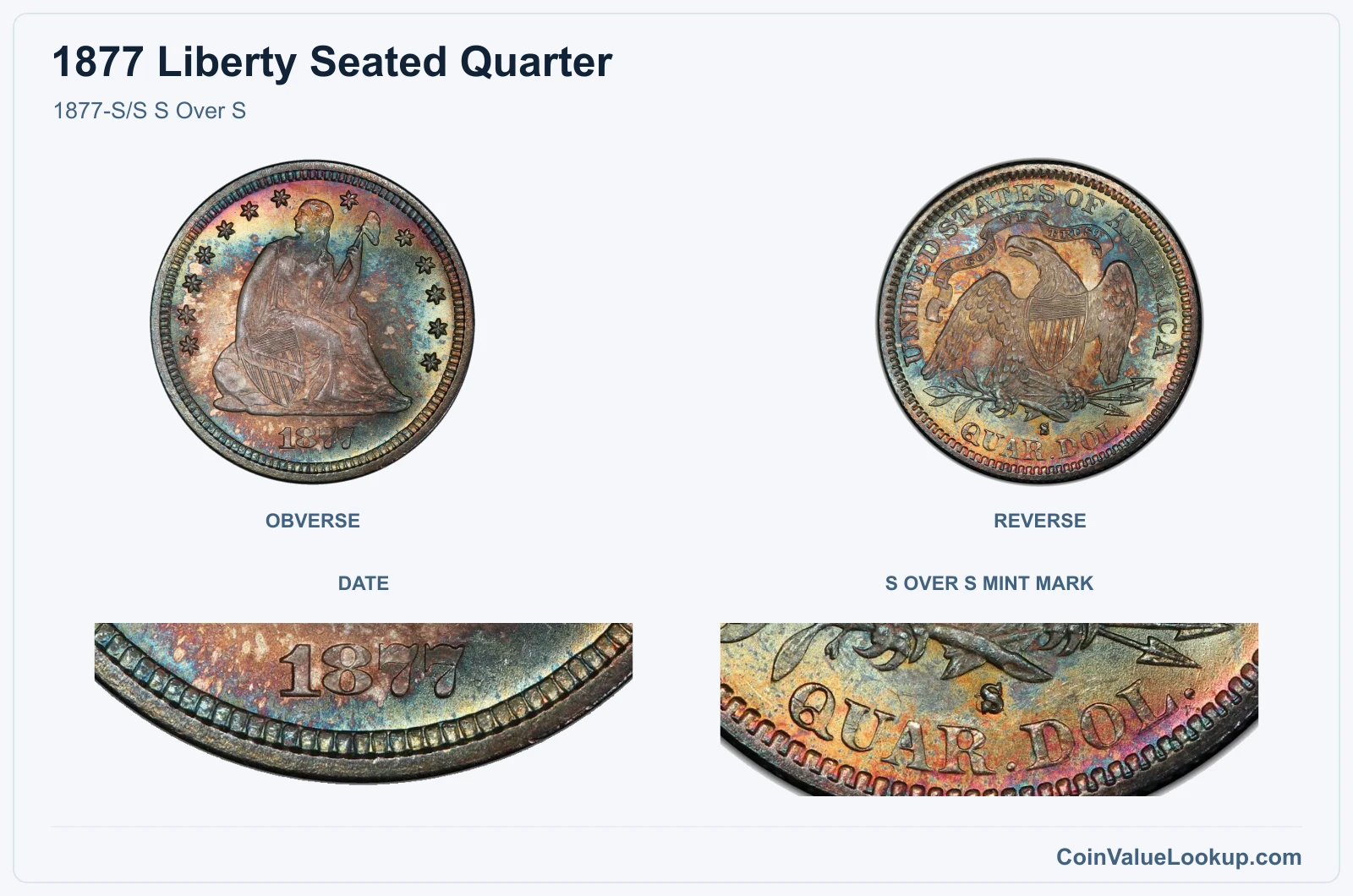
This is the variety collectors watch for. The 1877-S/S S Over S quarter shows a repunched mintmark: the San Francisco Mint's S was stamped over an earlier, slightly misaligned S on the working die.
Under magnification you can see traces of the first S peeking out around the edges of the final letter, often visible as extra serifs or a shifted outline.
USA Coin Book guide estimates are $58.00 at G4, $1,072.00 at MS60, and $2,506.00 at MS63. That is a substantial jump over a normal 1877-S, especially in higher grades.
The premium reflects genuine scarcity and strong collector demand for confirmed examples. Use a loupe or magnifying glass to inspect the mintmark carefully.
If the S looks clean with no doubling, you likely have the standard 1877-S instead. Original surfaces and clear visibility of the repunching both influence how much this variety commands.
Range Grade
Price Auction Records Appraisal PO PO 1
—
Coin Identifier FR FR 2
—
Coin Identifier AG AG 3
—
Coin Identifier G G 4
—
Coin Identifier
G 6
—
Coin Identifier VG VG 8
—
Coin Identifier
VG 10
—
Coin Identifier F F 12
—
Coin Identifier
F 15
—
Coin Identifier VF VF 20
—
Coin Identifier
VF 25
Coin Identifier
VF 30
—
Coin Identifier
VF 35
Coin Identifier XF XF 40
Coin Identifier
XF 45
—
Coin Identifier AU AU 50
Coin Identifier
AU 53
Coin Identifier
AU 55
Coin Identifier
AU 58
Coin Identifier MS MS 60
Coin Identifier
MS 61
—
Coin Identifier
MS 62
Coin Identifier
MS 63
Coin Identifier
MS 64
Coin Identifier
MS 65
Coin Identifier
MS 66
Coin Identifier
MS 67
Coin Identifier
MS 68
—
—
—
MS 69
—
—
—
MS 70
—
—
—
1877 Liberty Seated Quarter Error List
1. 1877 Liberty Seated Quarter — Overdate
An overdate variety has been reported for the 1877 quarter, specifically described as an 1877/77 associated with the Carson City mint. On an overdate, the final date was punched into the die over an earlier set of numerals, leaving faint traces of the original digits visible beneath or around the final numbers.
Look closely at the last two 7s for remnants of underlying figures that do not match the surrounding font or spacing.
This is not the same as a damaged date or ordinary machine doubling. Damage tends to produce irregular, uneven distortion, while machine doubling creates flat, shelf-like outlines without the depth of a true overdate's underlying impression.
An overdate shows distinct, purposeful numeral shapes beneath the top layer.
No adopted numerical price is available for this variety. Value depends on the visibility of the underlying date, the coin's overall condition, and whether surfaces remain original.
Professional authentication is advisable for any coin suspected of being an overdate, as the distinction from lookalikes can be subtle.