2001 Quarter Coin Value: How Much Is It Worth?
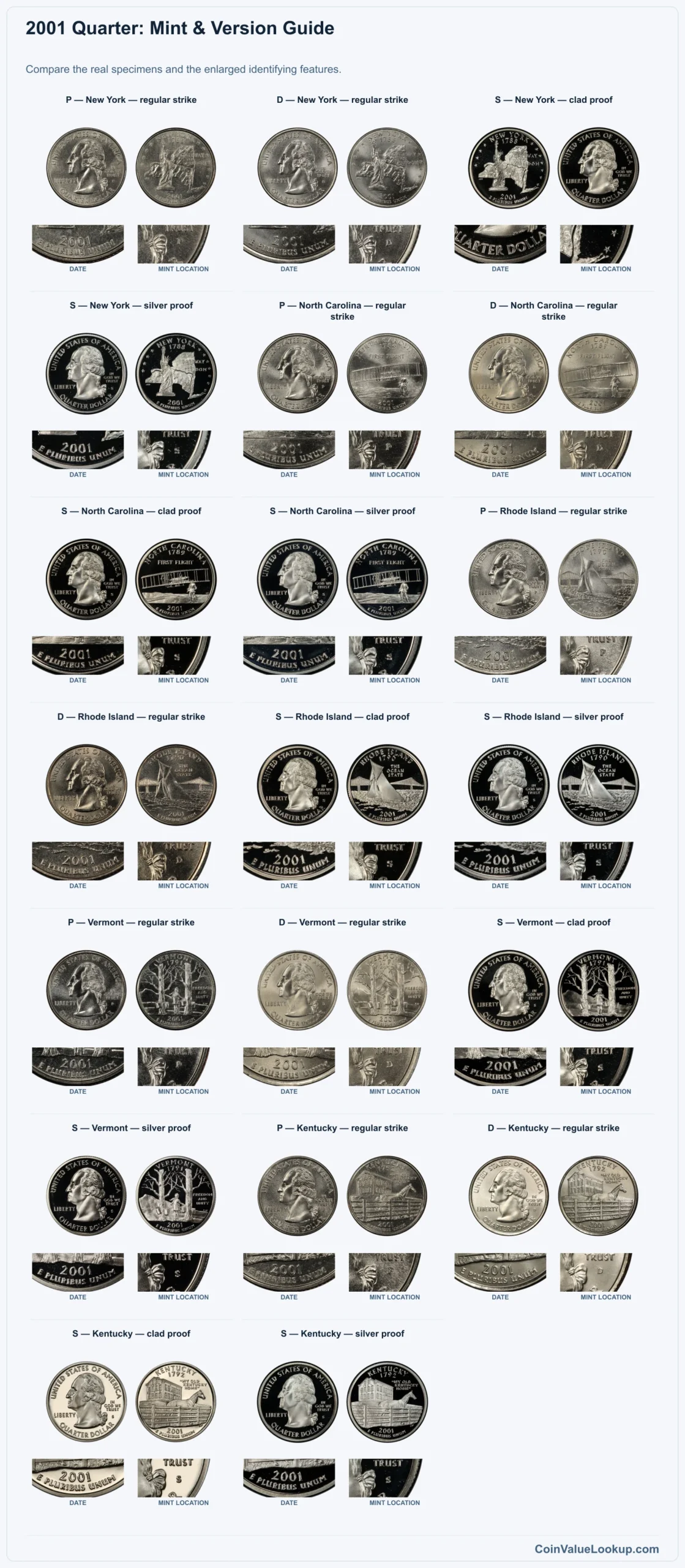
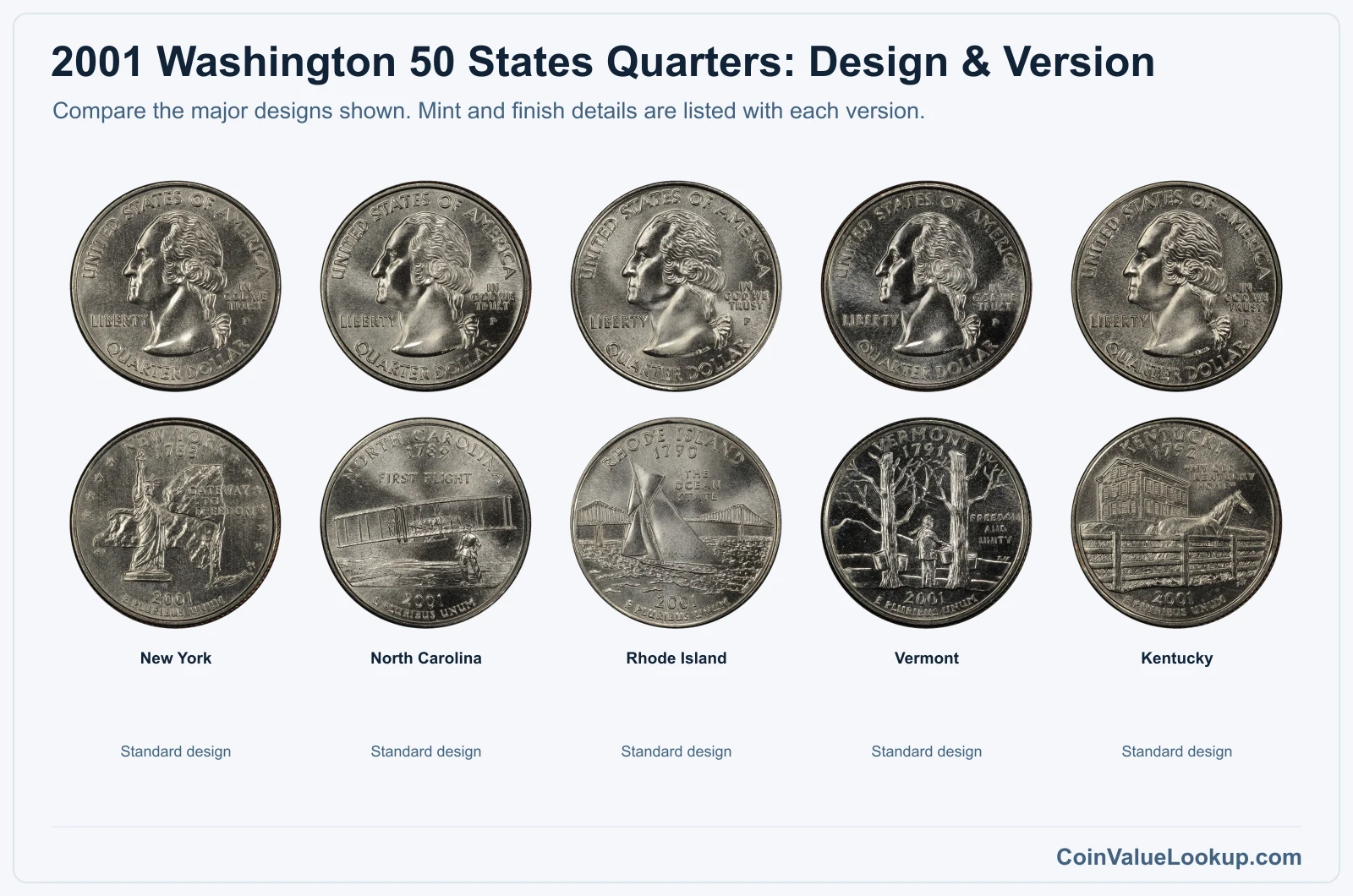
The 2001 quarter covers five statehood reverse designs — New York, North Carolina, Rhode Island, Vermont and Kentucky — struck at up to three mints each. Guide estimates from USA Coin Book range from about $0.74 at MS60 for common business strikes to $28.00 at PR65 for the silver proof versions.
Which part of that range applies depends entirely on your coin's mint, reverse design, composition and condition.
Fast Way to Identify Your 2001 Quarter
Upload clear photos of both the front and back of your 2001 quarter for a preliminary identification. The image helps narrow down the mintmark, reverse design and general condition so you can match your coin to the right version and price column.
Two well-lit, in-focus shots are all you need to get started.
2001 Quarter Value
Upload both sides of your 2001 Quarter.
Front Obverse
Upload photo
Back Reverse
Upload photo
Which 2001 Quarter Versions Are Worth Money?
- S-mint silver proofs carry the highest guide values at PR65 — $28.00 each for New York, North Carolina, Rhode Island, Vermont and Kentucky — because of their 90% silver content and limited collector-set production.
- S-mint clad proofs are next at about $10.00 in PR65, well above the face value of circulated business strikes.
- P and D Kentucky business strikes list slightly higher than other states at MS65 ($6.25 versus $4.96), so gem examples of that reverse are worth checking.
- Reported errors across all five reverses — doubled dies, off-center strikes, broadstrikes and others — can carry individual premiums that vary with visibility and condition.
Step 1: Identify Your 2001 Quarter Mint Mark and Version
Start on the obverse. Look near Washington's ponytail for a small "P," "D" or "S" mintmark.
Philadelphia coins carry a P, Denver a D, and San Francisco an S. The S-mint produced both clad and silver proofs, so the mintmark alone does not tell you which one you have.
Flip the coin over. The reverse will show one of five state designs: New York, North Carolina, Rhode Island, Vermont or Kentucky.
Each design is distinct, so there is no guesswork here.
Now figure out composition. Regular business strikes and clad proofs are copper-nickel clad and weigh about 5.67 grams.
Silver proofs are 90% silver and weigh roughly 6.25 grams. A kitchen scale accurate to 0.1 g can separate them.
Also check the edge — a copper-nickel clad coin shows a visible copper stripe, while a silver proof edge appears uniformly silver-gray.
Do not confuse the statehood date on the reverse with the minting year. The obverse date reads 2001 and that is the issue year.
Proof finish — mirror fields and frosted raised devices — is a deliberate manufacturing method, not a grade above Mint State and not an error.
Step 2: Check Your 2001 Quarter Grade
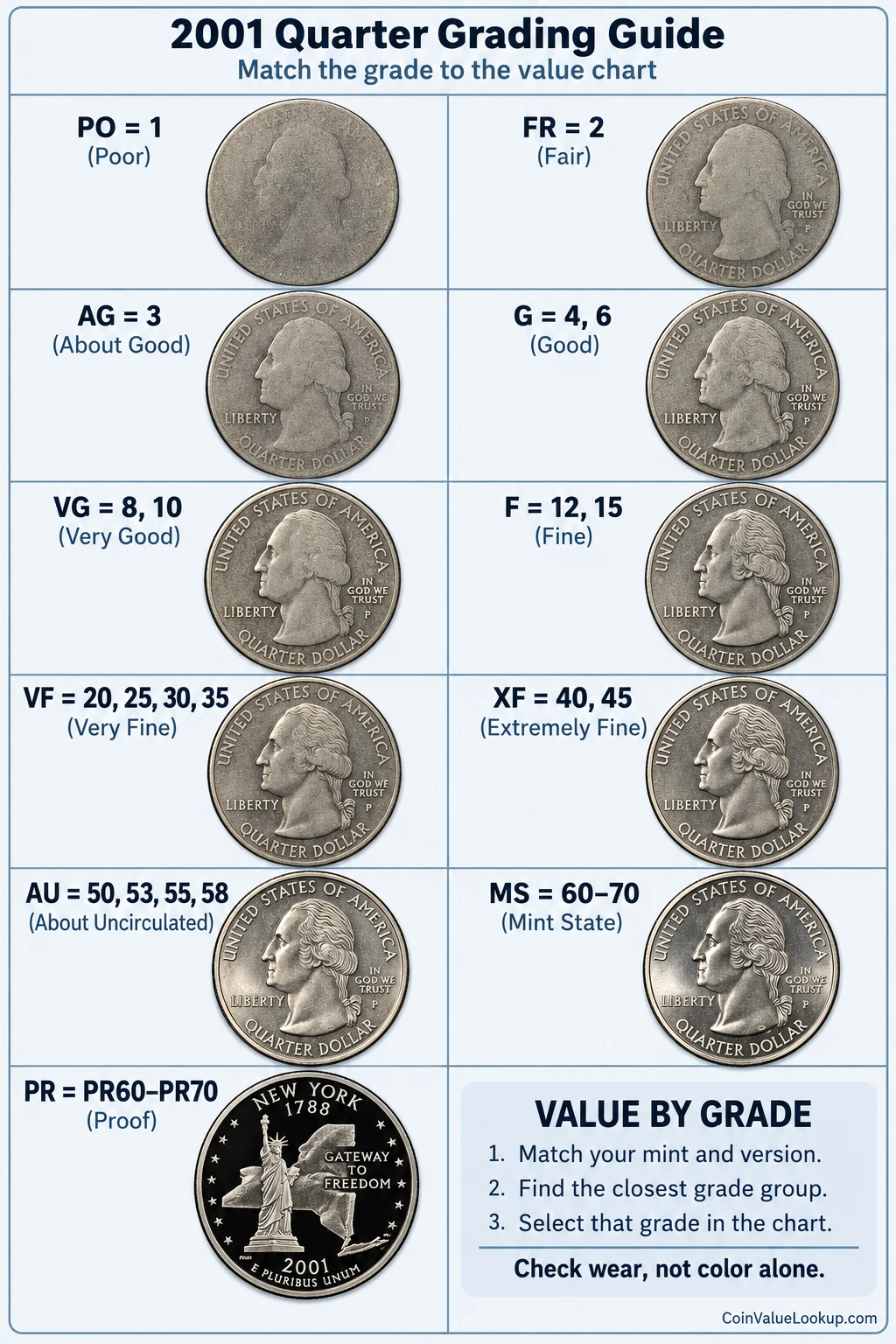
Focus on Washington's cheek first. On an unworn coin the cheek retains full roundness and luster.
As the coin circulates, that area flattens and loses its sheen before anything else. The hair detail above the ear is the next checkpoint — individual strands should be crisp on a high-grade piece.
On the reverse, examine the highest relief points of the state design. Those flatten early with wear.
Luster matters as much as detail. A coin can have sharp design elements but dull, lifeless surfaces from cleaning or heavy bag contact — and that drags value down.
Compare your coin to the reference comparison image, matching the lighting angle if you can.
For proofs, tilt the coin under a single light source. Hairlines from handling show up as fine scratches across the mirror fields.
Haze or milkiness also lowers a proof's grade. A weak strike can reduce detail even on an untouched coin, so do not assume every soft spot means wear.
Step 3: Check 2001 Quarter Value by Mint and Version
2001 Quarter — P — New York — regular strike
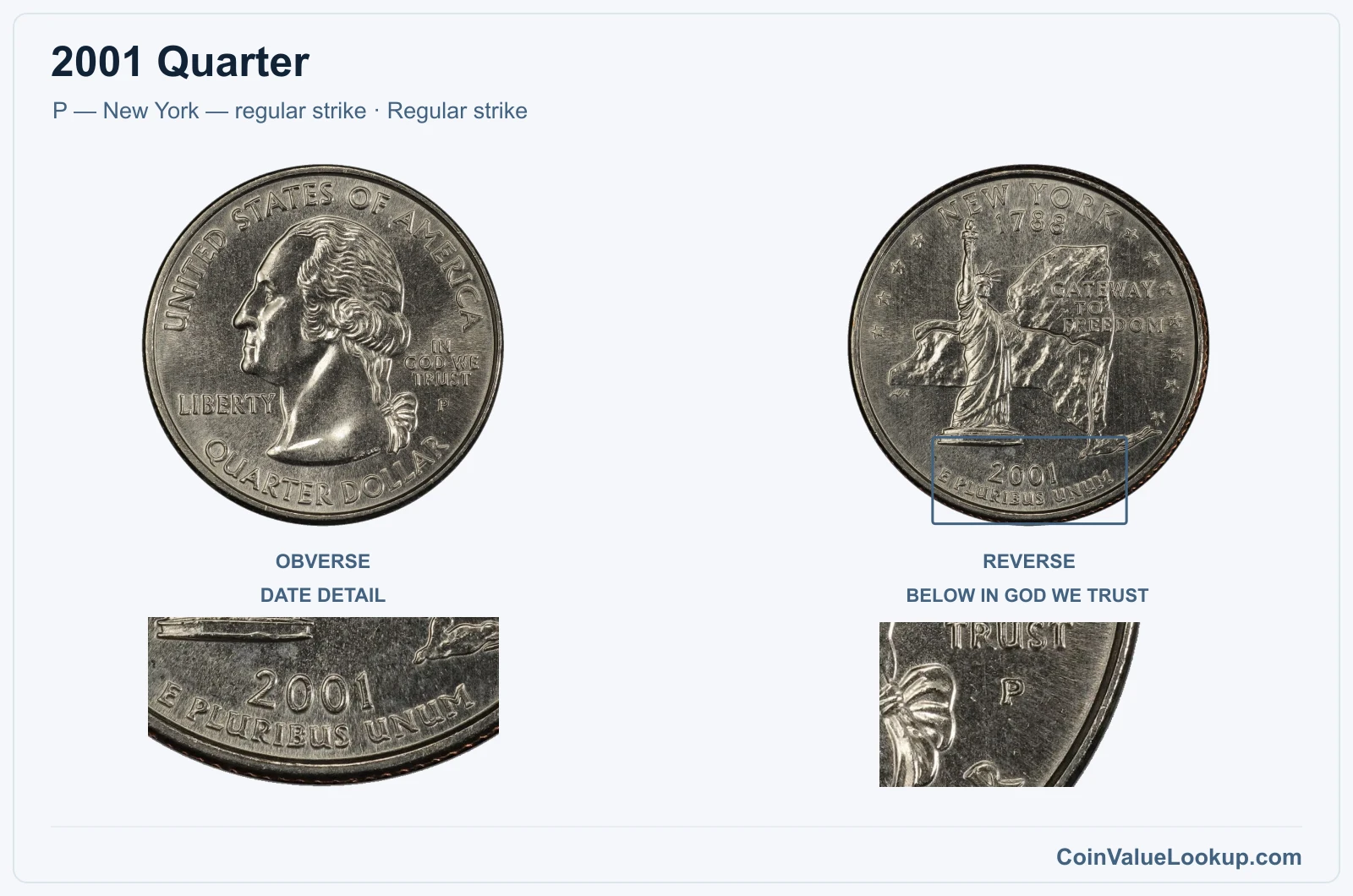
The 2001-P New York quarter is a copper-nickel clad business strike, 24.26 mm across and weighing about 5.67 g. Look for the P mintmark on the obverse and the Statue of Liberty reverse design.
Circulated examples generally trade near face value. In uncirculated condition, USA Coin Book estimates about $0.74 at MS60 and $4.96 at MS65.
Those are guide estimates, not guaranteed offers. Confirm the mintmark and reverse match before applying any price column.
Range Grade
Price Auction Records Appraisal PO PO 1
—
Coin Identifier FR FR 2
—
Coin Identifier AG AG 3
—
Coin Identifier G G 4
—
Coin Identifier
G 6
—
Coin Identifier VG VG 8
—
Coin Identifier
VG 10
—
Coin Identifier F F 12
—
Coin Identifier
F 15
—
Coin Identifier VF VF 20
—
Coin Identifier
VF 25
—
Coin Identifier
VF 30
—
Coin Identifier
VF 35
—
Coin Identifier XF XF 40
—
Coin Identifier
XF 45
—
Coin Identifier AU AU 50
—
Coin Identifier
AU 53
—
Coin Identifier
AU 55
—
Coin Identifier
AU 58
—
Coin Identifier MS MS 60
—
Coin Identifier
MS 61
—
Coin Identifier
MS 62
—
Coin Identifier
MS 63
—
Coin Identifier
MS 64
—
Coin Identifier
MS 65
Coin Identifier
MS 66
Coin Identifier
MS 67
Coin Identifier
MS 68
Coin Identifier
MS 69
Coin Identifier
MS 70
—
—
—
2001 Quarter — D — New York — regular strike
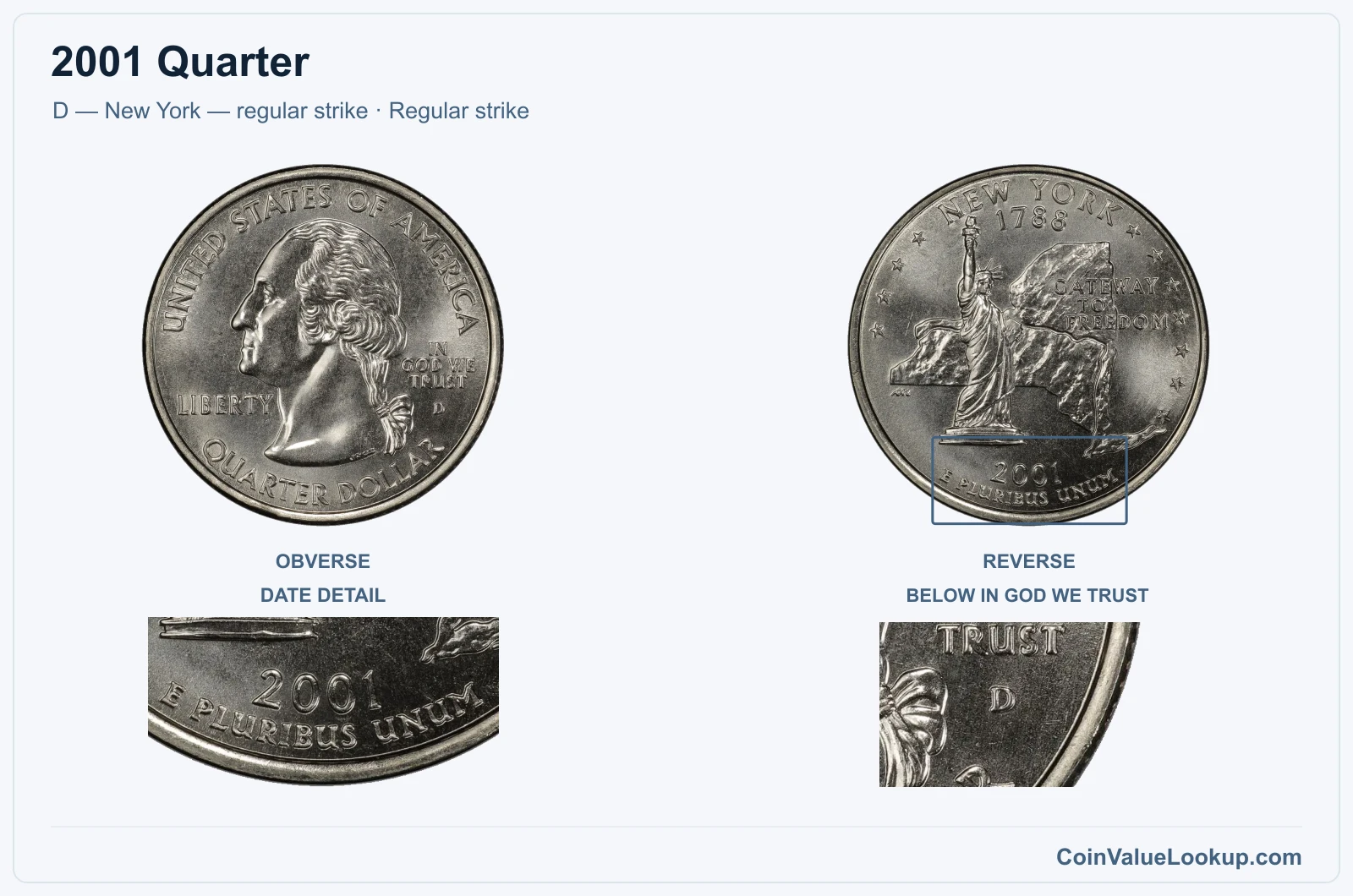
The 2001-D New York quarter shares the same copper-nickel clad specs and reverse design as its Philadelphia counterpart, but carries a D mintmark. It is equally common in circulation.
Guide estimates from USA Coin Book place it around $0.74 at MS60 and $4.96 at MS65. Worn pieces are worth face value.
Only original, lustrous uncirculated examples reach those guide figures.
Range Grade
Price Auction Records Appraisal PO PO 1
—
Coin Identifier FR FR 2
—
Coin Identifier AG AG 3
—
Coin Identifier G G 4
—
Coin Identifier
G 6
—
Coin Identifier VG VG 8
—
Coin Identifier
VG 10
—
Coin Identifier F F 12
—
Coin Identifier
F 15
—
Coin Identifier VF VF 20
—
Coin Identifier
VF 25
—
Coin Identifier
VF 30
—
Coin Identifier
VF 35
—
Coin Identifier XF XF 40
—
Coin Identifier
XF 45
—
Coin Identifier AU AU 50
—
Coin Identifier
AU 53
—
Coin Identifier
AU 55
—
Coin Identifier
AU 58
—
Coin Identifier MS MS 60
—
Coin Identifier
MS 61
—
Coin Identifier
MS 62
—
Coin Identifier
MS 63
—
Coin Identifier
MS 64
—
Coin Identifier
MS 65
Coin Identifier
MS 66
Coin Identifier
MS 67
Coin Identifier
MS 68
Coin Identifier
MS 69
—
—
—
MS 70
—
—
—
2001 Quarter — S — New York — clad proof
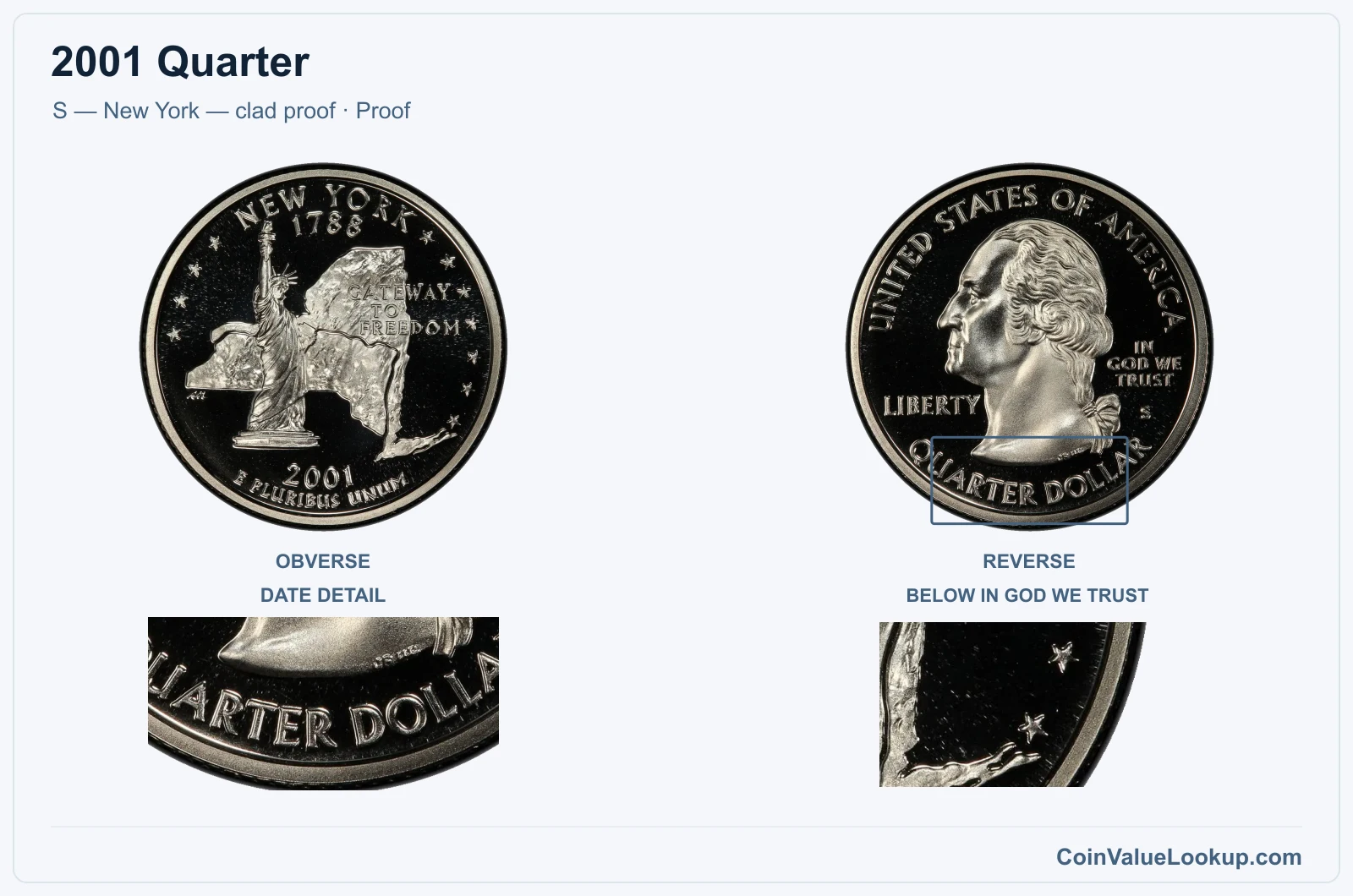
This is the 2001-S New York clad proof, struck on a standard copper-nickel clad planchet at the San Francisco Mint. It has mirror-like fields and frosted raised devices.
Do not confuse it with the silver proof — check the edge for a copper stripe or weigh the coin. USA Coin Book lists the clad proof at about $10.00 in PR65.
These were sold in government proof sets, so most survive in excellent condition.
Range Grade
Price Auction Records Appraisal PR PR 1
—
Coin Identifier
PR 2
—
Coin Identifier
PR 3
—
Coin Identifier
PR 4
—
Coin Identifier
PR 6
—
Coin Identifier
PR 8
—
Coin Identifier
PR 10
—
Coin Identifier
PR 12
—
Coin Identifier
PR 15
—
Coin Identifier
PR 20
—
Coin Identifier
PR 25
—
Coin Identifier
PR 30
—
Coin Identifier
PR 35
—
Coin Identifier
PR 40
—
Coin Identifier
PR 45
—
Coin Identifier
PR 50
—
Coin Identifier
PR 53
—
Coin Identifier
PR 55
—
Coin Identifier
PR 58
—
Coin Identifier
PR 60
—
Coin Identifier
PR 61
—
Coin Identifier
PR 62
—
Coin Identifier
PR 63
—
Coin Identifier
PR 64
—
Coin Identifier
PR 65
—
Coin Identifier
PR 66
—
Coin Identifier
PR 67
—
Coin Identifier
PR 68
Coin Identifier
PR 69
Coin Identifier
PR 70
Coin Identifier
2001 Quarter — S — New York — silver proof
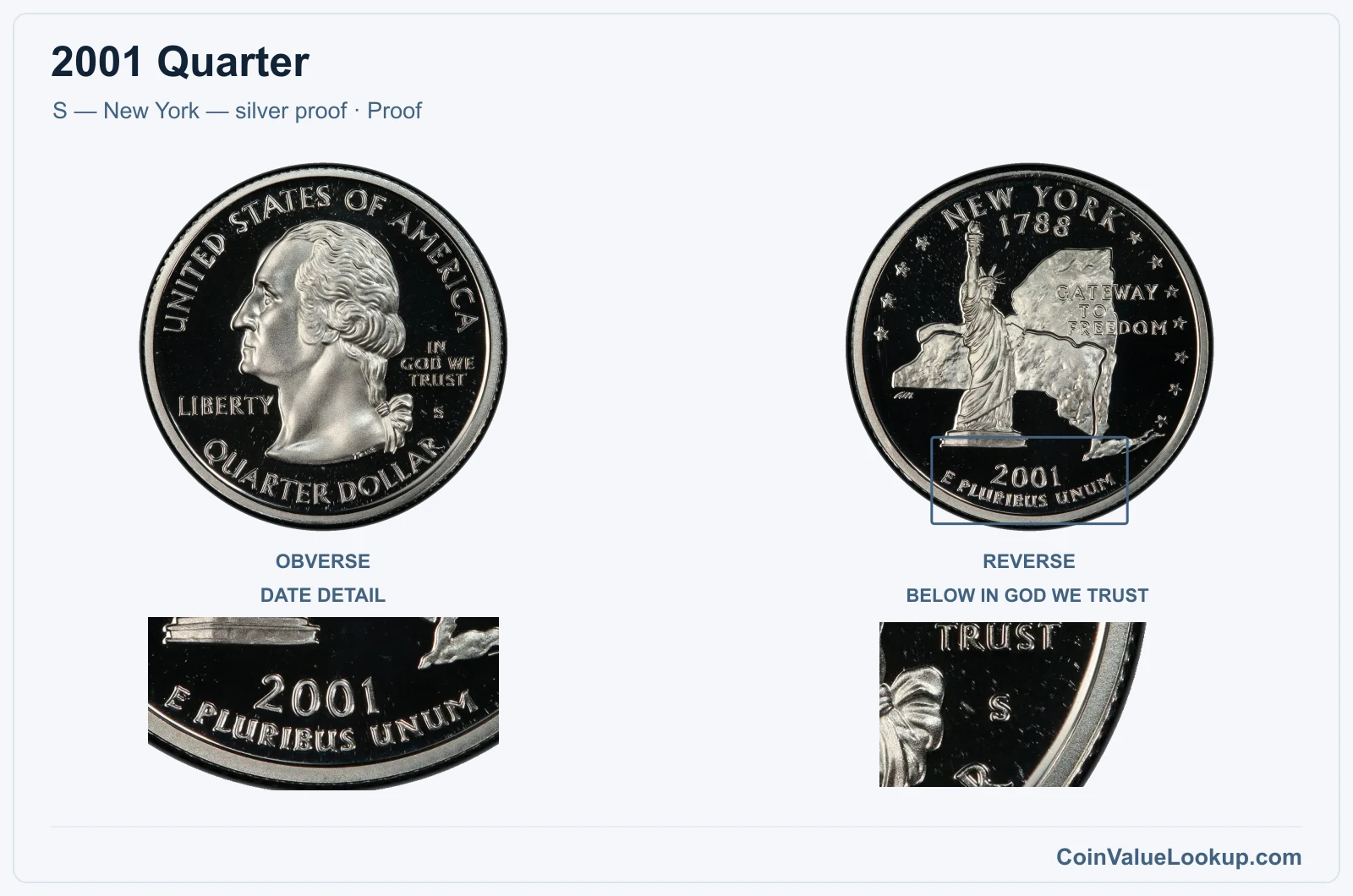
The 2001-S New York silver proof is struck on a 90% silver planchet weighing about 6.25 g, noticeably heavier than the 5.67 g clad version. The edge will show no copper stripe.
At PR65, USA Coin Book estimates this coin at $28.00 — the highest guide value among the New York versions. Keep silver and clad proof values separate; they are different coins despite sharing the S mintmark and proof finish.
Range Grade
Price Auction Records Appraisal PR PR 1
—
Coin Identifier
PR 2
—
Coin Identifier
PR 3
—
Coin Identifier
PR 4
—
Coin Identifier
PR 6
—
Coin Identifier
PR 8
—
Coin Identifier
PR 10
—
Coin Identifier
PR 12
—
Coin Identifier
PR 15
—
Coin Identifier
PR 20
—
Coin Identifier
PR 25
—
Coin Identifier
PR 30
—
Coin Identifier
PR 35
—
Coin Identifier
PR 40
—
Coin Identifier
PR 45
—
Coin Identifier
PR 50
—
Coin Identifier
PR 53
—
Coin Identifier
PR 55
—
Coin Identifier
PR 58
—
Coin Identifier
PR 60
—
Coin Identifier
PR 61
—
Coin Identifier
PR 62
—
Coin Identifier
PR 63
—
Coin Identifier
PR 64
—
Coin Identifier
PR 65
—
Coin Identifier
PR 66
—
Coin Identifier
PR 67
—
Coin Identifier
PR 68
Coin Identifier
PR 69
Coin Identifier
PR 70
Coin Identifier
2001 Quarter — P — North Carolina — regular strike
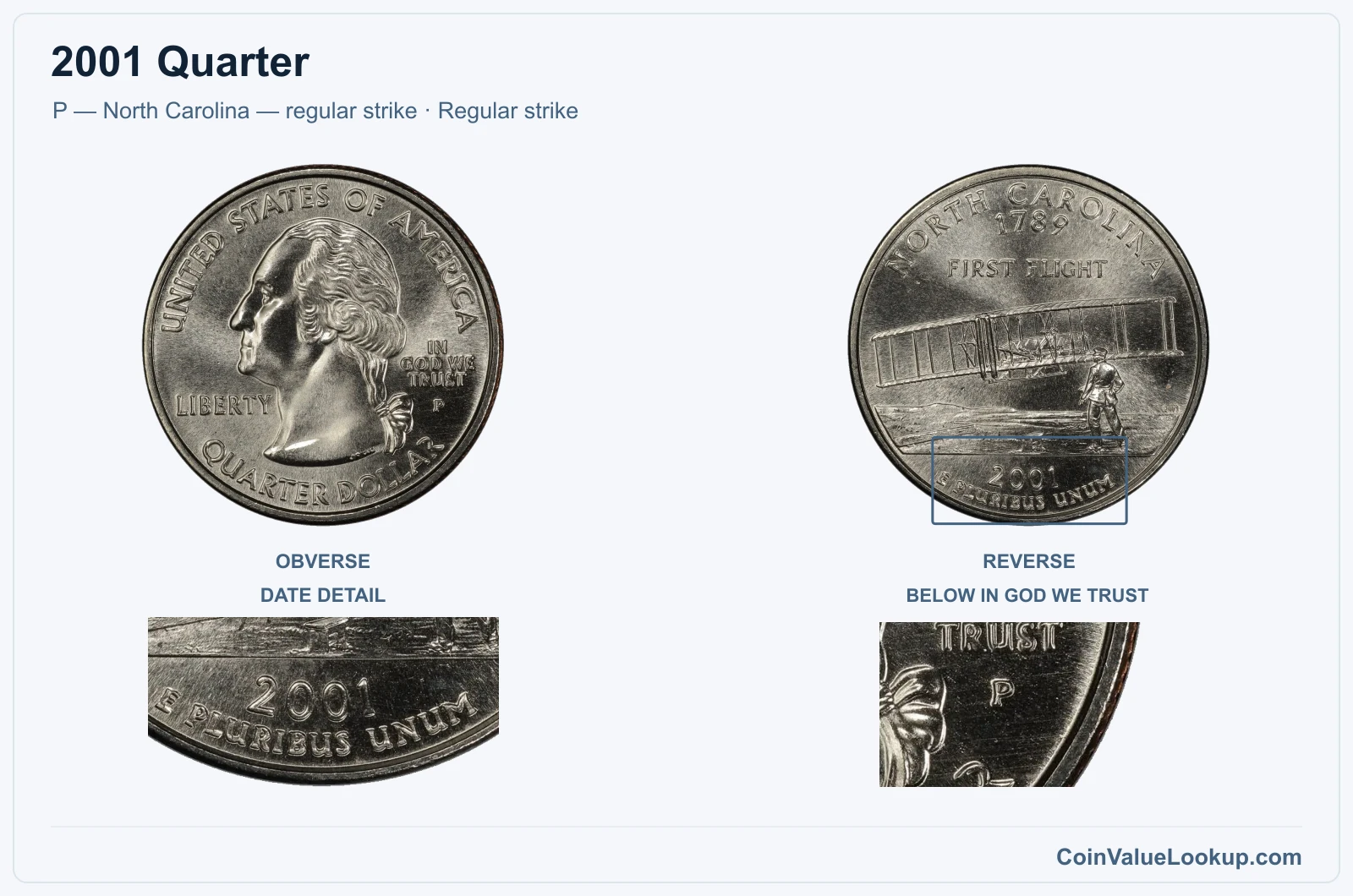
The 2001-P North Carolina quarter features the Wright Brothers' first flight reverse. It is copper-nickel clad, 24.26 mm, roughly 5.67 g.
The P mintmark sits on the obverse. Worn examples are worth face value.
USA Coin Book guide estimates put uncirculated pieces at about $0.74 for MS60 and $4.96 for MS65. Match both the mintmark and the specific reverse before looking up a price.
Range Grade
Price Auction Records Appraisal PO PO 1
—
Coin Identifier FR FR 2
—
Coin Identifier AG AG 3
—
Coin Identifier G G 4
—
Coin Identifier
G 6
—
Coin Identifier VG VG 8
—
Coin Identifier
VG 10
—
Coin Identifier F F 12
—
Coin Identifier
F 15
—
Coin Identifier VF VF 20
—
Coin Identifier
VF 25
—
Coin Identifier
VF 30
—
Coin Identifier
VF 35
—
Coin Identifier XF XF 40
—
Coin Identifier
XF 45
—
Coin Identifier AU AU 50
—
Coin Identifier
AU 53
—
Coin Identifier
AU 55
—
Coin Identifier
AU 58
—
Coin Identifier MS MS 60
—
Coin Identifier
MS 61
—
Coin Identifier
MS 62
—
Coin Identifier
MS 63
—
Coin Identifier
MS 64
Coin Identifier
MS 65
Coin Identifier
MS 66
Coin Identifier
MS 67
Coin Identifier
MS 68
Coin Identifier
MS 69
Coin Identifier
MS 70
—
—
—
2001 Quarter — D — North Carolina — regular strike
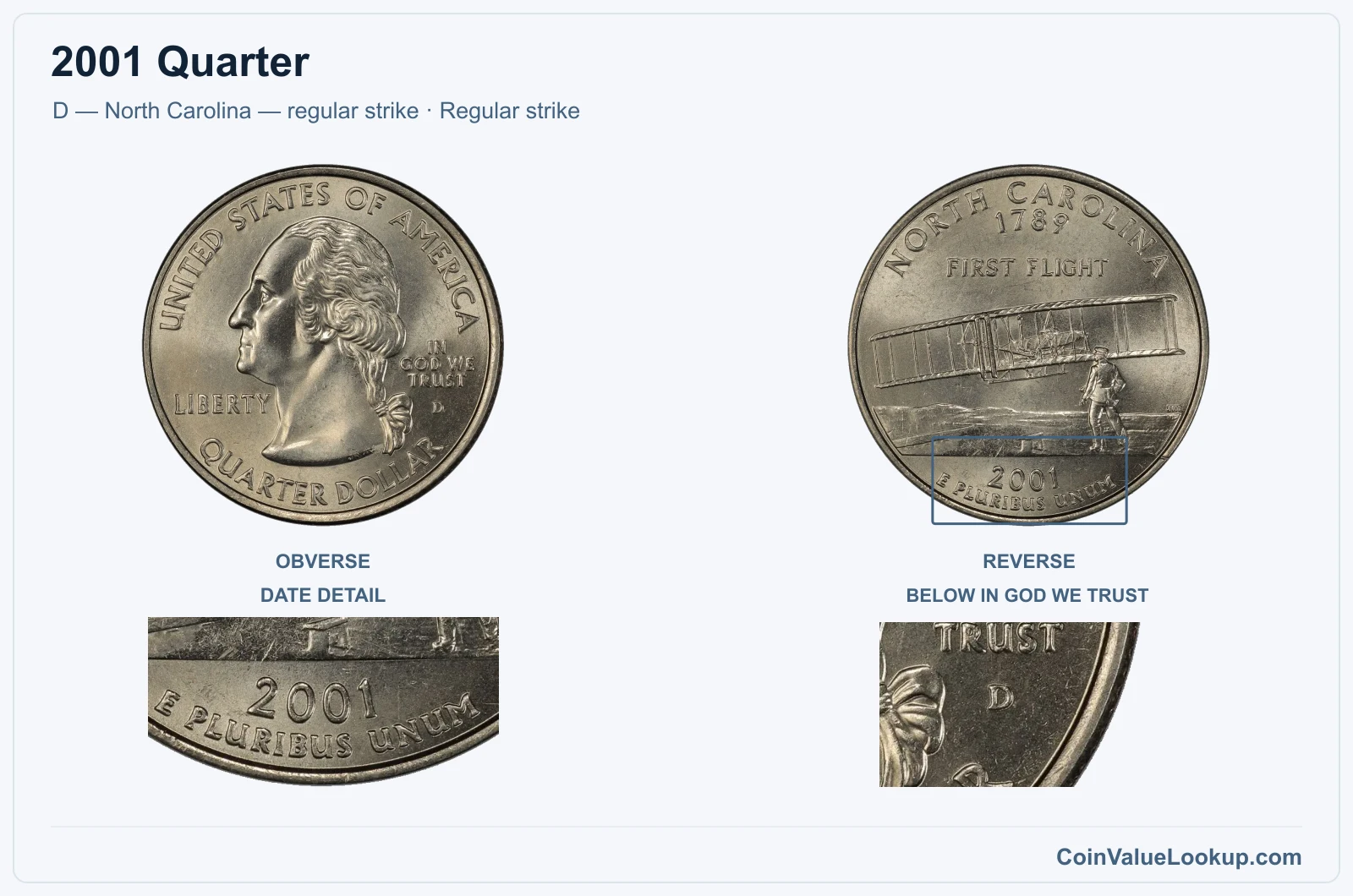
Denver's version of the 2001 North Carolina quarter carries a D mintmark but is otherwise identical in design and composition to the Philadelphia issue. Guide estimates from USA Coin Book are $0.74 at MS60 and $4.96 at MS65.
Circulated pieces remain at face value. Only well-preserved examples with full original luster approach the upper guide figure.
Range Grade
Price Auction Records Appraisal PO PO 1
—
Coin Identifier FR FR 2
—
Coin Identifier AG AG 3
—
Coin Identifier G G 4
—
Coin Identifier
G 6
—
Coin Identifier VG VG 8
—
Coin Identifier
VG 10
—
Coin Identifier F F 12
—
Coin Identifier
F 15
—
Coin Identifier VF VF 20
—
Coin Identifier
VF 25
—
Coin Identifier
VF 30
—
Coin Identifier
VF 35
—
Coin Identifier XF XF 40
—
Coin Identifier
XF 45
—
Coin Identifier AU AU 50
—
Coin Identifier
AU 53
—
Coin Identifier
AU 55
—
Coin Identifier
AU 58
—
Coin Identifier MS MS 60
—
Coin Identifier
MS 61
—
Coin Identifier
MS 62
—
Coin Identifier
MS 63
—
Coin Identifier
MS 64
—
Coin Identifier
MS 65
—
Coin Identifier
MS 66
Coin Identifier
MS 67
Coin Identifier
MS 68
Coin Identifier
MS 69
—
—
—
MS 70
—
—
—
2001 Quarter — S — North Carolina — clad proof
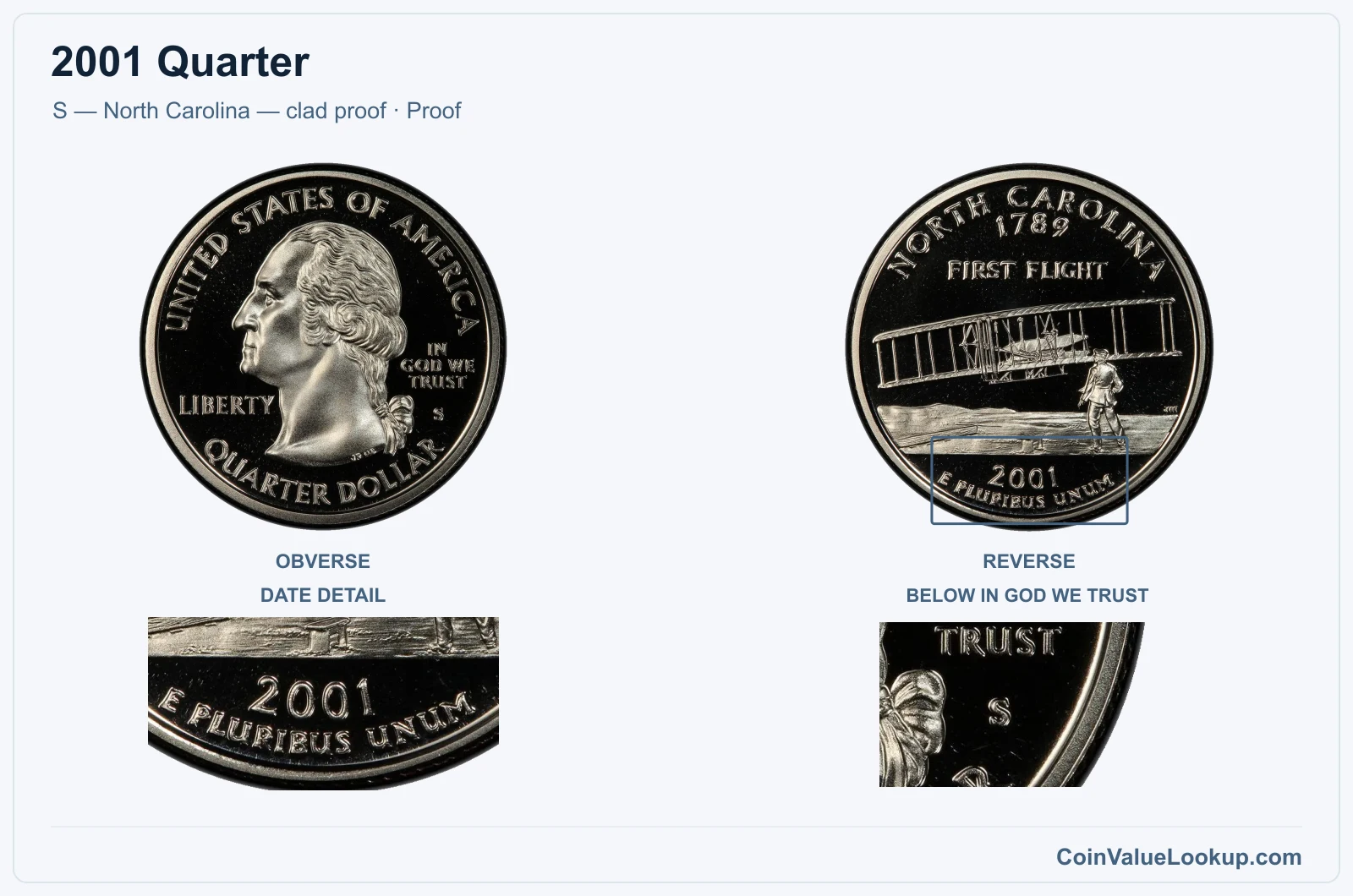
The 2001-S North Carolina clad proof is a copper-nickel clad collector strike with reflective fields and frosted devices. Confirm composition before assigning a value — weigh it or look at the edge.
USA Coin Book estimates about $10.00 at PR65. Most survived in proof sets and stay in good shape, so the real question is whether yours has hairlines or haze that would lower the grade.
Range Grade
Price Auction Records Appraisal PR PR 1
—
Coin Identifier
PR 2
—
Coin Identifier
PR 3
—
Coin Identifier
PR 4
—
Coin Identifier
PR 6
—
Coin Identifier
PR 8
—
Coin Identifier
PR 10
—
Coin Identifier
PR 12
—
Coin Identifier
PR 15
—
Coin Identifier
PR 20
—
Coin Identifier
PR 25
—
Coin Identifier
PR 30
—
Coin Identifier
PR 35
—
Coin Identifier
PR 40
—
Coin Identifier
PR 45
—
Coin Identifier
PR 50
—
Coin Identifier
PR 53
—
Coin Identifier
PR 55
—
Coin Identifier
PR 58
—
Coin Identifier
PR 60
—
Coin Identifier
PR 61
—
Coin Identifier
PR 62
—
Coin Identifier
PR 63
—
Coin Identifier
PR 64
—
Coin Identifier
PR 65
—
Coin Identifier
PR 66
—
Coin Identifier
PR 67
—
Coin Identifier
PR 68
Coin Identifier
PR 69
Coin Identifier
PR 70
Coin Identifier
2001 Quarter — S — North Carolina — silver proof
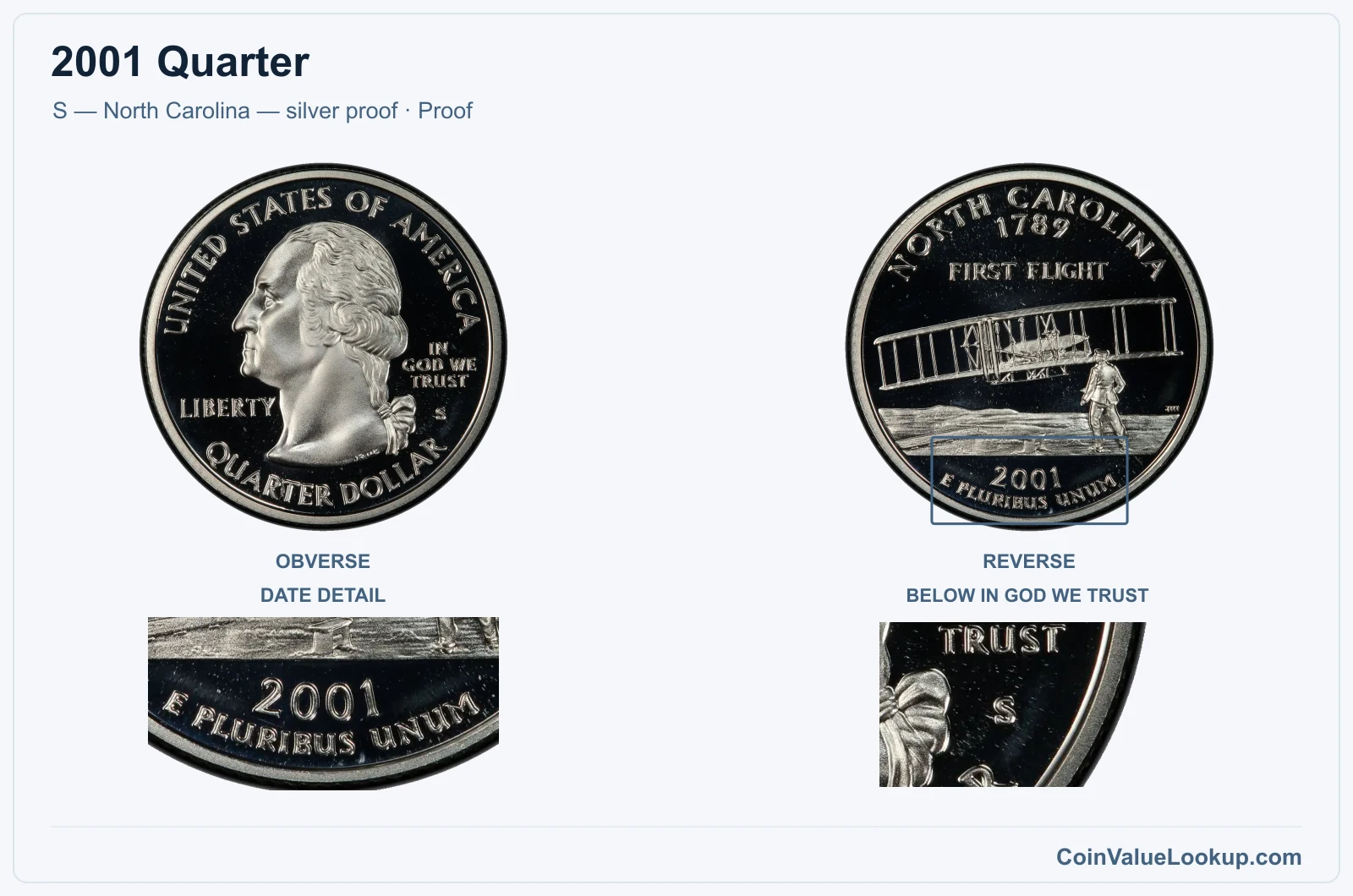
The silver proof version of the 2001-S North Carolina quarter is 90% silver, about 6.25 g. USA Coin Book estimates it at $28.00 in PR65.
These were issued in silver proof sets and carry a meaningful premium over the clad proof because of their precious-metal content. Edge examination and weight are the most reliable ways to tell the two S-mint proofs apart.
Range Grade
Price Auction Records Appraisal PR PR 1
—
Coin Identifier
PR 2
—
Coin Identifier
PR 3
—
Coin Identifier
PR 4
—
Coin Identifier
PR 6
—
Coin Identifier
PR 8
—
Coin Identifier
PR 10
—
Coin Identifier
PR 12
—
Coin Identifier
PR 15
—
Coin Identifier
PR 20
—
Coin Identifier
PR 25
—
Coin Identifier
PR 30
—
Coin Identifier
PR 35
—
Coin Identifier
PR 40
—
Coin Identifier
PR 45
—
Coin Identifier
PR 50
—
Coin Identifier
PR 53
—
Coin Identifier
PR 55
—
Coin Identifier
PR 58
—
Coin Identifier
PR 60
—
Coin Identifier
PR 61
—
Coin Identifier
PR 62
—
Coin Identifier
PR 63
—
Coin Identifier
PR 64
—
Coin Identifier
PR 65
—
Coin Identifier
PR 66
—
Coin Identifier
PR 67
—
Coin Identifier
PR 68
Coin Identifier
PR 69
Coin Identifier
PR 70
Coin Identifier
2001 Quarter — P — Rhode Island — regular strike
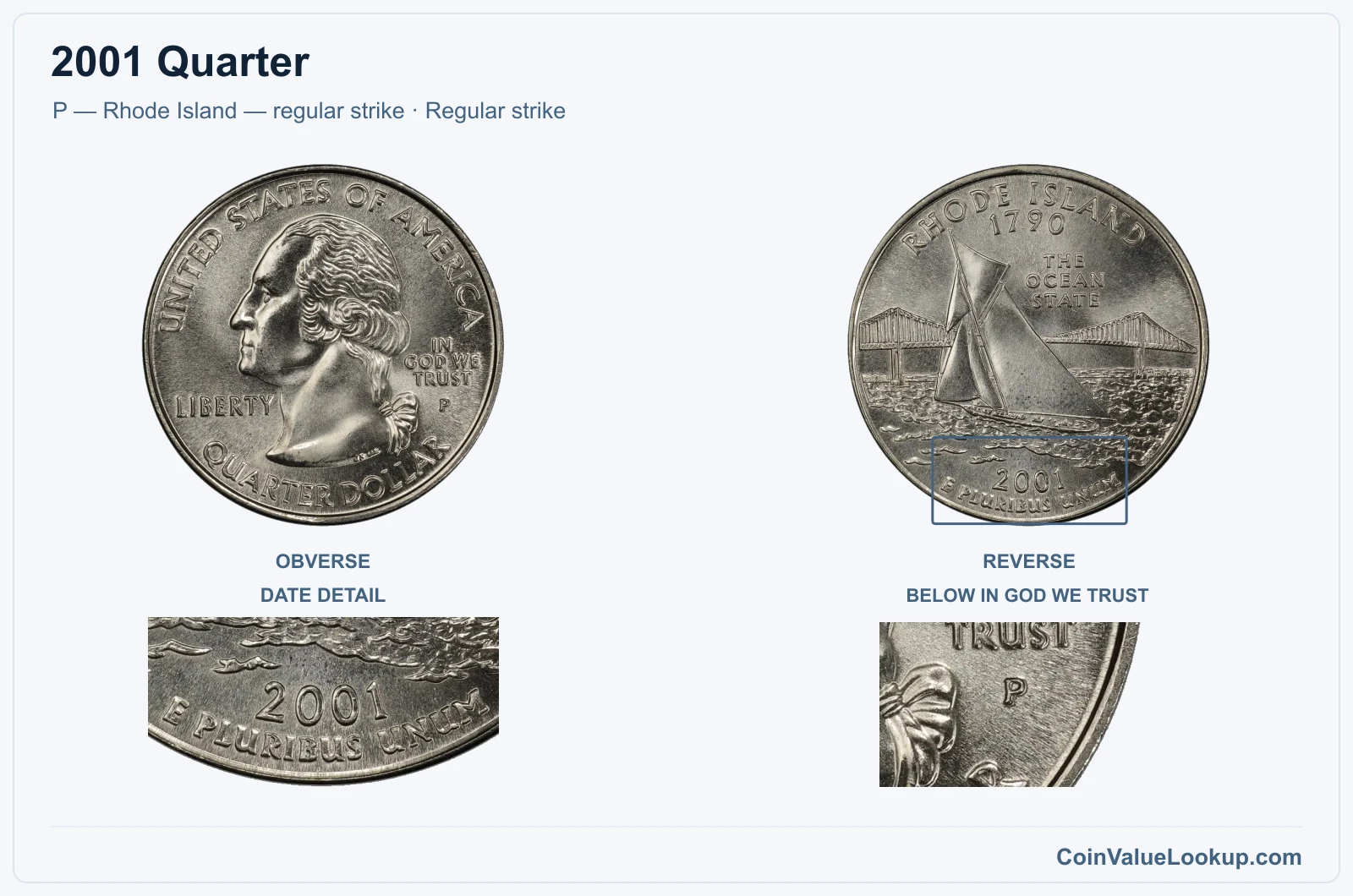
The 2001-P Rhode Island quarter shows a sailboat and bridge on the reverse. It is copper-nickel clad at the standard 5.67 g.
Circulated coins are worth 25 cents. In uncirculated condition, USA Coin Book estimates $0.74 at MS60 and $4.96 at MS65.
These are guide-level estimates. Verify mintmark and reverse design before comparing grades.
Coin Value Lookup is a good starting point if you are sorting through multiple quarters from different years and want to pull up the right guide quickly.
Range Grade
Price Auction Records Appraisal PO PO 1
—
Coin Identifier FR FR 2
—
Coin Identifier AG AG 3
—
Coin Identifier G G 4
—
Coin Identifier
G 6
—
Coin Identifier VG VG 8
—
Coin Identifier
VG 10
—
Coin Identifier F F 12
—
Coin Identifier
F 15
—
Coin Identifier VF VF 20
—
Coin Identifier
VF 25
—
Coin Identifier
VF 30
—
Coin Identifier
VF 35
—
Coin Identifier XF XF 40
—
Coin Identifier
XF 45
—
Coin Identifier AU AU 50
—
Coin Identifier
AU 53
—
Coin Identifier
AU 55
—
Coin Identifier
AU 58
—
Coin Identifier MS MS 60
—
Coin Identifier
MS 61
—
Coin Identifier
MS 62
—
Coin Identifier
MS 63
—
Coin Identifier
MS 64
—
Coin Identifier
MS 65
Coin Identifier
MS 66
Coin Identifier
MS 67
—
Coin Identifier
MS 68
Coin Identifier
MS 69
—
Coin Identifier
MS 70
—
—
—
2001 Quarter — D — Rhode Island — regular strike
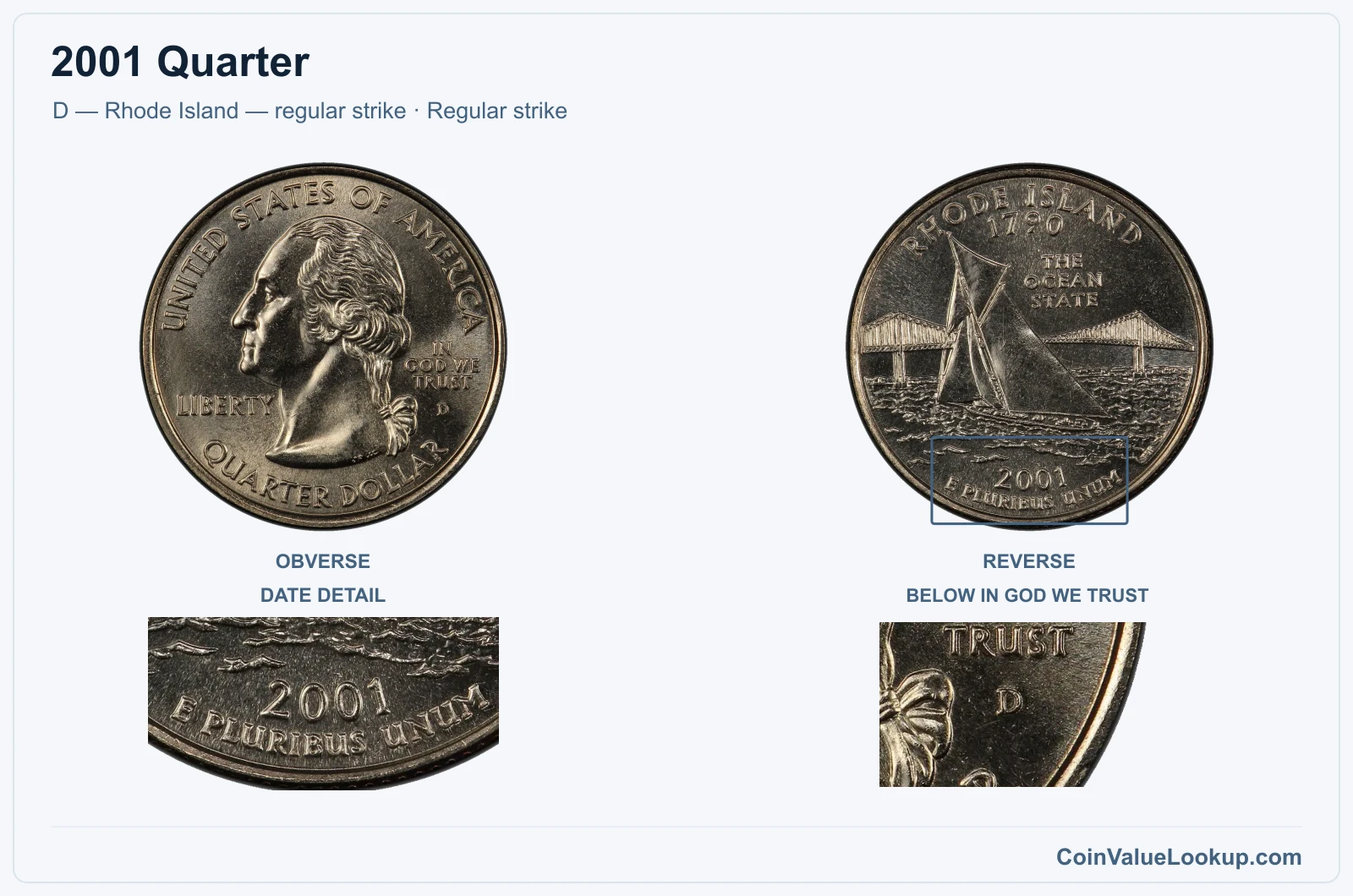
The 2001-D Rhode Island quarter is the Denver Mint's version, sharing the same copper-nickel clad composition and sailboat reverse. Guide estimates from USA Coin Book are $0.74 at MS60 and $4.96 at MS65.
Circulated pieces trade at face value. Only original uncirculated examples with good luster are candidates for the higher end of those figures.
Range Grade
Price Auction Records Appraisal PO PO 1
—
Coin Identifier FR FR 2
—
Coin Identifier AG AG 3
—
Coin Identifier G G 4
—
Coin Identifier
G 6
—
Coin Identifier VG VG 8
—
Coin Identifier
VG 10
—
Coin Identifier F F 12
—
Coin Identifier
F 15
—
Coin Identifier VF VF 20
—
Coin Identifier
VF 25
—
Coin Identifier
VF 30
—
Coin Identifier
VF 35
—
Coin Identifier XF XF 40
—
Coin Identifier
XF 45
—
Coin Identifier AU AU 50
—
Coin Identifier
AU 53
—
Coin Identifier
AU 55
—
Coin Identifier
AU 58
—
Coin Identifier MS MS 60
—
Coin Identifier
MS 61
—
Coin Identifier
MS 62
—
Coin Identifier
MS 63
—
Coin Identifier
MS 64
—
Coin Identifier
MS 65
Coin Identifier
MS 66
Coin Identifier
MS 67
Coin Identifier
MS 68
Coin Identifier
MS 69
—
—
—
MS 70
—
—
—
2001 Quarter — S — Rhode Island — clad proof
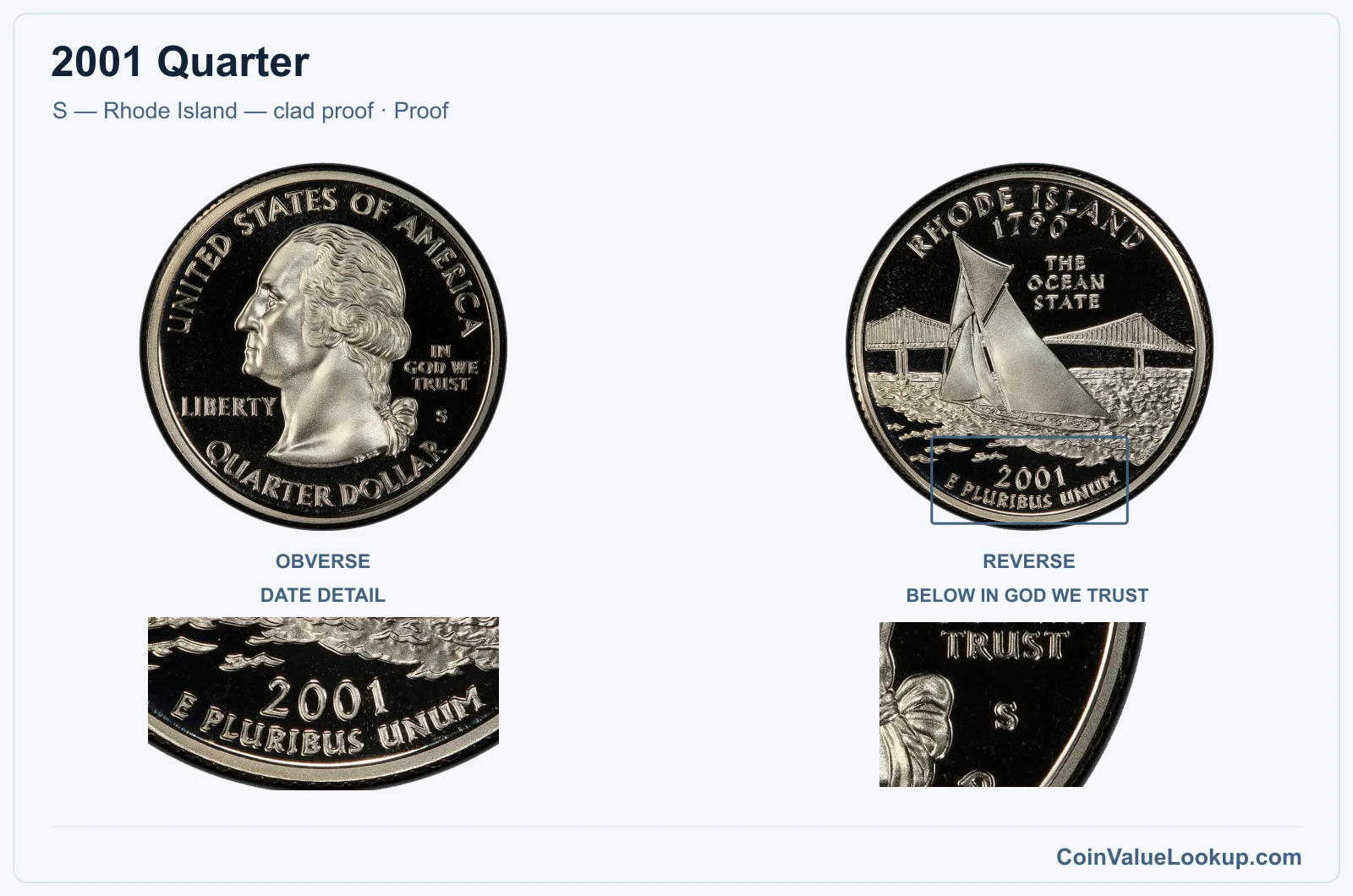
This is the 2001-S Rhode Island clad proof, struck on a copper-nickel clad blank at San Francisco. It features the proof finish: mirror fields, frosted devices.
USA Coin Book estimates about $10.00 at PR65. Check the edge and weight to make sure you are not holding the silver version, which is worth more than twice as much in the same grade.
Range Grade
Price Auction Records Appraisal PR PR 1
—
Coin Identifier
PR 2
—
Coin Identifier
PR 3
—
Coin Identifier
PR 4
—
Coin Identifier
PR 6
—
Coin Identifier
PR 8
—
Coin Identifier
PR 10
—
Coin Identifier
PR 12
—
Coin Identifier
PR 15
—
Coin Identifier
PR 20
—
Coin Identifier
PR 25
—
Coin Identifier
PR 30
—
Coin Identifier
PR 35
—
Coin Identifier
PR 40
—
Coin Identifier
PR 45
—
Coin Identifier
PR 50
—
Coin Identifier
PR 53
—
Coin Identifier
PR 55
—
Coin Identifier
PR 58
—
Coin Identifier
PR 60
—
Coin Identifier
PR 61
—
Coin Identifier
PR 62
—
Coin Identifier
PR 63
—
Coin Identifier
PR 64
—
Coin Identifier
PR 65
—
Coin Identifier
PR 66
—
Coin Identifier
PR 67
—
Coin Identifier
PR 68
—
Coin Identifier
PR 69
Coin Identifier
PR 70
Coin Identifier
2001 Quarter — S — Rhode Island — silver proof
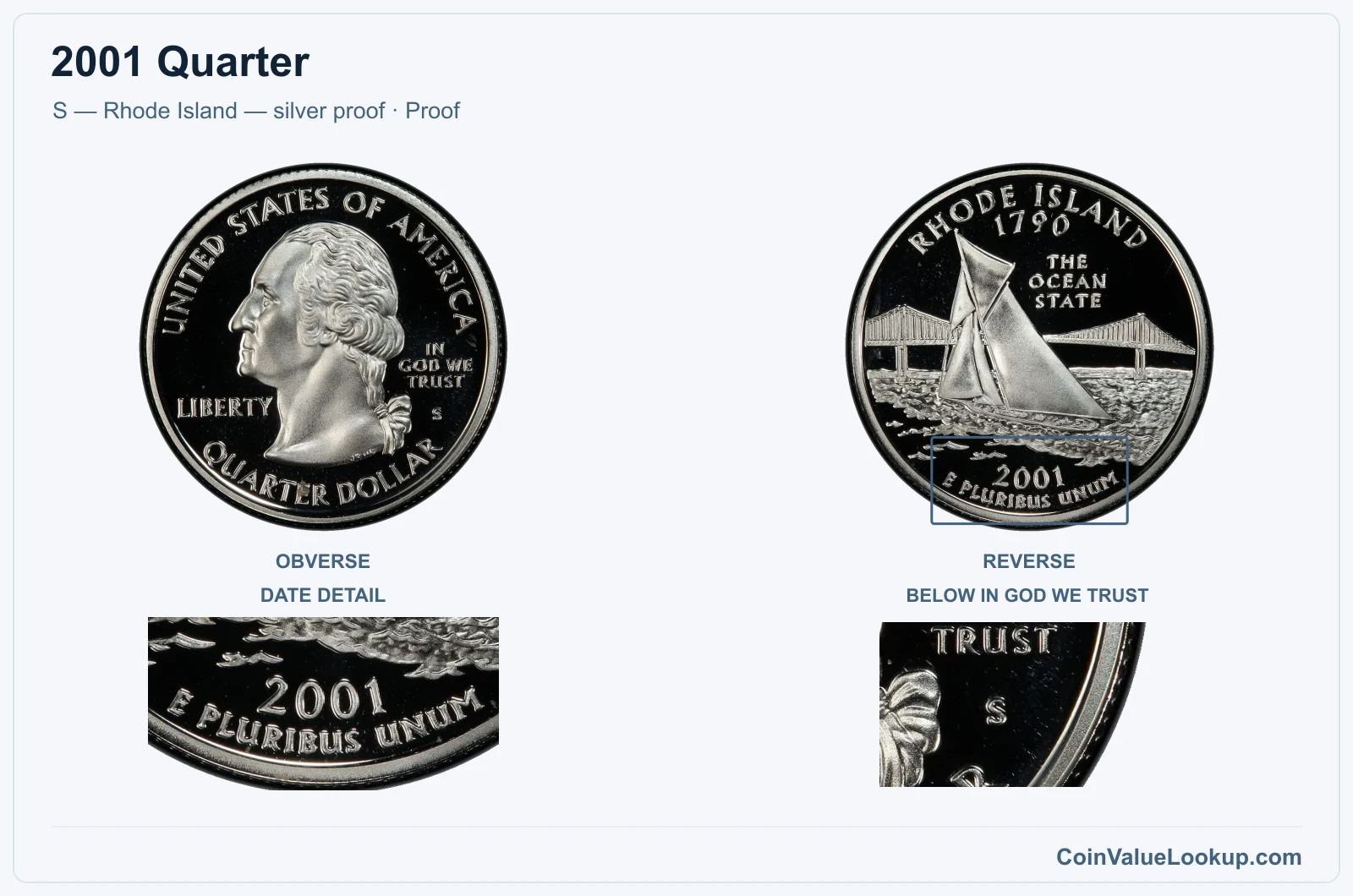
The 2001-S Rhode Island silver proof is 90% silver, weighing about 6.25 g versus 5.67 g for the clad. USA Coin Book estimates $28.00 at PR65.
The edge will appear uniformly silver-toned with no copper stripe. These came in special silver proof sets.
Condition still matters — hairlines, spots and haze pull a proof below that PR65 benchmark.
Range Grade
Price Auction Records Appraisal PR PR 1
—
Coin Identifier
PR 2
—
Coin Identifier
PR 3
—
Coin Identifier
PR 4
—
Coin Identifier
PR 6
—
Coin Identifier
PR 8
—
Coin Identifier
PR 10
—
Coin Identifier
PR 12
—
Coin Identifier
PR 15
—
Coin Identifier
PR 20
—
Coin Identifier
PR 25
—
Coin Identifier
PR 30
—
Coin Identifier
PR 35
—
Coin Identifier
PR 40
—
Coin Identifier
PR 45
—
Coin Identifier
PR 50
—
Coin Identifier
PR 53
—
Coin Identifier
PR 55
—
Coin Identifier
PR 58
—
Coin Identifier
PR 60
—
Coin Identifier
PR 61
—
Coin Identifier
PR 62
—
Coin Identifier
PR 63
—
Coin Identifier
PR 64
—
Coin Identifier
PR 65
—
Coin Identifier
PR 66
—
Coin Identifier
PR 67
—
Coin Identifier
PR 68
—
Coin Identifier
PR 69
Coin Identifier
PR 70
Coin Identifier
2001 Quarter — P — Vermont — regular strike
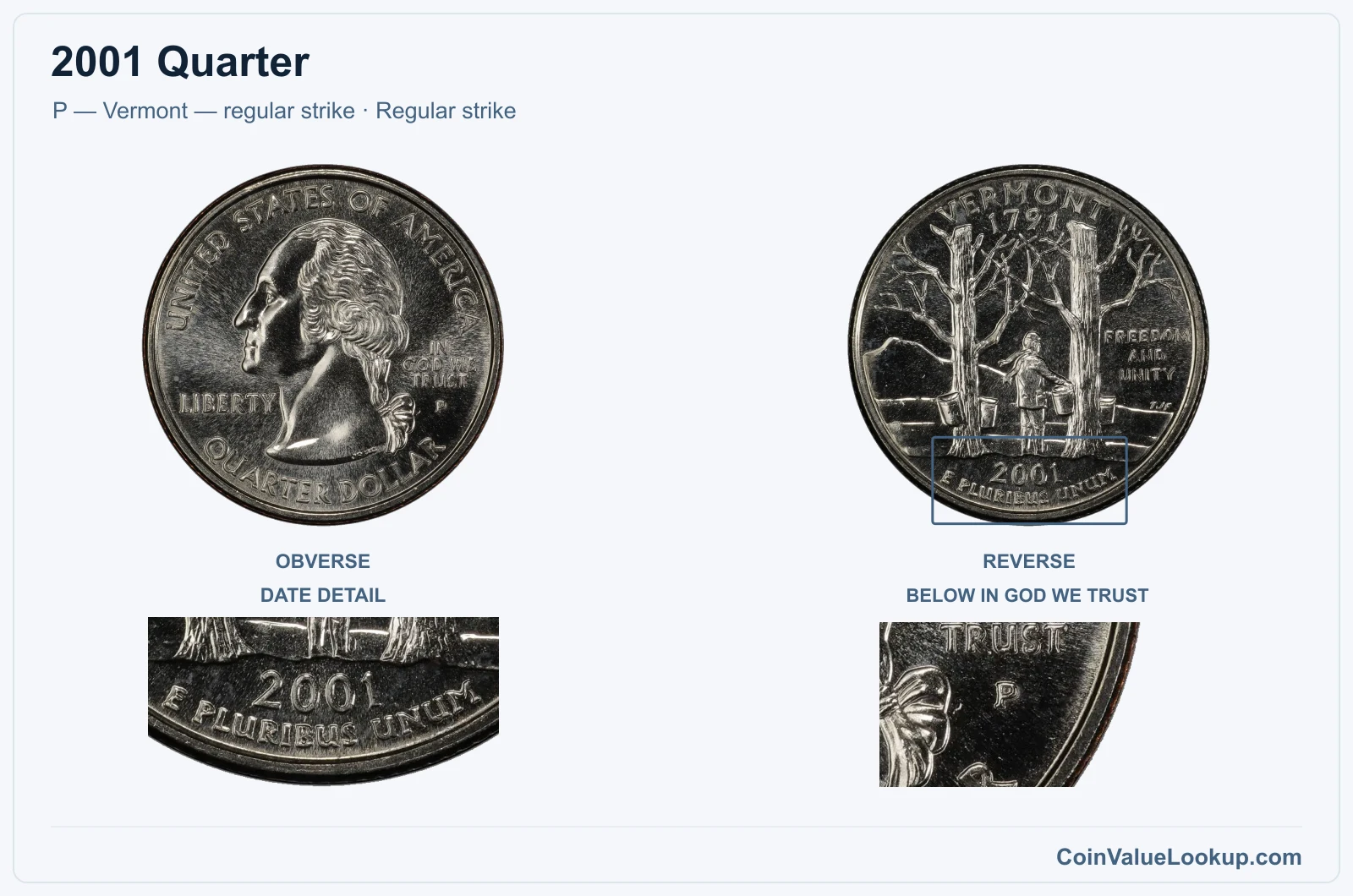
The 2001-P Vermont quarter shows a maple-tree-and-sap-bucket design on the reverse. It is copper-nickel clad, 24.26 mm, about 5.67 g.
Worn copies are common and worth face value. USA Coin Book guide estimates for uncirculated pieces are about $0.74 at MS60 and $4.96 at MS65.
Verify the mintmark reads P and the reverse is definitely Vermont before applying those numbers.
Range Grade
Price Auction Records Appraisal PO PO 1
—
Coin Identifier FR FR 2
—
Coin Identifier AG AG 3
—
Coin Identifier G G 4
—
Coin Identifier
G 6
—
Coin Identifier VG VG 8
—
Coin Identifier
VG 10
—
Coin Identifier F F 12
—
Coin Identifier
F 15
—
Coin Identifier VF VF 20
—
Coin Identifier
VF 25
—
Coin Identifier
VF 30
—
Coin Identifier
VF 35
—
Coin Identifier XF XF 40
—
Coin Identifier
XF 45
—
Coin Identifier AU AU 50
—
Coin Identifier
AU 53
—
Coin Identifier
AU 55
—
Coin Identifier
AU 58
—
Coin Identifier MS MS 60
—
Coin Identifier
MS 61
—
Coin Identifier
MS 62
—
Coin Identifier
MS 63
—
Coin Identifier
MS 64
—
Coin Identifier
MS 65
Coin Identifier
MS 66
Coin Identifier
MS 67
Coin Identifier
MS 68
Coin Identifier
MS 69
Coin Identifier
MS 70
—
—
—
2001 Quarter — D — Vermont — regular strike
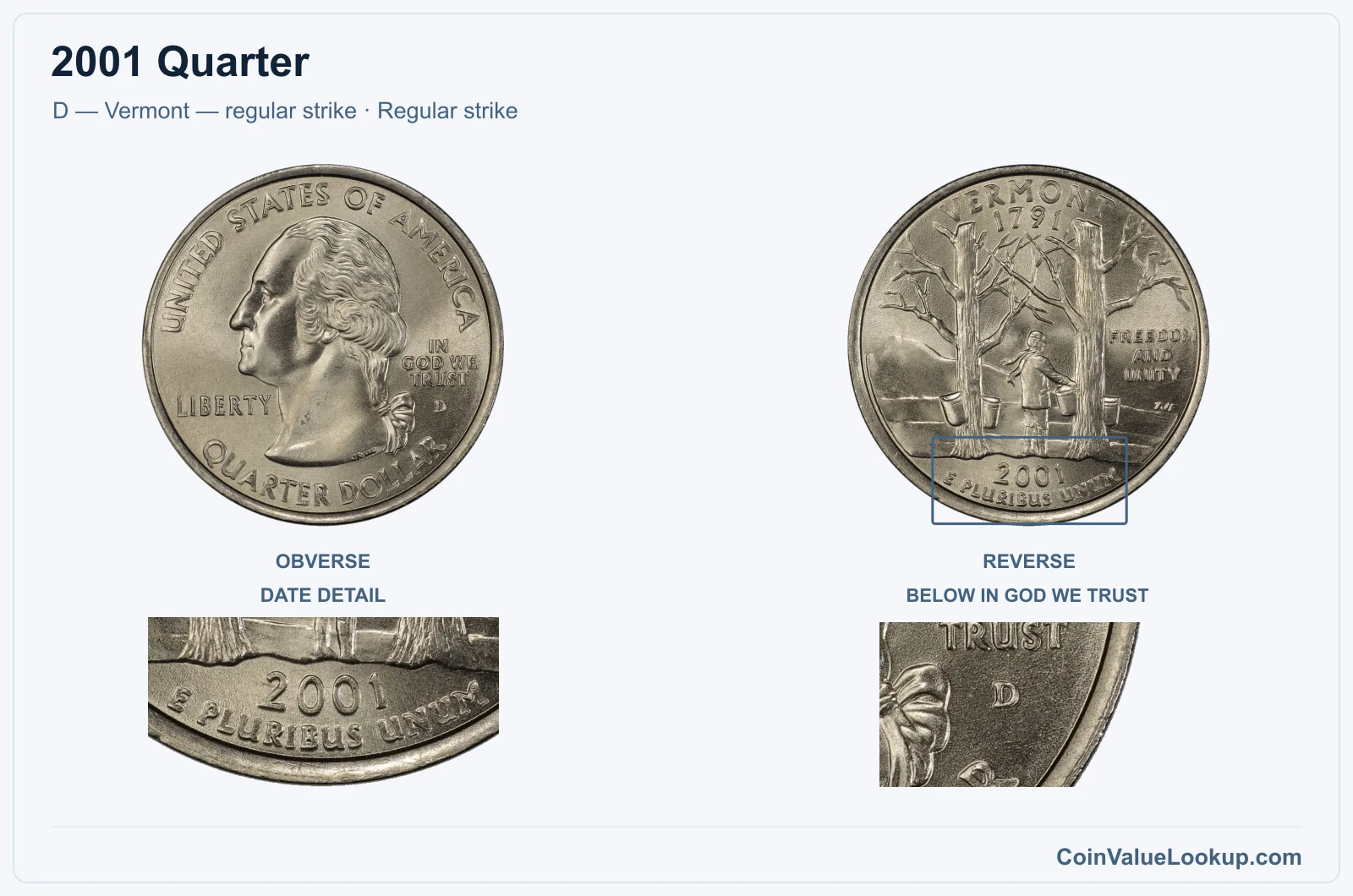
Denver struck the 2001-D Vermont quarter in the same copper-nickel clad format. The D mintmark is the distinguishing feature.
Guide estimates from USA Coin Book sit at $0.74 for MS60 and $4.96 for MS65. Circulated examples are face-value coins.
A nice original uncirculated example is worth setting aside, but it is not scarce.
Range Grade
Price Auction Records Appraisal PO PO 1
—
Coin Identifier FR FR 2
—
Coin Identifier AG AG 3
—
Coin Identifier G G 4
—
Coin Identifier
G 6
—
Coin Identifier VG VG 8
—
Coin Identifier
VG 10
—
Coin Identifier F F 12
—
Coin Identifier
F 15
—
Coin Identifier VF VF 20
—
Coin Identifier
VF 25
—
Coin Identifier
VF 30
—
Coin Identifier
VF 35
—
Coin Identifier XF XF 40
—
Coin Identifier
XF 45
—
Coin Identifier AU AU 50
—
Coin Identifier
AU 53
—
Coin Identifier
AU 55
—
Coin Identifier
AU 58
—
Coin Identifier MS MS 60
—
Coin Identifier
MS 61
—
Coin Identifier
MS 62
—
Coin Identifier
MS 63
—
Coin Identifier
MS 64
—
Coin Identifier
MS 65
Coin Identifier
MS 66
Coin Identifier
MS 67
Coin Identifier
MS 68
Coin Identifier
MS 69
—
—
—
MS 70
—
—
—
2001 Quarter — S — Vermont — clad proof
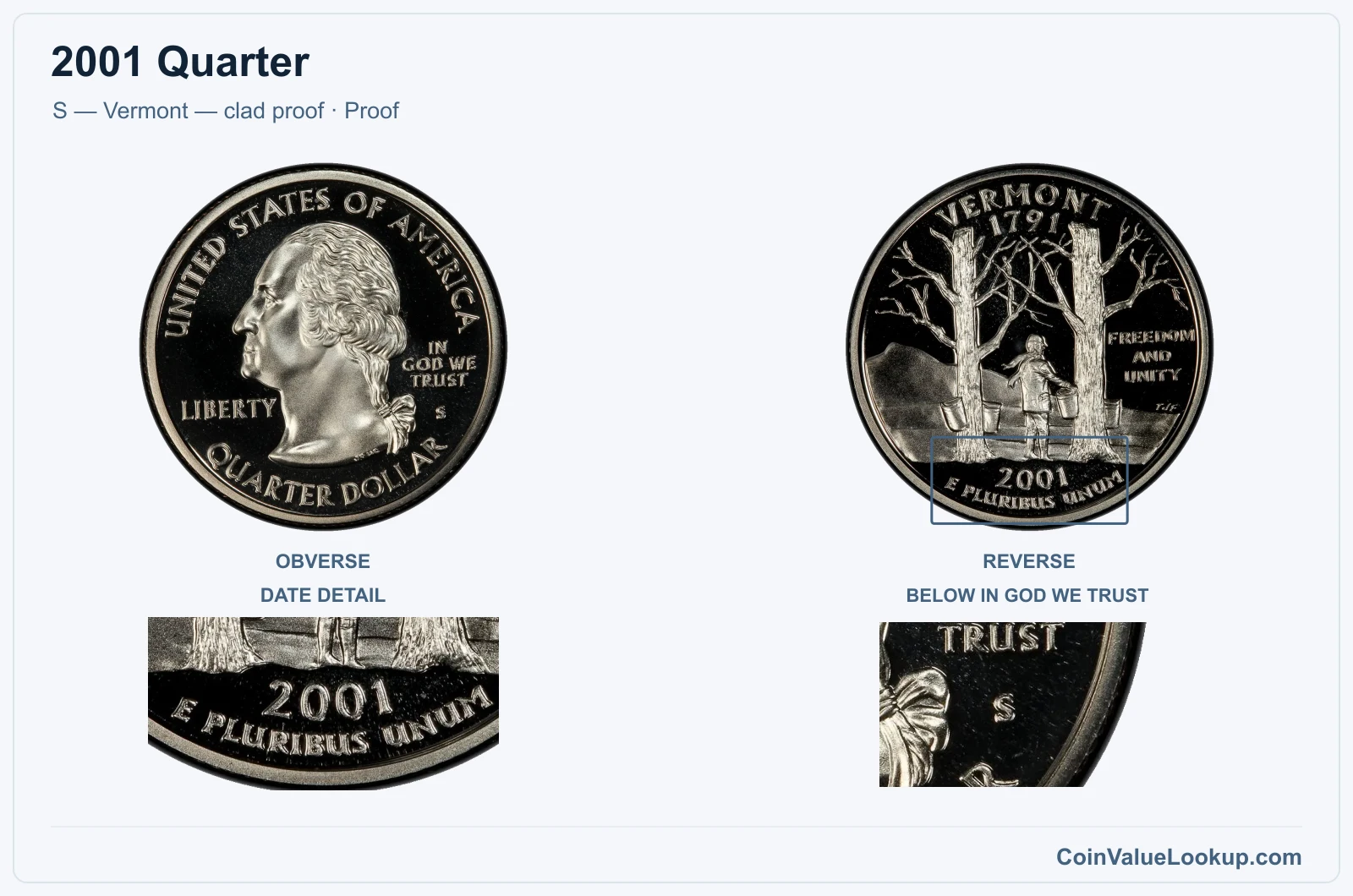
The 2001-S Vermont clad proof is a collector-finish coin on a standard copper-nickel clad planchet. Look for fully reflective fields and frosted design elements.
USA Coin Book estimates about $10.00 at PR65. Confirm you are holding the clad version and not the silver proof by checking the edge or weighing the coin — the difference in value is significant.
Range Grade
Price Auction Records Appraisal PR PR 1
—
Coin Identifier
PR 2
—
Coin Identifier
PR 3
—
Coin Identifier
PR 4
—
Coin Identifier
PR 6
—
Coin Identifier
PR 8
—
Coin Identifier
PR 10
—
Coin Identifier
PR 12
—
Coin Identifier
PR 15
—
Coin Identifier
PR 20
—
Coin Identifier
PR 25
—
Coin Identifier
PR 30
—
Coin Identifier
PR 35
—
Coin Identifier
PR 40
—
Coin Identifier
PR 45
—
Coin Identifier
PR 50
—
Coin Identifier
PR 53
—
Coin Identifier
PR 55
—
Coin Identifier
PR 58
—
Coin Identifier
PR 60
—
Coin Identifier
PR 61
—
Coin Identifier
PR 62
—
Coin Identifier
PR 63
—
Coin Identifier
PR 64
—
Coin Identifier
PR 65
—
Coin Identifier
PR 66
—
Coin Identifier
PR 67
—
Coin Identifier
PR 68
—
Coin Identifier
PR 69
Coin Identifier
PR 70
Coin Identifier
2001 Quarter — S — Vermont — silver proof
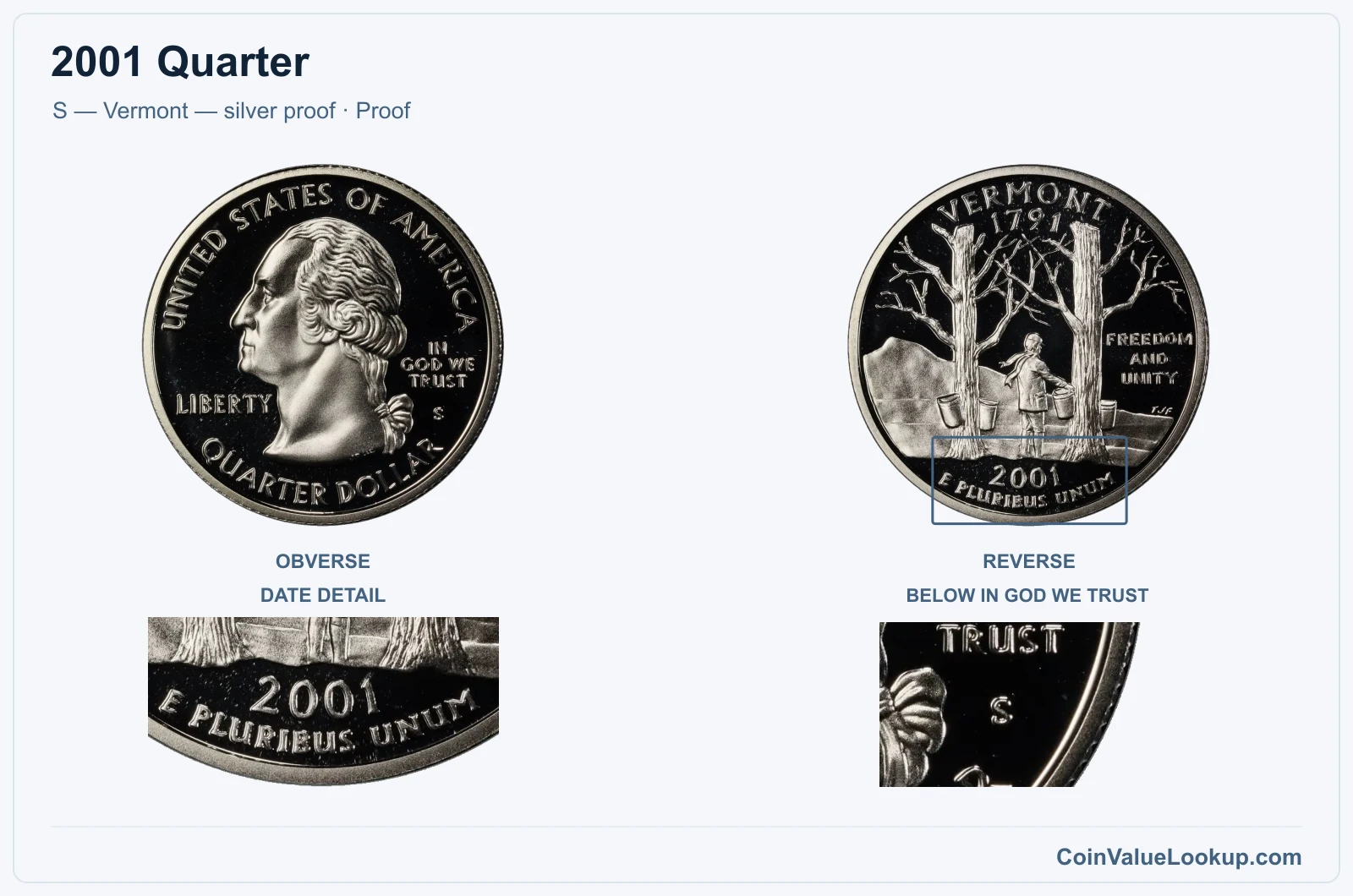
The 2001-S Vermont silver proof uses a 90% silver planchet at approximately 6.25 g. USA Coin Book estimates it at $28.00 in PR65.
Silver proof sets were sold separately from clad proof sets, so packaging can help identify this coin. Without original packaging, edge examination and a precise weight are your best tools.
Hairlines and haze lower the grade and the value.
Range Grade
Price Auction Records Appraisal PR PR 1
—
Coin Identifier
PR 2
—
Coin Identifier
PR 3
—
Coin Identifier
PR 4
—
Coin Identifier
PR 6
—
Coin Identifier
PR 8
—
Coin Identifier
PR 10
—
Coin Identifier
PR 12
—
Coin Identifier
PR 15
—
Coin Identifier
PR 20
—
Coin Identifier
PR 25
—
Coin Identifier
PR 30
—
Coin Identifier
PR 35
—
Coin Identifier
PR 40
—
Coin Identifier
PR 45
—
Coin Identifier
PR 50
—
Coin Identifier
PR 53
—
Coin Identifier
PR 55
—
Coin Identifier
PR 58
—
Coin Identifier
PR 60
—
Coin Identifier
PR 61
—
Coin Identifier
PR 62
—
Coin Identifier
PR 63
—
Coin Identifier
PR 64
—
Coin Identifier
PR 65
—
Coin Identifier
PR 66
—
Coin Identifier
PR 67
—
Coin Identifier
PR 68
—
Coin Identifier
PR 69
Coin Identifier
PR 70
Coin Identifier
2001 Quarter — P — Kentucky — regular strike
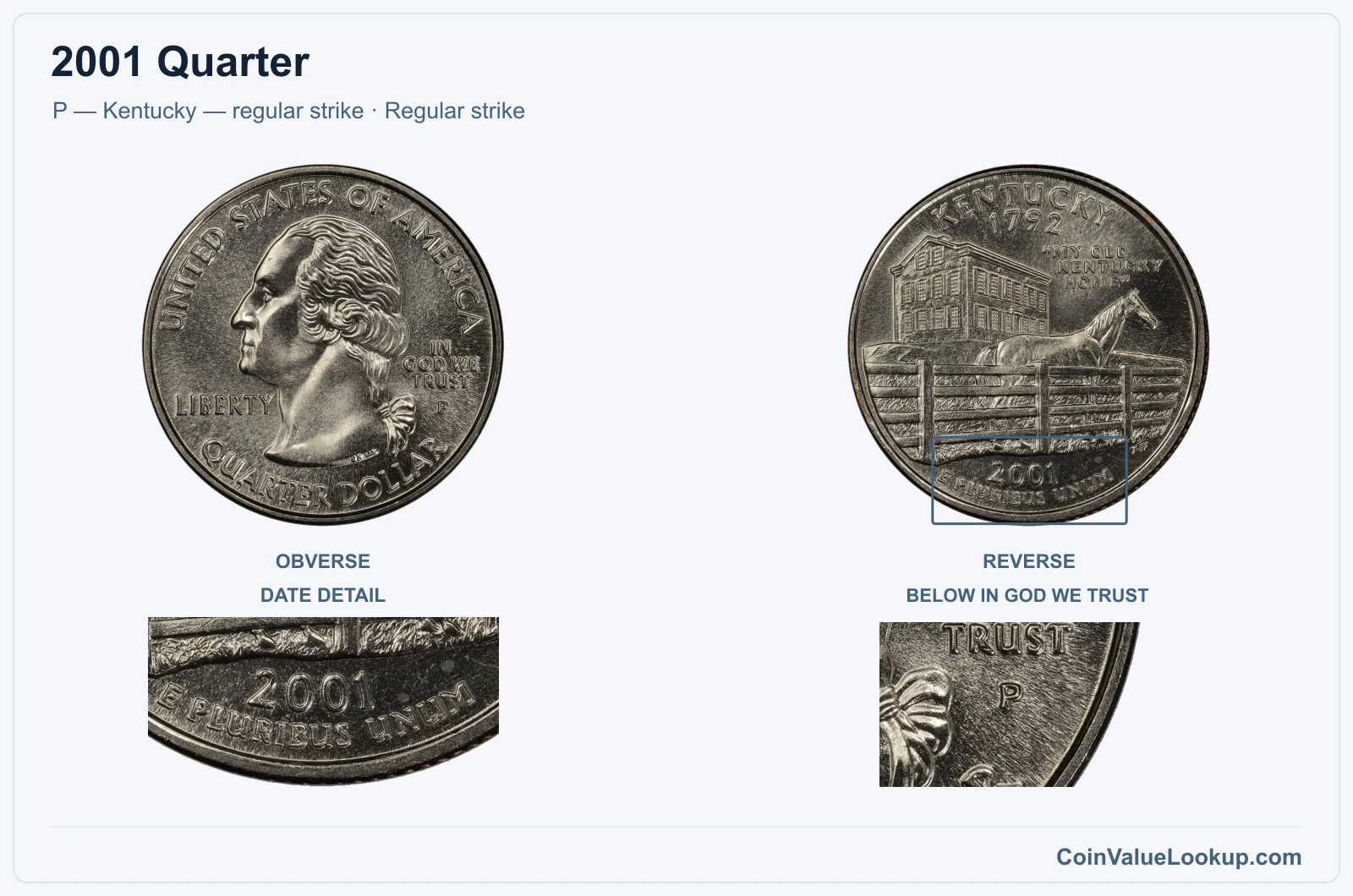
The 2001-P Kentucky quarter carries the horse-and-fence reverse design. Copper-nickel clad, standard 24.26 mm diameter, about 5.67 g.
USA Coin Book lists it at $0.74 at MS60 and $6.25 at MS65 — slightly higher at the gem level than the other four state designs this year. Circulated pieces still trade at face value, but a clean, lustrous MS65 example is a little more desirable.
Range Grade
Price Auction Records Appraisal PO PO 1
—
Coin Identifier FR FR 2
—
Coin Identifier AG AG 3
—
Coin Identifier G G 4
—
Coin Identifier
G 6
—
Coin Identifier VG VG 8
—
Coin Identifier
VG 10
—
Coin Identifier F F 12
—
Coin Identifier
F 15
—
Coin Identifier VF VF 20
—
Coin Identifier
VF 25
—
Coin Identifier
VF 30
—
Coin Identifier
VF 35
—
Coin Identifier XF XF 40
—
Coin Identifier
XF 45
—
Coin Identifier AU AU 50
—
Coin Identifier
AU 53
—
Coin Identifier
AU 55
—
Coin Identifier
AU 58
—
Coin Identifier MS MS 60
—
Coin Identifier
MS 61
—
Coin Identifier
MS 62
—
Coin Identifier
MS 63
—
Coin Identifier
MS 64
—
Coin Identifier
MS 65
—
Coin Identifier
MS 66
Coin Identifier
MS 67
Coin Identifier
MS 68
Coin Identifier
MS 69
Coin Identifier
MS 70
—
—
—
2001 Quarter — D — Kentucky — regular strike
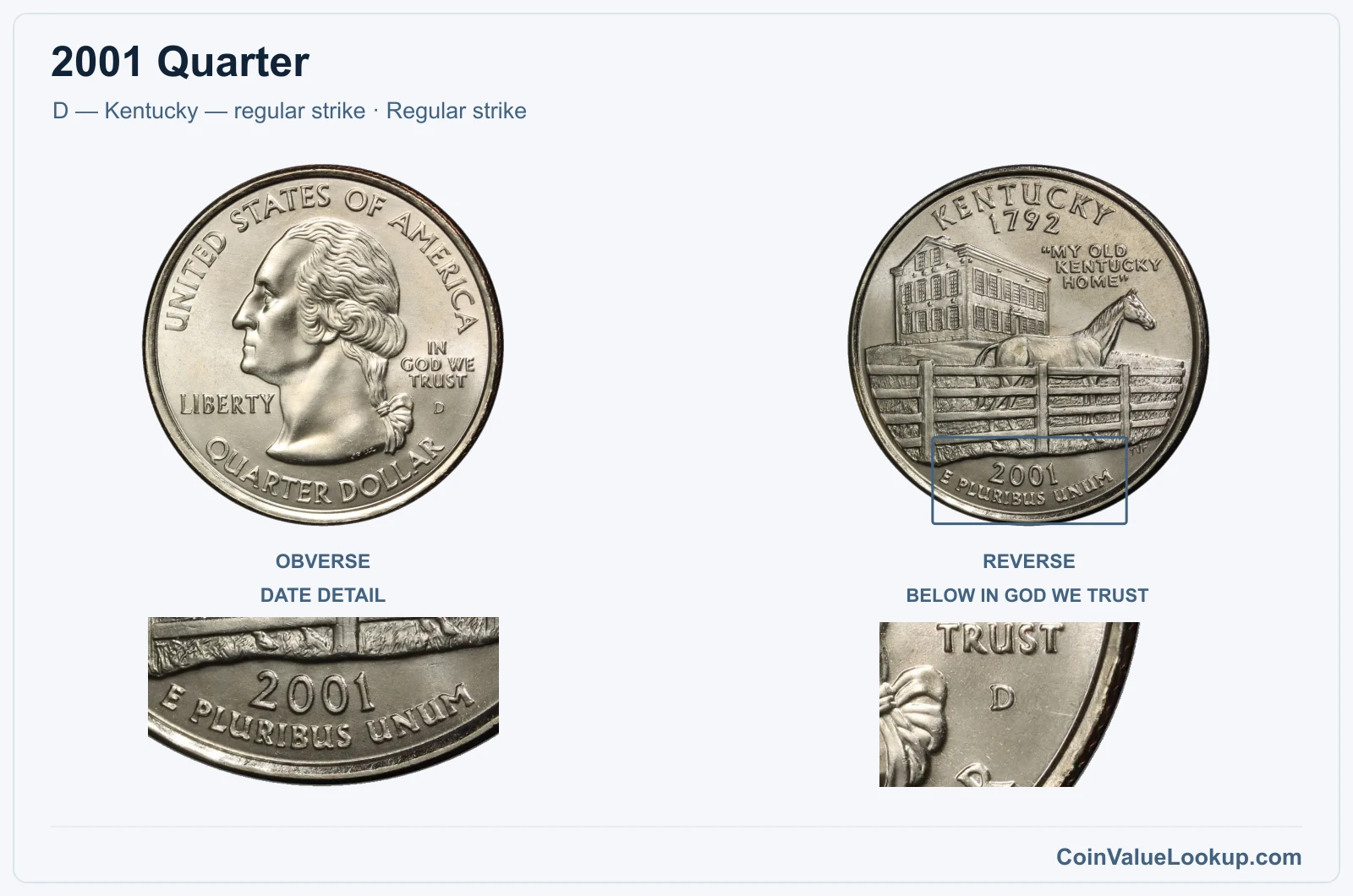
The 2001-D Kentucky quarter matches the P version in design and composition but has a D mintmark. USA Coin Book also lists this one at $0.74 for MS60 and $6.25 for MS65, sharing that small premium over the other reverses at the gem grade.
Worn coins are worth 25 cents. Focus on luster and the absence of bag marks when evaluating higher-grade examples.
Range Grade
Price Auction Records Appraisal PO PO 1
—
Coin Identifier FR FR 2
—
Coin Identifier AG AG 3
—
Coin Identifier G G 4
—
Coin Identifier
G 6
—
Coin Identifier VG VG 8
—
Coin Identifier
VG 10
—
Coin Identifier F F 12
—
Coin Identifier
F 15
—
Coin Identifier VF VF 20
—
Coin Identifier
VF 25
—
Coin Identifier
VF 30
—
Coin Identifier
VF 35
—
Coin Identifier XF XF 40
—
Coin Identifier
XF 45
—
Coin Identifier AU AU 50
—
Coin Identifier
AU 53
—
Coin Identifier
AU 55
—
Coin Identifier
AU 58
—
Coin Identifier MS MS 60
—
Coin Identifier
MS 61
—
Coin Identifier
MS 62
—
Coin Identifier
MS 63
—
Coin Identifier
MS 64
—
Coin Identifier
MS 65
—
Coin Identifier
MS 66
Coin Identifier
MS 67
Coin Identifier
MS 68
Coin Identifier
MS 69
—
—
—
MS 70
—
—
—
2001 Quarter — S — Kentucky — clad proof
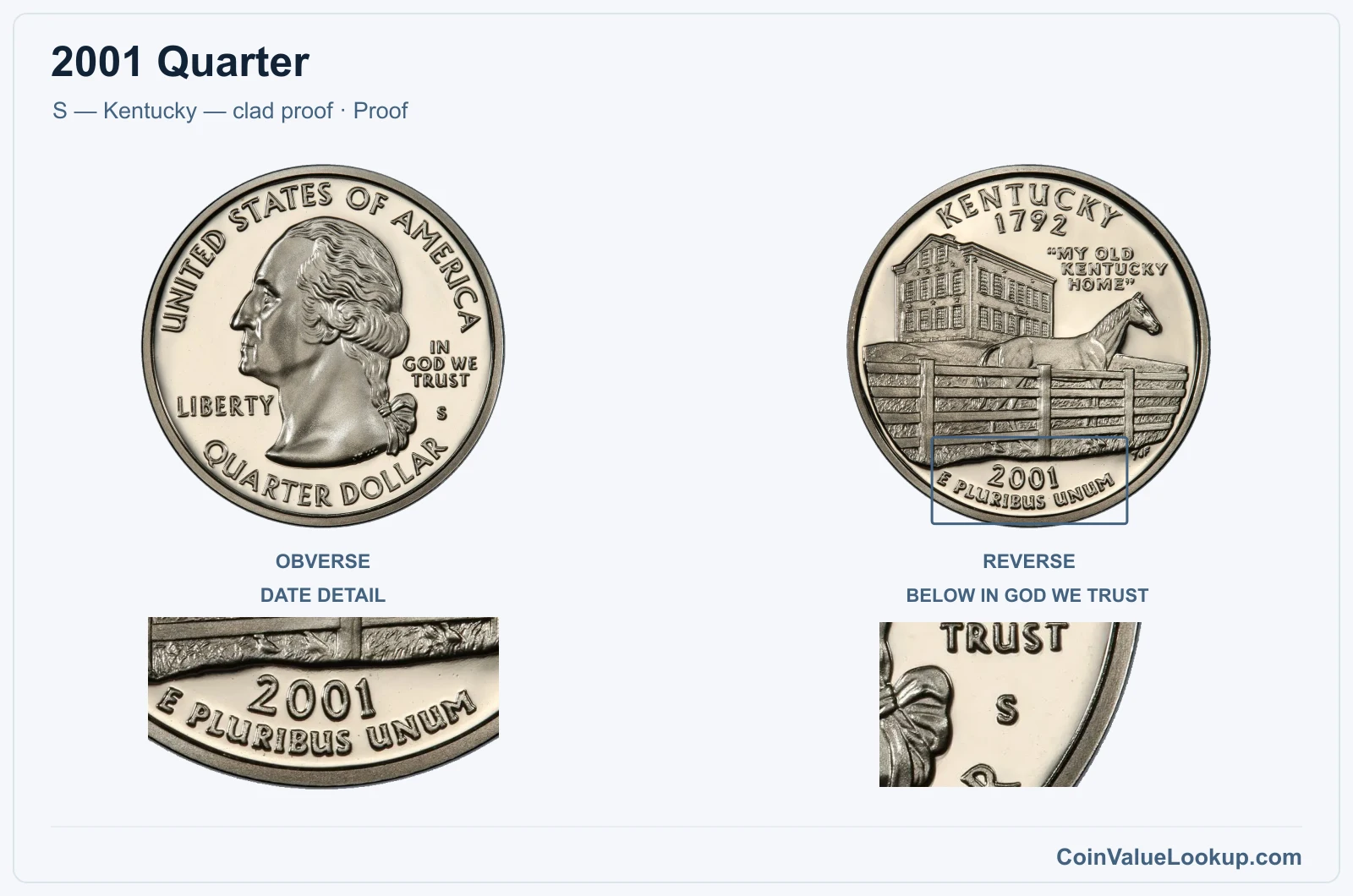
The 2001-S Kentucky clad proof is a collector strike on a copper-nickel clad blank. It displays the standard proof finish of mirror fields and frosted raised design.
USA Coin Book estimates about $10.00 at PR65. As with all the S-mint issues, the edge or weight will separate this from its silver sibling.
Most examples grade well because they came in protective sets.
Range Grade
Price Auction Records Appraisal PR PR 1
—
Coin Identifier
PR 2
—
Coin Identifier
PR 3
—
Coin Identifier
PR 4
—
Coin Identifier
PR 6
—
Coin Identifier
PR 8
—
Coin Identifier
PR 10
—
Coin Identifier
PR 12
—
Coin Identifier
PR 15
—
Coin Identifier
PR 20
—
Coin Identifier
PR 25
—
Coin Identifier
PR 30
—
Coin Identifier
PR 35
—
Coin Identifier
PR 40
—
Coin Identifier
PR 45
—
Coin Identifier
PR 50
—
Coin Identifier
PR 53
—
Coin Identifier
PR 55
—
Coin Identifier
PR 58
—
Coin Identifier
PR 60
—
Coin Identifier
PR 61
—
Coin Identifier
PR 62
—
Coin Identifier
PR 63
—
Coin Identifier
PR 64
—
Coin Identifier
PR 65
—
Coin Identifier
PR 66
—
Coin Identifier
PR 67
—
Coin Identifier
PR 68
Coin Identifier
PR 69
Coin Identifier
PR 70
Coin Identifier
2001 Quarter — S — Kentucky — silver proof
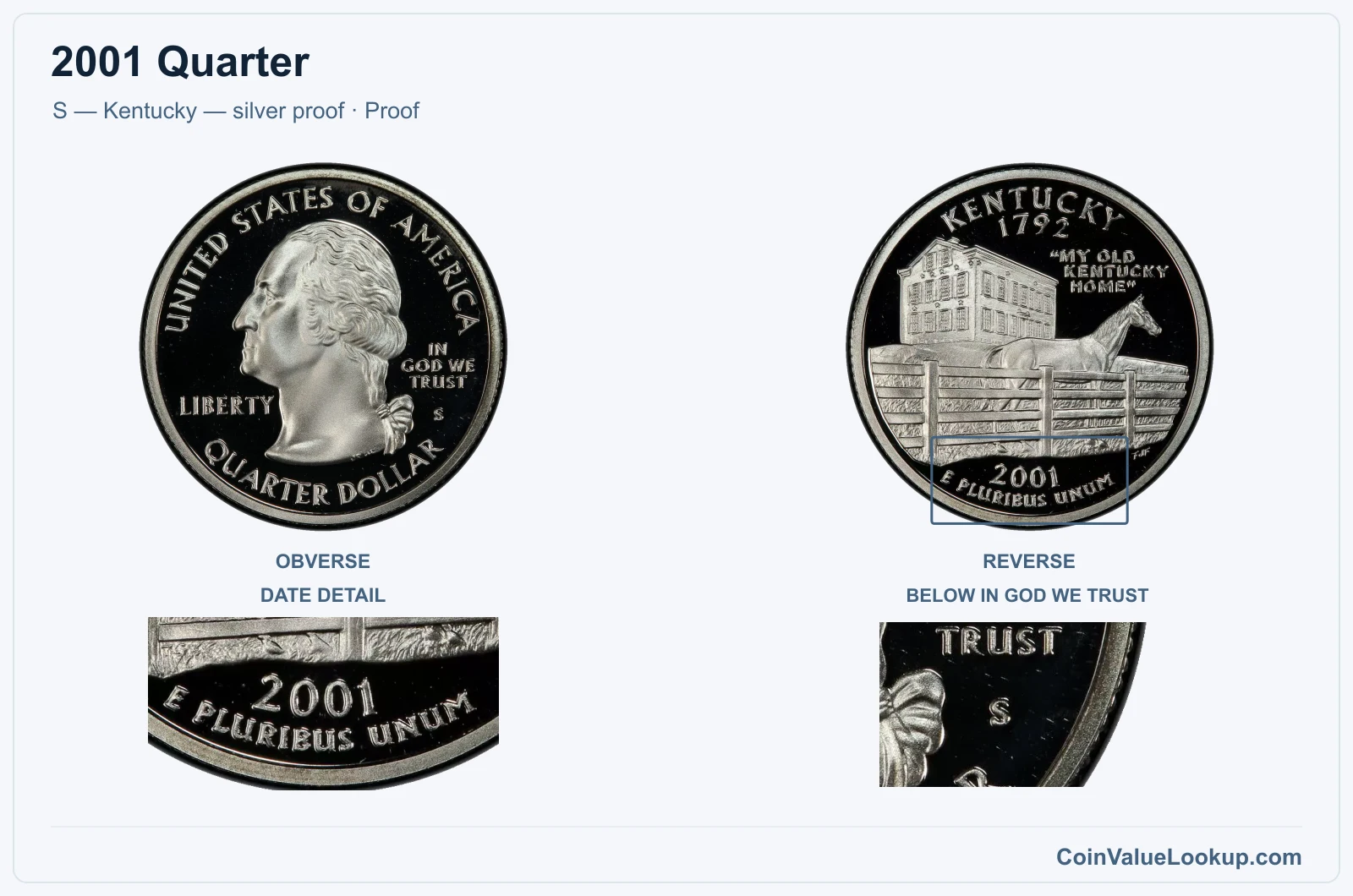
The 2001-S Kentucky silver proof rounds out the year's lineup. It is 90% silver, about 6.25 g, and USA Coin Book estimates $28.00 at PR65.
The silver proofs from 2001 are struck from 90% silver blanks, and the edge will lack any copper stripe. Condition drives the grade — look for clean mirror fields without haze, hairlines or spots before assuming PR65.
Range Grade
Price Auction Records Appraisal PR PR 1
—
Coin Identifier
PR 2
—
Coin Identifier
PR 3
—
Coin Identifier
PR 4
—
Coin Identifier
PR 6
—
Coin Identifier
PR 8
—
Coin Identifier
PR 10
—
Coin Identifier
PR 12
—
Coin Identifier
PR 15
—
Coin Identifier
PR 20
—
Coin Identifier
PR 25
—
Coin Identifier
PR 30
—
Coin Identifier
PR 35
—
Coin Identifier
PR 40
—
Coin Identifier
PR 45
—
Coin Identifier
PR 50
—
Coin Identifier
PR 53
—
Coin Identifier
PR 55
—
Coin Identifier
PR 58
—
Coin Identifier
PR 60
—
Coin Identifier
PR 61
—
Coin Identifier
PR 62
—
Coin Identifier
PR 63
—
Coin Identifier
PR 64
—
Coin Identifier
PR 65
—
Coin Identifier
PR 66
—
Coin Identifier
PR 67
—
Coin Identifier
PR 68
Coin Identifier
PR 69
Coin Identifier
PR 70
Coin Identifier
2001 Quarter Error List
1. 2001 Quarter — Clashed Dies
Clashed dies occur when the obverse and reverse dies strike each other without a planchet between them. The impact transfers faint traces of each die's design onto the other.
On a 2001 quarter, you would see ghostly outlines of the reverse design in the obverse fields, or vice versa — elements that do not belong on that side of the coin. These traces line up consistently with the expected opposing design, which separates them from random scratches or raised lines.
A brockage — where a struck coin acts as a die — produces a different pattern. Value depends on how visible the clash is, the coin's condition and the specific mint and reverse involved.
No standard guide price applies.
2. 2001 Quarter — New York — Off-Center Strike
An off-center 2001 New York quarter was not properly centered between the dies during striking. The result is a displaced design with a blank crescent where part of the coin received no impression.
The more dramatic the shift, the more desirable the error — provided the date remains visible, which is generally a baseline collectors want. Do not confuse this with a clipped planchet, where the blank itself is incomplete, or with a die misalignment that only shifts one side.
Post-mint damage from a vise or hammer can flatten an edge but will not produce the matching blank crescent. Value depends on the percentage off-center and overall condition.
3. 2001 Quarter — New York — Double / Multiple Strike
A double-struck 2001 New York quarter received two or more impressions from the dies, with the coin shifting or rotating between strikes. You will see separate, overlapping design images rather than the subtle letter thickening of a doubled die.
The second impression is typically displaced or rotated relative to the first. Look at the relationship between the two images — a genuine double strike shows a complete second impression, not just slightly spread lettering.
Impressions added after leaving the mint, such as from a vice or press, lack the characteristic die sharpness. Value varies with the visibility, rotation and the coin's overall condition.
4. 2001 Quarter — New York — Clipped Planchet
A clipped planchet error on a 2001 New York quarter means the blank was incomplete before striking. The missing section can be curved (from overlapping punches in the blanking process), straight or ragged.
A genuine clip often shows a weakness in the design opposite the missing area, called the Blakesley effect, where metal flow was insufficient. The edge at the clip will have a different texture than the normal reeded edge.
Compare carefully to a filed notch or corroded edge — post-mint damage lacks the matching design weakness and flow characteristics. The size and shape of the clip, plus the coin's grade, determine collector interest.
5. 2001 Quarter — New York — Struck-Through Error
A struck-through error on a 2001 New York quarter shows a localized depression or incomplete design area where something — grease, a thread, a metal fragment — sat between the die and the planchet during striking. Grease-filled dies typically produce a smooth, featureless patch, while a retained foreign object can leave a distinctive impression.
The affected area is depressed into the coin's surface, not scratched across it. Ordinary wear, cleaning marks or a weak strike can mimic the look, but those affect broad areas uniformly rather than creating a sharply defined obstruction pattern.
Value depends on the size, clarity and type of obstruction involved.
6. 2001 Quarter — Vermont — Doubled Die Obverse
A doubled die obverse has been reported on 2001 Vermont quarters, with the area near Washington's ear being a known checkpoint. On a genuine doubled die, you will see consistent separation or notching in the design elements — not a flat, shelf-like spread.
Compare the suspected area to a normal 2001 Vermont quarter under the same lighting. Machine doubling, which is mechanical and has no collector premium, tends to produce a flat shelf with reduced sharpness, whereas a true doubled die retains full detail in both images.
Light reflections can also fool you. Condition and the strength of the doubling affect collector interest; no standard guide price is established.
7. 2001 Quarter — North Carolina — Doubled Die Obverse
A doubled die obverse error has been reported on 2001 North Carolina quarters. The diagnostic is consistent separation or notching visible in obverse design elements — lettering, the date or portrait details — that repeats across the affected area.
Compare your coin to a normal example under the same light and angle. True die doubling preserves full sharpness in both images, while machine doubling creates a flat, mushy shelf.
Reflections and toning lines can mimic doubling to the untrained eye, so take your time. Value depends on where the doubling appears, how strong it is and the coin's overall condition.
8. 2001 Quarter — North Carolina — Die Crack / Die Chip
Die cracks and die chips have been reported on 2001 North Carolina quarters. A die crack shows up on the coin as a thin raised line running across the design or field — it is raised because the crack in the die is recessed.
A die chip appears as a small raised blob, often inside a letter or near a design element. These are different from incuse scratches, which are pressed into the surface, or corrosion bumps, which lack the sharp definition of a die-produced feature.
If the raised line runs from the design to the rim, it may be a more significant break. Value depends on length, location and visibility.
9. 2001 Quarter — North Carolina — Off-Center Strike
Off-center strikes have been reported on 2001 North Carolina quarters. The misalignment between the planchet and dies produces a crescent-shaped blank area along one edge, with the full design shifted away from center.
Collectors prefer examples where the date and mintmark remain fully visible despite the shift. A small percentage off-center may be barely noticeable; larger shifts are more dramatic and typically more desirable.
Do not confuse this with a clipped planchet, where the blank was incomplete, or with post-mint flattening from a vise. The unstruck crescent on a genuine off-center coin has a smooth, unimpressed surface.
10. 2001 Quarter — Lamination / Split Planchet
Lamination and split planchet errors have been reported on 2001 quarters. These show up as peeling metal, a retained flap or visible separation within the coin's layers.
On a clad quarter, the separation might occur between the outer cladding and the inner layer, or within the metal itself. Photograph both the affected face and the edge together — the edge view is often the most telling.
Distinguish this from post-mint scraping, corrosion or a coin that has been deliberately cut. Genuine lamination flaws have a natural, irregular boundary and the underlying metal shows the expected color.
Value depends on size, visibility and condition.
11. 2001 Quarter — Vermont — Die Crack / Die Chip
Die cracks and die chips have been reported on 2001 Vermont quarters. On the coin, a die crack appears as a fine raised line, while a die chip looks like a small raised lump — both caused by damage to the die itself.
An interior chip stays within the design or field. If the raised feature connects to the rim, it may qualify as a more significant die break.
Incuse scratches (pressed into the surface) and foreign material stuck to the coin can look similar at first glance but behave differently under magnification. Value varies with the prominence and location of the crack.
12. 2001 Quarter — Vermont — Die Break / Cud
A die break or cud has been reported on 2001 Vermont quarters. A cud forms when a piece of the die breaks away, leaving a raised, featureless lump on the coin that connects to the rim.
The area it covers will lack normal design detail. This is different from an interior die chip, which sits within the field and is usually much smaller.
A rim dent from post-mint damage is depressed, not raised, and corrosion creates irregular texture rather than a smooth, die-produced blob. Value depends on the size and position of the cud and the coin's overall condition.
13. 2001 Quarter — Vermont — Double / Multiple Strike
Double or multiple strikes have been reported on 2001 Vermont quarters. A genuine double strike means the coin was hit by the dies more than once, with the coin shifting between impressions.
You will see two distinct, overlapping sets of design elements — not just thickened lettering. The rotation or displacement between strikes is usually obvious.
Compare this to a doubled die, which is a die manufacturing issue and produces much subtler, consistent doubling. Post-mint impressions from a vise or press can mimic a second strike but lack proper die detail.
Condition, degree of displacement and visual impact all affect value.
14. 2001 Quarter — Kentucky — Off-Center Strike
Off-center strikes have been reported on 2001 Kentucky quarters. The design is shifted, leaving a blank crescent along one edge.
The greater the percentage off-center, the more dramatic the appearance — but collectors strongly prefer that the date and mintmark remain readable. A clipped planchet error involves an incomplete blank, not a shifted strike, so examine whether the missing area was ever part of the planchet.
Post-mint flattening from external pressure lacks the characteristic unstruck crescent. Value depends on the shift percentage, date visibility and overall grade of the coin.
15. 2001 Quarter — Kentucky — Broadstrike
Broadstrike errors have been reported on 2001 Kentucky quarters. A broadstruck coin was struck without the retaining collar that normally confines the planchet to its proper diameter.
The result is a coin that spreads outward, appearing slightly larger than normal with a missing or distorted reeded edge. The full design is still present, just expanded.
This separates a broadstrike from an off-center strike, where part of the design is missing entirely. A coin flattened after minting by a roller or vise will show damage to the surface and lack the even metal flow of a genuine broadstrike.
Condition and the degree of expansion affect value.
16. 2001 Quarter — Kentucky — Die Crack / Die Chip
Die cracks and die chips have been reported on 2001 Kentucky quarters. A crack shows as a raised line on the coin's surface — thin, often running between design elements or from the rim inward.
A chip is a small raised blob, typically found inside a letter or near fine details. Both are die-damage features, meaning they are raised on the coin rather than incised into it.
That distinction separates them from scratches (incuse) and corrosion (irregular, often discolored). Location and size matter: a long crack crossing a major design element draws more collector attention than a tiny chip inside a letter.
17. 2001 Quarter — Kentucky — Die Break / Cud
Die breaks, sometimes called cuds, have been reported on 2001 Kentucky quarters. A cud is a raised, flat, featureless area along the rim where a chunk of the die broke off.
The displaced design in that zone is simply gone, replaced by a smooth lump of metal. Compare this to a rim dent, which is depressed and shows tool marks, or to an interior die chip, which is smaller and sits away from the rim.
Corrosion can also create raised bumps but will look irregular and discolored under magnification. Value depends on the cud's size, location and the coin's condition.
18. 2001 Quarter — Kentucky — Doubled Die
A doubled die error has been reported on 2001 Kentucky quarters. On a genuine doubled die, you will find consistent separation or notching in the affected design elements — lettering, numerals or parts of the design — that repeats in the same direction across the coin.
Compare your coin to a normal example under the same lighting. Machine doubling, which carries no premium, creates a flat, shelf-like spread with reduced sharpness.
Reflections and post-mint impressions can also trick the eye. Keep the specific mint and die details unspecified unless confirmed.
Visibility, location and condition all influence collector interest.
19. 2001 Quarter — New York — Broadstrike
Broadstrike errors have been reported on 2001 New York quarters. A broadstruck coin escaped the retaining collar during striking, so the metal spread outward beyond the normal 24.26 mm diameter.
The design remains complete but appears expanded, and the edge lacks proper reeding. This is distinct from an off-center strike, where the design itself shifts and leaves a blank crescent.
A coin flattened by external force after minting will show surface damage — tool marks, scratches — that a genuine broadstrike does not have. Value depends on the degree of expansion, edge profile and overall condition of the piece.
20. 2001 Quarter — Rhode Island — Missing Clad Layer
A missing clad layer error has been reported on the 2001-P Rhode Island quarter specifically. On a normal clad quarter, copper-nickel outer layers sandwich an inner layer.
When one of those outer layers is absent, the exposed face may show a distinctly different color or texture, and the coin will weigh less than the standard 5.67 g. Check the edge — a missing clad layer is usually visible as an asymmetry in the edge sandwich.
Toning, environmental damage and coins where someone has stripped or sanded a surface after minting can look similar but lack the corresponding weight difference. Value depends on which side is affected, the degree of the missing layer and overall condition.
21. 2001 Quarter — Rhode Island — Improper Annealing
Improper annealing has been reported on 2001 Rhode Island quarters. Annealing is a heat treatment applied to blanks before striking.
When that process goes wrong, the resulting coin can display unusual surface discoloration, a woody or streaky texture, or uneven toning that does not match normal wear patterns. These surface differences are a screening clue, not definitive proof of the cause — environmental toning, corrosion and exposure to heat after minting can produce similar appearances.
Compare the affected coin's edge and surfaces to a normal example. Value depends on how distinctive the annealing defect is and the coin's overall condition.
22. 2001 Quarter — Rhode Island — Struck-Through Error
Struck-through errors have been reported on 2001 Rhode Island quarters. A struck-through coin has a localized depression or incomplete design area where foreign material — grease, a fiber, a metal chip — was trapped between the die and the planchet during striking.
Grease fills tend to create a smooth blank patch, while a retained foreign object can leave a textured or shaped impression. The key diagnostic is that the affected area is depressed or obstructed rather than scratched or worn.
Ordinary wear, cleaning or a weak strike affect larger areas more uniformly. Value depends on the type of obstruction, clarity of the impression and the coin's overall condition.