2005 Quarter Coin Value: How Much Is It Worth?
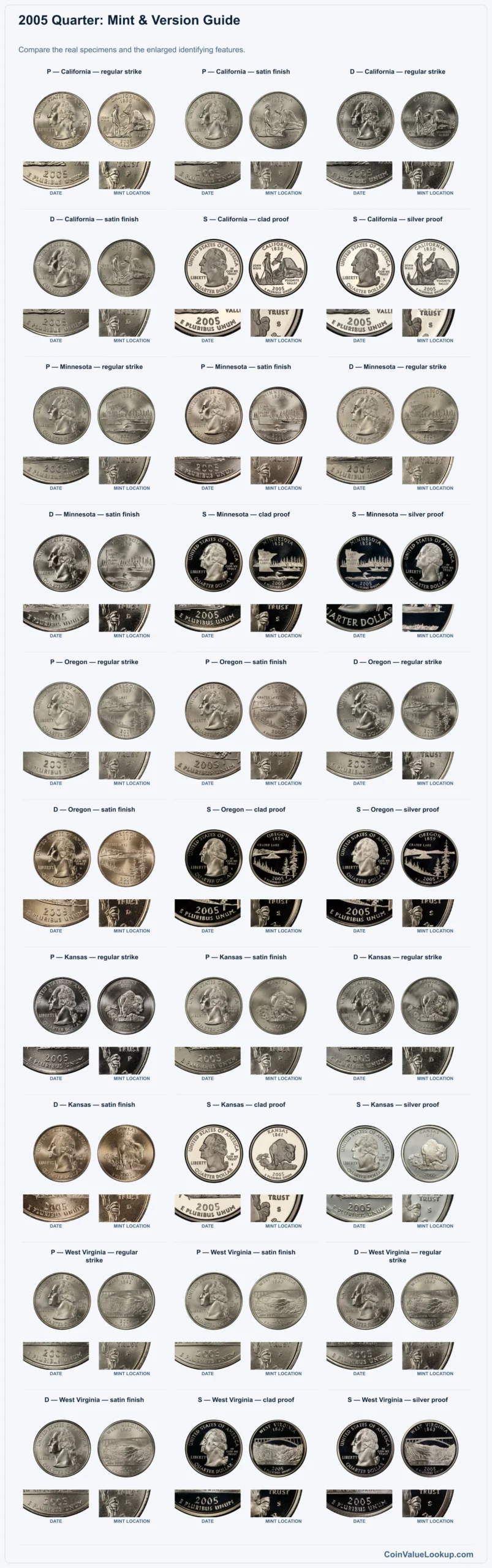
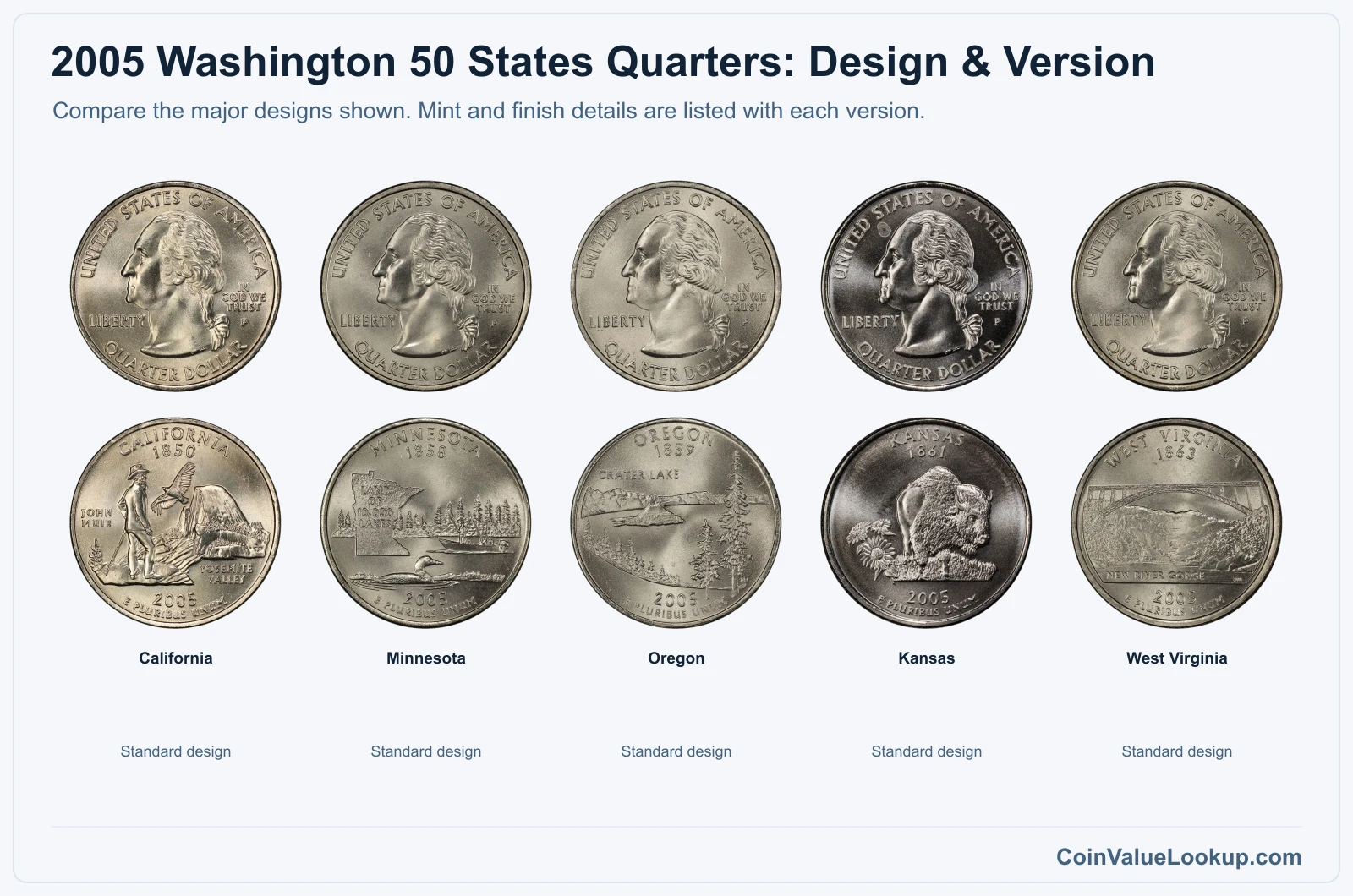
The 2005 Washington 50 States Quarters came in five reverse designs — California, Minnesota, Oregon, Kansas and West Virginia — each struck at up to three mints in several finishes. Guide estimates for these quarters range from about $0.49 at MS60 for a regular business strike up to $23.00 for a silver proof at PR65, depending on the specific mint, reverse design, composition and condition of your coin.
Fast Way to Identify Your 2005 Quarter
The quickest way to start figuring out what your 2005 quarter is worth is to upload clear photos of both sides. A front shot shows the mintmark and date, while the back reveals which state design you have.
From those two images we can offer a preliminary identification of the version and finish, which points you toward the right part of the value guide.
2005 Quarter Value
Upload both sides of your 2005 Quarter.
Front Obverse
Upload photo
Back Reverse
Upload photo
Which 2005 Quarter Versions Are Worth Money?
- The S-mint silver proofs for West Virginia, Oregon and Minnesota each carry a guide estimate of $23.00 at PR65, the highest among 2005 quarter versions listed here.
- Satin-finish quarters from P and D mints (all five state designs) are distinct collectible versions that require individual assessment — they are not ordinary circulation strikes.
- Clad proofs from San Francisco carry a PR65 guide estimate of $5.63 across all five designs, well above face value.
- Several reported error types — doubled dies, off-center strikes, grease fills and die breaks — can add significant collector interest beyond the base version value.
Step 1: Identify Your 2005 Quarter Mint Mark and Version
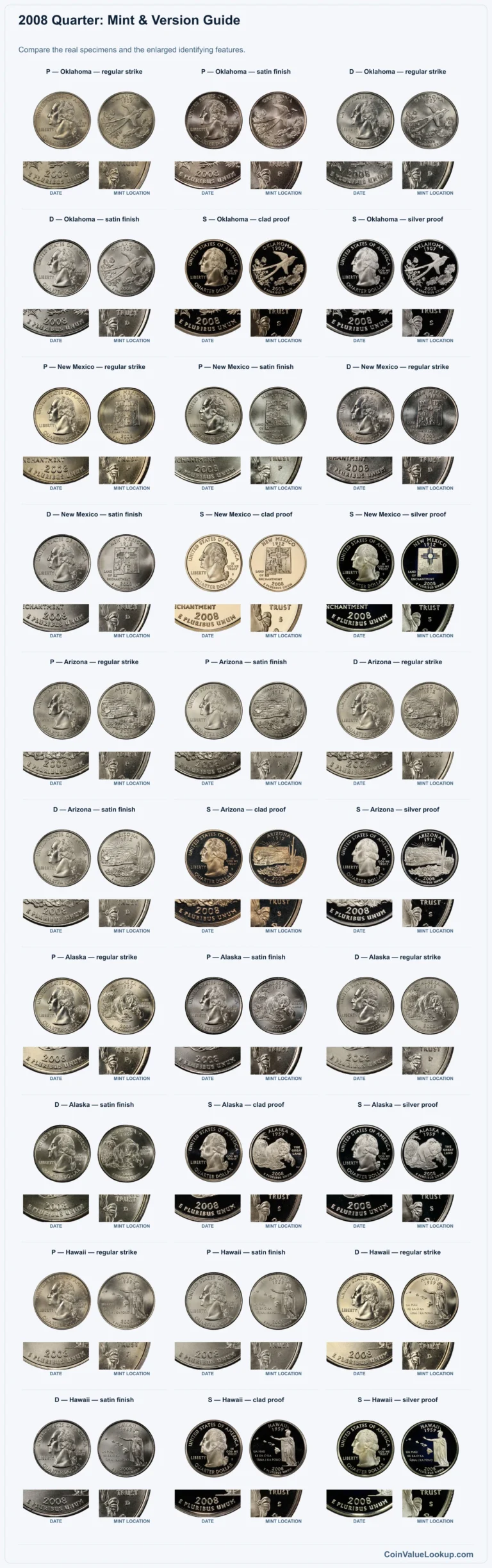
Start with the obverse. Look near Washington's portrait for a small letter: P means Philadelphia, D means Denver, and S means San Francisco.
No mintmark at all on a 2005 quarter still means Philadelphia — but check carefully, because the letter is small.
Next, flip it over. The reverse tells you which of the five state designs you have: California, Minnesota, Oregon, Kansas or West Virginia.
Each state paired with each mint is its own version with its own value line.
Composition matters too. Regular circulation strikes and clad proofs are copper-nickel clad over a copper core, weighing about 5.67 grams.
Silver proofs — only from San Francisco — are 90% silver and tip the scale at roughly 6.25 grams. Check the edge: a clad coin shows a visible copper-colored stripe, while a silver proof edge is uniformly silver-colored.
Do not rely on surface color alone.
Satin-finish coins came in 2005 Uncirculated Mint Sets and have a distinctive soft, even texture across the entire surface. They are separate from ordinary business strikes.
A dull or cleaned coin does not qualify, and a proof's mirror-like field is a different finish entirely. A mintmark or finish by itself is not an error — these are intentional production variants.
Step 2: Check Your 2005 Quarter Grade
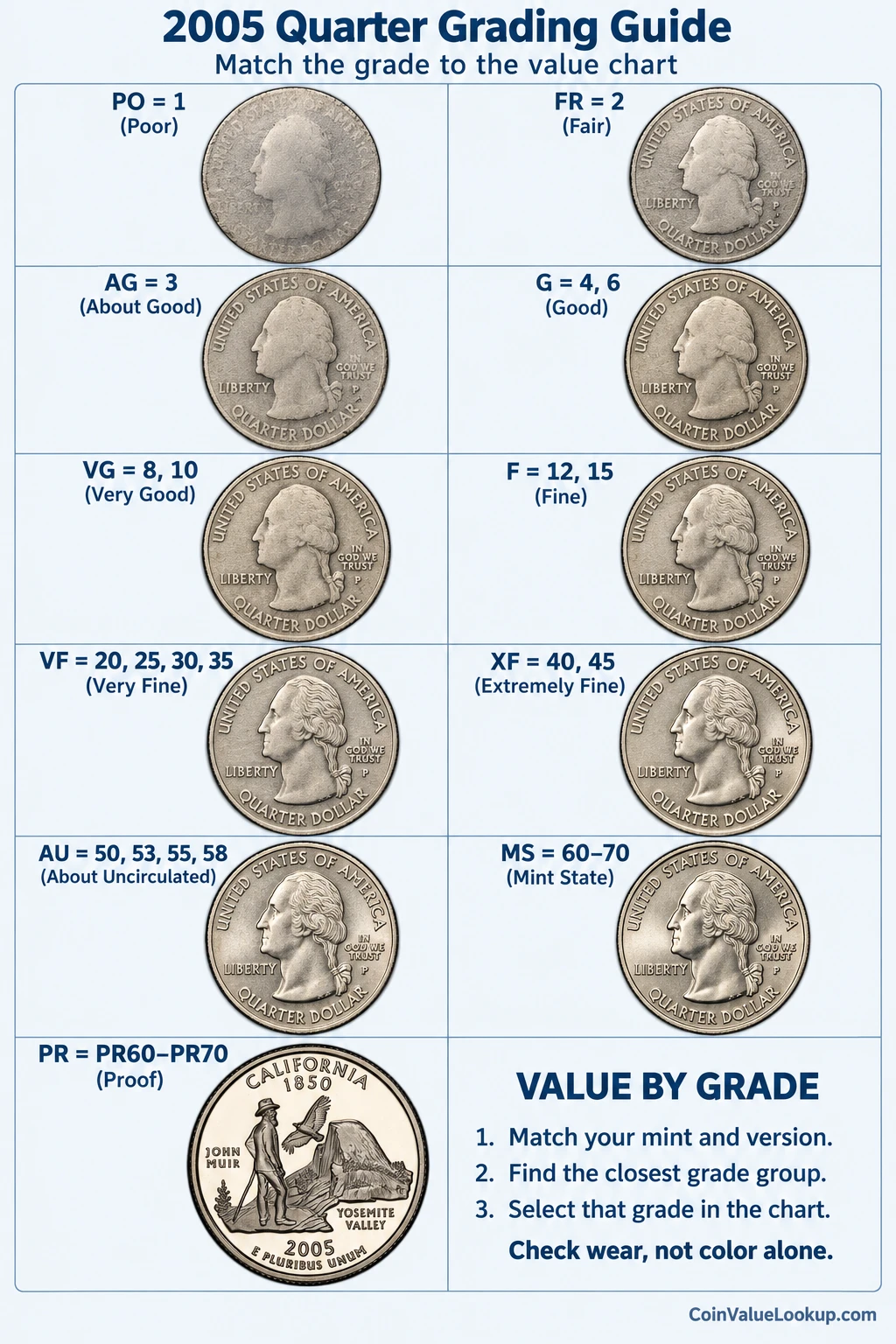
Focus on Washington's cheek and the hair detail above his ear when judging the obverse. These are the first spots to soften with wear.
On the reverse, check the highest-relief areas of whichever state design you have.
Luster is just as important as detail. A coin can have sharp design elements but show dull, washed-out surfaces from cleaning — that hurts the grade.
Compare your coin to the reference image to see how original mint luster should look at various levels of preservation.
For proofs, look at the mirror fields under good light. Hairlines — fine parallel scratches from wiping or improper storage — and milky haze both drag a proof grade down.
A weak strike can also reduce detail on a coin that has never circulated, so do not assume every soft area is from wear.
Step 3: Check 2005 Quarter Value by Mint and Version
2005 Quarter — P — California — regular strike
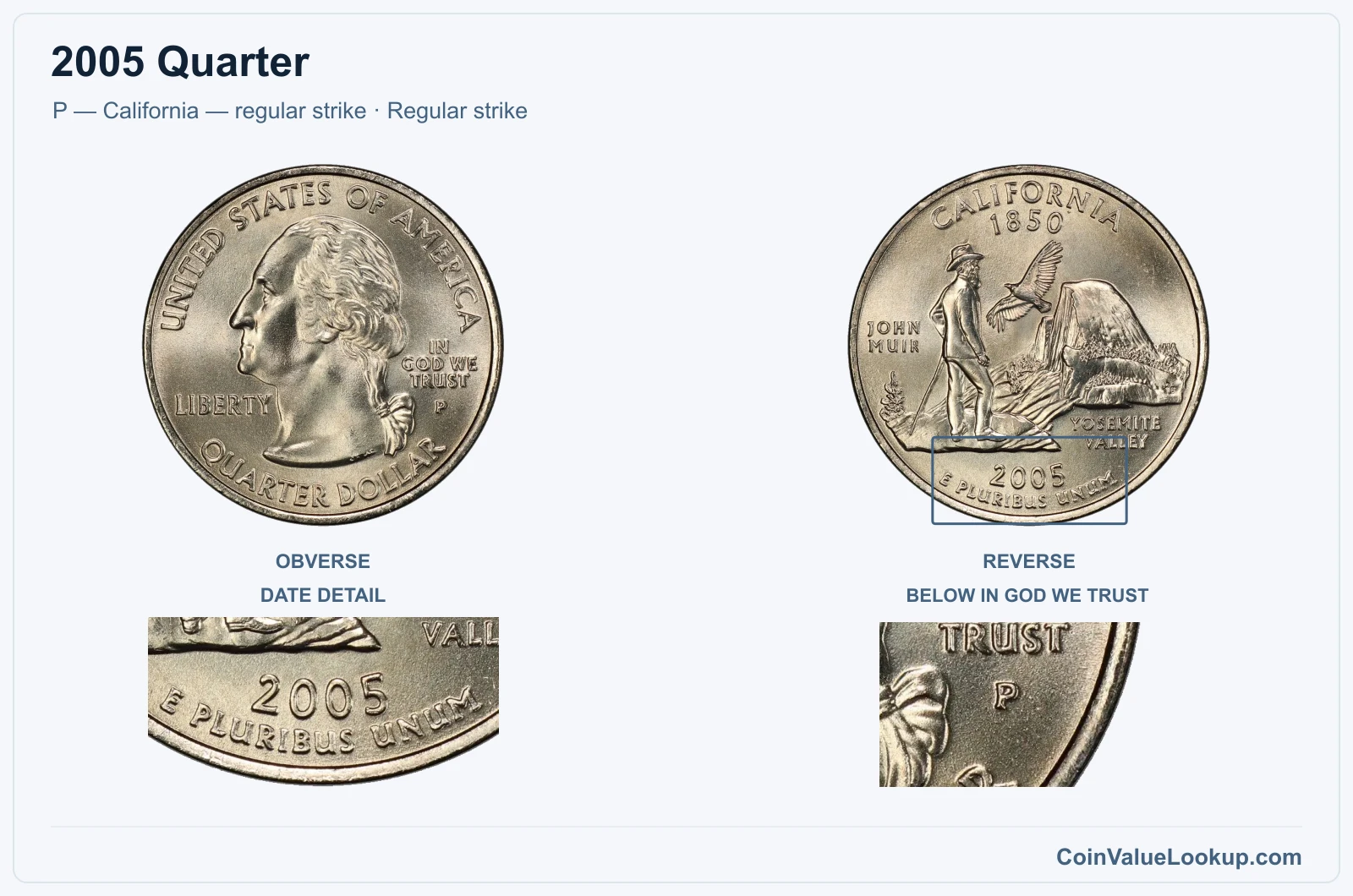
This is the standard Philadelphia-mint California quarter you would have pulled from pocket change. It is copper-nickel clad, 24.26 mm in diameter and weighs about 5.67 grams.
Worn examples trade near face value. In uncirculated condition, USA Coin Book estimates about $0.49 at MS60 and $6.25 at MS65.
Make sure you confirm the California reverse and the P mintmark before comparing grades — the other four state designs have separate value lines.
Range Grade
Price Auction Records Appraisal PO PO 1
—
Coin Identifier FR FR 2
—
Coin Identifier AG AG 3
—
Coin Identifier G G 4
—
Coin Identifier
G 6
—
Coin Identifier VG VG 8
—
Coin Identifier
VG 10
—
Coin Identifier F F 12
—
Coin Identifier
F 15
—
Coin Identifier VF VF 20
—
Coin Identifier
VF 25
—
Coin Identifier
VF 30
—
Coin Identifier
VF 35
—
Coin Identifier XF XF 40
—
Coin Identifier
XF 45
—
Coin Identifier AU AU 50
—
Coin Identifier
AU 53
—
Coin Identifier
AU 55
—
Coin Identifier
AU 58
—
Coin Identifier MS MS 60
—
Coin Identifier
MS 61
—
Coin Identifier
MS 62
—
Coin Identifier
MS 63
—
Coin Identifier
MS 64
—
Coin Identifier
MS 65
—
Coin Identifier
MS 66
—
Coin Identifier
MS 67
Coin Identifier
MS 68
Coin Identifier
MS 69
—
—
—
MS 70
—
—
—
2005 Quarter — P — California — satin finish
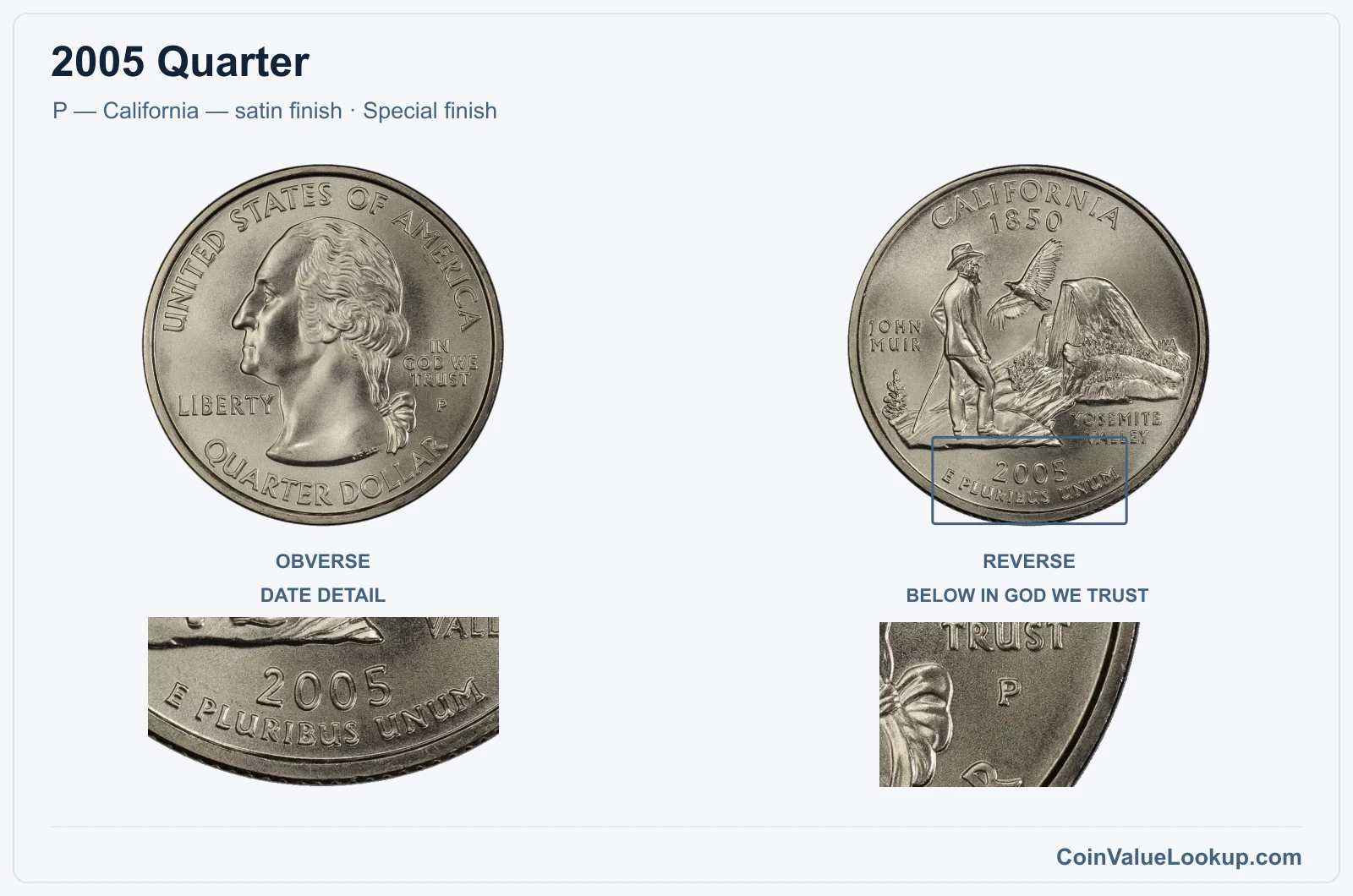
The P-mint California satin finish came exclusively in 2005 Uncirculated Mint Sets. These coins have a distinctive fine-grained texture across both faces that differs from the cartwheel luster of a business strike.
A worn or artificially dulled surface does not count. Because satin-finish quarters occupy a separate category from regular strikes, their value depends on authenticated identity and individual condition rather than the standard business-strike price chart.
If you think you have one, look for the even, matte-like texture that covers the entire coin uniformly.
Range Grade
Price Auction Records Appraisal SP SP 1
—
Coin Identifier
SP 2
—
Coin Identifier
SP 3
—
Coin Identifier
SP 4
—
Coin Identifier
SP 6
—
Coin Identifier
SP 8
—
Coin Identifier
SP 10
—
Coin Identifier
SP 12
—
Coin Identifier
SP 15
—
Coin Identifier
SP 20
—
Coin Identifier
SP 25
—
Coin Identifier
SP 30
—
Coin Identifier
SP 35
—
Coin Identifier
SP 40
—
Coin Identifier
SP 45
—
Coin Identifier
SP 50
—
Coin Identifier
SP 53
—
Coin Identifier
SP 55
—
Coin Identifier
SP 58
—
Coin Identifier
SP 60
—
Coin Identifier
SP 61
—
Coin Identifier
SP 62
—
Coin Identifier
SP 63
—
Coin Identifier
SP 64
—
Coin Identifier
SP 65
—
Coin Identifier
SP 66
—
Coin Identifier
SP 67
Coin Identifier
SP 68
Coin Identifier
SP 69
Coin Identifier
SP 70
Coin Identifier
2005 Quarter — D — California — regular strike
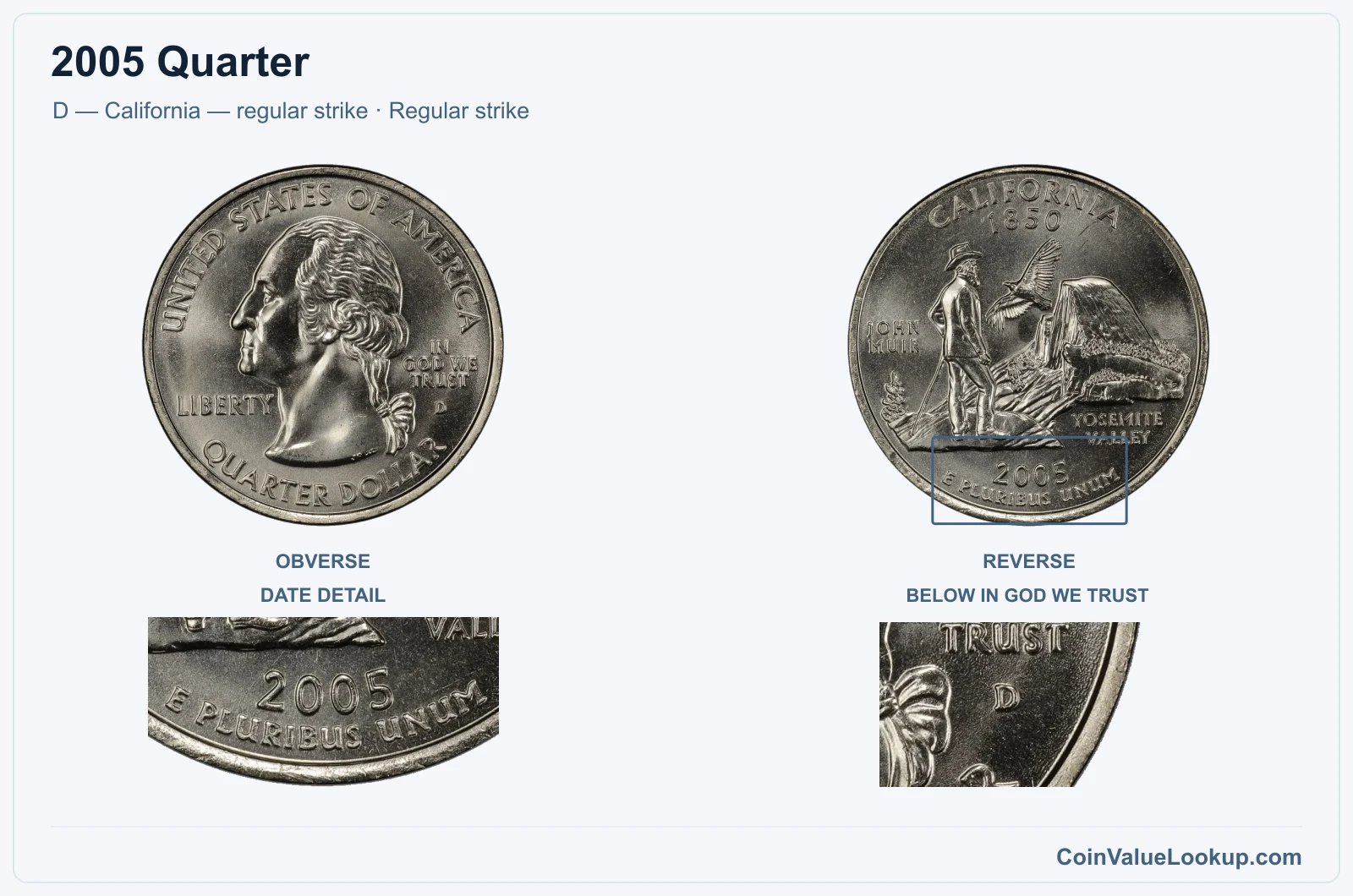
The Denver-mint California quarter is another high-mintage circulation issue. Same copper-nickel clad composition, same 5.67-gram weight, same 24.26 mm diameter.
USA Coin Book pegs it at roughly $0.49 in MS60 and $6.25 in MS65. Circulated pieces are worth face value.
Look for the D mintmark on the obverse to tell it apart from the Philadelphia version, and confirm the California reverse before checking grades.
Range Grade
Price Auction Records Appraisal PO PO 1
—
Coin Identifier FR FR 2
—
Coin Identifier AG AG 3
—
Coin Identifier G G 4
—
Coin Identifier
G 6
—
Coin Identifier VG VG 8
—
Coin Identifier
VG 10
—
Coin Identifier F F 12
—
Coin Identifier
F 15
—
Coin Identifier VF VF 20
—
Coin Identifier
VF 25
—
Coin Identifier
VF 30
—
Coin Identifier
VF 35
—
Coin Identifier XF XF 40
—
Coin Identifier
XF 45
—
Coin Identifier AU AU 50
—
Coin Identifier
AU 53
—
Coin Identifier
AU 55
—
Coin Identifier
AU 58
—
Coin Identifier MS MS 60
—
Coin Identifier
MS 61
—
Coin Identifier
MS 62
—
Coin Identifier
MS 63
—
Coin Identifier
MS 64
—
Coin Identifier
MS 65
—
Coin Identifier
MS 66
—
Coin Identifier
MS 67
Coin Identifier
MS 68
Coin Identifier
MS 69
—
—
—
MS 70
—
—
—
2005 Quarter — D — California — satin finish
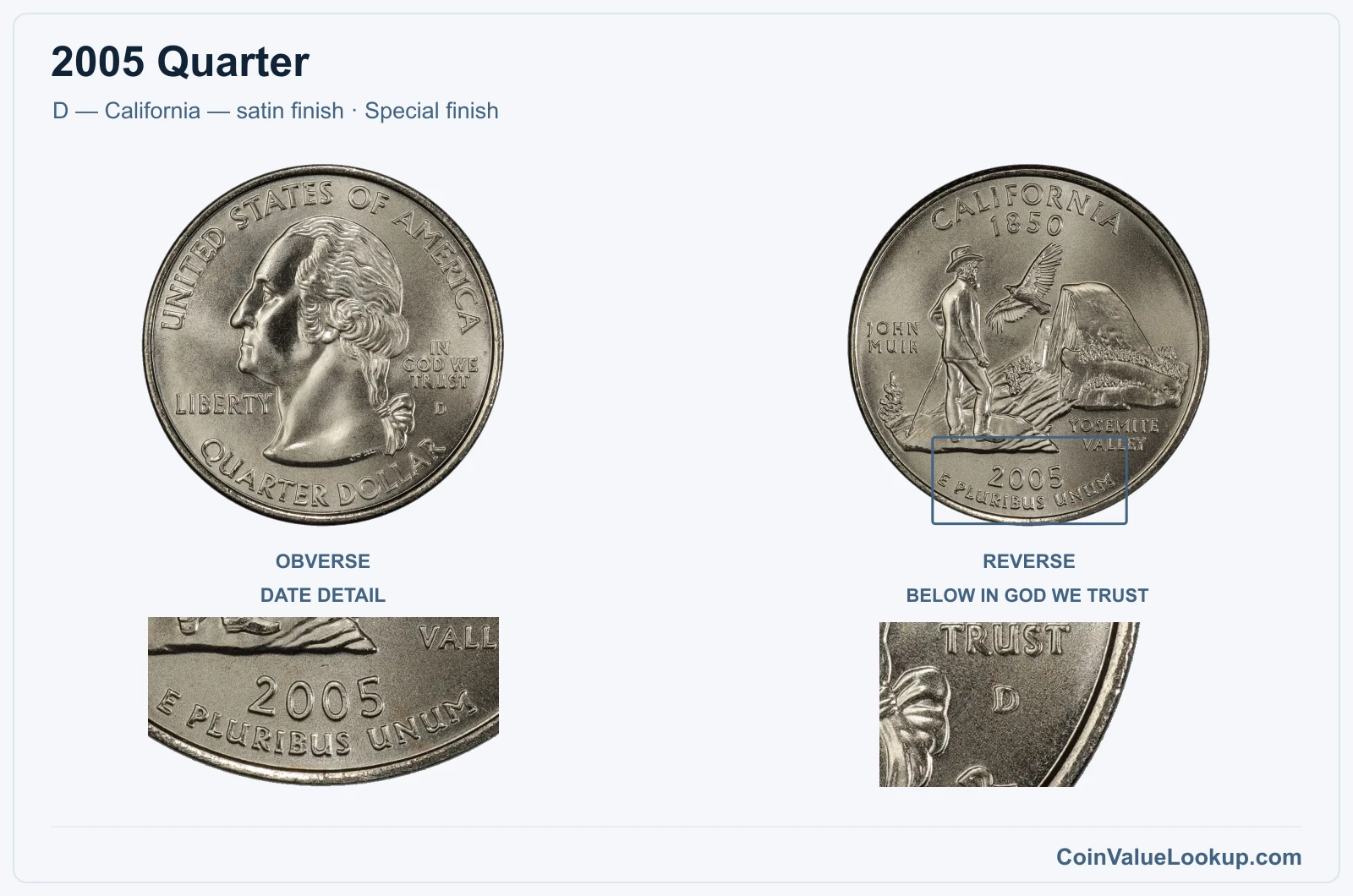
Denver also produced satin-finish California quarters for the 2005 Uncirculated Mint Set. Like their Philadelphia counterpart, these have a soft, even surface texture that is neither proof-like mirror nor ordinary business-strike luster.
An artificially dulled coin is not the same thing. Value for authenticated satin-finish examples depends on the individual coin's condition, and no standard guide price is adopted here.
The D mintmark and the original mint-set packaging help confirm attribution.
Range Grade
Price Auction Records Appraisal SP SP 1
—
Coin Identifier
SP 2
—
Coin Identifier
SP 3
—
Coin Identifier
SP 4
—
Coin Identifier
SP 6
—
Coin Identifier
SP 8
—
Coin Identifier
SP 10
—
Coin Identifier
SP 12
—
Coin Identifier
SP 15
—
Coin Identifier
SP 20
—
Coin Identifier
SP 25
—
Coin Identifier
SP 30
—
Coin Identifier
SP 35
—
Coin Identifier
SP 40
—
Coin Identifier
SP 45
—
Coin Identifier
SP 50
—
Coin Identifier
SP 53
—
Coin Identifier
SP 55
—
Coin Identifier
SP 58
—
Coin Identifier
SP 60
—
Coin Identifier
SP 61
—
Coin Identifier
SP 62
—
Coin Identifier
SP 63
—
Coin Identifier
SP 64
—
Coin Identifier
SP 65
—
Coin Identifier
SP 66
Coin Identifier
SP 67
Coin Identifier
SP 68
Coin Identifier
SP 69
Coin Identifier
SP 70
—
Coin Identifier
2005 Quarter — S — California — clad proof
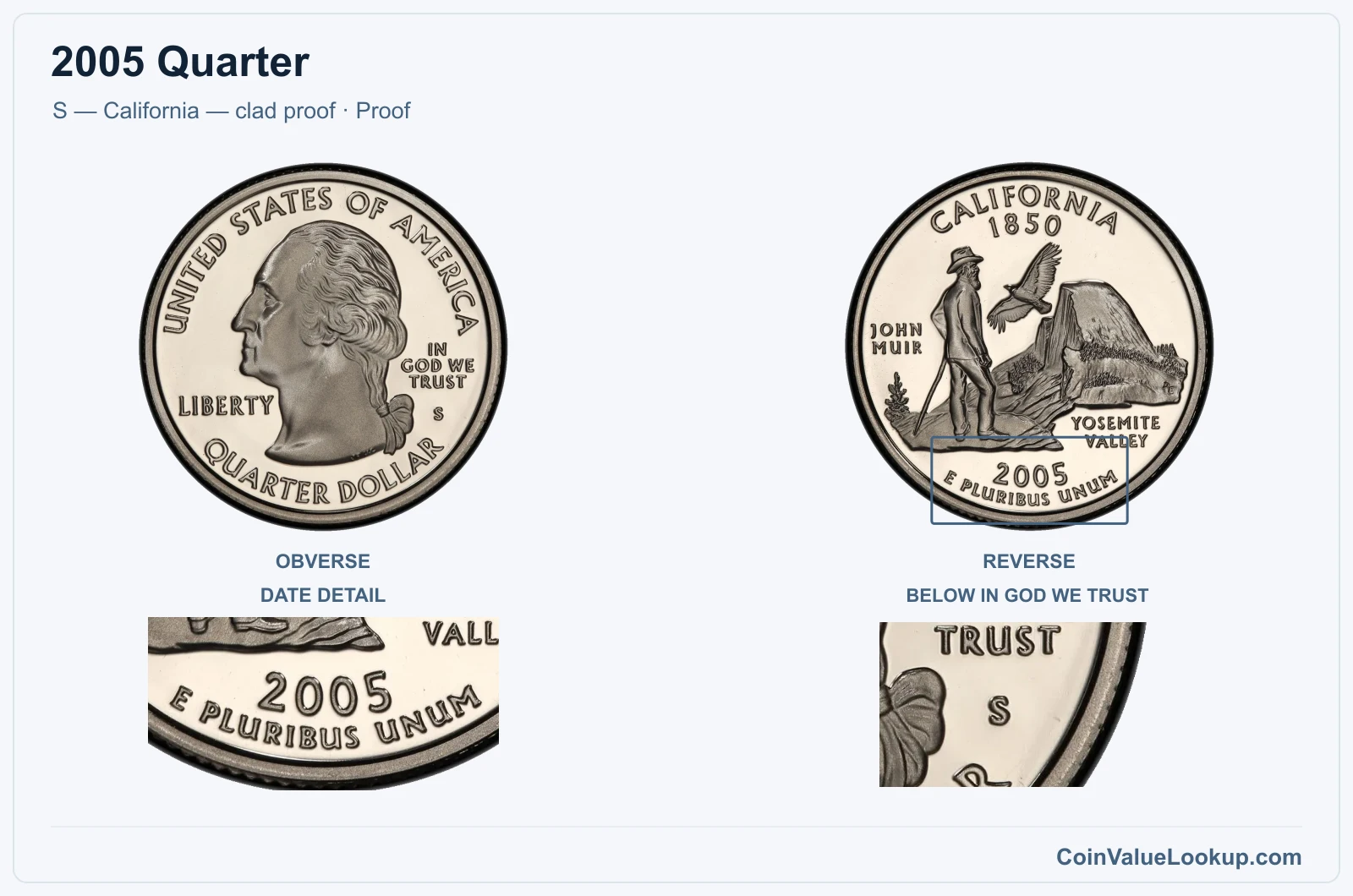
San Francisco struck clad proof California quarters in copper-nickel clad, the same base metal as circulation coins. They feature sharply struck, frosted design elements against mirror-like fields.
USA Coin Book estimates about $5.63 at PR65. Do not confuse these with silver proofs — check the edge for a copper stripe or weigh the coin.
The clad version weighs about 5.67 grams versus 6.25 grams for silver. Original proof-set packaging also helps confirm composition.
Range Grade
Price Auction Records Appraisal PR PR 1
—
Coin Identifier
PR 2
—
Coin Identifier
PR 3
—
Coin Identifier
PR 4
—
Coin Identifier
PR 6
—
Coin Identifier
PR 8
—
Coin Identifier
PR 10
—
Coin Identifier
PR 12
—
Coin Identifier
PR 15
—
Coin Identifier
PR 20
—
Coin Identifier
PR 25
—
Coin Identifier
PR 30
—
Coin Identifier
PR 35
—
Coin Identifier
PR 40
—
Coin Identifier
PR 45
—
Coin Identifier
PR 50
—
Coin Identifier
PR 53
—
Coin Identifier
PR 55
—
Coin Identifier
PR 58
—
Coin Identifier
PR 60
—
Coin Identifier
PR 61
—
Coin Identifier
PR 62
—
Coin Identifier
PR 63
—
Coin Identifier
PR 64
—
Coin Identifier
PR 65
—
Coin Identifier
PR 66
—
Coin Identifier
PR 67
—
Coin Identifier
PR 68
Coin Identifier
PR 69
Coin Identifier
PR 70
Coin Identifier
2005 Quarter — S — California — silver proof
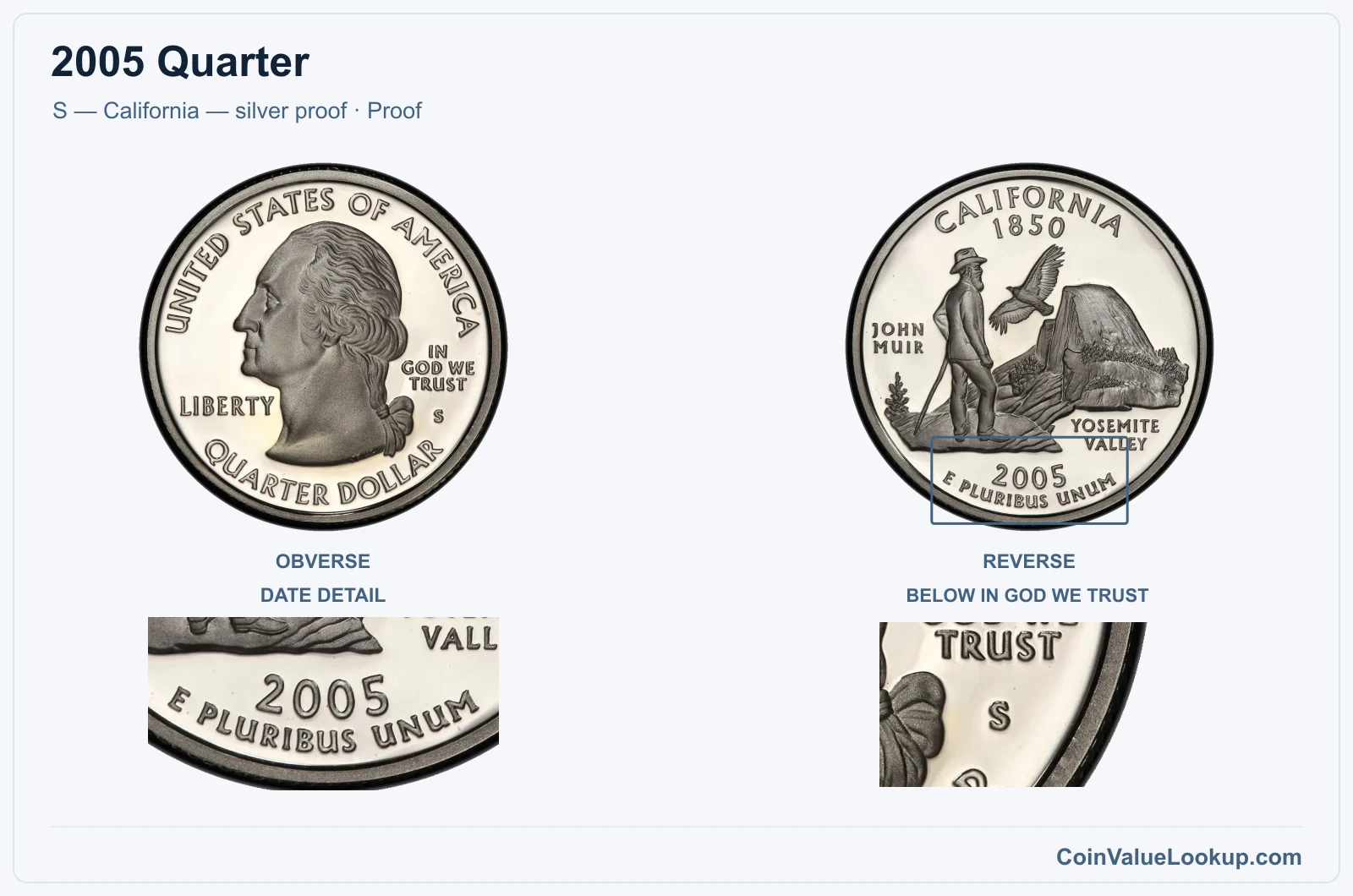
The silver proof California quarter is struck in 90% silver and 10% copper, weighing approximately 6.25 grams. The edge appears uniformly silver-toned with no copper stripe.
USA Coin Book estimates this version at about $23.00 in PR65. That silver content, combined with the proof finish's frosted devices and deep mirror fields, makes it the most collectible standard California quarter from 2005.
Confirm composition by weight or original packaging before assuming you have the silver version rather than the clad proof.
Range Grade
Price Auction Records Appraisal PR PR 1
—
Coin Identifier
PR 2
—
Coin Identifier
PR 3
—
Coin Identifier
PR 4
—
Coin Identifier
PR 6
—
Coin Identifier
PR 8
—
Coin Identifier
PR 10
—
Coin Identifier
PR 12
—
Coin Identifier
PR 15
—
Coin Identifier
PR 20
—
Coin Identifier
PR 25
—
Coin Identifier
PR 30
—
Coin Identifier
PR 35
—
Coin Identifier
PR 40
—
Coin Identifier
PR 45
—
Coin Identifier
PR 50
—
Coin Identifier
PR 53
—
Coin Identifier
PR 55
—
Coin Identifier
PR 58
—
Coin Identifier
PR 60
—
Coin Identifier
PR 61
—
Coin Identifier
PR 62
—
Coin Identifier
PR 63
—
Coin Identifier
PR 64
—
Coin Identifier
PR 65
—
Coin Identifier
PR 66
—
Coin Identifier
PR 67
—
Coin Identifier
PR 68
Coin Identifier
PR 69
Coin Identifier
PR 70
Coin Identifier
2005 Quarter — P — Minnesota — regular strike
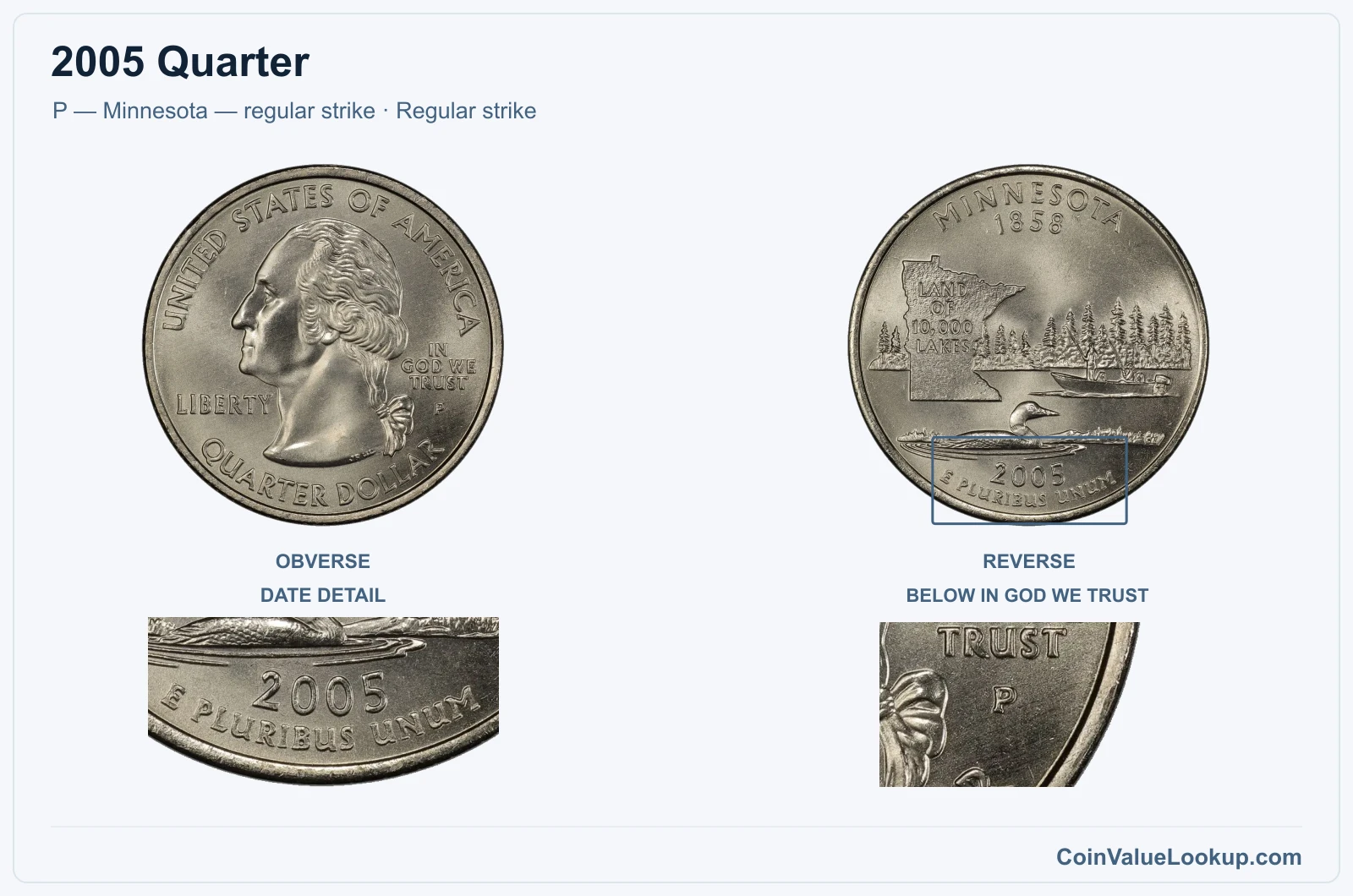
The Philadelphia-mint Minnesota regular strike is copper-nickel clad, 24.26 mm across and 5.67 grams. USA Coin Book lists it at roughly $0.49 in MS60 and $6.25 in MS65.
Worn specimens are worth 25 cents. Confirm the Minnesota reverse — featuring a lake, trees and the state outline — and the P mintmark.
The Minnesota design has several reported error varieties, so take a close look at both sides before filing it away as ordinary.
Range Grade
Price Auction Records Appraisal PO PO 1
—
Coin Identifier FR FR 2
—
Coin Identifier AG AG 3
—
Coin Identifier G G 4
—
Coin Identifier
G 6
—
Coin Identifier VG VG 8
—
Coin Identifier
VG 10
—
Coin Identifier F F 12
—
Coin Identifier
F 15
—
Coin Identifier VF VF 20
—
Coin Identifier
VF 25
—
Coin Identifier
VF 30
—
Coin Identifier
VF 35
—
Coin Identifier XF XF 40
—
Coin Identifier
XF 45
—
Coin Identifier AU AU 50
—
Coin Identifier
AU 53
—
Coin Identifier
AU 55
—
Coin Identifier
AU 58
—
Coin Identifier MS MS 60
—
Coin Identifier
MS 61
—
Coin Identifier
MS 62
—
Coin Identifier
MS 63
—
Coin Identifier
MS 64
—
Coin Identifier
MS 65
—
Coin Identifier
MS 66
—
Coin Identifier
MS 67
—
Coin Identifier
MS 68
Coin Identifier
MS 69
—
—
—
MS 70
—
—
—
2005 Quarter — P — Minnesota — satin finish
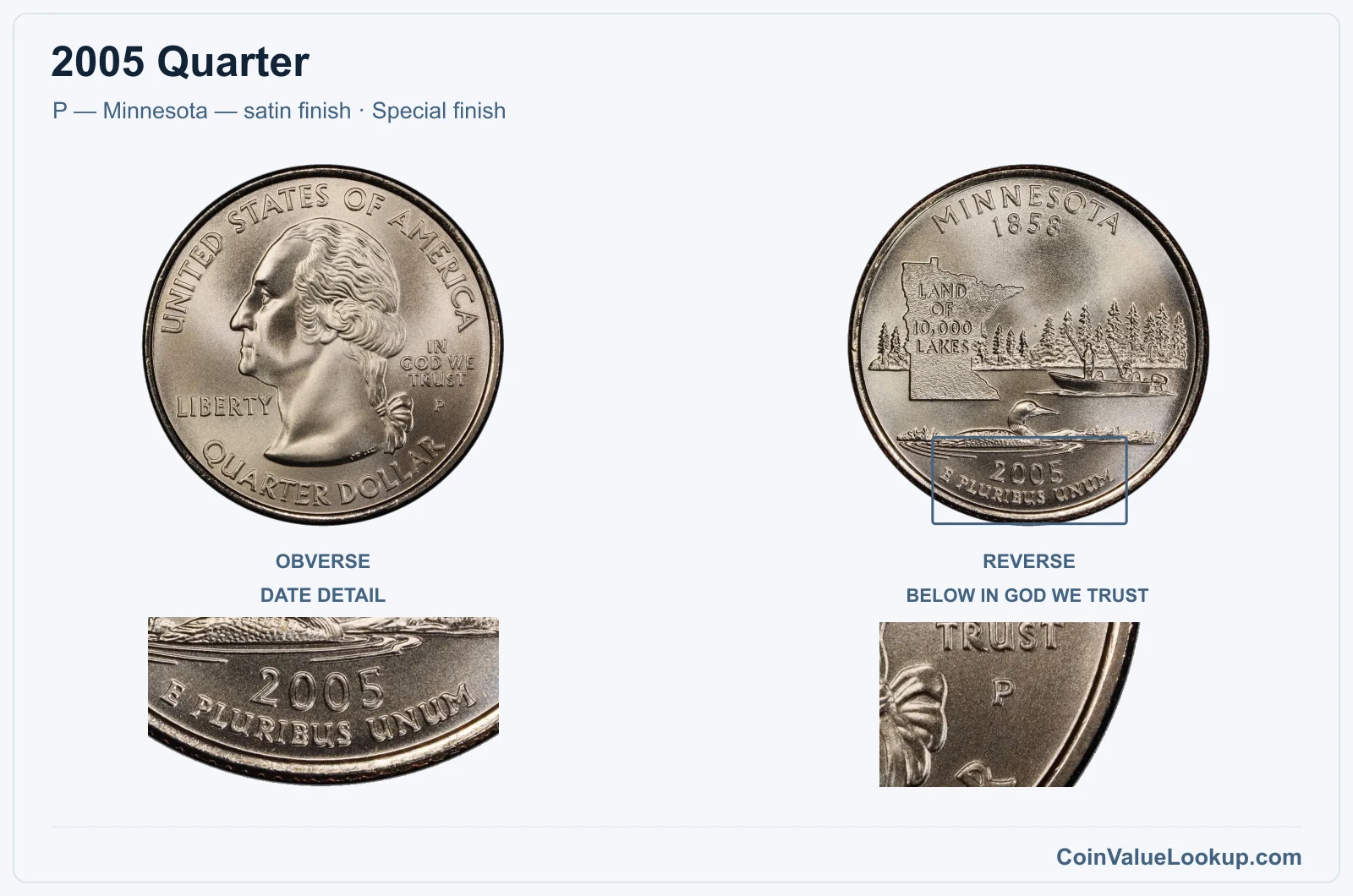
Philadelphia satin-finish Minnesota quarters were packaged in the 2005 Uncirculated Mint Set. They show a uniform fine-grained surface texture distinct from a normal business strike's luster.
Value for these coins is assessed individually based on authenticated identity and condition. A coin that merely looks dull from wear or cleaning does not qualify.
If the texture is consistent and even across the entire surface, and the coin came from mint-set packaging, you may have the satin version.
Range Grade
Price Auction Records Appraisal SP SP 1
—
Coin Identifier
SP 2
—
Coin Identifier
SP 3
—
Coin Identifier
SP 4
—
Coin Identifier
SP 6
—
Coin Identifier
SP 8
—
Coin Identifier
SP 10
—
Coin Identifier
SP 12
—
Coin Identifier
SP 15
—
Coin Identifier
SP 20
—
Coin Identifier
SP 25
—
Coin Identifier
SP 30
—
Coin Identifier
SP 35
—
Coin Identifier
SP 40
—
Coin Identifier
SP 45
—
Coin Identifier
SP 50
—
Coin Identifier
SP 53
—
Coin Identifier
SP 55
—
Coin Identifier
SP 58
—
Coin Identifier
SP 60
—
Coin Identifier
SP 61
—
Coin Identifier
SP 62
—
Coin Identifier
SP 63
—
Coin Identifier
SP 64
—
Coin Identifier
SP 65
—
Coin Identifier
SP 66
—
Coin Identifier
SP 67
Coin Identifier
SP 68
Coin Identifier
SP 69
Coin Identifier
SP 70
Coin Identifier
2005 Quarter — D — Minnesota — regular strike
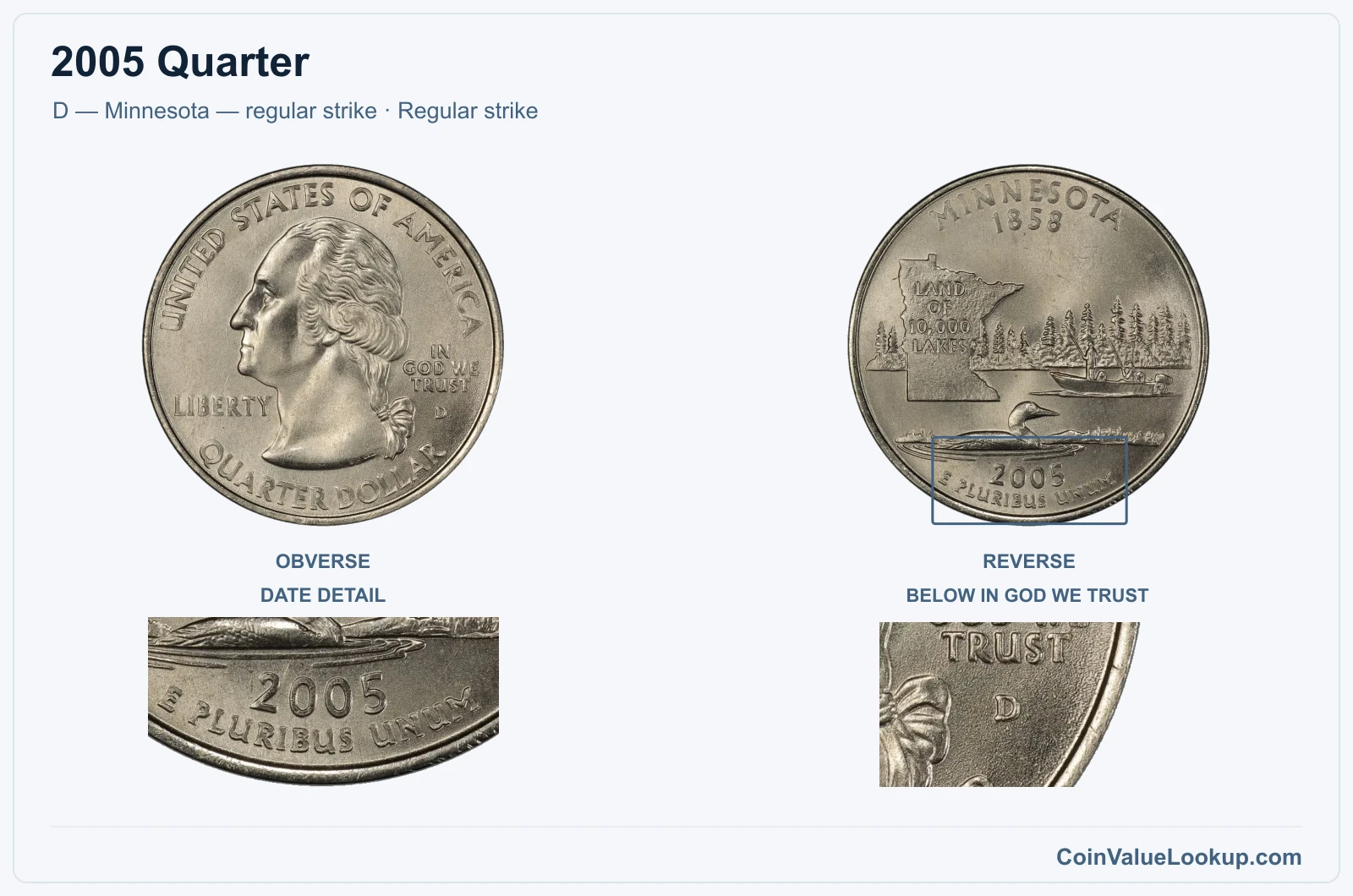
The D-mint Minnesota quarter is another common circulation piece. Copper-nickel clad, standard weight and diameter.
USA Coin Book puts it at about $0.49 in MS60 and $6.25 at MS65. Circulated examples are face value.
Confirm the D mintmark on the obverse and the Minnesota state design on the reverse. Like the P-mint version, some Minnesota quarters carry reported error varieties, so a careful look under magnification is worthwhile.
Range Grade
Price Auction Records Appraisal PO PO 1
—
Coin Identifier FR FR 2
—
Coin Identifier AG AG 3
—
Coin Identifier G G 4
—
Coin Identifier
G 6
—
Coin Identifier VG VG 8
—
Coin Identifier
VG 10
—
Coin Identifier F F 12
—
Coin Identifier
F 15
—
Coin Identifier VF VF 20
—
Coin Identifier
VF 25
—
Coin Identifier
VF 30
—
Coin Identifier
VF 35
—
Coin Identifier XF XF 40
—
Coin Identifier
XF 45
—
Coin Identifier AU AU 50
—
Coin Identifier
AU 53
—
Coin Identifier
AU 55
—
Coin Identifier
AU 58
—
Coin Identifier MS MS 60
—
Coin Identifier
MS 61
—
Coin Identifier
MS 62
—
Coin Identifier
MS 63
—
Coin Identifier
MS 64
—
Coin Identifier
MS 65
—
Coin Identifier
MS 66
Coin Identifier
MS 67
Coin Identifier
MS 68
Coin Identifier
MS 69
—
Coin Identifier
MS 70
—
—
—
2005 Quarter — D — Minnesota — satin finish
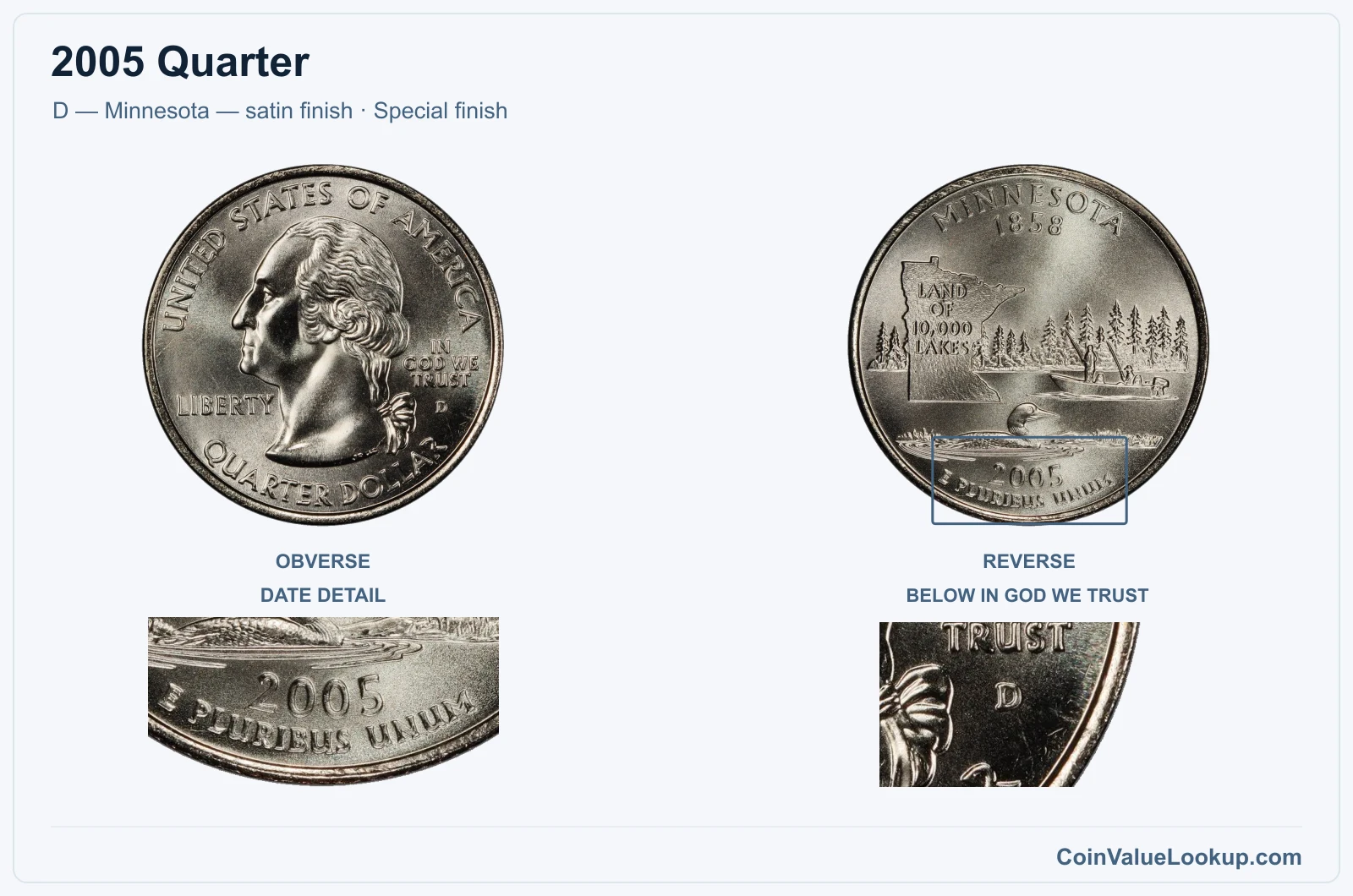
Denver satin-finish Minnesota quarters came from the 2005 Uncirculated Mint Set. Same copper-nickel clad composition as the business strike, but the surface has a soft, uniform texture you will not see on a coin pulled from a roll.
No standard guide price is adopted for this version; value depends on the specific coin's condition and confirmed satin attribution. An artificially matte surface does not qualify.
Range Grade
Price Auction Records Appraisal SP SP 1
—
Coin Identifier
SP 2
—
Coin Identifier
SP 3
—
Coin Identifier
SP 4
—
Coin Identifier
SP 6
—
Coin Identifier
SP 8
—
Coin Identifier
SP 10
—
Coin Identifier
SP 12
—
Coin Identifier
SP 15
—
Coin Identifier
SP 20
—
Coin Identifier
SP 25
—
Coin Identifier
SP 30
—
Coin Identifier
SP 35
—
Coin Identifier
SP 40
—
Coin Identifier
SP 45
—
Coin Identifier
SP 50
—
Coin Identifier
SP 53
—
Coin Identifier
SP 55
—
Coin Identifier
SP 58
—
Coin Identifier
SP 60
—
Coin Identifier
SP 61
—
Coin Identifier
SP 62
—
Coin Identifier
SP 63
—
Coin Identifier
SP 64
—
Coin Identifier
SP 65
—
Coin Identifier
SP 66
Coin Identifier
SP 67
Coin Identifier
SP 68
Coin Identifier
SP 69
Coin Identifier
SP 70
—
Coin Identifier
2005 Quarter — S — Minnesota — clad proof
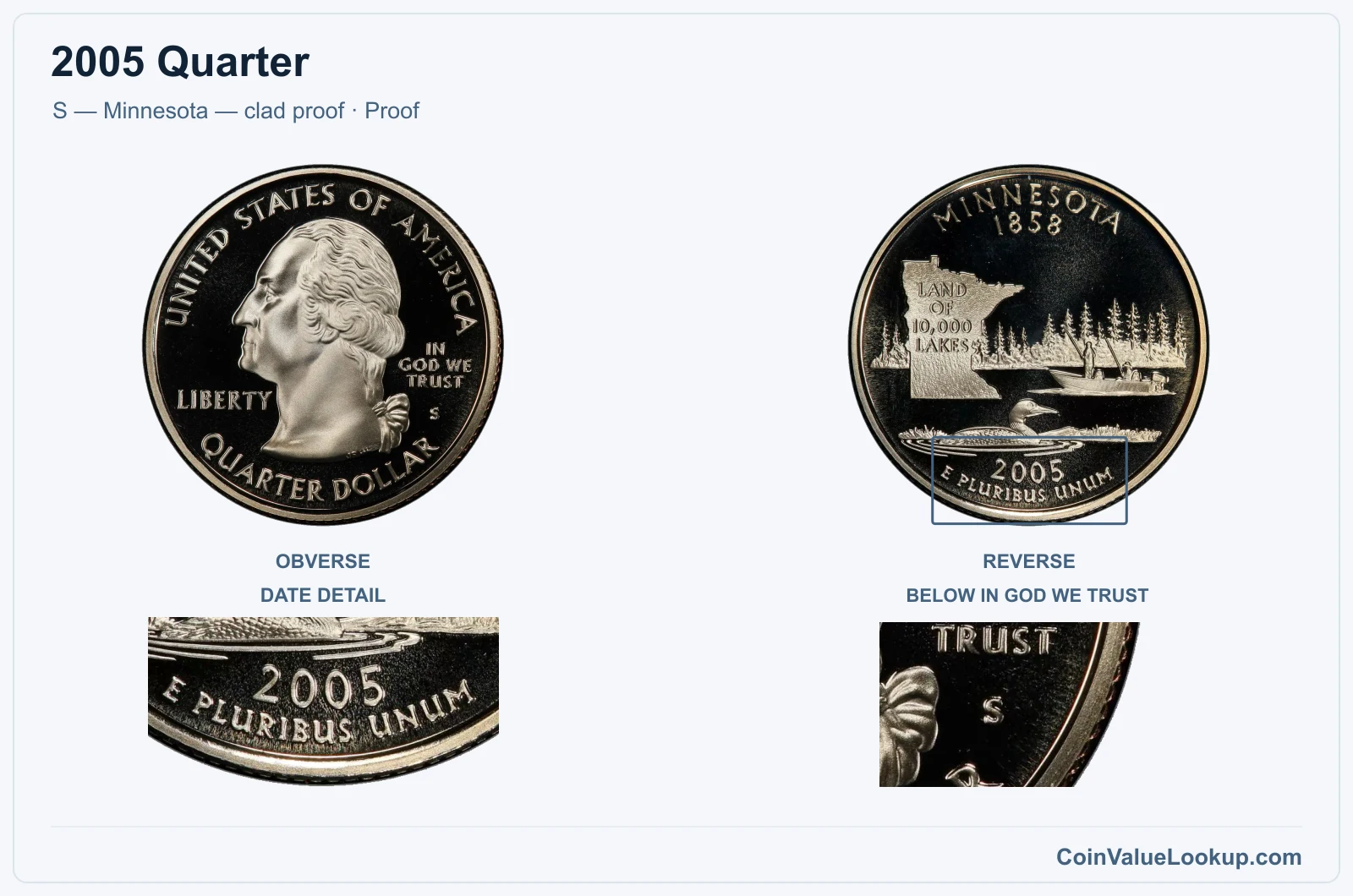
The S-mint clad proof Minnesota quarter is copper-nickel clad with proof-quality mirror fields and frosted devices. USA Coin Book estimates about $5.63 at PR65.
Distinguish it from the silver proof by checking the edge for a visible copper-colored stripe or by weighing the coin — the clad proof should be around 5.67 grams. Original proof-set packaging is the easiest confirmation method.
Handle proofs by the edges to avoid adding hairlines.
Range Grade
Price Auction Records Appraisal PR PR 1
—
Coin Identifier
PR 2
—
Coin Identifier
PR 3
—
Coin Identifier
PR 4
—
Coin Identifier
PR 6
—
Coin Identifier
PR 8
—
Coin Identifier
PR 10
—
Coin Identifier
PR 12
—
Coin Identifier
PR 15
—
Coin Identifier
PR 20
—
Coin Identifier
PR 25
—
Coin Identifier
PR 30
—
Coin Identifier
PR 35
—
Coin Identifier
PR 40
—
Coin Identifier
PR 45
—
Coin Identifier
PR 50
—
Coin Identifier
PR 53
—
Coin Identifier
PR 55
—
Coin Identifier
PR 58
—
Coin Identifier
PR 60
—
Coin Identifier
PR 61
—
Coin Identifier
PR 62
—
Coin Identifier
PR 63
—
Coin Identifier
PR 64
—
Coin Identifier
PR 65
—
Coin Identifier
PR 66
—
Coin Identifier
PR 67
—
Coin Identifier
PR 68
—
Coin Identifier
PR 69
Coin Identifier
PR 70
Coin Identifier
2005 Quarter — S — Minnesota — silver proof
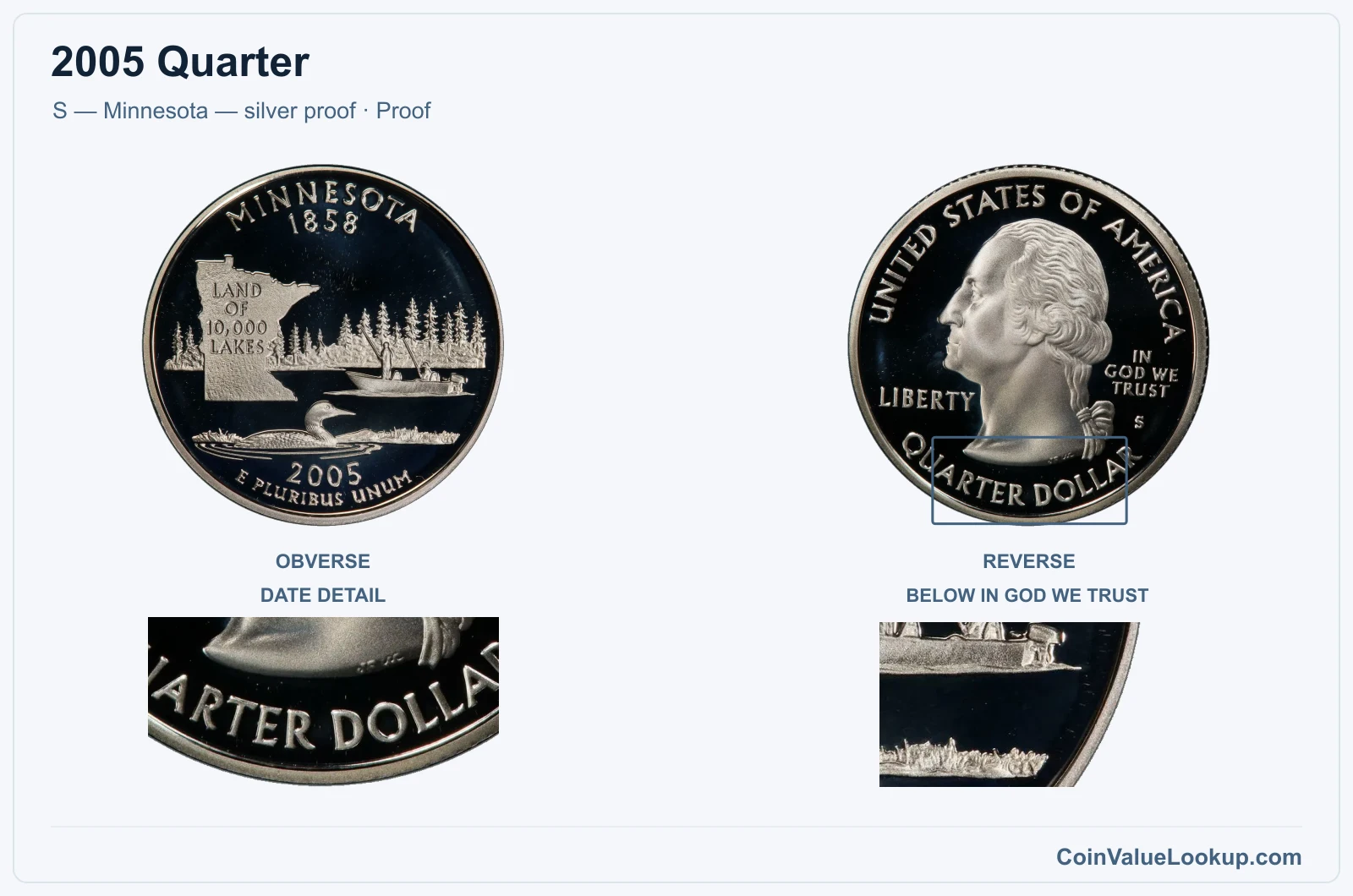
The silver proof Minnesota quarter is 90% silver, weighing about 6.25 grams. Its edge shows no copper stripe.
USA Coin Book lists it at approximately $23.00 in PR65. The combination of precious-metal content and the proof finish's contrast between frosted design elements and reflective fields gives this version strong collector appeal.
Verify composition through weight or original silver proof set packaging before assigning this value line to your coin.
Coin Value Lookup is a good starting point if you want to look up guides for other years and denominations in the 50 States Quarters series. It can help you quickly narrow down which version and value range applies to a coin you have in hand.
Range Grade
Price Auction Records Appraisal PR PR 1
—
Coin Identifier
PR 2
—
Coin Identifier
PR 3
—
Coin Identifier
PR 4
—
Coin Identifier
PR 6
—
Coin Identifier
PR 8
—
Coin Identifier
PR 10
—
Coin Identifier
PR 12
—
Coin Identifier
PR 15
—
Coin Identifier
PR 20
—
Coin Identifier
PR 25
—
Coin Identifier
PR 30
—
Coin Identifier
PR 35
—
Coin Identifier
PR 40
—
Coin Identifier
PR 45
—
Coin Identifier
PR 50
—
Coin Identifier
PR 53
—
Coin Identifier
PR 55
—
Coin Identifier
PR 58
—
Coin Identifier
PR 60
—
Coin Identifier
PR 61
—
Coin Identifier
PR 62
—
Coin Identifier
PR 63
—
Coin Identifier
PR 64
—
Coin Identifier
PR 65
—
Coin Identifier
PR 66
—
Coin Identifier
PR 67
—
Coin Identifier
PR 68
—
Coin Identifier
PR 69
Coin Identifier
PR 70
Coin Identifier
2005 Quarter — P — Oregon — regular strike
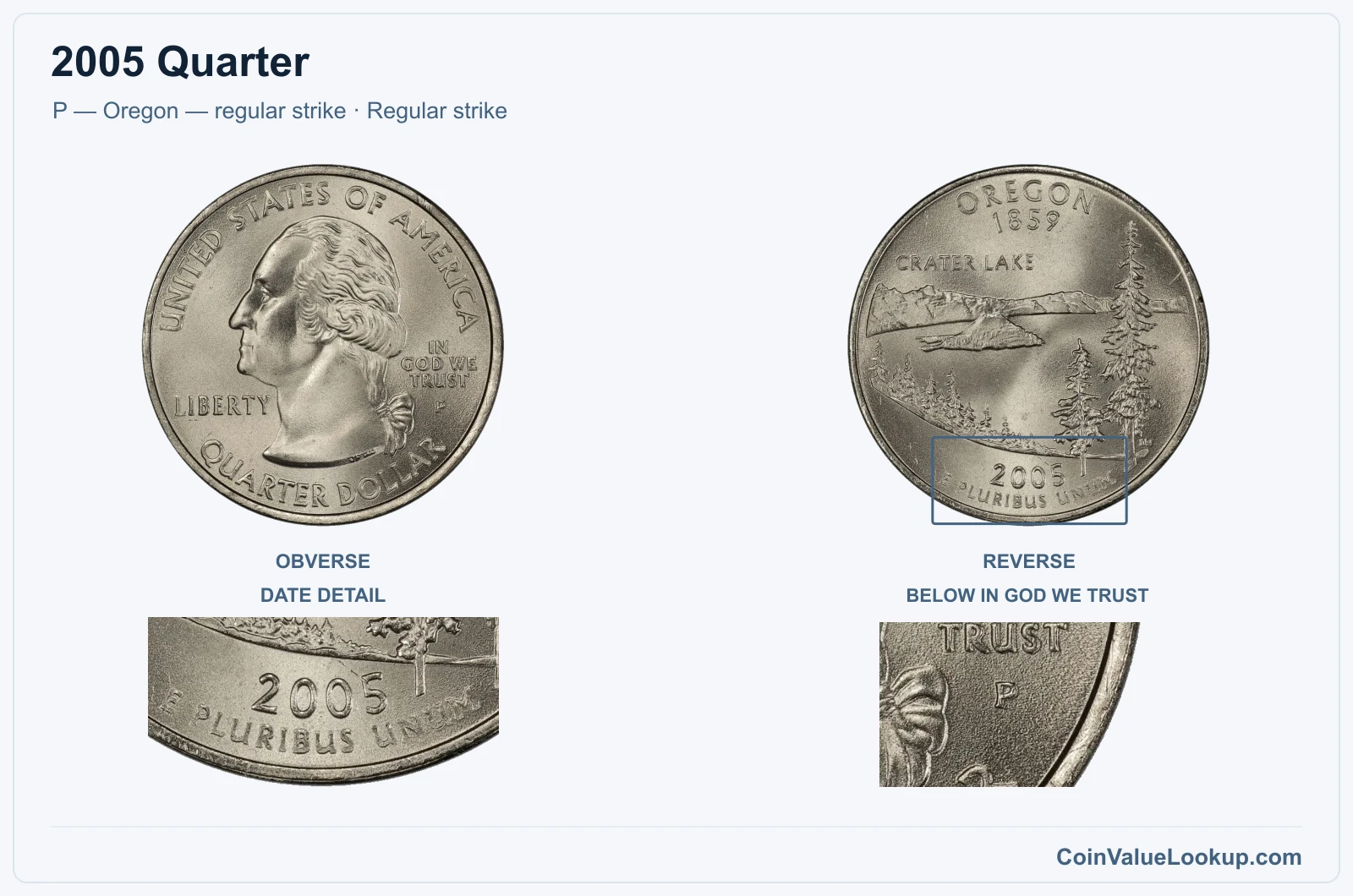
The Philadelphia Oregon quarter is a standard circulation strike in copper-nickel clad. It shows Crater Lake on the reverse.
USA Coin Book estimates roughly $0.49 at MS60 and $6.25 at MS65. Worn pieces are worth face value.
The Oregon design has enough high-relief detail — especially around the lake and crater rim — that a strong strike makes a noticeable difference in eye appeal at upper grades.
Range Grade
Price Auction Records Appraisal PO PO 1
—
Coin Identifier FR FR 2
—
Coin Identifier AG AG 3
—
Coin Identifier G G 4
—
Coin Identifier
G 6
—
Coin Identifier VG VG 8
—
Coin Identifier
VG 10
—
Coin Identifier F F 12
—
Coin Identifier
F 15
—
Coin Identifier VF VF 20
—
Coin Identifier
VF 25
—
Coin Identifier
VF 30
—
Coin Identifier
VF 35
—
Coin Identifier XF XF 40
—
Coin Identifier
XF 45
—
Coin Identifier AU AU 50
—
Coin Identifier
AU 53
—
Coin Identifier
AU 55
—
Coin Identifier
AU 58
—
Coin Identifier MS MS 60
—
Coin Identifier
MS 61
—
Coin Identifier
MS 62
—
Coin Identifier
MS 63
—
Coin Identifier
MS 64
—
Coin Identifier
MS 65
—
Coin Identifier
MS 66
—
Coin Identifier
MS 67
Coin Identifier
MS 68
Coin Identifier
MS 69
—
Coin Identifier
MS 70
—
—
—
2005 Quarter — P — Oregon — satin finish
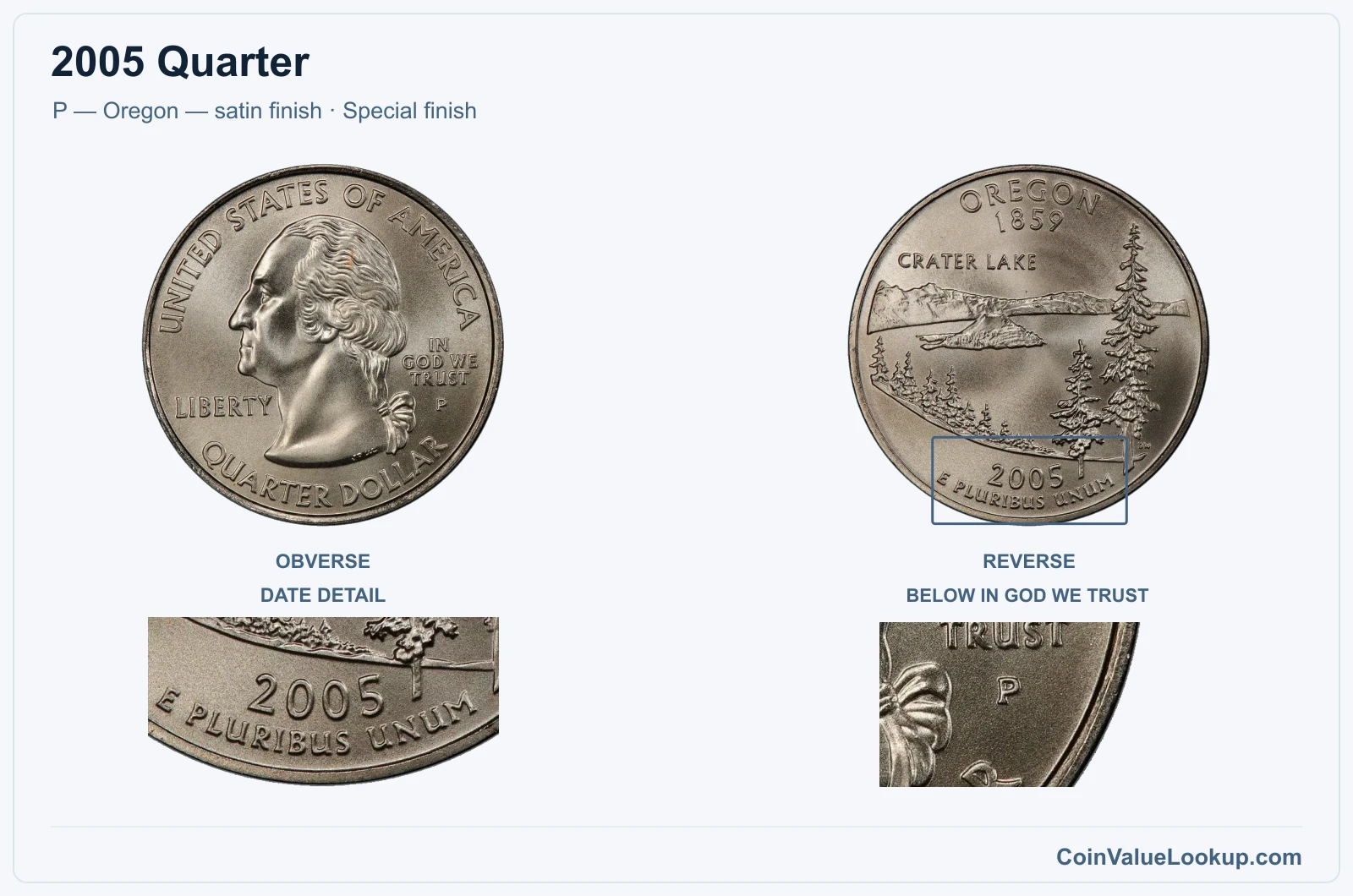
Philadelphia satin-finish Oregon quarters were included in 2005 Uncirculated Mint Sets. The surface has an even, fine-grained texture that covers both sides uniformly, distinct from the radial luster of a business strike.
No standard guide price is adopted; value depends on individual condition and confirmed satin attribution. A coin that has been cleaned or lightly circulated can look dull, but that is not the same as the intentional satin finish.
Range Grade
Price Auction Records Appraisal SP SP 1
—
Coin Identifier
SP 2
—
Coin Identifier
SP 3
—
Coin Identifier
SP 4
—
Coin Identifier
SP 6
—
Coin Identifier
SP 8
—
Coin Identifier
SP 10
—
Coin Identifier
SP 12
—
Coin Identifier
SP 15
—
Coin Identifier
SP 20
—
Coin Identifier
SP 25
—
Coin Identifier
SP 30
—
Coin Identifier
SP 35
—
Coin Identifier
SP 40
—
Coin Identifier
SP 45
—
Coin Identifier
SP 50
—
Coin Identifier
SP 53
—
Coin Identifier
SP 55
—
Coin Identifier
SP 58
—
Coin Identifier
SP 60
—
Coin Identifier
SP 61
—
Coin Identifier
SP 62
—
Coin Identifier
SP 63
—
Coin Identifier
SP 64
—
Coin Identifier
SP 65
—
Coin Identifier
SP 66
—
Coin Identifier
SP 67
Coin Identifier
SP 68
Coin Identifier
SP 69
Coin Identifier
SP 70
Coin Identifier
2005 Quarter — D — Oregon — regular strike
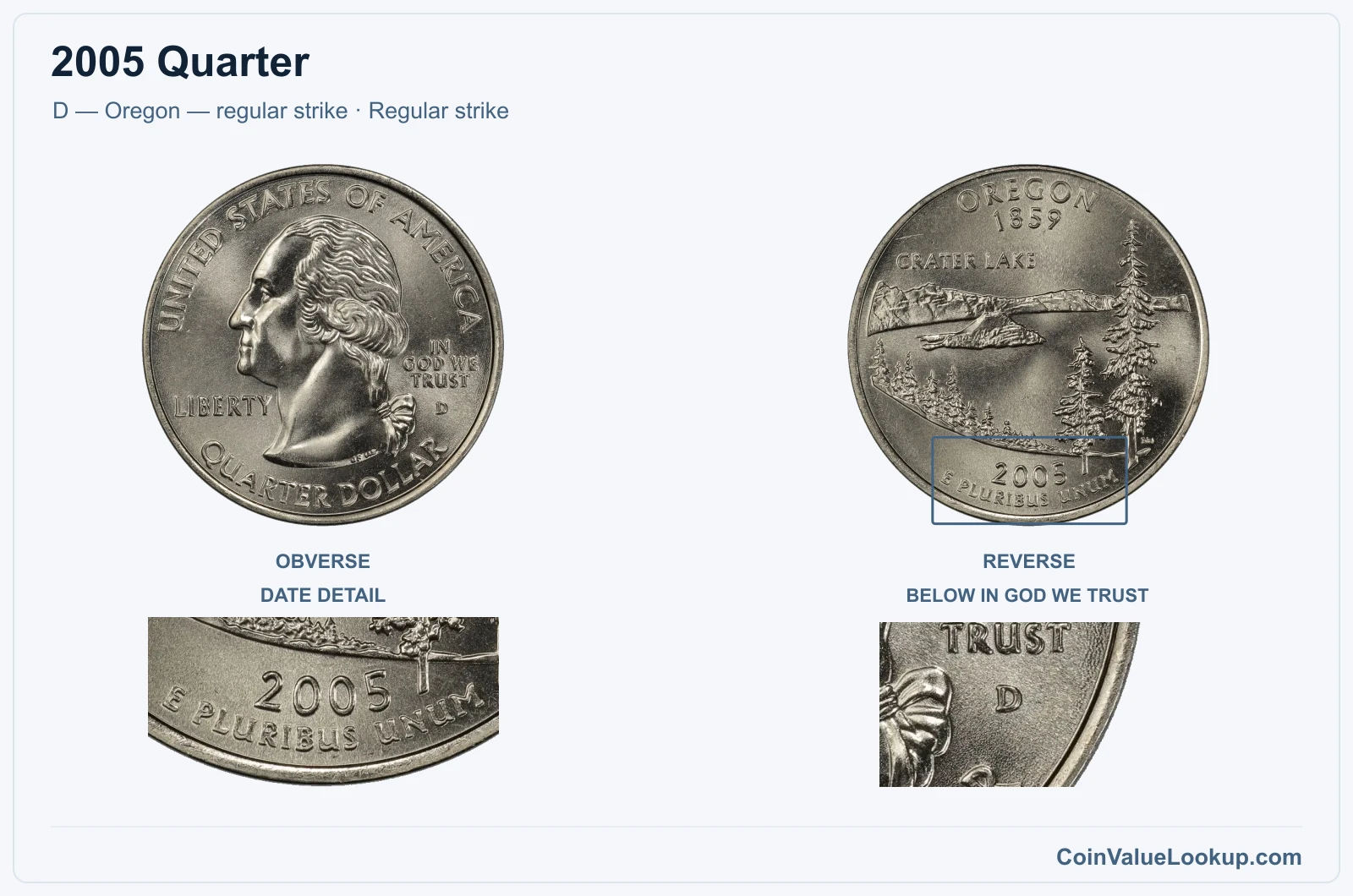
The Denver Oregon quarter is another readily available circulation coin. Copper-nickel clad, 5.67 grams, 24.26 mm.
USA Coin Book estimates $0.49 at MS60 and $6.25 at MS65. Worn specimens are face value only.
Look for the D mintmark and the Crater Lake reverse. If the coin is in truly original, high-grade condition with strong luster and no marks, it starts to separate from the bulk of pocket-change examples.
Range Grade
Price Auction Records Appraisal PO PO 1
—
Coin Identifier FR FR 2
—
Coin Identifier AG AG 3
—
Coin Identifier G G 4
—
Coin Identifier
G 6
—
Coin Identifier VG VG 8
—
Coin Identifier
VG 10
—
Coin Identifier F F 12
—
Coin Identifier
F 15
—
Coin Identifier VF VF 20
—
Coin Identifier
VF 25
—
Coin Identifier
VF 30
—
Coin Identifier
VF 35
—
Coin Identifier XF XF 40
—
Coin Identifier
XF 45
—
Coin Identifier AU AU 50
—
Coin Identifier
AU 53
—
Coin Identifier
AU 55
—
Coin Identifier
AU 58
—
Coin Identifier MS MS 60
—
Coin Identifier
MS 61
—
Coin Identifier
MS 62
—
Coin Identifier
MS 63
—
Coin Identifier
MS 64
—
Coin Identifier
MS 65
—
Coin Identifier
MS 66
—
Coin Identifier
MS 67
Coin Identifier
MS 68
Coin Identifier
MS 69
—
—
—
MS 70
—
—
—
2005 Quarter — D — Oregon — satin finish
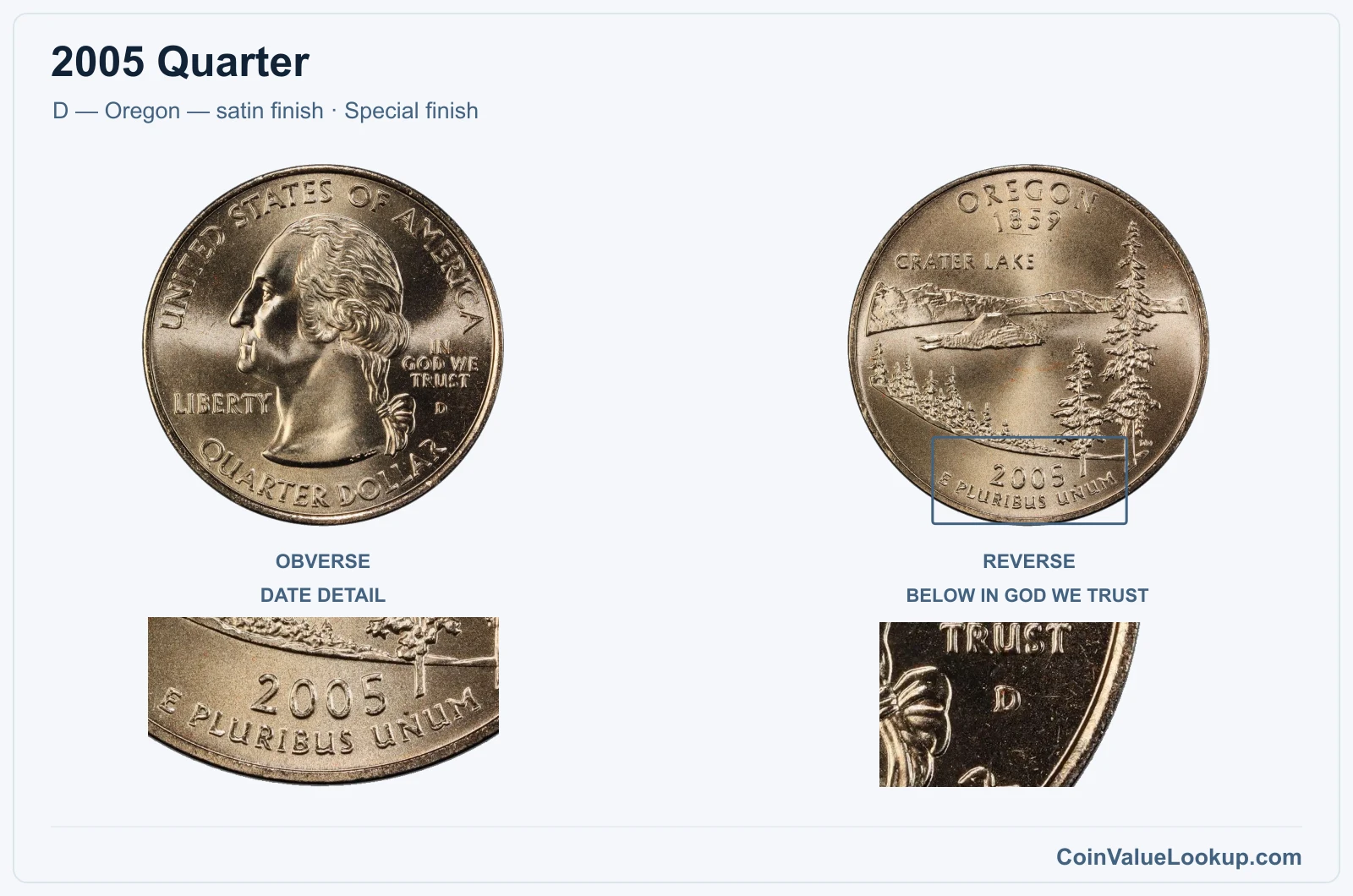
The Denver satin-finish Oregon quarter came from the 2005 Uncirculated Mint Set. It shares the copper-nickel clad composition with the regular strike but has a distinctive soft texture across both surfaces.
Value is determined individually based on authenticated identity and the coin's condition. An artificially dulled or lightly circulated coin does not meet the attribution standard.
Look for the even, matte-like finish and the D mintmark.
Range Grade
Price Auction Records Appraisal SP SP 1
—
Coin Identifier
SP 2
—
Coin Identifier
SP 3
—
Coin Identifier
SP 4
—
Coin Identifier
SP 6
—
Coin Identifier
SP 8
—
Coin Identifier
SP 10
—
Coin Identifier
SP 12
—
Coin Identifier
SP 15
—
Coin Identifier
SP 20
—
Coin Identifier
SP 25
—
Coin Identifier
SP 30
—
Coin Identifier
SP 35
—
Coin Identifier
SP 40
—
Coin Identifier
SP 45
—
Coin Identifier
SP 50
—
Coin Identifier
SP 53
—
Coin Identifier
SP 55
—
Coin Identifier
SP 58
—
Coin Identifier
SP 60
—
Coin Identifier
SP 61
—
Coin Identifier
SP 62
—
Coin Identifier
SP 63
—
Coin Identifier
SP 64
—
Coin Identifier
SP 65
—
Coin Identifier
SP 66
—
Coin Identifier
SP 67
—
Coin Identifier
SP 68
Coin Identifier
SP 69
Coin Identifier
SP 70
—
—
—
2005 Quarter — S — Oregon — clad proof
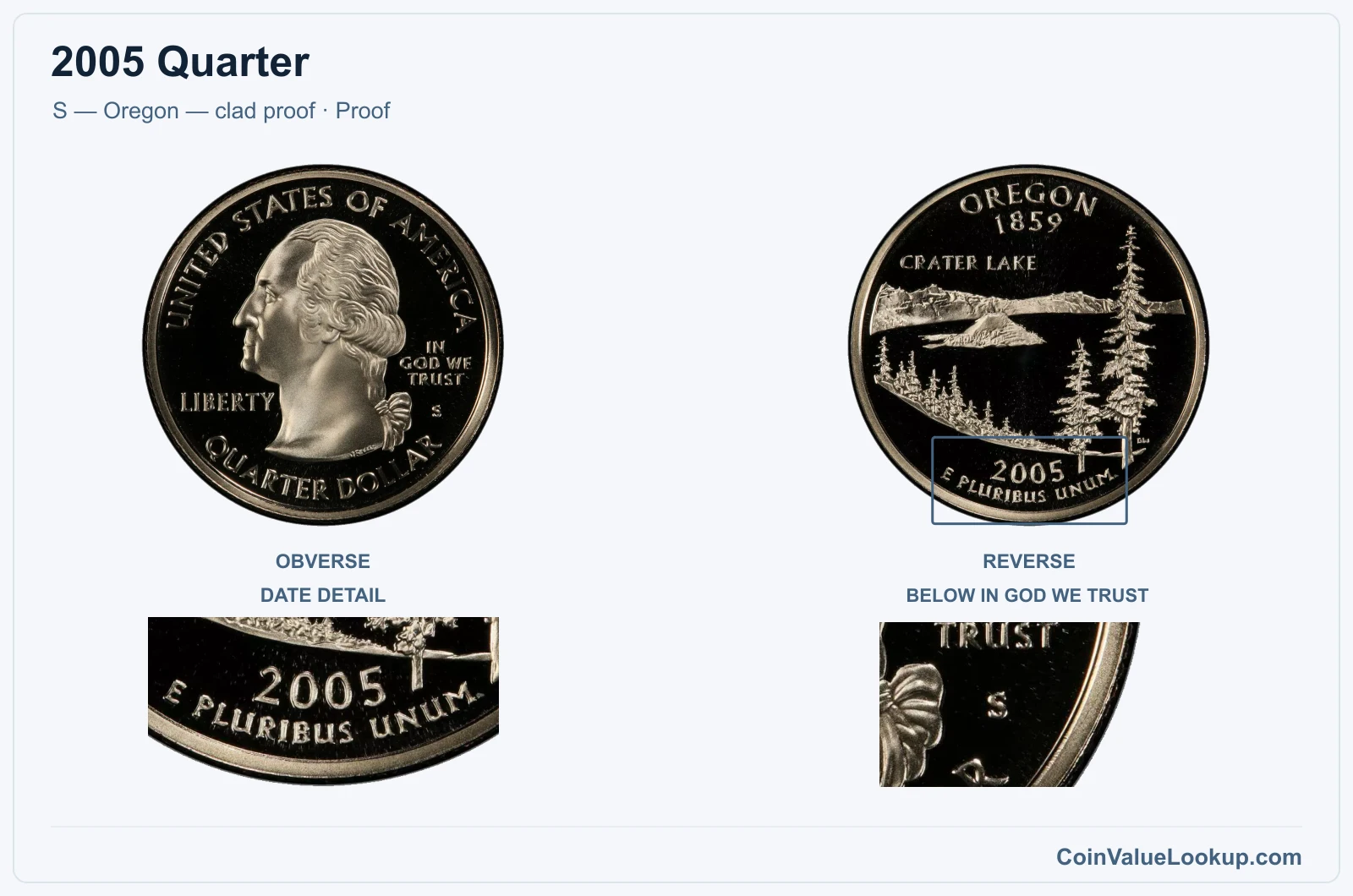
San Francisco's clad proof Oregon quarter features Crater Lake in sharp detail with frosted devices over mirror fields. USA Coin Book estimates about $5.63 at PR65.
It is copper-nickel clad — check the edge for a copper stripe or weigh the coin at about 5.67 grams to separate it from the silver version. Keep clad and silver proof values distinct, because the difference at PR65 is significant.
Range Grade
Price Auction Records Appraisal PR PR 1
—
Coin Identifier
PR 2
—
Coin Identifier
PR 3
—
Coin Identifier
PR 4
—
Coin Identifier
PR 6
—
Coin Identifier
PR 8
—
Coin Identifier
PR 10
—
Coin Identifier
PR 12
—
Coin Identifier
PR 15
—
Coin Identifier
PR 20
—
Coin Identifier
PR 25
—
Coin Identifier
PR 30
—
Coin Identifier
PR 35
—
Coin Identifier
PR 40
—
Coin Identifier
PR 45
—
Coin Identifier
PR 50
—
Coin Identifier
PR 53
—
Coin Identifier
PR 55
—
Coin Identifier
PR 58
—
Coin Identifier
PR 60
—
Coin Identifier
PR 61
—
Coin Identifier
PR 62
—
Coin Identifier
PR 63
—
Coin Identifier
PR 64
—
Coin Identifier
PR 65
—
Coin Identifier
PR 66
—
Coin Identifier
PR 67
—
Coin Identifier
PR 68
—
Coin Identifier
PR 69
Coin Identifier
PR 70
Coin Identifier
2005 Quarter — S — Oregon — silver proof
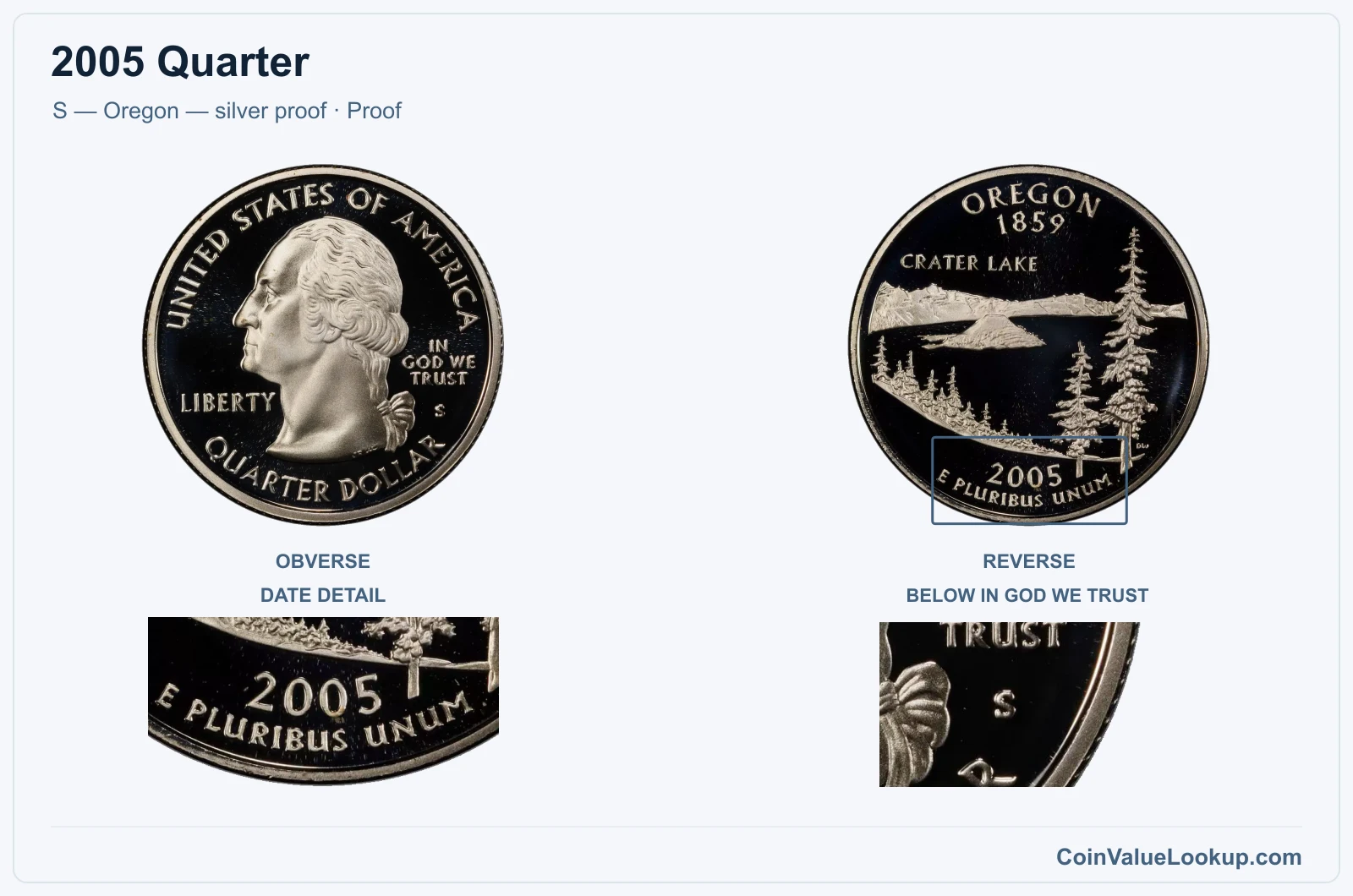
The silver proof Oregon quarter is 90% silver, weighing approximately 6.25 grams with no copper edge stripe. USA Coin Book estimates about $23.00 at PR65.
The proof finish produces crisp detail on the Crater Lake design, and the silver composition adds intrinsic metal value. Verify silver content by weight or original packaging.
Proofs in this grade should have clean, hairline-free fields and full frosted contrast on the devices.
Range Grade
Price Auction Records Appraisal PR PR 1
—
Coin Identifier
PR 2
—
Coin Identifier
PR 3
—
Coin Identifier
PR 4
—
Coin Identifier
PR 6
—
Coin Identifier
PR 8
—
Coin Identifier
PR 10
—
Coin Identifier
PR 12
—
Coin Identifier
PR 15
—
Coin Identifier
PR 20
—
Coin Identifier
PR 25
—
Coin Identifier
PR 30
—
Coin Identifier
PR 35
—
Coin Identifier
PR 40
—
Coin Identifier
PR 45
—
Coin Identifier
PR 50
—
Coin Identifier
PR 53
—
Coin Identifier
PR 55
—
Coin Identifier
PR 58
—
Coin Identifier
PR 60
—
Coin Identifier
PR 61
—
Coin Identifier
PR 62
—
Coin Identifier
PR 63
—
Coin Identifier
PR 64
—
Coin Identifier
PR 65
—
Coin Identifier
PR 66
—
Coin Identifier
PR 67
—
Coin Identifier
PR 68
—
Coin Identifier
PR 69
Coin Identifier
PR 70
Coin Identifier
2005 Quarter — P — Kansas — regular strike
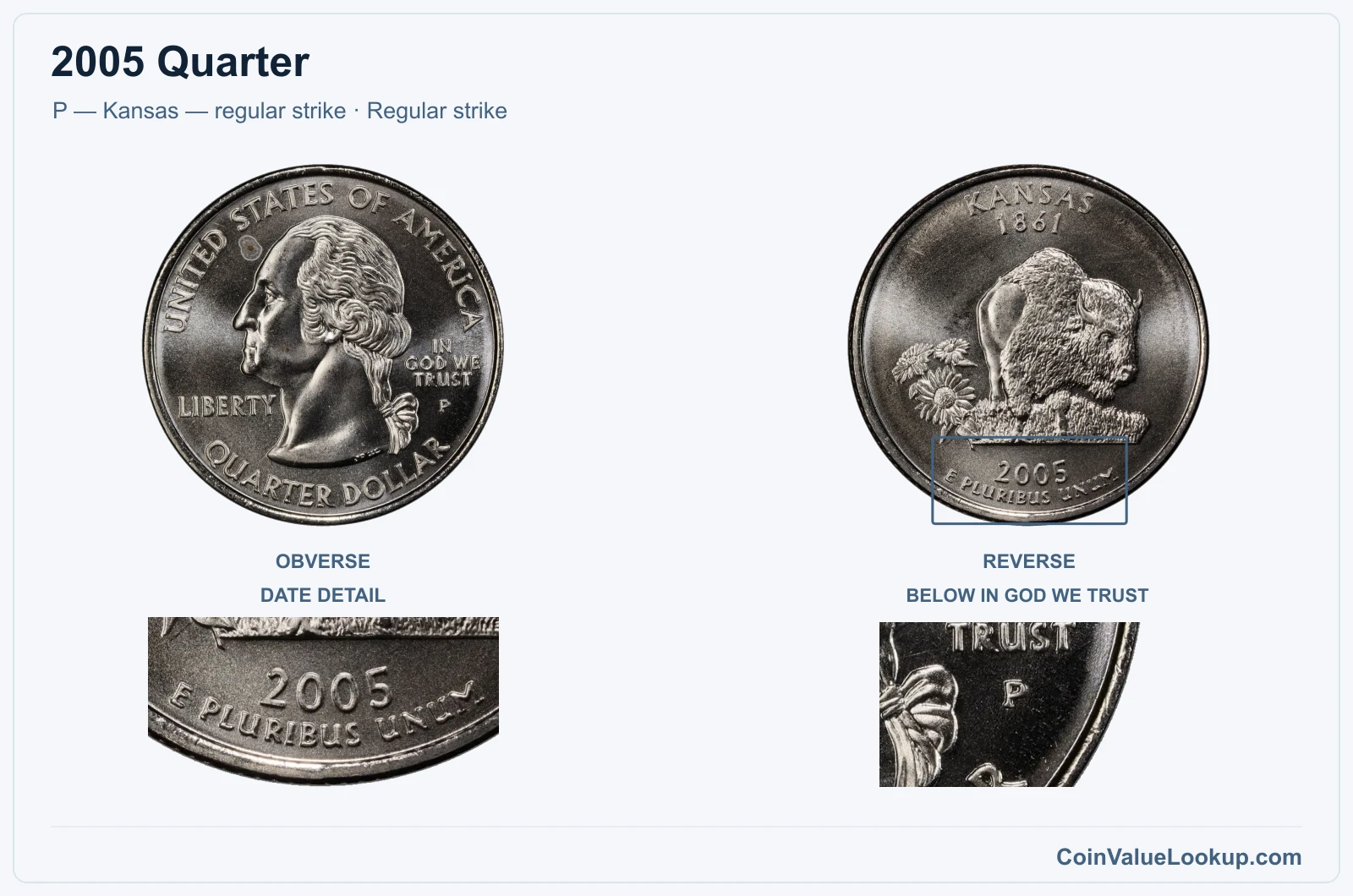
The Philadelphia Kansas quarter is a regular business strike in copper-nickel clad. The reverse features a bison and sunflower.
USA Coin Book estimates roughly $0.49 at MS60 and $6.25 at MS65. Circulated examples are worth face value.
The Kansas design has some well-known reported error types — including grease-filled dies and die breaks on the bison — so give both sides a close look before setting it aside.
Range Grade
Price Auction Records Appraisal PO PO 1
—
Coin Identifier FR FR 2
—
Coin Identifier AG AG 3
—
Coin Identifier G G 4
—
Coin Identifier
G 6
—
Coin Identifier VG VG 8
—
Coin Identifier
VG 10
—
Coin Identifier F F 12
—
Coin Identifier
F 15
—
Coin Identifier VF VF 20
—
Coin Identifier
VF 25
—
Coin Identifier
VF 30
—
Coin Identifier
VF 35
—
Coin Identifier XF XF 40
—
Coin Identifier
XF 45
—
Coin Identifier AU AU 50
—
Coin Identifier
AU 53
—
Coin Identifier
AU 55
—
Coin Identifier
AU 58
—
Coin Identifier MS MS 60
—
Coin Identifier
MS 61
—
Coin Identifier
MS 62
—
Coin Identifier
MS 63
—
Coin Identifier
MS 64
—
Coin Identifier
MS 65
—
Coin Identifier
MS 66
—
Coin Identifier
MS 67
Coin Identifier
MS 68
—
Coin Identifier
MS 69
—
—
—
MS 70
—
—
—
2005 Quarter — P — Kansas — satin finish
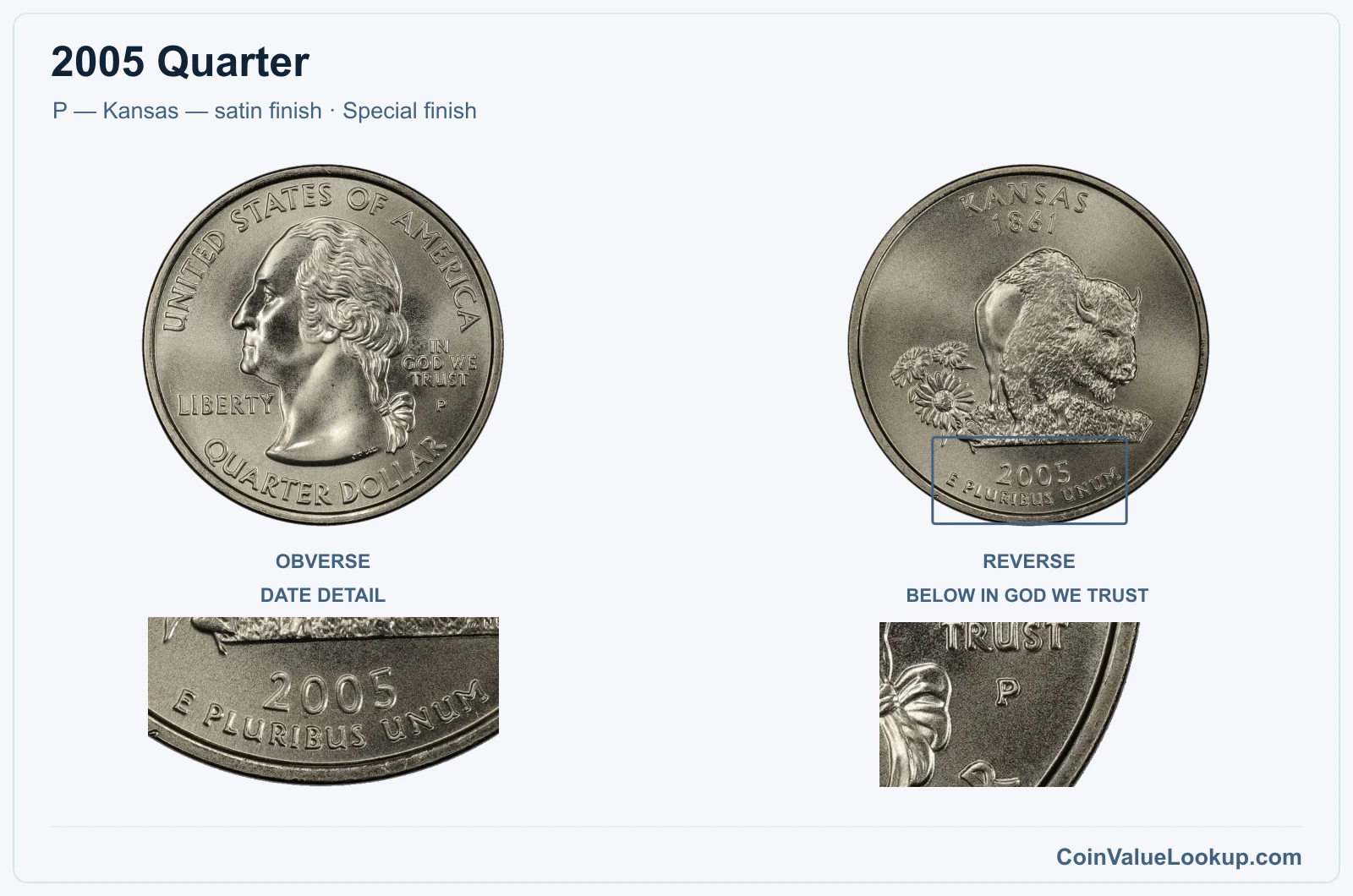
The P-mint Kansas satin finish was distributed through the 2005 Uncirculated Mint Set. These have a uniform, fine-grained surface that is not the same as ordinary business-strike luster.
No standard guide estimate is adopted for satin-finish Kansas quarters; their value depends on confirmed satin attribution and individual condition. A cleaned or worn coin will not pass as satin finish under close inspection.
Range Grade
Price Auction Records Appraisal SP SP 1
—
Coin Identifier
SP 2
—
Coin Identifier
SP 3
—
Coin Identifier
SP 4
—
Coin Identifier
SP 6
—
Coin Identifier
SP 8
—
Coin Identifier
SP 10
—
Coin Identifier
SP 12
—
Coin Identifier
SP 15
—
Coin Identifier
SP 20
—
Coin Identifier
SP 25
—
Coin Identifier
SP 30
—
Coin Identifier
SP 35
—
Coin Identifier
SP 40
—
Coin Identifier
SP 45
—
Coin Identifier
SP 50
—
Coin Identifier
SP 53
—
Coin Identifier
SP 55
—
Coin Identifier
SP 58
—
Coin Identifier
SP 60
—
Coin Identifier
SP 61
—
Coin Identifier
SP 62
—
Coin Identifier
SP 63
—
Coin Identifier
SP 64
—
Coin Identifier
SP 65
—
Coin Identifier
SP 66
—
Coin Identifier
SP 67
Coin Identifier
SP 68
Coin Identifier
SP 69
Coin Identifier
SP 70
—
Coin Identifier
2005 Quarter — D — Kansas — regular strike
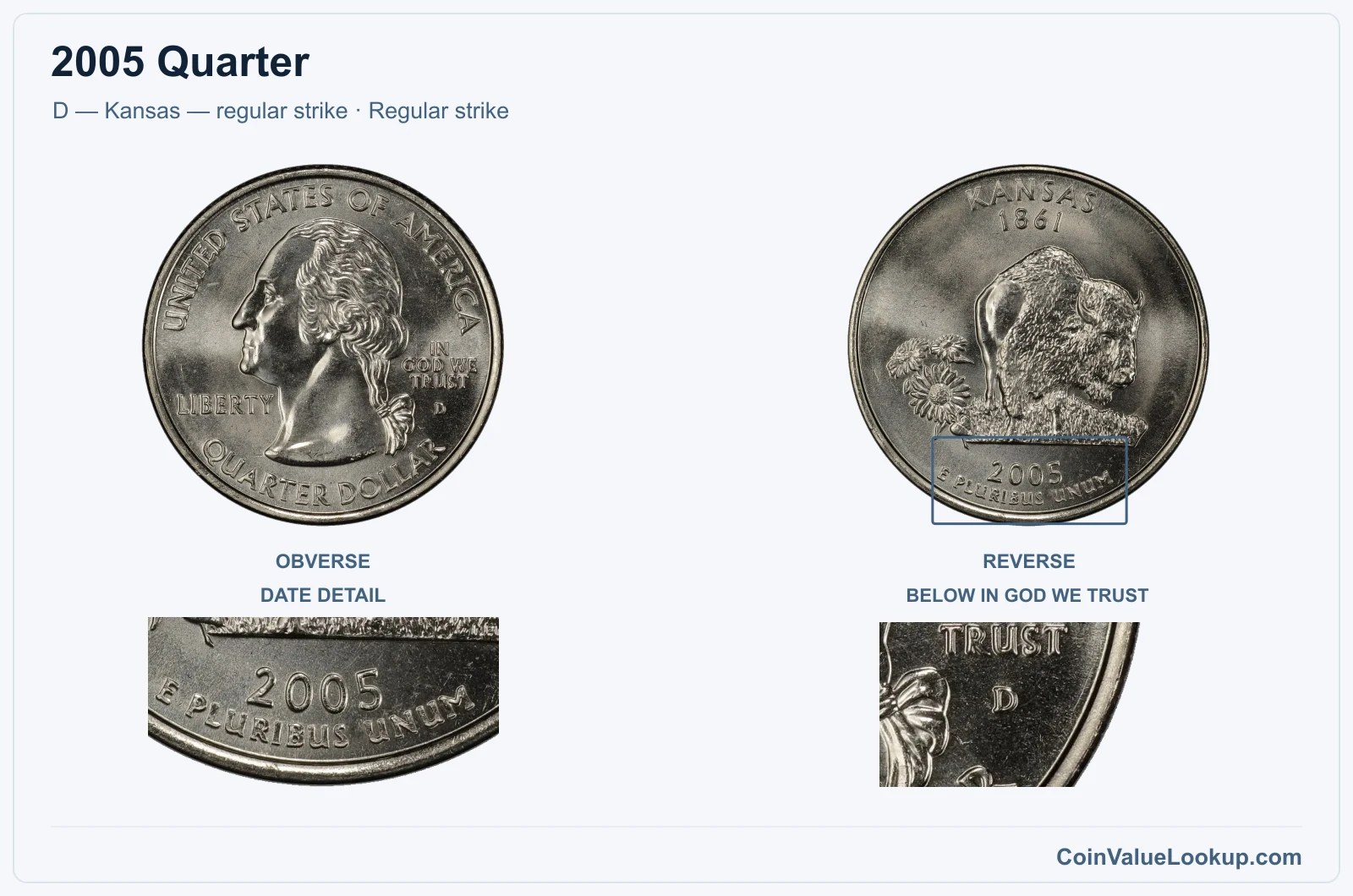
The Denver Kansas quarter is another high-production circulation piece. Copper-nickel clad, standard 5.67 grams and 24.26 mm.
USA Coin Book lists it at approximately $0.49 in MS60 and $6.25 at MS65. Worn coins are face value.
Look for the D mintmark. Like the P-mint version, the Kansas reverse design has been the subject of several reported error categories, so a quick check under magnification is a good idea.
Range Grade
Price Auction Records Appraisal PO PO 1
—
Coin Identifier FR FR 2
—
Coin Identifier AG AG 3
—
Coin Identifier G G 4
—
Coin Identifier
G 6
—
Coin Identifier VG VG 8
—
Coin Identifier
VG 10
—
Coin Identifier F F 12
—
Coin Identifier
F 15
—
Coin Identifier VF VF 20
—
Coin Identifier
VF 25
—
Coin Identifier
VF 30
—
Coin Identifier
VF 35
—
Coin Identifier XF XF 40
—
Coin Identifier
XF 45
—
Coin Identifier AU AU 50
—
Coin Identifier
AU 53
—
Coin Identifier
AU 55
—
Coin Identifier
AU 58
—
Coin Identifier MS MS 60
—
Coin Identifier
MS 61
—
Coin Identifier
MS 62
—
Coin Identifier
MS 63
—
Coin Identifier
MS 64
—
Coin Identifier
MS 65
—
Coin Identifier
MS 66
—
Coin Identifier
MS 67
Coin Identifier
MS 68
Coin Identifier
MS 69
—
—
—
MS 70
—
—
—
2005 Quarter — D — Kansas — satin finish
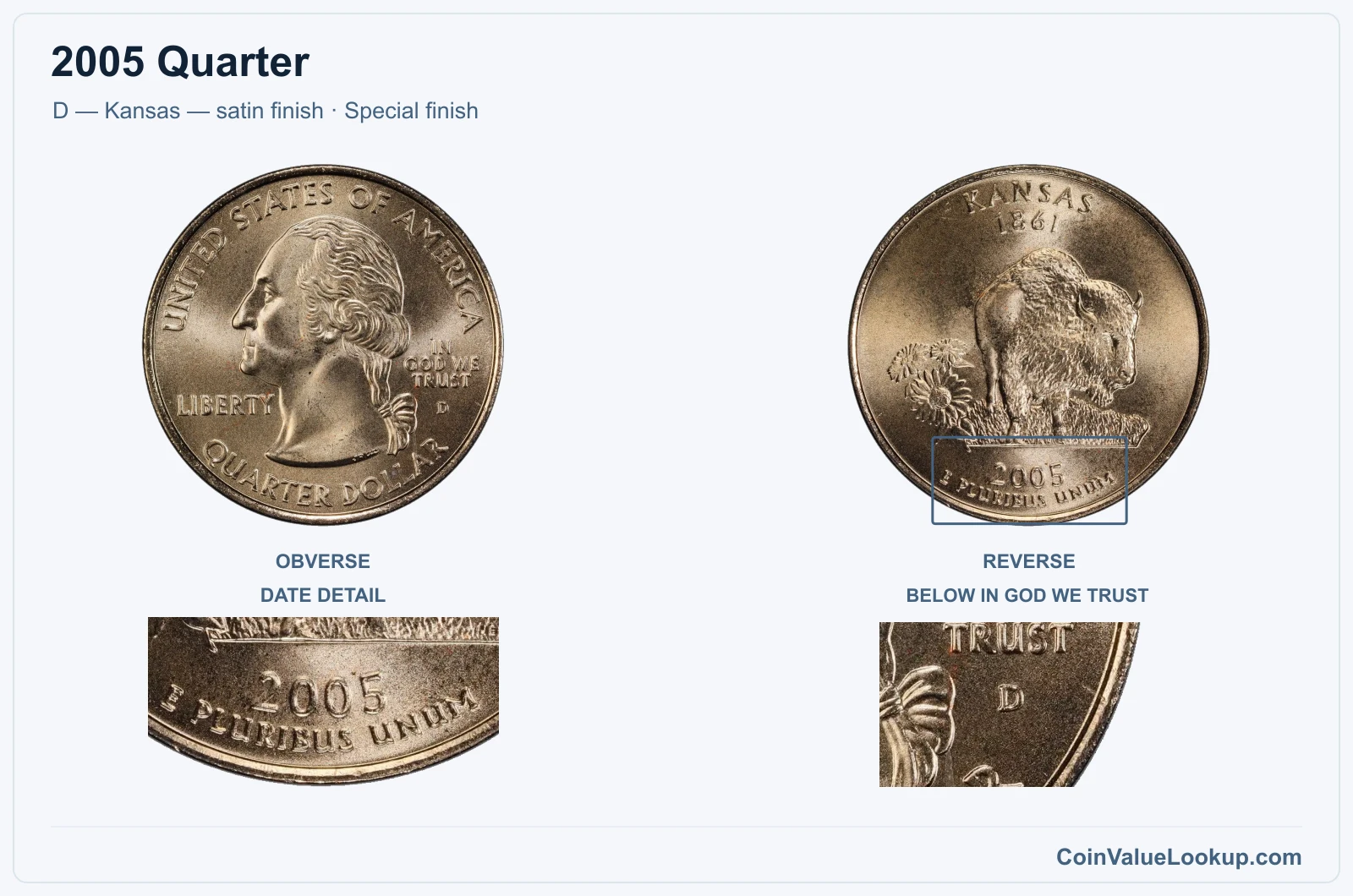
Denver satin-finish Kansas quarters were only available in the 2005 Uncirculated Mint Set. The intentional fine-grained texture covers both faces evenly and looks different from the radial cartwheel luster of a regular strike.
No guide price is adopted here. Value depends on the specific coin's condition and authenticated satin identity.
An artificially dulled surface — from cleaning or environmental exposure — does not count.
Range Grade
Price Auction Records Appraisal SP SP 1
—
Coin Identifier
SP 2
—
Coin Identifier
SP 3
—
Coin Identifier
SP 4
—
Coin Identifier
SP 6
—
Coin Identifier
SP 8
—
Coin Identifier
SP 10
—
Coin Identifier
SP 12
—
Coin Identifier
SP 15
—
Coin Identifier
SP 20
—
Coin Identifier
SP 25
—
Coin Identifier
SP 30
—
Coin Identifier
SP 35
—
Coin Identifier
SP 40
—
Coin Identifier
SP 45
—
Coin Identifier
SP 50
—
Coin Identifier
SP 53
—
Coin Identifier
SP 55
—
Coin Identifier
SP 58
—
Coin Identifier
SP 60
—
Coin Identifier
SP 61
—
Coin Identifier
SP 62
—
Coin Identifier
SP 63
—
Coin Identifier
SP 64
—
Coin Identifier
SP 65
—
Coin Identifier
SP 66
—
Coin Identifier
SP 67
Coin Identifier
SP 68
Coin Identifier
SP 69
Coin Identifier
SP 70
—
—
—
2005 Quarter — S — Kansas — clad proof
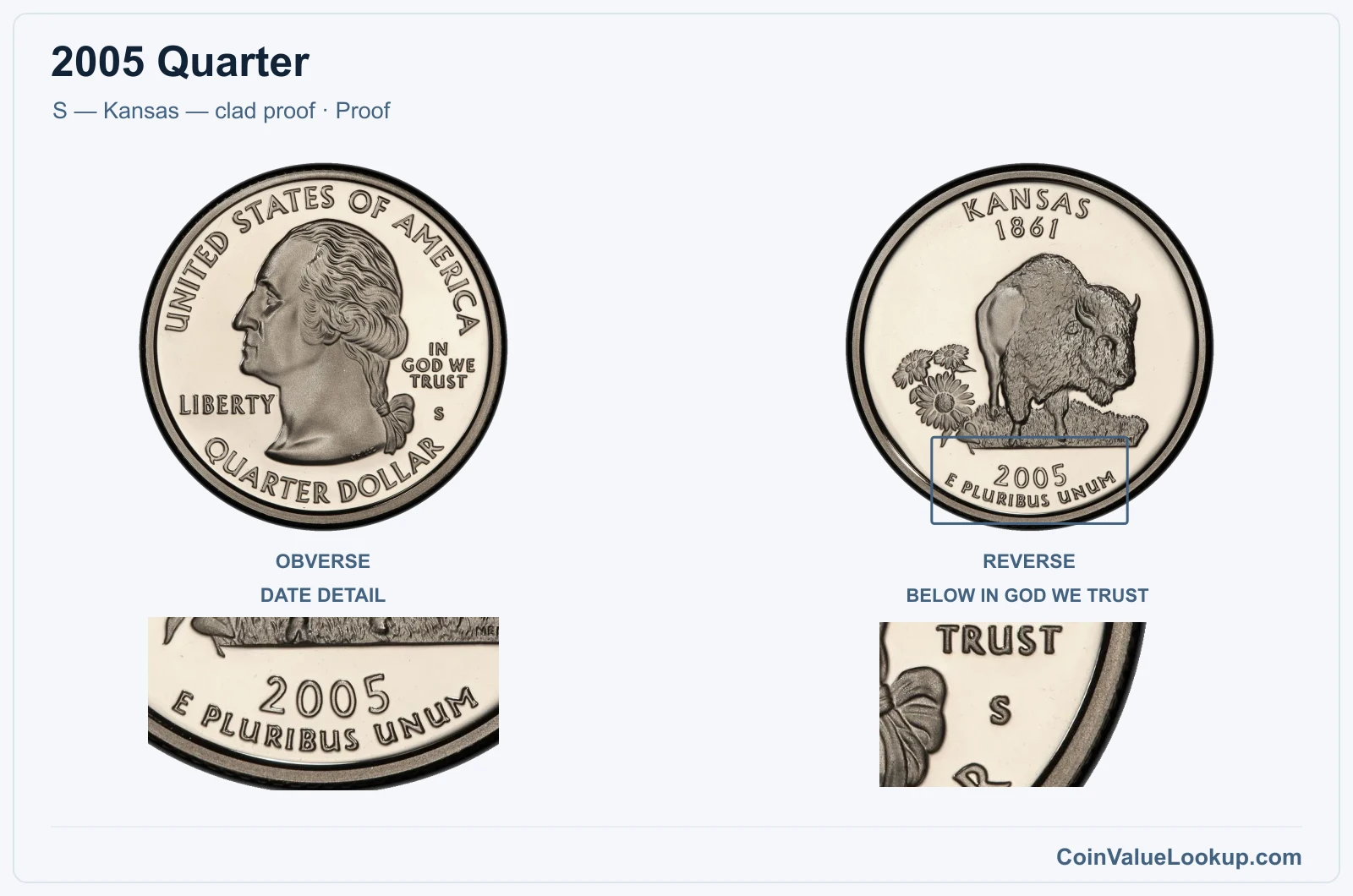
The S-mint clad proof Kansas quarter is copper-nickel clad with proof-quality mirror fields and frosted devices. USA Coin Book estimates about $5.63 at PR65.
Tell it apart from the silver proof by edge inspection or weight — the clad version weighs about 5.67 grams and shows a visible copper stripe. Original proof-set packaging is the most reliable way to confirm you have the clad rather than silver version.
Range Grade
Price Auction Records Appraisal PR PR 1
—
Coin Identifier
PR 2
—
Coin Identifier
PR 3
—
Coin Identifier
PR 4
—
Coin Identifier
PR 6
—
Coin Identifier
PR 8
—
Coin Identifier
PR 10
—
Coin Identifier
PR 12
—
Coin Identifier
PR 15
—
Coin Identifier
PR 20
—
Coin Identifier
PR 25
—
Coin Identifier
PR 30
—
Coin Identifier
PR 35
—
Coin Identifier
PR 40
—
Coin Identifier
PR 45
—
Coin Identifier
PR 50
—
Coin Identifier
PR 53
—
Coin Identifier
PR 55
—
Coin Identifier
PR 58
—
Coin Identifier
PR 60
—
Coin Identifier
PR 61
—
Coin Identifier
PR 62
—
Coin Identifier
PR 63
—
Coin Identifier
PR 64
—
Coin Identifier
PR 65
—
Coin Identifier
PR 66
—
Coin Identifier
PR 67
—
Coin Identifier
PR 68
—
Coin Identifier
PR 69
Coin Identifier
PR 70
Coin Identifier
2005 Quarter — S — Kansas — silver proof
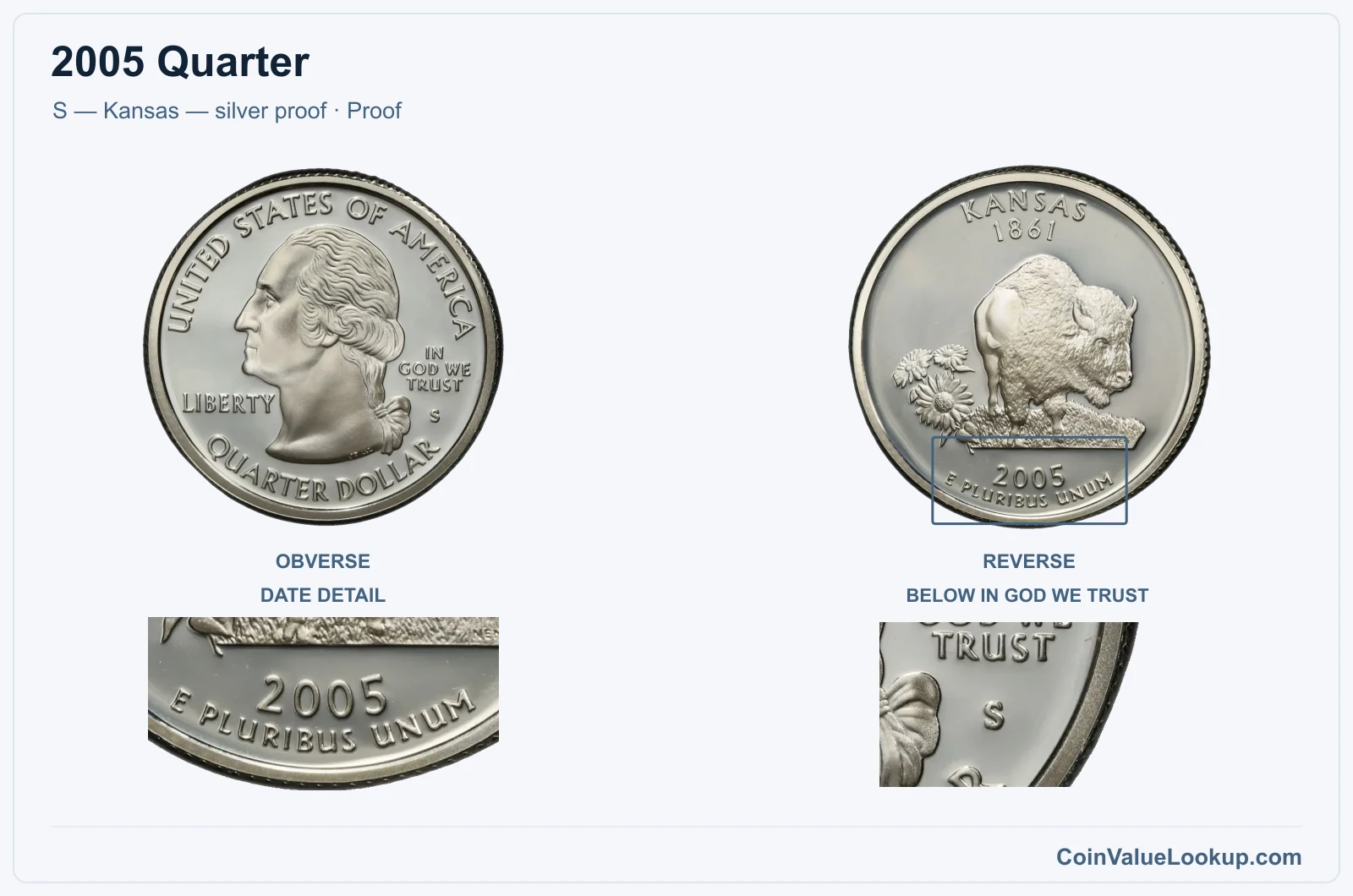
The silver proof Kansas quarter is 90% silver and weighs about 6.25 grams. No copper stripe on the edge.
USA Coin Book estimates roughly $23.00 at PR65. The silver composition and proof contrast make this the premium Kansas version for collectors.
Confirm the silver content by weight or packaging. In top proof grades the bison and sunflower design elements should show full, frosty detail against deeply mirrored fields.
Range Grade
Price Auction Records Appraisal PR PR 1
—
Coin Identifier
PR 2
—
Coin Identifier
PR 3
—
Coin Identifier
PR 4
—
Coin Identifier
PR 6
—
Coin Identifier
PR 8
—
Coin Identifier
PR 10
—
Coin Identifier
PR 12
—
Coin Identifier
PR 15
—
Coin Identifier
PR 20
—
Coin Identifier
PR 25
—
Coin Identifier
PR 30
—
Coin Identifier
PR 35
—
Coin Identifier
PR 40
—
Coin Identifier
PR 45
—
Coin Identifier
PR 50
—
Coin Identifier
PR 53
—
Coin Identifier
PR 55
—
Coin Identifier
PR 58
—
Coin Identifier
PR 60
—
Coin Identifier
PR 61
—
Coin Identifier
PR 62
—
Coin Identifier
PR 63
—
Coin Identifier
PR 64
—
Coin Identifier
PR 65
—
Coin Identifier
PR 66
—
Coin Identifier
PR 67
—
Coin Identifier
PR 68
—
Coin Identifier
PR 69
Coin Identifier
PR 70
Coin Identifier
2005 Quarter — P — West Virginia — regular strike
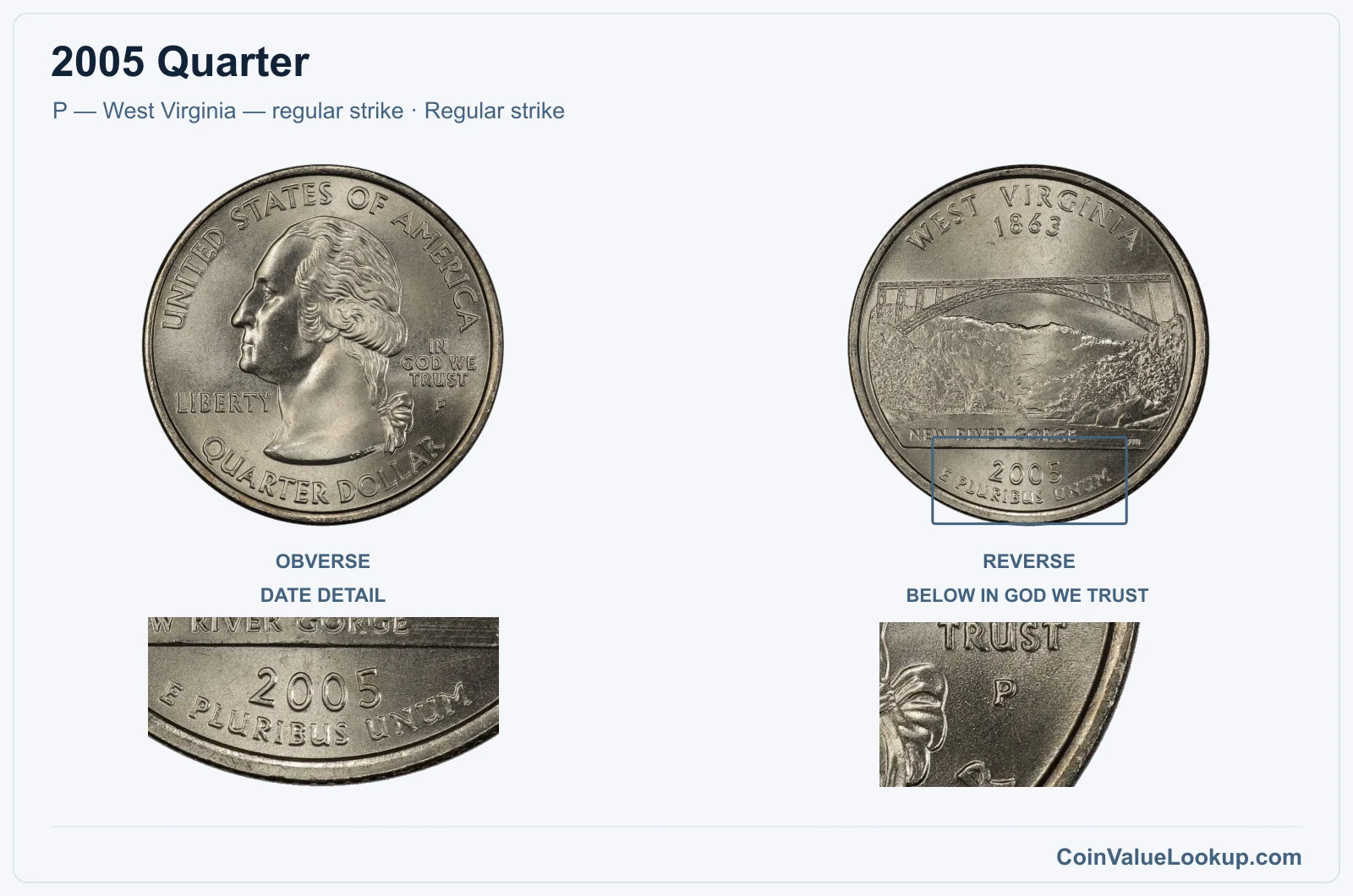
The Philadelphia West Virginia quarter is a standard copper-nickel clad business strike. The reverse depicts the New River Gorge Bridge.
USA Coin Book estimates about $0.49 at MS60 and $6.25 at MS65. Worn examples are worth face value.
Confirm the P mintmark and the West Virginia reverse. High-grade original specimens with strong luster and clean surfaces are uncommon from circulation.
Range Grade
Price Auction Records Appraisal PO PO 1
—
Coin Identifier FR FR 2
—
Coin Identifier AG AG 3
—
Coin Identifier G G 4
—
Coin Identifier
G 6
—
Coin Identifier VG VG 8
—
Coin Identifier
VG 10
—
Coin Identifier F F 12
—
Coin Identifier
F 15
—
Coin Identifier VF VF 20
—
Coin Identifier
VF 25
—
Coin Identifier
VF 30
—
Coin Identifier
VF 35
—
Coin Identifier XF XF 40
—
Coin Identifier
XF 45
—
Coin Identifier AU AU 50
—
Coin Identifier
AU 53
—
Coin Identifier
AU 55
—
Coin Identifier
AU 58
—
Coin Identifier MS MS 60
—
Coin Identifier
MS 61
—
Coin Identifier
MS 62
—
Coin Identifier
MS 63
—
Coin Identifier
MS 64
—
Coin Identifier
MS 65
Coin Identifier
MS 66
Coin Identifier
MS 67
Coin Identifier
MS 68
—
Coin Identifier
MS 69
—
—
—
MS 70
—
—
—
2005 Quarter — P — West Virginia — satin finish
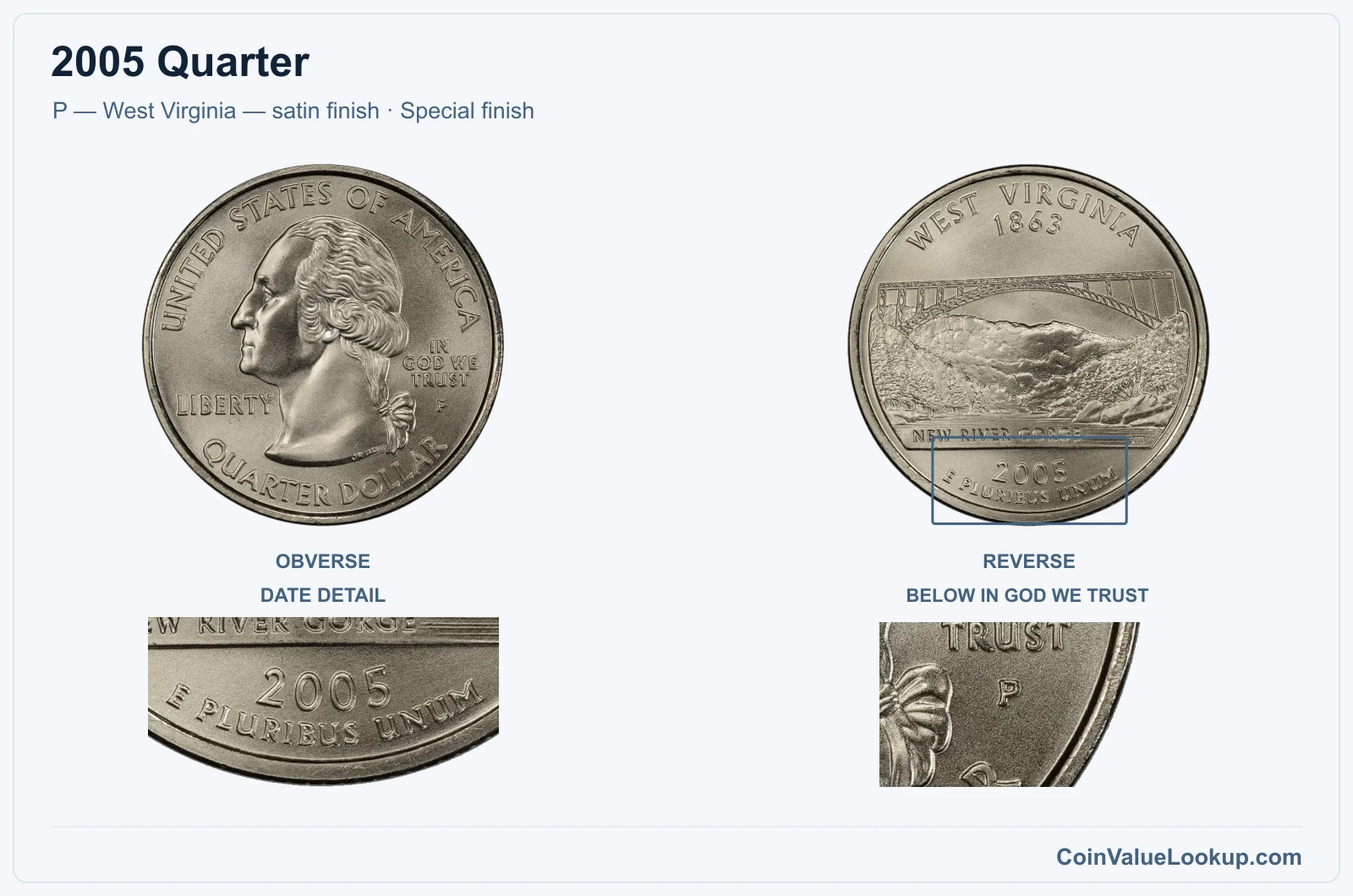
Philadelphia satin-finish West Virginia quarters came in the 2005 Uncirculated Mint Set. They feature an even, soft surface texture distinct from standard luster.
No guide price is adopted; value requires individual assessment of the coin's condition and confirmed satin identity. A coin that has simply lost its shine through wear or cleaning does not qualify.
Look for the characteristic fine-grained matte appearance across the entire surface.
Range Grade
Price Auction Records Appraisal SP SP 1
—
Coin Identifier
SP 2
—
Coin Identifier
SP 3
—
Coin Identifier
SP 4
—
Coin Identifier
SP 6
—
Coin Identifier
SP 8
—
Coin Identifier
SP 10
—
Coin Identifier
SP 12
—
Coin Identifier
SP 15
—
Coin Identifier
SP 20
—
Coin Identifier
SP 25
—
Coin Identifier
SP 30
—
Coin Identifier
SP 35
—
Coin Identifier
SP 40
—
Coin Identifier
SP 45
—
Coin Identifier
SP 50
—
Coin Identifier
SP 53
—
Coin Identifier
SP 55
—
Coin Identifier
SP 58
—
Coin Identifier
SP 60
—
Coin Identifier
SP 61
—
Coin Identifier
SP 62
—
Coin Identifier
SP 63
—
Coin Identifier
SP 64
—
Coin Identifier
SP 65
—
Coin Identifier
SP 66
—
Coin Identifier
SP 67
Coin Identifier
SP 68
Coin Identifier
SP 69
Coin Identifier
SP 70
—
Coin Identifier
2005 Quarter — D — West Virginia — regular strike
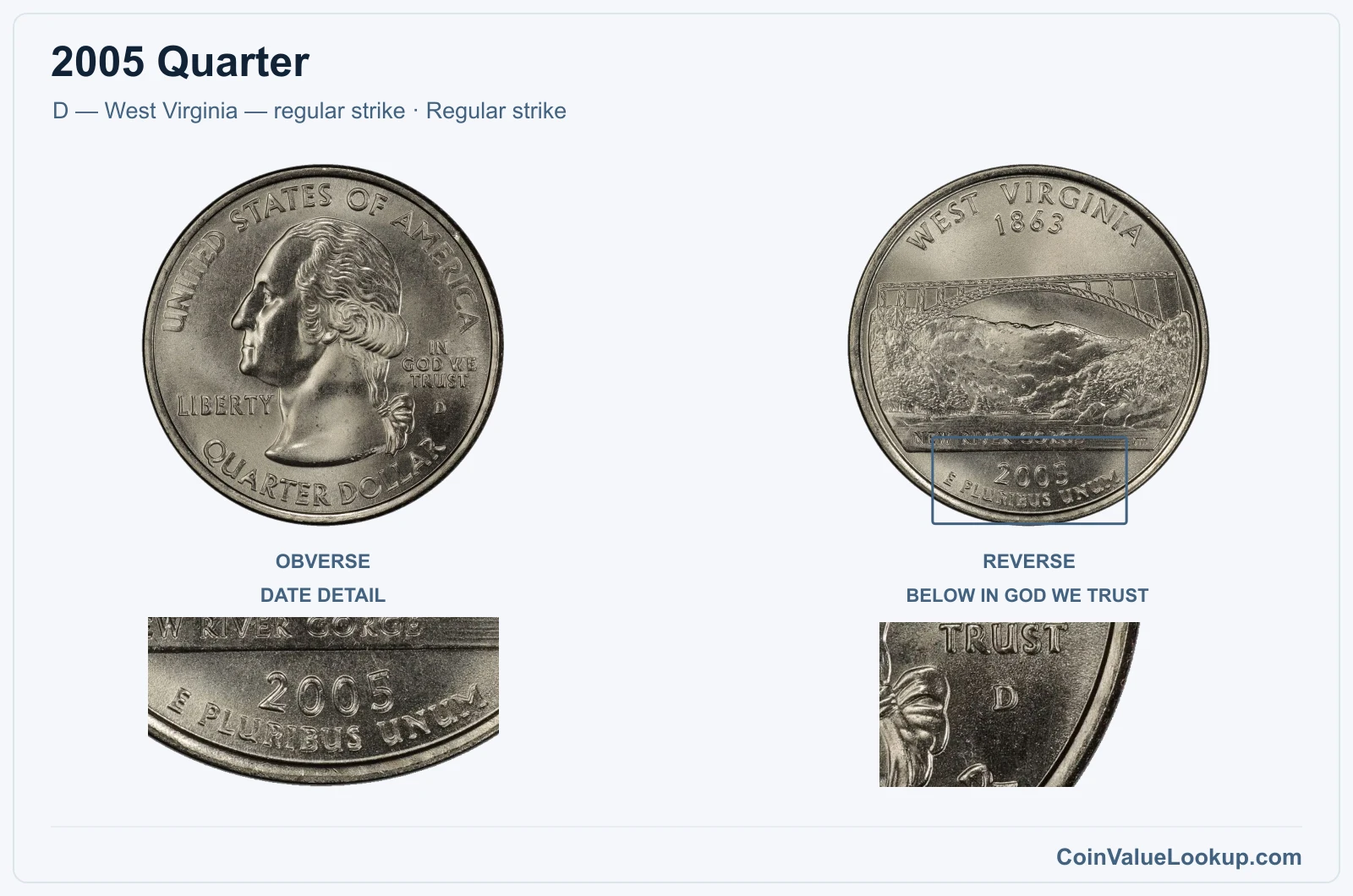
The Denver West Virginia quarter is a regular circulation strike. Copper-nickel clad, 5.67 grams, 24.26 mm diameter.
USA Coin Book estimates about $0.49 at MS60 and $6.25 in MS65. Circulated pieces are worth their face value.
Check for the D mintmark on the obverse and the New River Gorge Bridge on the reverse to properly identify this version before comparing condition.
Range Grade
Price Auction Records Appraisal PO PO 1
—
Coin Identifier FR FR 2
—
Coin Identifier AG AG 3
—
Coin Identifier G G 4
—
Coin Identifier
G 6
—
Coin Identifier VG VG 8
—
Coin Identifier
VG 10
—
Coin Identifier F F 12
—
Coin Identifier
F 15
—
Coin Identifier VF VF 20
—
Coin Identifier
VF 25
—
Coin Identifier
VF 30
—
Coin Identifier
VF 35
—
Coin Identifier XF XF 40
—
Coin Identifier
XF 45
—
Coin Identifier AU AU 50
—
Coin Identifier
AU 53
—
Coin Identifier
AU 55
—
Coin Identifier
AU 58
—
Coin Identifier MS MS 60
—
Coin Identifier
MS 61
—
Coin Identifier
MS 62
—
Coin Identifier
MS 63
—
Coin Identifier
MS 64
—
Coin Identifier
MS 65
—
Coin Identifier
MS 66
—
Coin Identifier
MS 67
Coin Identifier
MS 68
Coin Identifier
MS 69
—
—
—
MS 70
—
—
—
2005 Quarter — D — West Virginia — satin finish
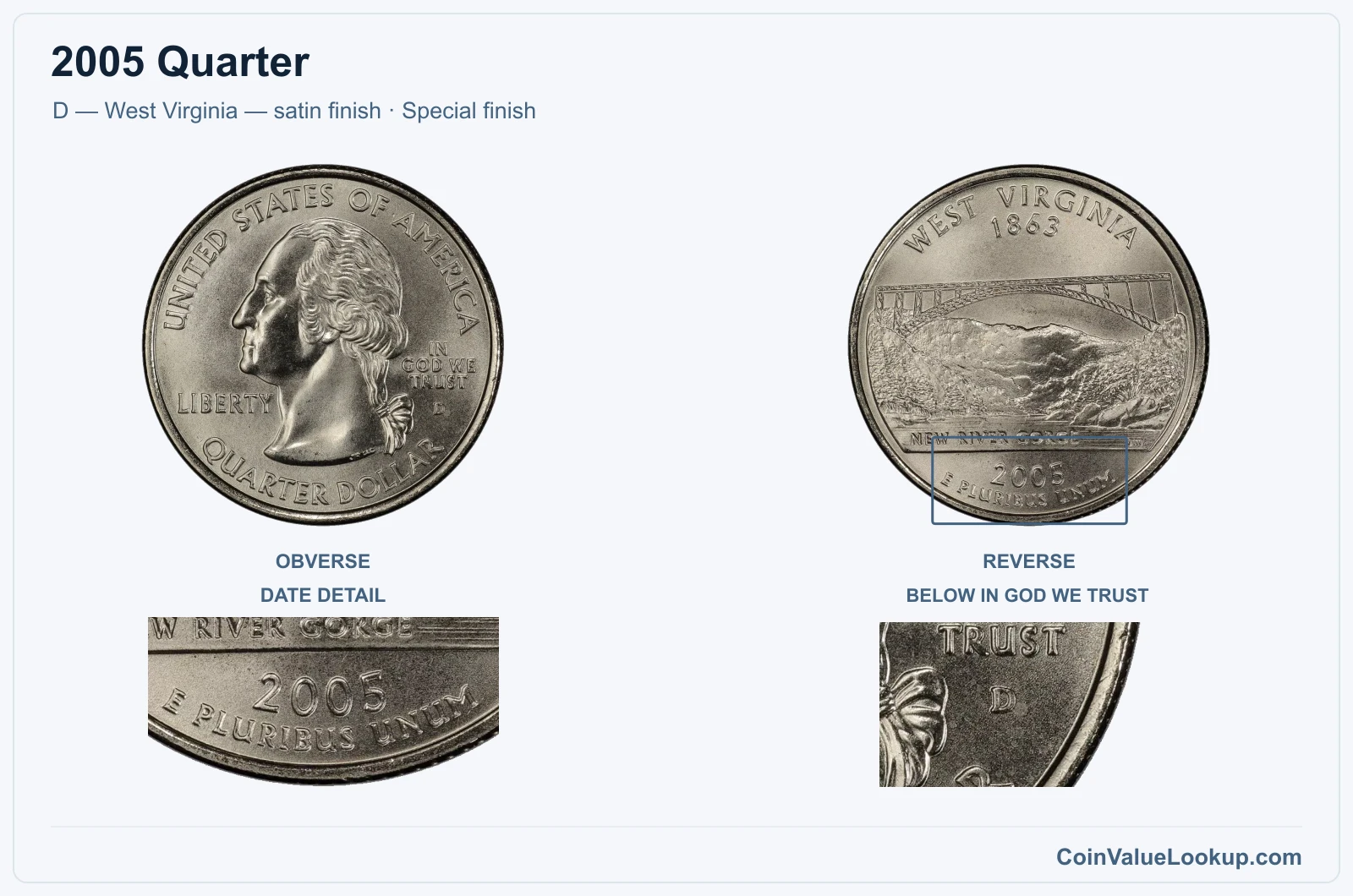
Denver satin-finish West Virginia quarters were distributed in the 2005 Uncirculated Mint Set. Like all satin issues this year, the surface has a uniform fine texture that is intentionally different from ordinary business-strike luster.
Value depends on individual condition and confirmed satin attribution. No standard guide price is adopted.
If your coin came from an original mint set and has that distinctive soft texture, it belongs in this category rather than the regular-strike line.
Range Grade
Price Auction Records Appraisal SP SP 1
—
Coin Identifier
SP 2
—
Coin Identifier
SP 3
—
Coin Identifier
SP 4
—
Coin Identifier
SP 6
—
Coin Identifier
SP 8
—
Coin Identifier
SP 10
—
Coin Identifier
SP 12
—
Coin Identifier
SP 15
—
Coin Identifier
SP 20
—
Coin Identifier
SP 25
—
Coin Identifier
SP 30
—
Coin Identifier
SP 35
—
Coin Identifier
SP 40
—
Coin Identifier
SP 45
—
Coin Identifier
SP 50
—
Coin Identifier
SP 53
—
Coin Identifier
SP 55
—
Coin Identifier
SP 58
—
Coin Identifier
SP 60
—
Coin Identifier
SP 61
—
Coin Identifier
SP 62
—
Coin Identifier
SP 63
—
Coin Identifier
SP 64
—
Coin Identifier
SP 65
—
Coin Identifier
SP 66
—
Coin Identifier
SP 67
Coin Identifier
SP 68
Coin Identifier
SP 69
Coin Identifier
SP 70
—
—
—
2005 Quarter — S — West Virginia — clad proof
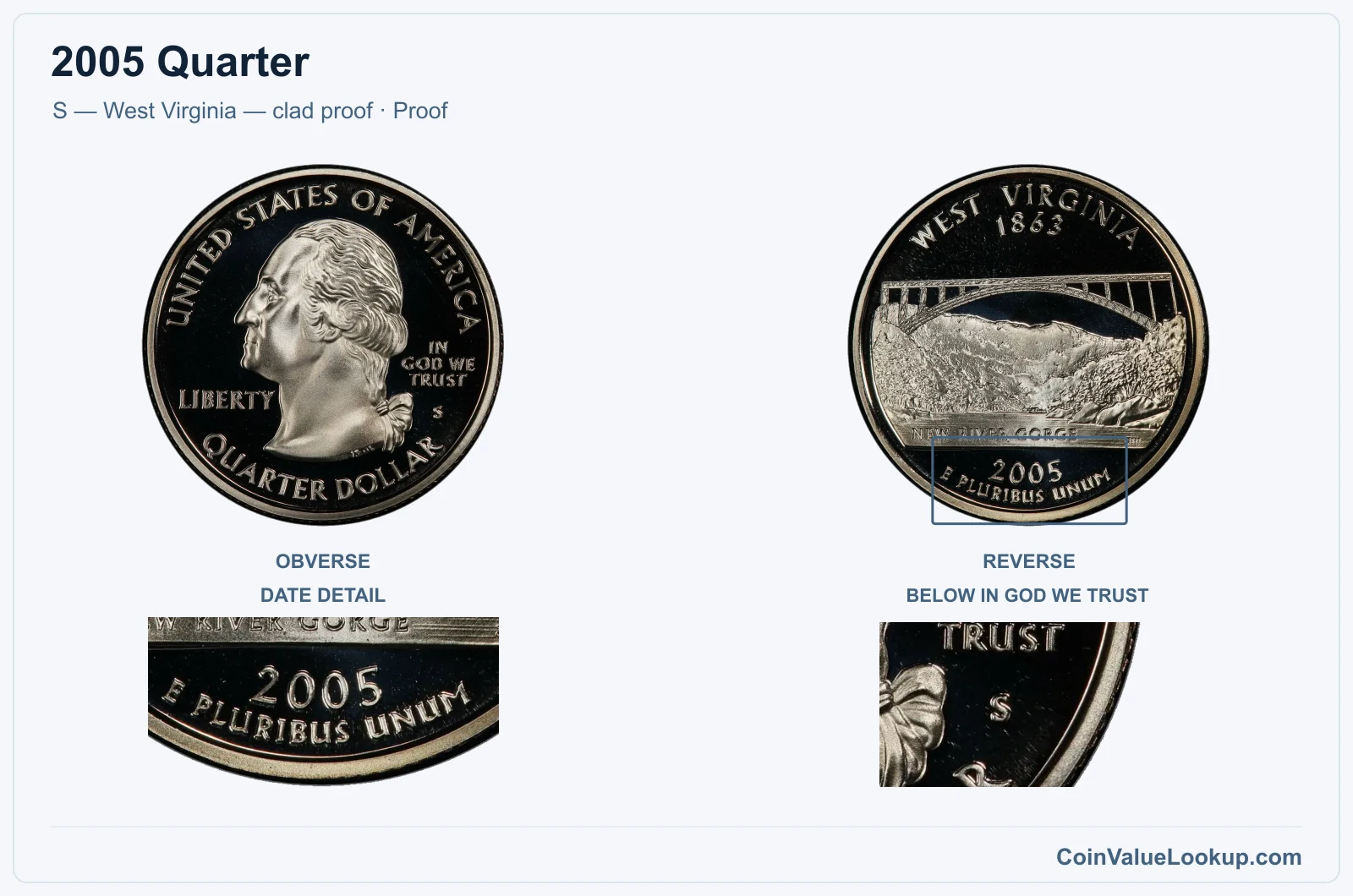
The S-mint clad proof West Virginia quarter is copper-nickel clad with mirror fields and frosted devices. USA Coin Book estimates about $5.63 at PR65.
The clad proof weighs roughly 5.67 grams and shows a copper stripe along the edge — that is how you tell it from the silver proof. Original proof-set packaging provides the simplest confirmation.
Handle by the edges; fingerprints on proof fields are not easy to remove.
Range Grade
Price Auction Records Appraisal PR PR 1
—
Coin Identifier
PR 2
—
Coin Identifier
PR 3
—
Coin Identifier
PR 4
—
Coin Identifier
PR 6
—
Coin Identifier
PR 8
—
Coin Identifier
PR 10
—
Coin Identifier
PR 12
—
Coin Identifier
PR 15
—
Coin Identifier
PR 20
—
Coin Identifier
PR 25
—
Coin Identifier
PR 30
—
Coin Identifier
PR 35
—
Coin Identifier
PR 40
—
Coin Identifier
PR 45
—
Coin Identifier
PR 50
—
Coin Identifier
PR 53
—
Coin Identifier
PR 55
—
Coin Identifier
PR 58
—
Coin Identifier
PR 60
—
Coin Identifier
PR 61
—
Coin Identifier
PR 62
—
Coin Identifier
PR 63
—
Coin Identifier
PR 64
—
Coin Identifier
PR 65
—
Coin Identifier
PR 66
—
Coin Identifier
PR 67
—
Coin Identifier
PR 68
—
Coin Identifier
PR 69
Coin Identifier
PR 70
Coin Identifier
2005 Quarter — S — West Virginia — silver proof
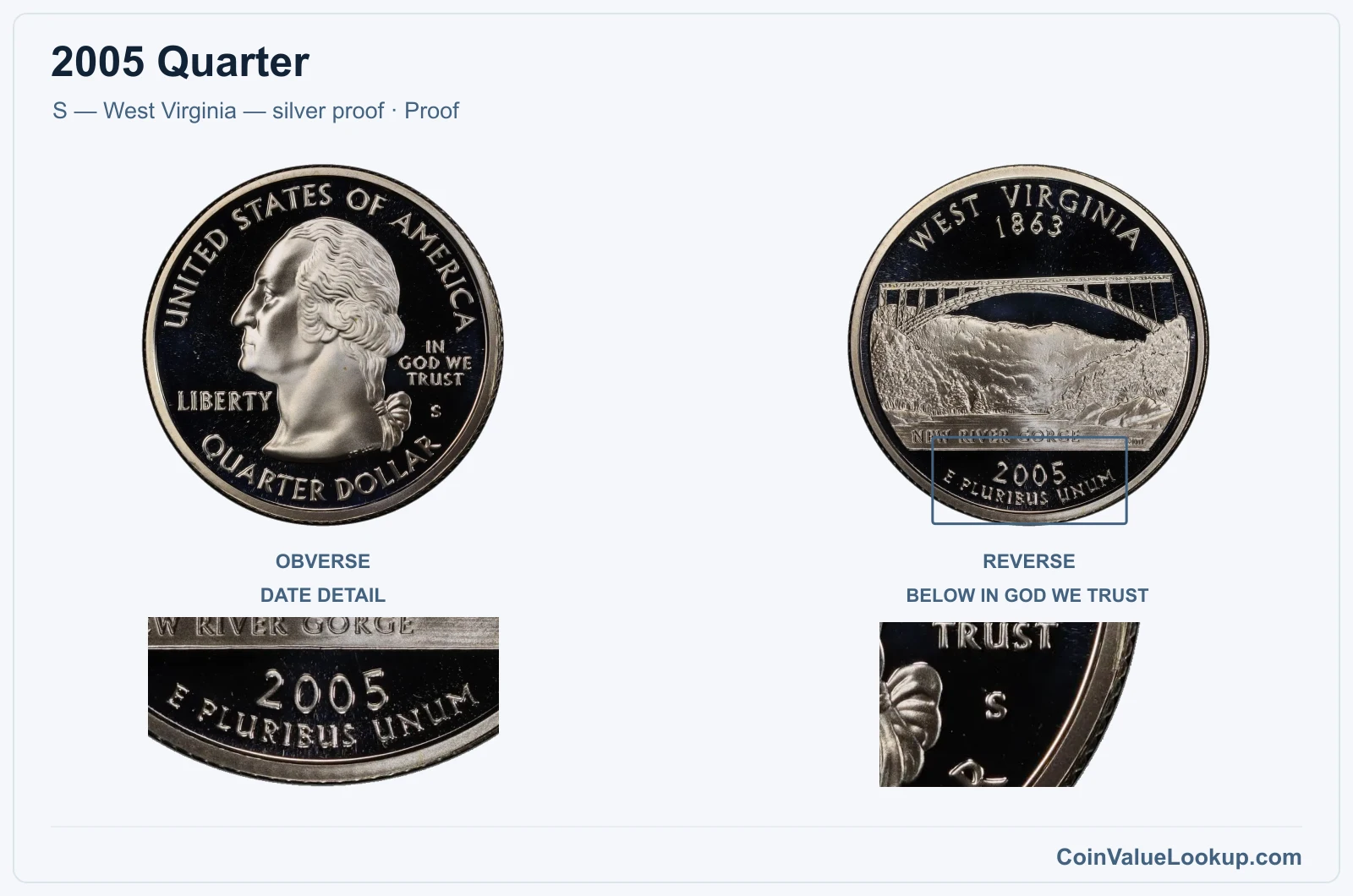
The silver proof West Virginia quarter is 90% silver, about 6.25 grams, with no copper edge stripe. USA Coin Book estimates approximately $23.00 at PR65.
The New River Gorge Bridge design looks particularly sharp in the proof format, with frosted devices standing out against deep mirror fields. Verify the silver composition by weight or original silver proof set packaging.
This is one of three 2005 silver proof quarters that share the top guide value at PR65.
Range Grade
Price Auction Records Appraisal PR PR 1
—
Coin Identifier
PR 2
—
Coin Identifier
PR 3
—
Coin Identifier
PR 4
—
Coin Identifier
PR 6
—
Coin Identifier
PR 8
—
Coin Identifier
PR 10
—
Coin Identifier
PR 12
—
Coin Identifier
PR 15
—
Coin Identifier
PR 20
—
Coin Identifier
PR 25
—
Coin Identifier
PR 30
—
Coin Identifier
PR 35
—
Coin Identifier
PR 40
—
Coin Identifier
PR 45
—
Coin Identifier
PR 50
—
Coin Identifier
PR 53
—
Coin Identifier
PR 55
—
Coin Identifier
PR 58
—
Coin Identifier
PR 60
—
Coin Identifier
PR 61
—
Coin Identifier
PR 62
—
Coin Identifier
PR 63
—
Coin Identifier
PR 64
—
Coin Identifier
PR 65
—
Coin Identifier
PR 66
—
Coin Identifier
PR 67
—
Coin Identifier
PR 68
—
Coin Identifier
PR 69
Coin Identifier
PR 70
Coin Identifier
2005 Quarter Error List
1. 2005 Quarter — Minnesota Extra Tree / Doubled Die Reverse
A doubled die reverse on the 2005 Minnesota quarter shows consistent doubling on reverse design elements — sometimes described as an extra tree line in the design. To check, compare your coin's reverse details against a normal Minnesota quarter under magnification.
Look for clear, consistent separation or thickening of design contours rather than a flat, shelf-like spread. Machine doubling produces a different look: flat and mushy rather than sharp and raised.
Random damage, bag marks or reflections from lighting can also mimic doubling to the untrained eye. The value of a genuine doubled die reverse depends on the visibility of the doubling and the coin's overall condition.
Professional authentication is the standard way to confirm this type of variety.
2. 2005 Quarter — West Virginia — Off-Center Strike
An off-center strike on the 2005-P West Virginia quarter occurs when the planchet is not properly seated between the dies at the moment of striking. The result is a displaced design with an unstruck crescent of blank metal along one side.
The more dramatic the displacement — and the more of the date and mintmark that remain visible — the more collector interest the coin generates. Do not confuse this with a clipped planchet, which involves a missing piece of the blank before striking.
One-sided die misalignment or post-mint flattening can also create misleading impressions. Value depends on the degree of off-center shift, the condition of the struck portion and whether key design elements are still visible.
3. 2005 Quarter — Minnesota — Doubled Die Obverse
The 2005-P Minnesota doubled die obverse shows consistent doubling on obverse design elements — letters, the date or portions of Washington's portrait. Under magnification, look for clear separation or notching on the affected areas.
The doubling should appear uniform and raised, not flat or mushy. Machine doubling is the most common lookalike: it creates a flat, shelf-like distortion rather than the sharp, distinct secondary image of a true doubled die.
Worn die contours and odd lighting angles can also fool you. If you see something promising, compare several areas of the obverse — genuine hub doubling tends to be consistent across multiple design elements.
Value depends on the strength and visibility of the doubling, plus the coin's condition.
4. 2005 Quarter — Oregon — Doubled Die Reverse
A doubled die reverse has been reported on the 2005 Oregon quarter. This shows as consistent doubling on reverse lettering or design elements around the Crater Lake scene.
Compare your coin's reverse to a normal example under magnification and good lighting. You are looking for raised, sharp secondary lines or separation rather than flat shelving.
Machine doubling is the usual suspect — it produces a different texture, more like a smeared or flattened echo of the design. Random damage and reflections can also trick you at first glance.
A confirmed doubled die reverse on this design commands collector interest that depends on the doubling's strength and the overall condition of the coin. Authentication is recommended for any serious attribution.
5. 2005 Quarter — Oregon — Clipped Planchet
Clipped planchet errors on the 2005 Oregon quarter result from a missing portion of the original metal blank. The clip can be curved, straight or irregular, and a genuine one often shows a characteristic weakness in the design on the opposite side of the coin from the clip — this is called the Blakesley effect.
Check the edge texture around the clip area; it should show metal flow consistent with striking rather than a clean cut. A filed edge, post-mint damage or corrosion can look similar at first glance but will not produce the same pattern of opposite-side weakness.
Value depends on the size and type of the clip, the overall condition and whether the main design elements remain identifiable. Professional attribution confirms the clip occurred before striking.
6. 2005 Quarter — Kansas “In God We Rust” Grease-Filled Die
The 2005 Kansas quarter has a well-known grease-filled die error sometimes nicknamed "In God We Rust." It happens when grease or debris fills part of the die cavity, preventing the design from fully striking. On affected coins, portions of the motto or other lettering appear incomplete or filled in — the T in TRUST being a famous target.
The surface in the affected area looks flat and smooth rather than sharply incised. Do not confuse this with ordinary wear, which removes detail from high points gradually and evenly.
A cleaned or scratched coin can also lose definition in small letters without being an error. Value depends on how dramatic and clearly defined the missing detail is, plus the coin's overall condition.
7. 2005 Quarter — Minnesota — Double / Multiple Strike
A double strike or multiple strike error on the 2005 Minnesota quarter shows two or more separate impressions of the design on the same coin. You will see displaced or rotated copies of design elements — not just thickened letters, but clearly separate overlapping images.
This is different from a doubled die, which is a die-manufacturing issue producing consistent doubling across every coin struck by that die. A double strike happens to one individual coin that was struck more than once.
After-the-fact impressions from machinery or other coins post-minting can mimic the look, so examine the relationship between the multiple images carefully. Value depends on how dramatic and clear the multiple impressions are, and on the coin's preservation.
8. 2005 Quarter — California — Rotated Dies
A rotated die error on the 2005 California quarter means the obverse and reverse dies were misaligned rotationally when the coin was struck. To test for this, hold the obverse upright and flip the coin top to bottom — on a normal US coin, the reverse should also appear upright.
If the reverse is tilted, you may have a rotation error. The degree of rotation matters: a few degrees is minor, while 90 or 180 degrees is dramatic and much scarcer.
Do not confuse this with a photograph that was simply taken at an angle, or a coin you are holding sideways. Value depends on the degree of rotation and the coin's overall condition.
9. 2005 Quarter — California — Missing Clad Layer
A missing clad layer error on the 2005 California quarter means one of the outer copper-nickel layers was absent when the coin was struck. The affected face may appear a different color — often showing the underlying copper core — and the coin will weigh less than the standard 5.67 grams.
Compare the edge cross-section with a normal clad quarter: you should see an asymmetric layering if one side is missing its clad. Toning, corrosion, plating or surface metal removed after minting can all mimic the look of a missing clad layer to the casual observer.
The difference is that a genuine missing-layer coin will have consistent color and reduced weight. Value depends on condition and confirmation of the error.
10. 2005 Quarter — Kansas — Die Break / Cud
A die break or cud error on the 2005 Kansas quarter occurs when a piece of the die breaks away, leaving a raised blob of metal on the coin. A cud specifically connects to the rim.
One well-known reported example is sometimes called the "Humpback Bison" because the die break appears on or near the bison on the Kansas reverse, creating an unusual raised lump. Look for a raised, featureless area with a clear boundary where normal design detail resumes.
A rim dent, corrosion spot or small interior die chip can look similar but will have different characteristics — dents are depressed, not raised, and corrosion has a rough, pitted texture. Value depends on the size, location and visual drama of the break, plus the coin's condition.
11. 2005 Quarter — Kansas — Clipped Planchet
A clipped planchet error has been reported on the 2005-P Kansas quarter. This means a portion of the original metal blank was missing before the coin was struck.
The clip leaves a curved, straight or irregular gap along the edge where metal should be. A genuine clip often produces a corresponding area of design weakness on the opposite side of the coin.
Check the edge near the clip — it should show metal-flow characteristics consistent with striking, not a clean mechanical cut or file marks. Post-mint damage such as an edge gouge, filed notch or corrosion can resemble a clip but will not produce that opposite-side weakness.
Value depends on the clip's size, the coin's condition and whether the main design elements remain visible.
12. 2005 Quarter — Die Crack / Die Chip
Die cracks and die chips have been reported on 2005 proof silver States Quarters. A die crack shows up as a thin raised line on the coin's surface, tracing where the die itself developed a fracture.
A die chip appears as a small raised blob where a tiny piece of the die broke away. Both are raised features — if a line on your coin is incuse (sunk into the surface), it is more likely a scratch.
Die cracks can run across open fields or through lettering, and they sometimes connect to the rim. Incuse scratches, corrosion and foreign material stuck to the surface are common lookalikes.
Value depends on the length, location and visual impact of the crack or chip, as well as the coin's overall condition.