2011 Quarter Coin Value: How Much Is It Worth?
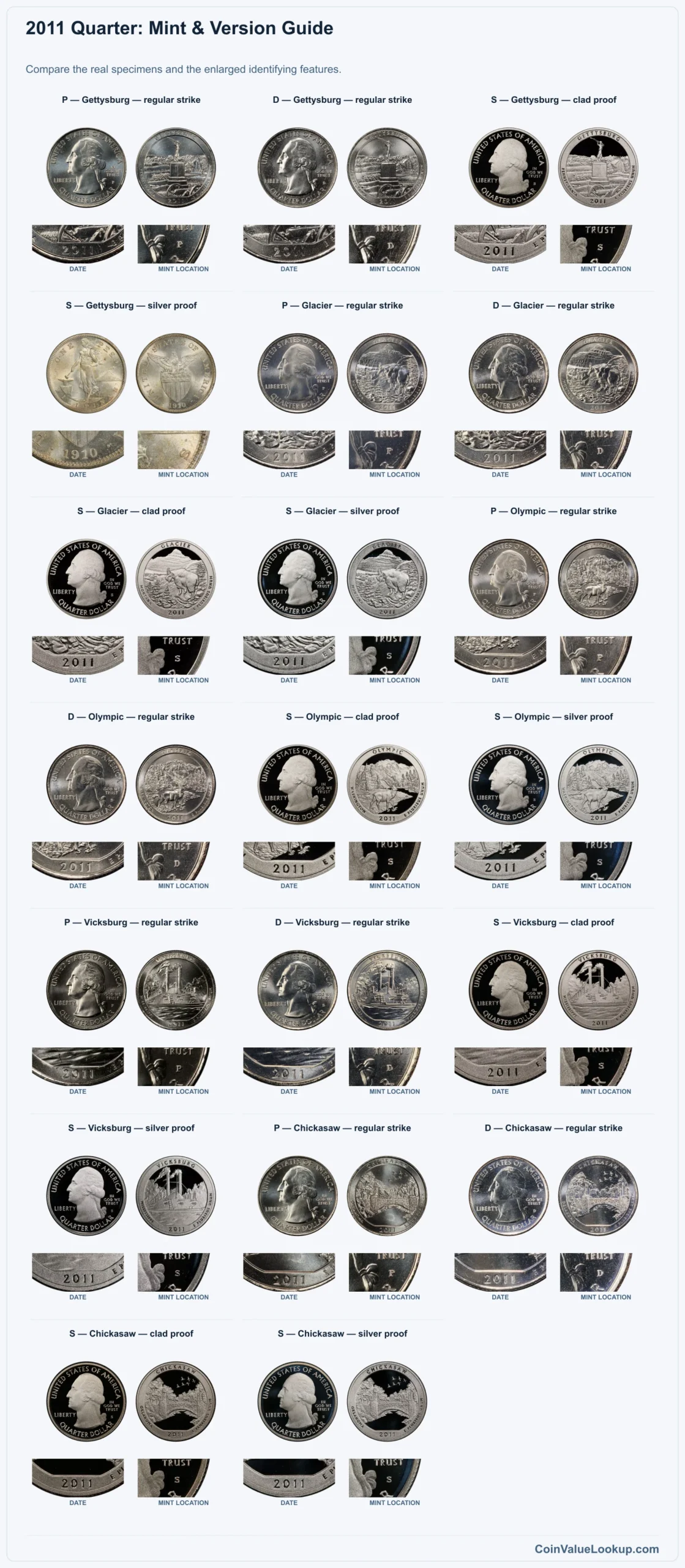
The 2011 quarter belongs to the America the Beautiful series, and it was minted with five different reverse designs: Gettysburg, Glacier, Olympic, Vicksburg and Chickasaw. Guide estimates from USA Coin Book range from $0.68 to $24.00 depending on the specific mint, reverse design, finish and grade.
That is not a single price range for every coin — most circulated examples sit near face value, while silver proofs at PR65 carry the highest guide figures.
Fast Way to Identify Your 2011 Quarter
Upload clear photos of both sides of your 2011 quarter and let the identifier give you a preliminary read on the mint, reverse design and finish. That first step narrows your coin to one of twenty listed versions.
From there you can compare condition to the right part of the guide chart.
2011 Quarter Value
Upload both sides of your 2011 Quarter.
Front Obverse
Upload photo
Back Reverse
Upload photo
Which 2011 Quarter Versions Are Worth Money?
- S-mint silver proofs carry the highest guide figures at PR65 — $24.00 each per USA Coin Book — across all five reverse designs (Gettysburg, Glacier, Olympic, Vicksburg, Chickasaw).
- S-mint clad proofs are listed at $5.63 in PR65, well above business-strike values but below silver proofs — confirm composition before assuming silver.
- Check mint and finish first; damage, wear or a bright cleaned surface does not establish a rare or valuable version.
Step 1: Identify Your 2011 Quarter Mint Mark and Version
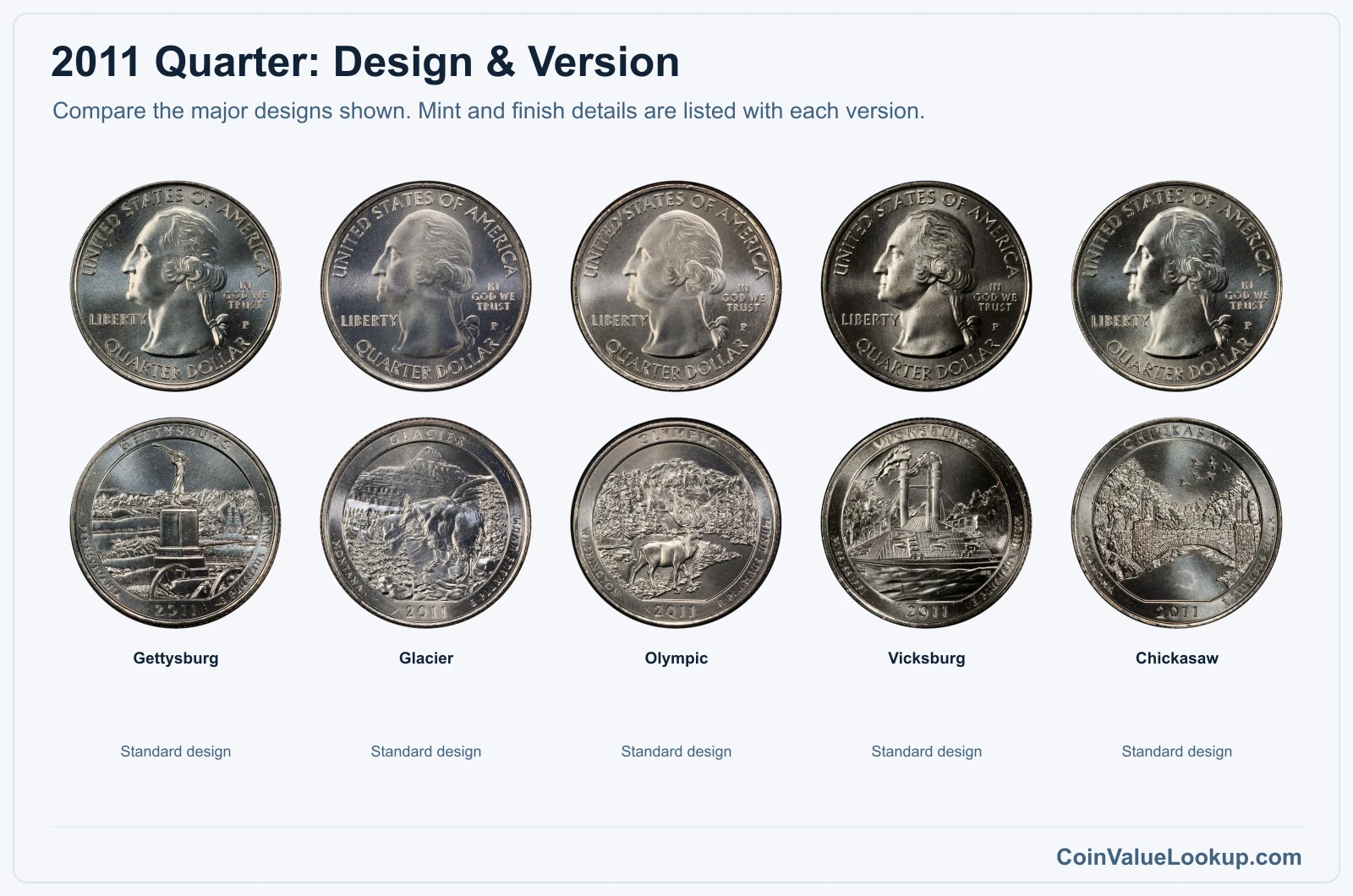
Start on the obverse. Look for the small mintmark letter near the base of Washington's portrait — P for Philadelphia, D for Denver, S for San Francisco.
Every 2011 quarter carries one of those three.
Next, flip the coin over and identify the reverse design. The five 2011 subjects are Gettysburg (Pennsylvania), Glacier (Montana), Olympic (Washington), Vicksburg (Mississippi) and Chickasaw (Oklahoma).
Each design is distinct, so a quick visual comparison settles it.
Ordinary business-strike quarters from P and D are copper-nickel clad over a copper core, weigh about 5.67 grams and measure 24.26 mm across. San Francisco produced both clad proofs and silver proofs.
The silver proof is 90% silver, 10% copper and weighs roughly 6.25 grams — noticeably heavier than a clad coin of the same size.
To tell a clad proof from a silver proof, check the edge. A clad coin shows a visible copper-toned stripe sandwiched between lighter layers.
A silver proof has a uniform silver-white edge. Weight on a gram scale confirms it.
Do not rely on surface color alone, because toning can fool you.
Any date you see in the reverse artwork refers to the park or site's history, not the minting year. The minting year is always on the obverse.
Also, this guide covers standard-size quarters only — the five-ounce silver collector and bullion versions share the same designs but are a completely separate format with different values.
Step 2: Check Your 2011 Quarter Grade
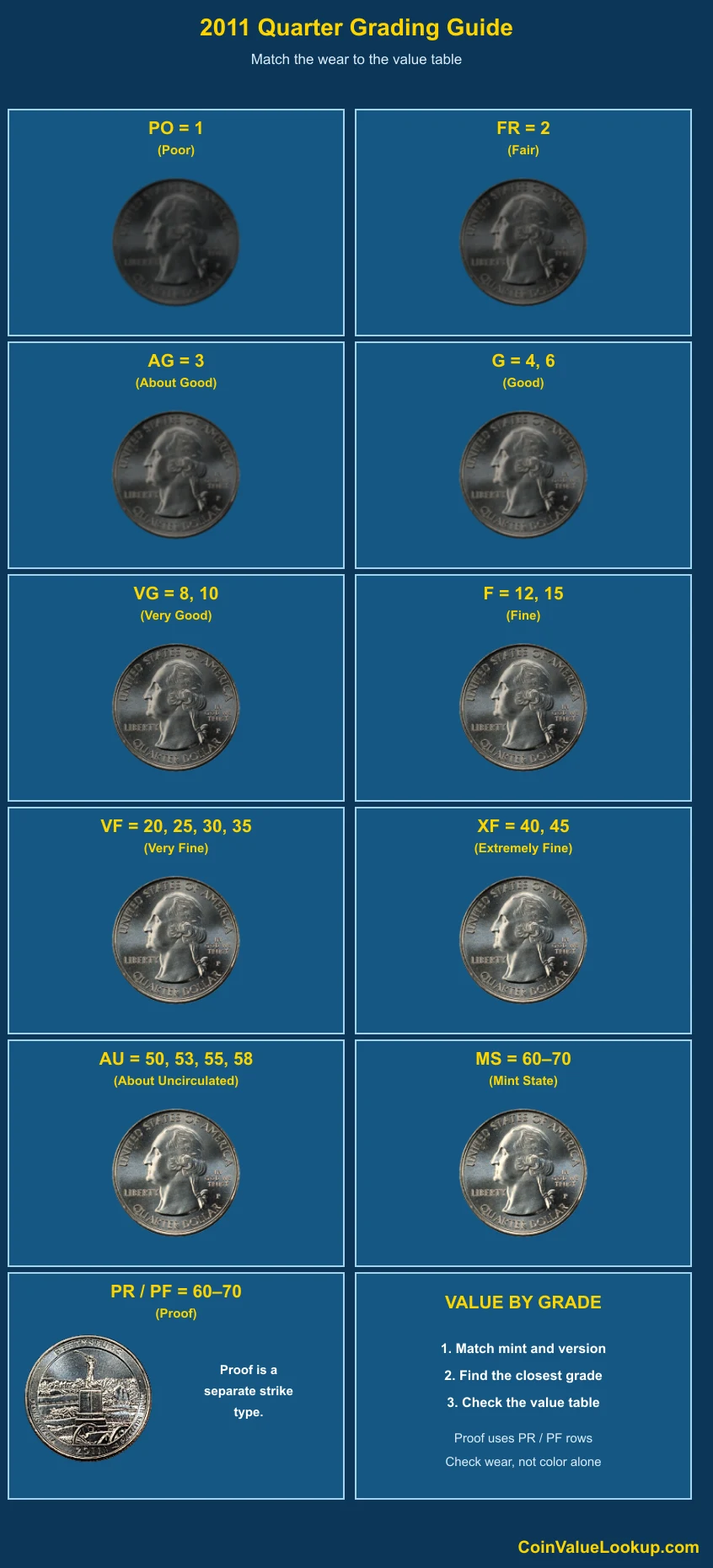
Focus on Washington's cheek and the hair detail just above his ear. On a lightly circulated coin those areas flatten first, giving you a quick read on how much the coin has been handled.
Compare that wear against the high-relief points of the reverse design, which vary by subject.
Luster matters as much as detail. Hold the coin at an angle under a single light source and look for the original mint cartwheel sheen.
A coin can have full detail from a strong strike yet show dulled or cleaned surfaces, and that distinction affects grade.
For proofs, examine the mirror-like fields for hairlines, haze and contact marks. Even light wipe marks visible under magnification lower the grade.
Use the comparison image to match your coin's overall look — proofs are graded on a different scale than business strikes, so keep those evaluations separate.
Don't assume a bright coin is uncirculated. A cleaned coin often has a flat, slightly hazy brightness with fine parallel lines visible under a loupe.
That is not original luster.
Step 3: Check 2011 Quarter Value by Mint and Version
2011 Quarter — P — Gettysburg — regular strike
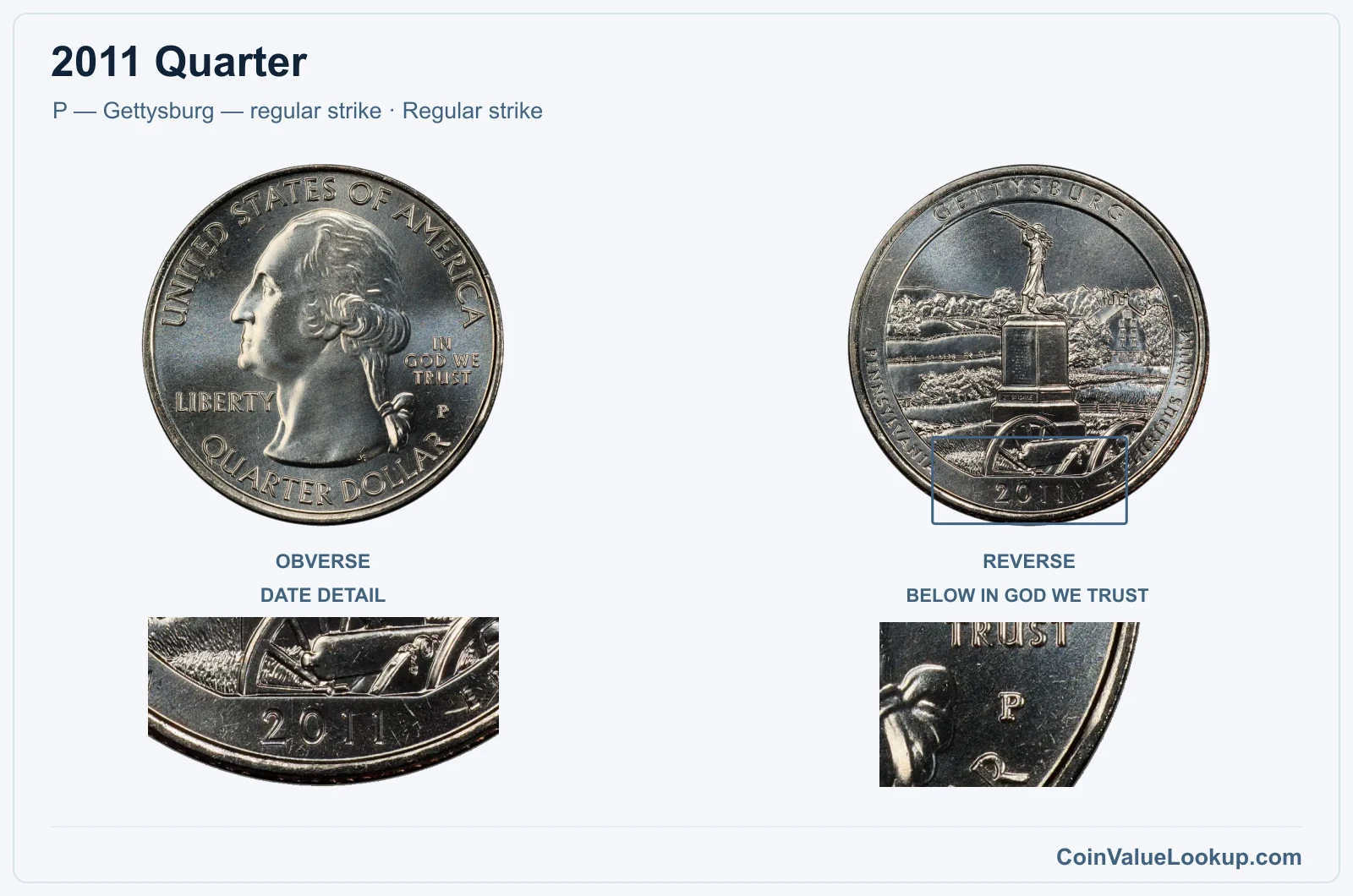
This is the Philadelphia-mint Gettysburg quarter, copper-nickel clad over a copper core, struck for circulation. It weighs about 5.67 grams and measures 24.26 mm.
Confirm the P mintmark and the Gettysburg reverse before checking the grade chart.
Worn examples trade near face value — 25 cents and not a penny more. USA Coin Book lists guide estimates of about $0.74 at MS60 and $1.24 at MS65.
Only truly original, uncirculated examples with full luster reach that upper figure.
Range Grade
Price Auction Records Appraisal PO PO 1
—
Coin Identifier FR FR 2
—
Coin Identifier AG AG 3
—
Coin Identifier G G 4
—
Coin Identifier
G 6
—
Coin Identifier VG VG 8
—
Coin Identifier
VG 10
—
Coin Identifier F F 12
—
Coin Identifier
F 15
—
Coin Identifier VF VF 20
—
Coin Identifier
VF 25
—
Coin Identifier
VF 30
—
Coin Identifier
VF 35
—
Coin Identifier XF XF 40
—
Coin Identifier
XF 45
—
Coin Identifier AU AU 50
—
Coin Identifier
AU 53
—
Coin Identifier
AU 55
—
Coin Identifier
AU 58
—
Coin Identifier MS MS 60
—
Coin Identifier
MS 61
—
Coin Identifier
MS 62
—
Coin Identifier
MS 63
—
Coin Identifier
MS 64
—
Coin Identifier
MS 65
—
Coin Identifier
MS 66
—
Coin Identifier
MS 67
—
Coin Identifier
MS 68
—
—
—
MS 69
—
—
—
MS 70
—
—
—
2011 Quarter — D — Gettysburg — regular strike
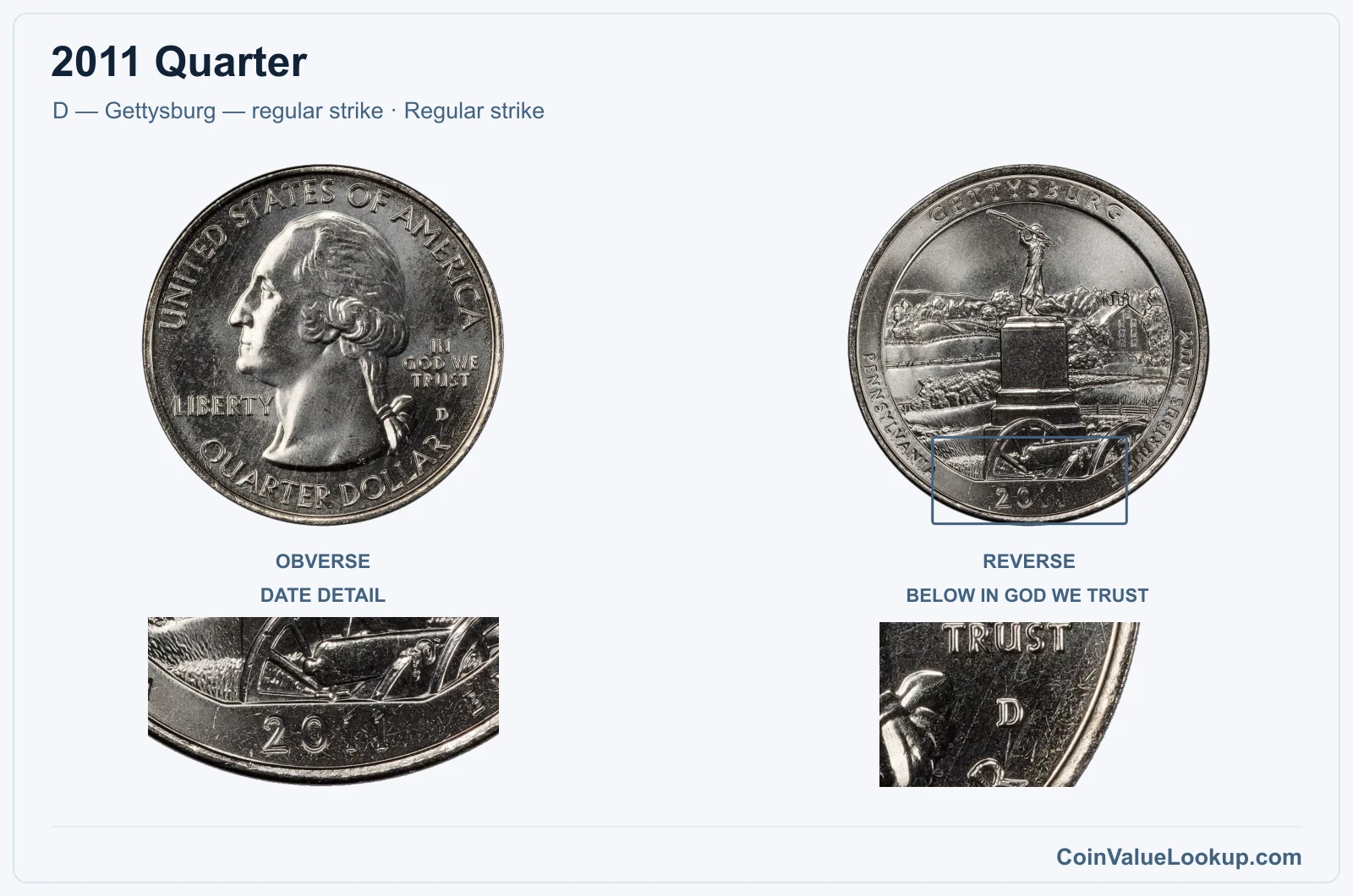
The Denver-mint Gettysburg quarter is the same copper-nickel clad composition, same weight and diameter as the Philadelphia version. Look for the D mintmark on the obverse.
Guide estimates from USA Coin Book place this coin at roughly $0.74 in MS60 and $1.24 in MS65. These are not guaranteed sale prices.
Circulated pieces are worth face value. If your coin shows any wear on Washington's cheek or hair, it falls below MS60.
Range Grade
Price Auction Records Appraisal PO PO 1
—
Coin Identifier FR FR 2
—
Coin Identifier AG AG 3
—
Coin Identifier G G 4
—
Coin Identifier
G 6
—
Coin Identifier VG VG 8
—
Coin Identifier
VG 10
—
Coin Identifier F F 12
—
Coin Identifier
F 15
—
Coin Identifier VF VF 20
—
Coin Identifier
VF 25
—
Coin Identifier
VF 30
—
Coin Identifier
VF 35
—
Coin Identifier XF XF 40
—
Coin Identifier
XF 45
—
Coin Identifier AU AU 50
—
Coin Identifier
AU 53
—
Coin Identifier
AU 55
—
Coin Identifier
AU 58
—
Coin Identifier MS MS 60
—
Coin Identifier
MS 61
—
Coin Identifier
MS 62
—
Coin Identifier
MS 63
—
Coin Identifier
MS 64
—
Coin Identifier
MS 65
—
Coin Identifier
MS 66
—
Coin Identifier
MS 67
Coin Identifier
MS 68
—
—
—
MS 69
—
—
—
MS 70
—
—
—
2011 Quarter — S — Gettysburg — clad proof
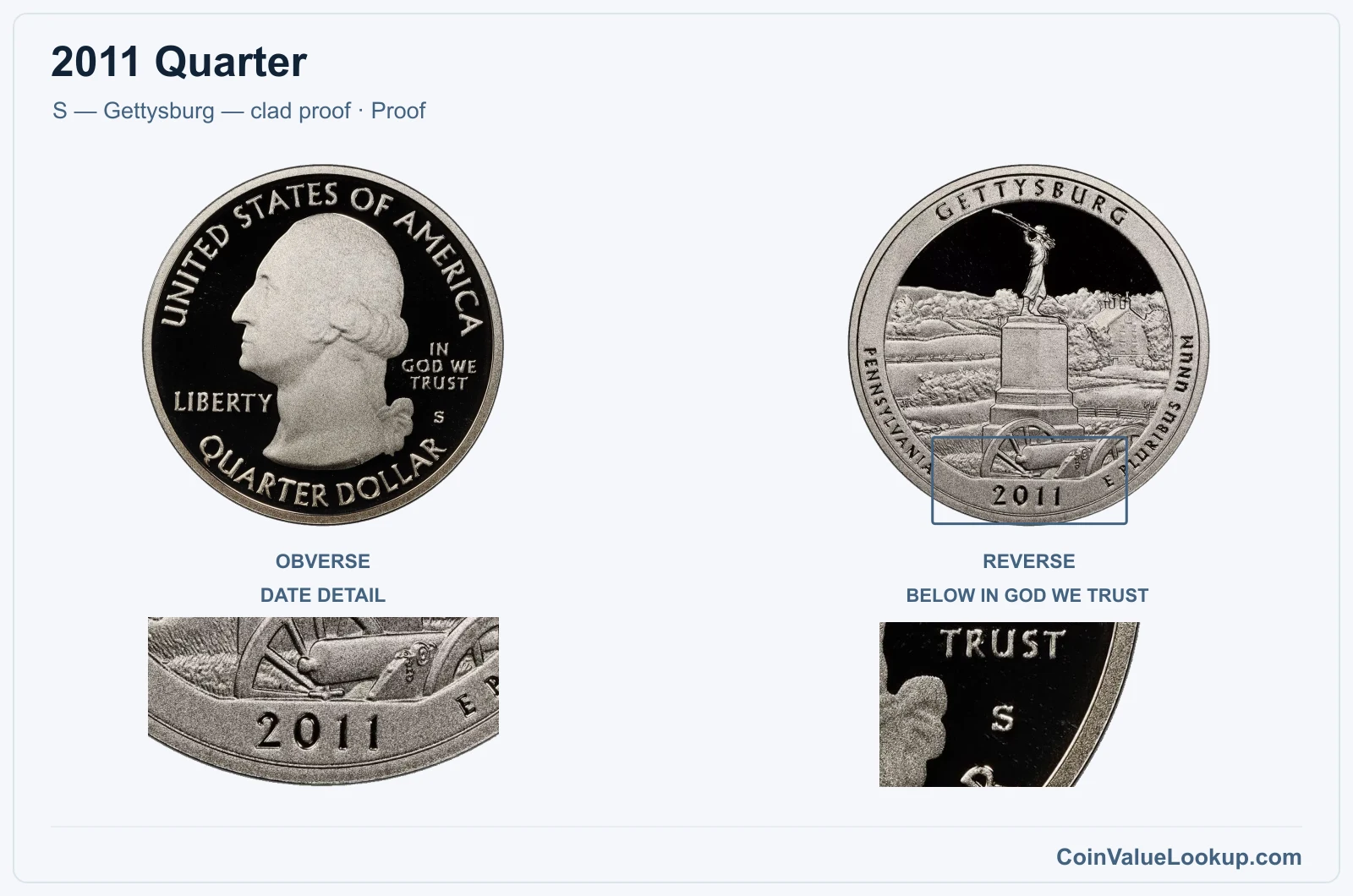
San Francisco struck a clad proof version of the Gettysburg quarter using the same copper-nickel clad composition as the business strikes — not silver. The S mintmark and mirror-like proof fields are the giveaways.
Check the edge for a visible copper stripe to confirm it is clad.
USA Coin Book estimates this coin at about $5.63 in PR65. These proofs were sold in packaged sets, so most survivors are well preserved.
Keep this version separate from the silver proof — they look similar face-on but differ in weight, edge appearance and value.
Range Grade
Price Auction Records Appraisal PR PR 1
—
Coin Identifier
PR 2
—
Coin Identifier
PR 3
—
Coin Identifier
PR 4
—
Coin Identifier
PR 6
—
Coin Identifier
PR 8
—
Coin Identifier
PR 10
—
Coin Identifier
PR 12
—
Coin Identifier
PR 15
—
Coin Identifier
PR 20
—
Coin Identifier
PR 25
—
Coin Identifier
PR 30
—
Coin Identifier
PR 35
—
Coin Identifier
PR 40
—
Coin Identifier
PR 45
—
Coin Identifier
PR 50
—
Coin Identifier
PR 53
—
Coin Identifier
PR 55
—
Coin Identifier
PR 58
—
Coin Identifier
PR 60
—
Coin Identifier
PR 61
—
Coin Identifier
PR 62
—
Coin Identifier
PR 63
—
Coin Identifier
PR 64
—
Coin Identifier
PR 65
—
Coin Identifier
PR 66
—
Coin Identifier
PR 67
—
Coin Identifier
PR 68
—
Coin Identifier
PR 69
—
Coin Identifier
PR 70
Coin Identifier
2011 Quarter — S — Gettysburg — silver proof
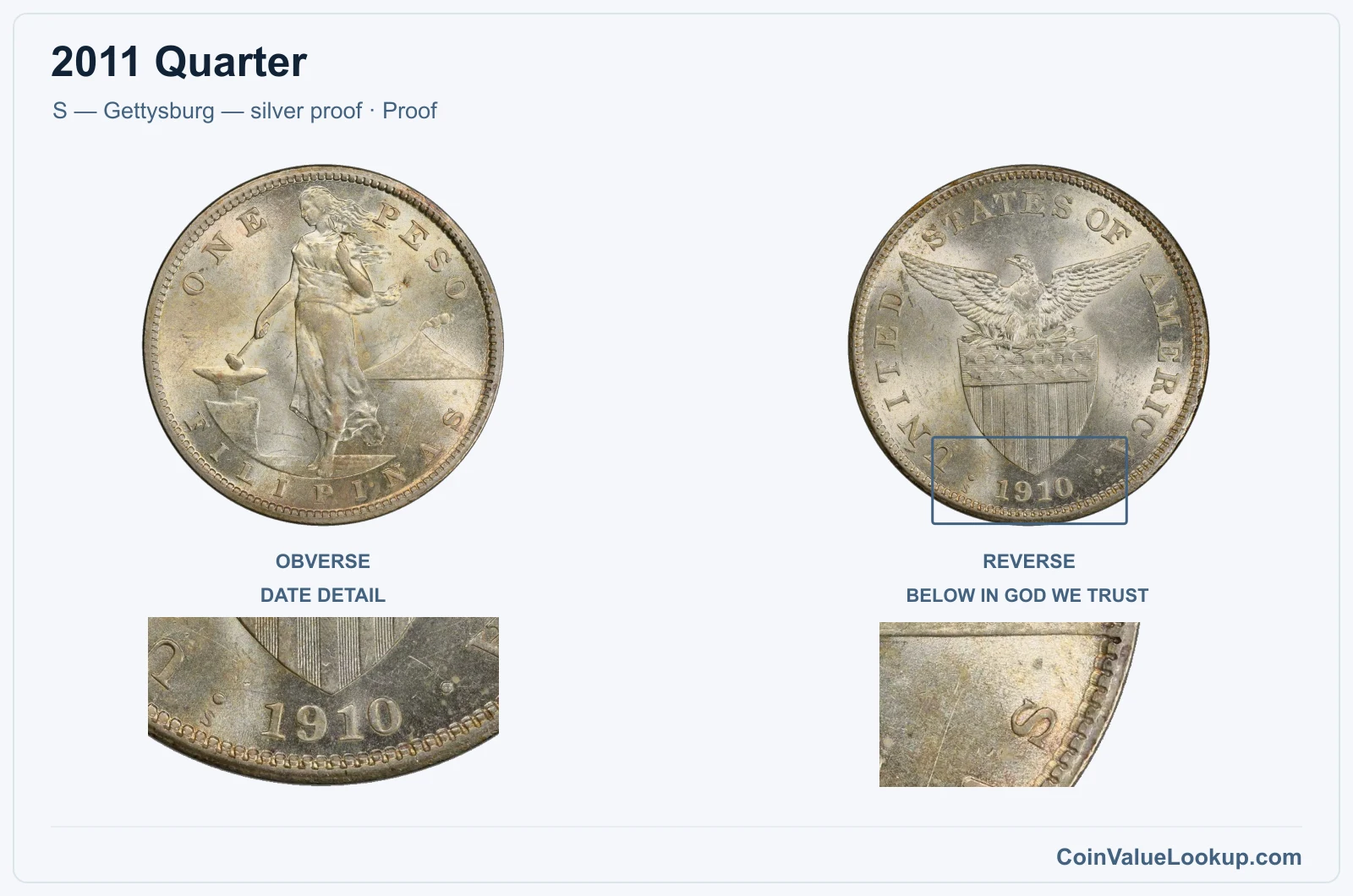
The silver proof Gettysburg quarter is 90% silver and 10% copper, weighing about 6.25 grams — roughly half a gram heavier than the clad version. The edge appears uniformly silver-white with no copper stripe.
Original government packaging or a certified holder makes identification straightforward.
USA Coin Book lists this at $24.00 in PR65, the highest guide figure among all 2011 Gettysburg quarters. That premium comes from the precious-metal content and the limited collector-set distribution.
Hairlines in the mirror fields are the main grade detractors, so check under magnification.
Range Grade
Price Auction Records Appraisal PR PR 1
—
Coin Identifier
PR 2
—
Coin Identifier
PR 3
—
Coin Identifier
PR 4
—
Coin Identifier
PR 6
—
Coin Identifier
PR 8
—
Coin Identifier
PR 10
—
Coin Identifier
PR 12
—
Coin Identifier
PR 15
—
Coin Identifier
PR 20
—
Coin Identifier
PR 25
—
Coin Identifier
PR 30
—
Coin Identifier
PR 35
—
Coin Identifier
PR 40
—
Coin Identifier
PR 45
—
Coin Identifier
PR 50
—
Coin Identifier
PR 53
—
Coin Identifier
PR 55
—
Coin Identifier
PR 58
—
Coin Identifier
PR 60
—
Coin Identifier
PR 61
—
Coin Identifier
PR 62
—
Coin Identifier
PR 63
—
Coin Identifier
PR 64
—
Coin Identifier
PR 65
—
Coin Identifier
PR 66
—
Coin Identifier
PR 67
—
Coin Identifier
PR 68
—
Coin Identifier
PR 69
—
Coin Identifier
PR 70
Coin Identifier
2011 Quarter — P — Glacier — regular strike
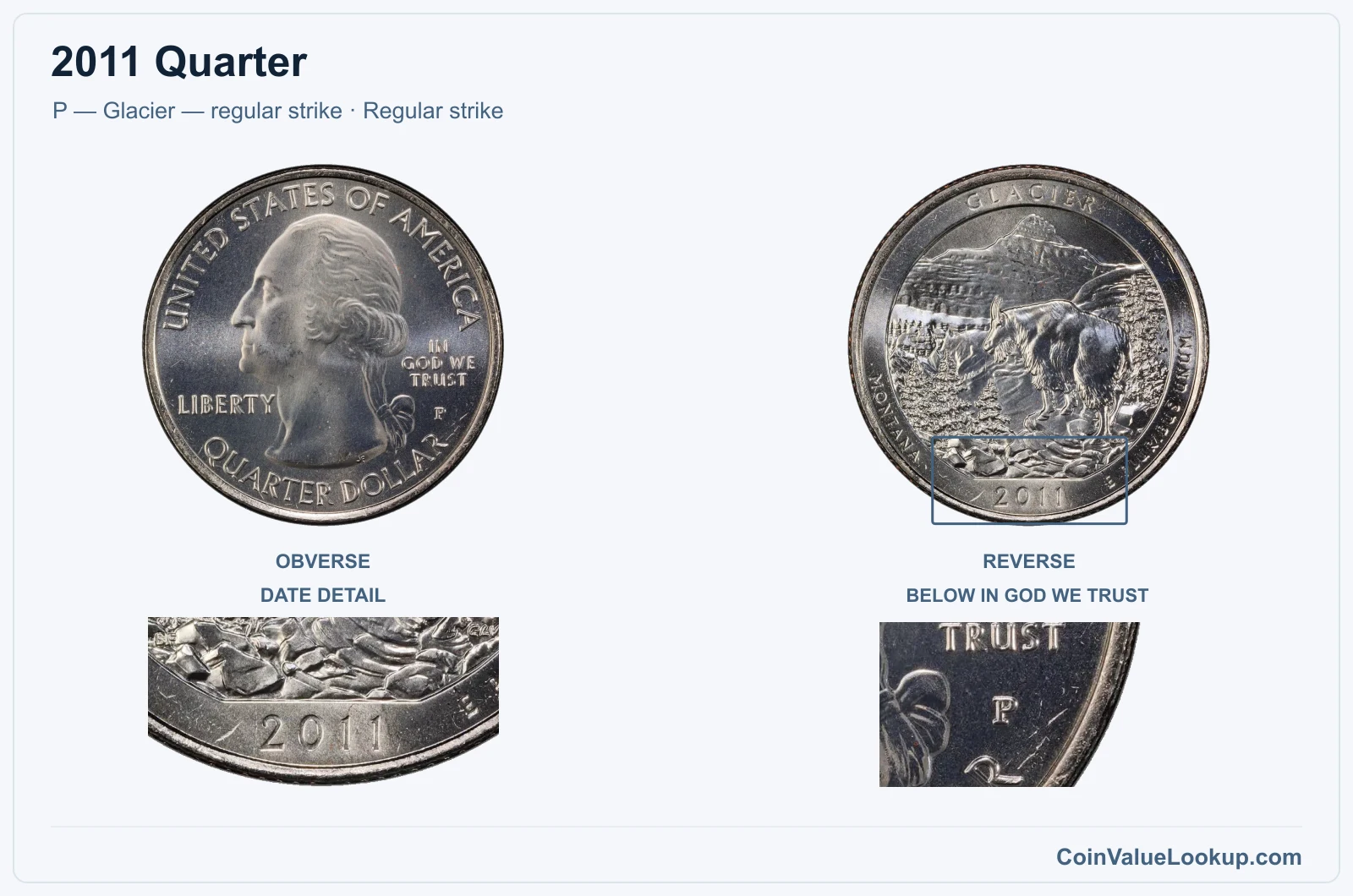
Philadelphia's Glacier quarter features the Montana national park reverse on standard copper-nickel clad planchets. Same 5.67-gram weight and 24.26-mm diameter as every other business-strike 2011 quarter.
Circulated examples are worth face value. USA Coin Book guides place uncirculated pieces at about $0.74 in MS60 and $1.24 in MS65.
These are retail estimates, not guaranteed offers. Confirm the P mintmark and the Glacier reverse before applying these figures.
Range Grade
Price Auction Records Appraisal PO PO 1
—
Coin Identifier FR FR 2
—
Coin Identifier AG AG 3
—
Coin Identifier G G 4
—
Coin Identifier
G 6
—
Coin Identifier VG VG 8
—
Coin Identifier
VG 10
—
Coin Identifier F F 12
—
Coin Identifier
F 15
—
Coin Identifier VF VF 20
—
Coin Identifier
VF 25
—
Coin Identifier
VF 30
—
Coin Identifier
VF 35
—
Coin Identifier XF XF 40
—
Coin Identifier
XF 45
—
Coin Identifier AU AU 50
—
Coin Identifier
AU 53
—
Coin Identifier
AU 55
—
Coin Identifier
AU 58
—
Coin Identifier MS MS 60
—
Coin Identifier
MS 61
—
Coin Identifier
MS 62
—
Coin Identifier
MS 63
—
Coin Identifier
MS 64
—
Coin Identifier
MS 65
—
Coin Identifier
MS 66
—
Coin Identifier
MS 67
—
Coin Identifier
MS 68
Coin Identifier
MS 69
—
—
—
MS 70
—
—
—
2011 Quarter — D — Glacier — regular strike
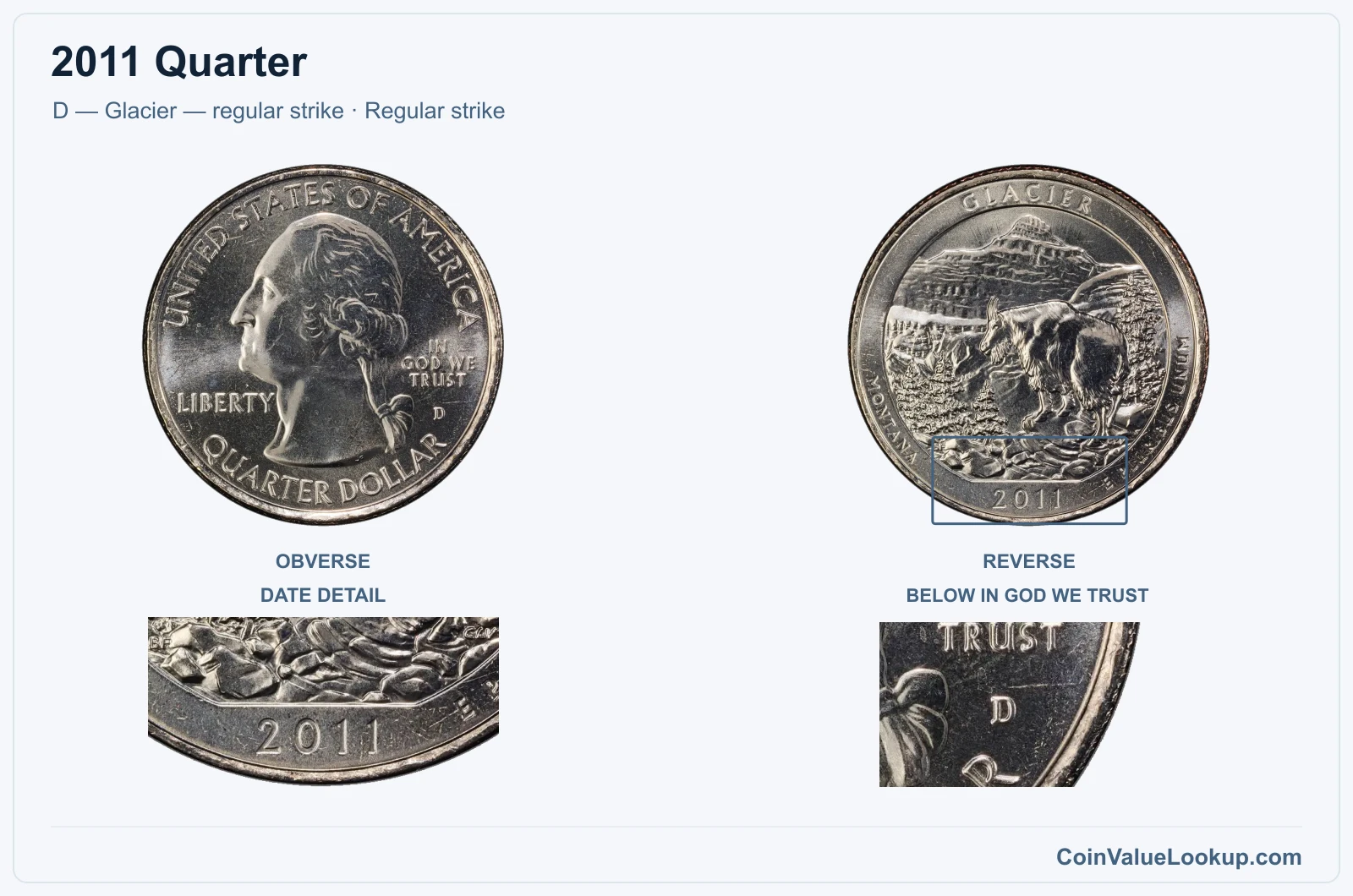
Denver's Glacier quarter mirrors the Philadelphia issue in every way except the D mintmark. Copper-nickel clad, 5.67 grams, 24.26 mm.
You will find plenty of these in circulation.
Guide estimates sit at $0.74 in MS60 and $1.24 in MS65 per USA Coin Book. As with most modern quarters, the collector premium only applies to coins that have never been spent.
A single bag mark or worn highpoint drops the grade quickly.
Range Grade
Price Auction Records Appraisal PO PO 1
—
Coin Identifier FR FR 2
—
Coin Identifier AG AG 3
—
Coin Identifier G G 4
—
Coin Identifier
G 6
—
Coin Identifier VG VG 8
—
Coin Identifier
VG 10
—
Coin Identifier F F 12
—
Coin Identifier
F 15
—
Coin Identifier VF VF 20
—
Coin Identifier
VF 25
—
Coin Identifier
VF 30
—
Coin Identifier
VF 35
—
Coin Identifier XF XF 40
—
Coin Identifier
XF 45
—
Coin Identifier AU AU 50
—
Coin Identifier
AU 53
—
Coin Identifier
AU 55
—
Coin Identifier
AU 58
—
Coin Identifier MS MS 60
—
Coin Identifier
MS 61
—
Coin Identifier
MS 62
—
Coin Identifier
MS 63
—
Coin Identifier
MS 64
—
Coin Identifier
MS 65
—
Coin Identifier
MS 66
—
Coin Identifier
MS 67
—
Coin Identifier
MS 68
—
—
—
MS 69
—
—
—
MS 70
—
—
—
2011 Quarter — S — Glacier — clad proof
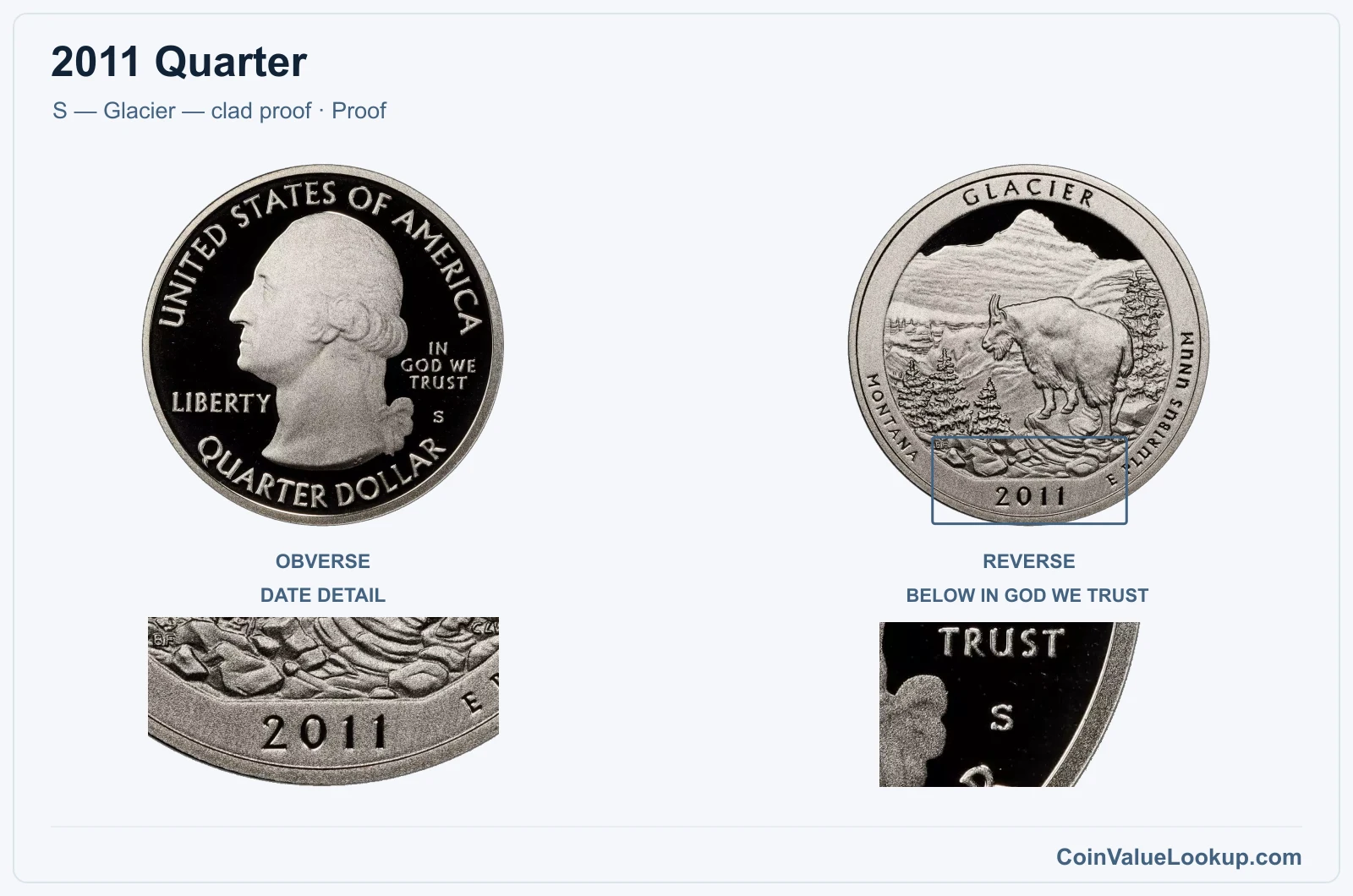
The clad proof Glacier quarter carries the S mintmark and shows the characteristic proof finish — frosted devices over mirror fields. Composition is still copper-nickel clad, not silver, and the edge stripe confirms it.
At PR65, USA Coin Book lists this at about $5.63. Most clad proofs come from annual proof sets, so they tend to survive in high grades.
The value difference between this clad proof and its silver sibling is significant, making composition verification an important step.
Range Grade
Price Auction Records Appraisal PR PR 1
—
Coin Identifier
PR 2
—
Coin Identifier
PR 3
—
Coin Identifier
PR 4
—
Coin Identifier
PR 6
—
Coin Identifier
PR 8
—
Coin Identifier
PR 10
—
Coin Identifier
PR 12
—
Coin Identifier
PR 15
—
Coin Identifier
PR 20
—
Coin Identifier
PR 25
—
Coin Identifier
PR 30
—
Coin Identifier
PR 35
—
Coin Identifier
PR 40
—
Coin Identifier
PR 45
—
Coin Identifier
PR 50
—
Coin Identifier
PR 53
—
Coin Identifier
PR 55
—
Coin Identifier
PR 58
—
Coin Identifier
PR 60
—
Coin Identifier
PR 61
—
Coin Identifier
PR 62
—
Coin Identifier
PR 63
—
Coin Identifier
PR 64
—
Coin Identifier
PR 65
—
Coin Identifier
PR 66
—
Coin Identifier
PR 67
—
Coin Identifier
PR 68
—
Coin Identifier
PR 69
Coin Identifier
PR 70
Coin Identifier
2011 Quarter — S — Glacier — silver proof
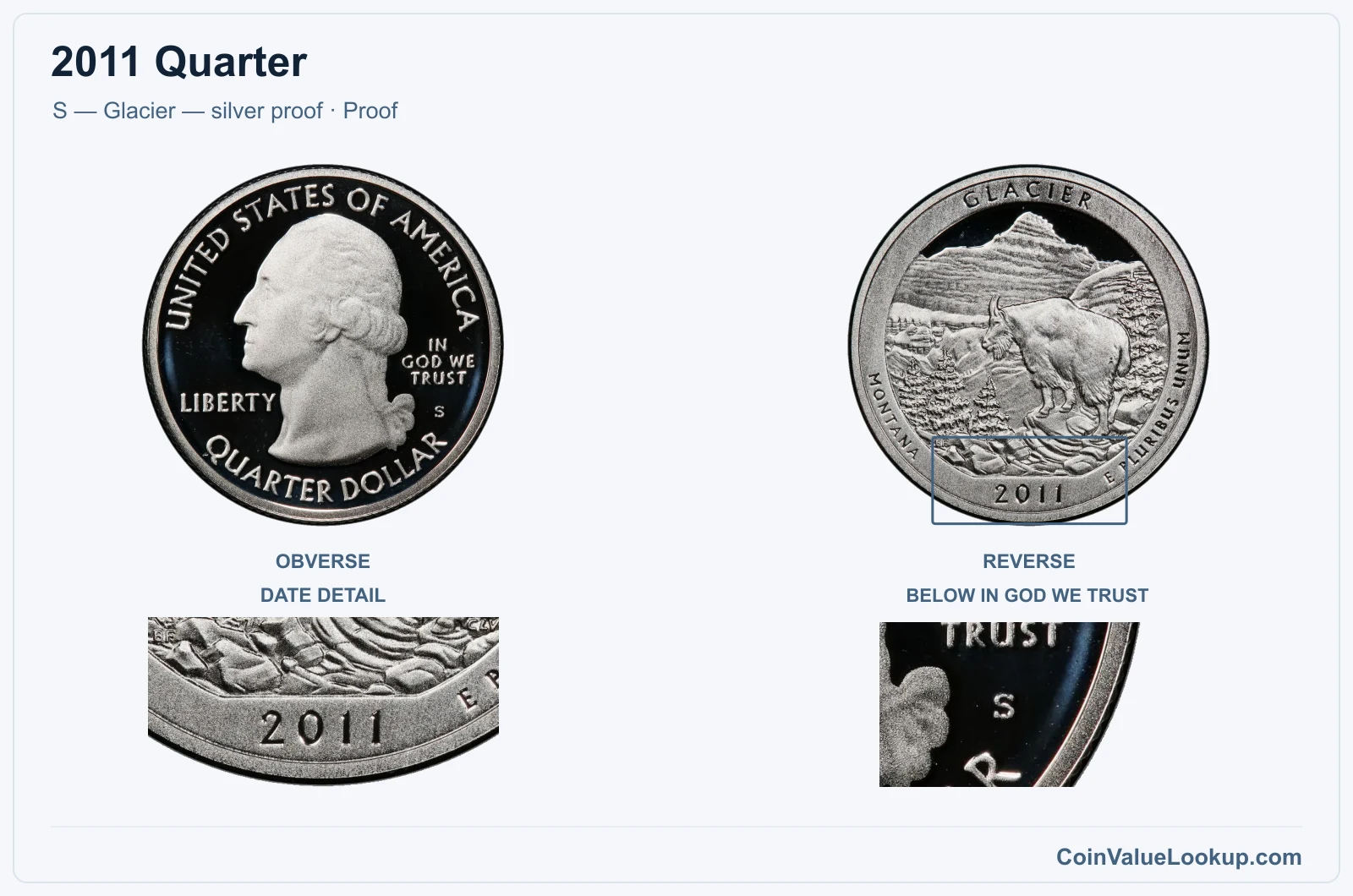
This is the 90% silver proof Glacier quarter from San Francisco, weighing approximately 6.25 grams. A uniform silver edge, heavier weight and original set packaging distinguish it from the clad proof version.
Coin Value Lookup is a good starting point if you are sorting through multiple quarters and need to look up each design and mint combination separately.
USA Coin Book estimates this version at $24.00 in PR65. Silver content and collector-set exclusivity drive the premium above clad proof values.
Range Grade
Price Auction Records Appraisal PR PR 1
—
Coin Identifier
PR 2
—
Coin Identifier
PR 3
—
Coin Identifier
PR 4
—
Coin Identifier
PR 6
—
Coin Identifier
PR 8
—
Coin Identifier
PR 10
—
Coin Identifier
PR 12
—
Coin Identifier
PR 15
—
Coin Identifier
PR 20
—
Coin Identifier
PR 25
—
Coin Identifier
PR 30
—
Coin Identifier
PR 35
—
Coin Identifier
PR 40
—
Coin Identifier
PR 45
—
Coin Identifier
PR 50
—
Coin Identifier
PR 53
—
Coin Identifier
PR 55
—
Coin Identifier
PR 58
—
Coin Identifier
PR 60
—
Coin Identifier
PR 61
—
Coin Identifier
PR 62
—
Coin Identifier
PR 63
—
Coin Identifier
PR 64
—
Coin Identifier
PR 65
—
Coin Identifier
PR 66
—
Coin Identifier
PR 67
—
Coin Identifier
PR 68
—
Coin Identifier
PR 69
Coin Identifier
PR 70
Coin Identifier
2011 Quarter — P — Olympic — regular strike
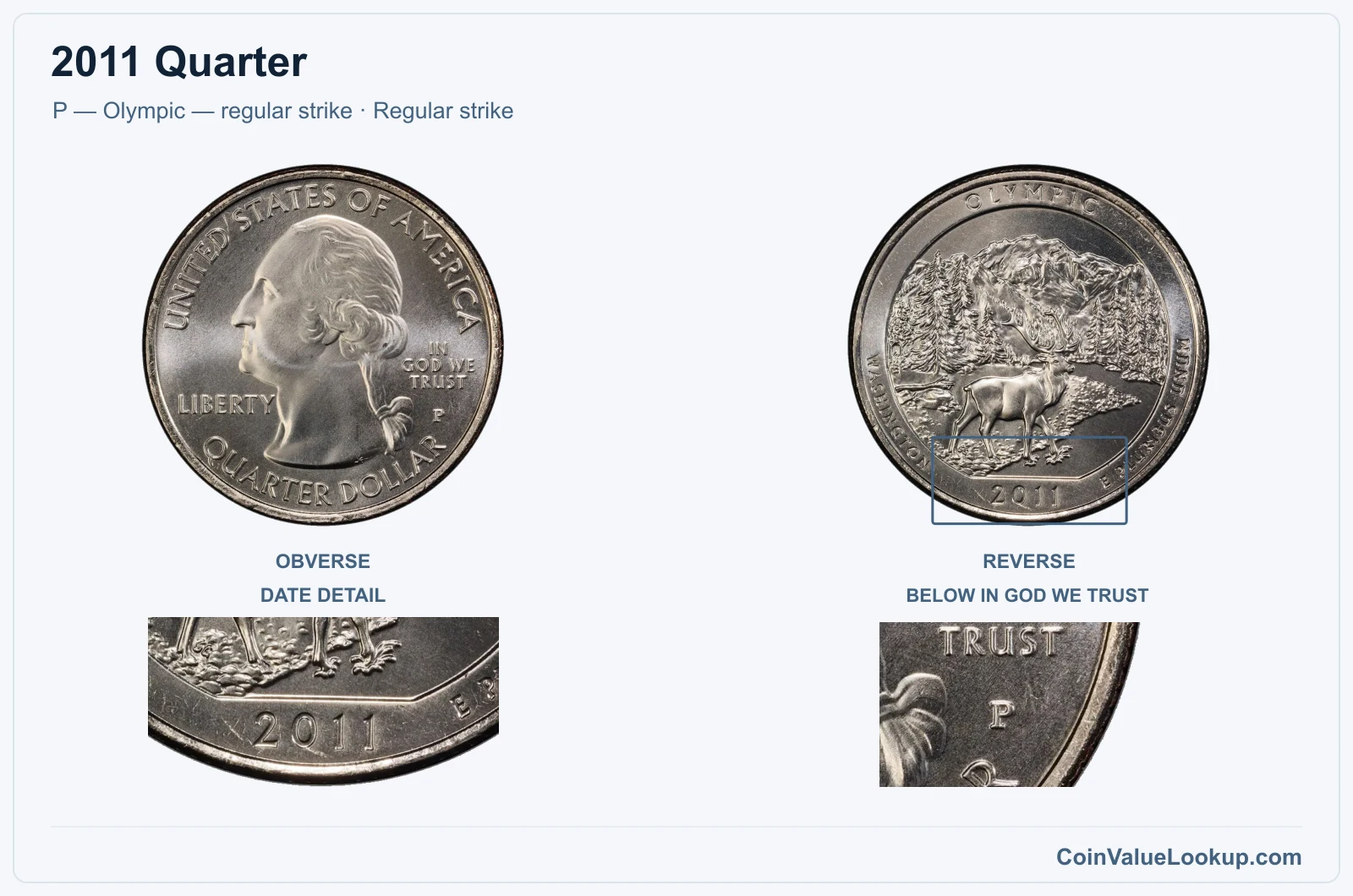
The Philadelphia-mint Olympic quarter honors Olympic National Park in Washington state. It is copper-nickel clad, weighs about 5.67 grams and measures 24.26 mm — same specs as all P-mint business strikes from 2011.
Circulated coins are worth 25 cents. USA Coin Book guides estimate $0.74 at MS60 and $1.24 at MS65 for uncirculated examples.
These are retail guide estimates. If your coin has wear, the collector premium disappears.
Range Grade
Price Auction Records Appraisal PO PO 1
—
Coin Identifier FR FR 2
—
Coin Identifier AG AG 3
—
Coin Identifier G G 4
—
Coin Identifier
G 6
—
Coin Identifier VG VG 8
—
Coin Identifier
VG 10
—
Coin Identifier F F 12
—
Coin Identifier
F 15
—
Coin Identifier VF VF 20
—
Coin Identifier
VF 25
—
Coin Identifier
VF 30
—
Coin Identifier
VF 35
—
Coin Identifier XF XF 40
—
Coin Identifier
XF 45
—
Coin Identifier AU AU 50
—
Coin Identifier
AU 53
—
Coin Identifier
AU 55
—
Coin Identifier
AU 58
—
Coin Identifier MS MS 60
—
Coin Identifier
MS 61
—
Coin Identifier
MS 62
—
Coin Identifier
MS 63
—
Coin Identifier
MS 64
—
Coin Identifier
MS 65
—
Coin Identifier
MS 66
—
Coin Identifier
MS 67
—
Coin Identifier
MS 68
Coin Identifier
MS 69
—
—
—
MS 70
—
—
—
2011 Quarter — D — Olympic — regular strike
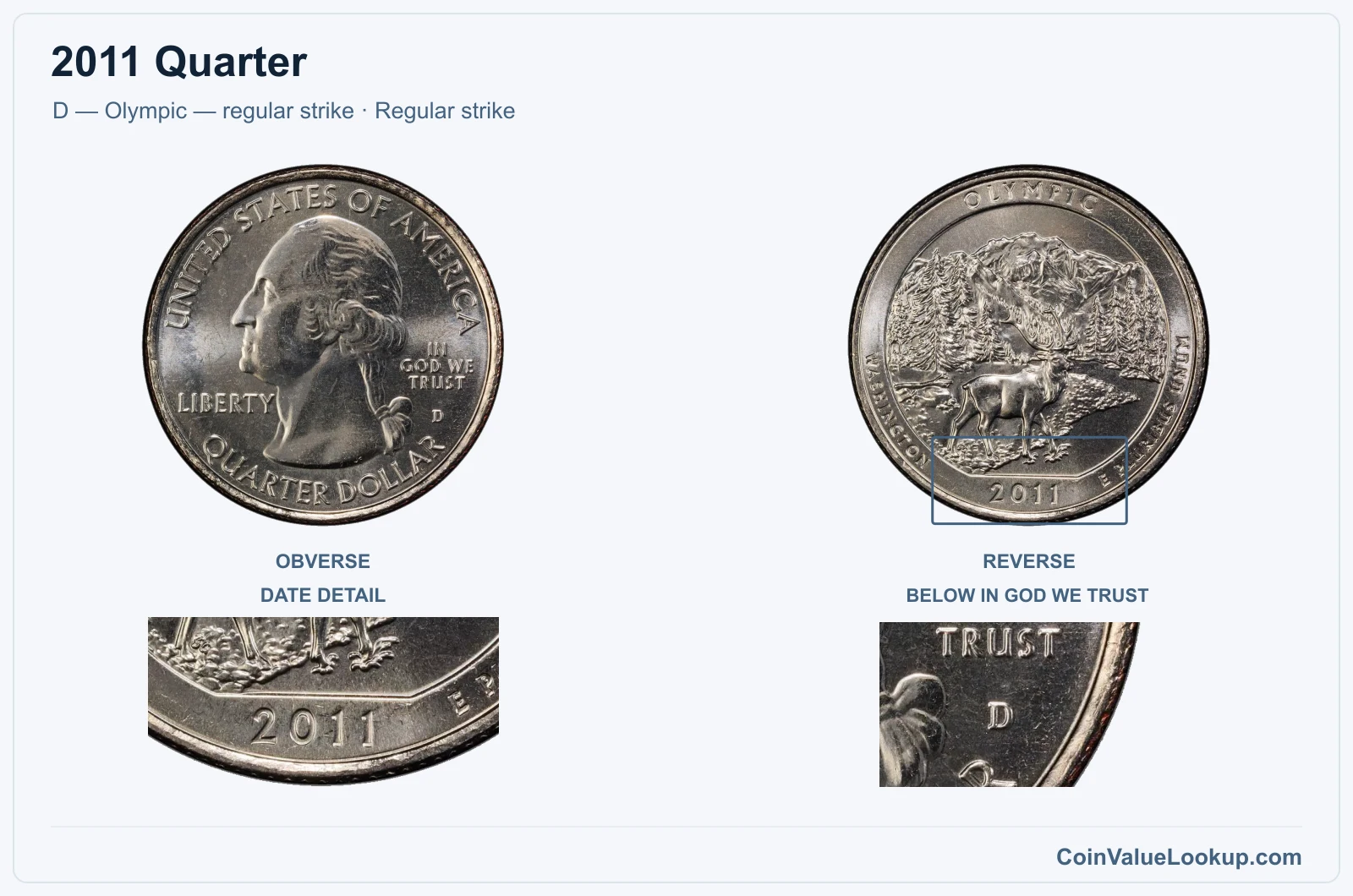
Denver's Olympic quarter is the D-mint counterpart. Copper-nickel clad, same weight and size, same reverse design.
Confirm the D mintmark before checking the value chart.
USA Coin Book estimates about $0.74 at MS60 and $1.24 at MS65. Circulated examples trade at face value.
Roll-hunting often turns up this version, but finding a gem-quality example with no bag marks is the real challenge.
Range Grade
Price Auction Records Appraisal PO PO 1
—
Coin Identifier FR FR 2
—
Coin Identifier AG AG 3
—
Coin Identifier G G 4
—
Coin Identifier
G 6
—
Coin Identifier VG VG 8
—
Coin Identifier
VG 10
—
Coin Identifier F F 12
—
Coin Identifier
F 15
—
Coin Identifier VF VF 20
—
Coin Identifier
VF 25
—
Coin Identifier
VF 30
—
Coin Identifier
VF 35
—
Coin Identifier XF XF 40
—
Coin Identifier
XF 45
—
Coin Identifier AU AU 50
—
Coin Identifier
AU 53
—
Coin Identifier
AU 55
—
Coin Identifier
AU 58
—
Coin Identifier MS MS 60
—
Coin Identifier
MS 61
—
Coin Identifier
MS 62
—
Coin Identifier
MS 63
—
Coin Identifier
MS 64
—
Coin Identifier
MS 65
—
Coin Identifier
MS 66
—
Coin Identifier
MS 67
—
Coin Identifier
MS 68
—
—
—
MS 69
—
—
—
MS 70
—
—
—
2011 Quarter — S — Olympic — clad proof
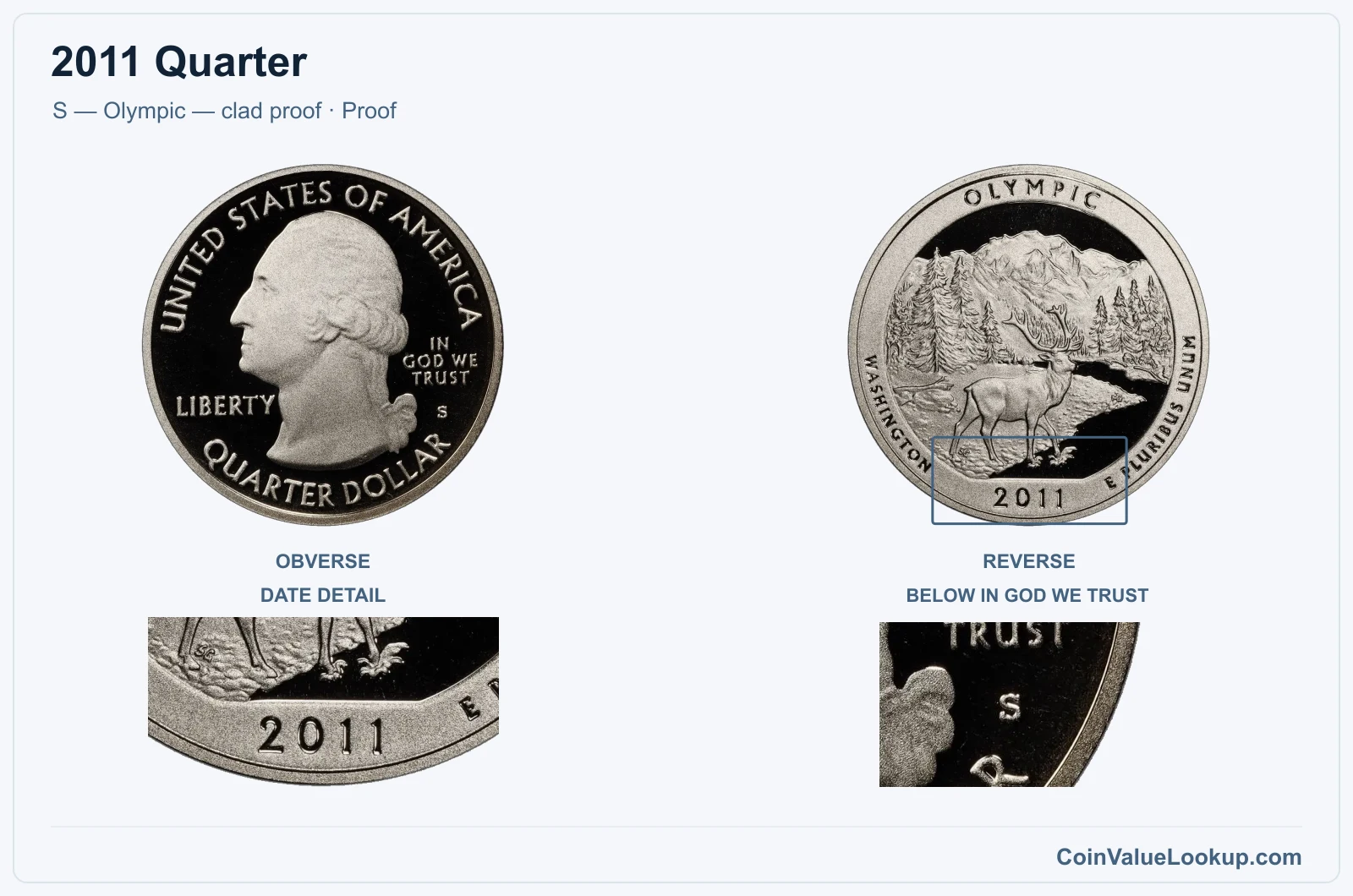
San Francisco's clad proof Olympic quarter has the proof finish — mirror fields and frosted relief — but uses the same copper-nickel clad composition as the business strikes. Look at the edge for a copper stripe, and weigh it if you have a scale.
USA Coin Book places this at approximately $5.63 in PR65. It is a collector item, not a pocket coin.
Keep it separate from the silver proof version when comparing values.
Range Grade
Price Auction Records Appraisal PR PR 1
—
Coin Identifier
PR 2
—
Coin Identifier
PR 3
—
Coin Identifier
PR 4
—
Coin Identifier
PR 6
—
Coin Identifier
PR 8
—
Coin Identifier
PR 10
—
Coin Identifier
PR 12
—
Coin Identifier
PR 15
—
Coin Identifier
PR 20
—
Coin Identifier
PR 25
—
Coin Identifier
PR 30
—
Coin Identifier
PR 35
—
Coin Identifier
PR 40
—
Coin Identifier
PR 45
—
Coin Identifier
PR 50
—
Coin Identifier
PR 53
—
Coin Identifier
PR 55
—
Coin Identifier
PR 58
—
Coin Identifier
PR 60
—
Coin Identifier
PR 61
—
Coin Identifier
PR 62
—
Coin Identifier
PR 63
—
Coin Identifier
PR 64
—
Coin Identifier
PR 65
—
Coin Identifier
PR 66
—
Coin Identifier
PR 67
—
Coin Identifier
PR 68
—
Coin Identifier
PR 69
—
Coin Identifier
PR 70
Coin Identifier
2011 Quarter — S — Olympic — silver proof
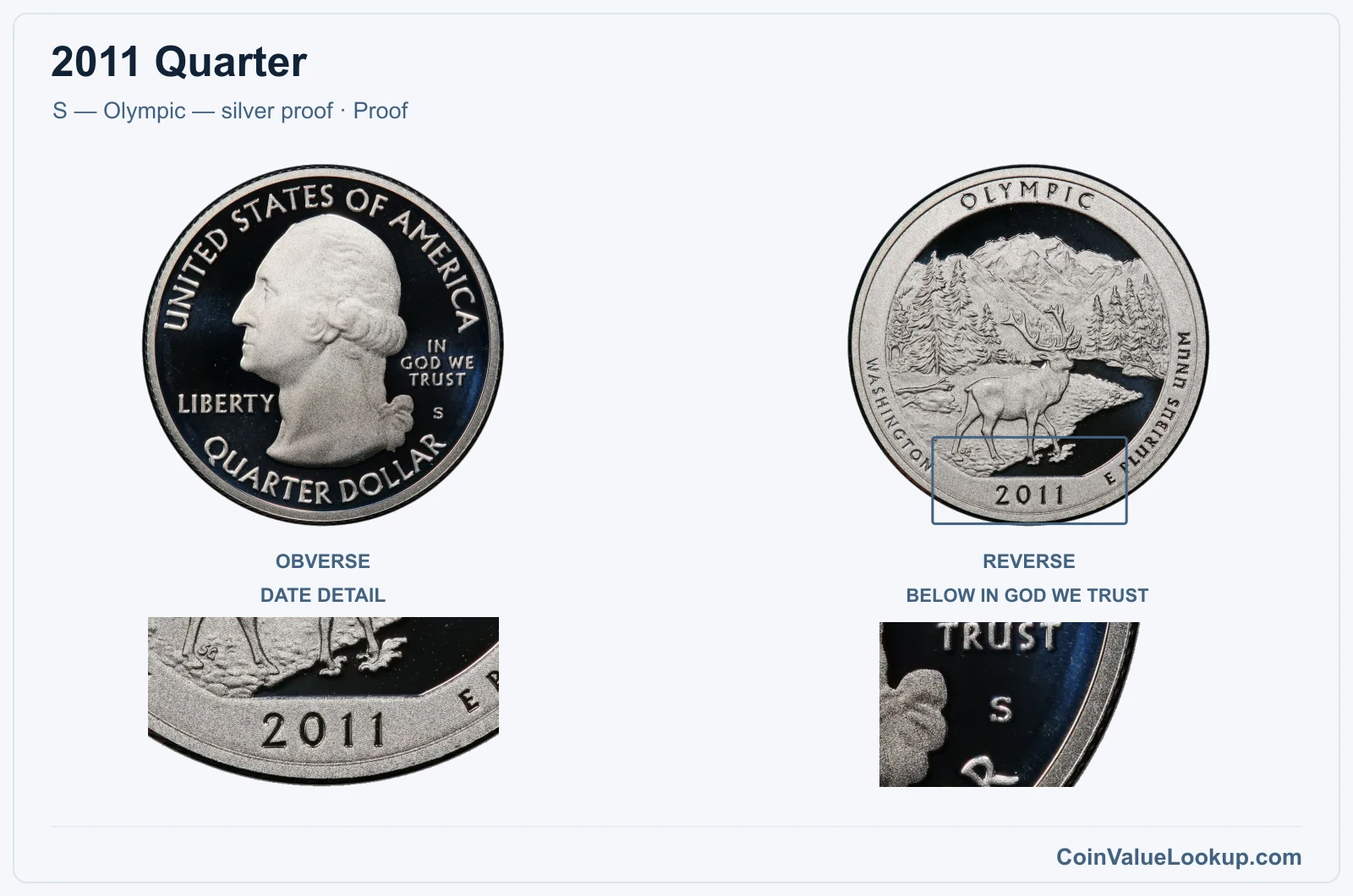
The silver proof Olympic quarter is struck in 90% silver at approximately 6.25 grams. No copper stripe shows on the edge.
This version was distributed exclusively in silver proof sets from the U.S. Mint.
USA Coin Book estimates $24.00 at PR65. That is the same guide figure as the other 2011 silver proof quarters.
Collectors prize these for their silver content and the sharp proof strike. Check fields carefully for any hairlines.
Range Grade
Price Auction Records Appraisal PR PR 1
—
Coin Identifier
PR 2
—
Coin Identifier
PR 3
—
Coin Identifier
PR 4
—
Coin Identifier
PR 6
—
Coin Identifier
PR 8
—
Coin Identifier
PR 10
—
Coin Identifier
PR 12
—
Coin Identifier
PR 15
—
Coin Identifier
PR 20
—
Coin Identifier
PR 25
—
Coin Identifier
PR 30
—
Coin Identifier
PR 35
—
Coin Identifier
PR 40
—
Coin Identifier
PR 45
—
Coin Identifier
PR 50
—
Coin Identifier
PR 53
—
Coin Identifier
PR 55
—
Coin Identifier
PR 58
—
Coin Identifier
PR 60
—
Coin Identifier
PR 61
—
Coin Identifier
PR 62
—
Coin Identifier
PR 63
—
Coin Identifier
PR 64
—
Coin Identifier
PR 65
—
Coin Identifier
PR 66
—
Coin Identifier
PR 67
—
Coin Identifier
PR 68
—
Coin Identifier
PR 69
—
Coin Identifier
PR 70
Coin Identifier
2011 Quarter — P — Vicksburg — regular strike
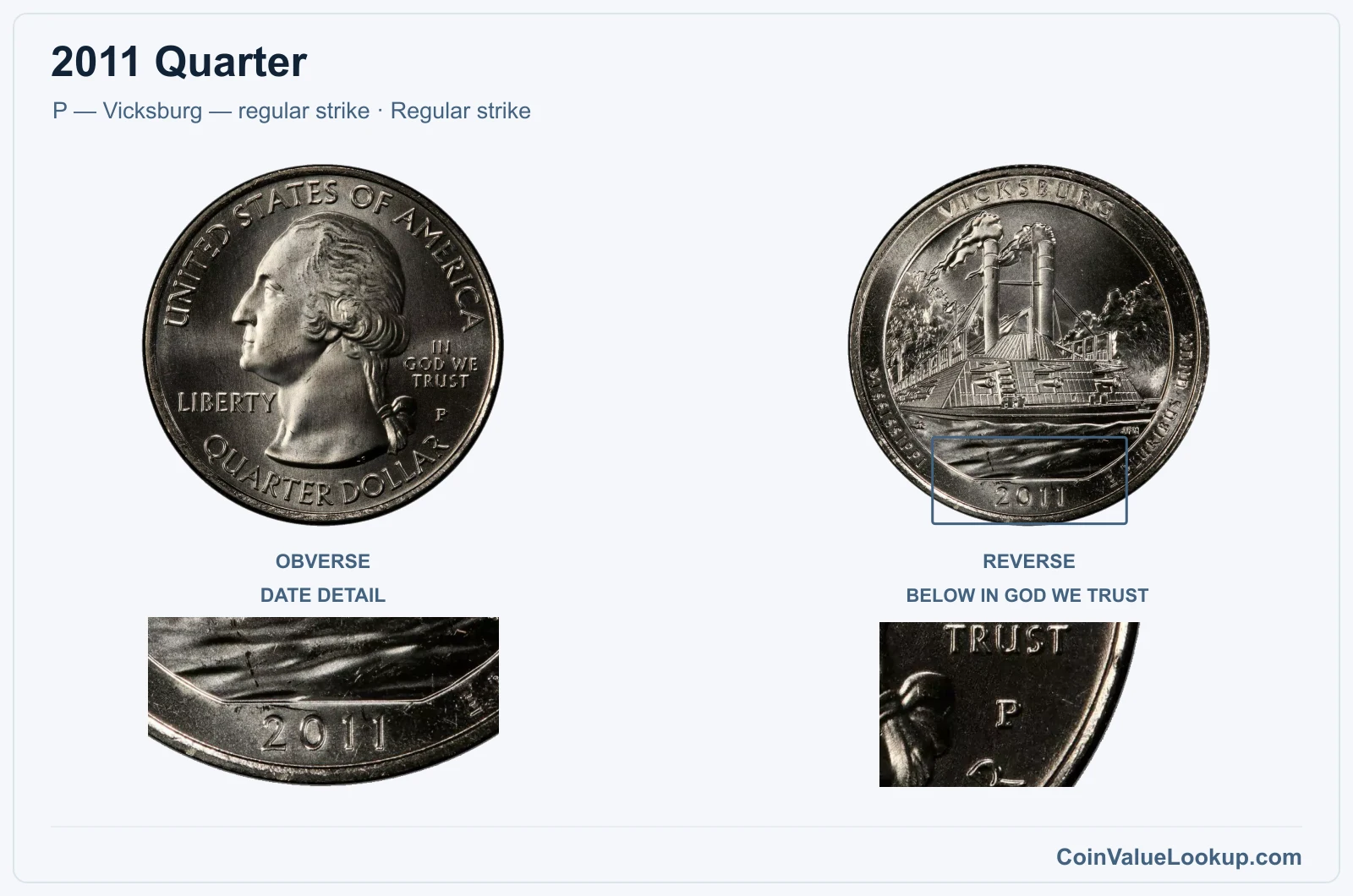
The Philadelphia-mint Vicksburg quarter depicts the Mississippi national military park. It is copper-nickel clad, 5.67 grams, 24.26 mm — standard business-strike specifications.
Confirm the P mintmark on the obverse.
Worn coins are worth a quarter. USA Coin Book guide estimates are $0.74 at MS60 and $1.24 at MS65.
Only fully original, uncirculated pieces command any premium at all. This reverse design is also associated with several reported error types, covered separately.
Range Grade
Price Auction Records Appraisal PO PO 1
—
Coin Identifier FR FR 2
—
Coin Identifier AG AG 3
—
Coin Identifier G G 4
—
Coin Identifier
G 6
—
Coin Identifier VG VG 8
—
Coin Identifier
VG 10
—
Coin Identifier F F 12
—
Coin Identifier
F 15
—
Coin Identifier VF VF 20
—
Coin Identifier
VF 25
—
Coin Identifier
VF 30
—
Coin Identifier
VF 35
—
Coin Identifier XF XF 40
—
Coin Identifier
XF 45
—
Coin Identifier AU AU 50
—
Coin Identifier
AU 53
—
Coin Identifier
AU 55
—
Coin Identifier
AU 58
—
Coin Identifier MS MS 60
—
Coin Identifier
MS 61
—
Coin Identifier
MS 62
—
Coin Identifier
MS 63
—
Coin Identifier
MS 64
—
Coin Identifier
MS 65
—
Coin Identifier
MS 66
—
Coin Identifier
MS 67
—
Coin Identifier
MS 68
—
—
—
MS 69
—
—
—
MS 70
—
—
—
2011 Quarter — D — Vicksburg — regular strike
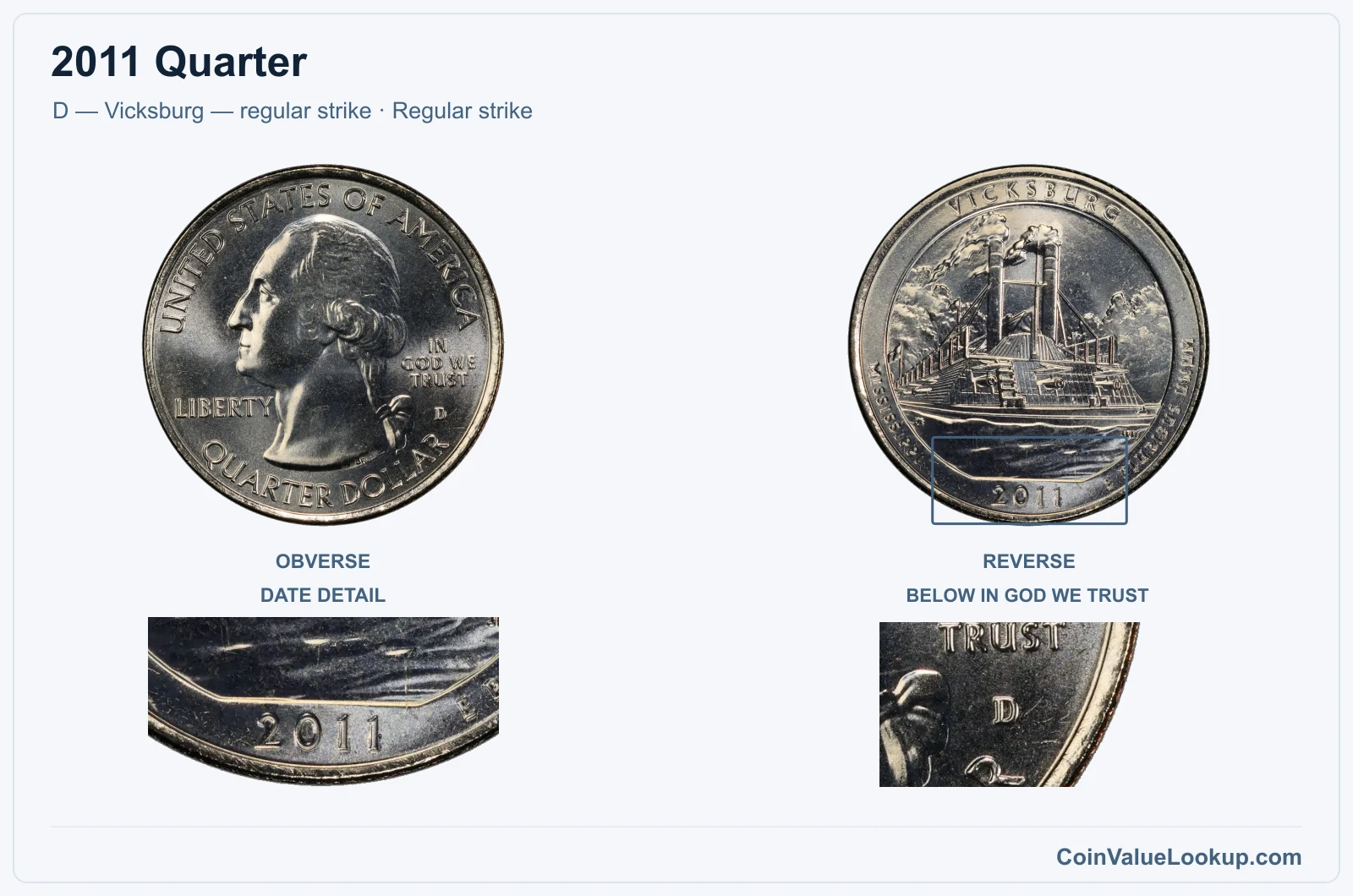
Denver's Vicksburg quarter is the D-mint version of the same design. Same clad composition, same weight, same diameter.
Look for the D near Washington's portrait to confirm.
USA Coin Book estimates about $0.74 at MS60 and $1.24 at MS65. Face value applies once there is any circulation wear.
Like the P-mint, this version has been reported with certain error varieties, so it is worth a careful look before tossing it back in the jar.
Range Grade
Price Auction Records Appraisal PO PO 1
—
Coin Identifier FR FR 2
—
Coin Identifier AG AG 3
—
Coin Identifier G G 4
—
Coin Identifier
G 6
—
Coin Identifier VG VG 8
—
Coin Identifier
VG 10
—
Coin Identifier F F 12
—
Coin Identifier
F 15
—
Coin Identifier VF VF 20
—
Coin Identifier
VF 25
—
Coin Identifier
VF 30
—
Coin Identifier
VF 35
—
Coin Identifier XF XF 40
—
Coin Identifier
XF 45
—
Coin Identifier AU AU 50
—
Coin Identifier
AU 53
—
Coin Identifier
AU 55
—
Coin Identifier
AU 58
—
Coin Identifier MS MS 60
—
Coin Identifier
MS 61
—
Coin Identifier
MS 62
—
Coin Identifier
MS 63
—
Coin Identifier
MS 64
—
Coin Identifier
MS 65
—
Coin Identifier
MS 66
—
Coin Identifier
MS 67
—
Coin Identifier
MS 68
—
—
—
MS 69
—
—
—
MS 70
—
—
—
2011 Quarter — S — Vicksburg — clad proof
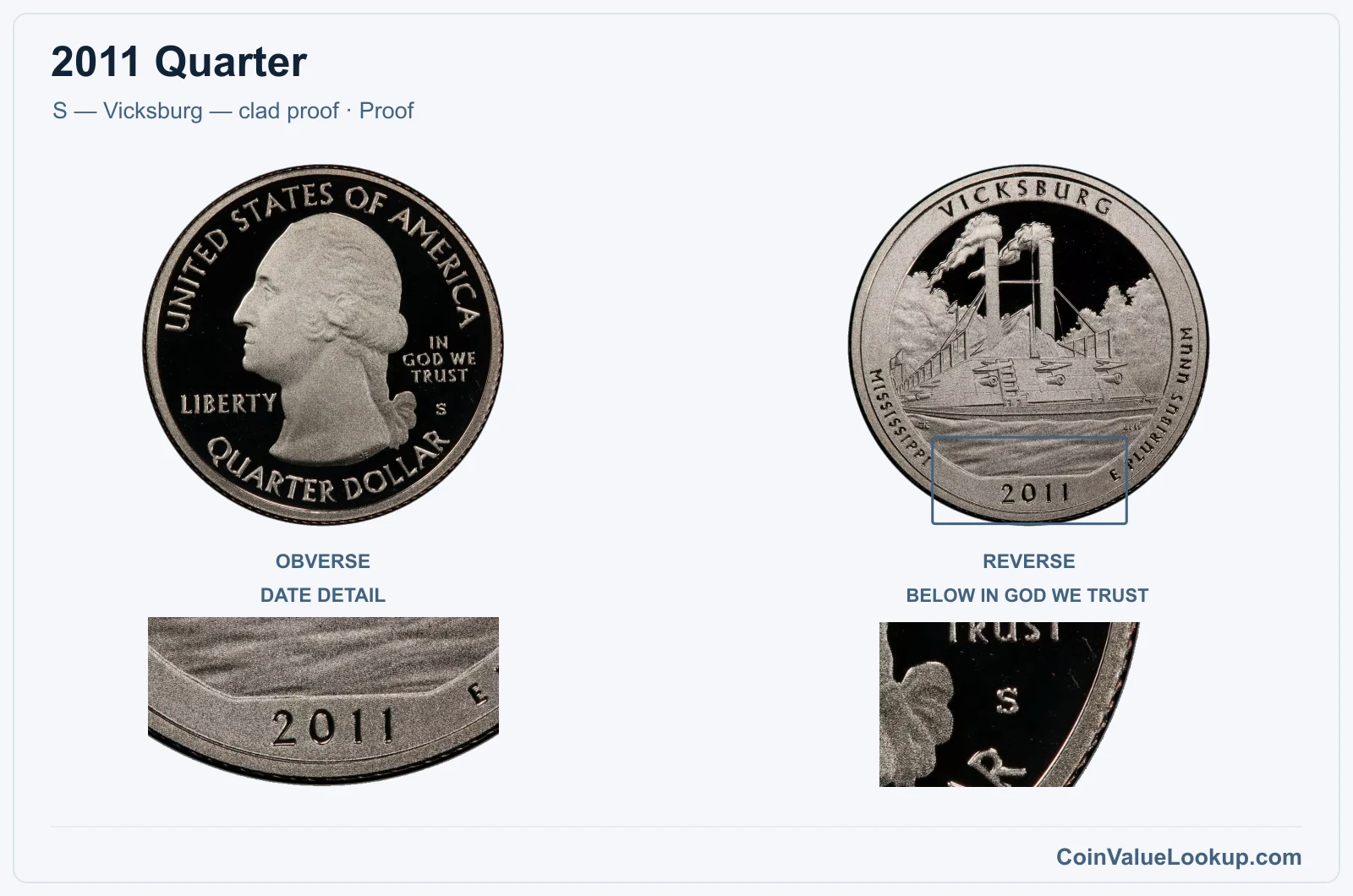
The clad proof Vicksburg quarter from San Francisco uses copper-nickel clad composition with a proof finish. The S mintmark and mirror-like fields identify it.
Edge examination confirms whether the coin is clad or silver.
USA Coin Book lists this at about $5.63 in PR65. These come from annual clad proof sets.
They are common in high grades because collectors store them carefully. Do not confuse this version with the silver proof — the value gap is wide.
Range Grade
Price Auction Records Appraisal PR PR 1
—
Coin Identifier
PR 2
—
Coin Identifier
PR 3
—
Coin Identifier
PR 4
—
Coin Identifier
PR 6
—
Coin Identifier
PR 8
—
Coin Identifier
PR 10
—
Coin Identifier
PR 12
—
Coin Identifier
PR 15
—
Coin Identifier
PR 20
—
Coin Identifier
PR 25
—
Coin Identifier
PR 30
—
Coin Identifier
PR 35
—
Coin Identifier
PR 40
—
Coin Identifier
PR 45
—
Coin Identifier
PR 50
—
Coin Identifier
PR 53
—
Coin Identifier
PR 55
—
Coin Identifier
PR 58
—
Coin Identifier
PR 60
—
Coin Identifier
PR 61
—
Coin Identifier
PR 62
—
Coin Identifier
PR 63
—
Coin Identifier
PR 64
—
Coin Identifier
PR 65
—
Coin Identifier
PR 66
—
Coin Identifier
PR 67
—
Coin Identifier
PR 68
—
Coin Identifier
PR 69
Coin Identifier
PR 70
Coin Identifier
2011 Quarter — S — Vicksburg — silver proof
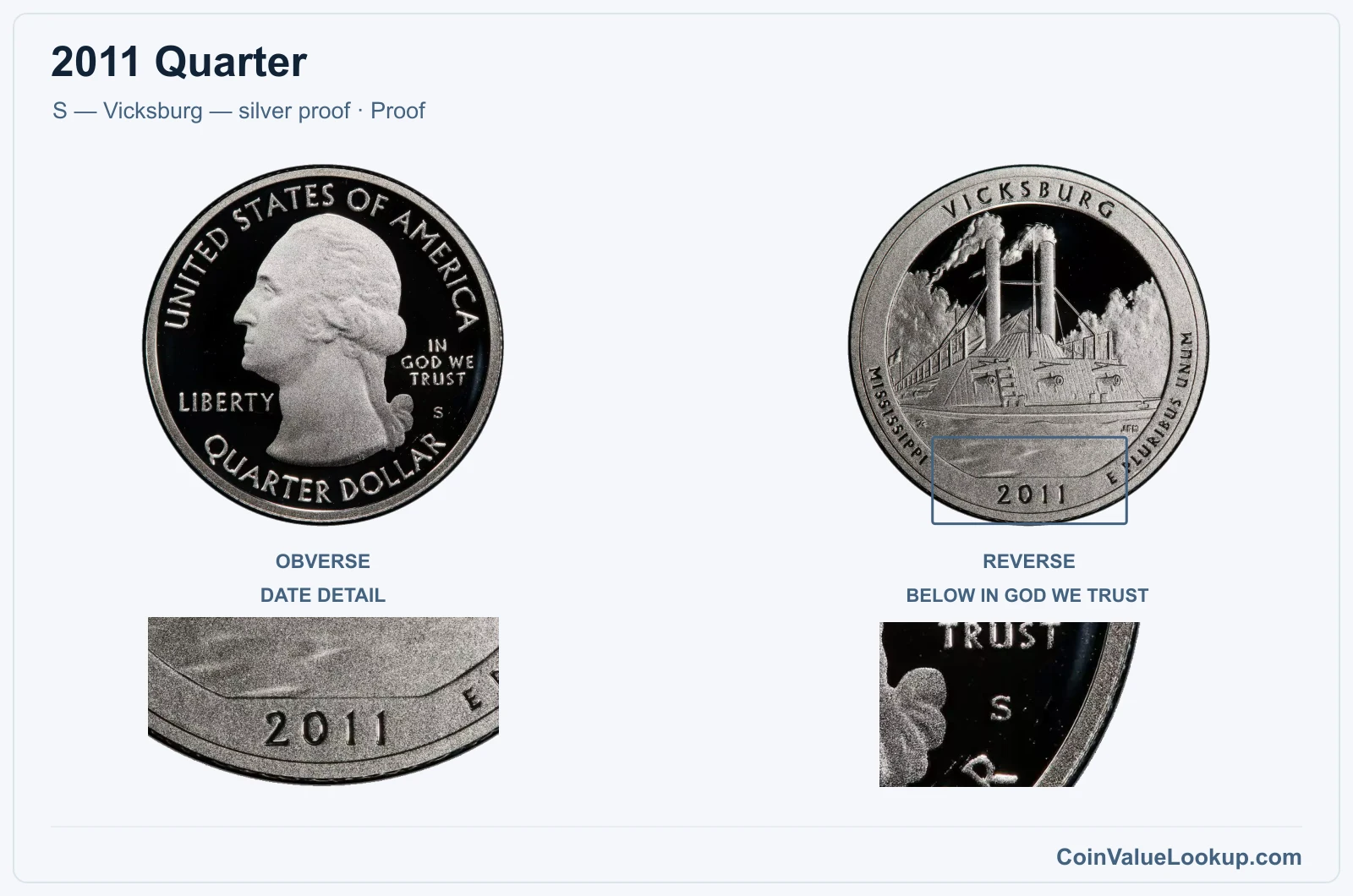
San Francisco's silver proof Vicksburg quarter is 90% silver, approximately 6.25 grams, with a solid silver-colored edge. This coin was only available in the 2011 silver proof set from the U.S. Mint.
USA Coin Book estimates this at $24.00 in PR65. That represents the precious-metal premium plus the collector finish.
Proof-grade hairlines and haze are the primary concerns. Original packaging or third-party certification simplifies identification.
Range Grade
Price Auction Records Appraisal PR PR 1
—
Coin Identifier
PR 2
—
Coin Identifier
PR 3
—
Coin Identifier
PR 4
—
Coin Identifier
PR 6
—
Coin Identifier
PR 8
—
Coin Identifier
PR 10
—
Coin Identifier
PR 12
—
Coin Identifier
PR 15
—
Coin Identifier
PR 20
—
Coin Identifier
PR 25
—
Coin Identifier
PR 30
—
Coin Identifier
PR 35
—
Coin Identifier
PR 40
—
Coin Identifier
PR 45
—
Coin Identifier
PR 50
—
Coin Identifier
PR 53
—
Coin Identifier
PR 55
—
Coin Identifier
PR 58
—
Coin Identifier
PR 60
—
Coin Identifier
PR 61
—
Coin Identifier
PR 62
—
Coin Identifier
PR 63
—
Coin Identifier
PR 64
—
Coin Identifier
PR 65
—
Coin Identifier
PR 66
—
Coin Identifier
PR 67
—
Coin Identifier
PR 68
—
Coin Identifier
PR 69
Coin Identifier
PR 70
Coin Identifier
2011 Quarter — P — Chickasaw — regular strike
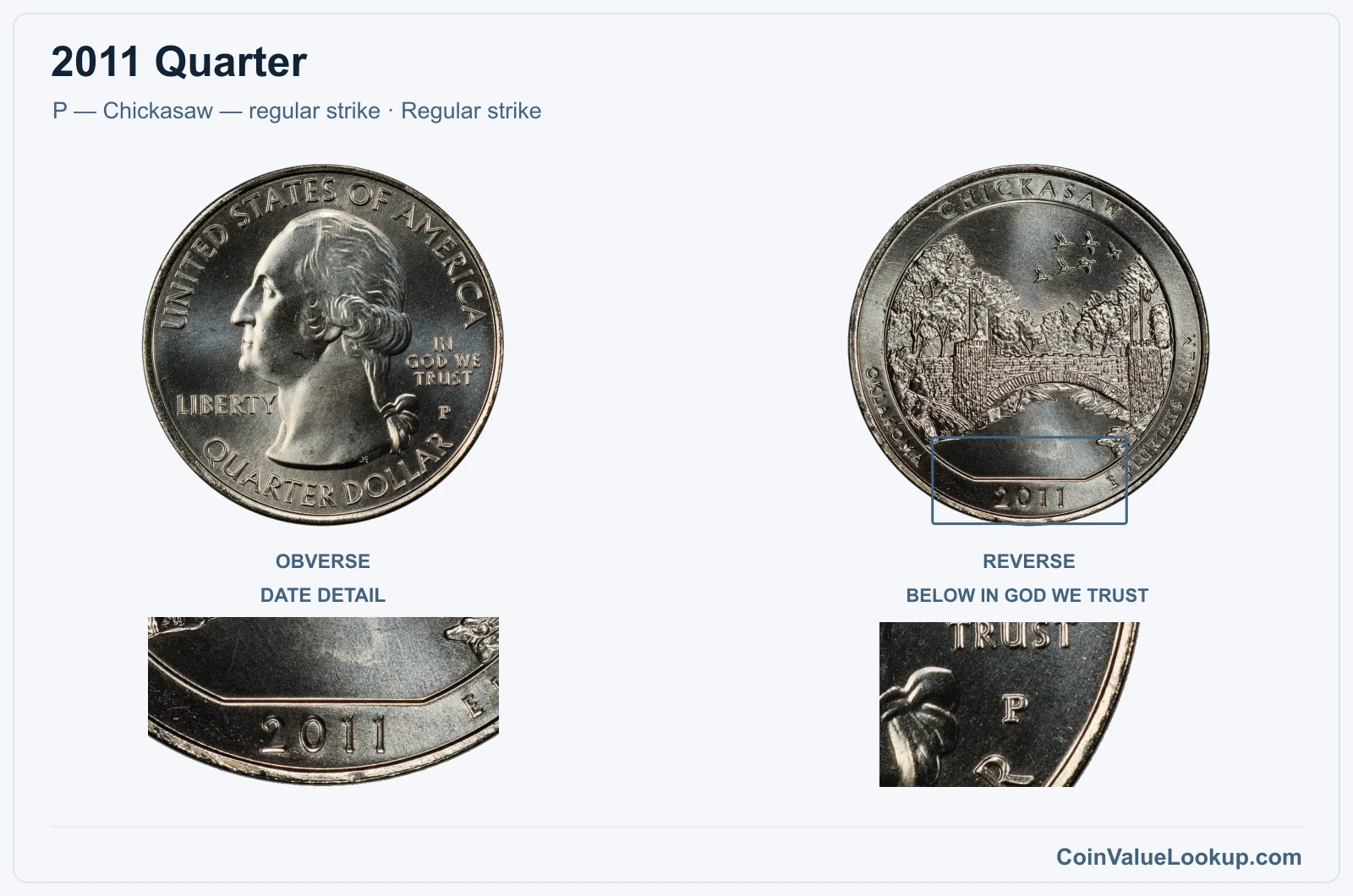
Philadelphia struck the Chickasaw quarter honoring the Oklahoma national recreation area. Copper-nickel clad over a copper core, 5.67 grams, 24.26 mm.
Look for the P mintmark on the obverse.
The USA Coin Book guide estimate is slightly different from the other P-mint designs: about $0.68 at MS60 and $1.24 at MS65. That tiny difference at the lower grade is a guide nuance.
Circulated examples are worth face value.
Range Grade
Price Auction Records Appraisal PO PO 1
—
Coin Identifier FR FR 2
—
Coin Identifier AG AG 3
—
Coin Identifier G G 4
—
Coin Identifier
G 6
—
Coin Identifier VG VG 8
—
Coin Identifier
VG 10
—
Coin Identifier F F 12
—
Coin Identifier
F 15
—
Coin Identifier VF VF 20
—
Coin Identifier
VF 25
—
Coin Identifier
VF 30
—
Coin Identifier
VF 35
—
Coin Identifier XF XF 40
—
Coin Identifier
XF 45
—
Coin Identifier AU AU 50
—
Coin Identifier
AU 53
—
Coin Identifier
AU 55
—
Coin Identifier
AU 58
—
Coin Identifier MS MS 60
—
Coin Identifier
MS 61
—
Coin Identifier
MS 62
—
Coin Identifier
MS 63
—
Coin Identifier
MS 64
—
Coin Identifier
MS 65
—
Coin Identifier
MS 66
—
Coin Identifier
MS 67
—
Coin Identifier
MS 68
Coin Identifier
MS 69
—
—
—
MS 70
—
—
—
2011 Quarter — D — Chickasaw — regular strike
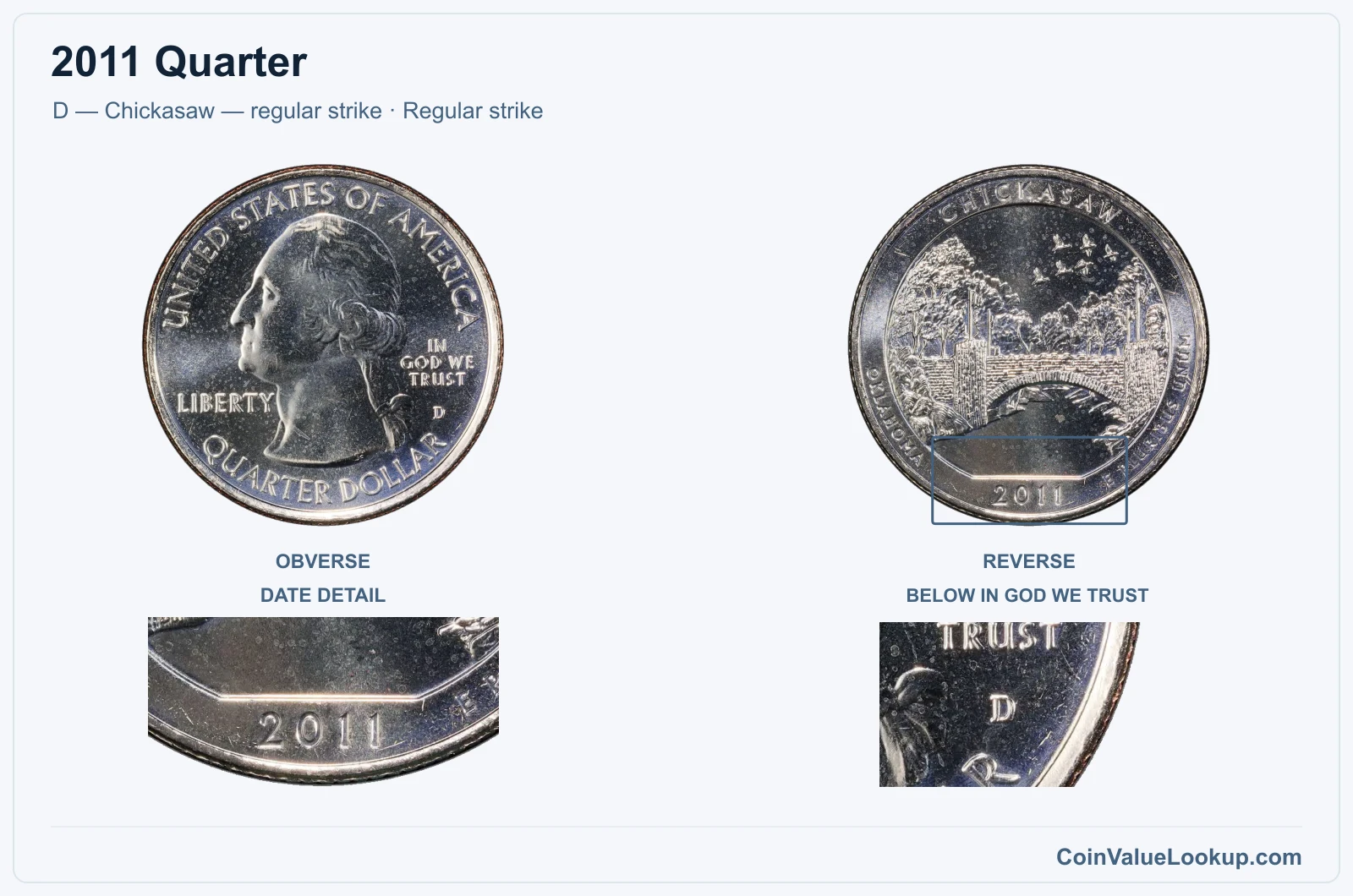
The Denver-mint Chickasaw quarter mirrors the Philadelphia version except for the D mintmark. Same copper-nickel clad composition, same specifications.
USA Coin Book places this at about $0.68 in MS60 and $1.24 in MS65. Again, a marginal difference from other 2011 D-mint designs at the MS60 level.
Only coins with full original luster and no wear qualify as uncirculated.
Range Grade
Price Auction Records Appraisal PO PO 1
—
Coin Identifier FR FR 2
—
Coin Identifier AG AG 3
—
Coin Identifier G G 4
—
Coin Identifier
G 6
—
Coin Identifier VG VG 8
—
Coin Identifier
VG 10
—
Coin Identifier F F 12
—
Coin Identifier
F 15
—
Coin Identifier VF VF 20
—
Coin Identifier
VF 25
—
Coin Identifier
VF 30
—
Coin Identifier
VF 35
—
Coin Identifier XF XF 40
—
Coin Identifier
XF 45
—
Coin Identifier AU AU 50
—
Coin Identifier
AU 53
—
Coin Identifier
AU 55
—
Coin Identifier
AU 58
—
Coin Identifier MS MS 60
—
Coin Identifier
MS 61
—
Coin Identifier
MS 62
—
Coin Identifier
MS 63
—
Coin Identifier
MS 64
—
Coin Identifier
MS 65
—
Coin Identifier
MS 66
—
Coin Identifier
MS 67
—
Coin Identifier
MS 68
—
—
—
MS 69
—
—
—
MS 70
—
—
—
2011 Quarter — S — Chickasaw — clad proof
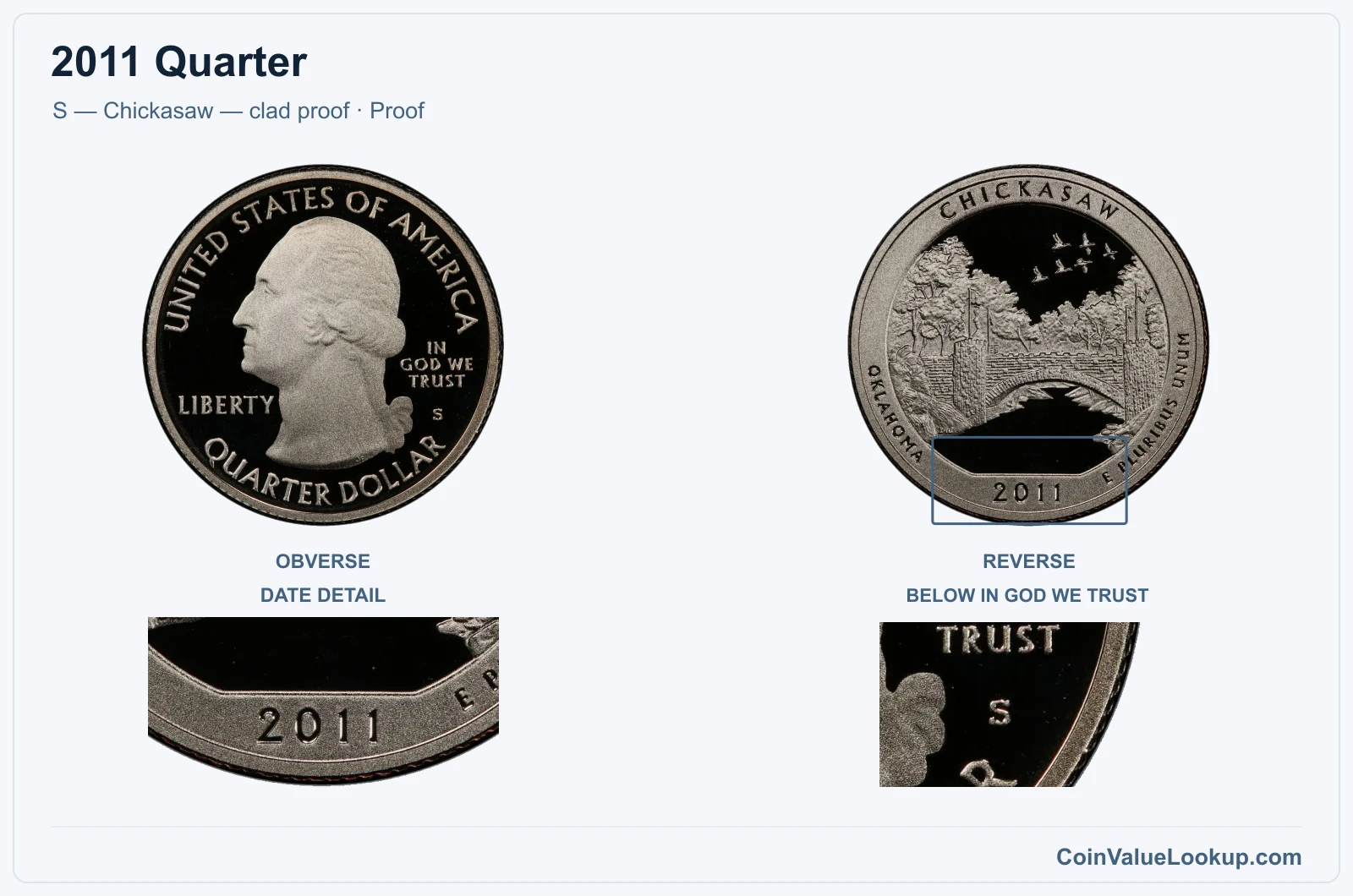
San Francisco's clad proof Chickasaw quarter has the standard proof finish on copper-nickel clad planchets. The S mintmark and reflective fields identify the finish; the copper edge stripe identifies the composition.
USA Coin Book estimates PR65 at about $5.63. These are collector coins from proof sets and rarely show up in circulation.
Confirm the composition before assuming higher silver proof value — the visual difference between clad and silver proofs can be subtle on the face.
Range Grade
Price Auction Records Appraisal PR PR 1
—
Coin Identifier
PR 2
—
Coin Identifier
PR 3
—
Coin Identifier
PR 4
—
Coin Identifier
PR 6
—
Coin Identifier
PR 8
—
Coin Identifier
PR 10
—
Coin Identifier
PR 12
—
Coin Identifier
PR 15
—
Coin Identifier
PR 20
—
Coin Identifier
PR 25
—
Coin Identifier
PR 30
—
Coin Identifier
PR 35
—
Coin Identifier
PR 40
—
Coin Identifier
PR 45
—
Coin Identifier
PR 50
—
Coin Identifier
PR 53
—
Coin Identifier
PR 55
—
Coin Identifier
PR 58
—
Coin Identifier
PR 60
—
Coin Identifier
PR 61
—
Coin Identifier
PR 62
—
Coin Identifier
PR 63
—
Coin Identifier
PR 64
—
Coin Identifier
PR 65
—
Coin Identifier
PR 66
—
Coin Identifier
PR 67
—
Coin Identifier
PR 68
—
Coin Identifier
PR 69
Coin Identifier
PR 70
Coin Identifier
2011 Quarter — S — Chickasaw — silver proof
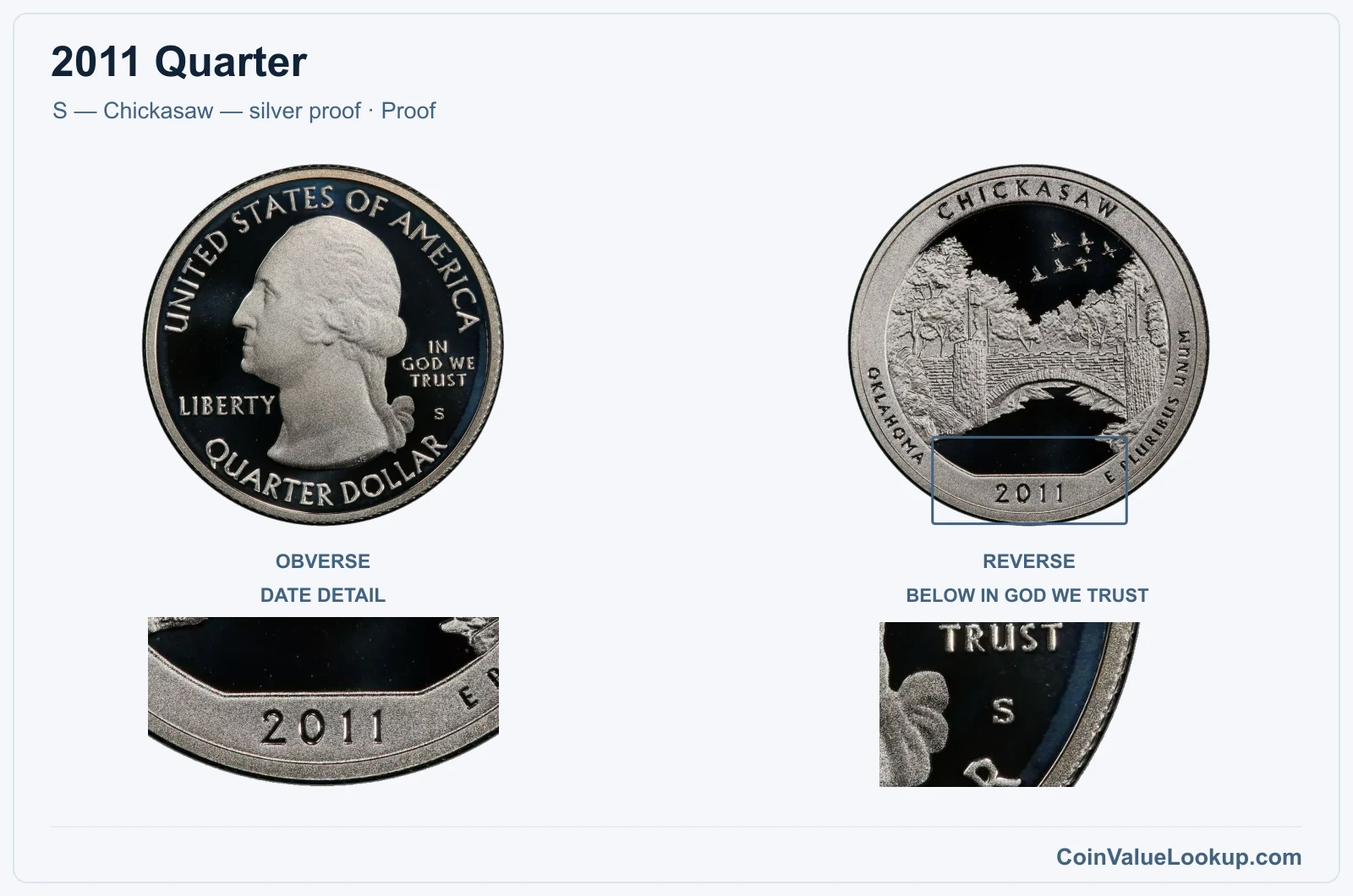
The silver proof Chickasaw quarter rounds out the 2011 set. It is 90% silver, approximately 6.25 grams, with a uniform silver edge.
This coin came in the U.S. Mint's 2011 silver proof set.
USA Coin Book lists it at $24.00 in PR65, matching the other four silver proof reverses from this year. The silver proof is the version to look for if you are buying or selling 2011 quarters — the premium is real, but only for confirmed silver composition in proof condition.
Range Grade
Price Auction Records Appraisal PR PR 1
—
Coin Identifier
PR 2
—
Coin Identifier
PR 3
—
Coin Identifier
PR 4
—
Coin Identifier
PR 6
—
Coin Identifier
PR 8
—
Coin Identifier
PR 10
—
Coin Identifier
PR 12
—
Coin Identifier
PR 15
—
Coin Identifier
PR 20
—
Coin Identifier
PR 25
—
Coin Identifier
PR 30
—
Coin Identifier
PR 35
—
Coin Identifier
PR 40
—
Coin Identifier
PR 45
—
Coin Identifier
PR 50
—
Coin Identifier
PR 53
—
Coin Identifier
PR 55
—
Coin Identifier
PR 58
—
Coin Identifier
PR 60
—
Coin Identifier
PR 61
—
Coin Identifier
PR 62
—
Coin Identifier
PR 63
—
Coin Identifier
PR 64
—
Coin Identifier
PR 65
—
Coin Identifier
PR 66
—
Coin Identifier
PR 67
—
Coin Identifier
PR 68
—
Coin Identifier
PR 69
Coin Identifier
PR 70
Coin Identifier
2011 Quarter Error List
1. 2011 Quarter — Clipped Planchet
A clipped planchet error occurs when part of the blank is missing before the coin is struck. On a 2011 quarter, look for a curved, straight or ragged portion absent from the edge, with design weakness on the opposite side from the clip — that opposite weakness results from incomplete metal flow during striking and helps confirm a genuine clip.
Do not confuse a clip with a filed edge, a deliberate notch or corrosion eating into the rim. Post-mint damage typically shows sharp, bright tool marks and no corresponding weakness on the opposite side.
The value depends on the size and visibility of the clip, plus the coin's overall condition. Larger clips with visible date retention tend to draw more collector attention.
2. 2011 Quarter — Vicksburg — Doubled Die
A doubled die on the 2011 Vicksburg quarter shows consistent doubling — separation or notching — in design elements where a misaligned hub impression affected the die itself. Compare lettering or device outlines on your coin to a normal Vicksburg quarter under the same lighting.
Genuine doubling appears as a secondary image with shelf-like edges on individual letters or features.
Machine doubling is the common lookalike. It produces flat, shelf-like displacement without the sharp, notched character of a true doubled die.
Post-mint impressions and reflections under magnification can also mimic doubling. Value depends on the strength and location of the doubling as well as the coin's grade — a strong, clearly visible doubled die is more desirable than faint traces.
3. 2011 Quarter — Vicksburg — Off-Center Strike
An off-center 2011 Vicksburg quarter has its design shifted so that a blank crescent of unstruck metal shows on one side. The percentage of off-center displacement matters: a 5% shift is minor, while 50% or more with a visible date is the collector sweet spot.
Post-mint flattening and clipped planchets can look similar at first glance. A true off-center strike shifts the entire design uniformly, and the blank crescent is smooth unstruck planchet metal — not a damaged rim.
Value depends on the degree of displacement, date visibility and overall condition. No specific price range is established here, so individual evaluation is appropriate.
4. 2011 Quarter — Clashed Dies
Die clash marks appear when the obverse and reverse dies strike each other without a planchet between them, transferring ghost impressions of the opposite design onto each die. On a 2011 quarter, look for faint, incuse outlines of Washington's portrait in the reverse fields, or traces of the reverse design on Washington's side.
These marks align with where the opposing design would contact.
Random scratches, raised lines from debris and brockage impressions can mimic a clash. A true clash shows design elements from the other side of the coin in predictable positions.
Condition, strength and visibility of the transferred design determine collector interest. A bold clash is considerably more desirable than a faint one.
5. 2011 Quarter — Gettysburg — Off-Center Strike
An off-center 2011 Gettysburg quarter shows the entire design shifted in one direction, leaving a crescent of blank metal along the opposite edge. The key diagnostic is that the design displacement is uniform — everything moves together — and the unstruck area is smooth planchet surface.
Look-alikes include a one-sided die misalignment, a clipped planchet and post-mint flattening. A clip removes a piece of the blank before striking, while an off-center error shifts the whole image.
Post-mint damage usually leaves tool marks or uneven edges. Value is driven by the percentage of displacement and whether the date remains visible.
Each coin needs individual assessment.
6. 2011 Quarter — Gettysburg — Broadstrike
A broadstrike on the 2011 Gettysburg quarter happens when the coin is struck without the retaining collar that normally forms the reeded edge. The result is a coin that spreads wider than normal, with a smooth or irregular rim and a slightly thinner profile.
The full design is present — just spread outward.
Do not confuse this with an off-center strike, which shifts the design and leaves blank metal. A broadstrike keeps the design centered but loses the normal edge confinement.
Coins flattened after minting by a vise or hammer can look similar but show damage marks and uneven distortion. Value depends on the degree of spread and overall condition.
7. 2011 Quarter — Gettysburg — Struck-Through Error
A struck-through error on the 2011 Gettysburg quarter means something — grease, debris, a thread, a piece of metal — sat between the die and the planchet during striking. The result is a localized depression, blurred area or impression of the foreign object in the coin's surface.
Grease fill-ins obscure design details in a smooth, featureless way. A retained foreign object leaves a distinct impression, sometimes with the object still embedded.
Ordinary wear, cleaning scratches and weak strikes from a tired die are the common look-alikes — none of those produce the characteristic depressed or impressed area of a genuine struck-through. Value depends on the size, clarity and type of obstruction.
8. 2011 Quarter — Gettysburg — Die Crack / Die Chip
Die cracks on the 2011 Gettysburg quarter appear as thin, raised lines on the coin's surface where the steel die fractured during use. Die chips are small raised blobs, usually on flat field areas, from tiny pieces of the die breaking away.
Both are raised because the crack or chip creates a recess in the die that fills with metal during striking.
Distinguish these from incuse scratches (which are cut into the surface, not raised), corrosion and foreign material stuck to the coin. A cud — a large die break connecting to the rim — is a related but more dramatic error.
Standard die cracks carry modest collector interest; value varies with size, location and overall coin condition.
9. 2011 Quarter — Gettysburg — Missing Clad Layer
A 2011 Gettysburg quarter missing a clad layer shows an exposed copper-colored surface on one or both faces where the outer nickel-copper layer failed to bond or separated before striking. The coin will also weigh less than the normal 5.67 grams.
Toning, environmental damage and deliberate acid-stripping can all make a coin look copper-colored, so weight and edge examination are essential. A genuine missing clad layer shows a uniform copper appearance on the affected face with a normal or partially visible clad structure on the edge.
The value depends on whether one or both layers are missing, the coin's condition and whether the error is confirmed through weight. Individual assessment is needed.
10. 2011 Quarter — Lamination / Split Planchet
Lamination errors on 2011 quarters appear as peeling, flaking or split layers in the coin's metal. You may see a retained flap of metal still attached, or a smooth area where a layer has separated and fallen away.
Photograph the edge alongside the affected face — a cross-section view helps show the internal separation.
Scraping damage, corrosion pitting and deliberately split coins are the main look-alikes. A genuine lamination follows the metal's internal structure and does not show tool marks.
The peeling typically has rounded, natural-looking edges rather than sharp cuts. Value depends on size and visual drama — a large retained flap is more collectible than a small surface blister.
Each coin should be evaluated individually.
11. 2011 Quarter — Misaligned Die
A misaligned die error on a 2011 quarter means one die was physically shifted off its normal centered position during striking. The result is a design that appears off-center on one face while the other face remains properly centered — or both faces show slight displacement relative to the planchet.
This is different from an off-center strike, where the entire planchet is mispositioned. With a misaligned die, the coin is fully within the collar but one die's image is shifted.
A tilted photograph or post-mint rim ding can mimic the look. Compare both sides carefully: if only one face is displaced, a misaligned die is the likely explanation.
Value depends on the degree of shift and overall condition.
12. 2011 Quarter — Doubled Die Obverse
A doubled die obverse on a 2011 quarter shows consistent doubling in the obverse design — typically visible in lettering such as IN GOD WE TRUST, LIBERTY or the date. Under magnification, look for separation or notching on letter serifs and device edges.
The doubling should appear in the same direction and magnitude across the affected area.
Machine doubling is the most common mimic. It produces flat, shelf-like distortion without the crisp secondary image of a true doubled die.
Reflections and worn die contours can also deceive. Value varies widely depending on the strength of the doubling and the coin's grade.
A dramatic, easily visible doubled die commands more attention than one requiring a loupe to detect.
13. 2011 Quarter — Doubled Die Reverse
A doubled die reverse on a 2011 quarter shows consistent design doubling on the reverse side — check park names, E PLURIBUS UNUM, QUARTER DOLLAR and other lettering for separation or notching. Compare your coin's reverse lettering to a known normal example under the same magnification and lighting.
Machine doubling, reflections and random surface damage are the usual look-alikes. True hub doubling produces a secondary image with notched or split serifs, while machine doubling shows flat displacement.
Do not assume a specific die marker — compare carefully. The value of a doubled die reverse depends on visibility, strength and the coin's overall condition.
14. 2011 Quarter — Vicksburg — Struck-Through Error
A struck-through error on the 2011 Vicksburg quarter shows a localized area where foreign material — grease, metal shavings, fabric or debris — blocked the die during striking. The affected zone may appear as a smooth depression, a textured impression or an area of missing design detail.
Grease fills produce featureless flat spots, while solid objects leave distinct impressions that sometimes retain the object's shape. The key distinction from ordinary wear is that a struck-through area is typically sharply bounded and surrounded by normal detail.
Cleaning scratches, bag wear and weak strikes from die fatigue do not share that characteristic. Value depends on the size, clarity and type of struck-through impression, plus the coin's condition.
15. 2011 Quarter — Vicksburg — Die Crack / Die Chip
Die cracks on the 2011 Vicksburg quarter appear as raised lines running across the coin's surface. They form when the steel die fractures from repeated use, and the crack fills with metal during each strike.
Die chips are similar but appear as small raised blobs rather than lines.
These are always raised features. If you see an incuse line cut into the surface, that is a scratch, not a die crack.
Corrosion deposits and foreign material adhering to the coin surface can also mimic a raised line. Interior chips are minor; a crack running to the rim edges into cud territory.
Value depends on prominence and location, and each example requires individual evaluation.
16. 2011 Quarter — Vicksburg — Die Break / Cud
A cud on the 2011 Vicksburg quarter is a major die break that connects to the rim, leaving a raised, flat or blobby area where the broken piece of the die no longer imparts design detail. The coin still strikes, but the missing die chunk means metal flows into the void and creates a distinctive raised mass along the edge.
A rim dent, corrosion buildup or a small interior die chip can look similar but lack the rim connection and the displaced design boundary of a true cud. Compare the suspect area to the same position on a normal coin.
Value depends on size — a large, prominent cud across significant design elements draws more collector interest than a tiny rim break. Individual evaluation is recommended.