2013 Quarter Coin Value: How Much Is It Worth?
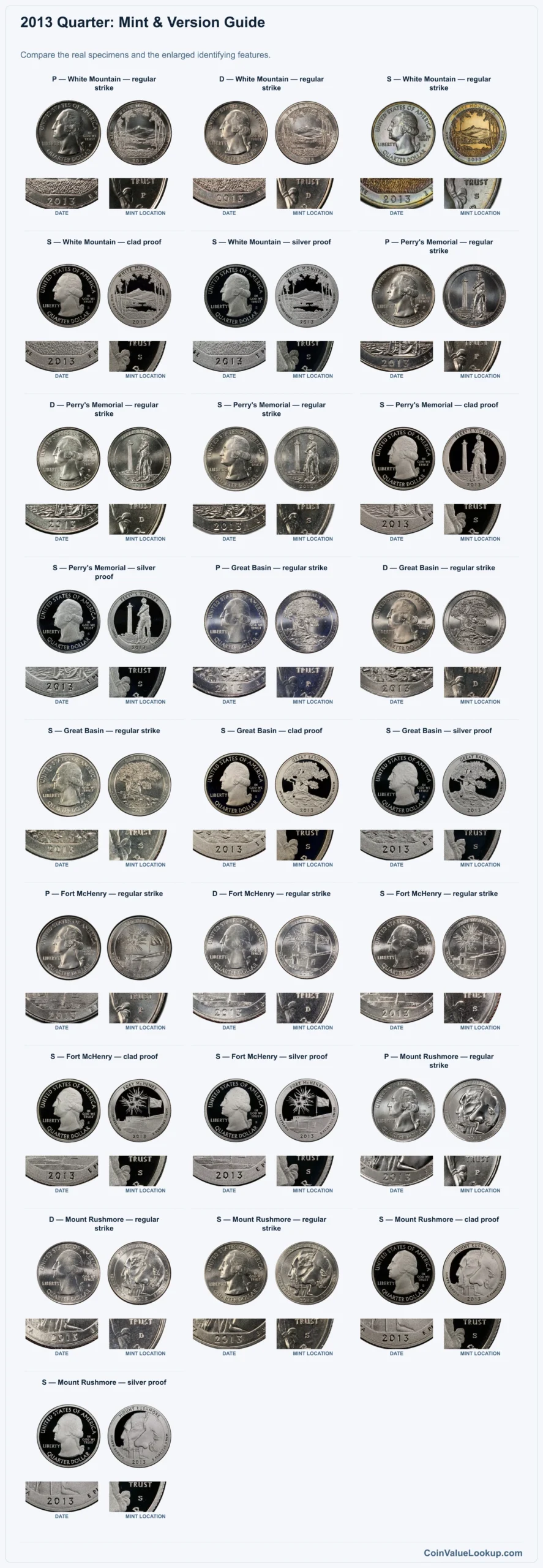
The 2013 quarter belongs to the America the Beautiful series, and five different reverse designs were issued that year: White Mountain, Perry's Memorial, Great Basin, Fort McHenry, and Mount Rushmore. Guide estimates for the versions covered here range from about $0.61 to $24.00, depending on mint, finish, condition, and reverse design.
A worn P- or D-mint quarter from pocket change is generally worth face value, while San Francisco collector strikes and silver proofs sit at the higher end of that range.
Fast Way to Identify Your 2013 Quarter
The quickest way to start figuring out what your 2013 quarter is worth is to upload clear photos of the front and back. That lets us provide a preliminary identification of the mint, reverse design, and finish so you can match it to the right version.
Snap both sides in good light, and avoid glare on the fields.
2013 Quarter Value
Upload both sides of your 2013 Quarter.
Front Obverse
Upload photo
Back Reverse
Upload photo
Which 2013 Quarter Versions Are Worth Money?
- S-mint silver proofs (White Mountain, Great Basin, Fort McHenry, Mount Rushmore) carry guide estimates around $24.00 at PR65, the highest among listed versions.
- S-mint uncirculated business strikes for White Mountain, Great Basin, Fort McHenry, and Mount Rushmore are listed at about $10.00 in MS65, well above face value.
- S-mint clad proofs for White Mountain, Great Basin, Fort McHenry, and Mount Rushmore are estimated around $5.63 at PR65.
- Error coins such as doubled dies, off-center strikes, and broadstrikes have been reported across several 2013 designs and can carry premiums based on condition and visibility.
Step 1: Identify Your 2013 Quarter Mint Mark and Version
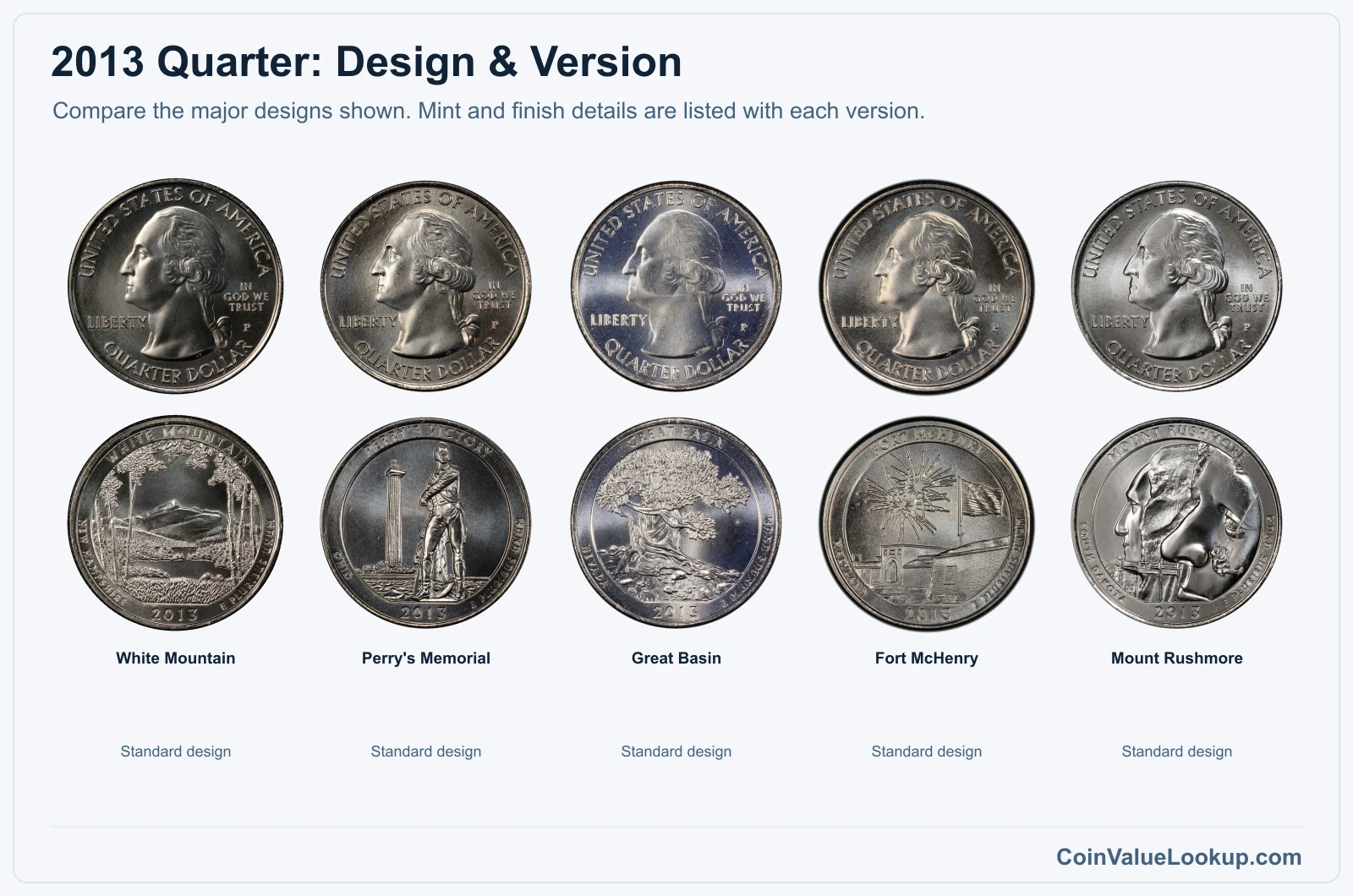
Start on the obverse. Look near Washington's portrait for a small mintmark: P for Philadelphia, D for Denver, or S for San Francisco.
An S mintmark does not automatically mean proof; San Francisco also struck non-proof collector pieces in 2013.
Flip the coin over. You need to identify which of five reverses you have: White Mountain (New Hampshire), Perry's Memorial (Ohio), Great Basin (Nevada), Fort McHenry (Maryland), or Mount Rushmore (South Dakota).
Any dates in the reverse design refer to the site's history, not the coin's minting year.
Ordinary circulation quarters are copper-nickel clad over a copper core, measuring 24.26 mm and weighing about 5.67 grams. Silver proofs, struck only at San Francisco, are 90% silver and 10% copper with a nominal weight of 6.25 grams.
To tell a clad proof from a silver proof, check the edge: a clad coin shows a visible layered band, while a silver proof has a uniform silver-gray edge. Weight on a precise scale also works.
This guide covers standard quarter-dollar-sized coins only. The Mint also sold five-ounce silver collector and bullion versions sharing these designs; those are a separate format with different values.
Step 2: Check Your 2013 Quarter Grade
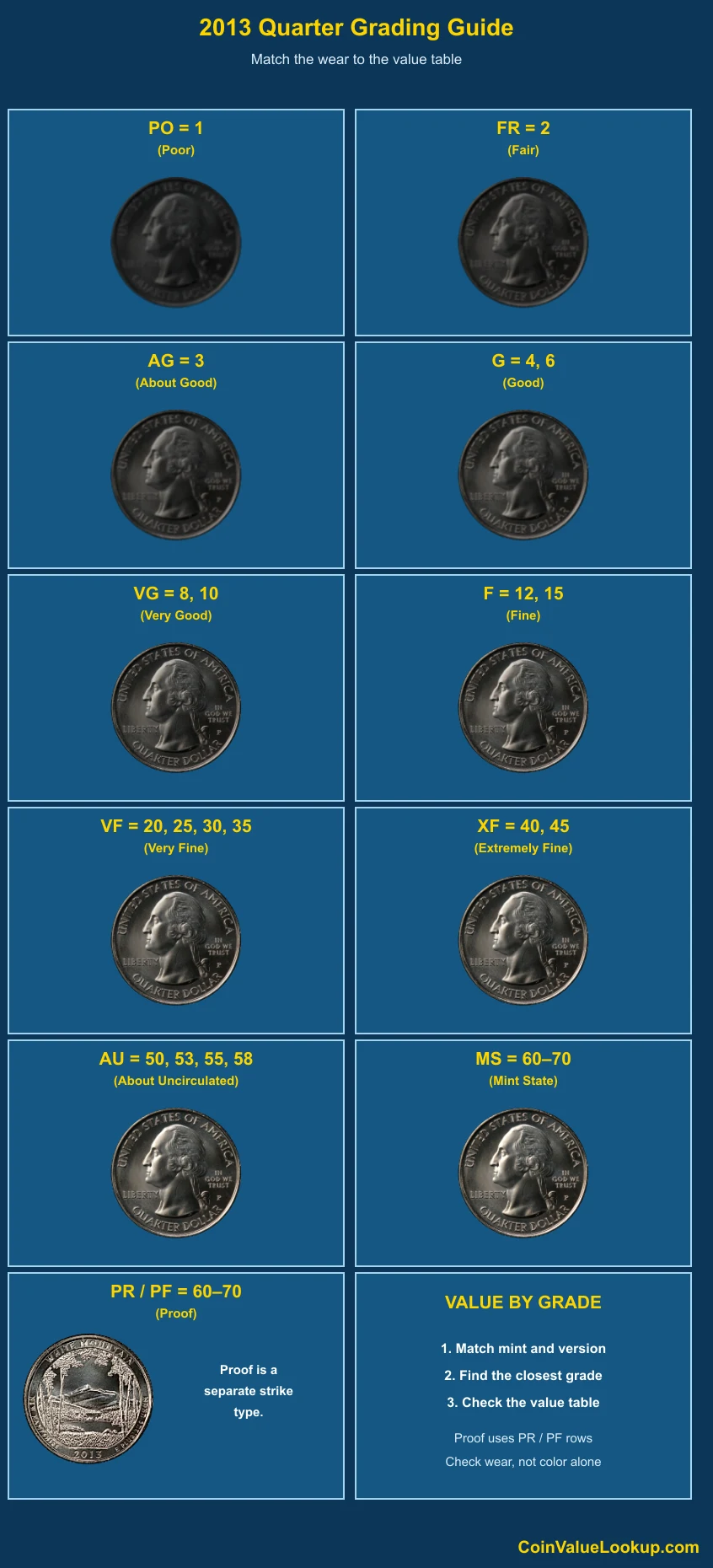
Focus on Washington's cheek and the hair strands above the ear on the obverse. These are the first areas to show friction.
On the reverse, examine the highest relief points of whatever design you have, whether that is tree detail on White Mountain or the carved faces on Mount Rushmore.
For proof coins, tilt the coin under a single light source. Hairlines across the mirror fields and any haze or milkiness reduce the grade, even if the devices still look sharp.
Compare your coin to the reference image showing different wear levels. Luster matters as much as detail; a dull coin with full detail may grade lower than you expect.
Also, a weak strike can reduce sharpness on an unworn coin, so do not assume missing detail always means circulation wear.
Step 3: Check 2013 Quarter Value by Mint and Version
2013 Quarter — P — White Mountain — regular strike
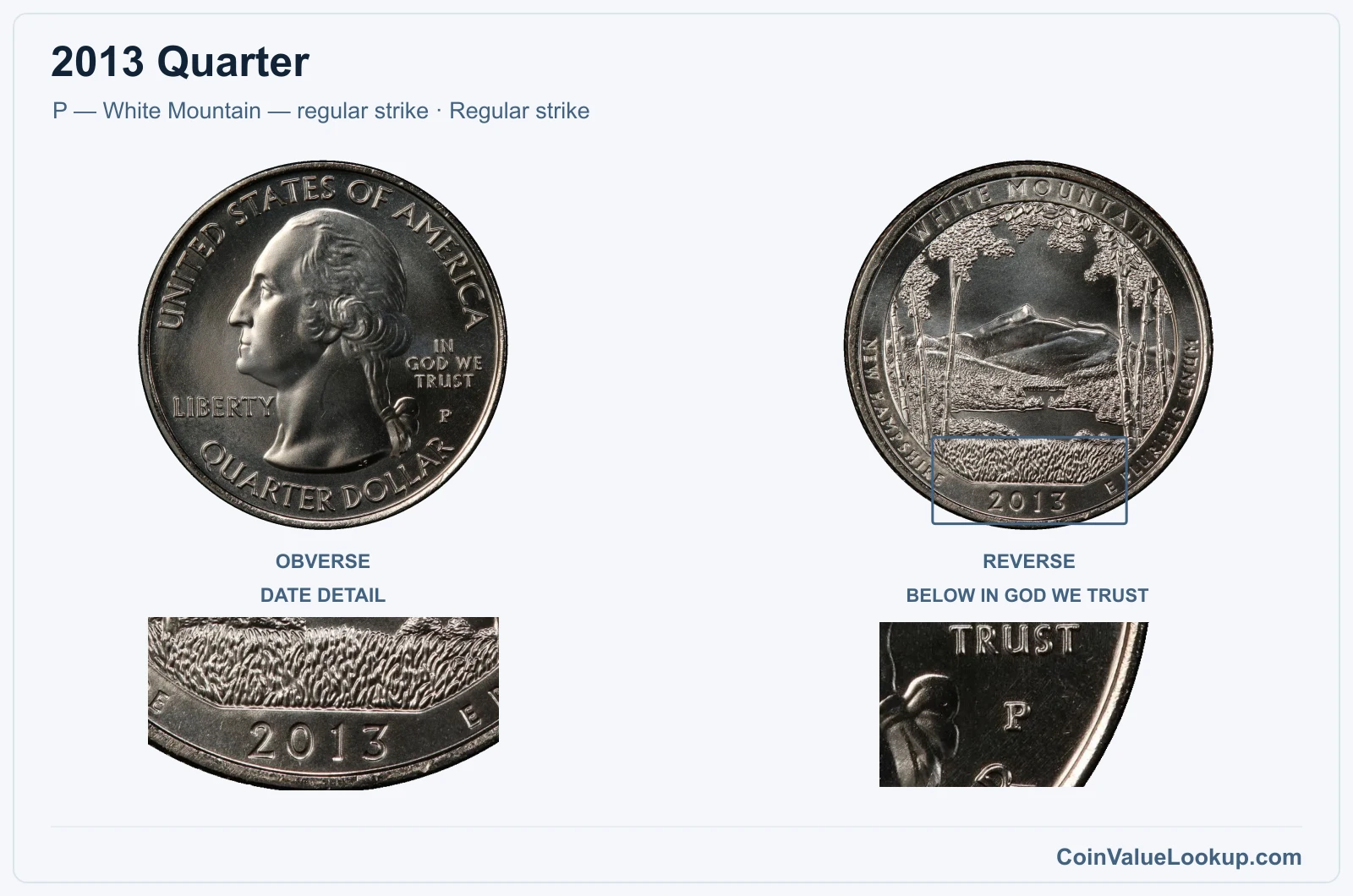
This is the Philadelphia-mint regular strike with the White Mountain (New Hampshire) reverse. It is copper-nickel clad, 24.26 mm, and weighs about 5.67 grams.
A circulated example is worth face value. USA Coin Book estimates an MS60 at about $0.74 and an MS65 at roughly $1.24.
To get above face value, the coin needs to be uncirculated with original luster and no contact marks on Washington's cheek or the mountain scene.
Range Grade
Price Auction Records Appraisal PO PO 1
—
Coin Identifier FR FR 2
—
Coin Identifier AG AG 3
—
Coin Identifier G G 4
—
Coin Identifier
G 6
—
Coin Identifier VG VG 8
—
Coin Identifier
VG 10
—
Coin Identifier F F 12
—
Coin Identifier
F 15
—
Coin Identifier VF VF 20
—
Coin Identifier
VF 25
—
Coin Identifier
VF 30
—
Coin Identifier
VF 35
—
Coin Identifier XF XF 40
—
Coin Identifier
XF 45
—
Coin Identifier AU AU 50
—
Coin Identifier
AU 53
—
Coin Identifier
AU 55
—
Coin Identifier
AU 58
—
Coin Identifier MS MS 60
—
Coin Identifier
MS 61
—
Coin Identifier
MS 62
—
Coin Identifier
MS 63
—
Coin Identifier
MS 64
—
Coin Identifier
MS 65
—
Coin Identifier
MS 66
—
Coin Identifier
MS 67
Coin Identifier
MS 68
Coin Identifier
MS 69
—
—
—
MS 70
—
—
—
2013 Quarter — D — White Mountain — regular strike
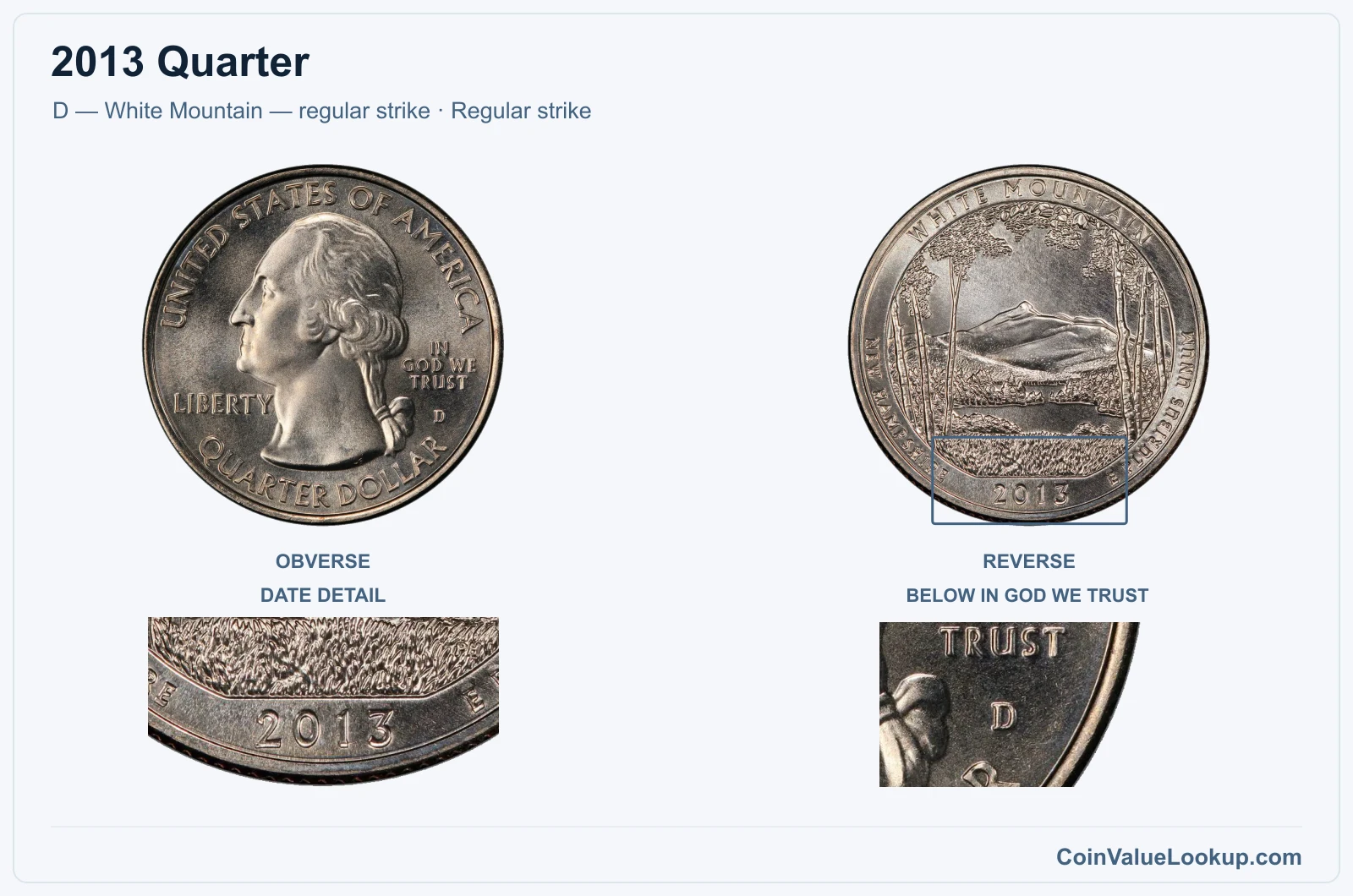
The Denver-mint White Mountain quarter is identical in composition and size to the P-mint version. Look for the D mintmark on the obverse near Washington's ponytail.
USA Coin Book estimates about $0.74 at MS60 and $1.24 at MS65. Worn pieces are face-value coins.
Only original, uncirculated examples with good eye appeal carry a modest collector premium.
Range Grade
Price Auction Records Appraisal PO PO 1
—
Coin Identifier FR FR 2
—
Coin Identifier AG AG 3
—
Coin Identifier G G 4
—
Coin Identifier
G 6
—
Coin Identifier VG VG 8
—
Coin Identifier
VG 10
—
Coin Identifier F F 12
—
Coin Identifier
F 15
—
Coin Identifier VF VF 20
—
Coin Identifier
VF 25
—
Coin Identifier
VF 30
—
Coin Identifier
VF 35
—
Coin Identifier XF XF 40
—
Coin Identifier
XF 45
—
Coin Identifier AU AU 50
—
Coin Identifier
AU 53
—
Coin Identifier
AU 55
—
Coin Identifier
AU 58
—
Coin Identifier MS MS 60
—
Coin Identifier
MS 61
—
Coin Identifier
MS 62
—
Coin Identifier
MS 63
—
Coin Identifier
MS 64
—
Coin Identifier
MS 65
—
Coin Identifier
MS 66
—
Coin Identifier
MS 67
Coin Identifier
MS 68
—
Coin Identifier
MS 69
—
—
—
MS 70
—
—
—
2013 Quarter — S — White Mountain — regular strike
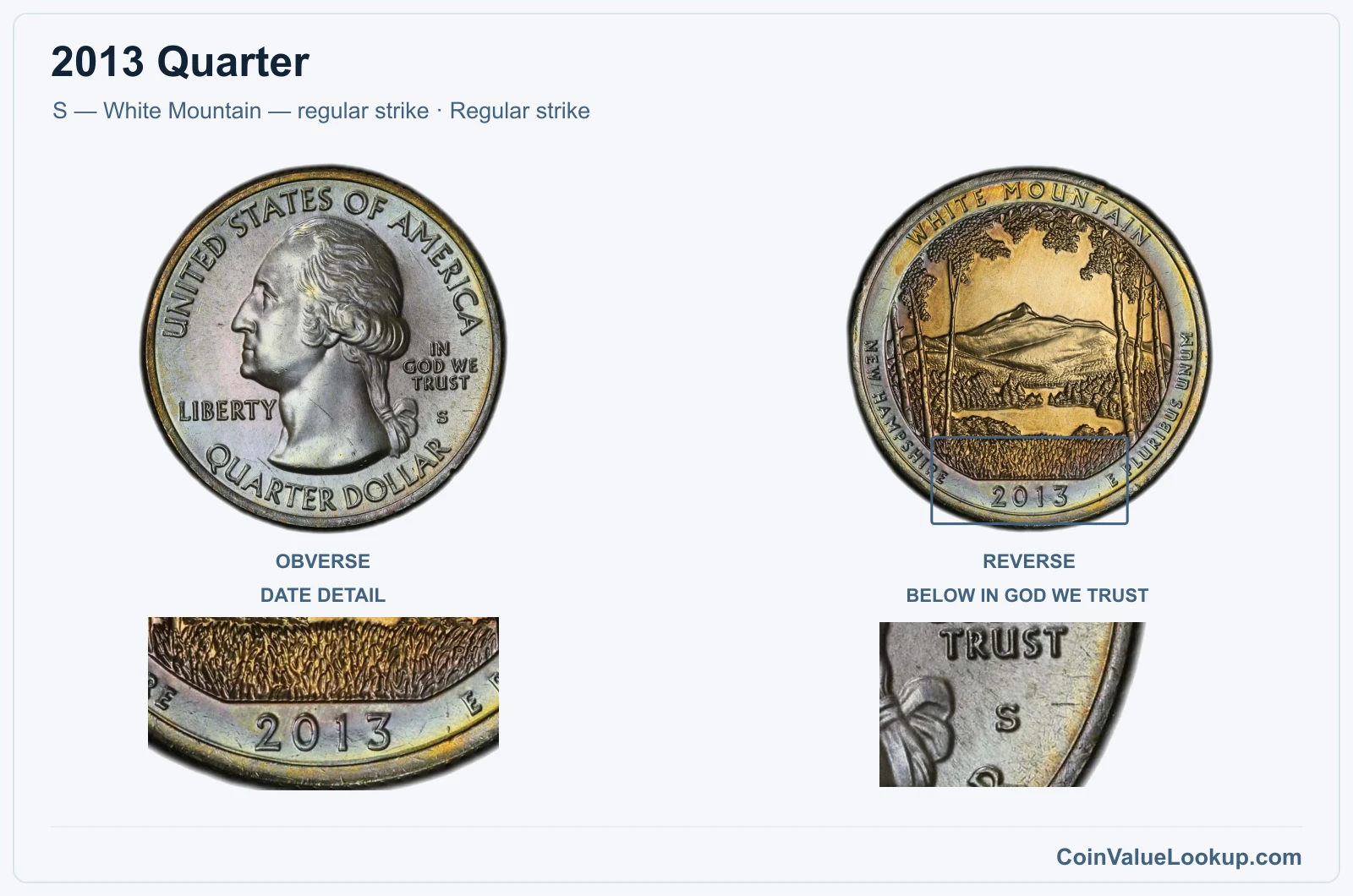
San Francisco also struck a non-proof, uncirculated White Mountain quarter in copper-nickel clad. The S mintmark does not mean proof here; look at the surfaces.
Proofs have mirror fields and frosted devices, while this version has a normal business-strike finish. USA Coin Book estimates MS65 at about $10.00.
These were sold through Mint sets, not released into circulation, so they are less common than P or D versions.
Range Grade
Price Auction Records Appraisal PO PO 1
—
Coin Identifier FR FR 2
—
Coin Identifier AG AG 3
—
Coin Identifier G G 4
—
Coin Identifier
G 6
—
Coin Identifier VG VG 8
—
Coin Identifier
VG 10
—
Coin Identifier F F 12
—
Coin Identifier
F 15
—
Coin Identifier VF VF 20
—
Coin Identifier
VF 25
—
Coin Identifier
VF 30
—
Coin Identifier
VF 35
—
Coin Identifier XF XF 40
—
Coin Identifier
XF 45
—
Coin Identifier AU AU 50
—
Coin Identifier
AU 53
—
Coin Identifier
AU 55
—
Coin Identifier
AU 58
—
Coin Identifier MS MS 60
—
Coin Identifier
MS 61
—
Coin Identifier
MS 62
—
Coin Identifier
MS 63
—
Coin Identifier
MS 64
—
Coin Identifier
MS 65
—
Coin Identifier
MS 66
—
Coin Identifier
MS 67
—
Coin Identifier
MS 68
—
—
—
MS 69
—
—
—
MS 70
—
—
—
2013 Quarter — S — White Mountain — clad proof
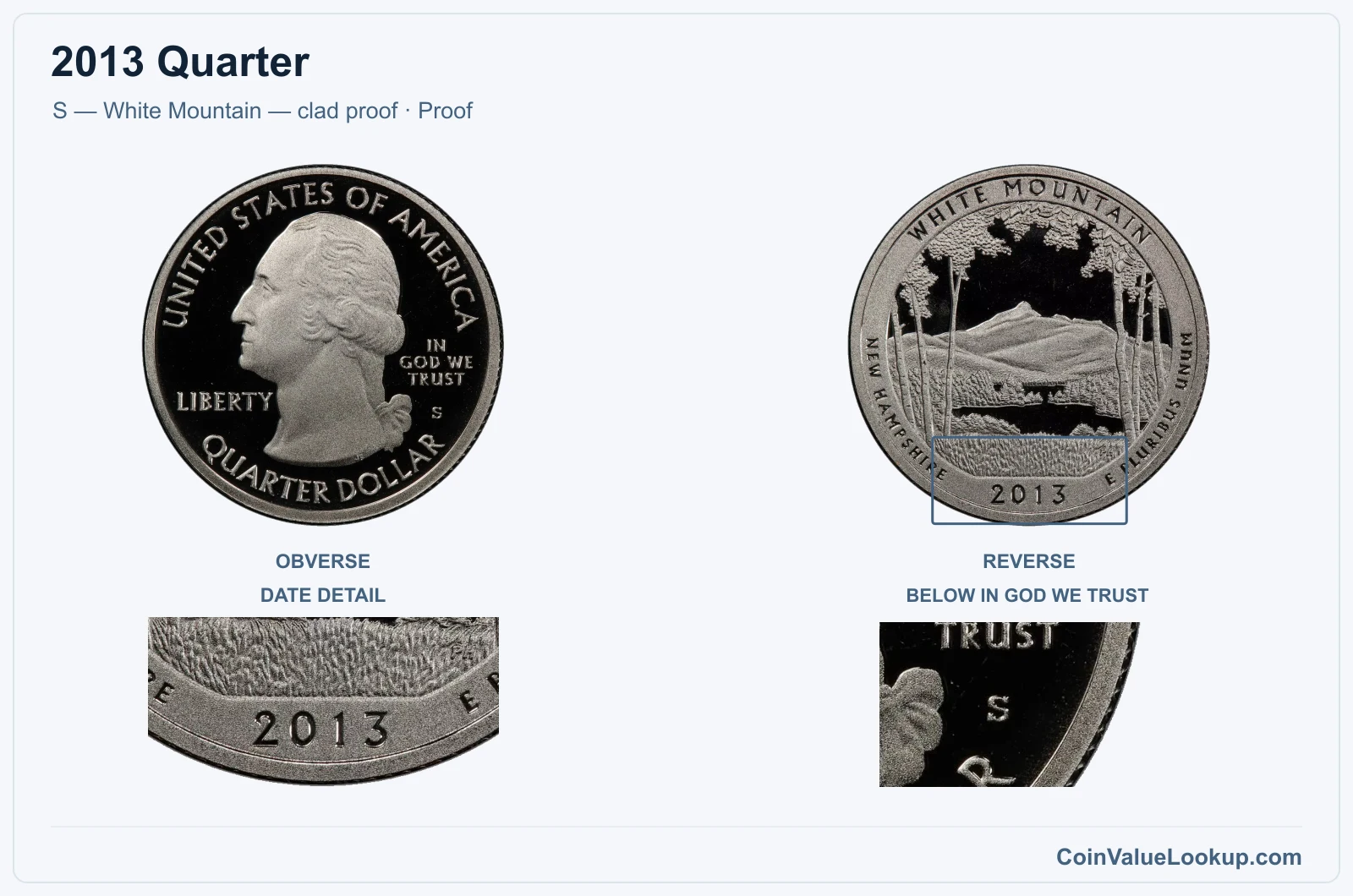
The S-mint clad proof White Mountain quarter has mirror-like fields and frosted raised design elements. It is the same copper-nickel clad composition as the business strikes, not silver.
Check the edge for a visible copper-colored layer between the outer cladding. USA Coin Book estimates PR65 at about $5.63.
Keep this version separate from the silver proof when pricing; they look similar face-on but differ in weight, edge appearance, and value.
Range Grade
Price Auction Records Appraisal PR PR 1
—
Coin Identifier
PR 2
—
Coin Identifier
PR 3
—
Coin Identifier
PR 4
—
Coin Identifier
PR 6
—
Coin Identifier
PR 8
—
Coin Identifier
PR 10
—
Coin Identifier
PR 12
—
Coin Identifier
PR 15
—
Coin Identifier
PR 20
—
Coin Identifier
PR 25
—
Coin Identifier
PR 30
—
Coin Identifier
PR 35
—
Coin Identifier
PR 40
—
Coin Identifier
PR 45
—
Coin Identifier
PR 50
—
Coin Identifier
PR 53
—
Coin Identifier
PR 55
—
Coin Identifier
PR 58
—
Coin Identifier
PR 60
—
Coin Identifier
PR 61
—
Coin Identifier
PR 62
—
Coin Identifier
PR 63
—
Coin Identifier
PR 64
—
Coin Identifier
PR 65
—
Coin Identifier
PR 66
—
Coin Identifier
PR 67
—
Coin Identifier
PR 68
—
Coin Identifier
PR 69
Coin Identifier
PR 70
Coin Identifier
2013 Quarter — S — White Mountain — silver proof
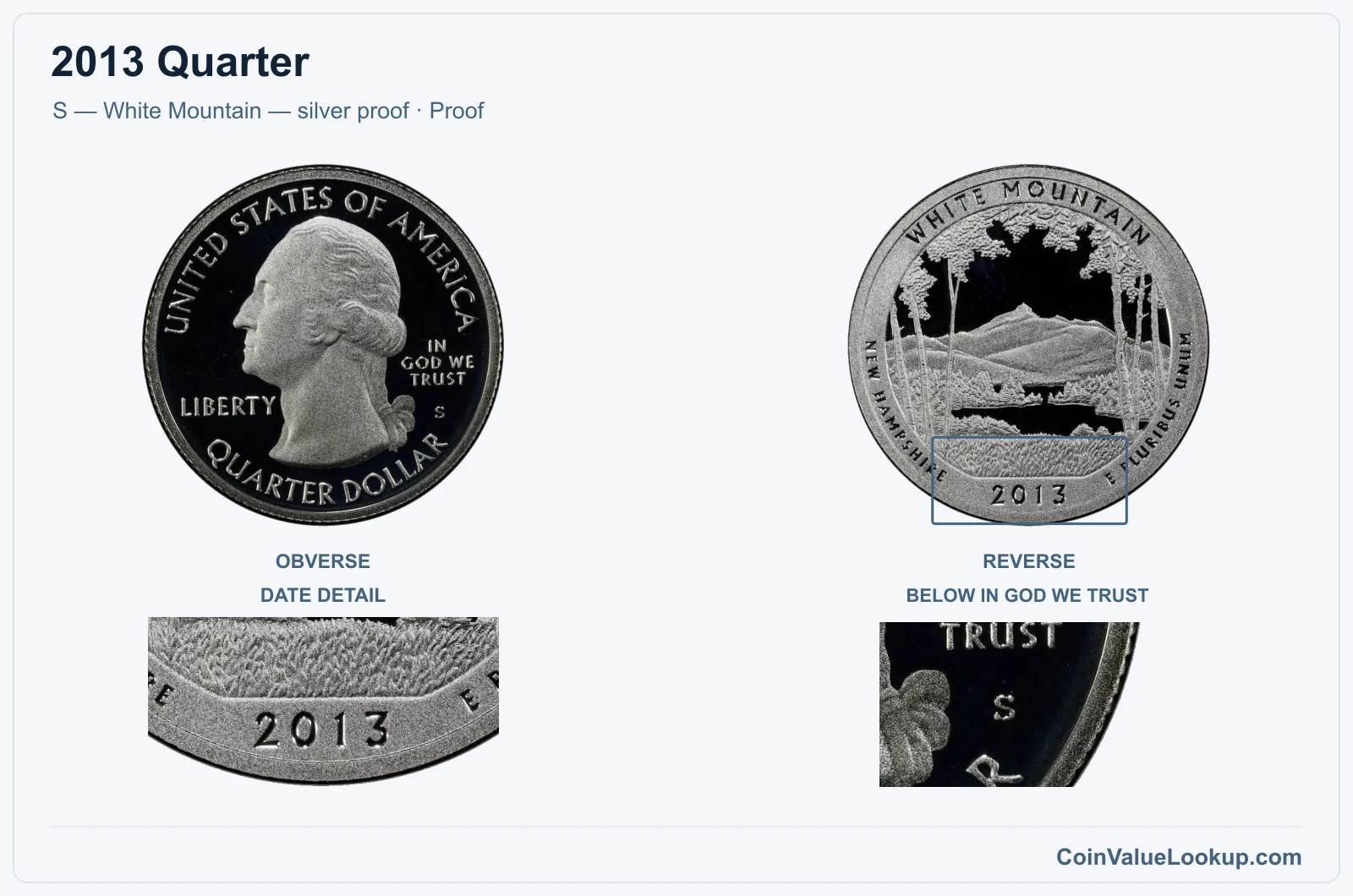
This is the silver proof version of the White Mountain quarter, struck at San Francisco in 90% silver and 10% copper. It weighs about 6.25 grams versus 5.67 grams for clad.
The edge is uniformly silver-gray with no copper band. USA Coin Book estimates PR65 at about $24.00, among the higher guide figures for 2013 quarters.
Confirm the composition before assuming you have this version; a clad proof looks nearly identical on the face but is worth considerably less.
Range Grade
Price Auction Records Appraisal PR PR 1
—
Coin Identifier
PR 2
—
Coin Identifier
PR 3
—
Coin Identifier
PR 4
—
Coin Identifier
PR 6
—
Coin Identifier
PR 8
—
Coin Identifier
PR 10
—
Coin Identifier
PR 12
—
Coin Identifier
PR 15
—
Coin Identifier
PR 20
—
Coin Identifier
PR 25
—
Coin Identifier
PR 30
—
Coin Identifier
PR 35
—
Coin Identifier
PR 40
—
Coin Identifier
PR 45
—
Coin Identifier
PR 50
—
Coin Identifier
PR 53
—
Coin Identifier
PR 55
—
Coin Identifier
PR 58
—
Coin Identifier
PR 60
—
Coin Identifier
PR 61
—
Coin Identifier
PR 62
—
Coin Identifier
PR 63
—
Coin Identifier
PR 64
—
Coin Identifier
PR 65
—
Coin Identifier
PR 66
—
Coin Identifier
PR 67
—
Coin Identifier
PR 68
—
Coin Identifier
PR 69
Coin Identifier
PR 70
Coin Identifier
2013 Quarter — P — Perry's Memorial — regular strike
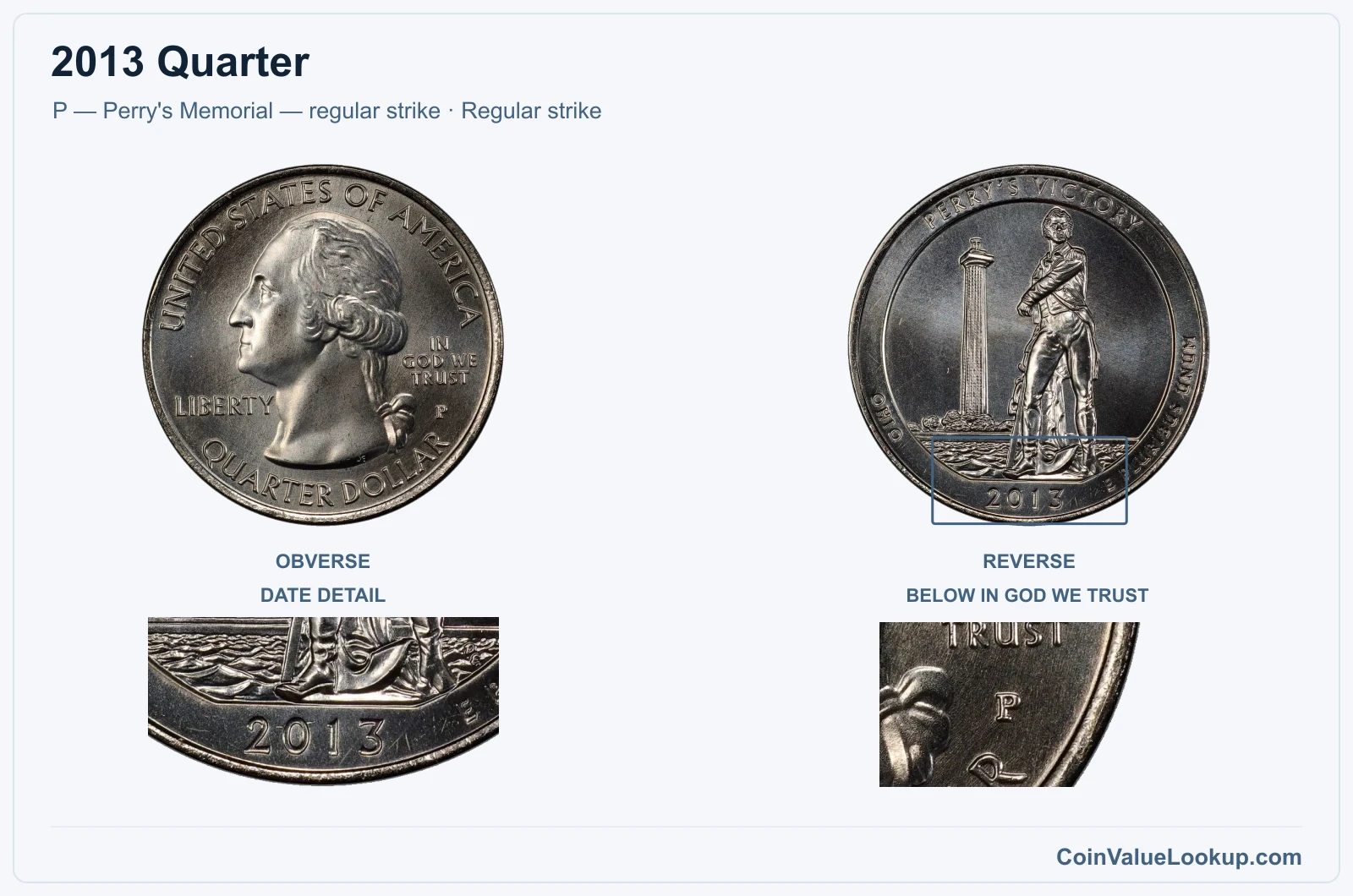
The Philadelphia-mint Perry's Memorial quarter depicts the Ohio monument honoring Commodore Perry's victory on Lake Erie. It is standard copper-nickel clad, 24.26 mm, and about 5.67 grams.
Circulated examples trade at face value. Individual value for higher-grade pieces depends on authenticated condition and any errors present.
No specific guide price was adopted for this version.
Range Grade
Price Auction Records Appraisal PO PO 1
—
Coin Identifier FR FR 2
—
Coin Identifier AG AG 3
—
Coin Identifier G G 4
—
Coin Identifier
G 6
—
Coin Identifier VG VG 8
—
Coin Identifier
VG 10
—
Coin Identifier F F 12
—
Coin Identifier
F 15
—
Coin Identifier VF VF 20
—
Coin Identifier
VF 25
—
Coin Identifier
VF 30
—
Coin Identifier
VF 35
—
Coin Identifier XF XF 40
—
Coin Identifier
XF 45
—
Coin Identifier AU AU 50
—
Coin Identifier
AU 53
—
Coin Identifier
AU 55
—
Coin Identifier
AU 58
—
Coin Identifier MS MS 60
—
Coin Identifier
MS 61
—
Coin Identifier
MS 62
—
Coin Identifier
MS 63
—
Coin Identifier
MS 64
—
Coin Identifier
MS 65
—
Coin Identifier
MS 66
—
Coin Identifier
MS 67
Coin Identifier
MS 68
—
Coin Identifier
MS 69
—
—
—
MS 70
—
—
—
2013 Quarter — D — Perry's Memorial — regular strike
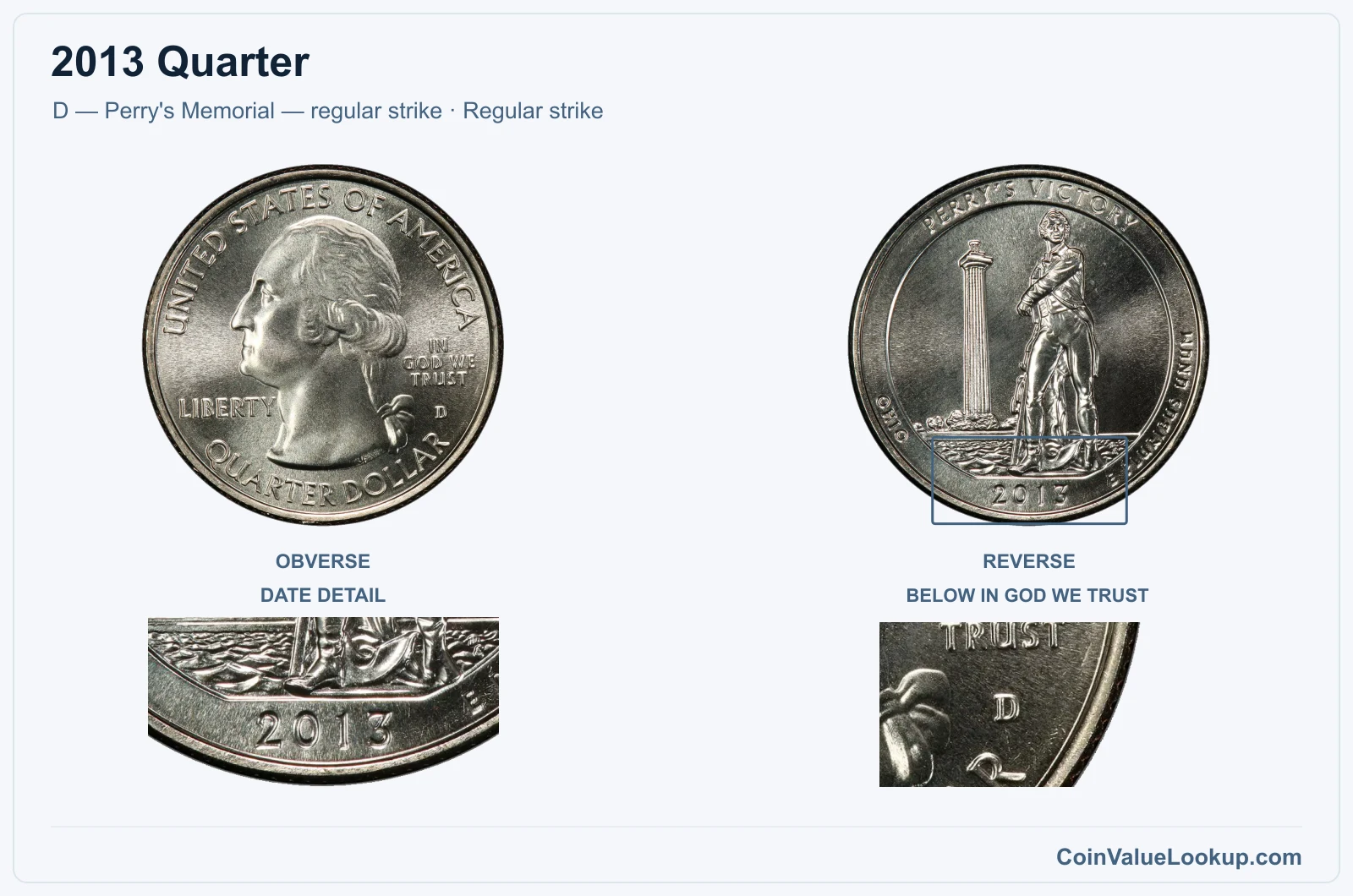
Denver's Perry's Memorial quarter carries the D mintmark. Same clad composition and design as the P-mint issue.
Worn examples are worth 25 cents. For uncirculated pieces, value depends on condition assessed individually.
No specific guide estimate was adopted, so have any promising example evaluated on its own merits.
Range Grade
Price Auction Records Appraisal PO PO 1
—
Coin Identifier FR FR 2
—
Coin Identifier AG AG 3
—
Coin Identifier G G 4
—
Coin Identifier
G 6
—
Coin Identifier VG VG 8
—
Coin Identifier
VG 10
—
Coin Identifier F F 12
—
Coin Identifier
F 15
—
Coin Identifier VF VF 20
—
Coin Identifier
VF 25
—
Coin Identifier
VF 30
—
Coin Identifier
VF 35
—
Coin Identifier XF XF 40
—
Coin Identifier
XF 45
—
Coin Identifier AU AU 50
—
Coin Identifier
AU 53
—
Coin Identifier
AU 55
—
Coin Identifier
AU 58
—
Coin Identifier MS MS 60
—
Coin Identifier
MS 61
—
Coin Identifier
MS 62
—
Coin Identifier
MS 63
—
Coin Identifier
MS 64
—
Coin Identifier
MS 65
—
Coin Identifier
MS 66
—
Coin Identifier
MS 67
Coin Identifier
MS 68
—
Coin Identifier
MS 69
—
—
—
MS 70
—
—
—
2013 Quarter — S — Perry's Memorial — regular strike
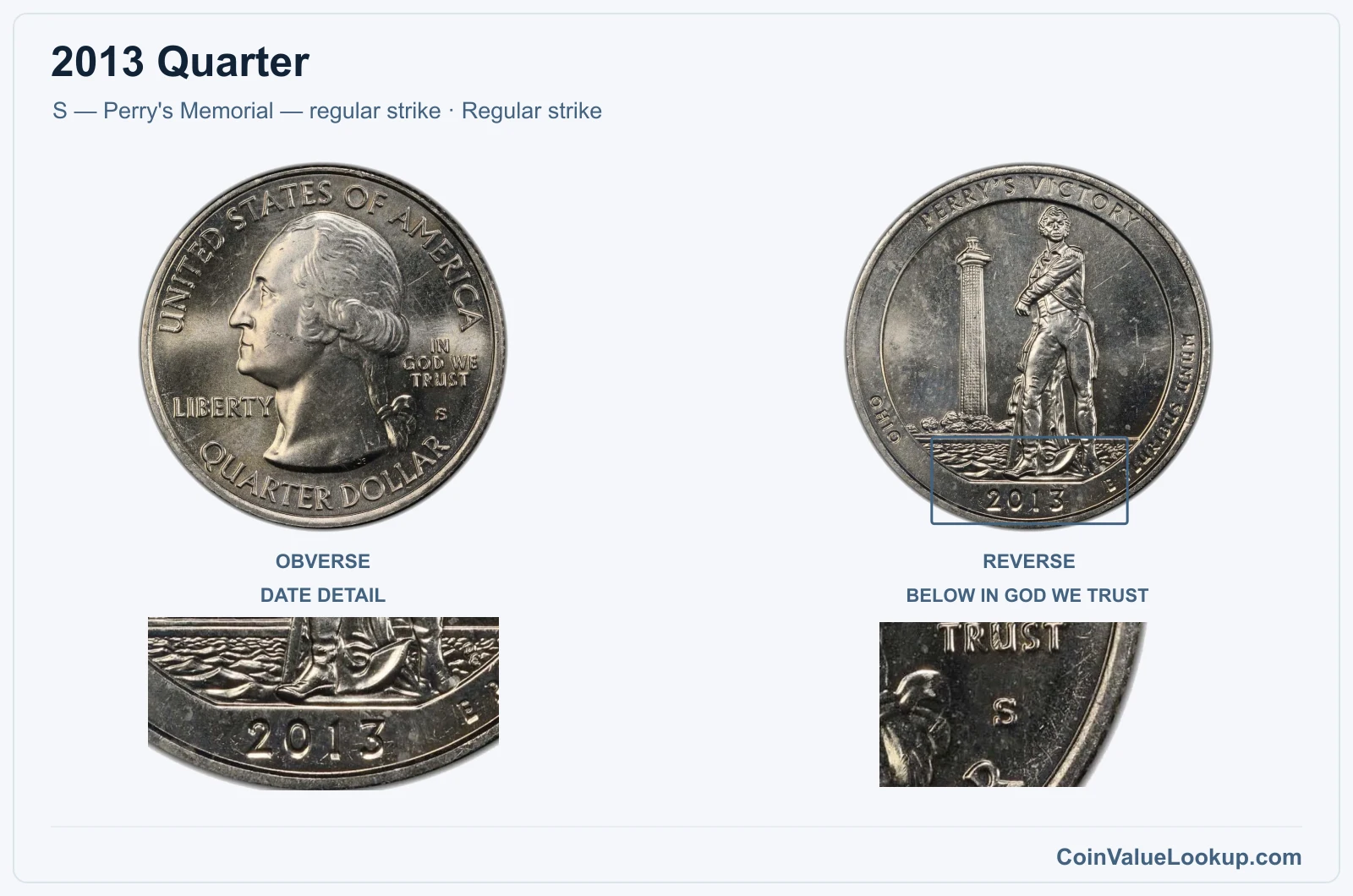
San Francisco struck a non-proof collector version of the Perry's Memorial quarter in copper-nickel clad. The S mintmark alone does not make it a proof.
These were distributed through Mint products rather than general circulation. No specific guide price was adopted for this version, so value depends on individual condition and demand.
Range Grade
Price Auction Records Appraisal PO PO 1
—
Coin Identifier FR FR 2
—
Coin Identifier AG AG 3
—
Coin Identifier G G 4
—
Coin Identifier
G 6
—
Coin Identifier VG VG 8
—
Coin Identifier
VG 10
—
Coin Identifier F F 12
—
Coin Identifier
F 15
—
Coin Identifier VF VF 20
—
Coin Identifier
VF 25
—
Coin Identifier
VF 30
—
Coin Identifier
VF 35
—
Coin Identifier XF XF 40
—
Coin Identifier
XF 45
—
Coin Identifier AU AU 50
—
Coin Identifier
AU 53
—
Coin Identifier
AU 55
—
Coin Identifier
AU 58
—
Coin Identifier MS MS 60
—
Coin Identifier
MS 61
—
Coin Identifier
MS 62
—
Coin Identifier
MS 63
—
Coin Identifier
MS 64
—
Coin Identifier
MS 65
—
Coin Identifier
MS 66
—
Coin Identifier
MS 67
—
Coin Identifier
MS 68
—
—
—
MS 69
—
—
—
MS 70
—
—
—
2013 Quarter — S — Perry's Memorial — clad proof
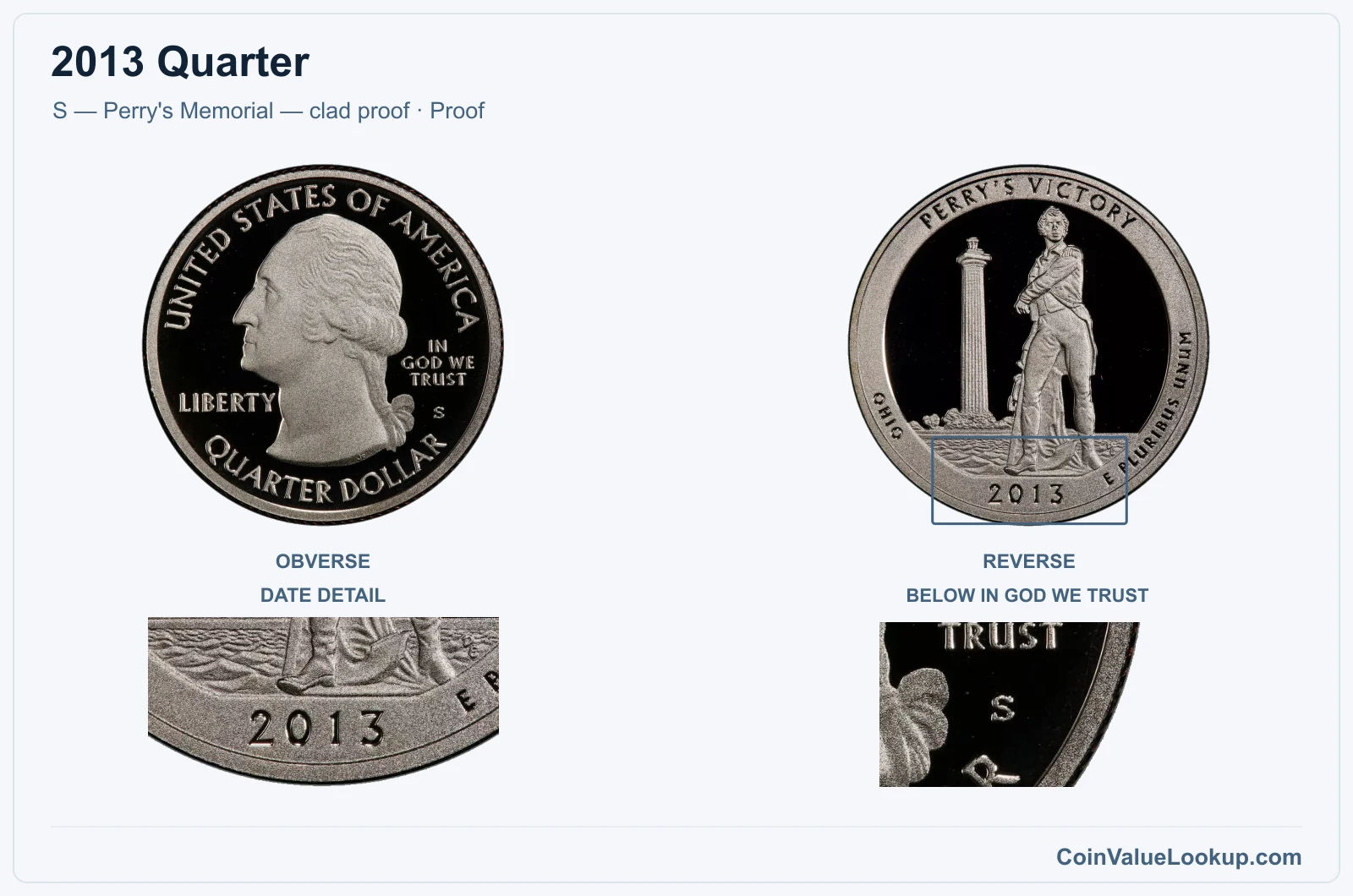
The clad proof Perry's Memorial quarter from San Francisco shows mirror fields and frosted devices. It is copper-nickel clad, not silver.
Check the edge for a layered band to confirm the clad composition. No specific guide price was adopted.
Value depends on individual condition, with hairline-free examples bringing more than hazy or spotted pieces.
Range Grade
Price Auction Records Appraisal PR PR 1
—
Coin Identifier
PR 2
—
Coin Identifier
PR 3
—
Coin Identifier
PR 4
—
Coin Identifier
PR 6
—
Coin Identifier
PR 8
—
Coin Identifier
PR 10
—
Coin Identifier
PR 12
—
Coin Identifier
PR 15
—
Coin Identifier
PR 20
—
Coin Identifier
PR 25
—
Coin Identifier
PR 30
—
Coin Identifier
PR 35
—
Coin Identifier
PR 40
—
Coin Identifier
PR 45
—
Coin Identifier
PR 50
—
Coin Identifier
PR 53
—
Coin Identifier
PR 55
—
Coin Identifier
PR 58
—
Coin Identifier
PR 60
—
Coin Identifier
PR 61
—
Coin Identifier
PR 62
—
Coin Identifier
PR 63
—
Coin Identifier
PR 64
—
Coin Identifier
PR 65
—
Coin Identifier
PR 66
—
Coin Identifier
PR 67
—
Coin Identifier
PR 68
—
Coin Identifier
PR 69
Coin Identifier
PR 70
Coin Identifier
2013 Quarter — S — Perry's Memorial — silver proof
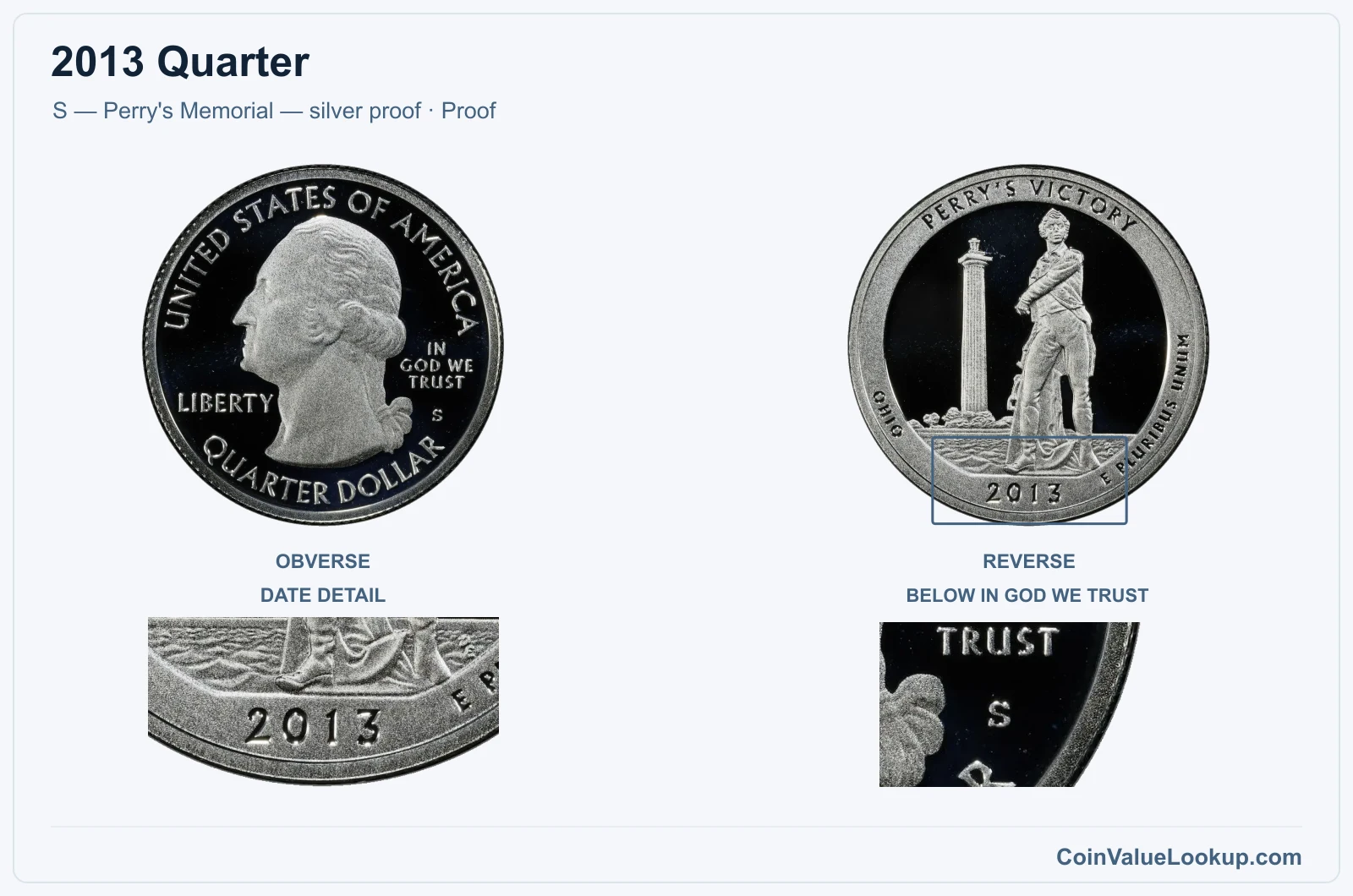
The silver proof Perry's Memorial quarter is 90% silver, struck at San Francisco, and weighs about 6.25 grams. Its edge is solid silver-gray.
Confirm the composition before assuming you hold this version. No specific guide price was adopted, so value is determined individually by authenticated condition and market demand.
Range Grade
Price Auction Records Appraisal PR PR 1
—
Coin Identifier
PR 2
—
Coin Identifier
PR 3
—
Coin Identifier
PR 4
—
Coin Identifier
PR 6
—
Coin Identifier
PR 8
—
Coin Identifier
PR 10
—
Coin Identifier
PR 12
—
Coin Identifier
PR 15
—
Coin Identifier
PR 20
—
Coin Identifier
PR 25
—
Coin Identifier
PR 30
—
Coin Identifier
PR 35
—
Coin Identifier
PR 40
—
Coin Identifier
PR 45
—
Coin Identifier
PR 50
—
Coin Identifier
PR 53
—
Coin Identifier
PR 55
—
Coin Identifier
PR 58
—
Coin Identifier
PR 60
—
Coin Identifier
PR 61
—
Coin Identifier
PR 62
—
Coin Identifier
PR 63
—
Coin Identifier
PR 64
—
Coin Identifier
PR 65
—
Coin Identifier
PR 66
—
Coin Identifier
PR 67
—
Coin Identifier
PR 68
—
Coin Identifier
PR 69
Coin Identifier
PR 70
Coin Identifier
2013 Quarter — P — Great Basin — regular strike
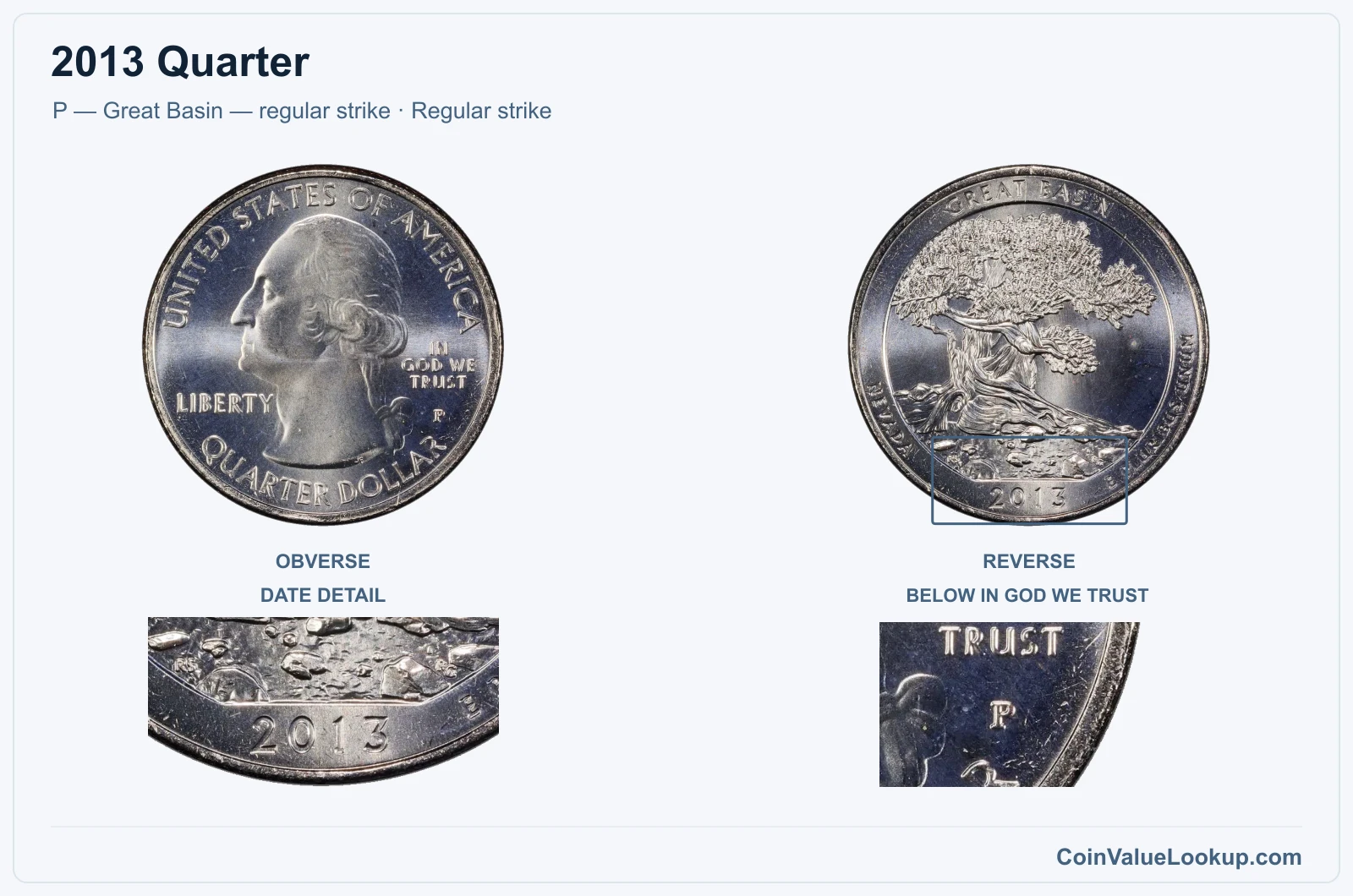
Philadelphia's Great Basin quarter features Nevada's Great Basin National Park. Standard copper-nickel clad, 24.26 mm, about 5.67 grams.
USA Coin Book estimates MS60 at $0.74 and MS65 at $1.24. Circulated examples are face-value coins.
Only pristine uncirculated examples with no bag marks carry a small collector premium.
Coin Value Lookup is a good place to look up guides for any of the five 2013 reverse designs and compare values across mints and finishes.
Range Grade
Price Auction Records Appraisal PO PO 1
—
Coin Identifier FR FR 2
—
Coin Identifier AG AG 3
—
Coin Identifier G G 4
—
Coin Identifier
G 6
—
Coin Identifier VG VG 8
—
Coin Identifier
VG 10
—
Coin Identifier F F 12
—
Coin Identifier
F 15
—
Coin Identifier VF VF 20
—
Coin Identifier
VF 25
—
Coin Identifier
VF 30
—
Coin Identifier
VF 35
—
Coin Identifier XF XF 40
—
Coin Identifier
XF 45
—
Coin Identifier AU AU 50
—
Coin Identifier
AU 53
—
Coin Identifier
AU 55
—
Coin Identifier
AU 58
—
Coin Identifier MS MS 60
—
Coin Identifier
MS 61
—
Coin Identifier
MS 62
—
Coin Identifier
MS 63
—
Coin Identifier
MS 64
—
Coin Identifier
MS 65
—
Coin Identifier
MS 66
—
Coin Identifier
MS 67
—
Coin Identifier
MS 68
Coin Identifier
MS 69
—
—
—
MS 70
—
—
—
2013 Quarter — D — Great Basin — regular strike
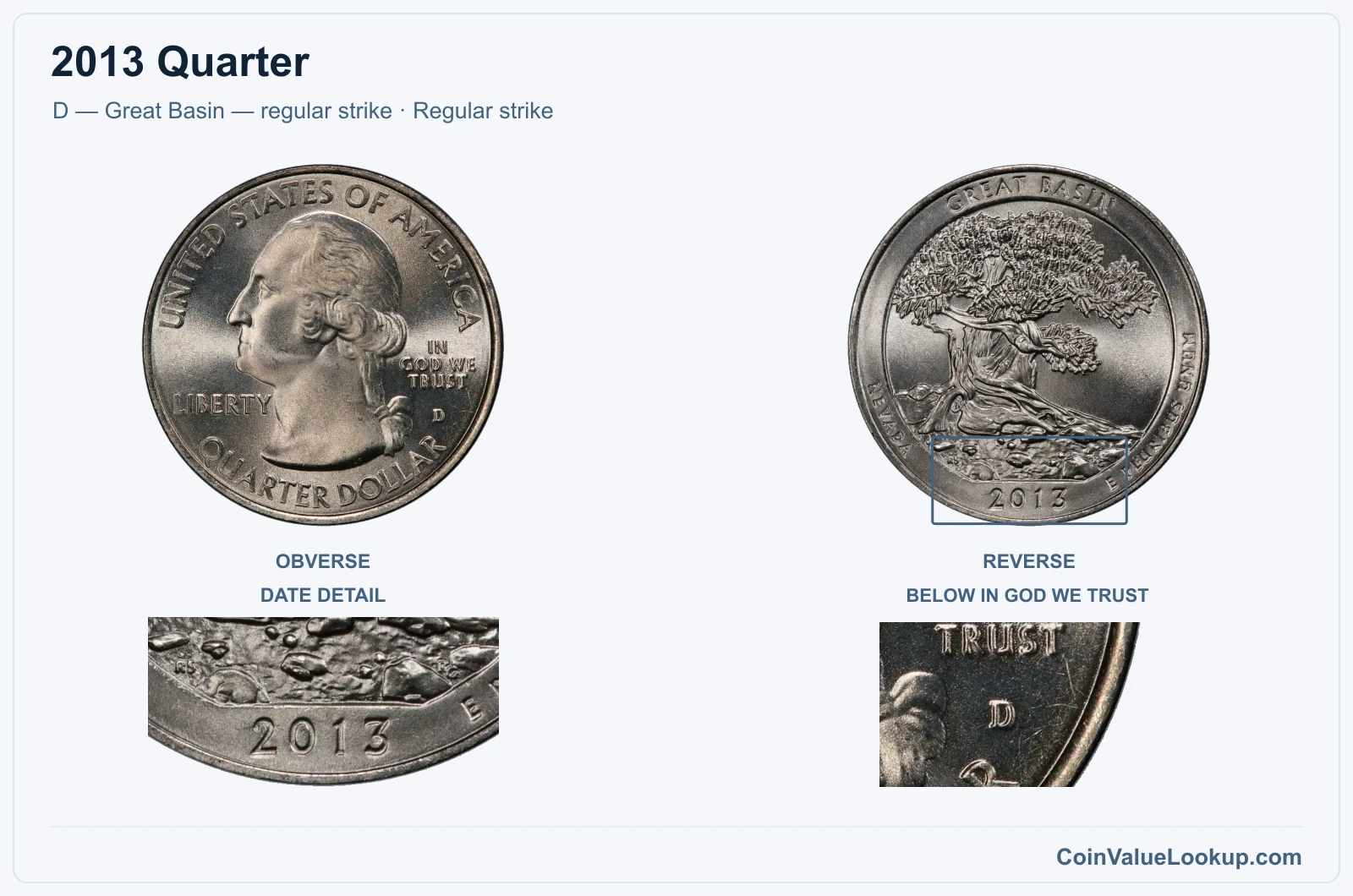
The D-mint Great Basin quarter is the Denver counterpart. Same clad composition, same design, different mintmark.
USA Coin Book lists MS60 at about $0.74 and MS65 at $1.24. Worn coins are worth a quarter.
Original uncirculated rolls or individual coins pulled straight from Mint bags have the best shot at collector grade.
Range Grade
Price Auction Records Appraisal PO PO 1
—
Coin Identifier FR FR 2
—
Coin Identifier AG AG 3
—
Coin Identifier G G 4
—
Coin Identifier
G 6
—
Coin Identifier VG VG 8
—
Coin Identifier
VG 10
—
Coin Identifier F F 12
—
Coin Identifier
F 15
—
Coin Identifier VF VF 20
—
Coin Identifier
VF 25
—
Coin Identifier
VF 30
—
Coin Identifier
VF 35
—
Coin Identifier XF XF 40
—
Coin Identifier
XF 45
—
Coin Identifier AU AU 50
—
Coin Identifier
AU 53
—
Coin Identifier
AU 55
—
Coin Identifier
AU 58
—
Coin Identifier MS MS 60
—
Coin Identifier
MS 61
—
Coin Identifier
MS 62
—
Coin Identifier
MS 63
—
Coin Identifier
MS 64
—
Coin Identifier
MS 65
—
Coin Identifier
MS 66
—
Coin Identifier
MS 67
—
Coin Identifier
MS 68
Coin Identifier
MS 69
—
—
—
MS 70
—
—
—
2013 Quarter — S — Great Basin — regular strike
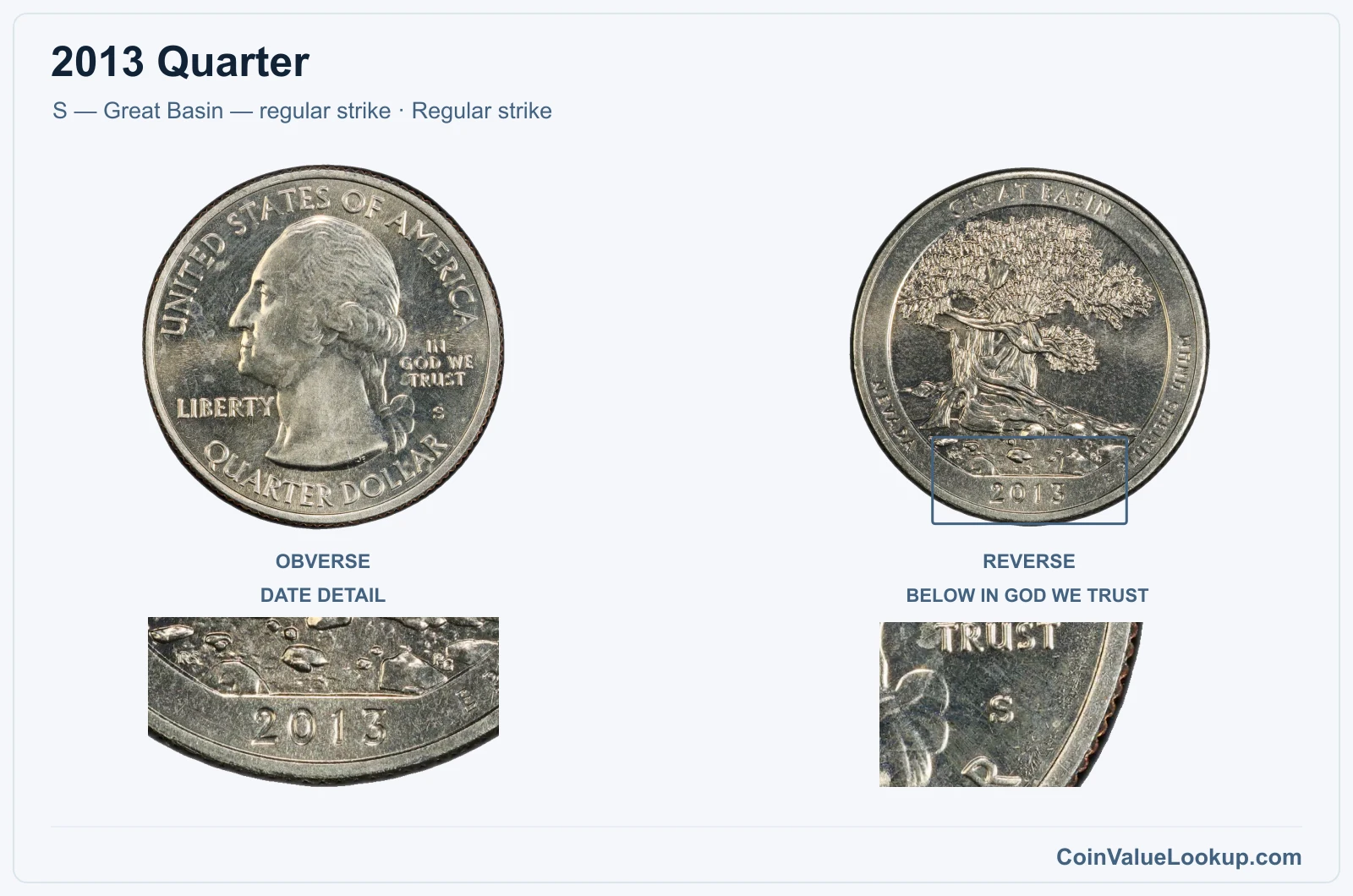
San Francisco's non-proof Great Basin quarter is copper-nickel clad. These were sold through Mint collector channels, not released into circulation, so they are somewhat scarcer than P or D rolls.
USA Coin Book estimates MS65 at about $10.00. The S mintmark alone does not confirm a proof; examine the surface finish carefully.
Range Grade
Price Auction Records Appraisal PO PO 1
—
Coin Identifier FR FR 2
—
Coin Identifier AG AG 3
—
Coin Identifier G G 4
—
Coin Identifier
G 6
—
Coin Identifier VG VG 8
—
Coin Identifier
VG 10
—
Coin Identifier F F 12
—
Coin Identifier
F 15
—
Coin Identifier VF VF 20
—
Coin Identifier
VF 25
—
Coin Identifier
VF 30
—
Coin Identifier
VF 35
—
Coin Identifier XF XF 40
—
Coin Identifier
XF 45
—
Coin Identifier AU AU 50
—
Coin Identifier
AU 53
—
Coin Identifier
AU 55
—
Coin Identifier
AU 58
—
Coin Identifier MS MS 60
—
Coin Identifier
MS 61
—
Coin Identifier
MS 62
—
Coin Identifier
MS 63
—
Coin Identifier
MS 64
—
Coin Identifier
MS 65
—
Coin Identifier
MS 66
—
Coin Identifier
MS 67
—
Coin Identifier
MS 68
—
Coin Identifier
MS 69
—
—
—
MS 70
—
—
—
2013 Quarter — S — Great Basin — clad proof
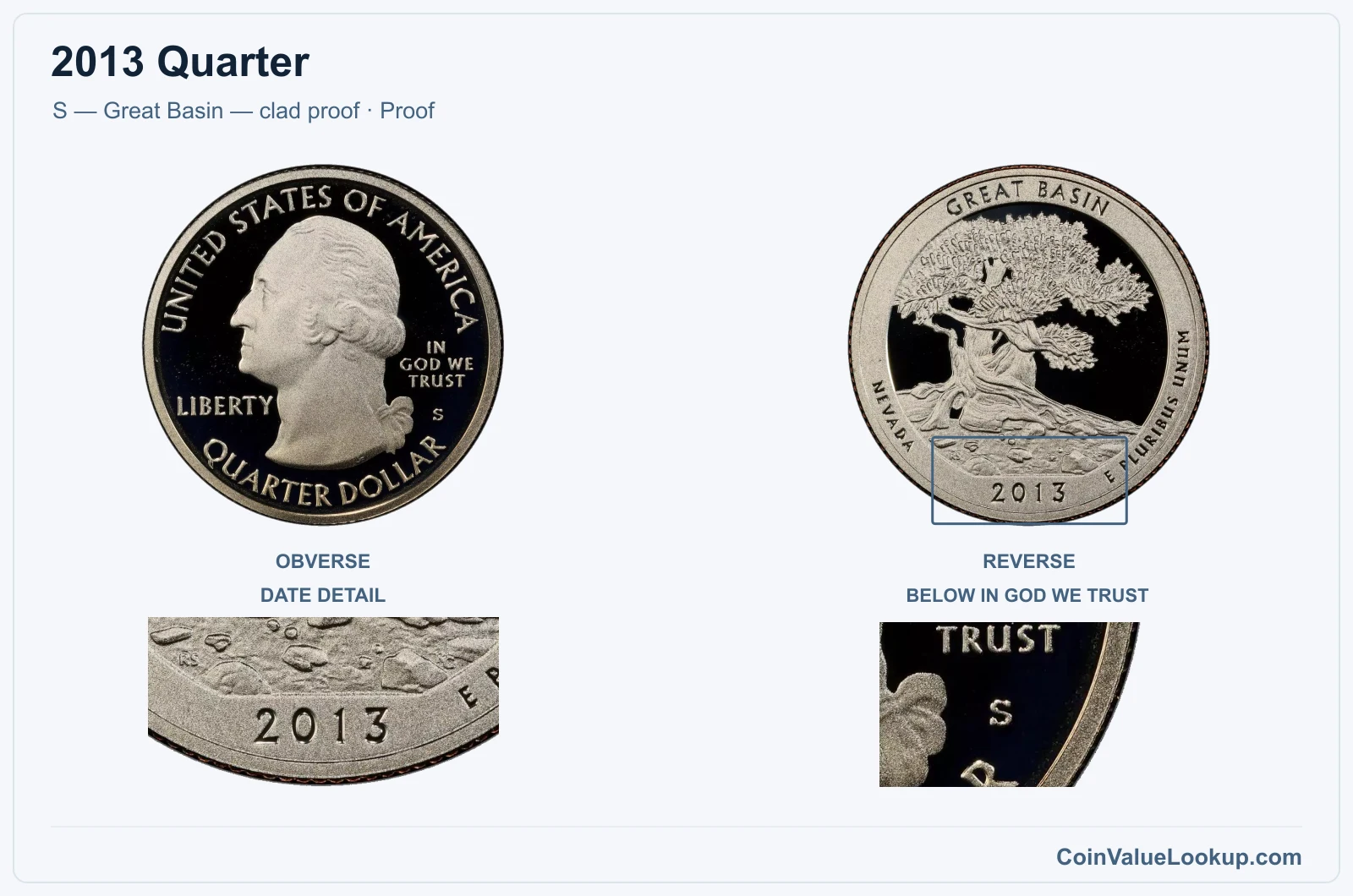
The clad proof Great Basin quarter from San Francisco has mirror fields and frosted design elements. Composition is copper-nickel clad.
USA Coin Book estimates PR65 at about $5.63. Do not confuse it with the silver proof; check the edge or weigh the coin on a scale that reads to 0.01 grams.
A clad piece will weigh around 5.67 grams, while silver runs about 6.25 grams.
Range Grade
Price Auction Records Appraisal PR PR 1
—
Coin Identifier
PR 2
—
Coin Identifier
PR 3
—
Coin Identifier
PR 4
—
Coin Identifier
PR 6
—
Coin Identifier
PR 8
—
Coin Identifier
PR 10
—
Coin Identifier
PR 12
—
Coin Identifier
PR 15
—
Coin Identifier
PR 20
—
Coin Identifier
PR 25
—
Coin Identifier
PR 30
—
Coin Identifier
PR 35
—
Coin Identifier
PR 40
—
Coin Identifier
PR 45
—
Coin Identifier
PR 50
—
Coin Identifier
PR 53
—
Coin Identifier
PR 55
—
Coin Identifier
PR 58
—
Coin Identifier
PR 60
—
Coin Identifier
PR 61
—
Coin Identifier
PR 62
—
Coin Identifier
PR 63
—
Coin Identifier
PR 64
—
Coin Identifier
PR 65
—
Coin Identifier
PR 66
—
Coin Identifier
PR 67
—
Coin Identifier
PR 68
—
Coin Identifier
PR 69
Coin Identifier
PR 70
Coin Identifier
2013 Quarter — S — Great Basin — silver proof
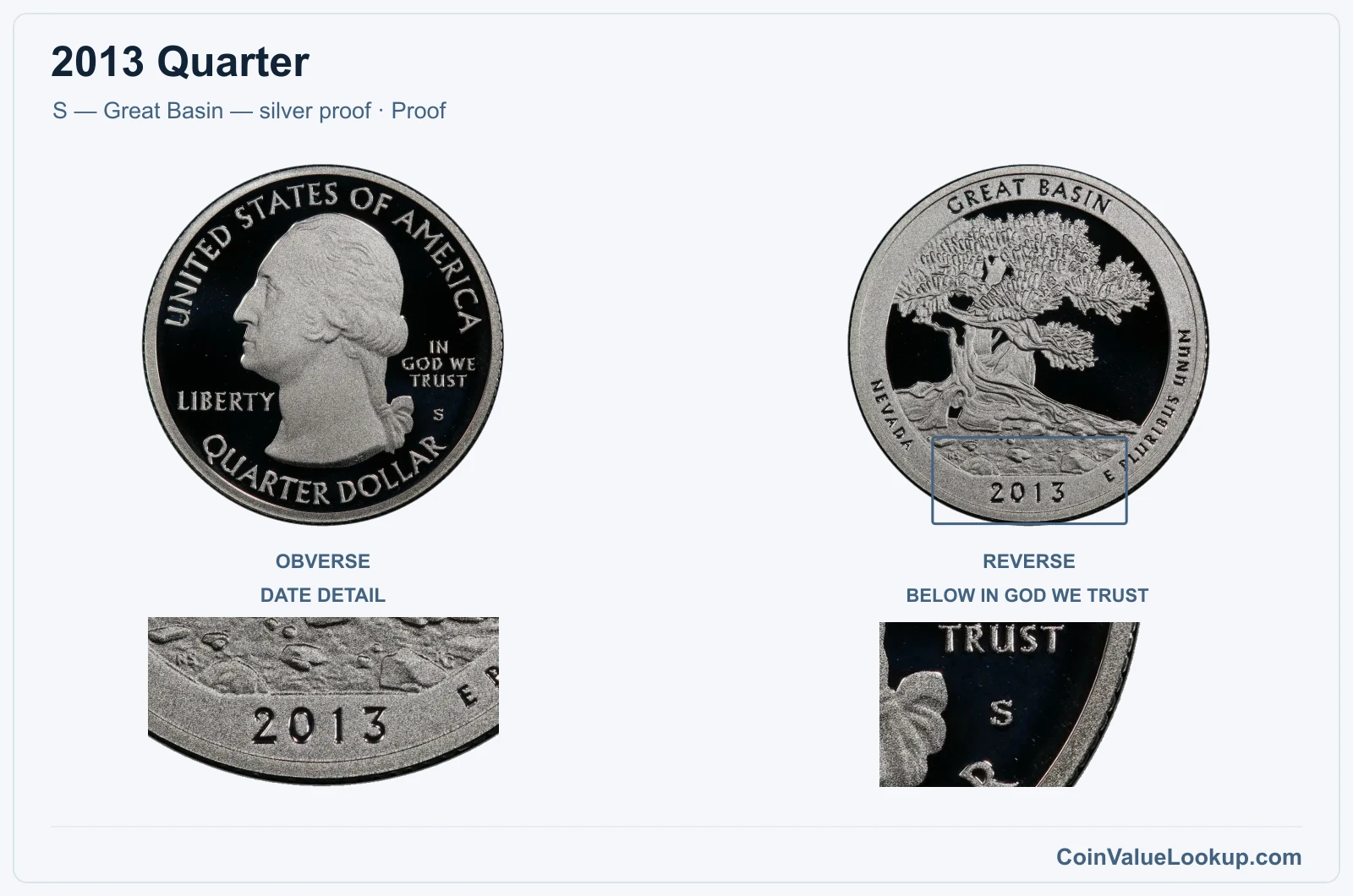
The silver proof Great Basin quarter is 90% silver, about 6.25 grams, struck only at San Francisco. USA Coin Book estimates PR65 at about $24.00.
The edge shows uniform silver with no copper band. Silver proofs often come from original Mint packaging, which can help confirm what you have.
Condition matters: even minor hairlines in the mirror fields reduce the grade.
Range Grade
Price Auction Records Appraisal PR PR 1
—
Coin Identifier
PR 2
—
Coin Identifier
PR 3
—
Coin Identifier
PR 4
—
Coin Identifier
PR 6
—
Coin Identifier
PR 8
—
Coin Identifier
PR 10
—
Coin Identifier
PR 12
—
Coin Identifier
PR 15
—
Coin Identifier
PR 20
—
Coin Identifier
PR 25
—
Coin Identifier
PR 30
—
Coin Identifier
PR 35
—
Coin Identifier
PR 40
—
Coin Identifier
PR 45
—
Coin Identifier
PR 50
—
Coin Identifier
PR 53
—
Coin Identifier
PR 55
—
Coin Identifier
PR 58
—
Coin Identifier
PR 60
—
Coin Identifier
PR 61
—
Coin Identifier
PR 62
—
Coin Identifier
PR 63
—
Coin Identifier
PR 64
—
Coin Identifier
PR 65
—
Coin Identifier
PR 66
—
Coin Identifier
PR 67
—
Coin Identifier
PR 68
—
Coin Identifier
PR 69
Coin Identifier
PR 70
Coin Identifier
2013 Quarter — P — Fort McHenry — regular strike
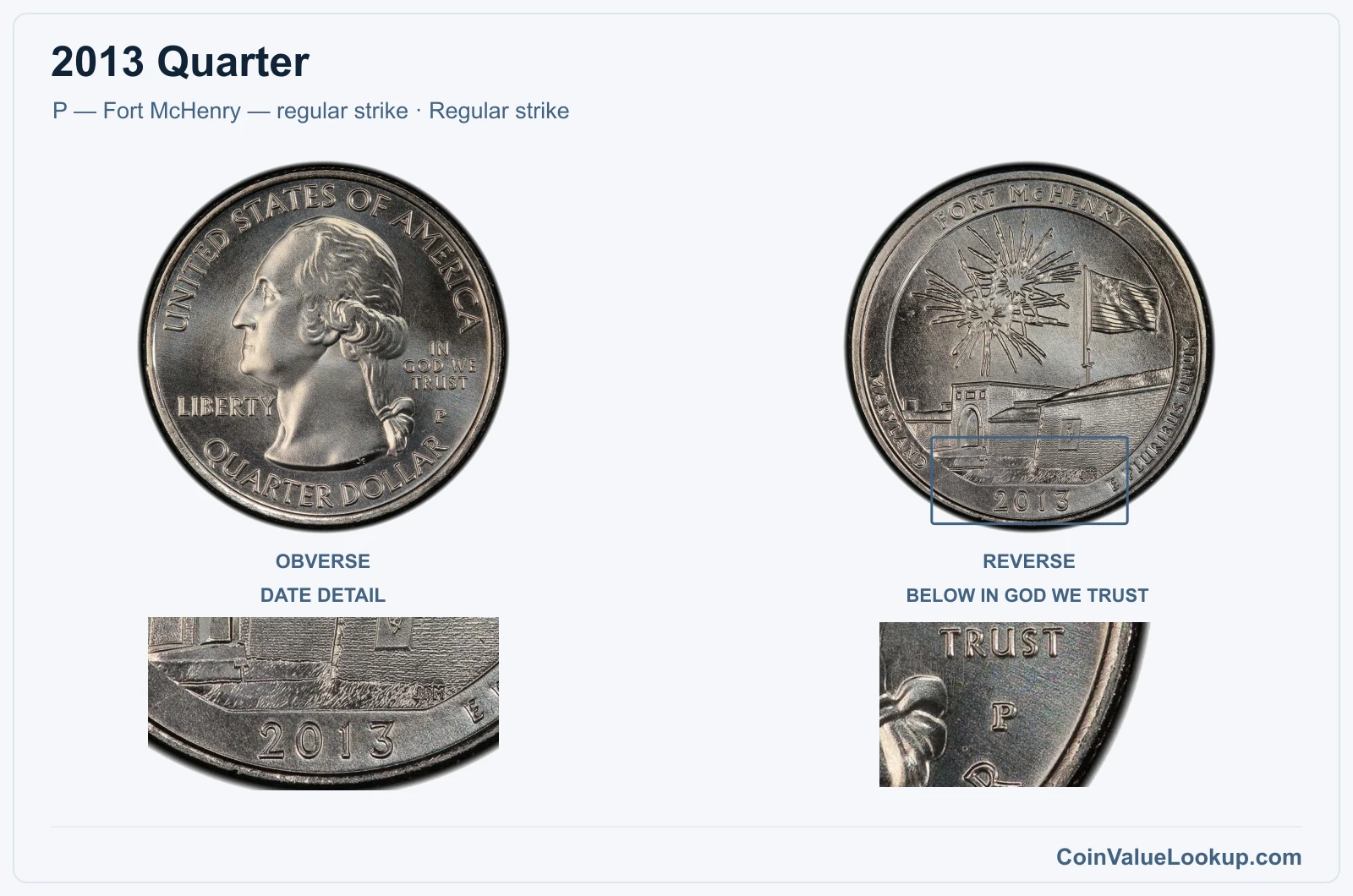
The P-mint Fort McHenry quarter shows Maryland's historic fort, birthplace of the Star-Spangled Banner. Standard copper-nickel clad, 24.26 mm, about 5.67 grams.
USA Coin Book estimates MS60 at $0.74 and MS65 at $1.24. Circulated pieces are worth face value.
High-grade coins must show full luster with minimal contact marks on the obverse and reverse high points.
Range Grade
Price Auction Records Appraisal PO PO 1
—
Coin Identifier FR FR 2
—
Coin Identifier AG AG 3
—
Coin Identifier G G 4
—
Coin Identifier
G 6
—
Coin Identifier VG VG 8
—
Coin Identifier
VG 10
—
Coin Identifier F F 12
—
Coin Identifier
F 15
—
Coin Identifier VF VF 20
—
Coin Identifier
VF 25
—
Coin Identifier
VF 30
—
Coin Identifier
VF 35
—
Coin Identifier XF XF 40
—
Coin Identifier
XF 45
—
Coin Identifier AU AU 50
—
Coin Identifier
AU 53
—
Coin Identifier
AU 55
—
Coin Identifier
AU 58
—
Coin Identifier MS MS 60
—
Coin Identifier
MS 61
—
Coin Identifier
MS 62
—
Coin Identifier
MS 63
—
Coin Identifier
MS 64
—
Coin Identifier
MS 65
—
Coin Identifier
MS 66
—
Coin Identifier
MS 67
—
Coin Identifier
MS 68
Coin Identifier
MS 69
—
—
—
MS 70
—
—
—
2013 Quarter — D — Fort McHenry — regular strike
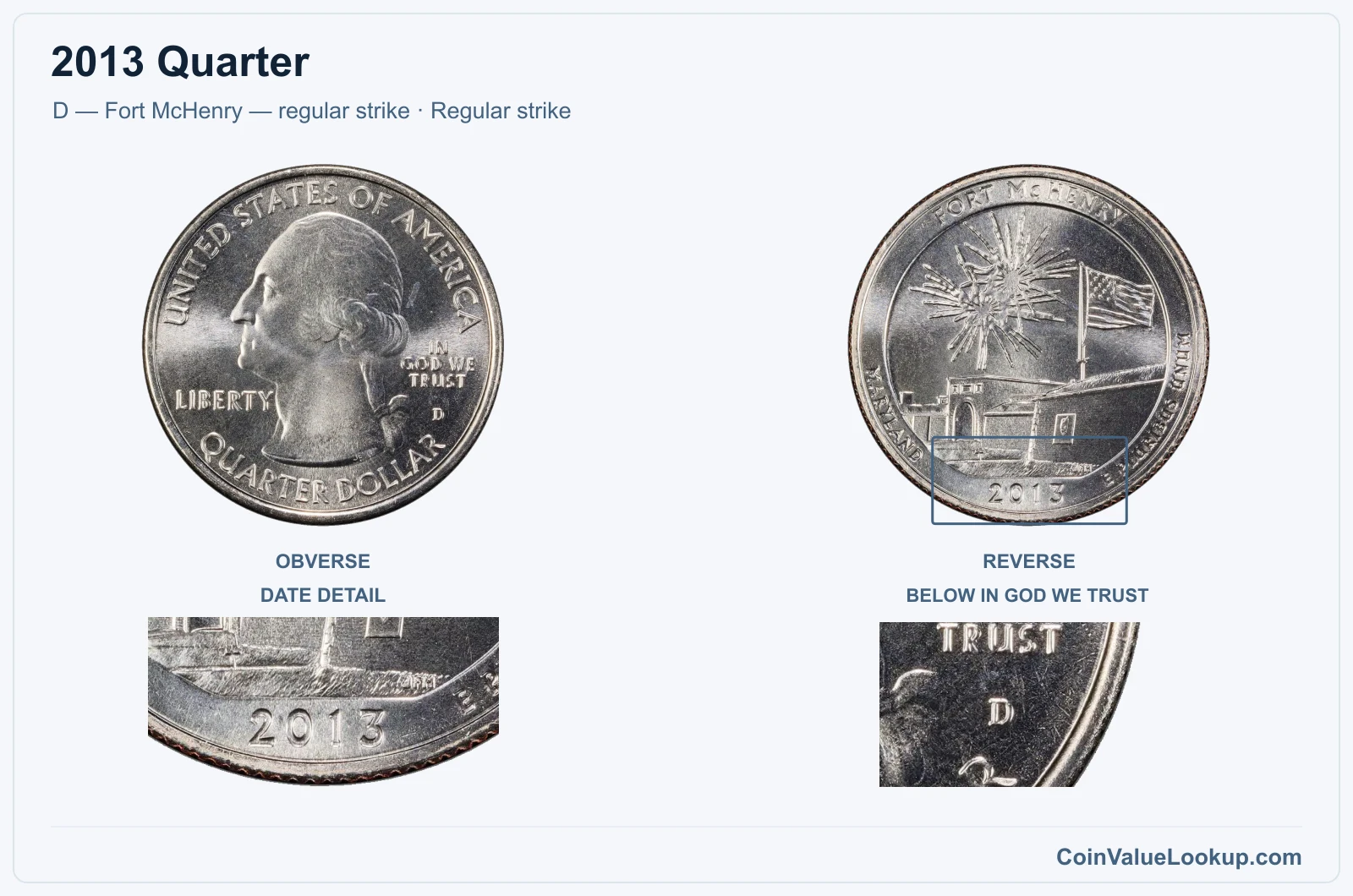
Denver's Fort McHenry quarter has a slightly lower MS60 guide estimate of $0.68 from USA Coin Book, with MS65 at $1.24. The difference is small and within normal guide variation.
Circulated coins remain worth 25 cents. Look for the D mintmark and confirm the Fort McHenry reverse before checking the price chart.
Range Grade
Price Auction Records Appraisal PO PO 1
—
Coin Identifier FR FR 2
—
Coin Identifier AG AG 3
—
Coin Identifier G G 4
—
Coin Identifier
G 6
—
Coin Identifier VG VG 8
—
Coin Identifier
VG 10
—
Coin Identifier F F 12
—
Coin Identifier
F 15
—
Coin Identifier VF VF 20
—
Coin Identifier
VF 25
—
Coin Identifier
VF 30
—
Coin Identifier
VF 35
—
Coin Identifier XF XF 40
—
Coin Identifier
XF 45
—
Coin Identifier AU AU 50
—
Coin Identifier
AU 53
—
Coin Identifier
AU 55
—
Coin Identifier
AU 58
—
Coin Identifier MS MS 60
—
Coin Identifier
MS 61
—
Coin Identifier
MS 62
—
Coin Identifier
MS 63
—
Coin Identifier
MS 64
—
Coin Identifier
MS 65
—
Coin Identifier
MS 66
—
Coin Identifier
MS 67
—
Coin Identifier
MS 68
Coin Identifier
MS 69
—
Coin Identifier
MS 70
—
—
—
2013 Quarter — S — Fort McHenry — regular strike
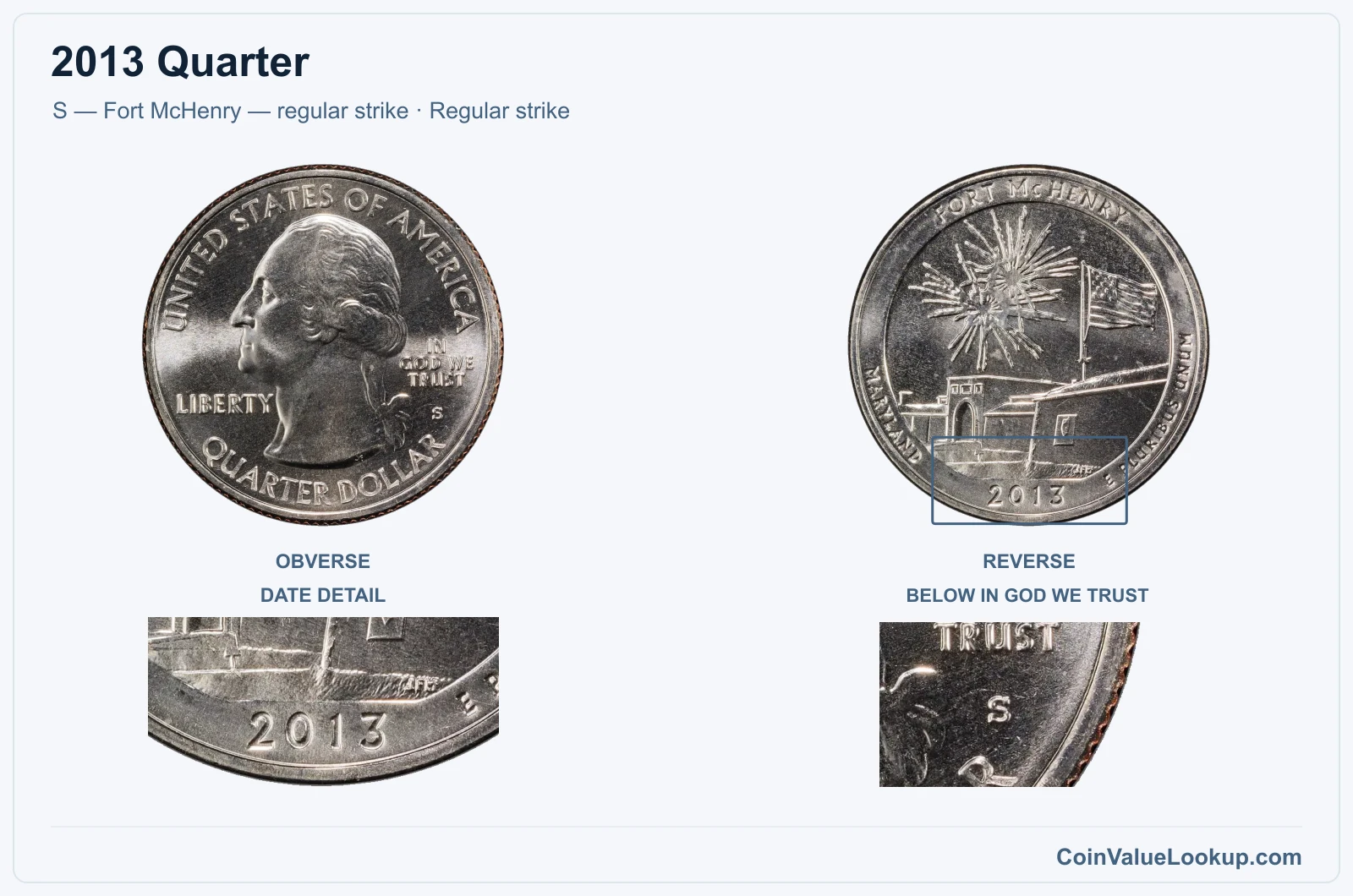
San Francisco struck a non-proof copper-nickel clad Fort McHenry quarter for collectors. The S mintmark is present, but the surfaces should look like a regular business strike, not a proof.
USA Coin Book estimates MS65 at about $10.00. These did not enter general circulation, so finding one in pocket change would be unusual.
Range Grade
Price Auction Records Appraisal PO PO 1
—
Coin Identifier FR FR 2
—
Coin Identifier AG AG 3
—
Coin Identifier G G 4
—
Coin Identifier
G 6
—
Coin Identifier VG VG 8
—
Coin Identifier
VG 10
—
Coin Identifier F F 12
—
Coin Identifier
F 15
—
Coin Identifier VF VF 20
—
Coin Identifier
VF 25
—
Coin Identifier
VF 30
—
Coin Identifier
VF 35
—
Coin Identifier XF XF 40
—
Coin Identifier
XF 45
—
Coin Identifier AU AU 50
—
Coin Identifier
AU 53
—
Coin Identifier
AU 55
—
Coin Identifier
AU 58
—
Coin Identifier MS MS 60
—
Coin Identifier
MS 61
—
Coin Identifier
MS 62
—
Coin Identifier
MS 63
—
Coin Identifier
MS 64
—
Coin Identifier
MS 65
—
Coin Identifier
MS 66
—
Coin Identifier
MS 67
—
Coin Identifier
MS 68
—
Coin Identifier
MS 69
—
—
—
MS 70
—
—
—
2013 Quarter — S — Fort McHenry — clad proof
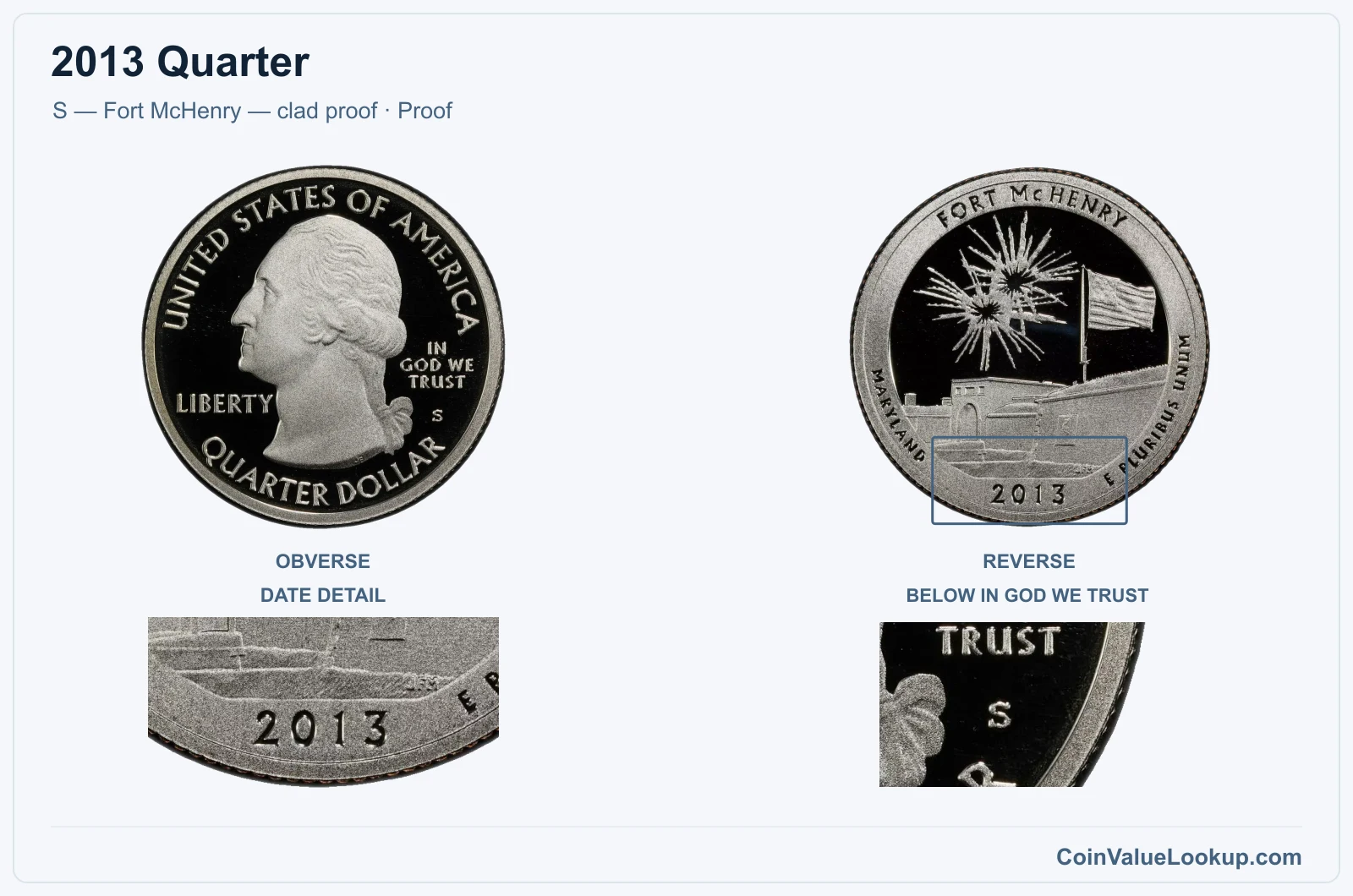
The clad proof Fort McHenry quarter from San Francisco shows mirror fields and frosted devices in copper-nickel clad. USA Coin Book estimates PR65 at about $5.63.
Confirm it is clad and not silver by checking the edge. Proofs with clean, haze-free fields and deep cameo contrast are preferred by collectors.
Range Grade
Price Auction Records Appraisal PR PR 1
—
Coin Identifier
PR 2
—
Coin Identifier
PR 3
—
Coin Identifier
PR 4
—
Coin Identifier
PR 6
—
Coin Identifier
PR 8
—
Coin Identifier
PR 10
—
Coin Identifier
PR 12
—
Coin Identifier
PR 15
—
Coin Identifier
PR 20
—
Coin Identifier
PR 25
—
Coin Identifier
PR 30
—
Coin Identifier
PR 35
—
Coin Identifier
PR 40
—
Coin Identifier
PR 45
—
Coin Identifier
PR 50
—
Coin Identifier
PR 53
—
Coin Identifier
PR 55
—
Coin Identifier
PR 58
—
Coin Identifier
PR 60
—
Coin Identifier
PR 61
—
Coin Identifier
PR 62
—
Coin Identifier
PR 63
—
Coin Identifier
PR 64
—
Coin Identifier
PR 65
—
Coin Identifier
PR 66
—
Coin Identifier
PR 67
—
Coin Identifier
PR 68
—
Coin Identifier
PR 69
Coin Identifier
PR 70
Coin Identifier
2013 Quarter — S — Fort McHenry — silver proof
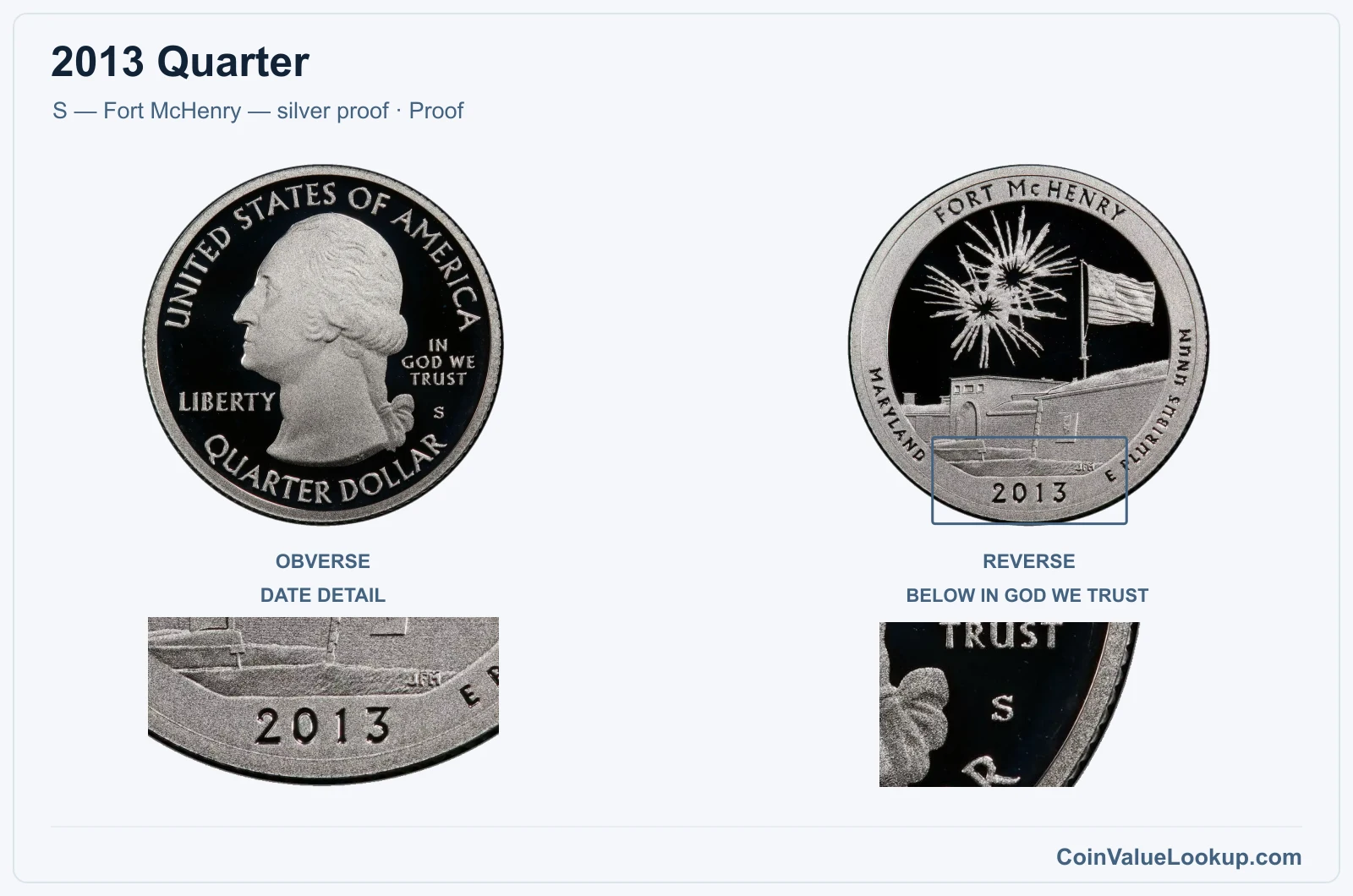
The silver proof Fort McHenry quarter is 90% silver, about 6.25 grams, with a uniform silver edge. USA Coin Book estimates PR65 at about $24.00.
This is one of five silver proof designs from 2013, each carrying the same guide figure at this grade. Original Mint packaging or third-party certification makes confirming the silver composition straightforward.
Range Grade
Price Auction Records Appraisal PR PR 1
—
Coin Identifier
PR 2
—
Coin Identifier
PR 3
—
Coin Identifier
PR 4
—
Coin Identifier
PR 6
—
Coin Identifier
PR 8
—
Coin Identifier
PR 10
—
Coin Identifier
PR 12
—
Coin Identifier
PR 15
—
Coin Identifier
PR 20
—
Coin Identifier
PR 25
—
Coin Identifier
PR 30
—
Coin Identifier
PR 35
—
Coin Identifier
PR 40
—
Coin Identifier
PR 45
—
Coin Identifier
PR 50
—
Coin Identifier
PR 53
—
Coin Identifier
PR 55
—
Coin Identifier
PR 58
—
Coin Identifier
PR 60
—
Coin Identifier
PR 61
—
Coin Identifier
PR 62
—
Coin Identifier
PR 63
—
Coin Identifier
PR 64
—
Coin Identifier
PR 65
—
Coin Identifier
PR 66
—
Coin Identifier
PR 67
—
Coin Identifier
PR 68
—
Coin Identifier
PR 69
Coin Identifier
PR 70
Coin Identifier
2013 Quarter — P — Mount Rushmore — regular strike
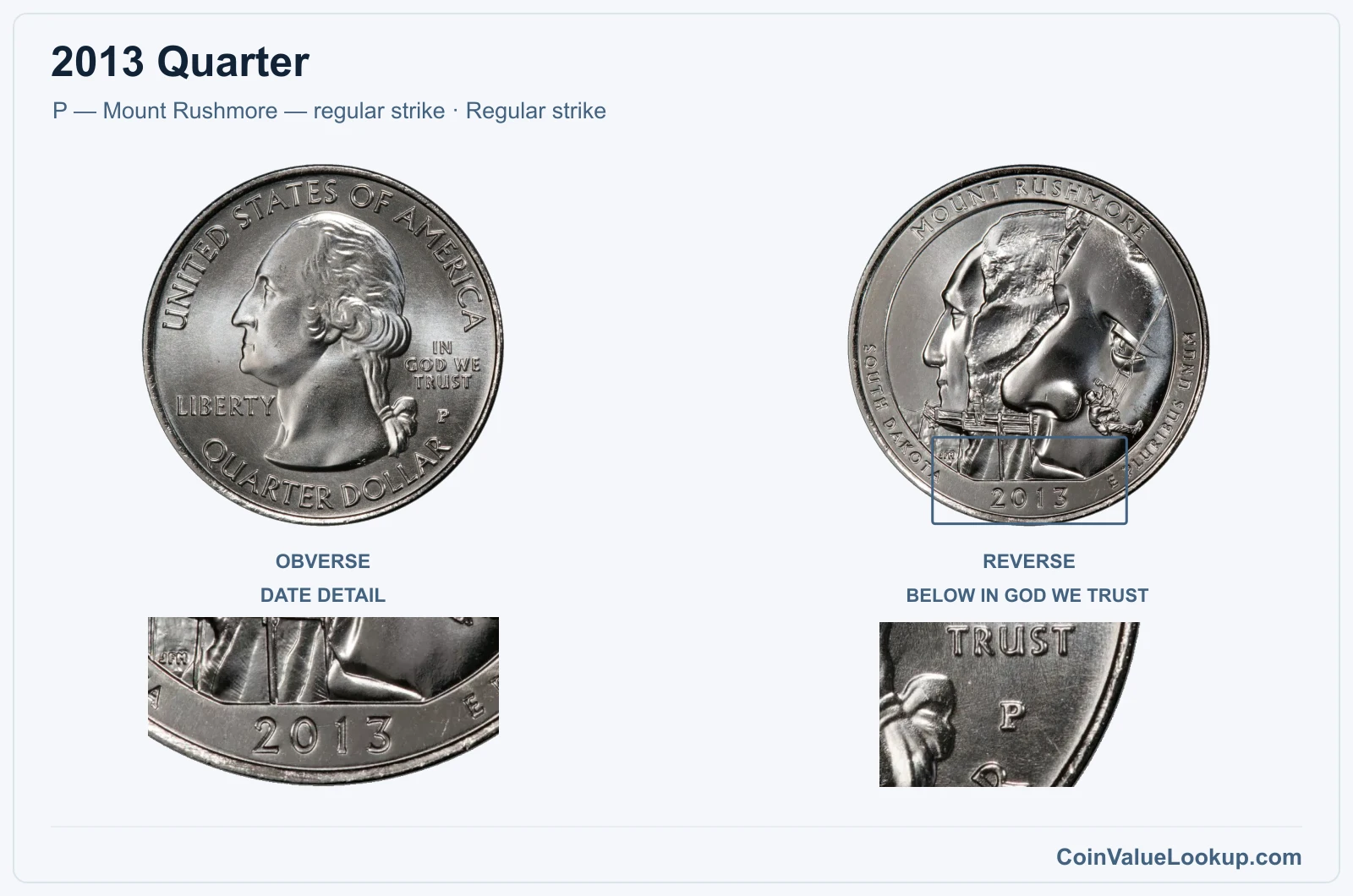
Philadelphia's Mount Rushmore quarter shows the famous South Dakota memorial. Copper-nickel clad, 24.26 mm, about 5.67 grams.
USA Coin Book estimates MS60 at about $0.61, the lowest among the five P-mint regular strikes, and MS65 at $1.24. Circulated examples are worth face value.
The slight MS60 dip is within normal guide variance and does not signal unusual scarcity.
Range Grade
Price Auction Records Appraisal PO PO 1
—
Coin Identifier FR FR 2
—
Coin Identifier AG AG 3
—
Coin Identifier G G 4
—
Coin Identifier
G 6
—
Coin Identifier VG VG 8
—
Coin Identifier
VG 10
—
Coin Identifier F F 12
—
Coin Identifier
F 15
—
Coin Identifier VF VF 20
—
Coin Identifier
VF 25
—
Coin Identifier
VF 30
—
Coin Identifier
VF 35
—
Coin Identifier XF XF 40
—
Coin Identifier
XF 45
—
Coin Identifier AU AU 50
—
Coin Identifier
AU 53
—
Coin Identifier
AU 55
—
Coin Identifier
AU 58
—
Coin Identifier MS MS 60
—
Coin Identifier
MS 61
—
Coin Identifier
MS 62
—
Coin Identifier
MS 63
—
Coin Identifier
MS 64
—
Coin Identifier
MS 65
—
Coin Identifier
MS 66
—
Coin Identifier
MS 67
—
Coin Identifier
MS 68
—
Coin Identifier
MS 69
—
—
—
MS 70
—
—
—
2013 Quarter — D — Mount Rushmore — regular strike
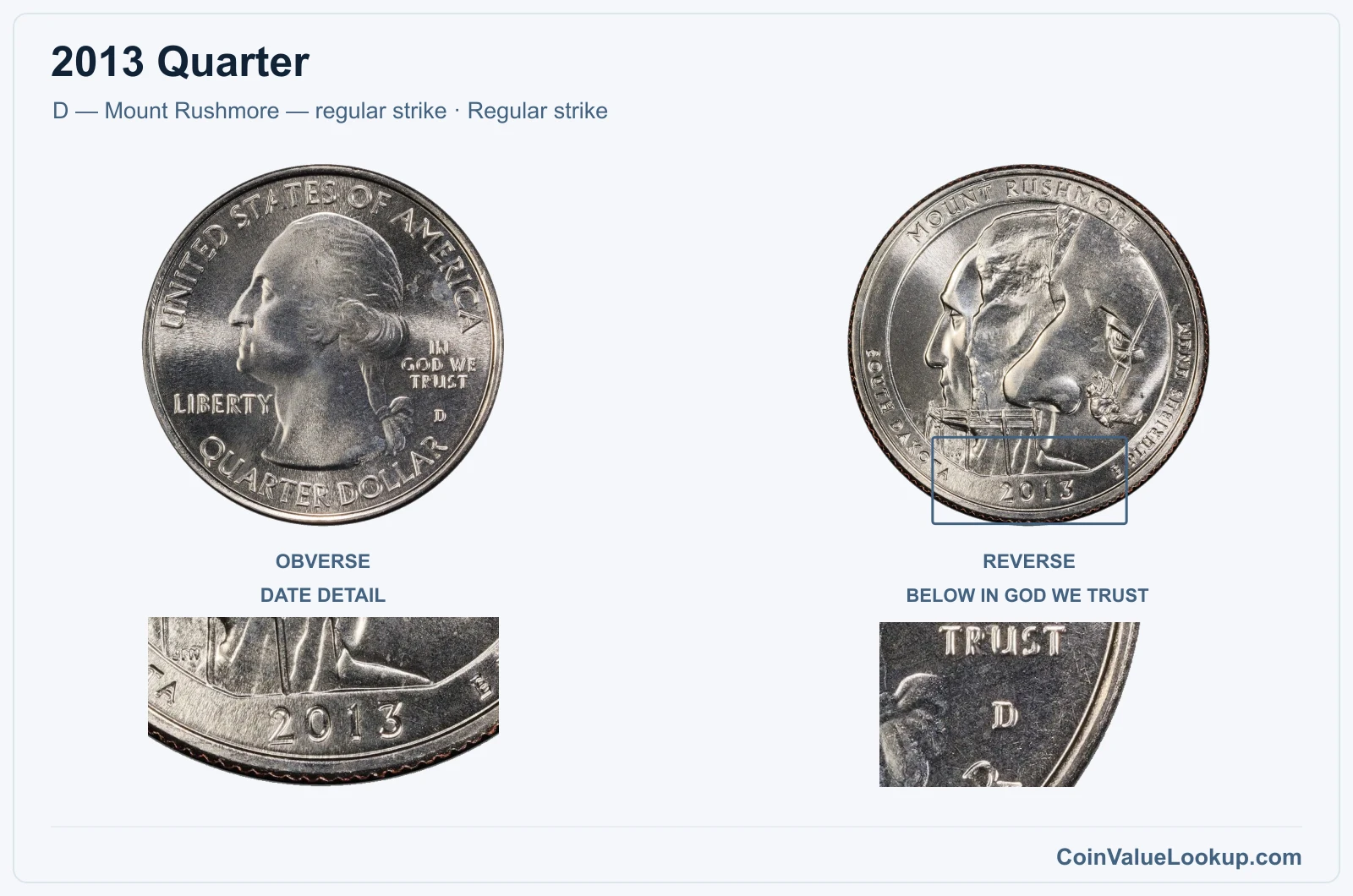
The Denver-mint Mount Rushmore quarter matches the P version in design and composition. USA Coin Book lists MS60 at $0.61 and MS65 at $1.24.
Worn coins remain face-value pieces. To claim any premium, the coin needs to be genuinely uncirculated with original luster intact.
Range Grade
Price Auction Records Appraisal PO PO 1
—
Coin Identifier FR FR 2
—
Coin Identifier AG AG 3
—
Coin Identifier G G 4
—
Coin Identifier
G 6
—
Coin Identifier VG VG 8
—
Coin Identifier
VG 10
—
Coin Identifier F F 12
—
Coin Identifier
F 15
—
Coin Identifier VF VF 20
—
Coin Identifier
VF 25
—
Coin Identifier
VF 30
—
Coin Identifier
VF 35
—
Coin Identifier XF XF 40
—
Coin Identifier
XF 45
—
Coin Identifier AU AU 50
—
Coin Identifier
AU 53
—
Coin Identifier
AU 55
—
Coin Identifier
AU 58
—
Coin Identifier MS MS 60
—
Coin Identifier
MS 61
—
Coin Identifier
MS 62
—
Coin Identifier
MS 63
—
Coin Identifier
MS 64
—
Coin Identifier
MS 65
—
Coin Identifier
MS 66
—
Coin Identifier
MS 67
—
Coin Identifier
MS 68
—
Coin Identifier
MS 69
—
—
—
MS 70
—
—
—
2013 Quarter — S — Mount Rushmore — regular strike
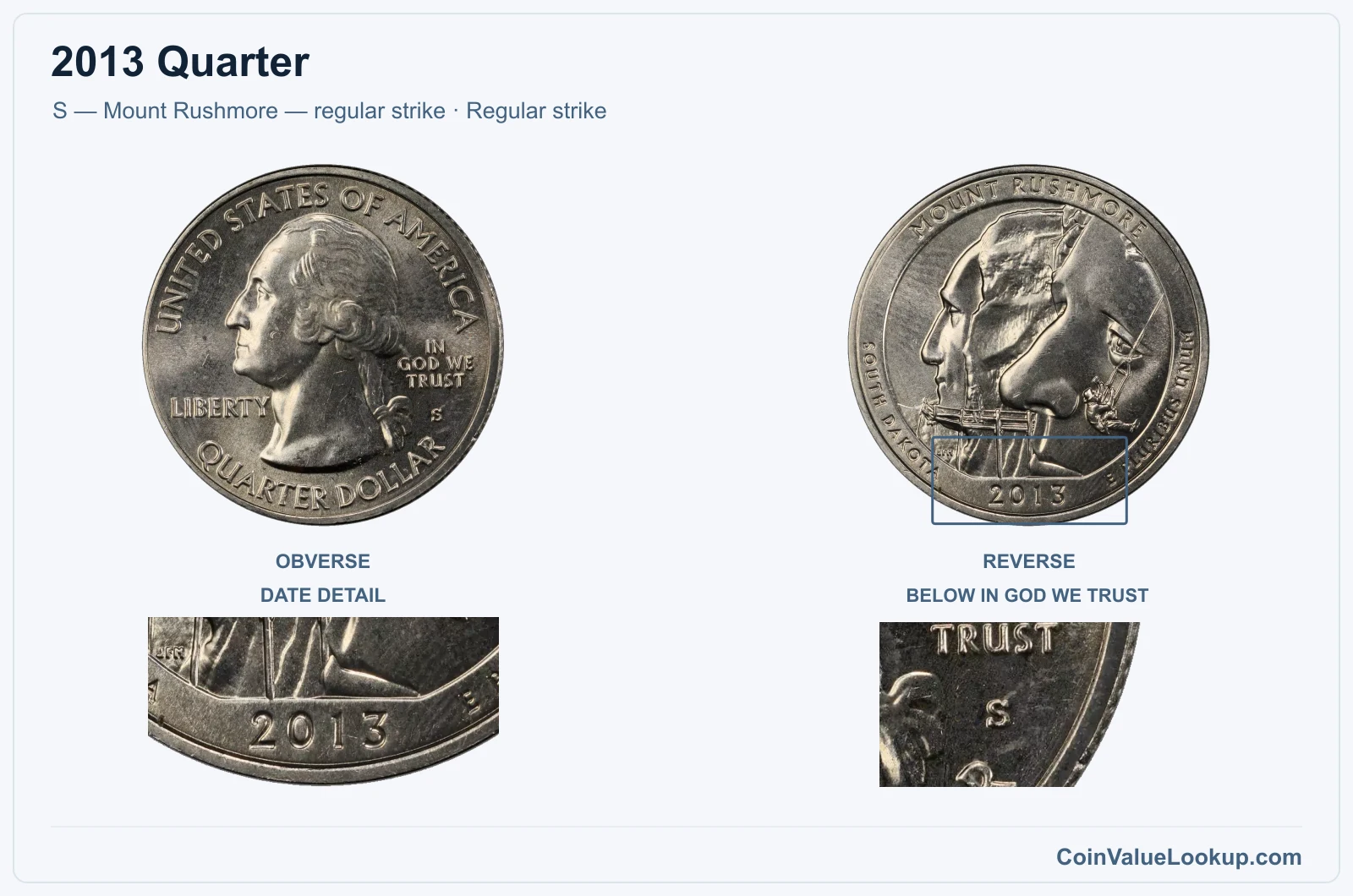
San Francisco's non-proof Mount Rushmore quarter is copper-nickel clad, sold through Mint collector sets. USA Coin Book estimates MS65 at about $10.00.
Remember, the S mintmark does not equal proof. These have a standard business-strike appearance; mirror-field proofs are a separate listing.
Range Grade
Price Auction Records Appraisal PO PO 1
—
Coin Identifier FR FR 2
—
Coin Identifier AG AG 3
—
Coin Identifier G G 4
—
Coin Identifier
G 6
—
Coin Identifier VG VG 8
—
Coin Identifier
VG 10
—
Coin Identifier F F 12
—
Coin Identifier
F 15
—
Coin Identifier VF VF 20
—
Coin Identifier
VF 25
—
Coin Identifier
VF 30
—
Coin Identifier
VF 35
—
Coin Identifier XF XF 40
—
Coin Identifier
XF 45
—
Coin Identifier AU AU 50
—
Coin Identifier
AU 53
—
Coin Identifier
AU 55
—
Coin Identifier
AU 58
—
Coin Identifier MS MS 60
—
Coin Identifier
MS 61
—
Coin Identifier
MS 62
—
Coin Identifier
MS 63
—
Coin Identifier
MS 64
—
Coin Identifier
MS 65
—
Coin Identifier
MS 66
—
Coin Identifier
MS 67
Coin Identifier
MS 68
—
Coin Identifier
MS 69
—
—
—
MS 70
—
—
—
2013 Quarter — S — Mount Rushmore — clad proof
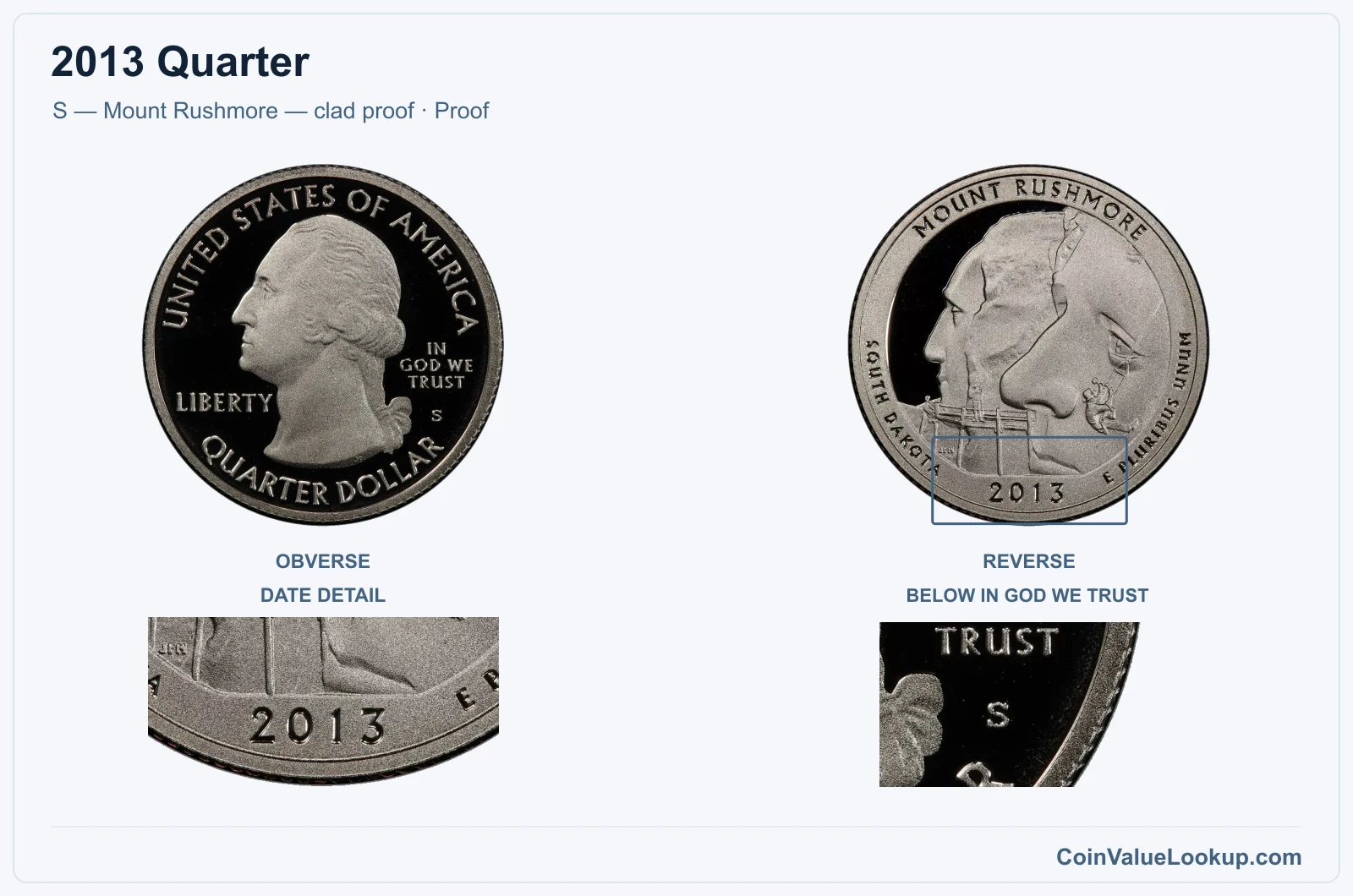
The clad proof Mount Rushmore quarter from San Francisco has mirror fields and frosted carved faces. Copper-nickel clad, not silver.
USA Coin Book estimates PR65 at about $5.63. Compare the edge to a known clad coin; if you see a copper-colored stripe between the outer layers, it is clad.
Proof handling matters: fingerprints and hairlines can significantly reduce the assessed grade.
Range Grade
Price Auction Records Appraisal PR PR 1
—
Coin Identifier
PR 2
—
Coin Identifier
PR 3
—
Coin Identifier
PR 4
—
Coin Identifier
PR 6
—
Coin Identifier
PR 8
—
Coin Identifier
PR 10
—
Coin Identifier
PR 12
—
Coin Identifier
PR 15
—
Coin Identifier
PR 20
—
Coin Identifier
PR 25
—
Coin Identifier
PR 30
—
Coin Identifier
PR 35
—
Coin Identifier
PR 40
—
Coin Identifier
PR 45
—
Coin Identifier
PR 50
—
Coin Identifier
PR 53
—
Coin Identifier
PR 55
—
Coin Identifier
PR 58
—
Coin Identifier
PR 60
—
Coin Identifier
PR 61
—
Coin Identifier
PR 62
—
Coin Identifier
PR 63
—
Coin Identifier
PR 64
—
Coin Identifier
PR 65
—
Coin Identifier
PR 66
—
Coin Identifier
PR 67
—
Coin Identifier
PR 68
—
Coin Identifier
PR 69
—
Coin Identifier
PR 70
Coin Identifier
2013 Quarter — S — Mount Rushmore — silver proof
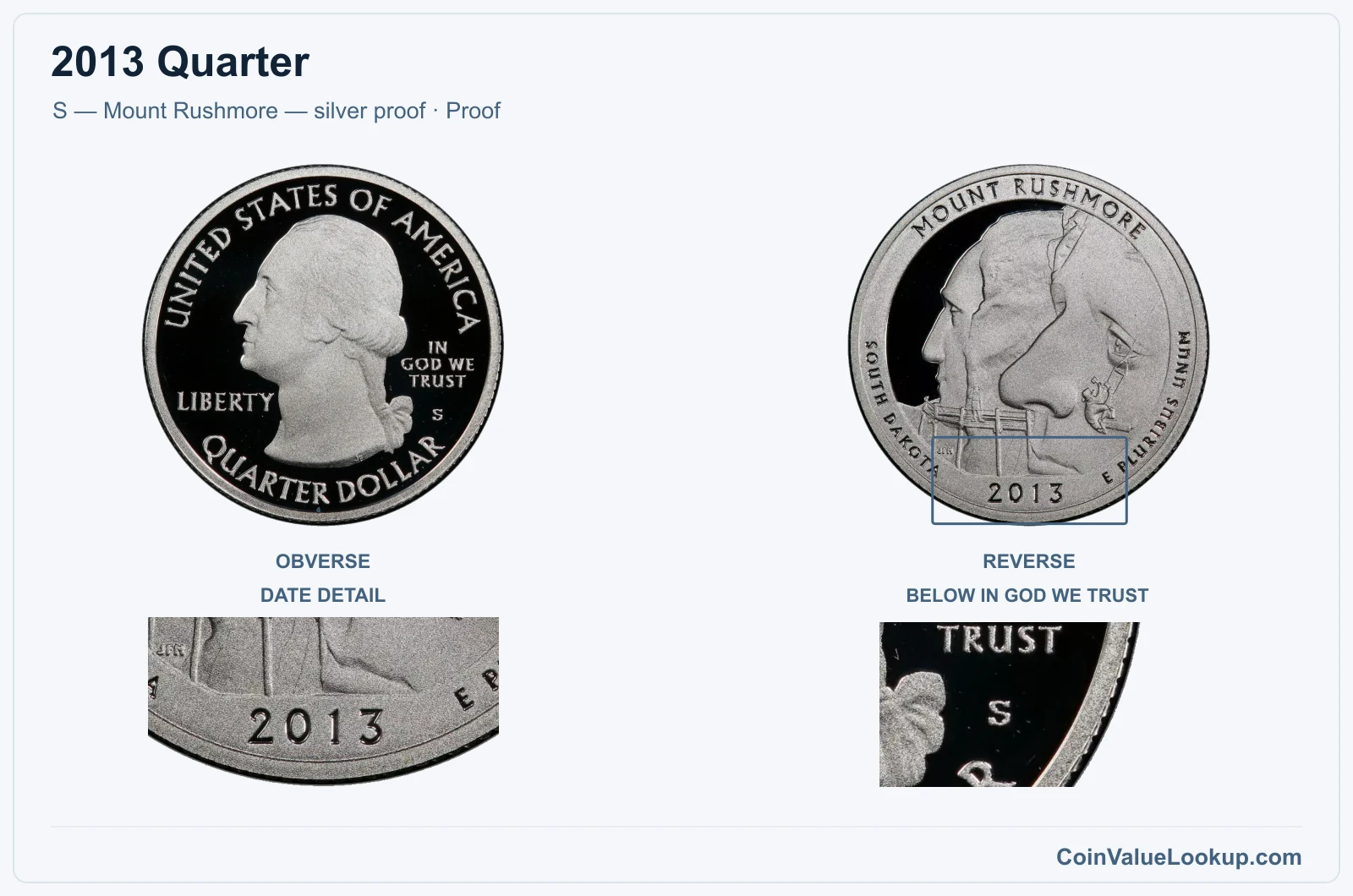
The silver proof Mount Rushmore quarter is 90% silver, about 6.25 grams, with an all-silver edge. USA Coin Book estimates PR65 at about $24.00, tied with the other four silver proof designs for the highest listed guide figure among standard-size 2013 quarters.
Confirm the composition before attributing this value. Silver proofs from 2013 remain widely collected, and condition drives where a specific coin falls within the market.
Range Grade
Price Auction Records Appraisal PR PR 1
—
Coin Identifier
PR 2
—
Coin Identifier
PR 3
—
Coin Identifier
PR 4
—
Coin Identifier
PR 6
—
Coin Identifier
PR 8
—
Coin Identifier
PR 10
—
Coin Identifier
PR 12
—
Coin Identifier
PR 15
—
Coin Identifier
PR 20
—
Coin Identifier
PR 25
—
Coin Identifier
PR 30
—
Coin Identifier
PR 35
—
Coin Identifier
PR 40
—
Coin Identifier
PR 45
—
Coin Identifier
PR 50
—
Coin Identifier
PR 53
—
Coin Identifier
PR 55
—
Coin Identifier
PR 58
—
Coin Identifier
PR 60
—
Coin Identifier
PR 61
—
Coin Identifier
PR 62
—
Coin Identifier
PR 63
—
Coin Identifier
PR 64
—
Coin Identifier
PR 65
—
Coin Identifier
PR 66
—
Coin Identifier
PR 67
—
Coin Identifier
PR 68
—
Coin Identifier
PR 69
—
Coin Identifier
PR 70
Coin Identifier
2013 Quarter Error List
1. 2013 Quarter — Fort McHenry — Doubled Die Reverse
A doubled die reverse on the 2013 Fort McHenry quarter has been reported as a "doubled fireworks" variety, where the fireworks design elements in the reverse show doubling. To check your coin, compare the fireworks and nearby lettering against a normal Fort McHenry reverse under magnification.
Genuine die doubling shows consistent separation or notching in the same direction across multiple design elements. Machine doubling, by contrast, tends to produce a flat shelf of displaced metal that lacks the three-dimensional quality of a true doubled die.
Reflections from bright proof-like surfaces can also mimic doubling. Condition and the strength of the visible doubling both affect value; no specific price was adopted for this variety.
2. 2013 Quarter — White Mountain — Rotated Dies
Rotated die errors on the 2013 White Mountain quarter have been reported, with the Philadelphia mint version noted as having the most prominent documented example. On a normal U.S. coin, if you hold the obverse upright and flip the coin top to bottom, the reverse should also appear upright.
A rotated die error means the reverse is tilted to some degree. To test, hold the obverse straight, then rotate the coin like a book page; any visible tilt of the reverse confirms rotation.
Be careful: a photograph rotated in editing or a coin held sideways is not a die error. Value depends on the degree of rotation and the coin's condition; no specific price was adopted.
3. 2013 Quarter — White Mountain — Misaligned Die
Misaligned die errors on the 2013 White Mountain quarter have been reported, again with Philadelphia examples documented. A misaligned die shifts one face of the coin off-center relative to the other, creating uneven rim width on the affected side.
This is different from a rotated die (where the image is twisted) and different from an off-center strike (where the blank itself was not centered). Compare the rim widths on both sides.
If one face shows a noticeably wider rim on one edge and a narrower rim opposite, that is the sign. Tilted photos, post-mint rim dings, and normal strike variation can all mimic this.
Value depends on the degree of misalignment and overall condition.
4. 2013 Quarter — Doubled Die Obverse
Doubled die obverse errors have been reported for 2013 America the Beautiful quarters. On the obverse, examine the lettering around the rim, the date, and the hair detail near Washington's ear.
A true doubled die shows consistent separation or notching in the design that repeats from one affected element to the next. Machine doubling is far more common and creates a flat, shelf-like displacement without the raised, split appearance of a doubled die.
Worn die contours can also blur lettering in ways that suggest doubling to the untrained eye. Use a loupe or microscope and compare against a confirmed normal example.
No specific price was adopted; value depends on the strength of the doubling and the coin's condition.
5. 2013 Quarter — Great Basin — Off-Center Strike
Off-center strikes have been reported on the 2013 Great Basin quarter. This happens when the blank is not properly seated between the dies at the moment of striking, resulting in a displaced design and an unstruck crescent of blank metal on one side.
The more the design is shifted, the more dramatic the error. Collectors generally want the date still visible, because a dateless off-center coin is hard to attribute.
Do not confuse this with a clipped planchet (a chunk missing from the blank before striking), a misaligned die (uneven rims but full design), or damage inflicted after the coin left the Mint. Value depends on the percentage of off-center shift and the coin's overall condition.
6. 2013 Quarter — Great Basin — Clipped Planchet
Clipped planchet errors have been reported on the 2013 Great Basin quarter. A clip means a portion of the blank was missing before the coin was struck, leaving a curved, straight, or irregular bite out of the edge.
The metal near the clip often shows weakness in the design because the press could not fully form that area. On the opposite side, you may see a subtle weakness called the Blakesley effect.
Post-mint damage like a filed notch or cut edge can mimic a clip but will not show metal-flow weakness or the Blakesley effect. Corrosion eating into the rim is another lookalike.
No specific price was adopted; value depends on the clip size and coin condition.
7. 2013 Quarter — Great Basin — Die Crack / Die Chip
Die cracks and die chips have been reported on the 2013 Great Basin quarter. A die crack shows up as a thin raised line on the coin's surface, formed when a crack in the steel die fills with metal during striking.
A die chip is a small raised blob where a tiny piece of the die has broken away. Both are raised above the normal surface, which distinguishes them from scratches (which are incuse, or pressed into the metal).
Corrosion bumps and foreign material stuck to the surface can look similar but will not follow die-consistent patterns across multiple coins. A crack reaching the rim becomes a cud, which is a different category.
No specific price was adopted; the location and prominence of the feature drive collector interest.
8. 2013 Quarter — Great Basin — Missing Clad Layer
Missing clad layer errors have been reported on the 2013 Great Basin quarter. A normal quarter has copper-nickel cladding bonded to a copper core.
When one clad layer fails to bond or separates before striking, the result is a coin with an exposed copper-colored surface on one side, often noticeably lighter in weight. To check, compare the edge of your coin with a normal quarter; a missing clad layer leaves a visibly thinner or differently colored edge on the affected side.
Weigh the coin: it should come in noticeably under 5.67 grams. Toning, chemical exposure, corrosion, and intentional plating removal can all mimic this appearance but will not change the weight the same way.
No specific price was adopted.
9. 2013 Quarter — Perry's Memorial — Off-Center Strike
Off-center strikes have been reported on the 2013 Perry's Memorial quarter. The design appears shifted, with a crescent of blank metal visible along one edge.
The severity of the shift determines collector interest: a 5% shift is modest, while 10% or more with a visible date starts getting attention. Compare carefully against a misaligned die error, where the rims are uneven but the full design is present.
A clipped planchet shows a bite out of the blank but the design remains centered. Post-mint flattening from a vise or hammer does not produce the characteristic unstruck crescent.
No specific price was adopted; value is tied to shift percentage and condition.
10. 2013 Quarter — Perry's Memorial — Doubled Die
Doubled die errors have been reported on the 2013 Perry's Memorial quarter. Look for consistent separation or notching in design elements such as lettering, the monument columns, or the date.
A true doubled die results from a hubbing error during die production, so the doubling appears identical on every coin struck from that die. Machine doubling, which is far more common, creates a flat displaced shelf without the crisp split look of a genuine doubled die.
Reflections or post-mint impressions from being pressed against another object can also mimic doubling. Compare against a confirmed normal example under magnification.
No specific price was adopted.
11. 2013 Quarter — Struck-Through Error
Struck-through errors have been reported on 2013 America the Beautiful quarters, including grease-filled die varieties. A struck-through grease error shows a smooth, depressed area where design detail is missing because grease or debris blocked the die during striking.
A retained foreign object can leave an impression of whatever was trapped between the die and the blank. The key distinction from normal wear is that a struck-through area has a different texture from the surrounding surface: it may be glossy and flat rather than gradually worn.
Scratches, cleaning, and general weak strikes from die wear are common lookalikes. No specific price was adopted; value depends on what was struck through and how much design is affected.
12. 2013 Quarter — Die Break / Cud
Rim cud errors have been reported on 2013 America the Beautiful quarters. A cud is a raised, featureless blob along the rim where a chunk of the die broke away.
Because the broken section of the die no longer impresses its design, the corresponding area on the coin fills with metal and appears as a smooth raised lump that connects to the rim. This distinguishes a cud from an interior die chip, which sits away from the rim.
Rim dents caused by post-mint damage are pushed inward and incuse, not raised. Corrosion bumps also lack the smooth, metallic appearance of a genuine cud.
No specific price was adopted; larger cuds that displace recognizable design tend to be more sought after.
13. 2013 Quarter — Great Basin — Misaligned Die
Misaligned die errors have been reported on the 2013 Great Basin quarter, described as a noticeable misalignment of design elements. When one die is shifted laterally, the rim width becomes uneven: wider on one side and narrower on the opposite.
Compare both sides of the coin. If only one face shows the uneven rim, the die for that face was the one that shifted.
This error is different from a rotated die (where the image is twisted, not shifted) and from an off-center strike (where the blank was mispositioned, affecting both sides equally). A tilted photograph or post-mint rim damage can create similar visual effects.
No specific price was adopted; value depends on the degree of displacement and overall condition.
14. 2013 Quarter — Great Basin — Partial Collar Strike
Partial collar strikes have been reported on the 2013 Great Basin quarter, described as having a widened rim edge. During normal striking, a collar die surrounds the blank and forms the reeded edge.
When the blank is only partially seated in the collar, part of the coin is confined normally while the rest spreads outward, producing a stepped or shelf-like edge. Examine the edge profile: part of it will show normal reeding, and the rest will be smooth or flared.
Do not confuse this with edge damage from being dropped or a complete broadstrike, which has no collar confinement at all. A coin flattened after minting also lacks the characteristic step.
No specific price was adopted.
15. 2013 Quarter — Mount Rushmore — Die Crack / Die Chip
Die chips have been reported on the 2013 Mount Rushmore quarter, described as small metal deposits in the area of the carved faces. A die chip appears as a small raised blob on the coin's surface where a tiny fragment of the die broke away, allowing metal to fill the void during striking.
These are raised above the normal surface level. Compare against incuse scratches, which are pressed into the metal, or surface corrosion, which has a different texture.
Foreign material stuck to the coin can also look similar but usually detaches or shows irregular adhesion. The location on or near the sculpted faces of Mount Rushmore makes these chips relatively easy to spot.
No specific price was adopted.
16. 2013 Quarter — Fort McHenry — Die Crack / Die Chip
Die cracks and die chips have been reported on the 2013 Fort McHenry quarter. A die crack appears as a raised line running across the surface, while a die chip shows up as a small raised blob.
Both result from damage to the steel die and produce raised features on the struck coin. Check carefully: an incuse scratch (pressed into the surface) is post-mint damage, not a die crack.
Corrosion deposits and foreign material on the surface can also resemble die chips but lack the consistent metallic texture. If a crack extends to the rim and forms a raised featureless area, it crosses into cud territory.
No specific price was adopted; visibility and location influence collector interest.
17. 2013 Quarter — Fort McHenry — Off-Center Strike
Off-center strikes have been reported on the 2013 Fort McHenry quarter, where portions of the design are shifted because the blank was not properly seated during striking. The telltale sign is a crescent of unstruck blank metal along one edge, with the design pushed toward the opposite side.
The percentage of shift matters: small shifts are less dramatic, while larger shifts with the date still visible draw the most interest. A clipped planchet removes a piece of the blank but leaves the design centered.
A misaligned die creates uneven rims without the blank crescent. Post-mint flattening does not produce a genuine unstruck area.
No specific price was adopted.
18. 2013 Quarter — Fort McHenry — Broadstrike
Broadstrike errors have been reported on the 2013 Fort McHenry quarter. A broadstrike occurs when the coin is struck without the collar die that normally confines the metal and forms the reeded edge.
The result is a coin that is wider than normal, with the design spread outward and no reeding on the edge. The entire design is still present but looks slightly flattened and expanded.
This is different from an off-center strike, where the design is shifted to one side with blank metal on the other. A coin flattened after leaving the Mint may look wider but will show damage marks and will not have the characteristic smooth, un-reeded edge.
No specific price was adopted; this error is described as very rare for this design.
19. 2013 Quarter — Improper Annealing
Improper annealing errors have been reported on 2013 America the Beautiful quarters. Annealing is a heat-treatment step applied to blanks before striking.
When the process goes wrong, the result may be unusual surface discoloration, a streaky or blotchy appearance, or an abnormal texture that differs from normal toning. Compare the affected coin's surface and edge with a normal example.
The color may appear darker, lighter, or uneven in a way that does not match typical environmental toning patterns. Environmental toning, corrosion, and heat applied after minting (such as from a fire or torch) can all mimic improper annealing.
Surface appearance is a screening clue, not proof. No specific price was adopted.
20. 2013 Quarter — Mount Rushmore — Doubled Die
Doubled die errors have been reported on the 2013 Mount Rushmore quarter. Examine the lettering, date, and design elements for consistent separation or notching that repeats across multiple areas.
A true doubled die is created during the die-making process and will be identical on every coin struck from that die. Machine doubling is a strike-related artifact that produces flat, shelf-like displacement rather than the crisp split look of a genuine doubled die.
Reflections from lustrous surfaces and post-mint impressions are other common lookalikes. Use a loupe and compare side by side with a confirmed normal coin.
No specific price was adopted; value depends on how visible the doubling is and the coin's overall condition.