1947 Washington Quarter Coin Value: How Much Is It Worth?
The 1947 Washington Quarter is a 90% silver coin struck at three mints, and even well-worn examples start around $16.43 in a retail guide. Selected uncirculated pieces in MS65 condition reach up to $48, depending on the mint.
These are guide estimates from USA Coin Book, not guaranteed sale prices. Three business-strike versions exist — Philadelphia, Denver, and San Francisco — with no proof issue for this year.
Fast Way to Identify Your 1947 Washington Quarter
Want a quick read on your 1947 quarter? Upload clear photos of the front and back of your coin, and our identifier can help with a preliminary identification of your mint version and general condition.
This is not a substitute for professional authentication, but it gives you a solid starting point before deciding on next steps.
1947 Washington Quarter Value
Upload both sides of your 1947 Washington Quarter.
Front Obverse
Upload photo
Back Reverse
Upload photo
Which 1947 Washington Quarter Versions Are Worth Money?
- Philadelphia (no mintmark) strikes are harder to find in Gem MS65 condition than the Denver or San Francisco issues — worth checking if yours looks pristine.
- A Doubled Die Obverse from the Philadelphia mint sold for $1,020 in MS66 at Stack's Bowers in February 2025, per PCGS records.
- The Spitting Eagle die feature on 1947 Philadelphia quarters is a recognized attribution — look for a raised mark near the eagle's beak on the reverse.
- A 1947-S/S Repunched Mintmark shows remnants of a second punch position beneath the S — value depends on visibility and condition.
- Uncirculated examples with original, untouched surfaces command stronger prices than cleaned coins regardless of technical detail.
Step 1: Identify Your 1947 Washington Quarter Mint Mark and Version
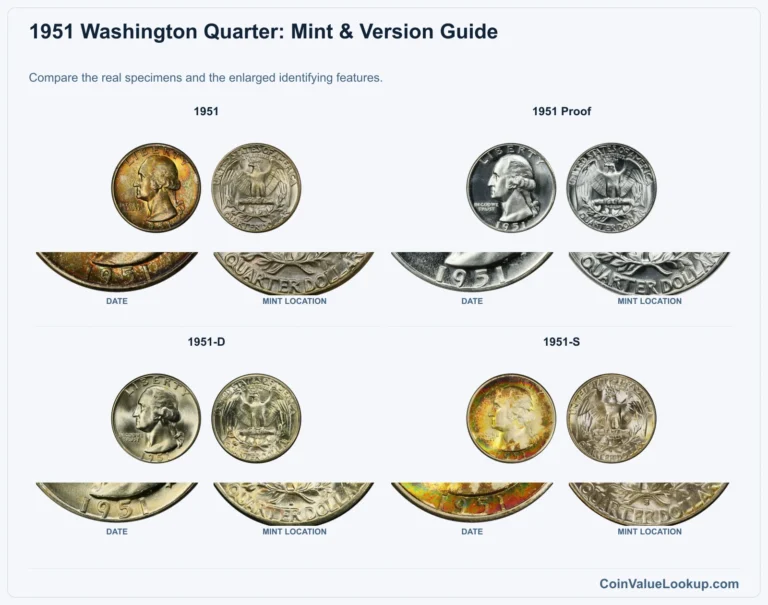
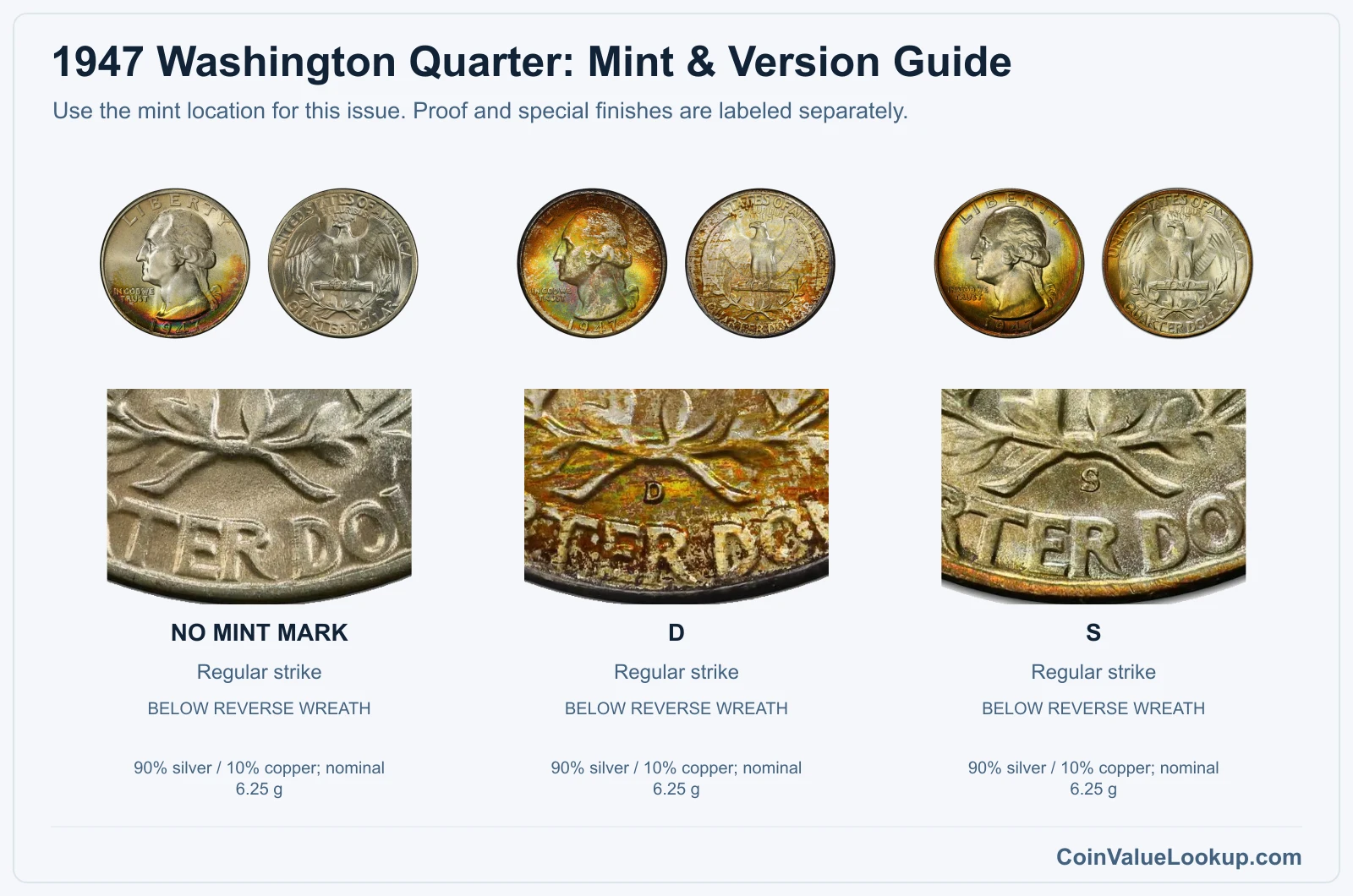
Start by reading the date on the obverse — you are looking for 1947. Then flip the coin over and check just below the wreath on the reverse for a small mintmark letter.
A "D" means Denver. An "S" means San Francisco.
If there is no letter at all, you have a Philadelphia strike — that blank space is normal for this era and does not indicate an error.
All three versions share the same composition: 90% silver and 10% copper, weighing about 6.25 grams and measuring roughly 24.3 mm across. If your coin is noticeably lighter or a different color, it may be damaged, cleaned, or not genuine.
No proofs were struck in 1947. Proof production had been suspended during the war years starting in 1942, so every authentic 1947 Washington Quarter is a business strike.
If someone offers you a "proof" 1947 quarter, that claim is not supported.
Step 2: Check Your 1947 Washington Quarter Grade
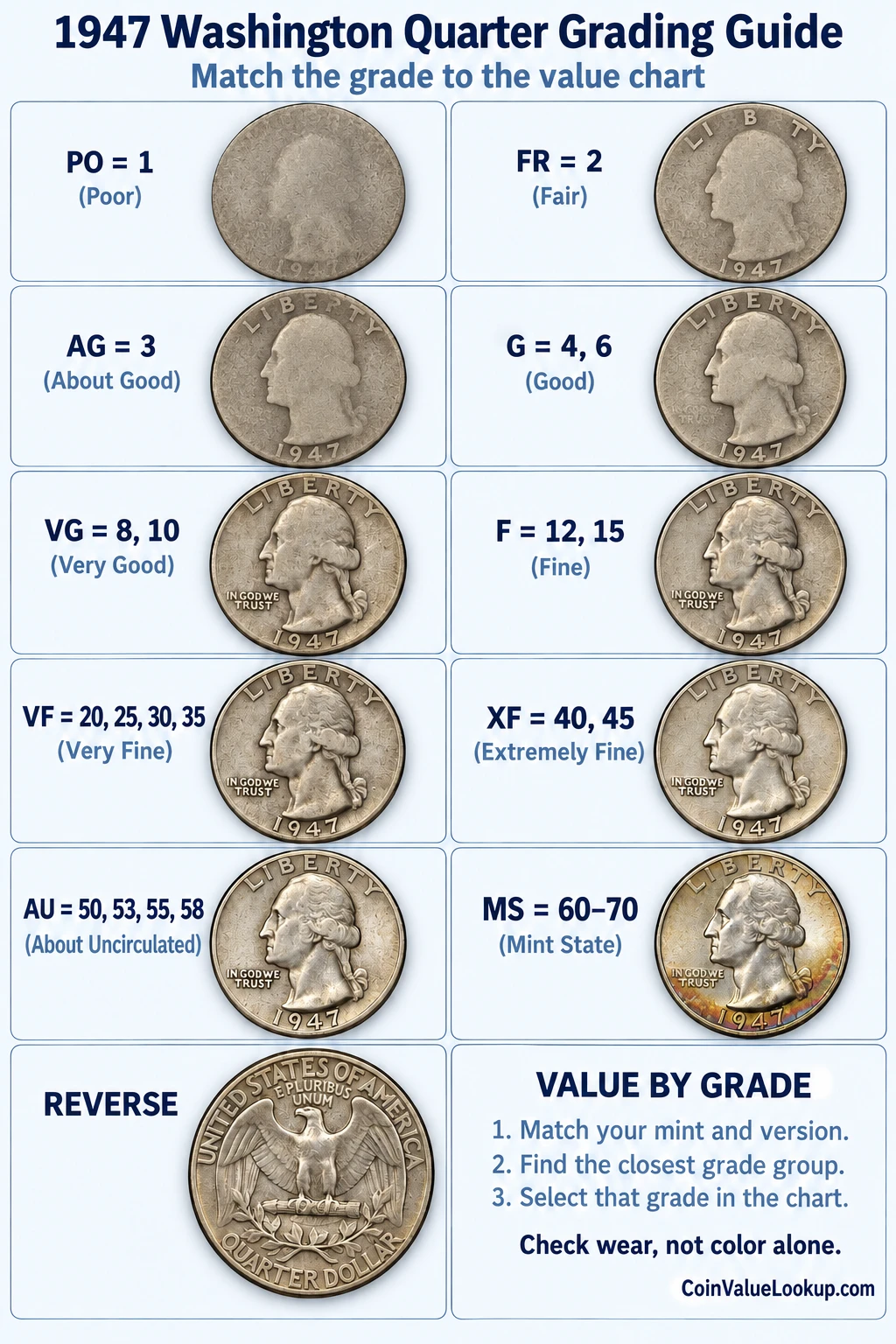
Focus on three key wear spots: the hair above Washington's ear on the obverse, the cheek and jawline, and the eagle's breast feathers on the reverse. In higher grades these areas show full detail and unbroken mint luster.
As the coin circulates, those high points flatten first. A coin graded Good (G4) will have significant smoothing across Washington's profile, while an MS60 uncirculated piece retains all detail but may show bag marks and contact from storage.
Do not confuse a weakly struck coin with a worn one. A weak strike shows soft detail but the surrounding fields still carry original luster.
Wear removes luster entirely from the affected area.
Use the comparison image to check your coin against known grade examples. Look carefully for hairline scratches that suggest past cleaning — these can reduce value substantially even on a coin that otherwise looks uncirculated.
Rim dings and heavy contact marks also matter at every grade level.
Step 3: Check 1947 Washington Quarter Value by Mint and Version
1947 Washington Quarter
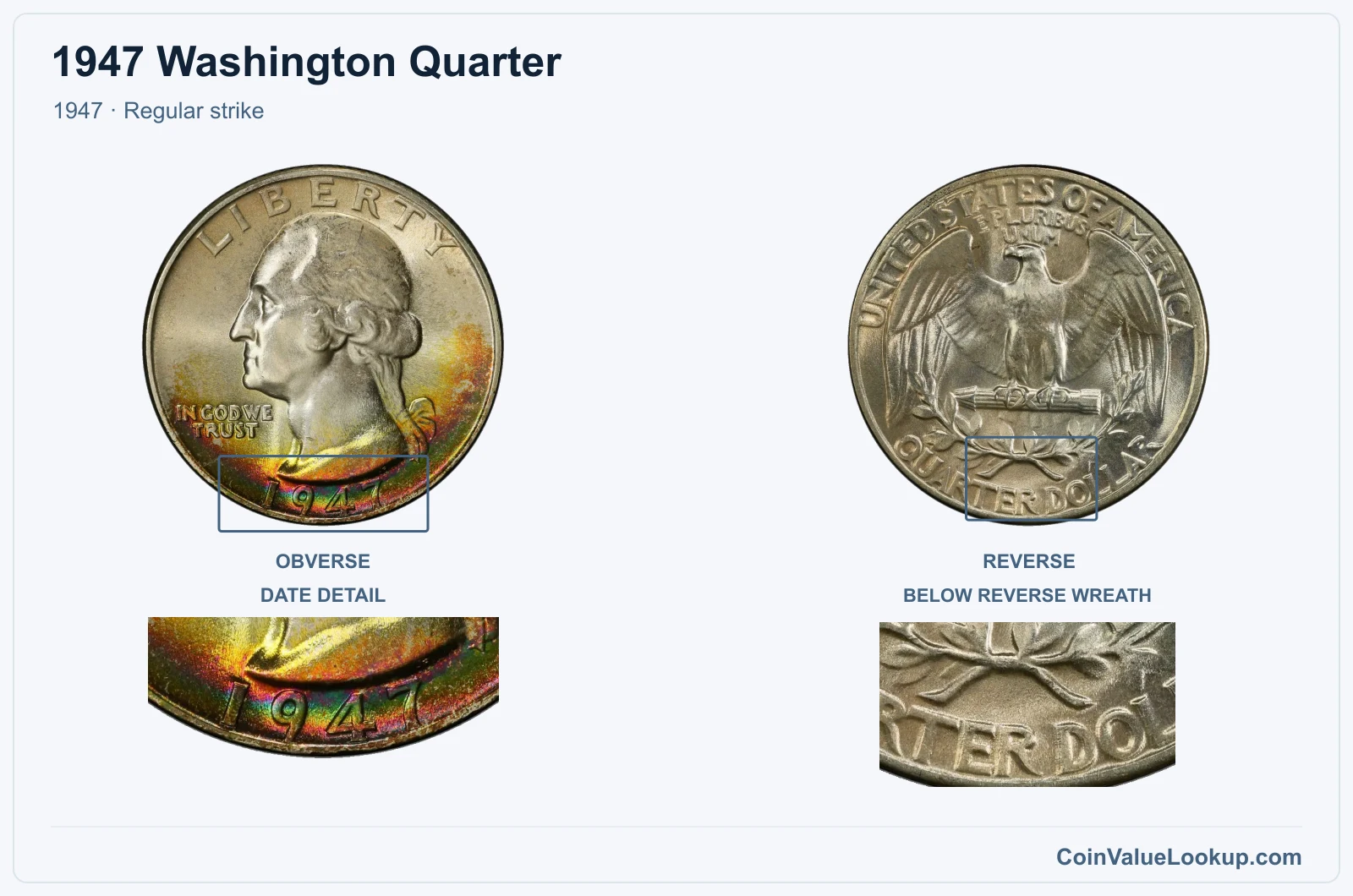
The 1947 Philadelphia quarter carries no mintmark below the reverse wreath. It is struck in 90% silver and 10% copper at a nominal weight of 6.25 grams.
Guide estimates from USA Coin Book place this coin at roughly $16.43 in G4, $22 in MS60, and $48 in MS65. The Philadelphia issue is notably tougher to find in true Gem condition compared to its Denver and San Francisco siblings, so clean, original surfaces matter here.
This is also the mint associated with the Spitting Eagle die feature and the known Doubled Die Obverse, so Philadelphia coins deserve a closer look under magnification before you toss them in the album.
| Range | Grade | Price | Auction Records | Appraisal |
|---|---|---|---|---|
| PO | PO 1 | — | Coin Identifier | |
| FR | FR 2 | — | Coin Identifier | |
| AG | AG 3 | — | Coin Identifier | |
| G | G 4 | — | Coin Identifier | |
| G 6 | — | Coin Identifier | ||
| VG | VG 8 | — | Coin Identifier | |
| VG 10 | — | Coin Identifier | ||
| F | F 12 | — | Coin Identifier | |
| F 15 | — | Coin Identifier | ||
| VF | VF 20 | — | Coin Identifier | |
| VF 25 | — | Coin Identifier | ||
| VF 30 | — | Coin Identifier | ||
| VF 35 | — | Coin Identifier | ||
| XF | XF 40 | — | Coin Identifier | |
| XF 45 | — | Coin Identifier | ||
| AU | AU 50 | — | Coin Identifier | |
| AU 53 | — | Coin Identifier | ||
| AU 55 | — | Coin Identifier | ||
| AU 58 | — | Coin Identifier | ||
| MS | MS 60 | — | Coin Identifier | |
| MS 61 | — | Coin Identifier | ||
| MS 62 | — | Coin Identifier | ||
| MS 63 | Coin Identifier | |||
| MS 64 | Coin Identifier | |||
| MS 65 | Coin Identifier | |||
| MS 66 | Coin Identifier | |||
| MS 67 | Coin Identifier | |||
| MS 68 | Coin Identifier | |||
| MS 69 | — | — | — | |
| MS 70 | — | — | — |
1947 Washington Quarter — D
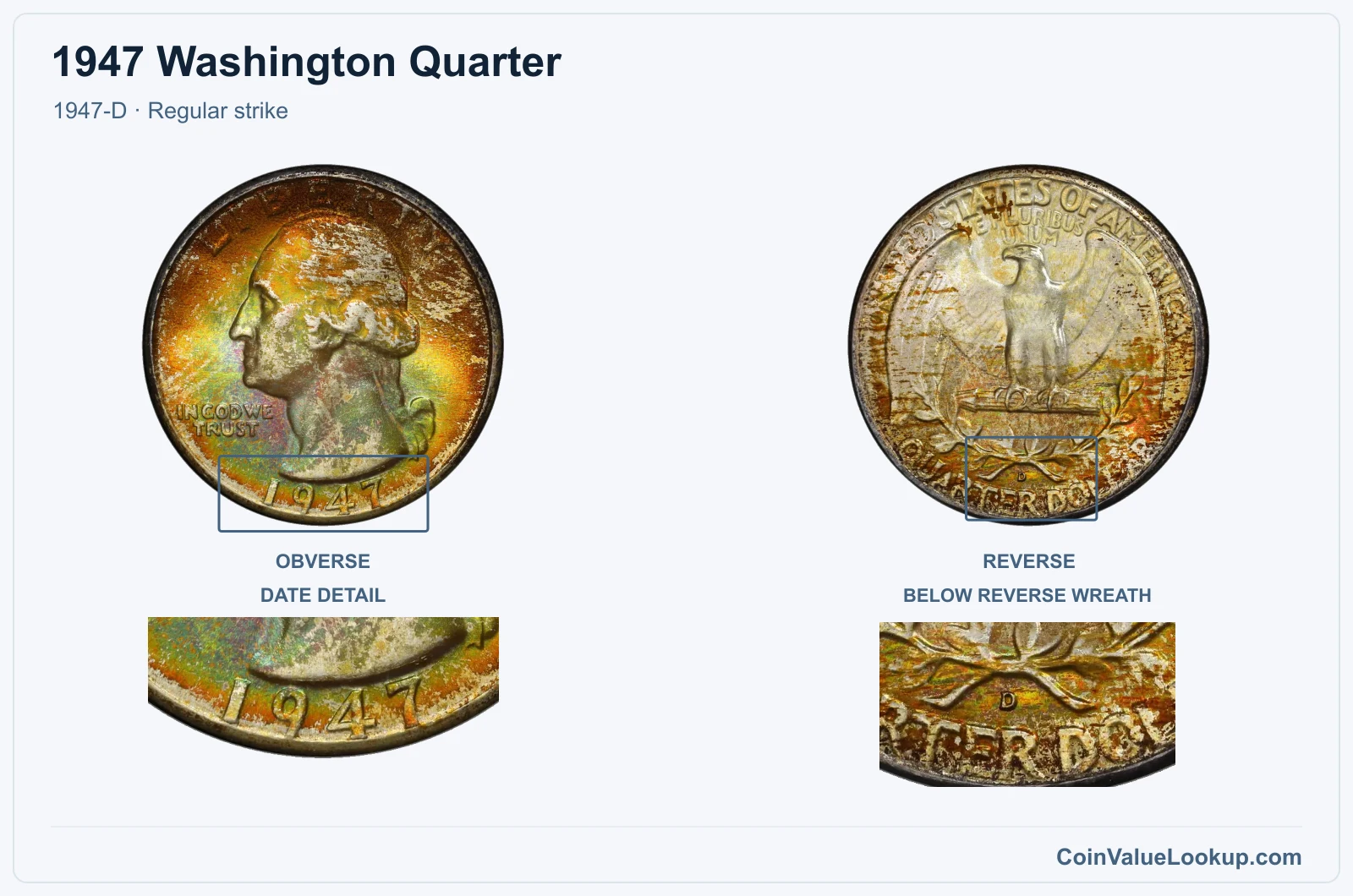
The 1947-D quarter was struck at the Denver Mint. Look for a small "D" below the wreath on the reverse to confirm.
Same silver composition and weight as the Philadelphia issue. USA Coin Book guide estimates run about $16.43 in G4, $22 in MS60, and $48 in MS65.
Coin Value Lookup is a useful place to look up guides for other dates and mints in the Washington Quarter series if you are working through a collection. It can save you time when you have a stack of quarters to sort through.
Denver strikes in this year are generally easier to find in higher grades than the Philadelphia version, but strong original luster and mark-free surfaces still matter for top-end value.
| Range | Grade | Price | Auction Records | Appraisal |
|---|---|---|---|---|
| PO | PO 1 | — | Coin Identifier | |
| FR | FR 2 | — | Coin Identifier | |
| AG | AG 3 | — | Coin Identifier | |
| G | G 4 | — | Coin Identifier | |
| G 6 | — | Coin Identifier | ||
| VG | VG 8 | — | Coin Identifier | |
| VG 10 | — | Coin Identifier | ||
| F | F 12 | — | Coin Identifier | |
| F 15 | — | Coin Identifier | ||
| VF | VF 20 | — | Coin Identifier | |
| VF 25 | — | Coin Identifier | ||
| VF 30 | — | Coin Identifier | ||
| VF 35 | — | Coin Identifier | ||
| XF | XF 40 | — | Coin Identifier | |
| XF 45 | — | Coin Identifier | ||
| AU | AU 50 | — | Coin Identifier | |
| AU 53 | — | Coin Identifier | ||
| AU 55 | — | Coin Identifier | ||
| AU 58 | — | Coin Identifier | ||
| MS | MS 60 | — | Coin Identifier | |
| MS 61 | — | Coin Identifier | ||
| MS 62 | — | Coin Identifier | ||
| MS 63 | — | Coin Identifier | ||
| MS 64 | Coin Identifier | |||
| MS 65 | Coin Identifier | |||
| MS 66 | Coin Identifier | |||
| MS 67 | Coin Identifier | |||
| MS 68 | Coin Identifier | |||
| MS 69 | — | — | — | |
| MS 70 | — | — | — |
1947 Washington Quarter — S
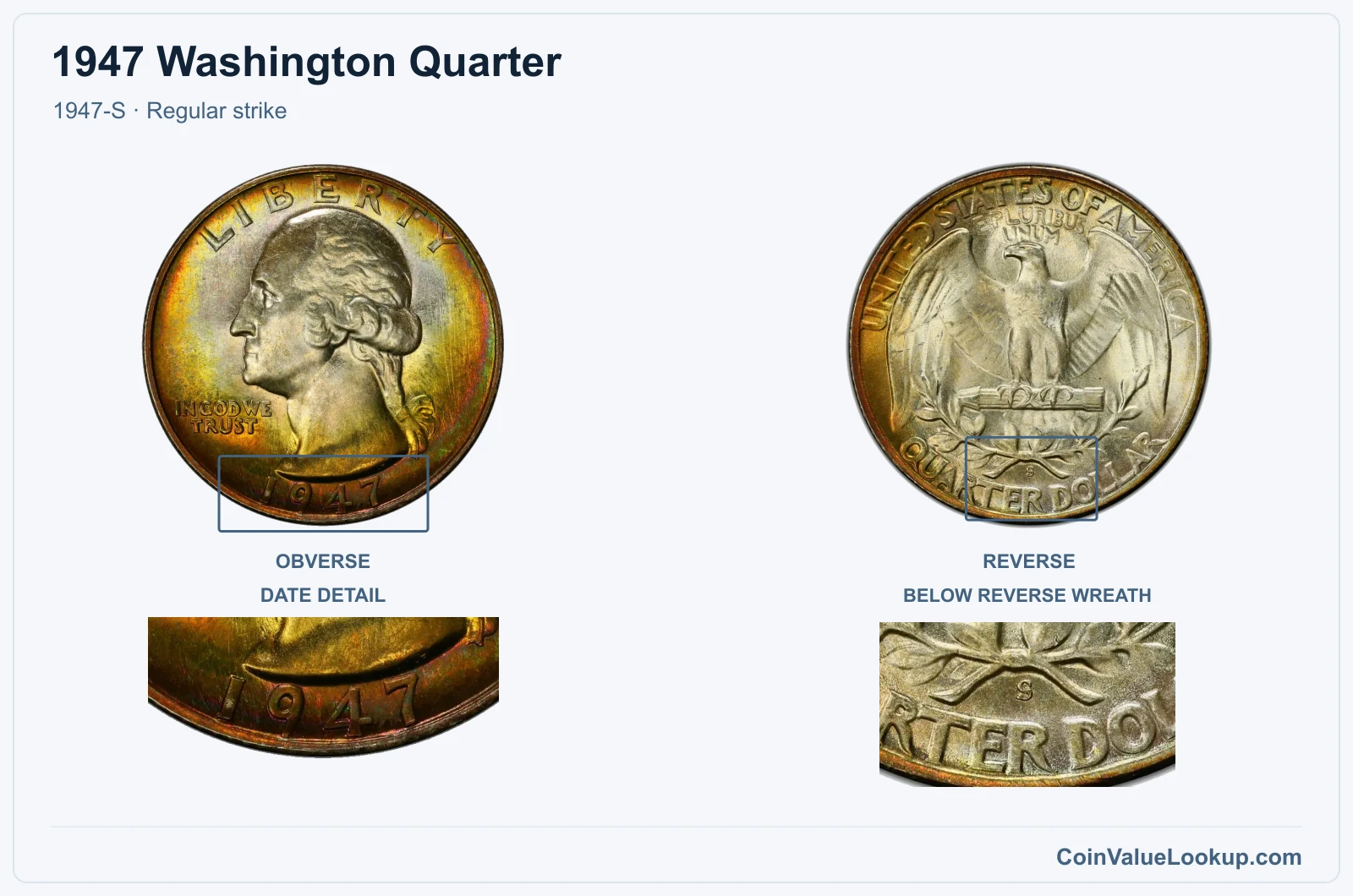
The 1947-S was produced at the San Francisco Mint. Confirm it by locating the "S" mintmark below the reverse wreath.
Composition is the same 90% silver and 10% copper at 6.25 grams. USA Coin Book guide estimates come in at about $16.43 in G4, $20 in MS60, and $39 in MS65 — slightly below the other two mints at the higher grades.
This is also the mint to check for a Repunched Mintmark, where the S was punched more than once in slightly different positions. If you see traces of a second S beneath or beside the primary one, that coin is worth a closer look by a professional grading service.
| Range | Grade | Price | Auction Records | Appraisal |
|---|---|---|---|---|
| PO | PO 1 | — | Coin Identifier | |
| FR | FR 2 | — | Coin Identifier | |
| AG | AG 3 | — | Coin Identifier | |
| G | G 4 | — | Coin Identifier | |
| G 6 | — | Coin Identifier | ||
| VG | VG 8 | — | Coin Identifier | |
| VG 10 | — | Coin Identifier | ||
| F | F 12 | — | Coin Identifier | |
| F 15 | — | Coin Identifier | ||
| VF | VF 20 | — | Coin Identifier | |
| VF 25 | — | Coin Identifier | ||
| VF 30 | — | Coin Identifier | ||
| VF 35 | — | Coin Identifier | ||
| XF | XF 40 | — | Coin Identifier | |
| XF 45 | — | Coin Identifier | ||
| AU | AU 50 | — | Coin Identifier | |
| AU 53 | — | Coin Identifier | ||
| AU 55 | — | Coin Identifier | ||
| AU 58 | — | Coin Identifier | ||
| MS | MS 60 | — | Coin Identifier | |
| MS 61 | — | Coin Identifier | ||
| MS 62 | — | Coin Identifier | ||
| MS 63 | — | Coin Identifier | ||
| MS 64 | Coin Identifier | |||
| MS 65 | Coin Identifier | |||
| MS 66 | Coin Identifier | |||
| MS 67 | Coin Identifier | |||
| MS 68 | Coin Identifier | |||
| MS 69 | — | — | — | |
| MS 70 | — | — | — |
1947 Washington Quarter Error List
1. 1947 Washington Quarter — Spitting Eagle Die Feature
The Spitting Eagle is a die feature found on 1947 Philadelphia quarters. On the reverse, look near the eagle's beak for a small raised mark that gives the appearance of the eagle spitting.
The key word is raised — this feature was created by the die during striking.
If you see a line near the beak that is incuse (cut into the surface), that is likely a post-mint scratch, gouge, or engraving mark, not the Spitting Eagle attribution. Compare your coin to an authenticated example at equal magnification before drawing conclusions.
Do not confuse this with the more famous 1983 quarter variety. This is specific to 1947 Philadelphia business strikes.
No numerical price range is available for this attribution; value depends on authentication, the feature's clarity, and the coin's overall condition. Professional assessment is recommended.
2. 1947 Washington Quarter — Doubled Die Obverse
A Doubled Die Obverse has been attributed to the 1947 Philadelphia quarter by PCGS. The diagnostic involves comparing the obverse lettering and design elements to a normal specimen at matching magnification, looking for repeated or duplicated contours in the relief.
This is not something you can call from a single thick letter. Genuine doubled die features show a consistent second impression across multiple design elements, and they appear as raised, duplicated contours — not flat shelves.
Machine doubling is the most common lookalike. It produces a flattened, shelf-like distortion rather than sharp secondary detail.
Wear, scratches, or added material also do not replicate a die-made doubled pattern.
A recorded sale of an MS66 example brought $1,020 at Stack's Bowers in February 2025, per PCGS. That is a single auction result at a specific grade, not a broad market range.
3. 1947 Washington Quarter — Repunched Mintmark
A Repunched Mintmark has been reported on 1947-S quarters, where the S mintmark was punched into the working die more than once in slightly different positions. To check yours, inspect the mintmark area below the wreath under magnification.
You are looking for remnants of a second S — traces of a letter visible beneath, beside, or overlapping the primary punch. Compare against a normal 1947-S mintmark at the same magnification to see whether extra letter outlines are genuinely present.
Several things can mimic an RPM. Die chips near the mintmark can add material that looks like part of a second letter.
Corrosion can blur edges. Machine doubling flattens and displaces the letter rather than showing a distinctly separate impression.
No specific price range is available for this attribution. Value depends on the coin's condition, the visibility and type of the repunching, and professional confirmation of the variety.